





Introduction
Corn is the largest acreage crop grown in the United States, with roughly 37,000,000 ha planted in 2024 (USDA-NASS 2024). As with all row crops grown in the United States, it is common for corn producers to apply preemergence herbicides to reduce early-season weed competition with crops. Studies have shown that weed interference can reduce corn yield by up to 74% (Barber et al. Reference Barber, Scott and Norsworthy2015; Gantoli et al. Reference Gantoli, Ayala and Gerhards2013 Soltani et al. Reference Soltani, Shropshire and Sikkema2023; Steckel and Sprague Reference Steckel and Sprague2004). Troublesome weeds of corn include Amaranthus spp. such as Palmer amaranth [Amaranthus palmeri (S.) Wats.], cocklebur [Xanthium strumarium (Mill.) Torr. & (A.) Gray)], morningglory (Ipomoea ssp.), common lambsquarters (Chenopodium album L.), and foxtail (Setaria spp.) (Espinosa and Ross Reference Espinoza and Ross2015). Due to effective control of these weeds, high crop tolerance, and relatively low costs, atrazine (categorized as a Group 5 herbicide by the Weed Science Society of America [WSSA]) is used on 65% of all the corn-planted acres in the United States (USDA-NASS 2019). Unfortunately, the widespread use of atrazine has led to environmental concerns.
In 2016, the U.S. Environmental Protection Agency (EPA) released an ecological risk assessment for atrazine that concluded that the chemical has the potential to leach and contaminate surface water and groundwater, which poses a threat to aquatic plant and animal communities (US EPA 2016). The soil organic carbon-water partition coefficient (Koc) is a measure of how much a chemical will bind to organic matter in the soil. A chemical with a higher Koc will have a greater binding affinity to organic matter, while a chemical with a lower Koc will not bind to organic matter as well. Chemicals with a lower Koc, such as atrazine, are more likely to experience leaching (Hamaker et al. Reference Hamaker1975). Atrazine Koc values have been reported to range from 15 to 155, depending on soil texture and percent organic matter (Lavy Reference Lavy1968; US EPA 1990). In comparison, paraquat (WSSA Group 22), a chemical known to have a very low potential for leaching, provides a useful contrast (Amondham et al. Reference Amondham, Parkpian, Polprasert, Delaune and Jugsujinda2006). Paraquat has a much higher Koc than atrazine, ranging from 8,400 to 40,000,000 (Lewis et al. Reference Lewis, Tzilivakis, Warner and Green2016). Another example, glyphosate (WSSA Group 9), has a Koc of 24,000, roughly 150 times higher than atrazine (Zhou et al. Reference Zhou, Wang, Hunkeler, Zwahlen and Boillat2010). The widespread use of atrazine combined with relatively low Koc can be associated with environmental risks, so the EPA has proposed label changes, including reducing the maximum annual use rate from 2,800 g ai ha−1 to 2,244 g ai ha−1 and prohibiting applications during rain or when soils are saturated (US EPA 2024).
While many corn producers do not rely on just one herbicide for preemergence weed control, atrazine is an economical and effective choice that many producers include in a herbicide program. Swanton et al. (Reference Swanton, Gulden and Chandler2007) examined the efficacy of various herbicides such as S-metolachlor (WSSA Group 15), isoxaflutole (WSSA Group 27), and mesotrione (WSSA Group 27) alone and with atrazine and concluded that weed control was increased by 25 percentage points in corn when atrazine was added to a preemergence herbicide program. In addition to improved weed control, the inclusion of atrazine increased corn yield by 8% and adjusted gross returns by US$41 ha−1. A reduction or elimination of atrazine might exacerbate weed control effectiveness. Therefore, research should be conducted to find an alternative preemergence herbicide that can provide comparable weed control.
Amicarbazone is a WSSA Group 5 photosystem II (PS II) inhibitor, which is in the triazolinone chemical family. Amicarbazone is currently labeled for use on turf in the United States and was registered for use on field corn in 2015 by the EPA, but this herbicide is not widely used (Arysta 2005; MDA 2012). Outside of the United States, amicarbazone is used preemergence and postemergence on sugarcane (Saccharum officinarum L.) to control both broadleaf and grass weeds (UPL 2009a). The high potency of amicarbazone allows the chemical to be used at much lower rates than atrazine (Dayan et al. Reference Dayan, Trindade and Velhini2009). For example, corn producers commonly apply atrazine at rates of 560 g ha−1 to 2,240 g ha−1 (Syngenta 2021). Amicarbazone has a use rate about 6.5 times lower than atrazine, with preemergence applications to corn at 336 g ai ha−1 on medium-texture soils (UPL 2025). In addition to low use rates, the EPA has stated that amicarbazone exhibits low acute toxicity and is not likely to be a human carcinogen (US EPA 2005). Unlike atrazine, amicarbazone degradation is not enhanced in fields with prior atrazine use (Mueller and Henry Reference Mueller and Henry2024: Mueller et al. Reference Mueller, Parker, Steckel, Clay, Owen, Curran, Currie, Scott, Sprague, Stephenson, Miller, Prostko, Grichar, Martin, Kruz, Bradley, Bernards, Dotray, Knezevic, Davis and Klein2017).
Metribuzin belongs to the triazinone family and is a WSSA Group 5 PS II inhibitor that is used to control grass and broadleaf weeds such as broadleaf signalgrass (Urochloa platyphylla Munro ex C. Wright), crabgrass (Digitaria ssp.), Amaranthus species, velvetleaf (Abutilon theophrasti Medik.), and lambsquarters species (Chenopodium ssp.) (UPL 2009b). Metribuzin is commonly used on soybean [Glycine max (L.) Merr.] but is also registered for use with other crops such as corn, potatoes (Solanum tuberosum L.), sugarcane, tomato (Solanum lycopersicum L.), and wheat (Triticum aestivum L.). Richburg and others (2019) conducted research on corn tolerance with PS II–inhibiting herbicides and found that metribuzin applied at 280 g ai ha−1 did not cause any crop injury or reduction in yield when applied preemergence. Despite being underused in corn production, metribuzin has been shown to control velvetleaf, sicklepod (Senna obtusifolia L.), prickly sida (Sida spinosa L.), hemp sesbania [Sesbania herbacea (Mill.) McVaugh], and common cocklebur (Xanthium strumarium L.) by ≥92% over a nontreated check (Green et al. Reference Green, Obrigawitch, Long and Hutchison1988). When applied with flufenacet (WSSA Group 15), metribuzin also increased corn yield by 19% over a nontreated check (Grichar et al. Reference Grichar, Besler, Brewer and Palrang2017).
When suboptimal germination conditions occur after planting, such as cold temperatures or excessive rain, corn densities can be nonuniform (Hoeft et al. Reference Hoeft, Nafziger, Johnson and Aldrich2000). Low plant populations can reduce corn yield and warrant replanting (Nafziger Reference Nafziger1994). In addition to yield loss from low plant populations, corn densities with gaps of 1.5 to 1.8 m can result in a 5% yield reduction (McMechan and Elmore Reference McMechan and Elmore2017). Van Roekel and Coulter (Reference Van Roekel and Coulter2011) documented a 15% yield loss when corn planting was delayed for 4 wk. Therefore, replanting corn will not only cost producers extra in seed and labor but also yield potential. With 65% of the corn acres in the United States having an application of atrazine, most producers are limited to replanting with corn or grain sorghum (Sorghum bicolor L.) within the current year (Syngenta 2021; NASS 2022). Therefore, research was conducted to determine soybean tolerance to a simulated failed corn stand with amicarbazone and metribuzin applied preemergence as an atrazine alternative. The current rotation interval for soybean following application of an amicarbazone and metribuzin premixture is 4 mo (UPL 2025). Additionally, little data are currently available on amicarbazone carryover and soybean injury.
Materials and Methods
Experimental Sites
Field experiments were conducted in 2023 and 2024 at the Milo J. Shult Agricultural Research and Extension Center in Fayetteville, Arkansas (36.06005°N, 94.09592°W) on a Captina silt loam (fine-silty, siliceous, active, mesic Typic Fragiudults) (USDA-NRCS 2025). The soil consisted of 13% sand, 75% silt, 12% clay, and 1.8% organic matter, pH 6.5 (as assessed by the Arkansas Agricultural Diagnostic Laboratory in Fayetteville). The seedbed was prepared using conventional tillage and was hipped to form beds spaced 91 cm apart. Prior to herbicide application, soil fertility was adjusted as needed to meet the University of Arkansas soybean fertility recommendations based on soil test results (Ross et al. Reference Ross, Elkins and Norton2024a).
Experimental Setup and Data Collection
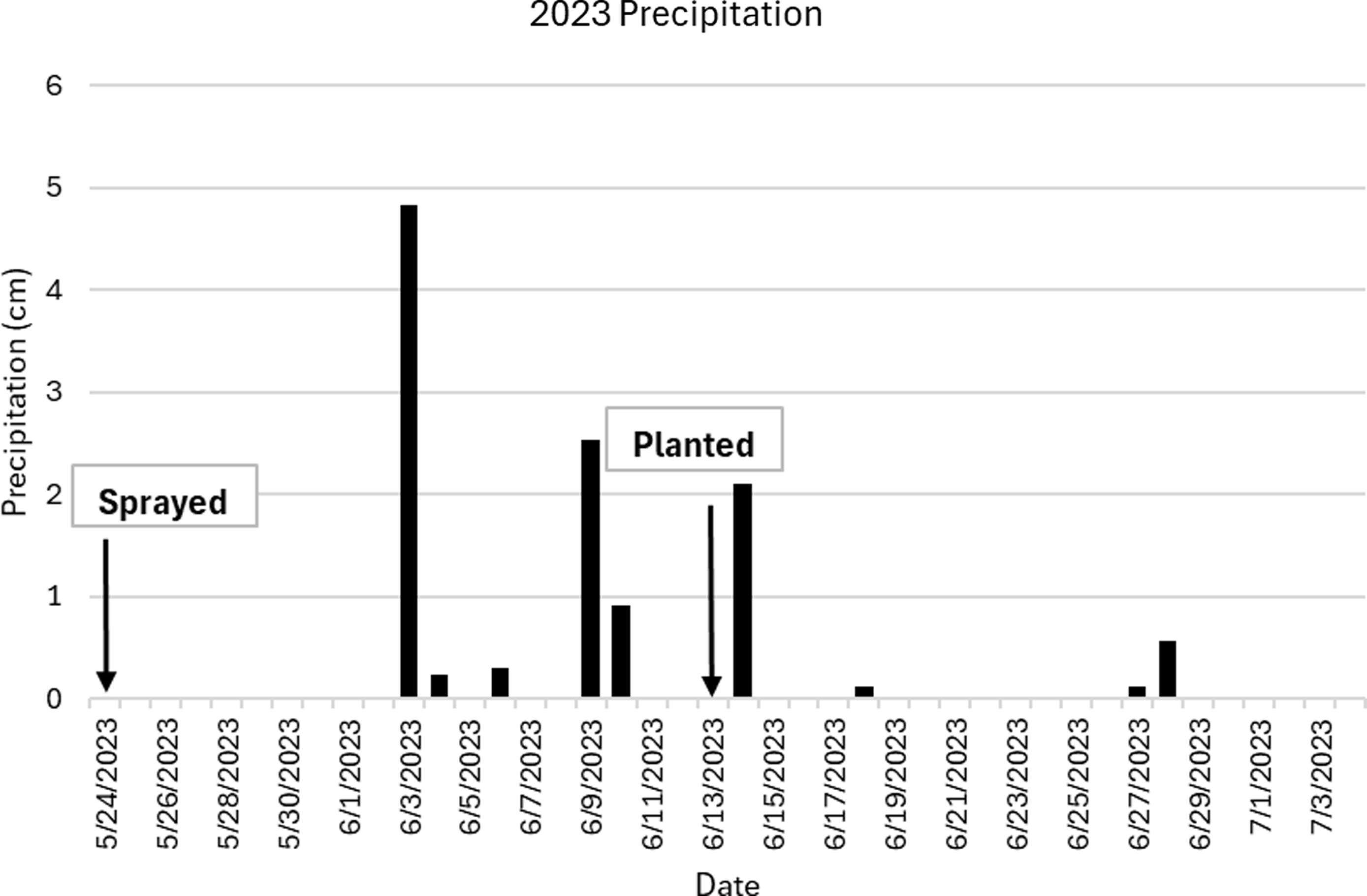
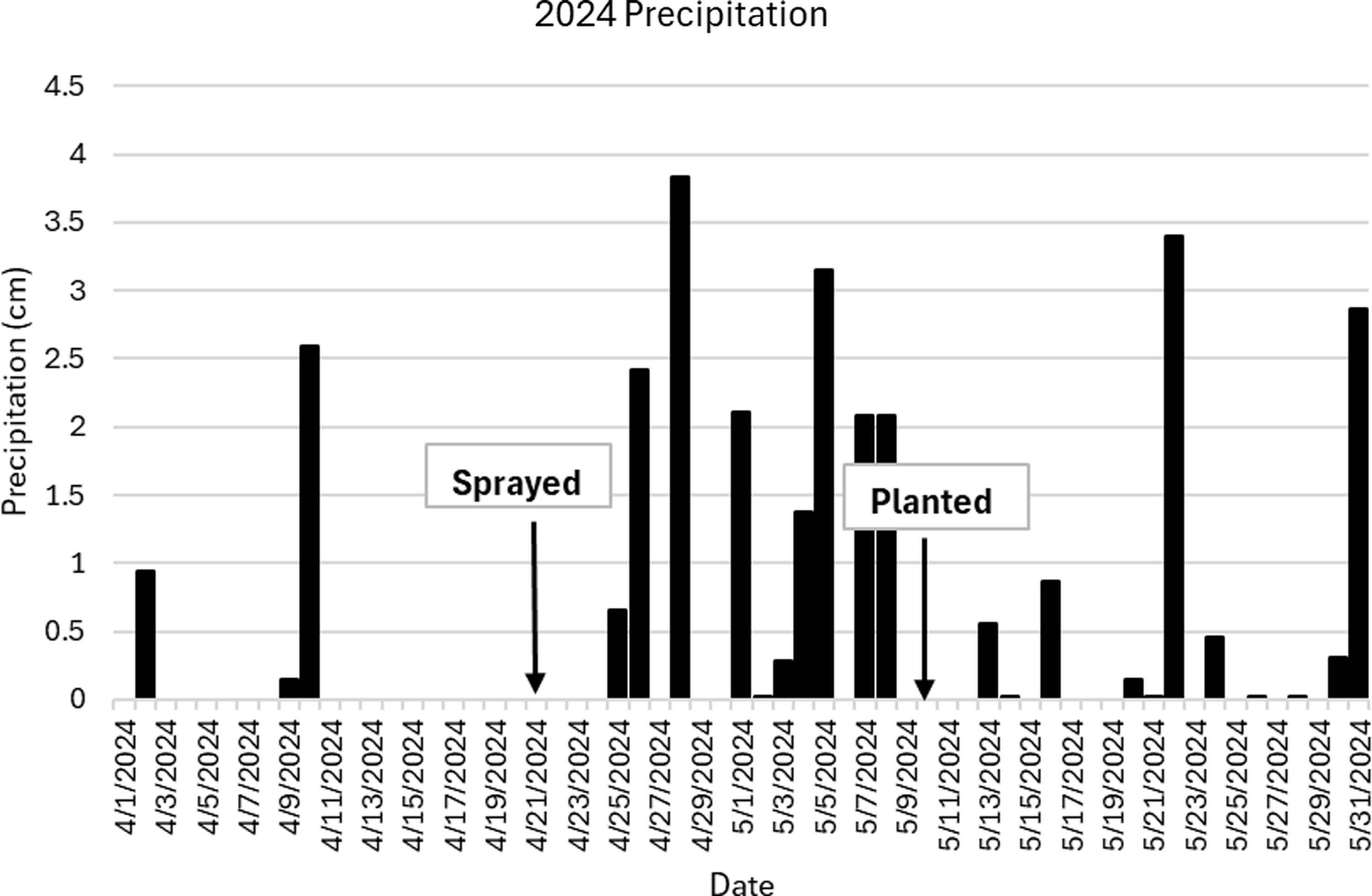
This experiment was designed as a randomized complete block design with three factors: herbicide choice, herbicide rate, and soybean cultivar. The first factor, herbicide, consisted of amicarbazone, metribuzin, or the combination of amicarbazone + metribuzin. The second factor, herbicide rate, had three levels for each herbicide: low, medium, and high. The low rate for amicarbazone and metribuzin was 245 g ai ha−1 and 140 g ai ha−1, respectively. The medium rate for the same herbicides was 490 g ha−1 and 280 g ha−1, respectively, and the high rate was 735 g ha−1 and 420 g ha−1, respectively. The third factor, soybean cultivar, had two levels. The field was planted with AG52XF0 (Bayer CropScience, St. Louis, MO) and P48A14E (Corteva Agriscience, Indianapolis, IN), a metribuzin-tolerant and -susceptible soybean, respectively, at a rate of 345,800 seeds ha−1 (Ross et al. Reference Ross, Norsworthy, Barber and Butts2024b). The plot dimensions were 3.7 m wide and 7.6 m long. The planting depth was 2.5 cm. The experiment had 20 treatments with four replications per treatment. All herbicides were applied to soil, and soybean seeds were planted when conditions were suitable after an activating rain of ≥1.3 cm at 20 and 19 d after application in 2023 and 2024, respectively (Figures 1 and 2). This procedure simulated a failed corn stand. A nontreated control was included for comparison. All treatments were applied with a CO2-pressurized four-nozzle backpack sprayer using AIXR 110015 nozzles (TeeJet Technologies, Glendale Heights, IL) spaced 51 cm apart at a speed of 4.8 kph to achieve 140 L ha−1. The trial was kept weed-free with an overspray of glyphosate at 1,260 g ae ha−1 when necessary. Furrow irrigation was provided if 2.5 cm of rain did not fall during a 7-d period.
Precipitation amounts by date in 2023 along with application and soybean planting dates at the Milo J. Shult Agricultural Research & Extension Center in Fayetteville, Arkansas.

Precipitation amounts by date in 2024, along with application and soybean planting dates at the Milo J. Shult Agricultural Research & Extension Center in Fayetteville, Arkansas.

Two 1-m crop density counts were recorded in each plot 14 d after emergence (DAE) and averaged across counts. Crop injury was visibly rated at 14 and 56 DAE. Injury to the crop was rated on a scale of 0% to 100%, with 0% representing no injury and 100% representing complete plant mortality. Drone images were taken at 28, 42, and 56 DAE from 30.5 m above the plot with an unmanned aerial system (DJI Mavic Air 2S; DJI Technology Co., Nanshan, Shenzhen, China) and analyzed in Field Analyzer (Green Research Services, LLC, Fayetteville, AR) to assess groundcover. The unmanned aerial system was equipped with a 2.5-cm complementary metal-oxide semiconductor sensor. Field Analyzer determines groundcover by quantifying the proportion of green pixels relative to brown pixels within each plot. Once the soybean reached maturity, the center two rows of each four-row plot were harvested using a Kincaid 8-XP plot combine (Kincaid, Haven, KS). The moisture was adjusted to 12% to report the yield for each plot in kilograms per hectare (kg ha−1).
Statistical Analysis
All data were analyzed in JMP Pro (v.18; SAS Institute Inc., Cary, NC). Soybean injury data were bound between 0 and 1 and fit to a complete factorial generalized linear mixed model with a beta distribution (Gbur et al. Reference Gbur, Stroup, McCarter, Durham, Young, Christman, West and Kramer2012). Data collected in 2023 and 2024 were analyzed separately due to differences in rain activation of the treatments, resulting in different levels of crop response between years (Figures 1 and 2). Soybean grain yield and density data were analyzed with a gamma distribution after the residuals failed the Shapiro-Wilks test for normality. All groundcover data from the Field Analyzer were analyzed with a lognormal distribution. Additionally, correlation analyses were conducted to determine the relationship between injury and groundcover at 28 and 56 DAE, plant density and yield, and groundcover and yield. The generalized linear mixed model included herbicide and rate as fixed effects and replication as a random effect. For each assessment, the interaction of herbicide and rate was significant. All data were subjected to an analysis of variance, with means being separated using a Tukey HSD test with α = 0.05.
Results and Discussion
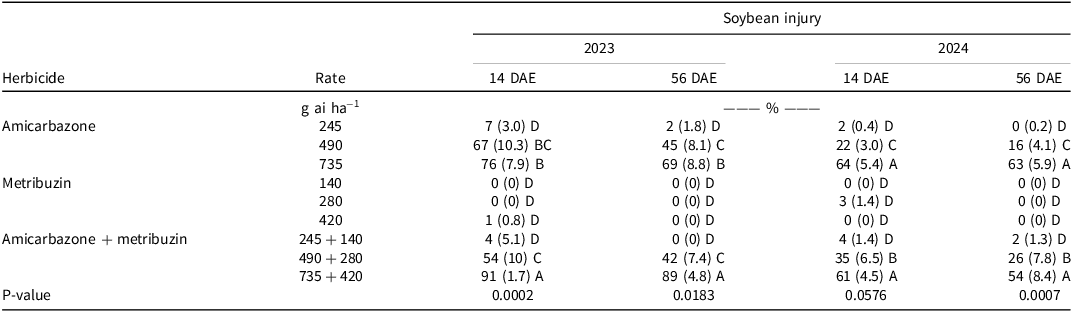
The herbicide-by-rate interaction was the only significant effect on soybean injury in 2023 at 14 DAE and 56 DAE, and in 2024 at 56 DAE (Table 1). No main effects or interactions were significant in 2024 at 14 DAE, indicating that both soybean varieties responded comparably to the treatments, even though a metribuzin-tolerant and metribuzin-sensitive soybean were planted. The lack of differences between the varieties could be attributed to the soil pH being 6.3. Soybean injury from metribuzin is more of a concern at pH 7.5 or higher (Ladlie et al. Reference Ladlie, Meggitt and Penner1976; Moomaw and Martin Reference Moomaw and Martin1978; UPL 2009). More than 18 cm of rain fell between the herbicide application and soybean planting in 2024, while only 8.8 cm of rain fell in 2023 between application and planting (Figures 1 and 2). Excessive rain can cause residual herbicides to leach, resulting in less crop injury than in years with little to below average rain (Bandeira et al. Reference Bandeira, Batista, Fernandes das Chagas, Silva, Fernandez, De Andrade and Silva2022; Moyer et al. Reference Moyer, Coen, Dunn and Smith2010). The metribuzin + amicarbazone premix label currently requires a 4-mo plant-back interval for soybean. Plant-back in this research occurred at 20 and 19 d in 2023 and 2024, respectively. Amicarbazone has a half-life of 19 to 87 d, depending on environmental conditions (US EPA 2005). The half-life of metribuzin has been reported to be 30 to 120 d (Wauchope et al. Reference Wauchope, Buttler, Hornsby, Augustijn-Becker and Burt1992). The primary methods of degradation for these herbicides are biological and photolytic (US EPA 2005, 1998). Higher temperatures or sunlight would enhance both processes, decreasing the half-life of these two herbicides and lowering the risk for soybean injury (Aziz and Ariffin Reference Aziz and Ariffin2024; Benoit et al. Reference Benoit, Perceval, Stenrød, Moni, Eklo, Barriuso and Sveistrup2007). Conversely, years with little to no rain before planting may increase the risk for crop injury, which is likely the reason for the 4-mo plant-back requirement according to the label.
Mean estimates of soybean injury following various rates of amicarbazone and metribuzin, averaged over cultivar, applied alone and in combination.a–d

a Abbreviation: DAE, days after emergence.
b Standard error values are displayed in parentheses.
c Means within a column with the same uppercase letter are not different according to the Tukey HSD test (α = 0.05).
d Injury reported on a 0% to 100% scale, with 0% representing no injury and 100% representing complete crop death.
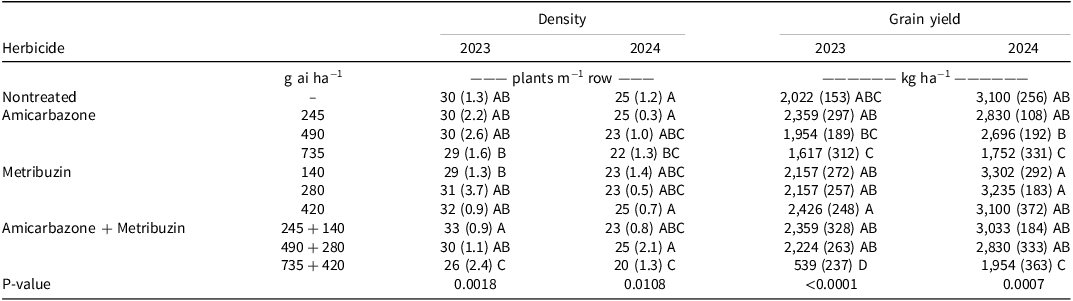
In 2023 at 56 DAE and at both evaluations in 2024, the greatest injury occurred when amicarbazone at 735 g ha−1 was applied alone or combined with metribuzin at 420 g ha−1 (Table 1). Injury from these treatments 14 DAE ranged from 76% to 91% in 2023 and from 61% to 64% in 2024. However, when applied alone, metribuzin at 420 g ha−1 caused only 1% injury in 2023 and 0% injury in 2024 at 14 DAE, indicating that most of the injury was attributed to amicarbazone. Amicarbazone applied at 245 g ha−1, as well as all three metribuzin rates, induced minimal soybean injury, ranging from 0% to 7% across both evaluations and years. Soybean injury occurred in the form of interveinal chlorosis followed by necrosis, with density loss present in plots treated with amicarbazone at 735 g ha−1 + metribuzin at 420 g ha−1 in 2023 and 2024, and in plots that received amicarbazone at 735 g ha−1 alone in 2024 (Table 2). The necrotic symptoms caused by amicarbazone, a PS II inhibitor, can reduce photosynthesis and retard vegetative growth, and reduce grain yield potential (Donald Reference Donald1998; Lasko et al. 1982).
Influence of various rates of amicarbazone and metribuzin, averaged over cultivar, applied alone and in combination, on soybean density and grain yield.a,b

a Standard error values are displayed in parentheses.
b Means within a column with the same uppercase letter are not different according to the Tukey HSD test (α = 0.05).
Differences in soybean density may also contribute to yield reductions. As soybean density decreases, insufficient leaf area index and light interception can limit grain yield (Board and Kahlon Reference Board and Kahlon2011; Conley et al. Reference Conley, Abendroth, Elmore, Christmas and Zarnstorff2008). In 2023, amicarbazone + metribuzin at 735 420 g ha−1 and 420 g ha−1 was the only treatment to reduce soybean density compared with the nontreated (Table 2). The nontreated plots had 30 plants m−1 row, and the plots with the highest rate of amicarbazone + metribuzin had 26 plants m−1 row, even though groundcover ratings were near 0%. The lack of groundcover can be partially explained by the software, Field Analyzer, which measures the total green pixels in a plot. Soybean plants in plots with high injury generally shed leaves, and plants with leaves were extremely necrotic and not detected by the groundcover analysis (Tables 1 and 3). Additionally, in 2024, soybean density was 22 plants m−1 row in plots that received amicarbazone alone at 735 g ai ha−1,versus 25 plants m−1 in nontreated plots.
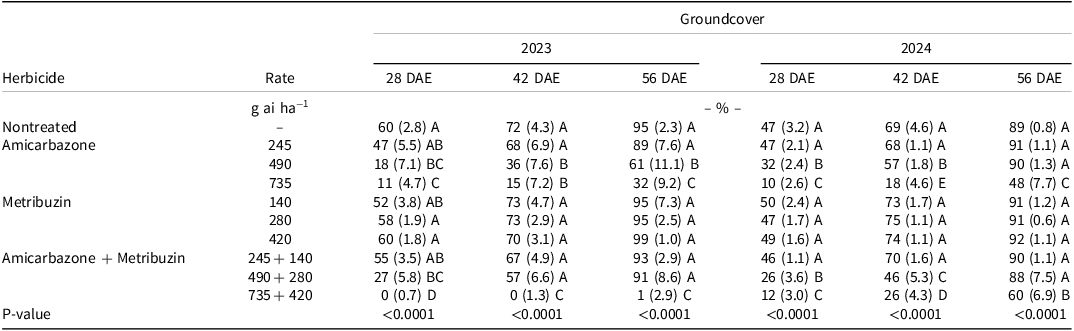
Influence of various rates of amicarbazone and metribuzin, averaged over cultivar, applied alone and in combination, on soybean groundcover.a–d

a Abbreviation: DAE, days after emergence.
b Groundcover data were collected with a DJI Mavic Air 2S (DJI Technology Co., Nanshan, Shenzhen, China) unmanned aerial system equipped with a 2.54-cm complementary metal-oxide semiconductor sensor and analyzed in Field Analyzer (Green Research Services, LLC., Fayetteville, AR). Field Analyzer determined groundcover by quantifying the proportion of green pixels relative to brown pixels within each plot.
c Standard error values are displayed in parentheses.
d Means within a column with the same uppercase letter are not different according to the Tukey HSD test (α = 0.05).
Injury observed from the PS II–inhibiting herbicides had a strong negative correlation with soybean groundcover. Correlation coefficients between injury and groundcover were −0.89 and −0.94 at 28 and 56 DAE in 2023, and −0.89 and −0.92 at the same evaluation timings in 2024 (data not shown). A significant herbicide-by-rate interaction was observed at every evaluation timing in both years (Table 3).
At 28 DAE, soybean groundcover in the nontreated control was 60% in 2023 and 47% in 2024. Applications of amicarbazone alone reduced groundcover in a rate-dependent manner in both years, with reductions to 18% (2023) and 32% (2024) at 490 g ai ha−1, and further reductions to 11% (2023) and 10% (2024) at 735 g ai ha−1 (Table 3). In contrast, no rate of metribuzin alone led to reductions in groundcover at any evaluation compared with groundcover in the nontreated plots in either year, reinforcing the idea that early season crop responses were primarily driven by amicarbazone.
A similar response was observed when amicarbazone was applied in combination with metribuzin. At 28 DAE, groundcover was reduced to 27% in 2023 and 26% in 2024 following an application of amicarbazone (490 g ai ha−1) + metribuzin (280 g ai ha−1) (Table 3). The higher rate of the premixture resulted in no detectable groundcover (0%) in 2023 and only 12% groundcover in 2024. Soybean leaves in these plots senesced soon after emergence, consistent with injury symptoms typical of herbicides that inhibit PS II when applied to a sensitive crop.
By 42 DAE, reductions in soybean groundcover persisted in both years following the high and medium rates of amicarbazone applied alone and the high rate of the premixture (Table 3). In 2024, the medium rate of the premixture also result in reduced groundcover at this timing. At 56 DAE, most treatments had partially recovered, particularly in 2024. In that year, soybean groundcover in plots treated with the middle rate of amicarbazone alone or in combination with metribuzin was comparable to that in the nontreated plots (Table 3). Only the treatments that received amicarbazone (735 g ha−1) alone or in combination with metribuzin (420 g ha−1) continued to exhibit reduced groundcover. In contrast, groundcover reductions persisted in 2023 for the middle rate of amicarbazone, further indicating that amicarbazone was the primary driver of prolonged crop injury and reduced vigor.
Overall groundcover reduction was greater in 2023 than in 2024. At 56 DAE, groundcover in 2023 was 32% following the high rate of amicarbazone alone and 1% following the high-rate premixture, compared with 48% and 60%, respectively, in 2024 (Table 3). In comparison, the nontreated exhibited 95% groundcover in 2023 and 89% in 2024.
By 56 DAE, soybean plants had reached the R3 to R4 reproductive growth stages, a critical period for yield determination (Egli Reference Egli2017; Monzon et al. Reference Monzon, La Menza, Cerrudo, Canepa, Edreira, Specht and Andrade2021). At this growth stage, the plant is diverting energy and resources into seed growth and pod fill. To optimize soybean grain yield, 95% light interception during mid-reproductive stages is needed (Shibles and Weber Reference Shibles and Weber1965; Taylor et al. Reference Taylor, Mason, Bennie and Rowse1982). Therefore, the reduced groundcover at this time likely contributed to yield loss (Table 2). Donald (Reference Donald1998) reported similar results, with groundcover and soybean yield showing a positive linear relationship, and 60% or more of the yield variation being explained by groundcover.
Soybean grain yield losses occurred in 2023 and 2024, with overall yield lower in 2023 (Table 2). Grain yields in the nontreated plots were 2,022 kg ha−1 in 2023 and 3,100 kg ha−1 in 2024. The later planting date could explain the low yield across all treatments, including the nontreated, in 2023. Soybean sown later in the season often experience a yield decrease compared to an earlier planting (Pedersen and Lauer Reference Pedersen and Lauer2004). Calvino and others (2003) reported that planting date is the single variable with the most significant influence on grain yield.
As with injury, the treatments that had a considerable negative effect on soybean grain yield were amicarbazone (735 g ha−1) alone and in combination with metribuzin (420 g ha−1) (Table 2). When applied in combination, grain yield was 539 kg ha−1 in 2023 and 1,954 kg ha−1 in 2024. Grain yield when amicarbazone was applied alone at 735 g ha−1 was 1,617 kg ha−1 in 2023 and 1,752 kg ha−1 in 2024, which would indicate that amicarbazone was the main driver of yield loss in both years at the highest rate tested. No other treatment resulted in a significant reduction in soybean grain yield in either year. Although correlations between plant density or groundcover and yield were statistically significant (data not shown), correlation coefficients were low (r < 0.5), suggesting that these variables alone were weak predictors of yield. The yield loss caused by the high rate of amicarbazone alone and in combination with metribuzin may be partially attributed to early season visible injury and reductions in plant density and groundcover during key stages of soybean reproductive development.
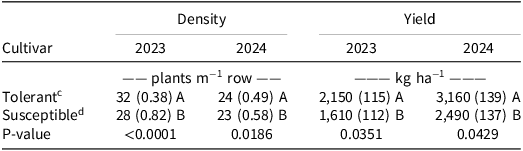
For soybean grain yield and crop density in both years, there was no cultivar interaction. Still, the main effect of cultivar was significant, indicating differences in emergence and yield potential between cultivars (Table 4). The metribuzin-tolerant soybean AG52XF0 had greater grain yield and density than the metribuzin-susceptible soybean P48A14E in 2023 and 2024. Scientists generally agree that there are no differences in soybean sensitivity among cultivars to amicarbazone based on preliminary greenhouse trials (K. Norsworthy, unpublished data). However, soybean cultivar differences in growth, net photosynthesis, yield, and germination are common (Dornhoff and Shibles Reference Dornhoff and Shibles1970; Oboda et al. 2016; Tekola et al. Reference Tekola, Yoseph and Worku2018).
Effect of soybean cultivar averaged over herbicide and rate on crop density and grain yield.a,b

a Standard error values are displayed in parentheses.
b Means within a column with the same uppercase letter are not different according to the Tukey HSD test (α = 0.05).
c Metribuzin-tolerant soybean AG52XF0.
d Metribuzin-susceptible soybean P48A14E.
Practical Implications
The amicarbazone and metribuzin premixture will not be labeled for use on soybean. However, if a corn stand fails, some producers might choose to plant soybean if the opportunity exists. Based on the results from this research, soybean response in the form of visible injury, reduction in groundcover, as well as stand and yield loss should be expected when planting into a silt loam soil with low organic matter that has had a premixture of amicarbazone + metribuzin applied at 735 g ha−1 and 420 g ha−1. This scenario is unlikely for producers, however, because the labeled rate for the premixture is amicarbazone at 336 g ha−1 and metribuzin at 190 g ha−1 on a silt loam soil with 1.5 to <2% soil organic matter (UPL 2025). The middle premixture rate used in this study was slightly higher than the labeled rate. Visible injury to soybean up to 54% occurred when planting into the middle rate of the premixture (amicarbazone at 490 g ha−1 + metribuzin at 280 g ha−1); however, it did not translate to stand or yield loss in either year.
Based on this research, following a failed corn stand with an application of the amicarbazone + metribuzin premixture at labeled rates, soybean could be planted without experiencing a reduction in grain yield. Therefore, amending the label to a 1-mo or less plant-back to soybean may be acceptable based on the weather and soil conditions in this research. However, additional research in a variety of environmental conditions is necessary to confirm crop tolerance. Caution should still be taken with soils with a pH of 7.5 or higher, especially with soybean varieties known to be sensitive to metribuzin. In years with excessive rain between application and soybean planting, as in 2024, crop response is expected to decrease. Conversely, soybean injury from amicarbazone and metribuzin may increase in years with little to no rainfall.
Acknowledgments
We thank all the support staff at the Milo J. Shult Agricultural Research and Extension Center for their assistance with this research.
Funding
Funding for this research was provided by UPL.
Competing Interests
Ryan Henry is an employee of UPL NA Inc.

 Open access

