


1. Introduction
Despite growing awareness of the aerospace manufacturing industry’s environmental impact, seen in movements such as flight-shaming in Sweden and Germany (Reference PescePesce, 2019), civil aviation continues to expand, with emissions projected to double by 2050 under business-as-usual scenarios (ICAO, 2025). The pace of technology development is not sufficient to achieve a sustainable development and there is an urgent need to rethink how aircraft systems are designed (Reference HaanHaan, 2010) to be valuable for society and the planet and to consider them truly sustainable products (Reference Dyllick and RostDyllick & Rost, 2017). The aerospace sector involves a complex, multi-level decision-making hierarchy of regulators, manufacturers, airlines, and suppliers. This structure often leads to delayed or diffused responsibility for sustainability initiatives and middle-level actors like manufacturers are especially influential in the aviation industry’s sustainable development (Reference Singh, Rana, Abdul Hamid and GuptaSingh et al., 2022). Yet, within these organisations, responsibility for sustainability in design is often unclear (Reference Léonard, Hallstedt, Isaksson, Kipouros and MallalieuLéonard et al., 2025).
Reference Hallstedt, Thompson and LindahlHallstedt et al. (2013) discusses the need for Sustainable Product Development (SPD) support from strategic management and the early involvement of procurement specialists. Building on this, Reference Schulte and KnutsSchulte and Knuts (2022) highlight the need to advance SPD from a managerial perspective to put sustainability on decision-makers’ agenda, which in turn can strengthen their own organisation. Further reinforcing this perspective, Reference Mallalieu, Isaksson Hallstedt, Isaksson, Watz and AlmefeltMallalieu et al. (2024) stress the need for systemic organisational changes towards the adoption of sustainable design methods. These changes apply not only to designers but also product development management and strategic roles, reflecting the distributed nature of responsibility in SPD. This diffusion is particularly visible in the context of social sustainability: very few social sustainability impacts connected to a product’s lifecycle are managed by designers and appear to be dealt by other functions outside design activities (Reference Mesquita and MissimerMesquita & Missimer, 2021). Previous research showed that stakeholders often have a dual role in sustainability problems and solutions: the actors who cause sustainability problems also need the development of effective solutions and their implementation, and this understanding is key to sustainability-oriented value creation (Reference Freudenreich, Lüdeke-Freund and SchalteggerFreudenreich et al., 2019). Designing for sustainability requires more than technical innovation: it demands changes in work systems, decision-making processes, and stakeholder engagement. The success of such interventions depends on identifying and involving the right stakeholders throughout the process (Reference Berlin, Bligård, Babapour Chafi and ErikssonBerlin et al., 2021).
These insights underscore the need for a deeper understanding of stakeholder roles in Sustainable Product Development, i.e. their levels of responsibility and influence over product sustainability. Such understanding is essential for guiding design teams in their interactions with other stakeholders to accelerate the design of sustainable products. This is particularly critical in sectors like aerospace, where product development is highly complex and responsibility for sustainability is often diffused. Therefore, this research aims to investigate the roles of stakeholders in aerospace Sustainable Product Development, clarifying who holds influence and how design teams can engage them effectively. This study adopts a systemic view of SPD and applies the Gioia method to capture stakeholder perspectives within aerospace manufacturing companies. Using a case study approach and triangulation to gather deep insights from different internal functions, this paper addresses the following research questions:
RQ1: Who are the stakeholders involved in product development that can significantly impact product sustainability?
RQ2: How can design teams engage with these stakeholders to realise sustainable products?
This study contributes a novel perspective by examining informal stakeholder influence and supports practitioners in navigating stakeholder relationships and overcoming structural barriers to sustainability in complex product development environments.
2. Methods
The research follows principles of theoretical sampling and constant comparison. The research adopts an inductive approach and applies the Gioia methodology for data collection and analysis (Reference Gioia, Corley and HamiltonGioia et al., 2012) to explore stakeholder dynamics in sustainable product development. A case study design was selected to enable a deep understanding of how design teams operate within organisation structures, engage with stakeholders, and navigate decision-making processes (Reference YinYin, 2019). This study is inspired by Reference Berlin, Bligård, Babapour Chafi and ErikssonBerlin et al. (2021)’s CHAI method for stakeholder identification and analysis in work system design interventions.
2.1. Case selection
Company A and Company B were selected as case companies. Both are large European aerospace firms with over 15,000 employees. They design and manufacture physical products, have a global footprint as Tier 1 suppliers and are representative of both defence and civil aviation businesses. Company A is an Original Equipment Manufacturer (OEM) with design and lifecycle responsibility for aircraft systems, sub-systems and components. Company B designs components and sub-system in partnership with aero-engines OEMs. While both companies include sustainability in their corporate strategy, their efforts are primarily focused on manufacturing operations. Product sustainability strategies are either emerging or under development, making them relevant cases for studying challenges in navigating stakeholder complexity towards sustainable design. The data collection and analysis took place between 2024 and 2025 in three main phases, which allowed early insights to inform subsequent data collection and conceptual development.
2.2. Data collection
Collaborative workshop with sustainable product development practitioners
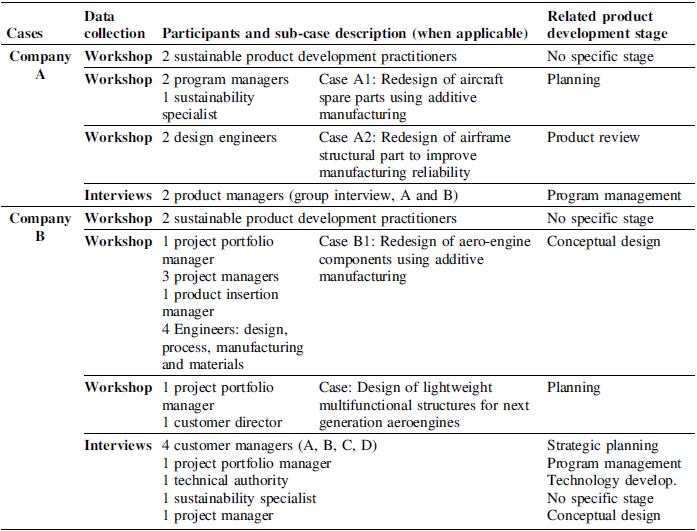
Two parallel workshops were conducted with sustainable product development practitioners: one per case company and documented by one researcher. Participants were introduced to a draft version of the sub-cases presented in Table 1, discussed for 30-minutes to answer to the following questions:
-
• Who are the stakeholders that can influence the sustainability performance of the use cases?
-
• What are potential conflicts or synergies related to value creation for different stakeholders?
Collaborative workshops with product development teams
Four workshops were conducted with different product development project teams, as described in Table 1. Cases A1, A2 and B1 involved the redesign of parts belonging to the existing aircraft fleet (e.g. being currently produced and used), while Case B2 focused on new product development for next-generation civil aircraft. The projects cover a variety of product development stages, with Cases A1, B1 and B2 in early design stages. Workshops lasted between 30 min and one hour and were held both online and in person. Each project team was first asked to describe their project- its motivations, timeline, status and people involved. They were then invited to respond to two guiding questions:
-
• Who are important internal and external stakeholders for your project?
-
• What role do those stakeholders have in the project and how do you interact with them?
Interviews at strategic and tactical levels
To triangulate the data and broaden the stakeholder perspective, interviews were conducted with individuals occupying strategic and tactical roles in product development who had not participated in the workshops. A total of ten individuals were interviewed for 30 minutes: two at Company A, and eight at Company B. The role of the interviewees is detailed in Table 1. Of the ten individuals interviewed, nine have more than 15 years of experience in the aerospace industry, offering deep insights into organisational practices and stakeholder interactions. The interviews were transcribed for analysis and explored the following topics:
-
• Role, interactions and connections to product development
-
• Stakeholder most likely to come asking for sustainable products - why and how likely it is
-
• Internal stakeholder most likely to develop sustainable solutions and how to enable them
-
• Ownership of sustainability in product development projects
Description of case companies, sub-cases, participants for different data collection procedures and related product development stage

2.3. Data analysis
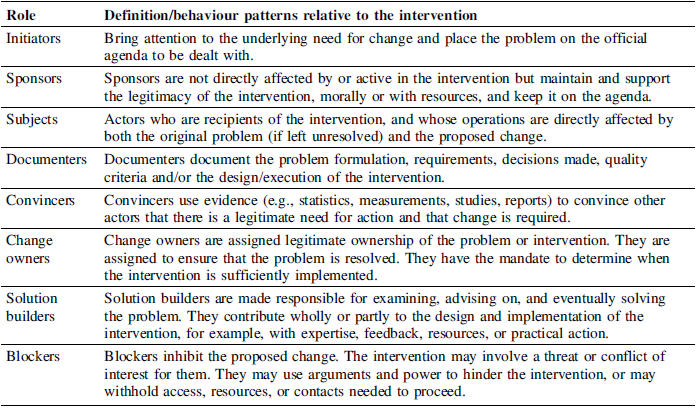
To understand stakeholder influence on product sustainability, an analysis was conducted using elements of the Change Agent Infrastructure (CHAI) framework (Reference Berlin, Bligård, Babapour Chafi and ErikssonBerlin et al., 2021) which provides a taxonomy of stakeholder roles that supports the understanding of informal influence and roles related to change (see Table 2). In this study, external stakeholders are defined as organisations outside the case companies, while internal stakeholders refer to functions or units within the case companies. The CHAI analysis began with the identification of main stakeholders collaboratively in a workshop format, which was conducted with two groups of sustainable product development practitioners and four product development teams (see Section 2.2). The classification of stakeholders was then carried out by the research team using qualitative data gathered from both workshops and interviews. This adapted use of the CHAI framework enabled rich insights and triangulation, while also allowing the inclusion of a broader range of stakeholders.
The taxonomy of stakeholder “Roles” in the Change Agent Infrastructure (CHAI) framework (Reference Berlin, Bligård, Babapour Chafi and ErikssonBerlin et al., 2021)

In the context of this study, a “file” refers to a discrete unit of qualitative data, such as an individual interview transcript or the documented output of a workshop. The written outputs from the workshop (six files) and interview transcripts (nine files) were imported into NVivo for qualitative analysis.
First, the data was segmented into citations and were coded in-vivo, using informant terms to synthetise each citation. These first-order codes were then reviewed to determine their relevance to the research questions or potential discussion themes.
Then, the final set of first order codes was clustered in second order codes. Throughout the process, constant comparison was employed to refine categories and ensure conceptual coherence. To identify main stakeholders, a cut-off criterion was applied: only stakeholders mentioned in at least three files and have their own second order code. Others are classified under “Other stakeholders”. Finally, codes describing interactions without characterising the stakeholder were classified under “Interactions”.
Finally, the identified main stakeholders were mapped using a binary approach with the roles of the CHAI framework (see Table 2). Each quote is reviewed and compared with the description of a role. The stakeholder is marked as taking this role if at least one quote describes one aspect of the role.
3. Results
3.1. Important stakeholders for product sustainability
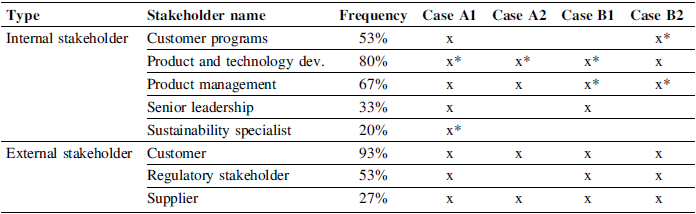
The analysis of the six workshop results and nine interview transcripts led to the identification of eight main stakeholders that can significantly impact product sustainability using cut-off criterion described in see Section 2.3. Table 3 shows these eight stakeholders, their frequency (i.e. in how many data files they were mentioned) and in which use cases they were identified. Four stakeholders were described by all use cases:
-
• Product and Technology development, which includes the product development team itself and other potential technical experts.
-
• Product management, which includes product owners, portfolio managers.
-
• Customer, which in aerospace may refer to OEMs, airlines or a governmental organisation.
-
• Supplier, referring to material or component suppliers without design ownership.
While most of these stakeholders were frequently mentioned across interviews and workshops, Suppliers were only discussed in 27% of the data sources (see Table 3). This suggests that their influence may be perceived as more limited or indirect in the context of sustainability-related design decisions. The Regulatory stakeholder was mentioned by all use cases except A2, which focused on a relatively minor design change compared to other cases. This indicates that regulatory influence is more prominent in new product development or significant redesigns. Customer programs, which is a strategic and commercial function linking manufacturers to their customers, was only mentioned by Case A1 and B2. Both cases relate to projects in the planning phase of product development, suggesting that customer programs may play a more critical role in the stages of design. Customer programs are important to get buy-in from customer and are frequently part of steering committees for product development projects. Senior leadership was identified in project A1 and B1, both involving additive manufacturing technologies. However, this stakeholder was only mentioned in one-third of the data sources, indicating that their involvement may be technology-specific or context dependant. Only one use case team mentioned Sustainability specialists as important to their project. Moreover, this stakeholder appeared in only three data sources: the workshop for Case A1 (where a sustainability specialist was present), the product owners’ interview, and the sustainability specialist interview.
Main stakeholders identified, frequency in data collection files and identification in the use cases (x); (x*) indicate that the stakeholder was present during the workshop

In addition to the eight main stakeholders identified, several other stakeholders were mentioned during workshops and interview, though they did not meet the frequency threshold to be classified as “key”. These stakeholders are primarily associated with the operational side of aerospace organisations. Examples include chief engineers, environmental managers, operators and manufacturing managers. These have an important role mostly in the production phase of the product lifecycle and were not described as impacting significantly the product design whose roles are more prominent during the production phase of the product lifecycle. Other internal stakeholders such as the quality department and technology insertion teams were also mentioned. While these actors may contribute to product development indirectly, they were not consistently described as shaping sustainability outcomes at the design level.
3.2. Analysis of stakeholder roles
Building on the identification of main stakeholders who can impact product sustainability (see Section 3.1), this section applies parts of the CHAI framework (Reference Berlin, Bligård, Babapour Chafi and ErikssonBerlin et al., 2021) to classify these stakeholders according to their roles in enabling or constraining change. The results of this classification are presented in Figure 1 and further detailed in Figure 2, which summarises the potential stakeholders associated with six of the eight CHAI roles: Initiators, Convincers, Change owners, Sponsors, Blockers and Solution builders and example quotes are included to illustrate how roles and stakeholders were linked from the data. A stakeholder may fulfil a particular role in specific context (e.g. product development type or phases) and the classifications in this study reflect patterns observed within case companies.
Role of identified main stakeholders in developing sustainable products. An “X” shows when at least one quote describes the stakeholder as taking a specific role in the CHAI framework

Initiators
Five stakeholder groups were identified as potential initiators of sustainable design, each contributing from distinct angles: ranging from bottom-up, solution-driven efforts to strategic, top-down approaches. Customers are identified as important initiators by most participants, yet they have taken that role further than the traditional sustainability concerns in aviation (i.e. focusing on reducing fuel efficiency in use). Their economic priorities often outweigh environmental ones, especially in the context of product redesign. Product and technology development is frequently described as the most likely stakeholder to generate ideas for improving product sustainability, but it is less clear how this innovation takes place in practice. Customer programs can initiate sustainable product development projects by leveraging their understanding of needs and technical capabilities and activating internal and external networks. Sustainability specialists are perceived as proactive actors who are “driving sustainability” in product development projects. However, in practice, their ability to initiate sustainable product design appears limited due to their unsystematic involvement in product development projects. Regulatory stakeholders can act as initiators by enforcing bans or restrictions on certain practices or substances, forcing companies to change how they supply or produce products. Company A perceives them as an important initiator, while company B has not yet observed such impacts.
Convincers
Three stakeholders were identified as potential Convincers, whose role is to advocate for change by persuade other actors of the legitimacy and urgency of sustainability efforts. The findings suggest that customer programs and product management act as convincers towards customers. Sustainability specialists, on the other hand, are described as convincers towards senior leadership. Notably, both Customer Programs and Sustainability Specialists were also classified as Change owners, indicating that convincers often play a dual role, not only advocating for change but also enabling it.
Roles in the Change Agent Infrastructure framework, related main stakeholders and explanatory quotes from interviews transcripts and workshops results

Change owners
In the CHAI framework, Change owners have legitimate ownership of the problem, ensure that the problem is resolved and have the mandate to determine when the intervention is sufficiently implemented. Findings from this study suggest that there are several change owners which have a different scope of influence. Senior leadership is described as having “ultimate responsibility” for sustainable product design. Their role involves ensuring that the proposed solution is aligned with company strategy and targets. However, their decision requires input from other actors, and it is most likely that Convincers play an important role in influencing this decision. The customer was identified as an important change owner, especially in Company B where OEMs are the customers. The system requirements lie within their responsibility, hence constraining the design space towards sustainable solutions. Product management have responsibility over design changes in more technical terms, ensuring the product and its functions can sustain over the expected lifecycle. The sustainability specialist was also identified as a Change owner, especially within Company A. It is their role to ensure that products comply to sustainability requirements.
Sponsors
In the CHAI framework, Sponsors support the legitimacy of the intervention, morally or with resources, and keep it on the agenda. Customer programs, while having a Convincer role towards customers, were also seen as internal Sponsors. Their support can secure resources to progress a project and to ensure the company has processes to enable sustainable innovation. While senior leadership were described as Change owners by some participants, others see them more acting as Sponsors which can “encourage decisions from the top down” and should “challenge what people doing the analysis do” (Technical authority). Regulatory stakeholders were also identified as sponsors, though their influence was described as passive and indirect. Their approval can enhance customer acceptance, which is critical as customers act as both Subjects and Change owners for sustainable design.
Blockers
Blockers inhibit the development of sustainable products as it may involve conflict of interest for them. This study identified three main conflicts of interests, namely economical, safety and technological. Economical conflict of interests can arise for the Customer, Customer programs or Product management, e.g. designing sustainable products is perceived too expensive compared to the added value. There can also be safety threats for aircraft passengers, which is why Regulatory stakeholders might not approve new products. Finally, technological limitations might also block sustainable design: the Supplier might not be able to provide the right materials or components for the proposed innovation.
Solution builders
Solution builders play an essential role to design for sustainability as they are responsible for either examining and advising on the problem or solving the problem. Product and technology development are at the core of designing sustainable solutions. They have technical expertise and are conducting practical action. They develop solutions and propose them to decision-makers. Findings, however, describe the design team as dependant of the Customer, especially at Company A where the customer is the OEM. Their input and support are essential which also includes them in the role of Solution builders. Customer programs and Product management are advising product development teams with business and technical expertise respectively, hence not directly designing the solution but participating with significant input.
4. Concluding discussion
Adopting a systemic approach, this study identified eight main stakeholders who significantly influence product sustainability and classified them according to their role in enabling Sustainable Product Development (SPD). Data was collected through workshops and interviews to gather perspectives from three main groups of practitioners in the aerospace industry: sustainability specialists, design teams, and product strategy and management, capturing perspectives across operational, tactical and strategic levels related to design. Moreover, four product development projects at different companies, maturity stages and levels of novelty were examined to analyse stakeholder dynamics in diverse contexts. This study applied elements of the CHAI framework to explore stakeholder roles in sustainable product development.
RQ1: Who are the stakeholders involved in product development that can significantly impact product sustainability?
Eight stakeholders were identified, four of them being consistently identified across the project use cases: Product and technology development, Product management, Customer and Supplier. The remaining four stakeholders showed context-dependent influence. Customer programs are especially important in the early stages of design to get buy-in from customers. Senior leadership and Regulatory stakeholders appeared to be more influential in cases involving the development of novel technologies. These findings alight with Reference Majava, Harkonen and HaapasaloMajava et al. (2015) who examined the relationship between external stakeholders and product development drivers. Only one use case project named Sustainability specialists as important, indicating a potential gap in integrating sustainability expertise across product development projects, a challenge also identified by Reference Hallstedt, Thompson and LindahlHallstedt et al. (2013). Similarly, Procurement did not emerge as a key stakeholder in this study, despite their important role for bringing in sustainability issues (Reference Hallstedt, Thompson and LindahlHallstedt et al., 2013), suggesting a lack of awareness and involvement of procurement in SPD. Future research should elaborate further on identifying stakeholders through a systematic approach to reduce the risk of cognitive bias in participants (e.g. Reference Mitchell, Agle and WoodMitchell et al., 1997).
RQ2: How can design teams engage with key stakeholders to realise sustainable products?
Product and technology development have multiple roles: they are the main Solution builders and Documenters and can also act Initiators. Findings suggest that design teams need strengthen their relations to convincers, i.e. Customer programs, Product management and Sustainability specialists, in the early stages of design. These stakeholders are instrumental in aligning sustainable products with a business case and in convincing other actors of the need for change, hence the importance to include a managerial perspective into SPD research (Reference Schulte and KnutsSchulte and Knuts, 2022). While the nature and challenges related to the “evidence” design teams must provide to support this process remains unclear solely based on this study, other studies have proposed support to communicate sustainability to a variety of stakeholders (e.g. Reference Hallstedt, Villamil, Lövdahl and NylanderHallstedt et al., 2023; Reference Parolin, Arnbjerg, Eriksen, McAloone and PigossoParolin et al., 2024). Beyond early-stage engagement, design teams must continuously engage with Change owners and Blockers, especially in aerospace product development projects which require multiple approvals stages. These findings support Basereh et al. (2024), who highlight the need for dialogue between design teams and external actors. While design teams appeared aware of this need to engage, the study revealed limited insight into how these relationships could be improved. Limited collaboration found between Initiators: sustainable ideas often emerge within isolated stakeholder groups and are either passed down to design teams or escalated to strategic decision-makers. Design teams have little direct contact with the others when it comes to generate ideas for sustainable innovations, and this fragmented communication hinders co-creation.
A key limitation in this study resides in the selection of an inductive research method that is based on the principle that informants are knowledgeable. This paradigm has potential limitations when studying complex phenomenon and if people do not understand fully, they are potentially unable to see gaps in current practice. Moreover, the CHAI framework was only applied in parts, and future work should expand the stakeholder analysis through collaborative workshops to get further validation and further explore pathways to facilitate integration and collaboration of key stakeholders in the design process.
Concluding remarks
The study adopts a systemic view of Sustainable Product Development and highlights the importance of considering a broad range of decision-makers beyond design teams when planning interventions to change product development practice. This research contributes to the growing body of literature in Sustainable Product Development and provides insight into decision-making processes through formal and informal roles in the case of an aerospace manufacturing company. While data gathering for this study is focused in the aerospace sector, its insights may be applicable to other sectors as they concern product-development practices in large organizations rather than the specifics of aerospace products. Moreover, the method for stakeholder analysis could be valuable to apply in companies with less structured processes to gain insights into informal roles. Our findings are particularly relevant for design teams, sustainability specialists, and managers seeking to embed sustainability into product development. Limitations to this research include its focus on the aerospace sector, which may constrain generalisability. The method for stakeholder analysis provided an understanding based on participant’s perceptions, and future work should aim to further understand this topic through a systematic approach.
Acknowledgements
This work has been financially supported by the Sweden´s Innovation Agency (Vinnova) through the national aerospace research program NFFP8. We would like to thank all the participants from Company A and Company B who generously shared their time, insights, and experiences.


 Open access

