





1. The problem and main results
The Born–Oppenheimer theory [Reference Born and Oppenheimer1] is the bedrock of molecular physics and quantum chemistry. It is used, among other things, to compute the shapes of molecules and their spectra. Consider a molecule consisting of $M$
nuclei with charges
$M$
nuclei with charges $Z_1, \dots , Z_M$
and masses
$Z_1, \dots , Z_M$
and masses $m_1, \dots , m_M$
and
$m_1, \dots , m_M$
and $N$
electrons with charge
$N$
electrons with charge $-1$
and mass
$-1$
and mass $m$
. The associated Schrödinger operator (the quantum Hamiltonian) is given by
$m$
. The associated Schrödinger operator (the quantum Hamiltonian) is given by
 \begin{equation} H_{\text{mol}} = - \sum _{j=1}^N \frac {1}{2}\Delta _{x_j} - \sum _{j=1}^M \frac {1}{2m_j} \Delta _{y_j} + V_e(x) + V_{en}(x,y) + V_n(y), \end{equation}
where $x = (x_1,\ldots , x_N) \in \mathbb{R}^{3N}$
and
$x = (x_1,\ldots , x_N) \in \mathbb{R}^{3N}$
and $y = (y_1, \ldots , y_M) \in \mathbb{R}^{3M}$
are, respectively, the coordinates of the electrons and nuclei.
$y = (y_1, \ldots , y_M) \in \mathbb{R}^{3M}$
are, respectively, the coordinates of the electrons and nuclei. $V_{\mathrm {e}}(x)$
represents the potential of the electron–electron interaction, while
$V_{\mathrm {e}}(x)$
represents the potential of the electron–electron interaction, while $V_{\mathrm {en}}(x,y)$
and
$V_{\mathrm {en}}(x,y)$
and $V_{\mathrm {n}}(y)$
denote the electron–nuclei and nuclei–nuclei interaction potentials, respectively (see, for instance, [Reference Schiff2–Reference Pauling and Wilson6]). We will explicitly write out
$V_{\mathrm {n}}(y)$
denote the electron–nuclei and nuclei–nuclei interaction potentials, respectively (see, for instance, [Reference Schiff2–Reference Pauling and Wilson6]). We will explicitly write out $V_{\mathrm {e}}(x)$
,
$V_{\mathrm {e}}(x)$
, $V_{\mathrm {en}}(x,y)$
and
$V_{\mathrm {en}}(x,y)$
and $V_{\mathrm {n}}(y)$
later on. The operator
$V_{\mathrm {n}}(y)$
later on. The operator $H_{\text{mol}}$
, originally defined on the space
$H_{\text{mol}}$
, originally defined on the space $L^2(\mathbb{R}^{3(N+M)})$
, is restricted to the subspace
$L^2(\mathbb{R}^{3(N+M)})$
, is restricted to the subspace $L^2_{\text{mol}}$
of
$L^2_{\text{mol}}$
of $L^2(\mathbb{R}^{3(N+M)})$
corresponding to an appropriate irreducible representation of the permutation symmetry group
$L^2(\mathbb{R}^{3(N+M)})$
corresponding to an appropriate irreducible representation of the permutation symmetry group $S_N$
of the electrons. For a precise definition of the spaces carrying irreducible representations of a permutation (symmetry) group, see [Reference Chen7–Reference Hamermesh10]. To simplify notation, we do not restrict to a permutation symmetry subspace of the nuclei, which corresponds to the physical situation of non-identical nuclei.Footnote
1
$S_N$
of the electrons. For a precise definition of the spaces carrying irreducible representations of a permutation (symmetry) group, see [Reference Chen7–Reference Hamermesh10]. To simplify notation, we do not restrict to a permutation symmetry subspace of the nuclei, which corresponds to the physical situation of non-identical nuclei.Footnote
1
According to the Born–Oppenheimer theory, to find the shapes and spectra of molecules, one proceeds as follows:
-
• First, one finds the ground state (smallest) energy $E(y)$
of the electrons in the external electrostatic potential of nuclei frozen at given positions
$y \;:\!=\; (y_1, \dots , y_M) \in {\mathbb{R}}^{3M}$
, i.e. the smallest eigenvalues of the operators(1.2)depending on (frozen) nuclear positions
\begin{equation} H_{\mathrm {bo}}(y) = - \sum _{j=1}^N \frac {1}{2}\Delta _{x_j} + V_e(\!\cdot\!) + V_{en}(\cdot ,y) + V_n(y), \quad \text{on }L^2_{\text{el}}, \end{equation}
$y \in {\mathbb{R}}^{3M}$
, for each
$y \in {\mathbb{R}}^{3M}$
, where
$L^2_{\text{el}}$
is the subspace of
$L^2({\mathbb{R}}^{3N})$
corresponding to an irreducible representation of the permutation group of
$N$
indices, corresponding to a
$2$
column Young tableau.
$E(y)$
of the electrons in the external electrostatic potential of nuclei frozen at given positions
$y \;:\!=\; (y_1, \dots , y_M) \in {\mathbb{R}}^{3M}$
, i.e. the smallest eigenvalues of the operators(1.2)depending on (frozen) nuclear positions
\begin{equation} H_{\mathrm {bo}}(y) = - \sum _{j=1}^N \frac {1}{2}\Delta _{x_j} + V_e(\!\cdot\!) + V_{en}(\cdot ,y) + V_n(y), \quad \text{on }L^2_{\text{el}}, \end{equation}
$y \in {\mathbb{R}}^{3M}$
, for each
$y \in {\mathbb{R}}^{3M}$
, where
$L^2_{\text{el}}$
is the subspace of
$L^2({\mathbb{R}}^{3N})$
corresponding to an irreducible representation of the permutation group of
$N$
indices, corresponding to a
$2$
column Young tableau.
-
• Second, this energy
$E(y)$
is considered as the potential for the nuclear motion, leading to the second spectral problem associated with the operator(1.3)
\begin{equation} K = - \sum _{j=1}^M \frac {1}{2m_j} \Delta _{y_j} + E(y), \quad \text{on }{\mathcal{H}}_{\mathrm {nucl}} =L^2({\mathbb{R}}^{3M}). \end{equation}
-
• The minima of
$E(y)$
give the possible equilibrium configurations of the molecule (see also [Reference Lieb and Thirring11]), and the nuclear oscillations around these equilibria give the low energy spectrum.


According to the Born–Oppenheimer approximation (BOA), the low energy spectrum of $H_{\text{mol}}$
and therefore EM radiation frequencies should be close in some sense to the low energy spectrum of
$H_{\text{mol}}$
and therefore EM radiation frequencies should be close in some sense to the low energy spectrum of $K$
, which is a considerably simpler operator. (For example, for a molecule of ozone
$K$
, which is a considerably simpler operator. (For example, for a molecule of ozone $\mathrm{O_3}$
,
$\mathrm{O_3}$
, $3(N+M) = 81$
, while
$3(N+M) = 81$
, while $3M = 9$
.)
$3M = 9$
.)
The BO theory is based on the observation that, since the electrons are much lighter than the nuclei (the mass ratio $\leq 1/1000$
), they move much faster and adjust to changing nuclear configurations “instantaneously”. It has been refined in numerous works, e.g. [Reference Teufel12–Reference Combes, Duclos, Seiler, Velo and Wightman20], where the authors obtain precise error estimates valid to higher-order approximations. This is a stationary or time-independent, theory.
$\leq 1/1000$
), they move much faster and adjust to changing nuclear configurations “instantaneously”. It has been refined in numerous works, e.g. [Reference Teufel12–Reference Combes, Duclos, Seiler, Velo and Wightman20], where the authors obtain precise error estimates valid to higher-order approximations. This is a stationary or time-independent, theory.
Proceeding to the time-dependent case, we recall that the evolution in time of the molecule is given by the Schrödinger equation,
 \begin{equation} \left \{ \begin{array}{l@{\quad}l} i \partial _s \Psi = H_{\text{mol}} \Psi , & \text{in } L^2_{\text{mol}}, \\[3pt] \Psi \vert _{s=0} = \Psi _0 \in L^2_{\text{mol}}, & \end{array} \right. \end{equation}
where $H_{\text{mol}}$
is given by (1.1). The stationary states of this equation are called bound states. They correspond to various eigenfunctions of
$H_{\text{mol}}$
is given by (1.1). The stationary states of this equation are called bound states. They correspond to various eigenfunctions of $H_{\text{mol}}$
and are the primary objects of the stationary (time-independent) theory briefly mentioned above.
$H_{\text{mol}}$
and are the primary objects of the stationary (time-independent) theory briefly mentioned above.
In the time-dependent case, the BOA relates – in some approximation – the evolution in time of the full molecular system (in $x,y$
variables) with the decoupled evolution of the nuclear variables only. The solution to the full molecular dynamics (1.4), given by
$x,y$
variables) with the decoupled evolution of the nuclear variables only. The solution to the full molecular dynamics (1.4), given by $H_{\text{mol}}$
, is reduced to the solutions to the dynamics associated with
$H_{\text{mol}}$
, is reduced to the solutions to the dynamics associated with $K$
, i.e.
$K$
, i.e.
 \begin{equation} \left \{ \begin{array}{l@{\quad}l} i \partial _s \psi = K \psi , & \text{in } L^2_{\mathrm {nucl}}, \\[3pt] \psi \vert _{s=0} = \psi _0 \in L^2_{\mathrm {nucl}}. & \end{array} \right. \end{equation}
The advantage of this approximation is obvious, as the dynamics described by (1.5) deals with considerably fewer particles and, therefore, dimensions. Moreover, (1.5) describes slow motion controlled by the small parameter $\kappa ^2$
, which is the ratio of the electron and nuclear masses,
$\kappa ^2$
, which is the ratio of the electron and nuclear masses,
 \begin{equation} \kappa ^2 \;:\!=\; \frac {m_e}{\min _j m_j} = \frac {1}{\min _j m_j}, \end{equation}
where $m_e = 1$
in atomic units.
$m_e = 1$
in atomic units.
There is considerable mathematical literature on the time-dependent BO theory; see [Reference Teufel12–Reference Spohn and Teufel14, Reference Hagedorn and Joye18, Reference Panati, Spohn and Teufel21–Reference Jecko28] for reviews.
In this paper, we pursue the original Born–Oppenheimer idea and extend it to molecular evolution. We derive an effective equation for the nuclear motion equivalent to the original Schrödinger equation, containing no electron variables. Then, we estimate the coefficients of the new equation and find tractable approximations for it.
In conclusion of this overview, we mention that the reduction described above is expected to break down at very large times. Thus, one has to choose a time scale in which to approximate the molecular dynamics. A standard time scale usually considered is $O(1/\kappa )$
. In this paper, we adopt this timescale. Hence, we write
$O(1/\kappa )$
. In this paper, we adopt this timescale. Hence, we write $s = t/\kappa$
, with
$s = t/\kappa$
, with $t = O(1)$
, and rescale (1.4) appropriately to obtain
$t = O(1)$
, and rescale (1.4) appropriately to obtain
 \begin{equation} \left \{ \begin{array}{l@{\quad}l} i \kappa \partial _t \Psi = H_{\text{mol}} \Psi , & \text{in } L^2_{\mathrm {mol}}, \\[3pt] \Psi \vert _{t=0} = \Psi _0 \in L^2_{\mathrm {mol}}, & \end{array} \right. \end{equation}
with $\Psi = \Psi (x,y,t)$
.
$\Psi = \Psi (x,y,t)$
.
In what follows, we formulate our results first in an abstract setting and then specify them to the concrete problem at hand.
1.1. The abstract setting
Let us denote the abstract nuclear variables by $y= (y_1, \dots , y_m) \in {\mathbb{R}}^m$
, for some
$y= (y_1, \dots , y_m) \in {\mathbb{R}}^m$
, for some $m \in \mathbb{N}$
, fixed but arbitrary. Let us fix a Hilbert space
$m \in \mathbb{N}$
, fixed but arbitrary. Let us fix a Hilbert space ${\mathcal{H}}_{\mathrm {el}}$
for the electronic configuration. Consider the Hilbert space
${\mathcal{H}}_{\mathrm {el}}$
for the electronic configuration. Consider the Hilbert space ${\mathcal{H}} = L^2({\mathbb{R}}^m, {\mathcal{H}}_{\mathrm {el}})$
for the whole (abstract) molecular dynamics. To separate the nuclear variable
${\mathcal{H}} = L^2({\mathbb{R}}^m, {\mathcal{H}}_{\mathrm {el}})$
for the whole (abstract) molecular dynamics. To separate the nuclear variable $y \in {\mathbb{R}}^m$
from the electronic variables in
$y \in {\mathbb{R}}^m$
from the electronic variables in ${\mathcal{H}}_{\mathrm {el}}$
, we use the formalism of direct integrals of Hilbert spaces (following, for instance, [Reference Jecko28–Reference Hoever31]).
${\mathcal{H}}_{\mathrm {el}}$
, we use the formalism of direct integrals of Hilbert spaces (following, for instance, [Reference Jecko28–Reference Hoever31]).
We consider the whole space ${\mathcal{H}} = L^2({\mathbb{R}}^m, {\mathcal{H}}_{\mathrm {el}})$
where the molecular dynamics take place as the fibred space of square integrable functions of
${\mathcal{H}} = L^2({\mathbb{R}}^m, {\mathcal{H}}_{\mathrm {el}})$
where the molecular dynamics take place as the fibred space of square integrable functions of $y \in {\mathbb{R}}^m$
with values in the Hilbert space
$y \in {\mathbb{R}}^m$
with values in the Hilbert space ${\mathcal{H}}_{\mathrm {el}}$
. A vector
${\mathcal{H}}_{\mathrm {el}}$
. A vector $\Psi \in {\mathcal{H}}$
can be written as the vector direct integral
$\Psi \in {\mathcal{H}}$
can be written as the vector direct integral
 \begin{equation} \Psi = \int _{{\mathbb{R}}^m}^\oplus \Psi (y) dy, \end{equation}
so that the usual inner product in $\mathcal{H}$
reads
$\mathcal{H}$
reads
 \begin{equation} \langle \Psi , \Phi \rangle = \int _{{\mathbb{R}}^m} \langle \Psi (y), \Phi (y) \rangle _{{\mathcal{H}}_{\mathrm {el}}} dy, \quad \Psi , \Phi \in {\mathcal{H}}. \end{equation}
With this notation, we can write $\mathcal{H}$
as a constant fibre direct integral or a direct integral of Hilbert spaces,
$\mathcal{H}$
as a constant fibre direct integral or a direct integral of Hilbert spaces,
 \begin{equation} {\mathcal{H}} = \int _{{\mathbb{R}}^m}^\oplus {\mathcal{H}}_{\mathrm {el}} dy. \end{equation}
Given a family of operators $\left \{ A(y)\right \}_{y\in {\mathbb{R}}^m}$
on
$\left \{ A(y)\right \}_{y\in {\mathbb{R}}^m}$
on ${\mathcal{H}}_{\mathrm {el}}$
, we can define an operator
${\mathcal{H}}_{\mathrm {el}}$
, we can define an operator $A$
acting on
$A$
acting on $\mathcal{H}$
by setting
$\mathcal{H}$
by setting
 \begin{equation} (A\Psi )(y) = A(y)\Psi (y), \quad y\in {\mathbb{R}}^m, \quad \Psi \in {\mathcal{H}}, \end{equation}
whenever this definition makes sense. We call such operators fibred (over ${\mathbb{R}}^m$
) and write them as
${\mathbb{R}}^m$
) and write them as
 \begin{equation} A = \int ^{\oplus }_{{\mathbb{R}}^m} A(y) dy, \end{equation}
with $A(y)$
called the fibre operators.
$A(y)$
called the fibre operators.
In the spirit of the BOA described above, let $H_\kappa$
be the operator family on the space
$H_\kappa$
be the operator family on the space $\mathcal{H}$
given by
$\mathcal{H}$
given by
 \begin{equation} H_\kappa = - \kappa ^2 \Delta _y + H_{\mathrm {bo}}, \quad \:\mathrm { with}\ H_{\mathrm {bo}} = \int _{{\mathbb{R}}^{m}}^\oplus H(y) dy, \end{equation}
where $H_{\mathrm {bo}}$
is an abstract Born–Oppenheimer operator, meaning that we assume
$H_{\mathrm {bo}}$
is an abstract Born–Oppenheimer operator, meaning that we assume $H(y)$
is a smooth family of self-adjoint operators with isolated and simple lowest eigenvalues
$H(y)$
is a smooth family of self-adjoint operators with isolated and simple lowest eigenvalues $E(y)$
and associated eigenvectors
$E(y)$
and associated eigenvectors $\psi _\circ (y)$
. For simplicity, we assume
$\psi _\circ (y)$
. For simplicity, we assume $H(y)$
is real.
$H(y)$
is real.
Now, consider the Schrödinger equation associated with this abstract molecular Hamiltonian in the molecular space $\mathcal{H}$
, i.e.
$\mathcal{H}$
, i.e.
 \begin{equation} \left \{ \begin{array}{l@{\quad}l} i \kappa \partial _t \Psi = H_{\kappa } \Psi , & \mathrm {in } {\mathcal{H}}, \\[3pt] \Psi \vert _{t=0} = \Psi _0 \in {\mathcal{H}}. & \end{array} \right. \end{equation}
We seek the effective nuclear dynamics in the nuclear variables $y\in {\mathbb{R}}^m$
only. To find an effective nuclear dynamics, we project out the electronic degrees of freedom in (1.14). This amounts to passing from the full Hilbert space
$y\in {\mathbb{R}}^m$
only. To find an effective nuclear dynamics, we project out the electronic degrees of freedom in (1.14). This amounts to passing from the full Hilbert space $\mathcal{H}$
to the space of nuclear states
$\mathcal{H}$
to the space of nuclear states ${\mathcal{H}}_{\text{nucl}} = L^2({\mathbb{R}}^m)$
in the following way. Writing
${\mathcal{H}}_{\text{nucl}} = L^2({\mathbb{R}}^m)$
in the following way. Writing $ t \mapsto \Psi (t) = \int ^{\oplus }_{{\mathbb{R}}^m} \Psi (y,t) dy$
in
$ t \mapsto \Psi (t) = \int ^{\oplus }_{{\mathbb{R}}^m} \Psi (y,t) dy$
in $\mathcal{H}$
, we define a corresponding path
$\mathcal{H}$
, we define a corresponding path $t \mapsto f(t)$
in
$t \mapsto f(t)$
in ${\mathcal{H}}_{\mathrm {nucl}}$
as
${\mathcal{H}}_{\mathrm {nucl}}$
as
 \begin{equation} f(y, t) \;:\!=\; \langle \psi _\circ (y), \Psi (y, t) \rangle _{{\mathcal{H}}_{\mathrm {el}}}. \end{equation}
The function $f(y, t)$
can be interpreted as the state of the nuclei at time
$f(y, t)$
can be interpreted as the state of the nuclei at time $t$
, given that the electrons are in the ground state. We expect the function
$t$
, given that the electrons are in the ground state. We expect the function $f(y, t)$
, associated with
$f(y, t)$
, associated with $\Psi (t)$
, solution to the Schrödinger equation (1.14), to satisfy an effective equation of the form
$\Psi (t)$
, solution to the Schrödinger equation (1.14), to satisfy an effective equation of the form
 \begin{equation} \left \{ \begin{array}{l} i \kappa \partial _t f = h_{\mathrm {eff}}^\kappa\, f, \\[3pt] f |_{t=0} = f_0\in {\mathcal{H}}_{\mathrm {nucl}}, \end{array} \right. \end{equation}
with some effective nuclear Hamiltonian $h_{\mathrm {eff}}^\kappa$
to be determined in terms of the abstract molecular Hamiltonian (1.13). It will turn out that
$h_{\mathrm {eff}}^\kappa$
to be determined in terms of the abstract molecular Hamiltonian (1.13). It will turn out that $h_{\mathrm {eff}}^\kappa$
is a non-local operator acting on functions
$h_{\mathrm {eff}}^\kappa$
is a non-local operator acting on functions $f \in C({\mathbb{R}}, {\mathcal{H}}_{\text{nucl}})$
. Once the effective nuclear Hamiltonian is found, we explain how to reconstruct the original molecular wave function
$f \in C({\mathbb{R}}, {\mathcal{H}}_{\text{nucl}})$
. Once the effective nuclear Hamiltonian is found, we explain how to reconstruct the original molecular wave function $\Psi (t)$
from the reduced effective nuclear wave function
$\Psi (t)$
from the reduced effective nuclear wave function $f(t)$
.
$f(t)$
.
1.2. Effective nuclear dynamics in the abstract setting
Let $H_{\kappa }$
be given by (1.13), and let
$H_{\kappa }$
be given by (1.13), and let
 \begin{equation} U_t = e^{- i H_\kappa t / \kappa }, \end{equation}
be the associated propagator. Denote the kinetic energy of the nuclei as
 \begin{equation} T = - \kappa ^2 \Delta _y, \quad \mathrm {in }\; {\mathbb{R}}^m, \end{equation}
where $\Delta _y$
is the usual (rescaled) Laplacian in nuclear variables.
$\Delta _y$
is the usual (rescaled) Laplacian in nuclear variables.
Our first result is the time-dependent Born–Oppenheimer correction to first order. Let $(\psi _\circ\, f)(y) = \psi _\circ (y) f(y)$
and
$(\psi _\circ\, f)(y) = \psi _\circ (y) f(y)$
and $\langle t \rangle = (1 + \left |t\right |^2)^{1/2}$
. For
$\langle t \rangle = (1 + \left |t\right |^2)^{1/2}$
. For $s \in \mathbb{N}$
, the spaces
$s \in \mathbb{N}$
, the spaces $H^{s, \kappa }_{\mathrm {nucl}}$
and
$H^{s, \kappa }_{\mathrm {nucl}}$
and ${\mathcal{H}}_{\mathrm {el}} H^{s, \kappa }_{\mathrm {nucl}}$
are defined in Section 1.3. For
${\mathcal{H}}_{\mathrm {el}} H^{s, \kappa }_{\mathrm {nucl}}$
are defined in Section 1.3. For $s,s' \in \mathbb{N}$
, we shall say that the operator
$s,s' \in \mathbb{N}$
, we shall say that the operator $F \;:\; {\mathcal{H}}_{\mathrm {el}} H^{s, \kappa }_{\mathrm {nucl}} \rightarrow {\mathcal{H}}_{\mathrm {el}} H^{s', \kappa }_{\mathrm {nucl}}$
is
$F \;:\; {\mathcal{H}}_{\mathrm {el}} H^{s, \kappa }_{\mathrm {nucl}} \rightarrow {\mathcal{H}}_{\mathrm {el}} H^{s', \kappa }_{\mathrm {nucl}}$
is $O_{{\mathcal{L}}_{s,s'}}(a),$
for some
$O_{{\mathcal{L}}_{s,s'}}(a),$
for some $a \geq 0$
if there exists a constant
$a \geq 0$
if there exists a constant $C\gt 0$
such that
$C\gt 0$
such that
 \begin{equation} \Vert F \phi \Vert _{{\mathcal{H}}_{\mathrm {el}} H^{s,\kappa }_{\mathrm {nucl}}} \leq C \Vert \phi \Vert _{{\mathcal{H}}_{\mathrm {el}}H^{s',\kappa }_{\mathrm {nucl}}}, \quad \forall \phi \in {\mathcal{H}}_{\mathrm {el}} H^{s,\kappa }_{\mathrm {nucl}}. \end{equation}
With the assumptions formulated in Section 1.3 and the previous notation, we have our first result.
Theorem 1.1. (Time-dependent BOA to order $\kappa$
.) Let Assumptions [A1]–[A4] below hold. Then, for any
$\kappa$
.) Let Assumptions [A1]–[A4] below hold. Then, for any $f \in H^{2, \kappa }_{\mathrm {nucl}}$
, we have
$f \in H^{2, \kappa }_{\mathrm {nucl}}$
, we have
 \begin{equation} U_t \psi _\circ\, f = \psi _\circ \left ( e^{-i h_{\mathrm {eff}} t /\kappa } f \right ) + O_{{\mathcal{L}}_{2,0}}(\kappa \langle t \rangle ^3), \end{equation}
where
 \begin{equation} h_{\mathrm {eff}} = T + E + \kappa ^2 v, \end{equation}
with $E$
and
$E$
and $v$
being multiplication operators by the functions
$v$
being multiplication operators by the functions $E(y)$
and
$E(y)$
and
 \begin{equation} v(y)\;:\!=\; \lVert {\nabla _{y} \psi _\circ }\rVert ^2_{{\mathcal{H}}_{\mathrm {el}}}. \end{equation}
Theorem1.1 is proven in Section 3. It states that the solution of the Schrödinger IVP (1.14) with the initial condition $\Psi _0 = \psi _\circ\, f_0$
can be approximated, up to the order
$\Psi _0 = \psi _\circ\, f_0$
can be approximated, up to the order $O_{{\mathcal{L}}_{2,0}}(\kappa \langle t \rangle ^3)$
, by
$O_{{\mathcal{L}}_{2,0}}(\kappa \langle t \rangle ^3)$
, by $\Psi (t) = \psi _\circ\, f(t)$
, where
$\Psi (t) = \psi _\circ\, f(t)$
, where $f(t)$
is the solution of the effective equation
$f(t)$
is the solution of the effective equation
 \begin{equation} i \kappa \partial _t f = h_{\mathrm {eff}} f, \quad f |_{t=0} = f_0. \end{equation}
The last term in Equation (1.21) can be dropped. We keep it because it arises naturally and the corresponding derivation is used later on.
Our next result gives the effective nuclear dynamics (with effective nuclear Hamiltonian $h_{\mathrm {eff}}^\kappa$
) to an arbitrary order beyond the leading order given in (1.21).
$h_{\mathrm {eff}}^\kappa$
) to an arbitrary order beyond the leading order given in (1.21).
Let $P(y)$
denote the eigenprojection associated with the eigenvalue
$P(y)$
denote the eigenprojection associated with the eigenvalue $E(y)$
, i.e. the orthogonal projection onto the ground state
$E(y)$
, i.e. the orthogonal projection onto the ground state $\psi _\circ (y)$
of
$\psi _\circ (y)$
of $H(y)$
,
$H(y)$
,
 \begin{equation} P(y)\phi = \psi _\circ (y) \langle \psi _\circ (y), \phi \rangle _{{\mathcal{H}}_{\mathrm {el}}}, \quad \forall \phi \in {\mathcal{H}}_{\mathrm {el}}. \end{equation}
Using projections (1.24), we define the fibred operator
 \begin{equation} P = \int ^\oplus _{{\mathbb{R}}^m} P(y) dy, \quad P\;:\; {\mathcal{H}} \to \mathrm {Ran }\;P \equiv \psi _\circ \otimes {\mathcal{H}}_{\mathrm {nucl}} \cong {\mathcal{H}}_{\mathrm {nucl}}. \end{equation}
It is easy to see that $P$
is an orthogonal projection on
$P$
is an orthogonal projection on ${\mathcal{H}} = L^2({\mathbb{R}}^m, {\mathcal{H}}_{\mathrm {el}})$
of infinite rank. Further, let
${\mathcal{H}} = L^2({\mathbb{R}}^m, {\mathcal{H}}_{\mathrm {el}})$
of infinite rank. Further, let $\overline {P}\;:\!=\;1-P$
, the orthogonal complement to
$\overline {P}\;:\!=\;1-P$
, the orthogonal complement to $P$
. We define the reduced resolvent
$P$
. We define the reduced resolvent
 \begin{equation} {\overline {R}} = {\overline {P}} ((H_{\mathrm {bo}} - E)|_{{\mathrm {Ran}}\, {\overline {P}}})^{-1} {\overline {P}}, \end{equation}
which is well-defined thanks to Assumption [A4] (see Lemma 3.1). Let us introduce the operator
 \begin{equation} \overline {H} = {\overline {P}} H_{\kappa } {\overline {P}}, \end{equation}
which, by self-adjointness (see Appendix B), generates the propagator
 \begin{equation} \overline {U}_t = e^{- i \overline {H} t / \kappa }, \quad t \in {\mathbb{R}}. \end{equation}
Given an interval $I \subseteq \mathbb{R}$
, let us define the map
$I \subseteq \mathbb{R}$
, let us define the map $Q_P \;:\; C(I,{\mathcal{H}}_{\mathrm {nucl}}) \to C(I, {\mathcal{H}})$
as
$Q_P \;:\; C(I,{\mathcal{H}}_{\mathrm {nucl}}) \to C(I, {\mathcal{H}})$
as
 \begin{align} &(Q_P f)(t) \;:\!=\; \psi _\circ\, f(t) - \frac {i}{ \kappa } \int _0^t \overline {U}_{t-s} \overline {P} H_{\kappa } P\psi _\circ\, f(s)\, \text{d}s, \quad t \in I, \end{align}
where we denote $f(t)(y) = f(y,t)$
and
$f(t)(y) = f(y,t)$
and $\Psi (t)(y) = \Psi (y,t) \in {\mathcal{H}}_{\mathrm {el}}$
. The main result of this paper is the following theorem.
$\Psi (t)(y) = \Psi (y,t) \in {\mathcal{H}}_{\mathrm {el}}$
. The main result of this paper is the following theorem.
Theorem 1.2. (Effective nuclear dynamics.) Let Assumptions [A1]–[A4] below hold. Let $H_{\kappa }$
be given by (
1.13
). Let
$H_{\kappa }$
be given by (
1.13
). Let $\Psi _0 = \psi _\circ\, f_0$
for some
$\Psi _0 = \psi _\circ\, f_0$
for some $f_0 \in {\mathcal{H}}_{\mathrm {nucl}}$
. We have the following:
$f_0 \in {\mathcal{H}}_{\mathrm {nucl}}$
. We have the following:
(a) If $\Psi = \Psi (t)$
satisfies the Schrödinger equation (
1.14
) on
$\Psi = \Psi (t)$
satisfies the Schrödinger equation (
1.14
) on ${\mathcal{H}} = L^2({\mathbb{R}}^m, {\mathcal{H}}_{\mathrm {el}})$
with
${\mathcal{H}} = L^2({\mathbb{R}}^m, {\mathcal{H}}_{\mathrm {el}})$
with $\Psi (0) = \Psi _0$
, then
$\Psi (0) = \Psi _0$
, then $f(t) \;:\!=\; \langle \psi _\circ , \Psi (t) \rangle _{\mathcal{H}_{el}}$
(see (
1.15
)) obeys the Schrödinger equation (
1.16
),
$f(t) \;:\!=\; \langle \psi _\circ , \Psi (t) \rangle _{\mathcal{H}_{el}}$
(see (
1.15
)) obeys the Schrödinger equation (
1.16
),
 \begin{equation} i \kappa \partial _t f = h_{\mathrm {eff}}^\kappa\, f, \quad f(0) = f_0, \end{equation}
with the effective (non-local) nuclear Hamiltonian
 \begin{equation} h_{\mathrm {eff}}^\kappa = T + E + \kappa ^2 v + w^\kappa , \end{equation}
where $E$
and
$E$
and $v$
are multiplication operators by the functions
$v$
are multiplication operators by the functions $E(y)$
and (
1.22
), and
$E(y)$
and (
1.22
), and $w^{\kappa }$
is the non-local operator acting on functions
$w^{\kappa }$
is the non-local operator acting on functions $f \in C({\mathbb{R}}, L^2({\mathbb{R}}^m))$
given by
$f \in C({\mathbb{R}}, L^2({\mathbb{R}}^m))$
given by
 \begin{equation} w^\kappa [f](t) = - \frac {i}{ \kappa } \int _0^t \langle \psi _\circ , P T \overline {P} \:\overline {U}_{t-s} \overline {P} T P \psi _\circ\, f(s) \rangle _{{\mathcal{H}}_{\mathrm {el}}}\, \text{d}s. \end{equation}
Conversely, if $f(t)$
obeys (
1.30
) with the effective nuclear Hamiltonian
$f(t)$
obeys (
1.30
) with the effective nuclear Hamiltonian $h_{\mathrm {eff}}^\kappa$
, then
$h_{\mathrm {eff}}^\kappa$
, then $Q_Pf(t)$
obeys (
1.7
) with initial conditions
$Q_Pf(t)$
obeys (
1.7
) with initial conditions $Q_Pf(0) = \psi _\circ\, f_0$
.
$Q_Pf(0) = \psi _\circ\, f_0$
.
(b) Let $n \geqslant 2$
be an integer. Assume that
$n \geqslant 2$
be an integer. Assume that $f_0 \in H^{s+2n, \kappa }_{\mathrm {nucl}}$
, for some integer
$f_0 \in H^{s+2n, \kappa }_{\mathrm {nucl}}$
, for some integer $0 \leqslant s \leqslant k_A - 2n - 2$
, and let
$0 \leqslant s \leqslant k_A - 2n - 2$
, and let $f$
be the corresponding solution of (
1.30
) in
$f$
be the corresponding solution of (
1.30
) in $B^{s+2n+2}_\tau \;:\!=\; L^\infty (0,\tau ;\; H^{s+2n+2, \kappa }_{\mathrm {nucl}})$
(see (
1.69
)) for some
$B^{s+2n+2}_\tau \;:\!=\; L^\infty (0,\tau ;\; H^{s+2n+2, \kappa }_{\mathrm {nucl}})$
(see (
1.69
)) for some $\tau \gt 0$
. Then, for every
$\tau \gt 0$
. Then, for every $0 \leq t \leq \tau$
, the electronic feedback operator
$0 \leq t \leq \tau$
, the electronic feedback operator $w^\kappa$
, defined in (
1.32
), acting on
$w^\kappa$
, defined in (
1.32
), acting on $f$
admits the following expansion:
$f$
admits the following expansion:
 \begin{equation} w^\kappa [f](t) = \sum _{j=1}^{n-1} (\!-\!i \kappa )^{j+1} \left (w_jf(t) - \tilde w_j(t) f_0 \right ) + (\!-\!i\kappa )^{n+1} w^\kappa _n[f](t), \end{equation}
where for $j \geqslant 1, w_j$
is an operator satisfying the estimate
$j \geqslant 1, w_j$
is an operator satisfying the estimate
 \begin{equation} \lVert {w_j u}\rVert _{H^{s, \kappa }_{\mathrm {nucl}}} \lesssim \lVert {u}\rVert _{H^{s+j+1, \kappa }_{\mathrm {nucl}}}, \quad \forall u \in H^{s+j+1, \kappa }_{\mathrm {nucl}}, \end{equation} $\tilde w_j(t)$
is a local operator family on
$\tilde w_j(t)$
is a local operator family on $L^2({\mathbb{R}}^m)$
satisfying the estimates
$L^2({\mathbb{R}}^m)$
satisfying the estimates
 \begin{equation} \lVert {\tilde w_j(t) u}\rVert _{H^{s, \kappa }_{\mathrm {nucl}}} \lesssim e^{C \tau } \lVert {u}\rVert _{H^{s+2j, \kappa }_{\mathrm {nucl}}}, \quad \forall u \in H^{s+2j, \kappa }_{\mathrm {nucl}}, \quad 0 \leq t \leq \tau , \end{equation}
and $w^{\kappa }_n[f]$
is a non-local in
$w^{\kappa }_n[f]$
is a non-local in $t$
operator satisfying the estimate
$t$
operator satisfying the estimate
 \begin{equation} \lVert {w^{\kappa }_n [f](t)}\rVert _{H^{s, \kappa }_{\mathrm {nucl}}} \lesssim e^{C \tau } \left ( \lVert {f}\rVert _{B^{s+2n+2}_\tau } + \lVert {f_0}\rVert _{H^{s+2n, \kappa }_{\mathrm {nucl}}} \right ), \quad 0 \leq t \leq \tau. \end{equation}
The operators $w_1$
,
$w_1$
, $\tilde w_1(t)$
and
$\tilde w_1(t)$
and $w_2^\kappa$
are given explicitly in (
4.29
)–(
4.31
), respectively. The higher-order operators can be computed explicitly using the expansion scheme described in Section
4.3
.
$w_2^\kappa$
are given explicitly in (
4.29
)–(
4.31
), respectively. The higher-order operators can be computed explicitly using the expansion scheme described in Section
4.3
.
In part (b) of Theorem1.2 above, we have assumed that if $f_0 \in H^{s+2n, \kappa }_{\mathrm {nucl}}$
, for some
$f_0 \in H^{s+2n, \kappa }_{\mathrm {nucl}}$
, for some $s\gt 0$
and
$s\gt 0$
and $n \geqslant 1$
, the corresponding solution
$n \geqslant 1$
, the corresponding solution $f$
of (1.30) exists and satisfies
$f$
of (1.30) exists and satisfies $ f \in {B^{s+2n+2}_\tau }$
for some
$ f \in {B^{s+2n+2}_\tau }$
for some $\tau \gt 0$
. While the existence of such
$\tau \gt 0$
. While the existence of such $f$
is clear from the existence of the full dynamics
$f$
is clear from the existence of the full dynamics $\Psi$
, the existence of the effective dynamics stemming from
$\Psi$
, the existence of the effective dynamics stemming from $f_0$
alone and satisfying
$f_0$
alone and satisfying $ f \in {B^{s+6}_T}$
is not completely straightforward. This can be addressed using the theory of existence of solutions of integro-differential Volterra type equations (see [Reference Desch and Schappacher32–Reference Oka36] and for a comprehensive review, [Reference Tismane, Bounit and Fadili37, Section 2]).
$ f \in {B^{s+6}_T}$
is not completely straightforward. This can be addressed using the theory of existence of solutions of integro-differential Volterra type equations (see [Reference Desch and Schappacher32–Reference Oka36] and for a comprehensive review, [Reference Tismane, Bounit and Fadili37, Section 2]).
Now we address the question of effective nuclear dynamics at second order. In light of part (b) of Theorem1.2, this is now possible. Our next theorem says that the solution $\Psi (t)$
of the Schrödinger IVP (1.14) with the initial condition
$\Psi (t)$
of the Schrödinger IVP (1.14) with the initial condition $\Psi _0 = \psi _\circ\, f_0$
is of the form
$\Psi _0 = \psi _\circ\, f_0$
is of the form
 \begin{equation} \Psi (t) = Q_P \tilde {f}(t) + O_{{\mathcal{L}}_{7,0}}(\kappa ^2 e^{Ct}), \end{equation}
for some constant $C \gt 0$
, where
$C \gt 0$
, where $\tilde {f}(t)$
is the solution of the effective equation given below.
$\tilde {f}(t)$
is the solution of the effective equation given below.
Theorem 1.3. (Effective nuclear dynamics to order $\kappa ^2$
.) Let Assumptions [A1]–[A4] below hold with
$\kappa ^2$
.) Let Assumptions [A1]–[A4] below hold with $H_{\kappa }$
given by (
1.13
). Let
$H_{\kappa }$
given by (
1.13
). Let $\Psi (t)$
satisfy the Schrödinger equation (
1.14
) on
$\Psi (t)$
satisfy the Schrödinger equation (
1.14
) on ${\mathcal{H}} = L^2({\mathbb{R}}^m, {\mathcal{H}}_{\mathrm {el}})$
with
${\mathcal{H}} = L^2({\mathbb{R}}^m, {\mathcal{H}}_{\mathrm {el}})$
with $\Psi (0) = \psi _\circ\, f_0$
for some
$\Psi (0) = \psi _\circ\, f_0$
for some $f_0 \in H^{7, \kappa }_{\mathrm {nucl}}$
. Then, there exists a
$f_0 \in H^{7, \kappa }_{\mathrm {nucl}}$
. Then, there exists a $\kappa _0 = \kappa _0 (\delta , m, \lVert {\nabla _{y_j} H_{\mathrm {bo}}}\rVert , \dots , \lVert {\nabla _{y_k} \psi _\circ }\rVert , \dots\!)$
such that for all
$\kappa _0 = \kappa _0 (\delta , m, \lVert {\nabla _{y_j} H_{\mathrm {bo}}}\rVert , \dots , \lVert {\nabla _{y_k} \psi _\circ }\rVert , \dots\!)$
such that for all $\kappa \in (0, \kappa _0)$
, there exists a constant
$\kappa \in (0, \kappa _0)$
, there exists a constant $C \gt 0$
such that
$C \gt 0$
such that
 \begin{equation} \lVert {\Psi (t) - Q_P \tilde {f}(t)}\rVert \leqslant \kappa ^2 C e^{C \tau } \lVert {f_0}\rVert _{H^{7, \kappa }_{\mathrm {nucl}}}, \quad 0 \leqslant t \leq \tau , \end{equation}
where $\tilde {f}(t)$
is a solution of the autonomous equation
$\tilde {f}(t)$
is a solution of the autonomous equation
 \begin{equation} i \kappa \partial _t \tilde {f} = h_{\mathrm {eff}}^{(2)} \tilde {f}, \quad h_{\mathrm {eff}}^{(2)} \;:\!=\; T + E + \kappa ^2 v - \kappa ^2 w_1, \end{equation}
with the initial condition $\tilde {f} |_{t=0} = f_0$
, where
$\tilde {f} |_{t=0} = f_0$
, where $w_1$
(see (
1.33
)) is given explicitly as
$w_1$
(see (
1.33
)) is given explicitly as
 \begin{equation} w_1 = -\frac {1}{\kappa ^2} \langle \psi _\circ , P T {\overline {P}}{\kern1pt} {\overline {R}}{\kern1pt} {\overline {P}} T P \psi _\circ \rangle _{{\mathcal{H}}_{\mathrm {el}}}, \quad w_1 = O_{{\mathcal{L}}_{s+2,s}}(1). \end{equation}
As $T + E = O_{{\mathcal{L}}_{2,0}}(1)$
, the operator
$T + E = O_{{\mathcal{L}}_{2,0}}(1)$
, the operator $T + E$
is the time-dependent BOA to first order. For
$T + E$
is the time-dependent BOA to first order. For $\kappa \in (0, \kappa _0)$
, the operator
$\kappa \in (0, \kappa _0)$
, the operator $h_{\mathrm {eff}}^{(2)}$
is self-adjoint on
$h_{\mathrm {eff}}^{(2)}$
is self-adjoint on ${\mathcal{H}}_{\mathrm {nucl}}$
with domain
${\mathcal{H}}_{\mathrm {nucl}}$
with domain $H^{2,\kappa }_{\mathrm {nucl}}$
.
$H^{2,\kappa }_{\mathrm {nucl}}$
.
Theorems1.2 and 1.3 state that $\kappa ^2 v - \kappa ^2 w_1$
is the correct second-order time-dependent Born–Oppenheimer correction. By iterating the expansion (1.33) to higher orders in
$\kappa ^2 v - \kappa ^2 w_1$
is the correct second-order time-dependent Born–Oppenheimer correction. By iterating the expansion (1.33) to higher orders in $\kappa$
(see (4.51)), higher-order corrections to the time-dependent BOA can be derived, and Theorem1.3 can be extended to these higher orders.
$\kappa$
(see (4.51)), higher-order corrections to the time-dependent BOA can be derived, and Theorem1.3 can be extended to these higher orders.
(1.39) was first obtained in [Reference Panati, Spohn and Teufel13, Reference Panati, Spohn and Teufel21, Reference Weigert and Littlejohn38]. In the physics literature, a similar equation was first obtained by Weigert and Littlejohn in [Reference Gustafson and Sigal39] for matrix-valued Hamiltonians.

1.3. Assumptions in the abstract setting
In order to track the dependence with respect to $\kappa$
, we introduce the rescaled differential operators (in nuclear variables)
$\kappa$
, we introduce the rescaled differential operators (in nuclear variables)
 \begin{equation} D_{y} \;:\!=\; -i\kappa \partial _{y}, \quad D^\alpha = \prod _{j=1}^m D^{\alpha _j}_{y_j}, \end{equation}
and we denote $\partial _y^\alpha = \partial ^{\alpha _1}_{y_1} \dots \partial ^{\alpha _m}_{y_m}$
for any
$\partial _y^\alpha = \partial ^{\alpha _1}_{y_1} \dots \partial ^{\alpha _m}_{y_m}$
for any $\alpha = (\alpha _1, \dots , \alpha _m) \in \mathbb{N}^m$
with
$\alpha = (\alpha _1, \dots , \alpha _m) \in \mathbb{N}^m$
with $\left |\alpha \right | = \sum _{j=1}^m \alpha _j$
. Writing
$\left |\alpha \right | = \sum _{j=1}^m \alpha _j$
. Writing ${\mathcal{H}}_{\mathrm {nucl}} \equiv L^2({\mathbb{R}}^m)$
, we introduce the
${\mathcal{H}}_{\mathrm {nucl}} \equiv L^2({\mathbb{R}}^m)$
, we introduce the $\kappa$
-scaled Sobolev spaces:
$\kappa$
-scaled Sobolev spaces:
 \begin{align} H^{s, \kappa }_{\mathrm {nucl}} &= \bigg\{\phi \in L^2({\mathbb{R}}^m) \::\: \lVert {\phi }\rVert _{H^{s, \kappa }_{\mathrm {nucl}}}^2 = \sum _{\left |\alpha \right | = s} \lVert {D_{y}^\alpha \phi }\rVert _{{\mathcal{H}}_{\mathrm {nucl}}}^2 + \lVert {\phi }\rVert _{{\mathcal{H}}_{\mathrm {nucl}}}^2 \lt \infty \bigg\}. \end{align}
with the usual convention $H^{0, \kappa }_{\mathrm {nucl}} = {\mathcal{H}}_{\mathrm {nucl}} = L^2({\mathbb{R}}^m)$
.
$H^{0, \kappa }_{\mathrm {nucl}} = {\mathcal{H}}_{\mathrm {nucl}} = L^2({\mathbb{R}}^m)$
.
Assumption [A1].
The operators $H(y)$
are self-adjoint on
$H(y)$
are self-adjoint on ${\mathcal{H}}_{\mathrm {el}}$
with a dense domain
${\mathcal{H}}_{\mathrm {el}}$
with a dense domain ${\mathcal{D}}_\circ$
independent of
${\mathcal{D}}_\circ$
independent of $y$
, and there exist constants
$y$
, and there exist constants $\gamma$
and
$\gamma$
and $k_A \geqslant 7$
, independent of
$k_A \geqslant 7$
, independent of $y$
, such that
$y$
, such that
 \begin{equation} \langle \phi , (H(y) + \gamma ) \phi \rangle _{{\mathcal{H}}_{\mathrm {el}}} \geq \gamma \Vert \phi \Vert ^2_{{\mathcal{H}}_{\mathrm {el}}}, \quad \phi \in {\mathcal{H}}_{\mathrm {el}}, \end{equation}
and
 \begin{equation} \lVert {\partial _y^{\alpha } H(y)}\rVert _{{\mathcal{L}}({\mathcal{H}}_{\mathrm {el}})} \leqslant C(\alpha ), \quad \forall \alpha \text{ with } 1 \leqslant \left |\alpha \right | \leqslant k_A \text{ and } y \in {\mathbb{R}}^m, \end{equation}
where the constant $C(\alpha )$
depends only on
$C(\alpha )$
depends only on $\alpha$
.
$\alpha$
.
Assumption [A2].
For all $\kappa \gt 0$
, the operators
$\kappa \gt 0$
, the operators $H_{\kappa }$
are self-adjoint on
$H_{\kappa }$
are self-adjoint on $\mathcal{H}$
with a dense domain
$\mathcal{H}$
with a dense domain ${\mathcal{D}}(H_\kappa )$
independent of
${\mathcal{D}}(H_\kappa )$
independent of $\kappa$
,
$\kappa$
,
 \begin{equation} {\mathcal{D}}(H_{\kappa }) = {\mathcal{H}}_{\mathrm {el}} \otimes H^{2,\kappa }_{\mathrm {nucl}} \cap {\mathcal{D}}_\circ \otimes {\mathcal{H}}_{\mathrm {nucl}}. \end{equation}
Here, ${\mathcal{D}}_\circ$
is the
${\mathcal{D}}_\circ$
is the $y$
-independent domain of the fibres
$y$
-independent domain of the fibres $H(y)$
from Assumption [A1].
$H(y)$
from Assumption [A1].
Assumption [A3].
The operators $H(y)$
have unique ground states, which we denote
$H(y)$
have unique ground states, which we denote $\psi _\circ (y)$
. The corresponding non-degenerate ground state energy,
$\psi _\circ (y)$
. The corresponding non-degenerate ground state energy, $E(y)$
, satisfies
$E(y)$
, satisfies
 \begin{equation} H(y) \psi _\circ (y) = E(y) \psi _\circ (y), \quad \lVert {\psi _\circ (y)}\rVert _{{\mathcal{H}}_{\mathrm {el}}} = 1, \quad \forall y \in {\mathbb{R}}^m. \end{equation}
Since $H(y)$
is real, we can assume
$H(y)$
is real, we can assume $\psi _\circ (y)$
to be real.
$\psi _\circ (y)$
to be real.
Assumption [A4].
There is a gap between the ground state energy $E(y)$
of
$E(y)$
of $H(y)$
and the rest of the spectrum of
$H(y)$
and the rest of the spectrum of $H(y)$
, which is positive uniformly for
$H(y)$
, which is positive uniformly for $y \in {\mathbb{R}}^m$
, i.e. there exists a
$y \in {\mathbb{R}}^m$
, i.e. there exists a $\delta \gt 0$
such that
$\delta \gt 0$
such that
 \begin{equation} \inf _{y \in {\mathbb{R}}^m} \left \{ \vert \xi - E(y) \vert ; \, \xi \in \sigma (H(y)) \setminus \{E(y)\} \right \} \geqslant \delta \gt 0. \end{equation}
1.4. Main results in the molecular case
Now, we specify the above construction to a molecular system as described by (1.1). We view the space $L^2_{\mathrm {mol}}$
as the space
$L^2_{\mathrm {mol}}$
as the space $L^2({\mathbb{R}}^{3M}, L^2_{\mathrm {el}})$
, with
$L^2({\mathbb{R}}^{3M}, L^2_{\mathrm {el}})$
, with $L^2_{\mathrm {el}}$
the subspace of
$L^2_{\mathrm {el}}$
the subspace of $L^2({\mathbb{R}}^{3N})$
carrying an irreducible representation of the permutation symmetry group
$L^2({\mathbb{R}}^{3N})$
carrying an irreducible representation of the permutation symmetry group $S_N$
of
$S_N$
of $N$
indices, as already mentioned above. We rewrite (1.1) as
$N$
indices, as already mentioned above. We rewrite (1.1) as
 \begin{equation} H_{\text{mol}} = T + H_{\mathrm {bo}}, \quad \mathrm { with } \quad H_{\mathrm {bo}} = \int _{\mathbb{R}^{3M}}^\oplus H(y) dy, \end{equation}
where the operators $H(y)$
and
$H(y)$
and $T$
acting on
$T$
acting on $L^2_{\mathrm {el}}$
and
$L^2_{\mathrm {el}}$
and $L^2_{\mathrm {nucl}}$
, respectively, are defined as
$L^2_{\mathrm {nucl}}$
, respectively, are defined as
 \begin{align} H(y) &= - \sum _{j=1}^N \frac {1}{2} \Delta _{x_j} + V_e(x) + V_{en}(x,y) + V_n(y), \end{align}
 \begin{align} T &= - \sum _{j=1}^M \frac {1}{2 m_j} \Delta _{y_j} = -\kappa ^2 \sum _{j=1}^M \frac {1}{2 m_j'} \Delta _{y_j}, \quad m_j' = \kappa ^2 m_j = \frac {m_j}{\min _{k} m_k}.\\[8pt] \nonumber \end{align}
The operator $H(y)$
on
$H(y)$
on $L^2_{\mathrm {el}}$
is supposed to satisfy Assumptions [A1]–[A4]. Note that, by introducing the inner product
$L^2_{\mathrm {el}}$
is supposed to satisfy Assumptions [A1]–[A4]. Note that, by introducing the inner product
 \begin{equation} (y, \tilde {y}) = 2 \sum _{j=1}^M m_j' y_j \cdot \tilde {y}_j \end{equation}
in ${\mathbb{R}}^{3M}$
, the operator
${\mathbb{R}}^{3M}$
, the operator $T$
can be written as
$T$
can be written as
 \begin{equation} T = - \kappa ^2 \Delta _y, \end{equation}
where $\Delta _y$
is the Laplace-Beltrami operator in the metric (1.51).
$\Delta _y$
is the Laplace-Beltrami operator in the metric (1.51).
The electrons have charges $-e$
, and the nuclei have charges
$-e$
, and the nuclei have charges $Z_j e$
, where
$Z_j e$
, where $j = 1, \dots , M$
. The electrons are modelled as point charges, and the electronic repulsion is given by the Coulomb potential energy
$j = 1, \dots , M$
. The electrons are modelled as point charges, and the electronic repulsion is given by the Coulomb potential energy
 \begin{equation} V_{\mathrm {e}}(x) = \sum _{i=1}^{N-1} \sum _{j=i+1}^N \frac {e^2}{\lvert {x_i - x_j}\rvert }. \end{equation}
For technical and physical reasons, we shall model the nuclei as smeared rigid charge distributions $\rho \in C^\infty _c(\mathbb{R}^3)$
,
$\rho \in C^\infty _c(\mathbb{R}^3)$
, $\rho \geqslant 0$
, and
$\rho \geqslant 0$
, and $\lVert {\rho }\rVert _{L^1} = 1$
, as opposed to the point charges. These are referred to in the literature as form-factors (see [Reference Simon40] and [Reference Weigert and Littlejohn38]). The potential for nuclear repulsion becomes
$\lVert {\rho }\rVert _{L^1} = 1$
, as opposed to the point charges. These are referred to in the literature as form-factors (see [Reference Simon40] and [Reference Weigert and Littlejohn38]). The potential for nuclear repulsion becomes
 \begin{equation} V_{\mathrm {n}}(y) = \sum _{i=1}^{M-1} \sum _{j=i+1}^M \int _{\mathbb{R}^6} \frac {e^2 Z_i Z_j \rho (z - y_i) \rho (z' - y_j)}{\lvert {z - z'}\rvert } dz dz', \end{equation}
and the attractive potential between electrons and nuclei becomes
 \begin{equation} V_{\mathrm {en}}(x,y) = - \sum _{i=1}^M \sum _{j=1}^N \int _{\mathbb{R}^3} \frac {e^2 Z_i\rho (z - y_i)}{\lvert {z - x_j}\rvert } dz. \end{equation}
Observe that $V_{\mathrm {n}}$
and
$V_{\mathrm {n}}$
and $V_{\mathrm {en}}$
are bounded and that
$V_{\mathrm {en}}$
are bounded and that $x \mapsto V_{\mathrm {en}}(x,\cdot )$
is smooth, and
$x \mapsto V_{\mathrm {en}}(x,\cdot )$
is smooth, and $V_{\mathrm {en}}(x,\cdot ) \in L^\infty ({\mathbb{R}}^{3M})$
for all
$V_{\mathrm {en}}(x,\cdot ) \in L^\infty ({\mathbb{R}}^{3M})$
for all $x \in {\mathbb{R}}^{3N}$
.
$x \in {\mathbb{R}}^{3N}$
.
We apply Theorems1.1–1.3 to the molecular system given by (1.7) with (1.48)–(1.55), identifying $m = 3M$
,
$m = 3M$
, ${\mathcal{H}} = L^2_{\mathrm {mol}}$
,
${\mathcal{H}} = L^2_{\mathrm {mol}}$
, ${\mathcal{H}}_{\mathrm {nucl}} = L^2_{\mathrm {nucl}}$
and
${\mathcal{H}}_{\mathrm {nucl}} = L^2_{\mathrm {nucl}}$
and ${\mathcal{H}}_{\mathrm {el}} = L^2_{\mathrm {el}}$
to obtain the following theorems.
${\mathcal{H}}_{\mathrm {el}} = L^2_{\mathrm {el}}$
to obtain the following theorems.
Theorem 1.4. (Time-dependent BOA to order $\kappa$
for molecules.) Let Assumptions [A3] and [A4] hold. Then, for any
$\kappa$
for molecules.) Let Assumptions [A3] and [A4] hold. Then, for any $f \in H^{2,\kappa }_{\mathrm {nucl}}$
, we have (
1.20
), where
$f \in H^{2,\kappa }_{\mathrm {nucl}}$
, we have (
1.20
), where $h_{\mathrm {eff}} = T + E + \kappa ^2 v$
, with
$h_{\mathrm {eff}} = T + E + \kappa ^2 v$
, with $E$
and
$E$
and $v$
being multiplication operators by the functions
$v$
being multiplication operators by the functions $E(y)$
and
$E(y)$
and $v(y)\;:\!=\; \frac {1}{2} \lVert {\nabla _{y} \psi _\circ }\rVert ^2_{L^2_{\mathrm {el}}}$
.
$v(y)\;:\!=\; \frac {1}{2} \lVert {\nabla _{y} \psi _\circ }\rVert ^2_{L^2_{\mathrm {el}}}$
.
Theorem 1.5. (Effective nuclear dynamics for molecules.) Let Assumptions [A3] and [A4] hold. Let $H_{\text{mol}}$
be given by (
1.48
). Let
$H_{\text{mol}}$
be given by (
1.48
). Let $\Psi _0 = \psi _\circ\, f_0$
for some
$\Psi _0 = \psi _\circ\, f_0$
for some $f_0 \in L^2_{\mathrm {nucl}}$
. We have the following:
$f_0 \in L^2_{\mathrm {nucl}}$
. We have the following:
(a) If $\Psi = \Psi (t)$
satisfies the Schrödinger equation (
1.4
) on
$\Psi = \Psi (t)$
satisfies the Schrödinger equation (
1.4
) on $L^2_{\mathrm {mol}}$
with
$L^2_{\mathrm {mol}}$
with $\Psi (0) = \Psi _0$
, then
$\Psi (0) = \Psi _0$
, then $f(t) \;:\!=\; \langle \psi _\circ , \Psi (t) \rangle _{L^2_{\mathrm {el}}}$
(see (
1.15
)) obeys the Schrödinger equation (
1.30
) with the effective (non-local) nuclear Hamiltonian (
1.31
)–(
1.32
). Conversely, if
$f(t) \;:\!=\; \langle \psi _\circ , \Psi (t) \rangle _{L^2_{\mathrm {el}}}$
(see (
1.15
)) obeys the Schrödinger equation (
1.30
) with the effective (non-local) nuclear Hamiltonian (
1.31
)–(
1.32
). Conversely, if $f(t)$
obeys (
1.30
) with the effective nuclear Hamiltonian
$f(t)$
obeys (
1.30
) with the effective nuclear Hamiltonian $h_{\mathrm {eff}}^\kappa$
, then
$h_{\mathrm {eff}}^\kappa$
, then $Q_Pf(t)$
obeys (
1.4
) with initial conditions
$Q_Pf(t)$
obeys (
1.4
) with initial conditions $Q_Pf(0) = \psi _\circ\, f_0$
.
$Q_Pf(0) = \psi _\circ\, f_0$
.
(b) Let $n \geqslant 1$
be an integer. Assume that
$n \geqslant 1$
be an integer. Assume that $f_0 \in H^{s+2n, \kappa }_{\mathrm {nucl}}$
, for some integer
$f_0 \in H^{s+2n, \kappa }_{\mathrm {nucl}}$
, for some integer $s \geqslant 0$
, and let
$s \geqslant 0$
, and let $f$
be the corresponding solution of (
1.30
) in
$f$
be the corresponding solution of (
1.30
) in $B^{s+2n+2}_\tau$
for some
$B^{s+2n+2}_\tau$
for some $\tau \gt 0$
. Then, for every
$\tau \gt 0$
. Then, for every $0 \leq t \leq \tau$
, the electronic feedback operator
$0 \leq t \leq \tau$
, the electronic feedback operator $w^\kappa$
, defined in (
1.32
), acting on
$w^\kappa$
, defined in (
1.32
), acting on $f$
admits the expansion (
1.33
)–(
1.36
).
$f$
admits the expansion (
1.33
)–(
1.36
).
Theorem 1.6. (Effective nuclear dynamics to order $\kappa ^2$
for molecules.) Let Assumptions [A3] and [A4] hold with
$\kappa ^2$
for molecules.) Let Assumptions [A3] and [A4] hold with $H_{\text{mol}}$
given by (
1.48
). Let
$H_{\text{mol}}$
given by (
1.48
). Let $\Psi (t)$
satisfy the Schrödinger equation (
1.4
) on
$\Psi (t)$
satisfy the Schrödinger equation (
1.4
) on $L^2_{\mathrm {mol}}$
with
$L^2_{\mathrm {mol}}$
with $\Psi (0) = \psi _\circ\, f_0$
for some
$\Psi (0) = \psi _\circ\, f_0$
for some $f_0 \in H^{s+7}_{\kappa ,y}$
for some
$f_0 \in H^{s+7}_{\kappa ,y}$
for some $s \gt 0$
, and let
$s \gt 0$
, and let $\tilde {f}(t)$
be a solution of the equation (
1.39
). Then, there exists a
$\tilde {f}(t)$
be a solution of the equation (
1.39
). Then, there exists a $\kappa _0 = \kappa _0(\delta , M, \lVert {\nabla _{y_j} V}\rVert _{{\mathcal{L}}(L^2_{\mathrm {el}})}, \dots , \lVert {\nabla _{y_k} \psi _\circ }\rVert _{L^2_{\mathrm {el}}}, \dots ) \gt 0$
such that for all
$\kappa _0 = \kappa _0(\delta , M, \lVert {\nabla _{y_j} V}\rVert _{{\mathcal{L}}(L^2_{\mathrm {el}})}, \dots , \lVert {\nabla _{y_k} \psi _\circ }\rVert _{L^2_{\mathrm {el}}}, \dots ) \gt 0$
such that for all $\kappa \in (0, \kappa _0)$
, there exists a constant
$\kappa \in (0, \kappa _0)$
, there exists a constant $C \gt 0$
such that (
1.38
) holds.
$C \gt 0$
such that (
1.38
) holds.
To derive Theorems1.4–1.6 from Theorems1.1–1.3, we have to show that the family of operators in (1.49) satisfies Assumptions [A1] and [A2].
The self-adjointness of $H_{\text{mol}}$
and
$H_{\text{mol}}$
and $H_{\mathrm {bo}}$
is standard (see, for example, [Reference Simon40–Reference Avron, Seiler and Yaffe43]). The differentiability follows from the fact that
$H_{\mathrm {bo}}$
is standard (see, for example, [Reference Simon40–Reference Avron, Seiler and Yaffe43]). The differentiability follows from the fact that
 \begin{equation} \partial _y^\alpha H(y) = \partial _y^\alpha \left (V_n(y) + V_{en}(x,y) \right ) \end{equation}
where $V_n(y)$
and
$V_n(y)$
and $V_{en}(x,y)$
, given by (1.54) and (1.55), are bounded and self-adjoint multiplication operators on
$V_{en}(x,y)$
, given by (1.54) and (1.55), are bounded and self-adjoint multiplication operators on ${\mathcal{H}}_{\mathrm {el}}$
by smooth and real functions of
${\mathcal{H}}_{\mathrm {el}}$
by smooth and real functions of $y$
. The semi-boundedness is also well-known (see [Reference Hunziker and Sigal41, Theorem 7.1.15] and the references above).
$y$
. The semi-boundedness is also well-known (see [Reference Hunziker and Sigal41, Theorem 7.1.15] and the references above).
1.5. Earlier results and remarks
The second order correction to the BO propagator was first derived rigorously in [Reference Panati, Spohn and Teufel13] (see also [Reference Teufel12, Reference Spohn and Teufel14, Reference Panati, Spohn and Teufel21]).
A different integration by parts method was introduced in [Reference Brummelhuis and Nourrigat44] and applied to the time-dependent BO by Panati, Spohn, and Teufel [Reference Panati, Spohn and Teufel13, Reference Spohn and Teufel14, Reference Panati, Spohn and Teufel21, Reference Spohn and Teufel22, Reference Weigert and Littlejohn38] to derive first-order corrections. For higher-order corrections, Panati, Spohn, and Teufel made use of the pseudo-differential calculus with operator-valued symbols (see also [Reference Martinez and Sordoni19, Reference Emmrich and Weinstein45–Reference Lasser and Lubich48]).
The novel contributions of this paper compared to earlier work are
-
• Our approximation of the molecular propagator by an adiabatic one holds for a large class of initial conditions.
-
• We develop a non-abelian integration by parts (NAIP) method, which iterates to higher orders, circumventing the need for complex pseudo-differential calculus used in prior approaches.
In Theorem1.3, we derive the effective second-order corrections, matching those derived by Teufel et al. (see, for example, [Reference Panati, Spohn and Teufel21, Section 2.2]).
Hagedorn et al. follow a distinct approach, constructing semiclassical wavepackets approximating the exact solutions [Reference Hagedorn and Joye18, Reference Hagedorn23–Reference Hagedorn and Joye27]. For computational semiclassical approaches, see [Reference Jin, Markowich and Sparber49, Reference Gherghe50].
Remarks.
-
(a) The fact that we are working on symmetry spaces affects only Assumptions [A3] and [A4] and does not affect either statements or proofs. We do not use the symmetry restriction for the nuclear space
$L^2_{\mathrm {nucl}} = L^2({\mathbb{R}}^{3M})$
, as this would introduce complicated notation for the fibre integrals. Physically, this is realised for molecules with non-identical nuclei. -
(b) On the full space,
$L^2({\mathbb{R}}^{3N})$
, the ground state of each Born–Oppenheimer fibre
$H(y)$
is unique by the positivity-improving property of
$e^{-\beta H(y)}$
for
$\beta \gt 0$
and the Perron-Frobenius theorem (see [Reference Reed and Simon30, Theorem XIII.46]). Imposing statistics can introduce ground-state degeneracies. -
(c) Assumption [A3] is given for technical reasons, and we expect it could be removed. In this case, Assumption [A4] would preclude the degenerate ground state energy from splitting and keep its degeneracy independent of
$y$
. -
(d) A spectral gap for all nuclear configurations is currently known only under bosonic statistics [Reference Born and Huang51]. We expect our results could be extended to hold under a local gap condition.
-
(e) For applications of higher-order corrections and multi-band projections, see [Reference Panati, Spohn and Teufel21] on effective dynamics near conical intersections and in reactive scattering for
$\mathrm{H_2} + \mathrm{H} \rightarrow \mathrm{H} + \mathrm{H_2}$
. -
(f) Equation (1.20) can be reformulated as the relation,
(1.57)where
\begin{equation} U_t P = U^P_t P + O_{{\mathcal{L}}_{2,0}}(\kappa \langle t \rangle ^3), \end{equation}
$U^P_t = e^{- i H^P t/\kappa }$
and
$H^P = P H_\kappa P$
, so
$H^P (\psi _\circ\, f) = \psi _\circ (h_{\mathrm {eff}} f)$
(see Lemma 3.2). Equation (1.57) can be further elaborated as(1.58)where
\begin{equation} U_t J = J \tilde {U}_t + O_{{\mathcal{L}}_{2,0}}(\kappa \langle t \rangle ^3), \end{equation}
$J \;:\; f \mapsto \psi _\circ\, f$
and
$\tilde {U}_t = e^{-i h_{\mathrm {eff}} t/\kappa }$
.
-
(g) If the eigenvalue
$E(y)$
is degenerate of multiplicity
$r$
, then (1.58) can be extended to(1.59)where
\begin{equation} U_t J_{\vec {\phi }} = J_{\vec {\phi }} \hat {U}_t + O_{{\mathcal{L}}_{2,0}}(\kappa \langle t \rangle ^3), \end{equation}
$J_{\vec {\phi }}$
, with
$\vec {\phi }(y) = \left (\phi _1(y), \dots , \phi _r(y) \right )$
a basis in the eigenspace of
$H(y)$
associated with
$E(y)$
, is the map(1.60)and
\begin{equation} J_{\vec {\phi }}\;:\; {\mathcal{H}}_{\mathrm {nucl}} \;:\!=\; L^2({\mathbb{R}}^m, {\mathbb{C}}^r) \to {\mathcal{H}}, \quad (J_{\vec {\phi }} f)(y)= \vec {\phi }(y) \cdot \vec {f}(y), \end{equation}
$\hat {U}_t = e^{- i \hat {h}_{\mathrm {eff}} t/\kappa }$
acting on
$L^2({\mathbb{R}}^m, {\mathbb{C}}^r)$
, with
$\hat {h}_{\mathrm {eff}} \;:\!=\; J_{\vec {\phi }}^* H_\kappa J_{\vec {\phi }}$
given explicitly as(1.61)on
\begin{equation} \hat {h}_{\mathrm {eff}} = ( D_y \otimes \textbf {1}_{{\mathbb{C}}^r} - \kappa \hat {A} )^2 + E \otimes \textbf {1}_{{\mathbb{C}}^r} + \kappa ^2 \hat {v} \end{equation}
$L^2({\mathbb{R}}^m, {\mathbb{C}}^r) = L^2({\mathbb{R}}^m) \otimes {\mathbb{C}}^r$
, where
$\hat {A}$
is the
$r \times r$
matrix multiplication operator with matrix elements given by(1.62)and
\begin{equation} \hat {A}_{lj}(y) = i \langle \phi _l(y), \nabla _y \phi _j(y) \rangle _{{\mathcal{H}}_{\mathrm {el}}}, \end{equation}
$\hat {v}$
is the matrix operator with matrix elements(1.63)also known as the Born–Huang potential [Reference Panati, Spohn and Teufel21, Reference Weigert and Littlejohn38, Reference Sutcliffe, Löwdin, Sabin, Zerner, Karwowski and Karelson52–Reference Berry54]. Here,
\begin{equation} \hat {v}_{l j}(y) = \langle \nabla _y \phi _l(y), {\overline {P}}(y) \nabla _y \phi _j(y) \rangle _{{\mathcal{H}}_{\mathrm {el}}}, \end{equation}
${\overline {P}}(y) = 1 - P(y)$
, with
$P(y)$
defined in (1.24).
-
(h) A situation similar to the one above occurs when
$E$
is non-degenerate, for
$\psi _\circ$
complex (say, in the presence of magnetic fields). Then,(1.64)with
\begin{equation} h_{\mathrm {eff}} = (D_y - i \kappa \vec {A})^2 + E + \kappa ^2 \tilde {v}, \end{equation}
$\vec {A}$
being the vector field (and the corresponding multiplication operator) given by(1.65)and
\begin{equation} \vec {A}(y) = i \langle \psi _\circ (y), \nabla _y \psi _\circ (y) \rangle _{{\mathcal{H}}_{\mathrm {el}}}, \end{equation}
$\tilde {v}$
is the Born–Huang potential,(1.66)Since
\begin{equation} \tilde {v}(y) = \lVert {{\overline {P}}(y) \nabla _y \psi _\circ (y)}\rVert _{{\mathcal{H}}_{\mathrm {el}}}^2. \end{equation}
$\lVert {\psi _\circ (y)}\rVert _{{\mathcal{H}}_{\mathrm {el}}} = 1$
, for a real
$\psi _\circ (y)$
, we have(1.67)and therefore
\begin{equation} \mathrm {Re } \langle \psi _\circ (y), \nabla _y \psi _\circ (y) \rangle _{{\mathcal{H}}_{\mathrm {el}}} = \frac {1}{2} \nabla _y \lVert {\psi _\circ (y)}\rVert ^2_{{\mathcal{H}}_{\mathrm {el}}} = 0, \end{equation}
$\vec {A} \equiv 0$
.
-
(i) The geometric interpretation of
$\hat {A} = (\hat {A}_{lj})$
is as a
$U(r)$
-connection form on the vector (line) bundle over
$y \in {\mathbb{R}}^m$
, with the fibres being the eigenspaces
$\mathrm {Null}(H(y) - E(y))$
(or the associated frame bundle over
${\mathbb{R}}^m$
with fibres
$\{\psi \in \mathrm {Null}(H(y) - E(y)) \;:\; \lVert {\psi }\rVert = 1\}$
). In the physics literature, it is called the Berry (hermitian) connection [Reference Brummelhuis and Nourrigat44, Reference Simon55–Reference Dusson, Sigal, Stamm, Exner, Holden, Frank, Weidl and Gesztesy58]. -
(j) Assumption [A4] is fundamental to proving the adiabatic structure of the theory and is standard in related settings (eigenvalue perturbation [Reference Reed and Simon30, Reference Reed and Simon42, Reference Born and Fock59], abstract adiabatic theorems [Reference Weigert and Littlejohn38, Reference Kato60, Reference Jansen, Ruskai and Seiler61] and runtime bounds in quantum adiabatic computation [Reference Elgart and Hagedorn62, Reference Avron and Elgart63]). Adiabatic theories without a gap condition exist (e.g. [Reference Bornemann64, Reference Merkli and Sigal65] and in the quantum resonance context [Reference Grubb66]).














1.6. Organisation of the paper
This paper is organised as follows. In Section 2 we develop the non-abelian integration by parts, NAIP, which is our central technique used to obtain Theorems1.1–1.3. Then, in Section 3 we prove Theorem1.1, relying upon technical results that are proven in Appendices A–D.
In Section 4, we prove Theorem1.2. Section 4.1 deals with part (a), in Sections 4.2–4.4, we focus on the proof of part (b), which also requires the NAIP developed in Section 2.
In Section 5, we prove Theorem1.3. Again, we will make use of the NAIP of Section 2.
In Appendix A, we collect some basic results on fibred operators, while in Appendix B, we establish the self-adjointness of $P H_\kappa P$
and
$P H_\kappa P$
and $\overline {H} = {\overline {P}} H_\kappa {\overline {P}}$
. Appendices C and D deal, respectively, with commutator estimates and propagators.
$\overline {H} = {\overline {P}} H_\kappa {\overline {P}}$
. Appendices C and D deal, respectively, with commutator estimates and propagators.
1.7. Notation
In this section, we gather some of the notation used throughout the paper. We reserve the symbols $f, g$
for elements of
$f, g$
for elements of $C({\mathbb{R}}, L^2({\mathbb{R}}^m))$
and
$C({\mathbb{R}}, L^2({\mathbb{R}}^m))$
and $u, v$
for functions of
$u, v$
for functions of $L^2({\mathbb{R}}^m)$
only.
$L^2({\mathbb{R}}^m)$
only.
We denote by $\mathcal{L}(\mathcal{H})$
and
$\mathcal{L}(\mathcal{H})$
and ${\mathcal{L}}({\mathcal{H}}_1, {\mathcal{H}}_2)$
the spaces of bounded linear operators on a Hilbert space
${\mathcal{L}}({\mathcal{H}}_1, {\mathcal{H}}_2)$
the spaces of bounded linear operators on a Hilbert space $\mathcal{H}$
(equipped with the standard operator norm
$\mathcal{H}$
(equipped with the standard operator norm $\lVert {\cdot }\rVert$
) and of bounded linear operators from
$\lVert {\cdot }\rVert$
) and of bounded linear operators from ${\mathcal{H}}_1$
to
${\mathcal{H}}_1$
to ${\mathcal{H}}_2$
(equipped with the operator norm).
${\mathcal{H}}_2$
(equipped with the operator norm).
In the rest of this document, we will write ${\mathcal{H}}_1 {\mathcal{H}}_2$
to denote the tensor product
${\mathcal{H}}_1 {\mathcal{H}}_2$
to denote the tensor product ${\mathcal{H}}_1 \otimes {\mathcal{H}}_2$
between two Hilbert spaces
${\mathcal{H}}_1 \otimes {\mathcal{H}}_2$
between two Hilbert spaces ${\mathcal{H}}_1$
and
${\mathcal{H}}_1$
and ${\mathcal{H}}_2$
, equipped with the tensor product norm. We write
${\mathcal{H}}_2$
, equipped with the tensor product norm. We write ${\mathcal{H}}_{\mathrm {nucl}} = L^2({\mathbb{R}}^m)$
and
${\mathcal{H}}_{\mathrm {nucl}} = L^2({\mathbb{R}}^m)$
and ${\mathcal{H}} = L^2({\mathbb{R}}^m, {\mathcal{H}}_{\mathrm {el}}) = {\mathcal{H}}_{\mathrm {el}} {\mathcal{H}}_{\mathrm {nucl}}$
and use the Sobolev spaces (1.42) defined above and denote the tensor spaces
${\mathcal{H}} = L^2({\mathbb{R}}^m, {\mathcal{H}}_{\mathrm {el}}) = {\mathcal{H}}_{\mathrm {el}} {\mathcal{H}}_{\mathrm {nucl}}$
and use the Sobolev spaces (1.42) defined above and denote the tensor spaces
 \begin{align} {\mathcal{H}}_{\mathrm {el}} H^{s, \kappa }_{\mathrm {nucl}} &= {\mathcal{H}}_{\mathrm {el}} \otimes H^{s, \kappa }_{\mathrm {nucl}}({\mathbb{R}}^{m}) = H^{s, \kappa }_{\mathrm {nucl}} \left ({\mathbb{R}}^{m}, {\mathcal{H}}_{\mathrm {el}} \right ), \end{align}
with ${\mathcal{L}}_{r,s} = {\mathcal{L}}({\mathcal{H}}_{\mathrm {el}} H^{r,\kappa }_{\mathrm {nucl}}, {\mathcal{H}}_{\mathrm {el}} H^{s, \kappa }_{\mathrm {nucl}}).$
We shall make use of the time-dependent spaces $B^s_T = L^\infty (0, T;\; H^{s, \kappa }_{\mathrm {nucl}})$
, which are the Banach spaces equipped with norm
$B^s_T = L^\infty (0, T;\; H^{s, \kappa }_{\mathrm {nucl}})$
, which are the Banach spaces equipped with norm
 \begin{equation} \lVert {g}\rVert _{B^s_T} = \sup _{t \in [0,T]} \lVert {g(t)}\rVert _{H^{s, \kappa }_{\mathrm {nucl}}}. \end{equation}
The commutator of two unbounded operators on $\mathcal{H}$
, denoted
$\mathcal{H}$
, denoted $[\cdot ,\cdot ]$
and widely used throughout the article, is to be understood in the sense explained in Section C without explicit mention.
$[\cdot ,\cdot ]$
and widely used throughout the article, is to be understood in the sense explained in Section C without explicit mention.
Finally, $A \lesssim B$
stands for the inequality
$A \lesssim B$
stands for the inequality $A \le C B$
, with some constant
$A \le C B$
, with some constant $C\gt 0$
independent of
$C\gt 0$
independent of $\kappa$
. We also adopt the big
$\kappa$
. We also adopt the big $O$
notation in the sense that
$O$
notation in the sense that $A = O(\alpha )$
if there exists a constant
$A = O(\alpha )$
if there exists a constant $C \gt 0$
such that
$C \gt 0$
such that $\lVert {A}\rVert \leqslant C \alpha$
.
$\lVert {A}\rVert \leqslant C \alpha$
.
2. Non-abelian integration by parts
In this section, we derive an integration by parts formula that we will use in various forms to apply to operator-valued oscillatory integrals. This formula is an improvement over previous works (e.g. [Reference Weigert and Littlejohn38]), its main advantages being simplicity and iterability.
Lemma 2.1 (Exponent derivative representation). Let $A$
and
$A$
and $B$
be anti-self-adjoint operators acting on an abstract Hilbert space such that
$B$
be anti-self-adjoint operators acting on an abstract Hilbert space such that $A-B$
is invertible and
$A-B$
is invertible and $[A,B]$
is well-defined. Then, for all
$[A,B]$
is well-defined. Then, for all $t \in {\mathbb{R}}$
, the following identity holds:
$t \in {\mathbb{R}}$
, the following identity holds:
 \begin{equation} e^{A t} = \partial _t \left (e^{A t}(A - B)^{-1}e^{- Bt} \right ) e^{Bt} - e^{At} S, \end{equation}
where
 \begin{equation} S = (A-B)^{-1} [A, B] (A-B)^{-1}. \end{equation}
Remark. If $[A, B] = 0$
, with
$[A, B] = 0$
, with $D \;:\!=\; A - B$
invertible, (2.1) yields the elementary formula
$D \;:\!=\; A - B$
invertible, (2.1) yields the elementary formula $e^{Dt} = \partial _t \left ( D^{-1} e^{Dt}\right )$
, which is at the foundation of the pseudo-differential calculus and the stationary phase method.
$e^{Dt} = \partial _t \left ( D^{-1} e^{Dt}\right )$
, which is at the foundation of the pseudo-differential calculus and the stationary phase method.
Proof of Lemma 2.1. We compute:
 \begin{align} \partial _t \left ( e^{A t}(A-B)^{-1}e^{-Bt} \right ) &= e^{A t} A (A-B)^{-1} e^{-Bt} - e^{A t} (A-B)^{-1} B e^{-Bt} \nonumber \\ &= e^{At} e^{-Bt} + e^{At} [A, (A-B)^{-1}] e^{-Bt}. \end{align}
Applying $e^{Bt}$
to both sides of (2.3) from the right, we obtain (2.1) with
$e^{Bt}$
to both sides of (2.3) from the right, we obtain (2.1) with $S = [(A-B)^{-1},A]$
. To obtain the representation (2.2) for
$S = [(A-B)^{-1},A]$
. To obtain the representation (2.2) for $S$
, we use
$S$
, we use $1 = (A-B)(A-B)^{-1}$
and
$1 = (A-B)(A-B)^{-1}$
and $1 = (A-B)^{-1}(A-B)$
to obtain
$1 = (A-B)^{-1}(A-B)$
to obtain
 \begin{align} [(A-B)^{-1},A] &= (A-B)^{-1} [A, A-B] (A-B)^{-1} \nonumber \\ &= - (A-B)^{-1} [A,B] (A-B)^{-1} \;=\!:\; -S. \end{align}
This completes the proof.
Identity (2.1) is applied in the situations where $[A,B]$
is of a “higher order” than either
$[A,B]$
is of a “higher order” than either $A$
or
$A$
or $B$
and similarly for higher-order commutators. Then,
$B$
and similarly for higher-order commutators. Then, $S$
is small in some sense. Of course, the choice of a suitable operator
$S$
is small in some sense. Of course, the choice of a suitable operator $B$
is a crucial point.
$B$
is a crucial point.
Lemma 2.2 (NAIP formula). Let $A$
and
$A$
and $B$
as in Lemma 2.1
. Let
$B$
as in Lemma 2.1
. Let $t \mapsto F_t$
and
$t \mapsto F_t$
and $t \mapsto G_t$
be two smooth functions with values in
$t \mapsto G_t$
be two smooth functions with values in $\mathcal{H}$
or operators acting on
$\mathcal{H}$
or operators acting on $\mathcal{H}$
. Then, for all
$\mathcal{H}$
. Then, for all $t \geqslant 0$
,
$t \geqslant 0$
,
 \begin{align} \int _0^t G_s e^{As} F_s\, \text{d}s &= G_s e^{As} R F_s \bigg |_{s=0}^{s=t} + \int _0^t G_s e^{As} S F_s\, \text{d}s \nonumber \\ &\quad - \int _0^t \left ( G_s' e^{As} R F_s + G_s e^{As} R \left [B F_s + F_s' \right ] \right )\, \text{d}s, \end{align}
where we write $R = (A-B)^{-1}$
and recall
$R = (A-B)^{-1}$
and recall $S = R [A, B] R$
.
$S = R [A, B] R$
.
Proof of Lemma
2.2. Using Lemma 2.1, for all $s \geqslant 0$
, we have
$s \geqslant 0$
, we have
 \begin{equation} G(s) e^{As} F(s) = G(s) \frac {d}{ds} \left [ e^{As} R e^{-Bs} \right ] e^{Bs} F(s) + G(s) e^{As} S F(s). \end{equation}
Then, we integrate over the interval $[0,t]$
and integrate by parts. Using
$[0,t]$
and integrate by parts. Using $e^{-Bs} e^{Bs} = 1$
and
$e^{-Bs} e^{Bs} = 1$
and
 \begin{align} e^{-Bs} \frac {d}{ds}\left [ e^{Bs} F_s \right ] = e^{-Bs} \left [B e^{Bs} F_s + e^{Bs} F_s'\right ] = B F_s + F_s', \end{align}
(2.5) follows.
We will also make use of a left-handed version of the NAIP. The proof follows in the same way.
Lemma 2.3 (Left-handed NAIP). Let $A$
and
$A$
and $B$
as in Lemma 2.1 and
$B$
as in Lemma 2.1 and $t \mapsto F_t$
and
$t \mapsto F_t$
and $t \mapsto G_t$
as in Lemma 2.2
. We have
$t \mapsto G_t$
as in Lemma 2.2
. We have
 \begin{equation} e^{-A t} = e^{-Bt} \partial _t \left (e^{B t}(A - B)^{-1}e^{- At} \right ) + S e^{-At}, \end{equation}
where $S$
is as in Lemma 2.1
, and
$S$
is as in Lemma 2.1
, and
 \begin{align} \int _0^t F_s e^{-As} G_s\, \text{d}s &= F_s R e^{-As} G_s \bigg |_{s=0}^{s=t} - \int _0^t F_s S e^{-As} G_s\, \text{d}s \nonumber \\ &\quad - \int _0^t \left ( \left [F_s' - F_s B \right ] R e^{-As} G_s + F_s R e^{-As} G_s' \right )\, \text{d}s. \end{align}
3. Proof of Theorem1.1
3.1. Onset of the proof
We now describe the approach and main steps of the proof of Theorem1.1 and outline the proof.
Given a solution $f$
to the effective dynamics generated by
$f$
to the effective dynamics generated by $h_{\mathrm {eff}}$
, we want to compare the evolution of
$h_{\mathrm {eff}}$
, we want to compare the evolution of $\psi _\circ\, f$
induced by the propagator
$\psi _\circ\, f$
induced by the propagator $U_t$
, acting in all variables, with the evolution of
$U_t$
, acting in all variables, with the evolution of $f$
restricted to the nuclear variable. This amounts at considering the difference
$f$
restricted to the nuclear variable. This amounts at considering the difference
 \begin{equation} D(t) \;:\!=\; (U_t - U_t^P )P, \quad t \geq 0, \end{equation}
where $U_t = e^{-i H_\kappa t/\kappa}$
, see Equation (1.17),
$U_t = e^{-i H_\kappa t/\kappa}$
, see Equation (1.17), $U^P_t = e^{- i H^P t/\kappa}$
and, recall,
$U^P_t = e^{- i H^P t/\kappa}$
and, recall, $P$
stands for the (fibred) projections
$P$
stands for the (fibred) projections
 \begin{equation} P = \int ^{\oplus }_{{\mathbb{R}}^m} P(y) dy, \text{ with } P(y) = |\psi _\circ (y) \rangle \langle \psi _\circ (y) |, \end{equation}
or $P \Psi = \int ^\oplus _{{\mathbb{R}}^m} \psi _\circ (y) \langle \psi _\circ (y), \Psi (y) \rangle _{{\mathcal{H}}_{\mathrm {el}}} dy.$
Now, if
$P \Psi = \int ^\oplus _{{\mathbb{R}}^m} \psi _\circ (y) \langle \psi _\circ (y), \Psi (y) \rangle _{{\mathcal{H}}_{\mathrm {el}}} dy.$
Now, if $f = P\Psi$
, we want to estimate the difference
$f = P\Psi$
, we want to estimate the difference $D(t)f$
acting on solutions to the effective Hamiltonian and show that this difference is of order
$D(t)f$
acting on solutions to the effective Hamiltonian and show that this difference is of order $\kappa$
in the adequate spaces.
$\kappa$
in the adequate spaces.
Thanks to Lemmas 3.2 and 3.3, we show that the difference $D(t)f$
can be recast as the integral in time of some operator-valued quantities. The next step is to prove that such integral terms are small using the NAIP of Lemma 2.2, which relies crucially on identity (2.1). We shall apply (2.1) to the self-adjoint operators
$D(t)f$
can be recast as the integral in time of some operator-valued quantities. The next step is to prove that such integral terms are small using the NAIP of Lemma 2.2, which relies crucially on identity (2.1). We shall apply (2.1) to the self-adjoint operators $A = \frac {i}{\kappa } \overline {H}$
,
$A = \frac {i}{\kappa } \overline {H}$
, $B = \frac {i}{\kappa } \overline {K}$
and the corresponding propagatorsFootnote
2
$B = \frac {i}{\kappa } \overline {K}$
and the corresponding propagatorsFootnote
2
 \begin{equation} e^{As} = e^{i\overline {H} s/\kappa } \;=\!:\; \overline {U}_{-s}, \quad \overline {H} = {\overline {P}} H_\kappa {\overline {P}}, \end{equation}
and
 \begin{equation} e^{Bs} = e^{i \overline {K} s/\kappa } \;=\!:\; \overline {V}_{-s}, \quad \overline {K} = {\overline {P}} K {\overline {P}}, \quad K = E + T. \end{equation}
This choice, relying strongly on the physical grounds suggested by the BO approximation, is possible and effective since $\overline {H} - \overline {K} = \overline {H}_{\mathrm {bo}} - \overline {E}$
, with
$\overline {H} - \overline {K} = \overline {H}_{\mathrm {bo}} - \overline {E}$
, with $\overline {H}_{\mathrm {bo}} \;:\!=\; {\overline {P}} H_{\mathrm {bo}} {\overline {P}}$
and
$\overline {H}_{\mathrm {bo}} \;:\!=\; {\overline {P}} H_{\mathrm {bo}} {\overline {P}}$
and $\overline {E} \;:\!=\; {\overline {P}} E {\overline {P}}$
, is invertible and therefore
$\overline {E} \;:\!=\; {\overline {P}} E {\overline {P}}$
, is invertible and therefore
 \begin{equation} (A-B)^{-1} = -i\kappa {\overline {P}} (\overline {H}_{\mathrm {bo}} - \overline {E})^{-1}{\overline {P}} \end{equation}
is well-defined thanks to the following lemma.
Lemma 3.1.
Let Assumptions [A1]–[A4] hold. Then, the operator $\overline {H}_{\mathrm {bo}} - \overline {E} \;:\; \overline {\mathcal{D}} \to {\mathrm {Ran}}\, {{\overline {P}}}$
is invertible and its inverse,
$\overline {H}_{\mathrm {bo}} - \overline {E} \;:\; \overline {\mathcal{D}} \to {\mathrm {Ran}}\, {{\overline {P}}}$
is invertible and its inverse, $\overline {R}$
(the reduced resolvent, see (
1.26
)), is bounded uniformly in
$\overline {R}$
(the reduced resolvent, see (
1.26
)), is bounded uniformly in $y \in {\mathbb{R}}^m$
and satisfies
$y \in {\mathbb{R}}^m$
and satisfies
 \begin{equation} \lVert {\overline {R}}\rVert _{{\mathcal{L}}({\mathrm {Ran}}\, {{\overline {P}}})} \leqslant \frac {1}{\delta }, \end{equation}
where $\delta$
is given in (
1.47
).
$\delta$
is given in (
1.47
).
Proof of Lemma
3.1. Since $E$
is a multiplication operator by the bounded real function
$E$
is a multiplication operator by the bounded real function $E(y)$
,
$E(y)$
, $\overline {H}_{\mathrm {bo}} - \overline {E}$
is a self-adjoint operator with domain
$\overline {H}_{\mathrm {bo}} - \overline {E}$
is a self-adjoint operator with domain $\overline {\mathcal{D}}$
. Then by (1.13) and (1.47), we have
$\overline {\mathcal{D}}$
. Then by (1.13) and (1.47), we have
 \begin{equation} \overline {H}_{\mathrm {bo}} = \int ^\oplus _{{\mathbb{R}}^m} \overline {H}(y) dy \geqslant \int ^\oplus _{{\mathbb{R}}^m} E_1(y) \overline {P}(y) dy, \end{equation}
where $E_1(y) \;:\!=\; \inf \left (\sigma (H(y)) \setminus \{E(y)\} \right )$
. Let
$E_1(y) \;:\!=\; \inf \left (\sigma (H(y)) \setminus \{E(y)\} \right )$
. Let $\Psi \;:\!=\; \int ^\oplus _{{\mathbb{R}}^m} \Psi (y) dy$
be any element of
$\Psi \;:\!=\; \int ^\oplus _{{\mathbb{R}}^m} \Psi (y) dy$
be any element of $\mathrm {Ran }\;\overline {P}$
. Then, by the gap condition (1.47),
$\mathrm {Ran }\;\overline {P}$
. Then, by the gap condition (1.47),
 \begin{align} \langle \Psi , (\overline {H}_{\mathrm {bo}}-\overline {E}) \Psi \rangle &\geqslant \int ^\oplus _{{\mathbb{R}}^m} \langle \Psi (y), (\overline {H}(y) - \overline {E}(y)) \Psi (y) \rangle _{{\mathcal{H}}_{\mathrm {el}}} dy \nonumber \\ &\geqslant \int ^\oplus _{{\mathbb{R}}^m} \langle \Psi (y), (E_1(y)-E(y)) \Psi (y) \rangle _{{\mathcal{H}}_{\mathrm {el}}} dy \nonumber \\ &\geqslant \int ^\oplus _{{\mathbb{R}}^m} \delta \lVert {\Psi (y)}\rVert ^2_{{\mathcal{H}}_{\mathrm {el}}} dy. \end{align}
Since $\int ^\oplus _{{\mathbb{R}}^m} \lVert {\Psi (y)}\rVert ^2_{{\mathcal{H}}_{\mathrm {el}}} dy = \lVert {\Psi }\rVert ^2$
, this gives
$\int ^\oplus _{{\mathbb{R}}^m} \lVert {\Psi (y)}\rVert ^2_{{\mathcal{H}}_{\mathrm {el}}} dy = \lVert {\Psi }\rVert ^2$
, this gives
 \begin{equation} \langle \Psi , (\overline {H}_{\mathrm {bo}} - \overline {E}) \Psi \rangle \geqslant \delta \lVert {\Psi }\rVert ^2. \end{equation}
Since $\overline {H}_{\mathrm {bo}} - \overline {E}$
is self-adjoint, (3.9) yields
$\overline {H}_{\mathrm {bo}} - \overline {E}$
is self-adjoint, (3.9) yields $\sigma (\overline {H}_{\mathrm {bo}} - \overline {E}) \subset [\delta , \infty )$
and therefore the operator
$\sigma (\overline {H}_{\mathrm {bo}} - \overline {E}) \subset [\delta , \infty )$
and therefore the operator $\overline {H}_{\mathrm {bo}} - \overline {E}$
is invertible. Furthermore, we have by a standard spectral estimate,
$\overline {H}_{\mathrm {bo}} - \overline {E}$
is invertible. Furthermore, we have by a standard spectral estimate,
 \begin{equation} \lVert {(\overline {H}_{\mathrm {bo}} - \overline {E})^{-1}}\rVert \leqslant \frac {1}{\mathrm {dist}(0, \sigma (\overline {H}_{\mathrm {bo}} - \overline {E}))}, \end{equation}
which implies the first estimate in (3.6).
In what follows, we present the subsequent steps of the proof as a sequence of lemmas, postponing the proof of some of the technical results to appendices.
3.2. Representation formulas
Our first step is the following lemma, which allows us to relate the self-adjoint operatorFootnote
3 $H^P$
to the effective Hamiltonian
$H^P$
to the effective Hamiltonian $h_{\mathrm {eff}}$
and also rephrase
$h_{\mathrm {eff}}$
and also rephrase $d$
in terms of
$d$
in terms of $\left (U_t - U^P_t \right ) P$
.
$\left (U_t - U^P_t \right ) P$
.
Lemma 3.2. Let Assumptions [A1]–[A4] hold.
a) For all $g \in H^{2,\kappa }_{\mathrm {nucl}}$
, the following identity holds:
$g \in H^{2,\kappa }_{\mathrm {nucl}}$
, the following identity holds:
 \begin{equation} P K P \psi _\circ g = \psi _\circ (K + \kappa ^2 v) g, \end{equation}
where $K = E + T$
and
$K = E + T$
and $v$
is the operator given by (
1.22
) when
$v$
is the operator given by (
1.22
) when $\psi _\circ$
is real
Footnote
4
. In particular, if
$\psi _\circ$
is real
Footnote
4
. In particular, if $t \mapsto \Psi (t) \in {\mathcal{H}}$
and
$t \mapsto \Psi (t) \in {\mathcal{H}}$
and $f$
is given by (
1.15
), the operator
$f$
is given by (
1.15
), the operator $H^P$
satisfies
$H^P$
satisfies
 \begin{equation} H^P \Psi = \psi _\circ h_{\mathrm {eff}} f, \end{equation}
where $h_{\mathrm {eff}} = T + E + \kappa ^2 v$
.
$h_{\mathrm {eff}} = T + E + \kappa ^2 v$
.
b) For all $\Psi \in {\mathrm {Ran}}\, P$
,
$\Psi \in {\mathrm {Ran}}\, P$
,
 \begin{equation} U^P_t \Psi = \psi _\circ e^{- i h_{\mathrm {eff}} t/\kappa } f, \end{equation}
where $f = \langle \psi _\circ , \Psi \rangle _{{\mathcal{H}}_{\mathrm {el}}}$
and
$f = \langle \psi _\circ , \Psi \rangle _{{\mathcal{H}}_{\mathrm {el}}}$
and $h_{\mathrm {eff}} = T + E + \kappa ^2 v$
.
$h_{\mathrm {eff}} = T + E + \kappa ^2 v$
.
Proof of Lemma
3.2. Proof of a). We begin by observing that, if $g \in H^{2,\kappa }_{\mathrm {nucl}}$
, then
$g \in H^{2,\kappa }_{\mathrm {nucl}}$
, then
 \begin{equation*} P(\psi _\circ g) = \psi _\circ g. \end{equation*}
Further, as $[K, \psi _\circ ] = [T, \psi _\circ ]$
, we may write
$[K, \psi _\circ ] = [T, \psi _\circ ]$
, we may write
 \begin{align} K P \psi _\circ g = K \psi _\circ g = \psi _\circ K g + [T, \psi _\circ ] g. \end{align}
Hence, taking the projection $P$
on the left and using the definition of
$P$
on the left and using the definition of $P$
yields
$P$
yields
 \begin{align} P K P \psi _\circ g &= P \psi _\circ K g + P [T, \psi _\circ ] g \nonumber \\ &= \psi _\circ K g + \psi _\circ \langle \psi _\circ , [T, \psi _\circ ] \rangle _{{\mathcal{H}}_{\mathrm {el}}} g. \end{align}
Now, we need to compute the last term in the identity above. Expanding the commutator we find
 \begin{align} [T, \psi _\circ ] g = - \kappa ^2 (\Delta _{y} \psi _\circ ) g - 2i \kappa (\nabla _{y} \psi _\circ ) D_{y} g. \end{align}
Henceforth, using that $ g \in H^{2,\kappa }_{\mathrm {nucl}}$
and is independent of the electronic variables,
$ g \in H^{2,\kappa }_{\mathrm {nucl}}$
and is independent of the electronic variables,
 \begin{align} \langle \psi _\circ , [T, \psi _\circ ] \rangle _{{\mathcal{H}}_{\mathrm {el}}} g & = - \kappa ^2 \langle \psi _\circ , \Delta _{y} \psi _\circ \rangle _{{\mathcal{H}}_{\mathrm {el}}} g - 2 i \kappa \langle \psi _\circ , \nabla _{y} \psi _{y} \rangle _{{\mathcal{H}}_{\mathrm {el}}} D_{y} g \nonumber \\ &= - \kappa ^2 \left (\nabla _{y} \langle \psi _\circ , \nabla _{y} \psi _\circ \rangle _{{\mathcal{H}}_{\mathrm {el}}} \right ) g + \kappa ^2 \langle \nabla _{y} \psi _\circ , \nabla _{y} \psi _\circ \rangle _{{\mathcal{H}}_{\mathrm {el}}} g \nonumber \\ &\quad - 2 i \kappa \langle \psi _\circ , \nabla _{y} \psi _{\circ } \rangle _{{\mathcal{H}}_{\mathrm {el}}} D_{y} g. \end{align}
Since $\psi _\circ (y)$
is real and
$\psi _\circ (y)$
is real and $\lVert {\psi _\circ }\rVert ^2_{{\mathcal{H}}_{\mathrm {el}}} = 1$
for any
$\lVert {\psi _\circ }\rVert ^2_{{\mathcal{H}}_{\mathrm {el}}} = 1$
for any $y \in {\mathbb{R}}^{m}$
, we have
$y \in {\mathbb{R}}^{m}$
, we have $\langle \psi _\circ , \nabla _{y} \psi _{\circ } \rangle _{{\mathcal{H}}_{\mathrm {el}}} = 0$
(see (1.67)). Hence,
$\langle \psi _\circ , \nabla _{y} \psi _{\circ } \rangle _{{\mathcal{H}}_{\mathrm {el}}} = 0$
(see (1.67)). Hence,
 \begin{equation} \langle \psi _\circ , [T, \psi _\circ ] \rangle _{{\mathcal{H}}_{\mathrm {el}}} g = \kappa ^2 \lVert {\nabla _{y} \psi _\circ }\rVert ^2_{{\mathcal{H}}_{\mathrm {el}}}g, \end{equation}
and we deduce
 \begin{equation} P K P \psi _\circ g = \psi _\circ K g + \kappa ^2 \lVert {\nabla _{y} \psi _\circ }\rVert ^2_{{\mathcal{H}}_{\mathrm {el}}} g, \end{equation}
which implies (3.11) with $v$
of the form (1.22).
$v$
of the form (1.22).
Finally, (3.12) follows from (3.11). Indeed, given $t \mapsto \Psi (t) \in {\mathcal{H}}$
and
$t \mapsto \Psi (t) \in {\mathcal{H}}$
and $f$
defined by (1.15), we have that
$f$
defined by (1.15), we have that $P \Psi = \psi _\circ\, f$
. Then, using (3.11) with the choice
$P \Psi = \psi _\circ\, f$
. Then, using (3.11) with the choice $g\;:\!=\; f$
, we get
$g\;:\!=\; f$
, we get
 \begin{align} H^P \Psi = P H P \Psi & = P (K - E + H_{\mathrm {bo}}) \psi _\circ\, f \nonumber \\ & = \psi _\circ (K + \kappa ^2 v) f + P (\!- E + H_{\mathrm {bo}}) \psi _\circ\, f. \end{align}
But the last term vanishes as
 \begin{align} P H_{\mathrm {bo}} \psi _\circ\, f = P H_{\mathrm {bo}} \psi _\circ\, f = P (H_{\mathrm {bo}} \psi _\circ ) f = P E \psi _\circ\, f, \end{align}
whence $P (\!- E + H_{\mathrm {bo}}) \psi _\circ\, f = 0$
and (3.12) follows.
$P (\!- E + H_{\mathrm {bo}}) \psi _\circ\, f = 0$
and (3.12) follows.
Proof of b). The operator $h_{\mathrm {eff}}$
is self-adjoint on
$h_{\mathrm {eff}}$
is self-adjoint on ${\mathcal{H}}_{\text{nucl}} = L^2({\mathbb{R}}^m)$
with domain
${\mathcal{H}}_{\text{nucl}} = L^2({\mathbb{R}}^m)$
with domain $H^{2, \kappa }_{\mathrm {nucl}}$
by the standard Kato-Rellich theory, since
$H^{2, \kappa }_{\mathrm {nucl}}$
by the standard Kato-Rellich theory, since $T$
is self-adjoint on the same domain and
$T$
is self-adjoint on the same domain and $E +\kappa ^2 v$
are bounded perturbations. Hence, the semigroup
$E +\kappa ^2 v$
are bounded perturbations. Hence, the semigroup $e^{- i h_{\mathrm {eff}} t/\kappa }$
exists.
$e^{- i h_{\mathrm {eff}} t/\kappa }$
exists.
All $\Psi \in {\mathrm {Ran}}\, P$
can be written in the form
$\Psi \in {\mathrm {Ran}}\, P$
can be written in the form $\Psi = \psi _\circ\, f_0$
, for some
$\Psi = \psi _\circ\, f_0$
, for some $f_0 \in {\mathcal{H}}_{\text{nucl}}$
. Denote
$f_0 \in {\mathcal{H}}_{\text{nucl}}$
. Denote $\Psi (t) = U^P_t \psi _0 f_0$
and using part a),
$\Psi (t) = U^P_t \psi _0 f_0$
and using part a),
 \begin{equation} i \kappa \partial _t \Psi (t) = H^P \Psi (t) = \psi _\circ h_{\mathrm {eff}} f(t), \end{equation}
where $f(t) \;:\!=\; \langle \psi _\circ , \Psi (t) \rangle _{{\mathcal{H}}_{\mathrm {el}}}$
. We have
$f(t) \;:\!=\; \langle \psi _\circ , \Psi (t) \rangle _{{\mathcal{H}}_{\mathrm {el}}}$
. We have $f(0) = f_0$
and
$f(0) = f_0$
and
 \begin{equation} i \kappa \partial _t f(t) = \langle \psi _\circ , H^P \Psi (t) \rangle = h_{\mathrm {eff}} f(t), \end{equation}
so the relation (3.13) follows.
We write the difference $\left (U_t - U^P_t \right ) P$
as an operator-valued integral in time in order to integrate by parts eventually.
$\left (U_t - U^P_t \right ) P$
as an operator-valued integral in time in order to integrate by parts eventually.
Lemma 3.3.
Let Assumptions [A1]–[A4] hold. Let $X = \frac {i}{\kappa } {\overline {P}} T P$
.
$X = \frac {i}{\kappa } {\overline {P}} T P$
.
We have
 \begin{equation} \left (U_t - U^P_t \right ) P = U_t X_t, \end{equation}
where
 \begin{align} X_t &= i \kappa U_{-s} {\overline {R}} X U^P_s \bigg |_{0}^t - i \kappa \int _0^t U_{-s} X^* {\overline {R}} X P U^P_s\, \text{d}s \nonumber \\ &\quad - i \kappa \int _0^t U_{-s} X_2 U^P_s\, \text{d}s, \end{align}
where
 \begin{equation} X_2 = \frac {i}{\kappa } S X + \frac {i}{\kappa } {\overline {R}} \left ( \overline {K} X - X K^P \right ), \quad S = {\overline {R}} [H_{\mathrm {bo}} - E , T] {\overline {R}}. \end{equation}
Here, $K^P = P K P$
.
$K^P = P K P$
.
Proof of Lemma
3.3. We write the difference $\left (U_t - U^P_t \right ) P$
as the integral of the derivative (c.f. a Duhamel formula) to obtain
$\left (U_t - U^P_t \right ) P$
as the integral of the derivative (c.f. a Duhamel formula) to obtain
 \begin{align} \left (U_t - U^P_t \right ) P &= - U_t \left (U_{-t} U^P_t - \textbf {1} \right ) P \nonumber \\ &= - U_t \int _0^t \frac {d}{ds} \left (U_{-s} U^P_s \right ) P\, \text{d}s \nonumber \\ &= - \frac {i}{\kappa } \int _0^t U_{t-s} \left ( H - PHP \right ) P U^P_s\, \text{d}s, \end{align}
where we used that $U^P_s P = P U^P_s$
. Observe that
$U^P_s P = P U^P_s$
. Observe that $H_\kappa = H_{\mathrm {bo}} + T$
and
$H_\kappa = H_{\mathrm {bo}} + T$
and $[H_{\mathrm {bo}}, P] = 0$
, so we have
$[H_{\mathrm {bo}}, P] = 0$
, so we have
 \begin{equation} \left (H_\kappa - H^P \right ) P = {\overline {P}} H_\kappa P = {\overline {P}} T P. \end{equation}
We use this on the right-hand side of (3.28) and use the relation $U_{t-s} = U_t U_{-s}$
to write (3.24) with
$U_{t-s} = U_t U_{-s}$
to write (3.24) with
 \begin{equation} X_t = - \int _0^t U_{-s} X U^P_s\, \text{d}s, \quad X \;:\!=\; \frac {i}{\kappa } {\overline {P}} T P. \end{equation}
In order to place $X_t$
in a form where we can integrate by parts, we use the Duhamel formula again to write
$X_t$
in a form where we can integrate by parts, we use the Duhamel formula again to write
 \begin{equation} U_{-s} {\overline {P}} = \overline {U}_{-s} {\overline {P}} + \frac {i}{\kappa } \int _0^s U_{-s+r} P H {\overline {P}}\,\overline {U}_{-r}\, \text{d}r. \end{equation}
Making the change of variables $r \mapsto a = s - r$
inside the integral above and using
$r \mapsto a = s - r$
inside the integral above and using $- \frac {i}{\kappa } P H {\overline {P}} = - \frac {i}{\kappa } P T {\overline {P}} = X^*$
, we write
$- \frac {i}{\kappa } P H {\overline {P}} = - \frac {i}{\kappa } P T {\overline {P}} = X^*$
, we write
 \begin{equation} U_{-s} {\overline {P}} = Y_s \overline {U}_{-s} {\overline {P}}, \quad Y_s = \textbf {1} + \int _0^s U_{-a} X^* \overline {U}_{a} \text{d}a. \end{equation}
Introducing (3.32) into $X_t$
, we obtain
$X_t$
, we obtain
 \begin{equation} X_t \;:\!=\; - \int _0^t Y_s \overline {U}_{-s} X U^P_s\, \text{d}s, \quad \text{ with } \quad Y_s \;:\!=\; \textbf {1} + \int _0^s U_{-a} X^* \overline {U}_{a} \text{d}a. \end{equation}
We apply the NAIP formula Lemma 2.2 to $X_t$
in (3.25) with
$X_t$
in (3.25) with $G_s = Y_s$
,
$G_s = Y_s$
, $A = \frac {i}{\kappa } \overline {H}$
,
$A = \frac {i}{\kappa } \overline {H}$
, $B = \frac {i}{\kappa } \overline {K}$
(where recall
$B = \frac {i}{\kappa } \overline {K}$
(where recall $K = E + T$
and
$K = E + T$
and $\overline {K} = {\overline {P}} K {\overline {P}}$
) and
$\overline {K} = {\overline {P}} K {\overline {P}}$
) and $F_s = X U^P_s$
. Hence,
$F_s = X U^P_s$
. Hence,
 \begin{align} X_t &= i \kappa Y_s \overline {U}_{-s} {\overline {R}} X U^P_s \bigg |_{0}^t - \int _0^t Y_s \overline {U}_{-s} S X P U^P_s\, \text{d}s \nonumber \\ &\hspace {-30pt} - i \kappa \int _0^t \left [ \left (\partial _s Y_s\right ) \overline {U}_{-s} {\overline {R}} X U^P_s + Y_s \overline {U}_{-s} {\overline {R}} \left ( \frac {i}{\kappa } \overline {K} X U_s^P + \partial _s (X U_s^P) \right ) \right ]\, \text{d}s. \end{align}
We re-write the terms on the right-hand side into a more suitable form. First, we compute using that $H^P = K^P \equiv P K P$
,
$H^P = K^P \equiv P K P$
,
 \begin{align} \frac {i}{\kappa } \overline {K} X U_s^P + \partial _s (X U_s^P) &= \frac {i}{\kappa } \left ( \overline {K} X - X K^P \right ) U^P_s, \end{align}
Define $X_2$
as in (3.27). Using (3.32), we write
$X_2$
as in (3.27). Using (3.32), we write $Y_s \overline {U}_{-s} {\overline {P}} = U_{-s} {\overline {P}}$
and
$Y_s \overline {U}_{-s} {\overline {P}} = U_{-s} {\overline {P}}$
and $\left (\partial _s Y_s\right ) \overline {U}_{-s} {\overline {P}} = U_{-s} X^*$
, where recall
$\left (\partial _s Y_s\right ) \overline {U}_{-s} {\overline {P}} = U_{-s} X^*$
, where recall $X = \frac {i}{\kappa } {\overline {P}} T P$
and so
$X = \frac {i}{\kappa } {\overline {P}} T P$
and so $X^* = - \frac {i}{\kappa } P T {\overline {P}}$
. Using these relations, we can re-write the right-hand side of (3.33) as (3.26).
$X^* = - \frac {i}{\kappa } P T {\overline {P}}$
. Using these relations, we can re-write the right-hand side of (3.33) as (3.26).
Finally, it remains to show the second part of (3.27). Using that ${\overline {R}}\,{\overline {P}} = {\overline {R}} = {\overline {P}}\,{\overline {R}}$
and
${\overline {R}}\,{\overline {P}} = {\overline {R}} = {\overline {P}}\,{\overline {R}}$
and $[H_{\mathrm {bo}} - E, {\overline {P}}] = 0$
, we can write
$[H_{\mathrm {bo}} - E, {\overline {P}}] = 0$
, we can write
 \begin{align} S &= {\overline {R}} \left ((H_{\mathrm {bo}}- E) {\overline {P}} K - K {\overline {P}} (H_{\mathrm {bo}} - E) \right ) {\overline {R}} \nonumber \\ &= {\overline {R}} \left ( (H_{\mathrm {bo}} - E) K - K (H_{\mathrm {bo}} - E) \right ) {\overline {R}} \nonumber \\ &= {\overline {R}} [H_{\mathrm {bo}} - E , K] {\overline {R}}. \end{align}
Using $K = E + T$
and the fact that
$K = E + T$
and the fact that $E$
commutes with
$E$
commutes with $H_{\mathrm {bo}}$
and itself, we find
$H_{\mathrm {bo}}$
and itself, we find $[H_{\mathrm {bo}} - E , K] = [H_{\mathrm {bo}} - E , T]$
. This concludes the proof.
$[H_{\mathrm {bo}} - E , K] = [H_{\mathrm {bo}} - E , T]$
. This concludes the proof.
The last step is to estimate the operators appearing on the right-hand side of (3.26). The basic building blocks are the smoothness of fibres of $E$
,
$E$
, $P$
,
$P$
, $\psi _\circ$
and
$\psi _\circ$
and $\overline {R}$
. These are standard results in adiabatic perturbation theory and we sketch them in Appendix A. Building on these results, we compute and estimate the various commutators that we encounter in
$\overline {R}$
. These are standard results in adiabatic perturbation theory and we sketch them in Appendix A. Building on these results, we compute and estimate the various commutators that we encounter in $S$
and
$S$
and $X_2$
, those estimates are less standard and we delegate them to Appendix C.
$X_2$
, those estimates are less standard and we delegate them to Appendix C.
Lemma 3.4. Let Assumptions [A1]–[A4] hold. Then, we have
 \begin{equation} S = O_{{\mathcal{L}}_{s+1,s}}(\kappa ), \quad X_2 = O_{{\mathcal{L}}_{2,0}}(1), \end{equation}
and estimating the right-hand side of ( 3.26 ), we obtain
 \begin{equation} X_t = O_{{\mathcal{L}}_{2,0}}(\kappa \langle t \rangle ^3). \end{equation}
Proof of Lemma
3.4. Our first step is to show the estimate for $S$
in (3.36). In Lemma C.5, we show that
$S$
in (3.36). In Lemma C.5, we show that $[H_{\mathrm {bo}}, T]$
and
$[H_{\mathrm {bo}}, T]$
and $[E,T]$
are
$[E,T]$
are $O_{{\mathcal{L}}_{s+1,s}}(\kappa )$
. Writing
$O_{{\mathcal{L}}_{s+1,s}}(\kappa )$
. Writing $S = {\overline {R}} \left ([H_{\mathrm {bo}}, T] - [E , T] \right ) {\overline {R}}$
and using
$S = {\overline {R}} \left ([H_{\mathrm {bo}}, T] - [E , T] \right ) {\overline {R}}$
and using
 \begin{equation} {\overline {R}} = O_{{\mathcal{L}}_{s,s}}(1), \end{equation}
from Lemma A.3, the desired estimate follows.
Now, we estimate the terms on the right-hand side of (3.33). Using ${\overline {P}} P = 0$
, we have
${\overline {P}} P = 0$
, we have $X = \frac {i}{\kappa } {\overline {P}} [T, P] P$
and
$X = \frac {i}{\kappa } {\overline {P}} [T, P] P$
and $X^* = \frac {i}{\kappa } P [T, P] {\overline {P}}$
. Then by Lemma C.5 part a),
$X^* = \frac {i}{\kappa } P [T, P] {\overline {P}}$
. Then by Lemma C.5 part a), $X$
and
$X$
and $X^*$
are both
$X^*$
are both $O_{{\mathcal{L}}_{1,0}}(1)$
. Making use of the propagator estimates
$O_{{\mathcal{L}}_{1,0}}(1)$
. Making use of the propagator estimates
 \begin{equation} U_t = O_{{\mathcal{L}}_{s,s}}(\langle t \rangle ^s), \quad U^P_t = O_{{\mathcal{L}}_{s,s}}(\langle t \rangle ^s), \end{equation}
(see Appendix D) and (3.6), this shows that the first and second terms on the right-hand side of (3.26) are $O_{{\mathcal{L}}_{2,0}}(\kappa \langle t \rangle ^3)$
. In order to estimate the third term, i.e.
$O_{{\mathcal{L}}_{2,0}}(\kappa \langle t \rangle ^3)$
. In order to estimate the third term, i.e. $X_2$
, we use the orthogonality of
$X_2$
, we use the orthogonality of $P$
and
$P$
and $\overline {P}$
combined with Lemma C.3, whose prove can be found in the Appendix. In particular, applying Lemma C.3 with
$\overline {P}$
combined with Lemma C.3, whose prove can be found in the Appendix. In particular, applying Lemma C.3 with $X^\circ = \frac {i}{\kappa } [T,P]$
, then
$X^\circ = \frac {i}{\kappa } [T,P]$
, then $X = {\overline {P}} X^\circ P$
and hence
$X = {\overline {P}} X^\circ P$
and hence
 \begin{align} X_2 &= \frac {i}{\kappa } S {\overline {P}} X^\circ P + \frac {i}{\kappa } {\overline {R}} \left [ X^\circ , [K,P] - K \right ] P U^P_s = O_{{\mathcal{L}}_{2,0}}(1), \end{align}
where the estimate is shown in Lemma C.6. In combination with the estimates (3.39), this shows that the third term on the right-hand side of (3.26) is also $O_{{\mathcal{L}}_{2,0}}(\kappa \langle t \rangle ^3)$
. This gives
$O_{{\mathcal{L}}_{2,0}}(\kappa \langle t \rangle ^3)$
. This gives $X_t = O_{{\mathcal{L}}_{2,0}}(\kappa \langle t \rangle ^3)$
.
$X_t = O_{{\mathcal{L}}_{2,0}}(\kappa \langle t \rangle ^3)$
.
3.3. Conclusion of the proof
We now conclude the proof of Theorem1.1.
Proof of Theorem
1.1. Let $f$
as in the statement. Then,
$f$
as in the statement. Then, $f = P\Psi$
and thanks to identity (3.12) in Lemma 3.2, we may write
$f = P\Psi$
and thanks to identity (3.12) in Lemma 3.2, we may write
 \begin{equation*} U_t(\psi _\circ\, f ) - \psi _\circ e^{i h_{\mathrm {eff}} t/k } f = (U_t - U_t^P )P\Psi . \end{equation*}
Next, using Lemma 3.3, we have
 \begin{equation*} (U_t - U_t^P )P\Psi = U_t X_t \Psi , \end{equation*}
for $X_t$
defined in Equation (3.25). Using Lemma 3.4, we deduce that there exists a constant
$X_t$
defined in Equation (3.25). Using Lemma 3.4, we deduce that there exists a constant $C\gt 0$
such that for every
$C\gt 0$
such that for every $\Psi \in {\mathcal{H}}_{\mathrm {el}} H^{2, \kappa }_{\mathrm {nucl}}$
,
$\Psi \in {\mathcal{H}}_{\mathrm {el}} H^{2, \kappa }_{\mathrm {nucl}}$
,
 \begin{equation} \Vert X_t \Psi \Vert _{H^{2, \kappa }_{\mathrm {nucl}} {\mathcal{H}}_{\mathrm {el}}} \leq C \kappa \langle t \rangle ^3 \Vert \Psi \Vert _{{\mathcal{H}}_{\mathrm {el}} {\mathcal{H}}_{\mathrm {nucl}}}. \end{equation}
Then, using the propagator estimate (D.2) of Theorem D.1, we get
 \begin{align*} \Vert U_t(\psi _\circ\, f ) - \psi _\circ e^{i h_{\mathrm {eff}} t/k } f \Vert _{{\mathcal{H}}_{\mathrm {el}} H^{2, \kappa }_{\mathrm {nucl}}} &= \Vert U_t X_t \Psi \Vert _{{\mathcal{H}}_{\mathrm {el}} H^{2, \kappa }_{\mathrm {nucl}}} \\ &\lesssim \Vert X_t \Psi \Vert _{{\mathcal{H}}_{\mathrm {el}} H^{2, \kappa }_{\mathrm {nucl}}} \\ &\lesssim C \kappa \langle t \rangle ^3 \Vert \Psi \Vert _{{\mathcal{H}}_{\mathrm {el}} {\mathcal{H}}_{\mathrm {nucl}}}. \end{align*}
This implies the result.Footnote 5
4. Proof of Theorem1.2
4.1. Proof of Theorem1.2, part (a)
We begin with the following lemma that will be useful in the proof.
Lemma 4.1.
Let $\Psi _0 \in {\mathcal{H}}_{\mathrm {el}}$
and let
$\Psi _0 \in {\mathcal{H}}_{\mathrm {el}}$
and let $\Psi$
satisfy (
1.14
). The projections
$\Psi$
satisfy (
1.14
). The projections $\phi (t) \;:\!=\; P \Psi (t)$
and
$\phi (t) \;:\!=\; P \Psi (t)$
and $ \overline {\phi }(t) \;:\!=\; \overline {P} \Psi (t)$
satisfy
$ \overline {\phi }(t) \;:\!=\; \overline {P} \Psi (t)$
satisfy
 \begin{equation} \left \{\begin{array}{l@{\quad}l} i \kappa \partial _t \phi = H^P \phi + P T \overline {\phi }, & \phi (0) = P\Psi _0, \\[3pt] i \kappa \partial _t \overline {\phi } = \overline {H}\, \overline {\phi } + \overline {P} T \phi , & \overline {\phi }(0) = \overline {P}\Psi _0. \end{array} \right. \end{equation}
Proof. We apply the projection $P$
to (1.14). As
$P$
to (1.14). As $P$
commutes with
$P$
commutes with $\partial _t$
, we get
$\partial _t$
, we get
 \begin{equation} i \kappa \partial _t \phi = P H_{\kappa } \Psi . \end{equation}
Next, we compute
 \begin{align} P H_{\kappa } \psi = P H_{\kappa } (\phi + \overline {\phi } ) &= P H_{\kappa } \phi + P (T + H_{\mathrm {bo}}) \overline {\phi } \nonumber \\ & = (P H_{\kappa } P) P \phi + PT \overline {\phi } + P H_{\mathrm {bo}} \overline {P} \psi \nonumber \\ & = H^P \phi + PT \overline {\phi }, \end{align}
where we have used that $P^2 = P$
and
$P^2 = P$
and $P H_{\mathrm {bo}} {\overline {P}} = 0$
since
$P H_{\mathrm {bo}} {\overline {P}} = 0$
since $P$
commutes with
$P$
commutes with $H_{\mathrm {bo}}$
. As a result, we get
$H_{\mathrm {bo}}$
. As a result, we get
 \begin{equation} i \kappa \partial _t \phi = H^P \phi + PT \overline {\phi } \end{equation}
and the first equation in (4.1) follows. Next, by applying the projection $\overline {P}$
to (1.14) and using that
$\overline {P}$
to (1.14) and using that $P H_{\mathrm {bo}} {\overline {P}} = 0 = {\overline {P}} H_{\mathrm {bo}} P$
, so that
$P H_{\mathrm {bo}} {\overline {P}} = 0 = {\overline {P}} H_{\mathrm {bo}} P$
, so that $P H {\overline {P}} = P T {\overline {P}}$
and
$P H {\overline {P}} = P T {\overline {P}}$
and ${\overline {P}} H P = {\overline {P}} T P$
, arguing as before yields the second equation in (4.1).
${\overline {P}} H P = {\overline {P}} T P$
, arguing as before yields the second equation in (4.1).
We are now in position to prove the result.
Proof of Theorem
1.2 (a). Step 1: Showing that solutions of (1.14) imply solutions of (1.30). Let $f_0 \in {\mathcal{H}}_{\mathrm {nucl}}$
and
$f_0 \in {\mathcal{H}}_{\mathrm {nucl}}$
and $\Psi _0 = \psi _0 f_0$
be as in the statement and let
$\Psi _0 = \psi _0 f_0$
be as in the statement and let $\Psi$
be the solution to (1.14) associated to the initial datum
$\Psi$
be the solution to (1.14) associated to the initial datum $\Psi _0$
given above. Then, thanks to Lemma4.1,
$\Psi _0$
given above. Then, thanks to Lemma4.1, $\phi (t) = P \Psi (t)$
and
$\phi (t) = P \Psi (t)$
and $\overline {\phi }(t) = \overline {P} \Psi (t)$
satisfy (4.1). Moreover, if we associate to
$\overline {\phi }(t) = \overline {P} \Psi (t)$
satisfy (4.1). Moreover, if we associate to $\Psi$
the path
$\Psi$
the path $t \mapsto f(t)$
defined by (1.15), we may write further
$t \mapsto f(t)$
defined by (1.15), we may write further
 \begin{equation} \phi (y,t) = \psi _\circ (y) f(y,t). \end{equation}
In particular, by construction, $\overline {\phi }(0) = \overline {P} \Psi (0) = \overline {P}( \psi _0 f_0 ) = 0$
. Hence,
$\overline {\phi }(0) = \overline {P} \Psi (0) = \overline {P}( \psi _0 f_0 ) = 0$
. Hence, $\overline {\phi }$
satisfies the inhomogeneous Cauchy problem
$\overline {\phi }$
satisfies the inhomogeneous Cauchy problem
 \begin{equation} i \kappa \partial _t \overline {\phi } = \overline {H}\, \overline {\phi } + \overline {P} T \phi , \quad \phi (0) = 0. \end{equation}
Using the semigroup $\overline {U}_t = \epsilon ^{-i\overline {H} t/\kappa }$
,
$\overline {U}_t = \epsilon ^{-i\overline {H} t/\kappa }$
, $t\in {\mathbb{R}}$
and the Duhamel principle, we may write
$t\in {\mathbb{R}}$
and the Duhamel principle, we may write
 \begin{equation} \overline {\phi }(t) = - \frac {i}{ \kappa } \int _0^t \overline {U}_{t-s} \overline {P} T \phi (s)\, \text{d}s. \end{equation}
Next, substituting (4.7) into (4.1), we obtain
 \begin{equation} i \kappa \partial _t \phi = H^P \phi + {\mathcal{K}} \phi , \end{equation}
where the operator $\mathcal{K}$
is defined as
$\mathcal{K}$
is defined as
 \begin{equation} ({\mathcal{K}} \phi )(t) = - \frac {i}{ \kappa } P T \overline {P} \int _0^t \overline {U}_{t-s} \overline {P} T P \phi (s)\, \text{d}s. \end{equation}
Now, we want to show that the $\mathcal{K}$
can be rewritten as
$\mathcal{K}$
can be rewritten as
 \begin{equation} ({\mathcal{K}} \phi )(y,t) = \psi _\circ (y) w^\kappa [f](y,t) \end{equation}
where $f$
is given in (1.15) and
$f$
is given in (1.15) and $w$
is given by (1.32). Recalling the direct integral representation of
$w$
is given by (1.32). Recalling the direct integral representation of $P$
, we find
$P$
, we find
 \begin{align} ({\mathcal{K}} \phi )(y,t) &= - \frac {i}{\kappa } \psi _\circ (y) \langle \psi _\circ (y), P T {\overline {P}} \int _0^t \overline {U}_{t-s} \overline {P} T P \psi _\circ (y) f(s)\, \text{d}s \rangle _{{\mathcal{H}}_{\mathrm {el}}} \nonumber \\ &= \psi _\circ (y) \left ( - \frac {i}{\kappa } \int _0^t \langle \psi _\circ (y), P T {\overline {P}} \ \overline {U}_{t-s} \overline {P} T P \psi _\circ (y) \rangle _{{\mathcal{H}}_{\mathrm {el}}} f(s)\, \text{d}s \right ), \end{align}
so (1.32) follows. Using (3.12), (4.8), (4.10), and dropping $\psi _\circ$
from (4.8), we obtain (1.30).
$\psi _\circ$
from (4.8), we obtain (1.30).
Step 2: Showing that solutions of (1.30 imply solutions of (1.14). Let $f$
satisfy (1.30) with initial conditions
$f$
satisfy (1.30) with initial conditions $f_0$
, and let
$f_0$
, and let $\Psi = Q_P f$
with
$\Psi = Q_P f$
with $\overline {\phi }_0 = 0$
. Then, (1.29) shows that
$\overline {\phi }_0 = 0$
. Then, (1.29) shows that $\Psi |_{t=0} = \psi _\circ (y) f_0(y)$
. Now, we show that
$\Psi |_{t=0} = \psi _\circ (y) f_0(y)$
. Now, we show that $\Psi$
satisfies (1.14). Using (1.30), we compute
$\Psi$
satisfies (1.14). Using (1.30), we compute
 \begin{align} i \kappa \partial _t \Psi &= \psi _\circ (i \kappa \partial _t f) + \overline {H} \Psi _1 + \overline {P} T \psi _\circ\, f \nonumber \\ &= \psi _\circ \left ( E + T + \kappa ^2 v\right ) f + \psi _\circ w^\kappa [f] + \overline {H} \Psi _1 + \overline {P} T \psi _\circ\, f, \end{align}
where
 \begin{equation*} \Psi _1 \;:\!=\; - \frac {i}{ \kappa } \int _0^t \overline {U}_{t-s} \overline {P} T \psi _\circ\, f\, \text{d}s. \end{equation*}
Now, we identify the terms on the right-hand side of (4.12). By (3.12) and the relation $P \Psi = \psi _\circ\, f$
, we have
$P \Psi = \psi _\circ\, f$
, we have
 \begin{equation} \psi _\circ \left ( E + T + \kappa ^2 v \right ) f = H^P \Psi . \end{equation}
Next, note that $P H \overline {P} = P T \overline {P}$
and hence, using (1.32) and the definition of
$P H \overline {P} = P T \overline {P}$
and hence, using (1.32) and the definition of $P$
in (1.24), we find that
$P$
in (1.24), we find that
 \begin{equation} \psi _\circ w^\kappa [f] = P T \Psi _1 = P H \overline {P} \Psi . \end{equation}
Similarly $\overline {P} H P = \overline {P} T P$
, and so, by
$\overline {P} H P = \overline {P} T P$
, and so, by $\psi _\circ\, f = P \Psi$
, we have
$\psi _\circ\, f = P \Psi$
, we have
 \begin{equation} \overline {P} T \psi _\circ\, f = \overline {P} H P \Psi . \end{equation}
Using (4.13), (4.14) and (4.15) we see that the right-hand side of (4.12) equals $(P HP + P H \overline {P} + \overline {P} H \overline {P} + \overline {P} H P)\Psi = H \Psi$
, and hence
$(P HP + P H \overline {P} + \overline {P} H \overline {P} + \overline {P} H P)\Psi = H \Psi$
, and hence $\Psi = Q_P f$
satisfies the Schrödinger equation (1.7) with initial condition
$\Psi = Q_P f$
satisfies the Schrödinger equation (1.7) with initial condition $\Psi _0(x,y) = \psi _\circ (x,y) f_0(y)$
.
$\Psi _0(x,y) = \psi _\circ (x,y) f_0(y)$
.
4.2. Main ideas of the proof of Theorem1.2, part (b)
In this subsection, we explain the main idea behind the proof of part (b) of Theorem1.2. In subsequent subsections, we will close the argument and prove Theorem1.2 (b) while relying on Lemmas 3.1, A.2 and A.3, as well as results from Appendices C and D.
Our goal is to decompose the electronic feedback operator $w^{\kappa }$
defined in (1.32) into a local (Markov) term and a higher order (in
$w^{\kappa }$
defined in (1.32) into a local (Markov) term and a higher order (in $\kappa$
) non-local one. To this end, assume that
$\kappa$
) non-local one. To this end, assume that $f$
obeys the Schrödinger equation (1.16) with the effective nuclear Hamiltonian (1.31). Recall in previous sections we used
$f$
obeys the Schrödinger equation (1.16) with the effective nuclear Hamiltonian (1.31). Recall in previous sections we used $X = \frac {i}{\kappa } {\overline {P}} T P$
and its adjoint
$X = \frac {i}{\kappa } {\overline {P}} T P$
and its adjoint $X^* = - \frac {i}{\kappa } P T {\overline {P}}$
. We re-write (1.32) as
$X^* = - \frac {i}{\kappa } P T {\overline {P}}$
. We re-write (1.32) as
 \begin{align} w^\kappa [f](t) &= - i \kappa \langle \psi _\circ , X^* \left (A_t^X f\right )(t) \rangle _{{\mathcal{H}}_{\mathrm {el}}}, \end{align}
where we have introduced the operator
 \begin{equation} \left (A_t^Xf\right )\!(t)= \int _0^t \overline {U}_{t-r} X \psi _\circ\, f(r)\, \text{d}r. \end{equation}
Now, similar to the treatment of $X_t$
in Theorems1.1, we expand
$X_t$
in Theorems1.1, we expand $A_t f$
further by using the NAIP. Then, each integration by parts produces a number of local and non-local terms involving commutators, with each commutator contributing
$A_t f$
further by using the NAIP. Then, each integration by parts produces a number of local and non-local terms involving commutators, with each commutator contributing $O(\kappa )$
, as shown in Section C.
$O(\kappa )$
, as shown in Section C.
4.3. Expansion of the electronic feedback operator
$\boldsymbol{w}^{\kappa }$

In this section, we consider integrals of the form
 \begin{equation} \left (A_t^Y f \right )(t) = \int _0^t \overline {U}_{t-r} Y \psi _\circ\, f(r)\, \text{d}r, \end{equation}
where $Y\;:\; {\mathrm {Ran}}\, P \to {\mathrm {Ran}}\, {\overline {P}}$
is a given operator and study the expansion of such
$Y\;:\; {\mathrm {Ran}}\, P \to {\mathrm {Ran}}\, {\overline {P}}$
is a given operator and study the expansion of such $A_t^Y f$
in terms of other operators of the same kind. Lemma 4.2 is one of the cornerstones of our proof of Theorem1.2, part (b) and essentially, it is an induction step for the expansion of
$A_t^Y f$
in terms of other operators of the same kind. Lemma 4.2 is one of the cornerstones of our proof of Theorem1.2, part (b) and essentially, it is an induction step for the expansion of $A_t^X f$
.
$A_t^X f$
.
Lemma 4.2.
Let $Y\;:\; {\mathrm {Ran}}\, P \to {\mathrm {Ran}}\, {\overline {P}}$
. For all
$Y\;:\; {\mathrm {Ran}}\, P \to {\mathrm {Ran}}\, {\overline {P}}$
. For all $t \in \mathbb{R}$
, and for all
$t \in \mathbb{R}$
, and for all $f$
solutions of (
1.30
),
$f$
solutions of (
1.30
), $A_t^{Y}f$
as given in (
4.18
) has the following expansion:
$A_t^{Y}f$
as given in (
4.18
) has the following expansion:
 \begin{align} \left (A_t^{Y} f\right )(t) &= - i \kappa \left [ {\overline {R}} Y \psi _\circ\, f(t) - \overline {U}_t {\overline {R}} Y \psi _\circ\, f_0 \right ] - i \kappa \left (A_t^{{\overline {R}} Y X^*} A^X_{(\cdot)}\, f \right )(t) \nonumber \\ &\quad + i \kappa \left (A^{W[Y]}_t f\right )(t), \end{align}
where the operator $Y_{j+1}$
is defined recursively through the recursion relation (
4.21
), i.e.
$Y_{j+1}$
is defined recursively through the recursion relation (
4.21
), i.e.
 \begin{equation} W[Y] = \frac {i}{\kappa } S Y + \frac {i}{\kappa } {\overline {R}} \left ( \overline {K} Y - Y K^P \right )P, \end{equation}
where recall $S$
is given by (
3.27
). Notice that
$S$
is given by (
3.27
). Notice that $W[Y]\;:\;{\mathrm {Ran}}\, P \to {\mathrm {Ran}}\, {\overline {P}}$
.
$W[Y]\;:\;{\mathrm {Ran}}\, P \to {\mathrm {Ran}}\, {\overline {P}}$
.
Repeated applications of the operation $W[\!\cdot\! ]$
on
$W[\!\cdot\! ]$
on $X = \frac {i}{\kappa } {\overline {P}} T P$
generates the recursive relation
$X = \frac {i}{\kappa } {\overline {P}} T P$
generates the recursive relation
 \begin{equation} \begin{cases} X_1 = \frac {i}{\kappa } {\overline {P}} T P, \\[3pt] X_j = \frac {i}{\kappa } S X_{j-1} + \frac {i}{\kappa } {\overline {R}} \left (K {\overline {P}} X_{j-1} - X_{j-1} P K \right ) P, \quad j \geqslant 2, \end{cases} \end{equation}
defining the family $\{X_j\}_{j \geqslant 1}$
of differential operators.
$\{X_j\}_{j \geqslant 1}$
of differential operators.
Proof of Lemma
4.2. We apply Lemma 2.2 to integrate $A^Y_t f$
by parts, with
$A^Y_t f$
by parts, with $G_s = 1$
,
$G_s = 1$
, $A = \frac {i}{\kappa } \overline {H}$
,
$A = \frac {i}{\kappa } \overline {H}$
, $B = \frac {i}{\kappa } \overline {K}$
and
$B = \frac {i}{\kappa } \overline {K}$
and $F_s = Y \psi _\circ\, f(s)$
. Then, we apply
$F_s = Y \psi _\circ\, f(s)$
. Then, we apply $\overline {U}_t$
to the right-hand side of (2.5) to obtain
$\overline {U}_t$
to the right-hand side of (2.5) to obtain
 \begin{align} \left (A_t^{Y} f\right )(t) &= \overline {U}_{t-r} {\overline {R}} Y \psi _\circ\, f(r) \bigg |_{r=0}^{r=t} + \int _0^t \overline {U}_{t-r} S Y \psi _\circ\, f(r)\, \text{d}r \nonumber \\ &\quad - \int _0^t \overline {U}_{t-r} {\overline {R}} C_r\, \text{d}r, \end{align}
where as before $S = {\overline {R}} [\overline {H}_{\mathrm {bo}} - \overline {E}, \overline {K}] {\overline {R}}$
and
$S = {\overline {R}} [\overline {H}_{\mathrm {bo}} - \overline {E}, \overline {K}] {\overline {R}}$
and ${\overline {R}} = {\overline {P}} (\overline {H}_{\mathrm {bo}} - \overline {E})^{-1}{\overline {P}}$
, and
${\overline {R}} = {\overline {P}} (\overline {H}_{\mathrm {bo}} - \overline {E})^{-1}{\overline {P}}$
, and
 \begin{align} C_r &\;:\!=\; \frac {i}{\kappa } \overline {K} Y \psi _\circ\, f(r) + \frac {\partial }{\partial r} \left (Y \psi _\circ\, f(r) \right )\!. \end{align}
Computing the time-derivative in $C_r$
and using that
$C_r$
and using that $f(r)$
solves (1.30), we write
$f(r)$
solves (1.30), we write
 \begin{align} - i \kappa C_r &= \overline {K} Y \psi _\circ\, f(r) - Y \psi _\circ (i \kappa \partial _{r} f(r)) \nonumber \\ &= \overline {K} Y \psi _\circ\, f(r) - Y \psi _\circ \left (K + \kappa ^2 v\right ) f(r) - Y \psi _\circ w^\kappa [f](r). \end{align}
Using the identity (3.11) and writing
 \begin{equation} \psi _\circ w^\kappa [f](r) = - i \kappa X^* \left ( A_r^X f \right )(r), \end{equation}
see (4.16), on the right-hand side of (4.24), we obtain
 \begin{align} - i \kappa C_r &= \left ( \overline {K} Y - Y K^P \right ) \psi _\circ\, f(r) - i \kappa Y X^* \left ( A_r^X f \right )(r). \end{align}
Substituting (4.26) into (4.22) and inserting $W[Y]$
using (4.20), we can identify all four terms in (4.19).
$W[Y]$
using (4.20), we can identify all four terms in (4.19).
Recall that $X$
and
$X$
and $X^*$
are both
$X^*$
are both $O_{{\mathcal{L}}_{s+1,s}}(1)$
. Hence, a direct estimate on
$O_{{\mathcal{L}}_{s+1,s}}(1)$
. Hence, a direct estimate on $\left (A^{X}_t f \right )(t)$
would be
$\left (A^{X}_t f \right )(t)$
would be $O(1)$
, but estimating after expanding using (4.19) gives us an estimate of
$O(1)$
, but estimating after expanding using (4.19) gives us an estimate of $O(\kappa )$
. In fact, we obtain
$O(\kappa )$
. In fact, we obtain
 \begin{align} \left (A_t^{X} f \right )(t) &= - i \kappa \left [ {\overline {R}} X \psi _\circ\, f(t) - \overline {U}_t {\overline {R}} X \psi _\circ\, f_0 \right ] - i \kappa \left (A_t^{{\overline {R}} X X^*} A^X_{(\cdot)}\, f \right )(t) \nonumber \\ &\quad + i \kappa \left (A^{X_2}_t f\right )(t), \end{align}
where we have two local terms and two non-local terms. The non-local terms can be expanded further by iterating the expansion to obtain higher-order local corrections and non-local remainders. This is in fact necessary in order to obtain a higher-order remainder, as recall by Proposition 4.7, $X_2=O_{{\mathcal{L}}_{s+2,s}}(1)$
in
$X_2=O_{{\mathcal{L}}_{s+2,s}}(1)$
in $\kappa$
and hence both non-local terms in (4.27) are of the same order as the local terms,
$\kappa$
and hence both non-local terms in (4.27) are of the same order as the local terms, $O(\kappa )$
. This is the content of the Lemma 4.3.
$O(\kappa )$
. This is the content of the Lemma 4.3.
Lemma 4.3.
We can expand $w^\kappa [f](t)$
into the following form
$w^\kappa [f](t)$
into the following form
 \begin{align} w^\kappa [f](t) = (\!-\!i\kappa )^{2} \left ( w_1 f(t) - \tilde w_1(t) f_0 \right ) + (\!-\!i\kappa )^{3} w^{\kappa }_{2}[f](t), \end{align}
where
 \begin{align} w_1 f(t) &= \langle \psi _\circ , X^* {\overline {R}} X \psi _\circ\, f(t) \rangle _{{\mathcal{H}}_{\mathrm {el}}}, \end{align}
 \begin{align} \tilde w_1(t) f_0 &= \langle \psi _\circ , X^* \overline {U}_t {\overline {R}} X \psi _\circ\, f_0 \rangle _{{\mathcal{H}}_{\mathrm {el}}}, \end{align}
 \begin{align} w^{\kappa }_{2}[f](t) &= - \left (w_2 f(t) - \tilde w_2(t) f_0 \right ) \nonumber \\ &\quad + \int _0^t \langle \psi _\circ , X^* \overline {U}_{t-r} \left (X_3 + {\overline {R}} X X^* {\overline {R}} X \right ) \psi _\circ\, f(r) \rangle _{{\mathcal{H}}_{\mathrm {el}}}\, \text{d}r \nonumber \\ &\quad + \int _0^t \int _0^r \langle \psi _\circ , X^* \overline {U}_{t-r} {\overline {R}} X_2 X^* \overline {U}_{r-s} X \psi _\circ\, f(s) \rangle _{{\mathcal{H}}_{\mathrm {el}}}\, \text{d}s\, \text{d}r \nonumber \\ &\quad + \int _0^t \int _0^r \langle \psi _\circ , X^* \overline {U}_{t-r} {\overline {R}} X X^* \overline {U}_{r-s} X_2 \psi _\circ\, f(s) \rangle _{{\mathcal{H}}_{\mathrm {el}}}\, \text{d}s\, \text{d}r \nonumber \\ &\quad + \int _0^t \int _0^r \int _0^s \langle \psi _\circ , X^* \overline {U}_{t-r} {\overline {R}} X X^* \overline {U}_{r-s} {\overline {R}} X X^* \overline {U}_{s-q} X \psi _\circ\, f(q) \rangle _{{\mathcal{H}}_{\mathrm {el}}} dq\, \text{d}s\, \text{d}r, \\[8pt] \nonumber\end{align}
and
 \begin{align} w_2f(t) &= \langle \psi _\circ , X^* {\overline {R}} X_2 \psi _\circ\, f(t) \rangle _{{\mathcal{H}}_{\mathrm {el}}}, \end{align}
 \begin{align} \tilde w_2(t) f_0 &= \langle \psi _\circ , X^* \overline {U}_t {\overline {R}} X_2 \psi _\circ\, f_0 \rangle _{{\mathcal{H}}_{\mathrm {el}}} \nonumber \\ &\quad - \int _0^t \langle \psi _\circ , X^* \overline {U}_{t-r} {\overline {R}} X X^* \overline {U}_{r} {\overline {R}} X \psi _\circ\, f_0 \rangle _{{\mathcal{H}}_{\mathrm {el}}}\, \text{d}r.\\[8pt] \nonumber \end{align}
In particular, recall that $X = \frac {i}{\kappa } {\overline {P}} [T, P] P$
,
$X = \frac {i}{\kappa } {\overline {P}} [T, P] P$
, $X^* = \frac {i}{\kappa } P[T, P] {\overline {P}}$
, and, c.f. (
4.21
),
$X^* = \frac {i}{\kappa } P[T, P] {\overline {P}}$
, and, c.f. (
4.21
),
 \begin{align} X_2 &= -\frac {1}{\kappa ^2} S {\overline {P}} [T, P] P - \frac {1}{\kappa ^2} {\overline {R}} \left [[T, P], [T, P] - K \right ] P, \end{align}
 \begin{align} X_3 &= -\frac {i}{\kappa ^3} S^2 {\overline {P}} [T, P] P - \frac {i}{\kappa ^3} {\overline {R}} \left [S, [T, P] - K \right ] [T, P] P \nonumber \\ &\quad - \frac {i}{\kappa ^3} {\overline {R}} S \left [[T, P], [T, P] - K \right ] P - \frac {i}{\kappa ^3} S {\overline {R}} \left [[T, P], [T, P] - K \right ] P \nonumber \\ &\quad - \frac {i}{\kappa ^3} {\overline {R}} \left [ {\overline {R}}, [T, P] - K \right ] \left [[T, P], [T, P] - K \right ] P \nonumber \\ &\quad - \frac {i}{\kappa ^3} {\overline {R}}^2 \left [ \left [[T, P], [T, P] - K \right ], [T, P] - K \right ]. \end{align}
Proof of Lemma
4.3. We begin with the expansion (4.27) with $n=1$
and expand the two non-local terms. For the term
$n=1$
and expand the two non-local terms. For the term $\left (A_t^{{\overline {R}} X X^*} A^X_{(\cdot)}\, f \right )(t)$
, we use Lemma 4.2 with
$\left (A_t^{{\overline {R}} X X^*} A^X_{(\cdot)}\, f \right )(t)$
, we use Lemma 4.2 with $Y = X$
to expand
$Y = X$
to expand $A^X_{(\cdot)}\, f$
and obtain
$A^X_{(\cdot)}\, f$
and obtain
 \begin{align} \left (A_t^{{\overline {R}} X X^*} A^X_{(\cdot)}\, f \right )(t) &= (\!-\!i\kappa ) \left ( A_t^{{\overline {R}} X X^* {\overline {R}} X} f\right )(t) \nonumber \\ &\quad - (\!-\!i\kappa ) \left ( A_t^{{\overline {R}} X X^* } \overline {U}_{(\cdot)}\right )(t) {\overline {R}} X \psi _\circ\, f_0 \nonumber \\ &\quad - (\!-\!i\kappa ) \left ( A_t^{{\overline {R}} X X^* } A_{(\cdot)}^{X_2}\, f \right )(t) \nonumber \\ &\quad + (\!-\!i\kappa ) \left ( A_t^{{\overline {R}} X X^*} A_{(\cdot)}^{{\overline {R}} X X^*} A_{(\cdot)}^{X}\, f \right )(t). \end{align}
Expanding $\left (A^{X_2}_t f\right )(t)$
using Lemma 4.2 with
$\left (A^{X_2}_t f\right )(t)$
using Lemma 4.2 with $Y = X_2$
yields
$Y = X_2$
yields
 \begin{align} \left (A^{X_2}_t f\right )(t) &= - (\!-\!i\kappa ) \left ({\overline {R}} X_2 \psi _\circ\, f(t) - \overline {U}_t {\overline {R}} X_2 \psi _\circ\, f_0 \right ) \nonumber \\ &\quad + (\!-\!i\kappa ) \left (A_t^{{\overline {R}} X_2 X^*} A^X_{(\cdot)}\, f \right )(t) - (\!-\!i\kappa ) \left (A_t^{X_3} f \right )(t). \end{align}
Using these expansions and plugging them back into (4.27), we obtain an expansion of the form
 \begin{align} \left (A_t^{X} f \right )(t) &= - i \kappa \left ( {\overline {R}} X \psi _\circ\, f(t) - \overline {U}_t {\overline {R}} X \psi _\circ\, f_0 \right ) \nonumber \\ &\quad - (\!-\!i\kappa )^2 \left ({\overline {R}} X_2 \psi _\circ\, f(t) - \overline {U}_t {\overline {R}} X_2 \psi _\circ\, f_0 \right ) \nonumber \\ &\quad - (\!-\!i\kappa )^2 \left ( A_t^{{\overline {R}} X X^* } \overline {U}_{(\cdot)}\right )(t) {\overline {R}} X \psi _\circ\, f_0 \nonumber \\ &\quad + (\!-\!i\kappa )^2 \left (A_t^{X_3 + {\overline {R}} X X^* {\overline {R}} X} f \right )(t) \nonumber \\ &\quad + (\!-\!i\kappa )^2 \left ( A_t^{{\overline {R}} X X^* } A_{(\cdot)}^{X_2}\, f \right )(t) + (\!-\!i\kappa )^2 \left (A_t^{{\overline {R}} X_2 X^*} A^X_{(\cdot)}\, f \right )(t) \nonumber \\ &\quad + (\!-\!i\kappa )^2 \left ( A_t^{{\overline {R}} X X^*} A_{(\cdot)}^{{\overline {R}} X X^*} A_{(\cdot)}^{X}\, f \right )(t). \end{align}
Now, we can write the expansion for $w^\kappa [f](t)$
by inserting (4.38) into the expression (4.16),
$w^\kappa [f](t)$
by inserting (4.38) into the expression (4.16),
 \begin{align} w^\kappa [f](t) = (\!-\!i\kappa )^{2} \left ( w_1 f(t) - \tilde w_1(t) f_0 \right ) + (\!-\!i\kappa )^{3} w^{\kappa }_{2}[f](t), \end{align}
where
 \begin{align} w_1 f(t) &= \langle \psi _\circ , X^* {\overline {R}} X \psi _\circ\, f(t) \rangle _{{\mathcal{H}}_{\mathrm {el}}}, \end{align}
 \begin{align} \tilde w_1(t) f_0 &= \langle \psi _\circ , X^* \overline {U}_t {\overline {R}} X \psi _\circ\, f_0 \rangle _{{\mathcal{H}}_{\mathrm {el}}}, \end{align}
 \begin{align} w^{\kappa }_{2}[f](t) &= - \left (\langle \psi _\circ , X^* {\overline {R}} X_2 \psi _\circ\, f(t) \rangle _{{\mathcal{H}}_{\mathrm {el}}} - \langle \psi _\circ , X^* \overline {U}_t {\overline {R}} X_2 \psi _\circ\, f_0 \rangle _{{\mathcal{H}}_{\mathrm {el}}} \right ) \nonumber \\ &\quad - \langle \psi _\circ , X^* \left (A^{{\overline {R}} X X^*}_t \overline {U}_{(\cdot)} \right )(t) {\overline {R}} X \psi _\circ\, f_0 \rangle _{{\mathcal{H}}_{\mathrm {el}}} \nonumber \\ &\quad + \langle \psi _\circ , X^* \left (A_t^{X_3 + {\overline {R}} X X^* {\overline {R}} X} f \right )(t) \rangle _{{\mathcal{H}}_{\mathrm {el}}} \nonumber \\ &\quad + \langle \psi _\circ , X^* \left (A_t^{{\overline {R}} X_2 X^*} A_{(\cdot)}^{X}\, f \right )(t) \rangle _{{\mathcal{H}}_{\mathrm {el}}} \nonumber \\ &\quad + \langle \psi _\circ , X^* \left (A_t^{{\overline {R}} X X^*} A_{(\cdot)}^{X_2}\, f \right )(t) \rangle _{{\mathcal{H}}_{\mathrm {el}}} \nonumber \\ &\quad + \langle \psi _\circ , X^* \left (A_t^{{\overline {R}} X X^*} A_{(\cdot)}^{{\overline {R}} X X^*} A_{(\cdot)}^{X}\, f \right )(t) \rangle _{{\mathcal{H}}_{\mathrm {el}}}.\\[8pt] \nonumber \end{align}
Using the definition (4.18) of the operators $A^{Y}_t f$
and identifying
$A^{Y}_t f$
and identifying $w_2f(t)$
and
$w_2f(t)$
and $\tilde w_2(t) f_0$
via (4.32) and (4.33), we obtain (4.28)–(4.33). The expansions (4.34) and (4.35) follow directly from the recursive relation (4.21).
$\tilde w_2(t) f_0$
via (4.32) and (4.33), we obtain (4.28)–(4.33). The expansions (4.34) and (4.35) follow directly from the recursive relation (4.21).
Next, we would like to obtain a closed-form expression of $\left (A^{X}_t f \right )(t)$
expanded to arbitrary order. It is clear that one can always expand using Lemma 4.2 to arbitrary order, and in the following proposition, we aim to at least characterise this expansion. However, the recursion relations are too complicated to characterise explicitly.
$\left (A^{X}_t f \right )(t)$
expanded to arbitrary order. It is clear that one can always expand using Lemma 4.2 to arbitrary order, and in the following proposition, we aim to at least characterise this expansion. However, the recursion relations are too complicated to characterise explicitly.
Proposition 4.4.
Suppose Assumptions [A1]–[A4] hold. For all $t \in \mathbb{R}$
, and for all
$t \in \mathbb{R}$
, and for all $f$
solutions of (
1.30
),
$f$
solutions of (
1.30
), $A_t^X$
as given in (
4.17
) admits an expansion of the following form:
$A_t^X$
as given in (
4.17
) admits an expansion of the following form:
 \begin{equation} \left (A_t^{X} f\right )(t) = \sum _{j=1}^n - (\!-\!i\kappa )^j \left [ L_j \psi _\circ\, f(t) - \tilde L_j(t) \psi _\circ\, f_0 \right ] + (\!-\!i\kappa )^n {\mathcal{R}}_n [f](t), \end{equation}
where $L_j$
and
$L_j$
and $L_j(t)$
are local operators satisfying the recursion relation below, and the remainder
$L_j(t)$
are local operators satisfying the recursion relation below, and the remainder ${\mathcal{R}}_n$
is given by
${\mathcal{R}}_n$
is given by
 \begin{align} {\mathcal{R}}_n [f](t) &= \left (A^{Y_n}_t f \right ) (t) + \sum _{j=2}^n \sum _{l=1}^{N(n,j)} \left ( A^{Y_{n, j}^{l,j}}_t A^{Y_{n, j}^{l,j-1}}_{(\cdot)} A^{Y_{n, j}^{l,j-2}}_{(\cdot)} \dots A^{Y_{n, j}^{l,1}}_{(\cdot)}\, f \right )(t) \nonumber \\ &\quad + \left ( A^{{\overline {R}} X X^*}_t \left (\prod _{1}^{n-1} A^{{\overline {R}} X X^*}_{(\cdot)}\right ) A^{X}_{(\cdot)}\, f \right )(t), \end{align}
for local time-independent differential operators $Y_{n, j}^{l,k}$
. The
$Y_{n, j}^{l,k}$
. The $n=1$
case is given by (
4.27
), in which case we have
$n=1$
case is given by (
4.27
), in which case we have $L_1 = {\overline {R}} X$
,
$L_1 = {\overline {R}} X$
, $\tilde L_1(t) = \overline {U}_t {\overline {R}} X$
and
$\tilde L_1(t) = \overline {U}_t {\overline {R}} X$
and $Y_1 = X_2$
, and the
$Y_1 = X_2$
, and the $n=2$
case is given by (
4.38
).
$n=2$
case is given by (
4.38
).
For $n \geqslant 2$
, we describe the following recursive relations.
$n \geqslant 2$
, we describe the following recursive relations. $N(n,j)$
is a sequence of integers counting the number of respective terms, given by the recursive relation
$N(n,j)$
is a sequence of integers counting the number of respective terms, given by the recursive relation $N(n,1) = 1$
,
$N(n,1) = 1$
, $N(n,n+1) = 1$
,
$N(n,n+1) = 1$
, $N(n, j) = 0$
for
$N(n, j) = 0$
for $j \geqslant n+2$
, and
$j \geqslant n+2$
, and
 \begin{equation} N(n+1,j) = N(n, j-1) + N(n,j) + N(n, j+1). \end{equation}
For all values of $n$
and
$n$
and $j$
the operators
$j$
the operators $Y_n$
and
$Y_n$
and $Y_{n,j}^{l,k}$
are differential operators belonging to the class
$Y_{n,j}^{l,k}$
are differential operators belonging to the class ${\mathcal{C}}^p$
for some
${\mathcal{C}}^p$
for some $p \geqslant 1$
. Furthermore, we have the following recursion relations:
$p \geqslant 1$
. Furthermore, we have the following recursion relations:
 \begin{equation} L_{n+1} = {\overline {R}} Y_n, \quad n \geqslant 0, \end{equation}
where
 \begin{equation} Y_{n} = - W(Y_{n-1}) + \sum _{l=1}^{N(n-1,2)} Y_{n,2}^{l,2} {\overline {R}} Y_{n,2}^{l,1}, \quad Y_1 \;:\!=\; X, \end{equation}
with $W(Y_{n-1}) = \frac {i}{\kappa } S Y_{n-1} + \frac {i}{\kappa } {\overline {R}} \left (\overline {K} Y_{n-1} - Y_{n-1} K^P \right )P$
. Also,
$W(Y_{n-1}) = \frac {i}{\kappa } S Y_{n-1} + \frac {i}{\kappa } {\overline {R}} \left (\overline {K} Y_{n-1} - Y_{n-1} K^P \right )P$
. Also, $\tilde L_{1}(t) = \overline {U}_t {\overline {R}} X$
and for
$\tilde L_{1}(t) = \overline {U}_t {\overline {R}} X$
and for $n \geqslant 1$
,
$n \geqslant 1$
,
 \begin{align} \tilde L_{n+1}(t) &= \overline {U}_t {\overline {R}} Y_n - \sum _{j=2}^n \sum _{l=1}^{N(n,j)} \left ( A^{Y_{n, j}^{l,j}}_t A^{Y_{n, j}^{l,j-1}}_{(\cdot)} A^{Y_{n, j}^{l,j-2}}_{(\cdot)} \dots \overline {U}_{(\cdot)} \right )(t) Y_{n, j}^{l,1} \nonumber \\ &\quad - \left ( A^{{\overline {R}} X X^*}_t \left (\prod _{1}^{n-1} A^{{\overline {R}} X X^*}_{(\cdot)}\right ) \overline {U}_{(\cdot)} \right )(t) {\overline {R}} X. \end{align}
Proof of Proposition
4.4. For the inductive step, we expand the remainder $({\mathcal{R}}_n f)(t)$
by expanding the innermost
$({\mathcal{R}}_n f)(t)$
by expanding the innermost $A^{Y}_{(\cdot)}\, f$
term in every term of the form
$A^{Y}_{(\cdot)}\, f$
term in every term of the form
 \begin{equation} \left ( A^{Y_{n, j}^{l,j}}_t A^{Y_{n, j}^{l,j-1}}_{(\cdot)} \dots A^{Y_{n, j}^{l,2}}_{(\cdot)} A^{Y_{n, j}^{l,1}}_{(\cdot)}\, f \right )(t), \end{equation}
using the expansion (4.19) with $Y = Y_{n, j}^{l,1}$
to obtain
$Y = Y_{n, j}^{l,1}$
to obtain
 \begin{align} & \left ( A^{Y_{n, j}^{l,j}}_t A^{Y_{n, j}^{l,j-1}}_{(\cdot)} \dots A^{Y_{n, j}^{l,2}}_{(\cdot)} A^{Y_{n, j}^{l,1}}_{(\cdot)}\, f \right )(t) \nonumber \\[4pt] &\quad = (\!-\!i\kappa ) \left ( A^{Y_{n, j}^{l,j}}_t A^{Y_{n, j}^{l,j-1}}_{(\cdot)} \dots A^{Y_{n, j}^{l,2} {\overline {R}} Y_{n,j}^{l,1}}_{(\cdot)}\, f \right )(t) \nonumber \\[4pt] &\qquad - (\!-\!i\kappa ) \left ( A^{Y_{n, j}^{l,j}}_t A^{Y_{n, j}^{l,j-1}}_{(\cdot)} \dots A^{Y_{n, j}^{l,2}}_{(\cdot)} \overline {U}_{(\cdot)} \right )(t) {\overline {R}} Y_{n,j}^{l,1} \psi _\circ\, f_0 \nonumber \\[4pt] &\qquad - (\!-\!i\kappa ) \left ( A^{Y_{n, j}^{l,j}}_t A^{Y_{n, j}^{l,j-1}}_{(\cdot)} \dots A^{Y_{n, j}^{l,2}}_{(\cdot)} A^{W(Y_{n, j}^{l,1})}_{(\cdot)}\, f \right )(t) \nonumber \\[4pt] &\qquad + (\!-\!i \kappa ) \left ( A^{Y_{n, j}^{l,j}}_t A^{Y_{n, j}^{l,j-1}}_{(\cdot)} \dots A^{Y_{n, j}^{l,2}}_{(\cdot)} A^{{\overline {R}} Y_{n, j}^{l,1} X^*}_{(\cdot)} A^{X}_{(\cdot)}\, f \right )(t). \end{align}
Here, we have one non-local term of length $j-1$
acting on
$j-1$
acting on $\psi _\circ\, f(t)$
, one local time-dependent term of length
$\psi _\circ\, f(t)$
, one local time-dependent term of length $j-1$
acting on
$j-1$
acting on $\psi _\circ\, f_0$
, one non-local term of length
$\psi _\circ\, f_0$
, one non-local term of length $j$
acting on
$j$
acting on $\psi _\circ\, f(t)$
and one non-local term of length
$\psi _\circ\, f(t)$
and one non-local term of length $j+1$
acting on
$j+1$
acting on $\psi _\circ\, f(t)$
. At every value of
$\psi _\circ\, f(t)$
. At every value of $n$
, there will always be one term of length
$n$
, there will always be one term of length $1$
and one term of length
$1$
and one term of length $n+1$
. This yields the recursion relation (4.45) for
$n+1$
. This yields the recursion relation (4.45) for $N(n,j)$
.
$N(n,j)$
.
To obtain the recursion relations (4.46)–(4.48), we expand the terms of length $j=2$
and
$j=2$
and $j=1$
in the same manner as (4.50) and collect the like terms.
$j=1$
in the same manner as (4.50) and collect the like terms.
Inserting (4.43) into the expression (4.16) for $w^{\kappa }[f](t)$
yields
$w^{\kappa }[f](t)$
yields
 \begin{equation} w^\kappa [f](t) = \sum _{j=1}^{n-1} - (\!-\!i\kappa )^{j+1} \left ( w_j f(t) - \tilde w_j(t) f_0 \right ) + (\!-\!i\kappa )^{n+1} w^{\kappa }_{n}[f](t), \end{equation}
with the local operators $w_j$
and
$w_j$
and $\tilde w_j(t)$
and remainder
$\tilde w_j(t)$
and remainder $w^{\kappa }_{n}[f](t)$
given by
$w^{\kappa }_{n}[f](t)$
given by
 \begin{align} w_j f(t) &= \langle \psi _\circ , X^* L_j \psi _\circ\, f(t) \rangle _{{\mathcal{H}}_{\mathrm {el}}}, \end{align}
 \begin{align} \tilde w_j(t) f_0 &= \langle \psi _\circ , X^* \tilde L_j(t) \psi _\circ\, f_0 \rangle _{{\mathcal{H}}_{\mathrm {el}}}, \end{align}
 \begin{align} w^{\kappa }_{n}[f](t) &= - \left (w_n f(t) - \tilde w_n(t) f_0\right ) + \langle \psi _\circ , X^* {\mathcal{R}}_n [f](t) \rangle _{{\mathcal{H}}_{\mathrm {el}}}.\\[8pt] \nonumber \end{align}
In the next subsection, we estimate the right-hand sides of (4.52)–(4.54).
4.4. Completion of proof of Theorem1.2 (b)
In this section, we estimate (4.51) completing the proof of Theorem1.2 (b). All terms $L_j$
,
$L_j$
, $\tilde L_j(t)$
and
$\tilde L_j(t)$
and ${\mathcal{R}}_n[f](t)$
can be estimated using the following two Proposition 4.7 and Proposition 4.4.
${\mathcal{R}}_n[f](t)$
can be estimated using the following two Proposition 4.7 and Proposition 4.4.
Finding an explicit expression for the recursive relation (4.21) is too hard. Instead, we will obtain our estimate recursively by first showing
 \begin{equation} X_j = O_{{\mathcal{L}}_{s+j,s}}(1). \end{equation}
To do so, we introduce ${\mathcal{C}}^{k}$
, the class of differential operators of order
${\mathcal{C}}^{k}$
, the class of differential operators of order $k$
with coefficients of a certain form. Consider an operator formed by linear combinations of compositions of the bounded operators
$k$
with coefficients of a certain form. Consider an operator formed by linear combinations of compositions of the bounded operators
 \begin{equation} (\partial _y^{\alpha _1} H_{\mathrm {bo}}), \:(\partial _y^{\alpha _2} P), \:(\partial _y^{\alpha _3} E), \text{ and } {\overline {R}}, \end{equation}
for multi-indices $\alpha _1 \geqslant 1$
, and
$\alpha _1 \geqslant 1$
, and $\alpha _2, \alpha _3 \geqslant 0$
as permitted by the regularity from Assumption [A1]. Consider operators of the form
$\alpha _2, \alpha _3 \geqslant 0$
as permitted by the regularity from Assumption [A1]. Consider operators of the form
 \begin{equation} A = \sum _{0 \leqslant \left |\alpha \right | \leqslant k} c_\alpha B_{\alpha } D^\alpha = O_{{\mathcal{L}}_{s+k,s}}(1), \end{equation}
where, for all multi-indices $\alpha$
and all
$\alpha$
and all $j$
,
$j$
, $c_\alpha$
are possibly
$c_\alpha$
are possibly $\kappa ^{-1}$
-dependent coefficients and
$\kappa ^{-1}$
-dependent coefficients and $B_\alpha$
are linear combinations of operators in (4.56) labeled by the multi-index
$B_\alpha$
are linear combinations of operators in (4.56) labeled by the multi-index $\alpha$
. We define the following class of operators,
$\alpha$
. We define the following class of operators,
 \begin{equation} {\mathcal{C}}^{k} \;:\!=\; \left \{ A \text{ operators of the form } (4.57) \right \}. \end{equation}
Lemma 4.5.
If $C_1 \in {\mathcal{C}}^{k}$
and
$C_1 \in {\mathcal{C}}^{k}$
and $C_2 \in {\mathcal{C}}^{l}$
, then the composition
$C_2 \in {\mathcal{C}}^{l}$
, then the composition $C_1 C_2 \in {\mathcal{C}}^{k+l}$
.
$C_1 C_2 \in {\mathcal{C}}^{k+l}$
.
Proof of Lemma 4.5. We write
 \begin{align} C_1 C_2 &= \sum _{\substack {\left |\alpha \right | \leqslant k, \\ \left |\beta \right | \leqslant l}} B_\alpha D^\alpha B_\beta D^\beta = \sum _{\substack {\left |\alpha \right | \leqslant k, \\ \left |\beta \right | \leqslant l}} B_\alpha B_\beta D^{\alpha + \beta } + \sum _{\substack {\left |\alpha \right | \leqslant k, \\ \left |\beta \right | \leqslant l}} B_\alpha [D^\alpha , B_\beta ] D^\beta . \end{align}
Clearly, the first term belongs to ${\mathcal{C}}^{k+l}$
, so it remains to show the same for the second term. This follows via a straightforward induction argument, by showing
${\mathcal{C}}^{k+l}$
, so it remains to show the same for the second term. This follows via a straightforward induction argument, by showing
 \begin{equation} [D^\alpha , B_\beta ] \in {\mathcal{C}}^{\left |\alpha \right |-1}. \end{equation}
As $B_\beta$
is a linear combination of elements of (4.56), (4.60) follows using Lemma C.5 parts a) and b).
$B_\beta$
is a linear combination of elements of (4.56), (4.60) follows using Lemma C.5 parts a) and b).
Lemma 4.6.
Let $B$
be one of the operators in (
4.56
). Then
$B$
be one of the operators in (
4.56
). Then $B = O_{{\mathcal{L}}_{s,s}}(1)$
,
$B = O_{{\mathcal{L}}_{s,s}}(1)$
, $\frac {i}{\kappa } [B, [T,P] - T] \in {\mathcal{C}}^{1}$
, and
$\frac {i}{\kappa } [B, [T,P] - T] \in {\mathcal{C}}^{1}$
, and
 \begin{equation} \frac {i}{\kappa } [B, [T,P] - T] = O_{{\mathcal{L}}_{s+1,s}}(1). \end{equation}
Proof of Lemma
4.6. Writing $T = D^2$
, then
$T = D^2$
, then
 \begin{equation} [T,P] - T = -\kappa ^2 (\Delta _y P) - 2 i \kappa (\nabla _y P) D - D^2. \end{equation}
Hence, using that $B$
is one of the operators in (4.56) and
$B$
is one of the operators in (4.56) and $B = O_{{\mathcal{L}}_{s,s}}(1)$
, we estimate the commutator
$B = O_{{\mathcal{L}}_{s,s}}(1)$
, we estimate the commutator $[B, [T,P] - T]$
in the manner of (4.61) using Lemma C.5 part a), and in particular,
$[B, [T,P] - T]$
in the manner of (4.61) using Lemma C.5 part a), and in particular, $\frac {i}{\kappa } [B, [T,P] - T] \in {\mathcal{C}}^{1}$
.
$\frac {i}{\kappa } [B, [T,P] - T] \in {\mathcal{C}}^{1}$
.
We write $X = {\overline {P}} X^\circ P$
, where
$X = {\overline {P}} X^\circ P$
, where
 \begin{equation} X^\circ = \frac {i}{\kappa } [T, P] \in {\mathcal{C}}^{1} \text{ and } X^\circ = O_{{\mathcal{L}}_{s+1,s}}(1) \text{ for } s \leqslant k_A - 1. \end{equation}
In fact, by the recursion relation (4.21), it is clear that $X_j = {\overline {P}} X_j P$
for each
$X_j = {\overline {P}} X_j P$
for each $j \geqslant 1$
. Then, we seek to show that there exists a
$j \geqslant 1$
. Then, we seek to show that there exists a $X_j^\circ \in {\mathcal{C}}^j$
such that
$X_j^\circ \in {\mathcal{C}}^j$
such that $X_j = {\overline {P}} X_j^\circ P$
.
$X_j = {\overline {P}} X_j^\circ P$
.
Proposition 4.7.
If $X_1 = {\overline {P}} X^\circ _1 P$
with
$X_1 = {\overline {P}} X^\circ _1 P$
with $X_1^\circ \in {\mathcal{C}}^1$
and
$X_1^\circ \in {\mathcal{C}}^1$
and $X_j$
for
$X_j$
for $j \geqslant 2$
is given by the recursive relation (
4.21
), then there exists
$j \geqslant 2$
is given by the recursive relation (
4.21
), then there exists $X_j^\circ \in {\mathcal{C}}^{j}({\mathbb{R}}^m)$
such that
$X_j^\circ \in {\mathcal{C}}^{j}({\mathbb{R}}^m)$
such that $X_j = {\overline {P}} X_j^\circ P$
for all
$X_j = {\overline {P}} X_j^\circ P$
for all $j \geqslant 2$
. In particular, (
4.55
) holds.
$j \geqslant 2$
. In particular, (
4.55
) holds.
Proof of Proposition
4.7. We argue by induction on $j$
. As the base case is covered by the hypothesis, only the induction step remains. Assume that
$j$
. As the base case is covered by the hypothesis, only the induction step remains. Assume that $X_n^\circ \in {\mathcal{C}}^{n}$
with
$X_n^\circ \in {\mathcal{C}}^{n}$
with $X_n = {\overline {P}} X_n^\circ P$
. Then, by the recursion relation (4.21),
$X_n = {\overline {P}} X_n^\circ P$
. Then, by the recursion relation (4.21),
 \begin{equation} X_{n+1} = \frac {i}{\kappa } S X_n + \frac {i}{\kappa } {\overline {R}} \left (K {\overline {P}} X_n - X_n P K \right ) P \end{equation}
and using $X_n = {\overline {P}} X_n^\circ P$
,
$X_n = {\overline {P}} X_n^\circ P$
,
 \begin{equation} X_{n+1} = \frac {i}{\kappa } S X_n^\circ P + \frac {i}{\kappa } {\overline {R}} \left (K {\overline {P}} X_n^\circ - X_n^\circ P K \right ) P. \end{equation}
Now, applying Lemma C.3 with $X^\circ = X_n^\circ$
yields
$X^\circ = X_n^\circ$
yields
 \begin{equation} X_{n+1} = \frac {i}{\kappa } S X_n^\circ P + \frac {i}{\kappa } {\overline {R}} [X_n^\circ , [K, P] - K] P. \end{equation}
Using $K = T + E$
and
$K = T + E$
and $[E, P] = 0$
, then
$[E, P] = 0$
, then $[K, P] = [T, P]$
so we write
$[K, P] = [T, P]$
so we write $X_{n+1}$
as the sum of three terms,
$X_{n+1}$
as the sum of three terms,
 \begin{equation} X_{n+1} = \frac {i}{\kappa } S X_n^\circ P + \frac {i}{\kappa } {\overline {R}} [X_n^\circ , [T, P] - T] P - \frac {i}{\kappa } {\overline {R}} [X_n^\circ , E] P. \end{equation}
Recall that $S = {\overline {R}} [H_{\mathrm {bo}} - E, T] {\overline {R}}$
and using Lemma C.5, it is clear that
$S = {\overline {R}} [H_{\mathrm {bo}} - E, T] {\overline {R}}$
and using Lemma C.5, it is clear that $S \in {\mathcal{C}}^{1}$
(c.f. (3.36)). Hence, we define
$S \in {\mathcal{C}}^{1}$
(c.f. (3.36)). Hence, we define
 \begin{equation} X_{n+1}^\circ = \frac {i}{\kappa } S X_n^\circ + \frac {i}{\kappa } {\overline {R}} [X_n^\circ , [T, P] - T] - \frac {i}{\kappa } {\overline {R}} [X_n^\circ , E]. \end{equation}
Clearly, the class ${\mathcal{C}}^{n+1}$
is closed under linear combinations, so we examine each term individually. Then, by Lemma 4.5, the composition
${\mathcal{C}}^{n+1}$
is closed under linear combinations, so we examine each term individually. Then, by Lemma 4.5, the composition $S X_n^\circ \in {\mathcal{C}}^{n+1}$
.
$S X_n^\circ \in {\mathcal{C}}^{n+1}$
.
Now consider the term ${\overline {R}} [X_n^\circ , [T, P] - T]$
. Since
${\overline {R}} [X_n^\circ , [T, P] - T]$
. Since $X_n^\circ \in {\mathcal{C}}^{n}$
, we write
$X_n^\circ \in {\mathcal{C}}^{n}$
, we write
 \begin{align} [X_n^\circ , [T, P] - T] &= \sum _{0 \leqslant \left |\alpha \right | \leqslant n} [B_{\alpha } D^\alpha , [T, P] - T] \nonumber \\ &= \sum _{0 \leqslant \left |\alpha \right | \leqslant n} [B_{\alpha }, [T, P] - T] D^\alpha + B_{\alpha } [D^\alpha , [T, P] - T]. \end{align}
By Lemma 4.6, $[B_{\alpha }, [T,P] - T] \in {\mathcal{C}}^{1}$
. By Lemma C.5 part d), it follows that
$[B_{\alpha }, [T,P] - T] \in {\mathcal{C}}^{1}$
. By Lemma C.5 part d), it follows that
 \begin{equation} [D^\alpha , [T, P] - T] = [D^\alpha , [T, P]] \in {\mathcal{C}}^{\left |\alpha \right |}. \end{equation}
Then by the above, Lemma 4.5, and (4.69),
 \begin{equation} [X_j^\circ , [T, P] - T] \in {\mathcal{C}}^{\left |\alpha \right |+1}. \end{equation}
The last term is ${\overline {R}}[X_n^\circ , E]$
. Writing
${\overline {R}}[X_n^\circ , E]$
. Writing
 \begin{equation} X_n^\circ = \sum _{0 \leqslant \left |\alpha \right | \leqslant n} B_\alpha D^\alpha , \end{equation}
we see that since $B_\alpha$
satisfy (4.56), by LemmaC.1, we have
$B_\alpha$
satisfy (4.56), by LemmaC.1, we have $[B_\alpha , E] = 0$
. Hence,
$[B_\alpha , E] = 0$
. Hence,
 \begin{equation} [X_n^\circ , E] = \sum _{0 \leqslant \left |\alpha \right | \leqslant n} B_\alpha [D^\alpha , E], \end{equation}
and by the Leibnitz Rule Lemma C.2, we have $[D^\alpha , E] \in {\mathcal{C}}^{\left |\alpha \right |-1}$
, so
$[D^\alpha , E] \in {\mathcal{C}}^{\left |\alpha \right |-1}$
, so ${\overline {R}} [X_n^\circ , E] \in {\mathcal{C}}^{n-1}$
. This concludes the proof.
${\overline {R}} [X_n^\circ , E] \in {\mathcal{C}}^{n-1}$
. This concludes the proof.
Proposition 4.8.
Let Assumptions [A1]–[A4] hold. Then, the following estimates hold for $s \geqslant 0$
a positive integer and some constant
$s \geqslant 0$
a positive integer and some constant $C \gt 0$
depending on
$C \gt 0$
depending on $s$
. For
$s$
. For $n \geqslant 1$
and
$n \geqslant 1$
and $t \in {\mathbb{R}}$
,
$t \in {\mathbb{R}}$
,
 \begin{equation} L_n = O_{{\mathcal{L}}_{s+n,s}}(1), \quad \tilde L_n (t) = O_{{\mathcal{L}}_{s+2n-1,s}}(e^{Ct}). \end{equation}
For $n \geqslant 1$
and
$n \geqslant 1$
and $0 \leqslant t \leqslant \tau$
,
$0 \leqslant t \leqslant \tau$
,
 \begin{equation} \lVert {{\mathcal{R}}_n[f](t)}\rVert _{H^{s, \kappa }_{\mathrm {nucl}}} \lesssim e^{C \tau } \lVert {f}\rVert _{B_\tau ^{s+2n+1}}. \end{equation}
Proof of Proposition
4.8. The $n=1$
case (4.74) follows directly from estimating the terms in (4.27). In particular, we use
$n=1$
case (4.74) follows directly from estimating the terms in (4.27). In particular, we use ${\overline {R}} = O_{{\mathcal{L}}_{s,s}}(1)$
,
${\overline {R}} = O_{{\mathcal{L}}_{s,s}}(1)$
, $X = O_{{\mathcal{L}}_{s+1,s}}(1)$
, and
$X = O_{{\mathcal{L}}_{s+1,s}}(1)$
, and $\overline {U}_t = O_{{\mathcal{L}}_{s,s}}(e^{Ct})$
to see that
$\overline {U}_t = O_{{\mathcal{L}}_{s,s}}(e^{Ct})$
to see that
 \begin{align} L_1 = {\overline {R}} X = O_{{\mathcal{L}}_{s+1,s}}(1), \quad L_1 (t) = \overline {U}_t {\overline {R}} X = O_{{\mathcal{L}}_{s+1,s}}(e^{Ct}). \end{align}
To estimate ${\mathcal{R}}_1[f](t)$
, we use in addition to the previous the estimates
${\mathcal{R}}_1[f](t)$
, we use in addition to the previous the estimates $X_2 = O_{{\mathcal{L}}_{s+2,s}}(1)$
and
$X_2 = O_{{\mathcal{L}}_{s+2,s}}(1)$
and $X^* = O_{{\mathcal{L}}_{s+1,s}}(1)$
. In particular, from the definition (4.18) of
$X^* = O_{{\mathcal{L}}_{s+1,s}}(1)$
. In particular, from the definition (4.18) of $A_t^Y f$
, we see that if
$A_t^Y f$
, we see that if $Y = O_{{\mathcal{L}}_{s+j,s}}(1)$
for some
$Y = O_{{\mathcal{L}}_{s+j,s}}(1)$
for some $j$
, then for
$j$
, then for $0\leqslant t \leqslant \tau$
,
$0\leqslant t \leqslant \tau$
,
 \begin{equation} \lVert {(A_t^Y f)(t)}\rVert _{H^{s, \kappa }_{\mathrm {nucl}}} \leqslant \int _0^t e^{C(t-s)} \lVert {Y \psi _\circ\, f(r)}\rVert _{H^{s, \kappa }_{\mathrm {nucl}}}\, \text{d}r \leqslant e^{C \tau } \lVert {f}\rVert _{B_\tau ^{s+j}}. \end{equation}
Hence, since (c.f. (4.27))
 \begin{equation} {\mathcal{R}}_1[f](t) = - i \kappa \left (A_t^{{\overline {R}} X X^*} A^X_{(\cdot)}\, f \right )(t) + i \kappa \left (A^{X_2}_t f\right )(t), \end{equation}
estimating this right-hand side gives us the estimate (4.75) for $n=1$
.
$n=1$
.
The $n=2$
case can also be seen explicitly, using the expansion (4.38). In particular, we have
$n=2$
case can also be seen explicitly, using the expansion (4.38). In particular, we have
 \begin{equation} L_2 = {\overline {R}} X_2 = O_{{\mathcal{L}}_{s+2,s}}(1), \end{equation}
and estimating
 \begin{align} \lVert {\left (A_t^{{\overline {R}} X X^*} \overline {U}_{(\cdot)}\right )(t) u}\rVert _{H^{s, \kappa }_{\mathrm {nucl}}} & \leqslant \int _0^t e^{C(t-r)} \lVert {{\overline {R}} X X^* \overline {U}_r u}\rVert _{H^{s, \kappa }_{\mathrm {nucl}}}\, \text{d}r \nonumber \\ &\lesssim e^{Ct} \lVert {u}\rVert _{H^{s+2, \kappa }_{\mathrm {nucl}}} \end{align}
for some constant $C \gt 0$
, we obtain
$C \gt 0$
, we obtain
 \begin{equation} \tilde L_2(t) = \overline {U}_t {\overline {R}} X_2 - \left (A_t^{{\overline {R}} X X^*} \overline {U}_{(\cdot)}\right )(t) {\overline {R}} X = O_{{\mathcal{L}}_{s+3,s}}(e^{Ct}). \end{equation}
We can also see that
 \begin{align} {\mathcal{R}}_2[f](t) &= \left (A_t^{X_3 + {\overline {R}} X X^* {\overline {R}} X} f \right )(t) + \left ( A_t^{{\overline {R}} X X^* } A_{(\cdot)}^{X_2}\, f \right )(t) \nonumber \\ &\quad + \left (A_t^{{\overline {R}} X_2 X^*} A^X_{(\cdot)}\, f \right )(t) + \left ( A_t^{{\overline {R}} X X^*} A_{(\cdot)}^{{\overline {R}} X X^*} A_{(\cdot)}^{X}\, f \right )(t). \end{align}
By Proposition 4.7, $X_3 = O_{{\mathcal{L}}_{s+3,s}}(1)$
. Recall also that for terms of the form
$X_3 = O_{{\mathcal{L}}_{s+3,s}}(1)$
. Recall also that for terms of the form $\left ( A^{Y_1}_t \dots A^{Y_n}_{(\cdot)} u \right )(t),$
by their length we mean the number of compositions of
$\left ( A^{Y_1}_t \dots A^{Y_n}_{(\cdot)} u \right )(t),$
by their length we mean the number of compositions of $A_t^{Y_j}$
that appear (for this generic term, the length is
$A_t^{Y_j}$
that appear (for this generic term, the length is $n$
). Then, the total differential order of such a term will be the sum of the differential orders of the
$n$
). Then, the total differential order of such a term will be the sum of the differential orders of the $Y_1, \dots , Y_n$
operators.
$Y_1, \dots , Y_n$
operators.
On the right-hand side of (4.82), we see that the term of length $1$
,
$1$
,
 \begin{equation} \left (A_t^{X_3 + {\overline {R}} X X^* {\overline {R}} X} f \right )(t), \end{equation}
is of differential order $3$
. The terms of length
$3$
. The terms of length $2$
,
$2$
,
 \begin{equation} \left ( A_t^{{\overline {R}} X X^* } A_{(\cdot)}^{X_2}\, f \right )(t) + \left (A_t^{{\overline {R}} X_2 X^*} A^X_{(\cdot)}\, f \right )(t), \end{equation}
are of differential order $4$
, and finally the term of length
$4$
, and finally the term of length $3$
,
$3$
,
 \begin{equation} \left ( A_t^{{\overline {R}} X X^*} A_{(\cdot)}^{{\overline {R}} X X^*} A_{(\cdot)}^{X}\, f \right )(t), \end{equation}
is of differential order $5$
. The estimate (4.75) for
$5$
. The estimate (4.75) for $n=2$
follows.
$n=2$
follows.
We now proceed to argue by induction, using the previous estimates as the base case. Following the estimate for ${\mathcal{R}}_2[f](t)$
, our intuition is that the length of a term dictates the differential order. Hence, assume that in the expansion of order
${\mathcal{R}}_2[f](t)$
, our intuition is that the length of a term dictates the differential order. Hence, assume that in the expansion of order $n$
, for all
$n$
, for all $1 \leqslant j \leqslant n+1$
, we have
$1 \leqslant j \leqslant n+1$
, we have
 \begin{equation} \sum _{l=1}^{N(n,j)} \left ( A^{Y_{n, j}^{l,j}}_t A^{Y_{n, j}^{l,j-1}}_{(\cdot)} \dots A^{Y_{n, j}^{l,2}}_{(\cdot)} A^{Y_{n, j}^{l,1}}_{(\cdot)}\, f \right )(t) = O_{{\mathcal{L}}_{s+n+j+1}}(e^{Ct}). \end{equation}
Expanding $A^{Y_{n, j}^{l,1}}_{(\cdot)}\, f$
using the expansion (4.19) with
$A^{Y_{n, j}^{l,1}}_{(\cdot)}\, f$
using the expansion (4.19) with $Y = Y_{n, j}^{l,1}$
for all
$Y = Y_{n, j}^{l,1}$
for all $1 \leqslant l \leqslant N(n,j)$
yields
$1 \leqslant l \leqslant N(n,j)$
yields
 \begin{align} &\sum _{l=1}^{N(n,j)} \left ( A^{Y_{n, j}^{l,j}}_t A^{Y_{n, j}^{l,j-1}}_{(\cdot)} \dots A^{Y_{n, j}^{l,2}}_{(\cdot)} A^{Y_{n, j}^{l,1}}_{(\cdot)}\, f \right )(t) \nonumber \\ &= (\!-\!i\kappa ) \sum _{l=1}^{N(n,j)} \left ( A^{Y_{n, j}^{l,j}}_t A^{Y_{n, j}^{l,j-1}}_{(\cdot)} \dots A^{Y_{n, j}^{l,2} {\overline {R}} Y_{n,j}^{l,1}}_{(\cdot)}\, f \right )(t) \end{align}
 \begin{align} &\quad - (\!-\!i\kappa ) \sum _{l=1}^{N(n,j)} \left ( A^{Y_{n, j}^{l,j}}_t A^{Y_{n, j}^{l,j-1}}_{(\cdot)} \dots A^{Y_{n, j}^{l,2}}_{(\cdot)} \overline {U}_{(\cdot)} \right )(t) {\overline {R}} Y_{n,j}^{l,1} \psi _\circ\, f_0 \end{align}
 \begin{align} &\quad - (\!-\!i\kappa ) \sum _{l=1}^{N(n,j)} \left ( A^{Y_{n, j}^{l,j}}_t A^{Y_{n, j}^{l,j-1}}_{(\cdot)} \dots A^{Y_{n, j}^{l,2}}_{(\cdot)} A^{W(Y_{n, j}^{l,1})}_{(\cdot)}\, f \right )(t) \end{align}
 \begin{align} &\quad + (\!-\!i \kappa ) \sum _{l=1}^{N(n,j)} \left ( A^{Y_{n, j}^{l,j}}_t A^{Y_{n, j}^{l,j-1}}_{(\cdot)} \dots A^{Y_{n, j}^{l,2}}_{(\cdot)} A^{{\overline {R}} Y_{n, j}^{l,1} X^*}_{(\cdot)} A^{X}_{(\cdot)}\, f \right )(t).\\[8pt] \nonumber \end{align}
The term (4.87) is of length $j-1$
and is of the same differential order as the term before expansion,
$j-1$
and is of the same differential order as the term before expansion, $s+n+j+1$
. The term (4.88), by (4.48), contributes to
$s+n+j+1$
. The term (4.88), by (4.48), contributes to $\tilde L_{n+1}(t)$
. We remark that it is also of differential order
$\tilde L_{n+1}(t)$
. We remark that it is also of differential order $s+n+j+1$
and return to it later. Next, the terms (4.89) are of length
$s+n+j+1$
and return to it later. Next, the terms (4.89) are of length $j$
and are of differential order
$j$
and are of differential order $s+(n+1)+j+1$
, since by Proposition 4.7,
$s+(n+1)+j+1$
, since by Proposition 4.7, $W(Y^{l,1}_{n,j})$
will be of one differential order higher that
$W(Y^{l,1}_{n,j})$
will be of one differential order higher that $Y_{n,j}^{l,1}$
. Lastly, the terms (4.90) are of length
$Y_{n,j}^{l,1}$
. Lastly, the terms (4.90) are of length $j+1$
and of differential order
$j+1$
and of differential order $s+(n+1)+(j+2)+1$
, since
$s+(n+1)+(j+2)+1$
, since ${\overline {R}} Y_{n,j}^{l,1} X^*$
is of one differential order higher than
${\overline {R}} Y_{n,j}^{l,1} X^*$
is of one differential order higher than $Y_{n,j}^{l,1}$
and
$Y_{n,j}^{l,1}$
and $X$
is of differential order
$X$
is of differential order $1$
. Hence, for all
$1$
. Hence, for all $n \geqslant 2$
and
$n \geqslant 2$
and $1 \leqslant j \leqslant n+1$
, (4.86) follows.
$1 \leqslant j \leqslant n+1$
, (4.86) follows.
Using (4.86), we can now estimate $L_n$
,
$L_n$
, $\tilde L_n(t)$
and
$\tilde L_n(t)$
and ${\mathcal{R}}_n[f](t)$
using the recursive relations (4.46)–(4.48). We have
${\mathcal{R}}_n[f](t)$
using the recursive relations (4.46)–(4.48). We have $Y_{n-1} = O_{{\mathcal{L}}_{s+n,s}}(1)$
, so (4.46) yields the first estimate in (4.74). Next, in (4.48), we see that the term of highest differential order is
$Y_{n-1} = O_{{\mathcal{L}}_{s+n,s}}(1)$
, so (4.46) yields the first estimate in (4.74). Next, in (4.48), we see that the term of highest differential order is
 \begin{equation} \left ( A^{{\overline {R}} X X^*}_t \left (\prod _{1}^{n-2} A^{{\overline {R}} X X^*}_{(\cdot)}\right ) \overline {U}_{(\cdot)} \right )(t) {\overline {R}} X = O_{{\mathcal{L}}_{s+2n-1}}(e^{Ct}), \end{equation}
so the second estimate in (4.74) follows. Finally, in (4.43), see that the term of highest differential order is
 \begin{equation} \left\lVert {\left ( A^{{\overline {R}} X X^*}_t \left (\prod _{1}^{n-1} A^{{\overline {R}} X X^*}_{(\cdot)}\right ) A^{X}_{(\cdot)}\, f \right )(t)}\rVert _{H^{s, \kappa }_{\mathrm {nucl}}} \lesssim e^{Ct} \right\lVert {f}\rVert _{B^{s+2n+1}_t}, \end{equation}
and the estimate (4.75) follows.
Now we can estimate the operators (4.51)–(4.54).
Proposition 4.9.
Let Assumptions [A1]–[A4] hold. Then, the following estimates hold for $s \geqslant 0$
a positive integer and some constant
$s \geqslant 0$
a positive integer and some constant $C \gt 0$
depending on
$C \gt 0$
depending on $s$
and independent of
$s$
and independent of $\kappa$
. For
$\kappa$
. For $n \geqslant 1$
and
$n \geqslant 1$
and $t \in {\mathbb{R}}$
,
$t \in {\mathbb{R}}$
,
 \begin{equation} \lVert {w_n f(t)}\rVert _{H^{s, \kappa }_{\mathrm {nucl}}} \lesssim \lVert {f(t)}\rVert _{H^{s+n+1, \kappa }_{\mathrm {nucl}}}, \quad \lVert {\tilde w_n(t) f_0}\rVert _{H^{s, \kappa }_{\mathrm {nucl}}} \lesssim e^{Ct} \lVert {f_0}\rVert _{H^{s+2n, \kappa }_{\mathrm {nucl}}}. \end{equation}
For $n \geqslant 1$
and
$n \geqslant 1$
and $0 \leqslant t \leqslant \tau$
,
$0 \leqslant t \leqslant \tau$
,
 \begin{equation} \lVert {w^\kappa _n[f](t)}\rVert _{H^{s, \kappa }_{\mathrm {nucl}}} \lesssim e^{C \tau } \left ( \lVert {f_0}\rVert _{H^{s+2n, \kappa }_{\mathrm {nucl}}} + \lVert {f}\rVert _{B_\tau ^{s+2n+2}} \right )\!. \end{equation}
Proof of Proposition
4.9. The estimates follow directly from the definitions (4.51)–(4.54) and the estimates in Proposition 4.8. We illustrate the estimate of $w_n f(t)$
. Using Cauchy-Schwartz and the normalisation
$w_n f(t)$
. Using Cauchy-Schwartz and the normalisation $\lVert {\psi _\circ }\rVert _{{\mathcal{H}}_{\mathrm {el}}} = 1$
, it follows from (4.52) that
$\lVert {\psi _\circ }\rVert _{{\mathcal{H}}_{\mathrm {el}}} = 1$
, it follows from (4.52) that
 \begin{equation} \lVert {w_n f(t)}\rVert _{H^{s, \kappa }_{\mathrm {nucl}}} \lesssim \lVert {X^* L_n \psi _\circ\, f}\rVert _{{\mathcal{H}}_{\mathrm {el}} H^{s, \kappa }_{\mathrm {nucl}}}. \end{equation}
Recall that $X^* = \frac {i}{\kappa } P [T, P] {\overline {P}} = O_{{\mathcal{L}}_{s+1,s}}(1)$
(see Lemma C.5 part a)). Combining this with
$X^* = \frac {i}{\kappa } P [T, P] {\overline {P}} = O_{{\mathcal{L}}_{s+1,s}}(1)$
(see Lemma C.5 part a)). Combining this with $L_n = O_{{\mathcal{L}}_{s+n,s}}(1)$
(from Proposition 4.8), we obtain the first estimate in (4.93). The remaining estimates follow similarly. In particular, estimating the right-hand side of (4.54) yields
$L_n = O_{{\mathcal{L}}_{s+n,s}}(1)$
(from Proposition 4.8), we obtain the first estimate in (4.93). The remaining estimates follow similarly. In particular, estimating the right-hand side of (4.54) yields
 \begin{equation} \lVert {w^\kappa _n[f](t)}\rVert _{H^{s, \kappa }_{\mathrm {nucl}}} \lesssim \lVert {f(t)}\rVert _{H^{s+n+1, \kappa }_{\mathrm {nucl}}} + e^{C \tau } \left ( \lVert {f_0}\rVert _{H^{s+2n, \kappa }_{\mathrm {nucl}}} + \lVert {f}\rVert _{B_\tau ^{s+2n+2}} \right )\!. \end{equation}
(4.94) follows by using $\lVert {f(t)}\rVert _{H^{s+n+1, \kappa }_{\mathrm {nucl}}} \leqslant \lVert {f}\rVert _{B^{s+n+1}_t} \lesssim \lVert {f}\rVert _{B^{s+2n+2}_t}$
.
$\lVert {f(t)}\rVert _{H^{s+n+1, \kappa }_{\mathrm {nucl}}} \leqslant \lVert {f}\rVert _{B^{s+n+1}_t} \lesssim \lVert {f}\rVert _{B^{s+2n+2}_t}$
.
The proof of Theorem1.2 (b) now follows immediately by combining the expansion (4.51)–(4.54) with the estimates in Proposition 4.9.
5. Proof of Theorem1.3 assuming Theorem1.2
5.1. Main steps of the proof
We first describe the approach and main steps of the proof of Theorem1.3 and outline the proof. The approach is very similar to the proof of Theorem1.1: we seek to re-write the difference $\Psi (t) - (Q_P\tilde {f})(t)$
as the integral in time of some operator-valued quantities, and we show these quantities are small by using the NAIP (the left-handed version, Lemma 2.3).
$\Psi (t) - (Q_P\tilde {f})(t)$
as the integral in time of some operator-valued quantities, and we show these quantities are small by using the NAIP (the left-handed version, Lemma 2.3).
As in the theorem, let $\Psi (t)$
satisfy the Schrödinger equation (1.14) with
$\Psi (t)$
satisfy the Schrödinger equation (1.14) with $\Psi (0) = \psi _\circ\, f_0$
. Then, using Theorem1.2 part (a) and the definition of
$\Psi (0) = \psi _\circ\, f_0$
. Then, using Theorem1.2 part (a) and the definition of $Q_P$
, see (1.29), we can write
$Q_P$
, see (1.29), we can write
 \begin{equation} \Psi (t) = (Q_P f)(t) = \psi _\circ\, f(t) + \int _0^t \overline {U}_{t-s} X^* \psi _\circ\, f(s)\, \text{d}s, \end{equation}
where recall $X^* = -\frac {i}{\kappa } {\overline {P}} H_\kappa P$
, and
$X^* = -\frac {i}{\kappa } {\overline {P}} H_\kappa P$
, and $f(t)$
solves the effective nuclear dynamics (1.30), i.e. the dynamics under the full non-local effective nuclear Hamiltonian
$f(t)$
solves the effective nuclear dynamics (1.30), i.e. the dynamics under the full non-local effective nuclear Hamiltonian $h_{\mathrm {eff}}^\kappa$
given in (1.31) with initial condition
$h_{\mathrm {eff}}^\kappa$
given in (1.31) with initial condition $f(0) = f_0$
. This representation implies
$f(0) = f_0$
. This representation implies
 \begin{align} \Psi (t) - (Q_P\tilde {f})(t) &= \psi _\circ \left (f(t) - \tilde {f}(t) \right ) + \int _0^t \overline {U}_{t-s} X^* \psi _\circ \left (f(s) - \tilde {f}(s) \right )\, \text{d}s, \end{align}
where recall $\tilde {f}(t)$
is the solution of the truncated effective nuclear (1.39), under the truncated local effective nuclear Hamiltonian
$\tilde {f}(t)$
is the solution of the truncated effective nuclear (1.39), under the truncated local effective nuclear Hamiltonian $h_{\mathrm {eff}}^{(2)}$
. In order to proceed, we prove
$h_{\mathrm {eff}}^{(2)}$
. In order to proceed, we prove $\psi _\circ \left (f(t) - \tilde {f}(t) \right ) = O_{{\mathcal{L}}_{s+6,s}}(\kappa ^2 e^{C \tau })$
for
$\psi _\circ \left (f(t) - \tilde {f}(t) \right ) = O_{{\mathcal{L}}_{s+6,s}}(\kappa ^2 e^{C \tau })$
for $0 \leqslant t \leqslant \tau$
by recasting the difference as the integral in time of some operator-valued quantities. We then prove that such integral terms are small using the left-handed NAIP of Lemma 2.3, (2.9). We apply the NAIP with the same choices as before, i.e.
$0 \leqslant t \leqslant \tau$
by recasting the difference as the integral in time of some operator-valued quantities. We then prove that such integral terms are small using the left-handed NAIP of Lemma 2.3, (2.9). We apply the NAIP with the same choices as before, i.e. $A = \frac {i}{\kappa } \overline {H}$
,
$A = \frac {i}{\kappa } \overline {H}$
, $B = \frac {i}{\kappa } \overline {K}$
(where recall
$B = \frac {i}{\kappa } \overline {K}$
(where recall $K = E + T$
and
$K = E + T$
and $\overline {K} = {\overline {P}} K {\overline {P}}$
), and the corresponding propagators
$\overline {K} = {\overline {P}} K {\overline {P}}$
), and the corresponding propagators
 \begin{align} e^{As} &= e^{i\overline {H} s/\kappa } \;=\!:\; \overline {U}_s, \quad \overline {H} = {\overline {P}} H_\kappa {\overline {P}}, \end{align}
 \begin{align} e^{Bs} &= e^{i \overline {K} s/\kappa } \;=\!:\; \overline {V}_s, \quad \overline {K} = {\overline {P}} K {\overline {P}},\\[8pt] \nonumber \end{align}
and the reduced resolvent
 \begin{equation} (A-B)^{-1} = -i \kappa {\overline {P}} (\overline {H}_{\mathrm {bo}} - \overline {E})^{-1}{\overline {P}} \;=\!:\; - i \kappa {\overline {R}}. \end{equation}
As in the previous proofs, we make use of Lemmas 3.1, A.2 and A.3, the commutator estimates of Appendix C, and the propagator estimates of Appendix D.
5.2. Representation formulas
As a first step in the proof of Theorem1.3, we prove the self-adjointness of $h_{\mathrm {eff}}^{(2)}$
in the following lemma.
$h_{\mathrm {eff}}^{(2)}$
in the following lemma.
Lemma 5.1.
Let Assumptions [A1]–[A4] hold. a) For $\kappa$
sufficiently small,
$\kappa$
sufficiently small,
 \begin{equation} 0 \lt \kappa \lt \sqrt {\frac {2}{\tilde C \sqrt {m(m+1)}}}, \quad \tilde C = \tilde C (\delta , \lVert {\nabla _{y_j} H_{\mathrm {bo}}}\rVert , \dots\!), \end{equation}
where $\tilde C$
is the smallest constant such that
$\tilde C$
is the smallest constant such that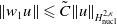 $\lVert {w_1 u}\rVert \leqslant \tilde C \lVert {u}\rVert _{H^{2,\kappa }_{\mathrm {nucl}}}$
, the operator
$\lVert {w_1 u}\rVert \leqslant \tilde C \lVert {u}\rVert _{H^{2,\kappa }_{\mathrm {nucl}}}$
, the operator $h_{\mathrm {eff}}^{(2)}$
is self-adjoint on
$h_{\mathrm {eff}}^{(2)}$
is self-adjoint on ${\mathcal{H}}_{\mathrm {nucl}}$
with domain
${\mathcal{H}}_{\mathrm {nucl}}$
with domain $H^{2, \kappa }_{\mathrm {nucl}}$
. b) The operator
$H^{2, \kappa }_{\mathrm {nucl}}$
. b) The operator $H^{(2)}_\kappa \;:\; {\mathrm {Ran}}\, P \to {\mathrm {Ran}}\, P$
acting via
$H^{(2)}_\kappa \;:\; {\mathrm {Ran}}\, P \to {\mathrm {Ran}}\, P$
acting via $H^{(2)}_\kappa (\psi _\circ\, f) = \psi _\circ (h_{\mathrm {eff}}^{(2)}\, f )$
is also self-adjoint. It generates the evolution
$H^{(2)}_\kappa (\psi _\circ\, f) = \psi _\circ (h_{\mathrm {eff}}^{(2)}\, f )$
is also self-adjoint. It generates the evolution
 \begin{equation} U^{(2)}_t = e^{- i H^{(2)}_\kappa t/\kappa }, \end{equation}
which for all $\Psi \in {\mathrm {Ran}}\, P$
acts via
$\Psi \in {\mathrm {Ran}}\, P$
acts via
 \begin{equation} U^{(2)}_t \Psi = \psi _\circ e^{- i h_{\mathrm {eff}}^{(2)} t/\kappa } g, \end{equation}
where $g = \langle \psi _\circ , \Psi \rangle _{\mathcal{H}_{\mathrm {el}}}$
.
$g = \langle \psi _\circ , \Psi \rangle _{\mathcal{H}_{\mathrm {el}}}$
.
Proof of Lemma
5.1. Proof of a). Using the Fourier transform on ${\mathbb{R}}^m$
, we can show
${\mathbb{R}}^m$
, we can show
 \begin{equation} \lVert {u}\rVert _{H^{2,\kappa }_{\mathrm {nucl}}} \leqslant \frac {\sqrt {m(m+1)}}{2} \lVert {T u}\rVert _{{\mathcal{H}}_{\mathrm {nucl}}} + \lVert {u}\rVert _{{\mathcal{H}}_{\mathrm {nucl}}}. \end{equation}
Combining this with the estimate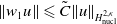 $\lVert {w_1 u}\rVert \leqslant \tilde C \lVert {u}\rVert _{H^{2,\kappa }_{\mathrm {nucl}}}$
, implies
$\lVert {w_1 u}\rVert \leqslant \tilde C \lVert {u}\rVert _{H^{2,\kappa }_{\mathrm {nucl}}}$
, implies
 \begin{equation} \lVert {w_1 u}\rVert _{{\mathcal{H}}_{\mathrm {nucl}}} \leqslant \tilde C \frac {\sqrt {m(m+1)}}{2} \lVert {T u}\rVert _{{\mathcal{H}}_{\mathrm {nucl}}} + \tilde C \lVert {u}\rVert _{{\mathcal{H}}_{\mathrm {nucl}}}, \end{equation}
and hence for $\kappa$
satisfying (5.6), the operator
$\kappa$
satisfying (5.6), the operator $- \kappa ^2 w_1$
is a relatively bounded perturbation of
$- \kappa ^2 w_1$
is a relatively bounded perturbation of $T$
with relative bound less than
$T$
with relative bound less than $1$
. It follows easily as well that
$1$
. It follows easily as well that $w_1$
is a symmetric operator. As
$w_1$
is a symmetric operator. As $E + \kappa ^2 v$
are bounded symmetric operators, it follows by the Kato-Rellich theorem that
$E + \kappa ^2 v$
are bounded symmetric operators, it follows by the Kato-Rellich theorem that $h_{\mathrm {eff}}^{(2)}$
is self-adjoint on
$h_{\mathrm {eff}}^{(2)}$
is self-adjoint on ${\mathcal{H}}_{\mathrm {nucl}}$
with domain
${\mathcal{H}}_{\mathrm {nucl}}$
with domain ${\mathcal{D}}(T) = H^{2,\kappa }_{\mathrm {nucl}}$
.
${\mathcal{D}}(T) = H^{2,\kappa }_{\mathrm {nucl}}$
.
Proof of b). The self-adjointness of $H^{(2)}_\kappa$
follows immediately. The proof of (5.8) follows analogous to that of Lemma 3.2 b).
$H^{(2)}_\kappa$
follows immediately. The proof of (5.8) follows analogous to that of Lemma 3.2 b).
Remark. It was shown in Lemma 8 of [Reference Elgart and Hagedorn62] that
 \begin{equation} \lVert {\nabla _{y_j} P}\rVert \leqslant \frac {1}{\delta } \lVert {\nabla _{y_j} H_{\mathrm {bo}}}\rVert . \end{equation}
Generalising these sorts of estimates would allow us to explicitly compute $\tilde C$
in terms of the spectral gap
$\tilde C$
in terms of the spectral gap $\delta$
and the operator norms of derivatives of
$\delta$
and the operator norms of derivatives of $H_{\mathrm {bo}}$
(which are all bounded by Assumption [A1]).
$H_{\mathrm {bo}}$
(which are all bounded by Assumption [A1]).
We write the difference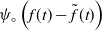 $\psi _\circ \left (f(t) - \tilde f(t)\right )$
as an operator-valued integral in time in order to integrate by parts.
$\psi _\circ \left (f(t) - \tilde f(t)\right )$
as an operator-valued integral in time in order to integrate by parts.
Lemma 5.2.
Let Assumptions [A1]–[A4] hold. Recall $X = \frac {i}{\kappa } {\overline {P}} T P$
and its adjoint
$X = \frac {i}{\kappa } {\overline {P}} T P$
and its adjoint $X^* = -\frac {i}{\kappa } P T {\overline {P}}$
. a) We have
$X^* = -\frac {i}{\kappa } P T {\overline {P}}$
. a) We have
 \begin{equation} \psi _\circ \left (f(t) - \tilde f(t)\right ) = U^{(2)}_{t} Z_t {\overline {R}} X \psi _\circ\, f_0 - \kappa ^2 \int _0^t U^{(2)}_{t-r} \psi _\circ w_2^\kappa [f](r)\, \text{d}r, \end{equation}
where
 \begin{align} Z_t &= -\kappa ^2 U_{-r}^{(2)} {\overline {R}} X \overline {U}_r \bigg |_{r=0}^{r=t} - \kappa ^2 \int _0^t U^{(2)}_{-r} X_{(2)} \overline {U}_r\, \text{d}r, \end{align}
with
 \begin{equation} X_{(2)} = \left (X_2\right )^* - i \kappa \psi _\circ w_1 \langle \psi _\circ , X^* \left (\cdot \right ) \rangle _{\mathcal{H}_{\mathrm {el}}}. \end{equation}
Here by $*$
we denote the adjoint and recall
$*$
we denote the adjoint and recall $X_2$
is defined in (
3.27
).
$X_2$
is defined in (
3.27
).
It is easy to see that the right-hand side of (5.13) is $O(\kappa )$
, so the integration by parts is necessary in order to estimate
$O(\kappa )$
, so the integration by parts is necessary in order to estimate $Z_t = O(\kappa ^2)$
.
$Z_t = O(\kappa ^2)$
.
Proof of Lemma
5.2. Using the expansion (1.33) from Theorem1.2 part (b) and introducing $h_{\mathrm {eff}}^{(2)}$
as defined in (1.39), we can write
$h_{\mathrm {eff}}^{(2)}$
as defined in (1.39), we can write
 \begin{equation} h_{\mathrm {eff}} f(t) = h_{\mathrm {eff}}^{(2)}\, f(t) + \kappa ^2 \tilde w_1(t) f_0 + i \kappa ^3 w_2^\kappa [f](t). \end{equation}
Using the semigroup $U^{(2)}_t$
and (5.16), we can re-write (1.39) for
$U^{(2)}_t$
and (5.16), we can re-write (1.39) for $\tilde {f}(t)$
and (1.30) for
$\tilde {f}(t)$
and (1.30) for $f(t)$
in Duhamel form, and taking the difference yields
$f(t)$
in Duhamel form, and taking the difference yields
 \begin{align} \psi _\circ \left (f(t) - \tilde {f}(t) \right ) &= - i \kappa \int _0^t U^{(2)}_{t-r} \psi _\circ \tilde w_1(r) f_0\, \text{d}r \nonumber \\ &\quad - \kappa ^2 \int _0^t U^{(2)}_{t-r} \psi _\circ w_2^\kappa [f](r)\, \text{d}r. \end{align}
By the definition of $\tilde w_1(r)$
, see (4.30), we have
$\tilde w_1(r)$
, see (4.30), we have
 \begin{equation} U^{(2)}_{t-r} \psi _\circ \tilde w_1(r) f_0 = U^{(2)}_{t-r} X^* \overline {U}_t {\overline {R}} X \psi _\circ\, f_0, \end{equation}
so we write (5.17) in the form (5.12), with
 \begin{equation} Z_t = - i \kappa \int _0^t U^{(2)}_{-r} X^* \overline {U}_r\, \text{d}r. \end{equation}
We now integrate $Z_t$
by parts using the left-handed NAIP as described above. We apply the integration by parts expansion (2.9) with
$Z_t$
by parts using the left-handed NAIP as described above. We apply the integration by parts expansion (2.9) with $F_r = U^{(2)}_{t-r} X^*$
and
$F_r = U^{(2)}_{t-r} X^*$
and $G_r = 1$
(then
$G_r = 1$
(then $R = -i\kappa {\overline {R}}$
), to the right-hand side of (5.13). In this case
$R = -i\kappa {\overline {R}}$
), to the right-hand side of (5.13). In this case $F_r' = \frac {i}{\kappa } U^{(2)}_{t-r} H^{(2)}_\kappa X^*$
, so we obtain
$F_r' = \frac {i}{\kappa } U^{(2)}_{t-r} H^{(2)}_\kappa X^*$
, so we obtain
 \begin{align} Z_t &= - \kappa ^2 U^{(2)}_{t-r} X^* {\overline {R}} \, \overline {U}_r \bigg |_{r=0}^{r=t} + i \kappa \int _0^t U^{(2)}_{t-r} X^* S \overline {U}_r\, \text{d}r \nonumber \\ &\quad - i \kappa \int _0^t U^{(2)}_{t-r} \left ( H^{(2)}_\kappa X^* - X^* \overline {K} \right ) {\overline {R}} \, \overline {U}_{r}\, \text{d}r. \end{align}
Combining the integrals, we obtain (5.14) with
 \begin{equation} X_{(2)} = -\frac {i}{\kappa } X^* S - \frac {i}{\kappa } \left ( H^{(2)}_\kappa X^* - X^* \overline {K} \right ) {\overline {R}}, \end{equation}
so it remains to show (5.15). Using the definition of $H^{(2)}_\kappa$
and the identity (3.11), we have that for any
$H^{(2)}_\kappa$
and the identity (3.11), we have that for any $g \in {\mathcal{H}}_{\mathrm {nucl}}$
,
$g \in {\mathcal{H}}_{\mathrm {nucl}}$
, $H^{(2)}_\kappa \psi _\circ g = K^P \psi _\circ g - \kappa ^2 \psi _\circ w_1 g$
. Since
$H^{(2)}_\kappa \psi _\circ g = K^P \psi _\circ g - \kappa ^2 \psi _\circ w_1 g$
. Since $X^* = P X^*$
, (5.15) follows.
$X^* = P X^*$
, (5.15) follows.
We estimate the right-hand side of (5.12) using (5.14) and (5.15). To do so, we will need the following two additional estimates.
Lemma 5.3. Let Assumptions [A1]–[A4] hold. a) Estimating the right-hand side of ( 5.14 ) yields
 \begin{equation} Z_t = O_{{\mathcal{L}}_{s+2,s}}(\kappa ^2 e^{Ct}), \end{equation}
for some constant $C \gt 0$
independent of
$C \gt 0$
independent of $t$
and
$t$
and $\kappa$
. b) For solutions
$\kappa$
. b) For solutions $f(t)$
of (
1.30
) with initial conditions
$f(t)$
of (
1.30
) with initial conditions $f(0) = f_0$
, we have
$f(0) = f_0$
, we have
 \begin{equation} \lVert {f}\rVert _{B^s_\tau } \leqslant C \langle \tau \rangle ^s \lVert {f_0}\rVert _{H^{s, \kappa }_{\mathrm {nucl}}}. \end{equation}
for some constant $C \gt 0$
independent of
$C \gt 0$
independent of $\tau$
and
$\tau$
and $\kappa$
.
$\kappa$
.
Proof of Lemma
5.3. Proof of a). To estimate $X_{(2)}$
, we use the estimate of
$X_{(2)}$
, we use the estimate of $X_2 = O_{{\mathcal{L}}_{s+2,s}}(1)$
, which follows from (3.36) in Lemma 3.4, and from the estimate (4.93), we have that
$X_2 = O_{{\mathcal{L}}_{s+2,s}}(1)$
, which follows from (3.36) in Lemma 3.4, and from the estimate (4.93), we have that $\psi _\circ w_1 \langle \psi _\circ , X^* \left (\cdot \right ) \rangle _{{\mathcal{H}}_{\mathrm {el}}} = O_{{\mathcal{L}}_{s+2,s}}(1)$
. These two estimates together imply
$\psi _\circ w_1 \langle \psi _\circ , X^* \left (\cdot \right ) \rangle _{{\mathcal{H}}_{\mathrm {el}}} = O_{{\mathcal{L}}_{s+2,s}}(1)$
. These two estimates together imply
 \begin{equation} X_{(2)} = O_{{\mathcal{L}}{s+2,s}}(1). \end{equation}
Combining this with the estimates for the propagator $\overline {U}_t = O_{{\mathcal{L}}_{s,s}}(e^{Ct})$
(see TheoremD.1) and using
$\overline {U}_t = O_{{\mathcal{L}}_{s,s}}(e^{Ct})$
(see TheoremD.1) and using $X = O_{{\mathcal{L}}_{s+1,s}}(1)$
and
$X = O_{{\mathcal{L}}_{s+1,s}}(1)$
and ${\overline {R}} = O_{{\mathcal{L}}_{s,s}}(1)$
, we obtain (5.21).
${\overline {R}} = O_{{\mathcal{L}}_{s,s}}(1)$
, we obtain (5.21).
Proof of b). From the definition of the operator $Q_P$
given in (1.29), we observe that
$Q_P$
given in (1.29), we observe that $\psi _\circ\, f(t) = P (Q_Pf)(t)$
. By Theorem1.2 part (a),
$\psi _\circ\, f(t) = P (Q_Pf)(t)$
. By Theorem1.2 part (a), $Q_Pf$
is a solution of the full Schrödinger equation
$Q_Pf$
is a solution of the full Schrödinger equation $i \kappa \partial _t Q_Pf(t) = H_\kappa Q_Pf(t)$
with initial conditions
$i \kappa \partial _t Q_Pf(t) = H_\kappa Q_Pf(t)$
with initial conditions $(Q_Pf)(0) = \psi _\circ\, f_0$
. Then,
$(Q_Pf)(0) = \psi _\circ\, f_0$
. Then,
 \begin{equation} \psi _\circ\, f(t) = P (Q_Pf)(t) = P U_t \psi _\circ\, f_0. \end{equation}
Using this and the fact that $P = O_{{\mathcal{L}}_{s,s}}(1)$
(see Lemma A.2), the definition of the
$P = O_{{\mathcal{L}}_{s,s}}(1)$
(see Lemma A.2), the definition of the $B^s_\tau$
norm (1.69) implies
$B^s_\tau$
norm (1.69) implies
 \begin{align} \lVert {f(t)}\rVert _{B^s_\tau } = \sup _{0 \leqslant t \leqslant \tau } \lVert {\psi _\circ\, f(t)}\rVert _{{\mathcal{H}}_{\mathrm {el}}H^{s, \kappa }_{\mathrm {nucl}}} \lesssim \sup _{0 \leqslant t \leqslant \tau } \lVert {U_t \psi _\circ\, f_0}\rVert _{{\mathcal{H}}_{\mathrm {el}} H^{s, \kappa }_{\mathrm {nucl}}}. \end{align}
The last step is to use the estimate $U_t = O_{{\mathcal{L}}_{s,s}}(\langle t \rangle ^s)$
, which is proven in TheoremD.1, (D.2), on the right-hand side of (5.25). Then the claim follows.
$U_t = O_{{\mathcal{L}}_{s,s}}(\langle t \rangle ^s)$
, which is proven in TheoremD.1, (D.2), on the right-hand side of (5.25). Then the claim follows.
5.3. Conclusion of proof
We now complete the proof of Theorem1.3 using the lemmas we have established.
Proof of Theorem
1.3. Let $\Psi (t)$
satisfy the Schrödinger equation (1.14) with
$\Psi (t)$
satisfy the Schrödinger equation (1.14) with $\Psi (0) = \psi _\circ\, f_0$
and let
$\Psi (0) = \psi _\circ\, f_0$
and let $\tilde {f}(t)$
be the solution of the truncated effective nuclear (1.39) with
$\tilde {f}(t)$
be the solution of the truncated effective nuclear (1.39) with $\tilde {f}(0) = f_0$
. We set
$\tilde {f}(0) = f_0$
. We set $\kappa _0$
to the right-hand side of the inequality in (5.6) and consider
$\kappa _0$
to the right-hand side of the inequality in (5.6) and consider $\kappa \in (0, \kappa _0)$
. Then, using the definition of
$\kappa \in (0, \kappa _0)$
. Then, using the definition of $Q_P$
, see (1.29), we can write
$Q_P$
, see (1.29), we can write
 \begin{align} \Psi (t) - (Q_P\tilde {f})(t) &= \psi _\circ \left (f(t) - \tilde {f}(t) \right ) \nonumber \\ &\quad + \int _0^t \overline {U}_{t-s} X^* \psi _\circ \left (f(s) - \tilde {f}(s) \right )\, \text{d}s, \end{align}
where $f(t)$
solves the effective nuclear dynamics (1.30) with
$f(t)$
solves the effective nuclear dynamics (1.30) with $f(0) = f_0$
. Using the self-adjointness of
$f(0) = f_0$
. Using the self-adjointness of $h_{\mathrm {eff}}^{(2)}$
(see Lemma 5.1), we can further write
$h_{\mathrm {eff}}^{(2)}$
(see Lemma 5.1), we can further write
 \begin{equation} \psi _\circ \left (f(t) - \tilde f(t)\right ) = U^{(2)}_{t} Z_t {\overline {R}} X \psi _\circ\, f_0 - \kappa ^2 \int _0^t U^{(2)}_{t-r} \psi _\circ w_2^\kappa [f](r)\, \text{d}r, \end{equation}
where $Z_t$
, after using the NAIP, admits the expansion (5.14)–(5.15) (see Lemma 5.2).
$Z_t$
, after using the NAIP, admits the expansion (5.14)–(5.15) (see Lemma 5.2).
To estimate the first term on the right-hand side of (5.27), we use Lemma 5.3 part a) to estimate $Z_t$
and the estimate
$Z_t$
and the estimate $U^{(2)}_t = O_{{\mathcal{L}}_{s,s}} ( \langle t \rangle ^s)$
, which can be obtained by arguing analogously as in the case of
$U^{(2)}_t = O_{{\mathcal{L}}_{s,s}} ( \langle t \rangle ^s)$
, which can be obtained by arguing analogously as in the case of $U^P_t$
(see TheoremD.2). The second term can be estimated by using Lemma 5.3 part b) together with the estimate (1.36) to conclude
$U^P_t$
(see TheoremD.2). The second term can be estimated by using Lemma 5.3 part b) together with the estimate (1.36) to conclude
 \begin{equation} \lVert {w^{\kappa }_2 [f](t)}\rVert \lesssim e^{C \tau } \lVert {f_0}\rVert _{H^{s+6, \kappa }_{\mathrm {nucl}}}, \quad 0 \leq t \leq \tau . \end{equation}
Using this on the right-hand side of (5.27), we conclude that
 \begin{align} \lVert {\psi _\circ \left (f(t) - \tilde {f}(t) \right )}\rVert _{H^{s, \kappa }_{\mathrm {nucl}}} &\lesssim \kappa ^2 \langle t \rangle ^s \lVert {f_0}\rVert _{H^{s+3, \kappa }_{\mathrm {nucl}}} + \kappa ^2 e^{C \tau } \lVert {f_0}\rVert _{H^{s+6, \kappa }_{\mathrm {nucl}}} \nonumber \\ &\lesssim \kappa ^2 e^{C \tau } \lVert {f_0}\rVert _{H^{s+6, \kappa }_{\mathrm {nucl}}}, \quad 0 \leqslant t \leqslant \tau . \end{align}
Using this estimate on the right-hand side of (5.26), we obtain (1.38), and the proof concludes.
Competing interests
The author(s) declare none.
Appendix A. Basic fibre smoothness estimates
In this section, we collect some preliminary lemmas characterising the range of $P$
and the smoothness of the eigenvalue
$P$
and the smoothness of the eigenvalue $E(\!\cdot\!)$
, the projection
$E(\!\cdot\!)$
, the projection $P(\!\cdot\!)$
, the eigenfunction
$P(\!\cdot\!)$
, the eigenfunction $\psi _\circ (\!\cdot\!)$
, and the reduced resolvent
$\psi _\circ (\!\cdot\!)$
, and the reduced resolvent ${\overline {R}}(\!\cdot\!)$
as fibres over
${\overline {R}}(\!\cdot\!)$
as fibres over $y \in {\mathbb{R}}^m$
. First, we note that
$y \in {\mathbb{R}}^m$
. First, we note that
 \begin{equation} \textit {Ran}\;P = \{g(y) \psi _\circ (y) \::\: \forall g(y) \in L^2({\mathbb{R}}^m)\}, \end{equation}
where $\psi _\circ = \int ^{\oplus }_{{\mathbb{R}}^m} \psi _\circ (y) dy$
.
$\psi _\circ = \int ^{\oplus }_{{\mathbb{R}}^m} \psi _\circ (y) dy$
.
A.1. Fibre smoothness
Under the gap condition (1.47) and by the definition of $\overline {P}$
, we have
$\overline {P}$
, we have
 \begin{equation} E(y) \in \rho (H(y)|_{{\mathrm {Ran}}\, {\overline {P}}}), \quad \forall y \in {\mathbb{R}}^m, \end{equation}
and the following result.
Lemma A.1. Let Assumptions [A1]–[A4] hold. Using the theory of Riesz integrals,
 \begin{equation} P(y) = \frac {1}{2 \pi i} \oint _{\Gamma (\tilde {y})} R(z,y) dz, \quad \forall y \in U(\tilde {y}), \end{equation}
where $\Gamma (\tilde {y}) \subset {\mathbb{C}}$
is a positively oriented closed curve encircling
$\Gamma (\tilde {y}) \subset {\mathbb{C}}$
is a positively oriented closed curve encircling $E(\tilde {y})$
once and
$E(\tilde {y})$
once and $U(\tilde {y})$
is an open neighbourhood of
$U(\tilde {y})$
is an open neighbourhood of $\tilde {y}$
such that
$\tilde {y}$
such that
 \begin{equation} \inf _{y \in U(\tilde {y})} \textit {dist}(\Gamma (\tilde {y}), \sigma (H(y))) \geqslant \frac {\delta }{4}. \end{equation}
Then, the ground state energy $E(y)$
and corresponding eigenprojection
$E(y)$
and corresponding eigenprojection $P(y)$
are
$P(y)$
are $k_A$
-times differentiable in
$k_A$
-times differentiable in $y$
(with
$y$
(with $k_A$
the same as in Assumption [A1]):
$k_A$
the same as in Assumption [A1]):
 \begin{equation} E(\!\cdot\!) \in C_b^{k_A}({\mathbb{R}}^m), \quad P(\!\cdot\!) \in C_b^{k_A}({\mathbb{R}}^m, {\mathcal{L}}({\mathcal{H}}_{\mathrm {el}})). \end{equation}
Moreover, the ground state $\psi _\circ (y)$
is a
$\psi _\circ (y)$
is a $k_A$
-times differentiable as a vector-function of
$k_A$
-times differentiable as a vector-function of $y$
, in the sense that
$y$
, in the sense that
 \begin{equation} \sup _y \lVert {\partial _y^\alpha \psi _\circ (y)}\rVert _{{\mathcal{H}}_{\mathrm {el}}} \leqslant C \quad \text{ for all multi-index } \lvert {\alpha }\rvert \leqslant k_A. \end{equation}
Proof of Lemma A.1. The smoothness of the eigenprojection $P(\!\cdot\!)$
follows from (A.3)–(A.4) and the first resolvent identity (see for instance [Reference Weigert and Littlejohn38, Theorem 2.2]), making use of the spectral gap and smoothness assumption on the fibres
$P(\!\cdot\!)$
follows from (A.3)–(A.4) and the first resolvent identity (see for instance [Reference Weigert and Littlejohn38, Theorem 2.2]), making use of the spectral gap and smoothness assumption on the fibres $H(\!\cdot\!)$
. To prove the differentiability of the ground state
$H(\!\cdot\!)$
. To prove the differentiability of the ground state $\psi _\circ (\!\cdot\!)$
and ground state energy
$\psi _\circ (\!\cdot\!)$
and ground state energy $E(\!\cdot\!)$
we use that the eigenvalues are simple and argue as follows. Let
$E(\!\cdot\!)$
we use that the eigenvalues are simple and argue as follows. Let $P(y)$
,
$P(y)$
, $y, \tilde {y} \in {\mathbb{R}}^m$
, and
$y, \tilde {y} \in {\mathbb{R}}^m$
, and $U(\tilde {y})$
be as in (A.3)–(A.4), i.e. taking
$U(\tilde {y})$
be as in (A.3)–(A.4), i.e. taking $U(\tilde {y})$
sufficiently small and using that
$U(\tilde {y})$
sufficiently small and using that $P(\tilde {y}) \psi _\circ (\tilde {y}) = \psi _\circ (\tilde {y})$
, we ensure that
$P(\tilde {y}) \psi _\circ (\tilde {y}) = \psi _\circ (\tilde {y})$
, we ensure that $P(y) \psi _\circ (\tilde {y}) \neq 0$
for all
$P(y) \psi _\circ (\tilde {y}) \neq 0$
for all $y \in U(\tilde {y})$
. Hence, by Assumption [A1] and
$y \in U(\tilde {y})$
. Hence, by Assumption [A1] and $P(\!\cdot\!) \in C_b^k({\mathbb{R}}^m, {\mathcal{L}}({\mathcal{H}}_{\mathrm {el}}))$
, the following functions
$P(\!\cdot\!) \in C_b^k({\mathbb{R}}^m, {\mathcal{L}}({\mathcal{H}}_{\mathrm {el}}))$
, the following functions
 \begin{align} \nu (y) &= \langle \psi _\circ (\tilde {y}), P(y) \psi _\circ (\tilde {y}) \rangle _{{\mathcal{H}}_{\mathrm {el}}}, \end{align}
 \begin{align} \mu (y) &= \langle H(y) \psi _\circ (\tilde {y}), P(y) \psi _\circ (\tilde {y}) \rangle _{{\mathcal{H}}_{\mathrm {el}}},\\[8pt] \nonumber \end{align}
are $k_A$
-times differentiable in
$k_A$
-times differentiable in $y$
and
$y$
and $\inf _{y \in {\mathbb{R}}^m} \nu (y) \gt 0$
. Then, we conclude (A.5) and (A.6) using
$\inf _{y \in {\mathbb{R}}^m} \nu (y) \gt 0$
. Then, we conclude (A.5) and (A.6) using
 \begin{equation} E(y) = \nu (y)^{-1} \mu (y), \quad \psi _\circ (y) = \nu (y)^{-\frac {1}{2}} P(y) \psi _\circ (\tilde {y}). \end{equation}
A.2. Resolvent estimates
We mention first that Assumption [A1] implies the boundedness of the operators $\partial _y^\alpha H_{\mathrm {bo}}$
, where
$\partial _y^\alpha H_{\mathrm {bo}}$
, where
 \begin{equation} \partial _y^\alpha H_{\mathrm {bo}} = \int _{{\mathbb{R}}^m}^{\oplus } \partial _y^\alpha H(y) dy. \end{equation}
Recall that $\overline {H}_{\mathrm {bo}} \;:\!=\; {\overline {P}} H_{\mathrm {bo}} {\overline {P}}$
and
$\overline {H}_{\mathrm {bo}} \;:\!=\; {\overline {P}} H_{\mathrm {bo}} {\overline {P}}$
and $\overline {E} \;:\!=\; {\overline {P}} E {\overline {P}}$
.
$\overline {E} \;:\!=\; {\overline {P}} E {\overline {P}}$
.
Lemma A.2.
Let Assumptions [A1]–[A4] hold. Then, the reduced resolvent $\overline {R}$
satisfies the smoothness estimate
$\overline {R}$
satisfies the smoothness estimate
 \begin{equation} {\overline {R}} = O_{{\mathcal{L}}_{s,s}}(1), \end{equation}
where $0 \leqslant s \leqslant k_A$
and recall
$0 \leqslant s \leqslant k_A$
and recall $k_A$
is given in Assumption [A1]. Moreover,
$k_A$
is given in Assumption [A1]. Moreover,
 \begin{equation} {\overline {R}} = \int ^{\oplus }_{{\mathbb{R}}^m} {\overline {R}}(y) dy, \end{equation}
with the ${\mathbb{R}}^m$
-fibres
${\mathbb{R}}^m$
-fibres ${\overline {R}}(y)$
satisfying
${\overline {R}}(y)$
satisfying ${\overline {R}}(\!\cdot\!) \in C_b^{k_A}({\mathbb{R}}^m, {\mathcal{L}}({\mathcal{H}}_{\mathrm {el}}))$
.
${\overline {R}}(\!\cdot\!) \in C_b^{k_A}({\mathbb{R}}^m, {\mathcal{L}}({\mathcal{H}}_{\mathrm {el}}))$
.
Proof of Lemma A.2. To prove that the fibres
 \begin{equation} {\overline {R}}(y) = {\overline {P}}(y) (\overline {H}(y) - \overline {E}(y))^{-1} {\overline {P}}(y) \end{equation}
satisfy ${\overline {R}}(\!\cdot\!) \in C_b^k({\mathbb{R}}^m, {\mathcal{L}}({\mathcal{H}}_{\mathrm {el}}))$
, we use that, by Lemma A.2 and the definition
${\overline {R}}(\!\cdot\!) \in C_b^k({\mathbb{R}}^m, {\mathcal{L}}({\mathcal{H}}_{\mathrm {el}}))$
, we use that, by Lemma A.2 and the definition ${\overline {P}}(y) = \textbf {1} - P(y)$
, we have
${\overline {P}}(y) = \textbf {1} - P(y)$
, we have ${\overline {P}}(\!\cdot\!) \in C_b^k({\mathbb{R}}^m, {\mathcal{L}}({\mathcal{H}}_{\mathrm {el}}))$
with
${\overline {P}}(\!\cdot\!) \in C_b^k({\mathbb{R}}^m, {\mathcal{L}}({\mathcal{H}}_{\mathrm {el}}))$
with $\partial _y^\alpha {\overline {P}}(y) = - \partial _y^\alpha P(y)$
. Since
$\partial _y^\alpha {\overline {P}}(y) = - \partial _y^\alpha P(y)$
. Since $[P(y), H(y)] = 0$
, we have that
$[P(y), H(y)] = 0$
, we have that $\overline {H}(y) = {\overline {P}}(y) H(y) {\overline {P}}(y) = H(y){\overline {P}}(y)$
. By the Liebnitz rule, for a multi-index
$\overline {H}(y) = {\overline {P}}(y) H(y) {\overline {P}}(y) = H(y){\overline {P}}(y)$
. By the Liebnitz rule, for a multi-index $\alpha = (\alpha _1, \dots , \alpha _m)$
,
$\alpha = (\alpha _1, \dots , \alpha _m)$
,
 \begin{eqnarray} \partial _y^\alpha \overline {H}(y) &=& \partial_y^\alpha (H(y) {\overline {P}}(y)) \nonumber \\&=& - \sum _{0 \leqslant \beta \leqslant \alpha } \left({{\alpha} \atop {\beta }}\right) \big(\partial _y^\beta H(y)\big) \big( \partial _y^{\alpha -\beta } P(y)\big), \end{eqnarray}
where recall for multi-indices, $\beta \leqslant \alpha$
if
$\beta \leqslant \alpha$
if $\beta _j \leqslant \alpha _j$
for all
$\beta _j \leqslant \alpha _j$
for all $j = 1, \dots , m$
and
$j = 1, \dots , m$
and $\left({{\alpha }\atop {\beta }}\right) \;:\!=\; \left({{\alpha _1}\atop {\beta _1}}\right) \dots \left({{\alpha _m}\atop {\beta _m}}\right)$
. By Assumption [A1] it suffices to consider the term
$\left({{\alpha }\atop {\beta }}\right) \;:\!=\; \left({{\alpha _1}\atop {\beta _1}}\right) \dots \left({{\alpha _m}\atop {\beta _m}}\right)$
. By Assumption [A1] it suffices to consider the term $H(y) \partial _y^\alpha P(y)$
. We choose
$H(y) \partial _y^\alpha P(y)$
. We choose $\tilde {y} \in {\mathbb{R}}^m$
and a neighbourhood
$\tilde {y} \in {\mathbb{R}}^m$
and a neighbourhood $U(\tilde {y})$
such that
$U(\tilde {y})$
such that
 \begin{equation} \inf _{y \in U(\tilde {y})} \mathrm {dist}(\Gamma (\tilde {y}), \sigma (H(y))) \geqslant \frac {\delta }{4}. \end{equation}
Then, for $y \in U(\tilde {y})$
,
$y \in U(\tilde {y})$
,
 \begin{equation} H(y) \partial _y^\alpha P(y) = \frac {1}{2 \pi i} \oint _{\Gamma (\tilde {y})} H(y) \partial _y^\alpha R(z,y) dz. \end{equation}
Using the first resolvent identity to differentiate $R(z,y)$
and using the identity
$R(z,y)$
and using the identity $H(y) R(z,y) = 1 + z R(z,y)$
, it follows from (A.16) that
$H(y) R(z,y) = 1 + z R(z,y)$
, it follows from (A.16) that $H(\!\cdot\!) \partial _y^\alpha P(\!\cdot\!) \in C^{k - \left |\alpha \right |}_b({\mathbb{R}}^m, {\mathcal{L}}({\mathcal{H}}_{\mathrm {el}}))$
. Using this, (A.14), and Assumption [A1], we obtain
$H(\!\cdot\!) \partial _y^\alpha P(\!\cdot\!) \in C^{k - \left |\alpha \right |}_b({\mathbb{R}}^m, {\mathcal{L}}({\mathcal{H}}_{\mathrm {el}}))$
. Using this, (A.14), and Assumption [A1], we obtain
 \begin{equation} \partial _y^\alpha \overline {H}_{\mathrm {bo}}(\!\cdot\!) \in C^{k-\left |\alpha \right |}_b({\mathbb{R}}^m, {\mathcal{L}}({\mathcal{H}}_{\mathrm {el}})). \end{equation}
With this, proceeding as in the proof of Lemma A.2, we find that ${\overline {R}}(\!\cdot\!) \in C_b^k({\mathbb{R}}^m, {\mathcal{L}}({\mathcal{H}}_{\mathrm {el}}))$
giving (A.12). The estimate (3.6) follows from
${\overline {R}}(\!\cdot\!) \in C_b^k({\mathbb{R}}^m, {\mathcal{L}}({\mathcal{H}}_{\mathrm {el}}))$
giving (A.12). The estimate (3.6) follows from
 \begin{equation} D^s {\overline {R}}(y) = [D^s, {\overline {R}}(y)] + {\overline {R}}(y) D^s \end{equation}
combined with the regularity ${\overline {R}}(\!\cdot\!) \in C_b^k({\mathbb{R}}^m, {\mathcal{L}}({\mathrm {Ran}}\, {{\overline {P}}}))$
and Lemma C.2.
${\overline {R}}(\!\cdot\!) \in C_b^k({\mathbb{R}}^m, {\mathcal{L}}({\mathrm {Ran}}\, {{\overline {P}}}))$
and Lemma C.2.
Appendix B. Self-adjointness
In this section, we establish the self-adjointness of the reduced Hamiltonians $H^P$
and
$H^P$
and $\overline {H}$
in Proposition B.2. Thanks to this lemma,
$\overline {H}$
in Proposition B.2. Thanks to this lemma, $\overline {H}$
generates the one-parameter unitary group
$\overline {H}$
generates the one-parameter unitary group $e^{-i \overline {H} t}$
. For the reader’s convenience, we recall that
$e^{-i \overline {H} t}$
. For the reader’s convenience, we recall that
 \begin{equation} D_{y_j} \;:\!=\; -i\kappa \partial _{y_j}, \quad D^\alpha = \prod _{j=1}^m D^{\alpha _j}_{y_j}. \end{equation}
First, we prove a preliminary lemma that we will use in the proof of self-adjointness.
Lemma B.1.
Let Assumptions [A1]–[A4] hold. Then, the re-scaled Laplacian $T = - \kappa ^2 \Delta _y$
is a relatively bounded perturbation of
$T = - \kappa ^2 \Delta _y$
is a relatively bounded perturbation of $H_\kappa$
, i.e. for some constant
$H_\kappa$
, i.e. for some constant $C \gt 0$
,
$C \gt 0$
,
 \begin{equation} \lVert {-\kappa ^2 \Delta _y \phi }\rVert \leqslant \lVert {H_\kappa \phi }\rVert + C \lVert {\phi }\rVert , \quad \phi \in {\mathcal{D}}(H_\kappa ). \end{equation}
Proof of Lemma
B.1. To begin, consider the quantity $2 {\mathrm {Re}}\, \langle -\kappa ^2 \Delta _y \phi , \tilde {H}_{bo} \phi \rangle$
. Here,
$2 {\mathrm {Re}}\, \langle -\kappa ^2 \Delta _y \phi , \tilde {H}_{bo} \phi \rangle$
. Here, $\tilde {H}_{bo} = H_{\mathrm {bo}} + \gamma$
for some constant
$\tilde {H}_{bo} = H_{\mathrm {bo}} + \gamma$
for some constant $0 \lt \gamma \lt \infty$
so that
$0 \lt \gamma \lt \infty$
so that $\tilde {H}_{bo} \geqslant 0$
(see Assumption [A1]). Since
$\tilde {H}_{bo} \geqslant 0$
(see Assumption [A1]). Since $- \kappa ^2 \Delta _y = (i \kappa \nabla _y)^2$
, we have using
$- \kappa ^2 \Delta _y = (i \kappa \nabla _y)^2$
, we have using $\tilde {H}_{bo} \geqslant 0$
that
$\tilde {H}_{bo} \geqslant 0$
that
 \begin{align} \langle -\kappa ^2 \Delta _y \phi , \tilde {H}_{bo} \phi \rangle &= \langle i \kappa \nabla _y \phi , \tilde {H}_{bo} (i \kappa \nabla _y \phi ) \rangle + \langle i \kappa \nabla _y \phi , (i \kappa \nabla _y H_{\mathrm {bo}} ) \phi \rangle \nonumber \\ &\geqslant \langle i \kappa \nabla _y \phi , i \kappa (\nabla _y H_{\mathrm {bo}} ) \phi \rangle , \end{align}
which implies
 \begin{equation} 2 {\mathrm {Re}}\, \langle -\kappa ^2 \Delta _y \phi , \tilde {H}_{bo} \phi \rangle \geqslant 2 {\mathrm {Re}}\, \langle i \kappa \nabla _y \phi , i \kappa (\nabla _y H_{\mathrm {bo}} ) \phi \rangle . \end{equation}
Using the product rule and Assumption [A1], $i \kappa (\nabla _y H_{\mathrm {bo}} )$
is antisymmetric,
$i \kappa (\nabla _y H_{\mathrm {bo}} )$
is antisymmetric,
 \begin{align} \langle \phi , i \kappa (\nabla _y H_{\mathrm {bo}} ) \psi \rangle &= \langle \phi , i \kappa \nabla _y (H_{\mathrm {bo}} \psi ) - H_{\mathrm {bo}} (i \kappa \nabla _y \psi ) \rangle \nonumber \\ &= \langle H_{\mathrm {bo}} (i \kappa \nabla _y \phi ) - i \kappa \nabla _y (H_{\mathrm {bo}} \phi ), \psi \rangle dy \nonumber \\ &= \langle - i \kappa (\nabla _y H_{\mathrm {bo}}) \phi , \psi \rangle . \end{align}
This implies
 \begin{align} \overline {\langle i \kappa \nabla _y \phi , i \kappa (\nabla _y H_{\mathrm {bo}}) \phi \rangle } &= \langle i \kappa (\nabla _y H_{\mathrm {bo}}) \phi , i \kappa \nabla _y \phi \rangle \nonumber \\ &= \langle (\!-\kappa ^2 \Delta _y H_{\mathrm {bo}}) \phi , \phi \rangle + \langle i \kappa (\nabla _y H_{\mathrm {bo}}) (i \kappa \nabla _y \phi ), \phi \rangle \nonumber \\ &= \langle (\!-\kappa ^2 \Delta _y H_{\mathrm {bo}}) \phi , \phi \rangle - \langle i \kappa \nabla _y \phi , i \kappa (\nabla _y H_{\mathrm {bo}}) \phi \rangle , \end{align}
so that by re-arranging we obtain
 \begin{equation} 2 {\mathrm {Re}}\, \langle i \kappa \nabla _y \phi , i \kappa (\nabla _y H_{\mathrm {bo}} ) \phi \rangle = 2 {\mathrm {Re}}\, \langle (\!-\kappa ^2 \Delta _y H_{\mathrm {bo}}) \phi , \phi \rangle . \end{equation}
By Assumption [A1], $(\!-\Delta _y H_{\mathrm {bo}})$
is a bounded operator. Hence (B.4) and (B.7) together imply that
$(\!-\Delta _y H_{\mathrm {bo}})$
is a bounded operator. Hence (B.4) and (B.7) together imply that
 \begin{equation} 2 {\mathrm {Re}}\, \langle -\kappa ^2 \Delta _y \phi , \tilde {H}_{bo} \phi \rangle \geqslant - C \kappa ^2 \lVert {\phi }\rVert ^2 \end{equation}
for some constant $C \gt 0$
. As
$C \gt 0$
. As $\kappa \lt 1$
, we obtain
$\kappa \lt 1$
, we obtain
 \begin{equation} 2 {\mathrm {Re}}\, \langle -\kappa ^2 \Delta _y \phi , \tilde {H}_{bo} \phi \rangle + C \lVert {\phi }\rVert ^2 \geqslant 0. \end{equation}
Add to both sides of the inequality above, we obtain
 \begin{align} \lVert {- \kappa ^2 \Delta _y \phi }\rVert ^2 &\leqslant \lVert {- \kappa ^2 \Delta _y \phi }\rVert ^2 + \lVert {\tilde {H}_{bo} \phi }\rVert ^2 + 2 {\mathrm {Re}}\, \langle -\kappa ^2 \Delta _y \phi , \tilde {H}_{bo} \phi \rangle + C \lVert {\phi }\rVert ^2 \nonumber \\ &= \lVert {(\!-\kappa ^2 \Delta _y + \tilde {H}_{bo}) \phi }\rVert ^2 + C \lVert {\phi }\rVert ^2 \nonumber \\ &\leqslant (\lVert {(\!-\kappa ^2 \Delta _y + H_{\mathrm {bo}}) \phi }\rVert + (\sqrt {C} + \left |\gamma \right |) \lVert {\phi }\rVert )^2, \end{align}
and so (B.2) follows.
Proposition B.2.
Let Assumptions [A1]–[A4] hold. The operators $H^P$
and
$H^P$
and $\overline {H}$
defined by
$\overline {H}$
defined by
 \begin{equation} H^P = P H_{\kappa } P, \quad \overline {H} = {\overline {P}} H_{\kappa } {\overline {P}}, \end{equation}
are self-adjoint on the orthogonal subspaces $\mathrm {Ran }\;P$
and
$\mathrm {Ran }\;P$
and $\mathrm {Ran }\;\overline {P}$
with domains
$\mathrm {Ran }\;\overline {P}$
with domains $\mathcal{D}(H^P) = \psi _\circ \otimes H^{2,\kappa }_{\mathrm {nucl}}$
and
$\mathcal{D}(H^P) = \psi _\circ \otimes H^{2,\kappa }_{\mathrm {nucl}}$
and $\mathcal{D}(\overline {P}) = \overline {P} \mathcal{D}(H_{\kappa })$
, respectively.
$\mathcal{D}(\overline {P}) = \overline {P} \mathcal{D}(H_{\kappa })$
, respectively.
Proof of Proposition
B.2. Step 1. The diagonalised Hamiltonian $H_{diag} \;:\!=\; H^P + \overline {H}$
is self-adjoint on
$H_{diag} \;:\!=\; H^P + \overline {H}$
is self-adjoint on $\mathcal{D}(H)$
. We claim it is self-adjoint on
$\mathcal{D}(H)$
. We claim it is self-adjoint on ${\mathcal{H}} = L^2({\mathbb{R}}^m, {\mathcal{H}}_{\mathrm {el}})$
with domain
${\mathcal{H}} = L^2({\mathbb{R}}^m, {\mathcal{H}}_{\mathrm {el}})$
with domain $\mathcal{D}(H_{diag}) = \mathcal{D}(H_{\kappa })$
. Writing
$\mathcal{D}(H_{diag}) = \mathcal{D}(H_{\kappa })$
. Writing
 \begin{align} H_{diag} &= H - \Lambda , \mathrm { where } \Lambda = P H_{\kappa } \overline {P} + \overline {P} H_{\kappa } P, \end{align}
we argue that the operator $\Lambda$
is a first-order differential operator. To see this, first consider
$\Lambda$
is a first-order differential operator. To see this, first consider $P H_{\kappa } \overline {P}$
. Since
$P H_{\kappa } \overline {P}$
. Since $H_{\kappa } = -\kappa ^2 \Delta _y + H_{\mathrm {bo}}$
and
$H_{\kappa } = -\kappa ^2 \Delta _y + H_{\mathrm {bo}}$
and $P H_{\mathrm {bo}} {\overline {P}} = H_{\mathrm {bo}} P {\overline {P}} = 0$
, then
$P H_{\mathrm {bo}} {\overline {P}} = H_{\mathrm {bo}} P {\overline {P}} = 0$
, then
 \begin{equation} P H_{\kappa } \overline {P} = - \kappa ^2 P \Delta _y {\overline {P}} = \sum _{j=1}^m P D_{y_j}^2 {\overline {P}}. \end{equation}
Commuting $D_{y_j}$
to the right, we have by the orthogonality of
$D_{y_j}$
to the right, we have by the orthogonality of $P$
and
$P$
and $\overline {P}$
that
$\overline {P}$
that $P D_{y_j}^2 {\overline {P}} = P [D_{y_j}^2, {\overline {P}}]$
and
$P D_{y_j}^2 {\overline {P}} = P [D_{y_j}^2, {\overline {P}}]$
and
 \begin{align} P [D_{y_j}^2, {\overline {P}}] &= P \left ( D_{y_j} (D_{y_j} {\overline {P}}) + (D_{y_j} {\overline {P}}) D_{y_j} \right ) \nonumber \\ &= P (D^2_{y_j} {\overline {P}}) + 2 P (D_{y_j} {\overline {P}}) D_{y_j}. \end{align}
The operators $(D^2_{y_j} {\overline {P}})$
and
$(D^2_{y_j} {\overline {P}})$
and $(D_{y_j} {\overline {P}})$
are bounded operators by Lemma A.2. Combining (B.14) with (B.13), it follows that
$(D_{y_j} {\overline {P}})$
are bounded operators by Lemma A.2. Combining (B.14) with (B.13), it follows that
 \begin{equation} \lVert {\overline {P} H_{\kappa } P \phi }\rVert ^2 \leqslant C_1 \sum _1^m \lVert {-i \kappa \partial _{y_j} \phi }\rVert ^2 + C_2 \lVert {\phi }\rVert ^2. \end{equation}
It is standard that $-i\kappa \partial _{y_j}$
is relatively bounded with respect to
$-i\kappa \partial _{y_j}$
is relatively bounded with respect to $-\kappa ^2 \Delta _y$
with relative bound
$-\kappa ^2 \Delta _y$
with relative bound $0$
(cf. [Reference Simon40], [Reference Avron, Seiler and Yaffe43], [Reference Hunziker and Sigal41]), so (B.15) implies that
$0$
(cf. [Reference Simon40], [Reference Avron, Seiler and Yaffe43], [Reference Hunziker and Sigal41]), so (B.15) implies that $P H_{\kappa } {\overline {P}}$
is relatively bounded by
$P H_{\kappa } {\overline {P}}$
is relatively bounded by $-\kappa ^2 \Delta _y$
with relative bound
$-\kappa ^2 \Delta _y$
with relative bound $0$
. Arguing similarly for the adjoint
$0$
. Arguing similarly for the adjoint ${\overline {P}} H_{\kappa } P = (P H_{\kappa } {\overline {P}})^*$
, we conclude that
${\overline {P}} H_{\kappa } P = (P H_{\kappa } {\overline {P}})^*$
, we conclude that $\Lambda = \overline {P} H_{\kappa } P + P H_{\kappa } \overline {P}$
is a relatively-bounded perturbation of
$\Lambda = \overline {P} H_{\kappa } P + P H_{\kappa } \overline {P}$
is a relatively-bounded perturbation of $-\kappa ^2 \Delta _y$
with relative bound
$-\kappa ^2 \Delta _y$
with relative bound $0$
. Now,
$0$
. Now, $-\kappa ^2 \Delta _y$
itself is a relatively-bounded perturbation of
$-\kappa ^2 \Delta _y$
itself is a relatively-bounded perturbation of $H_\kappa$
thanks to Lemma B.1 and (B.2), so we conclude that
$H_\kappa$
thanks to Lemma B.1 and (B.2), so we conclude that $\Lambda$
is a relatively bounded perturbation of
$\Lambda$
is a relatively bounded perturbation of $H_\kappa$
with relative bound
$H_\kappa$
with relative bound $0$
. Hence the operator
$0$
. Hence the operator $H_{diag}$
is self-adjoint on
$H_{diag}$
is self-adjoint on $\mathcal{D}(H)$
.
$\mathcal{D}(H)$
.
Step 2. The operators $\overline {H}$
and
$\overline {H}$
and $H^P$
are self-adjoint. Clearly they are both symmetric, so it remains to show they are densely-defined, closed, and satisfy the fundamental criterion of self-adjointness. To see that they are densely defined, we use (A.1). Now, as
$H^P$
are self-adjoint. Clearly they are both symmetric, so it remains to show they are densely-defined, closed, and satisfy the fundamental criterion of self-adjointness. To see that they are densely defined, we use (A.1). Now, as $H^{2,\kappa }_{\mathrm {nucl}}$
is dense in
$H^{2,\kappa }_{\mathrm {nucl}}$
is dense in ${\mathcal{H}}_{\mathrm {nucl}}$
, (A.1) implies that
${\mathcal{H}}_{\mathrm {nucl}}$
, (A.1) implies that $\mathcal{D}(H^P) = \psi _\circ \otimes H^{2,\kappa }_{\mathrm {nucl}}$
is dense in
$\mathcal{D}(H^P) = \psi _\circ \otimes H^{2,\kappa }_{\mathrm {nucl}}$
is dense in $\mathrm {Ran }\;P$
and
$\mathrm {Ran }\;P$
and $\mathcal{D}(\overline {H})$
is dense in
$\mathcal{D}(\overline {H})$
is dense in $\mathrm {Ran }\;\overline {P}$
, respectively.
$\mathrm {Ran }\;\overline {P}$
, respectively. $\overline {P}$
is a bounded operator and so
$\overline {P}$
is a bounded operator and so $H \overline {P}$
is closed since
$H \overline {P}$
is closed since $H$
is closed. This implies that
$H$
is closed. This implies that $(H\overline {P})^* = \overline {P} H$
is closed as it is densely defined (cf Theorem 7.1.1 in [Reference Hunziker and Sigal41]). Thus,
$(H\overline {P})^* = \overline {P} H$
is closed as it is densely defined (cf Theorem 7.1.1 in [Reference Hunziker and Sigal41]). Thus, $\overline {P} H \overline {P} = \overline {H}$
is also closed and analogously
$\overline {P} H \overline {P} = \overline {H}$
is also closed and analogously $H^P$
is closed.
$H^P$
is closed.
It remains to show the fundamental criterion of self-adjointness: that for any $f \in \mathrm {Ran}\;\overline{P}$
and
$f \in \mathrm {Ran}\;\overline{P}$
and $g \in \mathrm {Ran}\;P$
there exist
$g \in \mathrm {Ran}\;P$
there exist $u_\pm \in \mathcal{D}(\overline {H})$
and
$u_\pm \in \mathcal{D}(\overline {H})$
and $v_\pm \in \mathcal{D}(H^P)$
such that
$v_\pm \in \mathcal{D}(H^P)$
such that
 \begin{equation} (\overline {H} \pm i)u_\pm = f, \quad (H^P \pm i)v_\pm = g. \end{equation}
In what follows we will consider $\overline {H} + i$
and
$\overline {H} + i$
and $H^P + i$
, as the argument follows analogously for the other case. As
$H^P + i$
, as the argument follows analogously for the other case. As $H_{diag}$
is self-adjoint it must satisfy the fundamental criterion of self-adjointness, so for any
$H_{diag}$
is self-adjoint it must satisfy the fundamental criterion of self-adjointness, so for any $h \in L^2$
there exists a
$h \in L^2$
there exists a $w \in \mathcal{D}(H)$
such that
$w \in \mathcal{D}(H)$
such that
 \begin{equation} (H_{diag} + i) w = h. \end{equation}
Writing $H_{diag} = \overline {H} + H^P$
and applying the projections
$H_{diag} = \overline {H} + H^P$
and applying the projections $P$
and
$P$
and $\overline {P}$
to (B.17) yields the following two equations:
$\overline {P}$
to (B.17) yields the following two equations:
 \begin{equation} H^P u + i u = P h, \quad \overline {H} v + i v = \overline {P} h, \end{equation}
where $u = P w$
and
$u = P w$
and $v = \overline {P} w$
. Hence, for any
$v = \overline {P} w$
. Hence, for any $f \in \mathrm {Ran}\;\overline{P}$
and
$f \in \mathrm {Ran}\;\overline{P}$
and $g \in \mathrm {Ran }\;P$
, solving (B.18) for
$g \in \mathrm {Ran }\;P$
, solving (B.18) for $h = f + g$
will yield the solutions
$h = f + g$
will yield the solutions $u = \overline {P} w$
and
$u = \overline {P} w$
and $v = P w$
to (B.16), so
$v = P w$
to (B.16), so $\overline {H} + i$
and
$\overline {H} + i$
and $H^P + i$
are surjective on
$H^P + i$
are surjective on $\mathrm {Ran }\;\overline {P}$
and
$\mathrm {Ran }\;\overline {P}$
and $\mathrm {Ran }\;P$
, respectively. Arguing analogously yields that
$\mathrm {Ran }\;P$
, respectively. Arguing analogously yields that $\overline {H} - i$
and
$\overline {H} - i$
and $H^P - i$
are surjective as well.
$H^P - i$
are surjective as well.
Appendix C. Estimates of commutators
In this section we collect all estimates on commutators used in this paper. According to e.g. [Reference Amrein, de Monvel and Georgescu67, Section 12.4] or [Reference Pazy68, Section 6.2], if $A$
and
$A$
and $B$
are two given differential operators acting on Sobolev spaces of the form
$B$
are two given differential operators acting on Sobolev spaces of the form ${\mathcal{H}}_{\mathrm {el}} H^{s, \kappa }_{\mathrm {nucl}}$
, their commutator
${\mathcal{H}}_{\mathrm {el}} H^{s, \kappa }_{\mathrm {nucl}}$
, their commutator $[A,B]$
is the operator defined by
$[A,B]$
is the operator defined by
 \begin{equation} \langle f, [A,T] g \rangle = \langle A^* f, T g \rangle - \langle T^* f, A g \rangle , \end{equation}
for $f,g$
in a some dense subspace of the domains ob both
$f,g$
in a some dense subspace of the domains ob both $A$
and
$A$
and $B$
. We shall use this definition throughout this section.
$B$
. We shall use this definition throughout this section.
Recall that the operators $D_{y_j}$
and
$D_{y_j}$
and $D^\alpha$
are given in (B.1).
$D^\alpha$
are given in (B.1).
We use the following elementary lemma (presented without proof) when dealing with commutators of fibred operators.
Lemma C.1.
Let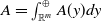 $A = \int _{{\mathbb{R}}^m}^{\oplus } A(y) dy$
and
$A = \int _{{\mathbb{R}}^m}^{\oplus } A(y) dy$
and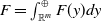 $F = \int _{{\mathbb{R}}^m}^{\oplus } F(y) dy$
be two fibred operators on
$F = \int _{{\mathbb{R}}^m}^{\oplus } F(y) dy$
be two fibred operators on $\mathcal{H}$
. Then,
$\mathcal{H}$
. Then,
 \begin{equation} [A, F] = \int _{{\mathbb{R}}^m}^{\oplus } [A(y), F(y)] dy. \end{equation}
If, in particular, $F(y) = f(y)$
where
$F(y) = f(y)$
where $f: {\mathbb{R}}^m \to {\mathbb{C}}$
, then
$f: {\mathbb{R}}^m \to {\mathbb{C}}$
, then
 \begin{equation} [A, F] = 0. \end{equation}
Moreover,
 \begin{equation} [D_{y_j}, A] = \int _{{\mathbb{R}}^m}^{\oplus } (D_{y_j} A(y)) dy \quad \forall \: j. \end{equation}
We will also make extensive use of the Leibniz (generalised product) rule.
Lemma C.2. (Leibniz Rule). Let $F(y) \in C_b^k \left ({\mathbb{R}}^m, {\mathcal{L}}_{s_1, s_2} \right )$
for some integers
$F(y) \in C_b^k \left ({\mathbb{R}}^m, {\mathcal{L}}_{s_1, s_2} \right )$
for some integers $s_1, s_2 \geqslant 0$
and
$s_1, s_2 \geqslant 0$
and $k \geqslant 1$
. Then, for any
$k \geqslant 1$
. Then, for any $y_i \in {\mathbb{R}}$
,
$y_i \in {\mathbb{R}}$
,
 \begin{equation} [D_{y_i}^k, F(y)] = \sum _{j=0}^{k-1} \left({{k}\atop {k-j}}\right) (\!-\!i\kappa )^{k-j} (\partial _{y_i}^{k-j} F(y)) D_{y_i}^j. \end{equation}
For a multi-index $\alpha = (\alpha _1, \dots , \alpha _m)$
with
$\alpha = (\alpha _1, \dots , \alpha _m)$
with $\left |\alpha \right | \leqslant k$
,
$\left |\alpha \right | \leqslant k$
,
 \begin{equation} [D^\alpha , F(y)] = \sum _{\substack {0 \leqslant \beta \leqslant \alpha \\ \beta \neq \alpha }} \left({{\alpha }\atop {\alpha - \beta }}\right) (\!-\!i\kappa )^{\left |\alpha - \beta \right |} (\partial _y^{\alpha - \beta } F(y)) D_{y}^\beta , \end{equation}
where recall for multi-indices, $\beta \leqslant \alpha$
if
$\beta \leqslant \alpha$
if $\beta _j \leqslant \alpha _j$
for all
$\beta _j \leqslant \alpha _j$
for all $j = 1, \dots , m$
and
$j = 1, \dots , m$
and $\left({{\alpha }\atop {\beta }}\right) \;:\!=\; \left({{\alpha _1}\atop {\beta _1}}\right) \dots \left({{\alpha _m}\atop {\beta _m}}\right)$
.
$\left({{\alpha }\atop {\beta }}\right) \;:\!=\; \left({{\alpha _1}\atop {\beta _1}}\right) \dots \left({{\alpha _m}\atop {\beta _m}}\right)$
.
In particular, if $F = \int _{{\mathbb{R}}^m}^{\oplus } F(y) dy$
is a fibred operator, then (
C.6
) implies
$F = \int _{{\mathbb{R}}^m}^{\oplus } F(y) dy$
is a fibred operator, then (
C.6
) implies
 \begin{align} [D^\alpha , F] &= \sum _{\substack {0 \leqslant \beta \leqslant \alpha \\ \beta \neq \alpha }} \left({{\alpha }\atop {\alpha - \beta }}\right) (\!-\!i\kappa )^{\left |\alpha - \beta \right |} (\partial _y^{\alpha - \beta } F) D_{y}^\beta , \end{align}
where $\partial _y^{\alpha - \beta } F = \int _{{\mathbb{R}}^m}^{\oplus } (\partial _y^{\alpha - \beta } F(y)) dy.$
We shall also need the following general result.
Lemma C.3.
Let $X^\circ$
be a differential operator. Then,
$X^\circ$
be a differential operator. Then,
 \begin{equation} {\overline {P}} \left ( K {\overline {P}} X^\circ - X^\circ P K \right ) P = {\overline {P}} \left [X^\circ , [K, P] - K \right ] P. \end{equation}
Proof of Lemma
C.3. Commuting the $K$
operators through the projections
$K$
operators through the projections $\overline {P}$
and
$\overline {P}$
and $P$
, we obtain
$P$
, we obtain
 \begin{align} &\quad {\overline {P}} \left ( K {\overline {P}} X^\circ - X^\circ P K \right ) P = {\overline {P}} \left (K X^\circ + [K, {\overline {P}}] X^\circ - X^\circ K - X^\circ [P, K] \right ) P. \end{align}
We re-arrange the terms on the right-hand side of the above as follows. First, we notice that $K X^\circ - X^\circ K = - [X^\circ , K]$
. Furthermore, due to
$K X^\circ - X^\circ K = - [X^\circ , K]$
. Furthermore, due to $[K, {\overline {P}}] = - [K, P]$
and
$[K, {\overline {P}}] = - [K, P]$
and $-[P, K] = [K, P]$
, we have
$-[P, K] = [K, P]$
, we have $[K, {\overline {P}}] X^\circ - X^\circ [P, K] = [X^\circ , [K, P]]$
. Using these two identities on the right-hand side of (C.9) yields (C.8).
$[K, {\overline {P}}] X^\circ - X^\circ [P, K] = [X^\circ , [K, P]]$
. Using these two identities on the right-hand side of (C.9) yields (C.8).
C.1. Commutators involving
$\boldsymbol{H}_\kappa$
,
$\overline {\boldsymbol{H}}$
and derivatives


Lemma C.4.
Let Assumption [
A1
] hold for some $k \geqslant 1$
and let
$k \geqslant 1$
and let $\alpha$
be a multi-index with
$\alpha$
be a multi-index with $1 \leqslant \left |\alpha \right | = s \leqslant k$
. Then,
$1 \leqslant \left |\alpha \right | = s \leqslant k$
. Then,
 \begin{align} [i H_\kappa , D^\alpha ] &= O_{{\mathcal{L}}_{s-1, 0}}(\kappa ), \end{align}
 \begin{align} [i \overline {H}, \overline {D^\alpha }] &= O_{{\mathcal{L}}_{s, 0}}(\kappa ).\\[8pt] \nonumber \end{align}
Proof of Lemma
C.4. We define $[i H_\kappa , D^\alpha ] = -[D^\alpha , i H_\kappa ]$
via the sesquilinear form
$[i H_\kappa , D^\alpha ] = -[D^\alpha , i H_\kappa ]$
via the sesquilinear form
 \begin{equation} \langle f, [i H_\kappa , D^\alpha ] g \rangle \;:\!=\; \langle D^\alpha f, i H_\kappa g \rangle - \langle i H_\kappa f, D^\alpha g \rangle \end{equation}
for $f, g \in \mathcal{D}(H_\kappa ) \cap {\mathcal{H}}_{\mathrm {el}} H^{s, \kappa }_{\mathrm {nucl}}$
. Similarly, we define
$f, g \in \mathcal{D}(H_\kappa ) \cap {\mathcal{H}}_{\mathrm {el}} H^{s, \kappa }_{\mathrm {nucl}}$
. Similarly, we define $[i \overline {H}, \overline {D^\alpha }] = -[\overline {D^\alpha }, i \overline {H}]$
via the sesquilinear form
$[i \overline {H}, \overline {D^\alpha }] = -[\overline {D^\alpha }, i \overline {H}]$
via the sesquilinear form
 \begin{equation} \langle f, [i \overline {H}, \overline {D^\alpha }] g \rangle \;:\!=\; \langle \overline {D^\alpha } f, i \overline {H} g \rangle - \langle i \overline {H} f, \overline {D^\alpha } g \rangle \end{equation}
for $f, g \in \mathcal{D}(\overline {H}) \cap {\overline {P}} {\mathcal{H}}_{\mathrm {el}} H^{s, \kappa }_{\mathrm {nucl}}$
.
$f, g \in \mathcal{D}(\overline {H}) \cap {\overline {P}} {\mathcal{H}}_{\mathrm {el}} H^{s, \kappa }_{\mathrm {nucl}}$
.
It remains to show that the forms $[i H_\kappa , D^\alpha ]$
and
$[i H_\kappa , D^\alpha ]$
and $[i \overline {H}, \overline {D^\alpha }]$
defined in (C.12) and (C.13), respectively, extend to the bounded operators on the domains
$[i \overline {H}, \overline {D^\alpha }]$
defined in (C.12) and (C.13), respectively, extend to the bounded operators on the domains ${\mathcal{H}}_{\mathrm {el}} H^{s, \kappa }_{\mathrm {nucl}}$
and
${\mathcal{H}}_{\mathrm {el}} H^{s, \kappa }_{\mathrm {nucl}}$
and ${\overline {P}} {\mathcal{H}}_{\mathrm {el}} H^{s, \kappa }_{\mathrm {nucl}}$
, respectively. We use the Leibniz Rule Lemma C.2 to compute the commutators on a suitable dense subset.
${\overline {P}} {\mathcal{H}}_{\mathrm {el}} H^{s, \kappa }_{\mathrm {nucl}}$
, respectively. We use the Leibniz Rule Lemma C.2 to compute the commutators on a suitable dense subset.
Proof of (C.10): For $f, g \in {\mathcal{H}}_{\mathrm {el}} H^{s, \kappa }_{\mathrm {nucl}} \cap {\mathcal{D}}(H_\kappa ) = {\mathcal{H}}_{\mathrm {el}} H^{s+2}_{\kappa ,y} \cap {\mathcal{D}}_{el} {\mathcal{H}}_{\mathrm {nucl}}$
,
$f, g \in {\mathcal{H}}_{\mathrm {el}} H^{s, \kappa }_{\mathrm {nucl}} \cap {\mathcal{D}}(H_\kappa ) = {\mathcal{H}}_{\mathrm {el}} H^{s+2}_{\kappa ,y} \cap {\mathcal{D}}_{el} {\mathcal{H}}_{\mathrm {nucl}}$
,
 \begin{equation} \langle D^\alpha f, i H_\kappa g \rangle - \langle i H_\kappa f, D^\alpha g \rangle = \langle f, [D^\alpha , i H_\kappa ] g \rangle . \end{equation}
Recall that $H_\kappa = T + H_{\mathrm {bo}}$
, where
$H_\kappa = T + H_{\mathrm {bo}}$
, where $T = -\kappa ^2 \Delta _y$
. For any multi-index
$T = -\kappa ^2 \Delta _y$
. For any multi-index $\alpha$
,
$\alpha$
, $[D^\alpha , T] = [D^\alpha , -\kappa ^2 \Delta _y] = 0$
. Then,
$[D^\alpha , T] = [D^\alpha , -\kappa ^2 \Delta _y] = 0$
. Then,
 \begin{equation} [D^\alpha , H_\kappa ] = [D^\alpha , H_{\mathrm {bo}}], \end{equation}
and using the Leibniz Rule Lemma C.2 we obtain
 \begin{equation} [D^\alpha , H_{\mathrm {bo}}] = \sum _{\substack {0 \leqslant \beta \leqslant \alpha \\ \beta \neq \alpha }} \left({{\alpha }\atop {\alpha - \beta }}\right) (\!-\!i\kappa )^{\left |\alpha - \beta \right |} (\partial _y^{\alpha - \beta } H_{\mathrm {bo}}) D_{y}^\beta , \end{equation}
where $\partial _y^{\alpha - \beta } H_{\mathrm {bo}} = \int ^{\oplus }_{{\mathbb{R}}^m} (\partial _y^{\alpha - \beta } H(y)) dy.$
For all terms in the sum it is true that
$\partial _y^{\alpha - \beta } H_{\mathrm {bo}} = \int ^{\oplus }_{{\mathbb{R}}^m} (\partial _y^{\alpha - \beta } H(y)) dy.$
For all terms in the sum it is true that $\left |\alpha - \beta \right | \leqslant k$
, and the furthermore the condition
$\left |\alpha - \beta \right | \leqslant k$
, and the furthermore the condition $\beta \neq \alpha$
implies
$\beta \neq \alpha$
implies $\left |\alpha - \beta \right | \geqslant 1$
for all
$\left |\alpha - \beta \right | \geqslant 1$
for all $\beta$
. Hence by Assumption [A1],
$\beta$
. Hence by Assumption [A1], $(\partial _y^{\alpha - \beta } H(y)) = O(1)$
for all
$(\partial _y^{\alpha - \beta } H(y)) = O(1)$
for all $\beta$
, and thus
$\beta$
, and thus $[D^\alpha , H_\kappa ]$
is of the form
$[D^\alpha , H_\kappa ]$
is of the form
 \begin{equation} [D^\alpha , H_\kappa ] = \sum _{j=0}^{\left |\alpha \right |-1} O_{{\mathcal{L}}_{j,0}}(\kappa ^{\left |\alpha \right | - j}) = O_{{\mathcal{L}}_{\left |\alpha \right | - 1,0}}(\kappa ), \end{equation}
using $\lVert {\phi }\rVert _{{\mathcal{H}}_{\mathrm {el}} H^{j, \kappa }_{\mathrm {nucl}}} \lesssim \lVert {\phi }\rVert _{{\mathcal{H}}_{\mathrm {el}} H^{n, \kappa }_{\mathrm {nucl}}}$
for all
$\lVert {\phi }\rVert _{{\mathcal{H}}_{\mathrm {el}} H^{j, \kappa }_{\mathrm {nucl}}} \lesssim \lVert {\phi }\rVert _{{\mathcal{H}}_{\mathrm {el}} H^{n, \kappa }_{\mathrm {nucl}}}$
for all $j \lt n$
. Summing over all
$j \lt n$
. Summing over all $\left |\alpha \right | = s$
yields the desired estimate (C.10).
$\left |\alpha \right | = s$
yields the desired estimate (C.10).
Proof of (C.11): For $f, g \in {\overline {P}} {\mathcal{H}}_{\mathrm {el}} H^{s, \kappa }_{\mathrm {nucl}} \cap {\mathcal{D}}(\overline {H}) = {\overline {P}} {\mathcal{H}}_{\mathrm {el}} H^{s+ 2, \kappa }_y \cap {\mathcal{D}}_{el} {\mathcal{H}}_{\mathrm {nucl}}$
,
$f, g \in {\overline {P}} {\mathcal{H}}_{\mathrm {el}} H^{s, \kappa }_{\mathrm {nucl}} \cap {\mathcal{D}}(\overline {H}) = {\overline {P}} {\mathcal{H}}_{\mathrm {el}} H^{s+ 2, \kappa }_y \cap {\mathcal{D}}_{el} {\mathcal{H}}_{\mathrm {nucl}}$
,
 \begin{equation} \langle \overline {D^\alpha } f, i \overline {H} g \rangle - \langle i \overline {H} f, \overline {D^\alpha } g \rangle = \langle f, [\overline {D^\alpha }, i \overline {H}] g \rangle . \end{equation}
Using $\overline {H} = \overline {H}_{\mathrm {bo}} + \overline {T}$
, we have
$\overline {H} = \overline {H}_{\mathrm {bo}} + \overline {T}$
, we have
 \begin{equation} [\overline {D^\alpha }, i \overline {H}] = [\overline {D^\alpha }, i \overline {H}_{\mathrm {bo}}] + [\overline {D^\alpha }, i \overline {T}]. \end{equation}
Consider the first commutator on the right-hand side of (C.19). Since $[{\overline {P}}, H_{\mathrm {bo}}] = 0$
, we have
$[{\overline {P}}, H_{\mathrm {bo}}] = 0$
, we have $\overline {H}_{\mathrm {bo}} = {\overline {P}} H_{\mathrm {bo}} {\overline {P}} = H_{\mathrm {bo}} {\overline {P}} = {\overline {P}} H_{\mathrm {bo}}$
, and thus
$\overline {H}_{\mathrm {bo}} = {\overline {P}} H_{\mathrm {bo}} {\overline {P}} = H_{\mathrm {bo}} {\overline {P}} = {\overline {P}} H_{\mathrm {bo}}$
, and thus
 \begin{align} [\overline {D^\alpha }, i \overline {H}_{\mathrm {bo}}] &= {\overline {P}} D^\alpha {\overline {P}} H_{\mathrm {bo}} {\overline {P}} - {\overline {P}} H_{\mathrm {bo}} {\overline {P}} D^\alpha {\overline {P}} \nonumber \\ &= i {\overline {P}} \left ( D^\alpha H_{\mathrm {bo}} - H_{\mathrm {bo}} D^\alpha \right ) {\overline {P}} \nonumber \\ &= i {\overline {P}} [D^\alpha , H_{\mathrm {bo}}] {\overline {P}} \end{align}
Using (C.16) and (C.17) it is clear that this term is $O_{{\mathcal{L}}_{\left |\alpha \right |-1, 0}}(\kappa )$
, hence
$O_{{\mathcal{L}}_{\left |\alpha \right |-1, 0}}(\kappa )$
, hence
 \begin{equation} [\overline {D^\alpha }, i \overline {H}_{\mathrm {bo}}] = O_{{\mathcal{L}}_{\left |\alpha \right |-1, 0}}(\kappa ). \end{equation}
Now consider the second commutator on the right-hand side of (C.19). Writing $T = \sum _{j=1}^m D_{y_j}^2$
, we have
$T = \sum _{j=1}^m D_{y_j}^2$
, we have
 \begin{equation} [\overline {D^\alpha }, i \overline {T}] = i \sum _{j=1}^m [\overline {D^\alpha }, \overline {D_{y_j}^2}], \end{equation}
and we compute the commutator $[\overline {D^\alpha }, \overline {D_{y_j}^2}]$
to obtain
$[\overline {D^\alpha }, \overline {D_{y_j}^2}]$
to obtain
 \begin{equation} [\overline {D^\alpha }, i \overline {T}] = i \sum _{j=1}^m {\overline {P}} [[D^\alpha , P],[D_{y_j}^2,P] ] {\overline {P}}. \end{equation}
We postpone the computation of (C.23) to the end. Using the Leibniz Rule Lemma C.2, we compute
 \begin{align*} [D^\alpha , P] &= \sum _{\substack {0 \leqslant \beta \leqslant \alpha \\ \beta \neq \alpha }} \left({{\alpha }\atop {\alpha - \beta }}\right) (\!-\!i\kappa )^{\left |\alpha - \beta \right |} (\partial _y^{\alpha - \beta } P) D_{y}^\beta , \\ [D_{y_j}^2,P] &= -\kappa ^2 (\partial _{y_j}^2 P) - 2 i \kappa (\partial _{y_j} P) D_{y_j}, \end{align*}
where by Lemma A.2, $\partial _y^{\gamma } P = O(1)$
for all
$\partial _y^{\gamma } P = O(1)$
for all $\gamma$
with
$\gamma$
with $\left |\gamma \right | \leqslant k$
,
$\left |\gamma \right | \leqslant k$
, $k$
given in Assumption [A1]. Thus, the commutator
$k$
given in Assumption [A1]. Thus, the commutator $[\overline {D^\alpha }, i \overline {T}]$
is of the form
$[\overline {D^\alpha }, i \overline {T}]$
is of the form
 \begin{align} [\overline {D^\alpha }, i \overline {T}] &= \sum _{\substack {0 \leqslant \beta \leqslant \alpha , \: \beta \neq \alpha \\ j = 1, \dots , m}} \left ( O(\kappa ^3) {\overline {P}} [(\partial _y^{\alpha - \beta } P) D_{y}^\beta , (\partial _{y_j}^2 P)] {\overline {P}} + O(\kappa ^2) {\overline {P}} [(\partial _y^{\alpha - \beta } P) D_{y}^\beta , (\partial _{y_j} P) D_{y_j}] {\overline {P}} \right)\!. \end{align}
As $[(\partial _y^{\alpha - \beta } P), (\partial _{y_j} P)] \neq 0$
and
$[(\partial _y^{\alpha - \beta } P), (\partial _{y_j} P)] \neq 0$
and $\left |\beta \right | = \left |\alpha \right | - 1$
, it follows that
$\left |\beta \right | = \left |\alpha \right | - 1$
, it follows that
 \begin{equation} [\overline {D^\alpha }, i \overline {T}] = O_{{\mathcal{L}}_{\left |\alpha \right |, 0}}(\kappa ^2). \end{equation}
Apply the estimates (C.21) and (C.25) together to the right-hand side of (C.19), we obtain
 \begin{equation} [\overline {D^\alpha }, i \overline {H}] = O_{{\mathcal{L}}_{\left |\alpha \right |-1, 0}}(\kappa ) + O_{{\mathcal{L}}_{\left |\alpha \right |, 0}}(\kappa ^2), \end{equation}
from which we obtain (C.11).
It remains to show (C.23). Analogous to (C.20),
 \begin{equation} [\overline {D^\alpha }, \overline {D_{y_j}^2}] = {\overline {P}} \big ( D^\alpha {\overline {P}} D_{y_j}^2 - D_{y_j}^2 {\overline {P}} D^\alpha \big ) {\overline {P}}. \end{equation}
Using ${\overline {P}} = 1 - P$
,
${\overline {P}} = 1 - P$
,
 \begin{equation} [\overline {D^\alpha }, \overline {D_{y_j}^2}] = {\overline {P}} \big ( [D^\alpha , D_{y_j}^2] - D^\alpha P D_{y_j}^2 + D_{y_j}^2 P D^\alpha \big ) {\overline {P}}, \end{equation}
and since $[D^\alpha , D_{y_j}^2] = 0$
we obtain
$[D^\alpha , D_{y_j}^2] = 0$
we obtain
 \begin{equation} [\overline {D^\alpha }, \overline {D_{y_j}^2}] = {\overline {P}} \big (D_{y_j}^2 P D^\alpha - D^\alpha P D_{y_j}^2 \big ) {\overline {P}}. \end{equation}
Writing $P^2 = P$
, we use that
$P^2 = P$
, we use that ${\overline {P}} D_{y_j}^2 P = {\overline {P}} [D_{y_j}^2, P]$
and
${\overline {P}} D_{y_j}^2 P = {\overline {P}} [D_{y_j}^2, P]$
and
 \begin{equation} P D^\alpha {\overline {P}} = [P, D^\alpha ] {\overline {P}} = - [D^\alpha , P] {\overline {P}} \end{equation}
to write
 \begin{equation} {\overline {P}} D_{y_j}^2 P D^\alpha {\overline {P}} = - {\overline {P}} [D_{y_j}^2, P] [D^\alpha ,P] {\overline {P}}, \end{equation}
and analogously for the adjoint terms,
 \begin{equation} - {\overline {P}} D^\alpha P D_{y_j}^2 {\overline {P}} = {\overline {P}} [D^\alpha , P] [D_{y_j}^2, P] {\overline {P}}. \end{equation}
Then combining (C.31) and (C.32) with (C.29), we obtain
 \begin{align} [\overline {D^\alpha }, \overline {D_{y_j}^2}] &= {\overline {P}} \big (\!- [D_{y_j}^2, P] [D^\alpha ,P] + [D^\alpha , P] [D_{y_j}^2,P] \big ) \nonumber \\ &= {\overline {P}} [[D^\alpha , P],[D_{y_j}^2,P] ] {\overline {P}}, \end{align}
C.2. Commutators involving
$\boldsymbol{H}_{\mathrm {bo}}$
,
$\boldsymbol{E}$
,
$\boldsymbol{P}$
,
$\boldsymbol{T}$
and derivatives


Lemma C.5.
Let Assumptions [A1]–[A4] hold. Then, for any multi-index $\left |\alpha \right | \leqslant k$
, where
$\left |\alpha \right | \leqslant k$
, where $k$
is from Assumption [A1],
$k$
is from Assumption [A1],
-
(a) the commutators
$[D^\alpha , H_{\mathrm {bo}}]$
,
$[D^\alpha , E]$
, and
$[D^\alpha , P]$
are
$O_{{\mathcal{L}}_{s+\left |\alpha \right |-1,s}}(\kappa )$
. The same holds if we replace
$H_{\mathrm {bo}}$
,
$E$
and
$P$
with higher-order derivatives
$\partial ^{\alpha _1} H_{\mathrm {bo}}$
,
$\partial ^{\alpha _2} E$
, and
$\partial ^{\alpha _3} P$
, respectively.
-
(b)
$[D^\alpha , {\overline {R}}] = O_{{\mathcal{L}}_{s+\left |\alpha \right |-1,s}}(\kappa )$
,
-
(c)
$[H_{\mathrm {bo}}, [T, P]] = O_{{\mathcal{L}}_{s+1,s}}(\kappa )$
, -
(d)
$[D^\alpha , [T, P]] = O_{{\mathcal{L}}_{s+\left |\alpha \right |,s}}(\kappa ^2)$
.





Proof of Lemma
C.5. a) Recall from Lemma A.2 that $E(y)$
and
$E(y)$
and $P(y)$
are regular, and
$P(y)$
are regular, and $H(y)$
is regular by Assumption [A1. Consider first the commutator
$H(y)$
is regular by Assumption [A1. Consider first the commutator $[D^\alpha , H_{\mathrm {bo}}]$
. We write
$[D^\alpha , H_{\mathrm {bo}}]$
. We write
 \begin{equation} \lVert {[D^\alpha , H_{\mathrm {bo}}] \phi }\rVert _{{\mathcal{H}}_{\mathrm {el}} H^{s, \kappa }_{\mathrm {nucl}}}^2 = \lVert {[D^\alpha , H_{\mathrm {bo}}] \phi }\rVert ^2 + \sum _{\left |\beta \right | = s} \lVert {D^\beta [D^\alpha , H_{\mathrm {bo}}] \phi }\rVert ^2. \end{equation}
We compute using the Leibniz Rule Lemma C.2,
 \begin{align} [D^\alpha , H_{\mathrm {bo}}] &= \sum _{\substack {0 \leqslant \gamma \leqslant \alpha \\ \gamma \neq \alpha }} \left({{\alpha }\atop {\alpha - \gamma }}\right) (\!-\!i\kappa )^{\left |\alpha - \gamma \right |} \int ^{\oplus }_{{\mathbb{R}}^m} (\partial _y^{\alpha - \gamma } H(y)) dy D_{y}^\gamma \nonumber \\ &= O_{{\mathcal{L}}_{\left |\alpha \right |-1,0}}(\kappa ), \end{align}
which estimates the first term on the right-hand side of (C.34). For the second term, consider
 \begin{equation} D^\beta [D^\alpha , H_{\mathrm {bo}}] = [D^\beta , [D^\alpha , H_{\mathrm {bo}}]] + [D^\alpha , H_{\mathrm {bo}}] D^\beta \end{equation}
and use (C.35) to obtain
 \begin{equation} D^\beta [D^\alpha , H_{\mathrm {bo}}] = [D^\beta , [D^\alpha , H_{\mathrm {bo}}]] + O_{{\mathcal{L}}_{s+ \left |\alpha \right | - 1,0}}(\kappa ). \end{equation}
For the remaining term on the right-hand side of (C.37), we have by (C.35) and $[D^\beta , D^\gamma ] = 0$
that
$[D^\beta , D^\gamma ] = 0$
that
 \begin{equation} [D^\beta , [D^\alpha , H_{\mathrm {bo}}]] = \sum _{\substack {0 \leqslant \gamma \leqslant \alpha \\ \gamma \neq \alpha }} \left({{\alpha }\atop {\alpha - \gamma }}\right) (\!-\!i\kappa )^{\left |\alpha - \gamma \right |} [D^\beta , (\partial _y^{\alpha - \gamma } H_{\mathrm {bo}})] D^\gamma . \end{equation}
Applying Lemma C.2 to expand $[D^\beta , (\partial _y^{\alpha - \gamma } H_{\mathrm {bo}})]$
, we see that
$[D^\beta , (\partial _y^{\alpha - \gamma } H_{\mathrm {bo}})]$
, we see that
 \begin{align} [D^\beta , (\partial _y^{\alpha - \gamma } H_{\mathrm {bo}})] = \sum _{\substack {0 \leqslant \sigma \leqslant \beta \\ \sigma \neq \beta }} \left({{\beta }\atop {\beta - \sigma }}\right) (\!-\!i\kappa )^{\left |\beta - \sigma \right |} (\partial _y^{\alpha + \beta - \gamma - \sigma } H_{\mathrm {bo}}) D^\sigma \end{align}
which implies
 \begin{align} & [D^\beta , [D^\alpha , H_{\mathrm {bo}}]] \nonumber \\ &\quad= \sum _{\substack {0 \leqslant \gamma \leqslant \alpha \\ \gamma \neq \alpha }} \sum _{\substack {0 \leqslant \sigma \leqslant \beta \\ \sigma \neq \beta }} \left({{\alpha }\atop {\alpha - \gamma }}\right) \left({{\beta }\atop {\beta - \sigma }}\right) (\!-\!i\kappa )^{\left |\alpha - \gamma \right | + \left |\beta - \sigma \right |} (\partial _y^{\alpha + \beta - \gamma - \sigma } H_{\mathrm {bo}}) D^{\gamma + \sigma } \nonumber \\ &\quad = O_{{\mathcal{L}}_{s+\left |\alpha \right | - 2,0}}(\kappa ^2) \end{align}
Using the bound $\lVert {f}\rVert _{H^{s+\left |\alpha \right | - 2,\kappa }_{\mathrm {nucl}}} \lesssim \lVert {f}\rVert _{H^{s+ \left |\alpha \right | - 1,\kappa }_{\mathrm {nucl}}}$
, and combining (C.37) and (C.40), we obtain
$\lVert {f}\rVert _{H^{s+\left |\alpha \right | - 2,\kappa }_{\mathrm {nucl}}} \lesssim \lVert {f}\rVert _{H^{s+ \left |\alpha \right | - 1,\kappa }_{\mathrm {nucl}}}$
, and combining (C.37) and (C.40), we obtain
 \begin{equation} D^s [H_{\mathrm {bo}}, T] = O_{{\mathcal{L}}_{s+\left |\alpha \right | - 2,0}}(\kappa ^2) + O_{{\mathcal{L}}_{s+ \left |\alpha \right | - 1,0}}(\kappa ) = O_{{\mathcal{L}}_{s+ \left |\alpha \right | - 1,0}}(\kappa ). \end{equation}
Using both estimates (C.35) and (C.41) on the right-hand side of (C.34) we see that
 \begin{align} \lVert {[H_{\mathrm {bo}}, T] \phi }\rVert _{H^{s, \kappa }_{\mathrm {nucl}}}^2 &\lesssim \kappa ^2 \lVert {\phi }\rVert _{H^{\left |\alpha \right | - 1,\kappa }_{\mathrm {nucl}}}^2 + \kappa ^2 \lVert {\phi }\rVert _{H^{s+ \left |\alpha \right | - 1,\kappa }_{\mathrm {nucl}}}^2 \nonumber \\ &\lesssim \kappa ^2 \lVert {\phi }\rVert _{H^{s+ \left |\alpha \right | - 1,\kappa }_{\mathrm {nucl}}}^2, \end{align}
proving the claim. The estimates for the commutators $[D^\alpha , E]$
,
$[D^\alpha , E]$
, $[D^\alpha , P]$
, and the higher-order derivatives follow analogously, replacing
$[D^\alpha , P]$
, and the higher-order derivatives follow analogously, replacing $H(y)$
with
$H(y)$
with $E(y)$
or
$E(y)$
or $P(y)$
or higher-order derivatives where appropriate.
$P(y)$
or higher-order derivatives where appropriate.
b) We consider $[D^\alpha , {\overline {R}}]$
. Using
$[D^\alpha , {\overline {R}}]$
. Using $1 = P + {\overline {P}},$
we expand the commutator
$1 = P + {\overline {P}},$
we expand the commutator $[D^\alpha , {\overline {R}}]$
to write
$[D^\alpha , {\overline {R}}]$
to write
 \begin{align} [D^\alpha , {\overline {R}}] = D^\alpha {\overline {R}} - {\overline {R}} D^\alpha = [\overline {D^\alpha }, {\overline {R}}] + P D^\alpha {\overline {R}} - {\overline {R}} D^\alpha P, \end{align}
where $\overline {D^\alpha } \;:\!=\; {\overline {P}} D^\alpha {\overline {P}}$
. By part a),
$\overline {D^\alpha } \;:\!=\; {\overline {P}} D^\alpha {\overline {P}}$
. By part a), $P D^\alpha {\overline {P}} = [P,D^\alpha ]{\overline {P}} = O_{{\mathcal{L}}_{s+\left |\alpha \right | - 1,s}}(\kappa )$
, and from Lemma A.3 we have
$P D^\alpha {\overline {P}} = [P,D^\alpha ]{\overline {P}} = O_{{\mathcal{L}}_{s+\left |\alpha \right | - 1,s}}(\kappa )$
, and from Lemma A.3 we have ${\overline {R}} = O_{{\mathcal{L}}_{s,s}}(\kappa )$
. Then,
${\overline {R}} = O_{{\mathcal{L}}_{s,s}}(\kappa )$
. Then,
 \begin{equation} P D^\alpha {\overline {R}} = O_{{\mathcal{L}}_{s+\left |\alpha \right | - 1,s}}(\kappa ) = {\overline {R}} D^\alpha P. \end{equation}
Next, we note that, since $ {\overline {P}} (H_{\mathrm {bo}} - E) {\overline {R}} = {\overline {P}} = {\overline {R}} (H_{\mathrm {bo}} - E) {\overline {P}}$
, we have
$ {\overline {P}} (H_{\mathrm {bo}} - E) {\overline {R}} = {\overline {P}} = {\overline {R}} (H_{\mathrm {bo}} - E) {\overline {P}}$
, we have
 \begin{equation} [\overline {D^\alpha }, {\overline {R}}] = {\overline {R}} [\overline {H}_{\mathrm {bo}} - \overline {E}, \overline {D^\alpha }] {\overline {R}}. \end{equation}
Now, using that ${\overline {R}} \: {\overline {P}} = {\overline {R}} = {\overline {P}} \: {\overline {R}}$
and
${\overline {R}} \: {\overline {P}} = {\overline {R}} = {\overline {P}} \: {\overline {R}}$
and $[H_{\mathrm {bo}} - E, {\overline {P}}] = 0$
, we obtain
$[H_{\mathrm {bo}} - E, {\overline {P}}] = 0$
, we obtain
 \begin{align} [\overline {D^\alpha }, {\overline {R}}] &= {\overline {R}} \left ((H_{\mathrm {bo}}- E) {\overline {P}} D^\alpha - D^\alpha {\overline {P}} (H_{\mathrm {bo}} - E) \right ) {\overline {R}} \nonumber \\ &= {\overline {R}} \left ((H_{\mathrm {bo}}- E) D^\alpha - D^\alpha (H_{\mathrm {bo}} - E) \right ) {\overline {R}} \nonumber \\ &= {\overline {R}} \left ( [H_{\mathrm {bo}} - E, D^\alpha ] \right ) {\overline {R}}. \end{align}
By part a), $[H_{\mathrm {bo}}, D^\alpha ]$
and
$[H_{\mathrm {bo}}, D^\alpha ]$
and $[E,D^\alpha ]$
are
$[E,D^\alpha ]$
are $O_{{\mathcal{L}}_{s+\left |\alpha \right | - 1,s}}(\kappa )$
. Hence,
$O_{{\mathcal{L}}_{s+\left |\alpha \right | - 1,s}}(\kappa )$
. Hence,
 \begin{equation} [\overline {D^\alpha }, {\overline {R}}] = O_{{\mathcal{L}}_{s+\left |\alpha \right | - 1,s}}(\kappa ). \end{equation}
Combining (C.43), (C.44), and (C.47) we obtain $[D^\alpha , {\overline {R}}]$
is
$[D^\alpha , {\overline {R}}]$
is $O_{{\mathcal{L}}_{s+\left |\alpha \right |-1,s}}(\kappa )$
, as desired.
$O_{{\mathcal{L}}_{s+\left |\alpha \right |-1,s}}(\kappa )$
, as desired.
c) Now consider $[[T, P], H_{\mathrm {bo}}]$
. While the operators
$[[T, P], H_{\mathrm {bo}}]$
. While the operators $[T,P]$
and
$[T,P]$
and $[T, H_{\mathrm {bo}}]$
are
$[T, H_{\mathrm {bo}}]$
are $O_{{\mathcal{L}}_{s+1,s}}(\kappa )$
, it is not immediately clear whether the commutator of the coefficients of the differential operators in
$O_{{\mathcal{L}}_{s+1,s}}(\kappa )$
, it is not immediately clear whether the commutator of the coefficients of the differential operators in $[T, P]$
and
$[T, P]$
and $H_{\mathrm {bo}}$
are bounded. Writing
$H_{\mathrm {bo}}$
are bounded. Writing $T = D^2$
, then
$T = D^2$
, then
 \begin{equation} [T, P] = [D^2, P] = -i\kappa D (\nabla _y P) - i \kappa (\nabla _y P) D \end{equation}
so that
 \begin{equation} [[T, P], H_{\mathrm {bo}}] = -i\kappa [D (\nabla _y P), H_{\mathrm {bo}}] - i \kappa [(\nabla _y P) D, H_{\mathrm {bo}}]. \end{equation}
Let us consider the first commutator on the right-hand side of (C.49), proceeding analogously for the second. We have
 \begin{equation} [D (\nabla _y P), H_{\mathrm {bo}}] = [D, H_{\mathrm {bo}}] (\nabla _y P) + D [(\nabla _y P), H_{\mathrm {bo}}]. \end{equation}
Note that $\nabla _y P$
is no longer an eigenprojection of
$\nabla _y P$
is no longer an eigenprojection of $H_{\mathrm {bo}}$
, and
$H_{\mathrm {bo}}$
, and $[(\nabla _y P), H_{\mathrm {bo}}] \neq 0$
. However, using the product rule we have
$[(\nabla _y P), H_{\mathrm {bo}}] \neq 0$
. However, using the product rule we have
 \begin{align} [(\nabla _y P), H_{\mathrm {bo}}] &= (\nabla _y P)H_{\mathrm {bo}} - H_{\mathrm {bo}} (\nabla _y P) \nonumber \\ &= \nabla _y (P H_{\mathrm {bo}}) - P(\nabla _y H_{\mathrm {bo}}) - \nabla _y (H_{\mathrm {bo}} P) + (\nabla _y H_{\mathrm {bo}}) P. \end{align}
Since $H_{\mathrm {bo}} P = P H_{\mathrm {bo}}$
, then
$H_{\mathrm {bo}} P = P H_{\mathrm {bo}}$
, then $\nabla _y (P H_{\mathrm {bo}}) - \nabla _y (H_{\mathrm {bo}} P) = 0$
, and thus
$\nabla _y (P H_{\mathrm {bo}}) - \nabla _y (H_{\mathrm {bo}} P) = 0$
, and thus
 \begin{equation} [(\nabla _y P), H_{\mathrm {bo}}] = [(\nabla _y H_{\mathrm {bo}}), P], \end{equation}
which is the commutator of two bounded operators and thus is bounded. Moreover, it is easy to see that it is in fact $O_{{\mathcal{L}}_{s,s}}(1)$
, so that the right-hand side of (C.50) is
$O_{{\mathcal{L}}_{s,s}}(1)$
, so that the right-hand side of (C.50) is $O_{{\mathcal{L}}_{s+1,s}}(\kappa )$
. Arguing analogously for the second commutator on the right-hand side of (C.49), we conclude that
$O_{{\mathcal{L}}_{s+1,s}}(\kappa )$
. Arguing analogously for the second commutator on the right-hand side of (C.49), we conclude that $[[T,P], H_{\mathrm {bo}}]$
is
$[[T,P], H_{\mathrm {bo}}]$
is $O_{{\mathcal{L}}_{s+1,s}}(\kappa )$
.
$O_{{\mathcal{L}}_{s+1,s}}(\kappa )$
.
d) Now we consider $[D^\alpha , [T,P]]$
. Writing
$[D^\alpha , [T,P]]$
. Writing $T = D^2$
and using (C.48) and
$T = D^2$
and using (C.48) and $[D^\alpha , D] = 0$
we write
$[D^\alpha , D] = 0$
we write
 \begin{equation} [D^\alpha , [T,P]] = -i\kappa D [D^\alpha , (\nabla _y P)] - i\kappa [D^\alpha , (\nabla _y P)] D. \end{equation}
Arguing analogously to part a), $[D^\alpha , (\nabla _y P)] = O_{{\mathcal{L}}_{s + \left |\alpha \right |-1,s}}(\kappa )$
, so the right-hand side of (C.53) implies
$[D^\alpha , (\nabla _y P)] = O_{{\mathcal{L}}_{s + \left |\alpha \right |-1,s}}(\kappa )$
, so the right-hand side of (C.53) implies $[D^\alpha , [T,P]] = O_{{\mathcal{L}}_{s + \left |\alpha \right |,s}}(\kappa ^2)$
, as desired.
$[D^\alpha , [T,P]] = O_{{\mathcal{L}}_{s + \left |\alpha \right |,s}}(\kappa ^2)$
, as desired.
The next result is crucial for the proof of Theorem1.2 part (b), and in particular Proposition 4.7 in which we estimate the operators $X_j$
defined in the recursive relations (4.21). Recall that
$X_j$
defined in the recursive relations (4.21). Recall that $K = E + T$
.
$K = E + T$
.
Lemma C.6. Let Assumptions [A1]–[A4] hold. Then,
 \begin{align} &S {\overline {P}} [T, P] P + {\overline {R}} [[T, P], [K, P] - K] P = O_{{\mathcal{L}}_{s+2,s}}(\kappa ^2). \end{align}
Proof of Lemma C.6. We first note that by Lemma C.5 part a),
 \begin{equation} {\overline {P}} [T, P] P = O_{{\mathcal{L}}_{s+1,s}}(\kappa ). \end{equation}
To show (C.54), we study the two terms on the right-hand side individually. For the first term, $S {\overline {P}} [T, P] P$
, we recall that in (3.36),
$S {\overline {P}} [T, P] P$
, we recall that in (3.36), $S = O_{{\mathcal{L}}_{s+1,s}}(\kappa )$
, so that in combination with (C.55) we obtain
$S = O_{{\mathcal{L}}_{s+1,s}}(\kappa )$
, so that in combination with (C.55) we obtain
 \begin{equation} S {\overline {P}} [T, P] P = O_{{\mathcal{L}}_{s+2,s}}(\kappa ^2). \end{equation}
For the second term, ${\overline {R}} [[T, P], [K, P] - K] P$
, using
${\overline {R}} [[T, P], [K, P] - K] P$
, using ${\overline {R}} = O_{{\mathcal{L}}_{s,s}}(1)$
from Lemma A.3 it suffices to estimate the commutator
${\overline {R}} = O_{{\mathcal{L}}_{s,s}}(1)$
from Lemma A.3 it suffices to estimate the commutator $[[T, P], [K, P] - K]$
. Using
$[[T, P], [K, P] - K]$
. Using $K = T + E$
and
$K = T + E$
and $[E, P] = 0$
, then
$[E, P] = 0$
, then $[K, P] = [T, P]$
and we write
$[K, P] = [T, P]$
and we write
 \begin{align} \left [[T, P], [K, P] - K\right ] &= \left [[T,P], [T, P] - T - E\right ] \nonumber \\ &= - \left [[T, P], T\right ] - \left [[T, P], E\right ]. \end{align} $[[T, P], T] = O_{{\mathcal{L}}_{s+2,s}}(\kappa ^2)$
follows from Lemma C.5 part d). A similar argument demonstrates
$[[T, P], T] = O_{{\mathcal{L}}_{s+2,s}}(\kappa ^2)$
follows from Lemma C.5 part d). A similar argument demonstrates $\left [[T, P], E\right ] = O_{{\mathcal{L}}_{s+2,s}}(\kappa ^2)$
, as follows. Writing
$\left [[T, P], E\right ] = O_{{\mathcal{L}}_{s+2,s}}(\kappa ^2)$
, as follows. Writing $T = D^2$
, then
$T = D^2$
, then
 \begin{equation} [T,P] = [D^2, P] = [D,P] D + D[D,P] \end{equation}
where note $[D,P] = O(\kappa )$
. Using furthermore that
$[D,P] = O(\kappa )$
. Using furthermore that
 \begin{equation} [E, [D,P]] = -i\kappa [E, (\nabla _y P)] = i \kappa [P, (\nabla _y E)] = 0 \end{equation}
as $\nabla _y E$
is multiplication by the function
$\nabla _y E$
is multiplication by the function $(\nabla _y E)(y)$
(see LemmaC.1), we have
$(\nabla _y E)(y)$
(see LemmaC.1), we have
 \begin{align} [E,[T,P]] &= [E, [D,P]] D + [D,P][E, D] + [E,D] [D,P] \nonumber \\ &\quad + D [E,[D,P]] \nonumber \\ &= [D,P] [E, D] + [E, D] [D,P]. \end{align}
Since also $[E, D] = i \kappa (\nabla _y E) = O(\kappa ),$
then it follows that
$[E, D] = i \kappa (\nabla _y E) = O(\kappa ),$
then it follows that
 \begin{equation} [E,[T,P]] = O(\kappa ^2). \end{equation}
Thus the right-hand side of (C.57) is $O_{{\mathcal{L}}_{s+2,s}}(\kappa ^2)$
, which implies that
$O_{{\mathcal{L}}_{s+2,s}}(\kappa ^2)$
, which implies that
 \begin{equation} {\overline {R}} [[T, P], [K, P] - K] P = O_{{\mathcal{L}}_{s+2,s}}(\kappa ^2), \end{equation}
so the estimate (C.54) follows.
Appendix D. Estimates on propagators
In this section we collect the estimates on the propagators
 \begin{equation} U_t = e^{- i H t/\kappa }, \quad \overline {U}_t = e^{-i \overline {H} t/\kappa }, \quad U^P_t = e^{-i P H_\kappa P t/\kappa }. \end{equation}
By standard results and Proposition B.2, the generators are all self-adjoint on the spaces ${\mathcal{H}} = {\mathcal{H}}_{\mathrm {el}} {\mathcal{H}}_{\mathrm {nucl}} , {\mathrm {Ran}}\, {\overline {P}},$
and
${\mathcal{H}} = {\mathcal{H}}_{\mathrm {el}} {\mathcal{H}}_{\mathrm {nucl}} , {\mathrm {Ran}}\, {\overline {P}},$
and ${\mathrm {Ran}}\, P$
respectively.
${\mathrm {Ran}}\, P$
respectively.
We establish the existence of the semigroup $U_t$
on the Hilbert spaces
$U_t$
on the Hilbert spaces ${\mathcal{H}}_{\mathrm {el}} H^{s, \kappa }_{\mathrm {nucl}}$
, equipped with the tensor product norm of the Sobolev norm given in (1.42) and the norm
${\mathcal{H}}_{\mathrm {el}} H^{s, \kappa }_{\mathrm {nucl}}$
, equipped with the tensor product norm of the Sobolev norm given in (1.42) and the norm $\lVert {\cdot }\rVert _{{\mathcal{H}}_{\mathrm {el}}}$
of
$\lVert {\cdot }\rVert _{{\mathcal{H}}_{\mathrm {el}}}$
of ${\mathcal{H}}_{\mathrm {el}}$
. In a similar manner we consider
${\mathcal{H}}_{\mathrm {el}}$
. In a similar manner we consider $\overline {U}_t$
on the closed subspace
$\overline {U}_t$
on the closed subspace ${\overline {P}} {\mathcal{H}}_{\mathrm {el}} H^{s, \kappa }_{\mathrm {nucl}}$
.
${\overline {P}} {\mathcal{H}}_{\mathrm {el}} H^{s, \kappa }_{\mathrm {nucl}}$
.
Theorem D.1.
Let Assumptions [A1]–[A4] hold. Then, $U_t$
is a
$U_t$
is a $C_0$
-semigroup on
$C_0$
-semigroup on ${\mathcal{H}}_{\mathrm {el}} H^{s, \kappa }_{\mathrm {nucl}}$
. Furthermore, for all
${\mathcal{H}}_{\mathrm {el}} H^{s, \kappa }_{\mathrm {nucl}}$
. Furthermore, for all $t \in \mathbb{R}$
and integers
$t \in \mathbb{R}$
and integers $0 \leqslant s \leqslant k$
, where
$0 \leqslant s \leqslant k$
, where $k$
is given in 1, there exists a constant
$k$
is given in 1, there exists a constant $C \gt 0$
such that
$C \gt 0$
such that
 \begin{align} \lVert {U_t \phi }\rVert _{{\mathcal{H}}_{\mathrm {el}} H^{s, \kappa }_{\mathrm {nucl}}} \leqslant C \langle t \rangle ^s \lVert {\phi }\rVert _{{\mathcal{H}}_{\mathrm {el}} H^{s, \kappa }_{\mathrm {nucl}}}. \end{align}
Furthermore, for $\phi \in {\mathrm {Ran}}\, {\overline {P}}$
, then for every
$\phi \in {\mathrm {Ran}}\, {\overline {P}}$
, then for every $s$
there exists a constant
$s$
there exists a constant $C_s \gt 0$
such that
$C_s \gt 0$
such that
 \begin{equation} \lVert {\overline {U}_t \phi }\rVert _{{\mathcal{H}}_{\mathrm {el}} H^{s, \kappa }_{\mathrm {nucl}}} \leqslant C_s e^{C_s \left |t\right |} \lVert {\phi }\rVert _{{\mathcal{H}}_{\mathrm {el}} H^{s, \kappa }_{\mathrm {nucl}}}. \end{equation}
Proof of Theorem
D.1. To establish TheoremD.1, we will make use of the Lumer-Phillips theorem (see e.g. Theorem 4.3 [Reference Arbunich, Pusateri, Sigal and Soffer69]), which amounts at finding some constants $C, \overline {C} \gt 0$
such that the operators
$C, \overline {C} \gt 0$
such that the operators
 \begin{align} H_{\kappa ,C} \;:\!=\; \frac {i}{\kappa } H_{\kappa } - C, &\quad {\mathcal{D}}(H_{\kappa ,C}) = {\mathcal{D}}(H_{\kappa }), \end{align}
 \begin{align} H_{\overline {C}} \;:\!=\; \frac {i}{\kappa } \overline {H} - \overline {C}, &\quad {\mathcal{D}}(H_{\overline {C}}) = {\mathcal{D}}(\overline {H}),\\[8pt] \nonumber \end{align}
are dissipative, in the sense that
 \begin{align} {\mathrm {Re}}\, \bigg\langle \bigg(\frac {i}{\kappa } H_{\kappa } - C\bigg) \phi , \phi \bigg\rangle _{{\mathcal{H}}_{\mathrm {el}} H^{s, \kappa }_{\mathrm {nucl}}} &\leqslant 0, \end{align}
 \begin{align} {\mathrm {Re}}\, \bigg\langle \bigg(\frac {i}{\kappa } \overline {H} - \overline {C}\bigg) \phi , \phi \bigg\rangle _{{\mathcal{H}}_{\mathrm {el}} H^{s, \kappa }_{\mathrm {nucl}}} &\leqslant 0, \\[8pt] \nonumber\end{align}
for all $\phi \in {\mathcal{H}}_{\mathrm {el}} H^{s, \kappa }_{\mathrm {nucl}}$
.
$\phi \in {\mathcal{H}}_{\mathrm {el}} H^{s, \kappa }_{\mathrm {nucl}}$
.
Step 1. $H_{\kappa ,C}$
is dissipative for some constant
$H_{\kappa ,C}$
is dissipative for some constant $C\gt 0$
. We aim to establish the first inequality (D.6) for a suitable constant
$C\gt 0$
. We aim to establish the first inequality (D.6) for a suitable constant $C\gt 0$
to be chosen later on. By the definition of the tensor inner product and using that
$C\gt 0$
to be chosen later on. By the definition of the tensor inner product and using that $D_y^{\alpha } (\frac {i}{\kappa } H_\kappa ) = [D_y^{\alpha }, \frac {i}{\kappa } H_\kappa ] + \frac {i}{\kappa } H_\kappa D_y^\alpha$
we find
$D_y^{\alpha } (\frac {i}{\kappa } H_\kappa ) = [D_y^{\alpha }, \frac {i}{\kappa } H_\kappa ] + \frac {i}{\kappa } H_\kappa D_y^\alpha$
we find
 \begin{align} \bigg\langle \frac {i}{\kappa } H_\kappa \phi , \phi \bigg\rangle _{{\mathcal{H}}_{\mathrm {el}} H^{s, \kappa }_{\mathrm {nucl}}} & = \sum _{\left |\alpha \right | = s} \bigg\langle D_y^{\alpha } \bigg(\frac {i}{\kappa } H_\kappa \bigg) \phi , D_y^{\alpha } \phi \bigg\rangle + \bigg\langle \frac {i}{\kappa } H_{\kappa } \phi , \phi \bigg\rangle \nonumber \\ &= \sum _{\left |\alpha \right | = s} \bigg ( \bigg\langle \bigg[D_y^{\alpha }, \frac {i}{\kappa } H_\kappa \bigg] \phi , D_y^{\alpha } \phi \bigg\rangle + \bigg\langle \bigg(\frac {i}{\kappa } H_\kappa \bigg) D_y^{\alpha } \phi , D_y^{\alpha } \phi \bigg\rangle + \bigg\langle \frac {i}{\kappa } H_{\kappa } \phi , \phi \bigg\rangle \bigg ), \end{align}
for every $\phi \in {\mathcal{H}}_{\mathrm {el}} H^{s, \kappa }_{\mathrm {nucl}}$
. Using that
$\phi \in {\mathcal{H}}_{\mathrm {el}} H^{s, \kappa }_{\mathrm {nucl}}$
. Using that $H_\kappa$
is self-adjoint, taking the real part yields
$H_\kappa$
is self-adjoint, taking the real part yields
 \begin{equation} {\mathrm {Re}}\, \bigg\langle \frac {i}{\kappa } H_\kappa \phi , \phi \bigg\rangle _{{\mathcal{H}}_{\mathrm {el}} H^{s, \kappa }_{\mathrm {nucl}}} = \sum _{\left |\alpha \right | = s} {\mathrm {Re}}\, \bigg\langle \bigg[D_y^{\alpha }, \frac {i}{\kappa } H_\kappa \bigg] \phi , D_y^{\alpha } \phi \bigg\rangle . \end{equation}
Now, by Lemma C.4, $[D_y^{\alpha }, \frac {i}{\kappa } H_\kappa ] = O_{{\mathcal{L}}_{s-1, 0}}$
, and hence from Cauchy-Schwarz,
$[D_y^{\alpha }, \frac {i}{\kappa } H_\kappa ] = O_{{\mathcal{L}}_{s-1, 0}}$
, and hence from Cauchy-Schwarz,
 \begin{equation} {\mathrm {Re}}\, \bigg\langle \frac {i}{\kappa } H_\kappa \phi , \phi \bigg\rangle _{{\mathcal{H}}_{\mathrm {el}} H^{s, \kappa }_{\mathrm {nucl}}} \leqslant C \lVert {\phi }\rVert ^2_{{\mathcal{H}}_{\mathrm {el}} H^{s, \kappa }_{\mathrm {nucl}}}, \end{equation}
for some constant $C \gt 0$
. Thus,
$C \gt 0$
. Thus, $H_{\kappa ,C} = \frac {i}{\kappa } H_{\kappa } - C$
is dissipative and by the Lumer-Phillips theorem it generates a
$H_{\kappa ,C} = \frac {i}{\kappa } H_{\kappa } - C$
is dissipative and by the Lumer-Phillips theorem it generates a $C_0$
-semigroup on
$C_0$
-semigroup on ${\mathcal{H}}_{\mathrm {el}} H^{s, \kappa }_{\mathrm {nucl}}$
. By classical arguments, this semigroup must coincide with
${\mathcal{H}}_{\mathrm {el}} H^{s, \kappa }_{\mathrm {nucl}}$
. By classical arguments, this semigroup must coincide with $U_t \big |_{{\mathcal{H}}_{\mathrm {el}} H^{s, \kappa }_{\mathrm {nucl}}}$
and in particular, we have the estimate
$U_t \big |_{{\mathcal{H}}_{\mathrm {el}} H^{s, \kappa }_{\mathrm {nucl}}}$
and in particular, we have the estimate
 \begin{equation} \lVert {U_t \phi }\rVert _{{\mathcal{H}}_{\mathrm {el}} H^{s, \kappa }_{\mathrm {nucl}}} \lesssim e^{Ct} \lVert {\phi }\rVert _{{\mathcal{H}}_{\mathrm {el}} H^{s, \kappa }_{\mathrm {nucl}}}. \end{equation}
Step 2. Proof of the polynomial estimate (D.2). To show (D.2), we use the strong $C^1$
property of the map
$C^1$
property of the map $t \mapsto D(t) \;:\!=\; U_{-t} D^{\alpha } U_t$
, for
$t \mapsto D(t) \;:\!=\; U_{-t} D^{\alpha } U_t$
, for $|\alpha | = s$
. Arguing as in [Reference Anapolitanos70, Proposition 3.1], we may write
$|\alpha | = s$
. Arguing as in [Reference Anapolitanos70, Proposition 3.1], we may write
 \begin{align} U_{-t} D^\alpha U_t \phi &= D^\alpha \phi + U_{-t} [D^\alpha , U_t] \phi \nonumber \\ &= D^\alpha \phi + \int _0^t U_{-s} \bigg[\frac {i}{\kappa } H_\kappa , D^\alpha \bigg] U_s \phi\, \text{d}s. \end{align}
Then, we shall use Lemma C.4 to show that the unbounded commutator in the integrand of the right-hand side is $O_{{\mathcal{L}}_{s-1, 0}}(1)$
, which gives (D.2).
$O_{{\mathcal{L}}_{s-1, 0}}(1)$
, which gives (D.2).
We prove it by induction on $s \geqslant 1$
(when
$s \geqslant 1$
(when $s=0$
the estimate follows immediately by the unitary property of
$s=0$
the estimate follows immediately by the unitary property of $U_t$
). For the case
$U_t$
). For the case $s=1$
, commuting
$s=1$
, commuting $D_{y_j} U_t = U_t D_{y_j} + [D_{y_j}, U_t]$
, we have
$D_{y_j} U_t = U_t D_{y_j} + [D_{y_j}, U_t]$
, we have
 \begin{align} \lVert {U_t \phi }\rVert _{{\mathcal{H}}_{\mathrm {el}} H^{1, \kappa }_{\mathrm {nucl}}} &\leqslant \sum _{j=1}^m \lVert {D_{y_j} U_t \phi }\rVert + \lVert {U_t \phi }\rVert \nonumber \\ &\leqslant \sum _{j=1}^m \lVert {D_{y_j} \phi }\rVert + \lVert {[D_{y_j}, U_t] \phi }\rVert + \lVert {\phi }\rVert \nonumber \\ &\lesssim \lVert {\phi }\rVert _{{\mathcal{H}}_{\mathrm {el}} H^{1, \kappa }_{\mathrm {nucl}}} + \sum _{j=1}^m \lVert {[D_{y_j}, U_t] \phi }\rVert ^2. \end{align}
By Lemma C.4,
 \begin{equation} [D_{y_j}, U_t] = \int _0^t U_{t-r} \bigg[D_{y_j}, \frac {-i}{\kappa } H\bigg] U_r\, \text{d}r = O(\left |t\right |), \end{equation}
which combined with (D.13) completes the proof of the base case. Now assume the estimate (D.2) holds for $s = n$
and we seek to show the estimate for
$s = n$
and we seek to show the estimate for $s = n+1$
. Note that by the Assumption A2, it must be that
$s = n+1$
. Note that by the Assumption A2, it must be that $n+1 \leqslant k$
. Analogous to (D.13), we have
$n+1 \leqslant k$
. Analogous to (D.13), we have
 \begin{align} \lVert {U_t \phi }\rVert _{{\mathcal{H}}_{\mathrm {el}} H^{n+1, \kappa }_{\mathrm {nucl}}} &\leqslant \sum _{\left |\alpha \right | = n+1} \lVert {D_{y}^{\alpha } U_t \phi }\rVert + \lVert {U_t \phi }\rVert \nonumber \\ &\leqslant \sum _{\left |\alpha \right | = n+1} \lVert {D_{y}^{\alpha } \phi }\rVert + \lVert {[D_{y}^{\alpha }, U_t] \phi }\rVert + \lVert {\phi }\rVert \nonumber \\ &\lesssim \lVert {\phi }\rVert _{{\mathcal{H}}_{\mathrm {el}} H^{n+1, \kappa }_{\mathrm {nucl}}} + \sum _{\left |\alpha \right | = n+1} \lVert {[D_{y}^\alpha , U_t] \phi }\rVert . \end{align}
By Lemma C.4,
 \begin{equation} [D^\alpha , U_t] = \int _0^t U_{t-r} \bigg[D^\alpha , \frac {-i}{\kappa } H\bigg] U_r\, \text{d}r = \int _0^t U_{t-r} O_{{\mathcal{L}}_{n, 0}}(1) U_r\, \text{d}r. \end{equation}
Using the inductive assumption, $O_{{\mathcal{L}}_{n, 0}}(1) U_r = O_{{\mathcal{L}}_{n, 0}}((1+\left |r\right |)^n)$
, and integrating this estimate in
$O_{{\mathcal{L}}_{n, 0}}(1) U_r = O_{{\mathcal{L}}_{n, 0}}((1+\left |r\right |)^n)$
, and integrating this estimate in $r$
results in
$r$
results in
 \begin{equation} [D^\alpha , U_t] = O_{{\mathcal{L}}_{n, 0}}((1+\left |t\right |)^{n+1}). \end{equation}
Combining (D.15) with (D.17) and the bound $\lVert {\phi }\rVert _{{\mathcal{H}}_{\mathrm {el}} H^{n, \kappa }_{\mathrm {nucl}}} \lesssim \lVert {\phi }\rVert _{{\mathcal{H}}_{\mathrm {el}} H^{n+1, \kappa }_{\mathrm {nucl}}}$
yields the desired estimate for
$\lVert {\phi }\rVert _{{\mathcal{H}}_{\mathrm {el}} H^{n, \kappa }_{\mathrm {nucl}}} \lesssim \lVert {\phi }\rVert _{{\mathcal{H}}_{\mathrm {el}} H^{n+1, \kappa }_{\mathrm {nucl}}}$
yields the desired estimate for $s=n+1$
, so the proof by induction is complete.
$s=n+1$
, so the proof by induction is complete.
Step 3. $H_{\overline {C}}$
is dissipative for some constant
$H_{\overline {C}}$
is dissipative for some constant $\overline {C}\gt 0$
. The proof is identical to Step 1, so we underline only the significant modifications if
$\overline {C}\gt 0$
. The proof is identical to Step 1, so we underline only the significant modifications if $\phi \in {\overline {P}} {\mathcal{H}}_{\mathrm {el}} H^{s, \kappa }_{\mathrm {nucl}}$
. Using the self-adjointness of
$\phi \in {\overline {P}} {\mathcal{H}}_{\mathrm {el}} H^{s, \kappa }_{\mathrm {nucl}}$
. Using the self-adjointness of $\overline {H}$
(see Lemma B.2),
$\overline {H}$
(see Lemma B.2),
 \begin{equation} {\mathrm {Re}}\, \bigg\langle \frac {i}{\kappa } \overline {H} \phi , \phi \bigg\rangle _{{\mathcal{H}}_{\mathrm {el}} H^{s, \kappa }_{\mathrm {nucl}}} = \sum _{\left |\alpha \right | = s} {\mathrm {Re}}\, \bigg\langle D_y^{\alpha } \bigg(\frac {i}{\kappa }\overline {H}\bigg) \phi , D_y^{\alpha } \phi \bigg\rangle , \end{equation}
as $ {\mathrm {Re}}\, \langle \frac {i}{\kappa } \overline {H} \phi , \phi \rangle = 0$
. Now, as
$ {\mathrm {Re}}\, \langle \frac {i}{\kappa } \overline {H} \phi , \phi \rangle = 0$
. Now, as $\phi \in {\mathrm {Ran}}\, {\overline {P}}$
and
$\phi \in {\mathrm {Ran}}\, {\overline {P}}$
and $1 = P + {\overline {P}}$
, using that
$1 = P + {\overline {P}}$
, using that $ P \overline {H} = 0$
and
$ P \overline {H} = 0$
and $P \phi = 0$
we may write
$P \phi = 0$
we may write
 \begin{align} \bigg\langle D_y^{\alpha } \bigg(\frac {i}{\kappa }\overline {H}\bigg) \phi , D_y^{\alpha } \phi \bigg\rangle &= \bigg\langle D_y^{\alpha } (P + {\overline {P}}) \bigg(\frac {i}{\kappa }\overline {H}\bigg) \phi , D_y^{\alpha } (P + {\overline {P}}) \phi \bigg\rangle \nonumber \\ &= \bigg\langle D_y^{\alpha } {\overline {P}} \bigg(\frac {i}{\kappa }\overline {H}\bigg) \phi , D_y^{\alpha } {\overline {P}} \phi \bigg\rangle . \end{align}
Next, expanding the commutator
 \begin{equation} \overline {D_y^{\alpha }} \bigg(\frac {i}{\kappa }\overline {H}\bigg) = \bigg[\overline {D_y^{\alpha }}, \bigg(\frac {i}{\kappa }\overline {H}\bigg)\bigg] + \bigg(\frac {i}{\kappa }\overline {H}\bigg) \overline {D_y^{\alpha }}, \end{equation}
and using that ${\mathrm {Re}}\, \langle (\frac {i}{\kappa }\overline {H}) \overline {D_y^{\alpha }} \phi , \overline {D_y^{\alpha }} \phi \rangle = 0$
, taking the real part we have
${\mathrm {Re}}\, \langle (\frac {i}{\kappa }\overline {H}) \overline {D_y^{\alpha }} \phi , \overline {D_y^{\alpha }} \phi \rangle = 0$
, taking the real part we have
 \begin{align} {\mathrm {Re}}\, \bigg\langle D_y^{\alpha } \bigg(\frac {i}{\kappa }\overline {H}\bigg) \phi , D_y^{\alpha } \phi \bigg\rangle &= {\mathrm {Re}}\, \bigg\langle \overline {D_y^{\alpha }} \bigg(\frac {i}{\kappa }\overline {H}\bigg) \phi , \overline {D_y^{\alpha }} \phi \bigg\rangle \nonumber \\ &\quad + {\mathrm {Re}}\, \bigg\langle P D_y^{\alpha } {\overline {P}} \bigg(\frac {i}{\kappa }\overline {H}\bigg) \phi , P D_y^{\alpha } {\overline {P}} \phi \bigg\rangle . \end{align}
Hence, summing over $\alpha$
in the range
$\alpha$
in the range $\vert \alpha \vert = s$
, (D.18) can be rephrased as
$\vert \alpha \vert = s$
, (D.18) can be rephrased as
 \begin{equation} {\mathrm {Re}}\, \bigg\langle \frac {i}{\kappa } \overline {H} \phi , \phi \bigg\rangle _{{\mathcal{H}}_{\mathrm {el}} H^{s, \kappa }_{\mathrm {nucl}}} = \sum _{\left |\alpha \right | = s} {\mathrm {Re}}\, \left ( I_1^\alpha + I_2^\alpha \right ) , \end{equation}
where for every $\vert \alpha \vert = s$
,
$\vert \alpha \vert = s$
,
 \begin{equation} I_1^\alpha \;:\!=\; \bigg\langle \overline {D_y^{\alpha }} \bigg(\frac {i}{\kappa }\overline {H}\bigg) \phi , \overline {D_y^{\alpha }} \phi \bigg\rangle , \quad I_2^\alpha \;:\!=\; \bigg\langle P D_y^{\alpha } {\overline {P}} \bigg(\frac {i}{\kappa }\overline {H}\bigg) \phi , P D_y^{\alpha } {\overline {P}} \phi \bigg\rangle . \end{equation}
We shall next fix $\alpha$
with
$\alpha$
with $\vert \alpha \vert = s$
and examine each term separately.
$\vert \alpha \vert = s$
and examine each term separately.
Consider the term $I_1^\alpha$
. By Lemma C.4, the commutator
$I_1^\alpha$
. By Lemma C.4, the commutator $[\overline {D_y^\alpha }, \frac {i}{\kappa } \overline {H}]$
is
$[\overline {D_y^\alpha }, \frac {i}{\kappa } \overline {H}]$
is $O_{{\mathcal{L}}_{s, 0}}(1)$
, and thus by Cauchy-Schwarz and the bound
$O_{{\mathcal{L}}_{s, 0}}(1)$
, and thus by Cauchy-Schwarz and the bound $\lVert {\phi }\rVert _{{\mathcal{H}}_{\mathrm {el}} H^{s-1, \kappa }_{\mathrm {nucl}}} \lesssim \lVert {\phi }\rVert _{{\mathcal{H}}_{\mathrm {el}} H^{s, \kappa }_{\mathrm {nucl}}}$
,
$\lVert {\phi }\rVert _{{\mathcal{H}}_{\mathrm {el}} H^{s-1, \kappa }_{\mathrm {nucl}}} \lesssim \lVert {\phi }\rVert _{{\mathcal{H}}_{\mathrm {el}} H^{s, \kappa }_{\mathrm {nucl}}}$
,
 \begin{align} {\mathrm {Re}}\, I_1^\alpha = {\mathrm {Re}}\, \bigg\langle \bigg[\overline {D_y^{\alpha }}, \bigg(\frac {i}{\kappa }\overline {H}\bigg)\bigg] \phi , \overline {D_y^{\alpha }} \phi \rangle &\leqslant C \lVert {\phi }\rVert _{{\mathcal{H}}_{\mathrm {el}} H^{s-1, \kappa }_{\mathrm {nucl}}} \lVert {\phi }\rVert _{{\mathcal{H}}_{\mathrm {el}} H^{s, \kappa }_{\mathrm {nucl}}} \nonumber \\ &\leqslant C \lVert {\phi }\rVert _{{\mathcal{H}}_{\mathrm {el}} H^{s, \kappa }_{\mathrm {nucl}}}^2. \end{align}
Now we consider the term $I_2^\alpha$
. Owing to the particular structure of this term, we aim to manipulate both sides of the scalar product in
$I_2^\alpha$
. Owing to the particular structure of this term, we aim to manipulate both sides of the scalar product in $I_2^\alpha$
in order to make appear a suitable commutator that we know how to bound. Writing
$I_2^\alpha$
in order to make appear a suitable commutator that we know how to bound. Writing $\overline {H} = \overline {H}_{\mathrm {bo}} + \overline {T}$
, where
$\overline {H} = \overline {H}_{\mathrm {bo}} + \overline {T}$
, where $T = - \kappa ^2 \Delta _y$
, and using the commutator
$T = - \kappa ^2 \Delta _y$
, and using the commutator $D_y^\alpha H_{\mathrm {bo}} = [D_y^\alpha , H_{\mathrm {bo}}] + H_{\mathrm {bo}} D_y^\alpha$
we have
$D_y^\alpha H_{\mathrm {bo}} = [D_y^\alpha , H_{\mathrm {bo}}] + H_{\mathrm {bo}} D_y^\alpha$
we have
 \begin{align} P D_y^{\alpha } {\overline {P}} \bigg(\frac {i}{\kappa }\overline {H}\bigg) & = \frac {i}{\kappa } P D_y^\alpha {\overline {P}} H_{\mathrm {bo}} {\overline {P}} + \frac {i}{\kappa } P D_y^\alpha {\overline {P}} T {\overline {P}} \nonumber \\ &= \frac {i}{\kappa } P [D_y^\alpha , H_{\mathrm {bo}}] {\overline {P}} + \frac {i}{\kappa } PH_{\mathrm {bo}} D_y^\alpha {\overline {P}} + P D_y^\alpha {\overline {P}} T {\overline {P}}, \end{align}
as $[H_{\mathrm {bo}}, {\overline {P}}] = 0$
. Using also
$[H_{\mathrm {bo}}, {\overline {P}}] = 0$
. Using also $[H_{\mathrm {bo}}, P] = 0$
, this becomes
$[H_{\mathrm {bo}}, P] = 0$
, this becomes
 \begin{equation} P D_y^\alpha {\overline {P}} H_{\mathrm {bo}} {\overline {P}} = P D_y^\alpha H_{\mathrm {bo}} {\overline {P}} = P [D_y^\alpha , H_{\mathrm {bo}}] {\overline {P}} + H_{\mathrm {bo}} P D_y^\alpha {\overline {P}}, \end{equation}
which combined with the previous identity implies
 \begin{equation} P D_y^{\alpha } {\overline {P}} \bigg(\frac {i}{\kappa }\overline {H}\bigg) = \frac {i}{\kappa } H_{\mathrm {bo}} P D_y^\alpha {\overline {P}} + \frac {i}{\kappa } P [D_y^\alpha , H_{\mathrm {bo}}] {\overline {P}} + \frac {i}{\kappa } P D_y^\alpha {\overline {P}} T {\overline {P}}. \end{equation}
Now, injecting this in the definition of $I_2^\alpha$
we find
$I_2^\alpha$
we find
 \begin{align} {\mathrm {Re}}\, I_2^\alpha &= {\mathrm {Re}}\, \bigg\langle \frac {i}{\kappa } P [D_y^{\alpha }, H_{\mathrm {bo}}] {\overline {P}} \phi , P D_y^{\alpha } {\overline {P}} \phi \bigg\rangle \nonumber \\ &\quad + {\mathrm {Re}}\, \langle \frac {i}{\kappa } P D_y^{\alpha } {\overline {P}} T {\overline {P}} \phi , P D_y^{\alpha } {\overline {P}} \phi \rangle , \end{align}
where we have used that $ {\mathrm {Re}}\, \langle \frac {i}{\kappa } H_{\mathrm {bo}} P D_y^\alpha {\overline {P}} \phi , P D_y^\alpha {\overline {P}} \phi \rangle = 0$
is purely imaginary by the self-adjointness of
$ {\mathrm {Re}}\, \langle \frac {i}{\kappa } H_{\mathrm {bo}} P D_y^\alpha {\overline {P}} \phi , P D_y^\alpha {\overline {P}} \phi \rangle = 0$
is purely imaginary by the self-adjointness of $H_{\mathrm {bo}}$
.
$H_{\mathrm {bo}}$
.
We expand next the commutator in the first term of (D.28). By the Leibniz Rule (cf. Lemma C.2),
 \begin{align} P [D_y^{\alpha }, H_{\mathrm {bo}}] {\overline {P}} &= \sum _{\substack {0 \leqslant \beta \leqslant \alpha \\ \beta \neq \alpha }} \left({{\alpha }\atop {\alpha - \beta }}\right) (\!-\!i\kappa )^{\left |\alpha - \beta \right |} P (\partial _y^{\alpha - \beta } H_{\mathrm {bo}}) D_{y}^\beta {\overline {P}} \nonumber \\ &= O_{{\mathcal{L}}_{s-1, 0}}(\kappa ) \end{align}
and
 \begin{align} P D_y^\alpha {\overline {P}} = [P, D_y^\alpha ] {\overline {P}} &= - \sum _{\substack {0 \leqslant \beta \leqslant \alpha \\ \beta \neq \alpha }} \left({{\alpha }\atop {\alpha - \beta }}\right) (\!-\!i\kappa )^{\left |\alpha - \beta \right |} (\partial _y^{\alpha - \beta } P) D_{y}^\beta {\overline {P}} \nonumber \\ &= O_{{\mathcal{L}}_{s-1, 0}}(\kappa ). \end{align}
Using these estimates, by Cauchy-Schwarz we estimate the first term on the right-hand side of (D.28) by
 \begin{equation} {\mathrm {Re}}\, \langle \frac {i}{\kappa } P [D_y^{\alpha }, H_{\mathrm {bo}}] {\overline {P}} \phi , P D_y^{\alpha } {\overline {P}} \phi \rangle \leqslant C \kappa \lVert {\phi }\rVert _{{\mathcal{H}}_{\mathrm {el}} H^{s-1, \kappa }_{\mathrm {nucl}}}^2 \leqslant C \kappa \lVert {\phi }\rVert _{{\mathcal{H}}_{\mathrm {el}} H^{s, \kappa }_{\mathrm {nucl}}}^2, \end{equation}
for some constant $C \gt 0$
. Looking at the second term on the right-hand side of (D.28), we observe that the left side of the inner product is
$C \gt 0$
. Looking at the second term on the right-hand side of (D.28), we observe that the left side of the inner product is $O_{{\mathcal{L}}_{s+1, 0}}(1)$
(since
$O_{{\mathcal{L}}_{s+1, 0}}(1)$
(since $P D_y^\alpha {\overline {P}}$
is
$P D_y^\alpha {\overline {P}}$
is $O_{{\mathcal{L}}_{s-1,0}}(\kappa )$
, and
$O_{{\mathcal{L}}_{s-1,0}}(\kappa )$
, and ${\overline {P}} T {\overline {P}}$
is
${\overline {P}} T {\overline {P}}$
is $O_{{\mathcal{L}}_{2,0}}(\kappa )$
), while the right side is only
$O_{{\mathcal{L}}_{2,0}}(\kappa )$
), while the right side is only $O_{{\mathcal{L}}_{s-1,0}}(\kappa )$
. We make both sides
$O_{{\mathcal{L}}_{s-1,0}}(\kappa )$
. We make both sides $O_{{\mathcal{L}}_{s,0}}$
by commuting one derivative operator
$O_{{\mathcal{L}}_{s,0}}$
by commuting one derivative operator $D_{y_l}$
, for some index
$D_{y_l}$
, for some index $l$
, from
$l$
, from $P D_y^\alpha {\overline {P}}$
and transposing it to the right side. In this manner we are able to estimate
$P D_y^\alpha {\overline {P}}$
and transposing it to the right side. In this manner we are able to estimate
 \begin{equation} {\mathrm {Re}}\, \bigg\langle \frac {i}{\kappa } P D_y^{\alpha } {\overline {P}} T {\overline {P}} \phi , P D_y^{\alpha } {\overline {P}} \phi \bigg\rangle \leqslant C \kappa \lVert {\phi }\rVert _{{\mathcal{H}}_{\mathrm {el}} H^{s, \kappa }_{\mathrm {nucl}}}^2, \end{equation}
which combined with (D.31) yields the estimate
 \begin{equation} {\mathrm {Re}}\, I_2^\alpha = {\mathrm {Re}}\, \bigg\langle P D_y^{\alpha } {\overline {P}} \bigg(\frac {i}{\kappa }\overline {H}\bigg) \phi , P D_y^{\alpha } {\overline {P}} \phi \bigg\rangle \leqslant C \kappa \lVert {\phi }\rVert _{{\mathcal{H}}_{\mathrm {el}} H^{s, \kappa }_{\mathrm {nucl}}}^2, \end{equation}
for some constant $C \gt 0$
. Combining in turn this estimate with (D.28), (D.24) and (D.22), and summing over all
$C \gt 0$
. Combining in turn this estimate with (D.28), (D.24) and (D.22), and summing over all $\left |\alpha \right | = s$
we find
$\left |\alpha \right | = s$
we find
 \begin{equation} {\mathrm {Re}}\, \bigg\langle \frac {i}{\kappa } \overline {H} \phi , \phi \bigg\rangle _{{\mathcal{H}}_{\mathrm {el}} H^{s, \kappa }_{\mathrm {nucl}}} \leqslant \overline {C} \lVert {\phi }\rVert _{{\mathcal{H}}_{\mathrm {el}} H^{s, \kappa }_{\mathrm {nucl}}}^2, \end{equation}
for some constant $\overline {C} \gt 0$
. Then as desired,
$\overline {C} \gt 0$
. Then as desired, $\frac {i}{\kappa } \overline {H} - \overline {C}$
is dissipative, and the existence of
$\frac {i}{\kappa } \overline {H} - \overline {C}$
is dissipative, and the existence of $\overline {U}_t \big |_{{\overline {P}} {\mathcal{H}}_{\mathrm {el}} H^{s, \kappa }_{\mathrm {nucl}}}$
and estimate (D.3) follows.
$\overline {U}_t \big |_{{\overline {P}} {\mathcal{H}}_{\mathrm {el}} H^{s, \kappa }_{\mathrm {nucl}}}$
and estimate (D.3) follows.
The second result in this section concerns the estimate for $U^P_t$
, which acts on the subspace
$U^P_t$
, which acts on the subspace ${\mathrm {Ran}}\, P$
that has additional structure which we can exploit. This avoids working with the generator
${\mathrm {Ran}}\, P$
that has additional structure which we can exploit. This avoids working with the generator $P H_\kappa P$
, running into the same problems as in the case of
$P H_\kappa P$
, running into the same problems as in the case of ${\overline {P}} H_\kappa {\overline {P}}$
, and instead we look at the generator
${\overline {P}} H_\kappa {\overline {P}}$
, and instead we look at the generator $h_{\mathrm {eff}} = T + E + \kappa ^2 v$
which can be dealt with in the same manner as
$h_{\mathrm {eff}} = T + E + \kappa ^2 v$
which can be dealt with in the same manner as $H_\kappa = T + H_{\mathrm {bo}}$
.
$H_\kappa = T + H_{\mathrm {bo}}$
.
Theorem D.2.
Let Assumptions [A1]–[A4] hold. For all $\Psi \in {\mathrm {Ran}}\, P$
,
$\Psi \in {\mathrm {Ran}}\, P$
,
 \begin{equation} U^P_t \Psi (x,y) = \psi _\circ (x,y) e^{- i h_{\mathrm {eff}} t/\kappa } f(y), \end{equation}
where $f(y) = \langle \psi _\circ (x,y), \Psi (x,y) \rangle _{{\mathcal{H}}_{\mathrm {el}}}$
and
$f(y) = \langle \psi _\circ (x,y), \Psi (x,y) \rangle _{{\mathcal{H}}_{\mathrm {el}}}$
and $h_{\mathrm {eff}} = T + E + \kappa ^2 v$
. Moreover, if
$h_{\mathrm {eff}} = T + E + \kappa ^2 v$
. Moreover, if $\Psi \in {\mathcal{H}}_{\mathrm {el}} H^{s, \kappa }_{\mathrm {nucl}}$
, then
$\Psi \in {\mathcal{H}}_{\mathrm {el}} H^{s, \kappa }_{\mathrm {nucl}}$
, then $f \in H^{s, \kappa }_{\mathrm {nucl}}$
and
$f \in H^{s, \kappa }_{\mathrm {nucl}}$
and
 \begin{equation} \lVert {U^P_t \phi }\rVert _{{\mathcal{H}}_{\mathrm {el}} H^{s, \kappa }_{\mathrm {nucl}}} \leqslant C \langle t \rangle ^s \lVert {\phi }\rVert _{{\mathcal{H}}_{\mathrm {el}} H^{s, \kappa }_{\mathrm {nucl}}}. \end{equation}
Proof of Theorem
D.2. The relation (D.35) was shown in 3.2 part b). By the smoothness assumptions, $E + \kappa ^2 v$
is differentiable with bounded derivatives (see Proposition A.2 and Lemma A.2). Then it is easy to see that
$E + \kappa ^2 v$
is differentiable with bounded derivatives (see Proposition A.2 and Lemma A.2). Then it is easy to see that $h_{\mathrm {eff}} = T + E + \kappa ^2 v$
is dissipative on the Sobolev spaces
$h_{\mathrm {eff}} = T + E + \kappa ^2 v$
is dissipative on the Sobolev spaces $H^{s,\kappa }_{\mathrm {nucl}}$
, analogous to the dissipativity of
$H^{s,\kappa }_{\mathrm {nucl}}$
, analogous to the dissipativity of $H = T + H_{\mathrm {bo}}$
(where
$H = T + H_{\mathrm {bo}}$
(where $H_{\mathrm {bo}}$
is differentiable with bounded derivatives) shown in Step 1 in the proof of TheoremD.1. Similarly, the polynomial estimate
$H_{\mathrm {bo}}$
is differentiable with bounded derivatives) shown in Step 1 in the proof of TheoremD.1. Similarly, the polynomial estimate
 \begin{equation} \lVert {e^{- i h_{\mathrm {eff}} t/\kappa } \phi }\rVert _{H^{s, \kappa }_{\mathrm {nucl}}} \lesssim \langle t \rangle ^s \lVert {\phi }\rVert _{H^{s, \kappa }_{\mathrm {nucl}}} \end{equation}
follows by repeating the Duhamel-type argument in Step 2. (D.37) and (D.35) together imply (D.36).




 Open access

