


Introduction
Reproduction is an essential life cycle phase producing new individuals with a unique genome.(Reference Fusco and Minelli1) Currently, many people are influenced by reproductive problems during their lives. According to the World Health Organization report,(Reference Cox, Thoma and Tchangalova2) around 17.5% of the adult population, approximately 1 in 6 worldwide, experience fertility difficulties, demonstrating that this is a major health challenge.(3) Furthermore, according to Njagi et al., the incidence of infertility among couples of reproductive age ranges from 12.6% to 17.5% globally, with almost higher prevalence rates in some regions, such as the Western Pacific, the Americas, Africa, and Europe.(Reference Njagi, Groot, Arsenijevic, Dyer, Mburu and Kiarie4) Additionally, people’s pockets largely cover fertility treatment costs, and its high financial costs often prevent people from accessing the treatments. For instance, median US costs per IVF cycle or birth were predicted to be about $9,226 and $56,419, respectively, by 2011.(Reference Katz, Showstack and Smith5)
Moreover, according to previous studies, reproduction was related to anaemia, infant birth weight, and quality of diet, such as diet diversity, lifestyle, and physical activity.(Reference Shah, Khaskheli and Ansari6–Reference Redman9)
Diet diversity is defined as the number of food group items such as cereals, vegetables, fruits, legumes, meat/fish/egg, and dairy products consumed over 24 hours.(Reference Rathnayake, Madushani and Silva10) Diet diversity is considered an essential element of a balanced diet and is also suggested to indicate overall diet quality. Due to most dietary guidelines in the US and globally, increasing the variety of foods across food groups is recommended as it is thought to ensure sufficient intake of key nutrients and promote health.(Reference Ruel11) According to the Food Guide Pyramid, there are five main groups to score dietary diversity. Each of the five food sets has a maximum diversity score of two out of the ten possible score points. The total food diversity score is the sum of the scores of the five main groups.(Reference Azadbakht, Mirmiran, Esmaillzadeh and Azizi12)
Based on the literature, several studies were conducted on the relationship between a diversified diet and reproductive problems despite conflicting results. For instance, Zerfu et al. reported that a score of ≥ 4 in dietary diversity food groups during pregnancy was correlated with a lower possibility of maternal anaemia, infants with low-birth weight, and preterm birth, which is explained by the consumption of more nutrient-dense foods such as animal-source foods, fruits, and vegetables, and improved antioxidant and fibre intakes in the adequate DDS group.(Reference Zerfu, Umeta and Baye13) While Yang et al. observed maternal dietary diversity, their associations with inappropriate gestational weight gain and adverse birth outcomes.(Reference Yang, Wang and Tobias14) This inconsistency might be due to differences in study design, participants’ socio-economic status, geographic location, and eating habits.(Reference Delil, Tamiru and Zinab15)
According to our findings, the dietary diversity score and reproduction may probably be related despite the conflicting results. Thus, this systematic review evaluated the articles in this field to determine whether dietary diversity is linked to poor reproductive health and infant outcomes. To the best of our knowledge, this was the first systematic review examining this relationship.
Methods
This systematic review was carried out based on PRISMA guidelines for Systematic Reviews and Meta-Analyses.(Reference Page, McKenzie and Bossuyt16) This protocol was registered in PROSPERO under the registration number CRD42024548428.
Our research was performed using the following major databases: PubMed, Google Scholar, Web of Science, Scopus, and ProQuest. Moreover, publisher databases, mainly Elsevier, Springer, and Wiley, were also reviewed until March 2024 for possible relevant studies. This search was supplemented by covering the references of all articles for any probably related articles.
All relevant articles were retrieved using a combination of Mesh and non-Mesh terms and keywords like: ‘Pregnancy’, ‘Reproduction’, ‘Infant’, ‘Maternal Dietary Diversity’, ‘Pregnancy Complications’, ‘Reproductive Health’, ‘Diet Diversity Score’, ‘Low Birth Weight’, and ‘Small for Gestational Age’, ‘Polycystic Ovary Syndrome’, ‘Gestational Weight Gain’, ‘Preterm Birth’, ‘Birth Outcomes’, and ‘Apgar Score’.
Inclusion and exclusion
After screening the titles and abstracts, all related articles addressing the relationship between diet diversity score and reproductive health or different infant outcomes were included to be assessed in the current study. Furthermore, no language restrictions or restrictions regarding the quality of studies were imposed. No limitation criteria were assigned to the study’s publication date or geographic region. In addition, the database search results were classified, duplicate articles were removed using EndNote software, and articles with irrelevant titles and abstracts were excluded. Overall, observational studies were covered, while review articles and experimental and animal studies were ruled out from further assessment.
Quality assessment
To evaluate the methodological quality and bias risk, each included study was checked out using The Newcastle-Ottawa Scale (NOS) quality instrument. The NOS quality assessment is based on a star rating system for each response, allowing a maximum of seven stars for cross-sectional studies and nine stars for case-control and cohort studies. This assessment consists of three main subscales: Selection, Comparability, and Outcome/Exposure.
Two authors approved the evaluation process. The total star points were then converted into percentages, as illustrated in Fig. 1.(Reference Wells, Shea and O’Connell17)
NOS Quality Assessment of 27 observational studies.

Results
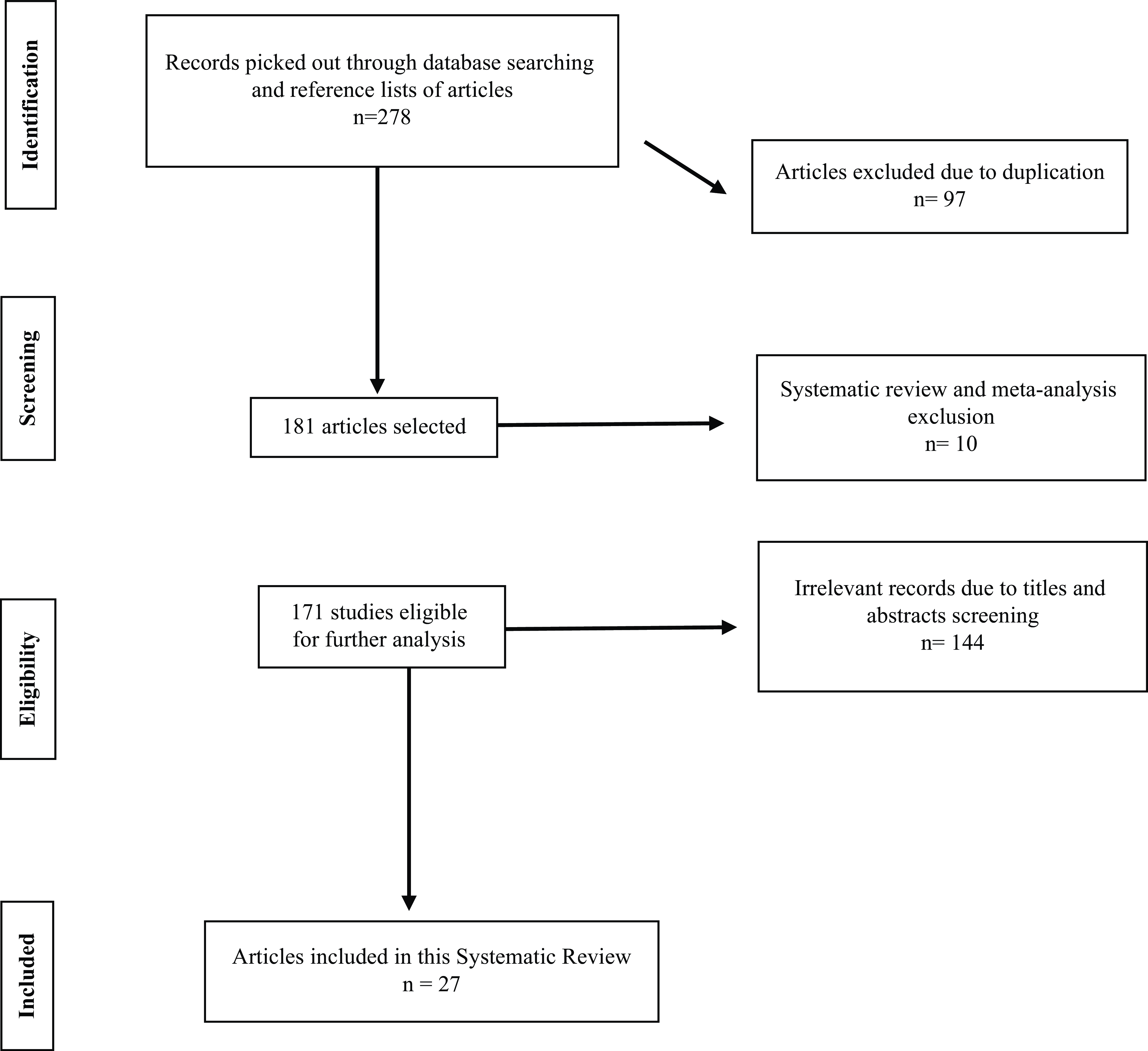
The primary search retrieved 278 articles from the databases mentioned above. According to the inclusion criteria, duplication, and abstract screening, 27 articles between 2012 and 2023 were added to the final analysis (Fig. 2). They all assessed the correlation between diet diversity score and reproductive issues.
Flow diagram for illustrating the literature search and selection process.
The cited articles provided evidence from eleven countries, including the United States of America, Spain, Tanzania, Sri Lanka, Iran, Ethiopia, Ghana, China, Cameroon, Pakistan, and India. Also, the population size of these studies ranged between 200 and 7553 women. Regarding the study design, 11 articles had a cohort design, five had a case-control design, and the remaining 11 were cross-sectional studies.
The articles used various methods for assessing dietary diversity scores, such as FAO MDDW (Minimum Dietary Diversity for Women),(18) Women Dietary Diversity Score (WDDS),(Reference Gina Kennedy and Dop19) and the methodology developed by Kant et al..(Reference Kant, Schatzkin, Harris, Ziegler and Block20) Additionally, Soodi et al. utilised the food guide pyramid approach for DDS measurement.(Reference Haines, Siega-Riz and Popkin21) Rammohan et al. implemented the DDI method to measure DDS.(Reference Rammohan, Goli, Singh, Ganguly and Singh22) Furthermore, Saaka et al. used the Individual Diet Diversity Score (IDDS) method to measure DDS.(Reference Saaka23) Zerfu et al. also adopted the Women Individual Dietary Diversity (WIDD) method in their DDS measurements.(Reference Zerfu, Baye and Faber24)
The articles included were categorised into two main sets: ‘Reproductive Health’ (Table 1) and ‘Infant Outcomes’ (Table 2).
Summary of twelve selected articles assessing the relationship between diet diversity score and Reproductive Health

a Kant et al. (Reference Kant, Schatzkin, Harris, Ziegler and Block20) method: this method includes five food groups such as 1) dairy, 2) meat, 3) grain, 4) fruit, 5) vegetables.
b MDDW (18)method: Minimum Dietary Diversity for Women Food groups: It includes the 10 following food groups: 1) starchy staples, 2) pulses, 3) nuts and seeds, 4) dairy, 5) meat, poultry, and fish, 6) eggs, 7) dark-green leafy vegetables, 8) other vitamin-A rich fruits and vegetables, 9) other vegetables, and 10) other fruits.
c WDDS (Reference Gina Kennedy and Dop19) method: Women Dietary Diversity Score Food groups: The foods were categorised into nine food groups: 1) cereals, roots, and tubers; 2) vitamin A– rich fruit and vegetables; 3) other fruit; 4) other vegetables; 5) legumes and nuts; 6) meat, poultry, and fish; 7) fats and oils; 8) dairy; and 9) eggs.
d WIDD (Reference Zerfu, Baye and Faber24) method: Women Individual Dietary Diversity Food groups following nine food groups to calculate the WIDD score: 1) cereals, roots, and tubers; 2) dark-green leafy vegetables; 3) vitamin A-rich fruits and vegetables; 4) other fruit and vegetables; 5) legumes and nuts; 6) meat, poultry, and fish; 7) organ meat; 8) dairy; and 9) eggs.
e Food Guide Pyramid (Reference Haines, Siega-Riz and Popkin21): 5 main groups, including 1) grains/bread, 2) vegetables, 3) fruits, 4) meats, and 5) dairy products, were used.
Summary of fifteen/sixteen selected articles assessing the relationship of dietary diversity with Infant Outcomes
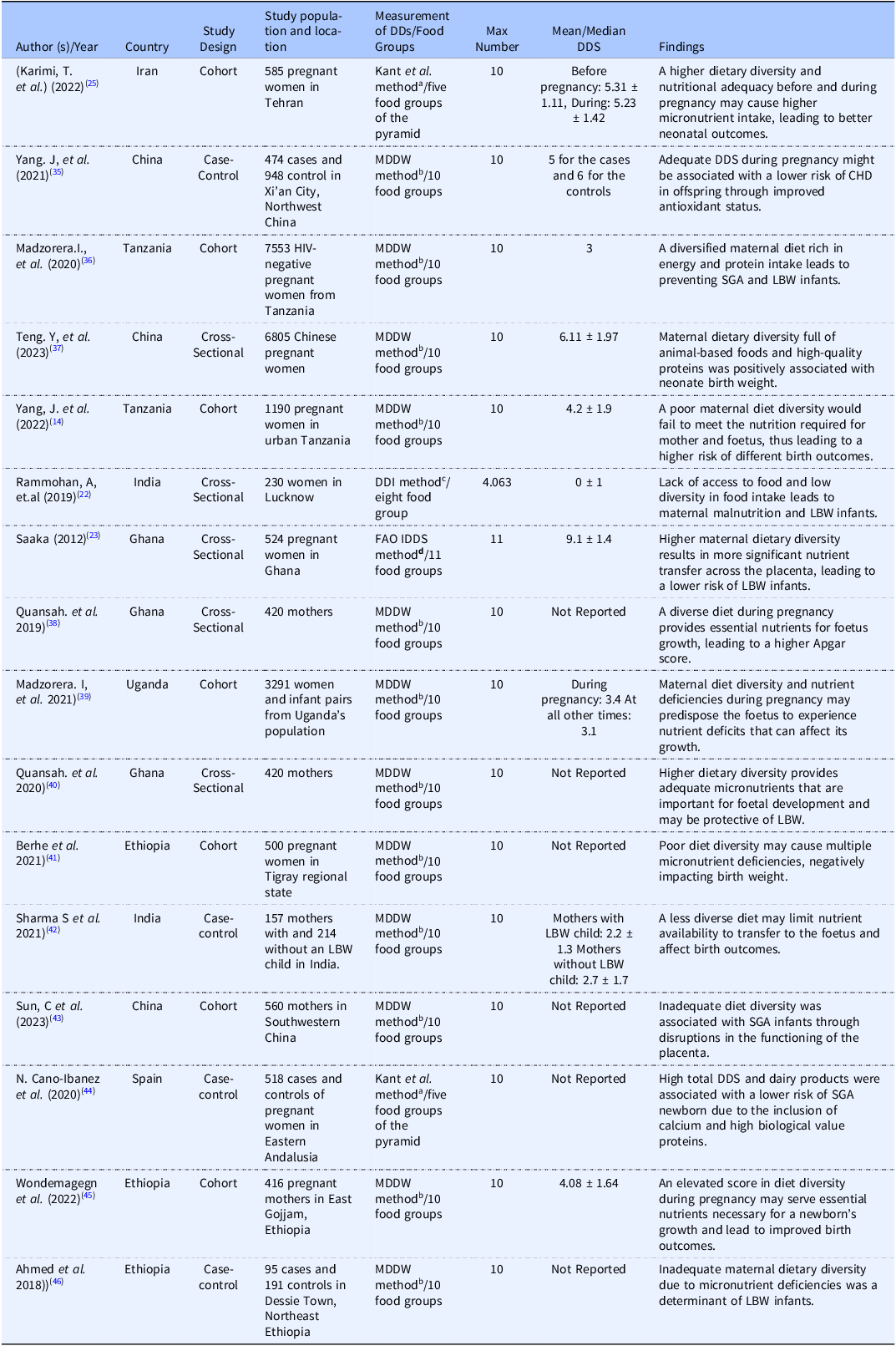
a Kant et al. (Reference Kant, Schatzkin, Harris, Ziegler and Block20) method: this method includes five food groups such as 1) dairy, 2) meat, 3) grain, 4) fruit, and 5) vegetables.
b MDDW (18) method: Minimum Dietary Diversity for Women Food groups: It includes the ten following food groups: 1) starchy staples, 2) pulses, 3) nuts and seeds, 4) dairy, 5) meat, poultry, and fish, 6) eggs, 7) dark-green leafy vegetables, 8) other vitamin-A rich fruits and vegetables, 9) other vegetables, and 10) other fruits.
c DDI (Reference Rammohan, Goli, Singh, Ganguly and Singh22)method: Dietary Diversity Index: including eight main groups: 1) grains, 2) pulses, 3) flour types, 4) sweet, 5) egg, 6) milk products, 7) fruits, and 8) vegetables.
d IDDS (Reference Saaka23) method: Individual Dietary Diversity Score: including 11 food groups: flesh meats (i.e. beef, pork, lamb, goat, poultry), fish, eggs, milk and milk products, organ meat (e.g. liver, kidney), legumes, cereals, roots & tubers, dark-green leafy vegetables, vitamin A rich fruits and fats & oils.
Reproductive health
The following group assessed in this study is women’s reproductive health, which includes conditions such as anaemia, nutritional and bone status, polycystic ovary syndrome, and metabolic disorders.
Maternal anaemia
Six out of 27 studies analysed the effect of a diversified diet on the prevalence of anaemia, all of which indicated a beneficial impact of higher DDS on maternal anaemia and, thus, a beneficial impact on managing this condition.(Reference Zerfu, Umeta and Baye13,Reference Zerfu, Baye and Faber24,Reference Jugha, Anchang-Kimbi, Anchang, Mbeng and Kimbi27,Reference Abriha, Yesuf and Wassie31–Reference Cai, Li and Feng33)
Nutritional status
In sum, four out of 27 articles examined the ratio of nutrient adequacy in women’s diets. Four papers found that a higher score in dietary diversity was correlated with greater nutritional status for women of reproductive age.(Reference Karimi, Eini-Zinab, Rezazadeh and Moslemi25,Reference Ali, Thaver and Khan28,Reference Zhong, Zhao and Lan29,Reference Yeneabat, Adugna and Asmamaw34)
Bone status
One out of 27 articles examined the effect of a varied diet on women’s bone status. Zhong W. et al. reported that a diversified diet was positively associated with better bone status, recommending the importance of modifying diet diversity for pregnant women.(Reference Zhong, Zhao and Lan29)
Polycystic ovary syndrome
Of the 27 studies, Soodi et al. found a link between diet diversity score and the incidence of polycystic ovary syndrome in women of reproductive age, showing a significant association with higher scores and lower odds of PCOS.(Reference Soodi, Keshavarz, Hosseini and Abbasi30)
Metabolic disorders
Out of 27 studies, Gicevic S. et al. identified the association between diet diversity score and different metabolic disorders. Gicevic S. et al. stated that the food-based dietary diversity score did not predict gestational diabetes mellitus (GDM) and hypertensive disorders of pregnancy (HDPs).(Reference Gicevic, Gaskins and Fung26)
Infant outcomes
Infant outcomes are the other set, containing articles on subjects such as low-birth weight and preterm birth infants (LBW), Apgar score, small for gestational age foetuses (SGA), and congenital heart defect.
Low birth weight and preterm birth infants
Eleven out of 27 articles expressed the correlation of diet diversity score with low-birth weight and preterm birth infants. The findings indicated that a greater maternal diet diversity was associated with lower rates of low-birth-weight infants, a significant relationship consistently observed across all eleven studies.(Reference Yang, Wang and Tobias14,Reference Rammohan, Goli, Singh, Ganguly and Singh22,Reference Saaka23,Reference Madzorera, Isanaka and Wang36,Reference Teng, Jing and Chacha37,Reference Madzorera, Ghosh and Wang39–Reference Sharma, Maheshwari and Mehra42,Reference Wondemagegn, Tsehay, Mebiratie and Negesse45,Reference Ahmed, Hassen and Wakayo46)
Small for gestational age (SGA)
Two studies evaluated the relationship between small for gestational age infants and diet diversity scores from the 27 articles. These studies found that women with a higher diet diversity score presented a lower SGA risk.(Reference Sun, Wu and Cai43,Reference Cano-Ibanez, Martinez-Galiano, Amezcua-Prieto, Olmedo-Requena, Bueno-Cavanillas and Delgado-Rodriguez44)
Apgar score
Among the 27 papers, Quansah D. Y. et al. assessed the correlation between diet diversity and infant Apgar scores. Indeed, they reported a positive impact of increasing diet diversity on the Apgar score. Most mothers who gave birth to babies with a standard Apgar score had a more diversified diet.(Reference Quansah, Boateng, Kwantwi, Owusu-Sekyere and Amegah38)
Congenital heart defect
Of the total of 27 studies, Yang et al. was the only study that examined the effect of diet diversity on the neonatal heart. Thus, it was concluded that an adequate diet diversity score during pregnancy might be related to a reduced chance of congenital heart defects.(Reference Yang, Cheng, Zeng, Dang and Yan35)
Discussion
To the best of our knowledge, this is the first systematic review to investigate the correlation between diet diversity score and reproductive health among women, as well as different infant outcomes, aimed at updating and concluding the prior studies.
The diet diversity score was related to maternal nutritional status. Karimi et al. pointed out that women with a higher score in diet diversity had an increased mean adequacy of different food groups and higher intake in all main components of the DDS, such as cereals and bread, meat, dairy products, vegetables, and fruit groups. As a result, they received more diverse foods. These circumstances may be correlated with different birth outcomes, affecting newborns’ bioavailability of nutrient resources.(Reference Karimi, Eini-Zinab, Rezazadeh and Moslemi25)
Overview of evidence related to women’s reproductive health
In the present study, 12 articles emphasised the significant impact of dietary diversity on women’s reproductive health, particularly highlighting the adverse effects of a low-diversity diet.
According to our assessment, a more diversified diet may be related to a lower incidence of maternal anaemia, which aligns with the findings from the six articles on this topic. Specifically, women who achieve a higher diet diversity score tend to consume more micronutrient-rich foods, such as sources of animal foods, vegetables, and fruits.(Reference Zhang, Li, Song, Fang, Huang and Sun47) Conversely, inadequate dietary diversity leads to mineral and vitamin deficiencies, which may affect iron levels and bioavailability.(Reference Haidar, Nekatibeb and Urga48) Moreover, meat consumption due to increased haemoglobin concentration and as an essential source of heme iron was another factor that showed a significant relationship with anaemia in pregnant women.(Reference Haidar and Pobocik49) Organ meats are an excellent source of iron and vitamin A, while milk and its products also provide substantial amounts of vitamin A. These nutrients are crucial in synthesising red blood cells and haemoglobin.(50) Moreover, meat contains protein with a high biological value, and fruits abundant in ascorbic acid can enhance iron absorption. Likewise, eating less or not eating meat and fruits also leads to inadequate intake of iron, which ultimately causes anaemia.
Furthermore, vegetables provide a valuable source of folic acid, and a lack of folic acid is related to anaemia during pregnancy.(Reference Zhang, Li, Song, Fang, Huang and Sun47) Overall, a diverse diet consisting of different food groups rich in micronutrients, particularly iron, vitamin A, vitamin B12, and folic acid, promotes the production of red blood cells and thus prevents anaemia in women of reproductive age.(Reference Jugha, Anchang-Kimbi, Anchang, Mbeng and Kimbi27) However, dietary practices and cultural taboos may also restrict mothers from consuming available iron-rich foods.(Reference Zerfu, Umeta and Baye51)
In this review, we investigated the associations between diet diversity score and bone status in women. Our results were aligned with Zhong et al.,(Reference Zhong, Zhao and Lan29) which confirmed that women with a higher diet diversity score had a higher intake of animal-source foods, such as dairy products, eggs, and flesh foods. These are rich sources of nutrients such as calcium, vitamin D, and protein, which are beneficial for peak bone mass, reduced bone resorption, and enhanced bone mineral density.(Reference Ettinger, Lamadrid-Figueroa and Mercado-García52) In addition, as stated by Weaver et al., women with a diversified diet had a higher consumption of fruits, vegetables, pulses, and nuts or seeds, which were rich in unsaturated fatty acids and bioactive complexes such as flavonoids that protect in case of oxidative stress and inflammation.(Reference Weaver, Gordon and Janz53)
In agreement with our assessments, Soodi et al. also reported that an elevated diet diversity score was significantly related to a lower incidence of polycystic ovary syndrome. Women with PCOS had more consumption of high-glycemic index foods and a lower intake of vegetables and legumes. As Azadbakht et al. and Shishehgar et al. claimed, vegetable consumption might be associated with a lower risk of expanding abdominal adiposity and obesity, both of which are the major symptoms of PCOS. It should also be noted that consuming vegetables can improve ovulation by increasing insulin sensitivity.(Reference Shishehgar, Ramezani Tehrani, Mirmiran, Hajian, Baghestani and Moslehi54,Reference Azadbakht and Esmaillzadeh55) Furthermore, Hajivandi et al. found that adolescent girls with polycystic ovary syndrome had unhealthy eating habits with a low consumption of meat, fish, and seafood and a high intake of fats full of sugar, unhealthy and fatty foods, which, as a result, cause some problems in women with polycystic ovary syndrome and reproductive issues.(Reference Hajivandi, Noroozi, Mostafavi and Ekramzadeh56)
Following the results of our study, Liao et al. showed that the risk of GDM was inversely associated with fruit intake. This relationship might be explainable by polyphenols and antioxidant complexes found in fruits, such as carotenoids and vitamins E and C. These compounds reduce oxidative stress in cells, interfering with glucose absorption and preventing the development of abnormal glucose tolerance. Moreover, the presence of fibre in fruits and vegetables can delay the absorption of food carbohydrates and avoid a rapid increase in blood sugar.(Reference Liao, Zheng, Jiang, Chen, Gao and Pan57) Gicevic et al. found that the food-based dietary diversity score did not correlate with GDM or HDPs. The following mechanism can describe this: the DDSs do not consider the specific types of carbohydrates, fats, and forms of animal protein sources in the total diet. Therefore, the inclusion of refined grains, saturated and trans fatty acids, and red and processed meats associated with a higher risk of several different chronic diseases, such as GDM or HDPs, may partly explain the findings from this study.(Reference Gicevic, Gaskins and Fung26)
Overview of evidence related to infant complications
An inappropriate maternal diet with insignificant diversity and quality would not meet the nutritional requirements of the mother and foetus, which could lead to an increased risk of in-pregnancy complications and harmful consequences of childbirth.(Reference Yang, Cheng, Zeng, Dang and Yan35)
In line with our assessments, articles also claimed that maternal nutritional status and micronutrient deficiencies during pregnancy may have severe consequences for the health of the developing foetus, thereby affecting birth size and the availability of nutrients to transfer to the foetus.(Reference Imdad and Bhutta58,Reference Kind, Moore and Davies59)
In close agreement with Quansah et al., our findings indicated that a diversified diet may be correlated with a reduced risk of infants with low-birth weight.(Reference Quansah and Boateng40)
In addition, a low diet diversity score during pregnancy can lead to a lack of essential micronutrients important for foetal growth and development. However, improved micronutrient intake, resulting in greater dietary diversity, can ameliorate infant complications through improved antioxidant and fibre intake.(Reference Brantsaeter, Haugen and Samuelsen60) According to Yang et al., the contrasts in maternal diet diversity among mothers with or without low-birth-weight infants, lack of animal protein intake, and inadequate dietary patterns could be the main nutritional complication for Chinese pregnant women.(Reference Yang, Chang and Tian61)
Moreover, lower DDS may develop anaemia, impairing oxygen delivery to the foetus and hence interfering with normal intrauterine development, possibly leading to low-birth weight.(Reference Muchemi, Echoka and Makokha62)
Consistent with our assessment with Zerfu et al., the findings of this review showed that diet diversity, an indicator of diet quality, was related to preterm birth and birth weight.(Reference Zerfu, Umeta and Baye13) According to a prospective cohort study involving 66,000 pregnant women in Norway, ‘prudent’ dietary patterns that included fruits, vegetables, whole-grain cereals, fibre-rich bread, oils, and water reported a lower chance of premature delivery.(Reference Englund-Ogge, Brantsaeter and Sengpiel63)
This current study found that diet diversity score during pregnancy may be positively related to the Apgar score. As Quansah noted, consuming a diverse diet during pregnancy provides essential nutrients for foetal growth and development. Consuming fewer food groups could result in a lack of important nutrients needed during pregnancy for the foetus’s growth and development.(Reference Dhiraj, Trivedi and Rokhade64) Since the Apgar score is related to birth weight, a low-birth-weight newborn probably has higher odds of having a low Apgar score due to poor nutrition throughout gestation.
One of the outcomes investigated in this review was the relationship between DDS and SGA infants. With the same result, Sun et al. indicated that having an underweight pre-pregnancy BMI and also an insufficient dietary diversity score increased the mother’s chance of delivering a small for gestational age infant.(Reference Sun, Wu and Cai43)
Besides, as claimed by Cano-Ibanez et al., diet diversity improves nutrient status and provides benefits not offered by supplementation during pregnancy. This analysis suggests that women with a high total DDS and more intake of dairy items had a protective impact against being small for gestational age..(Reference Cano-Ibanez, Martinez-Galiano, Amezcua-Prieto, Olmedo-Requena, Bueno-Cavanillas and Delgado-Rodriguez44) Additionally, the findings of Zerfu et al. showed a decreased risk of preterm birth and low-birth weight in pregnant women with a high diversity of dairy products,(Reference Zerfu, Pinto and Baye65) which are a good source of key nutrients, like calcium and high biological value proteins.(Reference Quann, Fulgoni and Auestad66) These nutrients are related to preventing small for gestational age due to their contribution to foetal growth.
As a result of our review, which is supported by Yang et al.,(Reference Yang, Cheng, Zeng, Dang and Yan35) a probable mechanism by which an adequate diet diversity score during pregnancy can decrease congenital heart defect risk would be through improving antioxidant status. Likewise, enhanced dietary diversity has been reported to be correlated with reduced oxidative stress in women. Maternal oxidative stress in pregnancy may affect the normal growth of the foetal cardiovascular system.(Reference Yang, Cheng, Zeng, Dang and Yan35,Reference Fisher and Burggren67,Reference Narmaki, Siassi and Fariba68) These findings highlight the importance of an increase in diet diversity score, which has a practical impact on women’s reproductive health and infant healthiness.
The present study was conducted to conclude previous studies on the relationship between the diversity of food ingredients and reproductive issues, which reported a positive relationship between higher DDS and reduced risk of reproductive health and infant issues. These findings can increase clinical and pre-clinical knowledge to recommend a diversified diet for the target group.
Considering that the present systematic review is a qualitative study, we conducted a review incorporating different study designs, including all observational studies, to draw conclusions and obtain reliable results from the relevant studies. Furthermore, no restrictions were placed on the publication date or language in our study.
Lastly, the articles included used various methodologies reporting DDS; therefore, quantitative analysis regarding different score calculation methods, was not possible.
Conclusion
Due to our findings, a higher dietary diversity score was correlated with a lower probability of reproductive disorders, including maternal anaemia and polycystic ovary syndrome, and a better status in nutrition and bone health. Moreover, a diversified diet may be correlated with a reduced risk of adverse birth outcomes, such as preterm delivery, low-birth weight infants, congenital heart defect, and a higher Apgar score. Likewise, results showed that DDS may not be correlated with GDM and HDPs. However, further studies are required in this area.
Abbreviations
DDS: Diet Diversity Score; GDM: Gestational Diabetes Mellitus; HDPs: Hypertensive Disorders of Pregnancy; LBW: Low Birth Weight; PCOS: Polycystic Ovary Syndrome; SGA: Small for Gestational Age
Acknowledgements
We appreciate the reviewers dedicating their time and effort to evaluating the manuscript.
Author contributions
P.A. & N.B. proposed ideas and designed the protocol. N.B. was responsible for the planned search and data collection strategy. P.A was responsible for preparing the original draft. P.A, N.B, and B.A were responsible for data screening and interpretation. B.A reviewed the literature and edited the final manuscript. Each of the authors has confirmed the final version to be published and approved the conception of the study.
-Data is available upon reasonable requests from the corresponding author.
Funding
The authors received no financial support for the research.
Competing interests
The authors had no conflict of interest to declare.


 Open access

