Introduction
Sri Lanka's central position within the Indian Ocean allowed the island to become a highly important port of call for merchant ships from the early days of Indian Ocean trade (Warmington Reference Warmington1928; Thapar Reference Thapar1992; Prickett-Fernando Reference Prickett-Fernando, Bandaranayake, Dewaraja, Silva and Wimalaratne2003; Ray Reference Ray2003; De Silva Reference De Silva2005; Gupta Reference Gupta2005; Tomber Reference Tomber2008; Francis Reference Francis, Carswell, Deraniyagala and Graham2013a; Bohingamuwa Reference Bohingamuwa2017a: 23-50; Cobb Reference Cobb2018). The island formed a key link in a complex system of trade routes both within South Asia (particularly with India) and the rest of the Old World. Growth of the Sri Lankan ports is associated with the development of long-distance maritime trade during the Early Historic (c. 500 BC–AD 300) and Middle Historic (c. AD 300-1250) periods. Goods from the East (both Mainland and Island Southeast Asia, as well as China) were bought and traded with those from the West (Europe, Africa and South-west Asia). Trade with the ports and markets that dotted the coasts of East and West India was also extensive during this period, as evidenced by the material culture recovered from various Sri Lankan sites (e.g. Prickett-Fernando Reference Prickett-Fernando, Bandaranayake, Dewaraja, Silva and Wimalaratne2003; Coningham et al. Reference Coningham, Manuel, Shoebridge and Mathew2016).
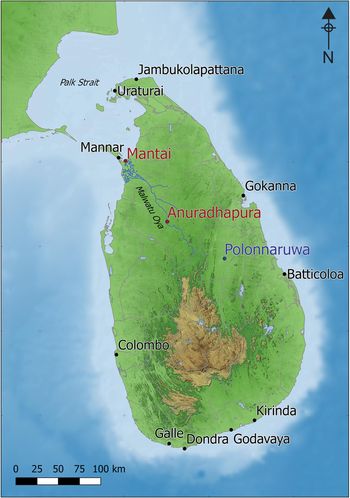
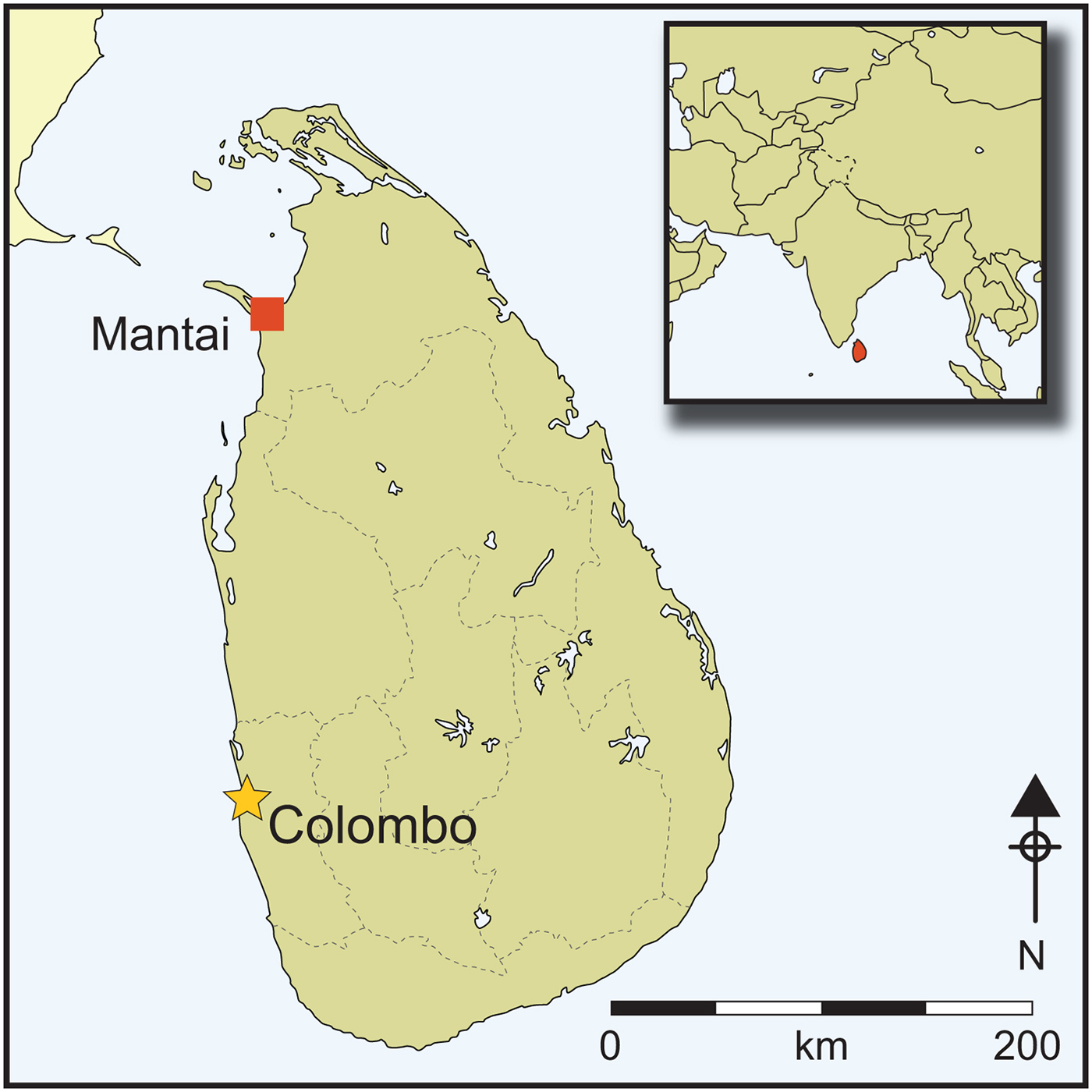
Mantai, situated on the north-western coast of Sri Lanka, close to Mannar, was ideally located to act as a coastal trade and transport ‘hub’ between the Arabian Sea, the Bay of Bengal and the east and west coasts of India. It was also a key gateway to the interior of Sri Lanka (Figure 1). The shallow navigable channels near Mantai (the Palk Strait) allowed only small boats to sail around the north of Sri Lanka; large vessels therefore had to anchor at Mantai to offload their cargo for transport across the strait. Additionally, ships approaching from the west and wanting to sail around the south of the island would have had to anchor near Mannar and wait for southerly winds (Nicholas Reference Nicholas1963; Shinde Reference Shinde1987). Mantai thus drew trade and served as the main seaport of the Anuradhapura kingdom for nearly two millennia (Coningham & Gunawardhana Reference Coningham and Gunawardhana2013). Traces of an ancient river bed suggest that a channel of the Malvatu/Malwathu Oya (Sinhala, ‘Aruvi Aru’ in Tamil) may have run close to Mantai and allowed for river traffic between the port and Anuradhapura from c. 250 BC (cf. Nicholas Reference Nicholas1963). By this time, Anuradhapura was the capital city of the Anuradhapura Kingdom, 500 BC–AD 1017 (Deraniyagala Reference Deraniyagala1990), with a centralised administration and control over many other regions of the island. It also developed as a successful, multicultural trading centre in its own right (Seneviratne Reference Seneviratne and Liebmann2008: 188; Coningham & Gunawardhana Reference Coningham and Gunawardhana2013), before the creation of a new capital at Polonnaruwa following conflict with the Chola dynasty in the tenth to eleventh centuries AD (Deraniyagala Reference Deraniyagala1990).
Map of Early Historic Sri Lanka showing key ports and cities: Mantai, Uraturai, Jambukolapattana and Godavaya were important ports of the Anuradhapura Kingdom. Ports on the east, west and south coasts became increasingly important post-AD 1000, after the establishment of Polonnaruwa as a capital city (figure by Ulrike Thuering).

The riverine link between Mantai and Anuradhapura, as well as the site's ideal locale at a key geographic point of transhipment, meant that Mantai came to have a large, urban and multicultural population over the course of its occupation (Carswell Reference Carswell, Carswell, Deraniyagala and Graham2013; Coningham et al. Reference Coningham, Manuel, Davis, Gunawardhana, Biedermann and Strathern2017). The archaeobotanical assemblage from Mantai reflects the dietary needs of the port's large population and, potentially, the varied food preferences of its diverse populace. The assemblage also provides evidence for the trade of exotic consumables. This article explores when rice agriculture and long-distance trade in plants and plant products began in the region. We address questions surrounding the extent to which the growth of Mantai and the wider Anuradhapura kingdom can be attributed to the growth of the entrepôt ports of Sri Lanka—including the international trade of foodstuffs, especially spices.
Unfortunately, little is known of the site of Mantai beyond South Asian archaeology. This is largely due to an abrupt end to the largest excavation of the site in 1984, at the beginning of the Sri Lankan civil war, and the subsequent delay in publication of the site report (Carswell et al. Reference Carswell, Deraniyagala and Graham2013). This report was compiled despite numerous setbacks, including the loss of stratigraphic data, and includes a brief report of the archaeobotanical remains recovered but no quantitative data (Kajale Reference Kajale1990, Reference Kajale, Carswell, Deraniyagala and Graham2013). Additional smaller-scale work was only briefly reported (Silva Reference Silva1985). Other publications have addressed the site's extensive bead assemblage (e.g. Francis Reference Francis, Carswell, Deraniyagala and Graham2013b). Despite the multiple seasons of exploration carried out there, only three radiocarbon dates have been published previously, covering c. AD 200–300 (Carswell et al. Reference Carswell, Deraniyagala and Graham2013: 512–13).
In this article we present results from renewed excavations at Mantai, conducted in 2009–2010 as part of a joint effort by the Sri Lankan Department of Archaeology, the European Research Council-funded Sealinks Project and the UCL Institute of Archaeology. The site is encircled by an outer and inner moat, which has been partially cut away by a modern road (Figure 2). Inside, the central archaeological occupation mound consists of a compact layer of urban housing, walls and refuse. A modern temple is located in the centre of the mound, and the excavations of the 1980s are located to the south-west of this temple. It is difficult for any single excavation to do justice to a complex urban site, and so the 2009–2010 season aimed to conduct a detailed multi-disciplinary investigation into material recovered from one deep trench. This approach included sieving for small finds, sampling throughout the sequence for macrobotanical remains and phytoliths, and obtaining a sequence of high-precision radiocarbon dates. A 3 × 3m trench was situated to the south of the central occupation mound, close to the site of previous excavations. The trench was excavated to a depth of 10m, down to what appeared to be mid Holocene contexts (Figure 2). This paper presents a full sequence of new and secure radiocarbon dates coupled to a sequence of basic ceramic data, producing a chronology for developments and growth in Early and Middle Historic Indian Ocean trade. The archaeobotanical study provides insights into aspects of agriculture and plant foods, and presents rare direct evidence for early trade in the valuable spice commodities upon which later empires would be founded.
Plan of Mantai and the surrounding area, showing the location of the 2009–2010 trench (figure by Ulrike Thuering, redrawn from SEALINKS plan).

Archaeobotanical methods
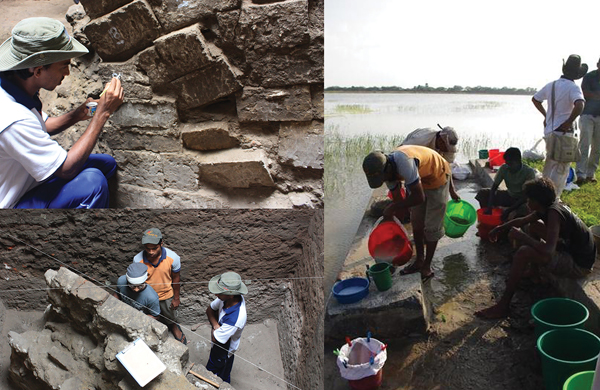
A total of 65 contexts were excavated at Mantai during the 2009–2010 field season, representing 11 stratigraphic periods (Bohingamuwa Reference Bohingamuwa2017b: 59; Figure 3). As period 1 was identified as a sterile layer, no samples were taken. Thirty-eight flotation samples of 10–20 litres each (677 litres in total) were taken from periods 2–10, which represent pit fills and settlement deposits. Charred plant remains were retrieved via wash-over bucket flotation on a 0.25mm mesh to ensure the recovery of small weeds and rice spikelet bases. Samples were dried onsite, packed into sealed plastic bags and exported to the UCL Institute of Archaeology for archaeobotanical analysis.
Top left and bottom left) excavation in progress at Mantai 2010; right) bucket flotation at Mantai tank (photographs by SEALINKS and COMPAG projects).

Each sample was fully sorted and analysed using an optical microscope (up to 35× magnification). The 0.25–0.5mm fraction was checked for previously unidentified species and rice (Oryza sp.) spikelet bases. Identifications were made using the reference collection at the UCL Institute of Archaeology and comparative published literature (e.g. Fuller & Harvey Reference Fuller and Harvey2006; Cappers et al. Reference Cappers, Neef and Becker2009, Fuller et al. Reference Fuller, Qin, Zheng, Zhao, Chen, Hosoya and Sun2009). The length, height and width of whole, unpuffed rice and wheat grains were recorded. Phytolith samples were taken from trench sections directly into sealed plastic bags. Approximately 100g of sediment was taken per sample, and 0.8g of this was processed at the UCL Institute of Archaeology by heavy liquid flotation using sodium polytungstate (see Rosen Reference Rosen1995; Piperno Reference Piperno2006). The weight of sediment to be processed was recorded, as were the weight of phytoliths extracted and the weight of phytoliths mounted. Phytoliths were counted using a biological microscope at 400× magnification. A minimum of 300 single-cell phytoliths and 100 multi-cell phytolith panels of 2+ individual phytoliths were counted per sample. Identifications were made using reference slides housed at the UCL Institute of Archaeology, as well as comparative published literature (e.g. Ball et al. Reference Ball, Vrydaghs, van den Houwe, Manwaring and Langhe2006; Piperno Reference Piperno2006; Pearsall Reference Pearsall, Biddle, Chandler-Ezell, Collins, Duncan, Grimm, Hart, Logan, O'Brien, Stewart, Veintimilla and Zhao2018).
Radiocarbon dates and ceramic sequence
Twenty-four samples, including 23 single seed samples from period 2 onwards, were submitted to the Oxford Radiocarbon Accelerator Unit (see Table S1 in the online supplementary material). These were calibrated using OxCal 4.3.2 and modelled into an archaeological sequence using Bayesian methods to take into account stratigraphic position (Table 1 & Figure 4). A shell from period 1, a pre-Iron Age layer, was dated to 1691–1509 BC (Table S1). This lowest unit is associated with a few lithics but no ceramics. Subsequent to this is a hiatus, followed by three apparent phases of occupation: phase 1, 200 BC–AD 600 (periods 2–4), which correlates to Carswell et al.’s (Reference Carswell, Deraniyagala and Graham2013: 139) “primary development of the mound” phase, and phase 2, AD 600–850 (periods 5–7). Period 6 represents a coral wall, which sealed periods 1–5. Due to a lack of stratigraphic data, it is unclear whether Carswell et al.’s (Reference Carswell, Deraniyagala and Graham2013: 139) “developed settlement and defensive circuit” phase (which includes coral stone buildings) relates to period 6. Phase 3, AD 850–1400 (periods 8–11), correlates to Carswell et al.’s (Reference Carswell, Deraniyagala and Graham2013: 139) “abandonment, decay and quarrying” phase. Deposits from periods 8–11 were identified as mixed and disturbed during excavation.
Bayesian model of radiocarbon dates from Mantai (Bronk Ramsey Reference Bronk Ramsey2017; Reimer et al. Reference Reimer2013) (figure credit: SEALINKS and COMPAG projects).

Stratigraphic sequence of Mantai.

The material culture recovered in 2009–2010 from Mantai contains an extensive range of ceramics and beads (Figure 5). Mantai has long been identified as a major glass bead production centre of South Asia (cf. Francis Reference Francis, Carswell, Deraniyagala and Graham2013b: 349–63). Nearly 91 per cent (1432 beads) of the assemblage recovered from the site is of Sri Lankan manufacture. Imported beads make up 2.7 per cent (43 beads) of the total assemblage (1580). Regions of their possible provenance include South-west Asia (mainly Iran and Iraq), India, Southeast Asia and China (Bohingamuwa Reference Bohingamuwa2017b: 222–89). The remaining beads were unidentifiable to type.
A selection of small finds from Mantai: A) Rouletted Ware, origin: India (late first to early third centuries AD); B) Rouletted Ware with chattering marks, origin: India (late first to early third centuries AD); C) Dusun Ware, origin: China/Guangzhou/Guangdong (seventh to tenth centuries AD); D) Changsha Ware, origin: China/Hunan (ninth century AD); E) bangle fragments; F) Indo-Pacific, and some organic, beads (200 BC to tenth/eleventh centuries AD); G) perforated shell ‘pendants’ (after Bohingamuwa Reference Bohingamuwa2017b) (figure credit: SEALINKS and COMPAG projects).

The total ceramic assemblage (TCA) recovered from our 2009–2010 excavations comprises 11 418 sherds, representing 123 different wares (Table 2); 77.7 per cent of the sherds are of Sri Lankan production, and 20.9 per cent were imported to the island; the remaining sherds are of unknown provenance. Sri Lankan ceramics occur throughout the sequence, suggesting a continuous local ceramic industry (Figure 6). The imported ceramic assemblage comprises 2386 sherds and 101 different wares (Table 2 & Figure 6), originating from India, the Middle East (primarily Iran, Iraq and Arabia), Southeast Asia and China. Six per cent of the imported TCA are of unknown provenance (termed ‘Imported unknown’, or ‘Imp.Unk’ in Table 2). Middle Eastern wares (7 per cent of the TCA) represent the largest imported ceramic group—even surpassing Indian wares (6 per cent), which were expected to be the largest group. Chinese (2 per cent) and Southeast Asian (0.5 per cent) wares were also anticipated to be more frequent than Middle Eastern wares, yet they are only represented in smaller quantities (Bohingamuwa Reference Bohingamuwa2017b: 103–221).
Distribution of ceramic assemblage from Mantai: top) Sri Lankan ware; bottom) imported wares. Note the increasing assemblage size and diversification in composition from period 3; periods 8–11 are disturbed (after Bohingamuwa Reference Bohingamuwa2017b: fig. 3.11) (figure credit: SEALINKS and COMPAG projects).
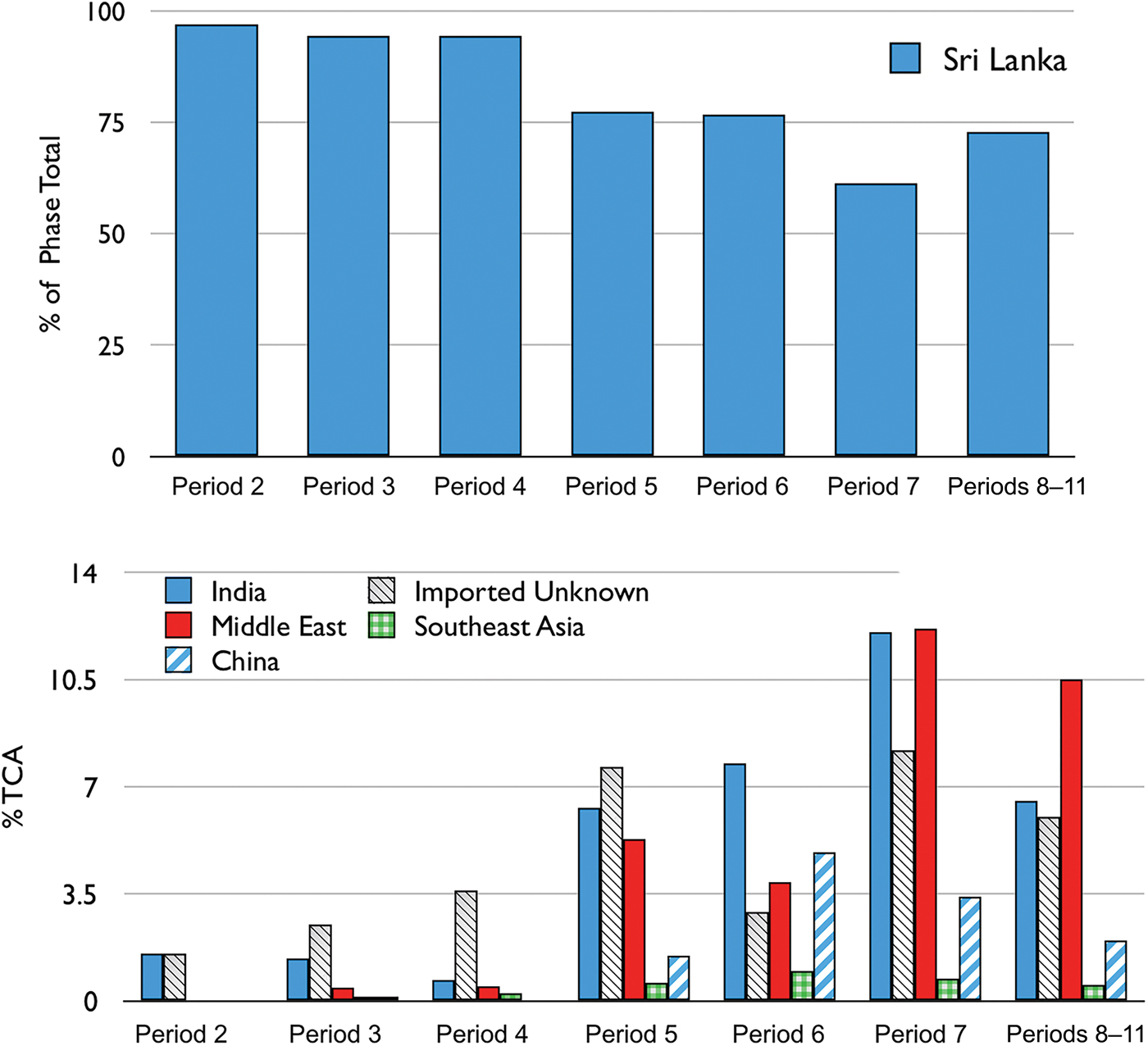
Geographic origin of ceramic wares across periods at Mantai (percentage from the TCA period total). ‘Imp.Unk’ = imported unknown (modified after Bohingamuwa Reference Bohingamuwa2017b: C3.9.11).

Figure 6 illustrates the initial arrival of imported wares in period 2, around 200 BC, although this is represented by only a single find of Indian origin. During the next two periods, there is a slight increase in the range and quantity of wares, with ceramics from China, Southeast Asia and the Middle East present in the sequence. These imports, however, make up only around five per cent of the TCA. Period 5 (c. AD 650–800) witnessed a significant increase in imported ceramics from all regions, rising to 21 per cent of the TCA. The culmination of these developments is observed during period 7. This period includes 946 imported sherds, representing 36.7 per cent of the TCA phase total. The upper ‘Disturbed’ periods contain the highest number of imported wares and sherds—particularly those from the Middle East and China—demonstrating the changing patterns of Indian Ocean trade post-AD 900. Over 10.5 per cent of the Middle Eastern, and two per cent of the Chinese sherds, found in the ‘Disturbed’ periods date to between AD 1100 and 1300 (possibly even up to AD 1400). This indicates the continuation of Mantai as an international trading port well after the Chola attack on Sri Lanka in AD 993 (e.g. Bohingamuwa Reference Bohingamuwa2017b: 110-11, 130, 207).
Plant foods and cultivation at Mantai
A total of 3235 cereal grains and grain fragments were identified from the 2009–2010 excavation assemblage, 1830 (57 per cent) of which have been identified as rice (Oryza sp.) and 84 (2.5 per cent) as wheat (Triticum ssp.) (Tables 3 & S2) (Kingwell-Banham Reference Kingwell-Banham2015). Although period 2 provides some evidence of crops within the macro-remains, none was identified in the phytoliths (Figure 7). As with the ceramics, this suggests initial low-level use and occupation of the site during this period. Archaeobotanical finds, ceramics and small finds all increase in volume by period 3 as the site entered its main period of occupation c. AD 100–350. By this date, the archaeobotanical evidence from Mantai demonstrates the presence of two different food cultures: rice, South Asian pulses and millets, reflecting south Asian cuisine; and wheat and South-west Asian pulses, reflecting ‘Western’ cuisine (see Van der Veen Reference Van der Veen2011: 7). This supports the suggestion that Roman traders were settled at Mantai by c. AD 200 (see discussions in Carswell et al. Reference Carswell, Deraniyagala and Graham2013; Coningham et al. Reference Coningham, Manuel, Davis, Gunawardhana, Biedermann and Strathern2017).
Top) ubiquity of key crops from Mantai by period; ‘Exotic goods’ include black pepper, one clove and one grape seed; bottom) relative frequency of the main phytolith morphotypes present, periods in parentheses; ‘All other morphotypes’ include Oryza-type leaf/culm multi-cell panels, only identified in samples 37, 44 and 45 (after Kingwell-Banham Reference Kingwell-Banham2015: figs 69, 95) (figure credit: SEALINKS and COMPAG projects).

Total counts and ubiquities of the macrobotanical remains of crops and wild/weedy seeds recovered from Mantai.

Trade for food staples as well as exotic goods occurred at port markets, and it is probable that rice produced in the interior of Sri Lanka was transported in the husk for trade at coastal ports. This accounts for the lack of culm nodes (from rice straw), arable weed seeds and cf. Oryza leaf/culm multi-panelled cells within the Mantai assemblage. Today, most rice fields are located over 3km from the site; some small deposits of vertisols and alluvium around 1km away are, however, under cultivation. Small reservoirs attributed to King Vasabha (AD 67–111) have been located in the areas surrounding Mantai, indicating the existence of small-scale water management in the area by the first century AD (Bohingamuwa Reference Bohingamuwa2017b: 83–84). The scale of agricultural use, however, is not clear. The population of Mantai therefore probably consumed grain from a larger area, including the farm lands from farther within the interior of Sri Lanka and those surrounding Giant's Tank, 12km inland from Mantai. This irrigation tank is claimed to have been built by King Dhatusena c. AD 460 (Geiger Reference Geiger1912; Carswell Reference Carswell, Carswell, Deraniyagala and Graham2013: 24), dating towards the end of Mantai's first phase of occupation and coinciding with the increase in trade visible in the ceramic and archaeobotanical assemblages. Additionally, the possibility that Mantai imported rice from the ancient ports of coastal India (areas with high rain-fed rice yields) should not be ignored. Regular trade is suggested by excavations of Early Historic port sites along the Odisha and Andhra Pradesh coasts, which reveal a very similar material culture to that of Sri Lankan sites, including Mantai (e.g. Tripathi & Vora Reference Tripathi and Vora2005; Mohanty & Smith Reference Mohanty and Smith2008; Tripathi et al. Reference Tripathi, Patnaik, Pradhan and Mathew2016). Buying grain from these regions was probably relatively easy, and is documented from the medieval period (c. AD 1300–1500) onwards (e.g. Dasgupta Reference Dasgupta, Habib and Raychaudhuri1982).
The length/width ratios of rice grains from Mantai suggest that Oryza sativa japonica was consumed throughout the occupation of the site (Figure 8). The profile in Figure 8 is similar to that of the Early Historic sites of Ter (Maharashtra) and Balathal (Rajasthan), which have both been shown to have consumed a majority japonica crop, alongside a smaller quantity of indica (Castillo et al. Reference Castillo, Tanaka, Sato, Bellina, Higham, Chang, Mohanty, Kajale and Fuller2016). Put together, these data suggest that japonica was common across South Asia by c. 200 BC.
Length/width (mm) of 173 rice grains recovered during archaeobotanical analysis compared to Oryza sativa japonica and Oryza sativa indica length/width data from Castillo et al. (Reference Castillo, Tanaka, Sato, Bellina, Higham, Chang, Mohanty, Kajale and Fuller2016). A) ‘Indica-type’ rice grain; B) ‘Japonica-type’ rice grain (figure credit: SEALINKS and COMPAG projects).

Banana (Musa sp.) is conspicuous by its absence at Mantai. In India, banana cultivation in the Gangetic Plains dates back to the fourth or fifth century BC, while Old Tamil sources and historical linguistics suggest its establishment in Tamil Nadu by the early centuries AD (Fuller & Madella Reference Fuller and Madella2009). Banana-type phytoliths are produced in the plant's leaves and are thought to be incorporated into archaeological assemblages through the use of leaves in cooking or as building materials. The absence of such phytoliths may indicate that banana leaves were not used in this way to any great extent at Mantai. The high numbers of echinate spheroids (produced by Arecaceae, or palms) within the assemblage indicate that the inhabitants primarily used palm leaves as building materials (Figure 9). It is also probable that palm fibres were used to manufacture ropes for use at the ports and canals, or in boat construction (see Vosmer Reference Vosmer, Potts, Naboodah and Hellyer2003), as well as providing food and drink (e.g. coconut and toddy palms). These palms were obviously highly important economically and would have been cultivated in local orchards.
Clove: a) transverse view; b) distal end (note the four petals); c) black pepper; grape seed: d) lateral view; e) ventral view, recovered from Mantai (photographs by SEALINKS and COMPAG projects).

Mantai and the Indian Ocean: evidence for trade links across the Old World
A number of the plant remains recovered probably reflect imports and point to Mantai's key role as a centre of Indian Ocean trade. Wheat, for example, is present in small but notable quantities, and the absence of wheat chaff or phytoliths (only one wheat rachis was recovered) indicates that the crop was brought to the site as a clean grain (without husk) import. Again, the most probable sources of this import include West Asia and the Mediterranean, but also include India and Pakistan.
Grape, recovered from period 5 (c. AD 650–800), cannot be grown in tropical Sri Lanka and must also have been imported. Grape is present at Harappan sites, having been recovered from the late third millennium BC (Saraswat & Pokharia Reference Saraswat and Pokharia2001–2002), and while it is reasonable to assume that grapes were among the fruit crops of the Indus region (Fuller & Madella Reference Fuller, Madella, Settar and Korisettar2001), they are unlikely to have survived in the wetter tropical conditions around Mantai. Although edible fresh or dried, it is probable that grapes came to Sri Lanka as a dried luxury product for reasons of preservation—perhaps from West Asia, where grape cultivation was common.
While early long-distance trade in spices is indicated in historical sources such as the Periplus of the Erythraean Sea (Warmington Reference Warmington1928; Casson Reference Casson1989; Morrison & Lycett Reference Morrison, Lycett, Abraham, Gullapalli, Raczel and Rizvi2013), direct identifications of spice remains in ancient archaeobotanical assemblages are relatively rare (although see Van der Veen Reference Van der Veen2011). The assemblage from Mantai has produced evidence for several high-value spice products, supporting the existence of a spice trade network that extended between Sri Lanka, India, Indonesia and the Mediterranean. The existence of an active trade in black pepper (Piper nigrum) between southern India and the Roman Empire is well documented historically (Warmington Reference Warmington1928; Thapar Reference Thapar1992), but archaeobotanical remains from the subcontinent are rare. The recovery of black pepper demonstrates that a market for exotic spices was in place at Mantai by the middle of the first millennium AD. Native to the forests of the Western Ghats in south-west India, black pepper was probably initially shipped from ports in south-west India, and later grown in the wet zone of Sri Lanka. The harvesting of wild black pepper before AD 500 has tentatively been associated with mobile groups of shifting cultivators, or hunter-gatherers engaging at the producer end of the spice trade (Kingwell-Banham & Fuller Reference Kingwell-Banham and Fuller2012; Morrison & Lycett Reference Morrison, Lycett, Abraham, Gullapalli, Raczel and Rizvi2013). These finds therefore represent the economic activities of multiple, and very different, social groups engaging to different degrees in early international trade.
One clove (Syzygium aromaticum) was recovered from period 10, c. AD 900–1100. Pliny the Elder records that the spice was traded from India to Rome in the first century AD (Rackham Reference Rackham1938), and the earliest mention of cloves in the South Asian texts comes from the c. first-century BC Ramayana (Mahdi Reference Mahdi1994; see also Zumbroich Reference Zumbroich2012). Archaeological finds of clove are both exceptionally rare and geographically sporadic. The earliest evidence for possible cloves dates to 1721 BC in Syria (Turner Reference Turner2004). The spice is native to the Maluku Islands in Indonesia, around 7000km away from Mantai by sea. It is unlikely that merchants sailed from Sri Lanka directly to Indonesia, and cloves may have instead been traded across the Bay of Bengal from Southeast Asian ports. Archaeobotanical analysis by Castillo (Reference Castillo2011) demonstrates early culinary and trade connections between South and Southeast Asia c. 50 BC–AD 125, but the remains of neither clove nor black pepper have yet been recovered from Early Historic Southeast Asia.
Conclusion
Archaeobotanical evidence from Mantai has yielded a rich array of species, providing insights into local food choices and economic connections with the wider world, and highlighting the interplay of several different cultures via economic exchange. The site of Mantai appears to have been a cosmopolitan locale, where different culinary traditions and foods were exchanged, and where the trade in consumer goods occurred alongside a trade in high-value spice products that have (until recently) been less effectively documented by archaeology due to a paucity of archaeobotanical studies. While there are limits to the conclusions that can be drawn from the results of the present study, which focuses on an assemblage from a single trench, the findings presented here are in agreement with previous work (Kajale Reference Kajale1990; Carswell et al. Reference Carswell, Deraniyagala and Graham2013), and have begun to fill in gaps in the archaeobotanical and stratigraphic data. Rice appears to have provided the foundation for the development of settlement at Mantai c. 200 BC, offering a staple food for local populations over hundreds of years, with limited evidence for the cultivation of millets. It is only with the development of trade, including in beads, ceramics and spices, however, that Mantai entered its main phase of occupation c. AD 650, and continued to flourish into the second millennium AD.
Acknowledgements
The Sealinks Project was funded by a European Research Council (ERC) grant (Starter Grant 206148). Radiocarbon dating was funded by a Natural Environmental Research Council (NERC) Radiocarbon Facility grant (NRCF project 2010/1/3). Our thanks go to Sheng Xu for his work extracting dates from difficult materials. Archaeobotanical analysis was funded by a NERC grant (NE/G005540/1, ‘Early Rice Project’), and further analysis and writing have been supported by the ERC (grant number 323842, ‘Comparative Pathways to Agriculture’).
Supplementary material
To view supplementary material for this article, please visit https://doi.org/10.15184/aqy.2018.168