





Highlights
-
• Can the blocked language order effect be found during sentence production?
-
• A blocked language order effect was observed with bilingual participants.
-
• Hence, proactive language control can be used in sentences in a single-language context.
1. Introduction
An increasing amount of research investigates the nature of language control (i.e., the process that reduces cross-language interference in bilingual language production), mostly focusing on single-word production (e.g., Declerck & Koch, Reference Declerck and Koch2023; Green, Reference Green2018). This line of research has shown that language control seems near ubiquitous during single-word production (e.g., de Bruin & Xu, Reference de Bruin and Xu2023; Meuter & Allport, Reference Meuter and Allport1999). More recent research on sentence production, on the other hand, is less straightforward, with findings suggesting that language control might be less relevant in a sentence context (e.g., Declerck et al., Reference Declerck, Grainger and Hartsuiker2021; Gullifer et al., Reference Gullifer, Kroll and Dussias2013). This difference in language control implementation between word and sentence production could be due to predictable sentence contexts constraining the number of possible lemmas (Ferreira & Pashler, Reference Ferreira and Pashler2002). In a bilingual context this would result in less cross-language activation between L1 and L2 lemmas, which in turn would reduce the need for language control (see also Declerck & Philipp, Reference Declerck and Philipp2015). Nevertheless, Hartsuiker et al. (Reference Hartsuiker, Pickering and Veltkamp2004) showed that cross-language interference not only occurs at the lemma but also at the syntactic level (see Hartsuiker & Pickering, Reference Hartsuiker and Pickering2008 for a review). Hence, while cross-language interference could be reduced at the lemma level in a sentence context, additional interference might occur at the syntactic level, which would then require more language control. The role of language control in sentence production thus remains unclear. To further investigate this issue, we set out to test if proactive language control is used in a sentence context. Proactive language control is implemented when a bilingual anticipates non-target language interference (e.g., de Bruin et al., Reference de Bruin, Kressel and Hemmings2023; Declerck, Reference Declerck2020; for an alternative explanation of the here reported proactive control measure, see Wolna et al., Reference Wolna, Szewczyk, Diaz, Domagalik, Szwed and Wodniecka2024).
So far, two effects assumed to index proactive language control have been investigated in a sentence context: mixing costs and the reversed language dominance effect. Mixing costs reflect worse performance in repetition trials (i.e., the same language is used in the current trial as the prior trial) in mixed-language blocks compared to trials in single-language blocks. This effect can be explained through proactive language control by arguing that in single blocks only the target language is activated while the non-target language is inhibited proactively. In contrast, both languages are activated in advance in mixed blocks since either language could be required in the next trial (Ma et al., Reference Ma, Li and Guo2016; Peeters & Dijkstra, Reference Peeters and Dijkstra2018). Due to the activation of both languages, there would be more cross-language interference in these blocks compared to single blocks. This should result in worse performance in the former and hence in mixing costs.
Gullifer et al. (Reference Gullifer, Kroll and Dussias2013) investigated this effect with two groups of Spanish-English bilinguals who read sentences silently, except for one marked word that had to be named out loud. One of the groups was presented with sentences in one language per block (single-language condition). The other group completed blocks with both Spanish and English sentences (mixed-language condition). The results showed small mixing costs, with the ANOVA being significant for items only (reaction times: 23 ms; error rates: 2%). This led the authors to conclude that the effect was unreliable.
Unlike Gullifer et al. (Reference Gullifer, Kroll and Dussias2013), Declerck et al. (Reference Declerck, Grainger and Hartsuiker2021) recently showed that reliable mixing costs could be observed during sentence production. In this study, Dutch-French bilinguals had to describe the route of a dot that moved through networks of pictures. Each transition from one picture to another had to be described with a sentence (including the direction, type of line and picture). In the single-language blocks, participants were told beforehand which language to use throughout the network. In the mixed-language block, a colored frame (green or blue) around each picture indicated which language participants had to use to describe each transition. This study focused on two dependent variables: language intrusions and filled pauses. Language intrusions are errors in that the correct message is conveyed in the incorrect language (e.g., when a Dutch-English bilingual wants to say hond, which means dog in Dutch, but says dog) and are typically seen as a breakdown of language control. Filled pauses are vocalizations that fill a gap during speaking (e.g., uh, um and er). As such, they indicate increased cognitive load during production (e.g., Hartsuiker & Notebaert, Reference Hartsuiker and Notebaert2010; Sugiura et al., Reference Sugiura, Alqatan, Nakai, Kambara, Silverstein and Asano2020). Declerck et al. (Reference Declerck, Grainger and Hartsuiker2021) observed more language intrusions and filled pauses in repetition trials of mixed-language blocks than in trials of single-language blocks and thus found mixing costs. However, several other accounts unrelated to proactive language control have been put forward to explain mixing costs, making them a rather ambiguous measure (see Prior & MacWhinney, Reference Prior and MacWhinney2010).
A more prudent measure of proactive language control is the reversed language dominance effect. Typically, first language (L1) performance is better than second language (L2) performance in single-language blocks (for a review, see Runnqvist et al., Reference Runnqvist, Strijkers, Sadat and Costa2011), while the opposite pattern can be observed in mixed blocks (e.g., Christoffels et al., Reference Christoffels, Firk and Schiller2007; Heikoop et al., Reference Heikoop, Declerck, Los and Koch2016). This reversed language dominance effect is usually explained by proactive inhibition of the more dominant L1 in mixed-language blocks. This should lead to a more similar activation of L1 and L2, thereby easing overall performance in a mixed context, which, in turn, should result in similar L1 and L2 performance (e.g., Gollan & Ferreira, Reference Gollan and Ferreira2009). However, the reversed language dominance pattern rather shows worse L1 than L2 performance in mixed blocks. This can be explained by an overshooting of L1 proactive inhibition, which is probably due to bilinguals not knowing exactly how much inhibition to implement on L1 (e.g., Declerck et al., Reference Declerck, Kleinman and Gollan2020).
Studies investigating the reversed language dominance effect in sentences have not shown a clear-cut pattern. Gullifer et al. (Reference Gullifer, Kroll and Dussias2013) found no evidence for this effect (see also Declerck & Philipp, Reference Declerck and Philipp2015). Yet, Tarłowski et al. (Reference Tarłowski, Wodniecka and Marzecová2013) did observe this effect with Polish-English bilinguals that described depicted scenes.
Unlike the measures discussed above, a third index that has been linked to proactive language control has to date only been tested with single-word production: the blocked language order effect (e.g., Branzi et al., Reference Branzi, Martin, Abutalebi and Costa2014; Casado et al., Reference Casado, Szewczyk, Wolna and Wodniecka2022; Degani et al., Reference Degani, Kreiner and Declerck2025; Wodniecka et al., Reference Wodniecka, Szewczyk, Kałamała, Mandera and Durlik2020). Previous studies obtained this effect by relying on consecutive single-language blocks that require the use of a different language per block. In one prominent design, bilinguals complete the task in three blocks, typically using L1 in Blocks 1 and 3, while completing Block 2 in L2. Studies employing this design have usually found worse L1 performance in Block 3 after having used L2 in Block 2, relative to L1 performance in Block 1 (Branzi et al., Reference Branzi, Martin, Abutalebi and Costa2014; Degani et al., Reference Degani, Kreiner, Ataria and Khateeb2020; see Wodniecka et al., Reference Wodniecka, Szewczyk, Kałamała, Mandera and Durlik2020 for potential confounds in this design).
This pattern is commonly explained by proactive inhibition (Declerck, Reference Declerck2020; Declerck & Koch, Reference Declerck and Koch2023, for alternative explanations, see Wodniecka et al., Reference Wodniecka, Szewczyk, Kałamała, Mandera and Durlik2020; Wolna et al., Reference Wolna, Szewczyk, Diaz, Domagalik, Szwed and Wodniecka2024). When using L2 consistently in Block 2, L1 will be inhibited proactively. This proactive control of L1 is assumed to persist into Block 3, where it has to be overcome to use L1 successfully. Hence, L1 performance will be worse in Block 3 compared to Block 1, in which no previous inhibition of L1 must be overcome.
2. Current study
The literature overview highlights that the role of proactive language control in a sentence context is far from resolved. Hence, we set out to gain further insight into this topic by focusing on the blocked language order effect (e.g., Branzi et al., Reference Branzi, Martin, Abutalebi and Costa2014; Degani et al., Reference Degani, Kreiner, Ataria and Khateeb2020; Wodniecka et al., Reference Wodniecka, Szewczyk, Kałamała, Mandera and Durlik2020), which has not yet been investigated in sentences. For this purpose, we used a network description task that consisted of three language blocks. Blocks 1 and 3 were conducted in the participants’ L1, and Block 2 in their L2. The aim of this experiment was to test whether the blocked language order effect could be replicated in a sentence context, which would indicate that proactive language control can be implemented during sentence production.
Examining this effect during sentence production further raises the question how long proactive language control is potentially implemented within an L1 context. It seems counterintuitive that proactive language control, which is assumed to spill over from the previous L2 context, should be implemented continuously in an L1 context, since this would ultimately impede target language production. Hence, it might be the case that the amount of persisting proactive language control decreases with ongoing L1 production. To gather insight into this question, we analyzed the trajectory of the blocked language order effect throughout the L1 blocks. This approach is similar to that of Misra et al. (Reference Misra, Guo, Bobb and Kroll2012), who conducted a picture naming task over four blocks. Chinese-English bilinguals had to name the same items in each block, using one language in Blocks 1 and 2 and the other language in Blocks 3 and 4. The authors compared the L1 performance of participants who used L1 in Block 1 to L1 performance of participants who produced Blocks 3 and 4 in L1 after having used L2 in the first two blocks. Results showed no difference in L1 performance between Block 1 and 3 while L1 naming was facilitated in Block 4 relative to Block 1. The authors concluded that L1 was still inhibited in Block 3 due to the previous L2 naming. By Block 4, this inhibition had been overcome due to the continuous L1 exposure, which in turn resulted in a facilitation effect elicited by item repetition (for a more continuous assessment of language control dynamics via trial number, see Casado et al., Reference Casado, Szewczyk, Wolna and Wodniecka2022). Contrary to Misra et al. (Reference Misra, Guo, Bobb and Kroll2012), the present study focuses on sentence instead of word production. It further examines how the blocked language order effect develops within blocks that consist of different pictures rather than reusing the same items throughout the task. Consequently, the expected pattern is not facilitated but decreased performance following L2 naming (see also Degani et al., Reference Degani, Kreiner, Ataria and Khateeb2020; Kreiner & Degani, Reference Kreiner and Degani2015).
3. Method
3.1. Participants
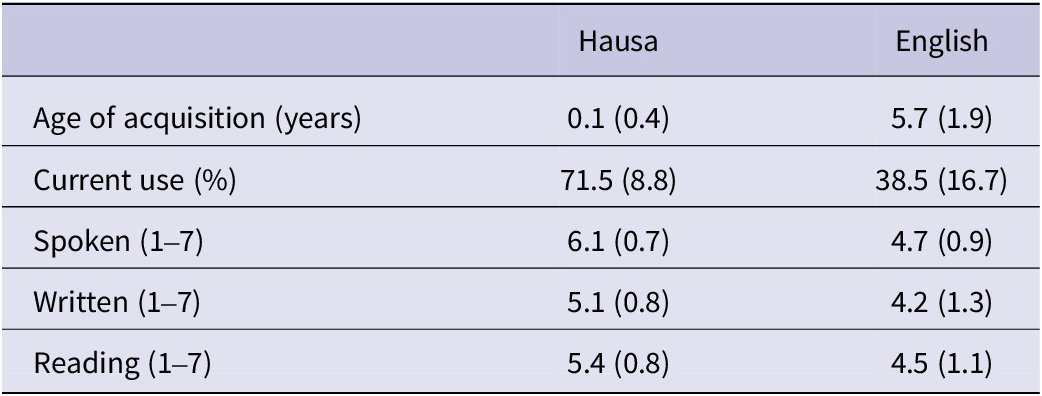
Thirty Hausa-English bilingualsFootnote 1 were recruited. Two participants were excluded due to recording failures, leaving 28 participants (27 male and 1 female) with an average age of 30.5 years (SD = 7.0). Following the experiment, the participants were asked to complete a language background questionnaire regarding Hausa and English (see Table 1).
Overview of the demographic information (SD in brackets) for participants

3.2. Stimuli
A network description task was used in the current study, similar to that of Declerck et al. (Reference Declerck, Grainger and Hartsuiker2021) and Sánchez et al. (Reference Sánchez, Struys and Declerck2022). Overall, 15 experimental networks were presented with seven unique pictures each (see Figure 1 for an example), for a total of 105 pictures. None of the pictures referred to a cognate between HausaFootnote 2 and English (average frequency per million: 118.1; Brysbaert & New, Reference Brysbaert and New2009).
Example of a network.

The pictures of each network were presented simultaneously and were all connected by lines. A red dot moved across the pictures and lines, shifting a total of nine times between the pictures of each network. Participants had to describe the dot’s path while it was moving, using complete sentences that included the dot’s direction (up, down, left or right), the type of line (upper, lower, right- or left-curved line, diagonal line or straight line) it crossed and the picture (e.g., “The dot goes up over the straight line to the finger.”). Every network was shown only once for 55 seconds.
3.3. Procedure
This online study started with task instructions (presented in Hausa), after which an example of the task was given in Hausa. Participants then completed two practice networks with five pictures each, all of which did not occur in the experimental networks.
The following experiment consisted of three sections: It started with one block of six networks in Hausa (L1), followed by an English (L2) block of three networksFootnote 3 and finished with another Hausa block of six networks. The two blocks that required Hausa were counterbalanced across participants.
3.4. Analysis
For the analysis, we focused on Blocks 1 and 3, which were both in Hausa. We analyzed the percentages of sentences containing filled pauses and language intrusions (Declerck et al., Reference Declerck, Grainger and Hartsuiker2021). We focused on these measures as they index failures of target language selection and increased cognitive load, respectively, thereby offering insights into ongoing language control processes. Coding of both measures was done by AMS. To this end, language intrusions were considered to be any words produced in the non-target language (i.e., English; e.g., producing finger instead of yatsa, which means finger in Hausa). Filled pauses were defined as vocalizations during speech that do not represent words (e.g., er, um and uh). To analyze how proactive language control developed over the course of the Hausa blocks, we took not only Blocks 1 and 3 in their entirety but also the block halves into account. This way, we determined whether proactive control diminished over the course of Block 3.
The binomial data were analyzed using a logistic mixed model with random effects for participants and items, with a maximal random effects structure (Barr et al., Reference Barr, Levy, Scheepers and Tily2013).Footnote 4 The fixed effects of interest were Block (Block 1 = −0.5; Block 3 = +0.5) and Block half (first half = −0.5; second half within a block = +0.5).
4. Results
4.1. Language intrusions
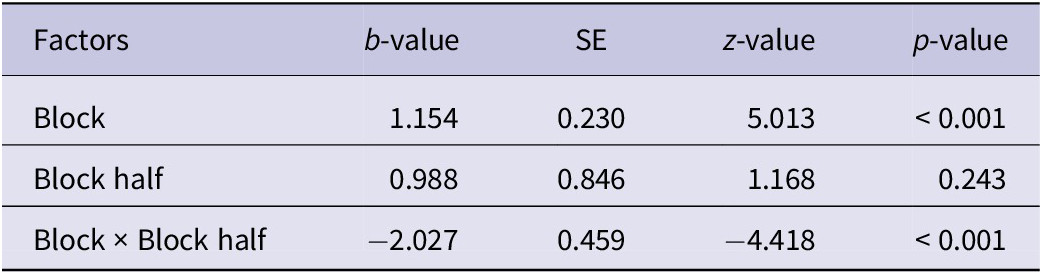
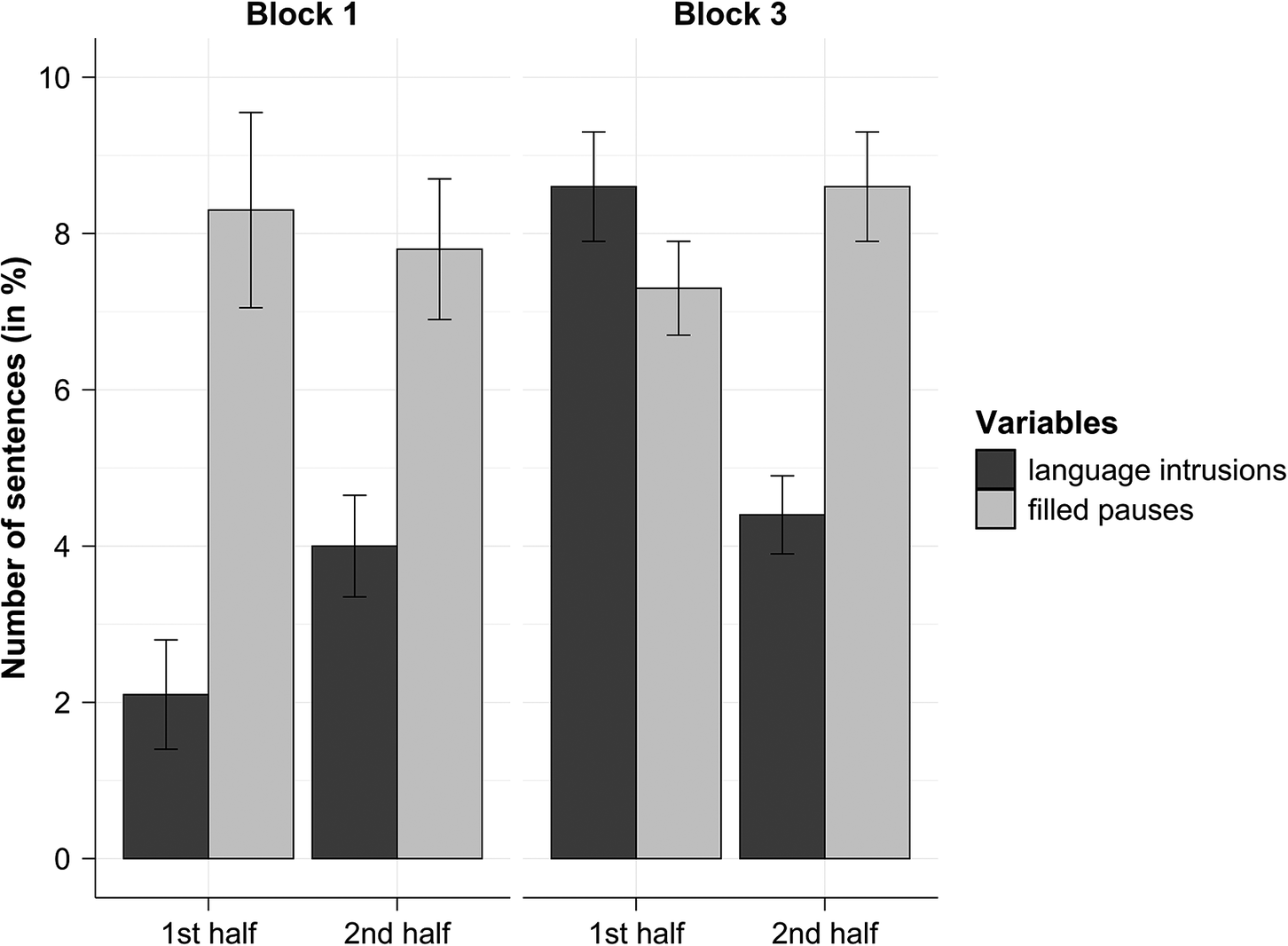
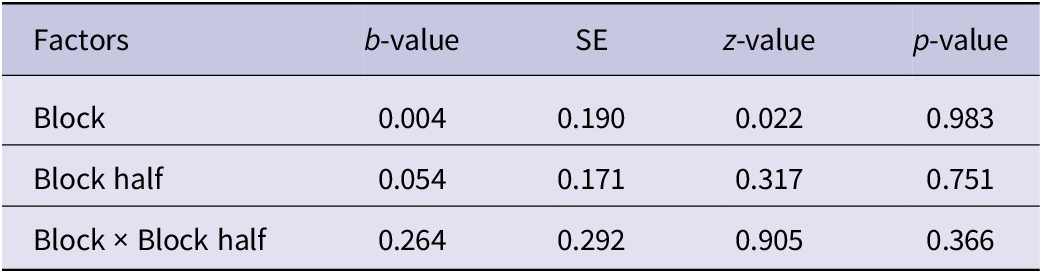
The effect of Block was significant (see Table 2), with more language intrusions in Block 3 (6.5%) than in Block 1 (3.0%).Footnote 5 Block half did not reach significance but the interaction between Block and Block half was significant. The latter interaction indicated a larger blocked language order effect, i.e., a larger difference between intrusions in the first half of Blocks 1 and 3 (6.5%) than in the second half of these blocks (0.4%; see Figure 2).
b-, z-values, and standard errors of the analysis of language intrusions
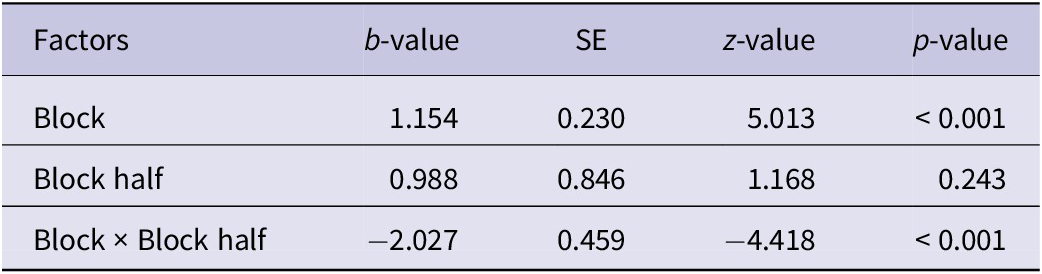
Percentage of sentences that contained a language intrusion or filled pause in the first and second half of Block 1 and Block 3. Error bars indicate 95% confidence intervals (Cousineau, Reference Cousineau2005).

4.2. Filled pauses
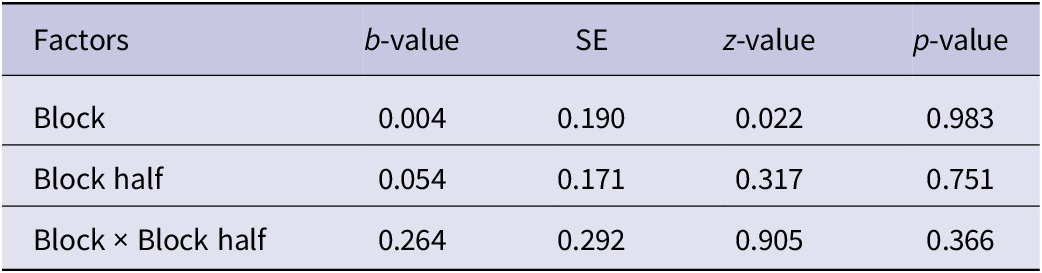
None of the effects reached significance (ps > .365; see Table 3).
b-, z-values, and standard errors of the analysis of filled pauses
5. Discussion
In this study, we investigated whether the blocked language order effect could be elicited during sentence production. For this purpose, Hausa-English bilinguals completed a network description task, using Hausa (Blocks 1 and 3) or English (Block 2). Results showed no effects for filled pauses but substantially more language intrusions in Block 3 compared to Block 1. Additionally, we found the same pattern for a group of Dutch-French bilinguals (see endnote 5). We thus replicated the blocked language order pattern that has previously only been observed during single-word production (Branzi et al., Reference Branzi, Martin, Abutalebi and Costa2014; Degani et al., Reference Degani, Kreiner, Ataria and Khateeb2020; Wodniecka et al., Reference Wodniecka, Szewczyk, Kałamała, Mandera and Durlik2020) with sentences. Moreover, the results indicated that this effect substantially decreased throughout an L1 block (see Figure 2).
This experiment is the first to show that the blocked language order effect can also be found during sentence production. Given previous research on the nature of this effect, our findings indicate that proactive language control is also implemented in a sentence context (Declerck, Reference Declerck2020). Based on previous studies suggesting that cross-language interference is reduced in sentences compared to single-word production (e.g., Schwartz & Kroll, Reference Schwartz and Kroll2006; Starreveld et al., Reference Starreveld, De Groot, Rossmark and Van Hell2014), one might have expected to find little evidence of proactive language control in a sentence context. This could be explained with sentences lowering the number of possible lemmas, thereby minimizing interference and thus the need for language control in this context (Ferreira & Pashler, Reference Ferreira and Pashler2002). In line with this assumption, previous research did not always provide reliable evidence for proactive language control in sentence production (Gullifer et al., Reference Gullifer, Kroll and Dussias2013; see also Declerck & Philipp, Reference Declerck and Philipp2015). In contrast, the blocked language order effect observed in the present study supports the premise that proactive control processes can also be implemented when sentences are produced by bilinguals. Our results are thus in line with prior studies that observed other indexes of proactive language control in a sentence context, such as mixing costs and the reversed language dominance effect (Declerck et al., Reference Declerck, Grainger and Hartsuiker2021; Tarłowski et al., Reference Tarłowski, Wodniecka and Marzecová2013). That proactive language control is applied in sentence production could be linked to bilinguals anticipating additional cross-language interference on the syntactic level (Hartsuiker et al., Reference Hartsuiker, Pickering and Veltkamp2004).
It should be noted that while the reversed language dominance effect and, to some degree, also mixing costs, focus on proactive language control in mixed-language blocks, the blocked language order effect measures proactive language control in a single-language context. Since this context requires less language control than mixed contexts (Green & Abutalebi, Reference Green and Abutalebi2013; Sánchez et al., Reference Sánchez, Philipp, Struys, Declerck, Hartsuiker and Strijkers2023), the present findings extend previous results on proactive language control in sentence production to single-language contexts.
Furthermore, this study provides insight into the development of the blocked language order effect and, consequently, proactive language control over the course of the L1 blocks. The pattern of language intrusions observed in the first and second half of Block 3 indicates that proactive language control of L1 spilled over from Block 2 into Block 3 and thus initially hindered renewed L1 naming. With prolonged L1 exposure, however, the previously implemented proactive control decreased, as indexed by the reduction of the blocked language order effect over the course of Block 3. The number of intrusions in the second half of Block 3 corresponds to that of the second half of Block 1, thereby suggesting that performance in the second half of Block 3 was once more on the same level as prior to the L2 block.
Overall, the present study shows that the blocked language order effect can be observed during sentence production. Our findings thus provide novel evidence that proactive language control is implemented during sentence production in a single-language context.
Supplementary material
The supplementary material for this article can be found at http://doi.org/10.1017/S1366728925100205.
Data availability statement
The data is available on Open Science Framework (https://osf.io/rq7me/). The material of both experiments is available upon request.
Funding statement
This project was funded by the Research Foundation – Flanders (FWO), Grant No. FWOAL1029, and by the Strategic Research Program of the Vrije Universiteit Brussel, Grant No. SRP88.
Competing interests
The author(s) declare none.



 Open access

