





Introduction
The Eurasian badger (Meles meles) is a mammal of the Mustelidae family, widely distributed throughout the Palearctic region from Ireland to Japan (Abramov Reference Abramov2025). In the Iberian Peninsula, at the south-western limit of its distribution area, the badger is widespread, although it is less abundant in the more arid southern regions compared to the Eurosiberian areas (Revilla et al. Reference Revilla, Casanovas, Virgós, Palomo, Gisbert and Blanco2007). The badger, due to its social behaviour and diverse feeding habits, can act as a reservoir or an accidental host for several parasites and pathogens. Infections with multiple agents have been documented both in Spain and in other parts of their range, including, among many others, viruses such as rabies virus (Smith Reference Smith2002), canine distemper virus (Oleaga et al. Reference Oleaga, Vázquez, Royo, Barral, Bonnaire, Armenteros, Rabanal, Gortázar and Balseiro2022) and several parvoviruses (Barlow et al. Reference Barlow, Schock, Bradshaw, Mullineaux, Dastjerdi, Everest, McGowan, Steinbach and Cowen2012; Calatayud et al. Reference Calatayud, Esperón, Velarde, Oleaga, Llaneza, Ribas, Negre, De la Torre, Rodríguez and Millán2020; Canuti et al. Reference Canuti, Mira, Villanúa, Rodríguez-Pastor, Guercio, Urra and Millán2025). They are also important reservoirs of bacteria such as Mycobacterium bovis (Corner et al. Reference Corner, Murphy and Gormley2011; Blanco-Vázquez et al. Reference Blanco-Vázquez, Barral, Romero, Queipo, Merediz, Quirós, Armenteros, Juste, Domínguez, Domínguez, Casais and Balseiro2021); Leptospira spp. (Millán et al. Reference Millán, Candela, López Bao, Pereira, Jiménez and León-Vizcaíno2009; Ayral et al. Reference Ayral, Djelouadji, Raton, Zilber, Gasqui, Faure, Baurier, Vourc’h, Kodjo and Combes2016); and Salmonella spp. (Millán et al. Reference Millán, Sevilla, Gerrikagoitia, García-Pérez and Barral2004b; Chiari et al. Reference Chiari, Ferrari, Giardiello, Lanfranchi, Zanoni, Lavazza and Alborali2014). Diverse protozoans, such as Toxoplasma gondii (Anwar et al. Reference Anwar, Knaggs, Service, McLaren, Riordan, Newman, Delahay, Cheesman and Macdonald2006), Leishmania infantum (Del Río et al. Reference Del Río, Chitimia, Cubas, Victoriano, De la Rúa, Gerrikagoitia and Berriatua2014; Peris et al. Reference Peris, Martínez-Durán, García, González, Morales, Castillo, Badiola and Moreno2024) and Babesia spp. (Bartley et al. Reference Bartley, Wilson, Innes and Katzer2017; Millán et al. Reference Millán, Checa, Oleaga, Rodríguez, Negre, Llaneza, Velarde and Miró2024), have also been identified in badgers.
Trypanosoma (Megatrypanum) pestanai is an extracellular bloodborne parasite for which the Eurasian badger acts as a natural host (Peirce and Neal Reference Peirce and Neal1974). It has been detected in badgers in France (Rioux et al., Reference Rioux, Albaret, Bres and Dumas1966), the United Kingdom (Peirce and Neal Reference Peirce and Neal1974; Ideozu et al. Reference Ideozu, Whiteoak, Tomlinson, Robertson, Delahay and Hide2015), Italy (Sgroi et al. Reference Sgroi, Iatta, Paolo Lia, Latrofa, Samarelli, Camarda and Otranto2021) and several Eastern European countries (Lindhorst et al. Reference Lindhorst, Brandstetter, Unterköfler, Eigner, Spergser, Colyn, Steinbach, Ćirović, Šprem, Dumić, Veneziano, Müller, Harl, Deak, Ionică, Heddergott and Fuehrer2024). It has also been found in other mammals, such as domestic dogs in Germany (Dyachenko et al. Reference Dyachenko, Steinmann, Bangoura, Selzer, Munderloh, Daugschies and Barutzki2017) and, more recently, in European hares (Lepus europaeus) (Veitova et al. Reference Veitova, Pikula, Votýpka, Linhart, Kokesova, Lesiczka, Piacek, Sedlackova, Sindelarova, Heger and Bandouchova2025). No human infections have been documented, and thus it is not considered zoonotic. According to Lizundia et al. (Reference Lizundia, Newman, Buesching, Ngugi, Blake, Sin, Macdonald, Wilson and McKeever2011), the life cycle of T. pestanai is believed to be indirect, as is the case for other trypanosomes within the subgenus Megatrypanum. Badgers are thought to become infected when the vector transmits the parasite’s infective forms during blood feeding. The main suspected vector of T. pestanai is the badger flea, Paraceras melis, and transmission is thought to be stercorarian (Lizundia et al. Reference Lizundia, Newman, Buesching, Ngugi, Blake, Sin, Macdonald, Wilson and McKeever2011). Recent studies have detected parasite DNA also in ticks that fed on infected badgers (Sgroi et al. Reference Sgroi, Iatta, Paolo Lia, Latrofa, Samarelli, Camarda and Otranto2021); however, this does not constitute proof of vector competence. Moreover, all smears prepared from the hemolymph, intestine, and salivary glands of live ticks tested negative for trypanosomes (Sgroi et al. Reference Sgroi, Iatta, Paolo Lia, Latrofa, Samarelli, Camarda and Otranto2021). The parasite may be present without causing evident clinical symptoms, although it has been associated with anaemia and splenomegaly in badgers (Lizundia et al. Reference Lizundia, Newman, Buesching, Ngugi, Blake, Sin, Macdonald, Wilson and McKeever2011). It has been suggested that the parasite may invade other tissues, including the nervous system, which could explain the neurological signs observed in infected individuals (Sgroi et al. Reference Sgroi, Iatta, Paolo Lia, Latrofa, Samarelli, Camarda and Otranto2021).
Since the presence of Trypanosoma. pestanai in Iberian badgers has not previously been investigated, the primary objective of this study was to determine whether this parasite occurs in a population of badgers from north-eastern Iberia and to estimate its occurrence using molecular methods. A secondary objective was to assess potential intrinsic and extrinsic risk factors associated with infection, including age, sex, and biogeographical origin, through statistical analysis.
Materials and methods
Field methods
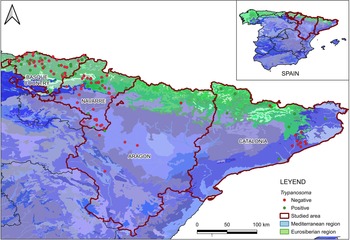
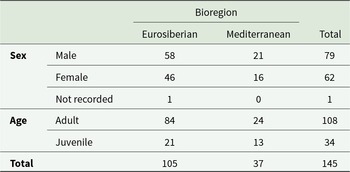
This study employed an opportunistic sampling approach. Road-killed badgers (n = 145) were collected across 4 autonomous regions: Aragon (n = 8), Navarre (n = 44), the Basque Country (n = 71) and Catalonia (n = 22) (Figure 1 and Table 1). In each of these regions, the carcasses of badgers found dead on roads were collected and sent to various wildlife recovery centres or regional laboratories. The GPS location of each roadkill incident was recorded. During necropsies carried out at these centres, each animal was classified by sex and age, and a spleen sample was collected and frozen at −20°C until analysis.
Map of peninsular Spain showing the origin of the badger samples analyzed for Trypanosoma pestanai.

Characteristics of the sample of Eurasian badgers analyzed for Trypanosoma pestanai DNA in northern Spain. For 3 badgers, the exact location was unknown

Molecular methods
Genomic DNA was extracted using a commercial Speedtools DNA extraction kit (Biotools B&M Labs S.A., Madrid, Spain) with slight modifications to the manufacturer’s protocol. For tissue lysis, 20–25 mg of spleen tissue was placed in a 1.5 mL Eppendorf tube, mixed with 200 μL of PBS (1 ×) and 200 μL of Buffer BB3 and subsequently homogenized using a sterile lancet. After complete tissue disruption and dissolution, 25 μL of Proteinase K was added, the mixture was vortexed for 1 minute, incubated in a thermal cycler for 30 minutes at 70°C, and the manufacturer’s instructions were subsequently followed. Extracted DNA was eluted in elution buffer (100 μL) and stored at -20°C until further use.
We initially designed a set of primers targeting a fragment of the 18S rRNA gene of T. pestanai to develop a SYBR Green-based real-time PCR protocol. Due to the lack of available T. pestanai reference material, we used a T. cruzi DNA as a positive control to optimize the amplification conditions. To validate the specificity of the SYBR Green protocol, several SYBR-positive samples were further analyzed using conventional PCR followed by Sanger sequencing. These sequences confirmed the presence of T. pestanai, supporting the specificity and reliability of the assay (see Results). Subsequently, a second set of primers and a TaqMan probe were designed to develop a probe-based qPCR protocol targeting the same 18S rRNA gene fragment. During protocol optimization, T. cruzi control DNA did not amplify under the TaqMan conditions. As a result, one of the T. pestanai-positive samples, previously confirmed by SYBR Green qPCR and sequencing, was selected and used as the positive control for the TaqMan protocol. Not all samples could be analyzed by both techniques due to insufficient DNA in some cases (SYBR Green: 123 from Aragon, Navarre, and Basque Country; TaqMan probe: 145 from all of them, plus samples from Catalonia).
Primers and TaqMan probe for both qPCR protocols were designed using the PrimerQuest Tool (Integrated DNA Technologies, Coralville, IA, USA), based on the T. pestanai 18S rRNA gene sequence reported by Dyachenko et al. (Reference Dyachenko, Steinmann, Bangoura, Selzer, Munderloh, Daugschies and Barutzki2017) (GenBank accession number KY354582). The tool was configured for qPCR applications using default parameters, except for the annealing temperature, which was adjusted to 55 °C. The primers designed for the SYBR Green protocol were Tryp set 1 F (5′-GCG ATA TTC GGT TGT ATC-3′) and Tryp set 1 R (5′-ACA TAG AGG AGC ATC AC-3′), yielding a 92 bp amplicon. Each reaction was performed in a final volume of 20 μL, consisting of 10 μL of GoTaq qPCR Master Mix with SYBR Green (Promega), 6.75 μL of nuclease-free water, 1 μL of each primer (final concentration 0.6 μm) and 2.25 μL of extracted DNA. All reactions were run in duplicate using a CFX Connect Real-Time PCR Detection System (Bio-Rad Laboratories) and 96-well plates. A negative control with water and a T. cruzi positive control were included in duplicates. A standard curve was generated using DNA extracted from a T. cruzi culture. Six 10-fold serial dilutions were prepared, and the resulting standard curve was used to determine the amplification efficiency (E = 106.2%, R2: 0.982; Supplementary Figure 1). The thermal cycling protocol included an initial hot-start DNA polymerase activation at 94 °C for 5 minutes, followed by 44 cycles of denaturation at 94 °C for 5 seconds and fluorescence acquisition during the annealing phase at 55 °C for 30 seconds, with an extension step at 79 °C for 5 seconds. To confirm the specificity of the amplified products, a melting curve analysis was performed at the end of the amplification process. The dissociation curve was generated from 60 °C to 94 °C, increasing the temperature in 0.5 °C increments. A sample was considered positive when it produced an amplicon with a melting temperature of 82 °C and a Ct < 38 (Supplementary Figure 2). All qPCR data were analyzed using Bio-Rad CFX Manager software, version 2.
The primers designed for the TaqMan protocol were Tryp F (5′-GAT CCG GAC AGG ATA AG-3′) and Tryp R (5′-GGA ATC AAC CAA ACA AAT C-3′), along with the TaqMan probe 5′-/56-FAM/TCA GGA AAT/ZEN/CGA GAA AGG ACA C/3IABkFQ/-3′ yielding a 106-bp amplicon.
Amplifications were performed using a CFX Connect Real-Time PCR Detection System (Bio-Rad Laboratories) and 96-well plates. Each reaction was prepared in a final volume of 20 μL, consisting of 10 μL of GoTaq qPCR Master Mix (Promega), 6.75 μL of nuclease-free water, 1 μL of each primer (final concentration 0.9 μm) and 2.25 μL of template DNA. The thermal cycling protocol began with an initial polymerase activation at 94 °C for 7 minutes, followed by 44 amplification cycles consisting of denaturation at 94 °C for 5 seconds, annealing at 55 °C for 30 seconds and extension at 79 °C for 5 seconds. A sample previously confirmed as T. pestanai was included in duplicates as a positive control. A sample was considered positive if Ct < 38.
A conventional PCR protocol targeting a specific region of the 18S rRNA gene was carried out for the detection of Trypanosoma spp. The method, based on Zeb et al. (Reference Zeb, Szekeres and Takács2019), employed the primers 609 F (5′-CACCCGCGGTAATTCCAGC-3′) and 706 R (5′-CTGAGACTGTAACCTCAA-3′), which amplify a fragment of approximately 900 bp.
PCR reactions were performed in a final volume of 25 μL, consisting of 12.5 μL of NZYTaq II 2 × Green Master Mix (NZYTech, Portugal), 0.5 μL of each primer (final concentration 10 nM), 9 μL of nuclease-free water, and 2.5 μL of template DNA. Amplifications were conducted in an MJ Mini thermal cycler (Bio-Rad) under the following conditions: initial denaturation at 94 °C for 2 minutes; 45 cycles of denaturation at 94 °C for 15 seconds, annealing at 60 °C for 15 seconds and extension at 72 °C for 2 minutes; followed by a final extension at 72 °C for 7 minutes. Samples were run in 1.5% agarose gel at 65 V for 1 hour.
PCR fragments were sequenced with both primers by Sanger sequencing. The obtained sequences were manually assembled and edited using the BioEdit 7.2 program. A BLAST search (https://blast.ncbi.nlm.nih.gov) was conducted to compare the sequenced products with sequences available in GenBank. Sequences obtained in the present study that showed 100% identity were classified as the same nucleotide sequence type (ntST). Following sequence alignment using MUSCLE, a phylogenetic analysis was performed under the Maximum Likelihood method. Sequences were trimmed to 787 bp. The optimal models for phylogenetic analysis were selected using the ‘Models’ option in MEGA software. All phylogenetic analyses were carried out with MEGA11: Molecular Evolutionary Genetics Analysis version 11.
Statistical analysis
To assess the level of agreement between the 2 molecular techniques, the kappa concordance coefficient was calculated using WinEpi, considering only those samples that were analyzed by both methods.
Based on their location, each individual was assigned to one of the following two biogeographic regions: Eurosiberian or Mediterranean. To identify potential risk factors for T. pestanai parasitism in badgers, a binary logistic regression analysis was performed. The dependent variable was the presence/absence of parasite DNA, while the explanatory variables included sex, age of the animal, and the bioregion where the animal was found. The analysis was conducted using IBM SPSS Statistics 29. A P-value of < 0.05 was considered statistically significant. Model goodness-of-fit was assessed using the Hosmer–Lemeshow test.
Results
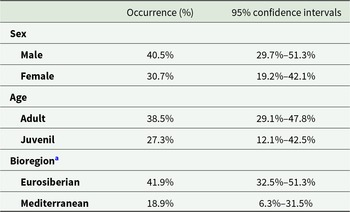
A prevalence of 23.6% was observed using the SYBR Green protocol and 31% using the TaqMan protocol (Table 2). Agreement between techniques was considered excellent (Kappa = 0.805). Considering as positive those samples that tested positive by at least one of the techniques, the overall observed prevalence was 35.2% (95% Confidence Intervals = 27.4%–42.9%).
Occurrence of Trypanosoma pestanai DNA depending on the badger sex, age and bioregion of origin

a Significant differences between groups.
Statistical analysis revealed significant differences only for the bioregion variable (Tables 2 and 3), with a higher prevalence in the Eurosiberian region compared to the Mediterranean region. The Hosmer-Lemeshow test indicated a good model fit (P = 0.763). Based on the odds ratio, the likelihood of finding a parasitized badger in the Eurosiberian region is 3.04 times greater than in the Mediterranean region.
Summary of the logistic regression for Trypanosoma pestanai occurrence in badgers

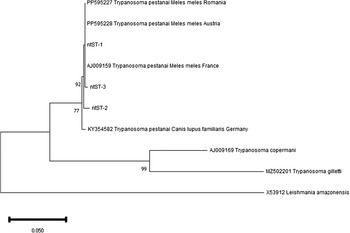
Of the 11 samples selected for conventional PCR, 9 displayed a band of the expected size, yielding 9 readable sequences. Six sequences were of good quality and were uploaded to GenBank under accession numbers PV819715-PV819720. Four of these sequences (PV819715, PV819716, PV819719, and PV819720) were identical and assigned to the ntST-1, which showed an identity of 100% with Trypanosoma pestanai from a badger in France (AJ009159). The sample assigned to ntST-2 (PV819717) was 99.49% identical to ntST-1 and showed this same percentage of identity with a sample from a badger in Austria (PP595227). Finally, ntST-3 (PV819718) was 99.75% similar to ntST-1, 99.23% to ntST-2, and 99.76% to the abovementioned sequence from France (AJ009159). The sequence quality of the remaining 3 samples was poor and therefore could not be definitely assigned to a species, although all were highly similar to those of T. pestanai. Phylogenetic analysis confirmed the BLAST results, placing our sequences within the same clade as other T. pestanai sequences (Figure 2).
Maximum-likelihood tree based on the Kimura 2-parameter with distribution G model of selected sequences (787 bp) from Trypanosoma pestanai. NtST1 to 3 are the nucleotide sequence types identified in this study (see text for details). The percentage of trees in which the associated taxa clustered together (bootstrap values) is shown next to the branches. Bootstrap values less than 70 are not shown. Leishmania amazonensis is included as an outgroup member.

Discussion
This study documents, for the first time, the presence of T. pestanai in badgers from the Iberian Peninsula. Previously, the parasite had been reported in several European countries, including France, the United Kingdom, Italy, Germany, Austria, Hungary, Romania, Bosnia and Herzegovina, Croatia, and Serbia (Peirce and Neal Reference Peirce and Neal1974; Lizundia et al. Reference Lizundia, Newman, Buesching, Ngugi, Blake, Sin, Macdonald, Wilson and McKeever2011; Ideozu et al. Reference Ideozu, Whiteoak, Tomlinson, Robertson, Delahay and Hide2015; Sgroi et al. Reference Sgroi, Iatta, Paolo Lia, Latrofa, Samarelli, Camarda and Otranto2021; Lindhorst et al. Reference Lindhorst, Brandstetter, Unterköfler, Eigner, Spergser, Colyn, Steinbach, Ćirović, Šprem, Dumić, Veneziano, Müller, Harl, Deak, Ionică, Heddergott and Fuehrer2024). The lack of prior detection in the Iberian Peninsula is most likely attributable to the absence of targeted investigations rather than to a recent introduction of the parasite.
The prevalence observed in our study is lower than that reported in certain countries such as Romania, even when considering only badgers from Eurosiberian regions of Iberia (Lindhorst et al. Reference Lindhorst, Brandstetter, Unterköfler, Eigner, Spergser, Colyn, Steinbach, Ćirović, Šprem, Dumić, Veneziano, Müller, Harl, Deak, Ionică, Heddergott and Fuehrer2024). However, it is comparable to the prevalence values reported for France. Differences in prevalence across regions may be explained by a combination of ecological, environmental and biological factors that influence parasite transmission dynamics.
Several factors may contribute to these differences. For instance, host–vector interactions, habitat structure and climatic conditions likely play key roles. Higher badger densities in certain countries may be associated with the availability of suitable habitats – such as forests, hedgerows and stable burrow systems – that facilitate host survival and, consequently, long-term parasite circulation (Kasozi et al. Reference Kasozi, Zirintunda, Ssempijja, Buyinza, Alzahrani, Matama, Nakimbugwe, Alkazmi, Onanyang, Bogere, Ochieng, Islam, Matovu, Nalumenya, Batiha, Osuwat, Abdelhamid, Shen, Omadang and Welburn2021). Nonetheless, prevalence estimates reported in high-density badger populations in the United Kingdom are broadly comparable to those observed in our survey. It is also important to consider methodological variation among studies, including differences in sample types and PCR protocols used, as these may affect detection sensitivity and comparability. Despite these limitations, our findings suggest that continental climates, characterized by higher humidity and moderate temperatures, may favour parasite transmission – either by enhancing vector survival or influencing host ecology. For example, the temperate and humid conditions typical of the Eurosiberian region promote the development and reproduction of fleas, which are suspected vectors of T. pestanai (Cox et al. Reference Cox, Stewart and Macdonald1999; Balestrieri et al. Reference Balestrieri, Remonti and Prigioni2009). In contrast, the warmer and drier Mediterranean climate may restrict flea proliferation and thus reduce transmission potential. Behavioural and social differences between regional badger populations may also influence transmission dynamics. In the Eurosiberian region, badgers tend to form larger, more stable social groups and use communal burrow systems over extended periods, conditions that may favour vector accumulation and intra-group transmission (Kruuk Reference Kruuk1978). Conversely, in Mediterranean areas, social groups are typically smaller, and burrow use is more dispersed or ephemeral, likely limiting both vector persistence and host-to-host transmission (Revilla et al. Reference Revilla, Palomares and Delibes2001; Lara-Romero et al. Reference Lara-Romero, Virgós, Escribano-Ávila, Mangas, Barja and Pardavila2012).
Unfortunately, due to the nature of our samples (road-killed individuals), we were unable to assess the potential association between the presence of fleas or other ectoparasites and T. pestanai infection. Ectoparasites often abandon their hosts shortly after death (Millán et al. Reference Millán, Gortazar, Martín-Mateo and Villafuerte2004a), and since the post-mortem interval was unknown for most individuals, any attempt to link ectoparasite burden with infection status would have been unreliable.
No statistically significant differences in T. pestanai occurrence were observed between sex or age groups. These results align with those reported by Ideozu et al. (Reference Ideozu, Whiteoak, Tomlinson, Robertson, Delahay and Hide2015), who also found no association with host sex or age. However, Lizundia et al. (Reference Lizundia, Newman, Buesching, Ngugi, Blake, Sin, Macdonald, Wilson and McKeever2011) documented a higher prevalence of infection in juveniles compared to adults, attributing this difference to the behaviour of young individuals, who may spend longer periods in burrows contaminated with ectoparasites. Such behaviour could increase exposure to vectors and facilitate transmission. Although this hypothesis is plausible, it could not be confirmed in the present study.
The higher prevalence detected using the TaqMan assay may be attributable to its lower limit of detection. In studies of Leishmania spp., TaqMan-based assays have demonstrated superior sensitivity and the ability to detect low parasite burdens that may be missed by SYBR Green-based methods. For instance, in comparative studies using canine Leishmania samples, TaqMan assays were able to identify low-intensity infections that went undetected by SYBR Green (Gomes et al. Reference Gomes, Cesetti, de Paula, Vernal, Gupta, Sampaio and Roselino2017; Peris et al. Reference Peris, Esteban-Gil, Ortega-Hernández, Morales, Halaihel and Castillo2021). It is therefore plausible that the TaqMan assay used in this study detected low-parasite-load infections in badgers that were not consistently identified by the SYBR Green assay. Despite this difference in sensitivity, both real-time PCR protocols showed a high level of concordance, supporting their reliability for the detection of T. pestanai DNA. While SYBR Green assays are more economical and simpler to implement – requiring only primers and an intercalating dye – they can still provide robust results when combined with proper melting curve analysis, making them suitable for large-scale screening studies. In contrast, TaqMan assays, which require the design of specific (and costlier) probes, offer greater specificity and are therefore more appropriate for diagnostic or epidemiological surveillance (Pareyn et al. Reference Pareyn, Hendrickx, Girma, Hendrickx, Van Bockstal, Van Houtte, Shibru, Maes, Leirs and Caljon2020). Based on our findings, we propose a cost-effective strategy for T. pestanai detection consisting of initial screening with the SYBR Green assay, followed by confirmatory testing with TaqMan for samples showing high Ct values or ambiguous amplification curves. This dual approach combines economic feasibility with diagnostic accuracy.
In conclusion, as demonstrated in this study, we report for the first time the presence of T. pestanai in the Iberian Peninsula. Given the parasite’s documented capacity to cross species barriers – having been reported in domestic dogs and hares – further research is warranted to explore its ecology, transmission dynamics and potential reservoir hosts in this region. Future studies should investigate its presence in other wild and domestic species, assess the role of different vector species and clarify environmental factors that facilitate its persistence. Additionally, these findings should be communicated to veterinary professionals to raise awareness of the parasite’s presence and to encourage its consideration in the differential diagnosis of relevant clinical cases.
Supplementary material
The supplementary material for this article can be found at https://doi.org/10.1017/S0031182025101066.
Data availability statement
Nucleotide sequences of 18S rRNA genes from the present study have been deposited in the GenBank database under the accession numbers PV819715–PV819720.
Acknowledgements
We wish to thank the Rangers from the Navarre and Aragón environmental departments who collected the carcasses, as well as the technicians E. Castién and M. López, who provided permits for collecting the samples in Navarre, and several veterinary students who assisted during necropsies. We would like to thank the provincial councils, Diputación Foral de Bizkaia and Diputación Foral de Gipuzkoa, and the wildlife recovery centres of the Basque Country for the effort they made to provide us with the carcasses. We are indebted to Javier Nieto and María Flores (Centro Nacional de Microbiología/ISCIII) for sending us a sample of T. cruzi to be used as a positive control.
Author contributions
Conceptualization: JM; Animal sampling: FU, DV, MB, CG, XG, RV; Laboratory work: EA, NH, MPP. Data analysis: JM, RR-P. Writing (original draft): JM. Writing (editing and reviewing): all authors.
Financial support
This study received partial support by project A16_23R, Gobierno de Aragón, and by the Instituto Agroalimentario de Aragón-IA2.
Competing interests
The authors declare there are no conflicts of interest.
Ethical standards
Since this investigation opportunistically used specimens from already dead wild animals collected from the regional authorities, ethical approval was not necessary to conduct the study.



 Open access

