


The California red-legged frog Rana draytonii is the largest native frog (length 4.4–13.8 cm) (Hayes & Miyamoto, Reference Hayes and Miyamoto1984; Stebbins & McGinnis, Reference Stebbins and McGinnis2012) in the United States west of the Mississippi River and was heavily exploited as a food resource during the Gold Rush era (Jennings & Hayes, Reference Jennings and Hayes1985). More recently, R. draytonii and other amphibians in southern California have suffered declines as a result of habitat loss, presence of non-native species, and pesticide pollution (Jennings & Hayes, Reference Jennings, Hayes, Brown and Wright1994; Fisher & Shaffer, Reference Fisher and Shaffer1996; Davidson et al., Reference Davidson, Shaffer and Jennings2001; Fellers, Reference Fellers and Lannoo2005; Backlin et al., Reference Backlin, Hitchcock, Gallegos, Yee and Fisher2015; Thomson et al., Reference Thomson, Wright and Shaffer2016), and are actively managed to stabilize populations and promote conservation. The range of R. draytonii extends from Mendocino County north of the San Francisco Bay and Butte County in the Sierra Nevada, south along the coastal mountains of California into northern Baja California, Mexico (Peralta-Garcia et al., Reference Peralta-Garcia, Hollingsworth, Richmond, Valdez-Villavicencio, Ruiz-Campos and Fisher2016; Thomson et al., Reference Thomson, Wright and Shaffer2016). In southern California, dramatic declines have occurred since the 1960s, with extirpations known from San Diego, San Bernardino, Orange and Riverside counties. Rana draytonii is categorized as Vulnerable on the IUCN Red List (Hammerson, Reference Hammerson2008) and listed as threatened by the U.S. Fish and Wildlife Service.
The last extant population of R. draytonii known from this four-county area occurred on the Santa Rosa Plateau in western Riverside County, where it was extirpated in the early 2000s. In February 2017, however, two individuals of R. draytonii were observed at Whitewater Preserve, c. 75 km east–north-east of the Santa Rosa Plateau in the southern foothills of the San Bernardino Mountains. We present results of a subsequent survey at The Wildlands Conservancy's Whitewater Preserve and a preliminary genetic analysis to identify the closest living relatives of these frogs.
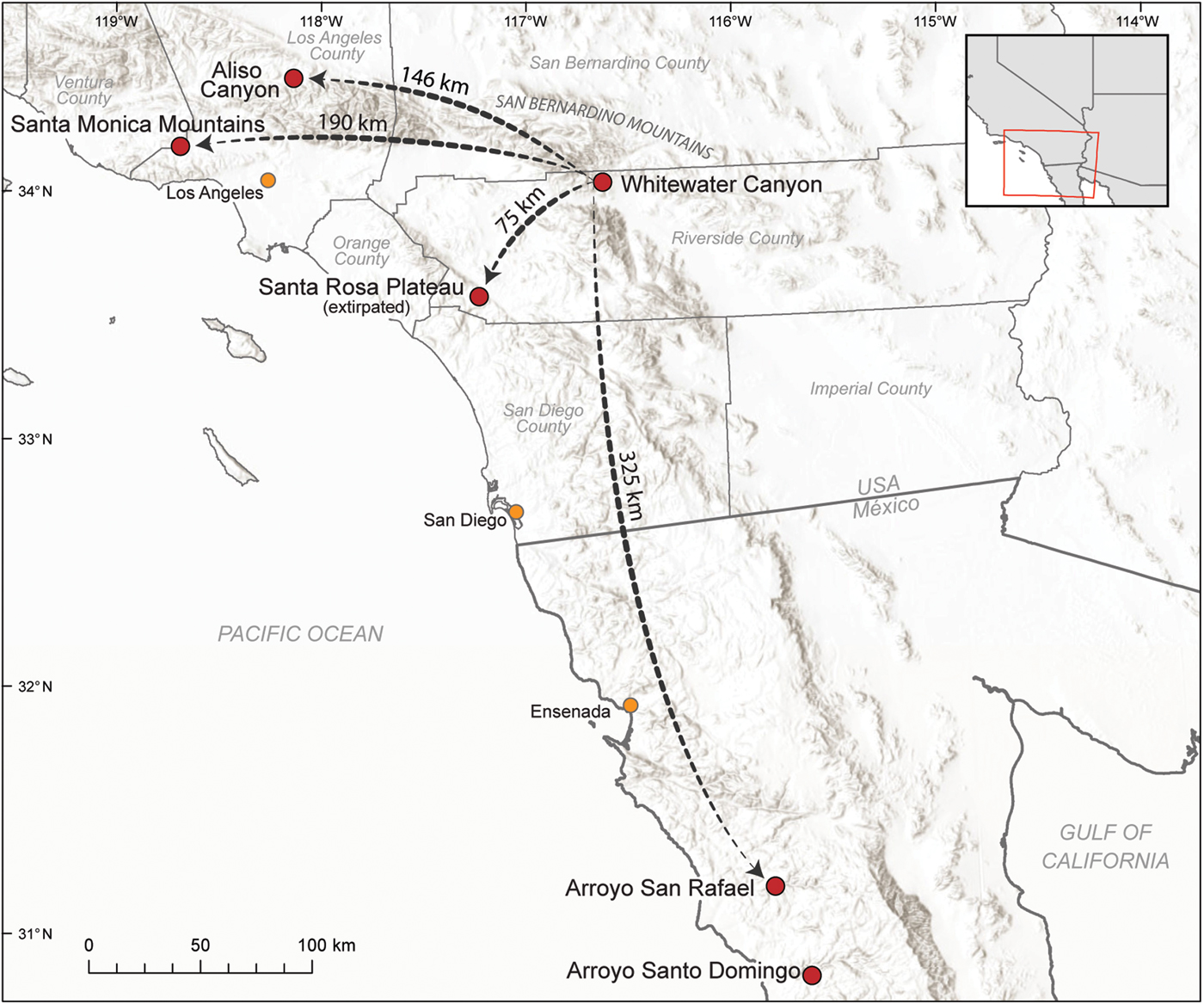
The Whitewater Preserve lies in Whitewater Canyon at the base of the San Bernardino Mountains in Riverside County, California (Fig. 1). Before The Wildlands Conservancy acquired the property in 2006 through a partnership with Friends of the Desert Mountains and The Coachella Valley Mountains Conservancy, it was a privately owned trout farm that consisted of several artificial ponds built in 1938. These concrete- and earthen-lined ponds are filled from wells, and French drains control the rate and direction of flow. Adjacent terrestrial habitat varies from paved stone sidewalks with public access to natural surroundings with restricted access.
The location of Whitewater Canyon in Riverside County, California, USA, and other sites in California and Mexico where the California red-legged frog Rana draytonii is known to occur, including the Santa Rosa Plateau, from where the species was recently extirpated.
A few days after the first sightings of R. draytonii at the Whitewater Preserve we conducted a visual daytime search for frogs, tadpoles and egg masses, followed by a night-time eye shine search for adult frogs. Captured frogs were weighed, measured (snout-to-urostyle length), and georeferenced using a global positioning system. Survey work was authorized by a U.S. Fish and Wildlife Service 10(a)(1)(A) Recovery Permit (TE-045994-17) and a California Department of Fish and Wildlife Scientific Collecting Permit (SCP838).
To improve our understanding of the origin of these frogs, we extracted DNA from a small toe clip using a Qiagen DNeasy Kit (Qiagen Inc., Valencia, USA) and Sanger-sequenced a region of the cytochrome b mitochondrial gene (986 base-pairs), which has been used to good effect for identifying regionally specific mtDNA clades (Richmond et al., Reference Richmond, Backlin, Tatarian, Solvesky and Fisher2014). Sequencing was performed on a 3730xl DNA Analyzer at Genewiz (La Jolla, California, USA). We used DnaSP 5.10 (Librado & Rozas, Reference Librado and Rozas2009) to match the haplotype sequence against a large cytochrome b database representing the full range of R. draytonii (GenBank accession: MG022156).
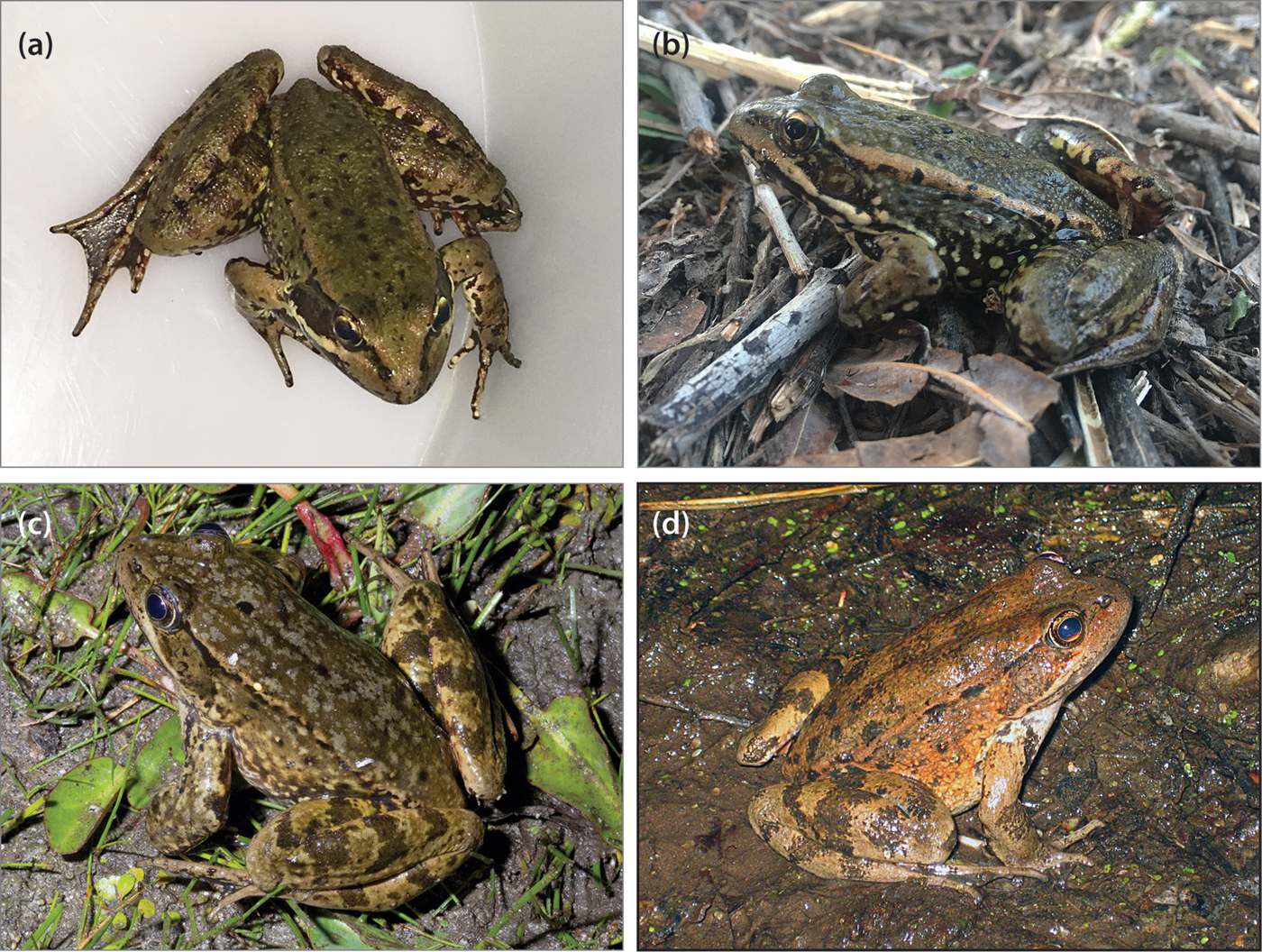
Our survey revealed only one R. draytonii adult, captured on 23 February 2017 (snout–urostyle length = 56.0 mm; weight = 18.0 g). No tadpoles or egg masses were detected. A week previously, Whitewater Preserve staff detected one large adult, which was not captured, and one noticeably smaller adult, which was captured, photographed and released. Based on certain aspects of colour pattern (Marlow et al., Reference Marlow, Wiseman, Wheeler, Drennan and Jackman2016) and body size, we are confident that these two frogs were different individuals than the one we captured in this survey (Plate 1).
The first (a) and second (b) R. draytonii individuals captured at the Whitewater Preserve in Whitewater Canyon, Riverside County, California (Fig. 1); (c) R. draytonii from Arroyo Santo Domingo in Baja California (Fig. 1); (d) R. draytonii from East Las Virgenes Canyon in the Santa Monica Mountains, Ventura County, California (Fig. 1). (Photograph credits: (a) CKC; (b) EAG; (c) JQR; (d) ARB)
The cytochrome b haplotype from Whitewater is identical to a haplotype recovered from the Santa Rosa Plateau population, in Riverside County, California, and to all extant R. draytonii populations in northern Baja California, Mexico (Table 1). This haplotype differs from the closest known R. draytonii populations in the Santa Monica Mountains by 20 mutations (uncorrected p-distance = −0.020) and from the northern San Gabriel Mountains by 16 mutations (uncorrected p-distance = 0.016; Fig. 1).
Representative cytochrome b haplotypes for Rana draytonii in southern California (invariable sites removed from the 986 base-pair sequence; * identifies nucleotide sites in the haplotype sequence where the character states are unique to the Baja mtDNA lineage). Haplotypes are arranged from south to north (1–5) and extend from Arroyo San Rafael in the Sierra San Pedro Martir of Baja California to the Cuyama River in northern Santa Barbara County, California.

The discovery of R. draytonii in Whitewater Canyon reduces a c. 420 km gap between the southernmost population within the USA (Santa Monica Mountains) and the northernmost population in Baja California, Mexico (Arroyo San Rafael; Fig. 1), and re-establishes the presence of a unique mtDNA lineage that was considered to be extirpated in California. Until now, the only members of this lineage in California were from the recently extirpated Santa Rosa Plateau population (Shaffer et al., Reference Shaffer, Fellers, Voss, Oliver and Pauly2004; Richmond et al., Reference Richmond, Backlin, Tatarian, Solvesky and Fisher2014). Because this haplotype extends from the San Bernardino Mountains south into the Sierra San Pedro Mártir of Baja California, it is reasonable to assume that Whitewater and Sierra San Pedro Mártir R. draytonii are representative of the lineage that was present historically across southern California. This finding is consistent with the biogeography of southern California given that these sites form portions of the Peninsular Ranges, and the fact that many species co-occurring in the Peninsular Ranges show a common phylogeographical history (Vandergast et al., Reference Vandergast, Bohonak, Hathaway, Boys and Fisher2008).
Our findings suggest that Whitewater Canyon may be an appropriate donor site for re-introducing R. draytonii to extirpated sites in southern California. Following guidance from the U.S. Fish and Wildlife Service Recovery Plan for R. draytonii (USFWS, 2002) and previous translocation efforts (Rathbun & Schneider, Reference Rathbun and Schneider2001), successful repatriation programmes for R. draytonii have already taken place at Pinnacles National Park (P. Johnson, pers. comm.), Golden Gate National Recreation Area (D. Fong, pers. comm.) and in the Santa Monica Mountains National Recreation Area (K. Delaney, pers. comm.), with similar efforts currently being pursued at Yosemite National Park (R. Grasso, pers. comm.).
The recent discovery of R. draytonii at the Whitewater Preserve raises some question about their source. The former presence of trout and a large raccoon population may have kept the frogs below a detectability threshold, given that non-native predatory fish and a host of small mammals (including raccoons) are known to prey on this species (Fellers, Reference Fellers and Lannoo2005). Trout removal and managed thinning of the raccoon population in recent years could have alleviated predation constraints, and heavy rains during winter 2016–2017 might have facilitated downstream dispersal from sites with potentially suitable habitat c. 6.5–12.0 km upstream. We cannot rule out the possibility that R. draytonii were artificially transplanted into these ponds, but this would have required that frogs were moved from either Mexico or an unknown site in southern California with the appropriate genetic background. Genome sequencing will provide more definitive information on the source of the individual captured in our survey in the coming months. Nonetheless, the evidence presented here and the documented historical presence of R. draytonii in nearby areas (VertNet, 2017) favours the hypothesis that these frogs are native.
Current management at the Whitewater Preserve is developing a strategy to conserve this population, and since our survey effort, two additional frogs have been observed on the property. Plans to continue monitoring the site are also underway. While the fate of R. draytonii remains uncertain the potential for former trout farming practices to be shifted to frog farming for translocation efforts in southern California merits consideration. Ironically, the one practice that may have been responsible for the species’ decline at this site may potentially be used to save it.
Acknowledgements
This work was supported by the U.S. Geological Survey's (USGS) Science Support Partnership (SSP) with the U.S. Fish and Wildlife Service (USFWS) and the USGS Ecosystems Mission Area. We thank the Whitewater Preserve staff, particularly Jack Thompson and Jose Cortez for site access and field assistance. Rebecca Gordon (USFWS) and Jack Crayon (California Department of Fish and Wildlife) provided support for the survey effort. This is contribution 579 of the USGS Amphibian Research and Monitoring Initiative. The use of trade names does not imply endorsement by the U.S. Federal Government.
Author contributions
ARB, EAG and CKC conducted field surveys. CKC discovered this R. draytonii population. JQR performed genetic analysis. ARB, JQR and RNF framed the information in a broader conservation context. ARB and JQR wrote the article.
Biographical sketches
Adam Backlin is an ecologist studying conservation of herpetofaunal and freshwater fish in the western USA. Jonathan Richmond's research focuses on the conservation genetics of threatened and endangered reptile and amphibian species in western North America and on Pacific Islands. Elizabeth Gallegos is a wildlife biologist studying endangered and threatened amphibians, and is interested in the conservation of herpetofauna. Clinton Christensen is a Wildlands Conservancy Ranger and is interested in conservation and wildlife photography. Robert Fisher’s research focuses on the impacts of urbanization and wildfires on southern California. He also studies the evolution and conservation biology of Pacific Island herpetofauna.



