



Anaemia, defined as a reduced concentration of Hb in the blood, is an important public health problem in the world. With universal susceptibility, it affects individuals from both poor and rich countries. However, there is a greater concern in the case of children, not only because they are most often affected but also because anaemia causes a variety of metabolic disorders that hinder their adequate growth and development(1).
A meta-analysis of articles published between 1996 and 2006 showed that the prevalence of anaemia in Brazilian children was a serious public health problem, regardless of the scenarios in which the samples were obtained: 52·0 % in studies carried out with samples from childcare centres, 60·2 % in studies performed in health services, 66·5 % in children of populations with social inequities and 40·1 % in population-based studies. Therefore, the most severe situation was found in populations subjected to social inequities, such as indigenous and slum communities(Reference Vieira and Ferreira2,Reference Vieira, Ferreira and Costa3) .
Considering the nutritional transition process and the implementation of public policies for the prevention of anaemia in the country, such as the programme that fortifies wheat and maize flour with iron and folic acid, and the National Iron Supplementation Programme (PNSF – Programa Nacional de Suplementação de Ferro) created in 2005 by the Ministry of Health(4), it was expected that the prevalence of anaemia in children would reduce largely throughout the country. However, there are no recent national studies that allow making a conclusion in this direction, which justifies a need for a new literature review integrating the several studies published in the period after the meta-analysis that was conducted in 2006(Reference Vieira and Ferreira2). Coincidentally, a national survey was performed in 2006, the exact limit year for inclusion of papers in the meta-analysis mentioned above, but this survey was not considered as it was not published until 2009(5). This investigation revealed that 20·9 % of children aged <5 years had anaemia(8). After this period, only small studies were conducted to evaluate this outcome in Brazilian children. Thus, new studies are needed to identify the prevalence of anaemia in this age group(Reference da Silva, Fawzi and Cardoso6).
The purpose of this study was to update the estimate of the prevalence of anaemia in Brazilian children according to different epidemiological scenarios considering the articles published between 2007 and May 2019. Also, it aimed to investigate the temporal evolution of the prevalence of anaemia by comparing the results obtained with those from the meta-analysis for the period 1996–2006.
Methods
The systematic review was undertaken according to the Meta-analysis of Observational Studies in Epidemiology (MOOSE) guidelines(Reference Stroup, Berlin and Morton7).
The identification of publications of interest was carried out in the database of the US National Library of Medicine, via PubMed (http://www.ncbi.nlm.nih.gov/pubmed), and the LILACS database (Latin American Literature and Caribbean in Health Sciences; http://lilacs.bvsalud.org).
From the predefined descriptors identified in the MeSH (Medical Subject Headings; www.ncbi.nlm.nih.gov/mesh) and DeCS (Descritores em Ciências da Saúde/Descriptors in Health Sciences; http://decs.bvs.br), the research strategy included the related terms ((anaemia) AND (criança OR infante OR lactente) AND (Brazil)) adapted according to each online library (alone and in combination). English, Portuguese and Spanish were used in the search. The study period covered studies published between 2007 and May 2019. In PubMed, the following search strategy was used: ((anaemia (All Fields) OR anaemia (MeSH Terms) OR anaemia (All Fields)) AND (child (MeSH Terms) OR child (All Fields) OR infant (MeSH Terms) OR infant (All Fields)) AND (Brazil (MeSH Terms) OR Brazil (All Fields))). For LILACS, this strategy was adapted according to its respective mechanisms. Besides, the references of the articles selected from these databases were consulted.
The inexistence of an article with a similar theme and objective was confirmed on 17 December 2015 by verification at the International Prospective Register of Systematic Reviews (PROSPERO; https://www.crd.york.ac.uk/prospero/) and the Cochrane Central Register of Controlled Trials (CENTRAL; https://www.cochranelibrary.com). For this purpose, the same combination of descriptors explained above was used.
This systematic review was registered in PROSPERO (code CRD42016053056). The search for articles on electronic bases was finalised on 22 May 2019.
Considering the articles retrieved according to the established search strategy, the following inclusion criteria were used: studies carried out on random samples (or whole population) of individuals residing in Brazil; studies including children aged 6–60 months; studies having data on the prevalence of anaemia; studies with a precise identification of the place of research, age group and diagnostic method; studies adopting the quantification of Hb as a diagnostic criterion for anaemia using a cut-off point <110 g/l (1); and articles published between January 2007 and May 2019.
The exclusion criteria were as follows: literature reviews; poster-type publications; debates, case studies; studies addressing anaemia of definite non-nutritional aetiology; studies adopting a diagnostic criterion not based on the quantification of Hb; studies including individuals outside of the established age range (6–60 months); data published in duplicate, that is, when two or more articles disclosed the prevalence of anaemia from the same database, only one of them was selected; and, finally, when there were two or more publications relating to the same target public (serial studies), the most recent study was considered. In the case of studies analysing children within the target age group but also included other ages, the article was included as long as it was possible to discriminate data by age group; only data relating to children within the range of 6–60 months were used.
Although WHO is currently reviewing the evidence about cut-off points to diagnose anaemia in different settings(8), it was decided not to include studies that used cut-off points different from the current recommendation (<110 g/l). Due to the small number of publications with such characteristics, it is impracticable to make estimates consistent with the objectives of this work.
Based on the inclusion and exclusion criteria and considering that not all the selected studies aimed to estimate the prevalence for a given population group, here the term prevalence is used, meaning the percentage of children presenting with anaemia in relation to children who composed the samples analysed in the respective studies. All studies included in the meta-analysis used probabilistic sample and, therefore, had an internal validity to estimate the frequency of anaemia in their respective samples.
The identification of articles, according to the established criteria, was performed by two pairs of researchers working independently.
The initial step was performed by reading the title and excluding articles that are clearly not of interest to the objectives of this review. Then, the abstracts of the shortlisted articles were analysed, excluding those deemed inappropriate. Articles that remained after this initial screening were organised and classified into an Excel spreadsheet for the detection of duplicates. The texts of remaining articles were read in full by each of the pairs, who decided which ones met the inclusion criteria. Finally, the list established by each pair was reviewed. Disagreements in article selection were discussed and resolved by consensus, with the final decision being made by the senior researcher.
The articles selected were again read in full and submitted to data extraction. This step was also performed independently in pair. The studies were then grouped into four categories (scenarios) according to the origin of the respective samples: childcare centres, health services, populations with social inequities (such as Quilombolas, Brazilian population that descended from African slaves, the indigenous and slum-dwellers), and population-based probabilistic samples (cities, regions or Brazilian states).
The Loney criteria(Reference Loney and Stratford9) were used to assess the methodological quality of each article included in this meta-analysis. This is a scale composed of eight items: (1) random sample or whole population, (2) unbiased sampling frame, (3) adequate sample size (>300 subjects), (4) standard measures, (5) outcomes measured by unbiased assessors, (6) adequate response rate (>70 %) and refusers described, (7) confidence intervals and subgroups analysis and (8) study subjects specified. To better fit the objectives of the present meta-analysis, criteria 2, 7 and 8 were modified as follows: (2) used cross-sectional design, (7) considered anaemia prevalence as a dependent variable and (8) included children from 6 or 12–60 months of age. As a standard measure, venous blood was considered rather than capillary blood. Each item that satisfied the respective criterion was assigned 1 point. Thus, the total score of the Loney criteria ranges from 0 to 8 points. Articles earning a score ≥5 were classified as high quality (see online supplementary material, Supplemental Table 1).
EndNote® X8 software was used as a reference manager.
Data analysis
Initially, to allow for a comparison of results, the same analytical procedure used in the meta-analysis for the period 1996–2006(Reference Vieira and Ferreira2) was reproduced. The mean prevalences, weighted by the respective samples, were calculated for each group of studies, which were presented with their respective amplitudes. The variation in prevalence observed in the systematic review from 1996 to 2006(Reference Vieira and Ferreira2) was calculated using the formula: ((b – a)/a) × 100, where b corresponds to the current study and a corresponds to the previous review.
For the studies published between 2007 and 2019, pooled prevalence ratios (PR) and 95 % CI were calculated via random-effects meta-analysis by the DerSimonian and Laird method(Reference DerSimonian and Laird10). This method was chosen because of the high heterogeneity observed across studies (Fig. 1). Heterogeneity was analysed using Cochrane’s Q statistic and I 2 statistic. I 2 percentages were classified as low, moderate and high, with upper limits of 25, 50 and 75 % for I 2, respectively(Reference Higgins and Thompson11). Subgroup analyses for PR were performed according to the different scenarios. For statistical analysis, Stata/se 12.1 for Windows (StataCorp LP) was employed, with the ‘metan’ package.
Flow diagram of literature screening

Using the forest plot, information from individual studies and the results of meta-analysis (combined) are presented. For each study, the graph presents: (a) the measure of effect (PR), represented by a grey square ( ), whose area is proportional to the study’s weight in the meta-analysis, and the combined PR is represented by a diamond (
 ); and (b) the respective 95 % CI, represented by a horizontal line around the estimate of the measure of effect (the bigger the line, the lower the weight in the meta-analysis).
A prevalence of 20·9 %, found by the National Survey on Demography and Health of Women and Children (PNDS-2006), published in 2009 by the Ministry of Health(5), was used as a reference for the calculation of PR. With a representative sample of Brazilian children aged 6–60 months (n 3455), this study integrates the diversity of factors existing in the different socioeconomic, cultural and epidemiological contexts of the country without, however, being able to distinguish the differentials of magnitude determined by the nuances that are characteristic of such settings. This is one of the reasons why the present work was carried out.
Thus, it was possible to estimate the magnitude of anaemia frequency relative to the specific differentials of each of the scenarios contemplated in the studies selected for the present meta-analysis. In PNDS-2006(5), data were collected in children’s residences. Blood samples were drawn from the children using a digital puncture. To measure Hb levels, the dried blood-spot technique was used for cyanomethemoglobin estimation. Whole blood was collected on filter paper and analysed using Labtest© colorimetric kits. According to McDade et al.(Reference McDade, Williams and Snodgrass12), the results of blood spot samples are comparable to standard laboratory techniques using venous blood samples for the measurement of Hb levels.
Due to the substantial heterogeneity detected, a sensitivity analysis was performed to examine the effect of individual study by excluding each study at one time and re-running the meta-analysis involving other studies belonging, respectively, to each of the four scenarios investigated (see online supplementary material, Supplemental Table 2). Additionally, to investigate the possible sources of heterogeneity, a subgroup analysis was performed using the following criteria: cross-sectional v. other designs; sample size (>300 v. ≤300 subjects); venous blood v. capillary blood; anaemia measured by unbiased assessors (trained v. untrained); adequate response rate (>70 v. ≤70 %); anaemia prevalence as a dependent variable (yes or no); sample including children from 6 or 12–60 months of age (yes or no); study quality (score ≥5 v. <5); and year of data collection (earliest studies v. most recent studies) (see online supplementary material, Supplemental Table 3).
Results
The search strategy identified 1227 articles, of which 586 were in PubMed and 641 were in Lilacs (English, Spanish and Portuguese language) as shown in Fig. 1. After eliminating duplicates (n 396) and applying the exclusion criteria (n 794), thirty-seven publications were selected for the present meta-analysis, covering a total of 17 741 individuals.
The studies were classified into four categories: childcare centres (n 13)(Reference Novaes, Gomes and Silveira13–Reference Vieira, Diniz and Cabral25); health services (n 4)(Reference Magalhaes, Maia and Pereira Netto26–Reference Engstrom, Castro and Portela29); populations in social inequities (n 7)(Reference Ferreira, Santos and Souza30–Reference Mondini, Canó and Fagundes36), of which five involved indigenous peoples and two approached Quilombola communities; and population-based studies involving representative samples of Brazilian cities, regions or states (n 13)(Reference Vieira, Livramento and Calheiros37–Reference Zanin, da Silva and Bonomo49).
Therefore, the meta-analysis included results referring to thirty-seven localities, grouped according to four different epidemiological scenarios. As previously mentioned, PNDS-2006(5) was also considered, and the prevalence of anaemia reported by this survey was taken as a reference for this meta-analysis. This study presents the most recent estimate of the prevalence of anaemia in children nationwide. Additional characteristics of the included studies are shown in Table 1.
Characteristics of reviewed studies on the prevalence of anaemia in children from different scenarios (childcare centres, health services, populations submitted to social inequities, population in general) from different locations in Brazil (publications between 2007 and 2019)

Study design – C, cross-sectional; H, cohort study; G, clinical trial/intervention; blood type – V, venous; C, capillary.
* Sample size: All studies included in the meta-analysis used a probabilistic sample (inclusion criteria).
† According to Loney(Reference Loney and Stratford9). [H] indicates high-quality study (score ≥ 5).
‡ Public health significance of anaemia (WHO, 2011)(1) according to the prevalence (%): normal, <5; mild, 5·0–19·9+; moderate, 20·0–39·9++; severe, ≥40·0+++.
About half of the articles (51·3 %) used samples including the full spectrum of the targeted age ranges (6 and 60 months). In others, the samples had children aged within this range but incompletely covering the full age range (Table 1). A cross-sectional study is the strategy most frequently reported in the analysed publications (n 29, 78·4 %), but there were also intervention/clinical trials (n 6, 16·2 %) and cohort studies (n 2, 5·4 %). For the latter two situations, the prevalence used in the present meta-analysis was that of the control group in the pre-intervention phase or that measured at the initial moment of follow-up, respectively.
All studies were based on probabilistic samples or on a population-based census since this is an inclusion criterion established in the present meta-analysis.
Regarding the origin of blood used in the determination of the level of Hb, there was a relative predominance of capillary blood in relation to venous blood (n 20, 54·1 % v. n 17, 45·9 %). For Hb dosage, a portable Hbometer (HemoCue®) was most widely used. However, the national survey, considered as a reference study here, used venous blood collected on filter paper and analysed with Labtest© colorimetric kits.
As indicated in Table 1, considering all the studies, the overall prevalence of anaemia was 40·4 %. However, there were considerable variations when the results were discriminated according to the different studies, varying from 3·4 % in one of the childcare centres(Reference Lander, Bailey and Lander19) to a maximum of 65·2 % in one of the populations with social inequities(Reference Barreto, Cardoso and Coimbra33). The percentage of studies whose prevalence reached the category of severe public health problem (≥40·0 %) was higher among populations in iniquities (85·7 %), followed by health services (75·0 %), population-based studies (23·1 %) and childcare centres (15·4 %) (Table 1).
In children from childcare centres, the mean prevalence of anaemia was 24·8 % (amplitude 52·7 %), which is the lowest compared to other scenarios. The study with the best situation (3·4 % prevalence) was carried out in 2010 with children aged 36–60 months from poor communities attending a philanthropic childcare centre in Salvador, Bahia(Reference Lander, Bailey and Lander19), and the worst anaemia prevalence (56·1 %) was found in 2005 with children aged 6–24 months in a municipal childcare centre in Goiânia, Goiás(Reference Hadler, Sigulem and Alves Mde24) (Table 2).
Synthesis of results from studies on the prevalence of anaemia in Brazilian children published between 2007 and 2019, categorised according to the origin of the samples: comparison with the previous meta-analysis (1996–2006) and percentage variation in anaemia prevalence among studies

In health services, the prevalence of anaemia was 39·9 %, with an amplitude of 35·8 % (Table 2). The lowest prevalence (26·8 %) was obtained in 2012/13 with children aged 11–15 months visiting the primary health care in four Brazilian cities (Rio Branco, Olinda, Goiânia and Porto Alegre)(Reference da Silva, Fawzi and Cardoso6); the highest prevalence (61·8 %) was obtained in a sample of children aged 12–16 months analysed between 2001 and 2002 in a public hospital in São Leopoldo, Rio Grande do Sul(Reference Bortolini and Vitolo27).
All articles based on populations insituations of social inequity (Table 1) used the HemoCue for the quantification of Hb in capillary blood. This group included studies with the highest prevalences of anaemia; the lowest prevalence (20·0 %) was identified in 2012 in Alagoas in the Bom Despacho Quilombola community(Reference Ferreira and Torres32). The other articles revealed prevalences >50·0 %, characterising the severity of the problem in these populations. The samples composing this scenario were predominantly formed by indigenous communities (n 5), followed by Quilombola communities (n 2).
Regarding population-based studies from cities, regions or states, the mean prevalence of anaemia was 35·8 %, ranging from 15·7 to 57·3 % (Table 2). There were no studies conducted in the central-west region. Of the thirteen localities that made up this scenario, three came from the northeast, five from the north of Brazil, four from the southeast region and only one study from the south of the country, which was based on a representative sample of children aged 18–59 months in the state of Rio Grande do Sul(Reference Silla, Zelmanowicz and Mito40). This study, among all of this category, presented the highest prevalence (50·9 %), while the lowest prevalence (15·7 %) was observed in 2008 in Vitória, the capital of Espírito Santo state, in children aged 12–60 months(Reference Saraiva, Soares and Santos39).
In relation to the national prevalence (20·9 %), the pooled PR was 1·44 (95 % CI 1·30, 1·59), ranging from 1·06 (95 % CI 0·81, 1·40) in childcare centres up to 2·02 (95 % CI 1·87, 2·18) in populations with social iniquities (Fig. 2).
Forest plot with prevalence rates (PR) of anaemia in children (<60 months of age) and 95 % CIa according to studies conducted in different epidemiological scenarios (childcare centres, health services, populations with social iniquities and general populations) in the Brazilian territory, 2007–19, compared with the results of the National Survey of Demography and Health(5)
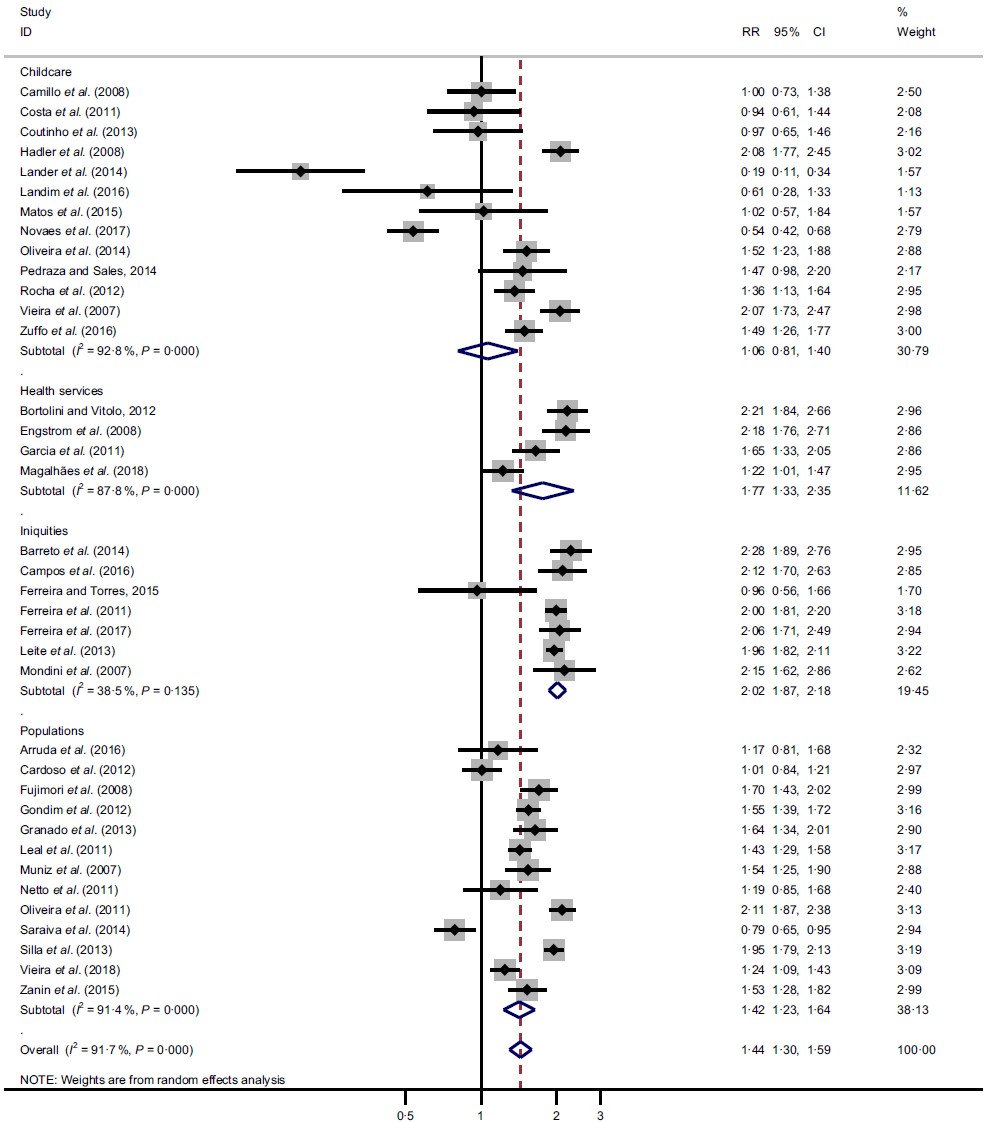
Upon comparing anaemia prevalences now reported against those found in the previous meta-analysis (1996–2006), there was a reduction in all the scenarios studied (Table 2); the largest decline was verified in studies conducted in childcare centres (–52·3 %), and the lowest reduction was found in population-based studies (–10·7 %). Table 2 also shows that the lowest prevalence was found among studies based on childcare samples (24·8 %), while the highest prevalence was seen among children belonging to communities with social inequities (51·6 %). In all situations, the prevalences are higher than those verified in PNDS-2006. The calculation of PRs for each of the study categories in relation to the national survey (PNDS-2006) showed that the worst-case scenario for anaemia risk existed in communities subjected to social inequities (Fig. 2).
Upon analysing the forest plot (Fig. 2), it is possible to verify the following aspects:
-
(a) In relation to the national survey, the highest prevalence of anaemia was found among children living in populations submitted to social inequities, while the lowest was found in childcare centres (PR 2·02, 95 % CI 1·87, 2·12 v. PR 1·06, 95 % CI 0·81, 1·40).
-
(b) Except for studies conducted in childcare centres, all other scenarios presented significantly (P < 0·05) higher prevalences than the national survey.
-
(c) The greatest heterogeneity occurred among the studies that used samples from childcare centres (I 2 = 92·8 %, P < 0·001), followed by population-based studies (I 2 = 91·4 %, P < 0·001), health services (I 2 = 87·8 %, P = <0·001) and populations with inequities (I 2 = 38·5 %, P = 0·135). In the first three categories, there was a high heterogeneity; in the last study, there was moderate heterogeneity.
-
(d) Among the thirteen studies carried out in childcare centres, five obtained results that were significantly higher than the national prevalence. Of the four studies performed in populations from health services, all surpassed the national value. This occurred in six of seven studies with populations in inequities. Among the thirteen population-based studies, nine presented a prevalence significantly higher than the PNDS-2006.
-
(e) Considering the thirty-seven surveys analysed, only three showed lower prevalences (P < 0·05) than PNDS-2006, of which two were performed in childcare centres and one in a population-based study.
-
(f) Consolidating all the results obtained with 17 741 children across thirty-seven studies conducted in the four different scenarios, a 44 % higher risk of anaemia (PR 1·44, 95 % CI 1·30, 1·59) was observed in relation to the general population of Brazilian children from 6–60 months.
In the subgroup analyses, none of the nine variables investigated was identified as an important source of heterogeneity. In the sensitivity analysis based on observed effect of excluding each study at once and re-running a meta-analysis of the remaining studies, heterogeneity reduction was seen only in studies conducted on populations in inequities. In this case, the omission of Ferreira and Torres(Reference Ferreira and Torres32) eliminated heterogeneity in this scenario. In all other situations and scenarios, no relevant changes were observed.
However, regarding the stratification of the analysis according to the year of data collection, although no relevant changes in heterogeneity were observed between the two groups (oldest studies v. most recent studies), anaemia prevalences showed a consistent reduction over time in these groups (Table 3).
Prevalence of anaemia by scenario analysed according to the time of data collection: prevalence ratio (PR), 95 % CI and heterogeneity indicator (I 2)

nc signifies could not be calculated. Among the seven articles included in this category, one had fieldwork done in 2001, other in 2008, four in 2009 and another in 2012. Thus, it was not possible to stratify them in old and recent studies.
* The effect of study time on heterogeneity in this scenario should not be considered, as it was calculated based on only two articles.
Discussion
Accurate information about the health situation of a population is essential for the planning, programming, monitoring and management of collective health interventions. For this reason, several countries, including Brazil, conduct periodic health surveys(Reference Malta, Leal and Costa50). Despite the relevance of these surveys, they are relatively fragile in their ability to reveal differences arising from the specificities of particular contexts, given that national surveys produce consolidated indicators for the general population for which it was planned. This is especially relevant in countries like Brazil that have vast socioeconomic disparities and exposure to risk factors(Reference Ferreira, Assunção and Vasconcelos51).
The results of the present meta-analysis highlight this aspect in an expressive way. Data show that the PR of population-based studies is very similar to those combined from all studies. However, various scenarios analysed in isolation have shown quite different results, such as children from populations with social inequities being more likely to have anaemia. On the other hand, children with access to educational institutions mitigated this risk to some extent.
Notably, among the thirty-seven surveys analysed, the one that reported the lowest prevalence (3·7 %) was related to a study conducted in a philanthropic childcare centre attended by children from poor communities in Salvador, Bahia. Obviously, these children belonged to communities with social inequities, and the differential would be the fact that these children were submitted to the specific actions of the childcare centre that granted them protection against injuries typical of the poor environment. In this childcare centre, the children stayed full time (07·30–17·00 hours) from Monday to Friday and received five meals per day that were planned and supervised by a nutritionist. The meals were nutritionally balanced, and preparations with enriched flours were offered(Reference Lander, Bailey and Lander19).
Given this, the lower prevalence of anaemia found in childcare centres is probably explained by the higher probability that children in these spaces are guaranteed access to adequate food for their nutritional needs(Reference Lander, Bailey and Lander19,Reference Silva, Giuglian and Aerts52) .
In this regard, it is pertinent to consider some initiatives of the federal government, such as the expansion of the National School Feeding Programme (PNAE – Programa Nacional de Alimentação Escolar), to public establishments that receive children under five in childcare centres (it was previously restricted to students from the age of 7, when they entered the first grade of elementary school). PNAE provides food to school children and develops food and nutrition education(Reference Peixinho53).
Besides, more recently (2015), the Strategy of Fortification of Infant Feeding with Micronutrients in Powder (NutriSUS) was implemented in Brazil(54). It consists of the direct addition of powdered nutrients to foods of children aged <6 years, aiming to prevent vitamin and mineral deficiencies. In a cluster-randomised clinical trial with infants aged 12–36 months, after 12 weeks of intervention, NutriSUS micronutrient fortification provided a beneficial effect on Hb values, reducing the prevalence of anaemia(Reference Arcanjo, da Costa Rocha and Arcanjo55). Similar results were obtained through a multicentre pragmatic controlled trial carried out in primary health centres(Reference Cardoso, Augusto and Bortolini56).
The strategy of offering a complete supplement, rather than just iron salts as in the PNSF (which is aimed at children under five and pregnant women in the general population)(4), is important because it would prevent other deficiency problems and not just iron deficiency. In this aspect, in a meta-analysis comprising data from twenty-three countries of varying levels of the Human Development Index, iron deficiency was not always the cause of anaemia(Reference Petry, Olofin and Hurrell57).
Comparing the results presented herein to the previous meta-analysis, there was a significant reduction in the prevalence of anaemia in all scenarios. Serial studies performed with representative probabilistic samples of children aged 6–60 months in the states of Alagoas and Pernambuco corroborate these findings. In Alagoas, the prevalence dropped from 45·1 % in 2005 to 27·4 % in 2015(Reference Vieira, Livramento and Calheiros37) (–39·1 %). In Pernambuco, this reduction was from 40·6 % in 1997(Reference Oliveira, Osorio and Raposo58) to 32·8 % (–19·2 %) in 2006(Reference Leal, Batista Filho and Lira46).
It is likely that broader programmes (in the sense of population coverage), such as the Maternal Breastfeeding Incentive Programme, the ‘Bolsa Família’ Programme (a conditional cash transfer programme), the Milk Program, the Program of Acquisition of Foods from Family Farming (PAA) and the PNSF, among others, have contributed to the reduction in anaemia prevalence. Through these programmes, especially the Bolsa Família, there was a positive impact on household income, providing better access to food(Reference Vasconcelos, Cavalcanti and Leal59).
Implemented in 2005, the PNSF, in addition to supplementation with ferrous sulphate, provides other supportive actions such as providing information on healthy eating and the importance of consuming foods rich in iron and foods that facilitate the absorption of minerals. At the population level, the effectiveness of the programme has been hampered due to problems with coverage and poor adherence on the part of beneficiaries, as well as deficiencies in the execution of educational activities(Reference Silva, Menezes and Oliveira60–Reference Motta, Domingues and Colpo62). Nevertheless, it is very likely that part of the reduction in anaemia prevalence is due to iron supplementation in the target population.
Despite the favourable results observed in childcare centres, the combined prevalence established by this review points to the fact that anaemia, even in this scenario, constitutes a problem of relevant magnitude. Concerning other scenarios, the most considerable heterogeneity among the studies (I 2 = 92·8 %) was observed for childcare centres; that is, these studies had a higher variation that was not attributable to sampling error.
Studies conducted in Brazil and other countries have verified the intake of nutrients as recommended for different age ranges of children attending childcare centres. However, this was not common to all childcare centres investigated, and many did not meet the national guidelines(Reference Novaes, Gomes and Silveira13,Reference Lander, Bailey and Lander19,Reference Neelon, Burgoine and Hesketh63,Reference Goldbohm, Rubingh and Lanting64) .
As already mentioned, the heterogeneity observed among the studies included cannot be explained only by sampling errors; it might be also due to the interrelationship between risk factors and protective factors prevailing in the different scenarios analysed, justifying the use of the random-effects model(Reference Legramanti Rodrigues and Klarmann Ziegelmann65).
In addressing heterogeneity, a common concern is methodological differences between the primary studies. In this meta-analysis, a part of heterogeneity could be attributed to the methods used to quantify Hb. Although most studies have adopted digital pulp blood to quantify Hb with a portable hemoglobinometer (HemoCue®), several different strategies have also been employed, even by the national survey(5) used here as the reference study, in which the Hb level was determined by cianometaHb using Labtest© colorimetric kits. Some studies suggest diagnostic overestimation in the prevalence of anaemia, when Hb values were measured with capillary samples and not venous samples(1), although it may be a valid resource for epidemiological surveys(Reference Sari, de Pee and Martini66–Reference Bansal, Toteja and Bhatia69). In this research, a subgroup analysis by the origin of blood sample (capillary or venous) did not explain the heterogeneity between studies (I 2 ranged from 75·3 to 93·7 % according to the scenario analysed; P < 0·05).
Children under 2 years of age are at an increased risk of anaemia – because of a growing demand for iron towards growth and development needs – due to food monotony or inadequate complementary feeding practices(Reference da Silva, Fawzi and Cardoso6) commonly seen in this age group(Reference Oliveira, Silva and Santos18,Reference Bortolini and Fisberg70) . An inverse association between age and prevalence of anaemia has been widely documented(Reference Vieira, Ferreira and Costa3,Reference Vieira, Livramento and Calheiros37,Reference Gondim, Diniz and Souto42,Reference Leal, Batista Filho and Lira46) . Although no significant interference was evidenced according to the age groups studied in the sensitivity analysis, the diversity of age groups considered in these studies, as shown in Table 1, may have masked the real influence of this variable.
Studies whose data collection occurred more recently would tend to present lower prevalences compared to older fieldwork because the prevalence of anaemia has reduced over time, regardless of the context considered(Reference Vieira, Ferreira and Costa3,Reference Vieira, Livramento and Calheiros37,Reference Leal, Batista Filho and Lira46,Reference Oliveira, Osorio and Raposo58) . This finding may not be specific to anaemia; according to The Global Burden of Childhood and Adolescent Health Collaboration(Reference Kassebaum, Kyu and Zoeckler71) from 1990 to 2015, there has been a substantial improvement in the health of children and adolescents worldwide. Nevertheless, anaemia is still a public health problem. In a systematic review with meta-analysis, the prevalence of anaemia in preschool children in Latin America and the Caribbean was estimated at 32·9 %(Reference Iglesias Vazquez, Valera and Villalobos72). In the present study, only those investigated in childcare showed a lower prevalence (24·8 %) than this, varying from 35·8 to 51·6 % in the other scenarios.
In spite of the heterogeneity, the magnitude of the values obtained by these studies consistently demonstrates the relevant reduction in the prevalence of anaemia when comparing the earlier studies with more recent ones.
When analysing children in health services, two opposing situations may arise: children would be there because they are ill, or children would have a better level of health given access to this type of care. In the first situation, a higher prevalence of anaemia would be expected, while in the second case, a lower prevalence. It was not possible to make this distinction from the articles analysed. In any case, the prevalence in this scenario was higher than both childcare centres and population-based studies and was only lower than the populations with social inequities.
Populations subjected to social inequities are especially exposed to factors associated with a higher likelihood of health problems. These populations are characterised by low socioeconomic conditions, low educational and professional qualification and limited access to public service infrastructures, such as schools, health services and basic sanitation(Reference Carlos73–Reference Guthridge, Li and Silburn75). Therefore, this scenario constituting the worst environment in terms of the risk of anaemia is not surprising.
In the previous meta-analysis (1996–2006), some studies included in the category ‘populations with inequities’ came from shantytowns. In this update, no study from this scenario exists. Of the seven articles included, five were conducted among indigenous peoples, and two within the Quilombola communities.
The trajectory of the indigenous population in Brazil is marked by inequities, which reflect a historical process of political, economic and social exclusion they have been subjected to over the years during colonisation. Even today, despite the provision of legal protective mechanisms and greater governmental attention, indigenous peoples present several unfavourable socioeconomic and health indicators compared to the general population of the country(Reference Carlos73,Reference Campos, Borges and Queiroz76–Reference Sartori Junior and Cogo Leivas78) .
The Quilombola population(Reference Mondini, Canó and Fagundes36) has been subject to a historical process of social exclusion(Reference Batista, Werneck and Lopes79), which is why the adoption of specific public policies to overcome these inequalities is justified(Reference Freitas, Caballero and Marques80).
Among the seven studies from populations with inequities, six significantly exceeded the prevalence found in PNDS-2006; only one(Reference Ferreira and Torres32), with a very peculiar characteristic, was at the same level. In the sensitivity analysis, the exclusion of this study eliminated heterogeneity. This study compared the health indicators before and after the certification of community members as a Quilombola. Based on the recognition established by the certification process, Quilombola communities have greater access to public service infrastructure and government programmes(81). In this regard, the community now has access to a health service within its geographic space, in addition to the implementation of other actions that significantly improved the health indicators, including those in relation to anaemia; the incidence of anaemia dropped from 41·6 % in 2008 (immediately prior to certification) to 20·0 % in 2012 (after certification)(Reference Ferreira and Torres32). This explains how inequity constitutes a risk factor for several health problems and demonstrates that strategies aimed at reducing these inequalities are in need.
Brazil is a vast country characterised by diverse social, economic, and extra- and intra-regional inequalities(Reference Carvalho, Pellanda and Doyle82). Obviously, within a specified level of this gradient, the population would be more susceptible to specific health problems. In this regard, large national surveys have failed to discriminate the differentials of disease magnitude prevailing in more specific contexts. Because of this, the high heterogeneity in the studies contemplated in the present meta-analysis is not surprising. Thus, this analysis shows that contextual differences, such as access to high-quality public services, strongly influence the health–disease process. The strategy adopted here, stratifying the samples according to different contexts, tends to homogenise these differentials, providing estimates that are more in keeping with the different realities, which is certainly not considered in large national surveys. Also, analysing the context in which the highest and lowest prevalences within the same scenario were observed will allow to identify factors that reduce the prevalence of anaemia. This information is of high relevance for planning health promotion actions.
A limitation of this study is absence of information relating to children’s food intake, as such information was not present in most primary studies. In a hierarchical approach, adequacy in food consumption represents an immediate level in determining deficiency diseases. Given this, there is a need for more studies to fill this gap.
In this meta-analysis, we found substantial heterogeneity among findings, except for the prevalences among indigenous and Quilombola populations. Of course, this heterogeneity may not be due to sampling error only, but to specific factors prevalent in the context studied. Therefore, differences in prevalences represent socioeconomic, epidemiological and access to service infrastructure disparities.
In addition, socioeconomic differences between samples, non-homogeneous age groups and different approaches in giving attention to children might contribute to this variation. Regardless, considering the purpose of this article, its objective was to demonstrate the relevant differentials in the magnitude of prevalence of anaemia according to the different scenarios analysed.
Final considerations
Together with the previous meta-analysis, the present results suggest that there is a declining trend in all contexts analysed, with a more significant reduction (–52·3 %) among children investigated in childcare centres. Therefore, children in this scenario have a lower likelihood of anaemia compared to the children analysed in population-based studies.
The prevalence of 24·8 % in childcare centres, as well as the 39·9 % and 35·3 % in health services and population-based studies, respectively, confirms that disease burden is below the level established by the WHO (40 %) to be characterised as a severe public health problem(Reference Batista Filho, Souza and Bresani83). However, there is still a need to implement actions aiming to reach acceptable levels (<5 %).
The smallest reduction in the prevalence (–22·4 %) occurred in populations with social inequities. Studies on groups with social vulnerability are important to support the implementation of new strategies as well as for the evaluation and proposition of more investments to increase the effectiveness of existing programmes. The reduction in prevalence from 66·5 % to the current 51·6 % may have occurred as a consequence of the public policies implemented on priority in these communities. Nevertheless, the prevalence remains a severe public health problem, justifying the maintenance of priority attention to socially vulnerable populations.
We conclude that, despite a declining trend, the prevalence of anaemia in Brazilian children continues to be an important public health problem, affecting mainly those living in communities under social inequalities, such as indigenous and Quilombolas populations.
This work highlights the need to enhance surveillance measures at the local, state and national levels, as well as implement interventions centred on confronting social inequities and achieving health equity.
Acknowledgements
Acknowledgements: Not applicable. Financial support: Not applicable. Conflict of interest: None. Authorship: H.S.F. and R.C.S.V. conceived and participated in the design of the study; A.R.S.L., B.L.L.F.S.D., G.F.A.S. and M.S.C.C. undertook the review; H.S.F. analysed the data. All authors performed data interpretation and contributed to drafting, reading and approving the final manuscript. Ethics of human subject participation: Not applicable.
Supplementary material
For supplementary material accompanying this article visit https://doi.org/10.1017/S1368980019005287



