

Introduction
Scenario 1
A group of 20 people living with dementia and their friends/family members sit behind tables in a large semi-circle with a staff member/quiz-master standing in front, operating a sound system. Lin, a woman living with dementia, sits next to Jan, a member of staff. The quiz-master presses play on the sound system and the theme music from James Bond plays.
1 Jan: D'you know this one? (Turns to look at Lin)
2 Lin: (Says something quietly to Jan and looks away)
3 Jan: Go on, you do, go on.
4 (Jan looks at Lin and sings the musical motif along with the music.
5 Lin looks ahead, smiles then looks away)
6 Jan: Remember it was James … (pauses) Bond.
7 Lin: (Nods her head) James Bond.
8 Jan: James Bond.
The United Kingdom (UK) government has outlined the importance of ‘access to personalised social activity … [and] peer support networks’ (Department of Health, 2009: 61) for people living with dementia, often realised in practice through people meeting and engaging in activities and games at memory cafes or other collective spaces (Akhtar et al., Reference Akhtar, Greenwood, Smith and Richardson2017; Harmer et al., Reference Harmer, Peart, Owen, Harper, Smith, Heaney and Rance2017), dementia-specific social and peer support groups (Beard and Fox, Reference Beard and Fox2008; Keyes et al., Reference Keyes, Clarke, Wilkinson, Alexjuk, Wilcockson, Robinson, Reynolds, McClelland, Corner and Cattan2016) or activities in care homes (Hauge and Heggen, Reference Hauge and Heggen2008). Games and social activities for people living with dementia have become a common part of a social care landscape that aspires to ‘living well with dementia’ (Department of Health, 2015).
The prevalence of ‘social quizzes’ for people with dementia has been touched upon in numerous descriptions of activities in social care settings (e.g. Mather, Reference Mather2006; Holthe et al., Reference Holthe, Thorsen and Josephsson2007; Hochgraeber et al., Reference Hochgraeber, Riesner and Schoppmann2013; Guendouzi et al., Reference Guendouzi, Meaux and Müller2016; Kiddle et al., Reference Kiddle, Drew, Crabbe and Wigmore2016; Evans et al., Reference Evans, Bray and Evans2017; Rokstad et al., Reference Rokstad, McCabe, Robertson, Strandenæs, Tretteteig and Vatne2019; Webb et al., Reference Webb, Lindholm and Williams2020a; Ellingsen-Dalskau et al., Reference Ellingsen-Dalskau, de Boer and Pedersen2021). Quizzes are also frequently promoted as an activity to do in groups for people living with dementia (see Dowling, Reference Dowling1995; Swann, Reference Swann2004; Bowden and Lewthwaite, Reference Bowden and Lewthwaite2009; Light and Delves, Reference Light and Delves2011; Graty, Reference Graty2013). Despite the widespread uptake of ‘quizzing’ for groups of people with dementia, surprisingly little has been written about (a) how quizzes came to be used so widely, and (b) how they are actually enacted (see Webb et al., Reference Webb, Lindholm and Williams2020a).
In the opening scenario, the quiz task was to guess the film title from a song associated with the film. There is a long-held belief that music and memory are positively connected in people living with dementia, prompting recall and recollections in uniquely responsive ways (Larkin, Reference Larkin2001). This vein of research, along with anecdotal observations, accounts for the practice of quizzes being reshaped to include music. As we see here, however, when the person living with dementia does not immediately answer the music question, staff members may attempt to prompt a response and create an engagement with the quiz by issuing questions of their own. The alternative is that they sit in silence whilst the music plays, unengaged; for a quiz hosted for social reasons, this is evidently undesirable. However, the upshot can be that the person with dementia is always on the backfoot, being questioned, and trying to guess the answer already known to the staff member. In the light of this type of difficulty which may be expected in a dementia care setting, this article draws on social practice theory to explore the question: why have social quizzes become a ubiquitous part of the social care landscape for people with dementia?
Quizzing as a social practice
The current ubiquity of quizzes as a social activity has its genesis in media formats like radio and television game shows (Holmes, Reference Holmes2008; Connor, Reference Connor2016). The quiz as a ‘group activity’ beyond broadcast formats was popularised in large part by the confluence of two iterations of the practice: the board game and the pub quiz. The popularity of the ‘quiz at home’ in the UK has been attributed to the rise of quiz-based board games such as Trivial Pursuit in the late 1980s (Berkmann, Reference Berkmann2008). However, the emergence of the pub quiz brought the practice to a wider audience in the 1970s following the production of quiz books as part of a successful marketing campaign to get people into pubs on quiet trading nights by creating inexpensive and easily run entertainment (Mason, Reference Mason2017). Quizzes thus changed from being something that was observed or listened to, to something in which people actively participated, either in their home or in public spaces.
Quizzes could be seen as an activity uniquely ill-suited to people living with dementia, since it relies largely on memory/recall (Buettner, Reference Buettner2001). What then lies behind the proliferation of quizzes in dementia settings? Maybe the clue lies in the positive social value and meaning attached to retaining memory and cognitive faculties. As Salthouse (Reference Salthouse2006: 70) states, ‘the view that keeping mentally active will maintain one's level of cognitive functioning, and possibly even prevent cognitive decline and the onset of dementia, is pervasive in contemporary culture’. There is a cultural understanding of dementia as something which must be combated (Lane et al., Reference Lane, McLachlan and Philip2013), and one way to do this is to attempt to counteract the most visible, and existentially terrifying symptom: loss of memory.
Memory (and the self as being grounded in the continuity of consciousness) has been seen as a key component of identity since the work of Locke ([Reference Locke1689] 1974]), and this notion is widely adopted by neuroscience (Schacter, Reference Schacter1996: 34). Dementia quizzes can therefore be seen as a ‘social practice’ that is (re)performed to fight dementia (Brockmeier, Reference Brockmeier, Hydén, Lindemann and Brockmeier2014) and to retain/train memory in an effort to preserve the personhood of players. However, there is the possibility that cognitive impairment(s) may be foregrounded and have the opposite intended effect. Much then rest on the specifics of how the quiz is enacted. Before we examine how this is done, we begin by stepping back to outline what constitutes a ‘social practice’.
Social practice theories
Social practices are simply the activities humans being do. They make up the patchwork of everyday life, from commuting to work in the morning, to the meeting you have at work, to going to the cinema; all of these are social practices. These practices involve a routinised kind of behaviour, consisting of interconnecting elements: ‘forms of bodily activities, forms of mental activities, “things” and their use, a background knowledge in the form of understanding, know-how, states of emotion and motivational knowledge’ (Reckwitz, Reference Reckwitz2002: 249). Social practice theory sees the practice itself as the central element of focus, rather than human actors, decisions or social forces (Shove et al., Reference Shove, Pantzar and Watson2012), posing the questions of what ‘practices demand of those who do them, and how it is that practices enlist and recruit people willing and able to carry them on’? (Shove and Pantzar, Reference Shove and Pantzar2007: 155).
Social practices such as smoking (Blue et al., Reference Blue, Shove, Carmona and Kelly2016) can be shown to follow routine patterns, although any social practice shifts and morphs over time (Shove and Pantzar, Reference Shove and Pantzar2007), and sometimes can disappear entirely. In our study 'Getting Things Changed', we have found the following set of ideas in social practice theory very useful in helping us to understand practices which can disable or exclude some people. Shove et al. (Reference Shove, Pantzar and Watson2012) suggest that a practice is made up of three interacting types of constitutive elements: materials (tangible objects needed to do the practice), competences (the physically embodied ‘know how’ or skills needed to perform the practice) and meanings (socially produced meanings, ideas and symbolic resonance of participating in a practice). We draw on these three elements throughout the article.
On the one hand, we can think of people being recruited and ‘captured’ by practices, and on the other hand, practices are re-defined each time someone engages in them. Whilst practice theorists often take a macro-approach to understand how practices work at a societal level, they nevertheless recognise that a social practice includes the micro-interactional level. Schatzki (Reference Schatzki, Hui, Schatzki and Shove2017: 130) argues for a close link between the study of interaction and that of social practices, since people ‘carry out practices through both sayings and doings’. In our study, video data were collected in order to conduct a conversation analysis (see Sidnell and Stivers, Reference Sidnell and Stivers2012) following the fine-grained detail of the talk and embodied actions, and the patterns of mutual intelligibility which are revealed by a close look at naturally occurring data. In this article, however, we step outside that framework, while building on insights in our existing conversation analysis publications (Williams et al., Reference Williams, Webb, Dowling and Gall2019; Webb et al., Reference Webb, Lindholm and Williams2020a, Reference Webb, Williams, Gall and Dowling2020b), to consider the wider social practices being performed in dementia settings. A quiz not only contains language, but it becomes what it is via the language used within it, and so our approach in this article is to present scenarios which reveal to the reader how participants conducted and responded to quizzing, on each occasion challenging and re-shaping the basic shape of the social practice.
Methodology
The research described in this paper was part of a larger project in the UK in which we explored in detail a wide range of practices, across various domains – including health care, social support and education. The overall goal was to identify disabling practices, and to suggest ways in which practices could be re-shaped to become more inclusive.
In this spirit of co-production, the first two authors approached a group of people living with dementia (Forget Me Not group) during the preparation phase, and three of that group (the final three authors) offered to work with them. Their role was initially an advisory one, but they became involved in interpretation and implementation of the findings as data were collected and they could watch the video footage (Williams et al., Reference Williams, Webb, Read, James and Davis2020). Pertinently for this article, they were on the whole advocates for the quizzes which the academics were questioning, but they were concerned about some of the practices which they felt could leave people living with dementia struggling and embarrassed (Webb et al., Reference Webb, Williams, Read, James and Davis2019). We return to their insights at the end of this article.
Before recruitment could take place, the study team needed endorsement and support from various gatekeepers at different levels: a national organisation providing dementia services, an ethics committee, support from ‘Evaluation and Impact Programme Managers’, then care co-ordinators, followed by managers of groups and, finally, the care staff themselves; all before speaking to potential participants. The study followed a strict protocol approved by the Social Care Research Ethics Committee of England to ensure that people assessed as lacking capacity to consent had personal consultees who could advise on their behalf.
Getting to know potential participants well also helped with understanding the way they communicated and the particular kinds of support they might need to express their preferences. For further description of the data collection practices and an overview of this research, see Webb et al. (Reference Webb, Williams, Gall and Dowling2020b) and Williams et al. (Reference Williams, Gall, Mason-Angelow, Read and Webb2021). Participants were people living with dementia and staff members who attended memory cafes, activity groups and day centres in three areas of England. Due to the nature of these groups, participants living with dementia typically had early to mid-stage dementia, and had a range of different dementia diagnoses.
Data collection and analysis
Approximately 70 hours were spent across the four settings, as well as collecting ten hours of video recordings of the activities and interactions. Time was spent getting to know participants, observing how the groups were run and how activities were organised and, in some instances, joining in activities and conversations with the people attending the groups. The data featured here are drawn from this corpus with ten quizzes recorded across the four settings featuring 28 people living with dementia and 15 staff members.
The video footage was collected near to the end of the data collection period. This allowed participants to become familiar with JW (the first author), so their presence would not be remarkable as it was in the initial visits. Collecting video recordings enabled repeated viewings, focusing on micro-behaviours and on the details of how the activities, such as quizzes, were organised (Heath et al., Reference Heath, Hindmarsh and Luff2010). The time spent by JW in the settings leading up to video recording also enabled an understanding of the context in which interactions occurred. Field notes and semi-structured interviews with some participants were also collected.
The clips were initially analysed drawing on a conversation analytic approach (Sidnell and Stivers, Reference Sidnell and Stivers2012), and the co-research team helped to identify what was interesting in the data, as well as bringing their own insights and expertise by experience to understand and reflect on what was happening in the videos. Potentially analytically interesting extracts were identified by JW, and played to the co-research group who watched the videos, discussed and re-enacted the scenes. They would then lead a discussion focused on what aspects of the communication in the video mattered to them, and what should be the focus of further analysis. This process is described in more detail in Williams et al. (Reference Williams, Webb, Read, James and Davis2020). The involvement of the co-research group was sought again at a later date to reflect on the quiz data as a whole, with a guided discussion drawing on their views and expertise by experience. Parts of this are presented in the postscript to this article.
Informed by the above, the analysis for this article followed a social practice theory structure defined by Shove et al. (Reference Shove, Pantzar and Watson2012), using the overarching categories of ‘materials’, ‘competencies’ and ‘meanings’. This structured analysis using the data/observations described was conducted to tease out how quizzes for people living with dementia were conducted as a social practice. Going back to the data, notes on each recorded quiz were made to see how they fit into the social practice theory framework. These were collated into the three categories (meanings, materials and competences) (Figure 1).
Social practice theory quiz themes

We now turn to our findings, in order to address the central question:
• Why have social quizzes become a ubiquitous part of the social care landscape for people living with dementia?
Based on our observations, the sections that follow outline the elements that make dementia quizzes popular, before taking a closer look, via real-life scenarios, at the risks and difficulties they may pose for people living with dementia. Some possible solutions will be considered at the end of this article. All participant information has been anonymised. All names used in the extracts are pseudonyms. Images have been blurred and filtered to protect participants' identity.
Findings
Quizzes require little (or no) extra material(s)
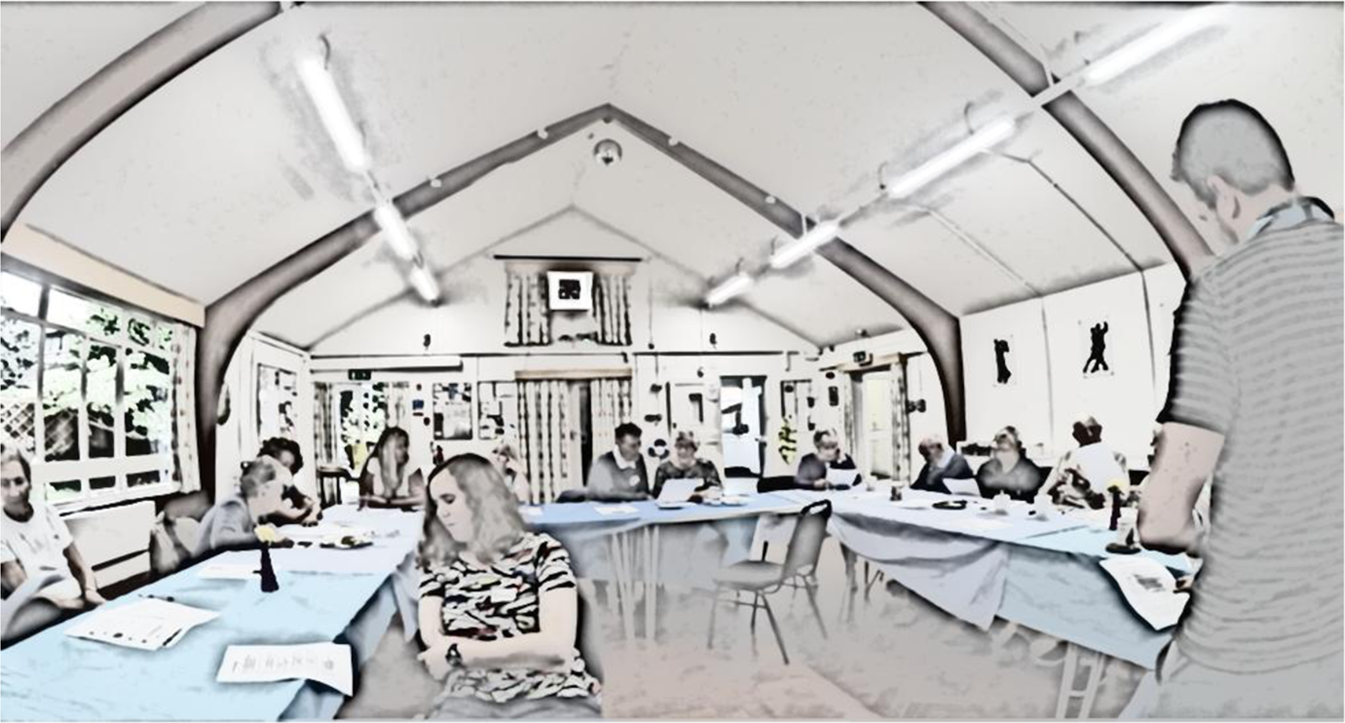
After receiving a diagnosis, people with dementia are often channelled to group settings and collective spaces like memory cafes and activity groups (Akhtar et al., Reference Akhtar, Greenwood, Smith and Richardson2017; Harmer et al., Reference Harmer, Peart, Owen, Harper, Smith, Heaney and Rance2017), dementia-specific social and peer support groups (Beard and Fox, Reference Beard and Fox2008; Keyes et al., Reference Keyes, Clarke, Wilkinson, Alexjuk, Wilcockson, Robinson, Reynolds, McClelland, Corner and Cattan2016) and care homes (Hauge and Heggen, Reference Hauge and Heggen2008). In the nine locations visited to recruit participants, all were held in large rooms (village/town halls, activity/communal rooms in residential homes, back rooms in libraries, social club, etc.). The organisation of social care dementia services is such that there is likely to be low staff–service user ratios (Caspar and O'Rourke, Reference Caspar and O'Rourke2008; Talbot and Brewer, Reference Talbot and Brewer2016), sometimes depending on the availability of volunteers in places like memory cafes (Light and Delves, Reference Light and Delves2011). These large collective spaces and groups of people provide two key materials for a quiz to take place: a space large enough for a group and a number of potential players (Figure 2).
A village hall where a quiz is taking place.
Once people are in a group, there is a necessity to organise the interactional space: to do something. Because the practice of doing a quiz is often an inherently interactional one, relying as it does on the question–answer sequence (Webb, Reference Webbforthcoming), it requires very few materials beyond a physical space, players and someone to ask a question.
Material resources, as Shove et al. (Reference Shove, Pantzar and Watson2012) suggest, form an important element in shaping any social practice. This was certainly true of the quizzes we observed. Although some quizzes, including the one in Figure 2, used paper and pens to deliver questions and write answers, we also witnessed many quizzes which were enacted without them. Staff would call out a quiz question and players would self-select to answer, with correct answers not recorded/noted down on paper. Naturally, some quizzes relied on a set of questions to ask, sometimes in the form of a quiz sheet. For example, one day centre we visited had purchased a large quiz book which the group were working through. However, we also saw that it was not absolutely necessary to have pre-prepared questions at all. Some quizzes were put on spontaneously to fill a few minutes here and there, and could be based on questions thought up in the moment. One day centre manager remarked:
It's like sometimes if we have … we're just trying to fill 10 minutes before lunch or something we might have a name game, so it might be [naming] makes of cars.
Quizzes can thus be impromptu and with little planning or materials needed. For example, Hawkins et al. (Reference Hawkins, Prashar, Lusambili, Ellard and Godfrey2018) describe care home staff as spontaneously engaging in activities such as quizzes. Quizzes are thus a flexible, malleable and adaptable format that can be enacted at a moment's notice and which, in their sparsest form, require very few (if any) materials.
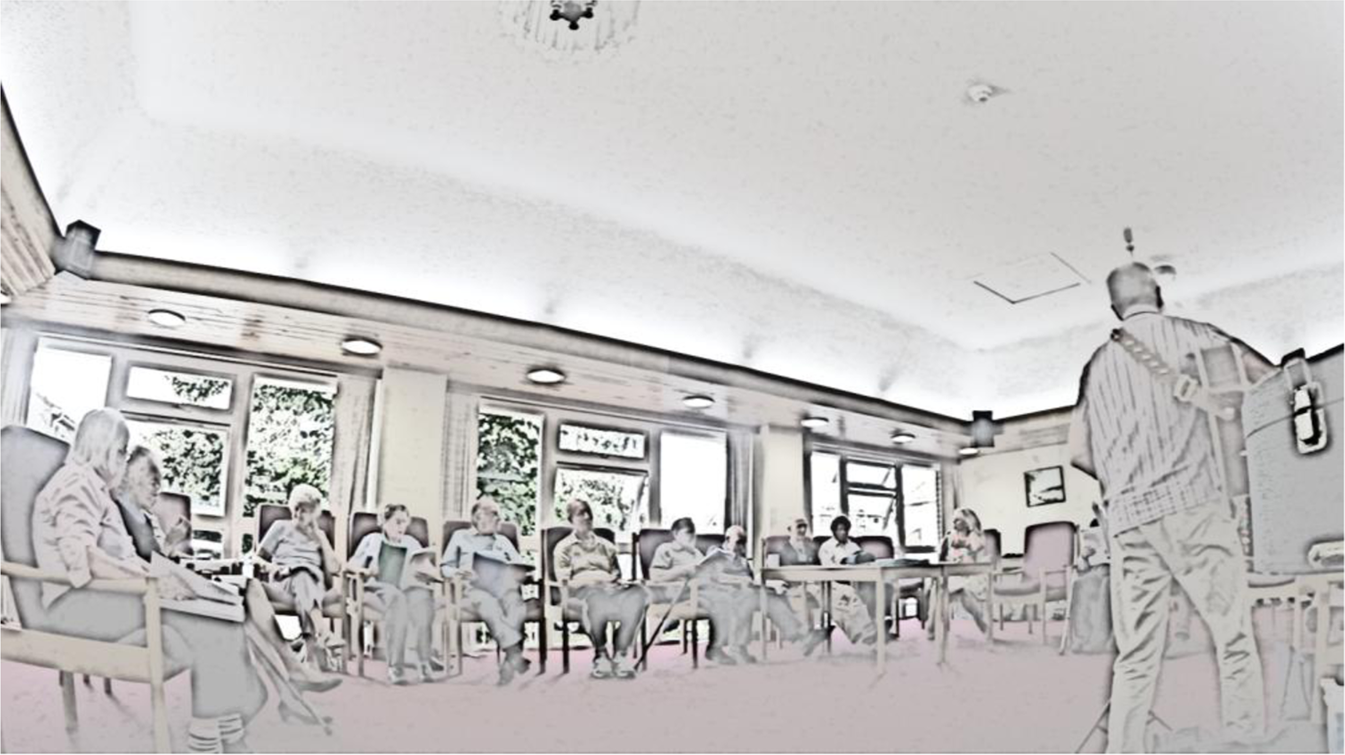
Take the following example: after a ‘sing-a-long’ session, a musician (Stan) has some time to fill before lunch. In this time he spontaneously enacts a quiz to the whole group of 17 players (still seated in a semi-circle as they were in the music session; Figure 3) in which he says one word and the players guess/answer what second word made up the word-pair he is thinking of. Essentially a word association game, but answers could be right or wrong, depending on what Stan has in mind. Here he names brands associated with specific foods. Presented here is a small extract of this particular quiz.
A group playing a ‘guess the second word I'm thinking of’ quiz.
Scenario 2
1 Stan: What about Birdseye?
2 Mary: Food, peas.
3 Stan: Peas, yeah. Or what about (pauses) Birdseye fish?
4 Ruby: Fingers.
5 Stan: Fingers. What about Birds?
6 Ruby: Custard.
7 Stan: That's what I'm looking for with that one.
A quiz-master, like Stan, generally conducts a quiz by asking questions, which duly produce answers from the group sitting in front of him. That question–answer sequence is a core pattern in ordinary conversation. In this case, it filled a gap in the timetable, and helped everyone present to feel that there was something social going on. For those who responded to the questions, it could be argued that their participation gave them additional confidence, social enjoyment or just fun. However, as our previous more-detailed analysis has shown (Williams et al., Reference Williams, Webb, Dowling and Gall2019), when a questioner repeats a question, or does not accept the first answer, then a respondent such as Mary (line 2) may feel she is not performing adequately. The answer Stan was thinking of was ‘fish fingers’, which Ruby guesses correctly after Stan's prompt. Further, he makes it evident in line 7 that the game is to guess what happens to be in his mind; what he is ‘looking for’.
In Scenario 1, some pre-planning had evidently taken place since the quiz involved naming musical extracts. In essence, the music took the place of the question, but when the player did not know the answer, the staff member would attempt to prompt a response or issue another question of their own. As we saw in both these extracts, these quizzes could easily put players on the spot and highlight their inability to answer. Moreover, they emphasised the competence and authority of the staff member, potentially at the expense of the players.
That being said, the Forget Me Not research group were positive about playing quizzes in groups. Speaking from his own experience of being involved in quizzes, H.D remarked that ‘It's good fun. I never win but it's the taking part. It's not that important to get the answer correct. It's the fact that you are having fun within the group and everybody's enjoying it’. This was particularly the case where the quiz could trigger nostalgic memories or conversations with their friends, e.g. by playing popular songs from a particular era. The enjoyment came from talking about the songs and the memories they sparked, rather than just answering the question. The enjoyment in the groups we witnessed, evident from joint laughter and engagement (eye gaze, head nods, etc.) was most often found in quizzes where smaller groups played collaboratively together, or where players could self-select to answer rather than where players were singled out to answer questions in turn. As our co-researchers noted when re-enacting being put on the spot with a quiz question, it could be ‘very uncomfortable. You knew you were trying to do something but it doesn't always come’ (S.R). When a player could not answer a question, even when it was repeated by the staff member, the co-researchers had empathy with the player: ‘he needed support, not just being stared at and asked the same question. Everybody was looking at him knowing he was in trouble’ (S.R). From their perspective then, sensitive and collaborative enactment was central in shaping the meaning of the quiz (‘test’ or ‘social activity’, ‘anxiety inducing’ or ‘fun’).
Quizzes rely on previously forged competences
Social practices can only persist because of the competence people build up in enacting that practice (Shove et al., Reference Shove, Pantzar and Watson2012). Turn-taking and question–answer sequences, in particular, are ubiquitous in everyday interaction (Sacks et al., Reference Sacks, Schegloff and Jefferson1974) and are also the bedrock of a quiz. Participating in turn-taking in interaction often remains intact, even as dementia progresses (Kitzinger and Jones, Reference Kitzinger and Jones2007; Mikesell, Reference Mikesell2009). Quizzing therefore draws upon deep-seated skills and previously forged competencies.
Whilst answering correctly would be one kind of competence, players demonstrated other types of interactional competence by using their turn to provide accounts for an incorrect or absent answer. For instance, we observed a quiz on personal safety in which people with dementia were grouped with their family member and maybe with a staff member or volunteer. One woman living with dementia who was talking to her daughter was asked an ambiguous question and, after a long gap, said ‘I don't know the answer to that one’; a perfectly appropriate response, and one which specifies her non-answer specific to this particular instance (‘that one’) and which preserves her status to carry on answering further questions. How may accounting for not answering relate to competence(s) needed to participate in a quiz? Providing an account for an inability to answer demonstrates competence in knowing not only what is required (i.e. an answer), but what one must do when an answer cannot be provided.
Take the following extract from an activity group. Quiz players are in teams answering questions posed by the quiz-master. Each question asks them to name an item in a certain category (e.g. food, countries) starting with a given letter. Cat is a member of staff, seated on a large table with a group of players with dementia. Cat is also participating in the quiz as a member of the team. She begins by outlining the next question for them to answer.
Scenario 3
1 Cat: We've got to think of a bridge, a famous bridge,
2 that begins with the letter T.
3 (silence)
4 Cat: So anything that a bridge it could be anywhere
5 in the world, it could be in England or,
6 anywhere in the world.
7 (Cat turns to look at Eve)
8 Cat: beginning with a T.
9 Eve: My brain's gone blank.
10 Cat: Oh dear.
11 Cat: Ha ha that's no good then Eve.
12 Eve: Huh ((Eve smiles))
13 Gina: Like Clifton right?
14 Eve: I said my brain's gone blank huh huh.
Cat's first attempt to get an answer from her group falls flat, so she then adds more information in line 4, adding in line 8 the additional requirement that the bridge needs to start with a ‘T’. Arguably, this poses quite a cognitive load on the players, who have to remember and respond to two requirements in the question, and when Cat makes eye contact with Eve by turning her body to face her (Eve is seated next to Cat), Eve immediately provides an account for not being able to answer the question (‘My brain's gone blank’). This strategy accounts for not being able to answer a specific question, and alludes to a temporary state of affairs. Indeed, this is treated as humorous by the staff member, occasioning laughter from Eve too, retroactively framing her ‘non-answer’ as humorous. We noticed that it was common to see people in these groups laughing at themselves, and good naturedly with each other, when memory lapses occurred. That can become sensitive; e.g. staff members did not often initiate laughter when players with dementia forgot things, which could be read as ‘laughing at’ the person, but did sometimes respond to laughter when players laughed at themselves, or treat the person as having made a joke (as in this extract). It is easy to see how the personhood of players can be supported or undermined in these moments by micro-actions of staff members.
Quizzes impose an interactional framework
Group settings and collective spaces are common in dementia care. Given the ratio of attendees to staff members and volunteer helpers (Caspar and O'Rourke, Reference Caspar and O'Rourke2008; Light and Delves, Reference Light and Delves2011; Talbot and Brewer, Reference Talbot and Brewer2016), there is a need to organise the interactional space. The quiz format offers an efficient tool for the organisation of people's interaction. The staff as question-master are in a position to control the interactional floor (Sacks, Reference Sacks1995: 54), and to facilitate the quiz being enacted. Of course, there is no reason why staff should be the quiz-master, a point we return to later.
One of the main tasks of the staff was not only to ask the questions, but to keep the quiz activity moving forward (Webb et al., Reference Webb, Lindholm and Williams2020a). Staff members often needed to do some work to retain intersubjectivity and restore collective action. Take the following example from an activity group for people living with dementia.
Scenario 4
Rianne (staff member) begins by announcing they would do a quiz. The people living with dementia sit at three large tables. They are asked questions by Rianne who stands in the middle of the room; any person can self-select to answer. Although there are 20 service users, only three appear in the extract. The rest are silent. There had already been a few quiz questions before the current scenario, which features Rianne (staff member) with Jim and Bob (service users). The previous question had led to people talking amongst themselves.
1 Rianne: Now come on then guys what president did
2 Marilyn Monroe sing for?
3 (silence)
4 Bob: The Kennedys.
5 Jim: JFK.
6 Rianne: John FK yep.
At the start of this extract, Rianne uses the word ‘now’; at the start of a turn at talk this is a way of introducing a new sequence and drawing people's attention to the matter at hand (Stenstroom, Reference Stenstroom1994). She goes further, with ‘come on then guys’, heardable as a plea for extraneous talk to stop, and for the group to work collectively on the question. This elicits two answers, the second one being accepted by Rianne (line 6). A successful moment like this requires some concentration and the authority to organise the group to listen and respond. The quiz in a sense gives the staff member the pretext to behave ‘like a quiz-master’, and to impose an interactional framework on the players.
Staff members also used other small ways of moving on between questions, with tokens such as: ‘right’, ‘now’, ‘okay’ used at the start of their utterance (see also Scenario 3). Such words could be used to shut down any stray conversation and restore collective focus on the joint activity. As we have previously analysed using conversation analysis, staff therefore needed this competence in order to move the quiz forwards (Webb et al., Reference Webb, Lindholm and Williams2020a). This may be particularly important and relevant for people living with dementia, for whom concentration and following the rules/stage of the quiz may be difficult.
Another key competence we observed was quiz-masters giving hints and tips to players. Crucially, the skill lay in knowing at what point in the sequence to give the hint, and how to do it. In a quiz relating to singers from the past, for instance, players were tending to name the song instead of the singer. To re-direct them, the staff member spoke the first name of the singer with continuing intonation, indicating that the staff member's speech was prosodically incomplete and that the second half of the name should be given. Two of the group members were immediately able to give versions of the singer's full name. These hints and tips occur typically in the part of the sequence after a question has been asked and either there has been silence or an incorrect answer.
Apart from displaying a type of competence that staff may need to host a quiz for players with dementia, these types of hints and tips also give us some insight into the meaning given to dementia quizzes as a social practice. We discuss this and other types of meaning in the following section.
Quizzes allow positive social meanings
When a social practice is enacted, it not only takes on a recognisable shape, but it also acquires ‘meaning’. For instance, as Shove et al. (Reference Shove, Pantzar and Watson2012) discuss, car driving was at one point in the 20th century a prestigious activity, associated with rich car owners who often delegated the actual driving to a chauffeur. In the quizzes we observed there was a positive social value attached to giving a correct answer. This can be seen in the previous section through the hints and tips, designed to help participants give a correct answer. Another way that the preference for correct answers, and their positive social meaning, can be seen in these interactions is through turns wherein staff members evaluate/assess the answer of the quiz player(s). Typically, correct answers were evaluated positively. For example, staff members responded without hesitation to correctly answered questions, and always with positive evaluation and praise for the answerer (‘that's right’, ‘well done’, ‘brilliant’, ‘good answer’, etc.). However, staff showed that wrong answers were trickier to respond to. Take the following scenario.
Scenario 5
As in Scenario 3, in the following extract players are asked to name something which fitted into a given category (in this case, ‘food’) and which began with a certain letter. Scenario 5 features a staff member asking the questions and two players, Julie and Richard.
1 Staff: Moving on, Richard. Can you think of a
2 food, beginning with R?
3 Julie: Radish huh huh ha huh huh.
4 Richard: Potatoes.
5 (silence)
6 Staff: Not quite have another go.
Upon Richard giving an incorrect answer to the question, there follows a silence, indicating that the response was inapposite in some way (Pomerantz, Reference Pomerantz, Maxwell Atkinson and Heritage1984). Following the silence, the staff member confirms the inadequacy of the answer (‘not quite’) and instructs the player to ‘have another go’. It is worth reflecting on the response to an incorrect answer in this scenario compared with the response to a correct answer, in the previous one. This can be seen most notably in the silence that follows an incorrect answer that was typical throughout the data, as well as the staff member giving the quiz player with dementia another turn, demonstrating a social preference for a correct answer to be given.
We saw in the data there was also a considerable amount of value placed on getting answers correct, and successfully exercising one's cognition and memory. The positive social value associated with relaxing in a pub, going for a drink with one's friends and taking part in a quiz as part of an evening's entertainment are overlaid here with the values associated with taking a test, a very different manifestation of the quiz experience for these players living with dementia. The parallels with the dementia diagnostic test process are striking. Dementia is typically diagnosed initially via questions which rely on cognition and memory, in the setting of a doctor's surgery, and where the personal stakes are high in terms of the outcome, a very different type of value is placed on success or failure. As we demonstrate here, much rests on how the memory tests are enacted ‘in the moment’ (Jones et al., Reference Jones, Wilkinson, Jackson and Drew2020).
Quizzes can be adapted to allow some independence and choice
Throughout the scenarios we have explored here, each quiz has been carried out in a slightly different way. Adding additional materials to a quiz for people living with dementia can be designed to stimulate inclusion and play to competences and choice; but it can also put players on the spot in precisely the same way, and highlight inabilities to answer. Much rests on how people living with dementia are supported, rather than on simply adjusting materials. For instance, one way of adjusting materials in an attempt to promote inclusion is giving players the option of either answering a question or doing a physical task (e.g. throwing a ball in a bucket, as we witnessed in one setting).
As discussed in detail in Webb et al. (Reference Webb, Lindholm and Williams2020a), the addition of material elements to a quiz can increase playability by offering alternatives to a traditionally cognitive-based activity. However, as analysed in the same article, pressure may be increased when these additional materials provide a physical alternative to answering a question and an object (such as a ball) is actually given to the player, regardless of their stated preference to decline participating in either option. As we see here, much rests both on the design and suitability of the materials for the players, and how they are included and woven into interactional flow of the quiz.
Players can reshape the function and meaning of quizzes ‘in the moment’
During this research, the first two authors worked throughout with co-researchers living with dementia (the Forget Me Not research group), who are the final three authors of this article. Having viewed the video data of quizzes in real dementia settings, they were keen to think of ways that quizzes could be adapted to be more inclusive and give players greater power and control over the activity. Their thoughts on adapting the meaning of dementia quizzes can be seen in one of a series of ‘dementia communication training videos’, accessible at https://www.bristol.ac.uk/sps/gettingthingschanged/about-the-project/dementiatalk/.
For instance, they suggested making a person living with dementia the quiz-master and including staff as players in an effort to ameliorate power imbalances that could become entrenched by the reiteration of institutional roles. They also suggested that there should be less focus on correct and incorrect answers, with time allowed to explore the subject in groups. This would make other types of contributions relevant, rather than only answers which disproportionally favour those who are more cognitively able to take part in such tasks. They also suggested possibilities such as incorporating points for saying interesting things, and making quizzes without ‘correct’ answers to questions. All of these were intended to move the meaning of a quiz away from being rigid, formal and institutional.
On occasion, some of these more informal structures for quizzing were observed. For instance, we noticed that in certain kinds of group quizzes, where access to the interactional floor was more fluid and democratic (i.e. anyone could self-select to talk, and the small teams enabled more informal styles of communication), players with dementia themselves were reshaping the meaning of the activity. For example, they often used the ‘subject’ of the answer (i.e. an answer could be ‘tomatoes’) to talk about their related experiences, thoughts and memories (i.e. how they grew tomatoes, memories of gardening, etc.). We found this a common occurrence in small-team quiz activities; players who may find it difficult to give an answer were able to produce topically relevant, but not task relevant, actions related to the quiz answer (Webb et al., Reference Webb, Lindholm and Williams2020a). This could thus shift the meaning of the quiz itself. Take the following example. We join the quiz players after an answer, telegram, had been given to the question ‘name a form of communication beginning with T’. The extract features Fred, Barbara and the staff member.
Scenario 6
1 Staff: Yeah, telegrams. Let's go with that,
2 because that's an unusual one.
3 Barbara: Yeah.
4 Fred: Yeah, my father had a – used telegrams.
5 Staff: So you remember getting telegrams. You
6 don't see that any more nowadays, do you,
7 people don't send telegrams.
8 Fred: No, they – but –
9 Barbara: Yeah, they would knock on the door with
10 a telegram, your heart started beating
11 Staff: Really?
12 Barbara: and you. Heh heh.
13 Staff: Yes, yeah, you wondered
14 Barbara: What's wrong ((laughs))
15 Staff: What it was, yeah. If it was going to be bad news.
16 Barb: Yeah.
Following Barbara's agreement to go with the group's answer (telegrams), this could have been the end of the matter, having completed the question–answer–evaluation sequence. On line 4 Fred initiates a new action not related to the overarching activity of quiz-completion; informing that his father had used telegrams. This piece of information is treated as the beginning of a story, with the staff member probing Fred for additional information (lines 5–7) whilst making an observation about telegrams within her own epistemic territory (‘You don't see that any more nowadays, do you, people don't send telegrams’). Fred's initiation of topicalising telegrams leads to Barbara sharing her own recollections about the emotional experience of receiving a telegram during the Second World War.
Here then we have two players self-selecting to initiate reminiscence, building on the topic of the quiz to share aspects of their lives. So, whilst quizzes impose an overarching interactional agenda characterised by a base ‘question and answer’ sequence, in group quizzes played as a team, there were more opportunities to command the interactional floor. Players used their turns to do actions which did not expedite the completion of the quiz but were of social value to them. Quizzes are not a static entity, but are built turn by turn by the interactions within them. Further, where there was opportunity, people with dementia could reshape the quiz itself by initiating actions. This both speaks to the competences of the players, and to the potential to change the meaning of a quiz from a kind of test, to a more informal activity that can spark conversations and reminiscences; where answers are used as jumping off points to share aspects of their lives.
Discussion
The research reported in this article showed how the combination of materials, competences and meanings interact to perpetuate dementia quizzes. The strengths of this ‘social practice’ approach included the use of real-time video recordings, enabling a deep familiarisation with the interactional detail of how quizzes were enacted, because the videos could be re-watched and engaged with in a way that would not be possible through note-taking or retrospective accounts from participants. Although there is always the chance that the video camera could have had an impact on interaction, we attempted to reduce this possibility by an extended pre-data collection period to normalise JW's presence before data collection began. The video camera was also introduced to participants over successive visits before data collection began.
One limitation of this research, at least in respect of this article, is that the research team did not set out to focus explicitly on quizzes. Rather, the interest in quizzes was emergent and responsive to what was happening in data collection settings. Future research could benefit from a closer focus on quizzes specifically, so that more data could be collected to compare and understand the distributed ways they are conducted. However, we believe this research was markedly enhanced by collaboration with co-researchers living with dementia who (amongst other tasks) reviewed the recorded data and gave their input and thoughts on the emotional and experiential effect of how quizzes (for example) were conducted. This helped us better understand the practice of participating in quizzes at the experiential level. Co-research is not an uncomplicated benefit and comes with its own tensions, which we reflect on more substantially elsewhere (Williams et al., Reference Williams, Webb, Read, James and Davis2020).
This article set out to answer the question: ‘why have social quizzes become so prevalent in dementia settings?’ Based on the analysis here, we suggest that they require few (if any) materials, they make use of pre-existing materials due to the way social care is organised (e.g. halls/large rooms, chairs, tables), they rely on previously forged competences (entrenched social understanding of the obligation of performing and responding to questions) and do not necessarily require complete mastery of memory and cognition to take part. Question and answer sequences enable staff to impose an interactional framework and manage access to the interactional floor; something which is very useful in larger groups. Another factor in the proliferation of quizzes is that they can be stretched or truncated to fit various windows of time in social care settings. This is a valuable quality given that social care service practices are also influenced by staff shift patterns and timetabling. Social care day centres are mapped out in terms of set activities (breakfast, lunch time, transport timetables) which dictate to some extent where the ‘free’ time will fall in a day, and for how long. The amount of time for activities may also vary depending on staff attendance or unforeseen circumstances. Practices which can be expanded or contracted to fit a time period are therefore likely to be well regarded. For example, we observed in our research that staff may declare that ‘this is the final round’ when they notice the time remaining before lunch, and not because of having fulfilled some pre-set criteria of number of rounds or questions.
The factors outlined above help explain why quizzes find optimal conditions in which to thrive. Apart from their functional attributes, we contend that their popularity also rests in the meaning attached to both quizzes and dementia. We showed in the scenarios that there are positive social meanings attached to giving correct answers, detectable in the way correct and incorrect answers are responded to. Kitwood and Bredin (Reference Kitwood and Bredin1992) long ago in this very journal warned of positioning people living with dementia as the problem (them) and other people as having to deal with that problem (us). Activities like quizzes can potentially become ways in which these roles, and the meaning(s) associated with them, become entrenched and reinforced, the quiz-master performing a role that aims to prevent cognitive deterioration and therefore try to keep players closer to ‘us’ and stop the players becoming ‘them’. The drive to keep mentally active by engaging in activities which facilitate this aim is all pervasive: the ‘use it or lose it’ mentality (Salthouse, Reference Salthouse2006). As Kitwood and Bredin (Reference Kitwood and Bredin1992: 274) remarked, ‘[t]he presence of dementia on a large scale in contemporary society, and the dire process which it often entails, raises very deep questions about what it means to be a person’. This fear of dementia as unsettling our perception of personhood is tied to our understanding of memory as being fundamental to identity and personhood. Quizzes can be seen as one way to weave these processes and preoccupations into social settings, and to work against memory loss and for the preservation of personhood. This fits more broadly with our cultural understandings of illness metaphors as an external enemy that must be battled against (Sontag, Reference Sontag1978; Lane et al., Reference Lane, McLachlan and Philip2013).
However, we would do well to remember that ‘[m]eanings of dementia are interpreted, embodied, or resisted by people in their social contexts' (Zeilig, Reference Zeilig2014). The danger with quizzes is that if they are enacted like a test, putting people on the spot, they could be interpreted as locating a deficit within the person (i.e. cognitive decline, memory) which ironically they are enacted to ameliorate. This raises the problematic implication that memory loss is correlated to loss of personhood (Kitwood and Bredin, Reference Kitwood and Bredin1992). Research in residential homes found ‘that the residents preferred activities that did not reveal their impairments or remind them of their weaknesses, but rather those in which they could participate equally with the others’ (Holthe et al., Reference Holthe, Thorsen and Josephsson2007: 105). We argue that the extent to which quizzes for people living with dementia are akin to a ‘test’ or a fun and enjoyable social activity rests in the specific interactional and social context in which they are performed. Meanings are created and negotiated, moment by moment. Remarkably, a similar observation has been made in this journal some 20 years ago:
[A] quiz hosted in the sitting room of one older persons’ home, with residents in rows, involved the ‘quizmaster’ (literally) behaving as tester, pronouncing answers ‘right!’ or ‘wrong!’, paying little attention to how the older people themselves understood or engaged with this activity, or more often became rapidly disengaged. It was not the quiz in itself which was inappropriate activity, but the absence of conscious attention to the quiz as social practice. (Carter and Everitt, Reference Carter and Everitt1998: 86)
This suggests that the meaning and appropriateness of quizzes for people living with dementia lies in the way they are enacted. Patterns of interaction persist over time, and quizzes appear to be a remarkably persistent social practice. Subsequently, they are likely to proliferate and, as social practice theorists would put it, to continue to recruit from this population (Shove and Pantzar, Reference Shove and Pantzar2007).
As we have seen, quizzes are not a static practice; each time they are enacted, the elements are reconfigured ‘in ways that subtly, but sometimes significantly, change all subsequent formulations’ (Shove et al., Reference Shove, Pantzar and Watson2012: 13). We saw here that the shape and meaning of quizzes as a practice could be altered in situ by what materials are involved, and by staff members and people living with dementia themselves. Through their participation, staff and people living with dementia have helped to widen the scope of quizzes as a social practice, who they recruit from and to shift (or at least broaden) some underlying meanings; when people identifying as ‘disabled’ take part in activities they may disrupt the way they are normatively done (see Williams et al., Reference Williams, Gall, Mason-Angelow, Read and Webb2021). As quizzes for people with dementia continue to be reshaped and reimagined, it raises the question of how far a social practice such as quizzes can be reshaped and reimagined before it shifts to become something wholly new (Hui et al., Reference Hui, Schatzki and Shove2017: 56). As materials change, and are reconfigured, for a practice (such as the introduction of technology in quizzes adapted/created especially for people living with dementia), so associated meanings are likely to change too (Shove, Reference Shove2014). We consider this point further in the following section.
What is the future of quizzes for people living with dementia?
The survival and persistence of a practice depends on its ability to recruit and retain cohorts of ‘practitioners’ (people) through whose performances/enactments the practice is reproduced and transformed. As people live longer, the number of people living with dementia increases (Prince et al., Reference Prince, Ali, Guerchet, Prina, Albanese and Wu2016). This provides a steady stream of potential ‘recruits’ for quizzes. However, the performance of the practice may evolve to interact with other practices and social changes. For example, the rise in usability and the ubiquity of digital technology platforms (tablets, smartphones, laptops, etc.) has led to the creation and growing use of digital ‘brain training’ quizzes used in care environments (McCallum and Boletsis, Reference McCallum and Boletsis2013). The COVID-19 pandemic has also shifted and accelerated various social practices related to technology that have implications for older populations. For example, quizzes have been adapted to be played remotely over video calls by care home residents (Zamir et al., Reference Zamir, Hennessy, Taylor and Jones2020). The introduction of such technology utilised in this way may have long-standing implications for the future of quizzes as a social practice, and how the practice evolves to continue to recruit new carriers.
The challenges of meeting the needs of increasing numbers of people with dementia mean there is a greater focus on services that are more socially orientated and seen as low-intensity, low-cost forms of support (Keyes et al., Reference Keyes, Clarke, Wilkinson, Alexjuk, Wilcockson, Robinson, Reynolds, McClelland, Corner and Cattan2016). There have been continued budget cuts in social care in the UK, with the impact of austerity being acutely felt (Baines and Cunningham, Reference Baines and Cunningham2015). Consequently, staff with little time are tasked with putting on activities, which could explain why an activity like quizzes which are inexpensive, easy to enact and easy to plan may be considered favourably by dementia staff. In addition, social care is often outsourced by the UK government (Needham and Glasby, Reference Needham and Glasby2014) to charities like the Alzheimer's Society to put on large groups with activities for people with dementia. Activities which can cater to large groups are therefore likely to be preferred.
It looks as though dementia quizzes are here to stay. So, the question remains: how can we ensure that they support the personhood and enrich the lives of those who take part? The Forget Me Not research group proposes that people living with dementia could be involved in putting on quizzes, in suggesting ways that quizzes could be adapted to be more inclusive and in reshaping the practice themselves. Quizzes are uniquely well fitted to the circumstances of dementia social care, and yet they also run the risk of foregrounding memory loss in an effort to preserve it. By involving people living with dementia in the enactment and planning of the practice, and by making participation more informal (i.e. by not dividing players and quiz-masters according to whether you are staff and attendees), by playing in small groups where players can self-select to answer, and where space can be made to talk about the subject rather than simply answer a question, the competences and meanings of dementia quizzes may change over time. The co-researchers have outlined various alterations and adaptations to the ways quizzes are done, indeed challenging the very foundations of a quiz in having to have ‘right’ answers at all (Webb et al., Reference Webb, Williams, Read, James and Davis2019). They assert that the inclusion of people with dementia in designing and putting on the quiz is key to equalising potential power imbalances between staff and service users, and in ensuring that quizzes are enacted in ways that respect and protect the personhood of players (Webb et al., Reference Webb, Williams, Read, James and Davis2019).
Performances of quizzing as a practice are diverse and culturally and historically situated. However, each performance is dependent on the way in which the elements come together and are enacted in that moment. By thinking about dementia quizzes as an entity, we have not only explored how this social practice is held together and maintained, but how this is enabled via countless performances and re-creations of the practice in the to-and-fro of real-life interactions, and how it could develop in the future with greater input from people living with dementia themselves. As such, the final word goes to the three co-researchers living with dementia regarding their views and experiences of quizzes.
Postscript by the Forget Me Not research group (Harry Davis, Roy James and Sandy Read)
Quizzes can be a fun way to include people, but they can exclude people too. There are ways of running quizzes that make it feel like the individual is playing by themselves, and ways of doing it so players feel they playing with other people they can talk to. Quizzes do help to keep the brain active. Just because people have dementia, doesn't mean they can't use their brain. When a quiz is put on, you have to judge it by who the people are, what they may know and what they are interested in. It depends on the kind of question sometimes. Some people's recall is really good if it is a ‘picture question’. Recall kicks in when they see the image and they think ‘I know what that is’, and then they can talk about it. That's important; making space to talk about things in the quiz, not just say the answers. It is a social activity, not a test.
I think staff often put on quizzes because it's just using time. Once we are in a place, they have to have something to do, and honestly the easiest thing is a quiz. You don't have to go outside, don't have to put anything on, just sit there. It just fills some time, gives people something to do. That's not necessarily a bad thing; you have to be motivated by something. But there are lots of ways to do it, to change it, it doesn't have to be boring. We saw all these groups on the videos [data collected for the project] where no-one moves for ages. You don't have to be sat down to do a quiz. You can adapt them to fit different groups of people.
If it goes down the route where people are doing quizzes more and more on technology, the people who design this stuff or help people to use it need to make sure it is a way to bring people together, and not just to do individual testing. It should generate conversation so that people with dementia can talk to each other and feel good about themselves, not reinforce feelings of failure about their memory. The main thing is to make sure you aren't putting someone in a position where the quiz makes them feel bad about themselves. Look at who can do what and who can support each other. We can do it together, we can help each other.
Acknowledgements
This research was carried out as part of a study entitled ‘Tackling Disabling Practices: Co-production and Change’. We are very grateful to our funders. We would also like to thank all the people living with dementia and staff who support them who took part in this research.
Financial support
This work was supported by the Economic and Social Research Council (grant number ES/M008339/1).
Conflict of interest
The authors declare no conflict of interest.
Ethical standards
This strand of the research was approved by the national Social Care Research Ethics Committee who approved the plan to seek personal consultees for those who lacked capacity to consent for themselves (Mental Capacity Act, 2005). The project used accessible information sheets and a short recruitment video made by the Forget Me Not group, and JW obtained consent from participants over a series of repeated visits, explanations and familiarisation. Permission to record events or conversations was always sought at the time, and so consent was continually re-negotiated with all participants.


 Open access

