





Introduction
Cestodes are parasitic platyhelminths that infect a wide variety of mammals, including humans and domestic ungulates (Saari et al., Reference Saari, Näreaho and Nikander2019). Easily transmitted between hosts, they cause diseases (cestodiases) of medical and veterinary relevance, such as cystic echinococcosis (CE) and alveolar echinococcosis (AE) (caused by the larval stage of Echinococcus granulosus and Echinococcus multilocularis, respectively), as well as cysticercosis (caused by the larval stage of Taenia spp.). CE, AE and cysticercosis are in the World Health Organization's list of Neglected Tropical Diseases (http://www.who.int/neglected_diseases/diseases/en/), which are prioritized worldwide for initiatives of treatment, control and eradication. Studies involving cestodes are hampered mainly by the scarce availability of biological material (Lustigman et al., Reference Lustigman, Prichard, Gazzinelli, Grant, Boatin, McCarthy and Basáñez2012). In this context, the availability of a model organism, such as Mesocestoides corti (syn. Mesocestoides vogae), allows the study of basic aspects of cestode biology. This is because this species is not infectious to humans and can be easily maintained in vivo and in vitro, providing continuous availability of biological material (Markoski et al., Reference Markoski, Bizarro, Farias, Espinoza, Galanti, Zaha and Ferreira2003; Hemphill, Reference Hemphill2010).
Infections with adult cestodes (intestinal cestodiases) are generally easier to treat than those caused by larval forms. Adult individuals are efficiently eliminated from human or domestic animal hosts by short treatments with anthelmintics such as praziquantel, niclosamide and benzimidazole derivatives (e.g. albendazole and mebendazole) (Gilman et al., Reference Gilman, Gonzalez, Llanos-Zavalaga, Tsang and Garcia2012; PAHO, 2021; Wang et al., Reference Wang, Zhong, Yu, Zhang, Budke, Liao, He, Chen, Xu, Xie, Danbazeli, Wang, Yang, Huang, Li, Yao, Giraudoux and Craig2021). Larval cestodiases, on the other hand, are chronic diseases and their treatment is longer and requires higher doses of the same drugs, with limitations in effectiveness and severe side effects (Woolsey and Miller, Reference Woolsey and Miller2021). Moreover, the restricted repertoire of available drugs for the treatment of larval cestodiases may favour the selection of parasites and emergence of resistance (Sangster et al., Reference Sangster, Cowling and Woodgate2018; Claerebout et al., Reference Claerebout, De Wilde, Van Mael, Casaert, Velde, Roeber, Veloz, Levecke and Geldhof2020; Haby et al., Reference Haby, Sosa Leon, Luciañez, Nicholls, Reveiz and Donadeu2020; Ramiandrasoa et al., Reference Ramiandrasoa, Ravoniarimbinina, Solofoniaina, Rakotomanga, Andrianarisoa, Molia, Labouche, Fahrion, Donadeu, Abela-Ridder and Rajaonatahina2020). In this scenario, new and more effective anthelmintics are in demand for the treatment of larval cestodiases.
Drug repurposing is an attractive strategy for the search for new anthelmintic compounds. It has become increasingly popular as it offers the possibility of reducing research and development time for a new drug, with significant cost savings (Xue et al., Reference Xue, Li, Xie and Wang2018). Drug repurposing strategies have been driven by genomic studies, which facilitated the identification of new potential therapeutic targets in pathogenic species, including parasitic worms (Coghlan et al., Reference Coghlan, Tyagi, Cotton, Holroyd, Rosa, Tsai, Laetsch, Beech, Day, Hallsworth-Pepin, Ke, Kuo, Lee, Martin, Maizels, Mutowo, Ozersky, Parkinson, Reid, Rawlings, Ribeiro, Swapna, Stanley, Taylor, Wheeler, Zamanian, Zhang, Allan, Allen, Asano, Babayan, Bah, Beasley, Bennett, Bisset, Castillo, Cook, Cooper, Cruz-Bustos, Cuéllar, Devaney, Doyle, Eberhard, Emery, Eom, Gilleard, Gordon, Harcus, Harsha, Hawdon, Hill, Hodgkinson, Horák, Howe, Huckvale, Kalbe, Kaur, Kikuchi, Koutsovoulos, Kumar, Leach, Lomax, Makepeace, Matthews, Muro, O'Boyle, Olson, Osuna, Partono, Pfarr, Rinaldi, Foronda, Rollinson, Samblas, Sato, Schnyder, Scholz, Shafie, Tanya, Toledo, Tracey, Urban, Wang, Zarlenga, Blaxter, Mitreva and Berriman2019). Parasite proteins involved in any vital processes, including energy metabolism, stress response or development, are of great interest as targets for the development or repurposing of new therapeutic drugs (de Andrade Picanço et al., Reference de Andrade Picanço, de Lima, Fraga, da Costa, Isac, Ambrosio, Castillo and Vinaud2017; Cancela et al., Reference Cancela, Paes, Moura, Barr, Zaha and Ferreira2019; Paludo et al., Reference Paludo, Thompson, Miyamoto, Guedes, Zaha, De Vasconcelos, Cancela and Ferreira2020). In this context, 3-hydroxy-3-methylglutaryl coenzyme A (HMG-CoA) has potential as a therapeutic target. It is the main enzyme in the mevalonate pathway, which synthesizes farnesyl pyrophosphate, the common substrate for protein prenylation, and for the synthesis of non-steroidal isoprenoids, including cholesterol (Karlic and Varga, Reference Karlic and Varga2017). In cestodes, the mevalonate pathway, although deficient in its cholesterol synthesis branch, remains essential for lipid metabolism and for normal cell growth, division and differentiation (Rauthan and Pilon, Reference Rauthan and Pilon2011; Lasunción et al., Reference Lasunción, Martínez-Botas, Martín-Sánchez, Busto and Gómez-Coronado2022).
HMG-CoA reductase is the target of a group of inhibitory drugs called statins, which are used to control hypercholesterolaemia and prevent cardiovascular diseases in humans (Schachter, Reference Schachter2005; Kazi et al., Reference Kazi, Penko and Bibbins-Domingo2017; Ray, Reference Ray2024). Statins have been also used for the treatment of inflammatory, immunological diseases and some types of cancer, such as breast cancer and lung cancer (Demierre et al., Reference Demierre, Higgins, Gruber, Hawk and Lippman2005; Liao and Laufs, Reference Liao and Laufs2005; Karlic and Varga, Reference Karlic and Varga2017; Jiang et al., Reference Jiang, Hu, He, Jin and He2021). The use of statins as antiparasitic drugs has already been tested in vitro for protozoans, like Trypanosoma cruzi, Plasmodium falciparum and Toxoplasma gondii (Parquet et al., Reference Parquet, Henry, Wurtz, Dormoi, Briolant, Gil, Baret, Amalvict, Rogier and Pradines2010; Sanfelice et al., Reference Sanfelice, da Silva, Bosqui, Miranda-Sapla, Barbosa, Silva, Ferro, Panagio, Navarro, Bordignon, Conchon-Costa, Pavanelli, Almeida and Costa2017; Peres et al., Reference Peres, Silva, Batista, Aiub, Felzenszwalb and Soeiro2018), and for different stages of the trematode Schistosoma mansoni (Rojo-Arreola et al., Reference Rojo-Arreola, Long, Asarnow, Suzuki, Singh and Caffrey2014).
Based on these previous findings, we evaluated the potential of repurposing statins for the treatment of CE, AE and cysticercosis. First, we conducted a survey of the genomes of parasitic helminths and their mammalian hosts to identify and compare the orthologous genes of HMG-CoA reductase and their deduced amino acid sequences. Phylogenetic studies enabled the assessment of the degree of conservation among HMG-CoA reductase orthologs of parasites and respective hosts. The degree of conservation of these enzymes was further assessed at the structural level, based on the comparative 3D-modelling of HMG-CoA reductases from 3 cestodes of medical importance (Echinococcus multilocularis, Echinococcus granulosus and Taenia solium), and from the model cestode M. corti with that of human HMG-CoA reductase. Molecular docking was then used to predict interactions of simvastatin with the 4 modelled parasite enzymes. Furthermore, in vitro assays were performed to evaluate the effect of simvastatin and fluvastatin treatment on M. corti larvae (tetrathyridia, TTs). The generated data provided valuable clues on the way of interaction of statins with target cestode HMG-CoA reductases, and the effects of treatment with these inhibitors on larvae of M. corti parasite. The repositioning potential of these statins for the treatment of larval cestodiases is discussed.
Materials and methods
Identification of HMG-CoA reductase orthologs in parasitic helminths and their respective hosts
Searches for HMG-CoA reductase orthologs of parasitic helminths and of mammal species (bovine, sheep and pig) that can host them were performed in different databases, using the human HMG-CoA reductase deduced amino acid sequence (Uniprot ID: P04035) as a reference. Searches were performed using the Markov models profile (HMMs profile) of the HMMER tools package (Potter et al., Reference Potter, Luciani, Eddy, Park, Lopez and Finn2018), using an e-value of 0.01. Searches were restricted by taxonomy, and only sequences from the Metazoa kingdom were selected. Searches were also performed in the WormBase ParaSite parasite-specific database (https://parasite.wormbase.org/index.html) using the deduced amino acid sequence of human HMG-CoA reductase (Uniprot ID: P04035) as reference. These searches were performed on the genomes of platyhelminths and nematodes available on the platform using the BLAST tool. The tool's default parameters were used (matrix: BLOSUM62 and e-value: 0.01).
The quality annotation of the amino acid sequences of HMG-CoA reductases from platyhelminths and parasitic nematodes was validated by genomic and transcriptomic analyses, as follows. First, mRNA sequences from M. corti and E. multilocularis were quality gauged based on comparisons with available RNA-seq data. Second, the DNA sequences of the HMG-CoA reductase gene from platyhelminths and nematodes (Howe et al., Reference Howe, Bolt, Cain, Chan, Chen, Davis, Done, Down, Gao, Grove, Harris, Kishore, Lee, Lomax, Li, Muller, Nakamura, Nuin, Paulini, Raciti, Schindelman, Stanley, Tuli, Van Auken, Wang, Wang, Williams, Wright, Yook, Berriman, Kersey, Schedl, Stein and Sternberg2016, Reference Howe, Bolt, Shafie, Kersey and Berriman2017) were translated into 3 reading frames using the ORFfinder tool (https://www.ncbi.nlm.nih.gov/orffinder/). Finally, to ensure that the amino acid sequences were complete, alignments among the translated amino acid sequences of HMG-CoA reductase from platyhelminths and nematodes and the amino acid sequences of M. corti and E. multilocularis were performed using clustalW (Larkin et al., Reference Larkin, Blackshields, Brown, Chenna, Mcgettigan, McWilliam, Valentin, Wallace, Wilm, Lopez, Thompson, Gibson and Higgins2007). After the validation of the obtained HMG-CoA reductase amino acid sequences, an identity and similarity matrix were assembled with the MatGAT tool (Campanella et al., Reference Campanella, Bitincka and Smalley2003) in order to verify the degree of conservation in relation to the human HMG-CoA reductase sequence. To define ortholog proteins, the minimum parameters of 20% identity and 28% similarity were established.
Phylogenetic analyses of HMG-CoA reductase in parasitic helminths and their respective hosts
Phylogenetic analyses were performed using the maximum likelihood (ML) probabilistic method. HMG-CoA reductase amino acid sequences from 9 species of trematodes, 8 species of cestodes, 4 species of nematodes and 4 species of parasitic helminths hosts (Supplemental Table 1) were aligned using clustalW (Larkin et al., Reference Larkin, Blackshields, Brown, Chenna, Mcgettigan, McWilliam, Valentin, Wallace, Wilm, Lopez, Thompson, Gibson and Higgins2007), and evolutionary analyses were conducted in the MEGA X v10.1.8 (Kumar et al., Reference Kumar, Stecher, Li, Knyaz and Tamura2018), using the JTT + G substitution model (defined by the Find Best DNA/Protein tool), with 5 gamma categories. The consensus tree was inferred with 2000 replicates.
Predictions of the 3-dimensional structure of cestode HMG-CoA reductases
Comparative modelling of HMG-CoA reductase from M. corti (McosHMGCR), E. multilocularis (EmHMGCR), E. granulosus (EgHMGCR) and T. solium (TsHMGCR) was performed using the Modeller v10.0 tool and SWISS-MODEL (https://swissmodel.expasy.org/).
The target HMG-CoA reductase aminoacid sequences were used as input in the HHpred tool, where the searches for templates were performed. For the choice of templates, the parameters of the function, coverage, identity and template resolution (<3 Å) were considered. Subsequently, alignments (PAIR format, input to Modeller) of the amino acid sequences of the templates with the target sequences were performed. Finally, the models were built using the Modeller tool.
The SWISS-MODEL server was also used for comparative modelling of HMG-CoA reductase from M. corti, E. multilocularis, E. granulosus and T. solium. The HMG-CoA reductase target amino acid sequences were used as input on the server to perform the search for templates. For the choice of template, the parameters of GMQE (Global Model Quality Estimation), function, coverage, identity and mould resolution (<3 Å) were considered. After defining the templates, we performed the alignment between the template sequences and the target sequences. These alignments were used to build the models in SWISS-MODEL.
The models built in Modeller and SWISS-MODEL had their qualities evaluated using the tools PROCHECK (Morris et al., Reference Morris, MacArthur, Hutchinson and Thornton1992), Verify-3D (Bowie et al., Reference Bowie, Lüthy and Eisenberg1991; Lüthy et al., Reference Lüthy, Bowie and Eisenberg1992), ERRAT (Colovos and Yeates, Reference Colovos and Yeates1993), available on the SAVES v6.0 server (https://saves.mbi.ucla.edu/), and the QMEAN tool, available on the SWISS-MODEL server. The best model for each analysed cestode target sequence (McosHMGCR, EmHMGCR, EgHMGCR and TsHMGCR) was chosen based on the evaluations of these tools. The 3D Protein imaging tool (https://3dproteinimaging.com/) was used to visualize the predicted structures.
Prediction of the modes of interaction of simvastatin with cestode HMG-CoA reductases
The molecular docking experiments were performed on the DockThor server (https://dockthor.lncc.br/v2/). For the molecular docking experiments, the predicted structure of cestodes HMG-CoA reductase (McosHMGCR, EmHMGCR, EgHMGCR and TsHMGCR), ligands simvastatin (PDB), and the adenosine-5-diphosphate (ADP) cofactor (PDB) and the box size x = 22, y = 22 and z = 22 were used. These components were used for docking experiments of the predicted structure of McosHMGCR, EmHMGCR, EgHMGCR and TsHMGCR with the ligands. The box coordinates were x = −30, y = 30 and z = 16 to McosHMGCR structure; x = 63, y = −18 and z = 35 to EmHMGCR structure; x = 62.5, y = −18.4 and z = 36.5 to EgHMGCR structure; finally, x = 49.5, y = 15 and z = 17 to TsHMGCR structure.
Parasite material
The M. corti TTs were obtained for assays both in Laboratório de Genômica Estrutural e Funcional, CBiot, UFRGS, Porto Alegre, RS, Brazil and in Instituto de Investigaciones en Microbiología y Parasitología Médica, (IMPaM, UBA-CONICET), Universidad de Buenos Aires, Buenos Aires, Argentina. In both laboratories, TTs were maintained in vivo by alternate serial passages in Wistar female rats and BALB/c female mice, as previously described (Markoski et al., Reference Markoski, Bizarro, Farias, Espinoza, Galanti, Zaha and Ferreira2003). Experimental hosts were infected by intraperitoneal inoculation and, after 3 months, TTs were collected and used for experiments. Only TTs from up to the third serial passage in mice were used for the experiments. Viability assessment of treated TTs with the inhibitors was performed by trypan blue staining and by motility assay. For experiments to viability assessment of treated TTs by trypan blue staining, TTs freshly collected from mice were washed 3 times with 50 mL of PBS and stored in RPMI 1640 medium at 4°C until the moment of use. For in vitro cultures, 3 biological replicates were pooled, each replicate produced using TTs obtained from a single mouse host. Before being used in experimental protocols, TTs were cultured for 24 h in 300 μL of RPMI medium at 37°C under 5% CO2 atmosphere. For experiments to motility assessment of treated TTs by motility automated assay, TTs recently collected from mice were washed 3 times with PBS with levofloxacin (20 μg mL−1). For in vitro cultures, 3 biological replicates were used, each one corresponding to TTs obtained from a single mouse host. Prior to use in experiments, TTs were size-selected using monofilament polyester meshes to a final size of 150–250 μm. TTs were cultured for 24 h in 200 μL of RPMI medium at 37°C under 5% CO2 atmosphere. All experimental procedures involving animals were previously approved by the Ethical Committee (CEUA) of the Universidade Federal do Rio Grande do Sul (Project no. 40598) and by the Comité Institucional para el Cuidado y Uso de Animales de Laboratorio (CICUAL), Facultad de Medicina, Universidad de Buenos Aires (UBA), Argentina (protocols: ‘In vivo passages of cestode parasites from Mesocestoides vogae’ CD N_1127/2015).
Trypan blue staining for preliminary viability assessment of simvastatin-treated TTs
TTs (15 μL TTs in 300 μL of medium) were cultured in RPMI medium at 37°C under 5% CO2 atmosphere in the presence of different concentrations of simvastatin (5 μm, 10 μm, 20 μm, 50 μm, 100 μm and 150 μm) for 48 h. Albendazole (ABZ) at concentration of 20 μm was used as a positive control, and RPMI medium and DMSO (drug vehicle, 3% DMSO final concentration) were used as negative controls. Due to the high number of TTs per well, the medium was changed daily, and simvastatin or ABZ were re-administered (maintaining the same final concentrations) with each medium change. TTs viability was determined by trypan blue staining, following a previously standardized staining-based techniques protocol to measure the viability of M. corti TTs (Fabbri and Elissondo, Reference Fabbri and Elissondo2018). After trypan blue staining, TTs were observed under a stereomicroscope, and images were captured to count the number of live and dead TTs. This count was then used to calculate the percentage of viability using the formula: (number of live TTs/total number of TTs) × 100 (Fabbri and Elissondo, Reference Fabbri and Elissondo2018). Statistical analyses were carried out using GraphPad Prism 8. One-way ANOVA tests were used to analyse the effects of the simvastatin on M. corti motility. Significant differences (P < 0.05) were determined by Tukey comparisons post-tests, comparing each simvastatin concentration with the negative controls. Additionally, the parasites were inspected daily to determine any detectable morphological alterations on parasites treated with simvastatin, and the images were taken using an inverted microscope (Axiovert 25, Carl Zeiss) coupled to a digital video camera (Eurekam 5.0, Bel Engineering).
Motility assays for assessment of effect of statins on M. corti motility
TTs (4–6 TTs in 200 μL of medium) were cultured in RPMI medium at 37°C under 5% CO2 atmosphere in the presence of different concentrations (25 μm, 75 μm, 100 μm and 150 μm) of either simvastatin or fluvastatin for 9 days. No medium changes were made, and a single dose of treatment was administered due to the low number of individuals per well. Parasites pre-treated with ethanol 70% for 30 min and praziquantel (PZQ) at concentration of 20 μm were used as positive controls. RPMI medium and DMSO (1% DMSO final concentration) were used as negative controls. TTs motility was determined using an assay with a worm tracker device (WMicrotracker MINI, Designplus SRL, Argentina), previously standardized for measuring the movement of M. corti TTs (Vaca et al., Reference Vaca, Celentano, Macchiaroli, Kamenetzky, Camicia and Rosenzvit2019, Reference Vaca, Celentano, Toscanini, Heimburg, Ghazy, Zeyen, Hauser, Oliveira, Elissondo, Jung, Sippl, Camicia and Rosenzvit2021, Reference Vaca, Celentano, Toscanini, Hauser, Macchiaroli, Cuestas, Nusblat, Sippl, Elissondo, Jung, Camicia and Rosenzvit2022). Measurements of motility with the WMicrotracker were performed before adding the compounds (day 0) and daily afterward. The data was collected from 3 independent biological replicates, each corresponding to TTs obtained from a different mouse, in quadruplicate for each tested condition. Relative motility indices, respective to parasite motility before adding the compounds, were determined as described previously (Vaca et al., Reference Vaca, Celentano, Macchiaroli, Kamenetzky, Camicia and Rosenzvit2019). The percentages of reduction of motility, as described in the Results section, were taken from the relative motility index by using the formula:

For example, an RMI of 0.3 corresponds to 70% of motility reduction. Statistical analyses were carried out using GraphPad Prism 8. Two-way ANOVA tests were used to analyse the effects of the simvastatin and fluvastatin on M. corti viability. Significant differences (P < 0.05) were determined by Bonferroni comparisons post-tests, comparing each simvastatin and fluvastatin concentration with the negative controls. In addition, the parasites were inspected daily to determine any possible morphological alterations. Images were taken using an inverted microscope (Primo Vert, Carl Zeiss) coupled to a digital video camera (AxioCam ERc5c, Carl Zeiss).
Results
Recovery and definition of HMG-CoA reductase sequences from parasitic helminths and their respective hosts
For the identification and definition of orthologs of HMG-CoA reductase from parasitic helminths and their respective hosts, HMG-CoA reductase amino acid sequences were retrieved from public databases and aligned. A total of 101 ortholog HMG-CoA reductase amino acid sequences were recovered (72 from the HMMMER database and 29 from the WormBase ParaSite database). Among the 101 amino acid sequences recovered, only 24 amino acid sequences were selected as orthologs of human HMG-CoA reductase according to the established orthology criteria. The genes coding for these 24 HMG-CoA reductases are in single copies in the corresponding genomes, as no paralogs have been found in the performed searches. The size of the HMG-CoA reductase amino acid sequences from parasitic helminths ranged from 375 to 1200 aa, with identities and similarities to the human enzyme ranging from 20 to 31% and from 28 to 50%, respectively. Considering host species, the size of the HMG-CoA reductase amino acid sequences ranged from 885 to 888 aa, with identities and similarities to the human enzyme ranging from 94 to 95% and from 96 to 97%, respectively (results shown in Supplementary Table 1). Furthermore, the alignment of HMG-CoA reductase amino acid sequences from parasitic helminths and their hosts demonstrated the conservation of amino acid residues with identity ranging from 36 to 97% in the catalytic domain, which also contains the active site catalytic residues in conserved positions (Supplementary Fig. 1).
Comparing the human reference enzyme with the HMG-CoA reductases from the parasitic helminths (results are summarized in Supplementary Table 1), the amino acid sequence of Taenia saginata was the one with the lowest degree of conservation (20% identity and 34% similarity). On the other hand, the amino acid sequence with the highest degree of conservation was that of Hymenolepis diminuta (31% identity and 50% similarity). For McosHMGCR, the values were 29% identity and 44% similarity. Among the species of the genus Echinococcus, the values were 27% identity and 40% similarity (E. multilocularis) and 27% identity and 38% similarity (E. granulosus sensu stricto). TsHMGCR, in turn, presented values of 29% identity and 45% similarity.
Evaluation of the evolutionary conservation of HMG-CoA-reductase amino acid sequences from parasitic helminths and their respective hosts
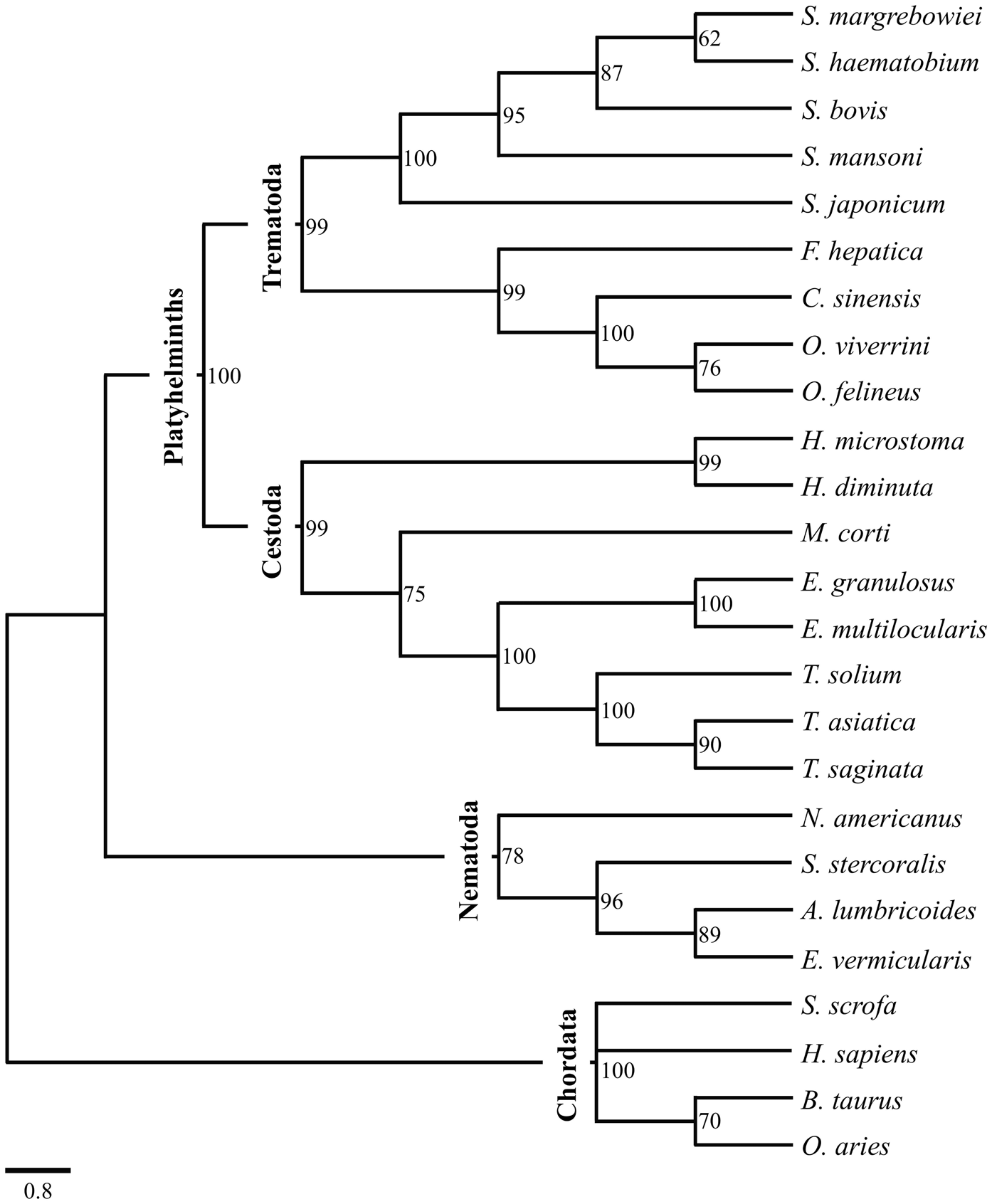
To reconstruct the evolutionary history of HMG-CoA reductases from some parasitic helminths and their respective hosts, a phylogenetic analysis was performed. A set of 17 amino acid sequences from parasitic flatworms was used, comprising 8 cestode sequences (E. granulosus, E. multilocularis, H. diminuta, Hymenolepis microstoma, M. corti, Taenia asiatica, T. saginata and T. solium), and 9 trematodes species (Clonorchis sinensis, Fasciola hepatica, Opisthorchis felineus, Opisthorchis viverrini, Schistosoma bovis, Schistosoma haematobium, Schistosoma japonicum, Schistosoma mansoni and Schistosoma margrebowiei). An outgroup of 8 amino acid sequences was used in the analysis, comprising 4 nematode species that cause gastrointestinal diseases (Ascaris lumbricoides, Enterobius vermicularis, Necator americanus and Strongyloides stercoralis) and the host species of the assessed helminths (Bos taurus, Homo sapiens, Ovis aries and Sus scrofa). The resulting phylogenetic tree is shown in Fig. 1. It revealed 3 distinct clades: Chordata, platyhelminths and nematodes. Platyhelminths were divided into 2 monophyletic groups of parasitic worms, 1 corresponding to trematodes and the other corresponding to cestodes. The distinction of the analysed organisms in monophyletic clades demonstrated that the closely related species are grouped in the same branch, reinforcing the conservation of HMG-CoA reductase among these organisms.
Phylogenetic tree of HMG-CoA reductase from parasitic helminths and their respective hosts. Phylogenetic tree showing the relative conservation of HMG-CoA reductase in different parasitic helminths. The analysis involved 25 amino acid sequences, 17 amino acid sequences from platyhelminths, 4 amino acid sequences from their hosts, and 4 amino acid sequences from nematodes (outgroup). The phylogenetic tree was obtained using the maximum likelihood (ML) probabilistic method based on the JTT matrix-based model with 5 gamma categories. The consensus tree was inferred from 2000 replicates.

Comparative analysis of HMG-CoA reductase structures from the cestodes M. corti, E. multilocularis, E. granulosus and T. solium
To assess the possible forms of interaction of HMG-CoA reductases from cestodes with simvastatin, the 3-dimensional structure of these enzymes was modelled for M. corti (Fig. 2A), E. multilocularis (Fig. 2B), E. granulosus (Fig. 2C) and T. solium (Fig. 2D). For each of these species, at least 12 models were built. These models had their qualities evaluated and the best models were chosen for the next steps. The results of the model quality assessments are presented in Supplementary Materials 1–4.
Three-dimensional structures of McosHMGCR, EmHMGCR, EgHMGCR and TsHMGCR and interactions with simvastatin. Predicted homotetrameric structures of (A) McosHMGCR, (B) EmHMGCR, (C) EgHMGCR and (D) TsHMGCR, with the different monomer chains shown in green, yellow, pink and blue. Active sites and interactions with the ligands are shown in the boxed detail for (a) McosHMGCR, (b) EmHMGCR, (c) EgHMGCR and (d) TsHMGCR. The structure of simvastatin is shown in green, and hydrogen bonds between it and amino acids from the assessed cestode HMG-CoA reductases are shown as yellow dotted lines.

In all the built cestode models, the general structure of the HMG-CoA reductase is similar to that observed in the structure of human enzyme (Supplementary Fig. 2). Furthermore, the HMG-CoA reductase monomer (Supplementary Fig. 3) contains a typical structure composed of 3 domains: an N-terminal helical domain called the N domain (pink), an L domain (blue) and a C-terminal domain called the S domain (grey), as the template enzyme. The S and L domains are connected by a loop assumed to be involved with the enzyme tetramerization. In the homotetramer, the active site contained in each monomer (A, B, C and D) is localized in the L domain interface between 2 monomers. As expected, not only the primary amino acid sequences of HMG-CoA reductase are conserved among the different cestodes (Fig. 3A) but also their overall structures (Fig. 3B).
Sequence and structure comparisons of McosHMGCR, EmHMGCR, EgHMGCR, TsHMGCR and HsHMGCR. (A) Alignment of the amino acid sequences of McosHMGCR, EmHMGCR, EgHMGCR, TsHMGCR and HsHMGCR. The catalytic amino acid, identical in all enzymes, are highlighted in salmon. Other identical amino acids are highlighted in dark green. (B) Superposition of the tetrameric structures of McosHMGCR (cyan), EmHMGCR (salmon), EgHMGCR (green), TsHMGCR (purple) and HsHMGCR (yellow).

Interactions of simvastatin with the active site of HMG-CoA reductases from M. corti, E. multilocularis, E. granulosus and T. solium
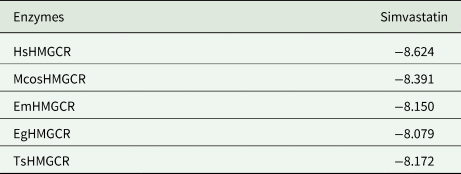
To evaluate the possible forms of interactions of simvastatin with the active site of cestode HMG-CoA reductases, molecular docking experiments were performed on the DockThor server with McosHMGCR, EmHMGCR, EgHMGCR and TsHMGCR. The parameters for molecular docking were calibrated using the redocking strategy using as reference the structure of HMG-CoA reductase from Homo sapiens (HsHMGCR) complexed with simvastatin (PDB ID: 1hw9). The result of redocking simvastatin with HsHMGCR yielded a binding affinity score of −8.624 (Table 1). We observed that simvastatin interacts with C-chain residues Glu559, Lys735 and Asn755 and with D-chain residues Arg590, Lys691 and Ser684 (Supplementary Fig. 4). These values were used for comparative analyses with the cestode HMG-CoA reductase orthologs.
Molecular docking results of the drug simvastatin. Binding affinity score (given in kcal mol−1) of the drug simvastatin with the HsHMGCR, McosHMGCR, EmHMGCR, EgHMGCR and TsHMGCR

The binding affinity scores of the cestode assessed enzymes with simvastatin are shown in Table 1. In McosHMGCR, simvastatin interacts with C-chain residues Glu543 and Lys719 and with D-chain residues Arg574, Ser668 and Asp674 (Fig. 2A). The interactions of EmHMGCR with simvastatin are with residues Glu252, Lys428 and Asn450 of the C-chain and with residues Arg283 and Ser377 of the D-chain (Fig. 2B). In EgHMGCR, simvastatin interacts with C-chain residues Glu216, Lys392 and with D-chain residues Arg247 and Ser341 (Fig. 2C). Finally, in TsHMGCR simvastatin interacts with C-chain residues Glu389, Lys565 and Asn587 and with D-chain residues Arg420 and Ser514 (Fig. 2D). In the comparison of the predicted active sites among the built models for the 4 orthologs enzymes, it was observed that the Glu and Lys residues of the C-chain and the Arg and Ser residues of the D-chain are always predicted to interact with simvastatin.
Preliminary viability assessment of simvastatin-treated TTs by trypan blue staining
To analyse the effects of simvastatin on M. corti with trypan blue staining, in vitro assays were performed with different concentrations of simvastatin (5 μm, 10 μm, 20 μm, 50 μm, 100 μm and 150 μm). After 48 h, we observed that simvastatin at concentrations of 100 μm and 150 μm reduced 90% of the viability of treated TTs by the trypan blue stain exclusion test (Fig. 4A) with most TTs treated at these concentrations stained blue (Supplementary Fig. 5). Optical observations of treated TT with the inverted microscope showed that after 24 h, TTs treated with concentrations between 50 μm and 150 μm of simvastatin displayed reduced viability compared to untreated TTs. At 48 h, TTs treated with concentrations of 100 μm and 150 μm clearly showed a drastic reduction in viability and progressive tegument damages (Fig. 4B). These results indicate that simvastatin decreases the viability of M. corti and that this statin is a potential anthelmintic.
Effects of simvastatin on the viability of M. corti tetrathyridia (TTs). (A) TTs were treated for 48 h with concentrations of 5 μm, 10 μm, 20 μm, 50 μm, 100 μm and 150 μm of simvastatin. The following were used as negative controls: RPMI and DMSO; and as positive control: ABZ. The experiment was performed in triplicate. The error bars represent the standard deviation, and the asterisks indicate those values that presented differences with statistical significance compared to the negative controls, according to the ANOVA test and Tukey's post-test (**P < 0.01; ****P < 0.0001). (B) Inverted optical microscope images of treated TTs with 5 μm, 10 μm, 20 μm, 50 μm, 100 μm and 150 μm concentrations of simvastatin on the last day of treatment (48 h). Treated TTs with 100 μm and 150 μm concentrations appear with tegument damage (arrows) compared to negative controls (RPMI and DMSO). All images are at 5× magnification.

Motility assessment of statins-treated TTs by motility assays
To further evaluate the potential cestocidal activity of statins, the effects of simvastatin and fluvastatin on TTs were assessed using motility assays. In these assays, conducted with a worm microtracker device, drug concentrations of 25 μm, 75 μm, 100 μm and 150 μm were tested. For simvastatin, motility values showed a consistent and significant reduction only at concentrations of 150 μm (from day 1) and 100 μm (from day 6). At the 150 μm concentration, an almost complete reduction in motility was observed from day 5, with motility being fully abolished (100% reduction) by day 7 (Fig. 5A). Observations with an inverted microscope showed reduced motility and morphological alterations (including tegument damage) in TTs treated with 150 μm from day 1, and in parasites treated with 100 μm and 75 μm from day 6 (Fig. 5B).
Effects of simvastatin and fluvastatin on the viability of M. corti tetrathyridia (TTs). Effects of (A) simvastatin and (C) fluvastatin on TTs were evaluated at concentrations of 25 μm, 75 μm, 100 μm and 150 μm at different incubation times, using the M. corti TTs motility assay. TTs incubated with the drug vehicle (DMSO 1%) were used as a negative control. Relative motility indices were measured from a biological replicate, in quadruplicate. The error bars represent the standard deviation, and the asterisks indicate those values that showed statistically significant differences in relation to the negative control, according to the two-way ANOVA test and Bonferroni post-tests (*P < 0.05; **P < 0.01; ***P < 0.001; ****P < 0.0001). (B and D) Inverted optical microscope images of M. corti TTs treated with 25 μm, 75 μm, 100 μm and 150 μm concentrations of simvastatin and fluvastatin at different days of treatment compared with the parasites incubated with DMSO 1%. Note the damage to the tegument with presence of influx (I) of culture medium into the worm and tegument debris (D) in the culture medium (shown in simvastatin 75 μm day 9).(B) Treated TTs with 150 μm of simvastatin appear with damage to the tegument in the first 24 h of treatment. (D) Treated TTs with 150 μm fluvastatin appear with tegument damage from day 6 of treatment. All images are at 4× magnification.

The effect of fluvastatin was less potent than simvastatin but was significant at a broader range of concentrations. A significant reduction of motility was observed with 150 and 100 μm concentrations from days 4 to 5 with 75 μm. The maximum reduction of motility did not surpass 50% with 150 μm (days 6 and 9), both 100 (day 6) and 75 μm (day 9) reached about 20% reduction in motility (Fig. 5C). Furthermore, we observed that TTs treated with a concentration of 150 μm of fluvastatin showed damage to the tegument of the parasites from day 6 of treatment (Fig. 5D). These results reinforce that statins can reduce TTs motility and demonstrate that treatment with this inhibitor has an anthelmintic effect on M. corti.
Discussion
Drug repurposing is the identification of new therapeutic uses for drugs that are already commercially available or in clinical development. One of the main advantages of using this strategy is the reduction of research time and the cost involved in the development of new drugs (Ashburn and Thor, Reference Ashburn and Thor2004; Xue et al., Reference Xue, Li, Xie and Wang2018). Therefore, it has gained increasing importance in the search for new therapeutic uses for proven safe and effective drugs to be repositioned for the treatment of diseases (Serafin and Hörner, Reference Serafin and Hörner2018).
Strategies of drug repurposing can be especially useful to identify new therapeutic uses for the treatment of rare and neglected diseases for which there are no effective treatments available (Ekins et al., Reference Ekins, Williams, Krasowski and Freundlich2011; Hamid et al., Reference Hamid, Mäser and Mahmoud2024). With the continuous advancement in the generation and analysis big data technologies, including those referring to structural analyses, and the deepening of the knowledge on the pathophysiology of diseases, it is expected that the drug repurposing will become increasingly effective for the treatment of infectious diseases, including parasitic ones (Bustamante et al., Reference Bustamante, Ochoa, Asela and Muskus2019; Pandey et al., Reference Pandey, Nascimento, Moore, Raj, Kalil and Cunha-Neto2020).
The HMG-CoA reductase gene has been identified in organisms from all 3 domains of life (Archaea, Bacteria and Eukarya), and amino acid sequence comparisons along with phylogenetic analyses have shown that the catalytic domain is highly conserved in eukaryotes, although the domain of membrane anchor is less conserved (Friesen and Rodwell, Reference Friesen and Rodwell2004). Furthermore, in genomes from higher metazoans, archaea and eubacteria, only a single copy of the HMG-CoA reductase gene has been found. In line with that, a single HMG-CoA reductase gene was identified here for parasitic helminths and the catalytic domain (residues 587–1102) of the encoded ortholog enzymes was conserved among the assessed species. The conservation of HMG-CoA reductase and the absence of paralogous genes favour the idea of repurposing of simvastatin not only for the treatment of cestodiases but also for the treatment of other diseases caused by parasitic helminths. It has already been shown that simvastatin has anthelmintic potential against S. mansoni, causing death of schistosomules and adults in vitro (Rojo-Arreola et al., Reference Rojo-Arreola, Long, Asarnow, Suzuki, Singh and Caffrey2014). Furthermore, the presence of a single copy of the HMG-CoA reductase gene reduces the chance of developing resistance by switching to alternate genes.
The evolutionary history of HMG-CoA reductase was assessed based on a phylogenetic analysis, confirming that orthologs from chordates, platyhelminths and nematodes are separated in distinct clades, as expected. Considering that closely related species were grouped in the same branch, it was confirmed that the HMG-CoA reductase gene has diversified in parallel with the separation of those taxa and is in line with other HMG-CoA reductase phylogenetic studies carried out for other taxonomic groups such as crustaceans, fish, birds, insects, mammals and plants (Zhao et al., Reference Zhao, Jiang, Song, Ma, Wang, Meng, Wei, Chen, Qiao, Zhang and Ma2015; Lü et al., Reference Lü, Jiang, Huo, Li and Zhang2016). Overall, it was observed that HMG-CoA reductase is conserved enough among different taxa, even among more distant ones, to allow a dependable identification of orthologs.
The structural analyses also showed an overall conservation of HMG-CoA reductase domain structures, comparing McosHMGCR, EmHMGCR, EgHMGCR and TsHMGCR with the reference HsHMGCR. Conservation is evident also in the comparisons among active sites, both in terms of predicted structure and amino acid identities. This corroborates the idea that human HMG-CoA inhibitor would also bind and inhibit the activity of the assessed cestode orthologs.
Statins competitively inhibit HMG-CoA reductase. Due to their HMG-CoA analogous structures, when these inhibitors bind to HMG-CoA reductase, they occupy part of the HMG-CoA binding site, thus blocking the access of this substrate to the enzyme (Istvan et al., Reference Istvan, Palnitkar, Buchanan and Deisenhofer2000). In addition to this similarity with HMG-CoA, the strong binding of statins is correlated to the large number of Van der Waals interactions and hydrogen bonds between these inhibitors and HMG-CoA-reductase (Istvan, Reference Istvan2001). In line with that, our molecular docking analyses demonstrated that the amino acid residues present in the predicted structures of McosHMGCR, EmHMGCR, EgHMGCR and TsHMGCR would interact with simvastatin essentially in positions correspondent to that observed in the interaction between simvastatin and HsHMGCR crystal (Pandey et al., Reference Pandey, Nascimento, Moore, Raj, Kalil and Cunha-Neto2020). This also points out to the potential of simvastatin as specific inhibitor for cestode HMG-CoA reductases.
M. corti is a model cestode widely used to identify new anthelmintic compounds in pharmacological studies (Markoski, Reference Markoski2006; Maggiore and Elissondo, Reference Maggiore and Elissondo2014; Vaca et al., Reference Vaca, Celentano, Macchiaroli, Kamenetzky, Camicia and Rosenzvit2019, Reference Vaca, Celentano, Toscanini, Heimburg, Ghazy, Zeyen, Hauser, Oliveira, Elissondo, Jung, Sippl, Camicia and Rosenzvit2021, 2022). Since this species is not infectious to humans and can be easily maintained in vivo and in vitro, it provides continuous availability of biological material, an important consideration in the work with cestodes-due to the scarcity of material suitable for laboratory work from zoonotic species (Markoski et al., Reference Markoski, Bizarro, Farias, Espinoza, Galanti, Zaha and Ferreira2003; Hemphill, Reference Hemphill2010; Lustigman et al., Reference Lustigman, Prichard, Gazzinelli, Grant, Boatin, McCarthy and Basáñez2012). However, as M. corti larvae are virtually non-infective to humans, it will be important to carry out future experiments to assess statin effects also on human-infecting species, like E. granulosus or E. multilocularis.
There are few standardized techniques to measure the viability of M. corti TTs in pharmacological experiments (Saldaña et al., Reference Saldaña, Casaravilla, Marín, Fernández and Domínguez2003; Maggiore and Elissondo, Reference Maggiore and Elissondo2014). Simple optical observation of movement and structural features are used as a standard to evaluate qualitatively parasite viability (Hemphill, Reference Hemphill2010). To improve the screening of compounds with possible anthelmintic effects, staining-based techniques employing the use of vital dyes, and a motility assay have been standardized to assess the viability and motility of TTs more accurately and quantitatively (Fabbri and Elissondo, Reference Fabbri and Elissondo2018; Vaca et al., Reference Vaca, Celentano, Macchiaroli, Kamenetzky, Camicia and Rosenzvit2019).
In the present work, we employed a staining-based technique (using trypan blue dye) to preliminary determine the viability of TTs that were treated with different concentrations of simvastatin. Furthermore, we also used the motility assay to evaluate the motility of TTs that were treated with different concentrations of simvastatin and fluvastatin. In these experiments, we qualitatively observed (by optical microscope) that simvastatin and fluvastatin reduced motility and caused damage to the tegument of treated TTs, indicating that the treatment reduced the viability of the parasites. Using the staining-based technique and the motility assay, as expected, we observed and quantified with both methodologies the effects of simvastatin on the viability and motility of treated TTs, and the effects of fluvastatin on the motility of treated TTs. Simvastatin was the inhibitor with the most significant effect on M. corti. Treatment with a concentration of 150 μm reduced the viability and motility of TTs in a short period time, indicating that simvastatin has a stronger anthelmintic effect on M. corti larvae. In terms of in vitro efficacy, simvastatin showed promising results against cestodes, suggesting its therapeutic potential for treating parasitic infections. However, the need to use significantly higher concentrations to achieve the desired effects, as observed in our study, may pose challenges when extrapolating these findings to clinical practice, as high doses of simvastatin could increase the risk of toxicity. While in vitro assays provide initial insights into the antiparasitic potential of simvastatin, applying these concentrations in vivo requires caution. Moreover, further investigations using animal models are essential to evaluate the efficacy of simvastatin against larval cestodes in vivo, with the goal of identifying doses that strike a balance between antiparasitic efficacy and safety.
Fluvastatin has also been shown to affect M. corti. However, the effect of fluvastatin was smaller when compared to the effect of simvastatin. This reduction in the effect of fluvastatin may be related to structural changes made to synthetic statins (such as fluvastatin) to increase the effectiveness of these inhibitor's interactions with human HMG-CoA reductase (Schachter, Reference Schachter2005). Given that structural modifications may enhance inhibitor efficacy, we hypothesize that altering the structure of simvastatin or fluvastatin could improve their interaction with cestode HMG-CoA reductases. However, the molecular mechanisms underlying the effects of simvastatin and fluvastatin on cestodes remain unknown, and further studies are necessary to better understand and enhance their effects on these helminth parasites.
The conservation of HMG-CoA reductase in different organisms is associated to the importance of the mevalonate pathway, as this pathway is considered vital for most organisms. It has already been demonstrated that inhibition of HMG-CoA reductase can lead to loss of the non-steroidal branch of the pathway that produces essential non-steroidal isoprenoids, such as geranylgeranyl diphosphate/pyrophosphate (GGPP) and farnesyl diphosphate/pyrophosphate (FPP) (Ranji et al., Reference Ranji, Rauthan, Pitot and Pilon2014). These molecules are essential for normal cellular functioning and are indispensable for several processes such as protein prenylation (farnesylation or geranylgeranylaton) of small GTPases and synthesis of isopentenylated tRNA (Rauthan and Pilon, Reference Rauthan and Pilon2011; Lasunción et al., Reference Lasunción, Martínez-Botas, Martín-Sánchez, Busto and Gómez-Coronado2022). In parasitc organisms, such as the protozoan Entamoeba histolytica and in the helminth S. mansoni, it has been shown that the inhibition of HMG-CoA reductase and farnesyltransferase leads to the loss of several functions such as cell differentiation and growth (Probst et al., Reference Probst, Nguyen, El-Sakkary, Skinner, Suzuki, Buckner, Gelb, Caffrey and Debnath2019). In the tapeworm E. multilocularis, it has already been demonstrated that a Ras-like (Ral) small GTP-binding protein undergo prenylation in the form of geranylgeranylation (Spiliotis and Brehm, Reference Spiliotis and Brehm2004). Therefore, inhibition of HMG-CoA reductase and geranylgeranyl transferase can lead to loss of key cellular processes mediated by Ral proteins, such as vesicle transport and migration and cell division. Thus, HMG-CoA reductase emerges as a promising therapeutic target for both parasitic protozoans and helminths.
The mevalonate pathway is essential for the survival of parasitic helminths. This pathway, as it plays an important role in the production of key cellular components, has become an interesting target for drug repositioning. Our in silico analyses showed that the constructed 3D-models McosHMGCR, EmHMGCR, EgHMGCR and TsHMGCR have structural similarities with HsHMGCR, indicating that human enzyme inhibitors could be effective against cestode enzymes. This was corroborated by our in vitro viability and motility assays that demonstrated dose-dependent viability and motility reduction in M. corti larvae, upon treatment with simvastatin or fluvastatin. Overall, our in silico and in vitro experimental approaches provided evidence that HMG-CoA reductase constitutes a promising therapeutic target for the repositioning of simvastatin or other statins as anthelmintic drugs to treat larval cestodiases. Our results pave the way for assessing the effects of statins in vivo through experiments using experimentally infected hosts.
Supplementary material
The supplementary material for this article can be found at https://doi.org/10.1017/S0031182024001586.
Data availability statement
Not applicable.
Acknowledgements
We thank the Programa de Pós-Graduação em Biologia Celular e Molecular (PPGBCM, UFRGS) for partially supporting a short-term stage of M.M.G. in the UBA (Argentina).
Author contributions
H. B. F. and A. Z. conceived and designed the study, supervised the project, and acquired funding; K. M. M. supervised project and acquired funding; M. M. G., J. C. L., J. A. P., M. P. C. C., A. M. C., M. C. R. conducted methodology, data collection, and analysis; M. M. G., J. C. L. and H. B. F. wrote and prepared the original draft of the article. All authors reviewed and edited the manuscript.
Financial support
This work was supported by Conselho Nacional de Desenvolvimento Científico e Tecnológico (CNPq, grant number 428305/2018-0), Fundação de Amparo à Pesquisa do Estado Rio Grande do Sul (FAPERGS), and Coordenação de Aperfeiçoamento de Pessoal de Nível Superior (CAPES). MMG is a recipient of a CAPES Ph.D. fellowship. J. C. L. was a recipient of a CAPES Ph.D. fellowship. J. A. P. was a recipient of a CAPES post-doc fellowship.
Competing interests
The authors declare do not have conflict of interest.
Ethical standards
All experimental procedures involving animals were previously approved by the Ethical Committee (CEUA) of the Universidade Federal do Rio Grande do Sul (Project no. 40598) and by the Comité Institucional para el Cuidado y Uso de Animales de Laboratorio (CICUAL), Facultad de Medicina, Universidad de Buenos Aires (UBA), Argentina (protocols: ‘In vivo passages of cestode parasites from Mesocestoides vogae’ CD N_1127/2015).




 Open access

