





1 Introduction
Over the past 15 years, methods originating in algebraic geometry have been developed to solve long-standing conjectures on unimodality and log-concavity in matroid theory [Reference Adiprasito, Huh and Katz1, Reference Anari, Liu, Oveis Gharan and ‘Vinzant4, Reference Ardila, Denham and Huh5, Reference Braden, Huh, Matherne, Proudfoot and Wang12, Reference Brändén and Huh14, Reference Huh21, Reference Huh and Katz22]. In the influential paper [Reference Adiprasito, Huh and Katz1], a Hodge theory of matroids was developed by Adiprasito, Huh and Katz to prove the Heron-Rota-Welsh conjecture on the log-concavity of the characteristic polynomial of a matroid. This paper has generated a surge of research activities at the interface of Hodge theory and combinatorics, and has led to the resolution of long-standing conjectures in matroid theory, see [Reference Eur16, Reference Huh23].
Another successful approach to log-concavity problems originates in the works of Choe, Oxley, Sokal, Wagner, Gurvits and the first author, see [Reference Wagner32]. This approach uses convexity properties of multivariate stable and hyperbolic polynomials rather than Hodge theory. Recently efforts to combine the two approaches were made by Huh and the first author [Reference Brändén and Huh14], and by Anari, Liu, Oveis Gharan and Vinzant [Reference Anari, Liu, Oveis Gharan and Vinzant3, Reference Anari, Liu, Oveis Gharan and ‘Vinzant4]. The theory of Lorentzian polynomials was developed in [Reference Anari, Liu, Oveis Gharan and ‘Vinzant4, Reference Brändén and Huh14, Reference Gurvits19], and used in [Reference Anari, Liu, Oveis Gharan and ‘Vinzant4, Reference Brändén and Huh14] to prove the strongest of Mason’s conjectures on the (ultra) log-concavity of the number of independent sets of a matroid.
In this paper we study a natural generalization of Lorentzian polynomials to convex cones. The notion is motivated by hyperbolic polynomials [Reference Atiyah, Bott and Gårding6, Reference Gårding20] and Hodge theory [Reference Baker9, Reference Eur16, Reference Huh23]. Indeed, any hyperbolic polynomial is Lorentzian with respect to its hyperbolicity cone, and if a graded vector space A satisfies the so-called Kähler package, then the volume polynomial associated to A is Lorentzian with respect to a convex cone $\mathscr {K}$
(see Example 2.2). In fact, the notion of
$\mathscr {K}$
(see Example 2.2). In fact, the notion of $\mathscr {K}$
-Lorentzian polynomials captures the Hodge-Riemann relations of degree zero and one. We have made an effort to make this paper self-contained, based on convexity properties of polynomials. Specifically, many of our results follow from basic facts in classical convexity theory and linear algebra.
$\mathscr {K}$
-Lorentzian polynomials captures the Hodge-Riemann relations of degree zero and one. We have made an effort to make this paper self-contained, based on convexity properties of polynomials. Specifically, many of our results follow from basic facts in classical convexity theory and linear algebra.
Outline. In Section 2 we prove fundamental properties of Lorentzian polynomials on cones, which are used in subsequent sections. These include sufficient conditions for a polynomial to be $\mathscr {K}$
-Lorentzian which are suitable for recursive proofs, see Theorem 2.10. In Section 3 we define a class of multivariate homogeneous polynomials which we call hereditary polynomials, Definition 3.1. The definition is inspired by fundamental properties of volume polynomials of Chow rings of simplicial fans. We define a natural notion of the Lorentzian property for hereditary polynomials, and give a complete and easily checkable characterization of hereditary Lorentzian polynomials, Theorem 3.10. In Section 4 we apply this characterization to give a self-contained and elementary proof of the Lorentzian property for the volume polynomial of the Chow ring of a matroid, Theorem 4.3. This is equivalent to the Hodge-Riemann relations of degree zero and one for this Chow ring, which were first proved by Adiprasito, Huh and Katz in [Reference Adiprasito, Huh and Katz1]. We use this to derive a new proof of the Heron-Rota-Welsh conjecture for the characteristic polynomial of a matroid in Section 4.1, first proved in [Reference Adiprasito, Huh and Katz1].
$\mathscr {K}$
-Lorentzian which are suitable for recursive proofs, see Theorem 2.10. In Section 3 we define a class of multivariate homogeneous polynomials which we call hereditary polynomials, Definition 3.1. The definition is inspired by fundamental properties of volume polynomials of Chow rings of simplicial fans. We define a natural notion of the Lorentzian property for hereditary polynomials, and give a complete and easily checkable characterization of hereditary Lorentzian polynomials, Theorem 3.10. In Section 4 we apply this characterization to give a self-contained and elementary proof of the Lorentzian property for the volume polynomial of the Chow ring of a matroid, Theorem 4.3. This is equivalent to the Hodge-Riemann relations of degree zero and one for this Chow ring, which were first proved by Adiprasito, Huh and Katz in [Reference Adiprasito, Huh and Katz1]. We use this to derive a new proof of the Heron-Rota-Welsh conjecture for the characteristic polynomial of a matroid in Section 4.1, first proved in [Reference Adiprasito, Huh and Katz1].
In Section 5 we define stellar subdivisions of hereditary polynomials. We show that the stellar subdivision of a polynomial f with respect to a face S is achieved by a canonical bijective linear operator $\operatorname {\mathrm {sub}}_S^{\mathbf {c}}$
. In Theorem 5.8 we prove that the hereditary Lorentzian property is invariant under subdivisions.
$\operatorname {\mathrm {sub}}_S^{\mathbf {c}}$
. In Theorem 5.8 we prove that the hereditary Lorentzian property is invariant under subdivisions.
In Section 6 we apply the results in Sections 3 and 5 to give a new proof of the Lorentzian property of volume polynomials of simple polytopes [Reference Aleksandrov2, Reference McMullen24]. A consequence is a simple and self-contained proof of the Alexandrov-Fenchel inequalities for convex bodies [Reference Aleksandrov2].
In Section 7 we give a complete and easily checkable characterization of Chow rings of simplicial fans which are hereditary Lorentzian, Theorem 7.11. More generally, we characterize hereditary Lorentzian functionals on Chow rings of simplicial fans, Theorem 7.10. In Section 7.1 we prove that the hereditary Lorentzian property only depends on the support of the fan. The corresponding property for Lefschetz fans was recently proved by Ardila, Denham and Huh in [Reference Ardila, Denham and Huh5].
In Section 8 we provide various characterizations of $\mathscr {K}$
-Lorentzian polynomials and M-convex sets, and in Section 9 we prove that the projective space of
$\mathscr {K}$
-Lorentzian polynomials and M-convex sets, and in Section 9 we prove that the projective space of $\mathscr {K}$
-Lorentzian polynomials of fixed degree and number variables is compact and contractible to a point in its interior.
$\mathscr {K}$
-Lorentzian polynomials of fixed degree and number variables is compact and contractible to a point in its interior.
Related work. The manuscript [Reference Brändén and Leake15] by the authors, which is not intended for publication, contains a short and self-contained proof (based on the same methods used in this paper) of the Hodge-Riemann relations of degree zero and one for the Chow ring of a matroid and the Heron-Rota-Welsh conjecture, first proved by Adiprasito, Huh and Katz in [Reference Adiprasito, Huh and Katz1]. We decided to instead include the work in [Reference Brändén and Leake15] in the more general setting of this paper.
While completing this paper, we became aware that Dustin Ross had independently proved the characterization of Chow rings of simplicial fans satisfying the Hodge-Riemann relations of degree zero and one, as well as that this property only depends on the support of the fan. Our papers are written from two different perspectives, which we believe to be mutually beneficial: The paper of Ross is from the perspective of Lorentzian fans, while our paper is from the perspective of (hereditary) polynomials. Therefore we decided to post our two papers simultaneously.
2 Lorentzian polynomials on cones
Inspired by Hodge theory, matroid theory and the theory of stable polynomials, Lorentzian polynomials were introduced by June Huh and the first author in [Reference Brändén and Huh14]. In this section we extend the notion of Lorentzian polynomials to open convex cones. To motivate this definition, we recall the Hodge-Riemann relations for the case of graded rings, see [Reference Huh23] for a detailed and more general exposition. Suppose
 $$ \begin{align*}A= \mathbb{R}[x_1,\ldots,x_n]/I=\bigoplus_{k=0}^dA^k \end{align*} $$
is a graded ring (with standard grading given by polynomial degree), where $A^d$
is one dimensional. Let
$A^d$
is one dimensional. Let $\deg : A^d \longrightarrow \mathbb {R}$
be a linear isomorphism. Suppose further that
$\deg : A^d \longrightarrow \mathbb {R}$
be a linear isomorphism. Suppose further that $\mathscr {K}$
is an open convex coneFootnote
1
in the real vector space
$\mathscr {K}$
is an open convex coneFootnote
1
in the real vector space $A^1$
. For
$A^1$
. For $0 \leq k \leq d/2$
, the (mixed) Hodge-Riemann relations of degree k say that given any elements
$0 \leq k \leq d/2$
, the (mixed) Hodge-Riemann relations of degree k say that given any elements $\ell _0,\ell _1, \ldots , \ell _{d-2k}$
in
$\ell _0,\ell _1, \ldots , \ell _{d-2k}$
in $\mathscr {K}$
, the bilinear form
$\mathscr {K}$
, the bilinear form
 $$ \begin{align} A^k \times A^k \longrightarrow \mathbb{R}, \ \ \ \ \ (x,y) \longmapsto (-1)^k\deg(xy \ell_1 \ell_2\cdots \ell_{d-2k}) \end{align} $$
is positive definite on $\{ x \in A^k : \ell _0\ell _1 \cdots \ell _{d-2k}x =0\}$
.
$\{ x \in A^k : \ell _0\ell _1 \cdots \ell _{d-2k}x =0\}$
.
Notice that $A^0$
is isomorphic to
$A^0$
is isomorphic to $\mathbb {R}$
and that
$\mathbb {R}$
and that $\ell _0 \ell _1 \cdots \ell _d = 0$
in A. It follows that for
$\ell _0 \ell _1 \cdots \ell _d = 0$
in A. It follows that for $k=0$
, the Hodge-Riemann relations simply say that
$k=0$
, the Hodge-Riemann relations simply say that $\deg (\ell _1\ell _2 \cdots \ell _{d})>0$
for any
$\deg (\ell _1\ell _2 \cdots \ell _{d})>0$
for any $\ell _1, \ldots , \ell _d \in \mathscr {K}$
. Given this, the Hodge-Riemann relations of degree one say that for any
$\ell _1, \ldots , \ell _d \in \mathscr {K}$
. Given this, the Hodge-Riemann relations of degree one say that for any $\ell _1,\ldots , \ell _{d-2} \in \mathscr {K}$
, the bilinear form
$\ell _1,\ldots , \ell _{d-2} \in \mathscr {K}$
, the bilinear form
 $$ \begin{align*}(x,y) \longmapsto \deg(xy \ell_1\ell_2 \cdots \ell_{d-2}) \end{align*} $$
has the Lorentz signature $(+,-,-,\ldots ,-)$
, that is, it is nonsingular and has exactly one positive eigenvalue. This reformulation follows from Cauchy’s interlacing theorem.
$(+,-,-,\ldots ,-)$
, that is, it is nonsingular and has exactly one positive eigenvalue. This reformulation follows from Cauchy’s interlacing theorem.
The Hodge-Riemann relations of degree zero and one may be rephrased in terms of polynomials as follows. The volume polynomial of A is the polynomial in $\mathbb {R}[t_1,\ldots , t_n]$
defined by
$\mathbb {R}[t_1,\ldots , t_n]$
defined by
 $$ \begin{align*}\operatorname{\mathrm{vol}}_A(\mathbf{t})= \frac 1 {d!} \deg\left(\left(\sum_{i=1}^nt_ix_i \right)^{\!\! d}\right). \end{align*} $$
Let $\partial _i$
(or
$\partial _i$
(or $\partial _{t_i}$
) denote the partial derivative with respect to
$\partial _{t_i}$
) denote the partial derivative with respect to $t_i$
, and for
$t_i$
, and for $\mathbf {u}=(u_1, \ldots , u_n) \in \mathbb {R}^n$
let
$\mathbf {u}=(u_1, \ldots , u_n) \in \mathbb {R}^n$
let $D_{\mathbf {u}}= u_1\partial _1 + \cdots + u_n \partial _n$
. For
$D_{\mathbf {u}}= u_1\partial _1 + \cdots + u_n \partial _n$
. For $\underline {\ell } = (a_1,\ldots , a_n) \in \mathbb {R}^n$
, let
$\underline {\ell } = (a_1,\ldots , a_n) \in \mathbb {R}^n$
, let $\ell = a_1x_1+\cdots + a_nx_n\in A^1$
. Then for any
$\ell = a_1x_1+\cdots + a_nx_n\in A^1$
. Then for any $\ell _1, \ldots , \ell _d \in A^1$
,
$\ell _1, \ldots , \ell _d \in A^1$
,
 $$ \begin{align*}\deg(\ell_1 \ell_2\cdots \ell_{d}) = D_{\underline{\ell}_1} D_{\underline{\ell}_2} \cdots D_{\underline{\ell}_d}\operatorname{\mathrm{vol}}_A. \end{align*} $$
The above discussion motivates the following definition, which encapsulates the Hodge-Riemann relations of degree zero and one.
Definition 2.1. Let $\mathscr {K}$
be an open convex cone in
$\mathscr {K}$
be an open convex cone in $\mathbb {R}^n$
. A homogeneous polynomial
$\mathbb {R}^n$
. A homogeneous polynomial $f \in \mathbb {R}[t_1,\ldots , t_n]$
of degree
$f \in \mathbb {R}[t_1,\ldots , t_n]$
of degree $d \geq 2$
is called
$d \geq 2$
is called $\mathscr {K}$
-Lorentzian if for all
$\mathscr {K}$
-Lorentzian if for all $\mathbf {v}_1, \ldots , \mathbf {v}_{d} \in \mathscr {K}$
,
$\mathbf {v}_1, \ldots , \mathbf {v}_{d} \in \mathscr {K}$
,
-
(P) $D_{\mathbf {v}_1}\cdots D_{\mathbf {v}_{d}} f>0$
, and
$D_{\mathbf {v}_1}\cdots D_{\mathbf {v}_{d}} f>0$
, and -
(HR) the bilinear form on
$\mathbb {R}^n$
, has exactly one positive eigenvalue.
$$ \begin{align*}(\mathbf{x},\mathbf{y}) \longmapsto D_{\mathbf{x}}D_{\mathbf{y}}D_{\mathbf{v}_3}\cdots D_{\mathbf{v}_d}f \end{align*} $$


We further define the $\mathscr {K}$
-Lorentzian polynomials of degree at most
$\mathscr {K}$
-Lorentzian polynomials of degree at most $0$
to be the nonnegative constant polynomials, and we define the
$0$
to be the nonnegative constant polynomials, and we define the $\mathscr {K}$
-Lorentzian polynomials of degree
$\mathscr {K}$
-Lorentzian polynomials of degree $1$
to be the linear polynomials satisfying (P).
$1$
to be the linear polynomials satisfying (P).
By definition, $D_{\mathbf {v}} f$
is
$D_{\mathbf {v}} f$
is $\mathscr {K}$
-Lorentzian whenever
$\mathscr {K}$
-Lorentzian whenever $\mathbf {v} \in \mathscr {K}$
and f is
$\mathbf {v} \in \mathscr {K}$
and f is $\mathscr {K}$
-Lorentzian of degree at least one.
$\mathscr {K}$
-Lorentzian of degree at least one.
We will prove in Proposition 8.2 that a polynomial is $\mathbb {R}_{>0}^n$
-Lorentzian if and only if it is Lorentzian as defined in [Reference Brändén and Huh14].
$\mathbb {R}_{>0}^n$
-Lorentzian if and only if it is Lorentzian as defined in [Reference Brändén and Huh14].
Example 2.2. By construction, volume polynomials of graded rings that satisfy the Hodge-Riemann relations (of degrees $0$
and
$0$
and $1$
) are
$1$
) are $\mathscr {K}$
-Lorentzian. This provides an important set of examples from projective geometry, matroid theory and convex geometry, see [Reference Huh23].
$\mathscr {K}$
-Lorentzian. This provides an important set of examples from projective geometry, matroid theory and convex geometry, see [Reference Huh23].
Another important class of $\mathscr {K}$
-Lorentzian polynomials are hyperbolic polynomials, which originate in PDE-theory [Reference Atiyah, Bott and Gårding6, Reference Gårding20]. A homogeneous polynomial
$\mathscr {K}$
-Lorentzian polynomials are hyperbolic polynomials, which originate in PDE-theory [Reference Atiyah, Bott and Gårding6, Reference Gårding20]. A homogeneous polynomial $f \in \mathbb {R}[t_1,\ldots , t_n]$
is hyperbolic with respect to a vector
$f \in \mathbb {R}[t_1,\ldots , t_n]$
is hyperbolic with respect to a vector $\mathbf {e} \in \mathbb {R}^n$
if
$\mathbf {e} \in \mathbb {R}^n$
if
-
•
$f(\mathbf {e})>0$
, and -
• for each
$\mathbf {x} \in \mathbb {R}^n$
, all zeros of the univariate polynomial
$t \longmapsto f(t\mathbf {e}-\mathbf {x})$
are real.


For example, the determinant $\det (\mathbf {x})$
, considered as a polynomial on the space of real symmetric matrices, is hyperbolic with respect to the identity matrix.
$\det (\mathbf {x})$
, considered as a polynomial on the space of real symmetric matrices, is hyperbolic with respect to the identity matrix.
The open hyperbolicity cone of a hyperbolic polynomial f with respect to $\mathbf {e}$
is the set
$\mathbf {e}$
is the set $\mathscr {K}(f,\mathbf {e})$
of all
$\mathscr {K}(f,\mathbf {e})$
of all $\mathbf {x}$
for which all zeros of
$\mathbf {x}$
for which all zeros of $f(t\mathbf {e}-\mathbf {x})$
are positive. The hyperbolicity cone is convex, and if
$f(t\mathbf {e}-\mathbf {x})$
are positive. The hyperbolicity cone is convex, and if $\mathbf {v} \in \mathscr {K}(f,\mathbf {e})$
, then
$\mathbf {v} \in \mathscr {K}(f,\mathbf {e})$
, then $D_{\mathbf {v}} f$
is hyperbolic with respect to
$D_{\mathbf {v}} f$
is hyperbolic with respect to $\mathbf {e}$
and
$\mathbf {e}$
and $\mathscr {K}(f,\mathbf {e}) \subseteq \mathscr {K}(D_{\mathbf {v}} f,\mathbf {e})$
, see [Reference Gårding20]. Hence to prove that f is
$\mathscr {K}(f,\mathbf {e}) \subseteq \mathscr {K}(D_{\mathbf {v}} f,\mathbf {e})$
, see [Reference Gårding20]. Hence to prove that f is $\mathscr {K}(f,\mathbf {e})$
-Lorentzian, it suffices to prove that quadratic hyperbolic polynomials satisfy (HR). In fact, a quadratic polynomial is
$\mathscr {K}(f,\mathbf {e})$
-Lorentzian, it suffices to prove that quadratic hyperbolic polynomials satisfy (HR). In fact, a quadratic polynomial is $\mathscr {K}$
-Lorentzian if and only if it is hyperbolic with hyperbolicity cone containing
$\mathscr {K}$
-Lorentzian if and only if it is hyperbolic with hyperbolicity cone containing $\mathscr {K}$
, see Lemma 2.3 below.
$\mathscr {K}$
, see Lemma 2.3 below.
We also note that hyperbolic polynomials with hyperbolicity cone containing $\mathbb {R}_{>0}^n$
are called real stable in the literature. Hence
$\mathbb {R}_{>0}^n$
are called real stable in the literature. Hence $\mathscr {K}$
-Lorentzian polynomials generalize hyperbolic polynomials with hyperbolicity cone containing
$\mathscr {K}$
-Lorentzian polynomials generalize hyperbolic polynomials with hyperbolicity cone containing $\mathscr {K}$
in the same way that Lorentzian polynomials generalize real stable polynomials.
$\mathscr {K}$
in the same way that Lorentzian polynomials generalize real stable polynomials.
Notice that (P) is equivalent to the condition that all coefficients of the polynomial
 $$ \begin{align*}f(s_1\mathbf{v}_1+s_2\mathbf{v}_2+\cdots+s_d\mathbf{v}_d) \in \mathbb{R}[s_1,\ldots, s_d] \end{align*} $$
are positive.
Lemma 2.3. Let $\mathscr {K}$
be a nonempty open convex cone in
$\mathscr {K}$
be a nonempty open convex cone in $\mathbb {R}^n$
, and let
$\mathbb {R}^n$
, and let $(\mathbf {x},\mathbf {y}) \longmapsto P(\mathbf {x},\mathbf {y})$
be a symmetric bilinear form on
$(\mathbf {x},\mathbf {y}) \longmapsto P(\mathbf {x},\mathbf {y})$
be a symmetric bilinear form on $\mathbb {R}^n$
such that
$\mathbb {R}^n$
such that $P(\mathbf {v},\mathbf {v})> 0$
for all
$P(\mathbf {v},\mathbf {v})> 0$
for all $\mathbf {v} \in \mathscr {K}$
. Then the following are equivalent:
$\mathbf {v} \in \mathscr {K}$
. Then the following are equivalent:
-
(AF)
$P(\mathbf {v},\mathbf {w})^2 \geq P(\mathbf {v},\mathbf {v}) P(\mathbf {w},\mathbf {w})$
for all
$\mathbf {v},\mathbf {w} \in \mathscr {K}$
, -
(AF2)
$P(\mathbf {v},\mathbf {x})^2 \geq P(\mathbf {v},\mathbf {v}) P(\mathbf {x},\mathbf {x})$
for all
$\mathbf {v} \in \mathscr {K}$
and
$\mathbf {x} \in \mathbb {R}^n$
, -
(Hyp) the polynomial
$f(\mathbf {x}) = P(\mathbf {x},\mathbf {x})$
is hyperbolic with hyperbolicity cone containing
$\mathscr {K}$
, -
(Lor) the polynomial
$f(\mathbf {x}) = P(\mathbf {x},\mathbf {x})$
is
$\mathscr {K}$
-Lorentzian, -
(H) P has exactly one positive eigenvalue.


Proof. Suppose P satisfies (AF), and let $\mathbf {v} \in \mathscr {K}$
and
$\mathbf {v} \in \mathscr {K}$
and $\mathbf {x} \in \mathbb {R}^n$
. Since
$\mathbf {x} \in \mathbb {R}^n$
. Since $\mathscr {K}$
is an open cone,
$\mathscr {K}$
is an open cone, $\mathbf {w}= \mathbf {x}+t\mathbf {v} \in \mathscr {K}$
for all
$\mathbf {w}= \mathbf {x}+t\mathbf {v} \in \mathscr {K}$
for all $t>0$
sufficiently large. Applying (AF) to
$t>0$
sufficiently large. Applying (AF) to $\mathbf {v},\mathbf {w}$
yields (AF2) after a simple calculation.
$\mathbf {v},\mathbf {w}$
yields (AF2) after a simple calculation.
Assume (AF2), and let $\mathbf {v} \in \mathscr {K}$
and
$\mathbf {v} \in \mathscr {K}$
and $\mathbf {x} \in \mathbb {R}^n$
. Then
$\mathbf {x} \in \mathbb {R}^n$
. Then
 $$ \begin{align} f(t\mathbf{v} - \mathbf{x}) = t^2 \cdot P(\mathbf{v},\mathbf{v}) - 2t \cdot P(\mathbf{v},\mathbf{x}) + P(\mathbf{x},\mathbf{x}), \end{align} $$
which is real-rooted by nonnegativity of the discriminant. Thus f is hyperbolic with hyperbolicity cone containing $\mathscr {K}$
. Note in fact that (AF2) and (Hyp) are equivalent, since the discriminant condition is equivalent to real-rootedness.
$\mathscr {K}$
. Note in fact that (AF2) and (Hyp) are equivalent, since the discriminant condition is equivalent to real-rootedness.
Assume (Hyp), and let $\mathbf {v} \in \mathscr {K}$
. Since (Hyp) implies (AF2), we have that P is negative semidefinite on the hyperplane
$\mathbf {v} \in \mathscr {K}$
. Since (Hyp) implies (AF2), we have that P is negative semidefinite on the hyperplane $\{\mathbf {x} : P(\mathbf {v},\mathbf {x})=0\}$
. By Cauchy interlacing and Sylvester’s law of inertia, P has at most one positive eigenvalue. Since
$\{\mathbf {x} : P(\mathbf {v},\mathbf {x})=0\}$
. By Cauchy interlacing and Sylvester’s law of inertia, P has at most one positive eigenvalue. Since $P(\mathbf {v},\mathbf {v})> 0$
, P has exactly one positive eigenvalue. Suppose
$P(\mathbf {v},\mathbf {v})> 0$
, P has exactly one positive eigenvalue. Suppose $\mathbf {x} \in \mathscr {K}$
. Then
$\mathbf {x} \in \mathscr {K}$
. Then $D_{\mathbf {v}} D_{\mathbf {x}} f = 2 \cdot P(\mathbf {v},\mathbf {x})> 0$
, since the quadratic (2.2) has two negative zeros. Hence
$D_{\mathbf {v}} D_{\mathbf {x}} f = 2 \cdot P(\mathbf {v},\mathbf {x})> 0$
, since the quadratic (2.2) has two negative zeros. Hence $f(\mathbf {x})$
satisfies (P). The fact that (Lor) implies (H) is immediate from Definition 2.1.
$f(\mathbf {x})$
satisfies (P). The fact that (Lor) implies (H) is immediate from Definition 2.1.
Assume (H), and let $\mathbf {v}, \mathbf {w} \in \mathscr {K}$
. If
$\mathbf {v}, \mathbf {w} \in \mathscr {K}$
. If $\mathbf {v}$
and
$\mathbf {v}$
and $\mathbf {w}$
are parallel, then (AF) holds. Otherwise extend
$\mathbf {w}$
are parallel, then (AF) holds. Otherwise extend $\mathbf {v},\mathbf {w}$
to a basis of
$\mathbf {v},\mathbf {w}$
to a basis of $\mathbb {R}^n$
. In this basis, the top-left
$\mathbb {R}^n$
. In this basis, the top-left $2 \times 2$
matrix reads
$2 \times 2$
matrix reads
 $$ \begin{align*}\begin{pmatrix} P(\mathbf{v},\mathbf{v}) & P(\mathbf{v},\mathbf{w}) \\ P(\mathbf{v},\mathbf{w}) & P(\mathbf{w},\mathbf{w}) \end{pmatrix}. \end{align*} $$
Since $P(\mathbf {v},\mathbf {v})>0$
, Cauchy interlacing and Sylvester’s law of inertia implies that this matrix has exactly one positive eigenvalue. The condition (AF) now follows since the determinant of this matrix is nonpositive.
$P(\mathbf {v},\mathbf {v})>0$
, Cauchy interlacing and Sylvester’s law of inertia implies that this matrix has exactly one positive eigenvalue. The condition (AF) now follows since the determinant of this matrix is nonpositive.
Remark 2.4. From Lemma 2.3 it follows that we may replace (HR) in Definition 2.1 by the following equivalent condition. Let $\overline {\mathscr {K}}$
be the closure of
$\overline {\mathscr {K}}$
be the closure of $\mathscr {K}$
in the Euclidean topology on
$\mathscr {K}$
in the Euclidean topology on $\mathbb {R}^n$
.
$\mathbb {R}^n$
.
-
(AF) For all
$\mathbf {v}_1, \ldots , \mathbf {v}_{d} \in \overline {\mathscr {K}}$
,
$$ \begin{align*}(D_{\mathbf{v}_1}D_{\mathbf{v}_2} D_{\mathbf{v}_3}\cdots D_{\mathbf{v}_{d}} f)^2 \geq (D_{\mathbf{v}_1}D_{\mathbf{v}_1} D_{\mathbf{v}_3}\cdots D_{\mathbf{v}_{d}} f)\cdot (D_{\mathbf{v}_2}D_{\mathbf{v}_2} D_{\mathbf{v}_3}\cdots D_{\mathbf{v}_{d}} f).\end{align*} $$


In particular, if f is $\mathscr {K}$
-Lorentzian and
$\mathscr {K}$
-Lorentzian and $\mathbf {u}, \mathbf {v} \in \overline {\mathscr {K}}$
, then the sequence
$\mathbf {u}, \mathbf {v} \in \overline {\mathscr {K}}$
, then the sequence $a_k=D_{\mathbf {u}}^kD_{\mathbf {v}}^{d-k} f$
,
$a_k=D_{\mathbf {u}}^kD_{\mathbf {v}}^{d-k} f$
, $0\leq k \leq d$
, is log-concave, that is,
$0\leq k \leq d$
, is log-concave, that is,
 $$ \begin{align} a_k^2 \geq a_{k-1}a_{k+1}, \ \ \ \ \ 0 \leq k \leq d. \end{align} $$
It is no coincidence that (AF) is reminiscent of the Alexandrov-Fenchel inequalities for convex bodies [Reference Aleksandrov2].
The following remark proves that the space of $\mathscr {K}$
-Lorentzian polynomials is closed in the linear space of all d-homogeneous polynomials in
$\mathscr {K}$
-Lorentzian polynomials is closed in the linear space of all d-homogeneous polynomials in $\mathbb {R}[t_1,\ldots , t_n]$
.
$\mathbb {R}[t_1,\ldots , t_n]$
.
Remark 2.5. We may replace (P) with the seemingly weaker condition
-
(N)
$D_{\mathbf {v}_1}\cdots D_{\mathbf {v}_{d}} f \geq 0$
, for all
$\mathbf {v}_1, \ldots , \mathbf {v}_{d} \in \overline {\mathscr {K}}$
.


Indeed, assume (N) and that $D_{\mathbf {v}_1}\cdots D_{\mathbf {v}_{d}} f = 0$
for some
$D_{\mathbf {v}_1}\cdots D_{\mathbf {v}_{d}} f = 0$
for some $\mathbf {v}_1, \ldots , \mathbf {v}_{d} \in \mathscr {K}$
. Let
$\mathbf {v}_1, \ldots , \mathbf {v}_{d} \in \mathscr {K}$
. Let $\mathbf {u}_1 \in \mathscr {K}$
. Since
$\mathbf {u}_1 \in \mathscr {K}$
. Since $\mathscr {K}$
is open, there is
$\mathscr {K}$
is open, there is $\epsilon>0$
such that
$\epsilon>0$
such that
 $$ \begin{align*}D_{\mathbf{v}_1+t\mathbf{u}_1} {D_{\mathbf{v}_2}} \cdots D_{\mathbf{v}_{d}}f = tD_{\mathbf{u}_1} {D_{\mathbf{v}_2}} \cdots D_{\mathbf{v}_{d}}f\geq 0, \end{align*} $$
for all $|t| <\epsilon $
. Hence
$|t| <\epsilon $
. Hence $ D_{\mathbf {u}_1}D_{\mathbf {v}_2}\cdots D_{\mathbf {v}_{d}}f =0 $
for all
$ D_{\mathbf {u}_1}D_{\mathbf {v}_2}\cdots D_{\mathbf {v}_{d}}f =0 $
for all $\mathbf {u}_1 \in \mathscr {K}$
. By applying the same argument to
$\mathbf {u}_1 \in \mathscr {K}$
. By applying the same argument to $\mathbf {v}_2,\ldots , \mathbf {v}_d$
,
$\mathbf {v}_2,\ldots , \mathbf {v}_d$
, $ D_{\mathbf {u}_1}D_{\mathbf {u}_2}\cdots D_{\mathbf {u}_{d}}f =0 $
for all
$ D_{\mathbf {u}_1}D_{\mathbf {u}_2}\cdots D_{\mathbf {u}_{d}}f =0 $
for all $\mathbf {u}_1,\ldots , \mathbf {u}_d \in \mathscr {K}$
. Hence
$\mathbf {u}_1,\ldots , \mathbf {u}_d \in \mathscr {K}$
. Hence $f \equiv 0$
, since
$f \equiv 0$
, since $\mathscr {K}$
is open.
$\mathscr {K}$
is open.
The following is a generalization of [Reference Brändén and Huh14, Thm. 2.10] and [Reference Anari, Liu, Oveis Gharan and ‘Vinzant4, Lem. 2.2] from Lorentzian to $\mathscr {K}$
-Lorentzian polynomials.
$\mathscr {K}$
-Lorentzian polynomials.
Proposition 2.6. Let $A : \mathbb {R}^m \to \mathbb {R}^n$
be a linear map. If
$A : \mathbb {R}^m \to \mathbb {R}^n$
be a linear map. If $f \in \mathbb {R}[t_1,\ldots ,t_n]$
is
$f \in \mathbb {R}[t_1,\ldots ,t_n]$
is $\mathscr {K}$
-Lorentzian, then the polynomial g defined by
$\mathscr {K}$
-Lorentzian, then the polynomial g defined by $g(\mathbf {x})= f(A\mathbf {x})$
is
$g(\mathbf {x})= f(A\mathbf {x})$
is $A^{-1}(\mathscr {K})$
-Lorentzian.
$A^{-1}(\mathscr {K})$
-Lorentzian.
Proof. Given a cone $\mathscr {K}$
, Remark 2.4 implies that a polynomial is
$\mathscr {K}$
, Remark 2.4 implies that a polynomial is $\mathscr {K}$
-Lorentzian if and only if it satisfies (P) and (AF) with respect to
$\mathscr {K}$
-Lorentzian if and only if it satisfies (P) and (AF) with respect to $\mathscr {K}$
. Notice that
$\mathscr {K}$
. Notice that
 $$ \begin{align} D_{\mathbf{v}_1}D_{\mathbf{v}_2}\cdots D_{\mathbf{v}_d} g = D_{A\mathbf{v}_1}D_{A\mathbf{v}_2}\cdots D_{A\mathbf{v}_d}f. \end{align} $$
Thus (P) and (AF) for g follow directly from (P) and (AF) for f.
Recall that the lineality space of an open convex cone $\mathscr {K}$
in
$\mathscr {K}$
in $\mathbb {R}^n$
is
$\mathbb {R}^n$
is $L_{\mathscr {K}}={\overline {\mathscr {K}}}\cap -{\overline {\mathscr {K}}}$
, that is, the largest linear space contained in the closure of
$L_{\mathscr {K}}={\overline {\mathscr {K}}}\cap -{\overline {\mathscr {K}}}$
, that is, the largest linear space contained in the closure of $\mathscr {K}$
. Given a homogeneous polynomial
$\mathscr {K}$
. Given a homogeneous polynomial $f \in \mathbb {R}[t_1,\ldots ,t_n]$
, we define the lineality space of f, denoted
$f \in \mathbb {R}[t_1,\ldots ,t_n]$
, we define the lineality space of f, denoted $L_f$
, to be the set of all
$L_f$
, to be the set of all $\mathbf {v} \in \mathbb {R}^n$
for which
$\mathbf {v} \in \mathbb {R}^n$
for which $D_{\mathbf {v}} f \equiv 0$
, that is, the set of all
$D_{\mathbf {v}} f \equiv 0$
, that is, the set of all $\mathbf {v}$
for which
$\mathbf {v}$
for which
 $$ \begin{align*}f(\mathbf{t}+\mathbf{v}) = f(\mathbf{t}), \text{ for all } \mathbf{t} \in \mathbb{R}^n. \end{align*} $$
Proposition 2.7. Let $\mathscr {K}$
be an open convex cone in
$\mathscr {K}$
be an open convex cone in $\mathbb {R}^n$
. If f satisfies (P), then
$\mathbb {R}^n$
. If f satisfies (P), then $L_{\mathscr {K}} \subseteq L_f$
.
$L_{\mathscr {K}} \subseteq L_f$
.
Proof. If $\mathbf {v} \in \mathscr {K}$
and
$\mathbf {v} \in \mathscr {K}$
and $\mathbf {w} \in L_{\mathscr {K}}$
, then
$\mathbf {w} \in L_{\mathscr {K}}$
, then
 $$ \begin{align*}D_{\mathbf{w}} f(\mathbf{v})= \frac{D_{\mathbf{w}} D_{\mathbf{v}}^{d-1}f}{(d-1)!} \geq 0 \ \ \text{ and } \ \ -D_{\mathbf{w}} f(\mathbf{v})= \frac {D_{-\mathbf{w}}D_{\mathbf{v}}^{d-1}f}{(d-1)!} \geq 0. \end{align*} $$
Hence $D_{\mathbf {w}} f(\mathbf {v}) =0 $
for all
$D_{\mathbf {w}} f(\mathbf {v}) =0 $
for all $\mathbf {v} \in \mathscr {K}$
. Since
$\mathbf {v} \in \mathscr {K}$
. Since $D_{\mathbf {w}} f$
is a polynomial which is
$D_{\mathbf {w}} f$
is a polynomial which is $0$
on the open set
$0$
on the open set $\mathscr {K}$
, we have that
$\mathscr {K}$
, we have that $D_{\mathbf {w}} f \equiv 0$
as desired.
$D_{\mathbf {w}} f \equiv 0$
as desired.
A matrix $A=(a_{ij})_{i,j=1}^n$
with nonnegative off-diagonal entries is called irreducible if for all distinct
$A=(a_{ij})_{i,j=1}^n$
with nonnegative off-diagonal entries is called irreducible if for all distinct $i,j$
there is a sequence
$i,j$
there is a sequence $i=i_0,i_1,i_2,\ldots , i_\ell =j$
such that
$i=i_0,i_1,i_2,\ldots , i_\ell =j$
such that $i_{k-1}\neq i_{k}$
for all
$i_{k-1}\neq i_{k}$
for all $1 \leq k \leq \ell $
, and
$1 \leq k \leq \ell $
, and ${a_{i_0 i_1} a_{i_1 i_2} \cdots a_{i_{\ell -1}i_{\ell }}>0.}$
By translating such a matrix by a positive multiple of the identity matrix, the Perron-Frobenius theory [Reference Berman and Plemmons10, Chapter 1] guarantees that A has a unique eigenvector (up to multiplication by positive scalars) whose entries are all positive. Moreover the corresponding eigenvalue is simple and is the largest eigenvalue of A.
${a_{i_0 i_1} a_{i_1 i_2} \cdots a_{i_{\ell -1}i_{\ell }}>0.}$
By translating such a matrix by a positive multiple of the identity matrix, the Perron-Frobenius theory [Reference Berman and Plemmons10, Chapter 1] guarantees that A has a unique eigenvector (up to multiplication by positive scalars) whose entries are all positive. Moreover the corresponding eigenvalue is simple and is the largest eigenvalue of A.
If A and B are symmetric matrices of the same size, we write $A \preceq B$
if
$A \preceq B$
if $B-A$
is positive semidefinite. Recall that the Hessian of f at
$B-A$
is positive semidefinite. Recall that the Hessian of f at $\mathbf {x}$
is the matrix
$\mathbf {x}$
is the matrix $\nabla ^2 f (\mathbf {x}) = (\partial _i\partial _j f(\mathbf {x}))_{i,j=1}^n$
.
$\nabla ^2 f (\mathbf {x}) = (\partial _i\partial _j f(\mathbf {x}))_{i,j=1}^n$
.
The following lemma is, in essence, taken from [Reference Cordero-Erausquin, Klartag, Merigot and Santambrogio17, Prop. 3].
Lemma 2.8. Let $f\in \mathbb {R}[t_1,\ldots , t_n]$
be a homogeneous polynomial of degree
$f\in \mathbb {R}[t_1,\ldots , t_n]$
be a homogeneous polynomial of degree $d \geq 3$
, and let
$d \geq 3$
, and let $\mathbf {x} \in \mathbb {R}_{>0}^n$
. If
$\mathbf {x} \in \mathbb {R}_{>0}^n$
. If
-
1.
$\partial _i f(\mathbf {x})>0$
for all i, and -
2. the Hessian of
$\partial _i f$
at
$\mathbf {x}$
has exactly one positive eigenvalue for all i, and -
3. the Hessian of f at
$\mathbf {x}$
has nonnegative off-diagonal entries and is irreducible,


then the Hessian of f at $\mathbf {x}$
has exactly one positive eigenvalue.
$\mathbf {x}$
has exactly one positive eigenvalue.
Proof. If g is a d-homogeneous polynomial and $g(\mathbf {x})>0$
, then the following three statements are equivalent
$g(\mathbf {x})>0$
, then the following three statements are equivalent
-
(a) the Hessian of g at
$\mathbf {x}$
has exactly one positive eigenvalue, -
(b) the Hessian of
$g^{1/d}$
is negative semidefinite at
$\mathbf {x}$
, -
(c) the matrix
$d\cdot g \cdot \nabla ^2g - (d-1)\cdot \nabla g (\nabla g)^T$
is negative semidefinite at
$\mathbf {x}$
,


see, for example, [Reference Brändén and Huh14, Prop. 2.33].
Suppose $\mathbf {x}$
and f are as in the hypotheses of the lemma. Then, by (c),
$\mathbf {x}$
and f are as in the hypotheses of the lemma. Then, by (c),
 $$ \begin{align*}(d-1)\cdot \partial_i f \cdot \nabla^2 \partial_i f \preceq (d-2) \cdot \nabla \partial_i f (\nabla \partial_i f)^T. \end{align*} $$
Euler’s identity, $ d \cdot f(\mathbf {x}) = \sum _{i=1}^n x_i \cdot \partial _i f(\mathbf {x}), $
yields
$ d \cdot f(\mathbf {x}) = \sum _{i=1}^n x_i \cdot \partial _i f(\mathbf {x}), $
yields
 $$ \begin{align*}(d-2)\cdot \nabla^2 f = \sum_{i=1}^n x_i \nabla^2 \partial_i f \preceq \sum_{i=1}^n \frac {x_i}{\partial_i f} \frac {(d-2)}{(d-1)} \nabla \partial_i f (\nabla \partial_i f)^T. \end{align*} $$
Rewrite the above inequality as $ (d-1) \cdot \nabla ^2 f \preceq (\nabla ^2 f) \Lambda (\nabla ^2 f), $
where
$ (d-1) \cdot \nabla ^2 f \preceq (\nabla ^2 f) \Lambda (\nabla ^2 f), $
where $\Lambda $
is the diagonal matrix
$\Lambda $
is the diagonal matrix $\operatorname {\mathrm {diag}}({x_1}/{\partial _1 f}, \ldots , {x_n}/{\partial _n f})$
. For the matrix
$\operatorname {\mathrm {diag}}({x_1}/{\partial _1 f}, \ldots , {x_n}/{\partial _n f})$
. For the matrix $B= \Lambda ^{1/2} (\nabla ^2 f) \Lambda ^{1/2}$
, this implies
$B= \Lambda ^{1/2} (\nabla ^2 f) \Lambda ^{1/2}$
, this implies $ B^2 -(d-1)B \succeq 0. $
Hence no eigenvalue of B lies in the open interval
$ B^2 -(d-1)B \succeq 0. $
Hence no eigenvalue of B lies in the open interval $(0,d-1)$
. The matrix B is irreducible and has nonnegative off-diagonal entries, so the Perron-Frobenius theorem applies to B. Notice that
$(0,d-1)$
. The matrix B is irreducible and has nonnegative off-diagonal entries, so the Perron-Frobenius theorem applies to B. Notice that $\Lambda ^{-1/2} \mathbf {x}$
is a positive eigenvector of B, and the corresponding eigenvalue is
$\Lambda ^{-1/2} \mathbf {x}$
is a positive eigenvector of B, and the corresponding eigenvalue is $d-1$
. Hence
$d-1$
. Hence $d-1$
is the unique largest eigenvalue of B afforded by the Perron-Frobenius theorem. We conclude that B, and thus also
$d-1$
is the unique largest eigenvalue of B afforded by the Perron-Frobenius theorem. We conclude that B, and thus also $\nabla ^2 f(\mathbf {x})$
, has exactly one positive eigenvalue.
$\nabla ^2 f(\mathbf {x})$
, has exactly one positive eigenvalue.
We say that an open convex cone $\mathscr {K}$
in
$\mathscr {K}$
in $\mathbb {R}^n$
is effective if
$\mathbb {R}^n$
is effective if $\mathscr {K}= \mathscr {K} \cap \mathbb {R}_{>0}^n + L_{\mathscr {K}}$
.
$\mathscr {K}= \mathscr {K} \cap \mathbb {R}_{>0}^n + L_{\mathscr {K}}$
.
Example 2.9. Any open convex cone contained in the positive orthant is trivially effective. Let $\mathscr {K}$
be an open half-plane in
$\mathscr {K}$
be an open half-plane in $\mathbb {R}^2$
whose boundary contains the origin. Then
$\mathbb {R}^2$
whose boundary contains the origin. Then $\mathscr {K}$
is effective if and only if
$\mathscr {K}$
is effective if and only if $\mathscr {K} \cap \mathbb {R}_{>0}^2 \neq 0$
.
$\mathscr {K} \cap \mathbb {R}_{>0}^2 \neq 0$
.
The following theorem provides sufficient conditions on a polynomial to be Lorentzian with respect to an effective cone.
Theorem 2.10. Let $f\in \mathbb {R}[t_1,\ldots , t_n]$
be a homogeneous polynomial of degree
$f\in \mathbb {R}[t_1,\ldots , t_n]$
be a homogeneous polynomial of degree $d \geq 3$
, and let
$d \geq 3$
, and let $\mathscr {K}$
be an open, convex and effective cone in
$\mathscr {K}$
be an open, convex and effective cone in $\mathbb {R}^n$
. If
$\mathbb {R}^n$
. If
-
1.
$D_{\mathbf {v}_1}\cdots D_{\mathbf {v}_d}f>0$
for all
$\mathbf {v}_1, \ldots , \mathbf {v}_d \in \mathscr {K}$
, and -
2. the Hessian of
$D_{\mathbf {v}_1} \cdots D_{\mathbf {v}_{d-2}}f$
is irreducible and its off-diagonal entries are nonnegative for all
$\mathbf {v}_1,\ldots , \mathbf {v}_{d-2} \in \mathscr {K}$
, and -
3.
$\partial _i f$
is
$\mathscr {K}$
-Lorentzian for all i,


then f is $\mathscr {K}$
-Lorentzian.
$\mathscr {K}$
-Lorentzian.
Proof. Let $\mathbf {v}_1, \ldots , \mathbf {v}_{d-3} \in \mathscr {K}$
, and consider the cubic
$\mathbf {v}_1, \ldots , \mathbf {v}_{d-3} \in \mathscr {K}$
, and consider the cubic $g= D_{\mathbf {v}_1}\cdots D_{\mathbf {v}_{d-3}} f$
. Since
$g= D_{\mathbf {v}_1}\cdots D_{\mathbf {v}_{d-3}} f$
. Since $\partial _i f$
is
$\partial _i f$
is $\mathscr {K}$
-Lorentzian, it follows from Definition 2.1 that so is
$\mathscr {K}$
-Lorentzian, it follows from Definition 2.1 that so is $\partial _i g$
. By choosing
$\partial _i g$
. By choosing $\mathbf {v}_{d-2}=\mathbf {x} \in \mathscr {K}$
, it follows from (2) that the Hessian
$\mathbf {v}_{d-2}=\mathbf {x} \in \mathscr {K}$
, it follows from (2) that the Hessian $\nabla ^2g(\mathbf {x})$
is irreducible and its off-diagonal entries are nonnegative.
$\nabla ^2g(\mathbf {x})$
is irreducible and its off-diagonal entries are nonnegative.
By (1) and Proposition 2.7, $g(\mathbf {x}+\mathbf {w})=g(\mathbf {x})$
for all
$g(\mathbf {x}+\mathbf {w})=g(\mathbf {x})$
for all $\mathbf {x} \in \mathbb {R}^n$
and
$\mathbf {x} \in \mathbb {R}^n$
and $\mathbf {w} \in L_{\mathscr {K}}$
. Since
$\mathbf {w} \in L_{\mathscr {K}}$
. Since $\mathscr {K}$
is effective, we may assume
$\mathscr {K}$
is effective, we may assume $\mathbf {x} \in \mathscr {K} \cap \mathbb {R}_{>0}^n$
. Lemma 2.8 then implies that the Hessian of g at
$\mathbf {x} \in \mathscr {K} \cap \mathbb {R}_{>0}^n$
. Lemma 2.8 then implies that the Hessian of g at $\mathbf {x}$
has exactly one positive eigenvalue.
$\mathbf {x}$
has exactly one positive eigenvalue.
The theorem now follows since the Hessian of $D_{\mathbf {v}_1}\cdots D_{\mathbf {v}_{d-3}} f$
at
$D_{\mathbf {v}_1}\cdots D_{\mathbf {v}_{d-3}} f$
at $\mathbf {x}$
is equal to the Hessian of
$\mathbf {x}$
is equal to the Hessian of $D_{\mathbf {v}_1}\cdots D_{\mathbf {v}_{d-3}}D_{\mathbf {x}} f$
.
$D_{\mathbf {v}_1}\cdots D_{\mathbf {v}_{d-3}}D_{\mathbf {x}} f$
.
3 Hereditary polynomials
In this section we introduce hereditary polynomials Footnote 2 . These capture fundamental properties of volume polynomials of Chow rings of simplicial fans. We characterize hereditary Lorentzian polynomials, which in Section 7 will lead to a characterization of Chow rings that satisfy the Hodge-Riemann relations of degree zero and one.
Let $\Delta $
be an abstract simplicial complex on a finite set V, and let L be a linear subspace of
$\Delta $
be an abstract simplicial complex on a finite set V, and let L be a linear subspace of $\mathbb {R}^V$
. For
$\mathbb {R}^V$
. For $S \in \Delta $
, let
$S \in \Delta $
, let $V_S$
be the set of vertices of the link,
$V_S$
be the set of vertices of the link,
 $$ \begin{align*}\operatorname{\mathrm{lk}}_\Delta(S)=\{T { \in \Delta} : T\cap S=\varnothing \text{ and } S \cup T \in \Delta\},\end{align*} $$
of S in $\Delta $
. The skeleton,
$\Delta $
. The skeleton, $\tau \Delta $
, of
$\tau \Delta $
, of $\Delta $
is the simplicial complex obtained by removing all facets from
$\Delta $
is the simplicial complex obtained by removing all facets from $\Delta $
. If
$\Delta $
. If
 $$ \begin{align} \{ (\ell_i)_{i \in T} : \ell \in L\} = \mathbb{R}^T, \ \ \text{ for all } T \in \Delta, \end{align} $$
we say the pair $(\Delta ,L)$
is hereditary. That is,
$(\Delta ,L)$
is hereditary. That is, $(\Delta , L)$
is hereditary if for every
$(\Delta , L)$
is hereditary if for every $T \in \Delta $
, the coordinate projection of L onto
$T \in \Delta $
, the coordinate projection of L onto $\mathbb {R}^T \subseteq \mathbb {R}^V$
(defined by deleting coordinates indexed by
$\mathbb {R}^T \subseteq \mathbb {R}^V$
(defined by deleting coordinates indexed by $V \setminus T$
) is surjective. Further, we say the pair
$V \setminus T$
) is surjective. Further, we say the pair $(\Delta , L)$
is weakly hereditary if
$(\Delta , L)$
is weakly hereditary if $(\tau \Delta , L)$
is hereditary.
$(\tau \Delta , L)$
is hereditary.
Given a homogeneous polynomial $f \in \mathbb {R}[t_i : i \in V]$
of degree
$f \in \mathbb {R}[t_i : i \in V]$
of degree $d\geq 1$
, we define a simplicial complex
$d\geq 1$
, we define a simplicial complex
 $$ \begin{align*}\Delta_f= \{ S \subseteq V : \partial^Sf \not \equiv 0\}. \end{align*} $$
Definition 3.1. Let $\Delta $
be a simplicial complex on V, let L be a linear subspace of
$\Delta $
be a simplicial complex on V, let L be a linear subspace of $\mathbb {R}^V$
. We define
$\mathbb {R}^V$
. We define $\mathscr {P}^k(\Delta ,L)$
to be the linear subspace of
$\mathscr {P}^k(\Delta ,L)$
to be the linear subspace of $\mathbb {R}[t_i : i \in V]$
consisting of all polynomials f of degree k for which
$\mathbb {R}[t_i : i \in V]$
consisting of all polynomials f of degree k for which $L \subseteq L_f$
and
$L \subseteq L_f$
and $\Delta _f \subseteq \Delta $
. If
$\Delta _f \subseteq \Delta $
. If $(\Delta ,L)$
is (weakly) hereditary then the polynomials in
$(\Delta ,L)$
is (weakly) hereditary then the polynomials in $\mathscr {P}^k(\Delta ,L)$
are called (weakly) hereditary.
$\mathscr {P}^k(\Delta ,L)$
are called (weakly) hereditary.
Equivalently, a polynomial f is (weakly) hereditary if $(\Delta _f,L_f)$
is (weakly) hereditary.
$(\Delta _f,L_f)$
is (weakly) hereditary.
Example 3.2. Let $f=(v_1t_1+\cdots +v_nt_n)^n$
, where each entry of
$f=(v_1t_1+\cdots +v_nt_n)^n$
, where each entry of $\mathbf {v}=(v_1,\ldots ,v_d)$
is a nonzero real number. Then
$\mathbf {v}=(v_1,\ldots ,v_d)$
is a nonzero real number. Then $\Delta _f$
is a simplex and
$\Delta _f$
is a simplex and $L_f$
is the orthogonal complement of
$L_f$
is the orthogonal complement of $\mathbb {R}\mathbf {v}$
. It follows that f is weakly hereditary since for each facet
$\mathbb {R}\mathbf {v}$
. It follows that f is weakly hereditary since for each facet $F=\{1, \ldots , n\} \setminus \{i \}$
of
$F=\{1, \ldots , n\} \setminus \{i \}$
of $\tau \Delta _f$
, and given real numbers
$\tau \Delta _f$
, and given real numbers $x_j$
,
$x_j$
, $j \in F$
, the vector
$j \in F$
, the vector $(x_1, \ldots , x_n)$
, where
$(x_1, \ldots , x_n)$
, where
 $$ \begin{align*}x_i = -\frac 1 {v_i} \sum_{j \neq i} v_jx_j \end{align*} $$
lies in $L_f$
. Notice that f is weakly hereditary but not hereditary.
$L_f$
. Notice that f is weakly hereditary but not hereditary.
Lemma 3.3. Suppose $g \in \mathbb {R}[\partial _1, \ldots , \partial _n]$
is homogeneous of degree
$g \in \mathbb {R}[\partial _1, \ldots , \partial _n]$
is homogeneous of degree $k \geq 1$
, and that
$k \geq 1$
, and that $f \in \mathbb {R}[t_1, \ldots , t_n]$
is a weakly hereditary polynomial. Then the polynomial
$f \in \mathbb {R}[t_1, \ldots , t_n]$
is a weakly hereditary polynomial. Then the polynomial $h(\mathbf {t})=g(\partial )f(\mathbf {t})$
is hereditary.
$h(\mathbf {t})=g(\partial )f(\mathbf {t})$
is hereditary.
Proof. Clearly $L_f \subseteq L_h$
and
$L_f \subseteq L_h$
and $\Delta _h \subseteq \tau \Delta _f$
. Hence h is hereditary.
$\Delta _h \subseteq \tau \Delta _f$
. Hence h is hereditary.
If $f \in \mathbb {R}[t_1,\ldots , t_n]$
and
$f \in \mathbb {R}[t_1,\ldots , t_n]$
and $S \subseteq \{1,\ldots ,n\}$
, define
$S \subseteq \{1,\ldots ,n\}$
, define
 $$ \begin{align*}f^S = \partial^Sf\big|_{t_i=0, i\in S}. \end{align*} $$
Note that $\Delta _{f^S} = \operatorname {\mathrm {lk}}_{\Delta _f}(S)$
and
$\Delta _{f^S} = \operatorname {\mathrm {lk}}_{\Delta _f}(S)$
and $L_{f^S} \supseteq L_S$
where we define
$L_{f^S} \supseteq L_S$
where we define
 $$\begin{align*}L_S = \{(\ell_i)_{i \in V_S} : \ell \in L \text{ and } \ell_i = 0, ~ \forall i \in S\}. \end{align*}$$
Lemma 3.4. If f is (weakly) hereditary and $S \in \Delta _f$
, then
$S \in \Delta _f$
, then $ f^S $
is (weakly) hereditary.
$ f^S $
is (weakly) hereditary.
Given weakly hereditary $(\Delta , L)$
, fix
$(\Delta , L)$
, fix $T \in \tau \Delta $
and
$T \in \tau \Delta $
and $S \in \operatorname {\mathrm {lk}}_{\tau \Delta }(T)$
. For all
$S \in \operatorname {\mathrm {lk}}_{\tau \Delta }(T)$
. For all $i \in S$
, let
$i \in S$
, let $\ell ^{(i)} \in L_T \subseteq \mathbb {R}^{V_T}$
be such that
$\ell ^{(i)} \in L_T \subseteq \mathbb {R}^{V_T}$
be such that $\ell _i^{(i)} = 1$
and
$\ell _i^{(i)} = 1$
and $\ell _j^{(i)} = 0$
for all
$\ell _j^{(i)} = 0$
for all $j \in S \setminus \{i\}$
. We define a linear map
$j \in S \setminus \{i\}$
. We define a linear map $\pi _S^T: \mathbb {R}^{V_T} \to \mathbb {R}^{V_{T \cup S}}$
by
$\pi _S^T: \mathbb {R}^{V_T} \to \mathbb {R}^{V_{T \cup S}}$
by
 $$ \begin{align} \pi_S^T\big((x_i)_{i \in V_T}\big) = (y_j)_{i \in V_{T \cup S}}, \quad \text{where} \quad (y_j)_{j \in V_T} = (x_j)_{j \in V_T} - \sum_{i \in S} x_i \ell^{(i)}. \end{align} $$
That is, $\mathbf {y} \in \mathbb {R}^{V_T}$
is defined via
$\mathbf {y} \in \mathbb {R}^{V_T}$
is defined via $\mathbf {y} = \mathbf {x} - \sum _{i \in S} x_i \ell ^{(i)}$
, and then
$\mathbf {y} = \mathbf {x} - \sum _{i \in S} x_i \ell ^{(i)}$
, and then $\pi _S^T(\mathbf {x})$
is defined to be the coordinate projection of
$\pi _S^T(\mathbf {x})$
is defined to be the coordinate projection of $\mathbf {y}$
onto
$\mathbf {y}$
onto $\mathbb {R}^{V_{T \cup S}}$
. Hence for
$\mathbb {R}^{V_{T \cup S}}$
. Hence for $f \in \mathscr {P}^d(\Delta ,L)$
we have
$f \in \mathscr {P}^d(\Delta ,L)$
we have
 $$ \begin{align} \partial^Sf^T(\mathbf{t})= f^{T \cup S}(\pi^T_S(\mathbf{t})), \quad \text{for each } S \in \tau \Delta_{f^T} \end{align} $$
since $\ell ^{(i)} \in L_{\partial ^S f^T}$
for all
$\ell ^{(i)} \in L_{\partial ^S f^T}$
for all $i \in S$
. We will often use the simpler notation
$i \in S$
. We will often use the simpler notation $\pi _S = \pi ^\varnothing _S$
.
$\pi _S = \pi ^\varnothing _S$
.
Lemma 3.5. If f is a weakly hereditary polynomial of degree d, then $\Delta _f$
is pure of dimension
$\Delta _f$
is pure of dimension $d-1$
.
$d-1$
.
Proof. If $S \in \Delta _f$
has fewer than d elements, then
$S \in \Delta _f$
has fewer than d elements, then $\partial ^Sf \not \equiv 0$
so that
$\partial ^Sf \not \equiv 0$
so that
 $$ \begin{align*}0 \not \equiv \partial^Sf(\mathbf{t}) = f^S(\pi_S(\mathbf{t})), \end{align*} $$
by (3.3). But then $f^S \not \equiv 0$
is a weakly hereditary polynomial in a set of variables
$f^S \not \equiv 0$
is a weakly hereditary polynomial in a set of variables $t_j$
such that
$t_j$
such that $j \notin S$
. If
$j \notin S$
. If $t_j$
is such a variable, then
$t_j$
is such a variable, then
 $$ \begin{align*}0 \not \equiv \partial_j f^T = \partial^{S \cup \{j\}}f\big|_{t_i=0, i\in S}. \end{align*} $$
Hence S is not maximal in $\Delta _f$
.
$\Delta _f$
.
There is a canonically defined open convex cone associated to any weakly hereditary polynomial.
Definition 3.6. Let $f \in \mathbb {R}[t_i: i \in V]$
be a weakly hereditary polynomial. Define an open (possibly empty) convex cone
$f \in \mathbb {R}[t_i: i \in V]$
be a weakly hereditary polynomial. Define an open (possibly empty) convex cone $\mathscr {K}_f$
in
$\mathscr {K}_f$
in $\mathbb {R}^V$
recursively as follows.
$\mathbb {R}^V$
recursively as follows.
-
(1) If f is linear, then
$\mathscr {K}_f = \{ \mathbf {v} \in \mathbb {R}^V : f(\mathbf {v})>0\}$
. -
(2) If
$\deg (f)>1$
, then
$$ \begin{align*}\mathscr{K}_f= (\mathbb{R}_{>0}^V +L_f)\cap \{ \mathbf{v} \in \mathbb{R}^V : \pi_{\{i\}}(\mathbf{v}) \in \mathscr{K}_{f^{\{i\}}} \text{ for all } i \in V\}. \end{align*} $$


It is straightforward to see that Definition 3.6 does not depend on the choices of the projections $\pi _{\{i\}}$
. By definition,
$\pi _{\{i\}}$
. By definition, $\mathscr {K}_f$
is effective whenever
$\mathscr {K}_f$
is effective whenever $d>1$
. Also, by construction,
$d>1$
. Also, by construction,
 $$ \begin{align} \pi^T_S(\mathscr{K}_{f^T}) \subseteq \mathscr{K}_{f^{T \cup S}} \qquad \text{ and } \qquad \pi^T_S(L_{f^T}) \subseteq L_{f^{T \cup S}}, \end{align} $$
for all $T \in \Delta _f$
and
$T \in \Delta _f$
and $S \in \tau \Delta _{f^T}$
.
$S \in \tau \Delta _{f^T}$
.
Definition 3.7. We say that a weakly hereditary polynomial f is positive if $f^F>0$
for all facets F of
$f^F>0$
for all facets F of $\Delta _f$
. (Notice that
$\Delta _f$
. (Notice that $f^F$
is a constant polynomial whenever F is a facet of
$f^F$
is a constant polynomial whenever F is a facet of $\Delta _f$
.)
$\Delta _f$
.)
Notice that if f is positive, then we may replace (1) Here ref X wants to replace (1) by (2), but I don’t agree in Definition 3.6 with $\mathscr {K}_f= \mathbb {R}_{>0}^V +L_f$
for linear f.
$\mathscr {K}_f= \mathbb {R}_{>0}^V +L_f$
for linear f.
Definition 3.8. A weakly hereditary polynomial f is hereditary Lorentzian if for each $S \in \tau \Delta _f$
, the polynomial
$S \in \tau \Delta _f$
, the polynomial $f^S$
is
$f^S$
is $\mathscr {K}_{f^S}$
-Lorentzian.
$\mathscr {K}_{f^S}$
-Lorentzian.
Definition 3.9. We say that a pure $(d-1)$
-dimensional simplicial complex
$(d-1)$
-dimensional simplicial complex $\Delta $
is H-connected (or hereditary connected) if
$\Delta $
is H-connected (or hereditary connected) if $\operatorname {\mathrm {lk}}_\Delta (S)$
is connected for each
$\operatorname {\mathrm {lk}}_\Delta (S)$
is connected for each $S \in \Delta $
of size at most
$S \in \Delta $
of size at most $d-2$
. Any zero-dimensional simplicial complex is considered to be H-connected.
$d-2$
. Any zero-dimensional simplicial complex is considered to be H-connected.
The next theorem is the main theorem of this section, and it can be thought of as a generalization of [Reference Brändén and Huh14, Thm. 2.25] or [Reference Anari, Liu, Oveis Gharan and ‘Vinzant4, Thm. 3.2]. It characterizes weakly hereditary Lorentzian polynomials into two conditions that are simple to check.
Theorem 3.10. Suppose $f \in \mathbb {R}[t_i : i \in V]$
is a weakly hereditary polynomial of degree
$f \in \mathbb {R}[t_i : i \in V]$
is a weakly hereditary polynomial of degree $d \geq 2$
, and that
$d \geq 2$
, and that $\mathscr {K}_f \neq \varnothing $
. Then f is hereditary Lorentzian if and only if
$\mathscr {K}_f \neq \varnothing $
. Then f is hereditary Lorentzian if and only if
-
(C)
$\tau \Delta _f$
is H-connected,Footnote
3
and -
(Q) for each
$S \in \Delta _f$
with
$|S|= d-2$
, the Hessian of the polynomial
$f^S$
has at most one positive eigenvalue.


Proof. We start by proving sufficiency of (C) and (Q) by induction over $d \geq 2$
. Suppose
$d \geq 2$
. Suppose $d=2$
, and let
$d=2$
, and let $i \in V$
. Then
$i \in V$
. Then $ \partial _if(\mathbf {v})=f^{\{i\}}(\pi _{\{i\}}(\mathbf {v}))>0 $
for all
$ \partial _if(\mathbf {v})=f^{\{i\}}(\pi _{\{i\}}(\mathbf {v}))>0 $
for all $\mathbf {v} \in \mathscr {K}_f$
, since
$\mathbf {v} \in \mathscr {K}_f$
, since $\pi _{\{i\}}(\mathbf {v}) \in \mathscr {K}_{f^{\{i\}}}$
. Hence
$\pi _{\{i\}}(\mathbf {v}) \in \mathscr {K}_{f^{\{i\}}}$
. Hence $f^{\{i\}}$
is
$f^{\{i\}}$
is $\mathscr {K}_{f^{\{i\}}}$
-Lorentzian. Also
$\mathscr {K}_{f^{\{i\}}}$
-Lorentzian. Also
 $$ \begin{align*}f (\mathbf{v}) = \frac 1 2\sum_{i\in V} v_i \cdot \partial_if(\mathbf{v})>0, \end{align*} $$
since $\mathscr {K}_f$
is effective. By Lemma 2.3 and (Q), f is
$\mathscr {K}_f$
is effective. By Lemma 2.3 and (Q), f is $\mathscr {K}_f$
-Lorentzian.
$\mathscr {K}_f$
-Lorentzian.
Suppose $d \geq 3$
. Then
$d \geq 3$
. Then $f^S$
satisfies (C) and (Q) for all nonempty
$f^S$
satisfies (C) and (Q) for all nonempty $S \in \tau \Delta _f$
. By induction,
$S \in \tau \Delta _f$
. By induction, $f^S$
is
$f^S$
is $\mathscr {K}_{f^S}$
-Lorentzian for all nonempty
$\mathscr {K}_{f^S}$
-Lorentzian for all nonempty $S \in \tau \Delta _f$
. It remains to prove that f is
$S \in \tau \Delta _f$
. It remains to prove that f is $\mathscr {K}_f$
-Lorentzian. To do this we apply Theorem 2.10. To verify (1) of Theorem 2.10, we prove that for all
$\mathscr {K}_f$
-Lorentzian. To do this we apply Theorem 2.10. To verify (1) of Theorem 2.10, we prove that for all $\mathbf {v}_1, \ldots , \mathbf {v}_d$
in
$\mathbf {v}_1, \ldots , \mathbf {v}_d$
in $\mathscr {K}_f$
the polynomial
$\mathscr {K}_f$
the polynomial $ f(s_1\mathbf {v}_1+ \cdots +s_d\mathbf {v}_d) $
has positive coefficients. Since
$ f(s_1\mathbf {v}_1+ \cdots +s_d\mathbf {v}_d) $
has positive coefficients. Since $\mathscr {K}_f$
is effective we may assume
$\mathscr {K}_f$
is effective we may assume $\mathbf {v}_1, \ldots , \mathbf {v}_d \in \mathscr {K}_f \cap \mathbb {R}_{>0}^n$
. Let
$\mathbf {v}_1, \ldots , \mathbf {v}_d \in \mathscr {K}_f \cap \mathbb {R}_{>0}^n$
. Let $\mathbf {y}=s_1\mathbf {v}_1+ \cdots +s_d\mathbf {v}_d$
. By Euler’s formula,
$\mathbf {y}=s_1\mathbf {v}_1+ \cdots +s_d\mathbf {v}_d$
. By Euler’s formula,
 $$ \begin{align*}d \cdot f(\mathbf{y})= \sum_{i \in V} y_i \cdot f^{\{i\}} \big( s_1\pi_{\{i\}}(\mathbf{v}_1)+\cdots+ s_d\pi_{\{i\}}(\mathbf{v}_d)\big). \end{align*} $$
By assumption all coefficients of $y_i$
are positive for each
$y_i$
are positive for each $i \in V$
, and by induction all coefficients of
$i \in V$
, and by induction all coefficients of $ f^{\{i\}} \big ( s_1\pi _{\{i\}}(\mathbf {v}_1)+\cdots + s_d\pi _{\{i\}}(\mathbf {v}_d)\big ) $
are positive since
$ f^{\{i\}} \big ( s_1\pi _{\{i\}}(\mathbf {v}_1)+\cdots + s_d\pi _{\{i\}}(\mathbf {v}_d)\big ) $
are positive since $\pi _{\{i\}}(\mathbf {v}_j) \in \mathscr {K}_{f^{\{i\}}}$
for all j. This proves the claim.
$\pi _{\{i\}}(\mathbf {v}_j) \in \mathscr {K}_{f^{\{i\}}}$
for all j. This proves the claim.
Next we claim that for each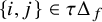 $\{i,j \} \in \tau \Delta _f$
and all
$\{i,j \} \in \tau \Delta _f$
and all $\mathbf {v}_1, \ldots , \mathbf {v}_{d-2}$
in
$\mathbf {v}_1, \ldots , \mathbf {v}_{d-2}$
in $\mathscr {K}_f$
, the polynomial
$\mathscr {K}_f$
, the polynomial
 $$ \begin{align*}(\partial_i\partial_j f)(s_1\mathbf{v}_1+ \cdots+s_{d-2}\mathbf{v}_{d-2})=f^{\{i,j\}} \big(s_1\pi_{\{i,j\}}(\mathbf{v}_1)+\cdots+ s_{d-2}\pi_{\{i,j\}}(\mathbf{v}_{d-2})\big) \end{align*} $$
has positive coefficients. The claim will prove the nonnegativity of the off-diagonal entries of the Hessian in Theorem 2.10 (2). The claim follows by induction as above, since $\pi _{\{i,j\}}(\mathbf {v}_k) \in \mathscr {K}_{f^{\{i,j\}}}$
for each k. By H-connectivity of
$\pi _{\{i,j\}}(\mathbf {v}_k) \in \mathscr {K}_{f^{\{i,j\}}}$
for each k. By H-connectivity of $\tau \Delta _f$
, the Hessian of
$\tau \Delta _f$
, the Hessian of $D_{\mathbf {v}_1}\cdots D_{\mathbf {v}_{d-2}}f$
is irreducible. Condition (3) of Theorem 2.10 follows by induction since
$D_{\mathbf {v}_1}\cdots D_{\mathbf {v}_{d-2}}f$
is irreducible. Condition (3) of Theorem 2.10 follows by induction since $ \partial _i f(\mathbf {t}) = f^{\{i\}} ( \pi _{\{i\}}(\mathbf {t})) $
is
$ \partial _i f(\mathbf {t}) = f^{\{i\}} ( \pi _{\{i\}}(\mathbf {t})) $
is $\mathscr {K}_f$
-Lorentzian for each
$\mathscr {K}_f$
-Lorentzian for each $i \in V$
by Proposition 2.6 and (3.4). Hence sufficiency follows from Theorem 2.10.
$i \in V$
by Proposition 2.6 and (3.4). Hence sufficiency follows from Theorem 2.10.
For the converse, we need to prove that for a weakly hereditary Lorentzian polynomial f, $\tau \Delta _f$
is H-connected. For
$\tau \Delta _f$
is H-connected. For $d=2$
, (C) is obvious, since
$d=2$
, (C) is obvious, since $\tau \Delta _f$
is zero-dimensional. Suppose
$\tau \Delta _f$
is zero-dimensional. Suppose $d\geq 3$
. It suffices to prove that
$d\geq 3$
. It suffices to prove that $ \tau \Delta _f $
is connected. Let
$ \tau \Delta _f $
is connected. Let $\mathbf {v} \in \mathscr {K}_f$
. Then
$\mathbf {v} \in \mathscr {K}_f$
. Then $g=D_{\mathbf {v}}^{d-2}f$
is a
$g=D_{\mathbf {v}}^{d-2}f$
is a $\mathscr {K}_f$
-Lorentzian polynomial. Moreover if
$\mathscr {K}_f$
-Lorentzian polynomial. Moreover if $\{i,j\} \in \tau \Delta _f$
, then
$\{i,j\} \in \tau \Delta _f$
, then
 $$ \begin{align*}\partial_i \partial_j g= D_{\mathbf{v}}^{d-2} \partial_i \partial_j f = (d-2)!f^{\{i,j\}}(\pi_{\{i,j\}}(\mathbf{v}))>0, \end{align*} $$
since $f^{\{i,j\}}$
is
$f^{\{i,j\}}$
is $\pi _{\{i,j\}}(\mathscr {K}_f)$
-Lorentzian. If
$\pi _{\{i,j\}}(\mathscr {K}_f)$
-Lorentzian. If $\tau \Delta _f$
is not connected, then we may write the Hessian of g as a block matrix
$\tau \Delta _f$
is not connected, then we may write the Hessian of g as a block matrix $A\oplus B$
with nonnegative off-diagonal entries, where A has exactly one positive eigenvalue and
$A\oplus B$
with nonnegative off-diagonal entries, where A has exactly one positive eigenvalue and $B=(b_{ij})$
is a negative semidefinite irreducible matrix for which
$B=(b_{ij})$
is a negative semidefinite irreducible matrix for which $b_{ij}>0$
for some
$b_{ij}>0$
for some $\{i,j\} \in \tau \Delta _f$
. By Perron-Frobenius the largest eigenvalue of B is simple. Hence the kernel of B has dimension at most one. Since
$\{i,j\} \in \tau \Delta _f$
. By Perron-Frobenius the largest eigenvalue of B is simple. Hence the kernel of B has dimension at most one. Since $\{i,j\} \in \tau \Delta _f$
and f is weakly hereditary, for each
$\{i,j\} \in \tau \Delta _f$
and f is weakly hereditary, for each $(x, y) \in \mathbb {R}^2$
there exists
$(x, y) \in \mathbb {R}^2$
there exists $\ell \in L_f \subseteq L_g$
such that
$\ell \in L_f \subseteq L_g$
such that $\ell _i=x$
and
$\ell _i=x$
and $\ell _j=y$
. Hence the kernel of B is at least two-dimensional. Hence
$\ell _j=y$
. Hence the kernel of B is at least two-dimensional. Hence $\tau \Delta _f$
is connected.
$\tau \Delta _f$
is connected.
Remark 3.11. If f is positive, then we may replace (C) in Theorem 3.10 with the condition that $\Delta _f$
is H-connected.
$\Delta _f$
is H-connected.
Remark 3.12. We may reformulate Theorem 3.10 as follows. Let f be a weakly hereditary polynomial of degree $d \geq 2$
and suppose
$d \geq 2$
and suppose $\mathscr {K}_f$
is nonempty. Then f is hereditary Lorentzian if and only if
$\mathscr {K}_f$
is nonempty. Then f is hereditary Lorentzian if and only if
-
•
$d=2$
and the Hessian of f has at most one positive eigenvalue, or -
•
$d\geq 3$
and
$\Delta _f$
is connected and
$f^{\{i\}}$
is hereditary Lorentzian for each
$i \in V$
.


Proposition 3.13. Suppose $f \in \mathbb {R}[t_i : i \in V]$
is a weakly hereditary polynomial of degree
$f \in \mathbb {R}[t_i : i \in V]$
is a weakly hereditary polynomial of degree $d \geq 2$
. If
$d \geq 2$
. If $\mathscr {K}$
is a nonempty open convex cone such that
$\mathscr {K}$
is a nonempty open convex cone such that $\pi _S(\mathscr {K})$
is effective and
$\pi _S(\mathscr {K})$
is effective and $f^S$
is
$f^S$
is $\pi _S(\mathscr {K})$
-Lorentzian for all
$\pi _S(\mathscr {K})$
-Lorentzian for all $S \in \tau \Delta _f$
, then
$S \in \tau \Delta _f$
, then $\mathscr {K} \subseteq \mathscr {K}_f$
and f is hereditary Lorentzian.
$\mathscr {K} \subseteq \mathscr {K}_f$
and f is hereditary Lorentzian.
Proof. If $\mathscr {K}$
satisfies the hypothesis in the statement, then so does
$\mathscr {K}$
satisfies the hypothesis in the statement, then so does $\mathscr {K}+L_f$
. Hence we may assume
$\mathscr {K}+L_f$
. Hence we may assume $L_f \subseteq \overline {\mathscr {K}}$
. Since f is weakly hereditary and
$L_f \subseteq \overline {\mathscr {K}}$
. Since f is weakly hereditary and $\mathscr {K}$
is open and nonempty,
$\mathscr {K}$
is open and nonempty, $\pi _S(\mathscr {K})$
is nonempty for all
$\pi _S(\mathscr {K})$
is nonempty for all $S \in \tau \Delta _f$
. By induction we deduce
$S \in \tau \Delta _f$
. By induction we deduce $\pi _S(\mathscr {K}) \subseteq \mathscr {K}_{f^S}$
for all nonempty
$\pi _S(\mathscr {K}) \subseteq \mathscr {K}_{f^S}$
for all nonempty $S \in \tau \Delta _f$
. If
$S \in \tau \Delta _f$
. If $\mathbf {v} \in \mathscr {K}$
, then
$\mathbf {v} \in \mathscr {K}$
, then $\mathbf {v} \in \mathbb {R}_{>0}^V+ L_f$
, since
$\mathbf {v} \in \mathbb {R}_{>0}^V+ L_f$
, since $\mathscr {K}$
is effective. Moreover
$\mathscr {K}$
is effective. Moreover $\pi _{\{i\}}(\mathbf {v}) \in \pi _{\{i\}}(\mathscr {K}) \subseteq \mathscr {K}_{f^{\{i\}}}$
. Hence
$\pi _{\{i\}}(\mathbf {v}) \in \pi _{\{i\}}(\mathscr {K}) \subseteq \mathscr {K}_{f^{\{i\}}}$
. Hence $\mathbf {v} \in \mathscr {K}_f$
by the definition of
$\mathbf {v} \in \mathscr {K}_f$
by the definition of $\mathscr {K}_f$
. As in the proof of Theorem 3.10, (C) follows from that
$\mathscr {K}_f$
. As in the proof of Theorem 3.10, (C) follows from that $f^S$
is
$f^S$
is $\pi _S(\mathscr {K})$
-Lorentzian. Also (Q) holds since the quadratics are
$\pi _S(\mathscr {K})$
-Lorentzian. Also (Q) holds since the quadratics are $\pi _S(\mathscr {K})$
-Lorentzian. Hence the theorem follows from Theorem 3.10.
$\pi _S(\mathscr {K})$
-Lorentzian. Hence the theorem follows from Theorem 3.10.
By Euler’s formula we have the following recursive formula for weakly hereditary polynomials.
 $$ \begin{align} (d-|S|)\cdot f^S(\mathbf{t})= \sum_{i \in V_S}t_i \cdot f^{S \cup\{i\}}(\pi_{\{i\}}^S(\mathbf{t})), \ \ \ S \in \Delta_f. \end{align} $$
Hence a weakly hereditary polynomial is uniquely determined by the numbers $w(S){:=}\partial ^S f$
,
$w(S){:=}\partial ^S f$
, $|S|=d$
. For each facet F of
$|S|=d$
. For each facet F of $\tau \Delta _f$
,
$\tau \Delta _f$
,
 $$ \begin{align*}f^F(\mathbf{t}) = \sum_{i \not \in F} w(F\cup\{i\})t_i, \end{align*} $$
and by construction this linear form is identically zero on $\pi _F(L_f)$
. Theorem 3.15 below shows that this exactly determines when the numbers
$\pi _F(L_f)$
. Theorem 3.15 below shows that this exactly determines when the numbers $w(S)$
determine a (unique) weakly hereditary polynomial.
$w(S)$
determine a (unique) weakly hereditary polynomial.
Lemma 3.14. Suppose $f \in \mathbb {R}[t_1, \ldots , t_n]$
is a homogeneous polynomial of degree d, and that
$f \in \mathbb {R}[t_1, \ldots , t_n]$
is a homogeneous polynomial of degree d, and that $ df = \sum _{i=1}^n t_i Q_i, $
where
$ df = \sum _{i=1}^n t_i Q_i, $
where $Q_1, \ldots , Q_n$
are homogeneous polynomials of degree
$Q_1, \ldots , Q_n$
are homogeneous polynomials of degree $d-1$
for which
$d-1$
for which $ \partial _i Q_j = \partial _j Q_i$
, for all
$ \partial _i Q_j = \partial _j Q_i$
, for all $i,j$
. Then
$i,j$
. Then $Q_i= \partial _i f$
, for all i.
$Q_i= \partial _i f$
, for all i.
Proof. By Euler’s identity,
 $$ \begin{align*} d \partial_j f &= \partial_j(t_jQ_j) -t_j\partial_jQ_j+ \sum_{i=1}^n t_i\partial_jQ_i \\ &= Q_j + \sum_{i=1}^n t_i\partial_iQ_j = Q_j+(d-1)Q_j= dQ_j.\\[-42pt] \end{align*} $$
The next theorem is analogous to Minkowski weights and the balancing condition for Chow rings of simplicial fans, see [Reference Adiprasito, Huh and Katz1, Section 5].
Theorem 3.15. Let $\Delta $
be a pure
$\Delta $
be a pure $(d-1)$
-dimensional simplicial complex on V, let L be a subspace of
$(d-1)$
-dimensional simplicial complex on V, let L be a subspace of $\mathbb {R}^V$
such that
$\mathbb {R}^V$
such that $(\Delta ,L)$
is weakly hereditary, and let w be a real-valued function on the d-element subsets of V which is nonzero precisely on the facets of
$(\Delta ,L)$
is weakly hereditary, and let w be a real-valued function on the d-element subsets of V which is nonzero precisely on the facets of $\Delta $
. Then there is at most one weakly hereditary polynomial f for which
$\Delta $
. Then there is at most one weakly hereditary polynomial f for which
 $$ \begin{align*}\partial^Sf = w(S), \ \ \ \ \text{ for all } |S|=d, \end{align*} $$ $\Delta _f = \Delta $
, and
$\Delta _f = \Delta $
, and $L \subseteq L_f$
.
$L \subseteq L_f$
.
Moreover, this polynomial exists if and only if for each facet F of $\tau \Delta $
, the linear form
$\tau \Delta $
, the linear form
 $$ \begin{align*}\sum_{i \not \in F} w(F\cup\{i\})t_i \end{align*} $$
is identically zero on $L_F$
. If further
$L_F$
. If further $(\Delta ,L)$
is hereditary, then f is hereditary.
$(\Delta ,L)$
is hereditary, then f is hereditary.
Proof. That there is at most one weakly hereditary polynomial with these properties follows from the above discussion, since a weakly hereditary polynomial f is determined by $\partial ^S f$
for all
$\partial ^S f$
for all $S \subset V$
for which
$S \subset V$
for which $|S| = d$
. Further, if such a weakly hereditary polynomial f exists, then for each facet F of
$|S| = d$
. Further, if such a weakly hereditary polynomial f exists, then for each facet F of $\tau \Delta $
,
$\tau \Delta $
,
 $$ \begin{align*}f^F(\mathbf{t}) = \sum_{i \not \in F} w(F\cup\{i\})t_i \end{align*} $$
is identically zero on $\pi _F(L_f) \supseteq \pi _F(L) = L_F$
.
$\pi _F(L_f) \supseteq \pi _F(L) = L_F$
.
It remains to prove that the condition on linear forms is enough to guarantee the existence of the weakly hereditary polynomial f. To this end, we define a family of polynomials $g^S \in \mathbb {R}[t_i : i \in V_S]$
recursively by
$g^S \in \mathbb {R}[t_i : i \in V_S]$
recursively by
 $$ \begin{align} (d-|S|)\cdot g^S(\mathbf{t})= \sum_{i \in V_S}t_i \cdot g^{S\cup\{i\}}(\pi_{\{i\}}^S(\mathbf{t})), \ \ \ S \in \Delta, \end{align} $$
where $ g^F=w(F) $
for each facet F of
$ g^F=w(F) $
for each facet F of $\Delta $
.
$\Delta $
.
We prove by induction over $d-|S|$
that
$d-|S|$
that $g^{S}$
is weakly hereditary and that
$g^{S}$
is weakly hereditary and that $L_S \subseteq L_{g^{S}}$
. The case when
$L_S \subseteq L_{g^{S}}$
. The case when $|S|=d-1$
is clear since then
$|S|=d-1$
is clear since then $L_S {\subseteq } L_{g^{S}}$
by hypothesis. Suppose
$L_S {\subseteq } L_{g^{S}}$
by hypothesis. Suppose $S \in \Delta $
with
$S \in \Delta $
with $|S|< d-1$
, and that
$|S|< d-1$
, and that $g^T$
is weakly hereditary with
$g^T$
is weakly hereditary with $L_{g^T}\supseteq L_T$
for all
$L_{g^T}\supseteq L_T$
for all $T \in \Delta $
of size greater than
$T \in \Delta $
of size greater than $|S|$
. We claim
$|S|$
. We claim $\partial _i g^S(\mathbf {t})= g^{S \cup \{i\}}(\pi ^S_{\{i\}}(\mathbf {t}))$
for each
$\partial _i g^S(\mathbf {t})= g^{S \cup \{i\}}(\pi ^S_{\{i\}}(\mathbf {t}))$
for each $i \in V_S$
. By Lemma 3.14 and Euler’s formula this holds if and only if
$i \in V_S$
. By Lemma 3.14 and Euler’s formula this holds if and only if
 $$ \begin{align*}\partial_j \left(g^{S \cup\{i\}}(\pi_{\{i\}}^S(\mathbf{t}))\right) = \partial_i \left(g^{S \cup\{j\}}(\pi_{\{j\}}^S(\mathbf{t}))\right) \end{align*} $$
for each $\{i,j\} \in \Delta _S$
. For
$\{i,j\} \in \Delta _S$
. For $|S|=d-2$
this is true by hypothesis. For
$|S|=d-2$
this is true by hypothesis. For $|S|<d-2$
, we get by induction
$|S|<d-2$
, we get by induction
 $$ \begin{align*}\partial_j \left(g^{S \cup\{i\}}(\pi_{\{i\}}^S(\mathbf{t}))\right)=g^{S \cup\{i,j\}}(\pi_{\{j\}}^{S\cup\{i\}}\pi_{\{i\}}^S(\mathbf{t})). \end{align*} $$
By the induction hypothesis it follows that $g^{S \cup \{i\}}(\pi _{\{i\}}^S(\mathbf {t}))$
does not depend on the choice of the vector
$g^{S \cup \{i\}}(\pi _{\{i\}}^S(\mathbf {t}))$
does not depend on the choice of the vector $\ell ^{(i)}$
in the definition of
$\ell ^{(i)}$
in the definition of $\pi _{\{i\}}^S$
. Hence we may assume
$\pi _{\{i\}}^S$
. Hence we may assume $\ell ^{(i)}_j=0$
. Then
$\ell ^{(i)}_j=0$
. Then $\pi _{\{j\}}^{S\cup \{i\}}\pi _{\{i\}}^S= \pi _{\{i,j\}}^S$
, and again by induction,
$\pi _{\{j\}}^{S\cup \{i\}}\pi _{\{i\}}^S= \pi _{\{i,j\}}^S$
, and again by induction, $g^{S \cup \{i,j\}}(\pi _{\{i,j\}}^S(\mathbf {t}))$
does not depend on the particular choice of vectors in the definition of
$g^{S \cup \{i,j\}}(\pi _{\{i,j\}}^S(\mathbf {t}))$
does not depend on the particular choice of vectors in the definition of $\pi _{\{i,j\}}^S$
. Hence
$\pi _{\{i,j\}}^S$
. Hence
 $$ \begin{align*}\partial_j \left(g^{S \cup\{i\}}(\pi_{\{i\}}^S(\mathbf{t}))\right) = \partial_i \left(g^{S \cup\{j\}}(\pi_{\{j\}}^S(\mathbf{t}))\right)= g^{S \cup\{i,j\}}(\pi_{\{i,j\}}^S(\mathbf{t})), \end{align*} $$
which proves the claim.
Next we prove $L_S \subseteq L_{g^{S}}$
. Let
$L_S \subseteq L_{g^{S}}$
. Let $\mathbf {y} \in L_S$
and
$\mathbf {y} \in L_S$
and $i \in V_S$
. Since
$i \in V_S$
. Since $\partial _i g^S(\mathbf {t})= g^{S \cup \{i\}}(\pi _{\{i\}}^S(\mathbf {t}))$
for all
$\partial _i g^S(\mathbf {t})= g^{S \cup \{i\}}(\pi _{\{i\}}^S(\mathbf {t}))$
for all $i \in V_S$
, it follows by induction, (3.4), and Euler’s formula that
$i \in V_S$
, it follows by induction, (3.4), and Euler’s formula that
 $$\begin{align*}\partial^\alpha g^S(\mathbf{y}) = \frac{1}{d-|S|-|\alpha|} \sum_{i \in V_S} t_i \cdot \partial^\alpha g^{S \cup \{i\}}(\pi_{\{i\}}^S(\mathbf{y})) = 0 \end{align*}$$
unless $|\alpha |=d-|S|$
. By Taylor expanding
$|\alpha |=d-|S|$
. By Taylor expanding $g^S(\mathbf {t}+\mathbf {y})$
,
$g^S(\mathbf {t}+\mathbf {y})$
,
 $$ \begin{align*}g^S(\mathbf{t}+\mathbf{y}) =\sum_{\alpha} \frac{\partial^\alpha g^S(\mathbf{y})}{\alpha!} \mathbf{t}^\alpha, \end{align*} $$
we see that $g^S(\mathbf {t}+\mathbf {y})=g^S(\mathbf {t})$
as claimed. This finishes the proof of the theorem for the weakly hereditary case by induction. Finally, since
$g^S(\mathbf {t}+\mathbf {y})=g^S(\mathbf {t})$
as claimed. This finishes the proof of the theorem for the weakly hereditary case by induction. Finally, since $L \subseteq L_f$
, if
$L \subseteq L_f$
, if $(\Delta ,L)$
is hereditary, then f is hereditary.
$(\Delta ,L)$
is hereditary, then f is hereditary.
Lemma 3.16. Let $\Delta _1$
and
$\Delta _1$
and $\Delta _2$
be pure simplicial complexes on disjoint sets. Suppose
$\Delta _2$
be pure simplicial complexes on disjoint sets. Suppose $f_1$
is the unique weakly hereditary polynomial corresponding to
$f_1$
is the unique weakly hereditary polynomial corresponding to $(\Delta _1$
,
$(\Delta _1$
, $L_1$
,
$L_1$
, $w_1$
), and
$w_1$
), and $f_2$
is the unique weakly hereditary polynomial corresponding to (
$f_2$
is the unique weakly hereditary polynomial corresponding to ( $\Delta _2$
,
$\Delta _2$
, $L_2$
,
$L_2$
, $w_2$
) (given by Theorem 3.15). If
$w_2$
) (given by Theorem 3.15). If $f_1,f_2$
are hereditary, then
$f_1,f_2$
are hereditary, then $f_1f_2$
is the unique hereditary polynomial corresponding to
$f_1f_2$
is the unique hereditary polynomial corresponding to $(\Delta _1\times \Delta _2$
,
$(\Delta _1\times \Delta _2$
, $L_1\oplus L_2$
,
$L_1\oplus L_2$
, $w_1w_2$
).
$w_1w_2$
).
Proof. The fact that $f_1f_2$
is hereditary follows from
$f_1f_2$
is hereditary follows from $\Delta _{f_1f_2} = \Delta _1 \times \Delta _2$
and
$\Delta _{f_1f_2} = \Delta _1 \times \Delta _2$
and $L_1 \oplus L_2 \subseteq L_{f_1f_2}$
. Further,
$L_1 \oplus L_2 \subseteq L_{f_1f_2}$
. Further, $\partial ^{S_1 \cup S_2} (f_1f_2) = \partial ^{S_1} f_1 \partial ^{S_2} f_2 = w_1(S_1) w_2(S_2)$
for all facets
$\partial ^{S_1 \cup S_2} (f_1f_2) = \partial ^{S_1} f_1 \partial ^{S_2} f_2 = w_1(S_1) w_2(S_2)$
for all facets $S_1 \in \Delta _1$
and
$S_1 \in \Delta _1$
and $S_2 \in \Delta _2$
(and equals 0 otherwise), which shows that
$S_2 \in \Delta _2$
(and equals 0 otherwise), which shows that $f_1f_2$
is a weakly hereditary polynomial corresponding to
$f_1f_2$
is a weakly hereditary polynomial corresponding to $\Delta _1\times \Delta _2$
,
$\Delta _1\times \Delta _2$
, $L_1\oplus L_2$
and
$L_1\oplus L_2$
and $w_1w_2$
. The uniqueness then follows from Theorem 3.15.
$w_1w_2$
. The uniqueness then follows from Theorem 3.15.
Proposition 3.17. Suppose f and g are hereditary polynomials on disjoint sets of variables. If f and g are positive and hereditary Lorentzian, then so is $fg$
.
$fg$
.
Proof. We apply Theorem 3.10. Clearly $\Delta _{fg}= \Delta _f \times \Delta _g$
,
$\Delta _{fg}= \Delta _f \times \Delta _g$
, $L_{fg}=L_f \oplus L_g$
and
$L_{fg}=L_f \oplus L_g$
and $\mathscr {K}_{fg}=\mathscr {K}_f \times \mathscr {K}_g$
. Hence
$\mathscr {K}_{fg}=\mathscr {K}_f \times \mathscr {K}_g$
. Hence $fg$
is hereditary and
$fg$
is hereditary and $\mathscr {K}_{fg}$
is nonempty. The Cartesian product of two nonempty simplicial complexes is automatically connected. Hence, the H-connectedness of
$\mathscr {K}_{fg}$
is nonempty. The Cartesian product of two nonempty simplicial complexes is automatically connected. Hence, the H-connectedness of $\Delta _{fg}$
follows from the H-connectedness of
$\Delta _{fg}$
follows from the H-connectedness of $\Delta _f$
and
$\Delta _f$
and $\Delta _g$
. This verifies (C).
$\Delta _g$
. This verifies (C).
The quadratics of $fg$
appearing in (Q) are either products of two linear polynomials with positive coefficients, or are positive constants times the quadratics appearing in (Q) for f or g. This verifies (Q) for
$fg$
appearing in (Q) are either products of two linear polynomials with positive coefficients, or are positive constants times the quadratics appearing in (Q) for f or g. This verifies (Q) for $fg$
.
$fg$
.
4 Volume polynomials of matroids
In [Reference Adiprasito, Huh and Katz1], Adiprasito, Huh and Katz proved that the Chow ring of a matroid satisfies the Kähler package. As a consequence the volume polynomial of a matroid is Lorentzian with respect to the cone of strictly submodular elements. A simplified proof of this consequence using Hodge theory and Lorentzian polynomials was proved in [Reference Backman, Eur and Simpson8]. We will now give a self-contained proof of this fact based on the theory developed in Section 3. This leads to an elementary proof of the Heron-Rota-Welsh conjecture first proved in [Reference Adiprasito, Huh and Katz1].
Let $\mathscr {L}$
be the lattice of flats of a matroid of rank
$\mathscr {L}$
be the lattice of flats of a matroid of rank $r(\mathscr {L})$
on a finite set E, that is,
$r(\mathscr {L})$
on a finite set E, that is, $\mathscr {L}$
is a collection of subsets of E, ordered by inclusion, satisfying
$\mathscr {L}$
is a collection of subsets of E, ordered by inclusion, satisfying
-
• if
$F,G \in \mathscr {L}$
, then
$F \cap G \in \mathscr {L}$
, and -
• for each F in
$\mathscr {L}$
,
$\{G\setminus F\}_{F \prec G}$
partitions
$E \setminus F$
.Footnote
4


The order complex, $\Delta (\mathscr {L})$
, of
$\Delta (\mathscr {L})$
, of $\mathscr {L}$
is the simplicial complex of all chains (totally ordered subsets) of
$\mathscr {L}$
is the simplicial complex of all chains (totally ordered subsets) of $\underline {\mathscr {L}}=\mathscr {L}\setminus \{K, E\}$
, where K denotes the smallest element in
$\underline {\mathscr {L}}=\mathscr {L}\setminus \{K, E\}$
, where K denotes the smallest element in $\mathscr {L}$
, that is, the set of loops of the matroid. Let further
$\mathscr {L}$
, that is, the set of loops of the matroid. Let further $L(\mathscr {L})$
be the linear subspace of
$L(\mathscr {L})$
be the linear subspace of $\mathbb {R}^{\underline {\mathscr {L}}}$
consisting of all modular
$\mathbb {R}^{\underline {\mathscr {L}}}$
consisting of all modular $(y_F)_{F \in \underline {\mathscr {L}}}$
, that is, there exists real numbers
$(y_F)_{F \in \underline {\mathscr {L}}}$
, that is, there exists real numbers $c_i$
,
$c_i$
, $i \in E \setminus K$
, such that for each
$i \in E \setminus K$
, such that for each $F \in \underline {\mathscr {L}}$
,
$F \in \underline {\mathscr {L}}$
,
 $$ \begin{align*}y_F= \sum_{i \in F \setminus K}c_i \ \ \ \text{ and } \ \ \ \sum_{i \in E \setminus K}c_i=0. \end{align*} $$
We shall apply Theorem 3.15 with $\Delta (\mathscr {L})$
,
$\Delta (\mathscr {L})$
, $L(\mathscr {L})$
and
$L(\mathscr {L})$
and $w(F)=1$
for all facets F of
$w(F)=1$
for all facets F of $\Delta (\mathscr {L})$
, to construct a hereditary polynomial
$\Delta (\mathscr {L})$
, to construct a hereditary polynomial $\operatorname {\mathrm {pol}}_{\mathscr {L}} \in \mathbb {R}[t_G : G \in \underline {\mathscr {L}}]$
. To this end, we first show that
$\operatorname {\mathrm {pol}}_{\mathscr {L}} \in \mathbb {R}[t_G : G \in \underline {\mathscr {L}}]$
. To this end, we first show that $(\Delta (\mathscr {L}),L(\mathscr {L}))$
is hereditary. Given a chain of flats
$(\Delta (\mathscr {L}),L(\mathscr {L}))$
is hereditary. Given a chain of flats
 $$\begin{align*}K= F_0 < F_1 < F_2 < \cdots < F_m < F_{m+1}=E, \end{align*}$$
and a vector $(x_j)_{j=1}^m \in \mathbb {R}^m$
, we want to find a vector
$(x_j)_{j=1}^m \in \mathbb {R}^m$
, we want to find a vector $(c_i)_{i \in E \setminus K}$
such that
$(c_i)_{i \in E \setminus K}$
such that
 $$ \begin{align*}x_j= \sum_{i \in F_j\setminus F_0}c_i, \ \ \ 1\leq j \leq m, \ \ \text{ and } \sum_{i \in E\setminus K}c_i=0. \end{align*} $$
Clearly this can be done since $F_0 \subset F_1 \subset F_2 \subset \cdots \subset F_m \subset F_{m+1}$
.
$F_0 \subset F_1 \subset F_2 \subset \cdots \subset F_m \subset F_{m+1}$
.
Next define $w(S) = 1$
for all facets
$w(S) = 1$
for all facets $S \in \Delta (\mathscr {L})$
. Let
$S \in \Delta (\mathscr {L})$
. Let $S=\{F_1,\ldots , F_m\}$
be a facet of
$S=\{F_1,\ldots , F_m\}$
be a facet of $\tau \Delta (\mathscr {L})$
, that is,
$\tau \Delta (\mathscr {L})$
, that is, $F_j \prec F_{j+1}$
for all j except for exactly one value
$F_j \prec F_{j+1}$
for all j except for exactly one value $0\leq k\leq m$
. Then
$0\leq k\leq m$
. Then
 $$\begin{align*}\sum_{G \not\in S} w(S \cup \{G\}) t_G = \sum_{F_k \prec G \prec F_{k+1}} t_G. \end{align*}$$
Since the interval $[F_k,F_{k+1}]$
is the lattice of flats of a rank-two matroid, we have that
$[F_k,F_{k+1}]$
is the lattice of flats of a rank-two matroid, we have that $V_S = \{G: F_k \prec G \prec F_{k+1}\}$
partitions
$V_S = \{G: F_k \prec G \prec F_{k+1}\}$
partitions $F_{k+1} \setminus F_k$
. Thus for any
$F_{k+1} \setminus F_k$
. Thus for any $\mathbf {y} \in L(\mathscr {L})_S$
,
$\mathbf {y} \in L(\mathscr {L})_S$
,
 $$\begin{align*}\sum_{F_k \prec G \prec F_{k+1}} y_G = \sum_{i \in F_{k+1} \setminus F_k} c_i = \sum_{i \in F_{k+1}} c_i - \sum_{i \in F_k} c_i = 0, \end{align*}$$
by the definition of $L(\mathscr {L})_S$
. Therefore Theorem 3.15 applies, so that there is a unique hereditary polynomial
$L(\mathscr {L})_S$
. Therefore Theorem 3.15 applies, so that there is a unique hereditary polynomial $\operatorname {\mathrm {pol}}_{\mathscr {L}}$
of degree
$\operatorname {\mathrm {pol}}_{\mathscr {L}}$
of degree $d(\mathscr {L}) = r(\mathscr {L})-1$
satisfying
$d(\mathscr {L}) = r(\mathscr {L})-1$
satisfying $\Delta _{\operatorname {\mathrm {pol}}_{\mathscr {L}}} = \Delta (\mathscr {L})$
,
$\Delta _{\operatorname {\mathrm {pol}}_{\mathscr {L}}} = \Delta (\mathscr {L})$
, $L(\mathscr {L}) \subseteq L_{\operatorname {\mathrm {pol}}_{\mathscr {L}}}$
, and
$L(\mathscr {L}) \subseteq L_{\operatorname {\mathrm {pol}}_{\mathscr {L}}}$
, and $\partial ^S \operatorname {\mathrm {pol}}_{\mathscr {L}} = 1$
for all facets S of
$\partial ^S \operatorname {\mathrm {pol}}_{\mathscr {L}} = 1$
for all facets S of $\Delta (\mathscr {L})$
. Notice that
$\Delta (\mathscr {L})$
. Notice that $\operatorname {\mathrm {pol}}_{\mathscr {L}}$
is positive.
$\operatorname {\mathrm {pol}}_{\mathscr {L}}$
is positive.
Further, for all $S=\{F_1,\ldots , F_m\} \in \Delta (\mathscr {L})$
,
$S=\{F_1,\ldots , F_m\} \in \Delta (\mathscr {L})$
,
 $$ \begin{align} \Delta_{\operatorname{\mathrm{pol}}_{\mathscr{L}}^S} = \operatorname{\mathrm{lk}}_{\Delta(\mathscr{L})}(S) = \prod_{i=0}^m \Delta([F_i,F_{i+1}]) \ \text{ and } \ \operatorname{\mathrm{pol}}_{\mathscr{L}}^S(\mathbf{t}) = \prod_{i=0}^m \operatorname{\mathrm{pol}}_{[F_i,F_{i+1}]}(\mathbf{t}), \end{align} $$
by Lemma 3.16.
Example 4.1. When $d(\mathscr {L})=r(\mathscr {L})-1=1$
, it is clear from Theorem 3.15 that
$d(\mathscr {L})=r(\mathscr {L})-1=1$
, it is clear from Theorem 3.15 that
 $$\begin{align*}\operatorname{\mathrm{pol}}_{\mathscr{L}}(\mathbf{t}) = \sum_{F \in \underline{\mathscr{L}}} t_F. \end{align*}$$
When $d(\mathscr {L})=2$
, we claim that
$d(\mathscr {L})=2$
, we claim that
 $$ \begin{align*}2 \cdot \operatorname{\mathrm{pol}}_{\mathscr{L}}(\mathbf{t}) = \left(\sum_{F}t_F\right)^2- \sum_{G} \left(t_G-\sum_{F<G}t_F\right)^2, \end{align*} $$
where F denotes the flats of rank one, and G denotes the flats of rank two. Since the set of rank one flats partitions $E\setminus K$
, it follows that
$E\setminus K$
, it follows that $L(\mathscr {L})$
is contained in the lineality space of the polynomial, f, on the right-hand side. Moreover
$L(\mathscr {L})$
is contained in the lineality space of the polynomial, f, on the right-hand side. Moreover $\Delta _f= \Delta (\mathscr {L})$
. Also the coefficients in front of the linear terms
$\Delta _f= \Delta (\mathscr {L})$
. Also the coefficients in front of the linear terms $t_Ft_G$
of f are all equal to two. Hence the claim follows from Theorem 3.15.
$t_Ft_G$
of f are all equal to two. Hence the claim follows from Theorem 3.15.
Given a matroid on E with lattice of flats $\mathscr {L}$
, a vector
$\mathscr {L}$
, a vector $(y_S)_{K \subseteq S \subseteq E}$
of real numbers is called strictly submodular if
$(y_S)_{K \subseteq S \subseteq E}$
of real numbers is called strictly submodular if $y_K = y_E = 0$
and
$y_K = y_E = 0$
and
 $$\begin{align*}y_S + y_T> y_{S \cap T} + y_{S \cup T} \end{align*}$$
for all incomparable sets S and T. Notice that S in $(y_S)_{K \subseteq S \subseteq E}$
runs over all subsets of E which contain K, not just flats. We denote by
$(y_S)_{K \subseteq S \subseteq E}$
runs over all subsets of E which contain K, not just flats. We denote by $\mathscr {S}_{\mathscr {L}}$
the open convex cone in
$\mathscr {S}_{\mathscr {L}}$
the open convex cone in $\mathbb {R}^{\underline {\mathscr {L}}}$
obtained by restricting strictly submodular vectors to the entries which are labelled by flats in
$\mathbb {R}^{\underline {\mathscr {L}}}$
obtained by restricting strictly submodular vectors to the entries which are labelled by flats in $\underline {\mathscr {L}}$
, that is,
$\underline {\mathscr {L}}$
, that is, $(y_F)_{F \in \underline {\mathscr {L}}}$
. Notice that
$(y_F)_{F \in \underline {\mathscr {L}}}$
. Notice that $L(\mathscr {L})$
is the lineality space of
$L(\mathscr {L})$
is the lineality space of $\mathscr {S}_{\mathscr {L}}$
.
$\mathscr {S}_{\mathscr {L}}$
.
Lemma 4.2. $\mathscr {S}_{\mathscr {L}} \subseteq \mathscr {K}_{\operatorname {\mathrm {pol}}_{\mathscr {L}}}$
.
$\mathscr {S}_{\mathscr {L}} \subseteq \mathscr {K}_{\operatorname {\mathrm {pol}}_{\mathscr {L}}}$
.
Proof. We first prove that $\mathscr {S}_{\mathscr {L}}$
is effective. Notice that
$\mathscr {S}_{\mathscr {L}}$
is effective. Notice that $\mathbf {v} = (|F \setminus K| \cdot |E \setminus F|)_{K < F < E}$
is a vector in
$\mathbf {v} = (|F \setminus K| \cdot |E \setminus F|)_{K < F < E}$
is a vector in $\mathscr {S}_{\mathscr {L}}$
with positive entries. Suppose
$\mathscr {S}_{\mathscr {L}}$
with positive entries. Suppose $\mathbf {y} \in \mathscr {S}_{\mathscr {L}}$
. Then
$\mathbf {y} \in \mathscr {S}_{\mathscr {L}}$
. Then $\mathbf {z} := \mathbf {y} - \epsilon \mathbf {v} \in \mathscr {S}_{\mathscr {L}}$
for
$\mathbf {z} := \mathbf {y} - \epsilon \mathbf {v} \in \mathscr {S}_{\mathscr {L}}$
for $\epsilon> 0$
sufficiently small. By, for example, [Reference Murota25, Prop. 4.4], there exists
$\epsilon> 0$
sufficiently small. By, for example, [Reference Murota25, Prop. 4.4], there exists $\mathbf {w} \in L(\mathscr {L})$
such that
$\mathbf {w} \in L(\mathscr {L})$
such that $\mathbf {z} + \mathbf {w} \in \mathbb {R}_{\geq 0}^{\underline {\mathscr {L}}}$
. Thus
$\mathbf {z} + \mathbf {w} \in \mathbb {R}_{\geq 0}^{\underline {\mathscr {L}}}$
. Thus $\mathbf {y} + \mathbf {w} = \mathbf {z} + \mathbf {w} + \epsilon \mathbf {v} \in \mathbb {R}_{> 0}^{\underline {\mathscr {L}}}$
as desired.
$\mathbf {y} + \mathbf {w} = \mathbf {z} + \mathbf {w} + \epsilon \mathbf {v} \in \mathbb {R}_{> 0}^{\underline {\mathscr {L}}}$
as desired.
We now prove $\mathscr {S}_{\mathscr {L}} \subseteq \mathscr {K}_{\operatorname {\mathrm {pol}}_{\mathscr {L}}}$
by induction on the degree of
$\mathscr {S}_{\mathscr {L}} \subseteq \mathscr {K}_{\operatorname {\mathrm {pol}}_{\mathscr {L}}}$
by induction on the degree of $\operatorname {\mathrm {pol}}_{\mathscr {L}}$
, where
$\operatorname {\mathrm {pol}}_{\mathscr {L}}$
, where $\mathscr {L} = [K, E]$
. First, the inclusion is clear when
$\mathscr {L} = [K, E]$
. First, the inclusion is clear when $\operatorname {\mathrm {pol}}_{\mathscr {L}}$
is linear. To complete the proof, we need to prove
$\operatorname {\mathrm {pol}}_{\mathscr {L}}$
is linear. To complete the proof, we need to prove
 $$ \begin{align*}\pi_{\{F\}}(\mathbf{y}) \in \mathscr{K}_{\operatorname{\mathrm{pol}}_{\mathscr{L}}^{\{F\}}},\end{align*} $$
for all $F \in \underline {\mathscr {L}}$
and
$F \in \underline {\mathscr {L}}$
and $\mathbf {y} \in \mathscr {S}_{\mathscr {L}}$
. Recall that
$\mathbf {y} \in \mathscr {S}_{\mathscr {L}}$
. Recall that $\operatorname {\mathrm {pol}}_{\mathscr {L}}^{\{F\}} = \operatorname {\mathrm {pol}}_{[K,F]} \cdot \operatorname {\mathrm {pol}}_{[F,E]}$
. Further,
$\operatorname {\mathrm {pol}}_{\mathscr {L}}^{\{F\}} = \operatorname {\mathrm {pol}}_{[K,F]} \cdot \operatorname {\mathrm {pol}}_{[F,E]}$
. Further, $\pi _{\{F\}}(\mathbf {y}) \in \mathscr {S}_{[K,F]} \oplus \mathscr {S}_{[F,E]}$
by the definition of
$\pi _{\{F\}}(\mathbf {y}) \in \mathscr {S}_{[K,F]} \oplus \mathscr {S}_{[F,E]}$
by the definition of $\pi _{\{F\}}$
, since the vectors in
$\pi _{\{F\}}$
, since the vectors in $L(\mathscr {L})$
are modular. Thus by induction
$L(\mathscr {L})$
are modular. Thus by induction $\pi _{\{F\}}(\mathbf {y}) \in \mathscr {S}_{[K,F]} \oplus \mathscr {S}_{[F,E]} \subseteq \mathscr {K}_{\operatorname {\mathrm {pol}}_{[K,F]}} \oplus \mathscr {K}_{\operatorname {\mathrm {pol}}_{[F,E]}} = \mathscr {K}_{\operatorname {\mathrm {pol}}_{\mathscr {L}}^{\{F\}}}$
, as desired.
$\pi _{\{F\}}(\mathbf {y}) \in \mathscr {S}_{[K,F]} \oplus \mathscr {S}_{[F,E]} \subseteq \mathscr {K}_{\operatorname {\mathrm {pol}}_{[K,F]}} \oplus \mathscr {K}_{\operatorname {\mathrm {pol}}_{[F,E]}} = \mathscr {K}_{\operatorname {\mathrm {pol}}_{\mathscr {L}}^{\{F\}}}$
, as desired.
Theorem 4.3. If $\mathscr {L}$
is the lattice of flats of a matroid, then the polynomial
$\mathscr {L}$
is the lattice of flats of a matroid, then the polynomial $\operatorname {\mathrm {pol}}_{\mathscr {L}}$
is hereditary Lorentzian.
$\operatorname {\mathrm {pol}}_{\mathscr {L}}$
is hereditary Lorentzian.
Proof. By Lemma 4.2, $\mathscr {K}_{\operatorname {\mathrm {pol}}_{\mathscr {L}}}$
is nonempty. By Remark 3.12, Proposition 3.17, (4.1) and induction on the rank of
$\mathscr {K}_{\operatorname {\mathrm {pol}}_{\mathscr {L}}}$
is nonempty. By Remark 3.12, Proposition 3.17, (4.1) and induction on the rank of $\mathscr {L}$
, it suffices to prove that
$\mathscr {L}$
, it suffices to prove that $\Delta (\mathscr {L})$
is connected for any
$\Delta (\mathscr {L})$
is connected for any $\mathscr {L}$
, and that the Hessian of
$\mathscr {L}$
, and that the Hessian of $\operatorname {\mathrm {pol}}_{\mathscr {L}}(\mathbf {t})$
has at most one positive eigenvalue whenever the rank of
$\operatorname {\mathrm {pol}}_{\mathscr {L}}(\mathbf {t})$
has at most one positive eigenvalue whenever the rank of $\mathscr {L}$
is three. The latter follows immediately from Example 4.1.
$\mathscr {L}$
is three. The latter follows immediately from Example 4.1.
Recall that lattices of flats of matroids are graded and semimodular, see [Reference Oxley26, Chapter 1.7]. Also, by [Reference Stanley30, Prop. 3.3.2] a finite lattice $\mathscr {L}$
is semimodular if and only if for all
$\mathscr {L}$
is semimodular if and only if for all $a,b \in \mathscr {L}$
,
$a,b \in \mathscr {L}$
,
 $$\begin{align*}\text{if } a \text{ and } b \text{ cover } a \wedge b, \text{ then } a \vee b \text{ covers } a \text{ and } b. \end{align*}$$
Connectedness of $\Delta (\mathscr {L})$
now follows from semimodularity.
$\Delta (\mathscr {L})$
now follows from semimodularity.
4.1 Heron-Rota-Welsh conjecture
The characteristic polynomial of a matroid $\mathrm {M}$
with lattice of flats
$\mathrm {M}$
with lattice of flats $\mathscr {L} = [K,E]$
is
$\mathscr {L} = [K,E]$
is
 $$ \begin{align} \chi_{\mathrm{M}}(t) = \sum_{F \in \mathscr{L}} \mu(K, F) t^{r([F,E])}, \end{align} $$
where $\mu $
is the Möbius function of
$\mu $
is the Möbius function of $\mathscr {L}$
, see [Reference Stanley30, Section 3.7]. If
$\mathscr {L}$
, see [Reference Stanley30, Section 3.7]. If $\mathrm {M}$
has rank at least one, then
$\mathrm {M}$
has rank at least one, then $\chi _{\mathrm {M}}(t)$
is divisible by
$\chi _{\mathrm {M}}(t)$
is divisible by $t-1$
, see [Reference White33, Section 7]. The reduced characteristic polynomial of a matroid
$t-1$
, see [Reference White33, Section 7]. The reduced characteristic polynomial of a matroid $\mathrm {M}$
is then
$\mathrm {M}$
is then $ \overline {\chi }_{\mathrm {M}}(t) = {\chi _{\mathrm {M}}(t)}/(t-1) $
. The next theorem, which was first proved by Adiprasito, Huh and Katz [Reference Adiprasito, Huh and Katz1], solved the Heron-Rota-Welsh conjecture. For completeness we provide an alternative proof below based on our approach.
$ \overline {\chi }_{\mathrm {M}}(t) = {\chi _{\mathrm {M}}(t)}/(t-1) $
. The next theorem, which was first proved by Adiprasito, Huh and Katz [Reference Adiprasito, Huh and Katz1], solved the Heron-Rota-Welsh conjecture. For completeness we provide an alternative proof below based on our approach.
Theorem 4.4 [Reference Adiprasito, Huh and Katz1].
The absolute values of the coefficients of the reduced characteristic polynomial of a matroid form a log-concave sequence.
Consider the following two elements in the closure of $\mathscr {S}_{\mathscr {L}}$
 $$ \begin{align*}\alpha_{\mathscr{L}}= \left(\frac {|F\setminus K|}{|E\setminus K|} \right)_{K < F < E} \text{ and } \ \ \beta_{\mathscr{L}} = \left( \frac {|E\setminus F|}{|E\setminus K| } \right)_{K < F < E}. \end{align*} $$
For those familiar with the techniques of [Reference Adiprasito, Huh and Katz1], we point out that the polynomial $\operatorname {\mathrm {pol}}_{\mathscr {L}}$
is the volume polynomial of the Chow ring of the matroid associated to the geometric lattice
$\operatorname {\mathrm {pol}}_{\mathscr {L}}$
is the volume polynomial of the Chow ring of the matroid associated to the geometric lattice $\mathscr {L}$
(see [Reference Brändén and Leake15, Sec. 5]), and the elements
$\mathscr {L}$
(see [Reference Brändén and Leake15, Sec. 5]), and the elements $\alpha _{\mathscr {L}}$
and
$\alpha _{\mathscr {L}}$
and $\beta _{\mathscr {L}}$
of the closure of
$\beta _{\mathscr {L}}$
of the closure of $\mathscr {S}_{\mathscr {L}}$
correspond to the classes
$\mathscr {S}_{\mathscr {L}}$
correspond to the classes $\alpha $
and
$\alpha $
and $\beta $
as defined in [Reference Adiprasito, Huh and Katz1].
$\beta $
as defined in [Reference Adiprasito, Huh and Katz1].
Throughout this section we fix an element $i \in E\setminus K$
, and let
$i \in E\setminus K$
, and let $\alpha _{\mathscr {L},i}=(a_F)_{K < F < E}$
and
$\alpha _{\mathscr {L},i}=(a_F)_{K < F < E}$
and $\beta _{\mathscr {L},i}=(b_F)_{K < F < E}$
be the
$\beta _{\mathscr {L},i}=(b_F)_{K < F < E}$
be the $0/1$
-valued vectors defined by
$0/1$
-valued vectors defined by $a_F=1$
if and only if
$a_F=1$
if and only if $i \in F$
and
$i \in F$
and $b_F=1$
if and only if
$b_F=1$
if and only if $i \not \in F$
. Then
$i \not \in F$
. Then
 $$ \begin{align} \alpha_{\mathscr{L}}-\alpha_{\mathscr{L},i} \in L(\mathscr{L}) \ \ \text{ and } \ \ \beta_{\mathscr{L}}-\beta_{\mathscr{L},i} \in L(\mathscr{L}), \end{align} $$
for all $i \in E \setminus K$
.
$i \in E \setminus K$
.
The elements $\alpha _{\mathscr {L}}$
and
$\alpha _{\mathscr {L}}$
and $\beta _{\mathscr {L}}$
behave well under the projections
$\beta _{\mathscr {L}}$
behave well under the projections $\pi _S$
. We leave the proof to the reader.
$\pi _S$
. We leave the proof to the reader.
Lemma 4.5. If $\mathscr {L} = [K,E]$
and
$\mathscr {L} = [K,E]$
and $K<F<E$
, then
$K<F<E$
, then
 $$\begin{align*}\pi_{\{F\}}(\alpha_{\mathscr{L}}) = (0, \alpha_{[F,E]}) \ \ \ \text{and} \ \ \ \pi_{\{F\}}(\beta_{\mathscr{L}}) = (\beta_{[K,F]}, 0). \end{align*}$$
Recall that $d(\mathscr {L})$
denotes the degree of the polynomial
$d(\mathscr {L})$
denotes the degree of the polynomial $\operatorname {\mathrm {pol}}_{\mathscr {L}}$
and
$\operatorname {\mathrm {pol}}_{\mathscr {L}}$
and $r(\mathscr {L})$
denotes the rank of
$r(\mathscr {L})$
denotes the rank of $\mathscr {L}$
, so that
$\mathscr {L}$
, so that $d(\mathscr {L}) = r(\mathscr {L}) - 1$
.
$d(\mathscr {L}) = r(\mathscr {L}) - 1$
.
Lemma 4.6. If $\mathscr {L} = [K,E]$
is the lattice of flats of a matroid, then
$\mathscr {L} = [K,E]$
is the lattice of flats of a matroid, then
 $$ \begin{align*}\operatorname{\mathrm{pol}}_{\mathscr{L}}(\alpha_{\mathscr{L}}) = \frac 1 {d(\mathscr{L})!}. \end{align*} $$
Proof. Since $\{ A\setminus K\}_{K\prec A \leq E}$
partitions
$\{ A\setminus K\}_{K\prec A \leq E}$
partitions $E \setminus K$
, there is a unique
$E \setminus K$
, there is a unique $H \in \underline {\mathscr {L}}$
containing i for which
$H \in \underline {\mathscr {L}}$
containing i for which $K \prec H < E$
. By Euler’s formula and (4.3),
$K \prec H < E$
. By Euler’s formula and (4.3),
 $$ \begin{align*}d(\mathscr{L}) \cdot \operatorname{\mathrm{pol}}_{\mathscr{L}}(\alpha_{\mathscr{L}})= d(\mathscr{L}) \cdot \operatorname{\mathrm{pol}}_{\mathscr{L}}(\alpha_{\mathscr{L},i})= \sum_{H\leq F < E} \partial_{t_F} \operatorname{\mathrm{pol}}_{\mathscr{L}}(\alpha_{\mathscr{L},i}). \end{align*} $$
By (4.3) and (3.3) the latter sum may be written as
 $$ \begin{align*}\sum_{H\leq F < E}\operatorname{\mathrm{pol}}_{\mathscr{L}}^{\{F\}}(\pi_{\{F\}}(\alpha_{\mathscr{L}})), \end{align*} $$
and by (4.1) and Lemma 4.5, this sum may be expressed as
 $$ \begin{align*}\sum_{H\leq F < E} \operatorname{\mathrm{pol}}_{[K,F]} ( 0)\cdot \operatorname{\mathrm{pol}}_{[F,E]} (\alpha_{[F,E]}) = \operatorname{\mathrm{pol}}_{[H,E]}(\alpha_{[H,E]}), \end{align*} $$
since $\operatorname {\mathrm {pol}}_{[K,F]} (0)=0$
unless F is an atom, and then
$\operatorname {\mathrm {pol}}_{[K,F]} (0)=0$
unless F is an atom, and then $\operatorname {\mathrm {pol}}_{[K,F]} (0)=1$
. The lemma now follows by induction over
$\operatorname {\mathrm {pol}}_{[K,F]} (0)=1$
. The lemma now follows by induction over $d(\mathscr {L})$
.
$d(\mathscr {L})$
.
The next theorem is usually stated as a consequence of Weisner’s theorem, see [Reference Stanley30, p. 277].
Theorem 4.7 (Weisner’s theorem).
If $x\prec a \leq y$
are elements in a semimodular lattice L, then
$x\prec a \leq y$
are elements in a semimodular lattice L, then $ \mu (x,y) = -\sum _b\mu (x,b) $
where the sum is over all
$ \mu (x,y) = -\sum _b\mu (x,b) $
where the sum is over all $b \in L$
for which
$b \in L$
for which $x\leq b\prec y$
and
$x\leq b\prec y$
and $a \not \leq b$
.
$a \not \leq b$
.
A consequence of Weisner’s theorem is that the Möbius function of a semimodular lattice $\mathscr {L}$
alternates in sign, that is,
$\mathscr {L}$
alternates in sign, that is, $(-1)^{\rho (b)-\rho (a)} \mu (a,b) \geq 0$
, where
$(-1)^{\rho (b)-\rho (a)} \mu (a,b) \geq 0$
, where $\rho $
is the rank function of
$\rho $
is the rank function of $\mathscr {L}$
.
$\mathscr {L}$
.
Lemma 4.8. If $\mathscr {L} = [K,E]$
is the lattice of flats of a matroid, then
$\mathscr {L} = [K,E]$
is the lattice of flats of a matroid, then
 $$ \begin{align*}\operatorname{\mathrm{pol}}_{\mathscr{L}}(\beta_{\mathscr{L}})= \frac {|\mu(K,E)|}{d(\mathscr{L})!}. \end{align*} $$
Proof. By (4.1), (4.3), and Lemma 4.5,
 $$ \begin{align*}d(\mathscr{L}) \cdot \operatorname{\mathrm{pol}}_{\mathscr{L}}(\beta_{\mathscr{L}})= \sum_{K<F<E} b_F \cdot \operatorname{\mathrm{pol}}_{[K,F]}(\beta_{[K,F]}) \cdot \operatorname{\mathrm{pol}}_{[F,E]}(0)= \sum_{\stackrel{K< F \prec E}{F \not \ni i}} \operatorname{\mathrm{pol}}_{[K,F]}(\beta_{[K,F]}). \end{align*} $$
The lemma then follows by induction and Weisner’s theorem.
Theorem 4.9. Suppose $\mathscr {L} = [K,E]$
is the lattice of flats of a matroid. Then
$\mathscr {L} = [K,E]$
is the lattice of flats of a matroid. Then
 $$ \begin{align*}d(\mathscr{L})! \cdot \operatorname{\mathrm{pol}}_{\mathscr{L}}(s\alpha_{\mathscr{L}} +t\beta_{\mathscr{L}}) = \sum_{\stackrel {K \leq F < E} {i \not \in F}} \binom {d(\mathscr{L})}{r([K,F])} \cdot |\mu(K,F)| \cdot t^{r([K,F])} s^{d([F,E])}. \end{align*} $$
Proof. Let $f(t)= \operatorname {\mathrm {pol}}_{\mathscr {L}}(s\alpha _{\mathscr {L}} +t\beta _{\mathscr {L}})$
. Then
$f(t)= \operatorname {\mathrm {pol}}_{\mathscr {L}}(s\alpha _{\mathscr {L}} +t\beta _{\mathscr {L}})$
. Then
 $$ \begin{align*}f'(t) = D_{\beta_{\mathscr{L}}}\operatorname{\mathrm{pol}}_{\mathscr{L}}(s\alpha_{\mathscr{L}} +t\beta_{\mathscr{L}})= \sum_{\stackrel {K < F < E} {i \not \in F}} \operatorname{\mathrm{pol}}_{\mathscr{L}} (s \pi_{\{F\}}(\alpha_{\mathscr{L}}) +t\pi_{\{F\}}(\beta_{\mathscr{L}})). \end{align*} $$
 $$\begin{align*}f'(t) = \sum_{\stackrel {K < F < E} {i \not \in F}} \operatorname{\mathrm{pol}}_{[K,F]}(\beta_{[K,F]}) \cdot \operatorname{\mathrm{pol}}_{[F,E]}(\alpha_{[F,E]}) \cdot t^{d([K,F])} s^{d([F,E])}. \end{align*}$$
 $$ \begin{align*}f'(t)= \sum_{\stackrel {K < F < E} {i \not \in F}} |\mu(K,F)| \cdot \frac {t^{d([K,F])}} {d([K,F])!} \cdot \frac {s^{d([F,E])}}{d([F,E])!}. \end{align*} $$
The lemma follows since $ f(0)= s^{d(\mathscr {L})} /{d(\mathscr {L})!} $
, by Lemma 4.6.
$ f(0)= s^{d(\mathscr {L})} /{d(\mathscr {L})!} $
, by Lemma 4.6.
Lemma 4.10 (Cor. 7.27, [Reference White33]).
Suppose $\mathscr {L} = [K,E]$
is the lattice of flats of a matroid
$\mathscr {L} = [K,E]$
is the lattice of flats of a matroid $\mathrm {M}$
. Then
$\mathrm {M}$
. Then
 $$ \begin{align} \overline{\chi}_{\mathrm{M}}(t) = \sum_{F \not \ni i} \mu(K,F) t^{d([F,E])}. \end{align} $$
Proof of Theorem 4.4.
If $\alpha =\alpha _{\mathscr {L}}$
,
$\alpha =\alpha _{\mathscr {L}}$
, $\beta =\beta _{\mathscr {L}}$
and
$\beta =\beta _{\mathscr {L}}$
and $d=d(\mathscr {L})$
, then
$d=d(\mathscr {L})$
, then
 $$ \begin{align*}d! \cdot \operatorname{\mathrm{pol}}_{\mathscr{L}}(s\alpha_{\mathscr{L}} +t\beta_{\mathscr{L}})= (sD_{\alpha}+tD_{\beta})^d \operatorname{\mathrm{pol}}_{\mathscr{L}}= \sum_{k=0}^d \binom d k \cdot (D_\alpha^k D_{\beta}^{d-k}\operatorname{\mathrm{pol}}_{\mathscr{L}}) \cdot s^kt^{d-k}. \end{align*} $$
Hence by Theorem 4.9 and Lemma 4.10, the coefficient in front of $t^k$
in the reduced characteristic polynomial of
$t^k$
in the reduced characteristic polynomial of $\mathrm {M}$
is equal to
$\mathrm {M}$
is equal to $D_\alpha ^k D_{\beta }^{d-k}\operatorname {\mathrm {pol}}_{\mathscr {L}}$
. The theorem now follows from Theorem 4.3 and Remark 2.4.
$D_\alpha ^k D_{\beta }^{d-k}\operatorname {\mathrm {pol}}_{\mathscr {L}}$
. The theorem now follows from Theorem 4.3 and Remark 2.4.
5 Stellar subdivisions of hereditary polynomials
In this section we study stellar subdivisions of hereditary polynomials. These are linear operators which for volume polynomials of Chow rings of simplicial fans correspond to stellar subdivisions of the fans. The main result of this section is Theorem 5.8, that subdivisions and their inverses preserve the hereditary Lorentzian property. This is analogous to [Reference Ardila, Denham and Huh5, Thm. 1.6] on the Kähler package of Chow rings of simplicial fans.
Let $S \in \Delta $
, where
$S \in \Delta $
, where $|S|\geq 1$
. The stellar subdivision,
$|S|\geq 1$
. The stellar subdivision, $\Delta _S$
, of
$\Delta _S$
, of $\Delta $
on S is the simplicial complex on
$\Delta $
on S is the simplicial complex on $V \cup \{0\}$
, where
$V \cup \{0\}$
, where $0 \notin V$
, obtained by
$0 \notin V$
, obtained by
-
• removing all faces containing S, and
-
• adding all faces
$R \cup \{0\}$
, where
$S \not \subseteq R$
and
$R \cup S \in \Delta $
.


For positive real numbers $\mathbf {c} =(c_i)_{i\in S}$
, let
$\mathbf {c} =(c_i)_{i\in S}$
, let
 $$ \begin{align*}L^{\mathbf{c}}= \left\{ (\ell_0, \ell) \in \mathbb{R}\times \mathbb{R}^V : \ell \in L \text{ and } \ell_0 = \sum_{i \in S}c_i\ell_i\right\}. \end{align*} $$
Lemma 5.1. If $(\Delta ,L)$
is hereditary, then so is
$(\Delta ,L)$
is hereditary, then so is $(\Delta _S, L^{\mathbf {c}})$
for every S and
$(\Delta _S, L^{\mathbf {c}})$
for every S and $\mathbf {c}$
.
$\mathbf {c}$
.
Proof. It suffices to prove (3.1) for facets F of $\Delta _S$
.
$\Delta _S$
.
If $0\not \in F$
, then
$0\not \in F$
, then $F \in \Delta $
so that (3.1) for
$F \in \Delta $
so that (3.1) for $(\Delta _S, L^{\mathbf {c}})$
follows from (3.1) for
$(\Delta _S, L^{\mathbf {c}})$
follows from (3.1) for $(\Delta , L)$
. Otherwise
$(\Delta , L)$
. Otherwise $0 \in F$
, and then F contains all but one element of S, and
$0 \in F$
, and then F contains all but one element of S, and $(F \setminus \{0\}) \cup S \in \Delta $
. In this case (3.1) for F follows from (3.1) for
$(F \setminus \{0\}) \cup S \in \Delta $
. In this case (3.1) for F follows from (3.1) for $(F \setminus \{0\}) \cup S \in \Delta $
.
$(F \setminus \{0\}) \cup S \in \Delta $
.
Lemma 5.2. Suppose $(\Delta ,L)$
is hereditary, where
$(\Delta ,L)$
is hereditary, where $\Delta $
has dimension
$\Delta $
has dimension $d-1$
. If
$d-1$
. If $S \in \Delta $
and
$S \in \Delta $
and $g \in \mathscr {P}^d(\Delta _S,L^{\mathbf {c}})$
, then
$g \in \mathscr {P}^d(\Delta _S,L^{\mathbf {c}})$
, then
 $$ \begin{align*}\partial_0^k\partial^T \partial_i g/c_i = \partial_0^k\partial^T \partial_j g/c_j= -\partial_0^{k+1}\partial^Tg \end{align*} $$
for all $T \subseteq V$
such that
$T \subseteq V$
such that $|T|=d-k-1$
,
$|T|=d-k-1$
, $k>0$
, and
$k>0$
, and $i,j \in S \setminus T$
.
$i,j \in S \setminus T$
.
Proof. The lemma is trivially true if $T\cup \{0\} \notin \Delta _S$
. Suppose
$T\cup \{0\} \notin \Delta _S$
. Suppose $T\cup \{0\} \in \Delta _S$
. The polynomial
$T\cup \{0\} \in \Delta _S$
. The polynomial $\partial _0^k g^T$
is hereditary by Lemma 3.3. Hence
$\partial _0^k g^T$
is hereditary by Lemma 3.3. Hence
 $$ \begin{align*}\partial_0^{k+1}\partial^T g \cdot t_0 + \sum_{i \in S\setminus T} \partial_0^k\partial^T \partial_i g\cdot t_i =0, \end{align*} $$
for all $\mathbf {t} \in \mathbb {R}^{S \cup \{0\}}$
such that
$\mathbf {t} \in \mathbb {R}^{S \cup \{0\}}$
such that $t_0 = \sum _{i\in S\setminus T} c_it_i$
. The lemma follows.
$t_0 = \sum _{i\in S\setminus T} c_it_i$
. The lemma follows.
Define a linear operator $\operatorname {\mathrm {weld}}_S^{\mathbf {c}} : \mathbb {R}[t_i : i \in V\cup \{0\}] \longrightarrow \mathbb {R}[t_i : i \in V]$
by
$\operatorname {\mathrm {weld}}_S^{\mathbf {c}} : \mathbb {R}[t_i : i \in V\cup \{0\}] \longrightarrow \mathbb {R}[t_i : i \in V]$
by
 $$ \begin{align*}\operatorname{\mathrm{weld}}_S^{\mathbf{c}}(g) = g\big|_{t_0= \sum_{i\in S}c_it_i}. \end{align*} $$
Lemma 5.3. Suppose $(\Delta ,L)$
is hereditary where
$(\Delta ,L)$
is hereditary where $\Delta $
has dimension
$\Delta $
has dimension $d-1$
, and that
$d-1$
, and that $S \in \Delta $
. Then
$S \in \Delta $
. Then
 $$ \begin{align*}\operatorname{\mathrm{weld}}_S^{\mathbf{c}} : \mathscr{P}^d(\Delta_S,L^{\mathbf{c}}) \longrightarrow \mathscr{P}^d(\Delta,L), \end{align*} $$
is injective.
Moreover if T is a facet of $\Delta $
and
$\Delta $
and $f=\operatorname {\mathrm {weld}}_S^{\mathbf {c}}(g)$
, then
$f=\operatorname {\mathrm {weld}}_S^{\mathbf {c}}(g)$
, then
 $$ \begin{align} \partial^T f &= c_j\partial_0 \partial^{T\setminus\{j\}}g, \ \ \text{ if } j\in S \subseteq T, \text{ and} \end{align} $$
 $$ \begin{align}\partial^T f &= \partial^{T}g, \ \ \text{ otherwise}. \end{align} $$
Proof. Let $g \in \mathscr {P}^d(\Delta _S, L^{\mathbf {c}})$
and
$g \in \mathscr {P}^d(\Delta _S, L^{\mathbf {c}})$
and $f=\operatorname {\mathrm {weld}}_S^{\mathbf {c}}(g)$
. Then
$f=\operatorname {\mathrm {weld}}_S^{\mathbf {c}}(g)$
. Then $L \subseteq L_f$
. Suppose
$L \subseteq L_f$
. Suppose $T \notin \Delta $
. If
$T \notin \Delta $
. If $S \cap T=\varnothing $
, then
$S \cap T=\varnothing $
, then $\partial ^T f \equiv 0$
. If
$\partial ^T f \equiv 0$
. If $T=S_0 \cup R$
, where
$T=S_0 \cup R$
, where $S_0=T \cap S \neq \varnothing $
, then
$S_0=T \cap S \neq \varnothing $
, then $\{0\} \cup R \notin \Delta _S$
. By the chain rule,
$\{0\} \cup R \notin \Delta _S$
. By the chain rule, $\partial ^Tf \equiv 0$
. Hence
$\partial ^Tf \equiv 0$
. Hence $f \in \mathscr {P}^d(\Delta ,L)$
.
$f \in \mathscr {P}^d(\Delta ,L)$
.
Let $T=S'\cup R$
, where
$T=S'\cup R$
, where $S'=T\cap S$
, be a facet of
$S'=T\cap S$
, be a facet of $\Delta $
. Then, by the chain rule,
$\Delta $
. Then, by the chain rule,
 $$ \begin{align*}\partial^T f = \prod_{i \in S'}(c_i\partial_0+\partial_i)\partial^R g. \end{align*} $$
If $|S'|=0$
, then
$|S'|=0$
, then $\partial ^T f= \partial ^Tg$
. If
$\partial ^T f= \partial ^Tg$
. If $|S'|>0$
, then by using Lemma 5.2,
$|S'|>0$
, then by using Lemma 5.2,
 $$ \begin{align*}\partial^T f = \prod_{i \in S'}(c_i\partial_0+\partial_i)\partial^R g = (c_j\partial_0+\partial_j)\partial^{S'\setminus\{j\}} \partial^Rg, \end{align*} $$
where $j \in S'$
. If
$j \in S'$
. If $S'=S$
, then
$S'=S$
, then $\partial ^T f= c_j\partial _0 \partial ^{T\setminus \{j\}}g$
. If
$\partial ^T f= c_j\partial _0 \partial ^{T\setminus \{j\}}g$
. If $S' \neq S$
, then
$S' \neq S$
, then $\partial ^T f = \partial ^T g$
. This proves (5.1) and (5.2).
$\partial ^T f = \partial ^T g$
. This proves (5.1) and (5.2).
From Theorem 3.15 and (5.1), (5.2) it follows that $\operatorname {\mathrm {weld}}_S^{\mathbf {c}}$
is injective.
$\operatorname {\mathrm {weld}}_S^{\mathbf {c}}$
is injective.
The next theorem introduces the stellar subdivision operator
Footnote
5 $\operatorname {\mathrm {sub}}_S^{\mathbf {c}}$
. Notice that
$\operatorname {\mathrm {sub}}_S^{\mathbf {c}}$
. Notice that $\operatorname {\mathrm {sub}}_S^{\mathbf {c}}$
is universal in the sense that the definition only depends on S and
$\operatorname {\mathrm {sub}}_S^{\mathbf {c}}$
is universal in the sense that the definition only depends on S and $\mathbf {c}$
, and not on
$\mathbf {c}$
, and not on $\Delta $
and L.
$\Delta $
and L.
Theorem 5.4. Suppose $(\Delta ,L)$
is hereditary where
$(\Delta ,L)$
is hereditary where $\Delta $
has dimension
$\Delta $
has dimension $d-1$
, and that
$d-1$
, and that $S \in \Delta $
. Then
$S \in \Delta $
. Then $\operatorname {\mathrm {weld}}_S^{\mathbf {c}} : \mathscr {P}^d(\Delta _S,L^{\mathbf {c}}) \longrightarrow \mathscr {P}^d(\Delta ,L)$
is bijective, and its inverse is given by the linear operator
$\operatorname {\mathrm {weld}}_S^{\mathbf {c}} : \mathscr {P}^d(\Delta _S,L^{\mathbf {c}}) \longrightarrow \mathscr {P}^d(\Delta ,L)$
is bijective, and its inverse is given by the linear operator $\operatorname {\mathrm {sub}}_S^{\mathbf {c}} : \mathscr {P}^d(\Delta ,L) \longrightarrow \mathscr {P}^d(\Delta _S,L^{\mathbf {c}})$
defined by
$\operatorname {\mathrm {sub}}_S^{\mathbf {c}} : \mathscr {P}^d(\Delta ,L) \longrightarrow \mathscr {P}^d(\Delta _S,L^{\mathbf {c}})$
defined by
 $$ \begin{align*}\operatorname{\mathrm{sub}}_S^{\mathbf{c}}(f) =f - (-1)^{s} \sum_{n=s}^\infty \frac{z^n}{n!} \cdot h_{n-s}(\bar{\partial}) \, \bar{\partial}^S f, \ \ \ \ \text{ where } s=|S|, \end{align*} $$
and where $h_k(\bar {\partial })$
is the complete homogeneous symmetric polynomial of degree k in the variables
$h_k(\bar {\partial })$
is the complete homogeneous symmetric polynomial of degree k in the variables $\bar {\partial }_i=\partial _i/c_i$
,
$\bar {\partial }_i=\partial _i/c_i$
, $i \in S$
, and
$i \in S$
, and $z = t_0 - \sum _{i \in S} c_i t_i$
.
$z = t_0 - \sum _{i \in S} c_i t_i$
.
Moreover, f is positive if and only if $\operatorname {\mathrm {sub}}_S^{\mathbf {c}}(f)$
is positive.
$\operatorname {\mathrm {sub}}_S^{\mathbf {c}}(f)$
is positive.
Proof. We first prove $\operatorname {\mathrm {sub}}_S^{\mathbf {c}} : \mathscr {P}^d(\Delta ,L) \longrightarrow \mathscr {P}^d(\Delta _S,L^{\mathbf {c}})$
. Let
$\operatorname {\mathrm {sub}}_S^{\mathbf {c}} : \mathscr {P}^d(\Delta ,L) \longrightarrow \mathscr {P}^d(\Delta _S,L^{\mathbf {c}})$
. Let $f \in \mathscr {P}^d(\Delta ,L)$
, and let
$f \in \mathscr {P}^d(\Delta ,L)$
, and let $g=\operatorname {\mathrm {sub}}_S^{\mathbf {c}}(f)$
. It is straightforward to see that
$g=\operatorname {\mathrm {sub}}_S^{\mathbf {c}}(f)$
. It is straightforward to see that $L^{\mathbf {c}} \subseteq L_g$
. We claim
$L^{\mathbf {c}} \subseteq L_g$
. We claim $\Delta _g \subseteq \Delta _S$
. By the definition of
$\Delta _g \subseteq \Delta _S$
. By the definition of $\Delta _S$
, for any
$\Delta _S$
, for any $T \subseteq V \cup \{0\}$
,
$T \subseteq V \cup \{0\}$
,
 $$ \begin{align*}(S\cup T) \setminus \{0\} \in \Delta \ \ \Longrightarrow \ \ T \in \Delta_S \text{ or } S \subseteq T. \end{align*} $$
Assume $T \notin \Delta _S$
and
$T \notin \Delta _S$
and $S \not \subseteq T$
. Then
$S \not \subseteq T$
. Then $(S \cup T) \setminus \{0\} \notin \Delta $
, so that
$(S \cup T) \setminus \{0\} \notin \Delta $
, so that $\partial ^{S\cup T}f \equiv 0$
, from which it follows
$\partial ^{S\cup T}f \equiv 0$
, from which it follows $\partial ^Tg = \partial ^Tf$
. If
$\partial ^Tg = \partial ^Tf$
. If $0 \in T$
, then
$0 \in T$
, then $\partial ^Tf \equiv 0$
. If
$\partial ^Tf \equiv 0$
. If $0 \notin T$
, then
$0 \notin T$
, then $T \notin \Delta $
so that
$T \notin \Delta $
so that $\partial ^Tf \equiv 0$
. Hence
$\partial ^Tf \equiv 0$
. Hence $T \not \in \Delta _g$
. To prove the claim it remains to prove
$T \not \in \Delta _g$
. To prove the claim it remains to prove $\partial ^Sg \equiv 0$
. If
$\partial ^Sg \equiv 0$
. If $e_j(\bar {\partial })$
denotes the elementary symmetric polynomial of degree j in the variables
$e_j(\bar {\partial })$
denotes the elementary symmetric polynomial of degree j in the variables $\bar {\partial }_i$
,
$\bar {\partial }_i$
, $i \in S$
, then
$i \in S$
, then
 $$\begin{align*}\begin{aligned} \bar{\partial}^Sg &= \bar{\partial}^S f - (-1)^{s} \sum_{n=s}^\infty\sum_{j=0}^{s} (-1)^{s-j} \frac{z^{n-s+j}}{(n-s+j)!} \cdot e_{j}(\bar{\partial})\, h_{n-s}(\bar{\partial}) \, \bar{\partial}^S f \\ &= \bar{\partial}^S f - \sum_{n=0}^\infty \frac{z^{n}}{n!} \left(\sum_{j=0}^{n} (-1)^{j} e_{j}(\bar{\partial}) \, h_{n-j}(\bar{\partial})\right) \bar{\partial}^S f =0, \end{aligned} \end{align*}$$
since $\sum _{j=0}^{n} (-1)^{j} e_{j} \, h_{n-j}=\delta _{0n}$
.
$\sum _{j=0}^{n} (-1)^{j} e_{j} \, h_{n-j}=\delta _{0n}$
.
Since $(\operatorname {\mathrm {weld}}_S^{\mathbf {c}} \circ \operatorname {\mathrm {sub}}_S^{\mathbf {c}})(f) =f$
for all f by definition,
$(\operatorname {\mathrm {weld}}_S^{\mathbf {c}} \circ \operatorname {\mathrm {sub}}_S^{\mathbf {c}})(f) =f$
for all f by definition, $\operatorname {\mathrm {sub}}_S^{\mathbf {c}}$
is a bijection. The final statement follows from Lemma 5.3.
$\operatorname {\mathrm {sub}}_S^{\mathbf {c}}$
is a bijection. The final statement follows from Lemma 5.3.
We now observe various basic connections between a hereditary polynomial and its stellar subdivisions, including descriptions of links and H-connectivity.
Lemma 5.5. Let $f \in \mathscr {P}^d(\Delta ,L)$
and
$f \in \mathscr {P}^d(\Delta ,L)$
and $S \in \Delta $
. For
$S \in \Delta $
. For $i \in V$
,
$i \in V$
,
 $$ \begin{align*} \operatorname{\mathrm{sub}}_S^{\mathbf{c}}(f)^{\{i\}} &= \operatorname{\mathrm{sub}}_S^{\mathbf{c}}(f^{\{i\}}), & & \text{if } i \not\in S \\ \operatorname{\mathrm{sub}}_S^{\mathbf{c}}(f)^{\{i\}} &= \operatorname{\mathrm{sub}}_{S\setminus \{i\}}^{\mathbf{c}'}(f^{\{i\}}), & & \text{if } i \in S \end{align*} $$
where $\mathbf {c}'$
is equal to
$\mathbf {c}'$
is equal to $\mathbf {c}$
restricted to
$\mathbf {c}$
restricted to $S \setminus \{i\}$
. Further if
$S \setminus \{i\}$
. Further if $S = \{i\}$
, then
$S = \{i\}$
, then
 $$\begin{align*}\operatorname{\mathrm{sub}}_S^{\mathbf{c}}(f) = \left.f\right|{}_{t_i = t_0/c_i}. \end{align*}$$
Proof. The case when $i \not \in S$
follows immediately from the definition of
$i \not \in S$
follows immediately from the definition of $\operatorname {\mathrm {sub}}_S^{\mathbf {c}}$
. The case when
$\operatorname {\mathrm {sub}}_S^{\mathbf {c}}$
. The case when $S = \{i\}$
follows from the fact that
$S = \{i\}$
follows from the fact that $\operatorname {\mathrm {weld}}_S$
is the inverse of
$\operatorname {\mathrm {weld}}_S$
is the inverse of $\operatorname {\mathrm {sub}}_S$
and that
$\operatorname {\mathrm {sub}}_S$
and that $\{i\} \not \in \Delta _S$
. For the case of
$\{i\} \not \in \Delta _S$
. For the case of $i \in S$
, we compute
$i \in S$
, we compute
 $$\begin{align*}\begin{aligned} \bar{\partial}_i \operatorname{\mathrm{sub}}_S^{\mathbf{c}}(f) &= \bar{\partial}_i f - (-1)^{s-1} \sum_{n=s-1}^\infty \frac{z^n}{n!} \left[h_{n+1-s}(\bar{\partial}) - h_{n-s}(\bar{\partial}) \bar{\partial}_i\right] \bar{\partial}^S f \\ &= \bar{\partial}_i f - (-1)^{s-1} \sum_{n=s-1}^\infty \frac{z^n}{n!} \cdot h_{n-(s-1)}\big((\bar{\partial}_j)_{j \in S \setminus \{i\}}\big) \, \bar{\partial}^{S \setminus\{i\}} \bar{\partial}_i f \end{aligned} \end{align*}$$
where $h_{-1} = 0$
. The result then follows by scaling by
$h_{-1} = 0$
. The result then follows by scaling by $c_i$
and setting
$c_i$
and setting $t_i = 0$
.
$t_i = 0$
.
The following lemma contains standard facts, but also follows as a corollary of Lemma 5.5.
Lemma 5.6. Let $\Delta $
be a simplicial complex on V, and let
$\Delta $
be a simplicial complex on V, and let $S \in \Delta $
. For
$S \in \Delta $
. For $i \in V$
we have
$i \in V$
we have
 $$ \begin{align*} \operatorname{\mathrm{lk}}_{\Delta_S}(\{i\}) &= (\operatorname{\mathrm{lk}}_{\Delta}(\{i\}))_S, \ \qquad\qquad\qquad\qquad\qquad \text{if } i \not\in S, \\\operatorname{\mathrm{lk}}_{\Delta_S}(\{i\}) &= (\operatorname{\mathrm{lk}}_{\Delta}(\{i\}))_{S\setminus\{i\}}, \qquad\qquad\qquad\qquad\quad \text{if } i \in S, \\\operatorname{\mathrm{lk}}_{\Delta_S}(\{0\}) &= \{R \subseteq V: S \not \subseteq R \text{ and } R\cup S \in \Delta\}. \end{align*} $$
Lemma 5.7. Given a simplicial complex $\Delta $
and
$\Delta $
and $S \in \Delta $
,
$S \in \Delta $
, $\Delta $
is H-connected if and only if
$\Delta $
is H-connected if and only if $\Delta _S$
is H-connected.
$\Delta _S$
is H-connected.
Proof. We may assume that $|S| \geq 2$
. It is straightforward to see that
$|S| \geq 2$
. It is straightforward to see that $\operatorname {\mathrm {lk}}_{\Delta _S}(\{0\})$
is always connected.
$\operatorname {\mathrm {lk}}_{\Delta _S}(\{0\})$
is always connected.
By Lemma 5.6 and induction on the dimension of $\Delta $
, we now only need to show that
$\Delta $
, we now only need to show that $\Delta $
is connected if and only if
$\Delta $
is connected if and only if $\Delta _S$
is connected, which is standard and clear by definition.
$\Delta _S$
is connected, which is standard and clear by definition.
Define an equivalence relation on positive hereditary polynomials by $f \sim g$
if there exists a finite sequence of hereditary polynomials
$f \sim g$
if there exists a finite sequence of hereditary polynomials
 $$ \begin{align*}f=f_0, f_1, \ldots, f_m=g \end{align*} $$
such that for each $1\leq k \leq m$
, either
$1\leq k \leq m$
, either
 $$ \begin{align*}\operatorname{\mathrm{sub}}_S^{\mathbf{c}}(f_{k-1})= f_k \ \ \text{ or }\ \ \operatorname{\mathrm{sub}}_S^{\mathbf{c}}(f_{k})= f_{k-1}, \end{align*} $$
for some positive real numbers $\mathbf {c}$
and
$\mathbf {c}$
and $S \in \Delta _{f_{k-1}}$
or
$S \in \Delta _{f_{k-1}}$
or $S \in \Delta _{f_{k}}$
.
$S \in \Delta _{f_{k}}$
.
Theorem 5.8. Suppose $f \sim g$
, and that
$f \sim g$
, and that $\mathscr {K}_f$
and
$\mathscr {K}_f$
and $\mathscr {K}_g$
are nonempty. Then f is hereditary Lorentzian if and only if g is hereditary Lorentzian.
$\mathscr {K}_g$
are nonempty. Then f is hereditary Lorentzian if and only if g is hereditary Lorentzian.
Proof. Consider the property (Q) restricted to positive hereditary polynomials f of degree d:
-
(Q) The Hessian of
$f^T$
has at most one positive eigenvalue for each
$T \in \Delta _f$
of size
$d-2$
.


Let $g = \operatorname {\mathrm {sub}}_S^{\mathbf {c}}(f)$
. We prove by induction over d that f satisfies (Q) if and only if g satisfies (Q). If
$g = \operatorname {\mathrm {sub}}_S^{\mathbf {c}}(f)$
. We prove by induction over d that f satisfies (Q) if and only if g satisfies (Q). If $s=1$
, then this follows from Lemma 5.5, and if
$s=1$
, then this follows from Lemma 5.5, and if $d < s$
, then this follows from the fact that
$d < s$
, then this follows from the fact that $g = f$
. Assume
$g = f$
. Assume $2 \leq s \leq d$
.
$2 \leq s \leq d$
.
If $d=2$
, then
$d=2$
, then $ g = f-z^2 \bar {\partial }^S f/2 $
. If f satisfies (Q), then so does g by the Cauchy interlacing theorem, since
$ g = f-z^2 \bar {\partial }^S f/2 $
. If f satisfies (Q), then so does g by the Cauchy interlacing theorem, since $\bar {\partial }^S f> 0$
. If g satisfies (Q), then so does
$\bar {\partial }^S f> 0$
. If g satisfies (Q), then so does $f=\operatorname {\mathrm {weld}}_S^{\mathbf {c}}(g)$
by Sylvester’s law of inertia and Cauchy interlacing. This verifies the statement for
$f=\operatorname {\mathrm {weld}}_S^{\mathbf {c}}(g)$
by Sylvester’s law of inertia and Cauchy interlacing. This verifies the statement for $d=2$
.
$d=2$
.
If $d=3$
, then
$d=3$
, then $g^{\{0\}}$
is either identically zero or the product of two linearly independent linear polynomials. Hence
$g^{\{0\}}$
is either identically zero or the product of two linearly independent linear polynomials. Hence $g^{\{0\}}$
has at most one positive eigenvalue. The statement for
$g^{\{0\}}$
has at most one positive eigenvalue. The statement for $d=3$
follows from Lemma 5.5 for
$d=3$
follows from Lemma 5.5 for $T = \{i\}$
,
$T = \{i\}$
, $i \neq 0$
, by induction.
$i \neq 0$
, by induction.
Finally if $d \geq 4$
, then the statement follows from Lemma 5.5 by induction.
$d \geq 4$
, then the statement follows from Lemma 5.5 by induction.
Suppose $f \sim g$
, and that
$f \sim g$
, and that $\mathscr {K}_f$
and
$\mathscr {K}_f$
and $\mathscr {K}_g$
are nonempty. By Lemma 5.7,
$\mathscr {K}_g$
are nonempty. By Lemma 5.7, $\Delta _f$
is H-connected if and only if
$\Delta _f$
is H-connected if and only if $\Delta _g$
is H-connected. Also, f satisfies (Q) if and only if g satisfies (Q). The theorem now follows from Theorem 3.10.
$\Delta _g$
is H-connected. Also, f satisfies (Q) if and only if g satisfies (Q). The theorem now follows from Theorem 3.10.
The following proposition may be proven by induction.
Proposition 5.9. Let $f \in \mathbb {R}[t_i : i \in V]$
be a positive hereditary polynomial, and suppose
$f \in \mathbb {R}[t_i : i \in V]$
be a positive hereditary polynomial, and suppose $S \in \Delta _f$
. If
$S \in \Delta _f$
. If $\mathbf {v} \in \mathscr {K}_f$
, then
$\mathbf {v} \in \mathscr {K}_f$
, then $\left (\sum _{i \in S}c_iv_i - \epsilon , \mathbf {v}\right ) \in \mathscr {K}_{\operatorname {\mathrm {sub}}_S^{\mathbf {c}}(f)}$
for all sufficiently small
$\left (\sum _{i \in S}c_iv_i - \epsilon , \mathbf {v}\right ) \in \mathscr {K}_{\operatorname {\mathrm {sub}}_S^{\mathbf {c}}(f)}$
for all sufficiently small $\epsilon>0$
.
$\epsilon>0$
.
Hence if $\mathscr {K}_f$
is nonempty, then f is hereditary Lorentzian if and only if
$\mathscr {K}_f$
is nonempty, then f is hereditary Lorentzian if and only if $\operatorname {\mathrm {sub}}_S(f)$
is hereditary Lorentzian.
$\operatorname {\mathrm {sub}}_S(f)$
is hereditary Lorentzian.
6 Volume polynomials of simple polytopes
We now turn to the classical topic of volume polynomials associated to simple polytopes and convex bodies. These polynomials are known to be $\mathscr {K}$
-Lorentzian by, for example, Hodge theory or convex geometry [Reference Aleksandrov2, Reference McMullen24, Reference Stanley29, Reference Timorin31]. We prove that such polynomials are Lorentzian using the theory developed in Section 3. This leads to a self-contained and new proof of the Alexandrov-Fenchel inequalities [Reference Aleksandrov2].
$\mathscr {K}$
-Lorentzian by, for example, Hodge theory or convex geometry [Reference Aleksandrov2, Reference McMullen24, Reference Stanley29, Reference Timorin31]. We prove that such polynomials are Lorentzian using the theory developed in Section 3. This leads to a self-contained and new proof of the Alexandrov-Fenchel inequalities [Reference Aleksandrov2].
We refer to [Reference Schneider28, Reference Timorin31] for undefined terminology. In this section P will denote a full-dimensional simple polytope of dimension d in a Euclidean space $(\mathcal {V},\langle \cdot , \cdot \rangle )$
. Let
$(\mathcal {V},\langle \cdot , \cdot \rangle )$
. Let $\rho _1, \ldots , \rho _n$
be the (outward) unit normals of the facets of P. Let further
$\rho _1, \ldots , \rho _n$
be the (outward) unit normals of the facets of P. Let further $\mathscr {K}_P$
be the set of all simple polytopes in
$\mathscr {K}_P$
be the set of all simple polytopes in $\mathcal {V}$
that have the same normals as P. A polytope
$\mathcal {V}$
that have the same normals as P. A polytope $Q \in \mathscr {K}_P$
is uniquely determined by its support numbers
$Q \in \mathscr {K}_P$
is uniquely determined by its support numbers
 $$ \begin{align*}t_i(Q) = \max_{q \in Q} \langle \rho_i, q \rangle, \ \ \ \ 1 \leq i \leq n. \end{align*} $$
If the origin is in the interior of Q, then $t_i(Q)$
is the distance to the supporting hyperplane in direction
$t_i(Q)$
is the distance to the supporting hyperplane in direction $\rho _i$
. Since the Minkowski sum
$\rho _i$
. Since the Minkowski sum $\lambda Q + \mu R$
lies in
$\lambda Q + \mu R$
lies in $\mathscr {K}_P$
whenever
$\mathscr {K}_P$
whenever $Q, R \in \mathscr {K}_P$
and
$Q, R \in \mathscr {K}_P$
and $\lambda , \mu>0$
, and
$\lambda , \mu>0$
, and
 $$ \begin{align*}t_i(\lambda Q + \mu R) = \lambda t_i(Q) + \mu t_i(R), \ \ \ \lambda, \mu>0, \end{align*} $$
we may identify $\mathscr {K}_P$
with an open convex cone in
$\mathscr {K}_P$
with an open convex cone in $\mathbb {R}^n$
. The volume on
$\mathbb {R}^n$
. The volume on $\mathscr {K}_P$
defines a polynomial in
$\mathscr {K}_P$
defines a polynomial in $t_i(Q)$
,
$t_i(Q)$
, $1\leq i \leq n$
, that is,
$1\leq i \leq n$
, that is,
 $$ \begin{align*}\operatorname{\mathrm{Vol}}(Q)= \operatorname{\mathrm{pol}}_P(t_1(Q), \ldots, t_n(Q)), \ \ \ \text{ for all } Q \in \mathscr{K}_P, \end{align*} $$
for a unique polynomial $\operatorname {\mathrm {pol}}_P \in \mathbb {R}[t_1,\ldots , t_n]$
.
$\operatorname {\mathrm {pol}}_P \in \mathbb {R}[t_1,\ldots , t_n]$
.
Consider the linear space
 $$ \begin{align*}L_P= \left\{ \Big(\langle \rho_1, \mathbf{y}\rangle, \ldots, \langle \rho_n, \mathbf{y}\rangle\Big) : \mathbf{y} \in \mathcal{V}\right\} \subseteq \mathbb{R}^n. \end{align*} $$
Then $\operatorname {\mathrm {pol}}_P(\mathbf {t}+\mathbf {w})=\operatorname {\mathrm {pol}}_P(\mathbf {x})$
, for all
$\operatorname {\mathrm {pol}}_P(\mathbf {t}+\mathbf {w})=\operatorname {\mathrm {pol}}_P(\mathbf {x})$
, for all $\mathbf {w} \in L_P$
,
$\mathbf {w} \in L_P$
, $\mathbf {t} \in \mathscr {K}_P$
. Since
$\mathbf {t} \in \mathscr {K}_P$
. Since $\mathscr {K}_P$
is open,
$\mathscr {K}_P$
is open, $L_P$
is contained in the lineality space of
$L_P$
is contained in the lineality space of $\operatorname {\mathrm {pol}}_P$
.
$\operatorname {\mathrm {pol}}_P$
.
Let $\Delta _P$
be the simplicial complex whose simplices are
$\Delta _P$
be the simplicial complex whose simplices are $\{ i \in [n] : F \subseteq P_i \}$
, where F is any face of P, and
$\{ i \in [n] : F \subseteq P_i \}$
, where F is any face of P, and $P_i$
is the facet of P with normal
$P_i$
is the facet of P with normal $\rho _i$
.
$\rho _i$
.
For details of the proof of the next proposition we refer to [Reference Schneider28, Reference Timorin31].
Proposition 6.1. Let P be a simple polytope, and let $P_i$
be the facet of P with normal
$P_i$
be the facet of P with normal $\rho _i$
(translated to the orthogonal complement
$\rho _i$
(translated to the orthogonal complement $\mathcal {V}_i$
of
$\mathcal {V}_i$
of $\rho _i$
in
$\rho _i$
in $\mathcal {V}$
). Then
$\mathcal {V}$
). Then
 $$\begin{align*}\partial_i \operatorname{\mathrm{pol}}_P(\mathbf{t}) = \operatorname{\mathrm{pol}}_{P_i}\left(\left(\frac{t_j - t_i \cos(\theta_{ij})} {\sin(\theta_{ij})}\right)_j\right), \end{align*}$$
where $\theta _{ij}$
is the angle between
$\theta _{ij}$
is the angle between $\rho _i$
and
$\rho _i$
and $\rho _j$
.
$\rho _j$
.
Proof. Let $\mathbf {t} \in \mathscr {K}_P$
be the support numbers of a polytope Q which contains the origin in its interior, and is such that the ray along
$\mathbf {t} \in \mathscr {K}_P$
be the support numbers of a polytope Q which contains the origin in its interior, and is such that the ray along $\rho _i$
intersects the relative interior of the facet
$\rho _i$
intersects the relative interior of the facet $Q_i$
. It is straightforward that
$Q_i$
. It is straightforward that $\partial _i \operatorname {\mathrm {pol}}_P(\mathbf {t}) = \operatorname {\mathrm {vol}}(Q_i)$
. The polytope
$\partial _i \operatorname {\mathrm {pol}}_P(\mathbf {t}) = \operatorname {\mathrm {vol}}(Q_i)$
. The polytope $Q' = Q - t_i \rho _i$
contains the origin in the relative interior of
$Q' = Q - t_i \rho _i$
contains the origin in the relative interior of $Q_i'$
. The support numbers of
$Q_i'$
. The support numbers of $Q'$
are then
$Q'$
are then
 $$\begin{align*}t_j' = t_j - t_i \langle\rho_i, \rho_j\rangle =t_j - t_i \cos(\theta_{ij}). \end{align*}$$
Suppose $P_j$
is adjacent to
$P_j$
is adjacent to $P_i$
. The projection of the unit normal vector
$P_i$
. The projection of the unit normal vector $\rho _j$
onto
$\rho _j$
onto $\mathcal {V}_i$
is given by
$\mathcal {V}_i$
is given by $\sin (\theta _{ij}) \cdot \rho _j'$
, where
$\sin (\theta _{ij}) \cdot \rho _j'$
, where $\rho _j' \in \mathcal {V}_i$
is the corresponding unit normal vector of
$\rho _j' \in \mathcal {V}_i$
is the corresponding unit normal vector of $P_i$
. This implies the
$P_i$
. This implies the $1/\sin (\theta _{ij})$
factors.
$1/\sin (\theta _{ij})$
factors.
Lemma 6.2. Let P be a simple polytope. Then $(\Delta _P, L_P)$
is hereditary, and
$(\Delta _P, L_P)$
is hereditary, and $\mathscr {K}_P \subseteq \mathscr {K}_{\operatorname {\mathrm {pol}}_P}$
.
$\mathscr {K}_P \subseteq \mathscr {K}_{\operatorname {\mathrm {pol}}_P}$
.
Proof. If $S \in \Delta _P$
, then
$S \in \Delta _P$
, then $\rho _i, i \in S$
are linearly independent since the dual of P is simplicial. Hence
$\rho _i, i \in S$
are linearly independent since the dual of P is simplicial. Hence $(\Delta _P, L_P)$
is hereditary. Let
$(\Delta _P, L_P)$
is hereditary. Let $S \in \Delta _P$
and
$S \in \Delta _P$
and $Q \in \mathscr {K}_P$
, and let F be the face of Q corresponding to S. Then we may translate by
$Q \in \mathscr {K}_P$
, and let F be the face of Q corresponding to S. Then we may translate by $\mathbf {y} \in \mathcal {V}$
so that the origin is in the relative interior of F. Then
$\mathbf {y} \in \mathcal {V}$
so that the origin is in the relative interior of F. Then $t_i(Q+\mathbf {y})=0$
for all
$t_i(Q+\mathbf {y})=0$
for all $i \in S$
and
$i \in S$
and $t_j(Q+\mathbf {y})>0$
for all j in the link of S. Hence
$t_j(Q+\mathbf {y})>0$
for all j in the link of S. Hence $Q \in \mathscr {K}_{\operatorname {\mathrm {pol}}_P}$
.
$Q \in \mathscr {K}_{\operatorname {\mathrm {pol}}_P}$
.
From Proposition 6.1 we deduce
Corollary 6.3. Let P be a simple d-dimensional polytope. Then $\operatorname {\mathrm {pol}}_P \in \mathscr {P}^d(\Delta _P,L_P)$
is hereditary, and
$\operatorname {\mathrm {pol}}_P \in \mathscr {P}^d(\Delta _P,L_P)$
is hereditary, and $\Delta _{\operatorname {\mathrm {pol}}_P}=\Delta _P$
. Moreover
$\Delta _{\operatorname {\mathrm {pol}}_P}=\Delta _P$
. Moreover $\operatorname {\mathrm {pol}}_P$
is positive.
$\operatorname {\mathrm {pol}}_P$
is positive.
Lemma 6.4. If P is a d-dimensional simplex containing $0$
in its interior, then
$0$
in its interior, then $\mathscr {P}^d(\Delta _P,L_P)$
is one-dimensional and contains a nonzero polynomial of the form
$\mathscr {P}^d(\Delta _P,L_P)$
is one-dimensional and contains a nonzero polynomial of the form
 $$\begin{align*}f(\mathbf{t}) = (v_1 t_1 + \cdots + v_{d+1} t_{d+1})^d \end{align*}$$
for some positive constants $v_1,\ldots ,v_{d+1}$
.
$v_1,\ldots ,v_{d+1}$
.
Proof. Since P is a simplex, there is a (unique up to positive scalar) $\mathbf {v} \in \mathbb {R}_{>0}^{d+1}$
such that
$\mathbf {v} \in \mathbb {R}_{>0}^{d+1}$
such that $v_1 \rho _1 + \cdots + v_{d+1} \rho _{d+1} = 0$
. Clearly
$v_1 \rho _1 + \cdots + v_{d+1} \rho _{d+1} = 0$
. Clearly $f(\mathbf {t})$
for this
$f(\mathbf {t})$
for this $\mathbf {v}$
is in
$\mathbf {v}$
is in $\mathscr {P}^d(\Delta _P,L_P)$
. On the other hand if
$\mathscr {P}^d(\Delta _P,L_P)$
. On the other hand if $g \in \mathscr {P}^d(\Delta _P,L_P)$
, then
$g \in \mathscr {P}^d(\Delta _P,L_P)$
, then $L_g$
contains
$L_g$
contains $\{ \mathbf {t} \in \mathbb {R}^{d+1} : v_1 t_1 + \cdots + v_{d+1} t_{d+1}=0\}$
, from which it follows that g is a constant multiple of f.
$\{ \mathbf {t} \in \mathbb {R}^{d+1} : v_1 t_1 + \cdots + v_{d+1} t_{d+1}=0\}$
, from which it follows that g is a constant multiple of f.
Theorem 6.5. If P is a simple polytope, then $\operatorname {\mathrm {pol}}_P$
is hereditary Lorentzian.
$\operatorname {\mathrm {pol}}_P$
is hereditary Lorentzian.
Proof. The cone $\mathscr {K}_{\operatorname {\mathrm {vol}}_P}$
is nonempty by Lemma 6.2. Moreover
$\mathscr {K}_{\operatorname {\mathrm {vol}}_P}$
is nonempty by Lemma 6.2. Moreover $\Delta _P$
is H-connected. By Proposition 6.1, it remains to prove that
$\Delta _P$
is H-connected. By Proposition 6.1, it remains to prove that $\operatorname {\mathrm {vol}}_P$
has at most one positive eigenvalue for
$\operatorname {\mathrm {vol}}_P$
has at most one positive eigenvalue for $d=2$
. By performing suitable edge subdivisions and inverse edge subdivisions to
$d=2$
. By performing suitable edge subdivisions and inverse edge subdivisions to $\operatorname {\mathrm {vol}}_P$
, it follows that
$\operatorname {\mathrm {vol}}_P$
, it follows that $\operatorname {\mathrm {vol}}_P \sim f$
for some polynomial f such that
$\operatorname {\mathrm {vol}}_P \sim f$
for some polynomial f such that $\Delta _f = \Delta _Q$
and
$\Delta _f = \Delta _Q$
and $L_Q \subseteq L_f$
, where Q is a triangle. Since
$L_Q \subseteq L_f$
, where Q is a triangle. Since $\mathscr {P}^2(\Delta _Q,L_Q)$
is one-dimensional by Lemma 6.4, it follows that f is a positive constant multiple of
$\mathscr {P}^2(\Delta _Q,L_Q)$
is one-dimensional by Lemma 6.4, it follows that f is a positive constant multiple of $\operatorname {\mathrm {vol}}_Q$
. The theorem now follows from Lemma 6.4 and Theorem 5.8.
$\operatorname {\mathrm {vol}}_Q$
. The theorem now follows from Lemma 6.4 and Theorem 5.8.
As a corollary of Theorem 6.5, we obtain the Alexandrov-Fenchel inequalities for convex bodies. The mixed volume of convex bodies $K_1, K_2, \ldots , K_n$
in
$K_1, K_2, \ldots , K_n$
in $\mathbb {R}^n$
may be defined by
$\mathbb {R}^n$
may be defined by
 $$ \begin{align*}V(K_1,K_2,\ldots, K_n)= \partial_1\partial_2 \cdots \partial_n \operatorname{\mathrm{Vol}}(t_1K_1+t_2K_2+\cdots+t_nK_n). \end{align*} $$
Corollary 6.6 (Alexandrov-Fenchel inequalities [Reference Aleksandrov2]).
Let $K_1,K_2,\ldots ,K_n$
be convex bodies in
$K_1,K_2,\ldots ,K_n$
be convex bodies in $\mathbb {R}^n$
. Then
$\mathbb {R}^n$
. Then
 $$\begin{align*}V(K_1,K_2,K_3,\ldots,K_n)^2 \geq V(K_1,K_1,K_3,\ldots,K_n) \cdot V(K_2,K_2,K_3,\ldots,K_n). \end{align*}$$
Proof. If $K_1, \ldots , K_n$
are simple polytopes in
$K_1, \ldots , K_n$
are simple polytopes in $\mathscr {K}_P$
, then using Proposition 2.6, the Alexandrov-Fenchel inequalities follow directly from Theorem 6.5 and Remark 2.4. By a simple approximation argument, the general case reduces to this case, see [Reference Schneider28, Theorem 2.4.15].
$\mathscr {K}_P$
, then using Proposition 2.6, the Alexandrov-Fenchel inequalities follow directly from Theorem 6.5 and Remark 2.4. By a simple approximation argument, the general case reduces to this case, see [Reference Schneider28, Theorem 2.4.15].
The same proof also reproves a recent result of Huh and the first author [Reference Brändén and Huh14], namely that the polynomial
 $$ \begin{align*}\operatorname{\mathrm{Vol}}(t_1K_1+t_2K_2+\cdots+t_nK_n) \end{align*} $$
is $\mathbb {R}_{>0}^n$
-Lorentzian, whenever
$\mathbb {R}_{>0}^n$
-Lorentzian, whenever $K_1, K_2, \ldots , K_n$
are convex bodies in
$K_1, K_2, \ldots , K_n$
are convex bodies in $\mathbb {R}^n$
.
$\mathbb {R}^n$
.
7 Chow rings of simplicial fans
We will now apply the theory developed so far to Chow rings of simplicial fans. The methods apply to more general rings which are intimately connected to hereditary polynomials.
Let $\Delta $
be a simplicial complex on V, and let L be a linear subspace of
$\Delta $
be a simplicial complex on V, and let L be a linear subspace of $\mathbb {R}^V$
. Define a graded
$\mathbb {R}^V$
. Define a graded $\mathbb {R}$
-algebra by
$\mathbb {R}$
-algebra by
 $$ \begin{align*}A(\Delta,L)= \bigoplus_{k \geq 0}A^k(\Delta,L)=\frac {\mathbb{R}[x_i : i \in V]}{I(\Delta)+J(L)}, \end{align*} $$
where
-
•
$I(\Delta )$
is the Stanley-Reisner ideal of
$\Delta $
, that is, the ideal in
$\mathbb {R}[x_i : i \in V]$
generated by all monomials
${\mathbf {x}^S :=} x_{s_1}\cdots x_{s_k}$
, for which
${S =} \{s_1,\ldots , s_k\}$
is not an face of
$\Delta $
, and -
•
$J(L)$
is the ideal generated by
$\sum _{i \in V}\ell _i x_i$
, for all
$\ell \in L$
.


Let $\Sigma $
be a simplicial fan in a finite-dimensional real vector space
$\Sigma $
be a simplicial fan in a finite-dimensional real vector space $\mathcal {V}$
with specified ray vectors
$\mathcal {V}$
with specified ray vectors $\rho _i$
,
$\rho _i$
, $i \in V$
, which generate the one-dimensional cones of
$i \in V$
, which generate the one-dimensional cones of $\Sigma $
. Let
$\Sigma $
. Let $L(\Sigma )$
be the linear subspace of
$L(\Sigma )$
be the linear subspace of $\mathbb {R}^V$
defined by
$\mathbb {R}^V$
defined by
 $$ \begin{align*}L(\Sigma) = \left( \lambda(\rho_i) : \lambda \in \mathcal{V}^{\ast} \right)_{i \in V}, \end{align*} $$
and let $\Delta (\Sigma )$
be the simplicial complex on V defined by
$\Delta (\Sigma )$
be the simplicial complex on V defined by
 $$\begin{align*}\Delta(\Sigma) = \{S \subseteq V : \{\rho_i : i \in S \} \text{ generates a cone in } \Sigma\}. \end{align*}$$
Definition 7.1. The Chow ring of a simplicial fan $\Sigma $
is the graded
$\Sigma $
is the graded $\mathbb {R}$
-algebra
$\mathbb {R}$
-algebra $A(\Sigma )= A(\Delta (\Sigma ), L(\Sigma ))$
.
$A(\Sigma )= A(\Delta (\Sigma ), L(\Sigma ))$
.
Notice that we don’t require that $\Sigma $
is rational, as is commonly required.
$\Sigma $
is rational, as is commonly required.
Lemma 7.2. If $\Sigma $
is a simplicial fan, then
$\Sigma $
is a simplicial fan, then $(\Delta (\Sigma ),L(\Sigma ))$
is hereditary.
$(\Delta (\Sigma ),L(\Sigma ))$
is hereditary.
Proof. Follows from the fact that any k-dimensional cone in $\Sigma $
is spanned by k linearly independent ray vectors.
$\Sigma $
is spanned by k linearly independent ray vectors.
For $\alpha \in A^k(\Delta ,L)^*$
, let
$\alpha \in A^k(\Delta ,L)^*$
, let $\hat {\alpha }$
be the polynomial in
$\hat {\alpha }$
be the polynomial in $\mathbb {R}[t_i: i \in V]$
defined by
$\mathbb {R}[t_i: i \in V]$
defined by
 $$ \begin{align*}\hat{\alpha}(\mathbf{t})= \frac 1 {k!} \alpha\left(\left(\sum_{i \in V}t_ix_i \right)^k\right). \end{align*} $$
Then
 $$ \begin{align} \partial_j \hat{\alpha}(\mathbf{t})= \frac 1 {(k-1)!} \alpha\left(x_j\left(\sum_{i \in V}t_ix_i \right)^{k-1}\right), \end{align} $$
from which it follows that $\hat {\alpha }(\mathbf {t}) \in \mathscr {P}^k(\Delta ,L)$
.
$\hat {\alpha }(\mathbf {t}) \in \mathscr {P}^k(\Delta ,L)$
.
Proposition 7.3. The linear map $A^k(\Delta ,L)^\ast \longrightarrow \mathscr {P}^k(\Delta ,L)$
defined by
$A^k(\Delta ,L)^\ast \longrightarrow \mathscr {P}^k(\Delta ,L)$
defined by $ \alpha \longmapsto \hat {\alpha }(\mathbf {t}) $
is bijective.
$ \alpha \longmapsto \hat {\alpha }(\mathbf {t}) $
is bijective.
Proof. If $a \in I(\Delta )+J(L)$
and
$a \in I(\Delta )+J(L)$
and $f \in \mathscr {P}^k(\Delta ,L)$
, then
$f \in \mathscr {P}^k(\Delta ,L)$
, then $a(\partial )f=0$
. Hence the linear map
$a(\partial )f=0$
. Hence the linear map $ \phi : \mathscr {P}^k(\Delta ,L) \to A^k(\Delta , L)^* $
is well-defined by
$ \phi : \mathscr {P}^k(\Delta ,L) \to A^k(\Delta , L)^* $
is well-defined by $ \phi (f)(a)= a(\partial )f. $
The inverse of
$ \phi (f)(a)= a(\partial )f. $
The inverse of $\phi $
is given by
$\phi $
is given by $ \alpha \longmapsto \hat {\alpha } $
.
$ \alpha \longmapsto \hat {\alpha } $
.
Lemma 7.4. Suppose $\Delta $
is a simplicial complex on V, and that L is a linear subspace of
$\Delta $
is a simplicial complex on V, and that L is a linear subspace of $\mathbb {R}^V$
. If
$\mathbb {R}^V$
. If $S \in \Delta $
, then
$S \in \Delta $
, then
 $$ \begin{align*}a \longmapsto \mathbf{x}^S a, \end{align*} $$
defines a linear map $\phi _S: A^{k}(\operatorname {\mathrm {lk}}_\Delta (S), L_S) \longrightarrow A^{k+|S|}(\Delta , L)$
, where
$\phi _S: A^{k}(\operatorname {\mathrm {lk}}_\Delta (S), L_S) \longrightarrow A^{k+|S|}(\Delta , L)$
, where
 $$ \begin{align*}L_S= \{(\ell_i)_{i \in V_S}: (\ell_i)_{i \in V} \in L \text{ and } \ell_j=0 \text{ for all } j \in S\}. \end{align*} $$
Moreover, if $\alpha \in A^{k+|S|}(\Delta ,L)^*$
, then
$\alpha \in A^{k+|S|}(\Delta ,L)^*$
, then
 $$ \begin{align} \widehat{\alpha \circ \phi_S}= \hat{\alpha}^S. \end{align} $$
Proof. If $\mathbf {x}^T \in I(\operatorname {\mathrm {lk}}_\Delta (S))$
, then
$\mathbf {x}^T \in I(\operatorname {\mathrm {lk}}_\Delta (S))$
, then $\mathbf {x}^S \mathbf {x}^T \in I(\Delta )$
. If
$\mathbf {x}^S \mathbf {x}^T \in I(\Delta )$
. If $(\ell _i)_{i \in V_S} \in L_S$
, then
$(\ell _i)_{i \in V_S} \in L_S$
, then
 $$ \begin{align*}\mathbf{x}^S \sum_{i \in V_S}\ell_i x_i = \mathbf{x}^S \sum_{i \in V}\ell_i x_i - \sum_{j : S\cup \{j\} \notin \Delta} \ell_jx_j\mathbf{x}^S \in I(\Delta) + J(\Delta). \end{align*} $$
Hence $\phi _S$
is well-defined. Moreover, (7.2) follows from (7.1).
$\phi _S$
is well-defined. Moreover, (7.2) follows from (7.1).
Let $\sigma $
be a cone in the simplicial fan
$\sigma $
be a cone in the simplicial fan $\Sigma $
, corresponding to the face
$\Sigma $
, corresponding to the face $S \in \Delta (\Sigma )$
. The star of
$S \in \Delta (\Sigma )$
. The star of $\sigma $
in
$\sigma $
in $\Sigma $
is the fan in
$\Sigma $
is the fan in $\mathcal {V}/\operatorname {\mathrm {span}}(\sigma )$
with cones
$\mathcal {V}/\operatorname {\mathrm {span}}(\sigma )$
with cones
 $$ \begin{align*}\text{ st } _{\Sigma}(\sigma)= \{ \tau+\operatorname{\mathrm{span}}(\sigma) : \tau \in \Sigma \text{ contains } \sigma \}. \end{align*} $$
It is straightforward to see that
 $$ \begin{align*}\Delta(\text{ st } _{\Sigma}(\sigma))=\operatorname{\mathrm{lk}}_{\Delta(\Sigma)}(S) \ \ \text{ and } \ \ L(\text{ st } _{\Sigma}(\sigma))= L(\Sigma)_S. \end{align*} $$
Hence Lemma 7.4 identifies a canonical map $A^d(\Sigma )^* \longrightarrow A^{d-\dim (\sigma )}(\text { st } _{\Sigma }(\sigma ))^*$
.
$A^d(\Sigma )^* \longrightarrow A^{d-\dim (\sigma )}(\text { st } _{\Sigma }(\sigma ))^*$
.
Lemma 7.5. Suppose $(\Delta , L)$
is hereditary. Any
$(\Delta , L)$
is hereditary. Any $a \in A(\Delta , L)$
may be written as
$a \in A(\Delta , L)$
may be written as
 $$ \begin{align*}a= \sum_{S \in \Delta} \mu(S) \prod_{i \in S} x_i, \ \ \ \ \mu(S) \in \mathbb{R}. \end{align*} $$
In particular, $A^m(\Delta ,L) =(0)$
for all
$A^m(\Delta ,L) =(0)$
for all $m>d$
, where
$m>d$
, where $d-1$
is the dimension of
$d-1$
is the dimension of $\Delta $
.
$\Delta $
.
Proof. Suppose
 $$ \begin{align*}x_{i_1}^{\alpha_1} \cdots x_{i_s}^{\alpha_s} \in A^k(\Delta, L)\setminus \{0\}, \end{align*} $$
where $\alpha _j>0$
for all
$\alpha _j>0$
for all $1\leq j \leq s$
. Then
$1\leq j \leq s$
. Then $S=\{i_1,\ldots , i_s\} \in \Delta $
. If
$S=\{i_1,\ldots , i_s\} \in \Delta $
. If $s=k$
we have nothing to prove. Hence we may assume
$s=k$
we have nothing to prove. Hence we may assume $\alpha _j>1$
for some j. Without loss of generality we may assume
$\alpha _j>1$
for some j. Without loss of generality we may assume $j=1$
and
$j=1$
and $i_1=1$
. There is an element
$i_1=1$
. There is an element $\ell \in L$
such that
$\ell \in L$
such that $\ell _1=1$
and
$\ell _1=1$
and $\ell _i=0$
for all
$\ell _i=0$
for all $i \in S \setminus \{1\}$
. Then
$i \in S \setminus \{1\}$
. Then
 $$ \begin{align*}x_{i_1}^{\alpha_1} \cdots x_{i_s}^{\alpha_s}= \left(x_1-\sum_{i \in V}\ell_i x_i\right)x_{i_1}^{\alpha_1-1}x_{i_2}^{\alpha_2} \cdots x_{i_s}^{\alpha_s}. \end{align*} $$
By induction over $\sum _{j=1}^s(\alpha _j-1)$
this proves the lemma.
$\sum _{j=1}^s(\alpha _j-1)$
this proves the lemma.
The following convex cone is the one commonly used for fans, called the ample cone or the cone of strictly convex elements.
Definition 7.6. Let $\Delta $
be a
$\Delta $
be a $(d-1)$
-dimensional simplicial complex on V, and let L be a linear subspace of
$(d-1)$
-dimensional simplicial complex on V, and let L be a linear subspace of $\mathbb {R}^V$
. Suppose
$\mathbb {R}^V$
. Suppose $(\Delta ,L)$
is weakly hereditary. Define an open convex cone
$(\Delta ,L)$
is weakly hereditary. Define an open convex cone $\mathscr {K}(\Delta ,L)$
recursively as follows.
$\mathscr {K}(\Delta ,L)$
recursively as follows.
-
(1) If
$d=1$
, then
$\mathscr {K}(\Delta ,L)= \mathbb {R}_{>0}^V+L$
, -
(2) If
$d>1$
, then
$$ \begin{align*}\mathscr{K}(\Delta,L) = (\mathbb{R}_{>0}^V +L)\cap \{ \mathbf{v} \in \mathbb{R}^V : \pi_{\{i\}}(\mathbf{v}) \in \mathscr{K}(\operatorname{\mathrm{lk}}_{\Delta}(\{i\}),L_{\{i\}}) \text{ for all } i \in V\}. \end{align*} $$


If $\Sigma $
is a simplicial fan we define
$\Sigma $
is a simplicial fan we define $\mathscr {K}(\Sigma )= \mathscr {K}(\Delta (\Sigma ), L(\Sigma ))$
.
$\mathscr {K}(\Sigma )= \mathscr {K}(\Delta (\Sigma ), L(\Sigma ))$
.
Lemma 7.7. If $(\Delta ,L)$
is weakly hereditary and
$(\Delta ,L)$
is weakly hereditary and $\Delta ' \subseteq \Delta $
and
$\Delta ' \subseteq \Delta $
and $L \subseteq L'$
, then
$L \subseteq L'$
, then $(\Delta ',L')$
is weakly hereditary and
$(\Delta ',L')$
is weakly hereditary and $\mathscr {K}(\Delta ,L) \subseteq \mathscr {K}(\Delta ',L')$
.
$\mathscr {K}(\Delta ,L) \subseteq \mathscr {K}(\Delta ',L')$
.
Proof. Both statements follow from the fact that $(\Delta ', L')$
being weakly hereditary is weaker than
$(\Delta ', L')$
being weakly hereditary is weaker than $(\Delta , L)$
being weakly hereditary.
$(\Delta , L)$
being weakly hereditary.
Corollary 7.8. Let $\Sigma $
be a simplicial fan and suppose
$\Sigma $
be a simplicial fan and suppose $\mathscr {K}(\Sigma )$
is nonempty. Then
$\mathscr {K}(\Sigma )$
is nonempty. Then $\mathscr {K}(\Sigma ')$
is nonempty for any subfan
$\mathscr {K}(\Sigma ')$
is nonempty for any subfan $\Sigma '$
of
$\Sigma '$
of $\Sigma $
.
$\Sigma $
.
We say that a functional $\alpha \in A^d(\Delta ,L)^*$
is hereditary Lorentzian if
$\alpha \in A^d(\Delta ,L)^*$
is hereditary Lorentzian if $\hat {\alpha }$
is hereditary Lorentzian. Moreover
$\hat {\alpha }$
is hereditary Lorentzian. Moreover $\alpha $
is called positive if
$\alpha $
is called positive if $\alpha (\mathbf {x}^F) \geq 0$
for all facets F of
$\alpha (\mathbf {x}^F) \geq 0$
for all facets F of $\Delta $
. It follows that if
$\Delta $
. It follows that if $\alpha $
is positive and
$\alpha $
is positive and $(\Delta , L)$
is weakly hereditary, then
$(\Delta , L)$
is weakly hereditary, then $ \mathscr {K}(\Delta ,L) \subseteq \mathscr {K}_{\hat {\alpha }}$
.
$ \mathscr {K}(\Delta ,L) \subseteq \mathscr {K}_{\hat {\alpha }}$
.
Example 7.9. Let $f_\theta (\mathbf {t}) = (t_1+t_2+t_3)^2-\theta (t_1+t_2-t_0)^2$
. This polynomial is hereditary for all
$f_\theta (\mathbf {t}) = (t_1+t_2+t_3)^2-\theta (t_1+t_2-t_0)^2$
. This polynomial is hereditary for all $\theta \in \mathbb {R}$
, hereditary Lorentzian for
$\theta \in \mathbb {R}$
, hereditary Lorentzian for $\theta> 0$
, and has a negative linear coefficient for
$\theta> 0$
, and has a negative linear coefficient for $\theta> 1$
. Further,
$\theta> 1$
. Further, $f_\theta $
is not a fan polynomial for
$f_\theta $
is not a fan polynomial for $0 < \theta < 1$
. To see this, fix
$0 < \theta < 1$
. To see this, fix $0 < \theta < 1$
and suppose
$0 < \theta < 1$
and suppose $\Sigma $
is a quadratic fan with ray vectors
$\Sigma $
is a quadratic fan with ray vectors $\rho _0,\rho _1,\rho _2,\rho _3 \in \mathcal {V}$
for which
$\rho _0,\rho _1,\rho _2,\rho _3 \in \mathcal {V}$
for which $f_\theta = \hat \alpha $
for some
$f_\theta = \hat \alpha $
for some $\alpha \in A^2(\Sigma )^*$
. Then
$\alpha \in A^2(\Sigma )^*$
. Then $L(\Sigma ) \subseteq L_{f_\theta }$
is at least two-dimensional, and thus
$L(\Sigma ) \subseteq L_{f_\theta }$
is at least two-dimensional, and thus
 $$\begin{align*}L(\Sigma) = L_{f_\theta} = \{(\ell_i)_{i=0}^3 \in \mathbb{R}^4 : \ell_1 + \ell_2 + \ell_3 = 0 \text{ and } \ell_1 + \ell_2 - \ell_0 = 0\}. \end{align*}$$
The condition $\ell _1 + \ell _2 - \ell _0 = 0$
implies
$\ell _1 + \ell _2 - \ell _0 = 0$
implies $\rho _0 = \rho _1 + \rho _2$
, and thus
$\rho _0 = \rho _1 + \rho _2$
, and thus $\rho _0$
lies in the relative interior of the cone generated by
$\rho _0$
lies in the relative interior of the cone generated by $\rho _1$
and
$\rho _1$
and $\rho _2$
. However
$\rho _2$
. However $\{1,2\} \in \Delta _{f_\theta } \subseteq \Delta (\Sigma )$
, which contradicts that
$\{1,2\} \in \Delta _{f_\theta } \subseteq \Delta (\Sigma )$
, which contradicts that $\Sigma $
is a fan.
$\Sigma $
is a fan.
The following direct consequence of Theorem 3.10 gives a characterization of hereditary Lorentzian functionals on Chow rings of fans.
Theorem 7.10. Let $\Sigma $
be a simplicial fan, and let
$\Sigma $
be a simplicial fan, and let $\alpha \in A^k(\Sigma )^*$
,
$\alpha \in A^k(\Sigma )^*$
, $1\leq k \leq d$
. If
$1\leq k \leq d$
. If $\mathscr {K}_{\hat \alpha }$
is nonempty, then
$\mathscr {K}_{\hat \alpha }$
is nonempty, then $\alpha $
is hereditary Lorentzian if and only if
$\alpha $
is hereditary Lorentzian if and only if
-
(C)
$\tau \Delta _{\hat \alpha }$
is H-connected, and -
(Q) for all
$S \in \Delta _{\hat \alpha }$
with
$|S|=k-2$
, the Hessian of
$\hat {\alpha }^S$
has at most one positive eigenvalue.


We also formulate a version for d-dimensional fans for which $A^d(\Sigma )$
is one-dimensional. The volume polynomial of
$A^d(\Sigma )$
is one-dimensional. The volume polynomial of $\Sigma $
is then defined (up to a constant) as
$\Sigma $
is then defined (up to a constant) as $\operatorname {\mathrm {vol}}_\Sigma = \hat {\alpha }$
, where
$\operatorname {\mathrm {vol}}_\Sigma = \hat {\alpha }$
, where $\alpha \in A^d(\Sigma )^*$
is chosen so that
$\alpha \in A^d(\Sigma )^*$
is chosen so that $\alpha (\mathbf {x}^F)>0$
for some facet F of
$\alpha (\mathbf {x}^F)>0$
for some facet F of $\Delta (\Sigma )$
. We say that
$\Delta (\Sigma )$
. We say that $\Sigma $
is positive if
$\Sigma $
is positive if $\hat {\alpha }$
is positive. We say that
$\hat {\alpha }$
is positive. We say that $\Sigma $
is hereditary Lorentzian if
$\Sigma $
is hereditary Lorentzian if $\operatorname {\mathrm {vol}}_{\Sigma }$
is hereditary Lorentzian.
$\operatorname {\mathrm {vol}}_{\Sigma }$
is hereditary Lorentzian.
Theorem 7.11. Let $\Sigma $
be a positive d-dimensional simplicial fan. If
$\Sigma $
be a positive d-dimensional simplicial fan. If $\mathscr {K}(\Sigma )$
is nonempty, then
$\mathscr {K}(\Sigma )$
is nonempty, then $\Sigma $
is hereditary Lorentzian if and only if
$\Sigma $
is hereditary Lorentzian if and only if
-
(C)
$\Delta (\Sigma )$
is H-connected, and -
(Q) for all
$S \in \Delta (\Sigma )$
with
$|S|=d-2$
, the Hessian of
$\operatorname {\mathrm {vol}}_{\Sigma }^S$
has at most one positive eigenvalue.


Remark 7.12. If $A^2(\text { st } _\Sigma (\sigma ))$
is one-dimensional for all cones
$A^2(\text { st } _\Sigma (\sigma ))$
is one-dimensional for all cones $\sigma $
of dimension
$\sigma $
of dimension $d-2$
, then (Q) is equivalent to the statement that
$d-2$
, then (Q) is equivalent to the statement that $\text { st } _\Sigma (\sigma )$
is (hereditary) Lorentzian for all cones
$\text { st } _\Sigma (\sigma )$
is (hereditary) Lorentzian for all cones $\sigma $
of dimension
$\sigma $
of dimension $d-2$
.
$d-2$
.
Remark 7.13. In Section 5 of [Reference Babaee and Huh7], Babaee and Huh constructed a two-dimensional positive simplicial fan in $\mathbb {R}^4$
for which the Hessian of its volume polynomial has more than one positive eigenvalue. Hence this fan fails to be hereditary Lorentzian. We thank June Huh for pointing out this example.
$\mathbb {R}^4$
for which the Hessian of its volume polynomial has more than one positive eigenvalue. Hence this fan fails to be hereditary Lorentzian. We thank June Huh for pointing out this example.
The product of two fans $\Sigma _1$
and
$\Sigma _1$
and $\Sigma _2$
on
$\Sigma _2$
on $\mathcal {V}_1$
and
$\mathcal {V}_1$
and $\mathcal {V}_2$
, respectively is the fan
$\mathcal {V}_2$
, respectively is the fan $\Sigma _1 \times \Sigma _2$
on
$\Sigma _1 \times \Sigma _2$
on $\mathcal {V}_1\oplus \mathcal {V}_2$
with cones
$\mathcal {V}_1\oplus \mathcal {V}_2$
with cones $\sigma _1 \times \sigma _2$
, where
$\sigma _1 \times \sigma _2$
, where $\sigma _1 \in \Sigma _1$
and
$\sigma _1 \in \Sigma _1$
and $\sigma _2 \in \Sigma _2$
. The following theorem is a direct consequence of Lemma 3.16.
$\sigma _2 \in \Sigma _2$
. The following theorem is a direct consequence of Lemma 3.16.
Theorem 7.14. Suppose $\Sigma = \Sigma _1 \times \Sigma _2$
is the product of two simplicial fans of dimensions p and q, respectively. If
$\Sigma = \Sigma _1 \times \Sigma _2$
is the product of two simplicial fans of dimensions p and q, respectively. If $\alpha \in A^p(\Sigma _1)^*$
and
$\alpha \in A^p(\Sigma _1)^*$
and $\beta \in A^q(\Sigma _2)^*$
are positive hereditary Lorentzian, then so is
$\beta \in A^q(\Sigma _2)^*$
are positive hereditary Lorentzian, then so is $\alpha \times \beta \in A^{p+q}(\Sigma )^*$
.
$\alpha \times \beta \in A^{p+q}(\Sigma )^*$
.
7.1 A support theorem for Lorentzian functionals on fans
Recall that the support $|\Sigma |$
of a fan
$|\Sigma |$
of a fan $\Sigma $
is the union of its cones. We will prove here that the Lorentzian property only depends on the support of the fan. More precisely, if
$\Sigma $
is the union of its cones. We will prove here that the Lorentzian property only depends on the support of the fan. More precisely, if $\Sigma $
and
$\Sigma $
and $\Sigma '$
are d-dimensional simplicial fans with the same support, then there is a canonical bijection
$\Sigma '$
are d-dimensional simplicial fans with the same support, then there is a canonical bijection $A^d(\Sigma )^* \longrightarrow A^d(\Sigma ')^*$
,
$A^d(\Sigma )^* \longrightarrow A^d(\Sigma ')^*$
, $\alpha \longmapsto \alpha '$
, such that
$\alpha \longmapsto \alpha '$
, such that
 $$ \begin{align*}\alpha \text{ is hereditary Lorentzian if and only if } \alpha' \text{ is hereditary Lorentzian, } \end{align*} $$
provided that $\mathscr {K}_{\hat \alpha }$
and
$\mathscr {K}_{\hat \alpha }$
and $\mathscr {K}_{\hat \alpha '}$
are nonempty. The corresponding property for Lefschetz fans was recently proved by Ardila, Denham and Huh in [Reference Ardila, Denham and Huh5].
$\mathscr {K}_{\hat \alpha '}$
are nonempty. The corresponding property for Lefschetz fans was recently proved by Ardila, Denham and Huh in [Reference Ardila, Denham and Huh5].
Let $\Sigma $
be a simplicial fan, and let
$\Sigma $
be a simplicial fan, and let $\rho _0$
be a vector in the relative interior of a cone
$\rho _0$
be a vector in the relative interior of a cone $\sigma \in \Sigma $
. The stellar subdivision of
$\sigma \in \Sigma $
. The stellar subdivision of $\Sigma $
with respect to
$\Sigma $
with respect to $\rho _0$
is the simplicial fan
$\rho _0$
is the simplicial fan $\operatorname {\mathrm {sub}}_{\rho _0}(\Sigma )$
obtained from
$\operatorname {\mathrm {sub}}_{\rho _0}(\Sigma )$
obtained from $\Sigma $
by
$\Sigma $
by
-
• removing all cones containing
$\sigma $
, and -
• adding all cones generated by
$\tau $
and
$\rho _0$
, where
$\sigma \not \subseteq \tau \in \Sigma $
is such that the cone generated by
$\tau $
and
$\sigma $
is in
$\Sigma $
.


If $S = \{i \in V : \rho _i \in \sigma \} \in \Delta (\Sigma )$
, then
$S = \{i \in V : \rho _i \in \sigma \} \in \Delta (\Sigma )$
, then
 $$ \begin{align*}\rho_0 = \sum_{i \in S} c_i \rho_i\end{align*} $$
for some positive real numbers $\mathbf {c} = (c_i)_{i \in S}$
. It follows that
$\mathbf {c} = (c_i)_{i \in S}$
. It follows that $\Delta (\operatorname {\mathrm {sub}}_{\rho _0}(\Sigma )) = \Delta (\Sigma )_S$
and
$\Delta (\operatorname {\mathrm {sub}}_{\rho _0}(\Sigma )) = \Delta (\Sigma )_S$
and $L(\operatorname {\mathrm {sub}}_{\rho _0}(\Sigma )) = L(\Sigma )^{\mathbf {c}}$
, and thus
$L(\operatorname {\mathrm {sub}}_{\rho _0}(\Sigma )) = L(\Sigma )^{\mathbf {c}}$
, and thus $A(\operatorname {\mathrm {sub}}_{\rho _0}(\Sigma )) = A(\Delta (\Sigma )_S, L(\Sigma )^{\mathbf {c}})$
. Hence by Theorem 5.4 and Proposition 7.3,
$A(\operatorname {\mathrm {sub}}_{\rho _0}(\Sigma )) = A(\Delta (\Sigma )_S, L(\Sigma )^{\mathbf {c}})$
. Hence by Theorem 5.4 and Proposition 7.3, $\operatorname {\mathrm {sub}}_{\rho _0}$
defines a linear bijection
$\operatorname {\mathrm {sub}}_{\rho _0}$
defines a linear bijection
 $$ \begin{align*}\operatorname{\mathrm{sub}}_{\rho_0} : A^d(\Sigma)^* \longrightarrow A^d(\operatorname{\mathrm{sub}}_{\rho_0}(\Sigma))^*. \end{align*} $$
Moreover $\operatorname {\mathrm {sub}}_{\rho _0}$
preserves positivity. Clearly
$\operatorname {\mathrm {sub}}_{\rho _0}$
preserves positivity. Clearly $|\Sigma | = |\operatorname {\mathrm {sub}}_{\rho _0}(\Sigma )|$
, and the converse is also trueFootnote
6
.
$|\Sigma | = |\operatorname {\mathrm {sub}}_{\rho _0}(\Sigma )|$
, and the converse is also trueFootnote
6
.
Theorem 7.15 (Theorem A in [Reference Włodarczyk34]).
Let $\Sigma $
and
$\Sigma $
and $\Sigma '$
be simplicial fans in
$\Sigma '$
be simplicial fans in $\mathcal {V}$
. Then
$\mathcal {V}$
. Then $|\Sigma |=|\Sigma '|$
if and only if there exists a finite sequence of simplicial fans
$|\Sigma |=|\Sigma '|$
if and only if there exists a finite sequence of simplicial fans
 $$\begin{align*}\Sigma = \Sigma_0, \Sigma_1, \ldots, \Sigma_m = \Sigma' \end{align*}$$
such that for each $1 \leq k \leq m$
, either
$1 \leq k \leq m$
, either
 $$\begin{align*}\operatorname{\mathrm{sub}}_\rho(\Sigma_{k-1})= \Sigma_k \ \ \text{ or }\ \ \operatorname{\mathrm{sub}}_\rho(\Sigma_{k})= \Sigma_{k-1}, \end{align*}$$
for some $\rho $
in
$\rho $
in $|\Sigma _{k-1}|=|\Sigma _k|$
.
$|\Sigma _{k-1}|=|\Sigma _k|$
.
Although the sequence of subdivisions and welds (inverse subdivisions) described above may not be unique, we now show that the associated bijection $\phi _{\Sigma ,\Sigma '}: A^d(\Sigma )^* \longrightarrow A^d(\Sigma ')^*$
is.
$\phi _{\Sigma ,\Sigma '}: A^d(\Sigma )^* \longrightarrow A^d(\Sigma ')^*$
is.
Theorem 7.16. Let $\Sigma $
and
$\Sigma $
and $\Sigma '$
be d-dimensional simplicial fans with the same support. There is a canonical bijection
$\Sigma '$
be d-dimensional simplicial fans with the same support. There is a canonical bijection $\phi _{\Sigma ,\Sigma '}: A^d(\Sigma )^* \longrightarrow A^d(\Sigma ')^*$
, given by any valid sequence of subdivisions and welds.
$\phi _{\Sigma ,\Sigma '}: A^d(\Sigma )^* \longrightarrow A^d(\Sigma ')^*$
, given by any valid sequence of subdivisions and welds.
Proof. There exists a bijection $\phi : A^d(\Sigma )^* \longrightarrow A^d(\Sigma ')^*$
given by a finite sequence of subdivisions and welds, by Theorems 5.4 and 7.15. It remains to prove that this bijection does not depend on the specific sequence.
$\phi : A^d(\Sigma )^* \longrightarrow A^d(\Sigma ')^*$
given by a finite sequence of subdivisions and welds, by Theorems 5.4 and 7.15. It remains to prove that this bijection does not depend on the specific sequence.
Fix a Euclidean norm on $\mathcal {V}$
. For a cone
$\mathcal {V}$
. For a cone $\sigma $
in a simplicial fan, let
$\sigma $
in a simplicial fan, let $V(\sigma )$
denote the (relative) volume of the parallelotope spanned by the ray vectors of
$V(\sigma )$
denote the (relative) volume of the parallelotope spanned by the ray vectors of $\sigma $
. Suppose
$\sigma $
. Suppose $\Sigma '= \text { st } _{\rho _0}(\Sigma )$
, and let
$\Sigma '= \text { st } _{\rho _0}(\Sigma )$
, and let $\alpha \in A^d(\Sigma )^*$
and
$\alpha \in A^d(\Sigma )^*$
and $\alpha '=\operatorname {\mathrm {sub}}_{\rho _0}(\alpha ) \in A^d(\Sigma ')^*$
. Let further
$\alpha '=\operatorname {\mathrm {sub}}_{\rho _0}(\alpha ) \in A^d(\Sigma ')^*$
. Let further $\sigma $
and
$\sigma $
and $\sigma '$
be two maximal cones in
$\sigma '$
be two maximal cones in $\Sigma $
and
$\Sigma $
and $\Sigma '$
, respectively, such that
$\Sigma '$
, respectively, such that $\sigma \cap \sigma '$
has nonempty interior. If F and
$\sigma \cap \sigma '$
has nonempty interior. If F and $F'$
are the faces corresponding to
$F'$
are the faces corresponding to $\sigma $
and
$\sigma $
and $\sigma '$
, then
$\sigma '$
, then
 $$ \begin{align*}V(\sigma) \alpha(\mathbf{x}^F) = V(\sigma') \alpha'(\mathbf{x}^{F'}), \end{align*} $$
follows from Lemma 5.3.
Now let $\phi : A^d(\Sigma )^* \longrightarrow A^d(\Sigma ')^*$
be any linear bijection given by a finite sequence of subdivisions and welds, and let
$\phi : A^d(\Sigma )^* \longrightarrow A^d(\Sigma ')^*$
be any linear bijection given by a finite sequence of subdivisions and welds, and let $\alpha \in A^d(\Sigma )^*$
and
$\alpha \in A^d(\Sigma )^*$
and $\alpha '=\phi (\alpha ) \in A^d(\Sigma ')^*$
. If the intersection of
$\alpha '=\phi (\alpha ) \in A^d(\Sigma ')^*$
. If the intersection of $\sigma $
and
$\sigma $
and $\sigma '$
has nonempty relative interior, it follows from iterating the argument above that
$\sigma '$
has nonempty relative interior, it follows from iterating the argument above that $ V(\sigma ) \alpha (\mathbf {x}^F) = V(\sigma ') \alpha '(\mathbf {x}^{F'}). $
Since
$ V(\sigma ) \alpha (\mathbf {x}^F) = V(\sigma ') \alpha '(\mathbf {x}^{F'}). $
Since $\widehat {\alpha '}$
is hereditary,
$\widehat {\alpha '}$
is hereditary, $\alpha '$
is determined by the values on
$\alpha '$
is determined by the values on $\mathbf {x}^F$
, where F ranges over all facets of
$\mathbf {x}^F$
, where F ranges over all facets of $\Delta (\Sigma ')$
, by Theorem 3.15. Hence
$\Delta (\Sigma ')$
, by Theorem 3.15. Hence $\phi $
does not depend on the choices of subdivisions and welds.
$\phi $
does not depend on the choices of subdivisions and welds.
As a corollary of Theorems 5.4 and 5.8, we deduce that the hereditary Lorentzian property only depends on the support of fans.
Theorem 7.17. Let $\Sigma $
and
$\Sigma $
and $\Sigma '$
be d-dimensional simplicial fans with the same support. Let further
$\Sigma '$
be d-dimensional simplicial fans with the same support. Let further $\alpha \in A^d(\Sigma )^*$
and
$\alpha \in A^d(\Sigma )^*$
and $\alpha ' \in A^d(\Sigma ')^*$
be related by
$\alpha ' \in A^d(\Sigma ')^*$
be related by $\alpha ' = \phi _{\Sigma ,\Sigma '}(\alpha )$
. If
$\alpha ' = \phi _{\Sigma ,\Sigma '}(\alpha )$
. If $\mathscr {K}_{\hat \alpha }$
and
$\mathscr {K}_{\hat \alpha }$
and $\mathscr {K}_{\hat \alpha '}$
are nonempty, then
$\mathscr {K}_{\hat \alpha '}$
are nonempty, then $\alpha $
is hereditary Lorentzian if and only if
$\alpha $
is hereditary Lorentzian if and only if $\alpha '$
is hereditary Lorentzian.
$\alpha '$
is hereditary Lorentzian.
Example 7.18 (The normal fan of a simple polytope).
Recall the notation from Section 6. Let P be a full-dimensional simple polytope in a d-dimensional Euclidean space $(\mathcal {V},\langle \cdot , \cdot \rangle )$
, and let
$(\mathcal {V},\langle \cdot , \cdot \rangle )$
, and let $\rho _1,\ldots ,\rho _n$
be the (outward) unit normals of the facets of P. The normal fan
$\rho _1,\ldots ,\rho _n$
be the (outward) unit normals of the facets of P. The normal fan $\Sigma _P$
of P may be defined as the simplicial fan in
$\Sigma _P$
of P may be defined as the simplicial fan in $\mathcal {V}$
with cones generated by
$\mathcal {V}$
with cones generated by $\{\rho _i\}_{i \in S}$
for all
$\{\rho _i\}_{i \in S}$
for all $S \in \Delta _P$
. Hence
$S \in \Delta _P$
. Hence $A(\Sigma _P)=A(\Sigma _P, L_P)$
.
$A(\Sigma _P)=A(\Sigma _P, L_P)$
.
The fan $\Sigma _P$
is complete, which means
$\Sigma _P$
is complete, which means $|\Sigma _P| = \mathcal {V}$
, and thus
$|\Sigma _P| = \mathcal {V}$
, and thus $|\Sigma _P| = |\Sigma _Q|$
for any full-dimensional simple polytope Q in
$|\Sigma _P| = |\Sigma _Q|$
for any full-dimensional simple polytope Q in $\mathcal {V}$
. When Q is a simplex, Lemma 6.4 implies
$\mathcal {V}$
. When Q is a simplex, Lemma 6.4 implies $A^d(\Sigma _Q)^*$
is one-dimensional and is spanned by a single hereditary Lorentzian functional. By Theorem 7.16,
$A^d(\Sigma _Q)^*$
is one-dimensional and is spanned by a single hereditary Lorentzian functional. By Theorem 7.16, $A^d(\Sigma _P)^*$
is thus defined by a single hereditary functional corresponding to
$A^d(\Sigma _P)^*$
is thus defined by a single hereditary functional corresponding to $\operatorname {\mathrm {pol}}_P$
, which is hereditary Lorentzian by Theorem 6.5.
$\operatorname {\mathrm {pol}}_P$
, which is hereditary Lorentzian by Theorem 6.5.
Example 7.19 (The Bergman fan of a matroid).
Recall the notation from Section 4. Let $\mathscr {L}=[K,E]$
be the lattice of flats of a rank
$\mathscr {L}=[K,E]$
be the lattice of flats of a rank $d+1$
matroid. For each proper flat
$d+1$
matroid. For each proper flat $F \in \underline {\mathscr {L}} = \mathscr {L} \setminus \{K,E\}$
, define the vector
$F \in \underline {\mathscr {L}} = \mathscr {L} \setminus \{K,E\}$
, define the vector $\rho _F \in \mathbb {R}^{E \setminus K} / \mathbb {R}\mathbf {1}$
, where
$\rho _F \in \mathbb {R}^{E \setminus K} / \mathbb {R}\mathbf {1}$
, where $\mathbf {1}$
is the all ones vector, via
$\mathbf {1}$
is the all ones vector, via
 $$\begin{align*}\rho_F = \sum_{i \in F \setminus K} e_i + \mathbb{R}\mathbf{1} \end{align*}$$
where $e_i$
is a standard basis vector. The Bergman fan
$e_i$
is a standard basis vector. The Bergman fan $\Sigma _{\mathscr {L}}$
is the subfan of the normal fan of the permutohedron with cones generated by
$\Sigma _{\mathscr {L}}$
is the subfan of the normal fan of the permutohedron with cones generated by $\{\rho _F\}_{F \in S}$
for all S in the order complex
$\{\rho _F\}_{F \in S}$
for all S in the order complex $\Delta (\mathscr {L})$
(see, e.g., [Reference Backman, Eur and Simpson8, Section 2.2]). It follows that
$\Delta (\mathscr {L})$
(see, e.g., [Reference Backman, Eur and Simpson8, Section 2.2]). It follows that $L(\Sigma _{\mathscr {L}})=L(\mathscr {L})$
.
$L(\Sigma _{\mathscr {L}})=L(\mathscr {L})$
.
Since the permutohedron is a simple polytope, $\mathscr {K}(\Sigma _{\mathscr {L}})$
is nonempty by Corollary 7.8. Further,
$\mathscr {K}(\Sigma _{\mathscr {L}})$
is nonempty by Corollary 7.8. Further, $\alpha \in (A^d(\Sigma _{\mathscr {L}}))^*$
is uniquely defined up to scalar via
$\alpha \in (A^d(\Sigma _{\mathscr {L}}))^*$
is uniquely defined up to scalar via $\alpha (\mathbf {x}^S) = 1$
for every maximal chain
$\alpha (\mathbf {x}^S) = 1$
for every maximal chain $S \in \Delta (\mathscr {L})$
by [Reference Adiprasito, Huh and Katz1, Prop. 5.2]. Hence
$S \in \Delta (\mathscr {L})$
by [Reference Adiprasito, Huh and Katz1, Prop. 5.2]. Hence $\operatorname {\mathrm {vol}}_{\Sigma _{\mathscr {L}}}=\operatorname {\mathrm {pol}}_{\mathscr {L}}$
, and
$\operatorname {\mathrm {vol}}_{\Sigma _{\mathscr {L}}}=\operatorname {\mathrm {pol}}_{\mathscr {L}}$
, and $\Sigma _{\mathscr {L}}$
is positive. H-connectedness of
$\Sigma _{\mathscr {L}}$
is positive. H-connectedness of $\Delta (\mathscr {L})$
then follows from semimodularity of
$\Delta (\mathscr {L})$
then follows from semimodularity of $\mathscr {L}$
as in the proof of Theorem 4.3, and the Hessian of
$\mathscr {L}$
as in the proof of Theorem 4.3, and the Hessian of $\operatorname {\mathrm {vol}}_{\Sigma _{\mathscr {L}}}^S$
has at most one positive eigenvalue for all
$\operatorname {\mathrm {vol}}_{\Sigma _{\mathscr {L}}}^S$
has at most one positive eigenvalue for all $S \in \Delta (\mathscr {L})$
with
$S \in \Delta (\mathscr {L})$
with $|S| = d-2$
, by Example 4.1. Thus Theorem 7.11 implies
$|S| = d-2$
, by Example 4.1. Thus Theorem 7.11 implies $\Sigma _{\mathscr {L}}$
is hereditary Lorentzian.
$\Sigma _{\mathscr {L}}$
is hereditary Lorentzian.
Example 7.20 (The conormal fan of a matroid).
In [Reference Ardila, Denham and Huh5] the authors define the conormal fan of a matroid $\mathrm {M}$
, which they denote by
$\mathrm {M}$
, which they denote by $\Sigma _{\mathrm {M},\mathrm {M}^\perp }$
. They prove that
$\Sigma _{\mathrm {M},\mathrm {M}^\perp }$
. They prove that $\Sigma _{\mathrm {M},\mathrm {M}^\perp }$
is Lefschetz (see [Reference Ardila, Denham and Huh5, Def. 1.5]), which implies the Hodge-Riemann relations for
$\Sigma _{\mathrm {M},\mathrm {M}^\perp }$
is Lefschetz (see [Reference Ardila, Denham and Huh5, Def. 1.5]), which implies the Hodge-Riemann relations for $\Sigma _{\mathrm {M},\mathrm {M}^\perp }$
. From the Hodge-Riemann relations of degree 0 and 1, they then derive a number of long-standing conjectures regarding properties of
$\Sigma _{\mathrm {M},\mathrm {M}^\perp }$
. From the Hodge-Riemann relations of degree 0 and 1, they then derive a number of long-standing conjectures regarding properties of $\mathrm {M}$
. Their proof that
$\mathrm {M}$
. Their proof that $\Sigma _{\mathrm {M},\mathrm {M}^\perp }$
is Lefschetz uses [Reference Ardila, Denham and Huh5, Thm. 1.6], which is a support theorem analogous to Theorem 7.17 for Lefschetz fans. Here we will use a similar proof strategy to prove the Hodge-Riemann relations of degree 0 and 1 for
$\Sigma _{\mathrm {M},\mathrm {M}^\perp }$
is Lefschetz uses [Reference Ardila, Denham and Huh5, Thm. 1.6], which is a support theorem analogous to Theorem 7.17 for Lefschetz fans. Here we will use a similar proof strategy to prove the Hodge-Riemann relations of degree 0 and 1 for $\Sigma _{\mathrm {M},\mathrm {M}^\perp }$
directly, by showing that
$\Sigma _{\mathrm {M},\mathrm {M}^\perp }$
directly, by showing that $\Sigma _{\mathrm {M},\mathrm {M}^\perp }$
is hereditary Lorentzian.
$\Sigma _{\mathrm {M},\mathrm {M}^\perp }$
is hereditary Lorentzian.
First, $\Sigma _{\mathrm {M},\mathrm {M}^\perp }$
is a subfan of the normal fan of a simple polytope called the bipermutohedron, by [Reference Ardila, Denham and Huh5, Props. 2.18 and 2.20]. Thus
$\Sigma _{\mathrm {M},\mathrm {M}^\perp }$
is a subfan of the normal fan of a simple polytope called the bipermutohedron, by [Reference Ardila, Denham and Huh5, Props. 2.18 and 2.20]. Thus $\mathscr {K}(\Sigma _{\mathrm {M},\mathrm {M}^\perp })$
is nonempty by Corollary 7.8. Further,
$\mathscr {K}(\Sigma _{\mathrm {M},\mathrm {M}^\perp })$
is nonempty by Corollary 7.8. Further, $\Sigma _{\mathrm {M},\mathrm {M}^\perp }$
has the same support as a product of Bergman fans of matroids by [Reference Ardila, Denham and Huh5, Section 3.4]. Products of Bergman fans are hereditary Lorentzian by Example 7.19 and Proposition 3.17, and therefore
$\Sigma _{\mathrm {M},\mathrm {M}^\perp }$
has the same support as a product of Bergman fans of matroids by [Reference Ardila, Denham and Huh5, Section 3.4]. Products of Bergman fans are hereditary Lorentzian by Example 7.19 and Proposition 3.17, and therefore $\Sigma _{\mathrm {M},\mathrm {M}^\perp }$
is hereditary Lorentzian by Theorem 7.17.
$\Sigma _{\mathrm {M},\mathrm {M}^\perp }$
is hereditary Lorentzian by Theorem 7.17.
8 Characterizations of Lorentzian polynomials on cones
In this section we provide various characterizations of Lorentzian polynomials on cones. We shall see how the Theorem 3.10 yields the characterization of Lorentzian polynomials proved by June Huh and the first author in [Reference Brändén and Huh14]. We first show that the notion of Lorentzian polynomials on cones extends the notion of Lorentzian polynomials in [Reference Brändén and Huh14].
Definition 8.1. A homogeneous polynomial $f \in \mathbb {R}[t_1,\ldots , t_n]$
of degree
$f \in \mathbb {R}[t_1,\ldots , t_n]$
of degree $d\geq 2$
is called strictly Lorentzian if for all
$d\geq 2$
is called strictly Lorentzian if for all $1\leq i_1, \ldots , i_d \leq n$
,
$1\leq i_1, \ldots , i_d \leq n$
,
-
(P1)
$\partial _{i_1} \cdots \partial _{i_d}f>0$
, and -
(H1) the symmetric bilinear form
is nonsingular and has exactly one positive eigenvalue.
$$ \begin{align*}(\mathbf{x}, \mathbf{y}) \longmapsto D_{\mathbf{x}}D_{\mathbf{y}} \partial_{i_3}\cdots \partial_{i_d} f \end{align*} $$


Any positive constant or linear form with positive coefficients is strictly Lorentzian. Limits (in the Euclidean space of homogeneous degree d polynomials) of strictly Lorentzian polynomials are called Lorentzian.
Proposition 8.2. Let $f\in \mathbb {R}[t_1,\ldots , t_n]$
be a homogeneous polynomial of degree
$f\in \mathbb {R}[t_1,\ldots , t_n]$
be a homogeneous polynomial of degree $d\geq 0$
. Then f is
$d\geq 0$
. Then f is $\mathbb {R}_{>0}^n$
-Lorentzian if and only if f is Lorentzian.
$\mathbb {R}_{>0}^n$
-Lorentzian if and only if f is Lorentzian.
Proof. Notice first that the $\mathbb {R}_{>0}^n$
-Lorentzian and the Lorentzian property are closed properties, by Remark 2.5 and definition of Lorentzian above.
$\mathbb {R}_{>0}^n$
-Lorentzian and the Lorentzian property are closed properties, by Remark 2.5 and definition of Lorentzian above.
We prove by induction on $d\geq 2$
that any strictly Lorentzian polynomial is
$d\geq 2$
that any strictly Lorentzian polynomial is $\mathbb {R}_{>0}^n$
-Lorentzian, the case when
$\mathbb {R}_{>0}^n$
-Lorentzian, the case when $d<2$
being trivial. Suppose f is strictly Lorentzian and of degree at least
$d<2$
being trivial. Suppose f is strictly Lorentzian and of degree at least $3$
. Then
$3$
. Then $\partial _if$
is strictly Lorentzian for each i. By induction,
$\partial _if$
is strictly Lorentzian for each i. By induction, $\partial _if$
is
$\partial _if$
is $\mathbb {R}_{>0}^n$
-Lorentzian for each i. Theorem 2.10, for the case when
$\mathbb {R}_{>0}^n$
-Lorentzian for each i. Theorem 2.10, for the case when $L_{\mathscr {K}}=\{0\}$
, now implies that f is
$L_{\mathscr {K}}=\{0\}$
, now implies that f is $\mathbb {R}_{>0}^n$
-Lorentzian.
$\mathbb {R}_{>0}^n$
-Lorentzian.
Suppose f is in the interior of the space of $\mathbb {R}_{>0}^n$
-Lorentzian polynomials. Then f has positive coefficients and (H1) is satisfied, so that f is strictly Lorentzian.
$\mathbb {R}_{>0}^n$
-Lorentzian polynomials. Then f has positive coefficients and (H1) is satisfied, so that f is strictly Lorentzian.
We now associate to any homogeneous polynomial f, the polarization $\Pi (f)$
, which is a hereditary polynomial that reduces to f by a change of variables. This polarization is different from the one considered in, for example, [Reference Borcea and Brändén11, Reference Brändén and Huh14]. Suppose
$\Pi (f)$
, which is a hereditary polynomial that reduces to f by a change of variables. This polarization is different from the one considered in, for example, [Reference Borcea and Brändén11, Reference Brändén and Huh14]. Suppose $f \in \mathbb {R}[t_1, \ldots , t_n]$
is a d-homogeneous polynomial of degree
$f \in \mathbb {R}[t_1, \ldots , t_n]$
is a d-homogeneous polynomial of degree $\kappa _i$
in
$\kappa _i$
in $t_i$
for each
$t_i$
for each $1\leq i \leq n$
. Let
$1\leq i \leq n$
. Let $V_\kappa = \{ v_{ij} : 1\leq i \leq n \text { and } 0\leq j \leq \kappa _i \}$
, and define
$V_\kappa = \{ v_{ij} : 1\leq i \leq n \text { and } 0\leq j \leq \kappa _i \}$
, and define $\Pi (f) \in \mathbb {R}[t_{ij}: v_{ij} \in V_\kappa ]$
by
$\Pi (f) \in \mathbb {R}[t_{ij}: v_{ij} \in V_\kappa ]$
by
 $$ \begin{align*}\Pi(f) = f(y_1, \ldots, y_n), \ \ \ \text{ where } y_i= \sum_{j=0}^{\kappa_i} t_{ij}. \end{align*} $$
For $S \subseteq V_\kappa $
, let
$S \subseteq V_\kappa $
, let
 $$ \begin{align*}\alpha(S) = \big( |S \cap \{v_{1j} : 0\leq j \leq \kappa_1 \}|, \ldots, |S \cap \{v_{nj} : 0\leq j \leq \kappa_n \}|\big). \end{align*} $$
Then S is a facet of $\Delta _{\Pi (f)}$
if and only if
$\Delta _{\Pi (f)}$
if and only if $\alpha (S) \in \operatorname {\mathrm {supp}}(f)$
, where
$\alpha (S) \in \operatorname {\mathrm {supp}}(f)$
, where
 $$ \begin{align*}\operatorname{\mathrm{supp}}(f) = \{ \alpha \in \mathbb{N}^n : \alpha_1+\cdots+\alpha_n=d \text{ and } \partial^\alpha f \neq 0\}. \end{align*} $$
Clearly
 $$ \begin{align*}\left\{ \mathbf{t} \in \mathbb{R}^{V_\kappa} : \sum_{j=0}^{\kappa_i} t_{ij} =0 \text{ for all } 1\leq i \leq n \right\} \subseteq L_{\Pi(f)}, \end{align*} $$
from which it follows that $\Pi (f)$
is hereditary.
$\Pi (f)$
is hereditary.
Proposition 8.3. Let $f \in \mathbb {R}[t_1,\ldots , t_n]$
be a homogeneous polynomial with nonnegative coefficients. Then f is Lorentzian if and only if
$f \in \mathbb {R}[t_1,\ldots , t_n]$
be a homogeneous polynomial with nonnegative coefficients. Then f is Lorentzian if and only if $\Pi (f)$
is hereditary Lorentzian.
$\Pi (f)$
is hereditary Lorentzian.
Proof. Suppose $\Pi (f)$
is hereditary Lorentzian. Let
$\Pi (f)$
is hereditary Lorentzian. Let $P : \mathbb {R}^{V_\kappa } \longrightarrow \mathbb {R}^V$
be the linear projection defined by
$P : \mathbb {R}^{V_\kappa } \longrightarrow \mathbb {R}^V$
be the linear projection defined by
 $$ \begin{align*}P(\mathbf{t})= \left(\sum_{j=0}^{\kappa_i} t_{ij}\right)_{i=1}^n. \end{align*} $$
Let $\mathscr {K}= P^{-1}(\mathbb {R}_{>0}^n)$
. Then
$\mathscr {K}= P^{-1}(\mathbb {R}_{>0}^n)$
. Then $\mathbb {R}_{>0}^{V_\kappa } \subseteq \mathscr {K} \subseteq \mathscr {K}_{\Pi (f)}$
. Hence
$\mathbb {R}_{>0}^{V_\kappa } \subseteq \mathscr {K} \subseteq \mathscr {K}_{\Pi (f)}$
. Hence $\Pi (f)$
is
$\Pi (f)$
is $\mathbb {R}_{>0}^{V_\kappa }$
-Lorentzian. Hence f is Lorentzian by Propositions 8.2 and 2.6.
$\mathbb {R}_{>0}^{V_\kappa }$
-Lorentzian. Hence f is Lorentzian by Propositions 8.2 and 2.6.
Suppose f is Lorentzian. Then $\Pi (f)$
is
$\Pi (f)$
is $\mathscr {K}$
-Lorentzian by Proposition 2.6. Likewise
$\mathscr {K}$
-Lorentzian by Proposition 2.6. Likewise $\Pi (f)^S$
is
$\Pi (f)^S$
is $\pi _S(\mathscr {K})$
-Lorentzian for each
$\pi _S(\mathscr {K})$
-Lorentzian for each $S \in \tau \Delta _{\Pi (f)}$
. The theorem now follows from Proposition 3.13.
$S \in \tau \Delta _{\Pi (f)}$
. The theorem now follows from Proposition 3.13.
For any nonempty $\mathrm {M} \subset \mathbb {N}^n$
and
$\mathrm {M} \subset \mathbb {N}^n$
and $\beta \in \mathbb {N}^n$
, define
$\beta \in \mathbb {N}^n$
, define
 $$ \begin{align*}\partial^\beta\mathrm{M}= \{\alpha -\beta : \alpha \in \mathrm{M} \text{ and } \alpha -\beta \in \mathbb{N}^n\} \ \ \text{ and } \ \ \tau(\mathrm{M}) = \!\!\! \bigcup_{1 \leq j \leq n} \!\!\! \partial_j(\mathrm{M}), \end{align*} $$
where $\partial _i = \partial ^{e_i}$
. We say that
$\partial _i = \partial ^{e_i}$
. We say that $\mathrm {M}$
has constant sum if there is a number r such that
$\mathrm {M}$
has constant sum if there is a number r such that $\alpha _1+\cdots +\alpha _n =r$
for all
$\alpha _1+\cdots +\alpha _n =r$
for all $\alpha \in \mathrm {M}$
. For
$\alpha \in \mathrm {M}$
. For $\mathrm {M}$
with constant sum r, we say that
$\mathrm {M}$
with constant sum r, we say that $\mathrm {M}$
is connected if
$\mathrm {M}$
is connected if $r \geq 2$
and there is no proper subset A of
$r \geq 2$
and there is no proper subset A of $[n]$
such that
$[n]$
such that
 $$ \begin{align*}\mathrm{M} = \{\alpha \in \mathrm{M} : \alpha_i=0 \text{ for all } i \in A\} \cup \{\alpha \in \mathrm{M} : \alpha_i=0 \text{ for all } i \in [n]\setminus A\} \end{align*} $$
is a partition of $\mathrm {M}$
into two nonempty sets. If
$\mathrm {M}$
into two nonempty sets. If $\mathrm {M}$
has constant sum
$\mathrm {M}$
has constant sum $r \leq 1$
, we say that
$r \leq 1$
, we say that $\mathrm {M}$
is connected by convention. If
$\mathrm {M}$
is connected by convention. If $\mathrm {M}$
has constant sum
$\mathrm {M}$
has constant sum $r \geq 2$
, we say that
$r \geq 2$
, we say that $\mathrm {M}$
is H-connected if
$\mathrm {M}$
is H-connected if $\partial ^\alpha \mathrm {M}$
is connected for each
$\partial ^\alpha \mathrm {M}$
is connected for each $\alpha \in \mathbb {N}^n$
with
$\alpha \in \mathbb {N}^n$
with $|\alpha | \leq r-2$
.
$|\alpha | \leq r-2$
.
Theorem 8.4. Let $f\in \mathbb {R}[t_1,\ldots , t_n]$
be a homogeneous polynomial of degree
$f\in \mathbb {R}[t_1,\ldots , t_n]$
be a homogeneous polynomial of degree $d\geq 2$
with nonnegative coefficients. Then f is Lorentzian if and only if
$d\geq 2$
with nonnegative coefficients. Then f is Lorentzian if and only if
-
(S2)
$\tau \operatorname {\mathrm {supp}}(f)$
is H-connected, and -
(H1) for any
$1\leq i_3, \ldots , i_d \leq n$
, the symmetric bilinear form has at most one positive eigenvalue.
$$ \begin{align*}(\mathbf{x}, \mathbf{y}) \longmapsto D_{\mathbf{x}}D_{\mathbf{y}} \partial_{i_3}\cdots \partial_{i_d} f \end{align*} $$


Proof. We first note that (H1) holds for f if and only if (Q) holds for $\Pi (f)$
. Also, it is not hard to see that
$\Pi (f)$
. Also, it is not hard to see that $\tau \Delta _{\Pi (f)}$
is H-connected if and only if
$\tau \Delta _{\Pi (f)}$
is H-connected if and only if $\tau \operatorname {\mathrm {supp}}(f)$
is H-connected. The theorem thus follows from Theorem 3.10 and Proposition 8.3.
$\tau \operatorname {\mathrm {supp}}(f)$
is H-connected. The theorem thus follows from Theorem 3.10 and Proposition 8.3.
Let us recall the definition of an M-convex set.
Definition 8.5. A finite subset $\mathrm {M}$
of
$\mathrm {M}$
of $\mathbb {N}^n$
is M-convex if the following exchange axiom holds
$\mathbb {N}^n$
is M-convex if the following exchange axiom holds
-
(EA) If
$\alpha , \beta \in \mathrm {M}$
and
$\alpha _i> \beta _i$
, then there is an index j such that
$\beta _j> \alpha _j$
and where
$$ \begin{align*}\alpha-e_i+e_j \in \mathrm{M}, \end{align*} $$
$e_i$
denotes the ith standard basis vector of
$\mathbb {R}^n$
.


A subset $\mathrm {M}$
of
$\mathrm {M}$
of $\mathbb {N}^n$
is M-convex if and only if it is the set of integer points of a generalized permutohedron, see [Reference Postnikov27]. Notice that if
$\mathbb {N}^n$
is M-convex if and only if it is the set of integer points of a generalized permutohedron, see [Reference Postnikov27]. Notice that if $\mathrm {M}$
is M-convex, then so is
$\mathrm {M}$
is M-convex, then so is $\tau (\mathrm {M})$
and
$\tau (\mathrm {M})$
and $\partial _i(\mathrm {M})$
for all i. Proposition 8.6 below is a converse to this.
$\partial _i(\mathrm {M})$
for all i. Proposition 8.6 below is a converse to this.
Proposition 8.6. Suppose $\mathrm {M} \subset \mathbb {N}^n$
has constant sum
$\mathrm {M} \subset \mathbb {N}^n$
has constant sum $r\geq 3$
. If
$r\geq 3$
. If $\mathrm {M}$
is connected and
$\mathrm {M}$
is connected and $\partial _i(\mathrm {M})$
are M-convex for all i, then
$\partial _i(\mathrm {M})$
are M-convex for all i, then $\mathrm {M}$
is M-convex.
$\mathrm {M}$
is M-convex.
Proof. First we show the exchange graph of $\mathrm {M}$
is connected. If not, then let
$\mathrm {M}$
is connected. If not, then let $\mathrm {M} = S_1 \sqcup S_2$
be a partition such that
$\mathrm {M} = S_1 \sqcup S_2$
be a partition such that $S_1$
and
$S_1$
and $S_2$
are disconnected in the exchange graph. By connectedness of
$S_2$
are disconnected in the exchange graph. By connectedness of $\mathrm {M}$
, there exist
$\mathrm {M}$
, there exist $\alpha \in S_1$
,
$\alpha \in S_1$
, $\beta \in S_2$
, and k such that
$\beta \in S_2$
, and k such that $\alpha _k,\beta _k> 0$
. The M-convexity of
$\alpha _k,\beta _k> 0$
. The M-convexity of $\partial _k(M)$
then implies
$\partial _k(M)$
then implies $\alpha $
and
$\alpha $
and $\beta $
are connected in the exchange graph, a contradiction. Therefore the exchange graph of
$\beta $
are connected in the exchange graph, a contradiction. Therefore the exchange graph of $\mathrm {M}$
is connected.
$\mathrm {M}$
is connected.
Given $\alpha , \beta \in \mathrm {M}$
and i such that
$\alpha , \beta \in \mathrm {M}$
and i such that $\alpha _i>\beta _i$
, we will now show (EA); that is, that there exists j such that
$\alpha _i>\beta _i$
, we will now show (EA); that is, that there exists j such that $\beta _j>\alpha _j$
and
$\beta _j>\alpha _j$
and
 $$ \begin{align} \alpha-e_i+e_j \in \mathrm{M}. \end{align} $$
We prove (8.1) by induction on distance in the exchange graph $d(\alpha ,\beta )$
. The base case is
$d(\alpha ,\beta )$
. The base case is $d(\alpha ,\beta ) < r$
. In this case
$d(\alpha ,\beta ) < r$
. In this case $\alpha _k \beta _k \neq 0$
for some k, and thus (8.1) follows from the M-convexity of
$\alpha _k \beta _k \neq 0$
for some k, and thus (8.1) follows from the M-convexity of $\partial _k(M)$
.
$\partial _k(M)$
.
For the general case, let A and B be the support of $\alpha $
and
$\alpha $
and $\beta $
respectively. If
$\beta $
respectively. If $A \cap B$
is nonempty, then (8.1) follows from the M-convexity of
$A \cap B$
is nonempty, then (8.1) follows from the M-convexity of $\partial _k(\mathrm {M})$
as above. Otherwise fix a minimal-length path between
$\partial _k(\mathrm {M})$
as above. Otherwise fix a minimal-length path between $\alpha $
and
$\alpha $
and $\beta $
, and let
$\beta $
, and let $\gamma \in \mathrm {M}$
be the element closest to
$\gamma \in \mathrm {M}$
be the element closest to $\alpha $
on the path with support which intersects B. Since there is a (unique) k such that
$\alpha $
on the path with support which intersects B. Since there is a (unique) k such that $\gamma _k\beta _k>0$
, we may use the M-convexity of
$\gamma _k\beta _k>0$
, we may use the M-convexity of $\partial _k(\mathrm {M})$
to deduce that
$\partial _k(\mathrm {M})$
to deduce that $d(\gamma ,\beta )=r-1$
. Thus
$d(\gamma ,\beta )=r-1$
. Thus $d(\alpha ,\gamma ) = d(\alpha ,\beta ) - (r-1)$
. By induction we apply (8.1) to
$d(\alpha ,\gamma ) = d(\alpha ,\beta ) - (r-1)$
. By induction we apply (8.1) to $\gamma ^{(0)} = \gamma $
,
$\gamma ^{(0)} = \gamma $
, $\alpha $
and any index
$\alpha $
and any index $k \in B^c$
for which
$k \in B^c$
for which $\gamma _k> \alpha _k$
, to obtain
$\gamma _k> \alpha _k$
, to obtain $\gamma ^{(1)} \in M$
. Iterating this process, we apply (8.1) by induction to
$\gamma ^{(1)} \in M$
. Iterating this process, we apply (8.1) by induction to $\gamma ^{(s)}$
,
$\gamma ^{(s)}$
, $\alpha $
and any index
$\alpha $
and any index $k \in B^c$
for which
$k \in B^c$
for which $\gamma ^{(s)}_k> \alpha _k$
, to obtain
$\gamma ^{(s)}_k> \alpha _k$
, to obtain $\gamma ^{(s+1)} \in \mathrm {M}$
. We can do this for
$\gamma ^{(s+1)} \in \mathrm {M}$
. We can do this for $s < r-1$
since
$s < r-1$
since $d(\alpha ,\gamma ^{(s)}) \leq d(\alpha ,\gamma ) + s$
for all s. Thus
$d(\alpha ,\gamma ^{(s)}) \leq d(\alpha ,\gamma ) + s$
for all s. Thus $\alpha ' = \gamma ^{(r-1)} \in \mathrm {M}$
is such that
$\alpha ' = \gamma ^{(r-1)} \in \mathrm {M}$
is such that $\alpha ^{\prime }_k \leq \alpha _k$
for all
$\alpha ^{\prime }_k \leq \alpha _k$
for all $k \in B^c$
, which implies
$k \in B^c$
, which implies
 $$\begin{align*}\alpha' = \alpha - e_{k'} + e_{j_1} \end{align*}$$
for some $k' \in A$
and
$k' \in A$
and $j_1 \in B$
. If
$j_1 \in B$
. If $k' = i$
, then (8.1) is satisfied by
$k' = i$
, then (8.1) is satisfied by $\alpha ' \in \mathrm {M}$
. Otherwise, since
$\alpha ' \in \mathrm {M}$
. Otherwise, since $\alpha ^{\prime }_{j_1}, \beta _{j_1}> 0$
, the M-convexity of
$\alpha ^{\prime }_{j_1}, \beta _{j_1}> 0$
, the M-convexity of $\partial _{j_1}(\mathrm {M})$
implies there exists
$\partial _{j_1}(\mathrm {M})$
implies there exists
 $$\begin{align*}\alpha" = \alpha' - e_i + e_{j_2} \in \mathrm{M} \end{align*}$$
where $j_2 \in B$
. Thus
$j_2 \in B$
. Thus
 $$\begin{align*}\alpha" = \alpha - e_{k'} - e_i + e_{j_1} + e_{j_2} \in \mathrm{M}. \end{align*}$$
Since $r \geq 3$
, there exists some k such that
$r \geq 3$
, there exists some k such that $\alpha _k,\alpha ^{\prime \prime }_k> 0$
, and (8.1) follows from the M-convexity of
$\alpha _k,\alpha ^{\prime \prime }_k> 0$
, and (8.1) follows from the M-convexity of $\partial _k(\mathrm {M})$
for some
$\partial _k(\mathrm {M})$
for some $j \in \{j_1,j_2\}$
.
$j \in \{j_1,j_2\}$
.
Lemma 8.7. Suppose $\mathrm {M} \subset \mathbb {N}^n$
has constant sum
$\mathrm {M} \subset \mathbb {N}^n$
has constant sum $r \geq 3$
. Then
$r \geq 3$
. Then $\mathrm {M}$
is connected if and only if the truncation
$\mathrm {M}$
is connected if and only if the truncation $\tau \mathrm {M}$
is connected.
$\tau \mathrm {M}$
is connected.
Proof. First, if $\mathrm {M}$
is disconnected via a proper subset
$\mathrm {M}$
is disconnected via a proper subset $A \subset [n]$
then
$A \subset [n]$
then $\tau \mathrm {M}$
is also disconnected via A. On the other hand, if
$\tau \mathrm {M}$
is also disconnected via A. On the other hand, if $\mathrm {M}$
is connected then for any proper subset
$\mathrm {M}$
is connected then for any proper subset $A \subset [n]$
, there exists
$A \subset [n]$
, there exists $\alpha \in \mathrm {M}$
which has support intersecting both A and
$\alpha \in \mathrm {M}$
which has support intersecting both A and $[n] \setminus A$
. Since
$[n] \setminus A$
. Since $r \geq 3$
, this implies there is some
$r \geq 3$
, this implies there is some $\alpha ' \in \tau \mathrm {M}$
which has support intersecting both A and
$\alpha ' \in \tau \mathrm {M}$
which has support intersecting both A and $[n] \setminus A$
. Therefore
$[n] \setminus A$
. Therefore $\tau \mathrm {M}$
is also connected.
$\tau \mathrm {M}$
is also connected.
The following characterization of $\mathrm {M}$
-convex sets follows directly from Proposition 8.6 and Lemma 8.7 by induction.
$\mathrm {M}$
-convex sets follows directly from Proposition 8.6 and Lemma 8.7 by induction.
Proposition 8.8. Suppose $\mathrm {M}$
has constant sum
$\mathrm {M}$
has constant sum $r \geq 3$
. Then
$r \geq 3$
. Then $\mathrm {M}$
is M-convex if and only if
$\mathrm {M}$
is M-convex if and only if
-
•
$\tau \mathrm {M}$
is H-connected, and -
•
$\partial ^\alpha \mathrm {M}$
is M-convex for each
$\alpha \in \mathbb {N}^n$
with
$|\alpha |=r-2$
.


The next lemma is well-known, but we give a quick proof here for completeness.
Lemma 8.9. If f is a Lorentzian quadratic, then $\operatorname {\mathrm {supp}}(f)$
is M-convex.
$\operatorname {\mathrm {supp}}(f)$
is M-convex.
Proof. Let $H=(h_{ij})_{i,j=1}^n$
be the Hessian of f. Suppose there are
$H=(h_{ij})_{i,j=1}^n$
be the Hessian of f. Suppose there are $\alpha , \beta \in \operatorname {\mathrm {supp}}(f)$
for which (EA) fails. Write
$\alpha , \beta \in \operatorname {\mathrm {supp}}(f)$
for which (EA) fails. Write $ \alpha =e_i+e_j \text { and } \beta = e_k+e_\ell. $
Then
$ \alpha =e_i+e_j \text { and } \beta = e_k+e_\ell. $
Then $\{i,j\}$
and
$\{i,j\}$
and $\{k,\ell \}$
are disjoint. Let
$\{k,\ell \}$
are disjoint. Let $t>0$
and
$t>0$
and $ \mathbf {u}=e_i+te_j \text { and } \mathbf {v}= e_k+e_\ell. $
Then
$ \mathbf {u}=e_i+te_j \text { and } \mathbf {v}= e_k+e_\ell. $
Then
 $$ \begin{align*}\mathbf{u}^T H \mathbf{v} = h_{ik}+h_{i\ell}, \ \mathbf{u}^TH\mathbf{u} = h_{ii}+t^2h_{jj} + 2th_{ij}, \text{ and } \mathbf{v}^TH\mathbf{v} = h_{kk}+h_{\ell \ell} + 2h_{k\ell}, \end{align*} $$
where $h_{ij}h_{k\ell }>0$
. Hence for large t,
$h_{ij}h_{k\ell }>0$
. Hence for large t, $ (\mathbf {u}^T H \mathbf {v})^2 < (\mathbf {u}^TH\mathbf {u}) (\mathbf {v}^TH\mathbf {v}), $
which contradicts (AF).
$ (\mathbf {u}^T H \mathbf {v})^2 < (\mathbf {u}^TH\mathbf {u}) (\mathbf {v}^TH\mathbf {v}), $
which contradicts (AF).
From Theorem 8.4, Lemma 8.9 and Proposition 8.8 we deduce the following characterization of Lorentzian polynomials, first proved in [Reference Brändén and Huh14].
Theorem 8.10. Let $f\in \mathbb {R}[t_1,\ldots , t_n]$
be a homogeneous polynomial of degree
$f\in \mathbb {R}[t_1,\ldots , t_n]$
be a homogeneous polynomial of degree $d\geq 2$
with nonnegative coefficients. Then f is Lorentzian if and only if
$d\geq 2$
with nonnegative coefficients. Then f is Lorentzian if and only if
-
(S) the support of f is M-convex, and
-
(H1) for any
$1\leq i_3, \ldots , i_d \leq n$
, the symmetric bilinear form has at most one positive eigenvalue.
$$ \begin{align*}(\mathbf{x}, \mathbf{y}) \longmapsto D_{\mathbf{x}}D_{\mathbf{y}} \partial_{i_3}\cdots \partial_{i_d} f \end{align*} $$


The following proposition is a consequence of Propositions 8.2 and Remark 2.4.
Proposition 8.11. Let $f \in \mathbb {R}[t_1,\ldots , t_n]$
be a homogeneous polynomial of degree d, and
$f \in \mathbb {R}[t_1,\ldots , t_n]$
be a homogeneous polynomial of degree d, and $\mathscr {K} \subset \mathbb {R}^n$
an open convex cone. Then f is
$\mathscr {K} \subset \mathbb {R}^n$
an open convex cone. Then f is $\mathscr {K}$
-Lorentzian if and only if for all
$\mathscr {K}$
-Lorentzian if and only if for all $\mathbf {v}_1,\ldots , \mathbf {v}_d \in \mathscr {K}$
, the polynomial
$\mathbf {v}_1,\ldots , \mathbf {v}_d \in \mathscr {K}$
, the polynomial
 $$ \begin{align*}f(s_1\mathbf{v}_1+\cdots + s_d\mathbf{v}_d) \in \mathbb{R}[s_1,\ldots, s_d] \end{align*} $$
is Lorentzian.
Denote by $\mathrm {L}_n(\mathscr {K})$
the space of all
$\mathrm {L}_n(\mathscr {K})$
the space of all $\mathscr {K}$
-Lorentzian polynomials in
$\mathscr {K}$
-Lorentzian polynomials in $\mathbb {R}[t_1,\ldots , t_n]$
, and let
$\mathbb {R}[t_1,\ldots , t_n]$
, and let $\mathrm {L}_n^d(\mathscr {K}) \subset \mathrm {L}_n(\mathscr {K})$
be the space of all such polynomials of degree d. Given an open convex cone
$\mathrm {L}_n^d(\mathscr {K}) \subset \mathrm {L}_n(\mathscr {K})$
be the space of all such polynomials of degree d. Given an open convex cone $\mathscr {K}$
in
$\mathscr {K}$
in $\mathbb {R}^n$
with lineality space
$\mathbb {R}^n$
with lineality space $L_{\mathscr {K}}$
, denote by
$L_{\mathscr {K}}$
, denote by $\mathrm {H}_n^d(\mathscr {K})$
the linear subspace of d-homogeneous polynomials in
$\mathrm {H}_n^d(\mathscr {K})$
the linear subspace of d-homogeneous polynomials in $\mathbb {R}[t_1,\ldots ,t_n]$
for which
$\mathbb {R}[t_1,\ldots ,t_n]$
for which $L_{\mathscr {K}}$
is contained in the lineality space of f. Hence
$L_{\mathscr {K}}$
is contained in the lineality space of f. Hence $\mathrm {L}_n^d(\mathscr {K}) \subseteq \mathrm {H}_n^d(\mathscr {K})$
. Further, denote by
$\mathrm {L}_n^d(\mathscr {K}) \subseteq \mathrm {H}_n^d(\mathscr {K})$
. Further, denote by $\rho _{\mathscr {K}}: \mathbb {R}^n \to \mathbb {R}^n / L_{\mathscr {K}}$
the standard linear projection, and let
$\rho _{\mathscr {K}}: \mathbb {R}^n \to \mathbb {R}^n / L_{\mathscr {K}}$
the standard linear projection, and let $S_{\mathscr {K}} \subset \overline {\mathscr {K}}$
be a set of unit vectors for which the projected vectors
$S_{\mathscr {K}} \subset \overline {\mathscr {K}}$
be a set of unit vectors for which the projected vectors $\rho _{\mathscr {K}}(S_{\mathscr {K}})$
generate the extreme rays of
$\rho _{\mathscr {K}}(S_{\mathscr {K}})$
generate the extreme rays of $\overline {\rho _{\mathscr {K}}(\mathscr {K})} \subset \mathbb {R}^n / L_{\mathscr {K}}$
.
$\overline {\rho _{\mathscr {K}}(\mathscr {K})} \subset \mathbb {R}^n / L_{\mathscr {K}}$
.
The next theorem is a version of Theorem 8.10 for $\mathscr {K}$
-Lorentzian polynomials.
$\mathscr {K}$
-Lorentzian polynomials.
Theorem 8.12. Let $\mathscr {K}$
be an open convex cone, let
$\mathscr {K}$
be an open convex cone, let $f \in \mathrm {H}_n^d(\mathscr {K})$
be of degree
$f \in \mathrm {H}_n^d(\mathscr {K})$
be of degree $d \geq 2$
, and let
$d \geq 2$
, and let $S_{\mathscr {K}}$
be defined as above. Then f is
$S_{\mathscr {K}}$
be defined as above. Then f is $\mathscr {K}$
-Lorentzian if and only if
$\mathscr {K}$
-Lorentzian if and only if
-
•
$D_{\mathbf {u}_1}D_{\mathbf {u}_2}\cdots D_{\mathbf {u}_d}f\geq 0$
for all
$\mathbf {u}_1,\ldots ,\mathbf {u}_d \in S_{\mathscr {K}}$
, and -
• the set
$\{ \alpha \in \mathbb {N}^{2d} : \alpha _1+\cdots +\alpha _{2d}=d \text { and } D_{\mathbf {u}_1}^{\alpha _1}\cdots D_{\mathbf {u}_{2d}}^{\alpha _{2d}}f>0\}$
is M-convex for all
$\mathbf {u}_1,\ldots ,\mathbf {u}_{2d} \in S_{\mathscr {K}}$
, and -
• for all
$\mathbf {u}_3,\ldots ,\mathbf {u}_d \in S_{\mathscr {K}}$
, the symmetric bilinear form has at most one positive eigenvalue.
$$ \begin{align*}(\mathbf{x}, \mathbf{y}) \longmapsto D_{\mathbf{x}}D_{\mathbf{y}} D_{\mathbf{u}_3} \cdots D_{\mathbf{u}_d} f \end{align*} $$


Proof. Note that up to translation by some vector in $L_{\mathscr {K}}$
, each vector of
$L_{\mathscr {K}}$
, each vector of $\mathscr {K}$
is a non-negative linear combination of vectors in
$\mathscr {K}$
is a non-negative linear combination of vectors in $S_{\mathscr {K}}$
. By Propositions 8.11 and 2.6, f is
$S_{\mathscr {K}}$
. By Propositions 8.11 and 2.6, f is $\mathscr {K}$
-Lorentzian if and only if for all vectors
$\mathscr {K}$
-Lorentzian if and only if for all vectors $\mathbf {u}_1, \ldots , \mathbf {u}_m \in S_{\mathscr {K}}$
, the polynomial
$\mathbf {u}_1, \ldots , \mathbf {u}_m \in S_{\mathscr {K}}$
, the polynomial $g=f(s_1\mathbf {u}_1+ \cdots + s_m \mathbf {u}_m)$
is Lorentzian. Notice that it requires at most
$g=f(s_1\mathbf {u}_1+ \cdots + s_m \mathbf {u}_m)$
is Lorentzian. Notice that it requires at most $2d$
vectors to verify that the support of g is M-convex. The proof now follows from Proposition 8.8 (using Remark 2.5 for the first condition).
$2d$
vectors to verify that the support of g is M-convex. The proof now follows from Proposition 8.8 (using Remark 2.5 for the first condition).
Corollary 8.13. If $f, g \in \mathrm {L}_n(\mathscr {K})$
, then
$f, g \in \mathrm {L}_n(\mathscr {K})$
, then $fg \in \mathrm {L}_n(\mathscr {K})$
.
$fg \in \mathrm {L}_n(\mathscr {K})$
.
Proof. We will show that $f(\mathbf {x})g(\mathbf {z}) \in \mathrm {L}_{2n}(\mathscr {K} \oplus \mathscr {K})$
, and the result then follows from Proposition 2.6 using
$f(\mathbf {x})g(\mathbf {z}) \in \mathrm {L}_{2n}(\mathscr {K} \oplus \mathscr {K})$
, and the result then follows from Proposition 2.6 using $A: \mathbf {x} \longmapsto (\mathbf {x},\mathbf {x})$
. First note that
$A: \mathbf {x} \longmapsto (\mathbf {x},\mathbf {x})$
. First note that $D_{\mathbf {v}} (fg) = 0$
for
$D_{\mathbf {v}} (fg) = 0$
for $\mathbf {v} \in L_{\mathscr {K} \oplus \mathscr {K}} = L_{\mathscr {K}} \oplus L_{\mathscr {K}}$
, so that
$\mathbf {v} \in L_{\mathscr {K} \oplus \mathscr {K}} = L_{\mathscr {K}} \oplus L_{\mathscr {K}}$
, so that $fg \in H_{2n}(\mathscr {K} \oplus \mathscr {K})$
. Next note that vectors that generate extreme rays of
$fg \in H_{2n}(\mathscr {K} \oplus \mathscr {K})$
. Next note that vectors that generate extreme rays of $\overline {\rho _{\mathscr {K} \oplus \mathscr {K}}(\mathscr {K} \oplus \mathscr {K}})$
are of the form
$\overline {\rho _{\mathscr {K} \oplus \mathscr {K}}(\mathscr {K} \oplus \mathscr {K}})$
are of the form $(\rho _{\mathscr {K}}(\mathbf {v}),\mathbf {0})$
or
$(\rho _{\mathscr {K}}(\mathbf {v}),\mathbf {0})$
or $(\mathbf {0},\rho _{\mathscr {K}}(\mathbf {v}))$
for some vector
$(\mathbf {0},\rho _{\mathscr {K}}(\mathbf {v}))$
for some vector $\mathbf {v}$
for which
$\mathbf {v}$
for which $\rho _{\mathscr {K}}(\mathbf {v})$
generates an extreme ray of
$\rho _{\mathscr {K}}(\mathbf {v})$
generates an extreme ray of $\overline {\rho _{\mathscr {K}}(\mathscr {K})}$
. Thus
$\overline {\rho _{\mathscr {K}}(\mathscr {K})}$
. Thus $f(\mathbf {x})g(\mathbf {z}) \in \mathrm {L}_{2n}(\mathscr {K} \oplus \mathscr {K})$
follows from Theorem 8.12.
$f(\mathbf {x})g(\mathbf {z}) \in \mathrm {L}_{2n}(\mathscr {K} \oplus \mathscr {K})$
follows from Theorem 8.12.
Theorem 8.14. Let $\mathscr {K}$
be an open convex cone in
$\mathscr {K}$
be an open convex cone in $\mathbb {R}^n$
with lineality space
$\mathbb {R}^n$
with lineality space $L_{\mathscr {K}}$
, and let
$L_{\mathscr {K}}$
, and let $f \in \mathrm {H}_n^d(\mathscr {K})$
be of degree
$f \in \mathrm {H}_n^d(\mathscr {K})$
be of degree $d\geq 2$
. Then f is in the interior of
$d\geq 2$
. Then f is in the interior of $\mathrm {L}_n^d(\mathscr {K}) \subset \mathrm {H}_n^d(\mathscr {K})$
if and only if for all
$\mathrm {L}_n^d(\mathscr {K}) \subset \mathrm {H}_n^d(\mathscr {K})$
if and only if for all $\mathbf {v}_1, \ldots , \mathbf {v}_d \in \overline {S_{\mathscr {K}}}$
,
$\mathbf {v}_1, \ldots , \mathbf {v}_d \in \overline {S_{\mathscr {K}}}$
,
-
(PC)
$D_{\mathbf {v}_1}\cdots D_{\mathbf {v}_{d}} f>0$
, and -
(HC) the symmetric bilinear form
has exactly one positive eigenvalue, and kernel equal to
$$ \begin{align*}(\mathbf{x}, \mathbf{y}) \longmapsto D_{\mathbf{x}}D_{\mathbf{y}} D_{\mathbf{v}_3}\cdots D_{\mathbf{v}_{d}} f \end{align*} $$
$L_{\mathscr {K}}$
.


Proof. Letting S denote the set of polynomials satisfying (PC) and (HC), it is clear that $S \subseteq \mathrm {L}_n^d(\mathscr {K})$
by Theorem 8.12. By compactness of
$S \subseteq \mathrm {L}_n^d(\mathscr {K})$
by Theorem 8.12. By compactness of $\overline {S_{\mathscr {K}}}$
and continuity, (PC) and (HC) are open conditions. Hence S is an open set contained in
$\overline {S_{\mathscr {K}}}$
and continuity, (PC) and (HC) are open conditions. Hence S is an open set contained in $\mathrm {L}_n^d(\mathscr {K})$
.
$\mathrm {L}_n^d(\mathscr {K})$
.
Finally, a standard perturbation argument shows that anything in the interior of $\mathrm {L}_n^d(\mathscr {K})$
must be contained in S, and this completes the proof.
$\mathrm {L}_n^d(\mathscr {K})$
must be contained in S, and this completes the proof.
The M-convexity condition of Theorem 8.12 can also be replaced by another derivative condition as follows.
Theorem 8.15. Let $\mathscr {K}$
be an open convex cone, and let
$\mathscr {K}$
be an open convex cone, and let $f \in \mathrm {H}_n^d(\mathscr {K})$
be of degree
$f \in \mathrm {H}_n^d(\mathscr {K})$
be of degree $d \geq 2$
. Given any
$d \geq 2$
. Given any $\mathbf {w} \in \mathscr {K}$
, f is
$\mathbf {w} \in \mathscr {K}$
, f is $\mathscr {K}$
-Lorentzian if and only if for all
$\mathscr {K}$
-Lorentzian if and only if for all $\mathbf {u}_1,\ldots ,\mathbf {u}_{d-2} \in S_{\mathscr {K}}$
and all
$\mathbf {u}_1,\ldots ,\mathbf {u}_{d-2} \in S_{\mathscr {K}}$
and all $0 \leq k \leq d-2$
, the quadratic polynomial
$0 \leq k \leq d-2$
, the quadratic polynomial
 $$\begin{align*}D_{\mathbf{u}_1} \cdots D_{\mathbf{u}_k} D_{\mathbf{w}}^{d-2-k} f \end{align*}$$
is $\mathscr {K}$
-Lorentzian.
$\mathscr {K}$
-Lorentzian.
Proof. If f is $\mathscr {K}$
-Lorentzian, the fact that the space of
$\mathscr {K}$
-Lorentzian, the fact that the space of $\mathscr {K}$
-Lorentzian polynomials is closed implies that
$\mathscr {K}$
-Lorentzian polynomials is closed implies that $D_{\mathbf {u}_1} \cdots D_{\mathbf {u}_k} D_{\mathbf {w}}^{d-2-k} f$
is
$D_{\mathbf {u}_1} \cdots D_{\mathbf {u}_k} D_{\mathbf {w}}^{d-2-k} f$
is $\mathscr {K}$
-Lorentzian for all choices of
$\mathscr {K}$
-Lorentzian for all choices of $\mathbf {u}_1,\ldots ,\mathbf {u}_{d-2}$
and k. For the other direction, we prove that f is
$\mathbf {u}_1,\ldots ,\mathbf {u}_{d-2}$
and k. For the other direction, we prove that f is $\mathscr {K}$
-Lorentzian by induction on d, the case when
$\mathscr {K}$
-Lorentzian by induction on d, the case when $d=2$
being immediate. For
$d=2$
being immediate. For $d \geq 3$
fix
$d \geq 3$
fix $\mathbf {v}_1, \ldots , \mathbf {v}_d \in \mathscr {K}$
, and let
$\mathbf {v}_1, \ldots , \mathbf {v}_d \in \mathscr {K}$
, and let $\mathbf {u}_1,\ldots ,\mathbf {u}_m \in S_{\mathscr {K}}$
be such that
$\mathbf {u}_1,\ldots ,\mathbf {u}_m \in S_{\mathscr {K}}$
be such that $\mathbf {v}_1, \ldots , \mathbf {v}_d$
and
$\mathbf {v}_1, \ldots , \mathbf {v}_d$
and $\mathbf {w}$
are contained in the relative interior of the convex hull of
$\mathbf {w}$
are contained in the relative interior of the convex hull of $\mathbf {u}_1,\ldots ,\mathbf {u}_m$
, up to translation by vectors in
$\mathbf {u}_1,\ldots ,\mathbf {u}_m$
, up to translation by vectors in $L_{\mathscr {K}}$
. Consider the polynomial
$L_{\mathscr {K}}$
. Consider the polynomial
 $$\begin{align*}g(\mathbf{s}) = f(s_1 \mathbf{u}_1 + \cdots +s_m \mathbf{u}_m). \end{align*}$$
Then $\partial _i g$
is Lorentzian for all
$\partial _i g$
is Lorentzian for all $i \in [m]$
by induction and Propositions 2.6 and 8.2. Further, there exists
$i \in [m]$
by induction and Propositions 2.6 and 8.2. Further, there exists $\mathbf {y} \in \mathbb {R}_{\geq 0}^m$
such that
$\mathbf {y} \in \mathbb {R}_{\geq 0}^m$
such that $\sum _i y_i \mathbf {u}_i = \mathbf {w}$
up to translation by vectors in
$\sum _i y_i \mathbf {u}_i = \mathbf {w}$
up to translation by vectors in $L_{\mathscr {K}}$
, and thus
$L_{\mathscr {K}}$
, and thus $D_{\mathbf {y}} g$
is Lorentzian as well by the same argument. Letting
$D_{\mathbf {y}} g$
is Lorentzian as well by the same argument. Letting $\mathrm {M}$
denote the support of g, Theorem 8.10 then implies
$\mathrm {M}$
denote the support of g, Theorem 8.10 then implies $\partial _i(\mathrm {M})$
and
$\partial _i(\mathrm {M})$
and $\tau \mathrm {M}$
are M-convex. By Lemma 8.7 and Proposition 8.6, this implies
$\tau \mathrm {M}$
are M-convex. By Lemma 8.7 and Proposition 8.6, this implies $\mathrm {M}$
is M-convex. Thus by Theorem 8.10 again, g is Lorentzian. Since
$\mathrm {M}$
is M-convex. Thus by Theorem 8.10 again, g is Lorentzian. Since $\mathbf {v}_1, \ldots , \mathbf {v}_d$
are contained in the convex hull of
$\mathbf {v}_1, \ldots , \mathbf {v}_d$
are contained in the convex hull of $\mathbf {u}_1,\ldots ,\mathbf {u}_m$
up to translation by vectors in
$\mathbf {u}_1,\ldots ,\mathbf {u}_m$
up to translation by vectors in $L_{\mathscr {K}}$
, Propositions 2.6 and 8.2 then imply
$L_{\mathscr {K}}$
, Propositions 2.6 and 8.2 then imply $ f(s_1 \mathbf {v}_1 + \cdots + s_d \mathbf {v}_d) $
is Lorentzian. Since this holds for all choices of
$ f(s_1 \mathbf {v}_1 + \cdots + s_d \mathbf {v}_d) $
is Lorentzian. Since this holds for all choices of $\mathbf {v}_1, \ldots , \mathbf {v}_d \in \mathscr {K}$
, Proposition 8.11 implies f is
$\mathbf {v}_1, \ldots , \mathbf {v}_d \in \mathscr {K}$
, Proposition 8.11 implies f is $\mathscr {K}$
-Lorentzian.
$\mathscr {K}$
-Lorentzian.
An immediate corollary is the following characterization of Lorentzian polynomials.
Corollary 8.16. Let $f \in \mathbb {R}[t_1,\ldots ,t_n]$
be a homogeneous polynomial of degree
$f \in \mathbb {R}[t_1,\ldots ,t_n]$
be a homogeneous polynomial of degree $d \geq 2$
. Then f is Lorentzian if and only if for all
$d \geq 2$
. Then f is Lorentzian if and only if for all $i_1,\ldots ,i_{d-2} \in [n]$
and all
$i_1,\ldots ,i_{d-2} \in [n]$
and all $0 \leq k \leq d-2$
, the quadratic polynomial
$0 \leq k \leq d-2$
, the quadratic polynomial
 $$\begin{align*}\partial_{i_1} \cdots \partial_{i_k} D_{\mathbf{1}}^{d-2-k} f \end{align*}$$
is Lorentzian.
9 Topology of spaces of
$\mathscr {K}$
-Lorentzian polynomials

Equip the linear space $\mathrm {H}_n^d(\mathscr {K})$
with a Euclidean topology. Fix
$\mathrm {H}_n^d(\mathscr {K})$
with a Euclidean topology. Fix $\mathbf {v} \in \mathscr {K}$
, and let
$\mathbf {v} \in \mathscr {K}$
, and let
 $$ \begin{align*}\mathbb{P}\mathrm{L}_n^d(\mathscr{K})= \{ f \in \mathrm{L}_n^d(\mathscr{K}) : f(\mathbf{v})=1 \}. \end{align*} $$
Since $\mathrm {L}_n^d(\mathscr {K})$
is closed, by Remark 2.5, it follows that
$\mathrm {L}_n^d(\mathscr {K})$
is closed, by Remark 2.5, it follows that $\mathbb {P}\mathrm {L}_n^d(\mathscr {K})$
is compact in
$\mathbb {P}\mathrm {L}_n^d(\mathscr {K})$
is compact in $\mathrm {H}_n^d(\mathscr {K})$
. We end by proving that the space
$\mathrm {H}_n^d(\mathscr {K})$
. We end by proving that the space $\mathbb {P}\mathrm {L}_n^d(\mathscr {K})$
is contractible, which generalizes [Reference Brändén and Huh14, Theorem 2.28] to any cone
$\mathbb {P}\mathrm {L}_n^d(\mathscr {K})$
is contractible, which generalizes [Reference Brändén and Huh14, Theorem 2.28] to any cone $\mathscr {K}$
.
$\mathscr {K}$
.
Theorem 9.1. Let $\mathscr {K}$
be an open convex cone in
$\mathscr {K}$
be an open convex cone in $\mathbb {R}^n$
. The space
$\mathbb {R}^n$
. The space $\mathbb {P}\mathrm {L}_n^d(\mathscr {K}) \subset \mathrm {H}_n^d(\mathscr {K})$
is the closure of its interior, and is contractible to a polynomial in its interior.
$\mathbb {P}\mathrm {L}_n^d(\mathscr {K}) \subset \mathrm {H}_n^d(\mathscr {K})$
is the closure of its interior, and is contractible to a polynomial in its interior.
Proof. We will construct a deformation retract $F : \mathbb {P}\mathrm {L}_n^d(\mathscr {K})\times [0,1] \longrightarrow \mathbb {P}\mathrm {L}_n^d(\mathscr {K})$
, such that for all
$F : \mathbb {P}\mathrm {L}_n^d(\mathscr {K})\times [0,1] \longrightarrow \mathbb {P}\mathrm {L}_n^d(\mathscr {K})$
, such that for all $f \in \mathbb {P}\mathrm {L}_n^d(\mathscr {K})$
,
$f \in \mathbb {P}\mathrm {L}_n^d(\mathscr {K})$
,
-
1.
$F(f,s)$
is in the interior of
$\mathbb {P}\mathrm {L}_n^d(\mathscr {K})$
for all
$0 <s \leq 1$
, and -
2.
$F(f,1)=g$
, for a specific polynomial g in the interior of
$\mathbb {P}\mathrm {L}_n^d(\mathscr {K})$
.


We may assume $\mathscr {K}$
is pointed by considering the quotient of
$\mathscr {K}$
is pointed by considering the quotient of $\mathbb {R}^n$
and
$\mathbb {R}^n$
and $\mathscr {K}$
by
$\mathscr {K}$
by $L_{\mathscr {K}}$
. Choose linearly independent vectors
$L_{\mathscr {K}}$
. Choose linearly independent vectors $\mathbf {w}_1,\ldots , \mathbf {w}_n$
in
$\mathbf {w}_1,\ldots , \mathbf {w}_n$
in
 $$ \begin{align*}\mathscr{K}^*= \{\mathbf{w} \in \mathbb{R}^n : \langle \mathbf{w}, \mathbf{u} \rangle>0 \text{ for all } \mathbf{u} \in \overline{\mathscr{K}} \cap \mathbb{S}^{n-1} \}, \end{align*} $$
the interior of the dual cone of $\overline {\mathscr {K}}$
. Fix
$\overline {\mathscr {K}}$
. Fix $\mathbf {v} \in \mathscr {K}$
, and let
$\mathbf {v} \in \mathscr {K}$
, and let $\mathbf {w}= \mathbf {w}_1+\cdots +\mathbf {w}_n$
. For
$\mathbf {w}= \mathbf {w}_1+\cdots +\mathbf {w}_n$
. For $s>0$
, let
$s>0$
, let
 $$ \begin{align*}f_s(\mathbf{t})= f(\mathbf{t}+s \langle \mathbf{t}, \mathbf{w}\rangle\mathbf{v})- Cs^d f(\mathbf{v})\sum_{j=1}^n \langle \mathbf{t}, \mathbf{w}_j\rangle^d, \end{align*} $$
where $0<C<1$
. We will prove that
$0<C<1$
. We will prove that $f_s$
lies in the interior of
$f_s$
lies in the interior of $\mathrm {L}_n^d(\mathscr {K})$
. By Proposition 2.6,
$\mathrm {L}_n^d(\mathscr {K})$
. By Proposition 2.6, $g_s(\mathbf {t})= f(\mathbf {t}+s \langle \mathbf {t}, \mathbf {w}\rangle \mathbf {v})$
is in
$g_s(\mathbf {t})= f(\mathbf {t}+s \langle \mathbf {t}, \mathbf {w}\rangle \mathbf {v})$
is in $\mathrm {L}_n^d(\mathscr {K})$
. Moreover by (2.4),
$\mathrm {L}_n^d(\mathscr {K})$
. Moreover by (2.4),
 $$ \begin{align*}D_{\mathbf{u}_1}\cdots D_{\mathbf{u}_d}g_s \geq s^d D_{\mathbf{v}}^d f \prod_{i=1}^d \langle \mathbf{u}_i, \mathbf{w} \rangle = d! s^d f(\mathbf{v}) \prod_{i=1}^d \langle \mathbf{u}_i, \mathbf{w} \rangle, \end{align*} $$
whenever $\mathbf {u}_i \in \overline {\mathscr {K}} \cap \mathbb {S}^{n-1}$
for all i. Also,
$\mathbf {u}_i \in \overline {\mathscr {K}} \cap \mathbb {S}^{n-1}$
for all i. Also,
 $$ \begin{align*}d! \prod_{i=1}^d \langle \mathbf{u}_i, \mathbf{w} \rangle \geq d! \sum_{j=1}^n \prod_{i=1}^d \langle \mathbf{u}_i, \mathbf{w}_j \rangle = D_{\mathbf{u}_1}\cdots D_{\mathbf{u}_d} \sum_{j=1}^n \langle \mathbf{t}, \mathbf{w}_j\rangle^d. \end{align*} $$
From this follows $D_{\mathbf {u}_1}\cdots D_{\mathbf {u}_d}f_s>0$
, whenever
$D_{\mathbf {u}_1}\cdots D_{\mathbf {u}_d}f_s>0$
, whenever $\mathbf {u}_i \in \overline {\mathscr {K}} \cap \mathbb {S}^{n-1}$
for all i. Moreover
$\mathbf {u}_i \in \overline {\mathscr {K}} \cap \mathbb {S}^{n-1}$
for all i. Moreover
 $$ \begin{align*}D_{\mathbf{u}_3}\cdots D_{\mathbf{u}_d}f_s = D_{\mathbf{u}_3}\cdots D_{\mathbf{u}_d}g_s - q(\mathbf{t}), \end{align*} $$
where $q(\mathbf {t})$
is positive definite. Hence the Hessian of
$q(\mathbf {t})$
is positive definite. Hence the Hessian of $D_{\mathbf {u}_3}\cdots D_{\mathbf {u}_d}f_s$
has exactly one positive eigenvalue and
$D_{\mathbf {u}_3}\cdots D_{\mathbf {u}_d}f_s$
has exactly one positive eigenvalue and $(d-1)$
negative eigenvalues. By Theorem 8.14,
$(d-1)$
negative eigenvalues. By Theorem 8.14, $f_s$
is a polynomial in the interior of
$f_s$
is a polynomial in the interior of $\mathrm {L}_n^d(\mathscr {K})$
for all
$\mathrm {L}_n^d(\mathscr {K})$
for all $s>0$
.
$s>0$
.
Now
 $$ \begin{align*}\lim_{s \to \infty} \frac {f_s(\mathbf{t})} {f_s(\mathbf{v})} = \frac {\langle \mathbf{t}, \mathbf{w}\rangle^d- C\sum_{j=1}^n \langle \mathbf{t}, \mathbf{w}_j\rangle^d}{\langle \mathbf{v}, \mathbf{w}\rangle^d- C\sum_{j=1}^n \langle \mathbf{v}, \mathbf{w}_j\rangle^d}, \end{align*} $$
is a polynomial in the interior of $\mathbb {P}\mathrm {L}_n^d(\mathscr {K})$
. Hence
$\mathbb {P}\mathrm {L}_n^d(\mathscr {K})$
. Hence
 $$ \begin{align*}F(f,s)= \frac {f_{s/(1-s)}(\mathbf{t})} {f_{s/(1-s)}(\mathbf{v})}, \end{align*} $$
is a deformation retract satisfying the required properties.
It was proved in [Reference Brändén13] that $\mathbb {P}\mathrm {L}_n^d(\mathbb {R}_{>0}^n)$
is homeomorphic to a Euclidean ball.
$\mathbb {P}\mathrm {L}_n^d(\mathbb {R}_{>0}^n)$
is homeomorphic to a Euclidean ball.
Question 1. Is $\mathbb {P}\mathrm {L}_n^d(\mathscr {K})$
homeomorphic to a Euclidean ball? What about if
$\mathbb {P}\mathrm {L}_n^d(\mathscr {K})$
homeomorphic to a Euclidean ball? What about if $\mathscr {K}$
is a polyhedral cone?
$\mathscr {K}$
is a polyhedral cone?
Acknowledgements
The authors would like to thank Weizhe Zheng for pointing out two errors in Section 8 in a previous version of this manuscript. The authors would also like to thank the anonymous referees for their careful reading and many comments, which improved the quality of the paper.
Competing interests
The authors have no competing interest to declare.
Financial support
PB is a Wallenberg Academy Scholar supported by the Knut and Alice Wallenberg Foundation, and the Göran Gustafsson Foundation. JL acknowledges the support of the Natural Sciences and Engineering Research Council of Canada (NSERC), [funding reference number RGPIN-2023-03726]. Cette recherche a été partiellement financée par le Conseil de recherches en sciences naturelles et en génie du Canada (CRSNG), [numéro de référence RGPIN-2023-03726].


 Open access

