

Introduction
Boardgames of skill and chance are frequently mentioned in early medieval Arabic poetry and prose, often in moralizing terms or as allegorical devices, attesting to the prevalence of gaming and gambling in everyday life (Rosenthal Reference Rosenthal1975). A range of games was played in the medieval Islamic world, though texts rarely discuss games other than chess and nard (backgammon) in detail, and modern scholarship on Islamic games has focused on chess (e.g. Murray Reference Murray1913, 186–351; Wieber Reference Wieber1972; Averbakh Reference Averbakh, Holländer and Schädler2008; Meissenburg Reference Meissenburg and Schönle2008; Fahid Reference Fahid2018). Despite the abundance of written evidence – and material evidence in the form of gameboards, dice and counters – gaming in the Islamic world has been neglected. Our analysis of an unpublished, datable gameboard carved into a step in the early medieval hammam (bathhouse) at Walīla (Roman Volubilis) in Morocco offers a rare opportunity to explore gaming in the early Islamic Mediterranean.Footnote 1
Extensive scholarship on Roman and late antique gaming shows that play was central to urban life in the Mediterranean, with gameboards revealing how people used public spaces where they lingered to play (e.g. Talloen Reference Talloen2018; Richards Reference Richards2021; papers in Pace, Penn and Schädler Reference Schädler, Pace, Penn and Schädler2024). Most of this work has focused on the Eastern Mediterranean and the North African evidence has received less attention. Antonio Ferrua’s survey of gameboards for ludus duodecim scripta identified 12 examples from sites in Libya, Tunisia and Algeria (Ferrua Reference Ferrua2001). More recently Nouria Akli, Francesco Trifilò and others have studied individual sites with gameboards and related floor markings in Libya, Tunisia and Algeria, but we still lack a synthesis (Akli Reference Akli2017a, Reference Akli2017b, Reference Akli2019, Reference Akli2023; Trifilò Reference Trifilò, Newsome and Newsome2011; Bruno, Carboni and Manderscheid Reference Bruno, Carboni and Manderscheid2011, 525–29; Ben Abed and Schied Reference Ben Abed and Schied2005, 341–42, 344, fig. 16; Ben Abed, Khader and Hanoune Reference Ben Abed, Khader, Hanoune, Balmelle, Chevalier and Ripoll2004, 70–71, fig. 5). Most of these gameboards are found in urban sites, especially in public spaces such as streets or fora, but also occasionally in bathhouses, for example, in the Antonine Baths at Carthage (de Voogt Reference de Voogt, Dasen and Schädler2019, 91, fig. 1a–b). This has led to an assumption that they date to the Roman or late antique period and no published gameboards have thus far been attributed to the medieval period.
Morocco has been neglected and there are no comprehensive published studies of gaming boards or material culture. Gameboards are only known from two sites: at Walīla, which is the subject of this article, and at Chellah (Roman Sala) where two grid boards (one with 8 x 10 squares; the other too worn to be certain) and several circular designs (a circle enclosing a diamond and cross, i.e. Pace, Penn and Courts Reference Pace, Penn, Courts, Pace, Penn and Schädler2024, type 7; and two concentric circles bisected by a large cross, a variant of Pace, Penn and Courts Reference Pace, Penn, Courts, Pace, Penn and Schädler2024, type 11) have recently been identified (Himich 2022–23, 43–45). The grid boards can probably be dated to the Roman period on typological grounds, as grids of this size can be securely linked with ludus latrunculorum, a strategy game in which each player attempts to capture an opponent’s pieces between two of their own (Schädler Reference Schädler1994; Crist et al. Reference Crist, Piette, Soemers, Stephenson, Browne, Pace, Penn and Schädler2024). The circular designs have previously been linked with merels-type games, throwing games and a host of non-gaming functions (reviewed by Schädler Reference Schädler2018). A recent study of gaming pieces in the reserves of Moroccan archaeological sites and museums identified several bone dice, gaming tokens and knucklebones, as well as 27 chess pieces in worked bone, namely rooks and pawns, from the sites of Lixus, Tamuda, Kouas and Chellah (El Khaouda Reference El Khaouda, Limane and Khaouda2018, and Reference El Khaouda2019, 189–96; El Khaouda in press). Dice have also been noted in medieval layers at Walīla/Volubilis (Fentress Reference Fentress, Fentress and Limane2018, 341–43, fig. 4.58, 346, tab. 4.6, nos. 18 and 147). However, the lack of stratigraphic or findspot information makes it challenging to attribute these pieces to a specific period – and all five sites have evidence of both Roman and medieval occupation. While the dice and knucklebones could be classical or medieval in date, the chess pieces are probably to be attributed to the medieval period.
The limited attention paid to games by Islamic archaeologists in North Africa and elsewhere stems from difficulties in dating graffiti gameboards found in public spaces and entertainment structures at urban sites (e.g. Roueché Reference Roueché and Finkel2007; Russell, Chaniotis and Wilson Reference Russell, Chaniotis, Wilson, Pace, Penn and Schädler2024; Schädler Reference Schädler, Pace, Penn and Schädler2024; Talloen Reference Talloen2018; Talloen Reference Talloen, Pace, Penn and Schädler2024; Carè Reference Carè, Carè, Dasen and Schädler2021; Crist Reference Crist, Kopp and Lapina2021; Penn, Courts and Schädler Reference Penn, Courts and Schädler2023) and on rocky outcrops in rural settings (Hulin, Timby and Mutri Reference Hulin, Timby and Mutri2009, 179–80, fig. 2; Hulin et al. Reference Hulin, Timby, Muftah and Mutri2010, 160–61, fig. 8). Graffiti gameboards are useful because their layout can reveal which game was played on them. However, establishing firm dates is challenging because most can only be dated through the terminus post quem: the construction date of the surface into which they are carved (de Voogt, Dunn-Vaturi and Crist Reference de Voogt, Dunn-Vaturi and Crist2016, 129–30, 151–66). At many urban sites which were monumentalised in the early Roman period, floors were laid down in the first or second century and remained in use for many centuries thereafter making it difficult to know when gameboards were carved or in use. In a handful of instances, when gameboards are covered by collapse layers, placed vertically, or in other positions in which they would not have been usable for play, we can establish a terminus ante quem. Unfortunately, this critical dating evidence has been lost at many sites which were cleared on a wide scale in the late nineteenth and early twentieth centuries, or where later layers were not recorded. Given the long lives of many cities in the Mediterranean, our reliance on terminus post quem dates makes it difficult to distinguish medieval gameboards from earlier gameboards, and it is assumed that most gameboards are Roman or late antique. Where gameboards are suggested to be of later date, it is often on stylistic or typological grounds rather than through secure archaeological context (e.g. Hulin, Timby and Mutri Reference Hulin, Timby and Mutri2009, 179–80, fig. 2; Hulin et al. Reference Hulin, Timby, Muftah and Mutri2010, 160–61, fig. 8), though a small number of possible medieval boards have been identified in the Levant (principally by Rokitta-Krumnow and Bloch Reference Rokitta-Krumnow, Bloch, Ahrens, Rokitta-Krumnow, Bloch and Bührig2020; see further additions below). As a result, the archaeology of games and play in early Islamic societies has been neglected.
The gameboard from Walīla provides a valuable case study for exploring gaming in early medieval North Africa and the broader Islamic world, and the intersection of these practices with the use of communal or public spaces like bathhouses. We first introduce Walīla and then focus on the context of the hammam in which the gameboard was carved. Close analysis demonstrates that the hammam was constructed in the late eighth century and was probably abandoned by the tenth or eleventh century at the latest, thereby providing a firm chronology for the gameboard itself. We then present the gameboard and discuss the best-fit interpretations for the game that could have been played on it: probably the game today called tāb or sīg which is still played in parts of North Africa, though an alternative interpretation – mancala – cannot be definitively excluded. If the gameboard was used for playing tāb/sīg, this is the earliest evidence for that game in North Africa and suggests that it has a far longer history in the region than previously appreciated. We conclude by considering the implications of the presence of a gameboard in the hammam at Walīla for gaming and social space in early medieval North Africa.
Medieval Walīla
The town of Volubilis, a centre of the Mauretanian kings, served as the provincial capital of Mauretania Tingitana until the retreat of the Roman authorities in the third century and was at least partially abandoned by the mid-fifth century following an earthquake. In the sixth century, settlement concentrated in the western third of the site near the Oued Khoumane; the elite memorialised their dead in Latin and used Roman titles and the Roman provincial calendar until at least 655 (Akerraz Reference Akerraz, Cressier and García-Arenal1998). After the Muslim conquest of Morocco in the early eighth century, the town was the residence of the Berber Awraba tribe who had converted to Islam (they were presumably, but not certainly, the same population as in the sixth and seventh century). In 788–89, Idrīs, a member of the ʿAlid family and descendant of the Prophet, arrived at Walīla after fleeing the Ḥijāz and was declared imam by the leader of the Awraba; he subsequently undertook military expeditions with his new Berber allies, and Walīla became the hub of one of the earliest Islamic successor states in North Africa. Idrīs I was murdered soon after, and his infant son, Idrīs II, became the new imam with a regent. When he grew up, he moved to the town of Fez; within a few generations Walīla was abandoned (Fenwick Reference Fenwick, van Berkel and Osti2022).
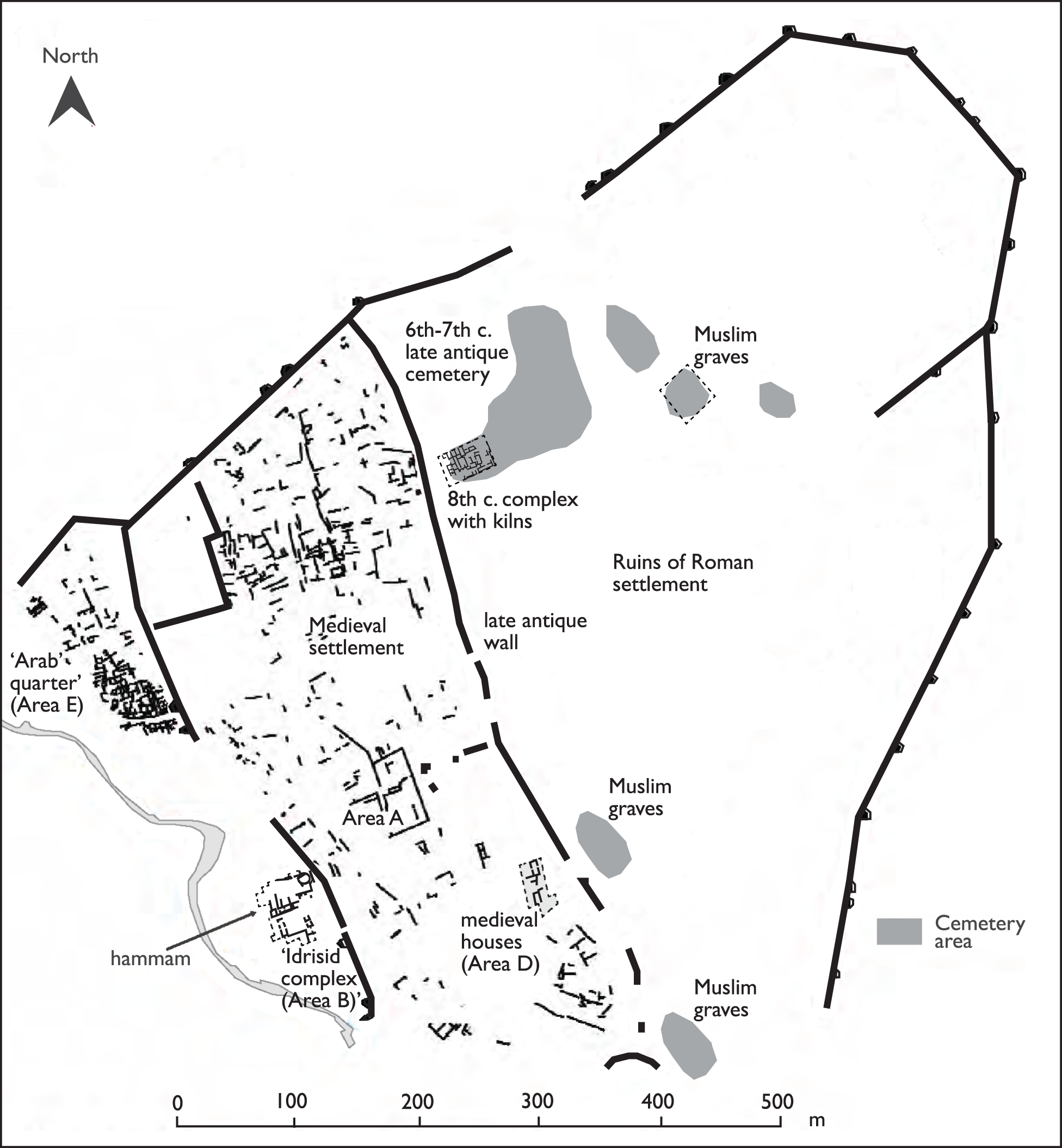
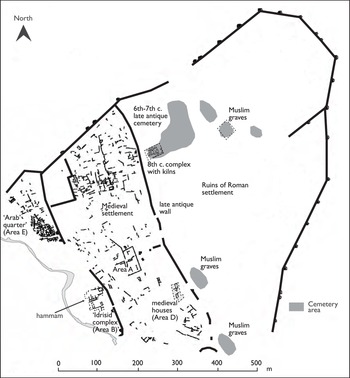
The medieval town has been extensively excavated, and its history is relatively well known (Figure 1). Before the arrival of Idrīs I, the eighth-century town was a substantial agro-settlement that minted its own copper coins, produced its own ceramics, and was linked with Mediterranean trading networks. Inside the walls, excavations in two areas have found simple, small, scattered two-room houses with storage silos outside (Fentress and Limane Reference Fentress and Limane2018, 74–81; Fentress, Fenwick and Limane Reference Fentress, Fenwick and Limane2021; Fentress, Fenwick and Limane Reference Fentress, Fenwick and Limane2022). Probably in the early eighth century, the so-called ‘quartier arabe’ was established outside the west gate and by the wadi. This new quarter contained dense medieval housing, industrial activity and possibly a mosque. A gold dīnār, several dirham hoards, hundreds of copper fulūs and an intaglio inscribed in Arabic have been found there (Eustache Reference Eustache1956; Fentress, Fenwick, and Limane Reference Fentress, Fenwick and Limane2021). The early conversion of Walīla’s inhabitants to Islam is supported by an absence of faunal evidence for pork consumption in eighth-century contexts, as well as burials laid out in accordance with Muslim funerary rites in a second phase of late antique cemeteries (King Reference King, Fentress and Limane2018; Akerraz Reference Akerraz, Cressier and García-Arenal1998, 297, 303). Under Idrisid rule, in the late eighth and ninth centuries, the town grew rapidly. Traces of occupation discovered outside the Roman walls to the northwest and in the extramural zone suggest that its extent far exceeded that of the late antique Berber settlement. The new rulers seem to have lived separately from the town’s inhabitants, settling outside the city walls. A complex of three courtyard buildings and the hammam in which the gameboard was found was constructed in the late eighth to early ninth century outside the Roman enceinte. The areas outside the Roman enceinte by the wadi continued to be occupied in the late ninth and tenth centuries and then the site was definitively abandoned before a brief re-occupation in the fourteenth and fifteenth centuries, under Merinid rule.
Plan of medieval Volubilis/Walīla (Corisande Fenwick and INSAP-UCL Volubilis Archaeological Project).
The hammam and its gameboard
The hammam was first noted by Henri de la Martinière, who mistakenly identified it as a Christian church after discovering an incense burner with a cross of late antique or early medieval date which is one of the few Egyptian/Middle Eastern imports identified at the site at present (De Villefosse Reference De Villefosse1891, 149). Further unpublished exploratory excavations were conducted by Michel Ponsich in the 1950s, and in 1964 Bernard Rosenberger conducted more systematic but never-published excavations in and around the building (his journal and sketches are published in Fili Reference Fili, Fentress and Limane2018). In 1992, Abdelaziz El Khayari conducted a detailed study of the hammam with test excavations in the different rooms and confirmed its medieval date (El Khayari Reference El Khayari, Mastino and Ruggeri1992). Between 2000–2005, an INSAP-UCL team excavated the area around the hammam and cleaned and restored the structure (El Habashi, Moujoud and Zizouni Reference El Habashi, Moujoud and Zizouni2016; Fentress and Limane Reference Fentress and Limane2018). The gameboard in the hammam is here presented for the first time.
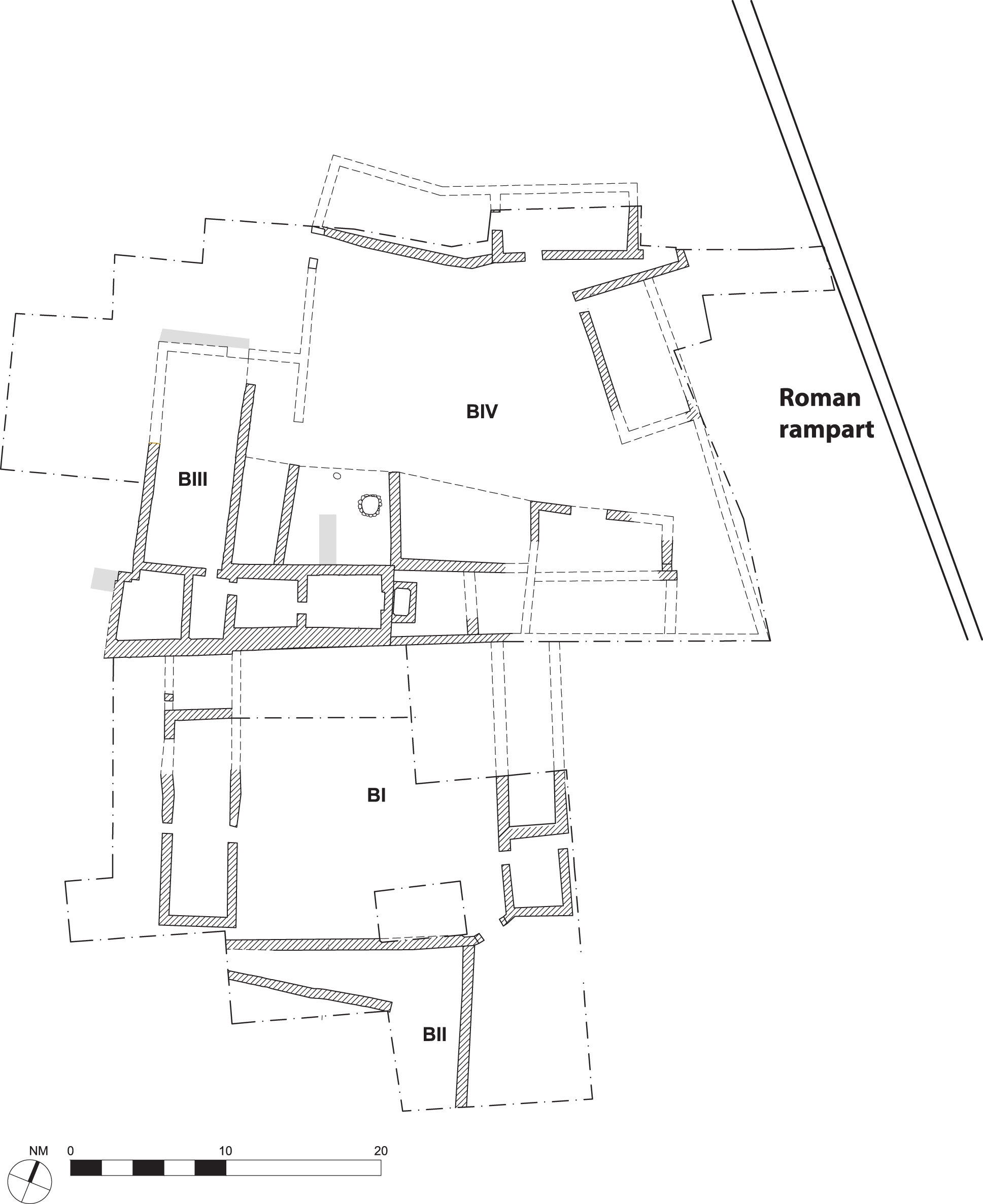
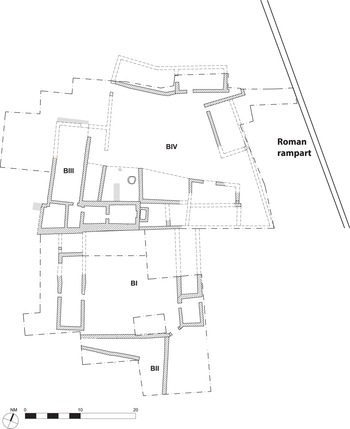
The hammam (BIII) forms part of a complex with several large courtyard buildings, which Elizabeth Fentress and Hassan Limane suggest served as the residence of Idrīs I and his son (Fentress and Limane Reference Fentress and Limane2018, 82–102) (Figure 2). Each building in the complex seems to have had different functions: from south to north a domestic space with a kitchen (BII), a reception space with plaster-floored rooms and a raised platform decorated in pink plaster at one end (BI), and finally a storage and processing compound (BIV), with deep pits/silos in the centre that may have been a collective granary. The hammam was accessible both from the complex’s exterior and from the courtyard of the storage compound. Strikingly, the courtyard buildings are wholly different in plan from the simple rectangular houses excavated inside the town, and the courtyard plan only appears in North Africa after the Muslim conquests (Fentress Reference Fentress, Mira and Lloret2013). Analysis of consumption patterns suggests that the extramural complex’s inhabitants were living in a more privileged way than those living inside the town: they ate choice cuts of meat butchered elsewhere, dined off simple decorated tableware, discarded more coins, used imported glazed lamps and processed cotton, presumably cultivated south of the Atlas Mountains (Fentress and Limane Reference Fentress and Limane2018, 99).
Plan of the Idrisid complex at Walīla (modified from Fentress and Limane Reference Fentress and Limane2018: 122, figure. 3.7, INSAP-UCL Volubilis Archaeological Project 2022?).
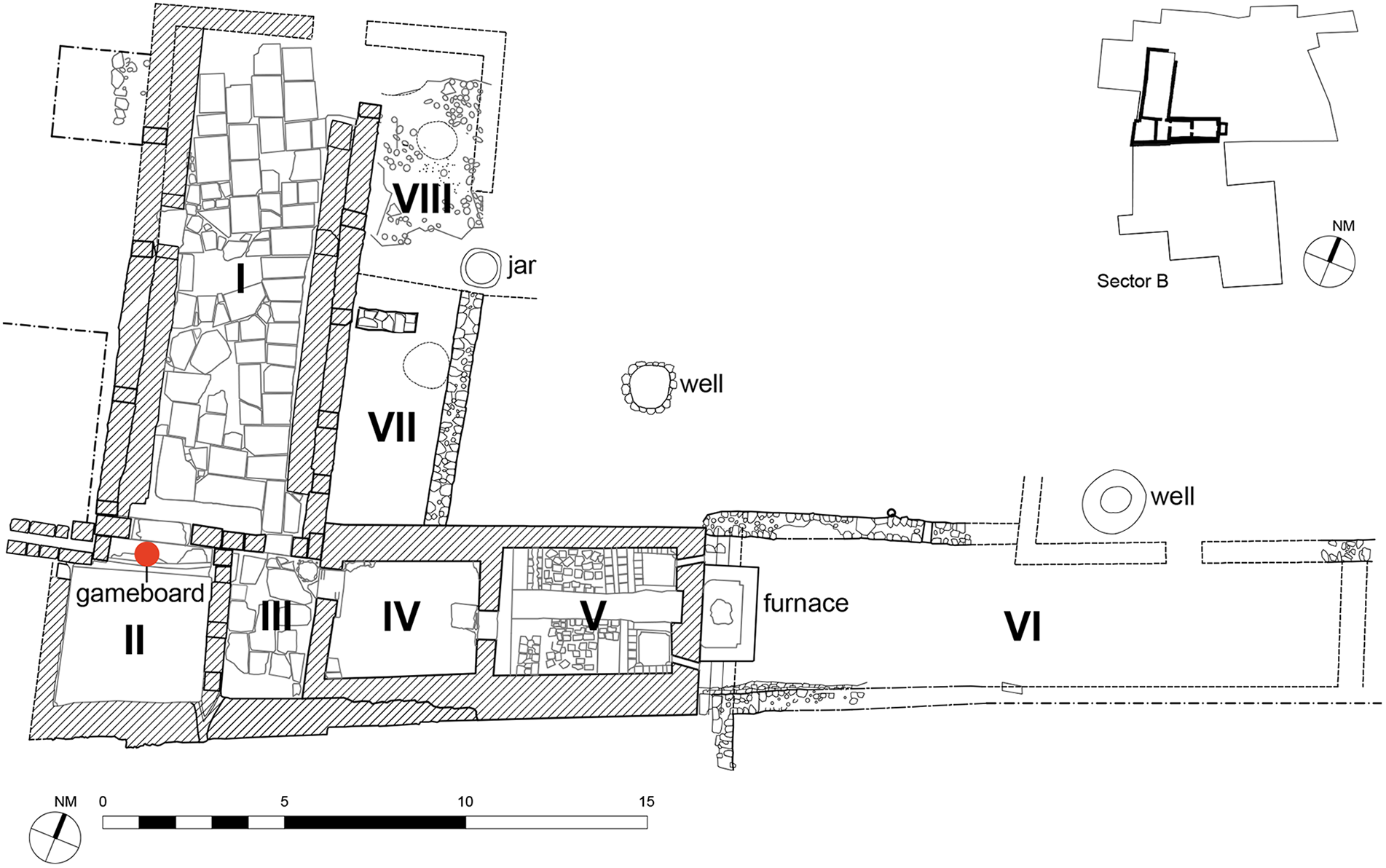
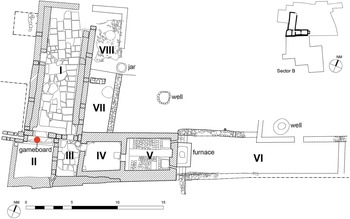
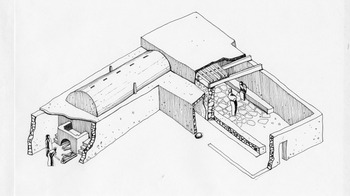
The hammam itself is a small structure (243 m2) built in re-used stone and brick with water provided by a channel from the wadi (Figures 3-4) (El Khayari Reference El Khayari, Mastino and Ruggeri1992; Fentress and Limane Reference Fentress and Limane2018, 84–91, 123–37). A bather would enter the building either from the outside or from the courtyard of the storage compound, and come first into a long room (Salle I) paved in re-used Roman paving slabs and lined with benches. Here the bathers could leave their clothes. At the end of this room, the bather passed through a small, paved vestibule (Salle III), which probably had a basin in the south-west corner which led into a room (Salle IV) that in turn led to the hot room (Salle V) with two small, square basins reached by a step, in which the bather could gather hot water for washing (the small size and height suggest that these were not immersion baths). The vestibule wall leading to the hot room contains a large, spoliated block with a shield in relief which came originally from the still-standing Arch of Caracalla, perhaps as Elizabeth Fentress has suggested as a ‘deliberate, symbolic, and ideologically charged transfer’ (Fentress Reference Fentress, Anderson, Fenwick and Rosser-Owen2017, 523–24). The hot room was heated by a praefurnium at the end and a water tank outside which had pipes to the basins. After this, the bather returned to the cold room (Salle I) to cool off in the cold water pool (Salle II). The room had three wide steps leading into a small, cold plunge-pool. The gaming board is on the top step, in the entrance. There is sufficient space for two people to play, and another person to enter the pool while they are playing. In a second phase, a corridor and vestibule were added on the north-east side of the complex; next to the entrance was a pit with a jar, perhaps containing water to wash feet before entering (Fentress and Limane Reference Fentress and Limane2018, 135, fig. 3.23).
Plan of the hammam at Walīla, including indication of the location of the gameboard (modified from Fentress and Limane Reference Fentress and Limane2018: 125, fig 3.10).
Reconstruction of the hammam (Fernanda Palmieri, INSAP-UCL Volubilis Archaeological Project).
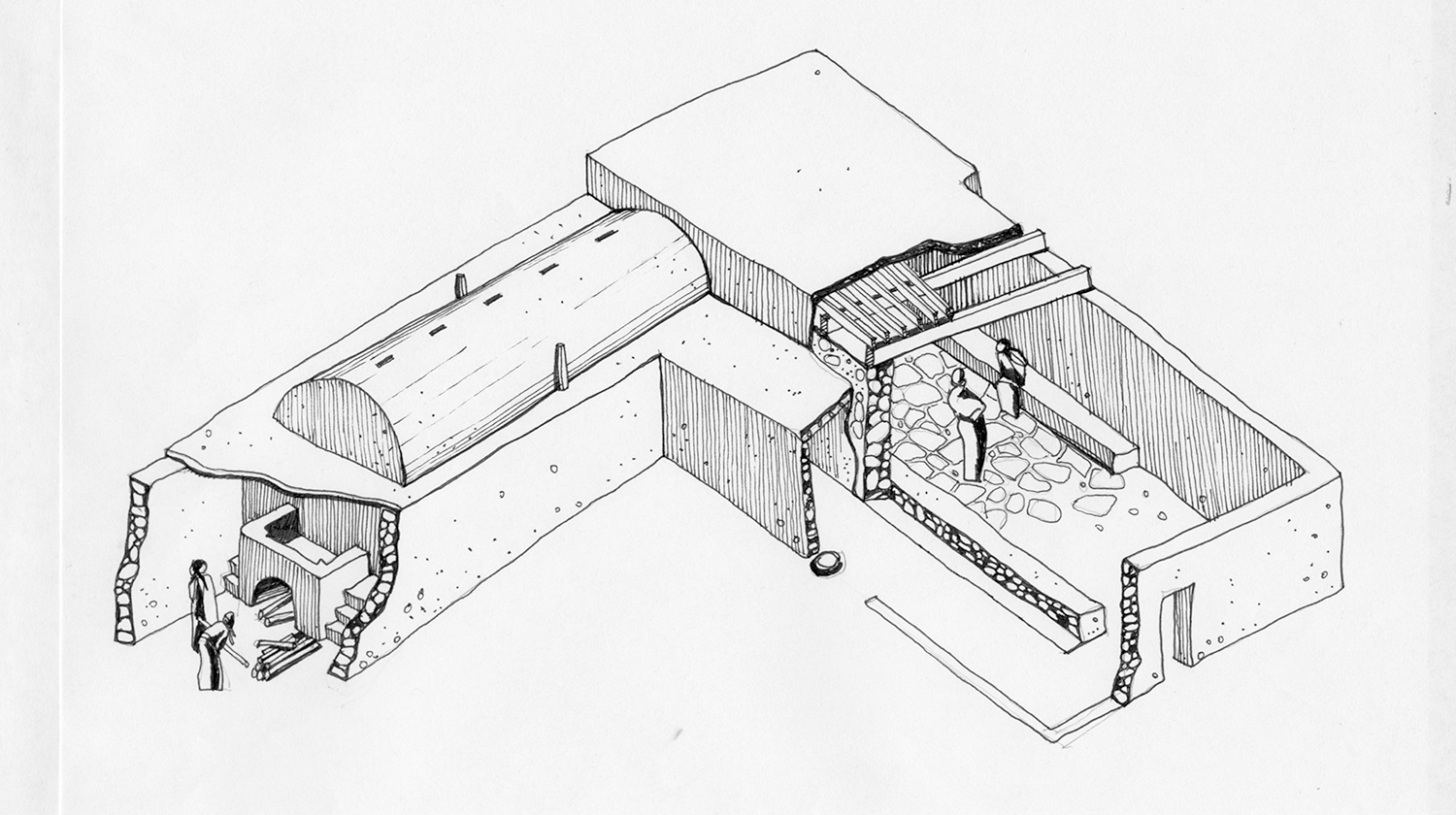
The hammam complex is unusual in several ways. The closest parallels in plan are to Cyrenaican baths of the sixth and seventh centuries and, in particular, the bathhouse inside the fortress of Tocra which may date to a second phase following the Arab conquest of Cyrenaica (Jones Reference Jones1984; Fenwick Reference Fenwick2013: 20–21). While the L-shaped plan is common in small, late antique baths in North Africa, there are peculiarities in the heating system when compared with other North African baths (Fentress and Limane Reference Fentress and Limane2018, 86–89).Footnote 2 Unlike late antique baths, where bathers typically immersed themselves in small, hot water pools, here raised basins were provided for the bather to wash with hot water. The heating system in the hot room is a channel-hypocaust or duct system, rather than a pillar-hypocaust system, and there is no evidence of tubes to heat the walls and ceiling and create steam. Thus, the hammam would have produced a dry heat rather than the sweating heat typical of late antique bathing practices. This would have raised the room’s temperature to a degree comfortable enough to warm the bather while washing themselves with hot water from the basins. The closest known parallels for the heating system are from the twelfth-century Ayyubid baths in Damascus which use underfloor channels and chimneys with combustion smoke as a heat source (Sourdel-Thomine and Louis Reference Sourdel-Thomine, Louis, Bearman, Bianquis, Bosworth, van Donzel and Heinrichs2012, EI2; Sibley Reference Sibley2007, 280; Grotzfeld Reference Grotzfeld1970, 58–59). A similar heating system is also employed in contemporary updraft ceramic kilns at the nearby city of al-Basra and (Benco Reference Benco, Cressier and Fentress2011, 57–58, fig. 14; Fentress and Limane Reference Fentress and Limane2018: 87–88). Nonetheless, together with the courtyard houses, the design of the bathhouse seems to have closer links to the Levant than North Africa, which further bolsters the interpretation of the complex as the residence of Idrīs I and his son.
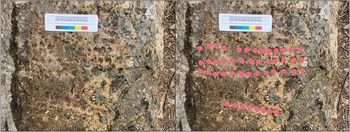
The gameboard is off-centre in the top step of the cold plunge-pool (see position in Figure 3). It comprises three rows of at least 13 holes, measuring ca. 34 cm x 9.5 cm. The holes are shallow, roughly carved, semi-spherical depressions (diameter: 1.2–1.6 cm) (Figure 5). As the step is slightly eroded, additional holes are possible; and it probably belongs to a type of game which typically has rows of 14 holes (see below). The rows run perpendicular across the step. The three rows are not quite straight. A fourth very irregular row (0.29 cm in length), on a notably different orientation in which only eight holes survive (the stone is eroded and there may have been more holes originally), is set 8–14 cm back from the main board. These holes may relate to scoring for the game, or – given their different orientation – belong to a damaged or unfinished board for another game (for clustered games on the same surface, see Penn Reference Penn, Agar, Allon, Hulin, Navratilova, Penn and Sartoriforthcoming; Tecca Reference Tecca2024). For the remainder of this article, we will focus on the three main rows of thirteen holes, as it is more clearly identifiable.
The gameboard in the hammam at Walīla (left), with mark-up showing position of holes (right) (INSAP-UCL Volubilis Archaeological Project).

The holes were probably carved with a chisel and mallet, as is typical for graffiti gameboards (see Penn Reference Penn, Agar, Allon, Hulin, Navratilova, Penn and Sartoriforthcoming). The uneven work suggests the carving was not done by a professional stoneworker, but it is nevertheless not casual; specialist tools would have been required. As with all the building material used in the hammam, the block into which the gameboard was carved was reused, but the off-centre position of the gameboard on the block suggests that the game was carved after this block was put in place. Its central position on the steps leading down into the plunge-pool must have been deliberate, allowing players to sit opposite one another on the steps during the game. This placement is highly visible: players would have been seen by those in the changing room (Salle I). The nature of the work and prominent location suggests that the gameboard was made with the permission of whoever controlled the hammam. We therefore interpret the gameboard as a purposeful addition, carved after the hammam’s construction and some time during its use.
The hammam is certainly early medieval in date. While earlier scholars suggested that it was Roman or late antique, El Khayari’s sondages found Idrisid coins and early medieval pottery below the floors in Salle VI and in Salle I (El Khayari Reference El Khayari, Mastino and Ruggeri1992, 307–308). The 2000–2005 excavations found two pre-Idrisid, medieval coins in the preparation layers for the hammam, while pits in the second-phase extension returned radiocarbon dates of the eighth–ninth centuries (Fentress and Limane Reference Fentress and Limane2018, 136). Rosenberger’s excavation notes are confused, but inside the baths, he found large numbers of Idrisid and medieval coins, medieval ceramics, lamps and some glazed pottery, and large amounts of animal bones in upper levels, supporting the Idrisid construction date of the hammam (Fili Reference Fili, Fentress and Limane2018). It is unclear precisely when the hammam went out of use, but in the tenth/eleventh century a village settlement was built in and over the complex and building BVII was built over the corner of the cold room. The gameboard therefore dates to the period between the late eighth/ninth century and the tenth century and offers a rare opportunity to examine a board carved directly into the fabric of a bathhouse.
No evidence for other graffiti gameboards has been identified at the site in any period, though finds of dice and gaming counters suggest that gaming did take place in the city at points during its history. This may reflect poor preservation, excavation biases or indicate that carving gameboards in stone was not a common practice – if it occurred at all – in Roman or late antique Volubilis. Alternatively, players may have marked out temporary gameboards in paint, charcoal, or chalk, or used portable boards made from perishable materials such as wood, cloth, leather, or even parchment (Penn, Pace and Schädler Reference Schädler, Pace, Penn and Schädler2024, 16; Lavan Reference Lavan2020, 241). No portable material culture related to gaming has been recovered from the hammam itself (as noted, this was excavated without proper documentation in the 1890s and 1960s), but there is sporadic evidence for medieval gaming in nearby buildings. Two bone dice were recovered from the ninth/tenth-century destruction layer in Building VIII and a destruction layer in Building V, in the area of the hammam (Fentress Reference Fentress, Fentress and Limane2018, 341–43, fig. 4.58, 346, tab. 4.6, nos 18 and 147). Together with the gameboard, the dice confirm that a range of different kinds of games, including games of chance, were played at Walīla during the Early Middle Ages.
Identifying the game
The gameboard, with its three rows of thirteen holes, does not fall into a well-known game typology (see Rosenthal Reference Rosenthal1975 for games and gambling in seventh- to sixteenth-century Islamic societies; it should be emphasised that games in Arabic, Persian and other texts remain little explored). Based on its layout, two common games might have been played on the Walīla gameboard: mancala and tāb/sīg. Significantly, both can, and usually are, played without specialised counters. Instead, players employ improvised pieces (seeds, beans, stones, etc), which archaeologists rarely identify in the archaeological record or link to play. The placement of the board on the surface of the step into the pool, perpendicular to the door frame, suggests that this was a game in which each player controls, to a greater or lesser extent, one side of the board. This fits both mancala (where players have their ‘own’ side for initiating moves) and tāb/sīg (in which all a player’s pieces are initially deployed on one side of the board). In the next sections we evaluate the board against the known rulesets for these two games.
Mancala
The term ‘mancala’ refers to a family of games where two players distribute stones, seeds, beans or other playing pieces between holes on a board to capture the most pieces (Russ Reference Russ2000). Players take turns ‘sowing’ pieces held in holes on their side and aim to collect them through various capturing moves. The board is divided into two equal parts, usually a row or pair of rows of holes, each comprising the territory of one player. The holes are often large as they need to hold multiple pieces at once. Many, though not all, mancala boards have a ‘storehouse’ for each player to store captured pieces. Mancala can be played on boards with an enormous range of configurations, including two, three and four rows of pits or holes, with four to ten holes or more. Variants of the game are today played widely, particularly in Africa, the Middle East, South and Southeast Asia and the Caribbean (De Voogt Reference de Voogt2021, Reference de Voogt2012, Reference de Voogt2010, Reference de Voogt1997). The earliest archaeologically-attested mancala-style games are boards from Matara, Eritrea (Anfray Reference Anfray1990). These gameboards are associated with fourth- to eighth-century coins, though these coins only provide a terminus post quem and the boards could be later. Other similar boards are known from Yeha in Ethiopia and Asmara in Eritrea (Pankhurst Reference Pankhurst1971, 154; Phillipson Reference Phillipson2002, 77). It remains unclear whether mancala developed in the Aksumite kingdom (Depaulis Reference Depaulis2024, 40; pace De Voogt Reference de Voogt2021). Schädler suggests that graffiti gameboards at urban sites in Anatolia with two rows of five holes may have been used for the Graeco-Roman game known as pente grammai (five lines), but others with combinations of two rows of four or six holes could have been used for playing mancala when that game reached the Eastern Mediterranean world from the Horn of Africa in either late antiquity or the Middle Ages (Schädler Reference Schädler1998).
A game known as the Game of Fourteen (Arabic: arbaʿata ʿashar) first appears in ḥadīth and ḥisbah compilations of the early to mid-ninth century. Franz Rosenthal (Reference Rosenthal1975) suggested this term may refer to mancala (in a presumed two-by-seven holes configuration), though Thierry Depaulis recently challenged this hypothesis (Depaulis Reference Depaulis2024; see further below). Rosenthal relies on two traditions, in which either ʿAbdallāh b. ʿUmar al-Kha ṭṭāb (d. 692), son of the second or fourth caliph (and first Shiʿī imam) or ʿAlī b. Abī Ṭālib (d. 661) prohibited the playing of the game. The earliest variants of the Abdallāh b. ʿUmar ḥadīth are found in the Kitāb al-ṭabaqāt al-kabīr of Ibn Saʿd (784/5–845), who was born in Basra and spent most of his life in Baghdad (Ibn Saʿd Reference Ibn Saʿd1904, 120 1904. Biography: Fück Reference Fück1960). Ibn Abī Shaybah (755–849) in his Muṣannaf includes both the Ibn ʿUmar and ʿAlī b. Abī Ṭālib traditions in his section ‘on the playing of the game of fourteen (fī al-laʿab bi-arbaʿata ashara)’ (Ibn Abī Shayba Reference Ibn Abī Shayba1988, vol 5, 287). The Ibn ʿUmar traditions can be found across the ḥadīth corpus, including in other ninth-century works Rosenthal was unaware of, such as that of Ibn (823–94) or al-Ṭabarī (839–923) (Ibn Abī Dunya Reference Ibn Abī Dunya and Abd al-Muʿnim Salīm1995, vol 1, 82. Al-Ṭabarī, Reference Al-Ṭabarīn.d. vol 4, 240 Kitāb Tahdhīb Athār, ed. Maḥmūd Muḥammad Shākir. vol. 4: 240. Maṭbaʿa al-Madanī, n.d.). The traditions ascribed to ʿAlī are less common. The ḥisba manual associated with the Zaydī imam. Al-Nāsir al-Hasan (ca. 844–917), a distant cousin of al-Idrīs, describes a prohibition on carpenters making gameboards for various games, including chess, nard (backgammon) and arba‘ata‘ashar (Serjeant Reference Serjeant1953, 8). Like Idrīs I, he was born in Medina but then entered open rebellion against the caliphate and established his own Imamate in the provinces of the empire, in Ṭabaristān. The above evidence indicates that the game was well known by the ninth century. Despite being well recorded for the period in question, there is no literary evidence supporting the use of the term in North Africa.
Carved gameboards with three rows are sometimes interpreted as mancala boards (e.g. Sebbane Reference Sebbane and Hirschfeld2000). However, known mancala gameboards with three rows are rare. Those that do exist always have an even number of holes per row, because the central row is divided equally between the players (Depaulis Reference Depaulis2024, 44; cf. Deledicq and Popova Reference Deledicq and Popova1977, 72–73). As the Walīla gameboard comprises 3 x 13 holes, i.e. an odd number of holes in each row, it would not have been well suited for playing mancala-type games – unless there were originally 3 x 14 holes. More significantly, the holes of the Walīla gameboard are shallow with a small diameter (1.2–1.6 cm). Mancala boards typically feature larger, deeper holes to hold multiple playing pieces. It is therefore unlikely that this board was used for mancala.
Tāb/sīg
The Walīla gameboard was more probably used for the game known as tāb wa-d-dukk (commonly shortened to tāb) in the Levant and as sīg in the Maghreb and Saharan Africa (Depaulis Reference Depaulis2001). Tāb is a running-fight game where two players start with their pieces on their respective sides and compete to move their pieces across a board, aiming to capture or eliminate the opponent’s pieces (see https://ludii.games/details.php?keyword=Tab). In its modern form, tāb does not require dice; instead, players throw four sticks, each with a white and yellow side, to determine their moves. The number of white sides facing up dictates movement; specific throws grant additional turns. The game is played on a board with three, four or five rows, with several spaces – squares or holes – ranging from seven to 29. Board size affects game duration and, given regional rule variations across North Africa, the Levant and Türkiye today, tāb is best treated as a game family rather than a single unitary game.
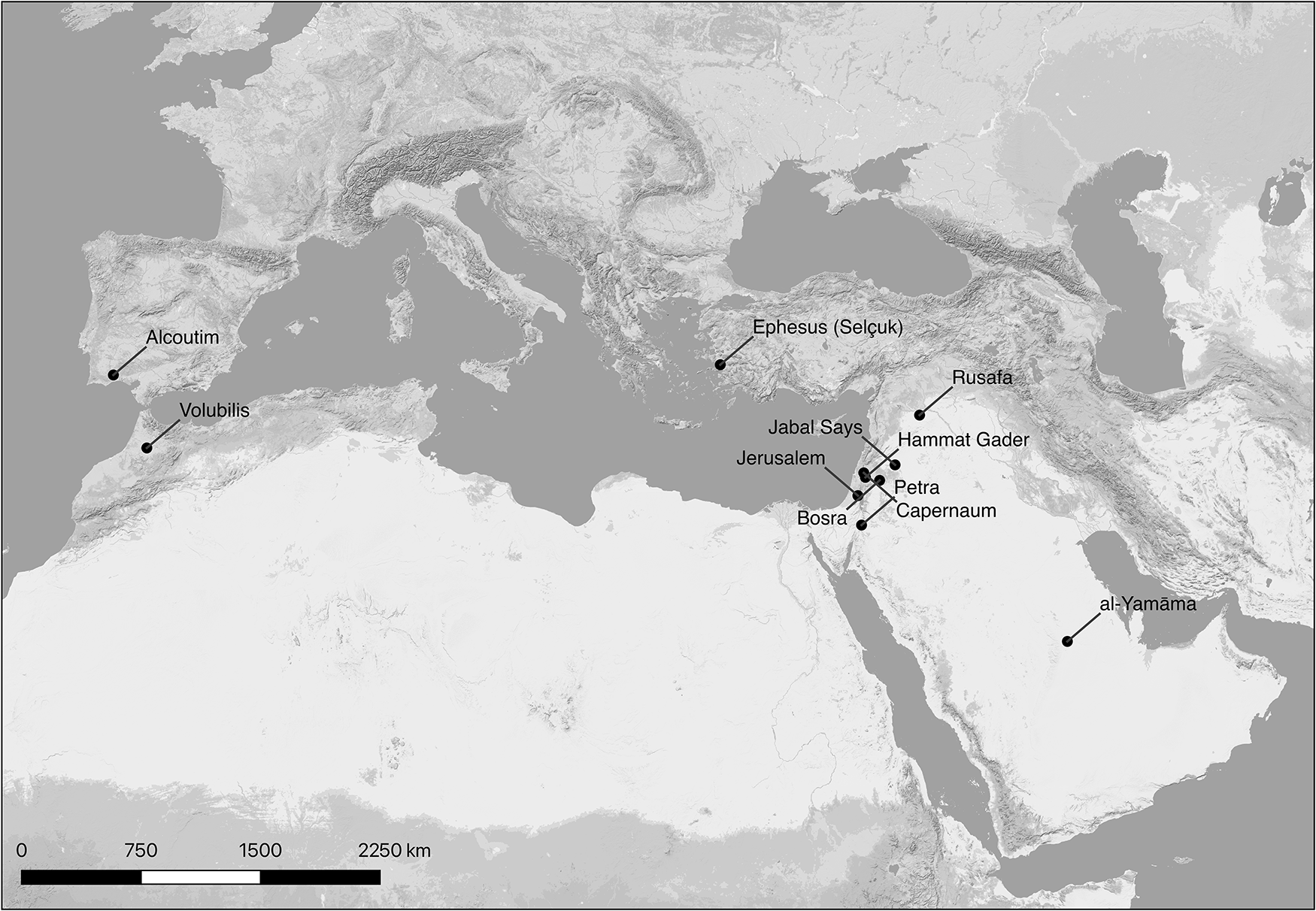
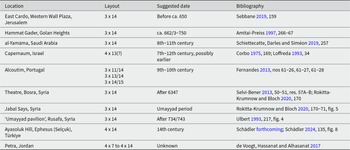
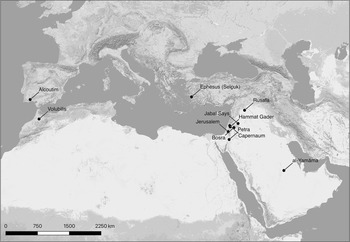
The date and origins of this game are debated – the first explicit mention of tāb is by the Egyptian author Ibn Dāniyāl (d. 710 AH/1310 CE) (Ibn Dānīyāl, Dīwān, MS. Istanbul Ayasfoya, 4880, fol. 149°). However, Thierry Depaulis has recently argued that the game has much earlier origins (Depaulis Reference Depaulis2024). He identified surviving boards from late antiquity and the early Middle Ages which could be used for playing tāb. Most boards come from Arabia and the Middle East, and most date to the early Islamic period; a handful of similar boards from Alcoutim, Portugal, attest to this game in the Western Mediterranean, but importantly none have been identified until now in North Africa. We reproduce and expand part of Depaulis’ corpus in Table 1, mapped in Figure 6, namely the boards with 13–15 holes/squares per line as closest comparisons to the Walīla board. As three or four rows of 14 holes or squares is a common configuration (and one that has proved difficult to assign to other games), Depaulis has argued that these boards should be interpreted as used for playing a version of tāb/sīg. He suggests this provides a better explanation for the Game of Fourteen described above than Rosenthal’s proposal of mancala, and indicates that tāb was played in the early Islamic period, particularly in Arabia and the Middle East, though it was also known in the West, particularly in Portugal.
Gameboards with three or four rows of 13–15 holes or squares (adapted from Depaulis Reference Depaulis2024, 53, with additions)
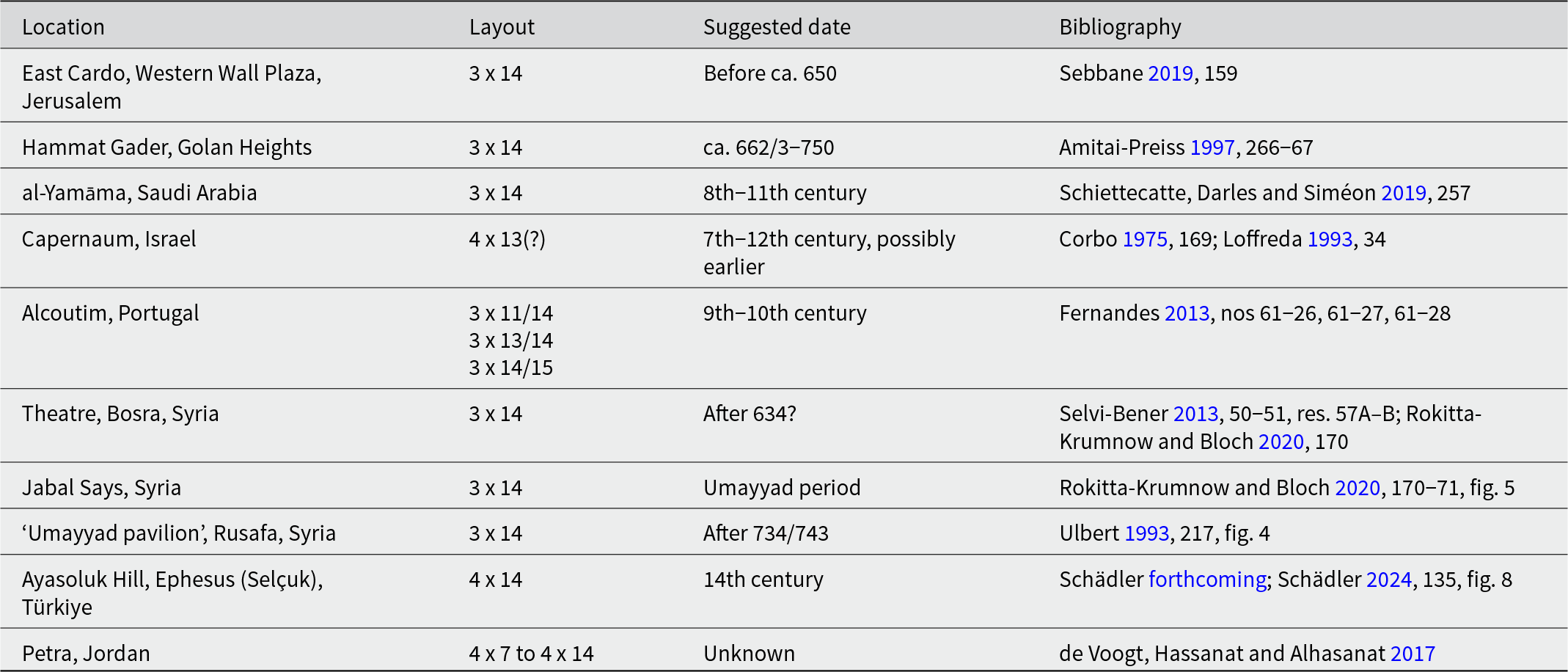
Map of locations of tāb-style gameboards similar to the board from Walīla (based on data in Table 1).
Further evidence for the extensive spread of tāb-style games in the early Middle Ages may come from Scandinavia. Here, early modern evidence attests to a running-fight game called daldøs (Danish), daldøsa (Norwegian), or sáhkku (in several Sámi languages) on a board made up of three rows of 12–17 holes, using very similar mechanics to tāb (Michaelsen Reference Michaelsen2001; Næsheim Reference Næsheim2001; Østergaard and Gaston Reference Østergaard and Gaston2001). Daldøs/daldøsa/sáhkku, like tāb, does not use cubic dice, but instead of throwing four sticks, players use four-sided dice. These similarities with tāb led Depaulis, noting that the evidence for daldøs/daldøsa/sáhkku is later than boards identified in West Asia, to hypothesise that this tāb-style was transmitted from the Islamic world, through the East Roman Empire, by Norsemen who served in the Varangian Guard (Depaulis Reference Depaulis2001; Depaulis Reference Depaulis2024, 41–43). The intensity of contact between Scandinavia and the Islamic world via the Rus could indicate another route of cultural transmission for this game. While the precise chronology of transmission remains uncertain, its resemblance to tāb highlights the broad diffusion and adaptability of these gaming traditions.
The Walīla gameboard – with three rows of at least 13 holes – shares a morphology with boards probably used for playing tāb-style games. These loose parallels, and the board’s unsuitability for mancala, suggest a tāb/sīg-type game as the best-fit interpretation. While this must remain tentative given the small number of published boards linked to tāb/sīg, the implications for gaming history in North Africa are worth considering. Notably, none of the other published boards potentially dating to the early Islamic period are from North Africa; aside from the examples from Alcoutim (Portugal) and Ephesus (Western Türkiye), all come from the Middle East or Arabia. The dating of the Walīla board suggests that tāb/sīg may have arrived in the Western Mediterranean in the early medieval period, perhaps via contact with individuals or groups familiar with the game further east in the Islamic world.
Discussion: games and social space in the early Islamic world
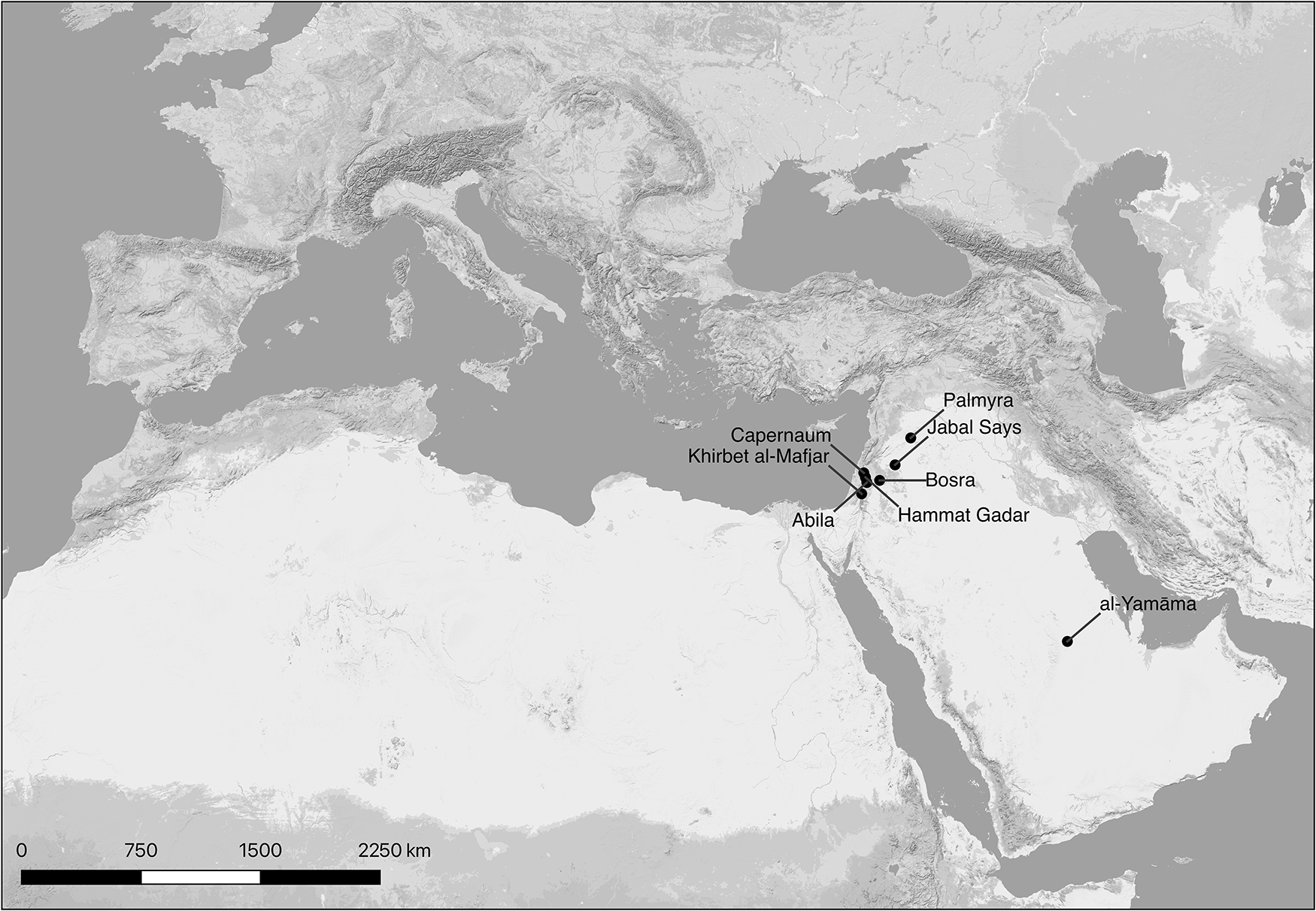
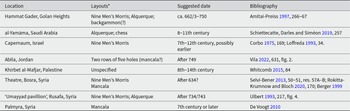
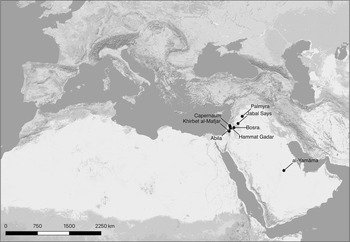
The Walīla gameboard is one of very few published in the Islamic Mediterranean that can be dated to the eighth–tenth centuries (Table 2, mapped in Figure 7). Carved gameboards of early Islamic date are associated with a range of structures, including the eighth–eleventh-century phase of the mosque at al-Yamāma, Saudi Arabia (Schiettecatte, Darles and Siméon Reference Schiettecatte, Darles and Siméon2019, 257), a possible muṣalla at Abila, Northern Jordan (Vila Reference Vila2022, 631, fig. 2), the gatehouse of Khirbet al-Mafjar, in the West Bank (Whitcomb Reference Whitcomb2015, 84), the ‘Umayyad pavilion’ in Rusafa (Ulbert Reference Ulbert1993, 218, fig. 4). In Palmyra, at some point after the seventh century, mancala games were carved into the Temple of Baal, which had by then become a fortification (De Voogt Reference de Voogt2010). A similar situation could plausibly be observed at the theatre in Bosra, which was turned into a fortress in the early Islamic period, though some of the games there may also have been carved earlier (Berger Reference Berger1999). A rare parallel for a gameboard in a bathhouse comes from the so-called Hall of the Inscriptions of the Hammat Gadar, where three gameboards were carved into surfaces laid down during the refurbishment of the complex dated by an inscription to 662/663, suggesting that the gameboards are also Umayyad in date (Amitai-Preiss Reference Amitai-Preiss and Hirschfeld1997). In other cases, dating is more speculative. For example, several gameboards are carved into the atrium of the White Synagogue in Capernaum which was abandoned in the seventh century (Corbo Reference Corbo1975, 169; Loffreda Reference Loffreda1993, 34, 41). It has been suggested that the games were carved by Muslim communities between the seventh and twelfth centuries (Depaulis Reference Depaulis2024, 49), but these gameboards could also have been carved when the synagogue was still in use. As implied by the boards at Alcoutim in Portugal and Ephesus in Western Türkiye, mentioned above, these gaming habits were not unique to the Islamicate world, and it is very likely that some gaming habits were shared in neighbouring lands. Despite this very small, published sample, these boards provide evidence for a variety of games – nine men’s morris, alquerque, mancala and also possibly backgammon and chess. Although the rules of these games need not concern us further here, their diversity underlines the richness and complexity of early Islamic gaming cultures. Importantly, moreover, all these findspots (barring the probably slightly later examples in Portugal) are in the central parts of the early Islamic world, far to the east of Walīla.
Other gameboards of plausibly early-Islamic date published elsewhere in the Mediterranean and Arabia (*does not include boards already mentioned above)
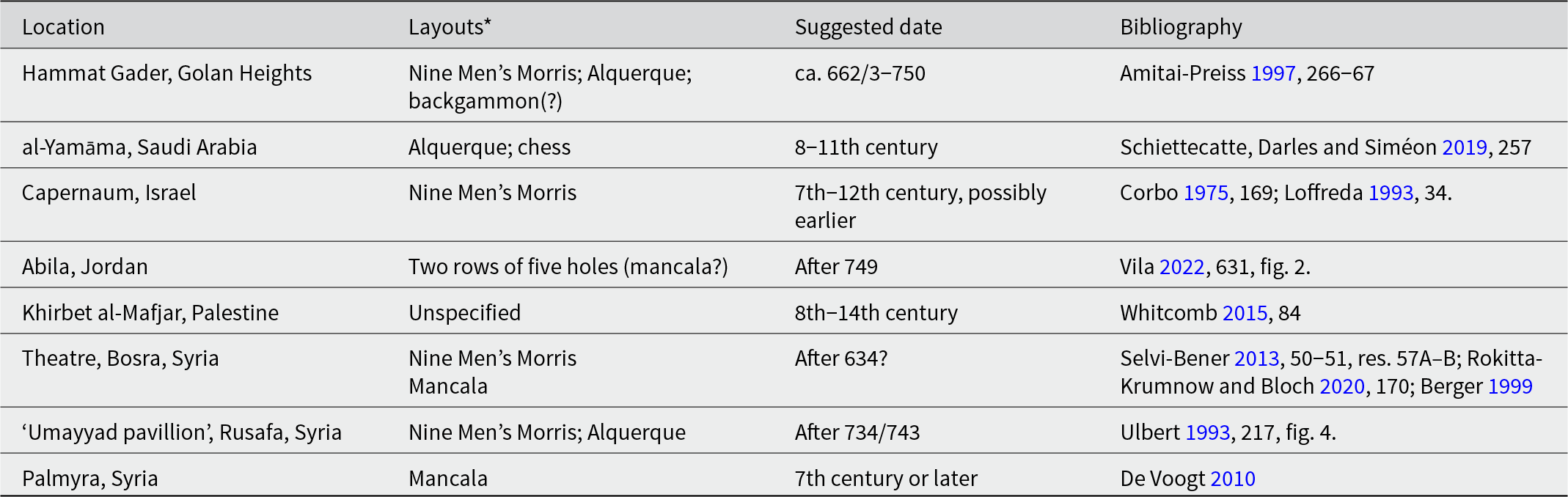
Map of locations of other plausibly medieval gameboards (based on data in Table 2).
Probably dated to the late eighth and ninth centuries, the Walīla board provides securely-dated evidence for tāb/sīg-style games in early medieval North Africa and suggests that these games have a longer and more complex history than previously recognised. The wide distribution of similar game types across the Mediterranean suggests that these games circulated via trade, military and cultural networks or through movement of people, who brought with them the cultural knowledge of certain boardgames. In the particular case of Walīla which had strong links with the Middle East in the eighth century – but not before – the presence of a gaming board which can plausibly be associated with tāb/sīg may reflect cultural influences or the mobility of people from the Levant or Arabian Peninsula, where many carved boards are attested, and some may be broadly contemporary with the Walīla example. Our excavations have found evidence of close links with the Middle East in the eighth century across the site, including large numbers of coins, a wine-jar and imported glass from Egypt and the Levant, as well as the possibly Egyptian bronze incense-burner with cross found in the hammam by de la Martinière. Coupled with the Eastern-style plan of the hammam and courtyard buildings, it is tempting to see the game as something that travelled to Morocco – perhaps even a game Idris I or his entourage enjoyed.
Whatever its origin, the presence of a gameboard in the hammam at Walīla sheds important light on the activities that took place in this building and its role as a social space. Early medieval hammams were key locales for the maintenance of purity, cleanliness and care of the body through bathing and associated activities, but they were also potentially impure realms because they intertwined bodily maintenance and pleasure with nudity and eroticism (e.g. Benkheira Reference Benkheira2003; Benkheira Reference Benkheira2007; Van Gelder Reference van Gelder2008; Cuffel Reference Cuffel, Scott and Kosso2009; Melchert Reference Melchert, Boussac, Denoix, Fournet and Redon2014). Large numbers of Arabic poems, stories and anecdotes about bathhouses underline that they were key foci for socialising, sometimes accompanied by eating and drinking, though Rosenthal did not identify any references to gaming in bathhouses in his synthesis of the evidence (Rosenthal Reference Rosenthal1975). Little work, however, has been done on the material evidence for social life in medieval bathhouses: scholars have primarily focused on architectural and art-historical analysis of plan and decoration, while small finds and graffiti have been neglected (see recently, e.g. Arce Reference Arce, Boussac and Fournet2015; Sartori Reference Sartori2015). As a result, we only have a very partial picture of medieval bathing practices in the early Islamic period.
The carved gameboard at Walīla provides an unusual but important piece of evidence for gaming as one of the leisure activities taking place in bathhouses. Located at the centre of the entrance and steps into the pool, the gameboard was at a spot where bathers using the changing room, as well as those getting in and out of the pool, would have seen it. The prominent placement of the gameboard suggests that gaming was an accepted – perhaps even encouraged – part of the social experience of bathing, rather than being a casual or illicit pastime. In the Levant, the presence of gameboards in the Umayyad bathhouse at Hammat Gadar suggests that bathing and gaming were more commonly practiced together than previously recognised. This points to a complex picture of hammam use in the early Islamic period that included elements of recreation and socialising alongside cleanliness and relaxation.
Conclusion
Gaming practices in the Islamic Western Mediterranean have been underexplored. There is a clear need for more systematic documentation and publication of gameboards as well as portable gaming material culture (dice, counters etc.) across the Mediterranean and beyond. Graffiti boards and informal carvings are all too often omitted from conventional excavation reports (including all previous publications of this hammam) but, as this article has shown, offer valuable insights into social behaviour, leisure and use of space. We encourage scholars working on sites in Morocco, North Africa and the wider Mediterranean to consider these boards in their archaeological and architectural contexts and the role of gaming in the early Islamic world.
Acknowledgements
This article was written within the remit of the INSAP-UCL project at Volubilis (Directors: Asmae El Kacimi, Corisande Fenwick, Elizabeth Fentress, Hassan Limane), financed by a grant from the European Research Council (Grant agreement no: 949367) which funded TP’s participation in the Volubilis 2021 season and CF’s time writing this up. We thank Elizabeth Fentress, Therry Depaulis, Walter Crist, Leone Pecorini-Goodall and Summer Courts for commenting on drafts.
Author contributions
Conceptualization: TP, CF, HL; Investigation: CF, HL; Writing – Original draft: TP, CF; Writing – Review and editing: CF, HL, TP;Visualization: TP; Project Administration: CF, HL; Funding Acquisition: CF. All authors read and approved the final manuscript.

 Open access

