




Introduction
The Bronze Age in Orkney (c. 2500–800 BC) is poorly understood. Lacking the monumental stone architecture and ostentatious display of the Neolithic and Iron Age, Bronze Age remains are archaeologically opaque and have thus attracted far less attention. Settlement evidence is sparse, and research has concentrated predominantly on funerary monuments, which, although numerous and varied, are only rarely associated with the type of high-status grave goods found elsewhere (Mamwell Reference Mamwell2017; Downes n.d.). Adding to this lack of attention is the perception that, from the Late Neolithic onward, Orkney became increasingly insular and socially unstable, blighted by the loss of its former prestige and the diminution of its external networks (e.g. Richards Reference Richards, Edmonds and Richards1998). Cut adrift to carve its own trajectory, it has been argued that there may even have been a conscious rejection by the islands’ population of new developments that were taking place elsewhere in Britain (Card et al. Reference Card2017). Implicit here is the sense of exceptionalism that attaches to the Neolithic in Orkney (Barclay & Brophy Reference Barclay and Brophy2020) and which overshadows interpretations of the Bronze Age. Ongoing work at the well-preserved cemetery and settlement at the Links of Noltland, however, provides substantial new information to challenge these various assumptions and misperceptions. Here, we present the first tranche of findings from the cemetery, supported by radiocarbon and aDNA analyses.
The Links of Noltland
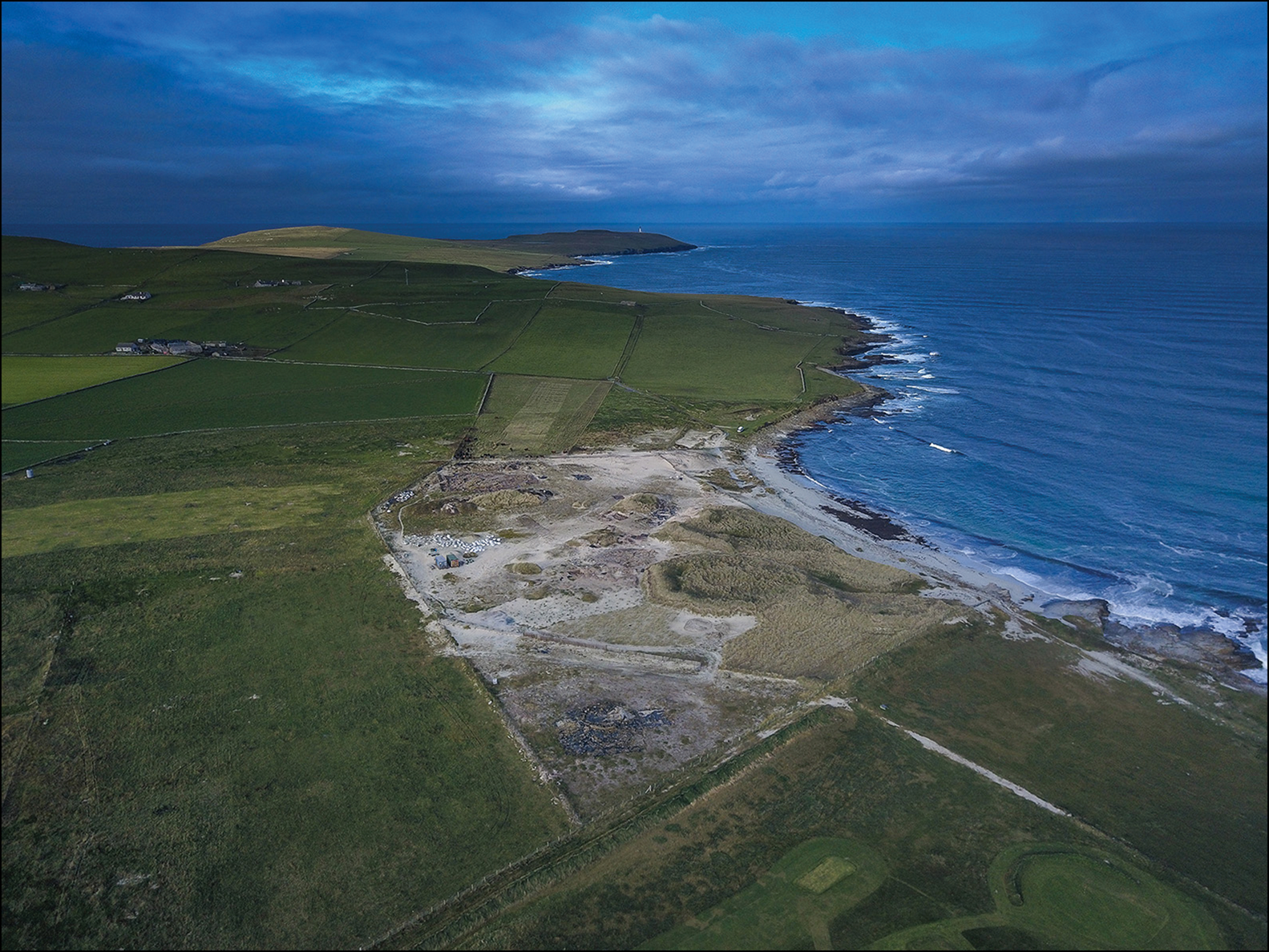
Located on the island of Westray at the north-west of the Orkney archipelago, the Links of Noltland is a tract of eroding coastal landscape extending across an area of approximately 5ha (Figure 1). Prehistoric remains, which hitherto were protected beneath sand dunes, have been exposed by erosion and, without intervention, will soon be entirely destroyed. Much of the site is designated as a Property in Care (Historic Environment Scotland 2018). The findings of an ongoing programme of rescue investigations, carried out by EASE Archaeology on behalf of Historic Environment Scotland, indicate that the area was continuously settled between at least the late fourth and the early first millennium cal BC.
View over the Links of Noltland site, looking west (photograph by D. O'Meara).
The features excavated so far include approximately 35 buildings, together with an extensive sample of the surrounding landscape (Figure 2). The preservation conditions are exceptional; the deposits have, until recently, been deeply buried and the area has not been cultivated since prehistory. Furthermore, the calcareous soils are conducive to the survival of bone and other organic materials (Moore & Wilson Reference Moore and Wilson2011).
Site plan showing the location of the cemetery, together with the Bronze Age settlement areas and trenches with major Neolithic remains (© EASE Archaeology).

From the late third millennium BC onwards, settlement patterns shifted from nucleated to more dispersed. Three new Bronze Age households, collectively forming a community, were established within the same landscape as their Neolithic predecessors, and a new cemetery was created to the east of the settlement. Set approximately 50m apart, each household comprised one or more curvilinear buildings with low walls made of earth and stone. The Bronze Age Noltland structures exhibit features that can be traced back to the Orcadian Neolithic, in a similar way to the broadly comparable contemporaneous Orcadian houses at Tofts Ness, Crossiecrown and Skaill (Buteux Reference Buteux1997; Dockrill Reference Dockrill2007; Richards & Jones Reference Richards and Jones2016), and, more widely, the ring-bank constructions of northern Scotland (Pope Reference Pope, Hunter and Ralston2015).
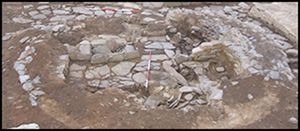
The settlement featured larger residential spaces and smaller outbuildings, often conjoined or paired together, accompanied by yards and middens (Figure 3). These buildings and associated spaces were repeatedly remodelled and reoccupied. While their complex sequences of use have yet to be fully interrogated via Bayesian analysis, our current interpretation of the evidence suggests that the cemetery and settlement were in use concurrently, and it is assumed the cemetery burials represent inhabitants of the Bronze Age households. Although leaving fewer substantial traces in the archaeological record than their Neolithic stone counterparts, the construction of the Bronze Age houses incorporated valuable timber and they were no less commodious and well-appointed than earlier houses. Indeed, being well insulated and set lower to the ground, they were perhaps better suited to the local conditions. In addition to the cemetery, the settlement also contained several communal buildings, including a sophisticated subterranean ‘burnt mound’ complex, buildings for crop drying, processing and storage, and a well house.
Paired buildings at Noltland (structures 5 & 6) (© EASE Archaeology).

During the second millennium BC, the coastal dune system at Noltland expanded, encroaching on the settlement, and leading to the periodic inundation of houses and fields. Concurrent changes in farming and food procurement practices suggest the need to optimise returns from the land, which was becoming increasingly marginal. New field systems were established, intensive manuring regimes were developed (McKenna & Simpson Reference McKenna, Simpson, Moore and Wilson2011) and more use was made of coastal resources. It would appear that as the quality of the grazing declined, barley cultivation intensified, and sheep became increasingly important (Fraser Reference Fraser2015). Coupled with this, Westray's semi-managed deer herd went into slow decline (Fraser Reference Fraser2015: 281–83), their value likely eclipsed by the more versatile sheep, with whom they vied for grazing.
Diachronic change is also reflected in the material culture of the site: more tools associated with cultivation and crop processing came in to use, while those associated with butchery and skin preparation declined (McLaren Reference McLaren, Moore and Wilson2011). A diminution in the role of cattle and deer is suggested by a decrease in the use of their bones for toolmaking and, by implication, the availability of their skins. Sheep bone was now more commonly used in tool making (Rice Reference Rice, Moore and Wilson2011) and the range of bone items being manufactured was reduced; beads and decorative dress pins largely disappear, while simpler and more expediently made pins and points became more common. During this period, the use of Grooved Ware pottery gave way to flat rimmed, undecorated ceramics. A few sherds of Beaker-type pottery have been recovered from the middens, although none was found within the houses or in the cemetery. Steatite vessels, imported from Shetland, are documented in domestic contexts, but not in the cemetery.
The cemetery
The cemetery was located approximately equidistant between two of the three households, on land that had previously been cultivated but which, by the early second millennium BC, had become marginal. The surviving remains comprise 56 graves, representing approximately 105 individuals, almost half of whom had been inhumed (estimated n = 49) and the remainder cremated. The cemetery appears to have been a customary place for both inhumation and cremation burial throughout the Bronze Age, and contains the remains of individuals of both sexes and all ages (Figure 4). The excavated remains probably do not represent the entire Bronze Age population of the settlement as, even though no other contemporaneous burials have yet been found elsewhere on the site, many burials will have been destroyed by erosion prior to archaeological intervention. Moreover, it is also unlikely that everyone in the community was buried here; older Neolithic monuments continued to form a focus for burial—at least in the Early Bronze Age—both in Orkney and further afield (e.g. Wilkin Reference Wilkin, Brophy, MacGregor and Ralston2016; Carlin Reference Carlin2018; Edmonds Reference Edmonds2019: 292–96).
Breakdown of burials by age range (© EASE Archaeology).

The focal point of the cemetery was a ditched enclosure around which the burials were clustered in three loose groupings. While a few graves lay inside the enclosure, or overlapped the ditch, the majority lay outside (Figure 5). In each group, one type of mortuary rite predominated. The south-east group comprised mainly inhumation burials; the north-west group featured inhumation burials, including a single large cist containing 22 consecutive burials; and the south group was almost entirely represented by cremations. Chronological modelling demonstrates that the three burial groups were contemporaneous.
Plan of the Noltland Bronze Age cemetery (© EASE Archaeology).

Most of the graves (n = 37) took the form of simple, unlined pits. Some comprised stone-lined cists (n = 11), or pits with capstones (n = 8). Five graves had either empty slots or slots with upright stones, which may represent the remains of grave markers; several others (n = 9) were marked with surface spreads of coral. The existence of surface markers suggests that, in these cases at least, the graves were not originally covered by a mound.
Sufficient evidence survives to determine the body positions for 18 of the inhumations. Of these, the majority were crouched or flexed and laid on their right side (Figure 6), with two laid on their left side, and four supine. A small number were so tightly crouched as to suggest that they had been bound or wrapped. Their orientation varies considerably, and no patterning is evident regarding sex or age. In at least one instance, skeletal remains appear to have been deliberately repositioned in the grave. Post-mortem manipulation is suggested by the insertion of isolated bones into graves and also by the incomplete nature of some burials from which skeletal material appear to have been removed—perhaps taken as mementos (Booth & Brück Reference Booth and Brück2020).
Inhumation burial of a female aged 36–45 years (© EASE Archaeology).

The cremations comprise small quantities of bone, sometimes accompanied by cramp (a vitrified pyre product). No pyre sites were found, although cramp and burnt stone were found both in association with cremation burials and as ex-situ deposits within the cemetery. This may suggest that pyres were dismantled after use, possibly as part of the mortuary rite (Sharman Reference Sharman2007).
Grave goods are few but, where they occur, are most frequently associated with the single burials of females and children. The items are of a nominal type, including sherds of poorly fired pottery, which were found almost exclusively in association with neonates. Other finds include quartz pebbles, shells and animal bone.
Both single and multiple burials were present in all three groups. The latter consisted exclusively of either inhumed or cremated remains; there were no instances of mixed cremation and inhumation burials. Fifteen graves contained the cremated remains of between two and four people, while six graves contained inhumations numbering between two and 22 individuals.
An exceptional grave in the cemetery was a large cist that had been periodically re-opened to receive the remains of approximately 22 individual inhumations. Figure 7 shows the three main levels of the cist. The occupants include nine adults (four males, two females, three unsexed), four non-adults that were sexed via aDNA analysis (one male infant, three female perinates/neonates) and at least nine other unsexed non-adults (five perinates/neonates, one infant, one child and two unassigned). Nine individuals were represented by complete or near-complete skeletons. The others comprised less complete remains, disarticulated concentrations, and single bones. In several instances, bodies were positioned in this grave in a manner suggestive of close association in life.
Outline plan of multiple burial, along with the three main layers of burial (© EASE Archaeology).

Osteological analysis indicates that dental disease was common, with dental enamel hypoplasia associated with nutritional stress during development (White & Folkens Reference White and Folkens2005: 422). Bone degeneration, particularly in the spine, was present, with instances of severe spinal curvature (ankylosing spondylitis) and of fused thoracic vertebrae (White & Folkens Reference White and Folkens2005: 419). The cremated remains yielded evidence of healed fractures and of cranial lesions.
Chronology
A total of 31 radiocarbon dates have so far been obtained from the human remains at the Links of Noltland. Chronological modelling shows that funerary activity began with the cremation burials, which are estimated to have started in 2300–1950 cal BC (95% probability), probably 2150–1990 cal BC (68% probability). Although the two different funerary rites were in use concurrently, it is 94 per cent probable that cremation started before inhumation, and 89 per cent probable that cremation ceased before inhumation (Figure 8). Inhumation burial is estimated to have been practised for 580–905 years (95% probability), probably 645–795 years (68% probability). Cremation is estimated to have been practised for 770–1105 years (95% probability), probably 855–1030 years (68% probability). The main period of burial activity occurred in the centuries around 1500 cal BC, when there were sporadic burials over a long interval. Most of the burials, however, clearly concentrate in the middle of the second millennium BC (Figure 9). Cemetery use came to an end with inhumation burials estimated to have concluded c. 1000–675 cal BC (95% probability), probably 960–795 cal BC (68% probability).
Schematic diagram showing the periods of use of inhumation and cremation at Noltland. The horizontal bars represent the probability that inhumations and cremations took place in a particular 50-year period (light shading is less probable, darker shading more probable) (figure by P. Marshall).

Probability distributions of dates from the Links of Noltland. Each distribution represents the relative probability that an event occurs at a particular time. For each of the dates, two distributions have been plotted: one in outline, which is the result of simple radiocarbon calibration, and a solid one, based on the chronological model used. Other distributions are based on the chronological model defined here and shown in black. The distribution ‘start cremations’, for example, is the estimated date when cremation burial began. The large square brackets down the left-hand side of the figure, along with the OxCal keywords, define the model exactly (Bronk Ramsey Reference Bronk Ramsey2009, Reference Bronk Ramsey2020; Reimer et al. Reference Reimer2020) (figure by P. Marshall).

Burials in the large cist, which contained 22 individual inhumations, are estimated to have started in 1730–1530 cal BC (95% probability), probably 1660–1565 cal BC (68% probability). These burials are estimated to have taken place for 510–745 years (95% probability), probably 550–665 years (68% probability), and to have finished in 1045–795 cal BC (95% probability), probably 995–885 cal BC (68% probability).
Carbon (δ13C) and nitrogen (δ15N) values of inhumed individuals from the Links of Noltland demonstrate a predominantly C3 terrestrial-based diet, which included both plant and animal protein, with only a small marine component. Given the limited baseline δ13C and δ15N values for local faunal and marine remains, it is difficult to estimate with any confidence the proportion of marine protein in the diet, but there is clearly no significant diachronic change in δ13C or δ15N values. Bulk human, faunal and marine bone collagen results from the Links of Noltland are shown in Figure 10.
δ13C and δ15N values of Links of Noltland bulk bone (human and faunal) samples (figure by P. Marshall).

Genetic analysis
Ancient DNA analysis was undertaken on 25 samples of human petrous bone and teeth at the University of Huddersfield Ancient DNA Facility. Twenty-three of these were successfully sequenced (Dulias et al. Reference Dulias2022) and yielded endogenous DNA content ranging between 3.1 and 66.5 per cent. Based on the genetic analysis, two infant samples from the multiple burial (which also had the same mitochondrial haplogroup and genetic sex) were identified as possibly being the same individual, and thus the minimum number of individuals analysed was 22. Following Skoglund et al. (Reference Skoglund, Storå, Götherström and Jakobsson2013), genetic sex was assigned to 20 of the 22 individuals, with nine females and 11 males. The genetic sex of the two remaining individuals could not be assigned due to poor genomic coverage of the sex chromosomes.
Alongside uniparental markers and morphological age-at-death estimates (Ni Challanain Reference Ni Challanainn.d.), READ (Relationship Estimation from Ancient DNA; Kuhn et al. Reference Kuhn, Jakobsson and Gunther2018) analysis was employed for the 16 individuals with the highest genomic coverage (seven females and nine males) to estimate the degree of kinship across the cemetery. Although several individuals shared maternal mitochondrial DNA lineages, and eight of the nine males carried a shared paternal Y-chromosome lineage, only one kinship link was identified: that between two full siblings, a brother and sister, both of whom were perinates. These two individuals came from the multiple cist inhumation and share an identical, rare mtDNA haplotype, with the male carrying the most common Y-DNA haplotype at the cemetery.
From genome-wide analysis, the Links of Noltland population falls broadly within the pattern of genetic variation seen amongst Northern European Bronze Age people, and distinct from Neolithic Orkney populations (Olalde et al. Reference Olalde2018; Silva et al. Reference Silva, Cunliffe and Koch2019). This suggests a substantial replacement of the Orcadian population between the Late Neolithic and the Bronze Age, probably as a result of migration from the British mainland at some point during the ‘Beaker’ period. There is, however, also clear evidence for continuity from the Neolithic in the male line of descent (Dulias et al. Reference Dulias2022), suggesting that patrilocal marriage patterns persisted from the end of the Neolithic into the Bronze Age.
Discussion
As individual and local practices come into focus at the site level, the association of settlement and cemetery at Links of Noltland makes it possible to connect houses with their inhabitants, and to consider the nature of local society and the wider implications for Bronze Age Orkney. The positioning of the burial ground between households and within a settled landscape identifies it as a community cemetery. As the burials are contemporaneous, their placement in three loose groupings within the cemetery suggests that each household maintained its own ‘plot’. By extension, it may be the case that the domination of a particular burial type within each plot was influenced, though not prescribed, by household affiliation.
The varied nature of funerary practice seen at Noltland is not unusual (Caswell & Roberts Reference Caswell and Roberts2018), and it is evident that cremation, inhumation and multiple burial continued throughout the life of this cemetery. There is no clear link between the burial rite accorded and the gender, ancestry or age of individuals, and neither can any trace of difference in status be deduced from, for example, grave goods. There is no chronological separation between types of mortuary treatment that could indicate a diachronic change in religious or spiritual belief. Perhaps the particular type of treatment afforded to individuals instead reflected the ‘type’ of person each was considered to be (Brück Reference Brück2009: 12).
The aDNA analysis suggests that the individuals in this cemetery were linked by kinship ties, even though only one first-degree biological relationship could be identified (Brück Reference Brück2021). The frequency of multiple burials suggests that the expression of relationships between individuals played an important role in how the dead were treated. The large cist containing 23 successive burials, although of a rarer type, is comparable to tombs at Sandfiold on Orkney, Sumburgh on Shetland and Mill Road, West Lothian (Hedges & Parry Reference Hedges and Parry1980; Dalland et al. Reference Dalland1999; Cook Reference Cook2000). These tombs span the Late Neolithic and Early Bronze Age, and, in their function, invite comparison with Neolithic chambered cairns.
Marriage and inheritance
Genetic analysis provides us with a tantalising glimpse into possible Bronze Age inheritance and marriage systems. The persistence of indigenous male lineages for at least 1000 years after the end of the Neolithic (Dulias et al. Reference Dulias2022) may be associated with a system of patrilineal inheritance, in which household and land rights were passed down through the male line. Furthermore, that the number of households remained constant suggests that inherited ‘assets’ were not subdivided but remained intact through time. Such a system of impartible inheritance would have served to reinforce the viability of households on increasingly marginal land.
We speculate that, despite the persistence of male lineages, and the implied patrilocality, this system of impartible inheritance nevertheless represents a break with what had gone before. A physical manifestation of this break is that these Bronze Age households did not expand exponentially in the manner of their Late Neolithic counterparts at Noltland. Rather, they remained as single units, used by a relatively constant population. It is assumed that to maintain this balance, it was necessary for some members of the community in every generation to move away.
Change may have been influenced by pressures brought on by a combination of factors, including population expansion, land degradation, an inability to expand beyond the existing boundaries and, perhaps, an over-reliance on cattle. Similar circumstances are likely to have pertained more widely across Orkney, perhaps exacerbated in some places by the use of resources for competitive display (Card et al. Reference Card2017). Certainly, major changes have been tracked elsewhere in the archipelago, although their magnitude may have been greater amongst larger population groups and at ceremonial centres on Mainland Orkney (Card et al. Reference Card2017). At Noltland, however, there appears to have been no major ‘watershed’; rather, change was more gradual and negotiated through a process of rebalancing and adjustment.
Patrilocal marriage
Alongside the genome-wide ancestry, aDNA analysis of the Noltland individuals provides the first concrete evidence of an influx of non-local people into Orkney during the Bronze Age. The presence of largely continental European genome-wide ancestry, alongside predominantly indigenous Y-chromosomes, suggests a patrilocal marriage tradition. By virtue of the scale of social networks implied by this, patrilocality is unlikely to have been unique to Westray, and it is tempting to view the Bronze Age female of continental ancestry buried at Lopness, Sanday, in this light (Olalde et al. Reference Olalde2018). Whether patrilocality was new in the Late Neolithic, or the continuation of an existing system with new people being drawn into it, requires further exploration.
Patrilocality is frequently suggested to have played a part in the dissemination of Beaker objects and practices (e.g. Brodie Reference Brodie1997; Needham Reference Needham2005). Here, despite evidence for the movement of people and for the espousal of new ideas, ‘exotic’ objects are conspicuously absent. This raises new issues of visibility, for while it is accepted that such artefacts need not denote the presence of continental migrants, it is now equally apparent that their absence cannot be taken as evidence against inward migration. This has important implications for the study of areas previously thought to lie beyond the Beaker ‘sphere of influence’.
The community into which the newcomers to Noltland arrived had deep roots. Continuously settled since at least the middle of the fourth millennium BC, the landscape was rich in ancestral monuments, and indigenous Neolithic male lineages were actively being maintained. Yet, despite the conservativism that might be assumed to attach to these factors, the arrival of incomers coincided with some fundamental changes in the Noltland way of life, particularly in farming methods, funerary practices and material culture, as well as in the networks in which the inhabitants participated. This suggests a stable society capable of mediating change. As the population became more diverse, now incorporating people who may also have exhibited distinctive physical traits and possibly exotic language and cultural affinities, more complex identities emerged. These encompassed the individual, the household and the community, and the inter-relationships of these overlapping identities are revealed within the cemetery.
Wider cultural connections
The Bronze Age Noltland community embraced new ideas and new people, but nevertheless did so selectively, “making choices about how and what they adopted and how they materially expressed their relationships” (Carlin & Cooney Reference Carlin, Cooney, Card, Edmonds and Mitchell2021: 331). In addition to the range of funerary preferences, we find other expressions of local identity. There seems to have been only limited adoption of Beaker ceramics within the settlement and none within the cemetery, and neither urns nor food vessels have yet been identified within the assemblage. This omission seems here to have been based on local selection, rather than on any outright rejection or lack of availability (see Jones Reference Jones, Richards and Jones2016: 356–57). Community-specific choice can also be detected in the use of steatite vessels solely in domestic contexts at Noltland, which contrasts with their use as funerary vessels elsewhere in the archipelago.
Besides the use of steatite, connections with the wider world include the adoption of a particular ‘developed’ form of burnt mound. Found at Noltland and elsewhere in Orkney (e.g. Toolis Reference Toolis2007), these complex structures are closely comparable to sites in Shetland (e.g. Moore & Wilson Reference Moore and Wilson1999, Reference Moore, Wilson, Moore and Wilson2014) and in the Western Isles (Armit & Braby Reference Armit and Braby2002) and are suggestive of shared social practices. They are also clearly related to the many burnt mounds distributed widely throughout Atlantic Britain. Similarly, parallels can be drawn with the domestic architecture of northern Scotland (Pope Reference Pope, Hunter and Ralston2015) and paired house traditions found from Shetland to southern England (Ellison Reference Ellison, Hodder, Isaac and Hammond1981, Reference Ellison1987; Downes & Lamb Reference Downes and Lamb2001).
Conclusions
The findings from the Links of Noltland site challenge existing understandings of Bronze Age Orkney. Definitive evidence for the immigration of non-local people alters existing narratives significantly and prompts a fundamental re-evaluation of both internal dynamics and external relations.
Hitherto, Orkney was not considered to have participated in Beaker networks (e.g. Sheridan Reference Sheridan, Allen, Gardiner and Sheridan2012), perhaps even consciously rejecting its associated metalwork and ceramic innovations (Card et al. Reference Card2017; Ness of Brodgar Excavation 2021). Bronze Age barrow cemeteries and occasional rich burials, such as at the Knowes of Trotty (perhaps the largest Bronze Age burial site in Scotland), have been interpreted as the emulation by a local elite of the customs of their Wessex counterparts (Downes Reference Downesn.d.: 24–25). Despite indications of large-scale population movement into Britain during this period, the possibility of migration into Orkney has largely been downplayed (e.g. Edmonds Reference Edmonds2019: 289; Richards Reference Richards2019).
Focusing on the level of the individual settlement yields evidence for a population influx and for significant change but effected from the bottom up, rather than the top down. Instead of decline and insularity, there is evidence for diversity, dynamism and resilience. The intensive and possibly more sustainable use of resources, combined with new ways to express identity and to build community, for example through shared ritual activities, appears to have engendered social and economic stability. Inheritance and marriage systems probably played a key role in securing these conditions.
Practices adopted in Bronze Age Orkney can be understood as representing local expressions of much wider cultural influences that brought about change but which, significantly, did not ‘overwrite’ existing traditions. The advance of new ideas and the movement of people gave rise to new and diverse communities across Europe, and, in this, Orkney was no exception.
Acknowledgements
We would like to thank our Historic Environment Scotland colleagues for their support: Lisa Brown, Doreen Grove, Rod McCullagh, Kirsty Owen, Richard Strachan and Peter Yeoman; also our project team, particularly Dan O'Meara and Sheena Fraser, and the two anonymous reviewers for their constructive feedback.
Funding statement
Excavations at the Links of Noltland were funded by Historic Environment Scotland.
Supplementary material
To view supplementary material for this article, please visit https://doi.org/10.15184/aqy.2021.185


 Open access

