

Hostname: page-component-6766d58669-wvcvf Total loading time: 0 Render date: 2026-05-23T19:00:01.781Z Has data issue: false hasContentIssue false

Low-dimensional analysis and modelling of the flow over a forward-facing step

Published online by Cambridge University Press:  28 November 2024

B. Podvin*
Affiliation:
EM2C, Centralesupélec, CNRS, Université Paris-Saclay, 91190 Gif/Yvette, France
Y. Fraigneau
Affiliation:
LISN, CNRS, Université Paris-Saclay, 91405 Orsay, France
*
Email address for correspondence: berengere.podvin@centralesupelec.fr

Abstract

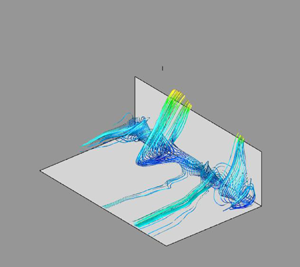
We consider the direct numerical simulation of the flow over a forward-facing step protruding in a turbulent boundary layer. Proper orthogonal decomposition (POD) is applied to the velocity field in different regions using Fourier modes in the spanwise direction. The upstream flow is characterized by a structure with a spanwise modulation of the order of the step height, the origin of which is consistent with a centrifugal instability. The structure is associated with ejections over the step of low-speed fluid from the upstream recirculation, and organized into streaks through the action of strong spanwise motions along the step face. The spanwise-averaged instantaneous momentum deficit created by the ejections is directly related to the maximal shear rate at the edge of the step, and is well correlated with the dynamics of the downstream recirculation. The most energetic patterns consist of three-dimensional motions with a large spanwise wavelength located in the shear layer developing at the edge of the step, as well as two-dimensional fluctuations downstream of the reattachment. A linear model based on the interaction of the mean flow with the dominant POD modes is able to recover the main frequencies of the fluctuations at these wavenumbers. Including the time variations of the ejections into the model yields temporal spectra that resemble qualitatively those computed from the simulation. The results suggest that the global dynamics of the flow are at least partly driven by linear mechanisms and depend on the characteristic structure identified in the upstream region close to the step.

Information

Type
JFM Papers
Copyright
© The Author(s), 2024. Published by Cambridge University Press

Access options

Get access to the full version of this content by using one of the access options below. (Log in options will check for institutional or personal access. Content may require purchase if you do not have access.)

Article purchase

Temporarily unavailable