



Dietary intakes during childhood may have many short- and long-term impacts on health, including obesity risks during childhood( Reference Karnik and Kanekar 1 , Reference Gupta, Goel and Shah 2 ). Childhood obesity is a serious public health problem that needs to be addressed urgently( Reference Wang and Lobstein 3 ), because it leads to several medical and psychosocial health problems in children( Reference Gupta, Goel and Shah 2 , Reference Nguyen and El-Serag 4 ). Moreover, overweight/obesity developed during childhood will continue into adulthood, and will be associated with risks for other diseases such as diabetes, arterial hypertension, coronary artery disease, and fatty liver disease( Reference Barton 5 ). At least one factor in the tracking of obesity from childhood into adulthood may be the fact that some eating habits developed during childhood eventually become lifelong dietary habits( Reference Wang, Bentley and Zhai 6 ).
Obesity is caused by a set of complex interactions between the environment, genetic predisposition, and human behaviour( Reference Nguyen and El-Serag 4 ). Among them, diet is an important factor. Although dietary factors have been implicated in the development of obesity, this relationship is complex and poorly understood( Reference Popkin, Adair and Ng 7 ). Traditional dietary analyses have focused merely on the relationship between individual nutrients or foods and obesity, which has certain limitations( Reference Bray, Paeratakul and Popkin 8 – Reference Hu 11 ). Dietary pattern analysis has emerged as an alternative, holistic dietary approach( Reference Van Horn 12 ). Dietary patterns may be more informative for investigating diet–disease relationships than consumption of individual foods or nutrients, as they consider total dietary intake and the co-linearity between many foods and nutrients, as well as the potentially synergistic effects of foods and nutrients( Reference Hu 11 – Reference Kant 14 ).
As in many other countries, nutrition transition is an ongoing phenomenon in China( Reference Popkin 15 ). For Chinese children and adolescents, urbanisation and modernization have resulted in improvement in nutritional status, with declines in under-weight and stunting( Reference Dearth-Wesley, Wang and Popkin 16 , Reference Wang, Popkin and Zhai 17 ). But China faces a significant and rapidly growing epidemic of overweight/obesity in children and adolescents( Reference Yu, Han and Chu 18 , Reference Gordon-Larsen, Wang and Popkin 19 ). Several studies have shown associations of childhood obesity with specific dietary patterns such as western eating patterns with increased consumption of sweet foods, animal foods, snacks, low-fibre and high-fat diets and dieting, although the results have been inconsistent( Reference Shin, Oh and Park 20 – Reference Oellingrath, Svendsen and Brantsaeter 24 ). But some of these findings may not especially be applicable to Chinese children due to cultural factors affecting intakes.
To fill such gaps in the literature, the present study aimed to identify the prevailing dietary patterns in Chinese children and their associations with childhood obesity.
Methods
Study population
We used for the present investigation the data of the China Health and Nutrition Survey (CHNS) 1989–2011 that was designed to examine how the social and economic transformation in China has affected the health and nutritional status of the Chinese population( Reference Popkin, Du and Zhai 25 ). The CHNS covers twelve provinces that vary in demography, geography, economic development, and public resources. A multistage, random cluster approach was used to draw the sample surveyed in each of the provinces. The present analysis was confined to the survey conducted in 2011. Participants with energy intake 33 MJ/d (>8000 kcal/d) or 17 MJ/d ( < 400 kcal/d) were excluded from the analysis. There were 1282 children and adolescents (boys = 645, girls = 637) aged 7 to 17 years with complete demographic and dietary data. All subjects' parents gave written informed consent for their children's participation in the survey. The study was approved by the Institutional Review Committees of the University of North Carolina at Chapel Hill and the National Institute of Nutrition and Food Safety, Chinese Center for Disease Control and Prevention.
Measures of dietary intakes
Dietary intake at the individual level was assessed by using three consecutive 24-h dietary recalls (two weekdays and one weekend day) in each wave of the CHNS. Interviewers were trained on using standard forms for administering the 24-h dietary recalls with food models and picture aids in the household interview. The participants, except children aged younger than 12 years, were asked to report the kinds and amounts of food and beverage items that they consumed both at home and away from home on a 24-h recall basis. For children younger than 12 years, the mother or a mother substitute who handled food preparation and feeding in the household was asked to recall the children's food consumption( Reference Zhai, Du and Wang 26 ). The average intakes of the three 24-h recalls were used for each individual.
Other relevant variables
Children' sex, age, urban–rural status, and annual household income were the other details collected through the use of a general information quetionnnaire with the help of mother or a mother substitute. Anthropometrical measurements were conducted by well-trained health workers who followed a reference protocol recommended by the WHO( 27 ). BMI was calculated using height and weight measures. Considering the differences in body composition across different ethnic groups, the Working Group for Obesity in China organized by the International Life Science Institute Focal Point in China conducted an analysis of BMI of children and adolescents aged 7–18 years. A new BMI classification reference was recommended by the Working Group for Obesity in China in 2004. Overweight was defined as BMI >85th percentile but ≤ 95th percentile, relative to sex and age, whereas obesity was defined as BMI >95th percentile( 28 ). This standard is the most appropriate one and has been applied extensively in recent years.
Statistical analysis
First, we conducted factor analysis (principal component) to derive food patterns based on the twenty food groups from the China Food Composition data (Appendix 1). Mean intake (g/d) was used as the input value in the analysis. The factors were rotated by an orthogonal transformation (Varimax rotation function in SAS) to achieve a more simplistic structure with greater interpretability. In considering the number of factors to retain, we evaluated eigenvalues (>1), the scree plots, and the interpretability of the factors to determine which set of factors can most meaningfully describe distinct food patterns. From these analyses, the three-factor solution was selected. Items were retained in a factor if they had an absolute correlation ≥ 0·25 with that factor. Factor loadings were calculated for each food group across the three factors. A factor score was calculated for each subject for each of the three factors, in which intakes of twenty food groups were weighted by their factor loadings and summed( Reference Kim J-O 29 ). Quartiles were categorized across the score of each dietary pattern based on the distribution in the whole population, and used for comparison of nutrient intake and other lifestyle factors.
Logistic regression analysis was used to assess the association between obesity risks and identified dietary patterns. Multivariate adjusted OR were calculated by adjusting for potential risk factors of obesity including age, sex, living area, physical activity, annual household income, and total energy intake. The linear trend of association was assessed by a logistic regression model assigning median scores to each quartile for each dietary pattern. We also fit linear regression analysis to test the association between the dietary pattern scores and BMI.
All statistical analyses were performed using the SAS software package (version 9.2; SAS Institute, Inc.). Statistical significance was defined as P< 0·05.
Results
Dietary patterns
Factor analysis revealed three dietary patterns: modern, traditional north and traditional south. The factor loadings of each pattern after orthogonal rotation are shown in Table 1. These three factors explained 27·6 % of the variance in total food intake. The modern pattern (Factor 1) was highly correlated with intake of milk, fast foods, eggs, other livestock meat, poultry, and cake. The traditional north pattern (Factor 2) was characterized by high intakes of wheat flour products and other cereals, combined with low consumption of rice, pork, and poultry, and represented atypical traditional diet in the north of China. The third factor, the traditional south pattern, represented a typical traditional diet in the south of China, characterized by high intakes of vegetables, rice, pork, and legumes.
Factor-loading matrix for the three dietary patterns and their food or food groups in Chinese children*
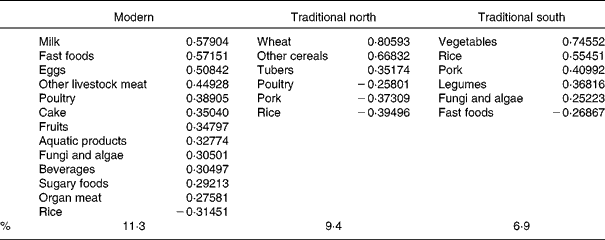
* Absolute values < 0·25are not presented in the table.
Association of dietary patterns with sociodemographic characteristics
The characteristics of Chinese children and adolescents across quartiles of the dietary pattern scores are presented in Table 2. Two of the three dietary patterns were associated with the participants' age. Children with high scores for the modern and southern patterns (P< 0·0001) were older. The modern pattern and southern pattern showed sex differences, with male subjects more likely to have high scores. Children with high scores for the modern pattern were more likely to be living in urban areas. Children with high scores for the northern pattern were more likely to be obese. Overweight and obesity increased across the quartile categories of the modern pattern (P= 0·0002, 0·0005). However, no association was found between the southern pattern and the prevalence of overweight and obesity.
Characteristics of Chinese children and adolescents according to quartiles (Q) of the three dietary patterns in China (Mean values and standard deviations, and percentages)

* P for trend was calculated from a linear regression analysis for continuous variables and Mantel-Haenszel χ2 for categorical variables.
Association of dietary patterns with nutrient intakes
Children with higher scores for the modern pattern had higher intakes of energy and a higher percent of energy from fats, fibre, Ca and Fe (Table 3). Higher scores for the northern pattern were associated with higher intakes of percent energy from carbohydrates, vitamin C, fibre and Fe, and lower intakes of percent energy from fats and vitamin A. Higher scores for the southern pattern were associated with higher intakes of energy, Fe, vitamin A, vitamin C, fibre and Ca, as well as lower intakes of percent energy from fats.
Total energy and nutrient intakes across quartiles (Q) of three dietary patterns in Chinese children† (Mean values with their standard errors)

* Mean value was significantly different (P< 0·05).
† Adjusted for age and sex for energy and age, sex and total energy for other nutrients.
Association of dietary patterns with BMI
In the modern pattern, participants in the upper quartile had a significant increase in BMI (β = 1·60 862, 95 % CI 1·04 172, 2·17 552; P for trend < 0·0001) (Table 4). In the traditional north pattern, participants in the upper quartile had an increase in BMI (β = 1·08 382, 95 % CI 0·55 900, 1·60 863; P for trend < 0·0001) when we used dietary pattern scores as categorical variables (quartiles) in the multivariate linear regression models.
Multivariate linear regression model to evaluate the effect of dietary pattern scores on BMI in Chinese children* (β Coefficients and 95 % confidence intervals)
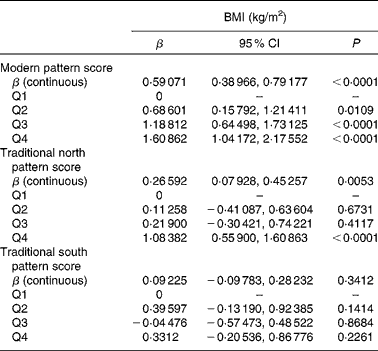
Q, quartile.
* Adjusted for age (continuous) and sex (male/female), living area (urban/rural), annual household income per family member (continuous), physical activity (continuous).
Association of dietary patterns with childhood obesity
Regression results of the association between the dietary patterns and obesity are shown in Table 5. After adjusting for confounders, children in the highest quartiles of the modern pattern score were more likely to be obese (OR 3·10, 95 % CI 1·52, 6·32). The likelihood of being obese was higher among those in the upper quartile compared to the lowest quartile (OR 2·42, 95 % CI 1·34, 4·39) within the northern pattern. The OR for obesity was significantly higher according to quartile categories for the modern pattern (P for trend = 0·0024) and the traditional north pattern (P for trend = 0·0060) after adjustments for age, sex, living area, physical activity, annual household income per family member, and energy intake. However, there was no significant association between the southern pattern and obesity.
Association of dietary patterns with childhood obesity in China (Odds ratios and 95 % confidence intervals)
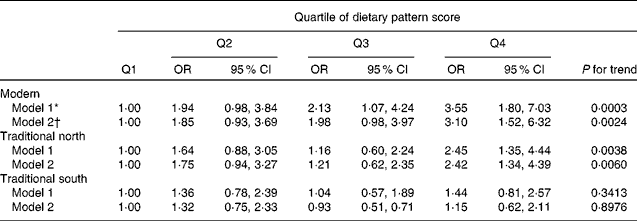
Q, quartile.
* Model 1: adjusted for age (continuous) and sex (male/female), living area (urban/rural), annual household income per family member (continuous), physical activity (continuous).
† Model 2: Model 1 additionally adjusted for total energy intake (continuous).
Discussion
We identified three distinct dietary patterns: the modern pattern, a traditional north pattern, and a traditional south pattern. The present study found that modern and northern patterns were positively associated with the risks of obesity after adjustments for putative risk factors. These results suggest that such dietary patterns are independently associated with obesity in Chinese children and adolescents.
It is difficult to compare these findings with earlier studies due to differing cultural and geographic factors and study methods( Reference Lioret, Touvier and Lafay 30 ). However, the patterns we identified showed some similarities with other studies among children and adolescents. For example, the modern pattern is comprised of more energy and fat. Dietary fat provides the greatest amount of energy per g, foods high in fat are generally high in energy density, and so the modern pattern represented an energy-dense diet. A review recently concluded that energy-dense diets are a risk factor for obesity in children( Reference Perez-Escamilla, Obbagy and Altman 31 ). Some other studies have reported similar dietary patterns characterized by high intakes of energy and fat, such as the western, snacking, and junk/convenience patterns, even though the food items comprising these patterns were different( Reference Ambrosini 32 ).
The modern pattern identified in the present study had high loadings mostly for convenience/snacking foods, including milk, fast foods, and eggs. Since 2004, a marked transition in snacking behaviors and patterns has occurred, with significant increases in the prevalence of snacking, the number of snacking occurrences in a day, and the contribution of snacks to total energy intake. Chinese children and adolescents are experiencing a dramatic increase in snacking( Reference Wang, Zhai and Zhang 33 ).
Milk consumption has been observed to be inversely associated with body mass or fat mass in cross-sectional studies of children and adolescents( Reference Barba, Troiano and Russo 34 , Reference Novotny, Daida and Acharya 35 ). But we found that children in the highest quartiles of the modern pattern tended to be obese compared to their counterparts in the lowest quartile. It may be due to the other food items of this pattern, such as fast foods. Although more research needs to be conducted specifically in regard to the effects of fast foods on health, public health recommendations presently include the need to limit fast food consumption( Reference Rosenheck 36 ).
The northern and the southern patterns had strong positive correlations with foods that are traditional in China. In the north of China, people are more likely to eat foods made from wheat flour like noodles and buns. However, the people in southern China prefer dishes with rice, vegetables, and pork. We therefore labeled these two patterns as ‘traditional patterns’ that were similar to the dietary patterns of Chinese adults( Reference Wang, He and Li 37 ). Besides, the prevalence size of obesity varies from region to region in China. Our analysis showed that the prevalence of obesity was 13·9 and 5·8 % in the north and south, respectively.
Following a traditional north consumption pattern, children in the upper quartile had a significantly higher likelihood of being obese compared to the lowest quartile. Compared with the staple food of rice, wheat absorbs less water when cooked( Reference Shi, Taylor and Hu 38 ). So the energy density of the traditional north pattern is higher than the traditional south pattern. It shows that high energy-dense diets are related to obesity( Reference Prentice and Jebb 39 ).
One characteristic of the northern pattern is high carbohydrate intake. To date, the mechanism underlying the carbohydrate-induced risk for obesity is still unclear. It is likely that carbohydrate intake may alter lipid profiles, such as an increase in TAG and/or a decrease in HDL-cholesterol, leading to increased obesity( Reference Mittendorfer and Sidossis 40 ). Further studies are needed to elucidate a detailed mechanism.
In China, the northern diet is simple and has less diversity, mainly including wheat noodles, dumplings, steamed buns and flat cakes. So the northern pattern included lower levels of micronutrients, that is, it represented a low nutrient-dense diet. Micronutrients like Fe, vitamin C, and vitamin A may play an important role in fat deposition and the pathogenesis of obesity( Reference Garcia, Ronquillo and Caamano Mdel 41 ). Low nutrient-dense diets appear to favour the development of central nervous system insulin resistance, which might in part be responsible for leptin resistance, which, accordingly, promotes pleasurable responses to foods( Reference Isganaitis and Lustig 42 , Reference Garcia, Long and Rosado 43 ). However, the association between dietary patterns and obesity in the present study cannot be fully explained by the nutrient-density issue.
We are aware that the presesnt study has several limitations. First, the results do not show the ‘cause and effect’ relationship between dietary patterns and risk of obesity, as the investigation is based upon cross-sectional data. Second, the statistical methods used to define the dietary patterns are somewhat subjective, including the consolidation of food items into food groups, the number of factors to extract, and the labelling of the pattern( Reference Martinez, Marshall and Sechrest 44 ). Third, dietary patterns could vary among studies because of diverse ethnicities/cultures or objectives of study. It is difficult to compare findings of the present study with those of others. Fourth, the 24-h dietary recall method cannot reliably evaluate usual dietary intake.
Despite these limitations, this is the first study to reveal the relationships between dietary patterns and risk of obesity in Chinese children and adolescents, using large survey data. In 2011, the three largest municipal cities (Beijing, Shanghai, and Chongqing) were added to the study. Thus, the 2011survey included twelve primary sample units consisting of individual provinces or autonomous cities. Because of the greater inclusivity of the data, the present study was useful in providing a better understanding of the dietary habits of the children and adolescents in China.
Conclusion
The present study indicates that childhood obesity is associated with dietary patterns in China; in particular, the modern dietary pattern and traditional north dietary pattern were positively associated with obesity risk. These findings, we hope, will be of some help in developing future childhood obesity interventions. However, further studies are needed to understand more objectively the relationship between dietary patterns and obesity using prospective data.
Acknowledgements
This research was supported in part by the National Institutes of Health (NIH), by grant number U54HD070725 from the Eunice Kennedy Shriver National Institute of Child Health & Human Development (NICHD). The U54 project is co-funded by the NICHD and the NIH Office of Behavioral and Social Sciences Research (OBSSR). The NIH U54 center grant funded three key research projects including one in China, the only international project, and Y. W. is the principal investigator (PI) and H. W. is the co-PI. H. W. is the original PI of the U54 grant. The present research used data collected in the CHNS. The authors are grateful to the participants for their involvement in the survey. The authors also thank the team at National Institute for Nutrition and Health, Chinese Center for Disease Control and Prevention, and the Carolina Population Center, University of North Carolina at Chapel Hill. The CHNS data collection was in part funded by research grants from the NIH (R01-HD30880, DK056350, R24 HD050924, and R01-HD38700) and the NIH Fogarty International Center. The content of the paper is solely the responsibility of the authors and does not necessarily represent the official views of the funders.
The authors declare that there are no conflicts of interest.
The authors' contributions are as follows: J. G. Z. conducted data collection, data management, statistical analysis and interpretation, manuscript design and writing. H. W. conducted data collection and data management, and advised on statistical analysis. F. Z. was primarily responsible for the supervision of the CHNS. Y. W. and H. X. contributed to data analysis and critical revisions of the manuscript. Z. W., W. D. and C. S. contributed to data collection and editing of the final version of the manuscript. J. Z. and H. J. revised the manuscript. B. Z. the corresponding author, had the primary responsibility for the final content. All authors read and approved the final manuscript.
Appendix 1 Food groups in the factor analysis



