


Introduction
The tiger Panthera tigris is an umbrella species for the protection of biodiversity in forested ecosystems in Asia (Dinerstein et al., Reference Dinerstein, Loucks, Wikramanayake, Ginsberg, Sanderson and Seidensticker2007). Despite various efforts to protect tigers by range states and global conservation partners, their numbers declined by > 96% during 2000–2010 (GTRP, 2010). The decline has been caused by illegal trading of tiger parts, habitat loss, loss of prey species, and conflict with humans over livestock. During 1996–2006 the species’ range was reduced by 41% (Dinerstein et al., Reference Dinerstein, Loucks, Wikramanayake, Ginsberg, Sanderson and Seidensticker2007), and a scenario projecting habitat loss in Tiger Conservation Landscapes suggests a possible further reduction of 43% during the coming decade (Wikramanayake et al., Reference Wikramanayake, Dinerstein, Forrest, Loucks, Seidensticker, Klenzendorf, Tilson and Nyhus2010).
Tigers are charismatic animals and are the focus of human attention for many reasons. They compete and conflict with humans for food and space and have done so across both evolutionary and historical time scales (Inskip & Zimmermann, Reference Inskip and Zimmermann2008). Cultural perceptions of tigers are shaped by factors as diverse as fear, admiration and superstition, and by the utilitarian values of meat, pelts and tourism potential. Thus, because of the tiger's cultural and utilitarian value, the public predominantly has a positive attitude towards tiger conservation despite the occurrence of conflict where people reside close to tiger habitat (Karanth & Chellam, Reference Karanth and Chellam2009).
Across tiger range states there remain 43 source sites, which have the potential to maintain > 25 breeding females. These source sites are embedded in larger landscapes with the potential to maintain > 50 breeding females. Together, these sources hold 70% of the current tiger population in a mere 6% of the recent range (Walston et al., Reference Walston, Robinson, Bennett, Breitenmoser, da Fonseca and Goodrich2010). If connectivity between adjacent tiger conservation landscapes could be created and conserved the habitat range could increase to 10% of its historical extent, from 7% in 2006 (Wikramanayake et al., Reference Wikramanayake, Dinerstein, Forrest, Loucks, Seidensticker, Klenzendorf, Tilson and Nyhus2010).
The forests of lowland Nepal and northern India were once continuous along the base of the Himalayas and supported dense populations of tigers and their prey (Seidensticker, Reference Seidensticker2010). In this area Chitwan National Park is home to one of three isolated tiger populations in Nepal (Smith et al., Reference Smith, Ahearn and McDougal1998), which has c. 3,000 km2 of tiger habitat (including Parsa Wildlife Reserve, Barandabhar buffer zone forest, Someswor forest in Nepal and Valmiki Tiger Reserve in India) and is an important source population within the Terai Arc Landscape (Walston et al., Reference Walston, Robinson, Bennett, Breitenmoser, da Fonseca and Goodrich2010).
Previous investigations of tiger status in Nepal were primarily based on radio-telemetry (Sunquist, Reference Sunquist1981; Smith, Reference Smith1993; Smith et al., Reference Smith, McDougal, Ahearn, Joshi, Conforti, Seidensticker, Christie and Jackson1999), pugmark surveys (McDougal, Reference McDougal, Seidensticker, Christie and Jackson1999) and limited camera-trap surveys (Barlow et al., Reference Barlow, McDougal, Smith, Gurung, Bhatta and Kumal2009). Although these methods can provide estimates of population size they do not deal explicitly with the two key issues of animal population estimation: incomplete spatial sampling of the area of interest and incomplete detection of animals, even within the area that is sampled. It is now recognized that population sampling approaches that deal explicitly with these problems by employing appropriate statistical models are essential for robust estimation of animal abundance (Seber, Reference Seber1982; Williams et al., Reference Williams, Nichols and Conroy2002; Thompson, Reference Thompson2004). A capture–recapture framework based on a spatially explicit approach overcomes these issues (Efford, Reference Efford2009; Royle et al., Reference Royle, Nichols, Karanth and Gopalaswamy2009; Singh et al., Reference Singh, Gopalaswamy, Royle, Kumar, Karanth and Mukherjee2010). In this study we used camera-trap-based mark–recapture in a closed-population framework to assess the tiger population in Chitwan National Park.
Study area
Chitwan National Park (Fig. 1) was the first national park established in Nepal, in 1973. It is a world heritage site and an important tiger conservation landscape (Dinerstein et al., Reference Dinerstein, Loucks, Wikramanayake, Ginsberg, Sanderson and Seidensticker2007), situated in the south central lowlands in the Inner Terai. The Park lies between the Siwalik (Churia) Outer Range and the Mahabharat Range. It is covered by forest (80%), grassland (12%), exposed surfaces (5%) and water bodies (3%; Thapa, Reference Thapa2011). The Narayani River marks the western boundary of the Park, Rapti River marks the northern boundary, Harda River and forest of the Parsa Wildlife Reserve mark the eastern boundary, and Reu River and the border with India along the Valmiki Tiger Reserve mark the southern boundary. The mean monthly maximum and minimum temperatures are 24–38 °C and 11–26 °C, respectively. For 2004–2007 the mean annual rainfall was 2,437 mm per year. More than 50 mammal species, > 526 bird species, 49 reptile and amphibian species, 156 butterfly species, and 120 fish species have been reported in the Park (Gurung, Reference Gurung1983; Edds, Reference Edds1986; BPP, 1995; Shah & Tiwari, Reference Shah and Tiwari2004; Baral & Upadhyay, Reference Baral and Upadhyay2006; Bhuju et al., Reference Bhuju, Shakya, Basnet and Shrestha2007). The major carnivore species present include tiger, leopard Panthera pardus, wild dog Cuon alpinus, jungle cat Felis chaus, fishing cat Prionailurus viverrinus, toddy cat Paradoxurus hermaphroditus, and jackal Canis aureus. Prey species include chital Axis axis, sambar Rusa unicolor, wild pig Sus scrofa, hog deer Heylaphus porcinus, barking deer Muntiacus muntjak, gaur Bos gaurus, nilgai Boselaphus tragocamelus, rhesus macaque Macaca mulatta, common langur Semnopithecus entellus, black-naped hare Lepus nigricollis, porcupine Hystrix indica, four-horned antelope Tetracerus quadricornis, one-horned rhinoceros Rhinoceros unicornis, and Asian elephant Elephas maximus.
Camera-trap stations in Churia hills and flood-plain habitat of Chitwan National Park. The rectangle on the inset indicates the location of the main map in Nepal.

Methods
The camera-trap survey was conducted in three blocks of 414–433 km2, covering a total area of 1,278 km2. Each block was camera-trapped for 19–21 days between 20 January and 22 March 2010. Camera-trapping was employed (Karanth, Reference Karanth1995; Karanth & Nichols, Reference Karanth and Nichols1998; Karanth et al., Reference Karanth, Bhargav and Kumar2001; O'Brien et al., Reference O'Brien, Kinnaird and Wibisono2003; Kawanishi & Sunquist, Reference Kawanishi and Sunquist2004; Wegge et al., Reference Wegge, Odden, Pokhrel and Storaas2009) to estimate the tiger population in a closed-population framework (Otis et al., Reference Otis, Burnham, White and Anderson1978; White et al., Reference White, Anderson, Burnham and Otis1982). Between 7 December 2009 and 6 January 2010 we conducted a preliminary sign survey in the Churia region by walking most of the available trails, ridges and river beds. We selected potential sites for cameras along sections of the trail or river bed with tiger signs (pug marks, scats, scrapes, claw marks), in passages between hills, and on narrow trails leading to ridge lines from river beds or valleys. We plotted these sites and similar sites identified in previous camera-trapping surveys in the flood plain (Karki et al., Reference Karki, Jnawali, Shrestha, Pandey, Gurung and Thapa (Karki)2009), along with altitude, aspect and substrate, in a geographical information system. The final selection of camera locations was based on adequate trap spacing, ease of access, availability of camping sites and a sampling effort that covered all areas where tigers were likely to occur (Karanth & Nichols, Reference Karanth and Nichols2002).
We identified 310 camera-trap locations, with a spacing of 1.5–2 km (Wegge et al., Reference Wegge, Pokharel and Jnawali2004), following guidelines for survey design (Karanth & Nichols, Reference Karanth and Nichols1998, Reference Karanth and Nichols2002; Karanth et al., Reference Karanth, Bhargav and Kumar2001) and considering the results of our sign survey. The Park and Barandabhar buffer zone forest were divided into three blocks to cover the 310 sites, with 107 pairs of camera traps. Cameras traps were deployed for a total of 62 days, with 21 days and 98 traps in block I, 19 days and 107 traps in bock II and 22 days and 105 traps in block III. Each sampling event (Otis et al., Reference Otis, Burnham, White and Anderson1978) was for a duration of 24 hours, except at nine sites in block III, where sampling was for 16 hours (16.00–08.00). Moultrie (Moultrie Feeders, Alabaster, USA) and Stealth Cam (Stealth Cam, Bedford, USA) camera traps were checked once every 2–3 days and Trail Master TM1550 cameras (Goodson Associates Inc. Kansas, USA) were checked every day. Memory cards were viewed at the site during every visit and were replaced if a tiger was recorded, to minimize the loss from damage by wild elephants or theft by poachers. Photographic films were sent for processing and scanning and a digital ID was prepared for all digital photographs.
Ninety-seven photographs of both sides of an animal and 76 left-flank photographs were used to identify individual tigers from their unique stripe patterns (Karanth & Nichols, Reference Karanth and Nichols1998). Identification was carried out individually by three trained personnel, who then reached a consensus on the identity of each tiger.
We developed capture histories (Otis et al., Reference Otis, Burnham, White and Anderson1978; Nichols, Reference Nichols1992) on the basis of the stripe patterns (Schaller, Reference Schaller1967; McDougal, Reference McDougal1977; Karanth, Reference Karanth1995). The tiger population was estimated in a closed-population mark–recapture framework in CAPTURE (Rexstad & Burnham, Reference Rexstad and Burnham1991). CAPTURE uses a series of discriminant function tests to compare the null (Mo), time effects (Mt), behaviour effects (Mb) and individual heterogeneity (Mh) models, and combinations of these, and rate them on a relative scale of 0 to 1.
We used two approaches to estimate tiger density: (1) the traditional approach of adding a buffer width of half the mean maximum distance moved (1/2 MMDM) by recaptured tigers to the camera-trap polygon to estimate the effectively sampled area (Karanth & Nichols, Reference Karanth and Nichols1998), and (2) a spatially explicit approach developed by Efford (Reference Efford2009) and Royle et al. (Reference Royle, Nichols, Karanth and Gopalaswamy2009) that estimates density directly from spatial capture histories of individual animals without the need for an ad hoc method of determining the effectively sampled area. These spatially explicit analyses were carried out using DENSITY (Efford, Reference Efford2009) and SPACECAP (Singh et al., Reference Singh, Gopalaswamy, Royle, Kumar, Karanth and Mukherjee2010). A habitat mask that removed non-tiger habitat from the sampled area was applied to both approaches for estimating tiger density.
Results
We identified 62 tigers (15 male, 41 female and six whose sex could not be determined) from 314 exposures, with a trapping effort of 3,920 trap days. New individuals continued to be photographed until the 21st day after camera installation. Tigers were photographed at 106 sites, including 23 locations in the Churia hills (Fig. 1).
CAPTURE selected the jackknife model (Mh) as the best fit. There was heterogeneity in trapping probabilities (Mo vs Mh; χ 2 = 51.655, df = 3, P < 0.001). As our sampling duration was short (62 days) in comparison to the lifespan of tigers, we could therefore assume demographic closure. We could also reasonably assume geographical closure over this short sampling duration as we camera-trapped the entire habitat occupied by tigers in this landscape.
The model Mh estimated a mean capture probability of 0.057 and the population size ( $\hat N$
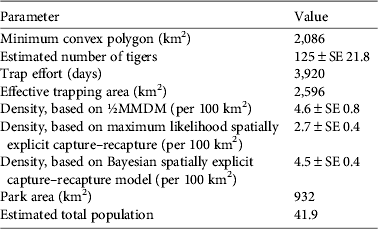
) was estimated to be 125 ± SE 21.8 tigers (95% CI 95–183). The effectively sampled area with habitat mask was estimated to be 2,596 km2 by the 1/2 MMDM method and the tiger density was estimated to be 4.6 ± SE 0.84 tigers per 100 km2, whereas SPACECAP estimated the tiger density to be 4.5 ± SE 0.4 tigers per 100 km2 and DENSITY estimated 2.3 ± SE 0.32 tigers per 100 km2 (Table 1). There was a clear gradient in tiger density, with a higher density in the flood plain habitat compared to the Churia hills (Fig. 2).
$\hat N$
) was estimated to be 125 ± SE 21.8 tigers (95% CI 95–183). The effectively sampled area with habitat mask was estimated to be 2,596 km2 by the 1/2 MMDM method and the tiger density was estimated to be 4.6 ± SE 0.84 tigers per 100 km2, whereas SPACECAP estimated the tiger density to be 4.5 ± SE 0.4 tigers per 100 km2 and DENSITY estimated 2.3 ± SE 0.32 tigers per 100 km2 (Table 1). There was a clear gradient in tiger density, with a higher density in the flood plain habitat compared to the Churia hills (Fig. 2).
Tiger density in the Churia hills and lowland habitat in Chitwan National Park.

Parameters for our survey of the tiger Panthera tigris population in Chitwan National Park, Nepal (Fig. 1), with minimum convex polygon, number of tigers estimated by a capture–mark–recapture model with time variation, trap effort, effective trapping area based on half the mean maximum distance moved, density estimates from various models, Park area, and estimated total population.
Discussion
Capture–recapture analysis using camera-trap photographs has been used in other studies to estimate tiger density in India (Jhala et al., Reference Jhala, Qureshi and Gopal2011a,Reference Jhala, Qureshi, Gopal and Sinhab; Karanth, Reference Karanth1995; Karanth & Nichols, Reference Karanth and Nichols1998, Reference Karanth and Nichols2000, Reference Karanth and Nichols2002; Karanth et al., Reference Karanth, Nichols, Kumar, Link and Hines2004a,Reference Karanth, Chundawat, Nichols and Kumarb), Nepal (Wegge et al., Reference Wegge, Pokharel and Jnawali2004, Reference Wegge, Odden, Pokhrel and Storaas2009; Barlow et al., Reference Barlow, McDougal, Smith, Gurung, Bhatta and Kumal2009), Indonesia (O'Brien et al., Reference O'Brien, Kinnaird and Wibisono2003), and Bhutan (Wang & McDonald, Reference Wang and Macdonald2009). However, this study has invested one of the largest sampling efforts, involving 4,793 camera-trap nights and covering an entire tiger-occupied landscape in Nepal. This high sampling effort has yielded reasonable capture rates, given the medium density of tigers.
There has been a general tendency to use 10–15-day trapping sessions in camera-trap surveys of tigers in India (Chauhan et al., Reference Chauhan, Harihar, Goyal, Qureshi, Lal and Mathur2005; Harihar et al., Reference Harihar, Pandav and Goyal2006) and Nepal (Mishra et al., Reference Mishra, Karki, Pokharel and Thapa2008; Karki et al., Reference Karki, Jnawali, Shrestha, Pandey, Gurung and Thapa (Karki)2009; Wegge et al., Reference Wegge, Odden, Pokhrel and Storaas2009). We used trapping sessions of 19–21 days in three blocks. Three, four, one, two and one new tigers were photographed on the 17th, 18th, 19th, 20th and 21st days of a session, respectively, which suggests that longer sessions may be needed to obtain sufficient recaptures for precise results, particularly in mixed terrain such as that of Chitwan, with undulating hills and tall grassland flood plains. Longer sessions were not possible in our study because of the limited number of cameras (107 pairs) and the size of the landscape being sampled. We circumvented this limitation by sampling smaller blocks of habitat for shorter duration, to ensure population closure. Ideally the entire landscape would be camera-trapped simultaneously, with more cameras and sessions.
We estimated a population of 125 tigers, with a density of 4.5 per 100 km2, in Chitwan. This is the highest estimate of tigers so far in the Park and compares to estimates of 26–36 in 1978 (Tamang, Reference Tamang1982), 65 in 1987 (Smith et al., Reference Smith, Wemmer, Mishra, Tilson and Seal1987), 50 in 1998 (Smith et al., Reference Smith, Ahearn and McDougal1998), 38 in 2000 (KMTNC/NCRTC, 2001), and 91 in 2009 (Karki et al., Reference Karki, Jnawali, Shrestha, Pandey, Gurung and Thapa (Karki)2009). All of these earlier studies estimated tiger numbers and densities in small areas of the Park and are therefore only partly comparable to our study, which covered the entire Park. Tiger densities reported for Chitwan have been lower than those reported for similar habitats in India. Corbett and Kaziranga Tiger Reserves in India are comparable tiger habitats to Chitwan in terms of habitat, prey availability and topography but the tiger densities reported for both these reserves are 3–5 times higher than that observed in Chitwan (Jhala et al., Reference Jhala, Qureshi and Gopal2011a,Reference Jhala, Qureshi, Gopal and Sinhab). The lower density of tigers in Chitwan is probably a result of prey depletion by subsistence and illegal poaching of tigers during the political insurgency of 1996–2006. There has been a reduction in wildlife crime since the end of this period of political unrest, as a result of improved cooperation between police, the Forest Department, national and international NGOs, local communities and district administration. Improved law enforcement and enhancement of prey species (perhaps with the reintroduction of locally extinct species such as water buffalo Bubalis bubalis arnee and swamp deer Cervus duvauceli duvauceli) could potentially result in recovery of the tiger population to match densities observed in comparable habitats in India.
A study conducted on the periphery of Chitwan National Park suggests that tigers can coexist with humans at fine spatial scales (Carter et al., Reference Carter, Shrestha, Karki, Pradhan and Liu2012). Our data, which cover the entire Park, including the study site of Carter et al. (Reference Carter, Shrestha, Karki, Pradhan and Liu2012), suggest that tigers and humans often co-occur on the periphery of large tiger-occupied areas, the cores of which are devoid of human settlements. This is the basic concept of zonation and management of protected areas for tigers: core areas are maintained free of human settlements to foster high tiger densities and in buffer zones spill-over tigers coexist with humans (Fig. 2). Buffer zones are managed to minimize land uses that are not compatible with the conservation objective of the protected area. However, it seems unlikely that areas of tiger–human coexistence would arise independently, without a human-settlement-free core zone that harbours a large source population of tigers (Gopal et al., Reference Gopal, Sinha, Mathur, Jhala and Qureshi2007).
Twelve tigers (five female, three male and four whose sex could not be determined) were photographed exclusively in the Churia hills, indicating that this area, although it has a lower tiger density than the floodplain habitat (Fig. 2), is an important tiger habitat. Churia experiences low disturbance by humans and is therefore a comparatively less disturbed habitat for wild prey species such as sambar, wild pig, chital, barking deer, serow Capricornis thar, goral Naemorhedus goral, and gaur. It has a cooler microenvironment during the summer, and water is available from perennial rivers, making the habitat suitable for tigers and their prey. Chitwan National Park is an important source of tigers in the Eastern Terai Arc complex, from where tigers disperse south to Valmiki Tiger Reserve in India (Jhala et al., Reference Jhala, Gopal and Qureshi2008, Reference Jhala, Qureshi, Gopal and Sinha2011b; Sharma et al., Reference Sharma, Stuckas, Bhaskar, Khan, Goyal and Tiedemann2011), east to Parsa Wildlife Reserve, and west to the Dumkibash forest of Nepal. The Churia hills are the conduit for these dispersing tigers, providing rugged vegetated terrain, with prey and water, that forms ideal corridor habitats. The Churia hills also provide space for the expanding tiger population of Chitwan National Park. A landscape that provides a large area for tigers is important for its long-term persistence (Walston et al., Reference Walston, Robinson, Bennett, Breitenmoser, da Fonseca and Goodrich2010; Wikramanayake et al., Reference Wikramanayake, Dinerstein, Seidensticker, Lumpkin, Pandav and Shrestha2011). The existing continuous tiger habitat, encompassing Chitwan, Parsa, Barandabhar, Someswor and Valmiki (Fig. 1), covers an area of c. 3,000 km2. This population, if managed through transboundary initiatives with India, could ensure long-term persistence of tigers for the entire landscape and assist in the goal of doubling tiger numbers globally by 2020 (GTRP, 2010).
The information generated from this survey will serve as a basis for future population monitoring and management planning and will facilitate objective assessment of the effectiveness of conservation interventions. A press release issued by the Department of National Parks and Wildlife Conservation on 29 July 2013 reported 120 individual tigers (95% CI 98–123), with a density of 3.84 tigers per 100 km2, which is close to our findings in 2009.
Acknowledgements
Funding for this study was provided by the Save the Tiger Fund, the US Fish and Wildlife Service, WWF–US, WWF–UK and WWF–International. The field work was jointly undertaken by the Department of National Parks and Wildlife Conservation, the National Trust for Nature Conservation and WWF–Nepal. We acknowledge personnel from Chitwan National Park and the Nepalese Army, nature guides, university and local volunteers, Terai Arc Landscape, National Trust for Nature Conservation–Biodiversity Conservation Centre and domestic elephant staff engaged in the survey, concessionaire hotels in the Park, and local people for their assistance with this project.
Biographical sketches
Jhamak B. Karki has served 23 years in protected-area conservation and management within the Department of National Parks and Wildlife Conservation in Nepal. B. Pandav is a tiger expert, with research interests in tiger, prey and landscape management. S. R. Jnawali managed field programmes for Nepal's National Trust for Nature Conservation for over 2 decades. R. Shrestha was a conservation biologist and worked in Nepal and the Eastern Himalayas. N. M. B. Pradhan is a conservation biologist and has served more than 2 decades in the Department of National Parks and Wildlife Conservation, managing protected areas. B. R. Lamichane has been actively engaged in research implementation activities for Chitwan National Park. P. Khanal works on biodiversity conservation and livelihood improvement programmes in Nepal. N. Subedi runs biodiversity research and monitoring programmes in Nepal's Terai region. Y.V. Jhala coordinates the implementation of tiger monitoring studies for the Government of India.



