

Introduction
Social cooperation and coordination have been key topics of discussion in the social sciences since the days of Adam Smith, at least. In turn, a central concern at the heart of these discussions is conflicts of interest (COI): different individual agents are assumed to have interests that are not fully aligned, and they thus face the problem of whether and how to cooperate and coordinate their actions.
However, as this paper shows, this purely individualistic view of COI overlooks an important version of this kind of problem: that involving at least some non-individualist social entities (NISE). It is not just the case that individual economic agents need to balance their interests against each other – they also need to do so against non-individualist entities, such as social institutions, norms, or social collectives (on the metaphysics of social institutions, see Guala, 2016; Searle, Reference Searle2005; Searle, Reference Searle1995). In these cases, the issue is not that different individuals disagree with each other; rather, the issue is that the individuals disagree with an entity – a firm or social institution, say – as a whole. In what follows, such entities are called ‘non-individualist social entities’ (NISE). In short, COI seem to be able to also occur with NISE.
This is important to note, as it makes the existing, individualistic treatments of the problem of COI inapplicable. With NISE, it is not so easy to see what their interests could be – hence, it is not so easy to see how they could disagree with an individual. Now, this may be the right conclusion to draw: perhaps the appearance of the existence of COI involving NISE is just that – an appearance. However, as the rest of this paper shows, this conclusion is unwarranted: there is a compelling, functionalist way to make sense of NISE interests. One theoretical virtue of this account is that it makes for a simple analysis of COIs between individuals and NISEs by using existing COI frameworks. In this way, it can be shown that across a number of important domains (e.g. the corporation, democracy), we already have analytical tools in our hands that can make sense of these COIs and do not need a new one. In turn, this allows us to grasp important theoretical and empirical phenomena that we would otherwise miss.
The paper is structured as follows. The section ‘Conflicts of interest, the principal/agent problem, and the need to go beyond individualism’ makes the problem to be solved clearer: it is not obvious how traditional approaches towards COI will be able to deal with COI in NISE without an account of the interests of NISE. The section ‘A new approach’ develops a new account of this phenomenon by showing how ‘presentist social functionalism’ – a theory which allows the assignment of functions to social institutions – can be used to assign interests to at least some NISE. The section goes on to show how this insight can be used to generalise the principal/agent framework to allow for non-individualistic COI. The section ‘An application: an expanded taxonomy of internal conflicts in collective agents’ presents a key application of this new account of COI: an expanded taxonomy of internal conflicts in economic collectives. The section ‘Conclusion’ concludes.
Conflicts of interest, the principal/agent problem, and the need to go beyond individualism
Much work in economics (and the social sciences in general) seeks to make clear when, why, and how entities can balance their respective interests to achieve outcomes that they could not achieve on their own. Now, it is possible that these respective interests are aligned in such a way that each pursuing their own wants yields outcomes that are mutually consistent.Footnote 1 However, while in principle possible, such cases of full interest alignment are, at best, benchmarks. In most realistic cases, a divergence exists: the goals and motivations of one individual in general do not coalesce with those of others, and conflicts thus arise. This is the problem of COI: how to understand and deal with the frequent occurrence of situations where what one party aims to achieve is not fully in alignment with the goals of other parties in the society in question.
Given this very abstract statement of the problem, it is unsurprising that many different approaches have been developed to understand the many different instances of the problem of COI – from social dilemmas (Skyrms, Reference Skyrms2004) and corporate governance (Demski, Reference Demski2003) to general equilibrium models (Mas-Colell et al. Reference Mas-colell, Whinston and Green1995) and legal theory (Buchen, Reference Buchen2024; Fama and Jensen, Reference Fama and Jensen1983). For concreteness, the focus in what follows will be on ‘principal/agent problems’ (PAPs) (itself a specific instance of the large class of social dilemmas) (Grossman and Hart, Reference Grossman and Hart1983; Hart and Holmström, Reference Hart, Holmström and Bewley1987; Ross, Reference Ross1973; Skyrms, Reference Skyrms2004). However, it is important to note from the get-go that this focus is not meant to be restrictive: much of what follows can be straightforwardly extended to other models of COI. This will also be made clearer below and in section ‘An application: an expanded taxonomy of internal conflicts in collective agents’.
PAPs are situations where one individual – the principal – asks another individual – the ‘agent’ – to act on their behalf. Importantly, in these cases, there can and typically are misaligned interests. There is a lot of work, both formal and empirical, exploring this framework further. Many of these details are not central here, but it is helpful to consider the outlines of the work/shirk game briefly as a simple but telling example of this kind of framework (see also Glimcher et al. Reference Glimcher, Dorris and Bayer2005). In this game, employees can choose to work (W) or shirk (∼W); managers can choose to inspect the work of the employee (I) or trust the work (∼I). Working is costly for the employee, and they would prefer to shirk – but only if not inspected. Inspecting is costly for the manager, and they would prefer to trust the employee – but only if they are working:
This game has a mixed strategy equilibrium, where workers work with probability p = ½, and managers inspect with probability q = ½. Note that this mixed equilibrium yields strictly less utility than what the employee would have gotten if they had gotten their way (shirk and not get caught) and what managers would have gotten if they had got their way (trust and have the employee work). For present purposes, there are three key points to note about principal/agent problems like the one in Table 1.
Work/shirk game

First, while, as just noted, the PAP is just one specific approach to the problem of COI, it still needs to be recognised as a central approach towards studying COI. In particular, it theoretically isolates a paradigmatic form of COI. In PAPs, it is presumed that the parties in question need to work together; that is why there is an agent that acts on behalf of the principal in the first place. The trouble, though, is that this need for cooperation coexists with divergent interests of the parties in question. Hence, these parties (continuously) need to figure out how to balance their respective interests with the need for continued cooperation and coordination. In this way, PAPs get to the heart of what the problem of COI is like. This also explains why PAPs are good models for many empirical examples of COI. For example, in a firm, the owners and employees typically want different things (working vs. shirking, or doing work of one kind rather than another kind) or believe different things (how hard the agent works, or what work is most important to be done now). This is exactly the nature of PAPs. The same, though, goes for many contractual relationships even outside of firms: if I contract you to cut my hair, you are acting on my behalf. This can create COI – e.g. if you are interested in displaying your skill as a hairdresser, but I am interested in getting a very simple cut only. In this way, many aspects of the economy can be approached by focusing on PAPs.
Second, though, much of what follows can be generalised to other models of COI. The point in what follows is to understand what the interests of a non-individual are, so as to be able to provide a broader theory of COI. The focus on PAPs specifically is useful here, as it allows the discussion to have a depth that it would not otherwise have. However, much of what follows is easily translated into other types of situations involving COI. Indeed, section ‘An application: an expanded taxonomy of internal conflicts in collective agents’ places PAPs into a broader typology of other approaches towards COI.
Third, PAPs, as they are commonly understood, are thoroughly individualist in the sense that they concern the relationship between the interests of different individual people. As noted in the introduction, though, this overlooks an important set of COI: disagreements involving non-individual social entities (NISE). At times, an individual’s actions are constrained, not just by what other individuals want, but also by the wants of firms, government agencies, and social institutions, treated as such. Indeed, it seems there can be COI purely between different NISE – different branches of government, for example, can be constitutionally set up to have differing ‘wants’, and the same goes for different parts of firms. In what follows, such COI involving NISE will be referred to as ‘NICOI’ (non-individualistic conflicts of interest).Footnote 2 The section ‘An application: an expanded taxonomy of internal conflicts in collective agents’ will provide some further details of these cases, but for now, it is sufficient to note that, for both theoretical and empirical reasons, being able to study NICOI matters.
Theoretically, it is important to have a toolkit that is not intrinsically limited to individualist methodologies. Of course, the debate surrounding ‘microfoundations’ in economics is old and complex (Elster, Reference Elster1982; Hodgson, Reference Hodgson2007; Hoover, Reference Hoover, Ross and Kincaid2009; Hoover, Reference Hoover2010; Jones, Reference Jones1996; Langlois, 1985; Little, Reference Little1998; Ross, Reference Ross2005; Watkins, Reference Watkins1952). However, what matters here is just that it has become clear that it is implausible to think that there is a monistic resolution to this debate: individualistic approaches are plausible in some, but not all cases (Epstein, Reference Epstein2015; Ruiz and Schulz, Reference Ruiz and Schulz2023). Importantly, there is no compelling a priori reason to think that all internal conflicts fall into the former category: it is at least prima facie possible that there are internal conflicts between individuals and the larger social collective they are part of. Hence, it is important to provide a compelling theoretical grounding for instances of internal conflicts that are not purely individualistic in nature. This is especially so, since many prior treatments of these issues seem to be based only on imprecise blanket statements concerning the interests of, say, ‘the establishment’. What the rest of the paper is trying to make clear, though, is that it is possible to make a compelling, precise, and formalisable sense of NICOI.Footnote 3
Indeed, empirically, too, capturing NICOI matters, as they seem in fact quite common. The introduction has provided some examples, and sections ‘A new approach’ and ‘An application: an expanded taxonomy of internal conflicts in collective agents’ will return to these issues as well, but a particularly prominent case concerns the ‘paradox of democracy’ or the ‘paradox of liberty’ (Popper, Reference Popper1945). When all the people of a democracy agree that they no longer want to be self-governed, there is a conflict between all the people and the institution of democracy – not among individual people.Footnote 4 (We may be tempted to say this is a conflict between current members of the society and potential future people – but since the latter do not actually exist, they are not well seen as individuals in their own right.)Footnote 5 Importantly, as the below makes clearer, this is just the tip of the iceberg; once this sort of phenomena is recognised, many more instances of it become visible – with a clear instance being the case of a large, established corporation, as made clearer in section ‘A new approach’ below.
The rest of this paper will therefore fill this theoretical and empirical lacuna by developing an account that allows for NICOI. Importantly, as the rest of the paper also shows, this account can be made formally specific and integrated with the existing work on COI.Footnote 6
A new approach
Do NISEs have interests? This is a long-debated topic among philosophers and social scientists alike. In order to extend PAPs (and other kinds of COI) to cases of NICOI, we would need to be able to answer this question in the affirmative.
Now, on the face of it, it may be thought that there are individualistic ways to do just that. While it may be true that not all COI are among individuals, it might be thought that, to the extent that they are not, individuals are still the basis on which all COI rest: non-individualistic interests may be thought to be derivable from individual interests. For example, one could follow a broadly social choice-theoretic, aggregating framework, and build up the interests of the non-individual social entities from those of their members (List, Reference List2012; List and Pettit, Reference List and Pettit2011). We could say that the interest of a corporation is the average of the interests of its members. Or we could follow some classic political theory and say that the interest of a state is the majority of the interests of its citizens. Or we could (very loosely following Rawls) have it that the interest of a collective is the interest of the least advantaged of its members. Many other approaches exist as well.
However, this individualistic, social choice theoretic approach will, in general, not be adequate. First, as the history of social-political thought makes clear, it is not obvious what the right way is of aggregating interests. Since aggregation is the very nature of the individualistic accounts, this lack of agreement on the right aggregation function means that there is a major lacuna at the heart of these accounts. Second, and relatedly, it is the core insight of social choice theory that, depending on the details of the aggregation function used, many seemingly possible collective interest assignments may turn out to, in fact, be inadmissible (Arrow, Reference Arrow1951; List, Reference List2012; Sen, Reference Sen1970).
Now, these issues may be solvable: perhaps a suitable aggregation function can be found that can be defended on both social-political and social-choice-theoretic grounds. However, even this would not fundamentally alter the issues here, as there is a third problem with this individualistic aggregating approach: not all NISE are collectives with a contemporaneous membership. For example, it is not the case that individual people are parts of social institutions like democracy (Ruben, Reference Ruben1985). People can choose to follow or abide by these institutions, and these institutions depend on the fact that there are people with interests in society (Searle, Reference Searle1995; Searle, Reference Searle2005) – but people do not constitute them, in the sense that Ms Smith’s 3rd Grade Class of 2025 is constituted by all and only the students in it. Unlike spatiotemporally circumscribed entities like Ms Smith’s 3rd Grade Class of 2025, social institutions like the US democratic system extend beyond the current members of a society, and also include potential future people. Importantly, also, we cannot take the interests of these potential future people into account like we can those of actual people: potential future people do not actually exist, and thus do not have interests that could be aggregated over. As noted earlier, this can be seen as a version of the ‘paradox of democracy’: not everything ‘the people’ want is in line with what is in the interest of democracy. Because of this, the individualistic, social-choice theoretic approach is too constrained to be generally compelling.
However, how can a non-reductive, non-individualistic treatment of the interests of a social non-individualist entity be determined? In response, the rest of this section will argue that these interests are best seen to lie in the function of the NISE: what this entity is for. This is a good place to start looking for these interests, as a social entity’s purpose sets out, in some sense at least, what it would be good for the entity (whether individual or not) to be or do. The entity’s purpose describes what it ought to be or do – and being and doing what it ought to be or do is, in this general way, in its interest. To appreciate this better, two points need to be noted.
On the one hand, some account needs to be provided that explains exactly what the purpose of a NISE is. Otherwise, this would be a matter of replacing one mysterious notion – that of the interest of a NISE – with another – that of the purpose of a NISE. On the other hand, and somewhat relatedly, some reason needs to be provided for thinking that many NISEs have functions (so understood). If this were not so, we would need to conclude that many NISEs do not have interests either.
To address these points, the rest of this paper relies on a specific, recently developed account of the function (or purpose) of social institutions: Presentist Social Functionalism (PSF). To be sure, other accounts of social functionalism exist, too (Merton, Reference Merton1968; Parsons, Reference Parsons1951; Pettit, Reference Pettit1996), and much – though not necessarily all – of what follows could be reformulated with these other accounts in the background as well. The focus on PSF is helpful, though, as it (a) avoids some of the key pitfalls that have been raised concerning social functionalism in general (for discussion, see e.g. Elster, Reference Elster1982; Langlois, Reference Langlois and Langlois1985; Pettit, Reference Pettit1996; Schulz, Reference Schulz2025), and (b) this account has some important features that makes it a particularly compelling contender in the present context (Schulz, Reference Schulz2022). Indeed, as the rest of this section makes clear, this account is well placed to be extended so as to ground the interests of NISE’s.
At the heart of the presentist social functionalist account is the idea that feature F of social entity E makes for (part of) the function of E to the extent that E’s having F now supports the fact that tokens of E will continue to exist from now on into the near future.Footnote 7 This can be expressed well by borrowing concepts from evolutionary biology (which has a long history in economics and the social science in general – see e.g. Hayek, Reference Hayek1973; Hodgson and Knudsen, Reference Hodgson and Knudsen2010; Langlois, Reference Langlois and Langlois1985; Nelson and Winter, Reference Nelson and Winter2002; Schulz, Reference Schulz2020; Schumpeter, Reference Schumpeter1959; Veblen, Reference Veblen1898; Vromen, Reference Vromen, Witt and Chai2018; Witt, Reference Witt2016):
(Presentist Social Functionalism) For any feature F of social entity E that makes it more likely that E will survive or reproduce in the current socio-cultural environment, F is (part of) the function of E.Footnote 8
Put differently: the function of a social entity lies in those of its features that increase the expected reproductive or persistence success in the current socio-cultural environment of the social entity in question.Footnote 9
Note that PSF is a dynamic, non-historical account. In this picture, the fact that social entity E has function F cannot be taken as an explanation of why the collective is in existence now. This makes for a major contrast to the historical accounts of function (Millikan, Reference Millikan1984; Papineau, Reference Papineau1987), according to which E’s having function F is due to E having been selected for F in the past. Rather, on PSF, E’s having function F is forward-looking from the present: it expresses why we should become more confident that tokens of E will continue to exist from now on. Of course, this does not mean that there is no explanation for why E has a given feature set S now; it is just that this explanation need not lie in its current function (though it may lie in its past function – which may or may not be equal to its current function). This is helpful, as it avoids one of the classic problems of social functionalism: that the appropriate history is often lacking (Elster, 1982; Pettit, Reference Pettit1996; Schulz, Reference Schulz2025).
On the flipside of this is the fact that the function of a social entity changes dynamically with its environment: the fact that E has function F today – since F helps E survive or reproduce today – does not mean that E will also have function F tomorrow. After all, it may be that, due to changes in the environment, it will be feature G that enables E to survive and reproduce then. Indeed, it may be precisely the presence of F that brings about these changes in the environment: a successful fire department may be thus that it leads to the absence of the need to fight fires (see also Satz, Reference Satz2013).Footnote 10 However, this is as it should be: in a world without fires, putting them out should not be seen to be the function of fire department – though preventing them from being started might be. The point to note is that a functional feature of an institution is not what guarantees its long-term survival; a functional feature is what makes it more likely that the institution will survive or reproduce in the here and now. In the famous Keynesian saying: in the long run, we are all dead.Footnote 11
This also matters here, as it helps to address the second point noted above: concerning the prevalence of functional NISEs. On the one hand, given that social purpose is tied to the features that now increase the expected survival or reproductive success of a social entity, many more (non-individualist) social entities can be expected to have purposes than may at first seem to be the case. In particular, even newly created social entities can have purposes, and even social entities whose past persistence or reproductive success was heavily driven by chance can still be purposeful now. On the other hand, though, the account is also not trivial or pan-functional: not every social entity always has a purpose. (This will become important again momentarily.)Footnote 12
A further noteworthy feature of PSF, especially in the present context, is the fact that, according to PSF, a social institution will generally have many functional features of different importance – as well as many dysfunctional and neutral ones. It is not that social entity E is restricted to having just one functional feature F. Rather, PSF can allow for F 1 to F n to all be part of the function of E – perhaps with some F i being particularly important, as they have the biggest single impacts on the expected reproductive or survival success of E. Similarly, the fact that E has F 1 to F n does not mean that it does not also have dysfunctional features G 1 to G n that decrease its expected reproductive or survival success. In this way, PSF allows for far more fine-grained functional ascriptions to social entities than many other versions of social functionalism.Footnote 13
With PSF in the background, we can go on to characterise the interest of a (non-individualist) social entity as follows:
(PSF-Interest) The interest of social entity E is (a) the preservation of those features Fi of E that make it more likely that E will survive or reproduce in the current socio-cultural environment, or (b) the abandonment of those features Gi of E that make it less likely that E will survive or reproduce in the current socio-cultural environment.Footnote 14
In other words, the key idea behind this account is that the interest of a social entity lies in safeguarding and enhancing whatever features it has that allow it to survive or reproduce in the here and now. It is in E’s interest to make sure that it can function well in its current social environment.
In turn, PSF-Interest allows for a genuinely non-individualistic account of the interest of a NISE. The features F that increase the expected reproductive or survival success of E need not be reducible to or derivable from features of individual members of E. They can be genuine features of E: how easily it spreads in the culture, say, how resilient it is to change, or how deeply embedded it is in the society in question.Footnote 15 Again, it is crucial to emphasise that, as such, other theories of social functionalism could also be used to assign interests to social entities. Still, relying on PSF to ground the interests of NISE has two key benefits (apart from the general ones attached to PSF just mentioned).
First, by relying on PSF, we are able to accommodate the individualistic approach to the interests of NISE, where the latter is plausible. According to the account defended here, there may be nothing problematic about seeing the interest of a collective sometimes in the interest of the majority of its members. After all, it may often be precisely this fact that increases the expected reproductive or survival success of that institution: sports clubs, say, that are not sensitive to the views of the majority are in danger of ceasing to have members, and thus dying out. The same goes for power relationships – i.e. who the institution is for (Emerson, Reference Emerson1962; Emerson, Reference Emerson1976; Weber, Reference Weber1968). Favouring certain individuals over others can, at times, increase an institution’s expected reproductive or survival success (e.g. if these individuals have significant influence in the society in question). Similarly, it is sometimes thought that the purpose of a corporation – and thus its interests – lie in maximising profits or shareholder value (see e.g. Friedman, Reference Friedman1970). Whatever else may be said about these ideas (see e.g. Freeman, Reference Freeman1984; Friedman, Reference Friedman1970; Orts and Strudler, Reference Orts and Strudler2002), the important point to note here is just that the PSF-Interest-based account can accept this conclusion – as long as it is the case that increasing profits or shareholder value increases the expected survival or reproductive success of corporations. (Importantly, where this is not the case, it seems clear that it is PSF-Interest that gives the right answer about the purpose of the corporation: it just does not seem relevant whether a corporation does or does not maximise profits if this is unimportant for its expected reproductive or persistence success.) In this way, the account here laid out can accept the best of the individualistic account, all the while avoiding its downsides.
However, second, the present account can go beyond the individualist account as it is not committed to the interests of a NISE being reducible to those of its (current) members. In particular (as noted earlier), PSF-Interest can be applied to collectives and social institutions – such as those of non-profits and democracies – that cannot be analysed in terms of the maximisation of profits or shareholder values (as they lack these features). In this way, PSF-Interest can be used to make sense of the kind of COI the previous accounts have overlooked. In particular, we can now see that there can be cases of COI that do not involve two individual agents, but where the conflict is between an individual and a NISE – such as a firm or other social institution. This occurs when the interests of the individual and those of the NISE are not fully aligned. As noted earlier, there is good reason to think that these kinds of NICOI are very widespread. In particular, there will, in general, be many cases where an individual’s interests do not (always) match what would aid the relevant NISE to increase its expected reproductive or survival success. Importantly, this theory can also now be made mathematically precise. Indeed, we can use the same framework familiar from standard formulations of the PAP to investigate this.
So, consider a corporation C and its (sole current) employee/owner M. Assume further that it is in C’s interest to make high-quality products that last a long time (H): this leads customers to stick with the company the next time they are in the relevant market, which in turn increases the medium-to long-term longevity of C. Assume further, though, that it is in M’s interest to make cheaper products that break more often: M’s time-horizon is shorter than that of C – M will not be an employee/owner when customers are likely to be back in the relevant market – and building high-quality product is more costly for M. The corporation can have costly but robust quality controls (R), or cheaper, but more cursory such controls (∼R). In that case, a COI can arise, as the interests of the manager and the corporation as a whole are not fully aligned. Table 2 spells out a simple model of this kind of conflict:
A corporate institutional conflict of interest

The key thing to note here is that we can now recognise this situation as having the same structure as the work/shirk game from earlier. This is explanatorily important, as there is only one individual person here (the employee/owner) – but it now becomes clear that there could still be a COI here. Similar to what was the case earlier, the equilibrium here involves ‘inspecting’ (quality control) with probability p = ½ and the employee switching between working and shirking with probability q = ½.
The one difference is that the ‘choice’ of the corporation as to what kind of quality control to employ needs to be interpreted slightly differently. The corporation faces the choice of which quality control protocol to adopt: it can always check (q = 1), never check (q = 0), or anything in between. Importantly, while these quality control protocols may be adopted or carried out by a human actor, they need not be: they might be part of the manufacturing machinery or carried out by an AI. The key point is just that these protocols are features of the corporation: these are different ways for the corporation to be (however, exactly, that is implemented). The corporation’s choice consists of the fact that it needs to assess which one to adopt. Importantly, this assessment can be made by a cultural evolutionary process: different quality protocols are differentially helpful for the corporation to survive or reproduce.Footnote 16 Of course, human decisions can be involved in determining whether the corporation sticks with a particular quality control protocol – but these human decisions are themselves subject to the cultural evolutionary assessment. That is to say, it is the corporation’s interests, as set out by PSF-Interest, that determine which quality control schemes it is best to adopt.
Without a doubt, it needs to be acknowledged that this way of understanding choice is different from the choice a human employee might make.Footnote 17 However, for two reasons, this is not problematic. On the one hand, this sense of choice is not unprecedented: indeed, it is familiar from work in evolutionary game theory, evolutionary ecology, or population genetics.Footnote 18 Take an organism like a penstemon flower; it faces the choice of which colour its petals should have. Assuming it is in an area frequented by hummingbirds, a choice of red or orange is being rewarded, as this ‘pops out’ to the hummingbirds (its pollinators) (Wessinger et al. Reference Wessinger, Katzer, Hime, Rausher, Kelly and Hileman2023). However, of course, this ‘choice’ amounts to the fact that plants with the right genes are being favoured by selection (though depending on the case, it need not be genetically driven – as is e.g. true when it comes to mycorrhizal symbioses). Of course, penstemon flowers do not choose pedal colour like a human might choose the colour of their shirt. This is a choice that is being made and assessed by an evolutionary process. Much the same is going on the case of a corporation.
Importantly, and on the other hand, while this seems quite different from an intentional, human choice, it is not an unreasonable sense of choice. In the first place, it still involves the evaluation of an option space. Second, many human choices are also habitual and subconscious (Kahneman et al. Reference Kahneman, Slovic and Tversky1982). Third and most importantly, this difference in the nature of choice is in line with the fact that we are trying to model a different kind of phenomenon: NICOI. Put differently, the key is that with PSF-Interest, we can model situations using the principal/agent framework that could not be modelled in this way before: we can now recognise that these otherwise different situations amount to a game with the same structure. Of course, this is an extension of work on PAPs – but it is precisely the fact that this is an extension that makes it the case that the explanatory payoff of PAPs is being increased considerably here.Footnote 19
In short, by using PSF-Interest to spell out the interests of NISE-like firms and other social institutions, NICOI can be modelled and theoretically handled. This then naturally leads to the question of when it is reasonable to treat a collective as a player of its own – i.e. how to diagnose whether a NICOI may be occurring in a given situation.Footnote 20 Now, on an abstract level, the framework here laid out gives a straightforward answer: a collective should be seen to have interests of its own – and thus to be a potential party to a conflict of interest – when it faces its own, separate cultural evolutionary pressures in the present environment. However, there are also some concrete diagnostics that can be derived from the above discussion, and which can be used as a framework with which to infer when a collective should be modelled as an actor, rather than merely a part of the ‘incentive landscapes’ of individual agents. Four key such diagnostics for treating a collective as a NISE and thus (potentially) party to a NICOI are the following:Footnote 21
-
• Time Horizon: The time horizon of the collective is different from that of the individual (individual managers may be evaluated/rewarded on a yearly basis, whereas corporations may only be evaluated/rewarded over decades).
-
• Composition: The collective comprises non-actually existing individuals (US democracy extends beyond the current voters – as opposed to Mr Smith’s 5th grade class, which only includes the students in the class this year).
-
• Functional Specialisation: There is a lot of functional specialisation and division of labour in the collective (the features of the collective are more than the sum of their parts, but depend on their integration as well).Footnote 22
-
• Behavioural Routines & Rules: The collective operates by means of culturally inherited behavioural routines/institutions (and thus, the relevant actions are not just features of the individuals in question).
Before considering some further benefits of this framework, it is helpful to be clear about the structure of the argument here. This argument has two components. First, situations like the above of the corporation and the owner/employee can be seen as involving a genuine NICOI. While the notion of institutional choice is different, it is still sufficiently well-grounded to make the extension of the principal/agent framework possible here. Importantly, the paper also shows that this can all be done in a ‘naturalized’ manner: institutional interests are not some mysterious entity, but grounded in a well-established cultural evolutionary process. Second, it is not just possible, but in fact plausible, to see these kinds of situations as cases of NICOI. While it may (often) also be possible to see these cases as just involving individual agents that make decisions using evolved rules of thumb that have unintended consequences (see also notes 3 and 5 for more on this), treating these as genuine NICOI allows researchers to recognise that these phenomena share key features with classic PAPs. The next section brings out some of these benefits in more detail.Footnote 23
An application: an expanded taxonomy of internal conflicts in collective agents
This new PSF-Interest-based account of NICOI can make it more precise how to think about – and manage – some of the problems that can arise as people cooperate and coordinate their actions. Several different applications come to mind here, from cases of institutional corruption (Miller, Reference Miller2017; Lessig, Reference Lessig2013; Schulz, Reference Schulz2023; Thompson, Reference Thompson1995) to the legal framework surrounding COI (Fama and Jensen, Reference Fama and Jensen1983). To give the discussion focus, though, the rest of this section will concentrate on internal conflicts in collective agents.
In general, the problem of internal conflicts in collective agents concerns the fact that the conflict between the need for cooperation and our egoistic tendencies should not be seen as a one-shot affair. Rather, we often find cooperation and coordination and our egoistic tendencies coexisting: even where we, as individual agents, manage to cooperate and coordinate to achieve collective actions, internal conflicts can persist. In line with the individualistic focus of the work on COI, though, the study of the nature of internal conflicts in collective agents (and the ways of managing them) has tended to focus on conflicts between different individuals internal to a given collective agent. However, given the above framework for the study of NICOI, this can now be seen to be overly limited.
To see this, it is best to begin by clarifying the nature of the problem. For concreteness, it is useful to focus on the case of a firm (though parallel remarks could be made for other economic collectives, such as government agencies, NGO’s, not-for-profits, and the like). A typical firm has a number of employees; these employees are likely to have at least somewhat differing interests from each other. In turn, this gives rise to the possible existence of conflicts within the firm: it is not just the case that the firm may have COI with other economic actors – there may be COI within the firm itself.Footnote 24
The most obvious such case concerns instances of the work/shirk game of Table 1. It is presumed that both the manager and the employee recognise that it is in their interest to play this ‘game’ (of being part of the same corporation), but they differ over what the best outcome is of this game. In this case, then, the internal conflict in the firm is centred on the fact that different individuals inside the firm face COI. This, though, is not the only kind of internal conflict widely studied in economics.
The other major such internal conflict centres on public goods games (see e.g. Falk and Fischbacher, Reference Falk and Fischbacher2006; Falk et al. Reference Falk, Fehr and Fischbacher2003; Fehr and Fischbacher, Reference Fehr and Fischbacher2003; Fehr and Gaechter, Reference Fehr and Gaechter2000; Fehr and Schmidt, Reference Fehr and Schmidt1999; Henrich et al. Reference Henrich, Boyd, Bowles, Camerer, Fehr, Gintis and Mcelreath2001; Reeson and Tisdell, Reference Reeson and Tisdell2008). In the work/shirk-type of internal conflicts, the different elements of the collective structure in question (the firm, say) are directly playing against each other. While not necessarily zero-sum games, these are still situations where one individual’s gain is another individual’s loss. It is inherent to these games that the principal and the agent are playing against each other: the principal wants the agent to do things that the agent does not want to do (at least in this way). It is the last point that is relaxed in the other major existing framework used to explore internal conflicts. In the latter, public good-focused kind of cases, it is not true that one person’s gaining an advantage implies that someone else loses. On the contrary, by contributing to the public good, we can all benefit. The conflict here consists of the fact that different individuals may contribute different amounts. In particular, some agents may choose to free-ride on the contributions of others.Footnote 25 That is, they may decide to consume the public good without adding to it. For example, each subject may receive a set number of monetary units that they can invest into a common pool. The total contributions in the pool are then multiplied by a fixed amount n and split evenly among the subjects. In public goods games, the multiplication constant n of the common pool ensures that each subject would prefer it if everyone else contributed to the common pool – except for themselves. Depending on the details of the case – whether people can interact multiple times, punish each other, etc. – more or less contribution to the public good will result.
For present purposes, it is key to note that while these public goods-based cases do not feature individuals with interests that are directly opposed to each other, we are still maintaining the focus on inter-individual interactions that was true of the PAPs. In both cases, the source of the conflict is between the different agents making up the collective in question. Given the framework of NICOI developed in the previous section, this can now be seen to be overly limited, though.
In particular, there are two other kinds of internal conflicts that can now be seen more clearly. On the one hand, there are internal conflicts between an employee (or other individual member) of the firm (or other collective in question) and the firm itself. This is the kind of case depicted in Table 2 above: what the firm ‘wants’ may conflict with what its particular individual members might want.
Importantly, and on the other hand, this kind of COI could even occur just among NISEs. For example, we could have a larger firm with several teams. The interests of one team – i.e. what, in the context of the firm environment, might help that team expand or survive – may not be what is in the interest of the firm as a whole. For example, it may be in the interest of a specific team to centralise as many activities under its auspices as possible – even though that may lead to a less efficient division of labour than if these activities were spread more widely among different units. Something like this could also lead to non-individualistic versions of a public goods game: it might be that all the teams would profit if they shared common pool resources efficiently, but each team individually prefers to free-ride on the public contributions of other teams.Footnote 26
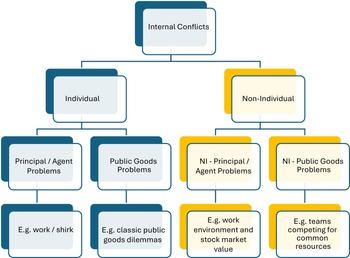
Putting all of this together, this thus yields an expanded taxonomy of internal conflicts; see Figure 1.
A taxonomy of internal conflicts; the orange parts are new additions.

In this way, it becomes clear that it is possible to capture a wider range of internal conflicts using familiar tools – i.e. those of the principal/agent framework and public goods games. Put differently, the account laid out here allows us to recognise and predict the existence of internal conflicts that we would otherwise overlook.Footnote 27 This thus brings out some of the benefits of the perspective advocated here: moving beyond seeing institutions merely as structures that constrain individual actions, but as parties to a conflict of interest can make it easier to see how to model and analyse these cases.
Importantly, also, with this taxonomy in the background, it becomes possible to make some clear predictions about the kinds of cases in which non-individualist internal conflicts are particularly severe – and how to prevent that from happening. This is a further benefit of the perspective advocated here.
It is a basic insight of the principal/agent framework that the more (fewer) control mechanisms there are, the less (more) pronounced the PAP will be. Similarly, the more ways there are of forcing contribution to public goods (e.g. through punishment), the fewer such internal conflicts there are. This matters, as the availability of such processes can now be recognised to be relevant to a wider set of phenomena – as a wider set of phenomena can now be recognised to be COI’s.
So, as noted in the discussion of Table 2, there may be different versions of a corporation C – or there may be different ‘behavioral routines’ concerning compensation in C – so that M’s compensation is more or less heavily skewed towards stock grants. This can then set up a cultural evolutionary process (Boyd and Richerson, Reference Boyd and Richerson2005; Henrich, Reference Henrich2000; Nelson and Winter, Reference Nelson and Winter1982; Nelson and Winter, Reference Nelson and Winter2002) that selects for compensation schemes that favour the interests of the corporation as a whole. For example, the employee’s compensation scheme could be based in part on the long-term quality of the product. It is, of course, also possible for the corporation to fail to mitigate its internal conflicts properly and collapse.
This kind of case is not restricted to the economic sphere and can also occur in the political realm. For example, consider the case of governments – whether democratically elected or autocratic – making decisions that are not in the interest of the state. So, a leader may make decisions that are in their interests (which may include enriching themselves, but could also just be centred on advancing their personal moral ideology), even though these decisions do not in fact help the state as a whole thrive. So, perhaps what would benefit the state is a strong commitment to the rule of law and due process, whereas the leader prefers to make decisions in line with their convictions, independently of the procedural requirements. Importantly, these decisions need not be opposed or go against the interests of anyone in the society – however, they are still in opposition to the interests of the state as a whole, though. As noted earlier in the context of the ‘paradox of democracy’, ‘the people’ can be wrong about what is good for the state as a whole. Importantly, as was the case in the economic sphere, different mitigation strategies could evolve that the state can ‘use’ to ameliorate the situation here. These include constitutional mechanisms that enshrine due process into the fabric of political decision-making, as well as robust systems of checks and balances.
Conclusion
This paper has shown that, by appealing to a contemporary theory of social functionalism – such as PSF – non-individualistic forms of conflicts of interest can be grasped with the standardly available tools – including, in particular, the principal/agent framework. More specifically, the paper has shown that the interests of a non-individualistic social entity – such as a social institution or collective – can be seen to rest in what allows it to increase its expected reproductive or survival success in the current socio-cultural-economic environment. This makes clear that the two main types of internal conflicts – classic PAPs and public goods dilemmas – come in two versions each: an individualistic and a non-individualistic one. The last case has not been as clearly recognised before now.
Acknowledgements
The author would like to thank the members of the grant team, the anonymous referees for this journal, and audiences at the Universities of Buffalo and Kansas for much helpful discussion.
Funding statement
Work for this paper was graciously supported by Grant ID 63320 from the John Templeton Foundation.





 Open access

