




Introduction
The project ‘Ethical entanglements’ aims to theorise and explore ethical debate around the treatment of human remains in museums and research institutions. It moves beyond the dichotomies of Indigenous/Western, science/spirituality and respect/abuse to embrace ambiguity, complexity and messiness. While the project identifies possible approaches to ethical challenges, it does so not through simplification or paring down to ‘solve’ ethics, but by attempting to identify the values and attitudes that inform current practice through international and interdisciplinary comparison. Centred on Sweden, where the debate on human remains in museums is rapidly developing, the project examines attitudes within the museum and research communities against a background of broader public debate. Three linked sub-projects approach the philosophical underpinnings of this discussion through three case studies of practices in Swedish museums, concerns of biomolecular researchers and key issues related to the identified and the anonymous dead.
Human remains are culturally situated on a spectrum between “objects of science and lived lives” (Nilsson Stutz Reference Nilsson Stutz2023: 1061). Their place on that spectrum can change according to how they are encountered, framed and understood. They are both the remains of living beings and resources for scientific enquiry (Figure 1). Museum professionals often find themselves caught between these two understandings. The implications for the care and curation of human remains might therefore differ according to where on the spectrum emphasis is placed.
The permanent ‘Bodyworlds’ exhibition in Amsterdam challenges museum conventions. Blanket specifications of what constitutes respect towards the remains of the dead are unhelpful when expectations in the present and in the past are so diverse. Nuanced, thoughtful and engaged approaches to ethics are therefore required (photograph by Liv Nilsson Stutz).

Much of the discussion surrounding human remains in museum collections has been dominated by post-colonial discourse about repatriation, reburial and what constitutes respectful treatment, given a socio-political history of exploitative, unequal Eurocentric traditions of research (e.g. Cassman et al. Reference Cassman, Odegaard and Powell2007; Biers & Stringer Clary Reference Biers and Stringer Clary2023). This is, in many ways, a response to the terms of debate that have evolved in North American, African and Australian anthropology, where Western/Indigenous relationships and history are central to modern understandings. These are undoubtedly important issues for European museums, too, but are they enough? Moving beyond the repatriation debates that have characterised much ethical discussion to date, this project does not aim to produce a set of correct answers, but to facilitate discussion and listen to the voices of practitioners. Taking a broad definition of human remains that includes all collected human tissue—not only bones and teeth but skin, hair, organs and microscopic samples—encourages us to think about the former owners of those bodies themselves as stakeholders, alongside Indigenous people, researchers, local communities, ‘the public’ and museum professionals. An ethics of care captures the essence of what these multiple actors owe the human remains in their guardianship.
Decision-making in museums
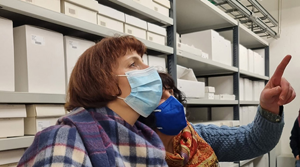
Recent attention to the ethical treatment of human remains in Swedish museums has been largely focused on the issue of repatriating Indigenous remains. This is important, but has effectively restricted ‘lived lives’ status to human remains of Indigenous origin, and does not solve the ethical challenges of dealing with all human remains, including those derived from local (pre)historic contexts. How can we meet a responsibility to all those remains, as both lived lives and objects of science? The project uses a practice-based approach to determine the values and assumptions that inform the actions of museum professionals (Figure 2). Through a programme of survey and interview, the attitudes, practices and decision-making processes at museums across Sweden were mapped to provide data to elevate the conversation about human remains in museum care and to provide both a basis on which to build claims for resources and the scaffolding for a confident public discussion with multiple stakeholders.
Practices in the storage, access to and exhibition of human remains vary considerably in museums across Europe. For example, in the Ethnographic Museum in Stockholm, Sweden, archaeological material is stored in a facility specifically for human remains (photograph by Liv Nilsson Stutz).

Museum professionals are thoughtful and committed to good ethical practice. Access to better support for decision-making from national, professional organisations, which sees ethical museum practice as a process and an ongoing conversation rather than a checklist or compliance audit, will revitalise professional debate.
Human remains and biomolecular research
As the field of biomolecular archaeology is relatively new, ethical discussion is not well developed. Researchers in the area have frequently outsourced ethical discussion to external panels or institutional guidance. Ethical Entanglements aims to support researchers in taking ownership of ethical issues. Major issues in this emerging field include expanding the definition of human remains, the implications of open access data, long-term stewardship of information and ethical sampling strategies as the proliferation of lab-based analytical techniques increases demand for biomolecular samples of archaeological populations (Figure 3). A series of qualitative interviews with European researchers identifies a widespread desire for open, non-judgemental spaces where ethical discussion might occur, and for access to case studies of how others have negotiated the expansion of ethical perspectives to include prehistory and other issues which fall outside the usual discussion of repatriation or coloniser/Indigenous relations.
Biomolecular scientists, working on museum collections, often have backgrounds in archaeology, laboratory sciences, data science and other disciplines, yet the project found that they are seldom given opportunities to discuss the ethical aspects of their work on human remains (photograph by Rita Peyroteo Stjerna).

The identified and the anonymous dead
A key component in research ethics on human subjects relates to consent, responsibility and respect towards a person, in this case a person from the past. The question of anonymity—what difference it makes if the identity of a past person is known, invented, concealed or, as is usually the case, lost—is a prism through which issues of privacy, biography and storytelling can be viewed. Attributing human remains with a name and perhaps a biography moves them further towards the ‘lived lives’ end of the spectrum. This is more likely to happen with the remains of traceable historical figures; it is less common when the human remains were collected to illustrate normative or pathological anatomy for a medical or scientific collection. Of course, we do not know the names or stories of the majority of human remains in archaeological collections. Some archaeologists and public interpreters have chosen to invent names and sometimes biographies to better engage modern audiences. This practice could be seen as an unethical projection of erroneous information or as a deeply ethical way to emphasise the humanity of the archaeological subject (Tarlow Reference Tarlow2024). For an example of the thoughtful use of fictional osteobiography, see the University of Cambridge's ‘After the Plague’ project (https://www.aftertheplague.org/people-of-medieval-cambridge and Inskip Reference Inskip2023).
A startling asymmetry exists between the extensive consideration of ethical approaches to human remains undertaken by archaeologists and museum professionals, and the almost total absence of ethical discourse on responsibilities when a dead human body is used in contemporary artistic practice. While some artists show awareness of the moral implications of their work, it is rare that the privacy of the dead subject is considered in this capacity (Figure 4).
Embellished casts of human organs made by British artist Anthony Noel Kelly, one of the contemporary artists interviewed by project members (photograph by Sarah Tarlow).

Conclusions
Despite the existence of codes of ethics and other published guidelines for the ethical treatment of human remains in many countries and for most professional bodies (e.g. Márquez-Grant & Fibiger Reference Márquez-Grant and Fibiger2011), there is still widespread anxiety among many professionals in museum and research contexts about whether they are getting it right. Rather than more detailed or coercive codes of practice or legislation, what is often required is access to an open and non-judgemental forum where ethical decisions can be discussed in a supportive and exploratory way. Through a focus on the museum as an institution of care, and on ethical responsibility to past persons, we can compare archaeological and museum practice with ethical norms in related fields such as medical and social science research, which in turn may enrich our practices. Ethics in the treatment of human remains is better understood as engaged, thoughtful, moral practice rather than as compliance or adherence to specified best practice.
Funding statement
This project is funded by Riksbankens Jubileumsfond. Stiftelsen för humanistisk och samhällsvetenskaplig forskning (FOE20-0012).


 Open access

