


Introduction
A common finding about people’s long-term care (LTC) preferences is that they prefer to age in place and, if care needs are not extensive, that they prefer LTC provided by the family. In case of extensive care needs, preferences shift towards mixed or exclusively formal care arrangements (Lehnert et al., Reference Lehnert, Heuchert, Hussain and König2019). Similar to these preferences, two-thirds of older LTC recipients receive care at home on average across Organisation for Economic Co-operation and Development (OECD) countries (OECD, 2019). More than one-third of informal care-givers are children who provide unpaid care to their parents (Colombo et al., Reference Colombo, Llena-Nozal, Mercier and Tjadens2011). As the demand for LTC is expected to increase in the future (OECD, 2019), families’ provision for current and future LTC needs has been subject to debate. Especially parents’ expectations about children’s care-giving behaviour, parents’ intentional strategies to acquire a desired child behaviour, and children’s motives for providing LTC to their parents have been of interest. Yet, the debate on why adult children provide LTC to their parents is far from being settled.
The economic literature on family transfers mainly discriminates between two motives, i.e. altruism and exchange. Under the exchange motive, parents acquire a desired care-giving behaviour by making financial transfers to their children (Cox and Rank, Reference Cox and Rank1992). In line with this idea, the empirical literature finds that children’s provision of LTC to a parent is positively associated with financial transfers that they received, receive or expect to receive from their parents in the past, present or future (Henretta et al., Reference Henretta, Hill, Li, Soldo and Wolf1997; Alessie et al., Reference Alessie, Angelini and Pasini2014; Norton et al., Reference Norton, Nicholas and Huang2014; Groneck, Reference Groneck2017). By contrast, other scholars stress that children provide LTC to their parents because they are altruistic towards their parents (Sloan et al., Reference Sloan, Zhang and Wang2002; Klimaviciute et al., Reference Klimaviciute, Perelman, Pestieau and Schoenmaeckers2017; Horioka et al., Reference Horioka, Gahramanov, Hayat and Tang2018). In addition to traditional motives, there is a smaller literature that finds evidence for Cox and Stark’s demonstration effect (Arrondel and Masson, Reference Arrondel and Masson2001; Cox and Stark, Reference Cox and Stark2001; Coe et al., Reference Coe, Skira and Van Houtven2015). Cox and Stark argue that parents provide LTC to their parents if their own children are present to teach their children a desired behaviour by setting an example (Cox and Stark, Reference Cox and Stark1994).
The sociological literature emphasises social norms and parents’ expectations as important factors in children’s care-giving decisions. Silverstein et al. (Reference Silverstein, Gans and Yang2006) show that children who strongly endorse filial norms are more likely to provide an increasing amount of support as parents’ functional health deteriorates. Fingerman et al. (Reference Fingerman, VanderDrift, Dotterer, Birditt and Zarit2011) find that racial differences in children’s support to parents can be explained by differences in children’s beliefs about the obligation to support parents. Furthermore, family norms appear to influence children’s care-giving behaviour in Eastern European countries (Klimaviciute et al., Reference Klimaviciute, Perelman, Pestieau and Schoenmaeckers2017). Considering parents’ expectations, Pillemer and Suitor (Reference Pillemer and Suitor2014) show that children who were identified as expected future care-givers by their mothers were more likely to provide care when a serious illness occurred.
Although factors influencing children’s care-giving behaviour have been extensively discussed in the social sciences, there remain open questions. If social norms affect children’s care-giving behaviour, parents have an incentive to socialise their children to their own traits to achieve a desired child behaviour. Peek et al. (Reference Peek, Coward, Peek and Lee1998) find that parents’ social norms about older parent–child relationships are positively related to the amount of LTC that they receive from their children. The authors suggest that norms of intergenerational assistance are shared to some degree by parents and children. However, a lack of information on children’s norms does not allow for further analyses. The study by Peek et al. (Reference Peek, Coward, Peek and Lee1998) supports the idea that a child’s care-giving behaviour can be a result of parents’ socialisation effort.
In this study, we contribute to the ongoing debate on why adult children provide LTC to their parents by making parents’ socialisation effort subject to discussion. We empirically assess to what extent parents transmit filial norms to their children and if parents’ socialisation effort affects child behaviour if a parent needs LTC. We initially analyse the transmission of filial norms from mothers and fathers to their children using data from the German Family Panel. Second, we examine the influence of average filial norms that prevail within the child’s local environment. Third, we explore whether an intergenerational transmission of norms transmits into a child’s behaviour when a parent needs LTC.
Conceptual framework
Filial norms or norms of filial responsibility are commonly defined as normative beliefs about what children should do if a parent needs LTC (Ganong and Coleman, Reference Ganong and Coleman2005) and are part of the broader concept of familism (Knight and Sayegh, Reference Knight and Sayegh2010). Although social norms have been attributed to a child’s care-giving behaviour (Silverstein et al., Reference Silverstein, Gans and Yang2006; Fingerman et al., Reference Fingerman, VanderDrift, Dotterer, Birditt and Zarit2011; Klimaviciute et al., Reference Klimaviciute, Perelman, Pestieau and Schoenmaeckers2017), parents’ incentives to affect a child’s care-giving behaviour via an intergenerational transmission of norms have rarely been addressed. De Vries et al. (Reference De Vries, Kalmijn and Liefbroer2009), as one exception, study the origins of filial norms. The authors find a positive relationship between children’s and their parents’ filial norms and identify parents’ socialisation effort as an important mechanism. By contrast, Gans and Silverstein (Reference Gans and Silverstein2006) find relatively low within-family similarities in filial norms. The authors conclude that the family is just one of several social environments that shape normative values. To address the aim of this study, we consequently need an approach that incorporates the parents’ socialisation effort, but that also accounts for socialisation processes through an individual’s social environment.
A model of attitude transmission
Bisin and Verdier (Reference Bisin and Verdier2000) developed a theoretical model to analyse the intergenerational transmission of ethnic and religious traits through family socialisation and marital decisions. In principle, the model can be used to analyse the evolution of traits other than ethnic and religious such as social norms.
The transmission of norms or cultural traits is modelled as a mechanism that interacts socialisation inside the family with socialisation outside the family (Bisin and Verdier, Reference Bisin and Verdier2000). Both mechanisms were previously identified in the empirical literature on filial norms (Gans and Silverstein, Reference Gans and Silverstein2006; De Vries et al., Reference De Vries, Kalmijn and Liefbroer2009). After being born, children are assumed to be exposed to their family’s socialisation effort (direct socialisation). Parents wish to transmit their own traits to their children, i.e. they want to socialise them to their own specific model. Bisin and Verdier (Reference Bisin and Verdier2000) call this behaviour paternalistic altruism, meaning that the parent sees his or her traits as best for the child. The parents’ socialisation effort takes the form of spending time with the child, choosing appropriate neighbourhoods or attending religious services. With a certain probability, the parents’ socialisation effort is not successful and socialisation outside the family occurs (oblique socialisation). In this case, the child is influenced by individuals in the local environment, e.g. friends, peers and teachers. These ‘role models’ are chosen randomly from the population and may or may not have the same norms or cultural traits as the child’s parents. The approach provides a theoretical basis to explain the transmission of norms or cultural traits through socialisation. This does not rule out that genetic or other mechanisms influence the child as well.
Since the seminal work of Bisin and Verdier (Reference Bisin and Verdier2000), the intergenerational transmission of traits and its implications for individual behaviour have gained much attention in the literature. Dohmen et al. (Reference Dohmen, Falk, Huffman and Sunde2012) empirically test for the intergenerational transmission of risk and trust attitudes. Their results indicate that socialisation by the family and individuals in the local environment are important factors in the formation of children’s risk and trust attitudes and influence child behaviour. Avdeenko and Siedler (Reference Avdeenko and Siedler2017) study the intergenerational transmission of attitudes towards immigration. The authors find that children whose parents expressed deep concerns about immigration to Germany have a higher likelihood of also being very concerned about immigration. Albanese et al. (Reference Albanese, De Blasio and Sestito2016) find a positive association between values that respondents received from their parents and values that they passed on to their descendants. These values include, among others, the importance of having a family/children.
Bisin and Verdier’s attitude transmission model interacts aspects of direct and oblique socialisation – both of them previously mentioned as relevant in the formation of filial norms – and has been empirically tested before. We, therefore, use this model to develop our hypotheses and to guide the empirical analysis.
Research questions and hypotheses
In this study, we ask to what extent parents transmit filial norms to their children and whether parents’ socialisation effort affects child behaviour if a parent needs LTC. Based on Bisin and Verdier’s model, the empirical evidence of the model and the findings by De Vries et al. (Reference De Vries, Kalmijn and Liefbroer2009) and Gans and Silverstein (Reference Gans and Silverstein2006), we hypothesise that:
(1) Parents’ filial norms are positively reflected in a child’s filial norms.
(2) A child’s filial norms are additionally positively influenced by average filial norms that prevail in the local environment.
Based on the literature that attributes children’s social norms a role for their care-giving behaviour, we hypothesise that:
(3) Children’s filial norms are positively related to their care-giving behaviour if a parent needs LTC.
To test our hypotheses empirically, we largely follow Dohmen et al. (Reference Dohmen, Falk, Huffman and Sunde2012). In a first step, the authors graphically analyse variations in mothers’, fathers’ and children’s risk and trust attitudes. In a second step, Dohmen et al. (Reference Dohmen, Falk, Huffman and Sunde2012) use linear regression techniques to estimate the intergenerational transmission of these attitudes (Hypothesis 1). Then, the linear regressions are extended to assess the role of attitudes in the local environment (Hypothesis 2). Finally, the authors estimate the relationship between the intergenerational transmission of risk and trust attitudes and individual behaviour (Hypothesis 3). For this purpose, Dohmen et al. (Reference Dohmen, Falk, Huffman and Sunde2012) estimate the relationship between individual attitudes and individual behaviour. The coefficient estimates for individual attitudes are then multiplied with the coefficient estimates for the mother’s and father’s attitudes, which are obtained from the second step.
Methods
Data and sample selection
We used data from the German Family Panel (pairfam), release 10.0 (Brüderl et al., Reference Brüderl, Drobnič, Hank, Nauck, Neyer, Walper, Alt, Bozoyan, Buhr, Finn, Garrett, Greischel, Gröpler, Hajek, Herzig, Huyer-May, Lenke, Minkus, Müller, Peter, Schmiedeberg, Schütze, Schumann, Thönnissen, Wetzel and Wilhelm2019). This annual survey has a multi-actor design, starting with 12,402 individuals in 2008/9. Individuals were randomly drawn from population registers of 343 randomly selected communities across Germany and belong to one of the three birth cohorts 1971–1973, 1981–1983 or 1991–1993. The multi-actor design collects data from primary respondents and from their parents, partner and children. The primary respondents’ parents were interviewed from Wave 2 onward. All participants who did not explicitly decline to participate in the panel study were contacted again with a maximum gap of one wave. Core questions are asked annually, whereas more detailed sets of questions on various topics are asked either every two or four years (for details, see Huinink et al. Reference Huinink, Brüderl, Nauck, Walper, Castiglioni and Feldhaus2011).
The dataset’s design is particularly suitable for the purpose of analysis as questions with identical wording are asked to various family members at similar points in time. Primary respondents’ responses are collected via computer-assisted personal interviews, whereas parents’ responses are collected via paper and pencil questionnaires.
To address the first and second hypotheses, we included all primary respondents who participated in the second wave (2009/10) and whose mother and father (biological or adoptive) were interviewed. Children in the second wave are at least 16 years old. According to Bisin and Verdier (Reference Bisin and Verdier2000), children at this age were already exposed to their parents’ and the local environment’s socialisation effort and can thus be included for the purpose of analysis. In addition, the second wave includes two distinct questions that are intended to measure filial norms. Other waves only include one question on filial norms. Moreover, parents’ participation rates are lower in later survey waves such that the second wave provided us with a relatively large sample of mothers and fathers. Step-parents were not considered as they may have entered children’s life after the biological or adoptive parents’ socialisation effort.
To address the third hypothesis, we included all primary respondents who participated in the second wave and who were ever observed to have a parent needing LTC. In Waves 2, 4, 6 and 8, primary respondents were asked whether their mother or father needed regular help with activities of daily living (ADLs) such as eating, standing up, dressing, bathing or going to the toilet. We used this question to identify parents’ need for LTC independent of the parents’ age as a need for LTC can arise at any age (Kaye et al., Reference Kaye, Harrington and LaPlante2010). Primary respondents were included irrespective of both parents being interviewed. Most parents were relatively young and never observed to need LTC. Therefore, we refrained from including only primary respondents where the mother and father were interviewed to obtain the most representative estimates on the relationship between children’s filial norms and their care-giving behaviour.
In both samples, we excluded all individuals who did not provide full information regarding the variables of interest. Henceforth, we will refer to primary respondents as children.
Dependent variables
The child’s filial norms was the dependent variable when the first and second hypotheses were assessed. Filial norms were measured in two ways: ‘Children should accommodate their parents if they cannot take care of themselves any longer’ and ‘Children should arrange their work so as to be able to care for their sick parents’. Respondents could answer on a scale from 1 to 5 where 1 corresponds to ‘disagree completely’ and 5 to ‘agree completely’. Both measures have a moderate correlation (0.37 for the selected sample). If a child agrees on one question, he or she also tends to agree on the other question. This indicates that the child has a tendency for high filial norms in general. But, both measures distinguish themselves regarding the consequences for children. In the first case, children are supposed to restrict their private life and share their accommodation with their parents. In the second case, children are supposed to restrict their work life, with possible consequences for their further career development and financial cutbacks.
The child’s care-giving behaviour in the form of help with ADLs and household help were the dependent variables when the third hypothesis was assessed. The binary variable, help with ADLs, indicated whether the child provided regular help with these activities. There was no information on the frequency. Household help during the preceding 12 months before the interview was measured on an ordinal scale with categories ‘never’, ‘seldom’, ‘sometimes’, ‘often’ and ‘very often’. The variable was collapsed into a binary variable with ‘often’ and ‘very often’ as a proxy for children who regularly provide help with instrumental ADLs. Children who chose ‘never’, ‘seldom’ or ‘sometimes’ represented the other group. The child’s care-giving behaviour was measured in the wave in which the parent needed LTC.
Key independent variables
We were initially interested whether parents’ filial norms are reflected in their child’s norms. Thus, our key independent variables of interest were the mother’s and the father’s filial norms. These variables were defined in the same way as the child’s filial norms.
Second, we were interested if a child’s filial norms are additionally influenced by average filial norms in the local environment. These norms may vary due to historical changes, such as the German separation and reunification (Diederich et al., Reference Diederich, König and Brettschneider2020), or due to differences in religiosity and/or cultural conservatism (Gans et al., Reference Gans, Silverstein and Lowenstein2009). To construct an independent variable for our second hypothesis, we used all individuals in the pairfam dataset who responded to the questions that capture filial norms and for whom the official district key was available. We used these responses to calculate average filial norms at the district level. The district level corresponds to the third and smallest level of the nomenclature of territorial units for statistics (NUTS) classification. The NUTS classification is a hierarchical system for dividing up the economic territory of the European Union. NUTS regions constitute a geographical area with an administrative authority that takes decisions for the respective area. The average population size of NUTS-3 regions lies between 150,000 and 800,000 (Eurostat, 2018). In 2009, Germany was divided into 412 districts (Federal Statistical Office, 2021). As the pairfam dataset is substantially larger than the sample that was included in our regression analysis, respondents in 336 districts answered the questions on filial norms. We excluded the child’s response when calculating the average response in the district in which the child was living. We additionally excluded the mother’s and/or father’s response if they were living in the same district as the child because we aimed at calculating average filial norms that prevail in the local environment in addition to parents’ norms. To obtain representative values for regional averages, we only calculated average filial norms for districts that include at least 40 responses. This applied to 148 districts. The assumption was subject to robustness checks.
Third, if parents’ norms transmit into child behaviour via children’s norms, children’s filial norms should be related to their behaviour. The key independent variable regarding our third hypothesis was the child’s filial norms in Wave 2 and measured in the same way as described above. By doing so, we implicitly assume that individual values do not substantially change over time. This is a common assumption in the economic literature (Alesina and Giuliano, Reference Alesina, Giuliano, Aghion and Durlauf2014).
Control variables
We accounted for an array of individual characteristics. When testing our first and second hypotheses, we initially included the child’s age and gender as well as the mother’s and father’s age to assess whether parental norms were still related to the child’s norms if exogenous personal characteristics were accounted for. Then, we added control variables that could additionally affect filial norms. We included educational attainment, religious affiliation, self-rated poor health, net household income and country of birth. The country of birth is a proxy variable for cultural characteristics. According to economic theory, immigrants and their descendants carry a ‘cultural baggage’ that influences people’s norms and behaviour (Alesina and Giuliano, Reference Alesina and Giuliano2010). The country of birth was specified according to the M49 standard used by the United Nations for statistical purposes (United Nations Statistics Division, 2022) and aggregated at the regional level: Federal Republic of Germany and German Democratic Republic (due to the German separation and reunification), Europe, Americas, Asia, Africa and others/unkown. An aggregation was conducted because the number of observations was insufficient to include single-country categories. Parental social and cultural characteristics were included because they have been previously interpreted as contextual effects that can influence children’s norms (De Vries et al., Reference De Vries, Kalmijn and Liefbroer2009). Each of the control variables was included for the child, the mother and the father.
When testing our third hypothesis, we included similar control variables, however, only for the child. The reason is that parents’ characteristics are largely obtained from the parent questionnaires. However, children were included irrespective of both parents being interviewed. Control variables were measured in the wave in which the parent needed LTC.
Besides individual characteristics, we accounted for an individual’s living environment. When considering the first and third hypotheses, we included federal state fixed effects. When testing the second hypothesis, any local variability in the availability of support and resources may influence children’s filial norms in addition to average filial norms in the local environment. A change in access to LTC services, expressed by the introduction of a LTC insurance system, for example, has been associated with changes in filial norms (Tsutsui et al., Reference Tsutsui, Muramatsu and Higashino2014). The availability of support and resources may be restricted by the supply of formal LTC services. But, it may also be restricted by urban–rural residency or economic resources. Similar to Diederich et al. (Reference Diederich, König and Brettschneider2020), we accounted for the number of places in nursing homes (occupied and available) and the number of outpatient LTC services for older adults at the district level, for the gross domestic product per capita at the district level (Federal Statistical Office and Statistical Offices of the Länder, 2021a, 2021b, 2021c) and for the size of the community.
Statistical analysis
Our dataset included information on the individual level and on the regional level. There are four main modelling approaches that are commonly applied to these kinds of datasets (Bryan and Jenkins, Reference Bryan and Jenkins2016). The choice for one approach over another depends on which parameters are the substantive focus of interest and on the discipline. The inclusion of regional fixed effects may be favoured over multilevel modelling if analysts are primarily interested in individual-level effects (Bryan and Jenkins, Reference Bryan and Jenkins2016).
The primary focus of this study was on the individual level, i.e. the transmission of filial norms from mothers and fathers to their children. In addition, we were interested in the influence of average filial norms that prevail in the local environment. We aimed to compare the results across model specifications to examine whether parents’ coefficient estimates substantially change if average norms in the local environment are added. We, therefore, estimated linear regression models and included regional-specific terms.
The analyses were conducted separately for the two measures of filial norms. For the ease of interpretation, we standardised all measures that capture filial norms separately for children, mothers and fathers. Therefore, the variables have a mean of 0 and a standard deviation of 1 by construction.
Results
The second wave of the pairfam dataset includes 9,069 respondents. Both parents are observed for 1,668 respondents; 92.93 per cent of these respondents provide full information regarding the variables of interest and are included in the analyses that correspond to the first and second hypotheses (for an illustration, see online supplementary material S.1). Table 1 displays the sample characteristics. Children are on average 22.4 years old; 16.77 per cent of children belong to the 1971–1973 cohort, 20.39 per cent to the 1981–1983 cohort and 62.84 per cent to the 1991–1993 cohort. On average, fathers are 53.57 years old and mothers are 50.76 years old; 49.94 per cent of children are men.
Sample characteristics
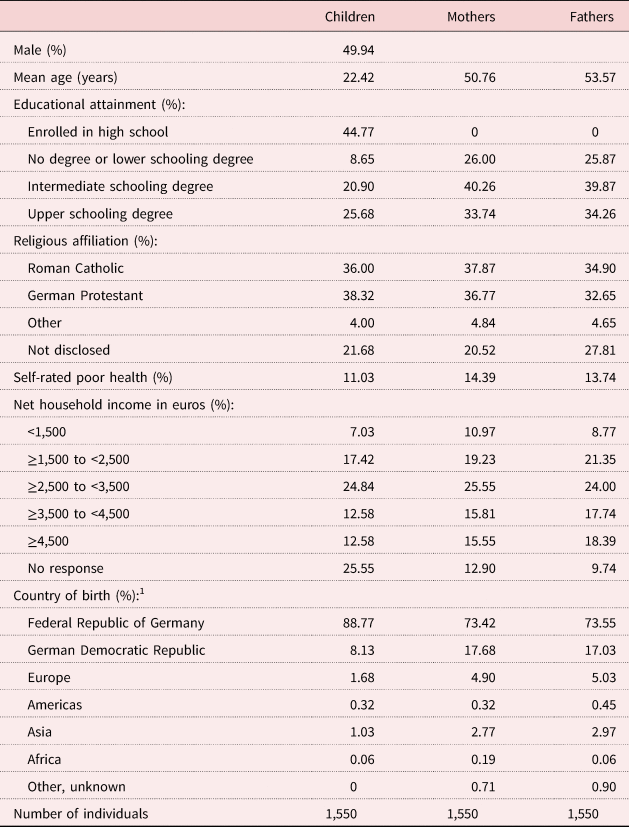
Note: 1. Geographic regions according to the United Nations Statistics Division (2022).
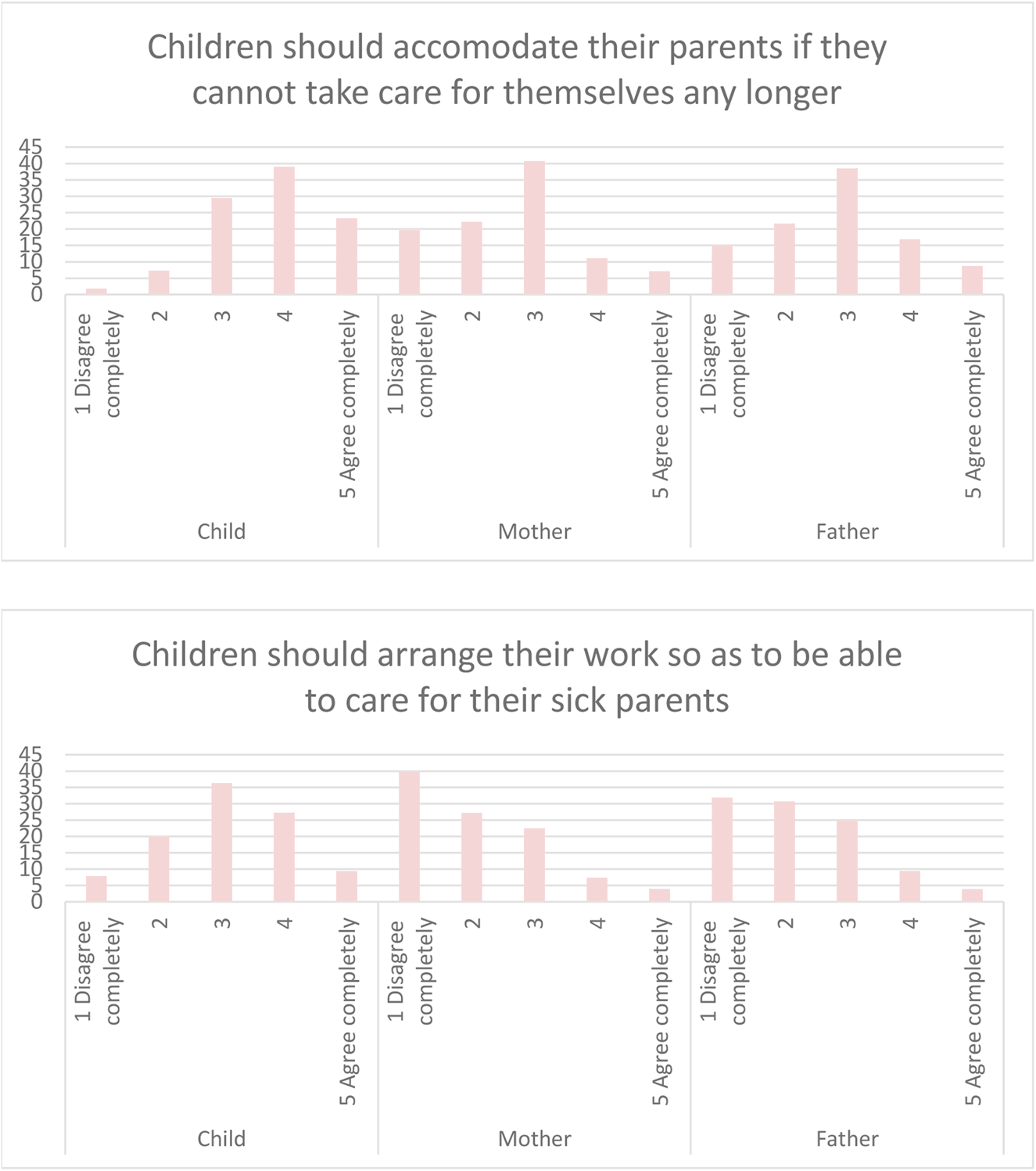
One condition that needs to be fulfilled in order to detect a separate influence of mothers and fathers is a variation in their filial norms. Figure 1 shows the distribution of filial norms (not standardised). Fathers tend to have stronger filial norms than mothers: 25.29 per cent (13.09%) of fathers choose scores 4 or 5 when they are asked about the accommodation of parents (arrangement of work to care for parents), whereas only 17.94 per cent (11.1%) of mothers choose scores 4 or 5. Noteworthy, 61.87 per cent (36.39%) of children choose scores 4 or 5 when they are asked about the accommodation of parents (arrangement of work to care for parents).
Distribution of children’s, mothers’ and fathers’ responses to questions on filial norms.
Note: Values are percentages.
Moreover, in order to detect an influence of average norms in the local environment, there should be a variation across regions. Compared to northern Germany, average filial norms in southern Germany are relatively high (for an illustration, see online supplementary material S.2). This relates to relatively conservative views in southern Germany, which are historically influenced by the Kingdom of Bavaria and the Austrian Empire, and which are also visible by the share of members in the Catholic church (Federal Agency for Civic Education, 2020) and political parties that represent the parliaments of the federal states (Federal Returning Officer, 2021).
Of the 9,069 respondents who participated in Wave 2, 924 are ever observed to have a parent needing LTC; 83.98 per cent of these individuals provide full information regarding the variables of interest and are included in the analyses that corresponds to our third hypothesis (for an illustration, see online supplementary material S.1). Respondents are on average 32.75 years old. Parents needing LTC are on average 63.08 years old (for descriptive statistics, see online supplementary material S.2). The difference in respondents’ average age between the first and second sample can be explained by the fact that the risk of parents needing LTC increases with age.
Intergenerational transmission
Table 2 displays the results that correspond to our first hypothesis. Models 1–4 include the coefficient estimates on the accommodation of parents, whereas Models 5–8 include the coefficient estimates on the arrangement of work to care for parents. The results confirm the first hypothesis by showing that children have stronger filial norms when both parents report stronger filial norms. Increasing both parents’ filial norms by one standard deviation is associated with an increase in the child’s norms by 0.247 for Model 1 and by 0.164 for Model 5. These relationships barely change when we account for the child’s and parents’ age and the child’s gender, as well as for additional control variables (Models 2, 3, 6 and 7).
Association between children’s and their parents’ filial norms
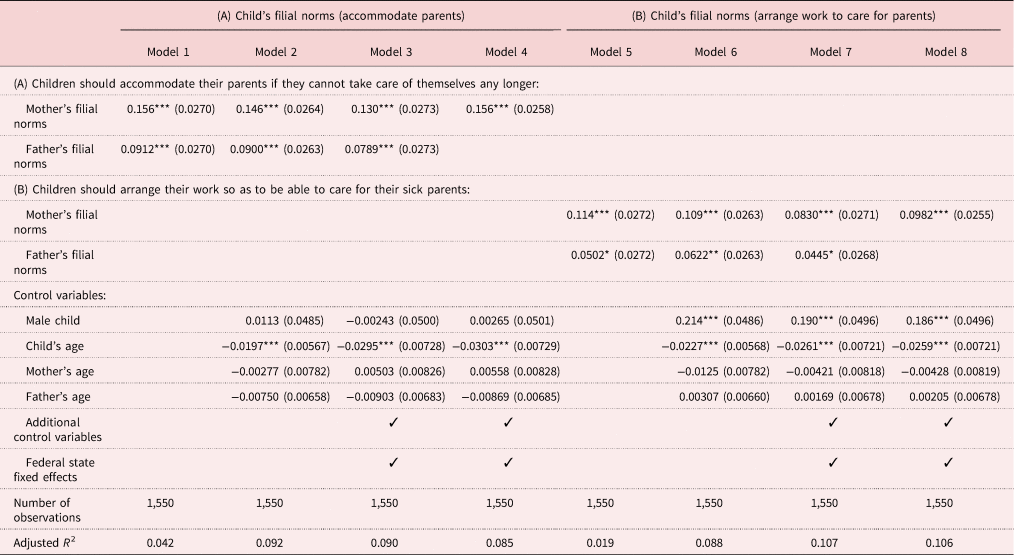
Notes: Results are obtained from ordinary least squares regressions. Each column represents a separate regression. Standard errors are in parentheses. A constant is included. All variables that capture filial norms are standardised. Additional control variables include educational attainment (for child, mother and father), religious affiliation (for child, mother and father), self-rated poor health (for child, mother and father), net household income (for child, mother and father) and country of birth (for child, mother and father).
Significance levels: * p < 0.10, ** p < 0.05, *** p < 0.01.
Throughout the different model specifications, the coefficient estimates for mothers are higher than the coefficient estimates for fathers. However, we cannot reject the hypothesis that the coefficients are the same at the 5 per cent significance level. To further assess the importance of fathers’ norms, we repeated the regressions but excluded the father’s filial norms (Models 4 and 8). If the father’s filial norms are excluded from the model, the coefficient estimates for the mother’s norms increase by 20 and 18.3 per cent, respectively. This shows that it is important to include fathers in order to identify the influence of parents on children’s filial norms.
Local environment
Table 3 displays the results that correspond to our second hypothesis. We compare regression models that exclude average filial norms in the child’s local environment (Models 1 and 3) to regression models that include average filial norms in the child’s local environment (Models 2 and 4). The coefficient estimate on average filial norms in the child’s local environment is positive if the accommodation of parents is considered (Model 2). However, the coefficient that captures average local norms regarding the arrangement of work to care for parents is non-significant (Model 4).
Association between children’s filial norms and average filial norms in the local environment
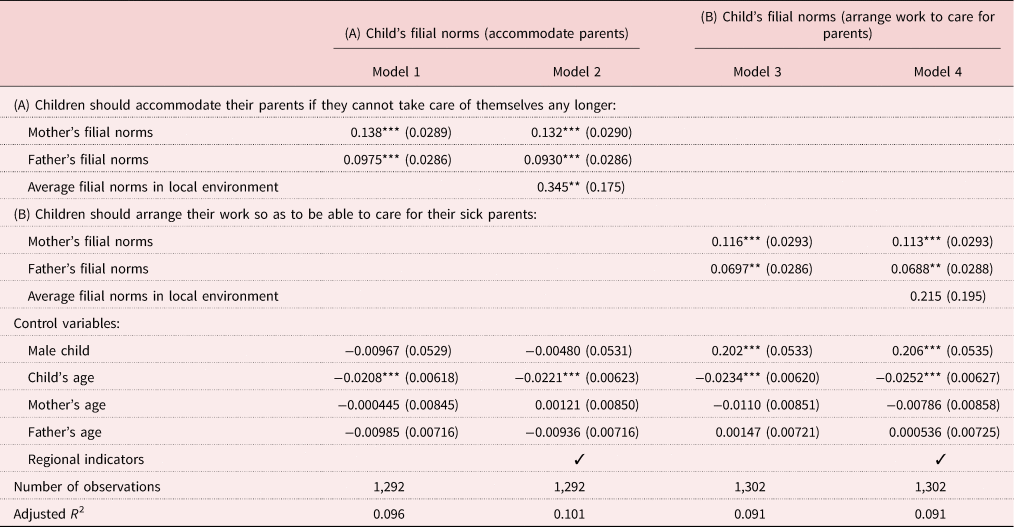
Notes: Results are obtained from ordinary least squares regressions. Each column represents a separate regression. Standard errors are in parentheses. A constant is included. All variables that capture filial norms are standardised. Regional indicators include the number of nursing home places and the number of outpatient long-term care services for older adults, gross domestic product per capita and the size of the community. Note that we excluded children from the regressions, due to a very low number of observations (<40) in the child’s local environment. The results do not change when we include only children with at least 50 observations in the local environment (detailed coefficient estimates are provided in the online supplementary material S.4).
Significance levels: ** p < 0.05, *** p < 0.01.
The coefficient estimates for parents’ filial norms do not considerably change when average filial norms in the child’s local environment are included. This implies that children’s filial norms are positively associated with their parents’ norms and – to a certain extent – with norms in the local environment. The result confirms our second hypothesis. The magnitude of coefficient estimates is similar to the estimates that Dohmen et al. (Reference Dohmen, Falk, Huffman and Sunde2012) find for the intergenerational transmission of risk attitudes.
Care-giving behaviour
Our previous analysis shows that mothers’ and fathers’ norms are both associated with a child’s filial norms. Consequently, parents’ filial norms may transmit into child behaviour via a child’s filial norms. Table 4 shows that a child’s care-giving behaviour is positively related to a child’s filial norms. A one standard deviation increase in a child’s filial norms increases the probability that the child provides help with ADLs to a parent in need by 6.7 percentage points in the model including the accommodation of parents (Model 1) and by 6.4 percentage points in the model including the arrangement of work to care for parents (Model 3). These relationships do not considerably change when control variables are included (Models 2 and 4). Similarly, an increase in a child’s filial norms is associated with an increased probability of household help from the child to the parent for both measures of filial norms (Models 5 and 7). Again, the results are robust to the inclusion of control variables (Models 6 and 8) and confirm our third hypothesis.
Association between children’s filial norms and their care-giving behaviour if a parent needs long-term care (LTC)
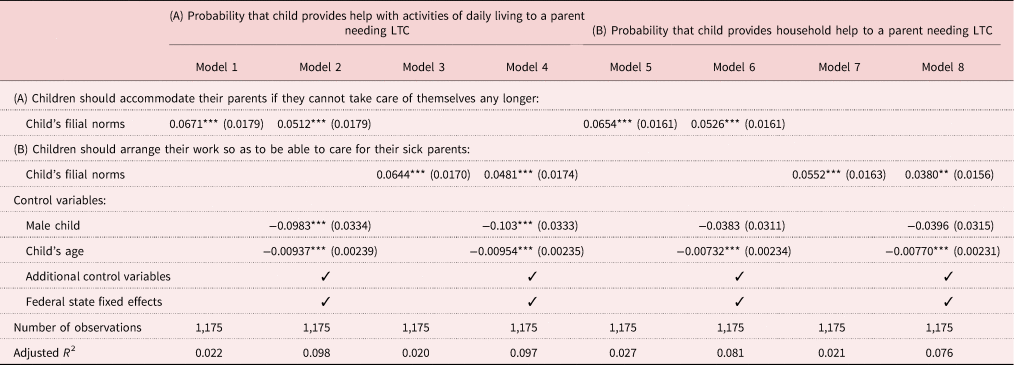
Notes: Results are obtained from ordinary least squares regressions. Each column represents a separate regression. Observations from Waves 2, 4, 6 and 8 are pooled. A constant and wave fixed effects are included in all regressions. Standard errors are in parentheses and clustered at the child–parent level. All variables that capture filial norms are standardised. Additional control variables include children’s educational attainment, religious affiliation, self-rated poor health, net household income and country of birth. All variables, with the exception of filial norms and time-invariant variables, were measured in the wave in which the parent needed LTC. Filial norms were obtained from the second wave.
Significance levels: ** p < 0.05, *** p < 0.01.
A combination of results from Tables 2 and 4 shows how parents’ filial norms transmit into child behaviour. Increasing both parents’ filial norms by one standard deviation is associated with an increase in the child’s norms by 0.247 (Table 2, Model 1). Multiplying this coefficient by the coefficient estimate for a child’s filial norms in Table 4 (Model 1) implies that a one standard deviation increase in both parents’ filial norms is associated with an increase in the probability that a child provides help with ADLs by 1.66 percentage points. Similarly, a one standard deviation increase in both parents’ filial norms is associated with an increase in the probability that a child provides household help by 1.62 percentage points (Table 2, Model 1 and Table 4, Model 5).
Detailed coefficient estimates that correspond to Hypotheses 1–3 are provided in the online supplementary material S.3.
Sensitivity analyses
One concern that may arise regarding our first hypothesis is that children and parents collaborate on survey responses, i.e. children fill in the parents’ questionnaires or one parent fills in the other parent’s questionnaire. We addressed this concern in two ways. First, we repeated the estimations but only included children who did not live with their parents. The relationship between mothers’, fathers’ and children’s norms remains essentially the same. Second, we compared the patterns of scale use within families. We checked if a child and his or her parents consistently used the lowest, the medium or the highest scale when answering the questions on filial norms. This only occurred in eight cases.
A concern that may arise regarding our second hypothesis is the selection of individuals into certain regions. We repeated the regressions and only included children of the 1990–1993 cohort who lived with their parents. These children are relatively young and are assumed to have a limited choice of living in a certain region. The coefficient estimates on average filial norms in the local environment are still positive, however, non-significant.
In the sample regarding our third hypothesis, children and their parents needing LTC are relatively young and care-giving is analysed at a rather uncommon lifestage. To address this issue, we repeated the regressions and divided the sample into two subgroups. One group includes children in midlife (40 years and older) and the other group includes children below this age. The coefficient estimates are slightly higher for the older age group. Moreover, based on the assumption that filial norms do not change over time, a parents’ need for LTC may arise in Wave 8, whereas filial norms are measured in Wave 2. We tested the robustness of the association when filial norms are measured in the same wave as a parents’ need for LTC arises. The results do not substantially change if filial norms are measured by the arrangement of work. This supports the assumption that filial norms do not change over time. The question on the accommodation of parents is only asked in the second wave.
Finally, it may be argued that we did not account for essential individual characteristics when addressing the third hypothesis. We repeated the regressions and added standard control variables that are associated with a child’s care-giving decision in the literature on child–parent transfers, i.e. marital status, number of minor children, employment status, distance between parent and child, parent’s gender, parent’s marital status and parent’s educational attainment (Bonsang, Reference Bonsang2007; Alessie et al., Reference Alessie, Angelini and Pasini2014). The coefficient estimates on children’s filial norms considerably reduce but remain significant in the model that includes the accommodation of parents. They are non-significant in the model that includes the arrangement work to care for sick parents.
All estimates are provided in the online supplementary material S.4.
Discussion
In the light of an increasing future demand of LTC services and people’s preferences to be cared for by family members, it is important to understand which factors influence children’s care-giving behaviour. However, there is little discussion about parents’ incentives to socialise their children to their own traits to achieve a desired child behaviour. Our study contributes to the literature because it shows that parents’ socialisation effort can at least partially affect children’s care-giving behaviour via an intergenerational transmission of filial norms. The economic literature on family transfers has mainly looked at children’s altruism, exchange motives between parents and children, and the demonstration effect. The sociological literature emphasises social norms and parents’ expectations. However, the role of parents’ socialisation effort has not been – to the best of our knowledge – studied before.
Findings in the context of previous research
The results regarding our first and second hypotheses show that mothers’ norms, fathers’ norms and – to a certain extent – average filial norms in the local environment shape children’s norms. The finding is in line with previous studies that find evidence for an intergenerational transmission of traits based on Bisin and Verdier’s theoretical model (Dohmen et al., Reference Dohmen, Falk, Huffman and Sunde2012; Albanese et al., Reference Albanese, De Blasio and Sestito2016; Avdeenko and Siedler, Reference Avdeenko and Siedler2017). In addition, the finding supports the results by De Vries et al. (Reference De Vries, Kalmijn and Liefbroer2009) who find a direct transmission of kinship norms from parents to children, and also confirm the results by Gans and Silverstein (Reference Gans and Silverstein2006). Our finding that average filial norms in the local environment are related to the child’s norms relates to the authors’ conclusion that the family is just one of several social environments that shape normative values. Moreover, our results show that fathers’ filial norms are distinct from mothers’ filial norms, which supports an argument previously made by Pillemer and Suitor (Reference Pillemer and Suitor2014), i.e. that fathers and mothers can have a distinct influence on children.
The separate influence of mothers and fathers may be enhanced by a ‘family effect’. Bisin and Verdier (Reference Bisin and Verdier2000) assume that socialisation is more efficient if parents share the same cultural traits (homogamous families) compared to parents with mixed cultural traits (heterogamous families). In this case, an individual’s choice of partner determines the ability to transmit his or her cultural traits to the child and gives an incentive to find a partner with similar traits (positive assortative mating). The raw correlations of filial norms between mothers and fathers in our sample are moderate (0.387 for the accommodation of parents and 0.383 for the arrangement of work to care for parents). This points to a family effect. However, it may also be argued that parents’ norms correlate because their norms have converged over time and not because of them becoming a couple due to similar norms.
The results regarding our third hypothesis show that children’s filial norms shape their care-giving behaviour if a parent needs LTC. This result confirms previous findings in literature that emphasise the importance of social norms as contributing factors in children’s care-giving decisions (Silverstein et al., Reference Silverstein, Gans and Yang2006; Fingerman et al., Reference Fingerman, VanderDrift, Dotterer, Birditt and Zarit2011; Klimaviciute et al., Reference Klimaviciute, Perelman, Pestieau and Schoenmaeckers2017). Moreover, in context to the result that parents transmit filial norms to their children, it also shows that parents can influence their children’s care-giving behaviour. Under the exchange motive, parents acquire a desired care-giving behaviour by making financial transfers to the child. In the light of the attitude transmission channel, parents acquire a desired care-giving behaviour by raising their children to their own traits.
The role of social norms as a contributing factor in children’s care-giving decisions may vary by a child’s gender. Using the Survey of Health, Ageing and Retirement in Europe, Haberkern and Szydlik (Reference Haberkern and Szydlik2010) show that care-giving behaviour of daughters corresponds to norms concerning the responsibility for the provision of care that prevail within the respective country. However, the authors do not find that these norms influence the care-giving behaviour of sons. Daughters may be confronted with a social norm regarding the care of parents and feel guilty if providing less care than the average amount provided by adult children (Barigozzi et al., Reference Barigozzi, Cremer and Roeder2020). Barigozzi et al. (Reference Barigozzi, Cremer and Roeder2020) assume that this does not necessarily apply to sons. A separate analysis by gender using a measure of filial norms that explicitly addresses normative beliefs concerning daughters and sons instead of children in general could provide greater insights into the intergenerational transmission process of filial norms and the effect on a child’s care-giving behaviour by gender.
Limitations
Several limitations should be considered when interpreting the results. First, 9,069 primary respondents participated in the second wave of the pairfam dataset. However, there were only 1,668 primary respondents whose parents were both interviewed (see online supplementary material S.1). One reason is that only 49 per cent of primary respondents gave consent to approach the parents. This number was closely related to the consent given to approach the partner and the children (Suckow et al., Reference Suckow, Schneekloth and Wich2010). Another reason is that of the parents approached, 66 per cent agreed to participate in the study (Suckow et al., Reference Suckow, Schneekloth and Wich2010). Although a response rate ≥60 per cent can be considered as relatively high, the relatively low rate of consent given by primary respondents may result in a sample selection towards more familistic triads.
Second, there is no information on the district in which respondents grew up. Therefore, we cannot assess the role of filial norms that prevailed in the local environment when the child was young. In addition, children may have lived only for a short time in their current community, such that the community might not have much affected the children’s values yet. In this case, we would underestimate the effect of values that prevail in the local environment.
Third, there is no consensus in the literature on whether normative values are static or significantly change over time. The economic literature assumes that normative values evolve slowly over time (Alesina and Giuliano, Reference Alesina, Giuliano, Aghion and Durlauf2014) and we follow this literature. However, other studies indicate that filial norms evolve over the lifecourse (Gans and Silverstein, Reference Gans and Silverstein2006) and in response to policy reforms (Tsutsui et al., Reference Tsutsui, Muramatsu and Higashino2014). Moreover, children’s filial norms possibly change if they actually experience a care-giving situation. In general, children in our sample are relatively young (mean = 32.75 years). Gans and Silverstein (Reference Gans and Silverstein2006) find that filial norms peak in midlife and weaken thereafter, i.e. children’s filial norms in their thirties are similar to children’s filial norms in their sixties, an age where they are very likely to experience a care-giving situation. According to this finding and our sensitivity analyses, we expect a similar relationship between children’s filial norms and their care-giving behaviour, if children are older than in our sample.
Fourth, we cannot rule out endogeneity. Although, it is unlikely that the child influences average filial norms in the local environment, a child might influence the parents’ norms to a certain extent. Moreover, we cannot establish a causal relationship between children’s filial norms and their care-giving behaviour. But, it may be reasonable to assume that children’s care-giving is an expression of held norms (Gans and Silverstein, Reference Gans and Silverstein2006).
Implications
We conclude that a child’s filial norms are at least partially shaped via a process of socialisation and that these norms transmit into a child’s care-giving behaviour if a parent needs LTC. It is important to note that mothers are not the only influence on children when it comes to the provision of LTC, but that fathers and local norms also make an important contribution. Therefore, researchers should not a priori assume that fathers and other role models are not an important part in a child’s decision to provide LTC to parents. Future research should take the influence of both parents and individuals in the local environment into account when analysing the process of children’s LTC provision.
Moreover, as parents’ filial norms and average filial norms in the local environment can shape children’s filial norms and care-giving behaviour, it is important that filial norms that prevail in a society are in accordance with the institutional LTC system that prevails within that country. A discrepancy between filial norms and options for LTC arrangements may affect care-givers’ and care recipients’ wellbeing. On the one hand, there may be the case where filial norms are weak and a formal LTC system is not well developed. Then, children have no other choice than providing LTC to a parent and may suffer heavily from providing LTC to their parents. This may be reflected in greater health problems from their care-giving obligations. On the other hand, parents needing LTC may experience a lower quality of care as the provision of LTC is experienced as burdensome by their children.
Supplementary material
The supplementary material for this article can be found at https://doi.org/10.1017/S0144686X23000132.
Data
This paper uses data from the German Family Panel pairfam, co-ordinated by Josef Brüderl, Sonja Drobnič, Karsten Hank, Franz Neyer and Sabine Walper. pairfam is funded as long-term project by the German Research Foundation (DFG).
Author contributions
FD, HHK and CB planned the study. FD performed the statistical analyses and drafted the manuscript. HHK and CB critically revised the manuscript for intellectual content. CB supervised the study. All authors approved the version to be published.
Financial support
This work was supported by the German Federal Ministry of Education and Research (grant number 01EH1601B). The funding source had no role in the study design, in the collection, analysis and interpretation of the data, in the writing of the manuscript and in the decision to submit the article for publication.
Competing interests
The authors declare no competing interests.
Ethical standards
The German Family Panel pairfam was approved by the ethics committee of the Faculty of Management, Economics and Social Sciences of the University of Cologne.


 Open access

