





Introduction
Rice is one of the most important food crops, providing 19% of the caloric intake for the world’s population (McKenzie et al. Reference McKenzie, Sha, Moldenhauer, Linscombe, Lyman and Nalley2014). In 2022, Mississippi produced 34,008 ha of rice, with an average yield of 8,264 kg ha−1 (USDA-NASS 2022). Rice production in Mississippi is almost completely limited to counties within the Mississippi-Yazoo Delta area, which consists of a 19-county area that borders the Mississippi River to the west. Bolivar and Tunica counties rank first and second in terms of harvested rice area with 8,947 and 7,773 ha during 2022, respectively, accounting for an average yield of 8,533 kg ha−1 and 8,130 kg ha−1 from the two respective counties (USDA-NASS 2022).
Weeds are one of the most limiting factors in rice production (Buehring Reference Buehring2008) and compete with rice for nutrients, water, space, and sunlight (Smith et al. Reference Smith, Flinchum and Seaman1977). The three most troublesome weeds in mid-southern U.S. rice production are Cyperus spp., Echinochloa spp., sprangletop species, and red rice (Oryza sativa) biotypes (Van Wychen Reference Van Wychen2020). Barnyardgrass [Echinochloa crus-galli (L.) P. Beauv.] is a rice-mimicking weed that can cause substantial yield losses of up to 57% in severe cases (Dayan et al. Reference Dayan, Owens and Duke2012). One barnyardgrass plant per 40 cm−1 of row can reduce rice yield by up to 27% (Stauber Reference Stauber, Smith and Talbert1991).
Herbicide-resistant weeds were not known to occur in U.S. rice fields prior to 1990 (Miller and Norsworthy Reference Miller and Norsworthy2018). Repeated use of herbicides with the same mode of action led to the selection and buildup of resistant plant populations (Carey et al. Reference Carey, Hoagland and Talbert1997; Retzinger and Mallory-Smith Reference Retzinger and Mallory-Smith1997). Propanil, a Group 7 herbicide (as categorized by the Herbicide Resistance Action Committee and Weed Science Society of America), has been used extensively by rice producers since its introduction in 1959 (Smith Reference Smith1961). However, the continued use of propanil led to the development of propanil-resistant barnyardgrass, which was first verified in Poinsett County, Arkansas, in 1989 (Smith Reference Smith1993). The resistance mechanism of barnyardgrass was documented to be elevated metabolism of propanil by the enzyme aryl acylamidase (Carey et al Reference Carey, Hoagland and Talbert1997). Following the discovery of propanil-resistant barnyardgrass, quinclorac, a Group 4 herbicide, was introduced in 1992 and became the standard for barnyardgrass control (Talbert and Burgos Reference Talbert and Burgos2007). However, in 1999, a barnyardgrass biotype from Arkansas was found to have resistance to both quinclorac and propanil (Lovelace et al. Reference Lovelace, Reaper, Scherder, Schmidt and Talbert2000). Since the initial observation of herbicide resistance in barnyardgrass, additional resistance to the chemicals developed to replace propanil has been observed. The development of barnyardgrass resistance to propanil, quinclorac, and herbicides in Group 2, including imazamox and imazethapyr, has limited the herbicide options for controlling barnyardgrass (Carey et al. Reference Carey, Hoagland and Talbert1997; Lovelace et al. Reference Lovelace, Reaper, Scherder, Schmidt and Talbert2000, Norsworthy et al. Reference Norsworthy, Bond and Scott2013).
Florpyrauxifen-benzyl is a Group 4 postemergence herbicide belonging to the arylpicolinate family of synthetic auxins that was commercialized in 2018 by Corteva Agriscience (Indianapolis, IN). Florpyrauxifen-benzyl can control problematic weeds such as yellow nutsedge (Cyperus esculentus L.), hemp sesbania [Sesbania exaltata (Raf.) Cory], and barnyardgrass when applied at the labeled rate (Miller and Norsworthy Reference Miller and Norsworthy2018). Florpyrauxifen-benzyl has a site of action different from that of quinclorac, favoring the AFB5-IAA co-receptor instead of the TIR1 co-receptor, which allows florpyrauxifen-benzyl to have activity on quinclorac-resistant barnyardgrass (Lee et al. Reference Lee, Sundaram, Armitage, Evans, Hawkes, Kepinski, Ferro and Napier2014; Miller and Norsworthy Reference Miller and Norsworthy2018; Walsh et al. Reference Walsh, Nela, Merlo, Honma, Hicks, Wolff, Matsumura and Davies2006). In rice production, florpyrauxifen-benzyl provides an alternate mode of action, which controls barnyardgrass resistance to photosystem II, synthetic auxin, 1-deoxy-D-xylulose-5-phosphate synthase, and acetolactate synthase (Epp et al. Reference Epp, Alexander, Balko, Buysse, Brewster, Bryan, Daeuble, Fields, Gast, Green, Irvine, Lo, Lowe, Renga, Richburg, Ruiz, Satchivi, Schmitzer, Siddal, Webster, Weimer, Whiteker and Yerkes2016).
Previous research has shown the propensity of florpyrauxifen-benzyl to control barnyardgrass to be greater than 96% (Miller and Norsworthy Reference Miller and Norsworthy2018). However, rice sensitivity to florpyrauxifen-benzyl application has been documented (Beesinger et al. Reference Beesinger, Norsworthy, Butts and Roberts2022; Sanders et al. Reference Sanders, Bond, Lawrence, Golden, Allen, Famoso and Bararpour2020; Wright et al. Reference Wright, Norsworthy, Roberts, Scott, Hardke and Gbur2020). Rice cultivar selection and many environmental factors can influence rice injury following florpyrauxifen-benzyl application, such as extremely dry or saturated conditions, above average temperatures, and cloudy conditions (Beesinger et al. Reference Beesinger, Norsworthy, Butts and Roberts2022; Sanders et al. Reference Sanders, Bond, Lawrence, Golden, Allen, Famoso and Bararpour2020). Beesinger et al. (Reference Beesinger, Norsworthy, Butts and Roberts2022) observed up to 36% injury following soil moisture conditions at 40% and 100%, indicating that both drought and saturated soils can increase injury symptoms. Wright et al. (Reference Wright, Norsworthy, Roberts, Scott, Hardke and Gbur2020) reported 34% injury 3 wk after florpyrauxifen-benzyl was applied 5 d apart to hybrid rice cultivar CLXL745, whereas injury to CL111 was <10% 3 wk after sequential applications. Sanders et al. (Reference Sanders, Bond, Lawrence, Golden, Allen, Famoso and Bararpour2020) observed 6% greater injury following florpyrauxifen-benzyl applications to cultivar PVL01 compared with cultivars CLXL745, PVL013, and PVL081. Injury following florpyrauxifen-benzyl application has been shown to be influenced by temperature, soil moisture conditions, and cultivar selection. Research has not focused on the impact florpyrauxifen-benzyl application can have on seeding rates of rice.
In the rice-producing areas of the mid-southern United States, proper seeding rate is critical for stand establishment and producing high yields (Bond et al. Reference Bond, Walker, Bollich, Koger and Gerard2005; Gravois and Helms Reference Gravois and Helms1992; Miller et al. Reference Miller, Hill and Roberts1991). Environmental conditions and management factors such as seeding method, cultivar, and tillage can cause the optimum seeding rate for rice to fluctuate (Harrell and Blanche Reference Harrell and Blanche2010). Rice has the capacity to overcome low plant populations by producing more reproductive tillers, which are culms that grow from the parent stem and produce panicles (Pinson et al. Reference Pinson, Wang and Tabien2015). Gravois and Helms (Reference Gravois and Helms1992) reported that rice seeding rates reduced by 66% produced yields comparable to those following greater seeding rates. When seeding rates are reduced, rice can compensate for the reductions and increase panicle density and filled grain per panicle (Counce Reference Counce1987; Gravois and Helms Reference Gravois and Helms1992; Jones and Synder Reference Jones and Snyder1987; Ottis and Talbert Reference Ottis and Talbert2005; Wells and Faw Reference Wells and Faw1978; Yoshida and Parao Reference Yoshida and Parao1972). Conversely, when rice seeding rates are increased, a decrease in panicles per plant is observed (Ottis and Talbert Reference Ottis and Talbert2005). Counce et al. (Reference Counce1987) attributed the reduction in rice yield at excessive rice densities to be associated with population-dependent stressors such as water deficits, disease, and nutrient deficiencies.
Ottis and Talbert (Reference Ottis and Talbert2005) reported that increased seeding rates of rice resulted in poor emergence likely caused by intraspecific competition among neighboring plants. Alternatively, reduced seeding rates resulted in improved emergence from decreased intraspecific competition.
The advancement of breeding and genetic technologies has led to the development of more productive rice cultivars (Nalley et al. Reference Nalley, Tack, Barkley, Jagadish and Brye2016). Introduction of hybrid rice began in 2000 in the mid-southern United States (Nalley et al. Reference Nalley, Tack, Durand, Thoma, Tsiboe, Shew and Barkley2017). The overall number of hectares seeded to hybrid rice in the mid-southern United Staters increased from 15% to 40% between 2005 and 2013. Hybrid rice returned US$0.16 more profit for every dollar invested than inbred cultivars. Research into the productivity of hybrid rice has shown 15% to 20% higher yield potential compared with inbred cultivars under reduced and optimum growing conditions (Katsura et al. Reference Katsura, Maeda, Horie and Shiraiwa2007; Yuan et al. Reference Yuan, Yang and Yang1994). Yuan et al. (Reference Yuan, Yang and Yang1994) reported that inbred rice produced more panicles and spikelets per square meter than hybrid rice, but fewer spikelets per panicle and 1,000 grain weight. Filled grain number per panicle has been the main yield component in support of the variability of yield between inbred and hybrids (Bueno and Lafarge Reference Bueno and Lafarge2009).
The development of hybrid rice, along with the natural ability of rice to compensate for low densities, has led to a decrease in seeding rates. With florpyrauxifen-benzyl possessing the potential to reduce rice yield, producers are concerned that the negative impact could be even greater in field situations where reduced seeding densities are employed. Therefore, research was conducted to evaluate the effect of florpyrauxifen-benzyl on rice performance and yield when hybrid rice was seeded at reduced densities.
Materials and Methods
The research was conducted once in 2019 and twice in 2020 and 2021 at the Mississippi State University Delta Research Extension Center in Stoneville, Mississippi, to determine the how florpyrauxifen-benzyl would affect the growth and yield of hybrid rice seeded at different densities. Geographic coordinates and soil information from each site year are presented in Table 1. Rice was seeded using a Great Plains 1520 small-plot grain drill (Great Plains Manufacturing, Inc., Salina, KS). Plots were 1.5 by 4.5 m, containing eight rows of rice spaced 20 cm apart, and separated by a fallow perpendicular alley 1.5 m in width. In all studies, glyphosate (Roundup PowerMax 4.5 L, 1,120 g ae ha−1; Bayer Crop Science, St. Louis, MO), paraquat (Gramoxone 2.0 SL, 560 g ai ha−1; Syngenta Crop Protection, Greensboro, NC), and/or 2,4-D (2,4-D Amine 3.8 SL, 560 g ae ha−1; Agri Star, Ankeny, IA) were applied in late March to early April each site-year to control emerged vegetation. Clomazone (Command 3 ME, 560 g ai ha−1; FMC Corporation, Philadelphia, PA) plus saflufenacil (Sharpen 2.85 SC, 50 g ai ha−1; BASF Crop Protection, Research Triangle Park, NC) were applied preemergence each site year for residual weed control. Imazethapyr (Newpath 2 L, 105 g ai ha−1; BASF) plus quinclorac (Facet 1.5 L, 420 g ai ha−1; BASF) plus a petroleum oil surfactant (Herbimax, 83% petroleum oil; Loveland Products, Greeley, CO) at 50 mL L−1 was applied at 2-leaf rice (early postemergence) to maintain experimental sites free of weeds.
Locations, soil series, and soil description for the experimental sites in Stoneville, MS.

The experimental design was a randomized, complete block with a two (florpyrauxifen-benzyl treatment) by five (seeding rate) factorial arrangement of treatments and four replications. Factor A was florpyrauxifen-benzyl rate and included florpyrauxifen-benzyl (Corteva Agriscience) applied at 0 or 58 g ai ha−1 plus methylated seed oil surfactant (MSO Concentrate, 70% methylated seed oil of soybean; Loveland Products) at 41.5 mL L−1 when rice reached the 4-leaf to 1-tiller growth stage. Applications of florpyrauxifen-benzyl were made at twice (2×) the labeled rate to evaluate herbicide tolerance (Sanders et al. Reference Sanders, Bond, Lawrence, Golden, Allen, Famoso and Bararpour2020; Wright et al. Reference Wright, Norsworthy, Roberts, Scott, Hardke and Gbur2020). Factor B was the seeding rate and included hybrid rice RT 7521 FP (RiceTec Inc., Alvin, TX) seeded at 10, 17, 24, 30, or 37 kg ha−1. The seeding rates were percentages (120%, 80%, 56.67%, and 33.3%) based on the recommended seeding rate of 30 kg ha−1 for RT 7521 FP (Harrell et al. Reference Harrell, Brown, Famoso, Fontenot, Growth, Levy, Kongchum, Oard, Angira, Wilson, Webster and Zaunbrecher2021). Seeding rates in these experiments were chosen to cover a range of seeding rates from 25% higher than the maximum recommended seeding rate to 33% of the recommended seeding rate to simulate poor rice populations (Bond et al. Reference Bond, Walker, Bollich, Koger and Gerard2005). Treatments were applied with a CO2-pressurized backpack sprayer equipped with flat-fan AM11002 nozzles (Greenleaf Technologies, Covington, LA) set to deliver 140 L ha−1.
Data collection included visible injury assessed on a scale of 0% to 100%, where 0% indicated no injury, and 100% indicated complete death at 7, 14, 21, and 28 d after application (DAA) (Frans and Talbert Reference Frans and Talbert1977). Rice plant height was recorded by measuring from the base of the plant to the tip of the uppermost leaf of five randomly selected plants on rows two and seven of each plot 14 DAA. Rice maturity was estimated as the number of days to 50% heading (when 50% of panicles in an individual plot had emerged from the leaf sheath) and recorded as days after emergence. Plots were mechanically harvested with a small-plot combine (Zürn Harvesting GmbH & Co. Schöntal-Westernhausen, Germany) to obtain rough rice yield. Rough rice yields were recorded and adjusted to 12% moisture for uniform statistical analysis.
Data were regressed against the seeding rate, allowing for both linear and quadratic terms with coefficients depending on the seeding rate, and nonsignificant model terms were removed sequentially until a satisfactory model was obtained (Golden et al. Reference Golden, Slaton, Norman, Gbur, Brye and Delong2006). Data that did not exhibit a significant trend were subjected to ANOVA using the GLIMMIX procedure with SAS software (v.9.4; SAS Institute Inc., Cary, NC) with site-year and replication (nested within site-year) as random effects parameters (Blouin et al. Reference Blouin, Webster and Bond2011). Estimates of the least square means at a 5% significance level were used for mean separation.
Results and Discussion
No biological trends in seeding rate were detected for rice injury across evaluations or rice maturity (P = 0.0659 to 0.9166). Pooled across seeding rates, rice injury following florpyrauxifen-benzyl application was 4%, 7%, 6%, and 5% at 7, 14, 21, and 28 DAA, respectively (data not presented). Wright et al. (Reference Wright, Norsworthy, Roberts, Scott, Hardke and Gbur2020) reported that in a field study, the CL111 cultivar exhibited <10% injury 3 wk after florpyrauxifen-benzyl application. Additionally, injury observed in a corresponding growth chamber trial never exceeded 9%. Sanders et al. (Reference Sanders, Bond, Lawrence, Golden, Allen, Famoso and Bararpour2020) reported that injury to eight modern cultivars did not exceed 13% at 28 d after florpyrauxifen-benzyl had been applied. Differential tolerance of certain rice cultivars to florpyrauxifen-benzyl could be attributed to a lack of bioactivation, metabolic activity, or differences in receptor affinity at the site of action (Velásquez et al. Reference Velásquez, Bundt, Camargo, Andres, Viana, Hoyos, Plaza and de Avila2021). Previous research has discussed the effects that environmental factors such as light, soil moisture, and temperature levels can have when florpyrauxifen-benzyl is applied to rice. Beesinger et al. (Reference Beesinger, Norsworthy, Butts and Roberts2022), for example, reported that when florpyrauxifen-benzyl was applied to rice, injury was 20% when the plants were subjected to high (24/35 C night/day) temperatures and low (700 μmol m−2 s−1) light. Furthermore, when soil moisture concentrations were 40% and 100%, injury to rice from florpyrauxifen-benzyl was 35% and 36%, respectively. Saturated soil that is typically found in a rice field can exacerbate crop injury following florpyrauxifen-benzyl application.
In the current research, rice plant height was reduced following exposure to florpyrauxifen-benzyl. Quadratic regression analysis indicated that the intercept for rice plant height was 62.20 when no florpyrauxifen-benzyl was applied (P = 0.0475, R 2 = 0.9524). When florpyrauxifen-benzyl was applied at 58 g ai ha−1, quadratic regression analysis indicated that the intercept for rice plant height was 56.41 (P = 0.0775, R 2 = 0.8735) (Table 2). Plant height was reduced by 14% across all seeding rates after florpyrauxifen-benzyl was applied. The greatest reduction in rice plant height between the two florpyrauxifen-benzyl treatments was 19% when rice was seeded at 37 kg ha−1. Previous research has indicated that the height of certain rice cultivars can be reduced by up to 20% when florpyrauxifen-benzyl is used (Beesinger et al. Reference Beesinger, Norsworthy, Butts and Roberts2022; Sanders et al. Reference Sanders, Bond, Lawrence, Golden, Allen, Famoso and Bararpour2020; Wright et al. Reference Wright, Norsworthy, Roberts, Scott, Hardke and Gbur2020).
Regression coefficients for rice plant height in research evaluating rice hybrid response to seeding rates and postemergence application of florpyrauxifen-benzyl from 2019 to 2021 at Stoneville, MS.

The main effect of the seeding rate was significant for rice maturity (P < 0.0001) (Table 3). Hybrid rice seeded at 10 and 17 kg ha−1 matured more slowly than that seeded at 24, 30, and 37 kg ha−1 (Table 3). Aklilu (Reference Aklilu2020) reported that rice planted at lower seeding rates had less competition for resources, resulting in delayed maturity. When florpyrauxifen-benzyl was applied, rice maturity was not affected (P = 0.0588). No differences in rice maturity were detected among eight different rice cultivars when florpyrauxifen-benzyl was applied (Sanders et al. Reference Sanders, Bond, Lawrence, Golden, Allen, Famoso and Bararpour2020).
Influence of seeding rate on rice maturity when evaluating postemergence applications of florpyrauxifen-benzyl. a,b
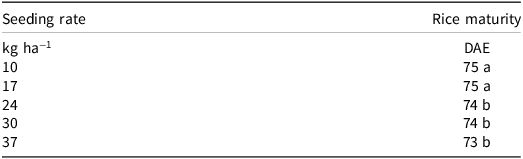
a Abbreviation: DAE, days after emergence.
b Data were pooled over two florpyrauxifen-benzyl rates and four studies. Means within a column followed by the same letter are not different at α = 0.05.
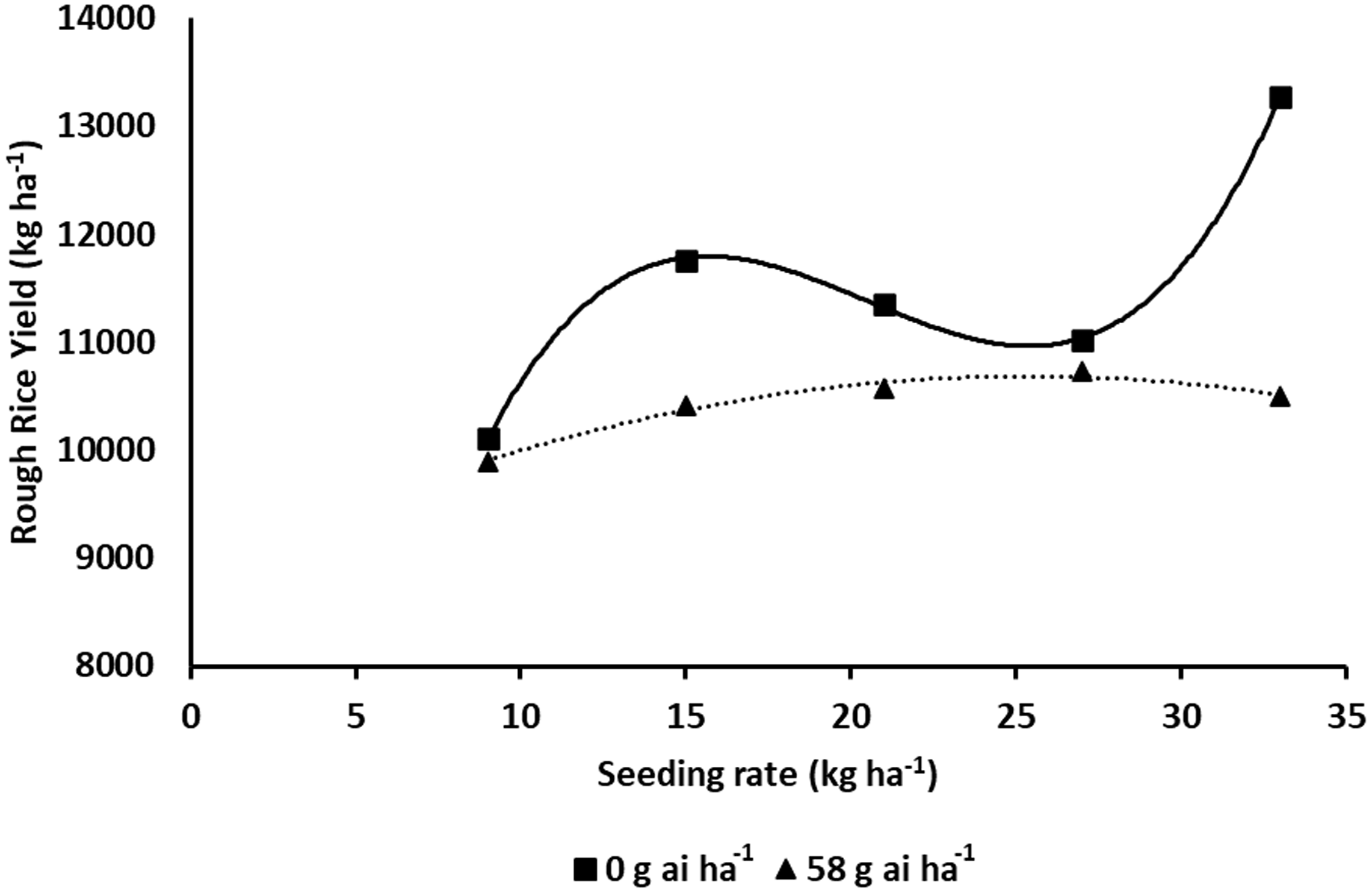
Rough rice yield is reduced when florpyrauxifen-benzyl is used. Cubic and quadratic regression analysis indicated that the intercept for rough rice yield when no florpyrauxifen-benzyl was applied was −1527.6688 (P = 0.0286, R 2 = 0.9995), and 8812.13 when florpyrauxifen-benzyl was applied at 58 g ai ha−1 (P = 0.0201, R 2 = 0.9798) (Table 4; Figure 1). When RT 7521 FP was seeded at 17 and 37 kg ha−1, rough rice yields were reduced 12% and 23%, respectively, when florpyrauxifen-benzyl was applied at 58 g ai ha−1 compared to the same seeding rates that received no florpyrauxifen-benzyl. Rough rice yield from the 10 kg ha−1 seeding rate was reduced by 27% compared with yield from the 37 kg ha−1 seeding rate. However, when florpyrauxifen-benzyl was applied, rough rice yield from the 10 kg ha−1 seeding rate was reduced by 5.9% compared with yield from the 37 kg ha−1 seeding rate. Sanders et al. (Reference Sanders, Bond, Lawrence, Golden, Allen, Famoso and Bararpour2020) reported that eight cultivars exhibited reduced rough rice yields when florpyrauxifen-benzyl was applied. Wright et al. (Reference Wright, Norsworthy, Roberts, Scott, Hardke and Gbur2020) reported that the CL111 cultivar did not exhibit a yield loss when florpyrauxifen-benzyl was applied, but yield from the CLXL245 cultivar was significantly reduced’. In contrast to the current research, Velásquez et al. (Reference Velásquez, Bundt, Camargo, Andres, Viana, Hoyos, Plaza and de Avila2021) reported that while rice injury from florpyrauxifen-benzyl increased with an increase in the herbicide rate, yield was not affected.
Regression coefficients for rough rice yield in research evaluating rice hybrid response to seeding rates and postemergence applications of florpyrauxifen-benzyl.

Rough rice grain yield for different Clearfield XL 7521 seeding rates following application of florpyrauxifen-benzyl from 2019 to 2021 at experimental sites in Stoneville, MS.
Practical Implications
This research demonstrates that florpyrauxifen-benzyl has the capacity to reduce rough rice yield of hybrid rice seeded at lower-than-recommended densities. Rice injury from florpyrauxifen-benzyl applied at a 2 × rate was ≤8% across all hybrid seeding rates. Sanders et al. (Reference Sanders, Bond, Lawrence, Golden, Allen, Famoso and Bararpour2020) reported ≤10% injury to commercial and experimental rice cultivars 14 d after florpyrauxifen-benzyl was applied at a 2× rate. The injury was 11% and 13% greater when florpyrauxifen-benzyl was applied to the inbred cultivars CL163 and PVLO24-B, respectively, compared with the Clearfield CL XL745 cultivar (Sanders et al. Reference Sanders, Bond, Lawrence, Golden, Allen, Famoso and Bararpour2020). Rice cultivar differential tolerance to florpyrauxifen-benzyl has been attributed to varying crop metabolism rates among cultivars (Velásquez et al. Reference Velásquez, Bundt, Camargo, Andres, Viana, Hoyos, Plaza and de Avila2021). In some cases, non-bioactivation of the florpyrauxifen-benzyl ester could be the cause of a lack of injury.
Similar to previous research, this study found that florpyrauxifen-benzyl applied to rice can reduce the height of the crop. Wright et al (Reference Wright, Norsworthy, Roberts, Scott, Hardke and Gbur2020) observed that injury from florpyrauxifen-benzyl may not always be visible. Rice maturity was significantly affected by the seeding rate, because the 10 kg ha−1 seeding rate matured 2 d slower than the 37 kg ha−1 seeding rate. Delaying rice maturity could potentially negatively impact rice producers in the mid-southern United States due to the tropical storm systems that are common during the harvest months of August and September. In the current study, florpyrauxifen-benzyl had no effect on rice maturity. Sanders et al. (Reference Sanders, Bond, Lawrence, Golden, Allen, Famoso and Bararpour2020) reported no delay in rice maturity when florpyrauxifen-benzyl was applied to multiple rice cultivars. Previous research has documented the ability of florpyrauxifen-benzyl to reduce rice yield (Beesinger et al. Reference Beesinger, Norsworthy, Butts and Roberts2022; Sanders et al. Reference Sanders, Bond, Lawrence, Golden, Allen, Famoso and Bararpour2020; Wright et al. Reference Wright, Norsworthy, Roberts, Scott, Hardke and Gbur2020). The current research indicates that applying florpyrauxifen-benzyl at a 2× rate can result in a loss of yield due to variation in rice densities. Rice producers should consider the effects of applying florpyrauxifen-benzyl to lower-seeded or highly seeded rice plant populations. Growers should ensure that rice has been planted at the recommended seeding rate of 30 kg ha−1 for cultivar RT 7521 FP when applying florpyrauxifen-benzyl.
Acknowledgments
We thank personnel at the Mississippi State University Delta Research and Extension Center for their assistance.
Funding
This publication is a contribution of the Mississippi Agricultural and Forestry Experiment Station. This study is based on a larger study that is supported by Hatch project 153300, which is funded by the U.S. Department of Agriculture–National Institute of Food and Agriculture. In addition, we extend gratitude to the Mississippi Rice Promotion Board for partially funding this research.
Competing interests
The authors declare they have no competing interests.


 Open access

