





Introduction
Waterhemp can be found in most of the continental United States and the Canadian provinces of Ontario, Quebec, Manitoba, and British Columbia (Costea et al. Reference Costea, Weaver and Tardif2005). First identified as a problematic weed in cultivated fields in Ontario in the early 2000s, waterhemp has rapidly expanded its range across southern Ontario (Benoit Reference Benoit2019; Costea and Tardif Reference Costea and Tardif2003; Schryver et al. Reference Schryver, Soltani, Hooker, Robinson, Tranel and Sikkema2017).
Waterhemp grows quickly (up to 2.5 cm per day) and produces 5 million seeds per plant under ideal growing conditions (Hartzler et al. Reference Hartzler, Battles and Nordby2004; Horak and Loughin Reference Horak and Loughin2000). Waterhemp grows faster than many other Amaranthus species and is one of the tallest, with a mature height of up to 3 m (Cole and Holch Reference Cole and Holch1941; Costea et al. Reference Costea, Weaver and Tardif2005; Horak and Laughin Reference Horak and Loughin2000). Waterhemp’s biparental reproduction, immense fecundity, and aggressive growth allow it to thrive (Nordby et al. Reference Nordby, Hartzler and Bradley2007; Waselkov and Olsen Reference Waselkov and Olsen2014. Waterhemp’s prolific nature and extended germination window make it competitive and difficult to control, especially in soybean (Sellers et al. Reference Sellers, Smeda, Johnson, Kendig and Ellersieck2003). Previous studies have documented yield losses of up to 73% in soybean and 74% in corn (Zea mays L.) due to interference from waterhemp (Soltani et al. Reference Soltani, Vyn and Sikkema2009; Steckel et al. Reference Steckel, Main, Mueller and Nandula2010; Vyn et al. Reference Vyn, Swanton, Weaver and Sikkema2007). Schryver et al. (Reference Schryver, Soltani, Hooker, Robinson, Tranel and Sikkema2017) reported up to 98% reduction in soybean grain yield when waterhemp density was greater than 1,200 plants m–2.
Until recently, waterhemp biotypes found in agricultural fields in Ontario have been confirmed to be mostly resistant to Group 2 (acetolactate synthase inhibitors) and/or Group 5 (photosystem II inhibitors) herbicides. Resistance to Group 9 (5-enolpyruvyl shikimate-3-phosphate synthase-inhibitors) and Group 14 [protoporphyrinogen oxidase (PPO)-inhibitors] has evolved in the last 5 yr, resulting in some waterhemp biotypes with multiple-herbicide resistance to all four of the aforementioned herbicide groups (Benoit et al. Reference Benoit, Hedges, Schryver, Soltani, Hooker, Robinson, Laforest, Soufiane, Tranel, Giacomini and Sikkema2019; Heap Reference Heap2021). The spread of multiple-herbicide-resistant (MHR) waterhemp has made control strategies challenging, as herbicide options are limited, especially in soybean. Early-season control of MHR waterhemp with soil-applied herbicides is critical to avoid soybean yield losses and limit reproduction and spread (Schryver et al. Reference Schryver, Soltani, Hooker, Robinson, Tranel and Sikkema2017; Vyn et al. Reference Vyn, Swanton, Weaver and Sikkema2007). Soil-applied herbicides such as pyroxasulfone and flumioxazin, applied preplant or preemergence alone or in combination, can provide control of MHR waterhemp during the critical weed-free period in soybean (Schryver et al. Reference Schryver, Soltani, Hooker, Robinson, Tranel and Sikkema2017).
Pyroxasulfone, a Group 15 (isoxazoline) herbicide, inhibits very long-chain fatty acid elongases in susceptible plants (Anonymous 2019b). Pyroxasulfone can control waterhemp and other broadleaf weeds and grasses in soybean (Mueller and Steckel Reference Mueller and Steckel2011; Stephenson et al. Reference Stephenson, Blouin, Griffin, Landry, Woolam and Hardwick2017). Flumioxazin is a Group 14 (N-phenylphthalimide) herbicide that inhibits the PPO enzyme in susceptible plants (Hartzler et al. Reference Hartzler, Battles and Nordby2004; Price et al. Reference Price, Pline, Wilcut, Cranmer and Danehower2004). Flumioxazin can control waterhemp and other broadleaf weeds in soybean (Niekamp Reference Niekamp1998; Nordby et al. Reference Nordby, Hartzler and Bradley2007; Taylor-Lovell et al. Reference Taylor-Lovell, Wax and Bollero2002). In recent years, PPO-resistant biotypes of waterhemp have emerged across North America (Heap Reference Heap2021). These biotypes fail to be controlled by the postemergence-applied PPO herbicides yet are still effectively controlled by preemergence-applied flumioxazin. However, length of residual control is sometimes reduced in the resistant biotypes (Dayan et al. Reference Dayan, Owens, Tranel, Preston and Duke2014; Harder et al. Reference Harder, Nelson and Smeda2012; Wuerffel et al. Reference Wuerffel, Young, Matthews and Young2015).
Pyroxasulfone and flumioxazin are currently labeled for use in soybean at 125 to 247 g ai ha–1 and 71 to 107 g ai ha–1 in Canada, respectively, with rates dependent upon soil texture and organic matter content (Anonymous 2019b, 2019c). Earlier studies have shown effective control of waterhemp and other Amaranthus species with a preemergence co-application of pyroxasulfone and flumioxazin (Nakatani et al. Reference Nakatani, Yamaji, Honda and Uchida2016; Strom et al. Reference Strom, Gonzini, Mitsdarfer, Davis, Riechers and Hager2019). The co-application of pyroxasulfone and flumioxazin combines two effective modes of action and can further improve the efficacy and the consistency of MHR waterhemp control in soybean. The premix formulation of pyroxasulfone/flumioxazin is currently labeled for use in soybean at 160 to 240 g ai ha–1 in Canada, the rate used is dependent upon soil texture and desired duration of residual control (Anonymous 2019a). The rates of active ingredients in the pre-mix product are less than the registered individual product rates. This rate discrepancy could be due to additive or synergistic weed control or increased risk of crop injury with the co-application of pyroxasulfone and flumioxazin, as the increased risk of injury is observed with mixtures of flumioxazin and S-metolachlor, another Group 15 herbicide (Mahoney et al. Reference Mahoney, Tardif, Robinson, Nurse and Sikkema2014; Salomao et al. Reference Salomao, Trezzi, Viecelli, Pagnoncelli, Patel, Damo and Frizzon2021). Flumioxazin is precluded from mixtures with very long-chain fatty acid elongases-inhibitor herbicides other than pyroxasulfone on the commercial label, because of the likelihood of unacceptable crop injury and yield loss (Anonymous 2019c).
To our knowledge, no published study has quantified the antagonistic, additive, or synergistic interactions of pyroxasulfone and flumioxazin mixtures on soybean injury and control of MHR waterhemp. Information on the interaction of these two herbicides is critical for scientists, growers, and agronomists in developing herbicide programs for MHR waterhemp control in soybean. Understanding the interactive effects of these mixtures will also help manage potential risk or capture increased efficacy.
The objective of this research was to determine the soybean tolerance and efficacy of pyroxasulfone and flumioxazin and to quantify their interaction when applied preemergence at various rates for the control of MHR waterhemp in soybean.
Materials and Methods
The study consisted of six field experiments; three were conducted in 2016, and three in 2017, in commercial soybean fields located in southwestern Ontario with waterhemp previously confirmed resistant to Group 2 (imazethapyr), Group 5 (atrazine), and Group 9 (glyphosate) (Heap Reference Heap2021; Schryver et al. Reference Schryver, Soltani, Hooker, Robinson, Tranel and Sikkema2017). The waterhemp biotypes present in the experimental fields survived application of 75 g ai ha–1 imazethapyr, and of 1,000 g ai ha–1 atrazine, and have a resistance factor of 5 to 28 for glyphosate (Schryver et al. Reference Schryver, Soltani, Hooker, Robinson, Tranel and Sikkema2017). One experiment each year was completed near Cottam, ON, Canada (42.149076º N, 82.683687º W) and two experiments (at separate sites) in each year were completed on Walpole Island, ON, Canada (42.561492º N, 82.501487º W and 42.554334° N, 82.515518° W).
The experimental design was a randomized complete block with four replications. Plots were 2.25 m wide and 8 m long, containing three soybean rows with 0.75 m inter-row spacing. Prior to planting, the plot area was tilled twice with a cultivator and harrow. Glyphosate/dicamba-resistant soybean cultivars DKB 30-61 (2016) and DKB 10-01 (2017) were seeded at a depth of 4 cm and at a rate of approximately 400,000 seeds ha–1 on planting dates listed in Table 1. Treatments included a nontreated weedy control, a weed-free control, pyroxasulfone (K-I Chemical USA Inc, Durham, NC) applied preemergence at 45, 89, 134, and 268 g ai ha–1, flumioxazin applied preemergence at 35, 70, 106, and 211 g ai ha–1, and a preformulated combination of pyroxasulfone/flumioxazin (Valent Canada, Guelph, ON) applied preemergence at 45 + 35, 89 + 70, 134 + 106, and 268 + 211 g ai ha–1. Herbicide rates were chosen based on titration of the individual active ingredients in the preformulated pyroxasulfone/flumioxazin combination. Herbicides were applied 1–5 d after seeding with a compressed CO2 backpack sprayer calibrated to apply 200 L ha–1 of spray solution through a 1.5-m hand-held boom equipped with four ULD120-02 nozzles (Pentair, 375 5th Ave NW, New Brighton, MN) producing a spray width of 2.0 m.
Location, year, soil characteristics, soybean planting and emergence dates, and herbicide application date for the interaction of pyroxasulfone and flumioxazin for multiple herbicide-resistant waterhemp control for six field experiments conducted in southwestern Ontario, Canada, during 2016 and 2017.

a Based on soil test results from the top 15 cm of the soil profile.
b Abbreviation: OM, organic matter.
Soybean injury was estimated visually at 2, 4, and 8 wk after soybean emergence (WAE), and MHR waterhemp control was estimated visually compared to the nontreated control at 2, 4, 8, and 12 wk after herbicide application (WAA). Plots were evaluated on a 0–100 scale where 0 = no visible soybean injury/no waterhemp control and 100 = complete soybean necrosis/total waterhemp control. The waterhemp density (plants m–2) and dry biomass (g m–2) was determined from two randomly placed 0.25-m–2 frames within each plot 8 WAA. MHR waterhemp plants within each quadrat were counted, then cut with hand clippers as close to the soil surface as practical, bagged in paper, dried until no moisture was left in the sample, and weights recorded. Soybean grain yield was harvested and weighed by a self-propelled research combine. The final grain yield was standardized to 13% moisture prior to statistical analysis.
Statistical Analysis
The GLIMMIX procedure in SAS v. 9.4 (SAS Institute, Cary, NC) was used to analyze the data variance for this study. Site-by-treatment interactions was evaluated with a mixed-model analysis where treatment was the fixed effect. It was determined that site, site-by-treatment, and replication within the site were random effects. Because the site-by-treatment interactions were considered nonsignificant (P > 0.05), data from all sites were combined for analysis.
Means were generated for soybean injury at 2, 4, and 8 WAE; MHR waterhemp control at 2, 4, 8, and 12 WAA; MHR waterhemp density and dry biomass; and relative soybean seed yield. A Tukey-Kramer test was used to compare means (P < 0.05). Expected values for the soybean injury, MHR waterhemp control, biomass, and density were calculated with the following equations used for the analysis.
Colby’s (Reference Colby1967) equation was applied to control and injury observations:
 $${\rm{Exp}} = \left( {X + Y} \right) - \left( {XY} \right)/100$$
where Exp = expected value, X = observed pyroxasulfone value and Y = observed flumioxazin value.
Modified Colby’s equation (applied to density and biomass observations):
 $${\rm{Exp}} = XY/C$$
where X = measured parameter value for pyroxasulfone, Y = measured parameter value for flumioxazin, and C = measured parameter value of the nontreated plot.
Colby’s equation was selected because the different modes of action of flumioxazin and pyroxasulfone are best in fitting an independent-action model (Abendroth et al. Reference Abendroth, Blankenship, Martin and Fred2011).
Expected values generated from the equations were compared to the observed means with a Student’s T-test. Where the expected and observed values did not differ, the interaction effect between the two herbicides was deemed additive. Where the difference between the observed and expected values was statistically significant, the interaction was determined to be antagonistic if lower, or synergistic if higher. Where computation of the difference between expected and observed values was not possible, a dash was inserted into the tables.
Results and Discussion
Soybean Injury
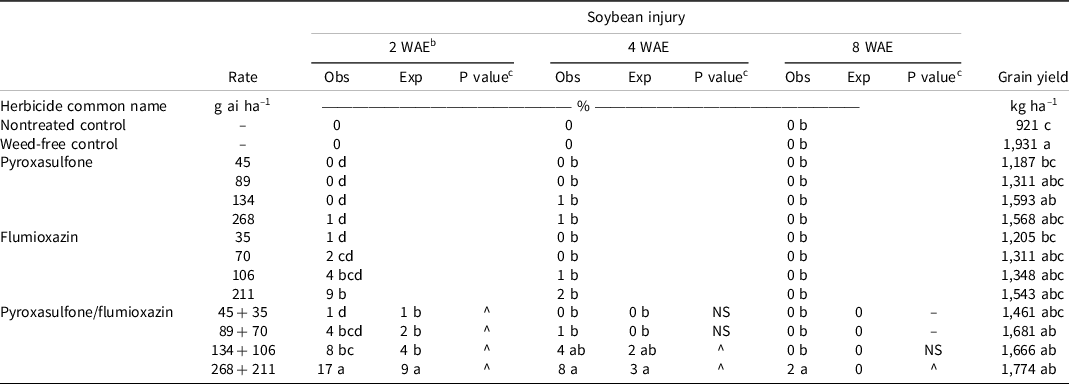
Pyroxasulfone applied preemergence at 45, 89, 134, and 268 g ai ha–1 caused minimal soybean injury (<1%) at 2, 4, and 8 WAE (Table 2). The yield reduction with pyroxasulfone applied preemergence at 45 g ai ha–1 was due to MHR waterhemp interference and not crop injury. Flumioxazin applied preemergence at 35, 70, 106, and 211 g ai ha–1 caused up to 9% injury at 2 WAE and 2% injury at 4 WAE; soybean showed no injury at 8 WAE (Table 2). Pyroxasulfone/flumioxazin applied preemergence at 45 + 35, 89 + 70, 134 + 106, and 268 + 211 g ai ha–1 caused 1%, 4%, 8% and 17% injury at 2 WAE; 0%, 1%, 4%, and 8% injury at 4 WAE; and 0%, 0%, 0%, and 2% injury at 8 WAE, respectively (Table 2). There was a synergistic increase in soybean injury with pyroxasulfone/flumioxazin at all rates evaluated at 2 WAE, the two highest rates evaluated (134 + 106 and 268 + 211 g ai ha–1) at 4 WAE, and the highest rate (268 + 211 g ai ha–1) evaluated at 8 WAE (Table 2). Soybean injury from pyroxasulfone/flumioxazin was transient with ≤2% injury at 8 WAE.
Observed and Colby’s (Reference Colby1967) expected soybean injury and grain yield after the application of pyroxasulfone and flumioxazin, applied preemergence, alone and in combination, from six field experiments conducted in southwestern Ontario, Canada during 2016 and 2017. a
a Means followed by the same letter within column do not significantly differ from each other according to Tukey-Kramer’s multiple range test, α = 0.05.
b Abbreviations: Exp, expected value; NS, not significant; Obs, observed value; WAE, weeks after crop emergence.
c A caret symbol ^ indicates that the observed value was significantly greater than the expected value; NS indicates that the observed value was not significantly different from the expected value; a dash – indicates that the difference could not be calculated. Expected values were calculated using Colby’s equation [E = (X + Y) – (XY)/100]; P = 0.05.
Soybean injury in this study is similar to Mahoney et al. (Reference Mahoney, Tardif, Robinson, Nurse and Sikkema2014), McNaughton et al. (Reference McNaughton, Shropshire, Robinson and Sikkema2014), and Steppig et al. (Reference Steppig, Norsworthy, Scott and Lorenz2018), who found that soybean recovered quickly following preemergence treatments of flumioxazin and pyroxasulfone alone or in combination. However, other researchers have reported potential interactions between pyroxasulfone and flumioxazin that may result in a significant risk of injury in soybean (Hartzler Reference Hartzler2017).
Soybean Yield
MHR waterhemp interference reduced soybean yield by 53% (Table 2). Reduced interference from the waterhemp population resulted in soybean yield that was similar to the weed-free control in all treatments except for the lowest examined dose of pyroxasulfone and flumioxazin.
MHR Waterhemp Control
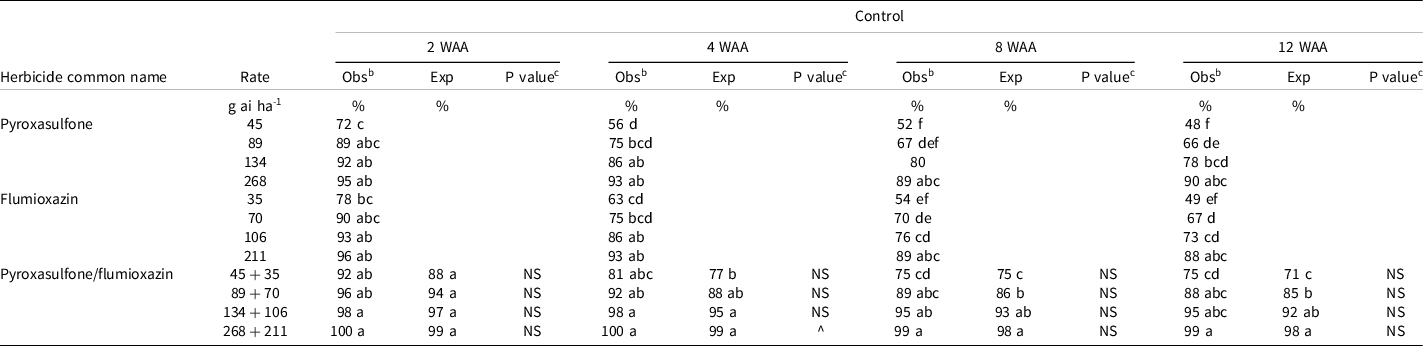
MHR waterhemp control with pyroxasulfone, flumioxazin, and pyroxasulfone/flumioxazin increased with rate and decreased over time (Table 3). There were no significant antagonistic or synergistic interactions with pyroxasulfone and flumioxazin at rates evaluated except with pyroxasulfone/flumioxazin applied preemergence at 268 + 211 g ai ha–1, which provided a synergistic increase in MHR waterhemp control at 4 WAE (Table 3). Control results are similar to Schryver et al. (Reference Schryver, Soltani, Hooker, Robinson, Tranel and Sikkema2017), who found 96%, 97%, 97%, and 97% control at 2, 4, 8, and 12 WAA, respectively, with pyroxasulfone/flumioxazin applied preemergence at a rate similar to 134 + 106 g ai ha–1 in soybean, but the study did not examine interaction effects. Meyer et al. (Reference Meyer, Norsworthy, Young, Steckel, Bradley, Johnson and Butts2016) reported 98% waterhemp control with pyroxasulfone/flumioxazin applied preemergence 3 WAA. Pyroxasulfone and flumioxazin interactions for control of other weed species were mostly additive in research conducted by Presoto (Reference Presoto2020) and mostly synergistic in a study conducted by Sievernich et al. (Reference Sievernich, Simon, Moberg and Evans2011). Interaction effects of the co-application of pyroxasulfone and flumioxazin appear to be specific to weed species and herbicide rate.
Observed and Colby’s (Reference Colby1967) expected control of waterhemp at 2, 4, 8, and 12 wk after application (WAA) of pyroxasulfone and flumioxazin, applied preemergence, alone and in combination, from six field experiments conducted in southwestern Ontario, Canada during 2016 and 2017. a
a Means followed by the same letter within column do not significantly differ from each other according to Tukey-Kramer’s multiple range test, α = 0.05.
b Abbreviations: Exp, expected value; NS, not significant; Obs, observed value.
c A caret symbol ^ indicates that the observed value was significantly greater than the expected value, P = 0.05; NS indicates that the observed value was not significantly different from the expected value. Expected values were calculated using Colby’s equation [E = X + Y) – (XY)/100].
Aboveground MHR Waterhemp Biomass and Density
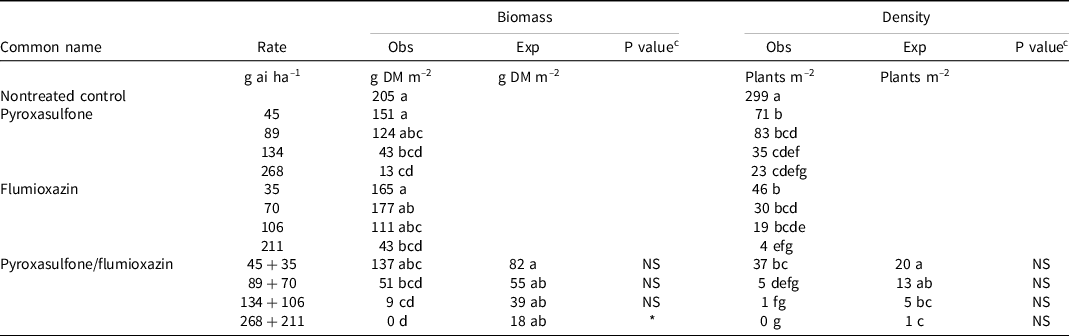
Pyroxasulfone applied preemergence at 45 and 89 g ai ha–1 did not reduce MHR waterhemp biomass but did reduce MHR waterhemp biomass 79% and 94% when applied at 134 and 268 g ai ha–1, respectively (Table 4). Pyroxasulfone applied preemergence at 45, 89, 134, and 268 g ai ha–1 reduced MHR waterhemp density 76%, 72%, 88%, and 92%, respectively (Table 4).
Observed and Colby’s (Reference Colby1967) expected waterhemp biomass and density at 8 wk after application of pyroxasulfone and flumioxazin, applied preemergence, alone and in combination, from six field experiments conducted in southwestern Ontario, Canada during 2016 and 2017. a
a Means followed by the same letter within column do not significantly differ from each other according to Tukey-Kramer’s multiple range test, α = 0.05.
b Abbreviations: DM, dry matter; Exp, expected value; NS, not significant; Obs, observed value.
c An asterisk * indicates that the observed value was significantly different from the expected value, P = 0.05; NS indicates that the observed value was not significantly different from the expected value. Expected values were calculated using a modified version of Colby’s equation (Exp = XY/C), where Exp is the expected parameter estimate, X and Y are the measured parameter values of pyroxasulfone and flumioxazin, respectively, and C is the measured parameter value of the nontreated control plot.
Flumioxazin applied preemergence at 35, 70, and 106 g ai ha–1 had no effect on MHR waterhemp biomass but reduced MHR waterhemp biomass 79% when applied at 211 g ai ha–1 (Table 4). Flumioxazin applied preemergence at 35, 70, 106, and 211 g ai ha–1 reduced MHR waterhemp density 85%, 90%, 94%, and 99%, respectively (Table 4).
Pyroxasulfone/flumioxazin applied preemergence at 45 + 35 g ai ha–1did not reduce MHR waterhemp biomass, but reduced MHR waterhemp biomass 75%, 96%, and 100% when applied at 89 + 70, 134 + 106, and 268 + 211 g ai ha–1, respectively (Table 4). There were no significant antagonistic or synergistic interactions with pyroxasulfone/flumioxazin at rates evaluated except at 268 + 211 g ai ha–1, which caused a synergistic decrease in MHR biomass of 9% (Table 4). Pyroxasulfone/flumioxazin applied preemergence at 45 + 35, 89 + 70, 134 + 106, and 268 + 211 g ai ha–1 reduced MHR waterhemp density 88%, 98%, 100%, and 100%, respectively (Table 4); all interactions for MHR waterhemp density were additive (Table 4). These results are similar to other studies that reported large reductions in waterhemp biomass and density with pyroxasulfone and flumioxazin applied alone or in combination at comparable rates (Hedges et al. Reference Hedges, Soltani, Hooker, Robinson and Sikkema2018; Perkins et al. Reference Perkins, Gage, Norsworthy, Young, Bradley, Bish, Hager and Steckel2020; Schryver et al. Reference Schryver, Soltani, Hooker, Robinson, Tranel and Sikkema2017).
This research concludes that there is the potential for a synergistic increase in soybean injury with the co-application of pyroxasulfone and flumioxazin. Although pyroxasulfone/flumioxazin caused up to 17% soybean injury, no decrease in soybean yield was detected in this study, which demonstrates that soybean injury was transient. In addition, this study found that the co-application of pyroxasulfone and flumioxazin results in an additive increase in MHR waterhemp control and an additive decrease in biomass and density. The results from this study can help farmers better manage MHR waterhemp in soybean. This study provided much-needed insight into the interaction of pyroxasulfone and flumioxazin. Pyroxasulfone/flumioxazin demonstrated overlapping and complementary visible control of MHR waterhemp. The long-term residual activity at commercially registered rates of pyroxasulfone/flumioxazin (89 + 70 and 134 + 106 g ai ha–1) (Anonymous 2019a) can help manage MHR waterhemp with its extended emergence pattern, allowing soybean growers to optimize yield and economic returns.
Acknowledgments
The authors wish to extend their gratitude to Dr. Michelle Edwards and Christy Shropshire for statistical advice as well as to Chris Kramer for the provided technical support. This project was funded in part by the Grain Farmers of Ontario (GFO), Nufarm Canada, and Valent Canada. The authors do not declare any conflicts of interest.


 Open access

