





Highlights
-
• The ANT paradigm proved sensitive to the positive cognitive effects associated with multilingualism.
-
• Bilingual and trilingual participants showed better performance in reaction times and accuracy on attentional tasks.
-
• No significant differences were found in alerting, orienting or executive attention scores as a function of linguistic background.
-
• In line with the Adaptive Response Hypothesis, a greater number of languages predicted faster responses.
-
• The findings suggest cognitive benefits of bilingualism and trilingualism in processing speed.
1. Introduction
The question of whether bilingualism drives cognitive benefits has spurred significant debate over past decades. Literature has presented evidence supporting the bilingual advantage hypothesis, suggesting that the constant management of two languages enhances cognitive functions (Antoniou, Reference Antoniou2019; Bialystok & Craik, Reference Bialystok and Craik2022; Grundy, Reference Grundy2020; Grundy & Timmer, Reference Grundy and Timmer2017). Alternative viewpoints exist regarding the locus of cognitive effects of bilingualism. On the one hand, specific cognitive benefits have been reported in various executive functions such as switching (Prior & MacWhinney, Reference Prior and MacWhinney2010) or working memory (Cockcroft & Alloway, Reference Cockcroft and Alloway2012). On the other hand, broader advantages in domain-general processes such as conflict monitoring or more general attentional abilities have been suggested (Luk et al., Reference Luk, de Sa and Bialystok2011; Bialystok & Craik, Reference Bialystok and Craik2022; Costa et al., Reference Costa, Hernández, Costa-Faidella and Sebastián-Gallés2009). Contrasting the bilingual advantage view, some studies have either identified strong inconsistencies in the literature or biases in the methods, concluding that the current evidence does not substantiate the claim of enhanced cognitive abilities in bilinguals, or that the bilingual effect may be minor or limited to specific contexts and tasks (Degirmenci et al., Reference Degirmenci, Grossmann, Meyer and Teichmann2022; Donnelly et al., Reference Donnelly, Brooks and Homer2019; Grundy, Reference Grundy2020; Hilchey et al., Reference Hilchey, Saint-Aubin, Klein and Schwieter2015; Lehtonen et al., Reference Lehtonen, Soveri, Laine, Järvenpää, de Bruin and Antfolk2018; Paap, Reference Paap, Schwieter and Paradis2019; Paap et al., Reference Paap, Johnson and Sawi2015; Privitera et al., Reference Privitera, Momenian and Weekes2022).
A related question in the bilingual effects debate is whether learning additional languages leads to improved cognitive functions. This interest has motivated research examining the extent to which the so-called bilingual effects extend to trilingualism (Chen et al. Reference Chen, Jiang and Liu2025; Chertkow et al., Reference Chertkow, Whitehead, Phillips, Wolfson, Atherton and Bergman2010; Kavé et al., Reference Kavé, Eyal, Shorek and Cohen-Mansfield2008; Perquin et al., Reference Perquin, Vaillant, Schuller, Pastore, Dartigues, Lair and Diederich2013; Schroeder & Marian, Reference Schroeder and Marian2017). Recent evidence on the effects of multilingualism has further strengthened this line of inquiry. For instance, a recent large-scale study involving 86,149 participants from 27 European countries found that multilingualism acted as a protective factor in both cross-sectional and longitudinal analyses, with effects persisting even after controlling for linguistic, physical, social and sociopolitical exposomes (Amoruso et al., Reference Amoruso, Hernandez, Santamaria-Garcia, Moguilner, Legaz, Prado, Cuadros, Gonzalez, Gonzalez-Gomez, Migeot, Coronel-Oliveros, Cruzat, Carreiras, Medel, Maito, Duran-Aniotz, Tagliazucchi, Baez, García and Ibanez2025). Building on this evidence and considering the extended Adaptive Response Hypothesis proposed by Bialystok (Reference Bialystok2024), the experience of managing an additional language may further enhance attentional efficiency. This framework therefore predicts that trilinguals could exhibit even greater attentional benefits as a form of cognitive adaptive response by increasing resource allocation. Thus, managing multiple languages would impose additional cognitive demands, and repeated engagement with these demands is thought to strengthen the underlying cognitive mechanisms, ultimately leading to more efficient processing (see this idea formalized also in the Supply–Demand Cognitive Plasticity Hypothesis by Schroeder & Marian, Reference Schroeder and Marian2017).
The relevance of attention as a plausible mechanism accounting for the potential effect of bilinguals has been previously analysed with the Attention Network Test (ANT). Indeed, the ANT developed by Fan et al. (Reference Fan, McCandliss, Sommer, Raz and Posner2002) is rooted in one of the most well-established theoretical frameworks of attentional processing, which identifies three independent brain networks, i.e., alerting, orienting and executive, as proposed by Posner and Petersen (Reference Posner and Petersen1990) and Petersen and Posner (Reference Petersen and Posner2012). Although the number of studies employing the ANT in bilingual populations remains relatively limited, a recent meta-analysis by Arora and Klein (Reference Arora and Klein2020) synthesized data from 16 identified studies. Using Bayesian hierarchical modelling, the authors analysed reaction time (RT) data across three distinct age groups: children (six studies), young adults (nine studies) and middle-aged adults (two studies). Their findings indicated a bilingual effect specifically in the executive control network among young adults, while no significant differences were observed in any attentional network measures or global RT scores for the child and middle-aged adult groups. However, the generalizability of these findings may be limited by the relatively small number of studies included in the review, the demographic and linguistic variability of the samples and the inconsistencies observed between the conclusions of individual studies and those of the meta-analysis. It should also be noted that none of the reported studies involving adult participants examined bilingual cognitive effects by including a multilingual comparison group, an approach that could yield valuable insights into potential cognitive adaptations associated with trilingualism.
The present study aimed to assess the impact of bilingualism and trilingualism, relative to monolingualism, on attentional performance across global and specific attentional network measures (alerting, orienting and executive control) using the ANT. Employing three homogeneous groups – monolinguals, bilinguals and trilinguals – offers an innovative design that refines and extends current theoretical predictions regarding the cognitive consequences of bilingualism. Based on the Adaptive Response Hypothesis, it was expected that the experience in managing additional languages would promote greater cognitive adaptation, leading to enhanced attentional efficiency as reflected in RTs and error rates (Bialystok, Reference Bialystok2024). Bilinguals were expected to outperform monolinguals, and trilinguals to outperform both bilinguals and monolinguals. In addition, if the bilingual effect is attributable to domain-specific attentional processes, differences will be expected in specific attentional network measures. Alternatively, if the bilingual effect is linked to a domain-general process, differences will be limited to global measures. To address previous limitations related to potential group inhomogeneities, the study recruited three samples of undergraduate students from the same university, ensuring homogeneity across key variables such as age, education, general fluid intelligence, motor speed, age of second-language acquisition, residential environment and the types of languages spoken.
2. Materials and methods
2.1. Participants
A power analysis was conducted using G*Power v. 3.1 statistical software (Faul et al., Reference Faul, Erdfelder, Buchner and Lang2009) to determine the sample size required for a repeated measures ANOVA assuming an effect size (f) of 0.314 from Costa et al. (Reference Costa, Hernández, Costa-Faidella and Sebastián-Gallés2009) due to its strong compatibility and similarity to this study. A significance level (α) of 0.05, and power of 0.80 were adopted. The results indicated that 101 participants would be necessary to achieve the target significance level (α) and power, respectively.
A total of 97 adult university students (mean age = 23.5 ± 0.5 years; 88 women) from Madrid, Spain, with Spanish as their native language, participated in this study as volunteers and received extra-academic credits for their involvement. A power analysis conducted with these data at a significance level of 0.05 revealed a high observed statistical power for the contrast (0.99), indicating a very low probability of committing a Type II error. General exclusion criteria included history of neurological disease, psychiatric illness or any other difficulty that could interfere with testing. Three participants were identified as outliers based on a Mahalanobis distance greater than 25 in their behavioural scores and were subsequently excluded from the analyses, resulting in a final sample size of 94 participants (Mahalanobis, Reference Mahalanobis1936).
Participants responded to a multilingual questionnaire about their language experience and proficiency that allowed us to divide them into different groups (modified from Weber-Fox & Neville, Reference Weber-Fox and Neville1996). The questionnaire evaluates information about language history including place of birth, age of acquisition of Spanish and any other languages, modes of language acquisition (family, school, other), language dominance, language preference and self-perceived proficiency in understanding, speaking, reading and writing each language, using a 4-point scale (1 = scarcely, 2 = sufficiently, 3 = well and 4 = perfectly). A total proficiency score in each language (0-to-16 point scale) was calculated by adding the four proficiency scores. The demographic and linguistic characteristics of the three established groups were as follows.
2.1.1. Monolingual second-language learners’ group
These participants were 35 young adults (mean age = 19.4 ± 0.3 years; 30 females) with 13.3 ± 0.3 years of education. They were native Spanish speakers who, as described above, had received mandatory English language instruction at school starting at the age of 6, but had not had any continuous exposure or immersion in any language other than Spanish.
2.1.2. Bilingual group
These participants were 37 young adults (mean age = 18.8 ± 0.1 year; 33 female), with 13.3 ± 0.1 years of education. The mean age of English acquisition was 3.5 ± 0.2 years, with 24 participants growing up bilingually in both Spanish and English, and 9 participants being exposed to English sequentially at the age of 6 or earlier. Self-reported mean proficiency in Spanish and English were 16 ± 0 and 15.6 ± 0.2, respectively, in a 0-to-16 point scale. None of these individuals had any continuous exposure or immersion in any other language apart from Spanish and English.
2.1.3. Trilingual group
These participants were 22 young adults (mean age = 19.9 ± 0.2 years; 19 female), with 13.7 ± 0.2 years of education. The mean age of English acquisition was 2.8 ± 0.4 years, with 16 participants growing up bilingually in both Spanish and English, and 6 participants being exposed to English sequentially at the age of 6 or earlier. The mean age of acquisition of the third language was 8.9 ± 0.8 years, with 2 participants growing up trilingually in both Spanish and English, and in a third language, 3 participants being exposed to the third language sequentially at an early age (6 years or earlier), and 17 participants being exposed to the third language sequentially at a latter age (between 7 and 13 years). The third language were French (16 participants), German (3 participants), Italian (1 participant), Catalan (1 participant) and Euskara (1 participant). Self-reported mean proficiencies in Spanish, English and the third language were 16 ± 0, 15.7 ± 0.2 and 12.1 ± 0.2, respectively in a 0-to-16-point scale.
The study was approved by the ethics committee of the institution and was completed in compliance with institutional standards for human research and following the Declaration of Helsinki. All participants gave informed consent, and their rights were protected in accordance with the ethical standards of the university’s Academic Board.
2.2. Materials and procedure
The Attention Network Test (ANT), as designed by Fan et al. (Reference Fan, McCandliss, Sommer, Raz and Posner2002), was used within the context of a larger examination to explore three attentional networks: alerting, orienting and executive control. The stimuli were presented via Presentation software (https://www.neurobs.com/) on a computer with a 15-inch monitor. The computer was set to 60 Hz and resolution 1680 x 1050 pixels and was placed at about 65 centimetres of distance from participants. Stimuli consisted of a row of five visually presented white arrowheads pointing rightward or leftward, against a black background. There were two types of target stimuli: a congruent target (> > > > > or < < < < <), when the centre arrow was flanked by other arrows pointing in the same direction, and an incongruent target (> > < > > or < < > < <), when the center arrow was flanked by other arrows pointing in the opposite direction. Target stimuli represented a total length of 5.3 cm on the x axis and 0.8 cm on the y axis. The congruent and incongruent trials occurred in equal proportions. Under each condition (congruent or incongruent), half were pointing to the left and half to the right. The participant’s task was to indicate the direction of the centre arrow by pressing the left and right buttons from a keyboard with their left and right index fingers. The target was presented in one of two locations, either 1.5 cm above or below a fixation cross that remained in the centre of the visual display throughout the entire experiment. To engage the alerting and orienting processes, a cue consisting in a white circle with a diameter of 0.7 cm was shown before the appearance of the target. There were four cue conditions: no cue, centre cue, double cue and spatial cue. All cues occurred equiprobably. While centre cues were presented in the screen overlapping the fixation cross, double and spatial cues were presented 1.5 cm above or below it. As a result of the combination of target and cue conditions, the following eight orthogonal conditions were applied: no cue-congruent, no cue-incongruent, centre cue-congruent, centre cue-incongruent, double cue-congruent, double cue-incongruent, spatial cue-congruent and spatial cue-incongruent. The task consisted of 96 trials (24 of each condition). Following Fan et al. (Reference Fan, McCandliss, Sommer, Raz and Posner2002), each trial consisted of five events. First, there was a fixation period for a random variable duration (400–1600 ms). Then a warning cue was presented for 100 ms. There was a short fixation period 400 ms after the warning cue and then the target and flanker appeared simultaneously. The targets were presented until participants responded, with a time limit of 1700 ms (see Figure 1). Target location was always uncertain except when spatial cue was presented. Individuals had a practice session of 20 trials before performing the task.
The figure illustrates the stimulus material and experimental conditions. (A) Schematic representation of trial sequences illustrating the experimental conditions (cues and targets) analysed. Trials included two types of target stimuli: congruent targets (> > > > >), in which the central arrow was flanked by arrows pointing in the same direction, and incongruent targets (> > < > >), in which the flanking arrows pointed in the opposite direction. (B) Each trial began with a visual cue (i.e., the “ο” symbol), followed by the presentation of a flanker display containing either a congruent or incongruent target. Participants were instructed to respond to the direction of the central arrow.

2.3. Data analyses
2.3.1. Demographic and background analysis
Group differences in demographic variables (sex, age and education), motor speed (Finger Tapping Test; Sherman et al., Reference Sherman, Tan and Hrabok2022; Roivainen, Reference Roivainen2011) and general fluid intelligence (Digit Span – WAIS-IV; Wechsler, Reference Wechsler2012; Gignac & Weiss, Reference Gignac and Weiss2015) were explored by means of 1-way ANOVA or Chi square tests where appropriate.
The homogeneity of the groups regarding the age of acquisition of English (comparison between bilingual and trilingual) was determined by means of Student t-test. The proficiency in Spanish and English was compared among monolinguals, bilinguals and trilinguals by means of a one-way ANOVA, and a Student t-test, respectively. Kolmogorov–Smirnov test was used to assess normality in the distribution of the variables as a prerequisite for comparisons.
2.3.2. Analysis of Group Differences in Cognitive Variables
Several analyses were performed in RTs to correct trials and percentage of errors to address the presence of differences in attentional performance among individuals of the three different linguistic groups. First, an initial three-way ANOVA using group (monolinguals, bilinguals, trilinguals), cue type (no cue, double cue, central cue, spatial cue) and flanker condition (congruent, incongruent) as the factors was performed in RTs and percentage of errors to explore global effects, and to set a reference point with preceding literature. Second, a series of two-way ANOVAs allowed for direct contrasts between the specific conditions relevant to the assessment of the three attentional networks of interest. Particularly, the effects of Group in the attentional networks were examined using two complementary approaches. On the one hand, a series of two-way ANOVAs were used to identify significant interactions in RTs and percentage of errors in the three attentional networks. Thus, the alerting network was assessed with an ANOVA using group (monolinguals, bilinguals and trilinguals) x cue (no cue and double cue trials) as factors. The Orienting network was assessed with an ANOVA using group x cue (centre cue and spatial cue trials) as factors. The Executive network was assessed with an ANOVA using group x condition (congruent and incongruent trials) as factors. On the other hand, three network scores were computed according to Fan et al. (Reference Fan, McCandliss, Sommer, Raz and Posner2002). Specifically, the alerting score was calculated by subtracting the mean RTs of the double cue from the mean RTs of the no cue. The orienting score was calculated by subtracting the mean RTs of the spatial cue from the mean RTs of the centre cue, and the executive score was calculated by subtracting the mean of the congruent condition from the mean of the incongruent condition in both RTs and percentage of errors. Homologous non-parametric statistical tests were used when the assumption of normality was not met for RTs or percentage of errors scores (see Results section below). The degrees of freedom were adjusted where appropriate using the Greenhouse–Geisser correction, as a precaution against inhomogeneities in the variances of the means. A significance level of p < .05 was set for all analyses, with a Bonferroni-corrected level of p < .05 applied for tests involving multiple comparisons. All statistical analyses were conducted using SPSS version 26.0. Additionally, G*Power version 3.1 (Faul et al., Reference Faul, Erdfelder, Buchner and Lang2009) was employed to estimate the required sample size.
2.3.3. Regression analyses
Simple regression analysis was conducted to examine the potential statistical trend, suggesting that individuals speaking a greater number of languages might exhibit faster RTs. Thus, a linear regression analysis explored the relationship between language group (monolingual, bilingual, trilingual) as the predictor variable, and global RTs as the criterion. Non-linear regression analyses were also conducted on transformed scores (quadratic and logarithmic) to assess alternative curvilinear relationships between the variables.
3. Results
3.1. Demographic and background results
Between-group comparisons revealed an absence of differences among monolinguals, bilinguals and trilinguals in gender, age, education, motor speed, general fluid intelligence, Spanish and English age of acquisition and Spanish and English proficiency (Table 1).
Summary of participants: demographic and background characteristics in the groups

Note: Mean ± Standard Error of Measurement; p-value: Statistical significance; a: Mean number of taps in the Finger Tapping Test; b: Digit Span score of the WAIS-IV.
3.2. Group Differences in Cognitive Variables
A three-way mixed ANOVA on RTs (2 × 4 × 2) was conducted to examine the effects of group, cue type and flanker condition on task performance. Significant effects were found for group, (F(2, 90) = 11.9; p < .001; η 2 = .21), cue type (F(2,204) = 340.4; p < .001; η 2 = .79) and flanker condition (F(1, 90) = 25.9; p < .001; η 2 = .22). Post hoc comparisons indicated that both bilinguals and trilinguals responded significantly faster than monolinguals (p < .002 and p < .001, respectively), with a non-significant trend towards a difference between bilinguals and trilinguals (p = .336). No significant two-way or three-way interactions were found among group, cue type or flanker type (p > .370 in all cases; see Table 2). The percentage of errors was analysed using Kruskal–Wallis tests due to a lack of normal distribution. Comparisons among the three groups and cue type (no cue, double cue, centre cue and spatial cue) revealed no significant group differences (p > .129 in all cases). Comparisons among the three groups revealed significant differences in incongruent condition (p < .001) and congruent condition (p < .001). Post hoc analyses on congruent trials showed differences in errors between monolingual and bilingual groups (p < .001) and monolingual and trilingual groups (p < .001), but not between the later groups (p > .097). Post hoc analyses on incongruent trials showed differences in errors between monolinguals and bilinguals (p < .001) and monolinguals and trilinguals (p < .001) but not between the later groups (p > .795). In summary, the RT analyses revealed significant group effects, with both bilinguals and trilinguals responding faster than monolinguals. Additionally, bilinguals and trilinguals exhibited a lower percentage of errors compared to monolinguals in both congruent and incongruent conditions.
Behavioural performance (RTs and % Er) in all ANT conditions

Note: Mean ± Standard Error of Measurement. RT: Reaction Time in milliseconds; % Er: Percentage of errors.
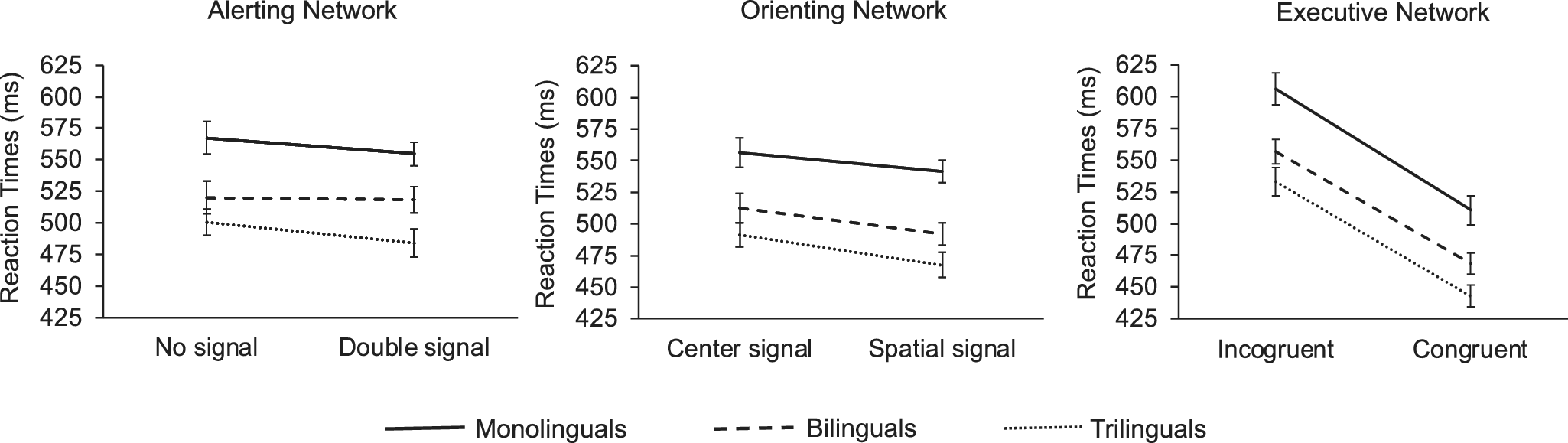
As noted above, a series of two-way mixed ANOVAs were conducted to explore the specific effects of the three attentional networks. Thus, a two-way mixed ANOVA was conducted to analyse RT effects in the alerting network using group (monolingual, bilinguals, trilingual) and cue type (no cue, double cue) as the factors (see Table 3 and Figure 2). It revealed the presence of group effect (F(2,91) = 9; p < .001; η 2 = .17) being monolinguals slower than both bilinguals, and trilinguals (p < .016 in all cases) with no differences between bilinguals and trilinguals (p = .329). As expected, the significant cue effect (F(1,91) = 7.5; p < .007; η 2 = .08) revealed that responses were faster in the double cue condition than in the no cue condition (p < .007). Importantly, no interaction effects were found (p > .242). The percentage of errors in responses was analysed using Kruskal–Wallis tests, and comparisons among the three groups revealed no significant differences in no cue and double cue (p > .244 in all cases). In summary, although the RT analysis revealed significant effects of group and cue type, with monolinguals exhibiting slower responses than bilinguals and trilinguals, the absence of interactions indicated a lack of effects on the alerting network.
Behavioural performance (RTs and % Er) in the three attentional network measures

Note: Mean ± Standard Error of Measurement. RT: Reaction Time in milliseconds; % Er: Percentage of errors.
The figure illustrates mean RTs in milliseconds and standard error of measurement in the ANT conditions used to identify the function of the alerting, orienting and executive networks. The different lines identify monolingual (solid line), bilingual (dashed line) and trilingual (dotted line) groups.

A two-way mixed ANOVA was conducted to analyse RT effects in the orienting network using group (monolingual, bilinguals, trilingual) and cue type (centre cue, spatial cue) as the factors (see Table 3 and Figure 2). It revealed the presence of main group effect (F(2,91) = 11.8; p < .001; η 2 = .21) showing that monolinguals were slower than both bilinguals and trilinguals (p < .002 in all cases) with no differences between bilinguals and trilinguals (p = .411). As expected, the presence of a cue effect (F(1,91) = 41; p < .001; η 2 = .31) revealed differences between spatial cue and the central cue conditions (p < .001). No other main effects or interaction reached significance (p > .370). The percentage of errors in responses was analysed using Kruskal–Wallis tests, and comparisons among the three groups revealed no significant differences in centre cue and spatial cue (p > .129 in all cases). In summary, although the RT analysis revealed significant effects of group and cue type, with monolinguals exhibiting slower responses than bilinguals and trilinguals, the absence of interactions indicated a lack of effects on the orienting network.
A two-way mixed ANOVA was conducted to analyse RT effects in the executive network using group (monolingual, bilinguals, trilingual), and flanker condition (congruent, incongruent) as the factors (see Table 3 and Figure 2). It revealed the presence of main group effect (F(2,90) = 11.9; p < .001; η 2 = .210) showing that monolinguals were slower than both bilinguals and trilinguals (p < .002 in all cases) with no differences between bilinguals and trilinguals (p = .336). As expected, the presence of a flanker effect (F(1,90) = 575.3; p < .001; η 2 = .87) revealed differences between incongruent and congruent conditions being RTs to the former trials slower than to the later. Importantly, no other main effects or interaction reached significance. The percentage of errors in responses was analysed using Kruskal–Wallis tests, and comparisons among the three groups revealed significant differences in incongruent (p < .001) and congruent (p < .001) conditions. Congruent and incongruent post hoc analyses showed differences between monolingual and trilingual groups (p < .001) and monolingual and bilingual groups (p < .001), but not in the remaining comparisons (p > .097 in all cases). In summary, although the RT analysis revealed significant effects of group and flanker condition, with monolinguals exhibiting slower responses than bilinguals and trilinguals, the absence of interactions indicated a lack of effects on the executive network. Additionally, bilinguals and trilinguals exhibited a lower percentage of errors compared to monolinguals in both congruent and incongruent conditions, thus indicating a lack of effects on the executive network.
Three additional one-way ANOVAs using group as a factor (monolingual, bilinguals, trilingual) were conducted to analyse the results on the attentional scores as described by Fan et al. (Reference Fan, McCandliss, Sommer, Raz and Posner2002). The calculations of the difference scores are presented in Table 4. The analysis of the alerting score (double cue minus no cue) revealed an absence of group effect in RTs (F(2,91) = 1.4; p < .242; η 2 = .03). Similarly, the analysis of the orienting score (spatial cue minus centre) revealed an absence of group effect in RTs (H(2) = 1.9; p < .392). In addition, the analysis of the executive score (incongruent condition minus congruent conditions) revealed an absence of group effect in RTs (F(2,90) = 0.3; p < .763; η 2 = .01). The percentage of errors was analysed using Kruskal–Wallis and revealed no differences across groups on attentional scores (p > .084 in all cases). In summary, no significant differences were found between monolinguals, bilinguals and trilinguals on the alerting, orienting or executive attentional scores.
Behavioural performance in attentional network scores

Note: Mean ± Standard Error of Measurement. RT: Reaction Time in milliseconds; % Er: Percentage of errors; Alerting score: Calculated by subtracting the mean of the double cue from the mean of the no cue; Orienting score: Calculated by subtracting the mean of the spatial cue from the mean of the center cue; Executive score: Calculated by subtracting the mean of the congruent condition from the mean of the incongruent condition.
3.3. Regression analyses
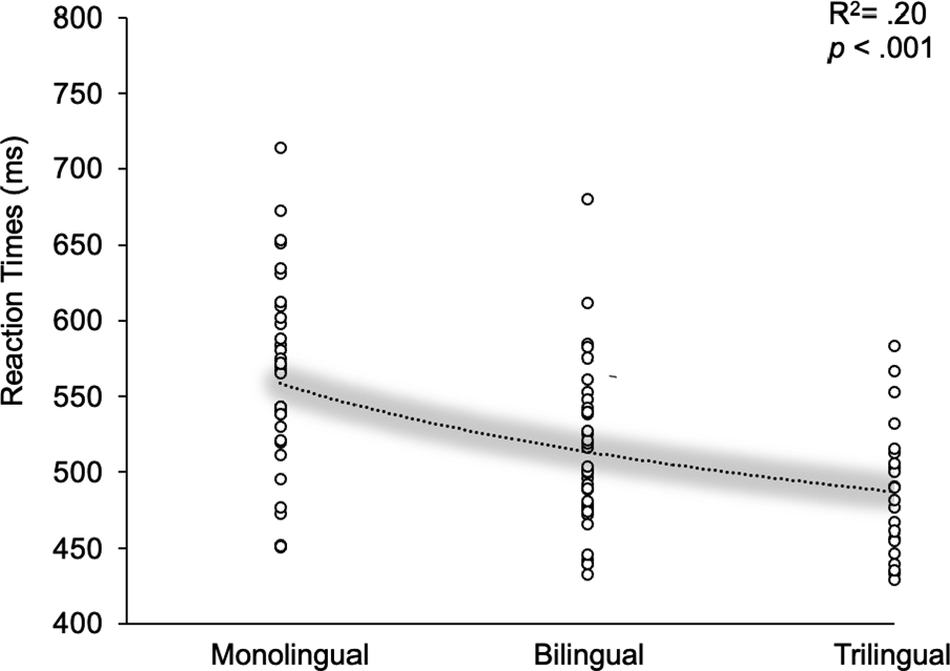
Simple regressions were conducted to explore the plausible association observed between global RT measures (dependent variable) and linguistic group (i.e., monolingual, bilingual, trilingual; independent variable). The linear regression analysis revealed an absence of a significant linear relationship between the variables (p = .072; R2 = .039). However, non-linear regression analyses revealed a significant quadratic association (F(1, 91) = 20.43; p < .001; R2 = .183), in which the number of languages spoken was associated with faster global RTs. Similarly, a significant logarithmic association was observed (F(1, 91) = 23.8; p < .001; R2 = .208), with the number of languages spoken also associated with faster global RTs (see Figure 3).
The figure illustrates a logarithmic trend in global RTs, measured in milliseconds, across monolingual, bilingual and trilingual groups. Individual data points are represented by open circles, with each point corresponding to a participant within the respective language group. The results reveal a general trend whereby global RTs improved as the number of languages spoken increases.

4. Discussion
The aim of the present study was to investigate the impact of speaking more than one language on attentional processing. Three groups of healthy monolinguals, bilinguals and trilinguals were matched in gender, age, education, motor speed, general fluid intelligence and age of acquisition of their first language. In addition, bilinguals and trilinguals were matched in the age of acquisition of their second language. Following the Adaptive Response Hypothesis (Bialystok, Reference Bialystok2024), it was expected that if the experience of handling more languages entails greater cognitive demands due to the constant management of two languages, this would adapt the attentional system to be more efficient. Accordingly, bilinguals were expected to outperform monolinguals, and, by extension, trilinguals were expected to outperform both bilinguals and monolinguals in attentional abilities. Additionally, the present study examined whether any observed effects could be attributed to domain-specific attentional mechanism namely, alerting, orienting or executive control, or alternatively, to a domain-general one.
The results of the general analysis (three-way ANOVA) indicated that speaking more than one language was associated with improved speed during ANT performance. Specifically, the bilingual and trilingual groups exhibited faster RTs compared to monolinguals. The accuracy analyses also revealed that the bilingual and trilingual groups exhibited a reduced number of errors compared to monolinguals. The relevance of these findings is highlighted by the fact that the monolingual comparison group was not entirely naïve to English, having received formal academic instruction in the language, albeit without sustained or immersive bilingual experience. These results replicate a pattern reported in the existing ANT literature with adults, as summarized in Table 5, showing that of the ten studies reviewed, nine analysed global RTs, with six reporting faster RTs in bilinguals, two finding no differences between groups and only one reporting a monolingual advantage. In addition, the present data revealed that the direct comparison of global RTs between bilinguals and trilinguals were non-significant. The lack of a significant difference between these groups, despite the trend observed in the data (see Figure 2), may reflect a potential ceiling effect. Given the present samples, the expected improvement in RT performance among healthy adults with a high educational level is likely to be small, approaching both psychological and physiological limits. This interpretation was preliminary supported by a non-linear regression analysis, which indicated that a greater number of languages spoken predicted better global RTs, with a logarithmic trend providing the best model fit (see Figure 3). Taken together, these findings provide partial support for the predictions of the Adaptive Response Hypothesis (Bialystok, Reference Bialystok2024) and its extension, which propose that bilingual and trilingual experiences can influence cognitive processes by inducing adaptive changes. Both bilinguals and trilinguals demonstrated more efficient performance on the attentional task than monolinguals, in terms of both speed and accuracy. However, the results only provide modest support for the notion that trilingualism confers additional benefits beyond bilingualism, as this was supported statistically solely by a logarithmic association between the number of languages spoken and processing speed.
Overview of studies using the ANT in bilingual adults

Note: N.R.: Not reported; *: Language corresponding to monolinguals; Global Statistical Analyses: Statistical test used to demonstrate overall RT effects between monolinguals and bilinguals; Network Statistical Analyses: Statistical test used to demonstrate differences in RT between monolinguals and bilinguals in attentional networks; Global effect: Presence or absence of RT differences among groups; Alerting Network effect: Presence or absence of differences among groups in measures of the alerting network; Orienting Network effect: Presence or absence of differences among groups in measures of the orienting network; Executive Network effect: Presence or absence of differences among groups in measures of the executive network; a: Statistical effects identified in an interaction from an ANOVA; b: Statistical effects identified in a 1-way ANOVA or Student’s t-test; †: Monolinguals outperformed bilinguals.
The analysis of behavioural performance in the three attentional networks, on the one hand, closely replicates the classical effects using the ANT (Fan et al., Reference Fan, McCandliss, Sommer, Raz and Posner2002; Rueda et al., Reference Rueda, Fan, McCandliss, Halperin, Gruber, Lercari and Posner2004). On the other hand, the analyses of the interactions between language and attentional networks suggested that, despite the faster RTs associated to bilingual and trilingual individuals as compared to monolinguals, such an effect was not related to a specific enhancement of any particular attentional mechanisms, i.e., alerting, orienting or executive networks (see Figure 2). In this regard, and as shown in Table 5, there is relative consensus in the ANT literature with healthy adults regarding the lack of a significant bilingual effect in relation to the alerting network (Desideri & Bonifacci, Reference Desideri and Bonifacci2018; Limberger & Buchweitz, Reference Limberger and Buchweitz2014; Nair et al., Reference Nair, Biedermann and Nickels2017; Ooi et al., Reference Ooi, Goh, Sorace and Bak2018; Pelham & Abrams, Reference Pelham and Abrams2014; Rodrigues & Zimmer, Reference Rodrigues and Zimmer2016; Sabourin & Vīnerte, Reference Sabourin and Vīnerte2019; Vivas et al., Reference Vivas, Ladas, Salvari and Chrysochoou2017; Yang et al., Reference Yang, Hartanto and Yang2016), with the only exception being the study by Costa et al. (Reference Costa, Hernández and Sebastián-Gallés2008), which reported that bilinguals benefited more than monolinguals from the presence of an alerting cue compared to no-cue trials. Importantly, this effect was not replicated in a later study by the same research group, thereby calling its reliability into question (Costa et al., Reference Costa, Hernández, Costa-Faidella and Sebastián-Gallés2009). Likewise, and as shown in Table 5, literature is homogeneous regarding the description of a lack of a bilingual effect in the orienting network (Costa et al., Reference Costa, Hernández and Sebastián-Gallés2008; Desideri & Bonifacci, Reference Desideri and Bonifacci2018; Limberger & Buchweitz, Reference Limberger and Buchweitz2014; Nair et al., Reference Nair, Biedermann and Nickels2017; Ooi et al., Reference Ooi, Goh, Sorace and Bak2018; Pelham & Abrams, Reference Pelham and Abrams2014; Rodrigues & Zimmer, Reference Rodrigues and Zimmer2016; Sabourin & Vīnerte, Reference Sabourin and Vīnerte2019; Vivas et al., Reference Vivas, Ladas, Salvari and Chrysochoou2017) with the only exception of Yang et al. (Reference Yang, Hartanto and Yang2016) showing differences between groups in the orienting score (difference between Spatial and Central cues). However, this study did not account for an interaction effect between group and cue, thus preventing the possibility of disentangling specific effects from generalized ones. Regarding the executive networks, results were more heterogeneous. Specifically, six out of ten studies from Table 5 concluded that bilingualism confers an effect on the executive network (Costa et al., Reference Costa, Hernández and Sebastián-Gallés2008; Desideri & Bonifacci, Reference Desideri and Bonifacci2018; Ooi et al., Reference Ooi, Goh, Sorace and Bak2018; Pelham & Abrams, Reference Pelham and Abrams2014; Sabourin & Vīnerte, Reference Sabourin and Vīnerte2019; Yang et al., Reference Yang, Hartanto and Yang2016). However, these effects were based on different statistical analyses that could limit the consistency of this finding. For example, using multivariate ANOVA, Costa et al. (Reference Costa, Hernández and Sebastián-Gallés2008) and Ooi et al. (Reference Ooi, Goh, Sorace and Bak2018) reported group by congruency interactions in RTs, but only Costa et al. (Reference Costa, Hernández and Sebastián-Gallés2008) found a significant post hoc effect with differences between incongruent and congruent trials being larger for monolinguals than for bilinguals. However, these effects disappeared in a subsequent study by the same group when the probability of congruent and incongruent trials was manipulated (Costa et al., Reference Costa, Hernández, Costa-Faidella and Sebastián-Gallés2009), as will be discussed later. On the other hand, the executive effects reported by Desideri and Bonifacci (Reference Desideri and Bonifacci2018), Sabourin and Vīnerte (Reference Sabourin and Vīnerte2019) and Yang et al. (Reference Yang, Hartanto and Yang2016) were based on Student’s t-tests and one-way ANOVAs, which again precluded the identification of reliable interaction effects and, consequently, the possibility of disentangling specific effects from generalized ones.
Taken together, the present results support the idea that no specific behavioural effects, aside from a global improvement in speed and accuracy among bilingual and trilingual individuals, were observed across the attentional networks measured by the ANT. It should be noted that, in the meta-analysis by Paap (Reference Paap, Schwieter and Paradis2019), only 16.7% of the studies reporting statistical tests of global RTs found a significant bilingual advantage, with effect sizes being statistically small; in contrast, 81.1% of the studies reported null effects, and 2.3% reported monolingual advantages. This pattern contrasts with the consistent findings in the ANT literature showing faster global RTs among bilinguals (see Table 5). Moreover, the present study provides preliminary evidence that trilingualism may confer an extra advantage in task performance relative to both bilingualism and monolingualism, as revealed by the logarithmic association found between the number of languages spoken and processing speed. Different authors have interpreted bilingual effect in global RT of the kind observed here as an effect in a domain-general executive process functions such as ‘monitoring’ (Costa et al., Reference Costa, Hernández, Costa-Faidella and Sebastián-Gallés2009), ‘coordination’ (Bialystok, Reference Bialystok2011), or ‘mental flexibility’ (Kroll & Bialystok, Reference Kroll and Bialystok2013). For instance, Costa et al. (Reference Costa, Hernández, Costa-Faidella and Sebastián-Gallés2009) manipulated the proportion of congruent and incongruent trials in a version of the ANT to explore the effects of low-monitoring demands (when most trials were of the same type) versus high-monitoring demands (when most trials were of varying types). A bilingual effect in global RTs was observed only under high-monitoring conditions, in which congruent and incongruent trials were presented in equal proportions (i.e., 50%). In this regard, our results obtained using an ANT version with a 50/50 distribution of congruent and incongruent trials replicate the findings of Costa et al. (Reference Costa, Hernández, Costa-Faidella and Sebastián-Gallés2009) and may support the hypothesis that bilingual and trilingual individuals benefit from a more efficient monitoring system. Alternatively, some researchers have suggested that the global RT effect observed in bilinguals cannot be attributed to monitoring in the absence of more specific experimental controls. For instance, Paap et al. (Reference Paap, Johnson and Sawi2015) argued that a monitoring-based interpretation would require a control condition involving no conflict across an extended block of trials (and thus minimal monitoring demands), in addition to a global RT condition that includes the average of both congruent and incongruent trials, or simply the mean RT on congruent trials. A more rigorous test, therefore, would involve calculating a difference score between congruent trials from a mixed block and the same type of trials from a pure block containing no conflict trials, i.e., mixing costs. When Bialystok (Reference Bialystok2011) implemented this experimental control, they found no differences in mixing costs between bilinguals and monolinguals, thereby undermining the monitoring account. Alternative explanations challenging other monitoring-like interpretations have been proposed by Paap (Reference Paap, Schwieter and Paradis2019). Based on this, it is possible that the group differences in global RT observed here reflect a more general effect associated with cognitive processing speed, rather than monitoring (see also Paap et al., Reference Paap, Johnson and Sawi2014; Paap & Greenberg, Reference Paap and Greenberg2013). For instance, Ebert (Reference Ebert2021), using a classical speed of processing task (i.e., a choice visual detection task), found enhanced processing speed in Spanish–English bilinguals compared to monolinguals, thus providing evidence for the speed of cognitive processing hypothesis in bilingualism. All in all, the aforementioned findings provide partial support for the predictions of the Adaptive Response Hypothesis (Bialystok, Reference Bialystok2024) and its extension for trilingualism, suggesting that bilingual and trilingual experience induces general adaptive changes, as both groups demonstrated more efficient performance on the attentional task compared to monolinguals in terms of speed and accuracy. However, analysis of the three attentional networks measured by the ANT revealed no specific attentional effects accounting for group differences. Future research should explore additional hypotheses to explain these general effects, which have been less studied in bilinguals and multilinguals. For instance, the Supply–Demand Cognitive Plasticity Hypothesis proposed by Schroeder and Marian (Reference Schroeder and Marian2017) suggests that when the demands imposed by multilingual language management exceed the system’s available resources, cognitive plasticity mechanisms generate an adaptive response by increasing resource allocation. With repeated exposure to such high-demand conditions, as occurs in bilingual and particularly trilingual language use, these adaptations may ultimately lead to lasting enhancements in general cognitive efficiency, with improvements in processing speed being a plausible behavioural manifestation of some of the adaptations described in both grey and white matter of the bilingual brain (DeLuca et al., Reference DeLuca, Rothman and Pliatsikas2019).
Our results may also contribute to current research on the effects of different bilingual experiences by conceptualizing our three groups along a continuum of linguistic knowledge, particularly given that our monolinguals were not entirely naïve to English. In line with previous ANT studies, recent work has highlighted that specific dimension of bilingual experience rather than simple monolingual–bilingual contrasts modulate cognitive outcomes. Higher L2 proficiency and frequent language switching have been linked to faster global RTs (Ooi et al., Reference Ooi, Goh, Sorace and Bak2018; Privitera et al., Reference Privitera, Momenian and Weekes2022), whereas less balanced experience or age-related factors may attenuate these patterns (Nour et al., Reference Nour, Struys and Stengers2019), with some studies reporting no global RT differences at all (Xing & Yang, Reference Xing and Yang2023). Within this broader framework, our findings offer preliminary evidence that managing multiple languages may confer additional, domain-general facilitation, supporting the idea of a continuum in which greater linguistic experience is associated with enhanced global information processing speed. It should be noted, however, that the effects of bilingual experience reported across the four previous investigations emerged only in global RTs and not in specific attentional network effects assessed by the ANT, consistent with the present study.
This study is not without limitations. First, although the present sample was highly homogeneous and controlled for variability in participant characteristics observed in many previous studies, the results may not generalize to more heterogeneous samples. Accordingly, the findings should be replicated in future research in individuals with different demographic characteristics. Second, the use of a single experimental task to assess cognitive performance may limit the scope of conclusions regarding other aspects of cognitive functioning. Third, linguistic proficiency was measured using a self-report questionnaire. To ensure greater accuracy, future studies should combine self-reports with more objective proficiency level measures, like official language certification exams. Fourth, caution is warranted when considering the current control group as purely monolingual, as participants in the “monolingual” condition were not entirely naïve to a second language. As mentioned above, conceptualizing participants according to low versus high bilingual proficiency through complementary measures of bilingual experience may help refine existing classification methods in bilingualism research and position individuals along a continuum of linguistic experience, thereby providing complementary perspectives for the study of bilingualism. This is particularly important because continuous exposure to non-native linguistic input in modern societies, driven by globalization, increasingly challenges traditional monolingual–bilingual distinctions. Lastly, this study used the Digit Span score from the WAIS-IV to control for differences in general fluid intelligence, based on its reported correlation with this construct (Gignac & Weiss, Reference Gignac and Weiss2015). However, Digit Span does not constitute a broad measure of intelligence; therefore, future studies should include more canonical indicators, such as Raven’s Progressive Matrices. In addition, although we controlled for motor speed across groups, future studies should also account for other speed-related factors (e.g., perceptual speed or simple processing speed) using tasks that do not overlap with the attentional mechanisms under investigation.
In conclusion, the findings of this study contribute to the growing body of evidence supporting the existence of a bilingual effect in domain-general factors during attentional performance such as processing speed, without producing specific effects on the three attentional networks outlined in the classical model by Petersen and Posner (Reference Petersen and Posner2012). Additionally, the results suggest a potential added benefit of trilingualism over bilingualism in global RTs, although this effect may be limited by a ceiling effect within the current sample of well-educated young adults. Furthermore, the findings suggest that the additive benefits of multilingualism may follow a logarithmic trend, a hypothesis that warrants further investigation in future research. Future research aiming to elucidate the sources of bilingual and multilingual effect in processing speed would benefit from the adoption of novel methodologies, such as neurophysiological and neuroimaging approaches, as well as more comprehensive and fine-grained classifications of bilingual experience for identifying additional relevant factors. Addressing these aspects would contribute to a deeper and more precise understanding of multilingualism and its cognitive effects.
Data availability statement
The data that support the findings are available in the Center for Open Science repository at https://osf.io/6upxk/files/osfstorage/6861bd3d0a8b1c2833e05fcc
Competing interests
The authors declare that they have no competing interests.
Funding statement
This research did not receive any specific grant from funding agencies in the public, commercial or not for profit sectors.





 Open access

