


Of the seven species of marine turtles only the loggerhead turtle Caretta caretta and green turtle Chelonia mydas nest on Mediterranean beaches (Groombridge, Reference Groombridge1990). Loggerhead turtles mainly nest in the eastern basin, with major nesting areas in Greece, Turkey, Cyprus and probably Libya (Margaritoulis et al., Reference Margaritoulis, Argano, Baran, Bentivegna, Bradai, Caminas, Bolten and Witherington2003). The green turtle has a more restricted distribution, nesting only in the eastern region of the eastern basin, mostly in eastern Turkey and Cyprus (Kasparek et al., Reference Kasparek, Godley and Broderick2001). Both the loggerhead and green turtles are categorized globally as Endangered on the IUCN Red List (IUCN, 2007), and the number of loggerhead and green turtles nesting annually in the Mediterranean are estimated to be 2,280–2,787 and 339–360, respectively (Broderick et al., Reference Broderick, Glen, Godley and Hays2002).
There is only limited information on the status of marine turtles in Syria. In June 1991 a brief survey of the 183 km coastline documented low-level nesting, attributed to loggerhead turtles, with most of the activity concentrated on a 12 km beach south of the city of Latakia (29 nesting tracks) with two additional tracks identified between Tartous and the border with Lebanon (Kasparek, Reference Kasparek1995).
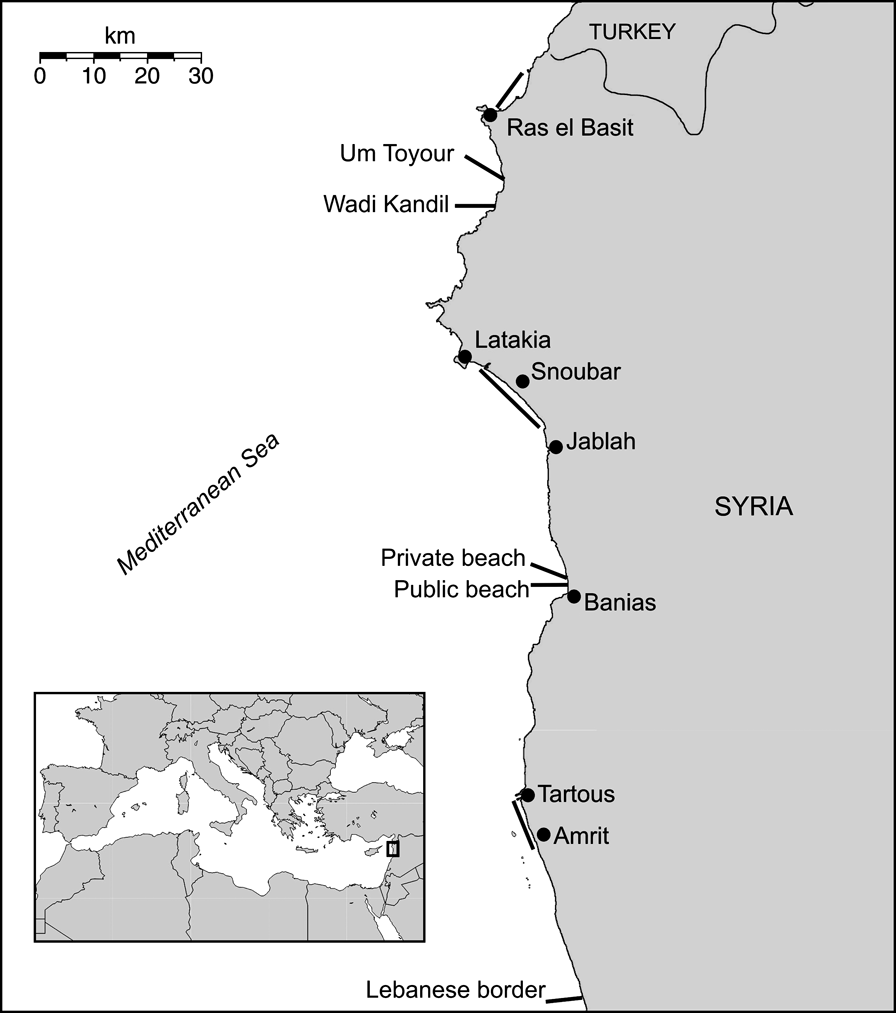
From 30 June to 27 August 2004, which incorporates a major proportion of both the nesting and hatching season of turtles in the Mediterranean (Broderick & Godley, Reference Broderick and Godley1996), we surveyed beaches at Latakia-Jablah, Ras al Basit and south of Tartous, described by Kasparek (Reference Kasparek1995), and previously unsurveyed nesting beaches (Fig. 1). From 30 June to 27 August 2004 (excluding 1, 7 & 31 July and 1 August) the 6 km beach between Snoubar and Jablah was surveyed on foot in the early morning for evidence of marine turtle nesting, nest hatching and events that may have affected the incubation of nests, such as inundation by storm waves or depredation. The adjoining 6 km beach to the north, from Snoubar to the river Al Kabir al Shamali, 1 km south-east of Latakia, was surveyed weekly for a total of 10 times. Single surveys of other beaches at Ras al Basit, Um Toyour, Wadi Kandil, Banias, and south of Tartous to the border with Lebanon were undertaken between mid July and mid August.
Locations of beaches surveyed for marine turtle nesting activity in 2004. Lines perpendicular to the coast indicate shorter stretches of beach and lines parallel to the coast indicate the lengths of beach surveyed. Rectangle on the inset indicates the location of the main figure in the eastern Mediterranean.
Emergence tracks of adult turtles that had crawled onto the beaches to nest were checked to identify species and evidence of nesting, and the track recorded as either a nesting or non-nesting emergence. Nesting species was determined from appearance of the track, as green turtles crawl with a symmetrical gait and loggerhead turtles asymmetrically (Schroeder & Murphy, Reference Schroeder, Murphy, Eckert, Bjorndal, Abreu-Grobois and Donnelly1999) and from maximum width of the track. In the eastern Mediterranean loggerhead turtles are generally much smaller than green turtles (Broderick & Godley, Reference Broderick and Godley1996), and hence their track widths are much narrower. Up to 18 July emergences were assigned to nests from appearance of the track, with only some being confirmed through clutch location, after which an emergence was only assigned to a nest if the clutch was located. Tracks and nests were marked to avoid duplication of records. Nests from Latakia beach were excavated, post-hatching, to assess hatching success (the percentage of eggs that produced hatchlings).
The number of green turtle nests recorded at Latakia, where only loggerhead turtle nesting had previously been reported, was 104, making it the most important green turtle nesting site in Syria. Nesting success was 33.6% for the period prior to routine clutch location and 40.6% afterwards. Assuming no significant seasonal changes in nesting success, nest determination from track observation can be considered an accurate (or somewhat conservative) method and hence the total number of nests may probably be more. The temporal pattern of green turtle nesting matched other Mediterranean populations, with nesting activity starting in June, peaking in July and trailing off into August (Broderick & Godley, Reference Broderick and Godley1996), and was confirmed by the large number of old tracks observed on the beach during the first survey (30 June) and the subsequent activity pattern recorded (Fig. 2).
Fresh green turtle nesting activity (number of nests and number of emergences) on Latakia beach (Fig. 1) in 2004, grouped into 4-day bins.

The number of green turtles nesting at Latakia in 2004 can be estimated from the maximum number of nests made over the modal inter-nesting interval or by dividing the total number of nests laid by the average clutch frequency (the number of clutches a turtle produces in one nesting season). Broderick et al. (Reference Broderick, Glen, Godley and Hays2002) calculated the inter-nesting interval to be 13 days and the clutch frequency to be three nests for green turtles on Cyprus. Using these values gives a population estimate of 31–35 turtles nesting on Latakia beach.
Post-hatch excavation of 29 undisturbed green turtle nests on Latakia beach indicated a mean clutch size of 108 ± SD 25.1 eggs (range 72–164), which is similar to that from Cyprus (Broderick et al., Reference Broderick, Glen, Godley and Hays2003), and hatching success was 83.5%, with 80.0% of eggs producing hatchlings that successfully emerged from the nest. However, general nest survival was not high. Prior to the end of the survey period canids depredated 26% of nests and others suffered inundation by high waves. Of the hatchlings that did emerge, numerous hatchling tracks oriented inland indicated that many were disoriented by artificial lights to the brighter inland horizon. Syria's coast is generally poorly developed or undeveloped beyond the four urban areas of Latakia, Jablah, Banias and Tartous. The sandy beaches are generally backed by agricultural land or have few and scattered buildings, whereas Latakia beach has an illuminated highway 2–3 km from the shore.
Hatchling tracks also suggested considerable numbers were lost to ghost crab Ocypode cursor predation. Ghost crabs were numerous, probably due to the high levels of beach litter. The identified threat of greatest concern was the deliberate killing of at least three adult female green turtles on or near the nesting beach, each of which had specific and characteristic injuries to the head. One turtle was found alive on the beach, having been attacked soon after egg laying. Two others were found with similar injuries in the strand line. None were apparently killed for consumption or any form of utilization as the carcasses were intact, except for the head injuries.
In addition, two further green turtle nests were recorded, one on a 1.5 km beach at Banias and the other at Wadi Kandil. Diffuse loggerhead turtle nesting was also confirmed, with six nests observed on Latakia beach, two nests on 12 km of beach at Banias and south of Tartous, and a single non-nesting emergence at Ras al Basit.
Several adult green turtles were observed and carapace lengths measured (Rees et al., Reference Rees, Saad and Jony2005). Mean curved carapace length (Bolten, Reference Bolten, Eckert, Bjorndal, Abreu-Grobois and Donnelly1999) of 91.4 ± SD 3.9 cm (range 85.0–97.5, n = 10) was similar to other populations of green turtles in the Mediterranean. Mediterranean loggerhead turtles vary in size between nesting areas (Margaritoulis et al., Reference Margaritoulis, Argano, Baran, Bentivegna, Bradai, Caminas, Bolten and Witherington2003) with these different populations being identifiable through genetic analysis (Carerras et al., 2007). It is therefore important to undertake genetic analyses of Mediterranean green turtles to identify any population structuring that may occur.
Green turtle nesting at Latakia beach is of national importance, being the only site in Syria with a significant numbers of nests. It is also of major regional importance as it ranks in the top 10 Mediterranean nesting beaches in terms of maximum number of nests recorded (Table 1). Since this initial study a monitoring programme, focusing on Latakia, has been initiated by AS and MJ, as marine turtles exhibit high interannual variation in numbers of nests (Broderick et al., Reference Broderick, Godley and Hays2001) that can mask actual population levels and trends. Additionally, conservation efforts to mitigate the identified threats of deliberate killing of nesting turtles and nest and hatchling predation have been attempted; for example, laying wire mesh screens over the nests has been trialled to reduce nest predation. Education and awareness activities for the public and stakeholders have followed from this study and need to be developed with a long-term strategy comprising clear targets and goals.
Maximum numbers of nesting green turtles on the 10 Mediterranean beaches with the highest number of recorded nests, including Latakia.
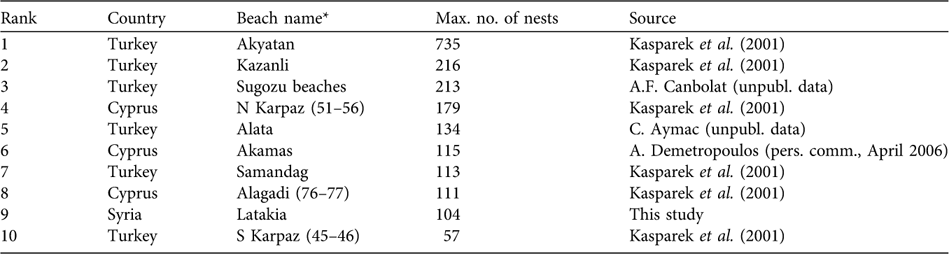
* Numbers in parentheses are beach numbers, from Kasparek et al. (Reference Kasparek, Godley and Broderick2001).
It is known that adult loggerhead turtles from Cyprus (Godley et al., Reference Godley, Broderick, Glen and Hays2003) and adult green turtles from Turkey (B. Godley, unpubl. data) migrate to Syrian waters. There is, therefore, a need to investigate Syria's at-sea populations of marine turtles to identify regionally critical habitats that may be present and to assess interaction with fisheries.
Acknowledgements
The project was supported by the Marine Conservation Society Turtle Conservation Fund and by the British Chelonia Group. The base map for Fig. 1 was made using MapTool, a free utility from SEATURTLE.ORG. The final manuscript was improved following constructive comments from two anonymous reviewers, and Brendan Godley provided constructive criticism of an earlier draft.
Biographical sketches
Alan F. Rees has worked for ARCHELON, the Sea Turtle Protection Society of Greece, since 1994 and this study is contributing to his PhD with the Marine Turtle Research Group at the University of Exeter in Cornwall, UK. His research interests focus mainly on nesting and foraging loggerhead turtle populations in Greece and general sea turtle telemetry. Adib Saad is Director of the Marine Science Laboratory, Tishreen University, Latakia, Syria. His research and consultancy work focuses on fisheries biology, marine biodiversity and endangered species. Mohammad Jony has worked at Ibn Hani marine protected area in Syria for several years. His current research involves monitoring sea turtle populations and investigations of a population of monk seals in Syria.



