





Introduction
Rodentia is the largest mammalian order and have successfully colonized most of the globe (Wilson and Reeder, Reference Wilson and Reeder2005). Their generally small size, vagility and adaptability enables them to occur in diverse habitats across the globe where they also encounter various parasites occurring in the external environments, in their nests and on the bodies of co-occurring hosts. For example, free-living immature life stages (larvae and/or nymphs) of most ixodid ticks and chiggers (trombiculid mites) attach to rodents when they move through vegetation, while lice are transferred between conspecifics through close body contact (e.g. during suckling, grooming and nest sharing) (Morand et al., Reference Morand, Krasnov and Poulin2006). Given the diverse life-history characteristics displayed by rodents (e.g. sociality, body size, habitat preference and nest types) it is expected that their parasite profiles will be influenced by life-history traits (Krasnov et al., Reference Krasnov, Matthee, Lareschi, Korallo-Vinarskaya and Vinarski2010; Morand and Bordes, Reference Morand and Bordes2015). Indeed, higher parasite infestations are often associated with larger bodied hosts (providing more available niches and/or resources) (Kamiya et al., Reference Kamiya, O'Dwyer, Nakagawa and Poulin2014; Esser et al., Reference Esser, Foley, Bongers, Herre, Miller, Prins and Jansen2016) and high host population densities (providing more opportunity to encounter parasites) (Arneberg, Reference Arneberg2001; Altizer et al., Reference Altizer, Nunn, Thrall, Gittleman, Antonovics, Cunningham, Dobson, Ezenwa, Jones, Pedersen, Poss and Pulliam2003). In addition, rodents that are geographically widespread (occur in multiple vegetation types) encounter diverse parasite species mainly due to vegetation type associated parasite distributions (i.e. distance decay in species similarity) (Spickett et al., Reference Spickett, Junker, Krasnov, Haukisalmi and Matthee2017; Wells et al., Reference Wells, Gibson, Clark, Ribas, Morand and McCallum2018; Stevens et al., Reference Stevens, Stekolnikov, Ueckermann, Horak and Matthee2022).
Geographically widespread rodent species are often opportunistic in nature and take advantage of alternative resources available in anthropogenic habitats to the extent that they become pests (Drazo et al., Reference Drazo, Kennis, Leirs and Migimiru2008; Makundi and Massawe, Reference Makundi and Massawe2011; Welegerima et al., Reference Welegerima, Meheretu, Haileselassie, Gebre, Kidane, Massawe, Mbije and Makundi2020). Habitat transformation generally results in a change in the microclimatic conditions due to change in vegetation structure and reduced vegetation cover (Gehlhausen et al., Reference Gehlhausen, Schwartz and Augspurger2000; Newman et al., Reference Newman, Ladd, Brundrett and Dixon2013). Consequently, variation in the microclimatic conditions between habitat types (e.g. natural and transformed habitat types) is documented to affect parasite occurrence and infestation levels (Lorch et al., Reference Lorch, Fisher and Spratt2007; Froeschke et al., Reference Froeschke, van der Mescht, McGeoch and Matthee2013; Froeschke and Matthee, Reference Froeschke and Matthee2014; van der Mescht et al., Reference van der Mescht, le Roux, Matthee, Raath and Matthee2016). The role of habitat-associated factors in shaping parasite infestations is mainly related to the susceptibility of free-living life stages to desiccation (Krasnov et al., Reference Krasnov, Khokhlova, Fielden and Burdelova2001a, Reference Krasnov, Khokhlova, Fielden and Burdelova2001b; Herrmann and Gern, Reference Herrmann and Gern2013; van der Mescht et al., Reference van der Mescht, le Roux and Matthee2013). Parasite taxa with free-living life stages (nematodes, fleas, mites and ticks) are particularly more sensitive to the microclimatic conditions (e.g. air temperature and relative humidity) compared to parasite taxa, such as lice, where all life stages occur permanently on the host's body (Krasnov et al., Reference Krasnov, Matthee, Lareschi, Korallo-Vinarskaya and Vinarski2010; Viney and Cable, Reference Viney and Cable2011; Härkönen et al., Reference Härkönen, Hurme and Kaitala2013).
To further investigate the role of abiotic factors (the environment) and host life history on parasite profiles of rodents, we herein study 2 multimammate mice species, Mastomys natalensis and M. coucha. In the 1970's, M. natalensis underwent taxonomic revision and a second species, M. coucha, was recognized based on differences in chromosome numbers, haemoglobin patterns, mtDNA sequencing, and subtle differences in the morphology of the cranium (Gordon, Reference Gordon1978; Green et al., Reference Green, Keogh, Gordon, Pinto and Hartwig1980; Granjon et al., Reference Granjon, Duplantier, Catalan and Britton-Davidian1997). The 2 rodent species are widely distributed habitat generalists that overlap in occurrence in the north-eastern and eastern summer rainfall region (Savanna and Grassland biomes) in South Africa (Skinner and Chimimba, Reference Skinner and Chimimba2005; Monadjem et al., Reference Monadjem, Taylor, Denys and Cotterill2015). However, based on previous studies it appears that M. natalensis are more commensal (associated with houses) (Brouat et al., Reference Brouat, Kane, Diouf, Bâ, Sall-Dramé and Duplantier2007; Mulungu et al., Reference Mulungu, Mahlaba, Massawe, Kennis, Crauwels, Eiseb, Monadjem, Makundi, Katakweba, Leirs and Belmain2011, Reference Mulungu, Ngowo, Mdangi, Katakweba, Tesha, Mrosso, Mchomvu, Sheyo and Kilonzo2013), and that M. coucha could prefer less disturbed habitats. The latter may be mainly attributed to the higher breeding success of M. natalensis on a poor quality diet when compared to M. coucha (Jackson and van Aarde, Reference Jackson and van Aarde2004). Mastomys species are prolific breeders, live in family groups (Isaacson, Reference Isaacson1975; Leirs et al., Reference Leirs, Verhagen, Verheyen, Mwanjabe and Mbise1996a, Reference Leirs, Verheyen and Verhagen1996b) and can attain high population densities in anthropogenic habitats (Makundi and Massawe, Reference Makundi and Massawe2011). In particular, M. natalensis, is regarded as an agricultural pest (Singleton et al., Reference Singleton, Hinds, Krebs and Spratt2003; Prakash, Reference Prakash2018) where they frequently utilize abandoned burrows of other rodent species (Veenstra, Reference Veenstra1958). Mastomys natalensis is also a reservoir host for disease causing pathogens such as Lassa virus that causes haemorrhagic fever, and Yersinia pestis which is the causative agent for bubonic plague (Isaacson, Reference Isaacson1975; Singleton et al., Reference Singleton, Hinds, Krebs and Spratt2003; Achtman et al., Reference Achtman, Morelli, Zhu, Wirth, Diehl, Kusecek, Vogler, Wagner, Allender, Easterday, Chenal-Francisque, Worsham, Thomson, Parkhill, Lindler, Carniel and Keim2004; Lecompte et al., Reference Lecompte, Fichet-Calvet, Daffis, Koulémou, Sylla, Kourouma, Doré, Soropogui, Aniskin, Allali, Kan, Lalis, Koivogui, Günther, Denys and ter Meulen2006). From a disease perspective, it is important to realize that the movement of commensal rodent species between habitat types and higher densities recorded in anthropogenic habitats, creates novel opportunities for parasite exchange and may pose a disease risk to domestic animals and humans (Lecompte et al., Reference Lecompte, Fichet-Calvet, Daffis, Koulémou, Sylla, Kourouma, Doré, Soropogui, Aniskin, Allali, Kan, Lalis, Koivogui, Günther, Denys and ter Meulen2006; Brettschneider et al., Reference Brettschneider, Anguelov, Chimimba and Bastos2012).
Although the ecology and taxonomy of M. natalensis and M. coucha is relatively well studied, information regarding their ectoparasite profiles is limited and biased towards parasite–host lists originally described for M. natalensis (Zumpt, Reference Zumpt1961; Isaacson, Reference Isaacson1975; Ledger, Reference Ledger1980; Segerman, Reference Segerman1995; Horak et al., Reference Horak, Heyne, Williams, Gallivan, Spickett, Bezuidenhout and Estrada-Peña2018). Given the taxonomic revision of the host genus, and the fact that the 2 rodent species are cryptic, it is essential that the ectoparasite profile of M. natalensis is re-assessed and an ectoparasite profile established for M. coucha. More recent empirical studies documented a rich ectoparasite diversity associated with widely distributed rodents in South Africa (e.g. Matthee et al., Reference Matthee, Horak, Beaucournu, Durden, Ueckermann and McGeoch2007, Reference Matthee, Horak, van der Mescht, Ueckermann and Radloff2010; Froeschke et al., Reference Froeschke, van der Mescht, McGeoch and Matthee2013; Archer et al., Reference Archer, Bennett, Ueckermann and Lutermann2014; Fagir et al., Reference Fagir, Ueckermann, Horak, Bennett and Lutermann2014, Reference Fagir, Horak, Ueckermann, Bennett and Lutermann2015; Stevens et al., Reference Stevens, Stekolnikov, Ueckermann, Horak and Matthee2022; Smith et al., Reference Smith, Krasnov, Horak, Ueckermann and Matthee2023) and made a considerable contribution in updating parasite lists for these rodents. Several of the ectoparasite taxa recorded in these studies are known vectors for disease-causing pathogens such as Y. pestis (causative agent of plague) and Rickettsia africae (causative agent of African tick-bite fever) (Achtman et al., Reference Achtman, Morelli, Zhu, Wirth, Diehl, Kusecek, Vogler, Wagner, Allender, Easterday, Chenal-Francisque, Worsham, Thomson, Parkhill, Lindler, Carniel and Keim2004; Ledger et al., Reference Ledger, Innocent, Lukhele, Dorleans and Wisely2022). To date only a few studies have explored the ecological factors (e.g. host and environment) that shape parasite infestations in South Africa (Froeschke et al., Reference Froeschke, Harf, Sommer and Matthee2010, Reference Froeschke, van der Mescht, McGeoch and Matthee2013; Froeschke and Matthee, Reference Froeschke and Matthee2014; van der Mescht et al., Reference van der Mescht, le Roux, Matthee, Raath and Matthee2016; Smith et al., Reference Smith, Krasnov, Horak, Ueckermann and Matthee2023). Although these studies confirm the importance of the host, habitat type and climate in shaping parasite infestations more studies on rodents with diverse life histories are needed before general patterns can be established.
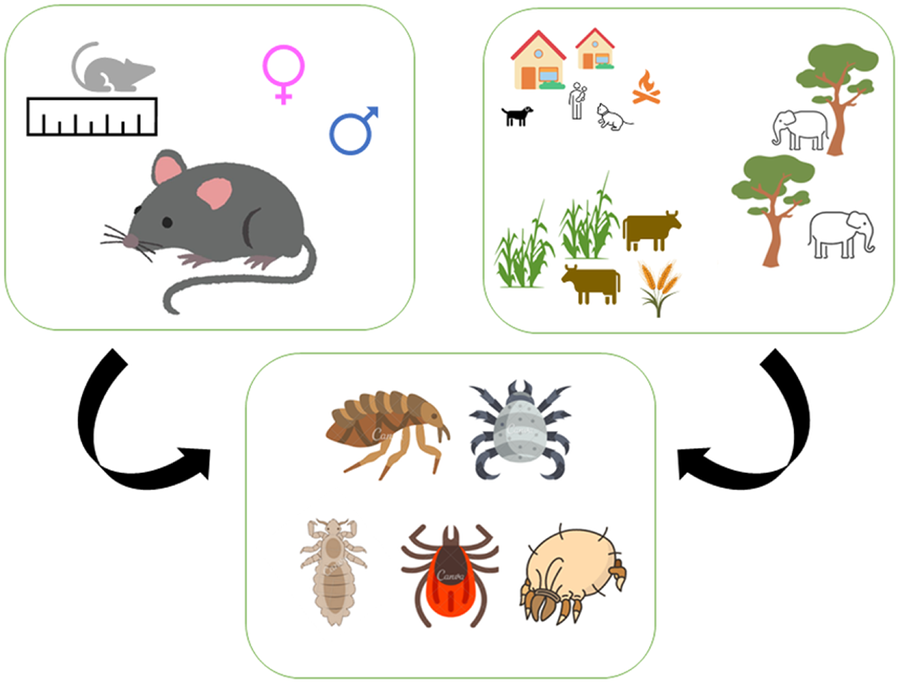
The overall aim of the study was to develop a better understanding of the ectoparasite diversity associated with the 2 distinct but closely related rodent species and to explore the role of host and habitat type in shaping ectoparasite infestations. The objectives of the study were: (1) Record the ectoparasite diversity associated with M. natalensis and M. coucha across a wildlife-humans/domestic animal interface, and (2) Explore the relationship between ectoparasite infestations, and host (sex, breeding state and body size) and habitat (village, agriculture and natural) factors in both rodents. Given the close evolutionary relationship between the rodents studied herein, it is predicted that the ectoparasite profile will largely overlap between M. natalensis and M. coucha. Further, it is predicted that ectoparasite infestations will be related to, (i) host sex, with higher infestations associated with larger-bodied male hosts, and (ii) habitat type, where ectoparasite taxa with free-living life stages (fleas, mites and ticks) will respond more strongly to habitat transformation.
Materials and methods
Study area
The study was conducted across a wildlife-human/domestic animal interface, located in the Mnisi rural community situated in the north-eastern Savanna biome of South Africa. The community comprises of several small villages that each have their own communal cattle grazing area and subsistence crop fields (also referred to as agriculture). Approximately 75% of the boundary surrounding the Mnisi rural community is shared with adjacent fenced nature reserves (Fig. 1). Rodents were trapped in the Manyeleti nature reserve (24°35′0.1″ S, 31°25′56″ E) and in 4 villages and their respective crop fields (Gottenburg 24°38′01″ S, 31°25′19″ E; Hlavekisa 24°37′51″ S, 31°22′42″ E, Athol 24°42′29″ S, 31°20′43″ E and Utlha 24°50′14″ S, 31°02′45″ E) in 2014, 2015 and again in 2019 and 2020. The villages were >5 km apart from each other. Small vegetable patches, cattle and other domestic animals can be found on the property (in the village). Crop fields were planted with seasonal crops that were fenced with a combination of wire and dried tree branches that were stacked to form a fence. The crop fields were situated on the edge of the villages and often occurred between the village and nature reserve. Cattle could be found in the crop fields during the dry season. The nature reserve comprised of pristine natural Savanna vegetation and biome-associated wildlife species.
Study area where Mastomys natalensis (n = 375) and Mastomys coucha (n = 215) were trapped across a wildlife-human/domestic animal interface in Mpumalanga, South Africa. (a) Savanna biome (grey) in South Africa and the position of the sampling area (square on map). (b) position of the villages and the nature reserve.

Rodent trapping and handling
Sherman-type live traps and Tomahawk live traps were used to trap rodents across 3 different habitat types namely, village (transformed), agriculture (semi-transformed), and natural (undisturbed). Rodents were trapped at 3 villages and their respective crop fields in spring (August–October) of 2014 and 2015, and once in summer (January) of 2015 and at 4 villages and their respective crop fields in spring (August–October) 2019 and 2020. A standardised trap design was followed every year, and each locality was only trapped once per trap session. Traps were placed at 10 m intervals along an 80 m-trap line that was replicated (3–4 times) at each sampling locality. The traps were left out for 3–4 days per locality. In the village, traps were set in and around the houses. In the agricultural habitat traps were placed along the fence of the crop fields, whereas in the nature reserve traps were set in trap lines in the natural vegetation. A mixture of oats and peanut butter was used as bait. Traps were checked twice daily and closed during the heat of the day (10:00–15:00). Targeted rodents were removed from the traps, individually placed into labelled plastic bags and euthanized with Isoflurane. All non-target rodent species were recorded and released at the trap sites. Targeted rodent species were frozen at −20°C to kill all ectoparasites. The rodents were initially morphologically identified to genus level using field guides (Stuart and Stuart, Reference Stuart and Stuart2007) and thereafter species were confirmed molecularly using a species-specific mtDNA cytochrome-b multiplex PCR (Bastos et al., Reference Bastos, Chimimba, von Maltitz, Kirsten and Belmain2005). For each rodent, their sex, reproductive state (breeding: males having a scrotum and females having a perforated vagina; or non-breeding: males with no visible scrotum and females with no perforated vagina), body weight, total-, tail- and hind foot- length was recorded. Rodents were dissected to further confirm rodent sex and reproductive state.
Laboratory procedures
Prior to ectoparasite removal rodents were thawed. All ectoparasites (fleas, lice, mites and ticks) and a subsample of trombiculid mites (chiggers) were systematically removed with fine point forceps while examining the body of the rodent under a Zeiss Stemi DV4 stereomicroscope (Carl Zeiss Light Microscopy, Göttingen, Germany). In the case of chiggers, the parasitope (region on the body where chiggers occurred) was recorded for each subsample. Ectoparasites were counted and placed into individual tubes containing 100% ethanol. All fleas (males and females) were counted, however only male individuals were available for species level identification and counts per species, as female fleas were used for a separate project and could not be identified to species level. The immature life stages of individual louse species remained undifferentiated and was reported as nymphs and counts presented per species. Fleas were mounted (in Canada balsam) as described by Segerman (Reference Segerman1995) and van der Mescht et al. (Reference van der Mescht, le Roux and Matthee2013). Lice and mites were cleared in lactic acid and mounted in Hoyer's or PVA (polyvinyl alcohol) on microscope slides. A subsample of the lice was kept for molecular examination. Chiggers were directly slide mounted in Hoyer's or PVA mounting medium. Ticks remained in 100% ethanol for morphological identification. Identification of fleas, lice, mites and chiggers was done using a Leica DM1000 light microscope (Leica Microsystems GmbH, Wetzlar, Germany) and ticks were identified with a Leica MZ75 high-performance stereomicroscope (Leica Microsystems GmbH, Wetzlar, Germany). All ectoparasites were morphologically identified to species level where possible using taxonomic reference literature; fleas (Segerman, Reference Segerman1995); lice (Johnson, Reference Johnson1972; Ledger, Reference Ledger1980; Durden and Musser, Reference Durden and Musser1994); mites (Till, Reference Till1963; Herrin and Tipton, Reference Herrin and Tipton1975); chiggers (Zumpt, Reference Zumpt1961; Stekolnikov, Reference Stekolnikov2008, Reference Stekolnikov2018) and ticks (Walker et al., Reference Walker, Keirans and Horak2000; Horak et al., Reference Horak, Heyne, Williams, Gallivan, Spickett, Bezuidenhout and Estrada-Peña2018). In a few cases the differentiation between Hoplopleura intermedia and H. ismailiae louse individuals was troublesome and are referred to as H. intermedia/ismailiae.
Data analysis
The relative host density, for the 2 rodent species, was estimated on trapping success (%) (number of trapped animals divided by the number of trap nights multiplied by the number of traps) (Froeschke et al., Reference Froeschke, van der Mescht, McGeoch and Matthee2013). For descriptive statistics on epifaunistic infestations per rodent species, rodent and epifaunistic data were pooled per locality within each of the habitat types (village, agriculture and natural) for all sampling years (2014–2020 for all taxa except mites, as species-level abundance data for mites was only available for 2019–2020) and seasons. For each rodent species we divided the epifauna into higher taxonomic groups (fleas, lice, mites and ticks) and pooled the different life stages (i.e. larvae, nymphs, males and females) within the respective taxa. The mean abundance (total epifaunistic abundance divided by the number of hosts) and prevalence (% of hosts infested) were calculated following Bush et al. (Reference Bush, Lafferty, Lotz and Shostak1997). Chigger prevalence was calculated using presence/absence data from 2019–2020, as chigger species identification per rodent species was only available for this sampling period.
To explore the relationship between epifaunistic infestations, host and habitat factors the following approach was used: total counts of epifaunistic individuals for a given taxon (overall epifauna, fleas, lice, ticks and mites) were calculated for 2014–2020 (excluding January 2015) and species richness per taxon (overall epifauna, fleas and mites) was calculated for 2019–2020 on an individual host (i.e. infracommunity). Only rodents with confirmed reproductive state were used for regression analyses, which meant that a reduced sample size was used for these analyses. Epifaunistic count data (excluding chiggers) was modified (log + 1 transformed) prior to analyses as the data was highly skewed with an excess of zero's. All models were fit to examine the influence of host-related factors (sex, reproductive state, interaction between reproductive state and sex and body size (tail length as proxy)), habitat type (village, agriculture, natural) and sampling year on the total count for each ectoparasite taxon and species richness of each host species. A generalised linear model (GLM) was constructed for the overall epifauna and mite counts following a Poisson distribution for both rodent species (note, although a negative binomial distribution is often used for ectoparasite data, our preliminary analysis suggests a stronger support to the Poisson distribution). To account for the large number of zero's in flea, tick and louse counts, a zero-inflated Poisson (ZIP) and a zero-inflated negative binomial (ZINB) model were generated from ‘pscl’ package in R (R Core Team, 2023). The methodology and mathematics of the ZIP and ZINB models can be found in (Zeileis et al., Reference Zeileis, Kleiber and Jackman2008; Zuur et al., Reference Zuur, Ieno, Walker, Saveliev and Smith2009; Zuur and Ieno, Reference Zuur and Ieno2016). The ZIP or ZINB models, were compared using a Likelihood Ratio Test (LRT).
The relationship between epifaunistic, flea, mite species richness and host and habitat related factors were based on individual hosts of each rodent species. Species richness was not informative for lice (as the taxon was dominated by 1 or 2 louse species) and for ticks (due to low infestations: 4–5 individuals during the 2019–2020 sample period) for both rodent species. For the regression analyses of epifaunistic, flea and mite species richness a GLM with a Poisson distribution was used. A backward model selection was considered for all regression analyses (count and species richness), using a ‘step’ function for all models, whereby the models with the lowest Akaike information criterion (AIC) were presented as the final selected models (Burnham and Anderson, Reference Burnham and Anderson2002; Snipes and Taylor, Reference Snipes and Taylor2014). All statistical analyses were performed in R version 4.2.0 (R Core Team, 2023).
Results
Rodent density
In total 375 M. natalensis and 215 M. coucha individuals were trapped (Supplementary Table 1). The number of individuals trapped, and their relative densities varied between habitat types for both rodent species (Supplementary Table 2; Fig. 2). In particular, the total abundance of M. natalensis was higher in the village and agricultural habitat types compared to the natural habitat. In contrast, the total abundance of M. coucha was higher in the natural and agricultural habitat types compared to the village habitat type (Fig. 2).
The total number of Mastomys natalensis (n = 375) and Mastomys coucha (n = 215), trapped in three habitat types across a wildlife-human/domestic animal interface in Mpumalanga, South Africa (2014–2020).

Epifaunistic diversity
A total of 10 420 epifaunistic individuals (parasitic and non-parasitic) were recorded of which 5053 were recorded on M. natalensis and 5367 on M. coucha during the sampling period. Overall, 45 ectoparasitic and 3 non-parasitic species (predatory mites) were recorded on M. natalensis and M. coucha (Supplementary Table 3). Mites (excluding chiggers) were the most speciose taxon (23), followed by chiggers (8), fleas (7), ticks (6) and lice (4) (Supplementary Table 3). The 2 rodent species shared 23 of the 48 epifaunistic species (Supplementary Table 3). A larger number of epifaunistic species were recorded on M. natalensis (40) compared to M. coucha (31) (Supplementary Table 3).
Five flea species were recorded on M. natalensis and 6 species on M. coucha. However, fleas were more prevalent on M. natalensis (46.93%) compared to M. coucha (35.81%). Xenopsylla brasiliensis and X. frayi were the most prevalent fleas on both rodent species (Supplementary Tables 4 and 5). Echidnophaga gallinacea occurred on both rodent species, but the total abundance was higher on M. natalensis (9), while only 1 individual was recorded on M. coucha. Three louse species were recorded on M. natalensis and 2 on M. coucha. Lice were less prevalent on M. natalensis (33.33%) in comparison to M. coucha (54.42%). Hoplopleura intermedia was the most prevalent louse on both rodent species. Polyplax biseriata was only recorded on M. coucha, while H. intermedia/ismailiae and P. spinulosa was only recorded on M. natalensis (Supplementary Tables 4 and 5). Five tick taxa (species and species groups) were recorded on M. natalensis and 4 on M. coucha. However, ticks were overall less prevalent on M. natalensis (6.93%) as opposed to M. coucha (22.79%). Dermacentor rhinocerinus was shared between the 2 rodents, while Amblyomma hebraeum and Haemaphysalis zumpti was only recorded on M. natalensis whereas Hyalomma truncatum was only recorded on M. coucha (Supplementary Tables 4 and 5). There were 19 mite species (excluding chiggers) recorded on M. natalensis and 12 recorded on M. coucha. Mites were less prevalent on M. natalensis (81.01%) compared to M. coucha (92.50%). Two parasitic mites Laelaps liberiensis and L. muricola were the most prevalent mite species on both rodent species (Supplementary Tables 4 and 5). Eight chigger species were recorded on M. natalensis and 6 on M. coucha. Chiggers were less prevalent on M. natalensis (25.32%) compared to M. coucha (45.00%). Microtrombicula mastomyia occurred on both rodent species, but at a lower prevalence on M. natalensis (22.36%) compared to M. coucha (36.67%) (Supplementary Table 6). On both rodent species several chiggers occurred on the ear pinna (Supplementary Table 6).
Mastomys natalensis – Role of host- and habitat factors
The results of the final selected models are presented in Tables 1–3. Overall epifaunistic, mite and flea abundance were significantly related to host sex, with higher infestations on males compared to females (Tables 1 and 2; Fig. 3a–c). Tick abundance was significantly higher on breeding individuals, while louse occurrence was significantly higher on non-breeding rodents (Table 2). None of the infestation parameters (abundance or number of species) for overall epifauna, mites, fleas, lice and ticks on M. natalensis were significantly correlated with the interaction between sex and reproductive state and body size (Tables 1 and 2). In addition, none of the infestation parameters for overall epifauna, mites, fleas and ticks were significantly different between the agriculture and natural habitat types (Tables 1 and 2). However, overall epifaunistic, mite and tick abundances (Tables 1 and 2) were significantly lower in the village habitat type compared to the agricultural and natural habitat types (see Fig. 4a for epifaunistic abundance). Louse abundance was significantly higher on M. natalensis in the natural compared to the agricultural habitat type (Table 2; Fig. 4b). However, louse abundance did not differ between the agricultural and village habitat type, whereas louse occurrence was significantly higher on M. natalensis in the agricultural habitat compared to the village habitat type (Table 2). The number of epifauna, flea and mite species were significantly lower in the village compared to the agricultural habitat type (Table 3; Fig. 5a and b). Overall epifauna, tick abundance and the number of flea species were related to sampling year (Tables 1–3).
Summary of the final selected generalized linear model with a Poisson distribution on the effect of host sex (SEX), reproductive state (BRS), year (Y) and habitat type (HBT) on the epifaunistic taxon abundance belonging to different higher taxa on Mastomys natalensis (n = 304, 2014–2020). Bold text indicate significant responses.

Reference levels are male for SEX, non-breeding for BRS.
HBT NAT, natural habitat; HBT AGR, agricultural habitat; HBT VIL, village habitat.
Summary of the final selected zero-inflation model with a Poisson distribution on the effect of host sex (SEX), reproductive state (BRS), tail length (TLL), year (Y) and habitat type (HBT) on the ectoparasite abundance belonging to different higher taxa on Mastomys natalensis (n = 304, 2014–2020). Bold text indicate significant responses.

Reference levels are male for SEX, non-breeding for BRS.
HBT NAT, natural habitat; HBT AGR, agricultural habitat; HBT VIL, village habitat.
Mean number of: (a) epifaunistic, (b) mite and (c) flea individuals per host sex on Mastomys natalensis (n = 304) in Mpumalanga, South Africa (2014–2020).

Mean number of: (a) epifaunistic and (b) lice individuals per habitat type on Mastomys natalensis (n = 304) in Mpumalanga, South Africa (2014–2020). Significant estimates: ***P < 0.001, **P < 0.01, *P < 0.05, ns-non-significant.

Summary of the final selected generalized liner model with a Poisson distribution on the effect of host reproductive state (BRS), tail length (TLL), year (Y) and habitat type (HBT) on number of epifaunistic, flea and mite species on Mastomys natalensis (n = 234, 2019–2020). Bold text indicate significant responses.

Reference levels are male for SEX, non-breeding for BRS, 2019 for YEAR.
HBT NAT, natural habitat; HBT AGR, agricultural habitat; HBT VIL, village habitat.
Mean number of: (a) epifaunistic, and (b) mite species per habitat type on Mastomys natalensis (n = 234) in Mpumalanga, South Africa (2014–2020). Significant estimates: ***P < 0.001, **P < 0.01, *P < 0.05, ns-non-significant.

Mastomys coucha – Role of host- and habitat factors
The results of the final selected models are presented in Tables 4–6. Louse occurrence was significantly negatively related to host body size (i.e. higher occurrence on smaller-bodied rodents; Table 5). None of the infestation parameters for overall epifauna, mites, fleas and ticks on M. coucha were significantly associated with host sex, reproductive state, the interaction between sex and reproductive state and body size (Tables 4 and 5). Additionally, none of the infestation parameters for overall epifauna, mites, fleas and ticks were significantly different between the agriculture and natural habitat types. However, overall epifauna and mite abundance were significantly lower in the village habitat type compared to the agricultural and the natural habitat type (Table 4; Fig. 6a and b). Further, louse occurrence was significantly higher on M. coucha in the agricultural habitat type compared to the natural and village habitat type and higher in the natural habitat type when compared to the village habitat type (Table 5). Flea and louse abundance, and flea species were significantly related to sampling year (Tables 5 and 6).
Summary of the final selected zero-inflated model (count and zero model) with a Poisson distribution on the effect of host sex (SEX), reproductive state (BRS), tail length (TLL), year (Y) and habitat type (HBT) on the ectoparasite abundance belonging to different higher taxa on Mastomys coucha (n = 189, 2014–2020). Bold text indicate significant responses.

Reference levels are male for SEX, non-breeding for BRS.
HBT NAT, natural habitat; HBT AGR, agricultural habitat; HBT VIL, village habitat.
Summary of the final selected generalized linear model with a Poisson distribution on the effect of habitat type (HBT) on the epifaunistic taxon abundance belonging to different higher taxa on Mastomys coucha (n = 189, 2014–2020). Bold text indicate significant responses.

HBT NAT, natural habitat; HBT AGR, agricultural habitat; HBT VIL, village habitat.
Mean number of: (a) epifaunistic, and (b) mite individuals per habitat type for Mastomys coucha in Mpumalanga, South Africa (2014–2020). Significant estimates: ***P < 0.001, **P < 0.01, *P < 0.05, ns-non-significant.

Summary of the final selected generalized linear model with a Poisson distribution on the effect of host sex (SEX), year (Y) and habitat type (HBT) on number of epifaunistic, flea and mite species on Mastomys coucha (n = 118, 2019–2020). Bold text indicate significant responses.

Reference levels are male for SEX, 2019 for YEAR.
HBT NAT, natural habitat; HBT AGR, agricultural habitat; HBT VIL, village habitat.
Discussion
Epifaunistic diversity
The 2 rodent species only shared approximately 50% of the epifaunistic species. This is most probably the result of the observed variation in spatial occurrence between the rodents with M. natalensis occurring mainly in the agricultural and village habitats, while M. coucha occurred mainly in the agricultural and natural habitats (Stenseth et al., Reference Stenseth, Leirs, Mercelis and Mwanjabe2001; Garba et al., Reference Garba, Dalecky, Kadaoure, Kane, Hima, Veran, Gagare, Gauthier, Tatard, Rossi and Dobigny2014; McCauley et al., Reference McCauley, Salkeld, Young, Makundi, Dirzo, Eckerlin, Lambin, Gaffikin, Barry and Helgen2015). Habitat-type associated variance was also recorded in other co-occurring rodent species in the present study. In particular, Rattus rattus and Rattus tanezumi were trapped predominantly in the village habitat, while Gerbilliscus leucogaster, Saccostomus campestris and Lemniscomys rosalia overlapped with M. coucha (Matthee et al., Reference Matthee, Stekolnikov, van der Mescht, Froeschke and Morand2020; Smith et al., Reference Smith, Krasnov, Horak, Ueckermann and Matthee2023). Based on this it is evident that the village habitat harboured fewer rodent species compared to the agricultural and natural habitats. The parasite diversity on M. natalensis and M. coucha may thus be directly related to variation in abundance and diversity of rodent hosts and their parasites in the different habitat types (also see Krasnov et al., Reference Krasnov, Shenbrot, Khokhlova and Degen2004; Morand et al., Reference Morand, Krasnov and Poulin2006). Similarly, the variation in relative density across habitat types for both Mastomys species will influence their contact with conspecific and confamilial host species and ectoparasites in the environment (Cote and Poulin, Reference Cote and Poulin1995; Arneberg et al., Reference Arneberg, Skorping, Grenfell and Read1998). This is consistent with previous studies that recorded a positive relationship between host density and parasite infestations (Esch and Fernández, Reference Esch and Fernández1993; Tompkins et al., Reference Tompkins, Dobson, Arneberg, Begon, Cattadori, Greenman, Heesterbeek, Hudson, Newborn, Pugliese, Rizzoli, Rosa, Rosso, Wilson, Hudson, Rizzoli, Grenfell, Heesterbeek and Dobson2001; Rifkin et al., Reference Rifkin, Nunn and Garamszegi2012). It is thus most likely that habitat type-related host diversity and relative abundance contributed to the fact that only 50% of epifaunistic species were shared between the 2 rodents (Haukisalmi et al., Reference Haukisalmi, Henttonen and Tenora1987; Froeschke and Matthee, Reference Froeschke and Matthee2014).
The occurrence of X. brasiliensis on M. natalensis is well documented (Isaacson, Reference Isaacson1975; Segerman, Reference Segerman1995; Guerra et al., Reference Guerra, Eckerlin, Dowling, Durden, Robbins, Dittmar, Helgen, Agwanda, Allan, Hedlund and Young2016) and in fact M. natalensis together with Rattus spp. (also commensal) are the principal hosts for the flea (Segerman, Reference Segerman1995). The present study provides the first record of X. brasiliensis on M. coucha in South Africa. This flea is a known vector of several zoonotic pathogens such as the bacterium Y. pestis and Bartonella species in Africa (Zimba et al., Reference Zimba, Pfukenyi, Loveridge and Mukaratirwa2011; Billeter et al., Reference Billeter, Borchert, Atiku, Mpanga, Gage and Kosoy2014). In the study, higher infestations of X. frayi were recorded on M. coucha compared to M. natalensis. This may be due to the fact that G. leucogaster is the principal host of X. frayi (Segerman, Reference Segerman1995) and the rodent co-occurred with M. coucha in the agricultural and natural habitat type (Smith et al., Reference Smith, Krasnov, Horak, Ueckermann and Matthee2023). Given that M. natalensis, and most likely M. coucha, often use the abandoned burrows of other rodent species (Veenstra, Reference Veenstra1958; Coetzee, Reference Coetzee1975; Isaacson, Reference Isaacson1975) the occurrence of non-specific flea species on Mastomys is most likely facilitated through nest sharing.
Current taxonomic records list the louse H. intermedia on M. natalensis and M. coucha (Ledger, Reference Ledger1980; Durden and Musser, Reference Durden and Musser1994). Important to realize, however, co-evolutionary divergence among lice and their hosts are often found (du Toit et al., Reference du Toit, Matthee and Matthee2013; Bothma et al., Reference Bothma, Matthee and Matthee2020, Reference Bothma, Matthee and Matthee2021; Durden et al., Reference Durden, Matthee, Bothma, Greiman and Matthee2020) and it is thus quite possible that H. intermedia comprises of 2 cryptic species. The presence of P. biseriata on M. coucha is possibly an accidental infestation, given that G. leucogaster is the principal host of this taxon (Ledger, Reference Ledger1980; Durden and Musser, Reference Durden and Musser1994). Similarly, the presence of P. spinulosa on M. natalensis may also be accidental given that the principal host is R. rattus (Durden and Musser, Reference Durden and Musser1994). Studies have recorded that M. natalensis (and possibly M. coucha) are rarely aggressive to conspecifics and/or other rodent species (Veenstra, Reference Veenstra1958) and accidental parasite exchange is quite plausible.
Overall ticks were the least prevalent taxon on both rodent species studied herein. Many ixodid tick species, and especially the taxa recorded in the present study, require vegetation (e.g. grass) to attach to and wait for a host to pass (Horak et al., Reference Horak, Heyne, Williams, Gallivan, Spickett, Bezuidenhout and Estrada-Peña2018; Ledger et al., Reference Ledger, Keenan, Sayler and Wisely2019). In the present study, the village habitat lacked natural vegetation and had proportionally lower cover compared to the agricultural and natural habitat type (Matthee et al., Reference Matthee, Stekolnikov, van der Mescht, Froeschke and Morand2020; S. Matthee personal observation). This may contribute to the overall lower tick infestations on M. natalensis. The larvae and or nymphs of 3 of the 4 species that could be identified (A. hebraeum, D. rhinocerinus, and H. truncatum) are known to occur on murid rodents (Horak et al., Reference Horak, Heyne, Williams, Gallivan, Spickett, Bezuidenhout and Estrada-Peña2018). However, the single occurrence of Hae. zumpti (1 individual) is most probably related to the fact that the tick prefers Sciuridae and Carnivora (Horak et al., Reference Horak, Heyne, Williams, Gallivan, Spickett, Bezuidenhout and Estrada-Peña2018; Jongejan et al., Reference Jongejan, Berger, Busser, Deetman, Jochems, Leenders, de Sitter, van der Steen, Wentzel and Stoltsz2020).
Mites (excluding chiggers) were the most specious taxon with L. liberiensis and L. muricola (both parasitic species) being the most common on both rodents. Mastomys natalensis is a new host record for Androlaelaps oliffi, A. rhodesiensis, A. taterae and L. simillimus. The presence of the remaining Androlaelaps and Laelaps species on M. natalensis is supported by previous taxonomic records (Isaacson, Reference Isaacson1975). Apart from L. muricola (previously recorded on M. coucha, Engelbrecht et al., Reference Engelbrecht, Matthee, Ueckermann and Matthee2014) the remaining Androlaelaps and Laelaps species are new records for M. coucha. The presence of Ornithonyssus bacoti, known as the tropical rat mite, represents the first record of this mite species on M. natalensis. The mite was recorded on M. natalensis in the village and agricultural habitat types but was absent from conspecific individuals trapped in the natural habitat. The primary hosts of O. bacoti are R. tanezumi and R. rattus, and as mentioned before both rodent species co-occurred with M. natalensis in the village habitat. This mite can cause pruritic papular dermatitis (known as rat mite dermatitis) in humans (Feldman and Easton, Reference Feldman, Easton, Suckow, Weisbroth and Franklin2005; Clancy et al., Reference Clancy, Theriault, Schoenberger, Bowers, Mitchell, Langan, Ostdiek and Luchins2022).
Chiggers were less prevalent on M. natalensis (25.32%) as opposed to M. coucha (45%). Six chigger species were shared between the 2 Mastomys species. Chiggers are regarded as habitat specialists and can occur on multiple unrelated host species in a particular habitat (Sasa, Reference Sasa1960). The present study provides the first list of chigger species recorded for M. coucha in South Africa. The ear pinna was the preferred attachment site for chiggers on both rodents. This parasitope was also recorded for several other rodents in South Africa (Fagir et al., Reference Fagir, Ueckermann, Horak, Bennett and Lutermann2014; Matthee et al., Reference Matthee, Stekolnikov, van der Mescht, Froeschke and Morand2020; Stevens et al., Reference Stevens, Stekolnikov, Ueckermann, Horak and Matthee2022). It is possible that this attachment site is preferred due to the protection that it provides against parasite removal through grooming.
Role of host- and habitat-associated factors on the epifauna of M. natalensis and M. coucha
Male-biased parasitism was recorded for overall epifauna, mite and flea abundance on M. natalensis. This pattern supports previous studies on other rodent species in South Africa (Archer et al., Reference Archer, Bennett, Ueckermann and Lutermann2014; Smith et al., Reference Smith, Krasnov, Horak, Ueckermann and Matthee2023) and elsewhere (Krasnov et al., Reference Krasnov, Morand, Hawlena, Khokhlova and Shenbrot2005). There are several, not mutually exclusive, factors that can contribute to this pattern. In particular, large-bodied male hosts encounter and can accommodate more ectoparasites due to their larger surface area and available niche space for parasites (Krasnov et al., Reference Krasnov, Shenbrot, Medvedev, Vatschenok and Khokhlova1997; Ezenwa et al., Reference Ezenwa, Price, Altizer, Vitone and Cook2006), males are less likely to engage in grooming activities compared to females (Ferkin and Leonard, Reference Ferkin, Leonard, Hurst, Beynon, Roberts and Wyatt2007; Hawlena et al., Reference Hawlena, Bashary, Abramsky and Krasnov2007) and males of some rodent species increase their home range during the breeding season (in search for females) which increases their contact with ectoparasites (i.e. mites, fleas, ticks) (Perez-orella and Schulte-hostedde, Reference Perez-orella and Schulte-hostedde2005; Morand et al., Reference Morand, Krasnov and Poulin2006; Frafjord, Reference Frafjord2016). Linked to this, during the breeding season elevated testosterone levels can facilitate immune suppression that may further increase their susceptibility to parasites (Klein, Reference Klein2004; Stanko et al., Reference Stanko, Fričová, Miklisová, Khokhlova and Krasnov2015). In the present study, male M. natalensis were larger (9.61 cm ± 0.05) compared to females (9.08 cm ± 0.06)) and more than 50% of the individuals were in the breeding state. Furthermore, from previous studies (Mlyashimbi et al., Reference Mlyashimbi, Mariën, Kimaro, Tarimo, Machang, Makundi, Isabirye and Massawe2019; Goyens et al., Reference Goyens, Reijniers, Borremans and Leirs2020) male M. natalensis increase their home range during the breeding season, thereby increasing their exposure to free-living infective life stages in the environment. The above mentioned may also explain why tick counts were significantly higher on M. natalensis individuals that were in the breeding state compared to non-breeding individuals. In contrast to the tick pattern, lice were significantly more prevalent on non-breeding M. natalensis individuals compared to breeding individuals. Lice are transmitted through direct body contact and it is possible that non-breeding M. natalensis spend more time engaging with conspecifics in the nest (Choate, Reference Choate1972).
From the study it seems that host-related parameters were less important in shaping epifaunistic infestations on M. coucha. It is possible that the fact that a higher proportion of M. coucha individuals were in the non-breeding state (83.07%) compared to the breeding individuals (16.93%) contributed to this. However, louse prevalence was significantly higher on smaller-bodied M. coucha compared to larger individuals. This pattern is in agreement with the pattern recorded for M. natalensis (higher louse prevalence on non-breeding individuals).
Epifaunistic abundance and particularly overall, flea, tick and mite abundance, on M. natalensis and M. coucha were not significantly different between the agricultural and natural habitat types. In contrast, the abundance of epifaunistic individuals, mites and ticks (the latter for M. natalensis) were significantly lower in the village compared to the agricultural and natural habitats. In addition, epifaunistic, flea and mite species richness on M. natalensis were also significantly lower in the village compared the agricultural habitat type. These patterns may be due to higher similarity in the vegetation structure (Matthee et al., Reference Matthee, Stekolnikov, van der Mescht, Froeschke and Morand2020) and rodent species in the agricultural and natural habitats compared to the village. Another contributing factor may be the fact that ectoparasite infestations were very low on the 2 Rattus species that co-occurred in the village habitat with M. natalensis (unpublished data). Depauperate parasite communities associated with Rattus species have also been recorded elsewhere (Murrel and Cates, Reference Murrel and Cates1970; Alonso et al., Reference Alonso, Ruiz, Lovera, Montes De Oca, Cavia and Sánchez2020). Lower rodent diversity in addition in a poorer parasite community most probably contributes to the lower ectoparasite abundances and species richness in the village. It is interesting to note that lice were significantly more abundant on M. natalensis in the natural compared to the agricultural habitat type but was not significantly different from the village habitat when compared to the agricultural and natural habitat type. Although fewer M. natalensis individuals were trapped in the natural habitat (19) the total louse abundance was 98 individuals and 6 M. natalensis individuals harboured >10 louse individuals. Whereas the 136 M. natalensis individuals in the agricultural habitat harboured a total of 258 lice and only 8 individuals carried >10 louse individuals. Therefore, a higher proportion of M. natalensis had higher louse counts in the natural habitat type (31.57%) when compared to the agricultural habitat (5.88%). However, lice were more prevalent on M. natalensis and M. coucha in the agricultural habitat type compared to the village habitat. Higher host density can facilitate contact between conspecifics which may result in louse transfer (Arneberg et al., Reference Arneberg, Skorping, Grenfell and Read1998). However, in the present study, the densities of M. natalensis was the highest in the village (66.88%) followed by the agriculture habitat type (43.44%), while M. coucha had the highest density recorded in the natural (37.81%) followed by the agriculture habitat type (25.94%). Regarding M. natalensis, the agricultural habitat type had a higher proportion of non-breeding individuals (53.70%) when compared to the village (36.90%), fitting the pattern that lice are more prevalent on non-breeding M. natalensis individuals compared to breeding individuals. In addition, Borremans et al. (Reference Borremans, Hens, Beutels, Leirs and Reijniers2016) found that at high host densities M. natalensis spend less time in contact with each other, whereas at a lower host density they spend more time together. Similar to M. natalensis, a higher proportion of non-breeding compared to breeding individuals were recorded for M. coucha in the agriculture (86.80%) compared to village habitat (55.50%). This pattern is also in agreement with the abovementioned record that lice were significantly more prevalent on smaller bodied (and most possibly non-breeding) M. coucha. However, lice prevalence was also significantly higher on M. coucha in the agricultural habitat type compared to the natural habitat type. It is uncertain what drives this pattern as the proportion of non-breeding compared to breeding individuals and their respective body sizes were not distinctly different between the agricultural and natural habitat types. It is possible that host density played a role as the relative density of M. coucha was higher in the natural compared to the agricultural habitat type. It is however important to note that previous studies on rodents have suggested that high host density does not always indicate a higher rate of contact between rodents (Froeschke et al., Reference Froeschke, van der Mescht, McGeoch and Matthee2013; Stanko et al., Reference Stanko, Fričová, Miklisová, Khokhlova and Krasnov2015), which also agrees with the study by Borremans et al. (Reference Borremans, Hens, Beutels, Leirs and Reijniers2016).
Recording the between-sampling year variation in infestations was not the focus of the study, however, given that epifaunistic species are ectothermic and sensitive to climatic conditions (Altizer et al., Reference Altizer, Dobson, Hosseini, Hudson, Pascual and Rohani2006; Paaijmans et al., Reference Paaijmans, Heinig, Seliga, Blanford, Blanford, Murdock and Thomas2013) it is expected that infestations will be influenced by annual variation in climatic conditions, a scenario that is open for further investigation in the future.
This study represents the first systematic long-term assessment of the ectoparasite species associated with M. natalensis and M. coucha. The findings support previous studies in that widely distributed rodent species harbour a diverse set of parasite species. Evident from the study is that habitat preference and the diversity of the local rodent community play important determining roles in shaping ectoparasite infestations, even in closely related host species such as M. natalensis and M. coucha.
Supplementary material
The supplementary material for this article can be found at https://doi.org/10.1017/S0031182024000714.
Data availability statement
All data generated or analysed during this study are included in this published article. The datasets used and/or analysed are available from the corresponding author upon reasonable request.
Acknowledgements
We wish to thank the staff at the Manyeleti nature reserve and the community leaders for permitting us to conduct fieldwork in the reserve and the various villages in the Mnisi community. The project would not have been possible without the support from property owners and local Environmental Monitors. The following postgraduate students, fellow researchers and research assistants are thanked for their logistical and technical support in the field and laboratory work. In particular, Jeanette Wentzel, Liezl Retief, Dina Fagir, Ilana van Wyk, Marinda Oosthuizen, Nicola Collins, Luis Neves, Armanda Bastos, Luther van der Mescht, Götz Froeschke, Marcela Espinaze and Amber Smith. We are grateful to Alexandr A. Stekolnikov (Zoological Institute of the Russian Academy of Sciences, Saint Petersburg, Russia) for his contribution to the identification of the chigger species found in this study.
Authors’ contributions
A. J. L. contributed to the field and laboratory work, performed the statistical analyses, and wrote the draft versions of the article. C. A. M. assisted in the field and commented on draft versions of the article. I. G. H. assisted with tick identification and E. A. U. identified the mites (excluding chiggers). C. H. supervised the statistical analyses and commented on draft versions of the article. S. M. conceived the study, supervised A. J. L. in the field and laboratory and commented on draft versions of the manuscript. All authors contributed to the final version of the article.
Financial support
Funding was provided by Stellenbosch University and the South African National Research Foundation (NRF) [GUN 85718 and GUN 129276 (to S. Matthee)]. Alyssa Little was funded by the NRF Master's Innovation bursary (grant number: 149689). Any opinion, finding and conclusion or recommendation expressed in this material is that of the author(s) and the NRF does not accept any liability in this regard. Research reported in this publication was supported by the National Institute of Allergy and Infectious Diseases of the National Institutes of Health under Award Number R01AI136832 (PI: Prof MC Oosthuizen). The content is solely the responsibility of the author(s) and does not necessarily represent the official views of the National Institutes of Health.
Competing interests
None.
Ethical standards
The project was approved by Mpumalanga Tourism and Parks Agency (permit number ES 5/14, MPB. 5694; MPB. 5663), Department of Agriculture, Forestry and Fisheries (Reference number 12/11/1/7/5), the Animal Ethics Committees of Stellenbosch University (Reference numbers ACU2016-00190; ACU2018-4555; ACU2020-17062) and Pretoria University (Reference numbers V046-14; VO23-19).


 Open access

