


Introduction
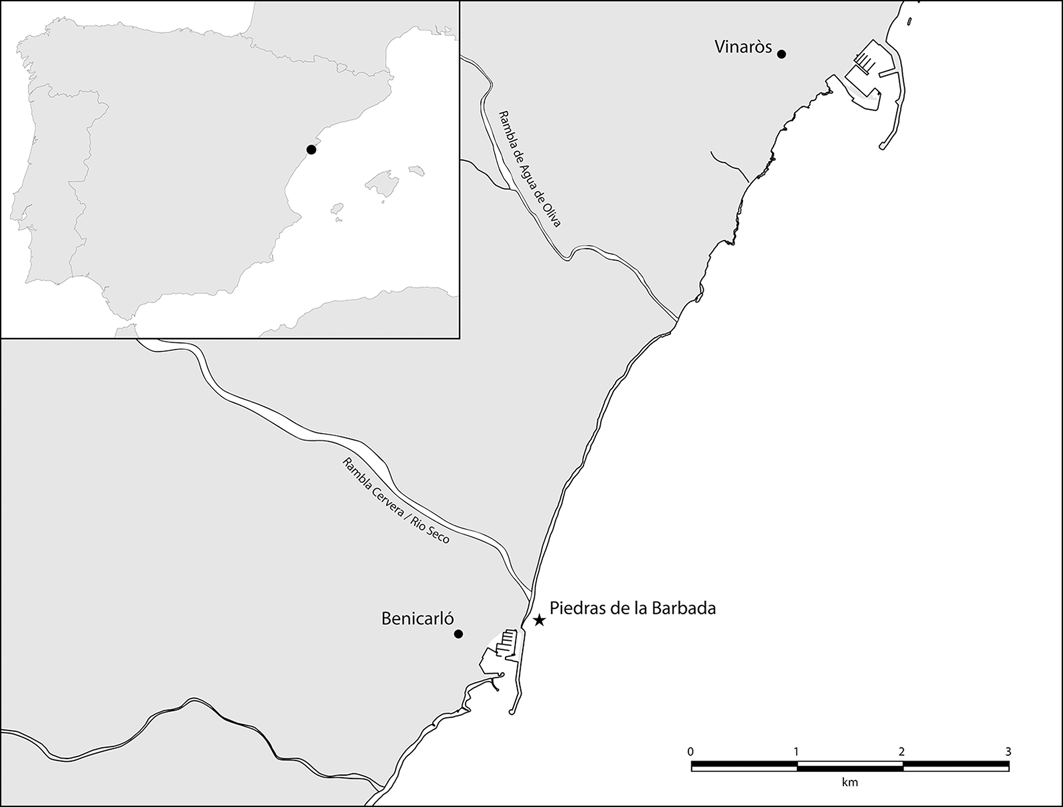
Within archaeological contexts, items of weaponry and armour are typically identified through comparison with parallels from other sites, museum collections and iconographic sources. Where such reference material proves elusive, identifications remain provisional and require alternative verification. The iron helmets from Benicarló (Castellón, Spain), recovered in 1990 from the underwater site of Piedras de la Barbada (Figure 1), offer a valuable case study in the challenges of identification and dating in underwater and military archaeology. Found near the outflow of the Rambla Cervera at a depth of approximately 6m, the assemblage consists of two large masses of iron calottes, stacked and fused by advanced corrosion, and sealed within calcareous concretions and sandy sediments. Based on their association with early material found at the site—amphorae, Roman anchor stocks and bronze helmets (Fernández Izquierdo Reference Fernández Izquierdo1990–1991; Ramos Barceló Reference Ramos Barceló1992), including Italic Montefortino helmets of Punic War date (c. 264–146 BC) (Oliver Foix Reference Oliver Foix1987–1988) and a fragment of a Hispano-Chalcidian helmet (late fourth–early third century BC) (Graells i Fabregat & Lorrio Alvarado Reference Graells i Fabregat and Lorrio Alvarado2013)—the iron helmets were initially attributed to similarly ancient periods. Re-examination of the assemblage, however, suggests a post-Classical date, revealing activity at the site many centuries later than previously assumed (Frallicciardi Reference Frallicciardi2024).
Location of the Piedras de la Barbada site (figure by D. Sica & M. Frallicciardi).

Helmets, particularly from the Roman Imperial period (27 BC–AD 476), are relatively frequent finds in the coastal waters of eastern Iberia (Graells i Fabregat & Lorrio Alvarado Reference Graells i Fabregat and Lorrio Alvarado2013), and are generally interpreted as losses resulting from shipwrecks or damage to harbour structures. Although the deposition of weapons in water for cultic purposes is well attested elsewhere—for example, at Fontino di San Cerbone near Populonia (Romualdi Reference Romualdi2009; Camilli Reference Camilli and Egg2016)—such motivation is unlikely for the helmets at Benicarló. Instead, the site’s location on a long-established maritime route connecting inland Iberia with the eastern Mediterranean (Graells i Fabregat Reference Graells i Fabregat2014) and its wider archaeological assemblage suggest a submerged landing place affected by accidental losses. This article presents new radiocarbon dates and typological considerations for the Benicarló helmets, establishing the assemblage as one of the most significant underwater discoveries for the study of medieval weaponry in the western Mediterranean.
Description of the assemblage
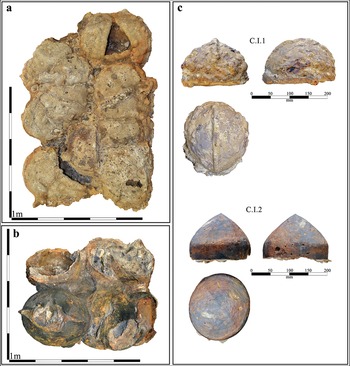
Following their recovery from the sea floor, the concreted blocks encasing the helmets were transferred to the Servicio de Investigación Prehistórica de Valencia for conservation and restoration. Two helmets were separated and are now on display at the Museo de la Ciudad de Benicarló (MUCBE) (Figure 2c). The remaining helmets, still embedded in the two original blocks, are housed at the Museu de Belles Arts de Castelló (MBAC), together with detached fragments from the assemblage (Figure 2a & b).
Three groups of the Benicarló assemblage: a & b) correspond to the two blocks recovered at Piedras de la Barbada, currently housed in the Museo de Bellas Artes de Castellón (groups A and B); c) the detached and conserved pieces exhibited in the Museo de la Ciudad de Benicarló (group C). The images were produced from photogrammetric data (figure by M. Frallicciardi).

At least 43 specimens can be identified from surface inspections, though this number is likely an underestimate as some helmets are fully enclosed within the blocks. The state of preservation is variable. The marine concretion—composed primarily of carbonate with inclusions of iron corrosion products—helped preserve many of the helmets but those exposed to the marine environment are more fragmentary. Sediment trapped between some specimens acted as a seal, creating stable microenvironments in which textile residues were preserved.
To ensure traceability, replicability and data integration across museum and laboratory work and in publications, a hierarchical numbering system was adopted to identify each helmet: Group. Nucleus. Element. Group (A, B, C) identifies whether specimens were found in a concretion mass or as an isolated group: A and B are the blocks stored at the MBAC; C denotes the two separated helmets on display at the MUCBE and associated fragments. Nucleus (I, II, III, …) subdivides each group into contiguous subsets defined by observable clusters or stacks. Element (1, 2, 3, …) orders the elements according to the stacking sequence, starting from the bottom. Thus, A.I.1 refers to element 1 of nucleus I in group A; B.II.4 refers to element 4 of nucleus II in group B (Figure 3).
Details of the overlapping helmets from different viewpoints: a) lateral view of groups IV and II; b) top view of group II, with detail of the fractured calotte of B.II.3 and B.II.2; c) detail of the crests in section of helmets B.I.2 and B.I.3; d) lateral view of groups B.I and B.III in relation to the better-preserved groups B.II and B.IV (figure by authors).

Groups A and B each consist of four stacks or clusters of helmets, while group C comprises two: the first formed by the two specimens on display at the MUCBE, the second consisting only of associated fragments. B was selected for detailed study, as it represents the best-preserved group, providing fabric fragments for microscopic analysis and radiocarbon dating.
Typology of the helmets
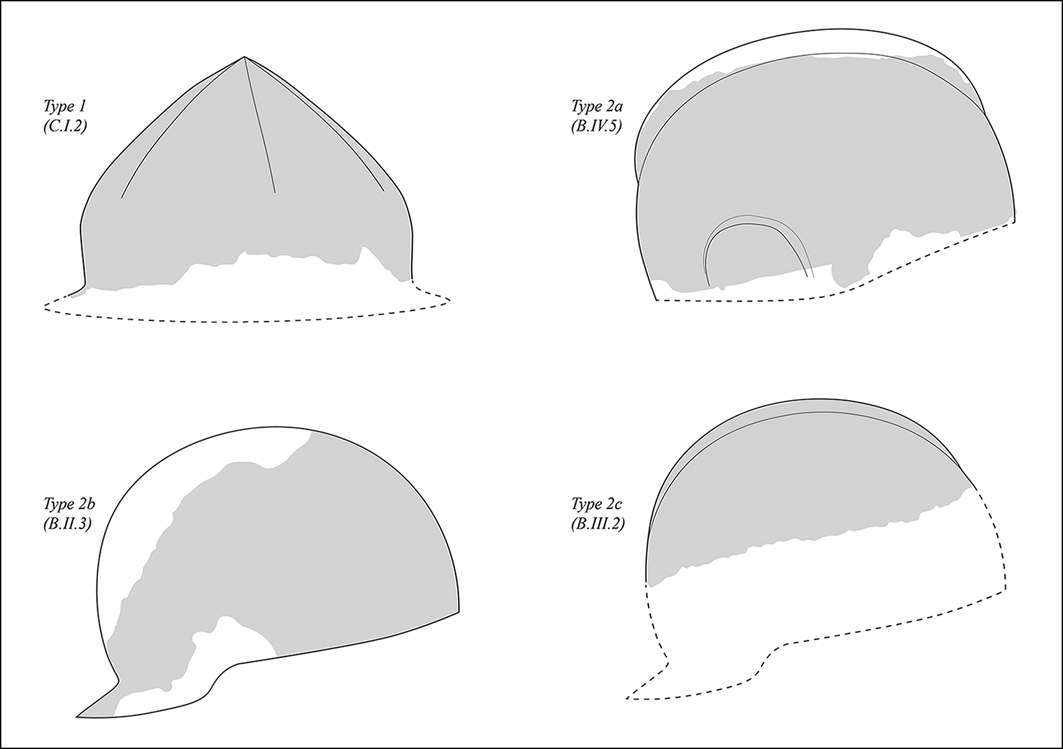
Despite the fragmentary nature of the finds, some helmets retain diagnostic morphological features. Specimens from groups A and B belong to the same morphotype (Figure 4, type 2), characterised by hemispherical calottes, often surmounted by a longitudinal crest of variable prominence. One helmet from group C (C.I.1) also fits this type, while the other (C.I.2) is an ogival, faceted calotte composed of six facets converging towards the apex (Figure 4, type 1). Several helmets show out-turned rims in the occipital area and a number from group B were forged from single pieces of iron.
Typological scheme of the iron helmets from Benicarló (with example specimens in brackets) (drawing by M. Frallicciardi).

The basic forms recall one-piece helmets of the Middle Roman/High Roman Empire (c. first–third centuries AD), with anatomically shaped calottes, usually in bronze or iron, but the crested variants (type 2) and the ogival, faceted form (type 1) find no parallels in this Roman helmet tradition (for Iberian cases, see Vega Avelaira Reference Vega Avelaira and Morillo Cerdán2006). A connection with Late Antique (third–sixth centuries AD) ridge helmets is also unlikely, as these followed Spangenhelm construction and were assembled from multiple metal segments (James Reference James1986: 113–15; Miks Reference Miks2014). Comparisons with infantry helmets typical of the fourteenth–fifteenth centuries, such as skullcaps, basinets and sallets, make a late medieval attribution for the assemblage more likely.
During the fifteenth century, military equipment underwent a gradual process of standardisation across Europe, driven by the extraordinary success of major production centres. Foremost among these were the Lombard and Milanese workshops, followed later by German, Flemish and Spanish armouries. The development of proto-industrial methods of steel production, together with the refinement of fully articulated plate-armour systems, revolutionised defensive equipment and contributed to the consolidation of major armour-making districts on a continental scale (Blair Reference Blair1958). Prior to this, in the late fourteenth century, defensive equipment displayed marked regional variability, reflecting local manufacturing practices and aesthetic preferences. It is within this transitional context that the Benicarló assemblage should be situated, at a time when helmet models and archetypes were still in the process of definition.
The sallet, with its rear neck guard, represents a highly variable category of helmet, produced on a large scale from the early fifteenth century onwards (Blair Reference Blair1958: 85–86, 105–107, 110, 200; Pyhrr Reference Pyhrr2000: 6–12), that included compact and simplified models, known in Italian as ribalde (Boccia Reference Boccia1982: 27), which show affinities with the type 2 specimens from Benicarló. Examples are attested in a wide range of iconographic and material sources, including The punishment of the rebels against the priesthood of Aaron painted by Jacopo Uccello around 1378 in the church of Santa Apollonia di Mezzaratta (Bologna). This fourteenth-century depiction of helmets worn by Roman soldiers closely recalls the Benicarló examples: nearly anatomical calottes; some plain and equipped with a projecting neck guard; others provided with a crest, one of which appears to display oblique incisions similar to those observed on specimen B.IV.5.
Perhaps the most convincing parallel for the Benicarló helmets derives from an English source, the mid-fourteenth-century Holkham Bible (c. 1330–1340, British Library, MS 47682). Illuminations in this manuscript depict biblical and apocryphal scenes set in contemporary contexts. Scenes illustrated on folios 29r, 31v and 40r include lightly armed soldiers wearing a distinctive type of basinet, characterised by a longitudinal crest and rounded temples, closely comparable to that visible on the exposed side of specimen B.IV.5 (Figure 5a).
a) Illustration from the Holkham Bible (c. 1330–1340) (licensed via British Library Images; from the archive of the British Library: MS 47682; fol. 40r); b) a helmeted figure from Christ before Pilate, by Hans Multscher (1437), originally part of the upper-right wing of the Wurzach Altarpiece, now in the Gemäldegalerie, Staatliche Museen zu Berlin (source: Wikimedia Commons (Web Gallery of Art); public domain (PD-Art)).

The most plausible attribution for the type 1 helmet (specimen C.I.2) is the kettle hat, widely used by European infantry from the fourteenth century onwards. Early examples were assembled from multiple plates, but from the fourteenth century manufacture increasingly favoured single-piece construction (Blair Reference Blair1958: 31–32). Although no direct archaeological parallels are known, iconographic sources attest to a wide range of forms for the kettle hat, particularly in the fifteenth century, when it reached the height of its popularity in European military equipment. An example is depicted in Christ before Pilate by Hans Multscher, part of the painted cycle that originally decorated the upper right wing of the Wurzach Altarpiece (c. 1437) and is now preserved in the Gemäldegalerie, Staatliche Museen zu Berlin (Figure 5b). The soldier dragging Christ before the prefect of Judea is shown wearing weaponry contemporary with the painting’s production: a finely detailed two-handed sword and an atypical breastplate laced directly over his tunic. On his head, he wears a single-piece forged kettle hat with a faceted calotte and an asymmetrical, downward-sloping brim, cut at the front to form a pointed, projecting, nasal-like extension.
Typology and iconographic comparisons do not, however, provide secure dating; they remain a set of heuristic inferences based on the observation of limited characteristics. Application of more formal analytical approaches is therefore indispensable in characterising the Benicarló assemblage, particularly given the lack of secure contextual data in marine environments.
Materials and methods
Textiles were preserved in functional positions inside several helmet calottes, sealed between layers of metal, corrosion products and sediment, offering the rare opportunity to investigate both the assemblage’s chronology through direct radiocarbon dating of the textiles, and assess preservation and the composition of metal-textile-sediment interfaces through microscopic and spectroscopic analyses.
The underwater context and post-depositional cementation favoured organic preservation but necessitate careful verification of radiometric dating as post-depositional processes (intrusion, reworking) and conservation-restoration treatments could affect the textiles’ apparent age. In this situation, radiocarbon dating by accelerator mass spectrometry (AMS) of the plant-fibre textiles provides an independent chronological constraint, while a suite of archaeometric analyses—optical microscopy (OM), field emission scanning electron microscopy with x-ray microanalysis (FESEM-EDX), Fourier transform infrared spectroscopy with attenuated total reflectance (FTIR-ATR), x-ray diffraction (XRD) and x-ray microtomography (XRM)—supply material indicators of sample suitability and allow interpretation of any outlier dates in an informed way.
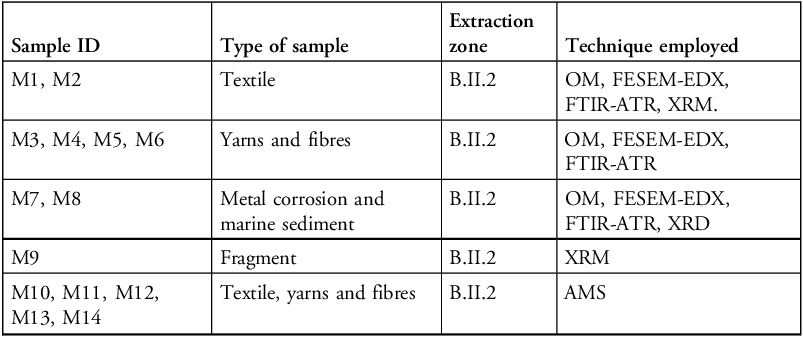
Textile samples were collected from group B, which exhibited a better state of preservation, allowing the identification of textile remains used to line the interior of several helmets. The samples were mechanically extracted using a scalpel, surgical blade, tweezers and scissors. Fragments from different places were selected for analysis using the various instrumental techniques (Table 1). The samples were analysed at the Instituto de Restauración del Patrimonio of the Universitat Politècnica de València (OM, FESEM-EDX, FTIR-ATR, XRM), the Departamento de Mineralogía y Petrología of the Universidad de Granada (XRD) and at Beta Analytic, Miami, and the Curt-Engelhorn-Zentrum Archäometrie (CEZA), Mannheim (radiocarbon dating by AMS). Detailed methods for each analysis are available in the online supplementary materials (OSM).
Analysed samples of helmets of Benicarló.

Analysis proceeded in three steps. First, documented sampling: for each sample we recorded its three-dimensional position within the block, depth from the exposed margin, the thickness and continuity of the concretion at the textile contact, sediment grain size and the corrosion state of the adjacent metal sheet. Second, microanalytical screening: FTIR-ATR was used to identify cellulose and potential contaminants; FESEM-EDX identified fibrillar morphologies, particulates and biofouling; XRD assessed the mineral phases of the concretion and iron corrosion products; and XRM was used to detect voids and to measure the thickness of the carbonate seal. Third, radiocarbon dating: radiocarbon ages (BP) were calibrated using the IntCal20 curve (Reimer et al. Reference Reimer2020) in OxCal, v.4.4.4 (Bronk Ramsey Reference Bronk Ramsey2009: 337–60).
Microchemical and morphological characterisation
The analytical study outlined here exemplifies an integrated approach to complex archaeological materials, where metal, associated organic matter and surrounding sediments form a stratified system. The investigation aimed to reconstruct the characteristics of the textiles, to characterise corrosion products and to describe the sedimentary components, in order to provide a coherent account of depositional processes and the microenvironmental conditions that governed preservation at the find site.
The microstratigraphic sequence is consistent across samples: an outer layer of marine sediment; an intermediate layer of plant-fibre textile; a thin but continuous interface of iron corrosion products; and, beneath, the original helmet metal (Figure 6). Characterisation of this sequence is critical not only for interpreting alteration processes but also for understanding depositional conditions and the mechanisms that enabled the survival of organic traces in this context that would not otherwise persist in underwater settings.
Photograph of the interior of helmet B.II.2, showing the different strata: 1) marine sediment; 2) textile; 3) metallic corrosion products; 4) constituent metal of the helmet (figure by C. Álvarez-Romero).

Under optical microscopy, textile samples show a plain one-over, one-under (tabby) weave of Z-twisted yarns composed of plant fibres, with features typical of bast fibres (Cook Reference Cook1984). Sediment is shown to be composed of fine- to medium-grained material with colours from amber-yellow to reddish, consistent with siliceous sands mixed with iron corrosion products (chiefly goethite, haematite and magnetite) (Figure 7).
Microphotographs of the collected samples: a) textile from the helmet interior (M1); b) fibre with Z-twist (M3); c) metallic corrosion products (M7); d) adhered marine sediment (M8) (figure by C. Álvarez-Romero).

Imaging using scanning electron microscopy resolved fibre morphology in greater detail, confirming parallel macro- and microfibrils, transverse fractures and residual polysaccharide cross-linking that indicate the use of bast fibres. Surfaces show globular cryptocrystalline deposits interpreted as ferric or carbonate precipitates (Figure 8a & b). EDX detected oxygen, silicon, iron, magnesium, sulphur and calcium, consistent with infiltration of mineral particles and corrosion products trapped within the fibres. The composition of corrosion samples is dominated by oxidised iron with traces of silicon and sulphur. Silica predominates sediment samples, with smaller contributions of sodium, magnesium and iron. Calcium carbonate is also present, consistent with marine precipitation and calcareous encrustation (Turchyn et al. Reference Turchyn2021).
Results of different analyses: a) FESEM image of a fibre from the inner textile of helmet B.II.2, showing plant stem morphology with visible macrofibrils (M1; SE2, 20 kV); b) FESEM image of a fibre from the inner textile, showing microfibril bundles (1) and cryptocrystalline deposits (2), possibly metallic corrosion products (M1; SE2, 5 kV); c) IR spectrum obtained on sample M3; d) diffractogram obtained on sample M7 (figure by C. Álvarez-Romero, M.T. Doménech-Carbó and N. Velilla-Sánchez).

FTIR-ATR spectra confirm the textile’s organic composition (Figure 8c). The samples show characteristic cellulose bands: a broad O–H stretch at around 3300cm-1, C–H stretches at 2927–2861cm-1, and O–H/C–H deformation bands around 1620–1400cm-1 (Konstadinovska et al. Reference Konstadinovska, Mokrys and Badura2016). Residual lignin is indicated by phenolic bands at 1595 and 1512cm-1, showing that despite degradation, the plant cell-wall signature remains discernible (Konstadinovska et al. Reference Konstadinovska, Mokrys and Badura2016). However, spectra also show silicate and kaolinite signals—attributable to sediment particles that infiltrated into textile pores rather than into the fibre itself—and possible traces of calcium oxalate dihydrate, consistent with progressive mineralisation of the cellulosic matrix. Spectra for corrosion-product samples display peaks diagnostic of goethite, magnetite and haematite, while those for sediment samples show signatures of quartz and calcite (Mohammed & Mohammed Reference Mohammed and Mohammed2018; Veneranda et al. Reference Veneranda2018).
Results of XRF corroborate these interpretations, identifying kaolinite, quartz and feldspar in the sediments, and magnetite and haematite among the corrosion products (Figure 8d). The predominance of magnetite is interpreted as indicating low-oxygen depositional conditions typical of protected, stagnant subaqueous settings, where reduction processes prevail over oxidation and favour the stability of mixed oxides such as magnetite (Calero et al. Reference Calero2017; Jia et al. Reference Jia2022).
XRM provided three-dimensional visualisation of the stratigraphic sequence observed in the helmets (Figure 9). The imaging clearly distinguished the metal, corrosion, textile and sediment layers. The method also permitted measurement of the textile without the need for further destructive sampling. Mean yarn diameter was approximately 420µm with a low standard deviation, indicating regular spinning, producing a Z-twist angle of 57°. The fabric is plain weave (tabby) at about 17 threads per centimetre. These parameters are consistent with a simple, robust textile suitable for lining or padding (Gleba Reference Gleba2017; Mateo Viciosa Reference Mateo Viciosa2018; Martín-Aguilera et al. Reference Martín-Aguilera2019).
2D and 3D XRM projections of sample M9: a) 3D cross-section showing: 1, marine sediment deposits; 2, textile; 3, corrosion products; 4, metal; b) 2D frontal view of plain weave; c) 2D cross-section of helmet fragment showing: 1, marine sediment deposits; 2, textile; 3, corrosion products; 4, metal (figure by C. Álvarez-Romero).

Integration of results from the various analyses yields a coherent picture. The fibres are securely identified as plant-cellulosic bast fibres, although the precise species cannot be determined because of spectral overlap and mineral contamination. Corrosion products form a layer that partly protects the textile while impregnating it with ferric particles that complicate interpretation. The surrounding sediments—mainly quartz, feldspars, kaolinite and calcite—indicate a low-energy depositional setting with fine- to medium-grained, sub-angular particles typical of protected seabed settings. Overall, the assemblage records a fragile preservation system in which textile survival depended on contact with the iron corrosion layer, which inhibited complete biological decay.
Radiocarbon dating
Radiocarbon dating of iron helmets from an underwater context is unprecedented and represents a significant methodological challenge. Underwater metal artefacts rarely preserve organic material suitable for radiocarbon dating, because marine conditions accelerate decay and dissolution. In this case, interaction between plant-fibre textiles, corrosion products and sediment created a sealed microenvironment that preserved cellulosic fibres, making possible a move beyond typological reasoning to anchor the prospective chronology in absolute, replicable measurements.
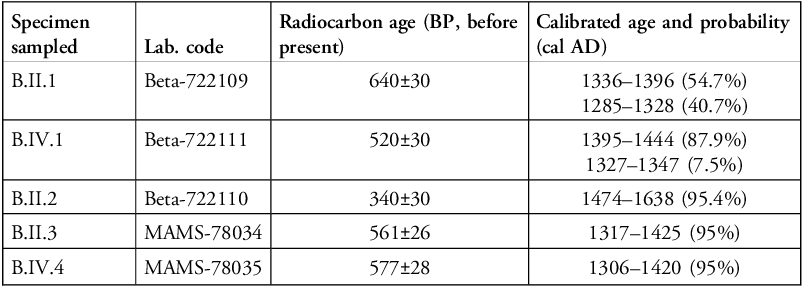
Analysed samples were taken from different places within the helmet-bearing conglomerate and were selected to maximise representativeness and minimise the risk of anomalous results. Three textile fragments were sent to Beta Analytic (Miami) and two further fragments were analysed at the Curt-Engelhorn-Zentrum Archäometrie (CEZA), Mannheim to enlarge the dataset and test the robustness of the dates. Both laboratories measured the 14C/12C ratio directly on small samples by AMS, ensuring high precision and low contamination risk. Results are shown in Table 2. Conventional radiocarbon ages were corrected for isotopic fractionation using δ13C values from isotope-ratio mass spectrometry (±1σ) and calibrated against the IntCal20 curve (Bronk Ramsey Reference Bronk Ramsey2009: 337–60; Reimer et al. Reference Reimer2020).
Results of radiocarbon determinations.

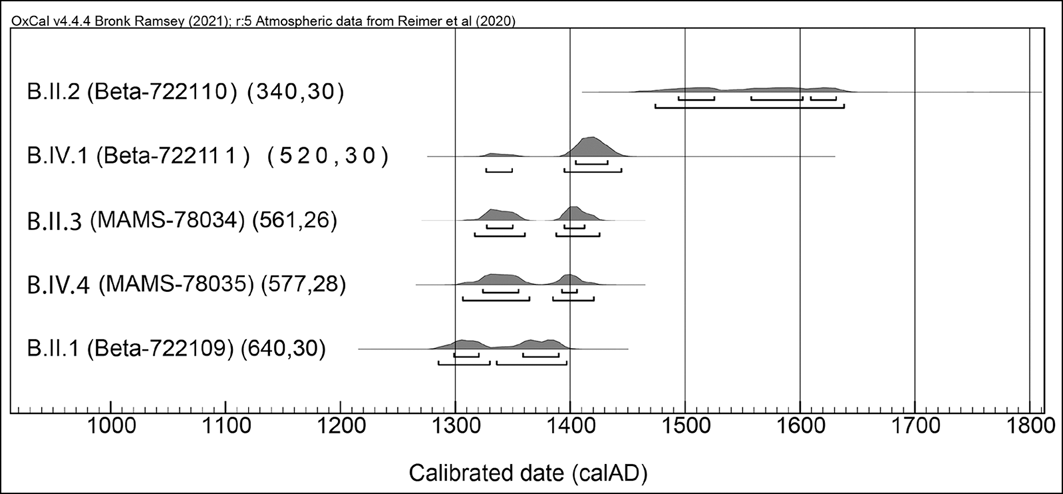
One date is anomalously late, at least 150 years younger than the others (raising an issue for the dating of the entire assemblage, which is discussed in the following section), but the five results together define a coherent chronological framework (Figure 10). The results place the use and deposition of the helmets between the third quarter of the fourteenth century AD and the early fifteenth century, with an upper boundary no later than the mid-fifteenth century. This chronology, based on independent measurements from two laboratories, demonstrates robustness and reduces uncertainty. Crucially, the radiocarbon dates derive from the lining textiles, reflecting their manufacture and use, and thus coincide with the service life of the helmets, given the functional and perishable nature of the lining material.
Calibrated AMS radiocarbon determinations from five textile samples taken from the Benicarló iron helmets (figure by G. García Atiénzar).

The outlier sample
Replication of the radiocarbon measurements in different laboratories increases confidence in the results and reinforces the overall interpretative framework, while also drawing attention to an important methodological issue. Of the five radiocarbon determinations, four converge between the last quarter of the fourteenth century and the early decades of the fifteenth; only sample B.II.2 yields a markedly later result, calibrated to AD 1474–1638. This outlying chronology—more than a century later than the others—requires careful consideration, as it may affect the dating of the entire assemblage.
The helmets are typologically homogeneous and were almost certainly part of a deliberate grouping, held together post-deposition by corrosion products and marine sediment. It is therefore clear that they are not unrelated finds lost in the same area over an extended period, but rather a group that sank during a single event and remained in situ until recovery. Under such conditions, stratigraphic and post-depositional considerations advise caution.
The position of helmet B.II.2 within the concreted mass indicates that the crate containing the helmets did not enter the water horizontally. Some helmets became embedded in the sand, while others, including B.II.2, remained exposed to marine currents that would have repeatedly uncovered and reburied them over the centuries. Such exposure may have facilitated the intrusion of younger sediments and other alteration processes.
Microscopic analysis of the textile associated with helmet B.II.2 also reveals poorer preservation: the fibres are disaggregated and mineralisation is uneven. These conditions may have favoured the absorption of younger exogenous carbon, thereby altering the residual radiocarbon activity. It is also possible that part of the sampled textile was replaced by intrusive material, such as plant fibres carried by currents entering through microfractures in the concreted block.
Another possibility is that the helmet’s padding or inner lining was replaced at some point during its period of use. If such a replacement occurred shortly before the loss of the cargo, the radiocarbon date would reflect the age of the substitute textile, in this case using newer, younger fibres, rather than that of the helmet itself. However, the lack of identifiable evidence for repairs or alterations to the artefacts, as well as the consistency of the other four dates, makes this scenario less convincing than post-depositional contamination.
This interpretation, which may be characterised as a lectio difficilior (the more difficult reading), proves the most coherent, confirmed by the agreement of the remaining dates.
Discussion
Having established that the Benicarló helmets date between the mid-fourteenth and mid-fifteenth centuries using radiocarbon dating, typological considerations can refine the chronological attribution. The presence of a crest and the relief treatment of the calotte sides on specimen B.IV.5 favour an earlier date. This assessment rests not only on similarities with the helmets depicted in the Holkham Bible, but also on clear differences from models widespread in the later fifteenth century. Sallets and kettle hats of this later phase typically feature deep and robust calottes, continuous sloping brims and skulls reinforced or embellished with prominent crests, such as the Italian cappelli d’arme or the Spanish capacetes. These forms were designed to integrate with full plate armour, which by then had become the dominant defensive system across Europe.
The Benicarló helmets were more likely crafted in minor production workshops active before the rise of Italian plate armour, when infantry equipment was commonly supplied through secondary or regional markets. Their simple workmanship, compact proportions and suitability for light defensive ensembles are consistent with this supposition. Although their manufacture can be placed within a relatively narrow chronological window (late fourteenth–early fifteenth century), their precise place of origin remains uncertain; they may represent a local or regional Iberian production for the Mediterranean market, or imported items reaching the Iberian coast from other regions.
The historical context of the find is even more elusive. During a period marked by profound political turbulence and frequent armed conflict—corresponding to the timeframe indicated by the radiocarbon dates—a batch of infantry helmets could have been intended for a wide range of organised military actors: troops of the Kingdom of Valencia, mercenary companies or militias raised by towns and communities enjoying a degree of local military autonomy. From the mid-fourteenth century onwards, Islamic piracy along the Valencian coast evolved from sporadic incursions into a persistent and structural threat (Díaz Borrás Reference Díaz Borrás1993: 78–79). After initial sightings in the 1350s and intermittent attacks during the 1360s, raids became recurrent from the 1370s, reaching their peak in the final decades of the century, when the western Mediterranean experienced the height of late medieval piracy. These incursions, concentrated along the southern Valencian littoral owing to its proximity to North African and Granadan bases and to favourable coastal geomorphology, prompted the progressive militarisation of the coastline, which came to function as a maritime frontier. Defensive responses included the construction of coastal towers and fortified settlements, as well as the mobilisation of locally organised militias and garrisons, particularly during the late fourteenth century and continuing into the fifteenth century (Díaz Borrás Reference Díaz Borrás1993: 78–81; Menéndez Fueyo Reference Menéndez Fueyo2016: 154, 162).
Conclusions
This study demonstrates the value of archaeometric approaches in addressing problems of identification and dating in military archaeology when typological and iconographic comparisons prove insufficient. The Benicarló helmets, long considered anomalous within the wider archaeological assemblage recovered from the site of Piedras de la Barbada, can now be securely placed within a late medieval horizon through direct dating of preserved textile linings.
Radiocarbon determinations from two independent laboratories, supported by microanalytical characterisation of the textiles and their surrounding matrices, define a coherent chronological framework centred between the third quarter of the fourteenth century and the early fifteenth century. Bayesian modelling confirms the consistency of four of the five dates and identifies the remaining determination as a statistical outlier, most plausibly explained by post-depositional contamination rather than by extended or multiphase deposition. This outcome highlights the need to integrate radiocarbon data with stratigraphic, taphonomic and material evidence, particularly in complex underwater contexts.
Typologically, the Benicarló helmets occupy a transitional position prior to the standardisation of European helmet forms. Their forms, construction techniques and associated textiles indicate non-elite infantry equipment produced in minor workshops and distributed through secondary or regional markets, providing rare material evidence for an intermediate phase that remains poorly documented in the archaeological record.
More broadly, the assemblage contributes to the understanding of late medieval maritime activity along the eastern Iberian coast, documenting the movement and accidental loss of military equipment at sea during a period of political instability. Preserved as a coherent group resulting from a single depositional event, the helmets offer an exceptional snapshot of infantry equipment in use during the late fourteenth and early fifteenth centuries.
Acknowledgements
We thank the Museu de Belles Arts de Castelló (MBAC), Arturo Oliver Foix and Ferran Falomir Granell, and the Museo de la Ciudad de Benicarló (MUCBE), Lorena Luján Edo, for access to the collections. We are also grateful to Angelo Meriani, Director of the RAMUS doctoral programme at the University of Salerno (Dipartimento di Scienze del Patrimonio Culturale), and to the Fundación Palarq for approving the funding. Finally, we thank Gabriel García Atiénzar for processing the radiocarbon dating data, Nicolás Velilla Sánchez for performing and interpreting the XRD analyses and the technicians of the Electron Microscopy Service at the Universitat Politècnica de València.
The authors acknowledge the use of AI-assisted tools (ChatGPT, OpenAI) for English-language translation and minor language editing. All content has been reviewed and approved by the authors, who take full responsibility for the final text.
Funding statement
The radiocarbon analyses were funded by Fundación Palarq (PALARQ24-01, Universitat d’Alacant) and by the RAMUS doctoral programme (Università degli Studi di Salerno). Microscopic and spectroscopic analyses of the textiles were funded by Ministerio de Ciencia e Innovación (MCIN/AEI/10.13039/501100011033), the European Regional Development Fund and Agencia Estatal de Investigación (PID2020-113022GB-I00, Universidad Politécnica de Valencia).
Competing interests
The authors declare no competing interests.
Online supplementary material (OSM)
To view supplementary material for this article, please visit https://doi.org/10.15184/aqy.2026.10341 and select the supplementary materials tab.
Author contributions: CRediT categories
Manuel Frallicciardi: Conceptualization-Lead, Data curation-Supporting, Investigation-Supporting, Project administration-Lead, Visualization-Lead, Writing - original draft-Lead. Carla Álvarez-Romero: Data curation-Lead, Investigation-Lead, Methodology-Lead, Visualization-Lead, Writing - original draft-Supporting. Maria Teresa Doménech-Carbó: Funding acquisition-Lead, Resources-Lead, Supervision-Equal, Writing - review & editing-Equal. Raimon Graells i Fabregat: Data curation-Lead, Funding acquisition-Lead, Project administration-Lead, Supervision-Equal, Writing - review & editing-Equal. Alfredo Maria Santoro: Funding acquisition-Lead, Project administration-Equal, Supervision-Equal, Writing - review & editing-Equal.






 Open access

