




Introduction
Distributive justice preferences matter because they shape the policy preferences of governments and political parties, and influence policy change (Burstein Reference Burstein2003; Wlezien and Soroka Reference Wlezien and Soroka2012), particularly in democratic regimes. Despite their significance, these preferences have received relatively little scholarly attention in countries that are not covered by major comparative surveys such as the European Social Survey. Unlike countries like the United Kingdom (UK) or the United States (US), which conduct national surveys such as the British Social Attitudes Survey or the American Life Panel, Turkey does not have a comparable national survey that examines distributive justice preferences. It remains unclear whether the patterns observed in these contexts hold in middle-income-country contexts with less mature welfare states, such as the Turkish case, where comparable datasets are unavailable. This makes the data collected in this study and its analysis particularly valuable.
In this study, we adopt Van Hootegem et al.’s (Reference Van Hootegem, Abts and Meuleman2020) definition of distributive justice preference, understood as core beliefs regarding the validity of different distributive principles utilized by the welfare state to distribute benefits and provide services. Much of the existing literature adopts a generalist perspective to distributive justice preferences, often reducing individuals’ preferences to being pro- or anti-welfare state, or pro- or anti-redistribution (Brooks and Manza Reference Brooks and Manza2006; Choi Reference Choi2019). Such binary framings are overly simplistic and fail to capture the complexity and multidimensional nature of distributive justice preferences. Evidence suggests that individuals may support one type of redistribution in some policy sectors while opposing it in others (Van Hootegem et al. Reference Van Hootegem, Abts and Meuleman2020). Examining distributive justice preferences across policy sectors therefore allows for a more nuanced understanding of public attitudes towards the welfare state. This sectoral perspective is also politically relevant, as it helps political actors to better understand the differentiated structure of public support and to identify political opportunities when incorporating social policy issues into their organizational strategies and broader political agendas.
In this study, we use three distributive justice principles that are commonly used in the literature: equality, equity, and need (Deutsch Reference Deutsch1975). Each principle suggests a distinct rationale for allocating benefits, goods, and services (Clasen and Van Oorschot Reference Clasen and Van Oorschot2002). For the purposes of this study, we establish distinct and mutually exclusive definitions, presenting them as alternatives to one another.
First, the equity principle (sometimes referred to as merit) dictates the distribution of resources or benefits based on individuals’ contributions. This manifests in various forms, such as salary contributions to old-age pensions and unemployment insurance funds, as well as direct payments in healthcare and education. While equity could also be defined in terms of effort, in this context, we define it as a function of direct monetary contribution, and expecting the resulting distribution as well as entitlements to align with the level of contribution.
Second, we define the principle of equality as the equal distribution of resources or benefits among all individuals, irrespective of their contributions or needs. Its aim is to ensure uniformity, ensuring that everyone receives an identical share.
Third, the principle of need pertains to the distribution of resources or benefits based on individuals’ specific needs or vulnerabilities, determined by income level. This principle addresses needs by providing assistance to the poorest. Need-based distribution strives to rectify inequalities and uphold social justice by directing resources to where they are most needed.
This study addresses two research questions. First, it investigates the distributive justice preferences of Turkish society and the extent to which they vary across different areas of social policy. Second, it seeks to identify individual-level factors that could elucidate variations in people’s distributive justice preferences across these areas.
By examining these questions, this article contributes to the welfare attitudes literature in two ways. While literature on this theme predominantly uses existing public opinion data from European and North American countries, our study extends the welfare attitudes agenda by generating and analyzing a unique, nationally representative survey. By doing so, we not only broaden the geographical scope of inquiry but also provide insights into the popular understandings of social justice in an understudied middle-income-country context with a sizeable yet immature welfare state. Additionally, this approach allows us to test hypotheses derived from existing literature on the UK and European Union member states within a unique Turkish socio-political landscape (Buğra and Keyder Reference Buğra and Keyder2006), potentially akin to other middle-income countries (Gatskova Reference Gatskova2013; Reyes and Gasparini Reference Reyes and Gasparini2017) that have diverse histories of social policy. Through this analysis, we aim to deepen the understanding of social justice preferences across diverse contexts.
Literature review
The academic discourse surrounding conceptions of social justice had traditionally been confined to the realms of social theory. However, since the 1980s there has been a growing scholarly interest in public understandings of distributive justice, leading to an expanding body of empirical research in this area (Hochschild Reference Hochschild1981; Miller Reference Miller1992). An early illustrative example is the International Social Justice Project, which initiated in 1991 public opinion surveys across twelve countries including Russia, Czechoslovakia, East and West Germany, the US, and Great Britain (Gerlitz et al. Reference Gerlitz, Mühleck, Scheller and Schrenker2012). Over time, scholars have sought to bridge the gap between these two bodies of literature, namely social theory and public opinion research, by integrating them into a productive dialogue. One noteworthy endeavor was undertaken by Swift (Reference Swift1999), who made a significant effort to reconcile philosophical discussions of distributive justice with empirical investigations into public opinion.
The study of popular beliefs regarding distributive justice and welfare preferences took a significant stride forward thanks to the welfare attitudes literature. Despite earlier doubts on whether individual attitudes towards distributive justice are sufficiently structured and consistent for meaningful social analysis (Zaller Reference Zaller1992), the findings of Ares et al. (Reference Ares, Häusermann, Enggist and Pinggera2024) demonstrate a remarkable level of consistency in preferences. Originating from studies investigating public support for the welfare state, particularly during the turbulent decades of the 1980s and 1990s when the legitimacy of the welfare state was questioned in the global North, this literature has since flourished (Svallfors Reference Svallfors and Svallfors2012). With the expansion of data sources, notably through endeavors like the European Social Survey, which conducted its eleventh round in 2024 across twenty-eight countries (Turkey did not take part), researchers working on most European countries gained access to comparative data enabling them to examine the influence of national contexts on welfare attitudes.
Researchers have increasingly shifted focus from examining general attitudes toward the welfare state as a whole in investigating specific areas of social policy (Van Oorschot et al. Reference Van Oorschot, Laenen, Roosma, Meuleman, Nelson, Nieuwenhuis and Yerkes2022). Many of these studies (e.g. Franke and Simonson Reference Franke and Simonson2018; Yang and Barrett Reference Yang and Barrett2006) have concentrated on domains addressing conventional social risks, such as pensions, unemployment benefits, and healthcare, which have uncovered significant variations in attitudes across these policy domains. For example, the study conducted by Van Hootegem et al. (Reference Van Hootegem, Abts and Meuleman2020) on Belgium departs from the criticism of the existing public opinion research on distributive justice as it overlooks the multiplicity of social justice principles that people may apply in their distributive judgments. To address this gap, they analyzed preferences for the principles of equality, equity, and need within the three welfare domains of healthcare, pensions, and unemployment benefits. Their findings show that distributive justice preferences for equality, equity, and need vary across welfare domains. In the Belgian case, they observed that equality emerged as the most commonly supported principle in all welfare domains. However, relative support for other principles differed considerably. Equity was more strongly favored in pensions, whereas need attracted considerable support in unemployment benefits. These results, Van Hootegem et al. (Reference Van Hootegem, Abts and Meuleman2020) concluded, challenge the assumption that individuals apply a single, abstract distributive justice principle to all social policy sectors.
Furthermore, since the early 1980s, a body of literature that employs experimental designs to investigate distributive behaviors has developed (e.g. Galeotti et al. Reference Galeotti, Kline and Orsini2017; Greenberg Reference Greenberg1983). One example is the Scott and Bornstein (Reference Scott and Bornstein2009) study involving 580 undergraduates from political science classes at the University of California, Davis. They manipulated contextual factors, such as non-emergency and emergency (flood) conditions, and examined preferences regarding various goods such as money, prescription medicine, and food. Their findings highlighted the significant impact of context (understood as the specific type of emergency) and the type of goods on individuals’ distributive decisions. Although these studies are potentially better in establishing causal relationships in explaining social justice preferences, we believe nationally representative surveys still have some advantages such as providing a more comprehensive understanding of distributive justice preferences among individuals across diverse demographics and institutional contexts.
Drawing on the literature on distributive justice preferences and welfare attitudes, we formulated several hypotheses, which we subsequently tested with Turkish data. Inspired by the study by Van Hootegem et al. (Reference Van Hootegem, Abts and Meuleman2020) on Belgium, our principal hypothesis posits that individuals’ distributive preferences exhibit variance across different social policy sectors.
In exploring these preferences across diverse sectors, we analyzed two established frameworks: self-interest and ideology, long utilized since the 1990s (d’Anjou et al. Reference d’Anjou, Steijn and Van Aarsen1995). In the realm of welfare attitudes literature, an often-cited individual-level explanation for distributive justice preferences revolve around self-interest. The self-interest framework maintains that individuals’ attitudes toward social policy are shaped by their social positions, reflecting their levels of (actual or foreseen) reliance on these social programs. Previous research has shown that individuals with higher levels of education and income tend to support equity-oriented distribution, whereas those with lower socio-economic status favor equality- or need-based distribution (e.g. Reeskens and van Oorschot Reference Reeskens and van Oorschot2013, Reference Reeskens, van Oorschot, Levrau and Clycq2021; Yang and Barrett Reference Yang and Barrett2006). Therefore, we hypothesize that household income and subjective income status are inversely related to the preference for the equality and need principles and positively related to the preference for the equity principle.
Another significant determinant of distributive justice preferences utilized in the welfare attitudes literature is ideology. Yang and Barrett (Reference Yang and Barrett2006) used the theory of political predisposition that posits that individuals’ perspectives on social policy stem from their political orientations. Using political party affiliation as a measure of ideology, Yang and Barrett (Reference Yang and Barrett2006) revealed in the US that Democratic Party affiliation correlates with increased support for social security. Mühleck (Reference Mühleck2009) demonstrated that political party affiliation and voting behavior in Germany influences preferences for distributive justice, with those on the right favoring equity and those on the left favoring equality and need. Specifically, identification with conservative or liberal parties in Germany was linked to meritocratic values, while identification with left-leaning parties was associated with redistributive values. Similarly, we hypothesize that individuals who voted for left-leaning political parties will demonstrate a stronger preference for the equality and need principles across all four social policy sectors.
The left–right ideological spectrums developed in Western European democracies do not always align well with the political expression available (and permitted) in other parts of the world. As a result, political party affiliation and voting behavior may not always serve as the most effective indicators of ideology. For example, the study conducted by He et al. (Reference He, Qian and Ratigan2021) on factors influencing support for welfare spending in China, a closed autocracy (V-DEM Institute 2025), used individual perceptions of the causes of poverty as an ideology indicator. We adopt a similar approach for the Turkish case. Previous European research also used views of poverty in measuring ideology, and found that individuals who view poverty as the result of personal responsibility are less supportive of welfare for all (e.g. Lepianka et al. Reference Lepianka, Van Oorschot and Gelissen2009). Building on this line of research, we examine the relationship between views of poverty (fatalistic, structuralist, and individualist) and distributive justice preferences across social policy sectors. We hypothesize that people with individualist views on poverty are less likely to prefer equality and need across different social policy sectors.
In addition to explanations based on self-interest and ideology, Van Hootegem et al. (Reference Van Hootegem, Abts and Meuleman2020) have proposed that the nature of risk that a social policy addresses might be affecting individuals’ distributive justice preferences. They define the nature of risk based on the perceived predictability, prevalence, and locus of individual. For instance, they hypothesized that the common perception of limited internal control and prevalent risks in healthcare leads to popular support for equality in healthcare. We also expect a preference for equality in this realm. Drawing from the article byVan Hootegem et al. (Reference Van Hootegem, Abts and Meuleman2020), we consider the risk related to old-age pensions as predictable and prevalent, hence expecting equity to be the most favored distributive justice principle in this context. Conversely, for unemployment, which is often perceived as unpredictable, we anticipate a stronger preference for need and equality principles. Although education was not examined in the study conducted by Van Hootegem et al. (Reference Van Hootegem, Abts and Meuleman2020), we suggest the decision to have children and planning for their education are often seen as predictable and within individual control, thus we expect most people to prefer equity over equality and need in this domain.
The Turkish context
The Turkish social policy landscape encompasses a diverse array of publicly funded social policy programs, spanning old-age pensions, unemployment insurance, healthcare, and education services (Buğra and Keyder Reference Buğra and Keyder2006). Each of these initiatives has its own unique developmental trajectory that dates back to the first half of the twentieth century, with the most recent addition being unemployment insurance in 1999. In addition to the four social policy sectors we focus on, the Turkish social policy framework includes various social assistance programs, such as a cash-for-care program (Akkan Reference Akkan2018), which targets poor households with members requiring intensive social care support, and conditional cash transfer programs designed to incentivize education for children in impoverished households.
Social policymaking and provision are primarily centralized under the auspices of the central government. However, municipalities also play a role in social provision, offering support in areas such as social care and social assistance (Çelebi Reference Çelebi2022). The role of municipalities in social policy has become increasingly prominent since the main opposition party, the Republican People’s Party (CHP), won local elections in İstanbul and Ankara in 2019 and further expanded its influence in 2024. However, this momentum was disrupted when many CHP mayors were detained and removed from office, in a move widely seen as signaling Turkey’s complete departure from meaningful electoral competition. For the purposes of this paper, our focus is primarily on the public perceptions of four centrally administered social policy programs. These programs were selected due to their widespread recognition among the populace and their suitability for inclusion in a nationwide survey, ensuring a common understanding among respondents.
We examine distributive justice preferences within the realms of publicly funded or public sector-managed education, healthcare, old-age pensions, and unemployment insurance. However, the private sector has expanded its presence in these domains, driven by Justice and Development Party-led (AKP) privatization reforms in the last two decades (Ağartan Reference Ağartan2021; Akkan Reference Akkan2018). This private sector growth occurred alongside the public sector’s struggle to meet escalating demands amid rapid urbanization, informal employment, and globalization challenges. Consequently, although public funding and public sector provision continue to dominate within these areas, a mixed welfare economy has emerged. Our study does not delve into this dynamic, presenting a limitation.
General characteristics of the Turkish welfare system are as follows. The Turkish healthcare system operates under a compulsory social health insurance model, guaranteeing coverage for all citizens (Ağartan Reference Ağartan2021). Despite a growing trend towards privatization in healthcare provision as evidenced by the increasing share of bed capacity and patient applications in the private sector, the public sector continues to play a central role as the primary provider (Ministry of Health 2024). The share of public spending on healthcare was 3.4 percent of gross domestic product (GDP) in 2019, while private spending reached 1 percent (Organization for Economic Cooperation and Development n.d.).
The Turkish education system has exhibited a privatization trend across all levels in the last two decades, with a more pronounced role of the private sector in higher education. This trend towards privatization involves increased involvement of the private sector at lower levels of formal education. Consequently, issues such as declining education quality, heightened competition among schools, and exacerbated social inequalities in education have emerged as significant concerns (Nohl and Somel Reference Nohl and Somel2020). However, the public sector remains predominant even at the tertiary level, given that public universities (129 of 208) outnumber private universities (Higher Education Council 2024). The share of students in public schools is around 93 percent at the primary and around 91 percent at the secondary level (Ministry of National Education 2024). The second largest share of public spending on social programs after old-age pensions was education (primary to tertiary), at 3.8 percent of GDP in 2019. The share of private education spending was 1.4 percent of GDP in 2019 (Organization for Economic Cooperation and Development n.d.).
The Turkish old-age pension system primarily relies on the public sector for provision, with the inclusion of an auto-enrolment-based, private, supplementary private pillar (Saydam Reference Saydam2018). Since 2001, there has been a notable increase in the share of public expenditure on old-age pensions, rising from 4.3 percent of GDP to 7.5 percent in 2019. Despite the launch of the private pillar, the share of private expenditure on old-age pensions is still limited (0.06 percent of GDP, in 2019) (Organization for Economic Cooperation and Development n.d.). As of 2019, there were more than twelve million beneficiaries of the public pension schemes (Social Security Institution 2024). Although the number of people contributing to private pension schemes reached almost seven million in 2019, only slightly more than 100,000 had become eligible to receive their pensions (Pension Monitoring Centre 2024). Thus, public old-age pensions are still at the center of the Turkish pensions system. In this system, as in many others worldwide, pension payments are often determined by factors such as prior contributions and employment status. Consequently, individuals who held higher positions in the labor market and made larger contributions tend to receive higher pension benefits.
Unemployment insurance scheme stands as a newcomer within the country’s social policy landscape. Legislative measures concerning unemployment benefits were enacted in 1999, with actual disbursements commencing in 2002 (Öktem Reference Öktem2020). Overall, while the Turkish unemployment benefit scheme is earnings-related, its primary characteristic is the difficulty in accessing benefits, coupled with relatively limited benefit levels. Unemployment insurance presents significant accessibility challenges for many unemployed individuals. This is because eligibility for these benefits is contingent upon several stringent criteria, including having paid unemployment insurance premiums for at least 600 days in the last three years and being in employment for the last 120 days before the end of the contract. The number of unemployed people receiving unemployment benefits was around half a million in 2020, representing only 12.5 percent of the unemployed in that year (Turkish Employment Agency 2024). Unemployment benefits are determined based on the last four months’ earnings. Benefit levels are relatively low, with thresholds set at 40 percent of the minimum wage for the lower limit and 80 percent for the upper limit. Turkey spends only a fraction of its GDP (0.35 percent in 2019) on unemployment benefits (Organization for Economic Cooperation and Development n.d.).
To the best of our knowledge, no other study to date has examined individual distributive justice preferences within Turkish society. However, there have been a few studies on popular views regarding poverty, with their numbers increasing in recent years. The study conducted by Morçöl (Reference Morçöl1997), which is the first of its kind, found that compared to the US, Turkish people assigned a more structural (social and economic factors like education, level of wages, etc.) rather than an individualistic (the poor themselves are poor because of their own behavior like drunkenness or lack of effort) explanation for poverty. The study by Özpınar and Akdede (Reference Özpınar and Akdede2022) corroborated the findings of Morçöl (Reference Morçöl1997) and reported that a majority of Turkish individuals attribute poverty to income inequality, adopting a structuralist perspective. Furthermore, Özpınar and Akdede (Reference Özpınar and Akdede2022) explored the relationship between attitudes towards poverty and policy preferences, revealing that those with a structuralist perspective prefer healthcare and education to be provided free at the point of service.
Data
The survey was designed by a team of researchers, led by the first author, and conducted in January and February 2019. It was carried out by a third-party survey company. The study employed a multistage stratified random sampling method based on Turkey’s twelve geographical regions as defined by the Turkish Statistical Institution’s Nomenclature of Territorial Units for Statistics (NUTS)-1 level. NUTS-1 consists of the following twelve regions: İstanbul; Western Marmara; Aegean; Eastern Marmara, Western Anatolia; Mediterranean; Central Anatolia; Western Black Sea; Eastern Black Sea; Northeastern Anatolia; Central Eastern Anatolia; and Southeastern Anatolia. A representative sample of 2,272 respondents (response rate: 17.7 percent) was obtained (confidence level: 95 percent; margin of error: ± 2.06), who are representative of the Turkish population. Respondents were interviewed in-person at their residences. This work was given ethical approval by the Institutional Review Board of Boğaziçi University (number 2018/21).
Dependent variables
The dependent variables are individual preferences for distributive justice principles in four major areas of social policy, which are education, healthcare, old-age pensions, and unemployment benefits. For each policy realm, respondents are asked to choose between equity-based, equality-based, and need-based distributions.
The questions regarding old-age pensions and unemployment benefits were structured as follows: “Could you please indicate the most appropriate method for calculating old-age pensions/unemployment benefits from the options I will now present to you?” Each question offered three choices reflecting different distributional preferences: equity-based, equality-based, and need-based. These options were phrased as follows: For equity, “Individuals with higher salaries during their employment should receive higher old-age pensions (or, unemployment benefits).” For equality, “Everyone should receive the same old-age pensions (or, unemployment benefits), regardless of their salary levels.” For need, “Individuals with lower salaries during their employment should receive higher old-age pensions (or, unemployment benefits).” Additionally, we always included a fourth “no answer” option in each question.
In the question on education, respondents were again given three options reflecting equity-based, equality-based, and need-based distributions. To ascertain preferences related to education, respondents were presented with the following statements: “There may be paid private classes in public schools,” representing equity; “It is the duty of the state to provide compulsory education free,” representing equality; and “Public schools should only serve the children of those who cannot afford to pay,” representing need. The formulation of the question varied slightly for the domains of education and healthcare. To assess preferences regarding healthcare, respondents were presented with the statements: “I would rather pay for healthcare services that are now free,” representing equity; “It is the duty of the state to provide free healthcare for everyone,” representing equality; and “Public hospitals should only serve those who cannot afford to pay,” representing need.
Independent variables
The independent variables encompass gender, age, education level, employment status, household income, subjective income, views about poverty and voting behavior.Footnote 1
The gender variable was binary, and it distinguishes between respondents self-identified as male and female. Age groups were categorized as follows: eighteen to twenty-four years; twenty-five to fifty-four years; and fifty-five years and above. This grouping is justified for two reasons. First, Turkey has a notably high proportion of young people. In 2022, the population aged fifteen to twenty-four years constituted 15.2 percent of the total population. Second, although the statutory retirement age has increased to sixty-five years for new entrants to the labor market, the average retirement age remained at fifty-four years in 2022.
Education level was grouped in three categories. Those with less than high school education were placed in the secondary school graduate or below category; those with high school education were categorized in the high school graduate category; and those with university education or above were classified in the college or university graduate or above category.
Responses regarding employment status were classified into five categories: full- or part-time employee; student, unemployed; retired; and housewife. Given the limited prevalence of part-time employment (less than 10 percent in 2022), we opted to merge part-time employees with full-time employees. Only students who were not in employment were coded as students. Additionally, due to the relatively low labor force participation rate among women (35 percent in 2022) and their full-time involvement in informal care and domestic responsibilities, we use the gendered category of housewife to accurately reflect this socio-economic context. This category is not an invention of ours; rather, it is a widely recognized social category within Turkish society and the literature on Turkey.
Respondents were queried about their monthly household income. Responses were grouped into three categories: low income (2,000 TL and below); middle income (2,001–5,000 TL); and high income (5,001 TL and above). The rationale behind this income grouping stems from the fact that the minimum wage in 2019, when the survey was conducted, was 2,000 TL. Additionally, respondents were prompted to identify their perceived income group, with three options including low or low-middle, middle, upper-middle or high, and undecided.
Following the footsteps of the study conducted by He et al. (Reference He, Qian and Ratigan2021) on the factors influencing support for welfare spending in China, we employed individual perceptions of the causes of poverty as a proxy for respondents’ worldviews. To investigate this aspect, we posed the question: “Which of the following reasons best explains why people are poor?” Respondents were presented with three options: bad luck or fate; social injustices; and laziness. We categorized these options as fatalistic, structuralist, and individualist, respectively.
We also used voting behavior as an ideology indicator. In the context of Turkish politics, which has become polarized between supporters and opponents of President Recep Tayyip Erdoğan especially after the mid-2010s, we decided that the traditional left–right scale may not be automatically applicable. Following the transition to a presidential system in 2017, Turkey witnessed the emergence of broad political coalitions, primarily divided into two major alliances: the People’s Alliance, led by the ruling AKP and the Nationalist Action Party (MHP); and the Nation Alliance, spearheaded by the center-left CHP and joined by various smaller parties on the right. Alongside these alliances, the People’s Democratic Party (HDP) represents the left-leaning Kurdish movement. During the survey, respondents were categorized based on their declared alignment with one of these political alliances or parties. In the 2018 general elections, the People’s Alliance secured approximately 54 percent of the vote, followed by the Nation Alliance with 34 percent, and the HDP with around 12 percent. Given the oppositional positioning of the Nation Alliance and the HDP against the ruling People’s Alliance and their inclusion of left-leaning factions in the context of the 2018 general elections, we hypothesized that individuals who voted for these will behave like left-leaning voters, and demonstrate a stronger preference for the equality and need principles across all four social policy sectors.
Collinearity diagnostics were calculated to assess multicollinearity among the independent variables. According to variance proportions, the highest condition index was 14.55, well below the traditional cut-off of 30. Views of poverty (0.49) and voting behavior (0.24) shared moderate variance on the same dimension (condition index = 7.57), again well below the crucial level (variance ≥ 0.90). No other variable showed high variance clustering, indicating that multicollinearity between independent variables is not a concern. Table 1 presents the list and frequency of independent variables.
List and frequency of variables
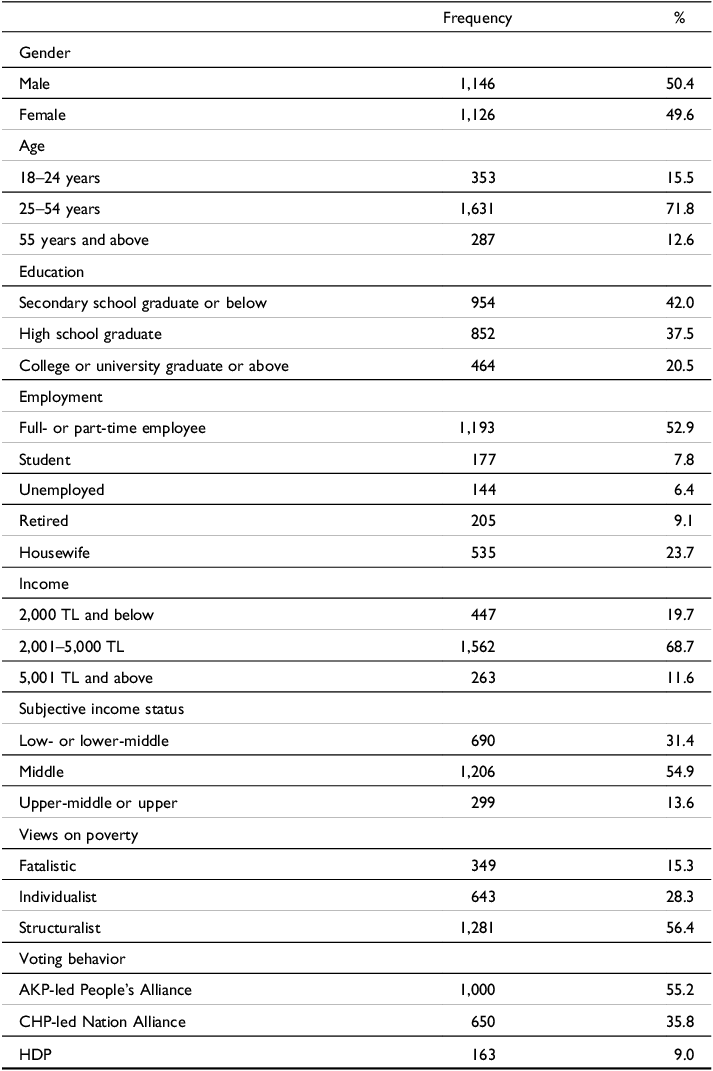
AKP, Justice and Development Party; CHP, Republican People’s Party; HDP, People’s Democratic Party.
Method
We calculated the descriptive statistics in exploring how individual preferences for distributive justice principles vary across the four areas of social policy. Furthermore, to address the question of whether and to what degree our independent variables predict distributive justice principles across four distinct social policy sectors, we used multinomial logistic regression. This is the most suitable method as our dependent variables, representing individual preferences for distributive justice principles in four key areas of social policy, are categorical in nature. These analyses were conducted using multinomial logistic regression in the SPSS 27 statistical package, utilizing the NOMREG command.
In each analysis, we designated women as the reference category for gender, the twenty-five to fifty-four years age group (working-age people) as the reference category for age groups, high school graduates as the reference category for education level, student as the reference category for employment status, middle income as the reference category for income, “middle” as the reference category for subjective income, “structuralist” as the reference category for perception of the causes of poverty, and the AKP-led People’s Alliance as the reference category for voting behavior. As for the dependent variable, we used the preference for equality principle as our reference category.
Findings
Table 2 presents individual preferences for distributive justice principles across four social policy areas: education; healthcare; old-age pensions; and unemployment benefits. Rows are organized according to the principles of distributive justice presented to participants: equity; equality; need; and no answer. Each column corresponds to a specific social policy area.
Individual preferences for distributive justice principles across four social policy areas, shown as the share of respondents

A key finding is the variability in the most prevalent individual preferences for distributive justice principles across the four social policy areas. Specifically, while equity emerges as the dominant preference for old-age pensions, equality takes precedence for unemployment benefits, healthcare, and education. Although equality remains the most favored distributive justice principle for three social policy areas, the share of respondents selecting equality varies across these areas. A significant majority (over 60 percent) opts for equality in healthcare, with more than half endorsing it for education. However, this preference declines to below 50 percent when it comes to unemployment benefits.
A notable finding is the overwhelming preference against need as the guiding distributive justice principle across education, healthcare, old-age pensions, and unemployment benefits. The highest percentage of respondents favoring need over other principles is found in healthcare (14.9 percent).
As indicated in Table 2, equity emerges as the most preferred distributive justice principle for old-age pensions (53 percent), followed by its prominence as the second-highest preference for unemployment benefits (41.4 percent). Conversely, equity does not rank among the top preferences for distributive justice in healthcare and education. Instead, the majority of respondents express a preference for equality-based distribution in healthcare and education. Furthermore, although respondents exhibit a higher preference for equity concerning old-age pensions, the preference shifts towards equality in the realm of unemployment benefits, another form of cash benefit, with slightly higher than 46 percent expressing a preference for equality over the other distributive justice principles.
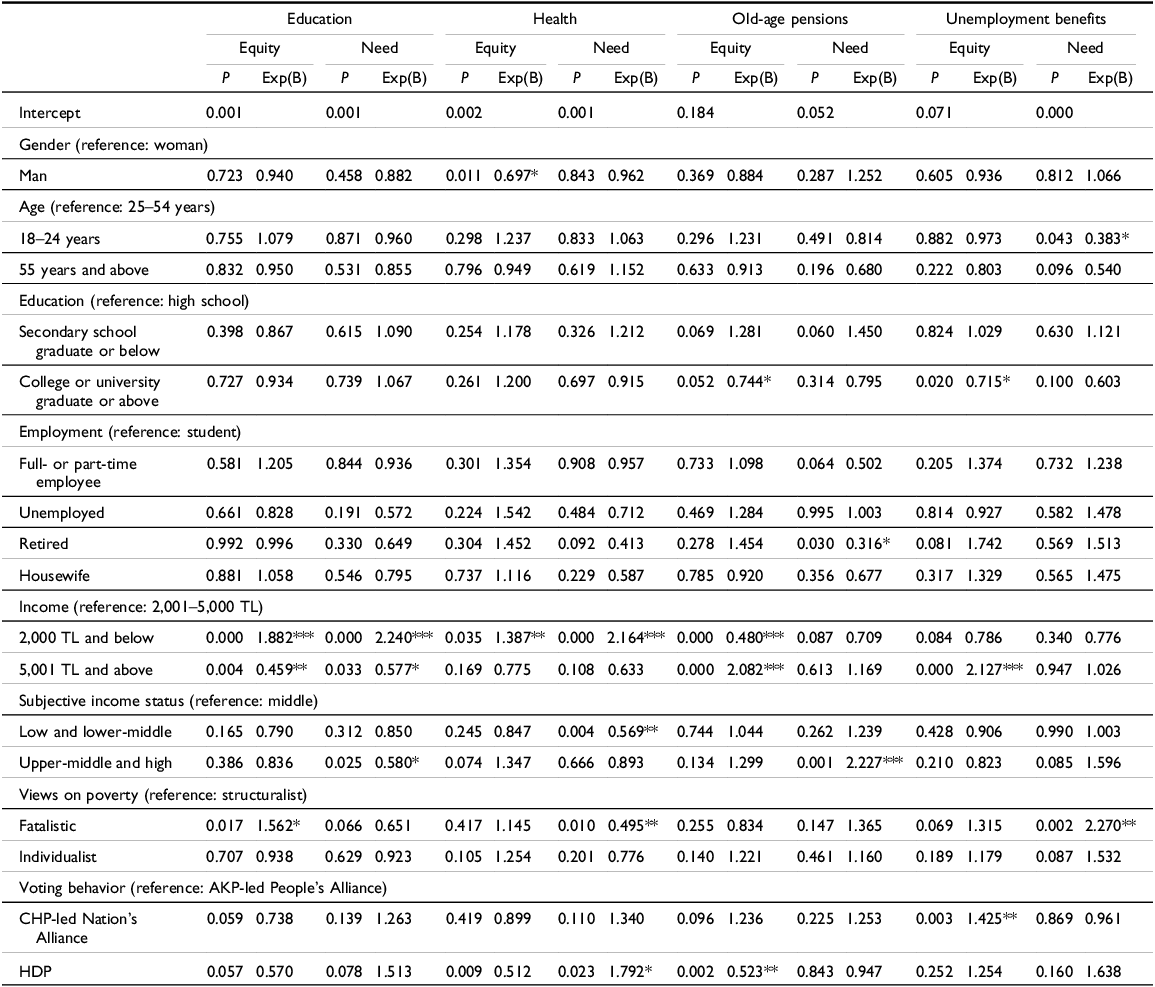
Table 3 presents the findings from multinomial logistic regression analysis, featuring P and Exp(B) values. We investigated the impact of eight independent variables on distributive justice preferences (equity, need, equality) across four distinct social policy areas. This was conducted separately for each policy sector, with Table 3 compiling all four. P values indicate statistical significance (P ≤ 0.05), while Exp(B) values quantify the effect size of each variable on the dependent variable, measured by the odds ratio. Each row in the table offers insights into the effect of an independent variable on the dependent variable, while controlling for other variables in the model. The first row, labelled “Intercept,” represents the expected value of the dependent variable when all independent variables are zero.
Multinomial logistic regression
AKP, Justice and Development Party; CHP, Republican People’s Party; HDP, People’s Democratic Party.
Note: * P ≤ 0.05; ** P ≤ 0.01; *** P ≤ 0.001.
The analysis indicates that demographic factors such as gender, age, and employment status generally do not significantly predict distributive justice preferences across most social policy areas, with a few notable exceptions that are discussed later. In contrast, self-reported income is a strong predictor: low-income individuals are more likely to favor both equity- and need-based distributions in education and healthcare, whereas high-income individuals are less supportive of these approaches. However, high-income individuals show greater preference for equity-based distribution in pensions and unemployment benefits. Additionally, views on poverty and voting behavior account for some variation in preferences, though their effects are less consistent and do not follow a clear pattern. We report findings for each independent variable in detail below.
Gender does not emerge as statistically significant in predicting the distributive justice preferences in the four areas of social policy. However, the sole exception lies within healthcare when considering equity-based distribution. Men exhibit a 0.697 times lower likelihood than women to prefer equity-based distribution in healthcare.
Similar to gender, age does not emerge as statistically significant in predicting the distributive justice preferences in select areas of social policy. However, the only exception arises in the context of unemployment benefits when considering the preference for need-based distribution. Young people (aged eighteen to twenty-four years) are 0.383 times less likely to prefer need-based distribution in unemployment benefits compared to those in the middle-age group (aged twenty-five to fifty-four years).
Upon examining the responses in relation to education level, we observe that individuals with an education level of college or university graduate or above exhibit a 0.744 times lower likelihood of supporting equity-based distribution in old-age pension compared to those with high school education. Similarly, individuals holding a college or university degree or above demonstrate a 0.715 times lower likelihood of favoring equity-based distribution in unemployment benefits compared to high school graduates.
Employment is not statistically significant in predicting the preference for equity-based distribution in the four areas of social policy. For the need-based distribution in the four areas of social policy, the only exception is old-age pensions. Retired people are 0.316 times less likely to prefer need-based distribution in old-age pensions than students.
Self-reported income level significantly predicts both equity-based and need-based distribution preferences in most of the four areas of social policy. Low-income individuals are nearly twice as likely to favor equity-based distribution in education, and they are also more likely to prefer need-based distribution in education compared to middle-income individuals. On the contrary, high-income individuals are approximately 0.459 times less likely to prefer equity-based distribution in education and they are also 0.577 times less likely to favor need-based distribution in education compared to middle-income individuals. Second, low-income individuals are 1.387 times more likely to prefer equity-based distribution in healthcare. They are also 2.164 times less likely to favor need-based distribution in healthcare compared to middle-income individuals. Third, in relation to old-age pensions, low-income individuals are less likely to prefer equity-based distribution, with an odds ratio of 0.480, while high-income individuals are 2.082 times more likely to prefer equity-based distribution compared to middle-income individuals. Lastly, for the case of unemployment benefits, high-income individuals are more likely to prefer equity-based distribution compared to middle-income individuals.
Subjective income is statistically significant only in predicting need-based distribution among four areas of social policy. Individuals who perceive themselves as being of the upper-middle- or high-income status are approximately 0.580 times less likely to prefer need-based distribution in education than those who perceive themselves as being in the middle-income category. Likewise, individuals who perceive themselves as being of the low and lower-middle income status are approximately 0.569 times less likely to express a preference for need-based distribution in healthcare than those who perceive themselves as being in the middle-income group. Lastly, individuals who perceive themselves as being of the upper-middle- or high-income status are more likely to prefer need-based distribution in old-age pensions, with an odds ratio of 2.227, than those who perceive themselves as being in the middle-income group.
Views on poverty are statistically significant in predicting equity-based distribution in education and also significant in predicting need-based distribution in healthcare and unemployment benefits. Individuals who explain poverty through a fatalistic perspective are 1.562 times more likely to prefer equity-based distribution than those who explain poverty through a structuralist perspective. Individuals who explain poverty through a fatalistic perspective are approximately 0.495 times less likely to prefer need-based distribution in healthcare than those who explain poverty through a structuralist perspective. Lastly, individuals who explain poverty through a fatalistic perspective are 2.270 times more likely to prefer need-based distribution in unemployment benefits than those who explain poverty through a structuralist perspective.
Voting behavior plays a statistically significant role in partially explaining preferences for distributive justice in healthcare, old-age pensions, and unemployment insurance. Supporters of the HDP are 1.792 times more likely to favor a need-based approach to healthcare distribution compared to supporters of the AKP-led Nation’s Alliance. Additionally, HDP supporters are 0.523 times less likely to prefer an equity-based approach to old-age pension distribution. On the other hand, supporters of the CHP-led Nation Alliance are 1.425 times more likely to favor an equity-based approach to the distribution of unemployment insurance.
Conclusion
Gaining insight into people’s distributive justice preferences within the complex landscape of social policies is essential for crafting a political strategy to achieve social justice. This article provides the first comprehensive analysis of distributive justice preferences within Turkish society, expanding the understanding of empirical social justice frameworks by applying it to a middle-income-country context with an immature yet sizeable welfare state. It contributes to the literature on distributive justice preferences by highlighting how these preferences vary in diverse socio-political environments.
Based on an analysis of unique data from a nationwide survey in Turkey, we confirmed our primary hypothesis. We found that individuals’ distributive preferences in Turkish society vary across different social policy sectors. This aligns with the assertion that shifting the focus from examining general attitudes towards the welfare state as a whole in investigating specific areas of social policy yields more nuanced results (Van Hootegem et al. Reference Van Hootegem, Abts and Meuleman2020).
The findings reveal both self-interest (the actual or anticipated benefit the participant derives from a policy) and ideology intersect with these preferences within Turkish society. Self-interest-related factors such as income and subjective income status, and ideological factors including the perceptions of poverty, and voting behavior all influence preferences in at least three of the four sectors of education, healthcare, old-age pensions, and unemployment benefits. However, the interactions between these factors sometimes produce unexpected outcomes such as low-income individuals and people with fatalistic views of poverty are more likely to prefer an equity-based approach to education. This may be due to the way we formulated the equity-based option as allowing paid private classes in public schools. Even with limited financial resources, low-income individuals may perceive this as attainable, since it does not require that everyone send their children to private schools.
Another hypothesis explored the relationship between socio-economic status and distributive preferences, as demonstrated in previous studies (Reeskens and van Oorschot Reference Reeskens and van Oorschot2013, Reference Reeskens, van Oorschot, Levrau and Clycq2021; Yang and Barrett Reference Yang and Barrett2006). These studies suggested that individuals with higher levels of education and income tend to support equity-oriented distribution, whereas those with lower socio-economic status lean towards equality- or need-based distribution. Our findings provide partial support for this hypothesis. For example, low-income individuals are less likely to favor equity over equality in old-age pensions, which corroborates this hypothesis. However, high-income individuals are unexpectedly less likely to support equity over equality in education (and we observe a similar trend in healthcare; however, it does not reach statistical significance), contradicting our initial assumptions and the earlier findings in the literature. This finding is particularly striking because Margalit and Raviv (Reference Margalit and Raviv2024) demonstrated that although many people including high-income individuals express concern about inequalities and appear to support government-led redistribution, their enthusiasm diminishes when asked about specific policy measures. In our study, we observe high-income individuals’ support for the principle of equality in education and healthcare (albeit not statistically significant), even when presented with an actual policy scenario. Nevertheless, Margalit and Raviv’s (Reference Margalit and Raviv2024) caution remains relevant; our question focuses on benefits rather than costs, and while high-income individuals may endorse equal access to education and healthcare in principle, it is unclear whether they are willing to pay more to achieve it.
Regarding ideology, we tested two hypotheses: one based on voting behavior; and the other on views of poverty. Prior research indicates that voting behavior influences preferences for distributive justice, with right-leaning individuals favoring equity and left-leaning individuals supporting equality and need (Mühleck Reference Mühleck2009; Yang and Barrett Reference Yang and Barrett2006). We hypothesized that individuals who voted for opposition political parties (or the alliance led by the main opposition) in the 2018 elections prior to the survey would show a stronger preference for equality and need principles across all of the four social policy sectors. Although voting behavior was not statistically significant in most cases, the overall trend supports this hypothesis. Voters of the CHP-led Nation Alliance and HDP are generally more inclined to support equality and need across different social policy sectors compared to those who voted for the AKP-led People’s Alliance. Notable exceptions include the CHP-led Nation Alliance voters being more likely to favor equity in unemployment insurance, and HDP voters being less likely to support equity in old-age pensions, both with statistical significance.
Inspired by the study conducted by He et al. (Reference He, Qian and Ratigan2021), we hypothesized that people with individualistic views on poverty would be less likely to prefer equality and need across various social policy sectors. Although no significant statistical relationship was found, respondents with an individualistic understanding of poverty, compared to those with a structuralist understanding, appeared to show greater support for the equity principle and less support for equality, with the exception of education.
Having a fatalistic view of poverty appears to influence distributive justice preferences in the Turkish case, but the direction of the effect is sometimes counterintuitive. It increases the likelihood of supporting equity in education and decreases support for need in health. In the questionnaire, we clearly framed poverty in a social-fate context with religious connotations, where respondents perceived that poor people’s circumstances were predetermined. For social services such as education and healthcare (without statistical significance), respondents with a fatalistic view of poverty showed more support for equity, allowing the better-off to differentiate themselves, whereas for benefits (especially in unemployment insurance), support aligned with need, favoring those who had contributed less due to their predetermined social position. Therefore, our findings, particularly with regard to education, suggest that a fatalistic view of poverty does not necessarily predict distributive justice preferences that prioritize the disadvantaged. This finding fails to confirm the results reported by Marquis and Rosset (Reference Marquis and Rosset2021), which suggested that social fatalist explanations for poverty are associated with preferences for greater generosity in social policy towards the poor. Further research is needed to better understand the distributive justice principles emerging from a fatalistic view of poverty and to develop testable hypotheses in this area.
In light of the observed contrast in distributive justice preferences between old-age pensions and unemployment benefits, it is possible that the disparity reflects nuanced perceptions of risk and fairness in Turkish society. While equity is favored for pensions, equality gains traction for unemployment benefits, potentially indicating a recognition of the unpredictable nature of unemployment and the need for equal support during economic uncertainty. Alternatively, because unemployment insurance was introduced in the late 1990s and is restrictive by design, it has failed to generate the kind of policy feedback observed for old-age pensions. These interpretations, however, remain speculative and would require further empirical investigation.
The overwhelming preference against need as the guiding distributive justice principle across education, healthcare, old-age pensions, and unemployment benefits underscores the intricate interplay between individual preferences and the broader social context in the Turkish context. Particularly notable is the low level of trust in public institutions such as courts and the Parliament (Saleh Reference Saleh2023) and social trust (Lippert and Schulman Reference Lippert and Schulman2025), which may influence individuals to opt for equality-based distribution and refrain from all forms of targeting in domains such as healthcare, education, and unemployment benefits. In a system where need must be determined by government authorities, the preference for equality could be seen as the best-available and lowest-risk approach, allowing individuals to navigate their distrust while still supporting government-led redistribution. This suggests that Turkish egalitarianism in these areas may be more grounded in practical considerations in the context of low trust in public institutions and fellow members of society rather than a purely ideological one. To capture this phenomenon, we introduce distrustful egalitarianism, a new concept describing egalitarian preferences that arise not necessarily from ideological commitment to equality, but from skepticism toward official allocation mechanisms in contexts of high inequality and low social and institutional trust.
The majority preference for equity in old-age pensions, where pension levels are determined by one’s salary during employment, can be attributed to two plausible explanations rooted in Turkish societal norms and institutional structures. First, it might be because Turkish society perceives salary differences in the labor market as mostly fair, leading them to prefer a similar distribution in pension levels as an extension of this perception. Second, the preference for equity may also be influenced by the longstanding tradition of an occupationally organized public old-age pension system in the Turkish context, where pension levels are indeed differentiated based on salary levels. In other words, as Pierson (Reference Pierson1993) would argue, it is possible that public preferences are conditioned by existing policy arrangements. Individuals may have internalized the norms of this system over time, shaping their preferences to align with the established institutional framework and its historical legacy. These two explanations can be formulated as hypotheses that could be tested to examine the intertwined relationship between societal norms, institutional structures, and individual perceptions.
Future research on distributive justice preferences would benefit from extending empirical analysis beyond advanced welfare states such as the UK and Western European countries to include middle-income countries and countries with less mature welfare systems. Our findings point to the importance of institutional and social contexts in shaping support for distributive justice principles in social policy and generate testable hypotheses for similar settings. In particular, low levels of social trust and limited trust in public institutions, features shared by several middle-income countries, raise the question of whether people in these contexts likewise endorse equality principles in areas such as education and healthcare. Some middle-income countries exhibit high levels of income inequality, which may shape people’s distributive justice preferences by affecting levels of social trust. Examining how distributive justice preferences are formed under conditions of weaker welfare institutions, low levels of social trust as well as trust in institutions, and higher levels of inequality would enhance the external validity of existing frameworks.
Acknowledgments
We would like to express our sincere thanks to Güçlü Atılgan of the Infakto Research Workshop in Istanbul for his support. We are also grateful to Dr Remziye Gül Aslan, in her capacity as a researcher at the Boğaziçi University Social Policy Forum Research Centre, for her valuable contributions during the preparation of this study.
Competing interests
The authors report there are no competing interests to declare.


 Open access

