




Introduction
In response to agricultural resource concerns (e.g., increasing soil erosion, waster scarcity and soil nutrient depletion) the United States government established programs to encourage conservation on private land (Table 1). The Food Security Act of 1985, under the 1985 Farm Bill, established several initiatives that targeted conservation practices on agricultural land, the most notable being the Conservation Reserve Program (CRP) (Stanek and Lovell, Reference Stanek and Lovell2020; Stubbs, Reference Stubbs2022). Agricultural land enrolled into CRP is planted to trees, grass, wildlife cover or other environmentally beneficial vegetation under 10–15-yr contracts with the goal to retire sensitive areas from production (Hellerstein, Reference Hellerstein2017). As an option for working lands, the Environmental Quality Incentives Program (EQIP) was authorized by the 1996 farm bill with the goal to promote agricultural production, forest management and environmental quality as simultaneously compatible goals (Stubbs, Reference Stubbs2011). In the 2002 Farm Bill, the Conservation Stewardship Program (CSP) was established to provide payments to farmers to encourage whole-farm resource goals, going beyond implementing individual practices (Stanek and Lovell, Reference Stanek and Lovell2020). Together, these initiatives demonstrate a government's recognition of the importance of integrating ecologically focused land management into agricultural landscapes (Table 2).
Overview of prominent events in federal policy and their implications for the development of conservation programs

ACEP, Agricultural Conservation Enhancement Program; CRP, Conservation Reserve Program; CSP, Conservation Stewardship Program; RCPP, Regional Conservation Partnership Program. Adapted from Stanek and Lovell (Reference Stanek and Lovell2020) and Cain and Lovejoy (Reference Cain and Lovejoy2004).
Overview of Farm Bill funded conservation programs

This table shows the primary conservation programs funded under the Farm Bill. Agroforestry has the most potential to be integrated into the working lands programs, EQIP and CSP. This table is adapted from Stubbs (Reference Stubbs2022).
While many of the above conservation programs are admirable in theory, in practice they are frequently criticized for being too inflexible, complex and outdated in comparison to new approaches that encourage the multifunctionality of agriculture (Stanek and Lovell, Reference Stanek and Lovell2020). Multifunctional landscapes provide numerous environmental, economic and social functions within the same area of land (Lovell and Johnston, Reference Lovell and Johnston2009). This integrated approach to land management is valuable for increasing biodiversity and restoring degraded areas while uniting local economic, social and conservation goals (McGinty et al., Reference McGinty, Swisher and Alavalapati2008). Agroforestry, simply defined as the intentional planting and management of trees with crops and/or livestock (Raedeke et al., Reference Raedeke, Green, Hodge and Valdivia2003; Wilson and Lovell, Reference Wilson and Lovell2016; Schoeneberger et al., Reference Schoeneberger, Bentrup and Patel-Weynand2017), is a different approach to the production of food, fiber and fuel that supports multiple land-use goals.
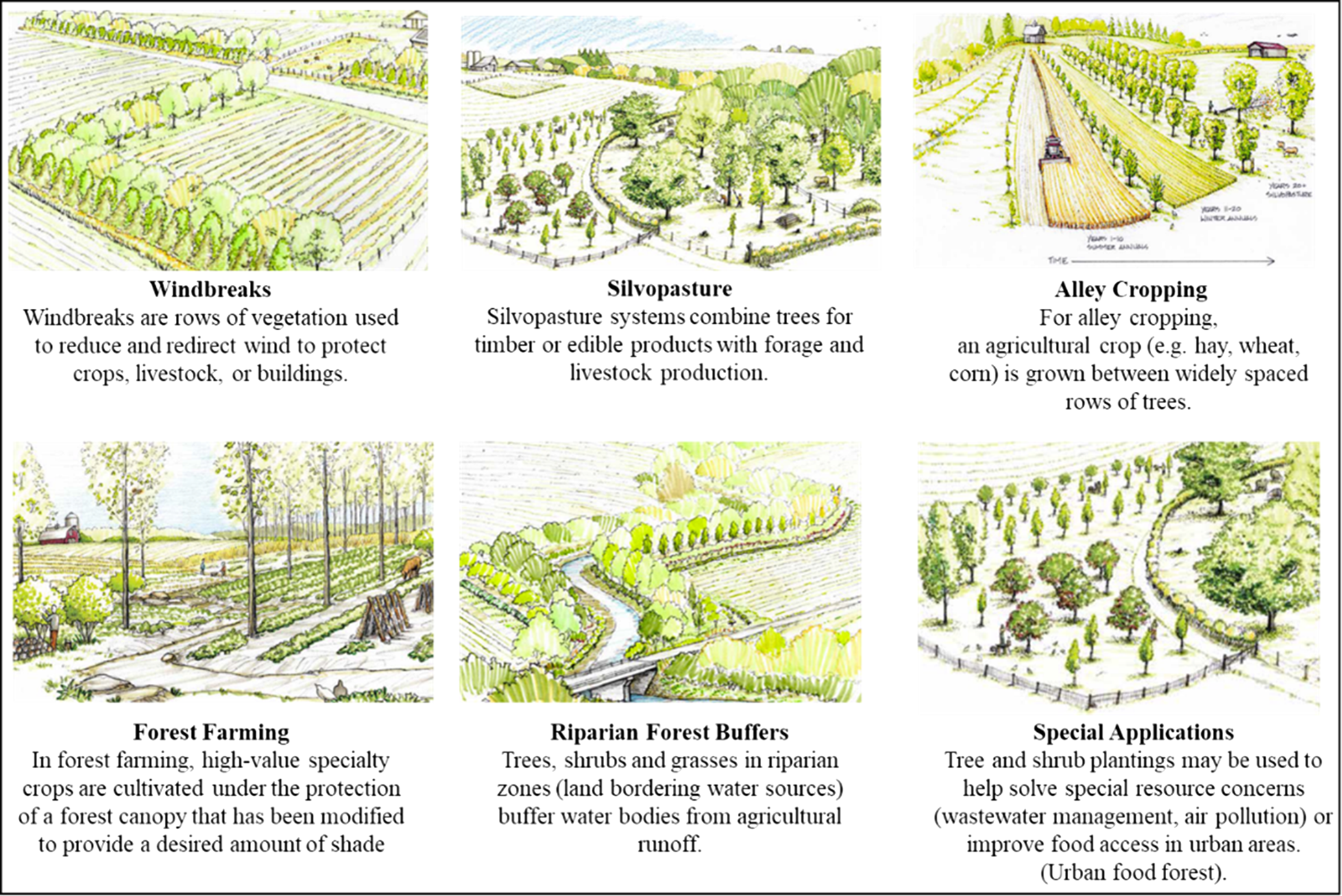
In the context of the United States agricultural system, there are six formally recognized practices under the umbrella term agroforestry: windbreaks, silvopasture, alley cropping, forest farming, riparian forest farming and special applications (Fig. 1). Each practice offers unique opportunities to address resource concerns while providing additional social and economic benefits. Both federal conservation programs EQIP and CSP provide ample opportunities to integrate agroforestry practices into landowners' conservation and resource management plans. Participants in these programs have the flexibility to choose which perennial species to plant to address both their resource concerns and personal land-use goals. Agroforestry practices are able to provide for conservation needs, improve rural livelihoods and offering additional income for landowners. Yet, little is known about how multifunctional agroforestry knowledge is learned by landowners/farmers, disseminated among agroforestry adopters, and promoted within knowledge communities including university extension, state and federal conservation and natural resource agencies, farm services providers and landowners.
Overview of agroforestry practices. Information adapted from USDA National Agroforestry Center (image credit: Paul Littleton, courtesy of the Savanna Institute).
Agroforestry adoption: key factors and information sources
Agroforestry may address local resource concerns while helping farmers and communities both adapt to and mitigate a changing climate (Jordan and Warner, Reference Jordan and Warner2010; Lovell et al., Reference Lovell, DeSantis, Nathan, Olson, Méndez, Kominami, Erickson, Morris and Morris2010; Stutter et al., Reference Stutter, Chardon and Kronvang2012). So why do we not see more of these practices throughout agricultural landscapes? While trees and other woody perennial plants have long been an important aspect of conservation programs, their acceptance by landowners and producers within agricultural production systems has been and continues to be slow (Valdivia et al., Reference Valdivia, Barbieri and Gold2012; Trozzo et al., Reference Trozzo, Munsell, Chamberlain and Aust2014; Lovell et al., Reference Lovell, Dupraz, Gold, Jose, Revord, Stanek and Wolz2018). Trees were once common across agricultural landscapes, but the use of intensive production methods led to their widespread removal (Raedeke et al., Reference Raedeke, Green, Hodge and Valdivia2003). Many farmers continue to honor the efforts of past generations to clear the land for agricultural production (Raedeke et al., Reference Raedeke, Green, Hodge and Valdivia2003). This suggests that in addition to the importance of information in supporting landowners to adopt agroforestry, shifts in the cultural perception of trees as part of agricultural landscapes must be made.
Studies throughout the United States have narrowed and clarified the variables that effect farmers' decision to adopt agroforestry practices on their land, but none have identified a direct answer. Of the potential variables that influence landowners' decision on how to manage their land, the availability of information on the establishment, care and economic potential of these practices has been found to consistently be the most limiting factor for increasing adoption of agroforestry (Strong and Jacobson, Reference Strong and Jacobson2006; Mattia et al., Reference Mattia, Lovell and Davis2018). While publications, including newspapers, journals and books, have their place in disseminating farming-related knowledge, farmers are highly influenced by communications among their peer networks and family members (Salamon et al., Reference Salamon, Farnsworth, Bullock and Yusuf1997; McGinty et al., Reference McGinty, Swisher and Alavalapati2008; Kumar and Nair, Reference Kumar and Nair2011). Beyond these close-knit social circles, farmers land management choices are also shaped by contact with natural resource conservation agencies and personnel (Kumar and Nair, Reference Kumar and Nair2011; Wilson and Lovell, Reference Wilson and Lovell2016; Stanek et al., Reference Stanek, Lovell and Reisner2019). Extension agents, private land conservationists and state foresters all serve an important role in supporting the use of conservation practices, including agroforestry adoption, on working farms. Due to the importance of these natural resource professionals in disseminating information directly to landowners, they are in an essential role to engage landowners in conversation around the potential of agroforestry practices to meet conservation and production goals.
A look at Missouri: the show me state
The United States contains a wide variety of agricultural landscapes, which means that any approach to integrating agroforestry systems into conservation programs must be targeted to the features of a specific area. The state of Missouri has a diversity of different agricultural enterprises (e.g., row crops, livestock and specialty crops), presenting an interesting case study on how conservation and production can be integrated throughout agricultural landscapes to further support economic and natural resource conservation goals. The state's geography includes flat, historically prairie land in the northern region and rocky, shallow soils within the Ozark highlands in the southern portions of the state. An area of the Mississippi river floodplain in the southernmost region of Missouri, termed the bootheel, is the state's most intensively row-cropped area. There are 95,000 farms across Missouri covering 27.8 million acres of land, roughly two-thirds of the state (Missouri Department of Agriculture, 2021). The agricultural industry contributes $88 billion to the state's economy and employs over 400,000 people (Missouri Department of Agriculture, 2021). Currently, there is no formal documentation of the number of farms that employ agroforestry practices. It is likely there are many landowners who are already using some form of these practices but are not aware of the official agroforestry terminology and therefore, are not reporting all the practices they currently employ.
The state's largest land grant university, The University of Missouri, has several high-level agricultural and natural resource programs and houses the Center for Agroforestry, a research-oriented academic center that furthers the scientific understanding of agroforestry practices and adoption within a global context (https://centerforagroforestry.org/). This is currently the only academic center focused on agroforestry research and education with a comprehensive graduate program for agroforestry studies in North America.
The Center hosts outreach and educational events including the Agroforestry Academy, a comprehensive agroforestry training program that focuses on a ‘train the trainer’ model where natural resource professionals gain a better understanding of agroforestry practices and how to support landowners interested in establishing agroforestry on their land (Mendelson et al., Reference Mendelson, Gold, Lovell and Hendrickson2021). The Center for Agroforestry also offers graduate programs and hosts a wide range of research activities on the science underlying agroforestry. Despite the presence of this robust knowledge base of agroforestry, adoption remains slow in Missouri.
This preliminary study explores natural resource professional knowledge of agroforestry practices and how conservation program funding can promote multifunctional tree and shrub planting. Interviews with natural resource professionals focus on exploring the following questions:
(1) How are the multifunctional uses of trees and shrubs understood by natural resource professionals within conservation programs?
(2) In what ways are natural resource professionals connecting with landowners who are considering placing their land under conservation programs?
(3) To what extent do natural resource agencies understand and promote agroforestry practices in Missouri conservation programs?
Methods
To gather context for this preliminary study, we used semi-structured interviews of natural resource professionals to learn their stated perspectives and knowledge of conservation programs that provide financial support for landowners to plant trees. This approach provided the flexibility to inquire about new topics as they arose during conversation (Young et al., Reference Young, Rose, Mumby, Benitez-Capistros, Derrick, Finch, Garcia, Home, Marwaha, Morgans, Parkinson, Shah, Wilson and Mukherjee2017). Professionals from major federal and private conservation organizations were invited to participate in interviews (Table 3). These professionals were chosen based on their active roles in agencies that provide financial and technical assistance to agricultural landowners. The study used snowball sampling to recruit participants (Young et al., Reference Young, Rose, Mumby, Benitez-Capistros, Derrick, Finch, Garcia, Home, Marwaha, Morgans, Parkinson, Shah, Wilson and Mukherjee2017). The inclusion of an array of natural resource personnel from agencies across Missouri provides a sample of the conservation work throughout the state.
Overview of research participants

This table show the number of research participants from each of natural resource organizations who participated in the interviews. Snowball sampling was used to recruit participants resulting in a non-representative sample.
Interviews were conducted using a combination of Zoom video-chat and phone calls that lasted from 30 min to 1 h. Interview audio was recorded with participant consent for later transcription. During the interviews, participants were asked to provide descriptions of programs that allowed or supported the planting of trees and shrubs on agricultural lands (see Supplementary materials). Interviewees were also asked about landowner enrollment in conservation programs and what objectives the landowners have for planting trees. Questions explored if landowners have shown interest in additional benefits from their trees including harvestable products, recreational opportunities, conservation of resources and agritourism opportunities. Interviews concluded by asking the professionals about their basic knowledge of agroforestry practices and if their agency encourages the use of conservation programs to support landowner adoption of them.
The recorded interviews were transcribed verbatim for analysis following the methods described in Stanek and Lovell (Reference Stanek and Lovell2020) and Stanek et al. (Reference Stanek, Lovell and Reisner2019). Based on the above research questions and previous studies on natural resource professionals role in agroforestry adoption and landowner interest in agroforestry for conservation consulted in the literature review (Table 4), a deductive qualitative content-analysis process was used to analyze the transcripts (Matilainen et al., Reference Matilainen, Pohja-Mykra, Lahdesmaki and Kurki2017). A codebook was established using QSR International NVivo 12.0 software to further analyze interview responses to understand perceptions of multifunctional agroforestry plantings and how conservation agencies are supporting the use of these plantings in federally funded conservation programs. Since the natural resource professional interview dialogue on agroforestry and tree planting in conservation programs focused mainly on EQIP and some on CSP, most of the discussion included in this paper refers to these programs. We acknowledge there are additional federal and state programs that can provide support for agroforestry practices and have different concerns and benefits. These are additional topics to explore in later research with a larger and more diverse sampling of natural resource professionals.
Key themes from literature review used for coding interviews

This table lists the eight key themes from the literature on agroforestry and conservation practice adoption used for guiding the development of research questions and establishing the NVivo code to analyze interview content.
Results and discussion
Natural resource agencies wish for greater agroforestry knowledge and promotion
In general, research has shown many natural resource professionals have minimal knowledge of agroforestry and rarely promote it to the landowners they are working with (Workman et al., Reference Workman, Bannister and Nair2003; Stutzman et al., Reference Stutzman, Barlow, Morse, Monks and Teeter2019). Workman et al. (Reference Workman, Bannister and Nair2003) found professionals responding to an opinion survey ranked lack of familiarity and lack of demonstrations as major obstacles to establishing agroforestry practices. Workman et al. (Reference Workman, Bannister and Nair2003) also found 30–35% of the professionals thought agroforestry had moderate to high potential in their work area and many were interested in learning more about agroforestry practices and building programs for their landowner clientele.
All the natural resource professionals interviewed in this study had some familiarity with the term agroforestry prior to being interviewed, but there was great variation in their depth of knowledge on these complex systems. When asked to rate their understanding of agroforestry practices, some professionals were familiar with all five, including silvopasture, riparian forest buffers, windbreaks, alley cropping and forest farming, while others reported they had minimal experience with most of the practices (Table 5). The two recognized by all seven interviewees, riparian forest buffers and windbreaks are well established practices to address resource concerns in current conservation programing. Of all the practices, forest farming was the only one where some professionals had never heard of the term. This finding reflects the novelty of forest farming practices and helps to explain why the natural resource professionals showed less interest in promoting this practice to landowners.
Overview of natural resource professionals' familiarity with agroforestry practices (n = 7)

Source: Natural Resource Professional Interviews, 2020.
Interviewees were also encouraged to share about their agency's promotion of agroforestry and how often they discuss agroforestry with the landowners they work with. Overall, the professionals concluded they did a fair job of exploring opportunities for agroforestry with landowners and that their agency presented a positive picture of agroforestry practices. Most professionals admitted they could do more to promote agroforestry.
One insight from the professionals interviewed is the need to send out the ‘right’ message to the ‘right’ landowner. One forester commented on how the Natural Resource Conservation Service (NRCS) does a good job of supporting agroforestry adoption saying:
‘We have done a good job of promoting agroforestry in Missouri. We can definitely do better. We just need to make sure we are sending out the right message’.
This concern with the right message to the right landowners was a common dialogue among several of the professionals interviewed. Despite the importance of what the right message is, and a growing body of knowledge on the different factors that influence adoption for different groups of landowners (McGinty et al., Reference McGinty, Swisher and Alavalapati2008; Barbieri and Valdivia, Reference Barbieri and Valdivia2010a; Rhodes et al., Reference Rhodes, Aguilar, Jose and Gold2018) there is still minimal research on what exactly constitutes the correct series of messages (Prokopy et al., Reference Prokopy, Floress, Arbuckle, Church, Eanes, Gao, Gramig, Ranjan and Singh2019).
While the general assertion was that conservation focused agencies, including NRCS and National Wild Turkey Federation (NWTF), are working to promote agroforestry it is contrasted with an admission by many professionals that they are not doing enough in the field to engage with landowners on agroforestry practices.
‘I'm probably guilty of not pushing it as much as I should sometimes, but I just, you got to have the right landowner to talk to. Because a lot of my landowners are typical stubborn old farmers that want to do things their way. I bring up planting trees in their grass they are going to just look at me like I'm crazy’.
This quote clearly shows the limited integration of agroforestry into conservation programs is even more complex than a shortage of knowledge and exposure, the acceptance of agroforestry must come from a shift if farming culture. Agroforestry practices, while by no means a completely new set of principles (MacFarland et al., Reference MacFarland, Schoeneberger, Bentrup and Patel-Weynand2017), are drastically different than most agricultural production methods widely used. For some farmers, such as the one referenced in the quote above, even mentioning the idea of planting trees begins to discredit the work of the natural resource professional. In these instances, the message must be focused on the outcomes of tree planting and tailored to the receptiveness of the farmer. Different farmers have different farm goals, backgrounds and social influences (Arbuckle et al., Reference Arbuckle, Valdivia, Raedeke, Green and Rikoon2009; Prokopy et al., Reference Prokopy, Floress, Arbuckle, Church, Eanes, Gao, Gramig, Ranjan and Singh2019). As noted above, the relationships between conservation agencies and farmers are built upon the initiative of the farmer. Educators, natural resource agencies and researchers must take care when speaking about agroforestry practices and focus on the needs and concerns of the farmers they are working with (Mendelson et al., Reference Mendelson, Gold, Lovell and Hendrickson2021). The key to greater use of agroforestry practices is supporting natural resource professionals to connect with farmers to know their concerns, land goals and farming practices to provide the information to address questions about agroforestry and conservation more broadly.
Trees in conservation: concerns, misunderstandings and potential
When asked about the potential of agroforestry practices to be accepted by landowners as part of conservation programs, natural resource professionals agree there is great potential to integrate trees into the agricultural landscape, but stressed it must be the right tree, in the right place and for the right reasons. Most of the professionals interviewed agreed conservation practices that integrated food-producing trees and shrubs would be beneficial, they were hesitant to encourage all organized agroforestry practices. Alley cropping and forest farming garnered far less interest compared to silvopasture, windbreaks and riparian forest buffers as the interviewees explained these practices often did not align with many of their landowner's production goals. When asked about landowner interest in these two practices, one of the foresters responded:
…the one that we get really the least interest in is alley cropping. And I think there are multiple reasons for that… You know, I would like to see that [alley cropping] explored more on a large farm scale. And the likelihood of that happening is pretty slim just because most large farm operations don't want to have to operate around trees.
The concern over ‘working around trees’ was brought up by a couple of professionals during the interviews as a reason landowners are hesitant or simply not willing to participate in conservation programs that include tree planting aspects. As one forester explained, ‘Most people like to get rid of trees and farm it [the land]’. Farmers have come to prefer the simplicity of open fields and pastures that allow for the mechanization and large-scale production needed to earn enough income in the commodity markets.
When professionals were asked about the potential of forest farming—the cultivation of herbs, mushrooms or other products under an existing forest canopy—most responded they were unfamiliar with the practice. This may be due to the small number of existing forest farming activities, which occur mainly in the southern part of the state. One forester explained:
‘…not that [forest farming] is super popular anywhere. In southern Missouri there are some people that actually do forest farming for shitake and stuff like that, but as far as in my area and what I've dealt with I have never personally dealt with anyone who has interest in that’.
The lack of information and personal experience with agroforestry is one of, if not the primary limiting factor for supporting farmers establishment of these practices (Workman et al., Reference Workman, Bannister and Nair2003). Another major contributor to the unfamiliarity of agroforestry practices such as forest farming and alley cropping are the limited demonstration opportunities for natural resource professionals interested in expanding their knowledge (Jacobson and Kar, Reference Jacobson and Kar2013).
Beyond the concerns about farmer's willingness to plant and manage trees, particularly in novel systems such as in alley cropping and forest farming, the professionals mentioned several misconceptions about what activities are allowed on land placed under conservation programs. Interestingly, misbeliefs about the management practices allowed are shared both by landowners and natural resource staff. One common misconception addressed by one of the professionals interviewed is what species or types of trees can be planted using conservation funds. This professional explained:
… There are some misconceptions [about using] EQIP money for these tree plantings when the side benefit of the tree plantings is food production. For some reason there is a lot of folks out with this misconception that you can't use EQIP money for that. I mean you can plant an oak tree or a hickory tree, but you can't plant a chestnut tree for nut production. That's something that's really hard to address when you are a state person. You need somebody at the national level speaking out and saying oh no no no that's ok.
Another challenge natural resource professionals face is keeping up-to-date information on the program specifications and requirements. Stutzman et al. (Reference Stutzman, Barlow, Morse, Monks and Teeter2019) found many natural resource professionals had a strong misconception about the requirements of silvopasture establishment including the species allowed and in what type of arrangements. Additionally, prior research also supports our finding that many professionals also do not know the cost of establishment (Lawrence and Hardesty, Reference Lawrence and Hardesty1992) and hesitate to suggest these practices to landowners. While conservation programs are funded at the federal level, individual states often have slightly different funding pools and ranking categories to address the natural resource concerns specific to the state and region. The above quote demonstrates the need for a national stance on practice requirements to address these misconceptions while working toward more consistent messages about the practice standards across states.
In addition to concerns over what species can be planted, many of the professionals interviewed mentioned potential restrictions on harvesting products, such as fruits and nuts, from trees established under the EQIP program. This confusion was expressed by several of the natural resource professionals interviewed and mentioned as a common challenge when working with landowners. One interviewee who works with University of Missouri (MU) Extension explained:
… One of my natural resource friends said something about NRCS funding that establishes trees and shrubs can't be used for trees and shrubs that have an economic value? So maybe some information on what you can and can't use cost-share for would be informational.
This misinformation and confusion around practice standards prevents natural resource professionals from confidently talking about tree planting under conservation programs. It is especially a challenge for establishing agroforestry practices using federal or state funding. When asked about any limitations on harvesting from trees with edible products, one forester mentioned ‘I don't know what, there shouldn't be any of them that they can't harvest nuts. There might be, I mean I might be wrong here’.
The lingering uncertainty of program rules, specifically the species of trees that are allowed to be planted and any potential harvesting regulations, is a significant finding that has not been extensively studied. The uncertainty many natural resource professionals have about the program requirements is concerning as earlier research has found that these professionals are an important information source for many farmers interested in establishing conservation practices on their land (Stutzman et al., Reference Stutzman, Barlow, Morse, Monks and Teeter2019). Additionally, it has been quantified that the more contact farmers have with conservation professionals, the greater their interest is in agroforestry practices (Arbuckle et al., Reference Arbuckle, Valdivia, Raedeke, Green and Rikoon2009). The impact professionals have on the farmers' management choices highlights how important it is to provide natural resource professionals working with landowners the most up-to-date information on conservation program guidelines and regulations.
One NRCS employee who has worked closely with agroforestry practices for conservation was able to clarify NRCS's position on planting food-producing tree and shrub species.
‘When we talk about the agroforestry under EQIP, we always have to remember that it's not primarily for the purposes of planting a food crop for the producer. Its primarily for the purpose of addressing a resource concern and it [agroforestry] just makes a really good fit’.
When planting trees and shrubs that produce edible products using conservation programs, it is important to remember they are first meant to address a resource concern, not to provide additional income for the landowner. Trees and shrubs that bear fruit or nuts do offer additional benefits when integrated into conservation programs such as sources of wildlife food and the opportunity for landowners to make some additional money from the land after their conservation program contract expires. An MU Extension agent commented ‘it also would help make the case for folks entering those cost-share agreements if they could come up with some other additional funding from it’. This is ultimately the goal of supporting agroforestry practices through conservation funding—to help landowners implement more conservation activities on their land that can simultaneously support their own economic and recreational goals.
The challenge of building long-term relationships for long-term conservation
The foundation of natural resource conservation programing is the working relationships between the natural resource conservation agencies and the landowners. Conservation agencies, including NRCS, are at the forefront in disseminating federal conservation program information such as available funding and sign-up periods and providing the technical assistance farmers need to establish and maintain conservation practices on their land. When asked how they approach building relationships with landowners, many of the professionals interviewed did not have a process for recruiting and networking with landowners. They generally were handed a list of names that had previously contacted their office and rely on farmers and landowners to initiate the dialogue around conservation. This appears to be typical across agencies. One professional explained:
…A lot of times for me with landowners it tends to be a fleeting discussion because they will reach out to me… I do the initial education for them about what our programs have to offer and how they can participate and then I usually send them to whoever their local personal is in the county.
While many interviewees could explain how they maintained relationships and built upon connections established by landowners or other conservation staff, none could provide concrete steps they took for supporting landowners to participate in conservation programs. For most, recruiting is a major challenge they acknowledge. This was pointed out by a professional who said, ‘It's probably why it's actually a problem, because it's [recruitment] hard. Hard to figure out’.
Since active recruitment is not a focus of these agencies, there may be landowners who are not receiving the information they need to be engaged in conservation practices. This prompts the consideration of what else agencies may be doing to try to reach out to landowners. Many farms are in rural areas with lower rates of internet access. In Missouri, only about 71% of rural residents have access to broadband internet (Quinn et al., Reference Quinn, Eldridge Houser and Kapp2020). Additionally, other surveys have found most farmers seek out printed information sources such as magazines (Barbieri and Valdivia, Reference Barbieri and Valdivia2010a) and input from peer and family networks (MacFarland et al., Reference MacFarland, Schoeneberger, Bentrup and Patel-Weynand2017). Despite these preferred avenues for information, the main outlet for details about conservation programing is increasingly digital. When asked about outreach, an agent from MU extension shared:
‘Social media has been really good… Every county extension office has a Facebook page and usually some other social media. And so that's been a good way to establish relationships and give the information of where they can find me at…’.
The NRCS office also relies on media outlets and engaging with landowners through online platforms. One professional explains their variety of approaches.
‘…we do a lot of Twitter and press releases. We have the ability for producers to go in and sign up for reminders of or information to identify what information they are interested in and it gets automatically emailed to them. We are still publishing newspapers and do press releases…’.
Generally, most recruitment and information sharing are facilitated through online interactions or through the mail, ultimately requiring the landowner to take the initiative to seek out the initial connection. It seems likely that the struggle to actively dialogue with landowners on a one-to-one basis comes from challenges in forming the initial connection. This is a great opportunity for natural resource and conservation agencies to expand their outreach efforts to work to maximize their connectivity with farmers and landowners.
It is also important to note that most landowners meet with a member of the field staff only a handful of times during the establishment of a conservation practice (mentioned during interviews). This suggests that the information shared during these short periods of connection is extremely important in influencing a landowner's decision to plant trees and shrubs on their land through conservation programs. Stanek et al. (Reference Stanek, Lovell and Reisner2019) found farmers valued personalized one on one planning time with professionals to help design agroforestry plantings and that without this assistance, the establishment of these practices would be too overwhelming. Ultimately, the knowledge that an agent has about the practices of tree planting, and agroforestry specifically, and the time they spend working with landowners to provide technical assistance are significant factors in the adoption of these practices (Hand et al., Reference Hand, Bowman and Tyndall2019).
Conclusion
Agroforestry practices that include trees and shrubs with multiple uses, such as the production of food, fuel and fiber, are a promising component of conservation programs. We were able to identify the beliefs and social factors of natural resource professionals that limit or support agroforestry in conservation programs. Despite the promise of agroforestry for conservation, there is a need for more developed information networks to ensure greater access to agroforestry knowledge for farmers, landowners and natural resource professionals. It will be crucial to dispel common misconceptions surrounding tree planting in conservation programs so professionals can be confident in their recommendations to landowners. Of particular importance is strengthening natural resource and conservation agencies role as educators and facilitators of agroforestry adoption as they work directly with landowners interested in conservation. Additional research to further refine the specific adoption factors and farmer profiles of the regions of the state will help determine which messages to send to whom. Working to expand the education networks for natural resource professionals and landowners on how to establish, fund and manage integrated tree–crop–livestock systems will provide support for expanding the use of agroforestry practices in conservation programs and agricultural production. Moving forward, we will develop a more extensive survey of natural resource professionals from a larger sample population to generate a deeper and more generalizable understanding of how they are understanding and communicating about agroforestry practices with the landowners they are working with.
Supplementary material
The supplementary material for this article can be found at https://doi.org/10.1017/S1742170523000054.
Acknowledgments
This work is supported by the University of Missouri Center for Agroforestry and the USDA/ARS Dale Bumpers Small Farm Research Center, Agreement number 58-6020-0-007 from the USDA Agricultural Research Service and by Award Number 2018-67019-27853 (subaward 090754-17910) from the USDA National Institute of Food and Agriculture.
Conflict of interest
The authors declare no competing interests for this research.
Ethical standards
All procedures included in the research received full University of Missouri IRB approval. IRB review number 261087.


 Open access

