


Introduction
The international wildlife trade is a multi-million-dollar industry that includes a diverse range of taxa traded for various purposes, including for the tropical aquatic aquarium trade (Scheffers et al., Reference Scheffers, Oliveira, Lamb and Edwards2019). Although the trade may have economic benefits for some actors, it can also have significant negative impacts, including the spread of animal and zoonotic diseases, and threats to global biodiversity (Fukushima et al., Reference Fukushima, Mammola and Cardoso2020). Most research regarding trends in the wildlife trade have focused on terrestrial vertebrates, with little data on invertebrates (Fukushima et al., Reference Fukushima, Mammola and Cardoso2020). However, recent work on popular traded invertebrate species, such as arachnids (Marshall et al., Reference Marshall, Strine, Fukushima, Cardoso, Orr and Hughes2022) and corals (Wood et al., Reference Wood, Malsch, Miller, Yellowlees and Hughes2012), has begun to address this. Most research on the tropical aquatic aquarium trade has, however, focused on marine ornamental fish (Biondo & Burki, Reference Biondo and Burki2020) and corals (Bruckner, Reference Bruckner2001).
The infraorder Brachyura is a highly diverse group (Ma et al., Reference Ma, Qin, Lin, Chan, Ng, Chu and Tsang2019). The most recently published catalogue of extant brachyuran taxa (Ng et al., Reference Ng, Guinot and Davie2008) recognized 6,793 named species and subspecies, 1,470 of which spend all or most of their life on land and/or in freshwater (Ng, Reference Ng2017). The groups of brachyurans occurring along the terrestrial–semi-terrestrial–freshwater continuum (herein referred to as land crabs) contain > 1,400 species across 11 families and fall into three groups (Ng, Reference Ng2017). Species of Gecarcinidae are often arboreal or reside deep inland and are found in, or utilize, freshwater systems, with some species undertaking migration to the sea for reproduction. Species of Chasmocarcinidae, Hymenosomatidae and Sesarmidae are completely independent of the sea, with little or no direct development, including some semi-aquatic species (Ng, Reference Ng2017). The primarily freshwater crabs (Pseudothelphusidae, Epiloboceridae, Trichodactylidae, Potamonautidae, Deckeniidae, Potamidae and Gecarcinucidae) have no free-swimming larval stages and spend their entire life cycle in freshwater (Yeo et al., Reference Yeo, Ng, Cumberlidge, Magalhães, Daniels and Campos2008). They are the largest assemblage of Brachyuran taxa, accounting for one fifth of the known species (Cumberlidge et al., Reference Cumberlidge, Ng, Yeo, Magalhães, Campos and Alvarez2009), with more yet to be described and discovered (Yeo et al., Reference Yeo, Ng, Cumberlidge, Magalhães, Daniels and Campos2008). These brachyuran families occur across 122 countries. Five of the six countries that have the highest concentration of these species are in Southeast Asia (Cumberlidge et al., Reference Cumberlidge, Ng, Yeo, Magalhães, Campos and Alvarez2009), making the region a centre of freshwater crab diversity.
In the tropical aquatic aquarium trade, brachyurans (true crabs, with four pairs of walking legs) and anomurans (false crabs, with three pairs of walking legs, including hermit crabs) are, together, the most traded marine invertebrate group after corals (Calado et al., Reference Calado, Lin, Rhyne, Araujo and Narciso2003). There is less research literature on marine brachyurans and anomurans than for other traded species such as corals and fishes (Calado et al., Reference Calado, Lin, Rhyne, Araujo and Narciso2003), but more so than for land crabs. Czechia, Germany, USA, Thailand and Russia are the leading countries in the freshwater decapod pet trade (Uderbayev et al., Reference Uderbayev, Patoka, Beisembayev, Petrtýl, Bláha and Kouba2017), including for many land crab species (Tsang et al., Reference Tsang, Schubart, Ahyong, Lai, Au and Chan2014). Studies of the wholesale trade through these countries identified the freshwater land crab genera Geosesarma and Parathelphusa as amongst the most commonly traded brachyurans (Krausova & Patoka, Reference Krausova, Patoka, Kubík and Barták2018). Other work has identified possible risks from the release of pet-traded decapods to wild systems (Uderbayev et al., Reference Uderbayev, Patoka, Beisembayev, Petrtýl, Bláha and Kouba2017) and has also started to document the hermit crab trade (Bundhitwongrut, Reference Bundhitwongrut2020). The extent of the trade in brachyuran land crabs is unclear, although they are increasingly popular as pets. There are many potential reasons for this, including ease of husbandry, the vivid colouration of many species (Owen, Reference Owen2015), and interesting and charismatic behaviours, including fighting, with one popular article describing some individuals as ‘attentive’ and capable of carrying out behaviours such as ‘grooming’ their owners (Allhusen & Tawfick, Reference Allhusen and Tawfick2024).
Land crabs have been described as ecosystem engineers because of activities such as burrow excavation and feeding on leaf litter (which contributes to soil aeration and nutrient cycling; Lindquist et al., Reference Lindquist, Krauss, Green, O’Dowd, Sherman and Smith2009). Studies of decapod crustaceans in the pet trade have not identified the source of traded individuals (Uderbayev et al., Reference Uderbayev, Patoka, Beisembayev, Petrtýl, Bláha and Kouba2017; Krausova and Patoka, Reference Krausova, Patoka, Kubík and Barták2018; Bláha et al., Reference Bláha, Weiperth, Patoka, Szajbert, Balogh and Staszny2022). As many ornamental marine species, including hermit crabs, are wild-caught (Calado & Dinis, Reference Calado and Dinis2008; Bundhitwongrut, Reference Bundhitwongrut2020), traded land brachyurans may also be wild-caught. Within the aquarium trade, increases in trading of wild-caught species are commonly linked to increased demand (Reksodihardjo-Lilley & Lilley, Reference Reksodihardjo-Lilley and Lilley2007), a growing concern as 20% of true freshwater crab species are categorized as Vulnerable, Endangered or Critically Endangered on the IUCN Red List (Toh et al., Reference Toh, Gan and Yeo2022).
As land crabs are ecologically important macroinvertebrates, their removal from the wild to supply the international pet trade is likely to have knock-on effects, such as a decline of diversity (O’Dowd et al., Reference O’Dowd, Green and Lake2003; Lindquist et al., Reference Lindquist, Krauss, Green, O’Dowd, Sherman and Smith2009). Amongst hobbyists, questions are rarely asked about how species are caught and whether this trade is sustainable (McCollum, Reference Mccollum2007). For consumers and intermediaries, the identification of wild-caught or captive-bred sourcing is difficult, and for wild-caught individuals it is problematic to determine which methods of capture have been used without direct communication with collectors (Reksodihardjo-Lilley & Lilley, Reference Reksodihardjo-Lilley and Lilley2007). Known capture methods of land decapods by collectors include snorkeling and SCUBA diving, various trap types, building surrogate habitats, hook and line capture, chemicals and electrocution. Some of these methods have more detrimental impacts on ecosystems than others (Ng, Reference Ng2017).
We carried out the first survey of the global land brachyuran pet trade through a systematic search of English language websites, to document which species of land brachyurans are traded. This provides an overview of global buying and selling trends, allowing us to document (1) which species are traded, (2) from which countries land crabs are sold and where to, (3) the naming trends of advertisements, and (4) the price trends of these advertisements.
Methods
We used the systematic survey approach proposed by Roberts et al. (Reference Roberts, Mun and Milner-Gulland2022), based upon the well-established systematic evidence review methodology of Higgins & Green (Reference Higgins, Thomas, Chandler, Cumpston, Li and Page2008), using English search terms in a Boolean format on Google (2024). We first tested various search terms to identify which words retrieved listings containing the most land crab species. The final search string used was: ‘freshwater crab pet’ AND “for sale” OR “to buy” (single quotation marks request a search on any of the included words, and double quotation marks request a search on the exact phrase). One individual was responsible for recording the data. We did not to use scrapers, which collect data automatically, because some trading websites expressly prohibit automated information collection (e.g. eBay, 2025). No profiles were created as data were only collected from open and publicly available sites, defined as an abstract space comprising data that can be accessed by anyone with the appropriate legal technological means and according to a site’s terms of service (Thompson et al., Reference Thompson, Hall, Morrison, Palmer and Roberts2021).
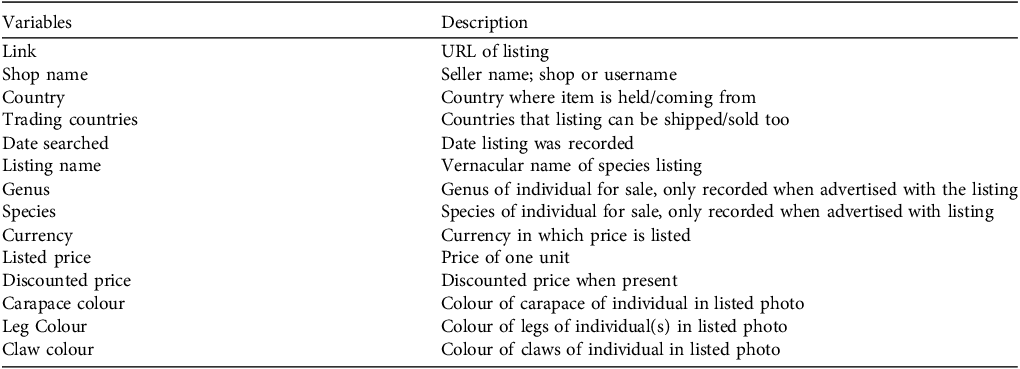
We collected data manually for 14 variables (Table 1) over a total of 12 days across 4 months (July–October 2024). To standardize weekly search trends, we only collected data on Thursdays. Personal identifiable details such as seller/company and name/username were only collected to allow the removal of duplicate listings and determine the frequency of trade per anonymized seller. For each listing, the common name and the binomial name (when present) were recorded as well as the colour of the crabs’ carapace, legs and claws visible in a listing’s photograph.
Variables recorded from the sale listings in the online trade of brachyuran land crabs during July–October 2024.

Table 1 Long description
The table presents a structured overview of 14 variables recorded from online sale listings of brachyuran land crabs. It includes the following columns: Variables and Description. The Variables column lists the specific data points collected, such as Link, Shop name, Country, Trading countries, Date searched, Listing name, Genus, Species, Currency, Listed price, Discounted price, Carapace colour, Leg Colour, and Claw colour. The Description column provides detailed explanations for each variable, such as the URL of the listing, the seller’s name, the country where the item is held or coming from, the countries the listing can be shipped to, the date the listing was recorded, the vernacular name of the species, the genus and species of the individual for sale, the currency in which the price is listed, the price of one unit, the discounted price when present, and the colors of the crab’s carapace, legs, and claws as visible in the listing’s photograph. This table is part of a study conducted over 12 days across 4 months (July to October 2024), with data collected on Thursdays to standardize weekly search trends. Personal identifiable details were collected to remove duplicate listings and determine the frequency of trade per anonymized seller.
We searched only on English language websites, and out of stock listings or in-person purchase only advertisements were not included. Search results labelled ‘sponsored’ were omitted. Data were collected from the first 20 results of the Google search, and the researcher only recorded listings that could be reached with a single click from the search result. This meant that if clicking the search result opened, for example, a seller’s homepage but no listing, the researcher did not proceed further into the website to locate a listing. All active listings were recorded and they were not ordered by relevance, alphabetically, popularity or price. Data were only collected on live crabs for sale; i.e. no taxidermic crabs. Sold out listings and historical listings were omitted. Listings were recorded as singular units, and if crabs were sold in groups, the price of one individual was estimated and recorded. We did not record duplicates of advertisements, and checked species names against DecaNet (2025).
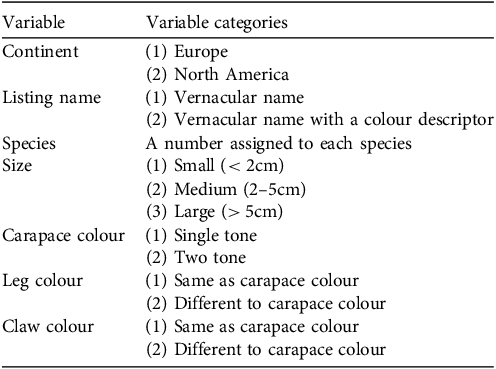
All price data were fixed, and in three currencies. To standardize price data for analysis, we converted them into GBP, using OANDA (2025) conversion rates: GBP 1 = EUR 1.1852, USD 1.2172. Of the 14 variables recorded (Table 1), a subset that could potentially influence the listing price (Table 2) were grouped into categories and each assigned a numerical value. A Spearman rank-order correlation was then used to examine any relationships between the listing price and these variables. Data analysis was conducted in R 4.3.0 (R Core Team, 2023).
A subset of the 14 variables recorded (Table 1), used for pricing analyses. Each was assigned a numerical value to facilitate a Spearman rank-order correlation between listing price in GBP and the variables.

Table 2 Long description
The table categorizes variables used for pricing analyses, including continent, listing name, species, size, carapace color, leg color, and claw color. Each variable is assigned numerical values to facilitate analysis. The continent category includes Europe and North America. The listing name category includes vernacular name and vernacular name with a color descriptor. The species category is assigned a number. The size category includes small, medium, and large, with specific size ranges. The carapace color category includes single tone and two tone. The leg color category includes same as carapace color and different to carapace color. The claw color category includes same as carapace color and different to carapace color.
Results
From 12 searches over 4 months, we collected data from 574 unique advertisements, after removal of duplicates, across 15 sellers (where a seller is an individual seller/company). Six of these sellers were listing on eBay (2025) rather than using their own website.
Species
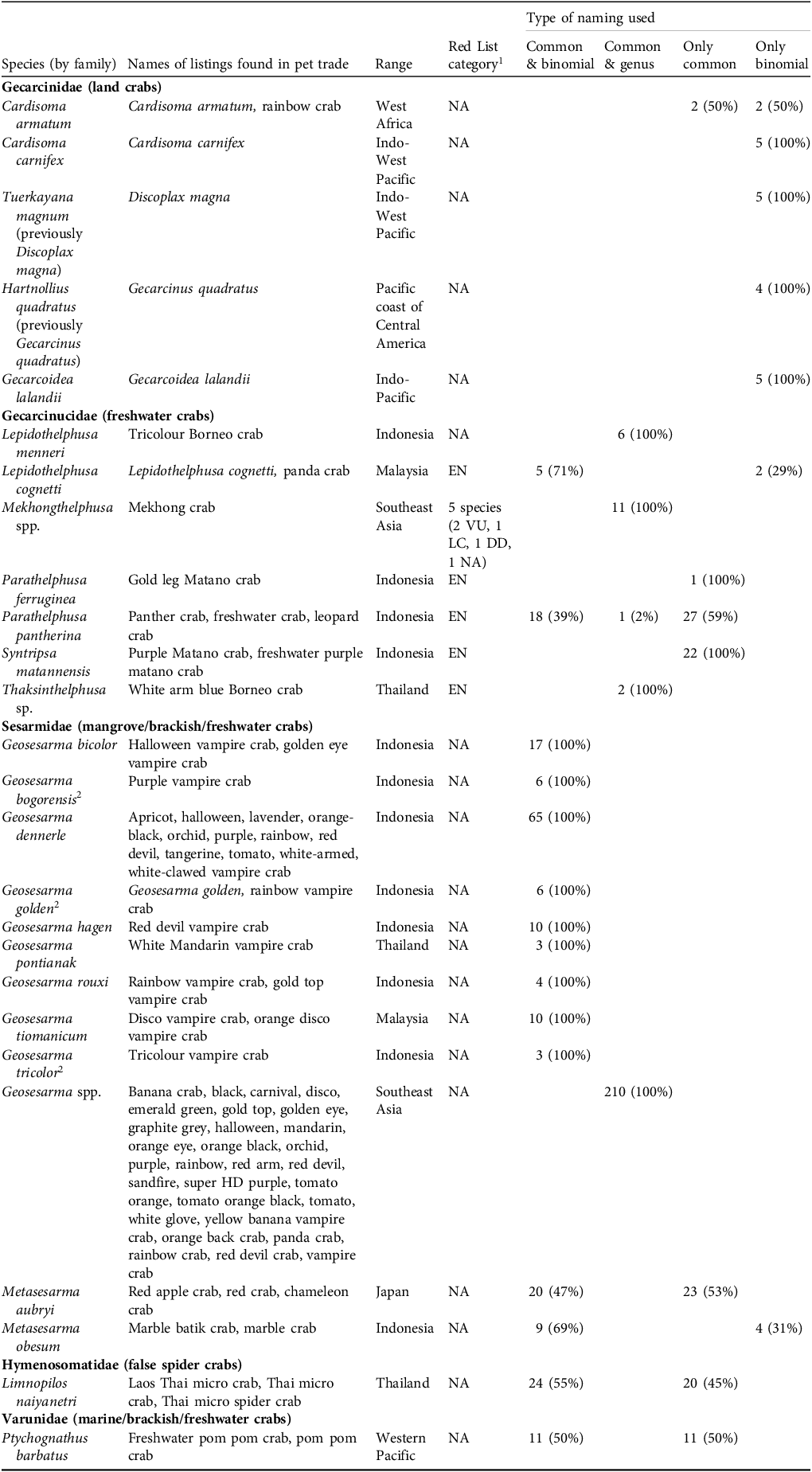
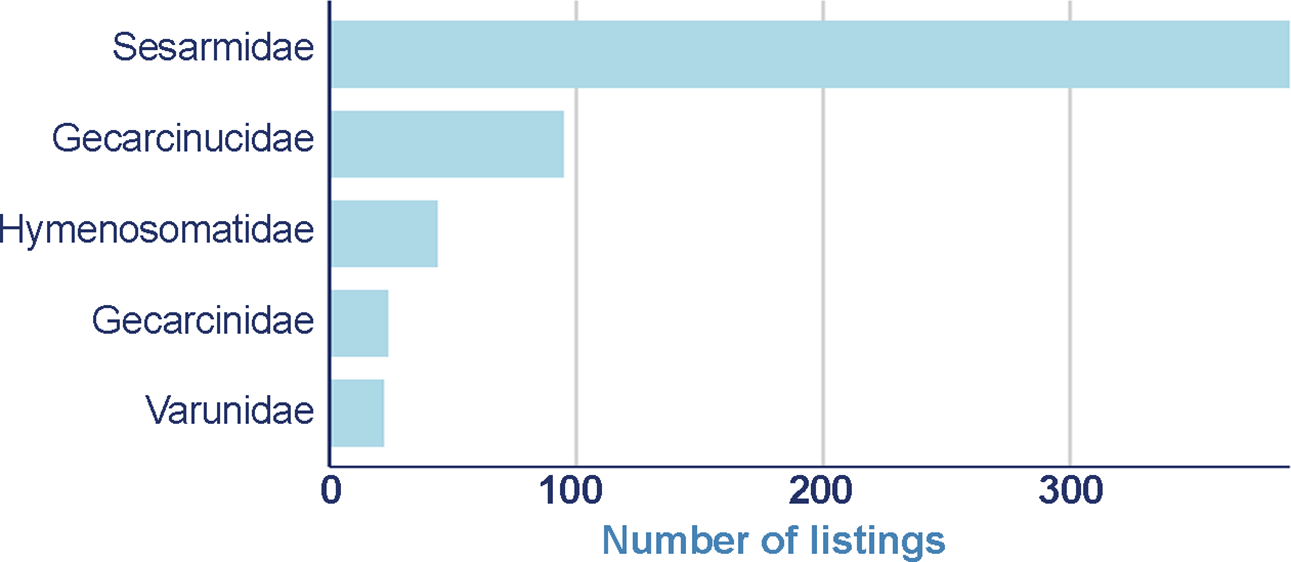
Of the 574 listings, 351 identified 23 species; the remaining 223 listings contained six additional taxa that were only identifiable to genus (Table 3). Two listings sold Thaksinthelphusa sp., which only contains one species, and 11 listings sold Mekhongthelphusa sp., which may have been any of the five species. The highest number of listings (210) was for Geosesarma spp.; these could have been any of the 72 species in the genus (Fig. 1; see Plate 1 for the six most commonly listed land crab species). Of the five families occurring in the listings, 389 of the listings (67.8%) were of Sesarmidae; all listings of the family Varunidae comprised Ptychognathus barbatus (Fig. 2), whereas listings for other families comprised multiple species. The two most frequently listed species were the purple vampire crab Geosesarma dennerle, with 65 listings (11.3% of the total) and the panther crab Parathelphusa pantherina, with 44 listings (7.7%) (Plate 1, Fig. 1).
Brachyuran land crab species listed for sale in the online pet trade, by family, with the names used in the sale listings, native range, IUCN Red List category, and the number of listings (and per cent of total listings for each species) for each type of naming used. Species were corroborated using DecaNet (2025), except for three species that were not listed there.

Table 3 Long description
The table presents data on Brachyuran land crab species listed for sale in the online pet trade. It includes information on the species by family, the names used in the sale listings, their native range, IUCN Red List category, and the number of listings for each type of naming used. The table has 23 rows and 7 columns. Column headers include Species (by family), Names of listings found in pet trade, Range, Red List category, Common & binomial, Common & genus, Only common, and Only binomial. The table lists various species such as Cardisoma armatum, Cardisoma carnifex, and Discoplax magna, among others, along with their respective details. Notable trends include the high number of listings for Geosesarma spp. and the significant presence of species from the Sesarmidae family.
1 EN, Endangered; VU, Vulnerable; LC, Least Concern; DD, Data Deficient; NA, Not assessed.
2 Not listed on DecaNet (2025).
Number of online listings of each of the 26 taxa of brachyuran land crabs (Table 3) recorded during July–October 2024.

Fig. 1 Long description
The bar graph compares the number of online listings for different taxa of brachyuran land crabs recorded during July–October 2024. The x-axis lists the taxa names, and the y-axis represents the number of listings, ranging from 0 to 200. There are 26 horizontal bars, each representing a different taxon. The bars vary in length, indicating the number of listings for each taxon. The longest bar represents Geosesarma spp., with approximately 200 listings. Other notable taxa include Geosesarma dennerle, Parathelphusa pantherina, Limnopilos naiyanetri, and Metasesarma aubryi, with listings ranging from around 50 to 100. The shortest bars represent taxa such as Geosesarma tricolor, Geosesarma pontianak, Thaksinthelphusa sp., and Parathelphusa ferruginea, with listings close to 0. The color scheme is light blue for all bars. All values are approximated.
The six most commonly listed species of land crabs for sale (not including listings only identified to genus): (a) purple vampire crab Geosesarma dennerle, average carapace size 4.6 cm, (photo: C. Lukhaup, modified from Ng et al. Reference Ng, Schubart and Lukhaup2015), (b) panther crab Parathelphusa pantherina, average carapace size 8 cm, (photo: O. Radosta, Reference Radosta2018), (c) Thai micro crab Limnopilos naiyanetri, average carapace size 1 cm, (photo: E. Murray, Reference Murray2009), (d) red apple crab Metasesarma aubryi, average carapace size 3.5 cm (photo: M. Mandak, Reference Mandák2017), (e) freshwater pom pom crab Ptychognathus barbatus, average carapace size 2 cm, (photo: J.W. Hsu, modified from Hsu et al., Reference Hsu, Mendoza and Shih2025), (f) mottled crab Metasesarma obesum, average carapace size 5 cm (photo: R. Lazarus, Reference Lazarus2025).

Number of online listings of each of the five families of brachyuran land crabs.

Fig. 2 Long description
The bar graph compares the number of online listings for five families of brachyuran land crabs. The x-axis represents the number of listings, ranging from 0 to 350. The y-axis lists the five families: Sesarmidae, Gecarcinucidae, Hymenosomatidae, Gecarcinidae, and Varunidae. Sesarmidae has the highest number of listings, around 350. Gecarcinucidae follows with approximately 100 listings. Hymenosomatidae has about 50 listings, while Gecarcinidae and Varunidae have around 25 and 10 listings, respectively. The bars are horizontal and color-coded in light blue. All values are approximated.
CITES appendices and IUCN Red List
None of the species recorded were present on any CITES appendices, 19 species are not assessed for the IUCN Red List, and four species are categorized as Endangered (IUCN, 2025) (Table 3). The listings for Thaksinthelphusa sp. only indicated the genus, but there is only one species in this genus: T. yongchindaratae. Listings of Mekhonghthelphusa spp. could not be identified to species, but there are five species in this genus; two are categorized as Vulnerable, one as Least Concern, one as Data Deficient and one has not been assessed (Table 3).
Nomenclature
Twenty-seven listings (4.7%) used only binomial names, all of which were from the same seller, 168 listings (29.3%) used only common names, 167 listings (29.1%) used the common name and genus, and 212 listings (36.9%) used the common, genus and species name (Table 3). Within the 574 advertisements, there was a total of 61 English vernacular names used, of which the most common was vampire crab, which comprised 326 listings (56.8%). This term was accompanied by another term that described the phenotype in 301 (92.3%) of these advertisements. Vampire crab was only used in connection with the genus Geosesarma and was not species-specific. There were 221 listings (38.5%) without the term vampire crab that encompassed 14 species, two of which were Geosesarma species. The species with the largest number of common-name variants (14) was Geosesarma dennerle. The vernacular name rainbow vampire crab was used in conjunction with three Geosesarma species. Halloween vampire crab, purple vampire crab and red devil vampire crab were used in conjunction with two Geosesarma species. The vernacular name panda crab was the only name used in conjunction with two genera: Geosesarma and Lepidothelphusa.
Sellers
The seller with the most listings had 158 (27.5%) of all listings and the seller with the lowest number of listings had just three (0.5%; Fig. 3). Over the course of the 4 months of data collection, the greatest number of land crab species sold by one seller was 15. Two sellers only sold one species; all others sold multiple. The genus Geosesarma spp., which included taxa not identifiable to species, was sold by 12 sellers. The most commonly sold species was the vampire crab Geosesarma dennerle (Fig. 1).
Number of online sellers listing each of the 26 taxa of brachyuran land crabs.

Fig. 3 Long description
The bar graph compares the number of online sellers listing each of the 26 taxa of brachyuran land crabs. The x-axis represents the number of sellers, ranging from 0 to 12. The y-axis lists the different taxa of brachyuran land crabs. The bars are horizontal and vary in length, indicating the number of sellers for each taxon. The taxa with the highest number of sellers are Geosesarma spp., Geosesarma dennerle, and Parathelphusa pantherina, each with around 10 to 12 sellers. Other notable taxa include Limnopilos naiyanetri, Metasesarma obesum, and Geosesarma tiomanicum, with around 4 to 6 sellers each. The color scheme is light blue, and all values are approximated.
Countries of origin and trade
A total of 10 sellers were based in the UK, four in the USA, and one in mainland Europe. Fourteen of the 15 sellers explicitly stated the countries to which they will ship crabs: UK, Canada and the USA (the inclusion of Puerto Rico and Hawaii was variable depending on importation legislation regarding potential invasive species). Areas of Europe to which shipment could be made were not stated. None of the listings divulged the source of the traded crabs, whether captive-bred or wild-caught. We recorded the countries of origin for those species listings that were taxonomically correct (Table 3), and Southeast Asia was the source of most of the species for sale.
Price
All 574 listings included a price. The Thai micro spider crab Limnopilos naiyanetri exhibited the largest range in price (GBP 5.29–119.74). The orange-legged crab Discoplax magna had the highest median price (GBP 40.44; Fig. 4). Sale price was not significantly associated with the nomenclature used for the listing name (Table 2; Spearman rank-order correlation ρ = −0.074, n = 574, P > 0.05) or the colouration of a crab’s carapace (ρ = 0.007, n = 574, P > 0.05), legs (ρ = 0.01, n = 574, P > 0.05) or claws (ρ = −0.038, n = 574, P > 0.05). The price of a crab was influenced by the continent from which it was sold (ρ = −0.094, n = 574, P < 0.05), the species (ρ = −0.098, n = 574, P < 0.05) and the size of the crab (ρ = 0.021, n = 574, P < 0.001).
Boxplots of the price, in GBP, of the 26 taxa of brachyuran land crabs listed for sale online. The vertical line indicates the median, the box the 1st and 3rd interquartile range, the whiskers the minimum and maximum, and dots indicate individual data points.

Fig. 4 Long description
A horizontal box-and-whisker plot displays the price distribution of 26 taxa of brachyuran land crabs in GBP. The x-axis represents the price in GBP, ranging from 0 to 120. The y-axis lists the 26 taxa of brachyuran land crabs. Each box plot shows the median price, the interquartile range, and the minimum and maximum prices. Dots indicate individual data points, highlighting outliers. The plot reveals significant price variations among different taxa, with some species like Limnopilos naiyanetri showing much higher prices compared to others. All values are approximated.
Discussion
The most popular traded land crab species was G. dennerle (Ng et al., Reference Ng, Schubart and Lukhaup2015). As we used only the information divulged in online listings and did not purchase specimens for species confirmation, we had to assume that sellers correctly identified the species for sale. However, the taxonomic description of the species G. dennerle, as published by Ng et al. (Reference Ng, Schubart and Lukhaup2015), was advertised alongside multiple phenotype descriptions and listing photographs of other Geosesarma species. The Geosesarma sp. phenotype with purple carapace/legs and white claws was advertised as G. dennerle under several listings, although this phenotype aligns more with G. bicolor (Ng & Davie, Reference Ng and Davie1995).
The listings for Thaksinthelphusa sp. were not advertised to species despite the genus only containing one species. The common name used in these listings was ‘white arm blue borneo crab’, yet this species is only known from one waterfall in Thailand (Klaus, Reference Klaus, Brandis, Ng, Yeo and Schubart2009). It is unclear whether the crabs were collected in Thailand and distributed from Borneo, or whether the identification is incorrrect. Regardless, the use of this common name needs to be investigated as any misconception of the origin locality of the species would hinder future export monitoring. The listings of Mekhongthelphusa spp. were only from one seller and could be any one of the five species in this genus. As species identification was not possible, future studies should investigate which species are being offered for sale. Geosesarma spp., which had the highest number of listings, is a Southeast Asian genus that contains 72 species, nine of which we recorded for sale. However, three of these species (G. tricolor, G. bogorensis and G. golden) are not listed on DecaNet (DecaNet, 2025), and there are no formal descriptions matching these binomial names. The name G. golden may have a descriptive use and could be interpreted as Geosesarma sp. golden, describing the yellow carapace colour. All the listings for these three species included both the common name and the binomial name, despite the binomial name being incorrect or not a formal species name.
The popularity of the land crab trade has increased in conjunction with social media use, and the online wildlife trade has significantly increased following the travel bans imposed by various countries during the Covid-19 pandemic (Bashyal & Roberts, Reference Bashyal and Roberts2024). Colourful and unique land crabs have been promoted on the social media platform Tik Tok (2026), using the species’ striking colours and unique characteristics for promotion. One such species is L. naiyanetri, which prior to Covid-19 was described as being traded in small quantities (Patoka et al., Reference Patoka, Bohatá, Karella, Marková, Yuliana and Yonvitner2019) but which we recorded regularly listed. This species is an omnivore, feeding on a range of food sources from dead fish to biofilm, and thus it is appealing to hobbyists as a potential replacement of, or addition to, cleaner shrimps, helping maintain the health and aesthetic of an aquarium.
Two of the four Endangered species that we found listed, S. matannensis and P. pantherina (but not P. ferruginea and L. cognetti), have collection and the worldwide aquarium trade noted as threats. Of the five species of Mekhongthelphusa, which could not be identified, M. kengsaphu and M. tetragona are categorized as Vulnerable, but neither currently have pet trade as a use or collection noted as a threat. Thaksinthelphusa yongchindaratae is categorized as Endangered but neither collection nor the aquarium trade are noted as a use or threat. However, the Red List assessment dates from 2008 (Esser & Cumberlidge, Reference Esser and Cumberlidge2008), when the species may not have been subject to trade. The robber crab Birgus latro, which is categorized as Vulnerable on the IUCN Red List, but not included here as it is an anomuran, is available for sale in the online wildlife trade and although overharvesting is listed as a threat, pets/display animals is not listed as a use or trade (Cumberlidge, Reference Cumberlidge2020). A full IUCN assessment of semi-terrestrial crabs has not yet been undertaken; assessment for the true freshwater crabs revealed that 49% of the species in the five families are Data Deficient (Cumberlidge et al., Reference Cumberlidge, Ng, Yeo, Magalhães, Campos and Alvarez2009). With the increase in the online trade of these species it is important that IUCN assessments do not overlook collection and sale in the pet-trade industry.
We did not document trade in coastal, estuarine or intertidal crab species, such as Perisesarma bidens or several species of fiddler crabs, although they are able to survive in freshwater. They are, however, sold within the freshwater sections of seller’s websites and advertised as ornamental crabs for freshwater tanks. The extent of the trade in these species, and husbandry techniques, merit investigation, as their behaviours and life histories may differ from freshwater species.
Species that were listed only using their binomial name all belong to the family Gecarcinidae (true land crabs) and had some of the lowest numbers of listings. The use of the binomial name may make species more appealing as it may be highlighting the rarity of that species of crab in the pet trade. However, as these were all listed by the same seller, it may only be because of their advertising policies. It is not uncommon for a species to have several different common names. When common names were used for Geosesarma individuals, they were often listed without their binomial name, possibly resulting in misidentification. For example, the colloquial name rainbow vampire crab was used in different advertisements alongside three different species names: G. dennerle, G. rouxi and G. golden. For species that were listed using a common and a genus name, it was not possible to identify the individuals to species without having access to the individual. The recurrence of stock photos within listings makes it difficult to determine whether the crab phenotype being sold is of the species being advertised. Within this trade, species identification is important as different species may have different dietary or husbandry needs. Clear species identification would also facilitate trade content and species export monitoring.
Sellers may not identify an individual to species because they lack the relevant taxonomic skill or because there is no species described for the individual on sale. Some species, particularly those of multiple colour forms, remain undescribed despite being commonly traded, as was formerly the case with the popular vampire crab, G. dennerle, which was traded for many years before it was described (Ng et al., Reference Ng, Schubart and Lukhaup2015). Re-examination of species complexes can also result in the discovery of new species in the trade. For example, the micro spider crab P. barbatus has recently been found to be a species complex, with P. dajie restricted to East and Southeast Asia and the more widespread P. barbatus occurring across the Indo-West Pacific (Hsu et al., Reference Hsu, Mendoza and Shih2025). In a case such as this, it may take time for the pet trade to recognize that two rather than one species are being sold, and it is challenging for both scientists and hobbyists to identify individuals in the absence of information such as country of origin. It is also possible that trade in these species could lead to hybridization, or that individuals for sale are phenotypes not yet recorded in the wild.
Little information is available regarding the number of specimens entering the trade, and few studies have investigated collection numbers or methods for land crabs harvested in Southeast Asia (Ng, Reference Ng2017). However, there have been several studies of land crab species, such as Cardisoma guanhumi, harvested for food (e.g. Rodriguez-Fourquet & Sbat, Reference Rodriguez-Fourquet and Sbat2009; Firmo et al., Reference Firmo, Tognella, Silva, Barboza and Alves2012; Takahashi & Nishida, Reference Takahashi and Nishida2018). Landing numbers of live crabs for the pet and aquarium trade are not currently recorded. Future studies should investigate what proportions of crab imports and exports comprise live animals for the pet and aquarium trade.
Generally, the aquarium trade does not disclose whether individuals for sale are captive-bred or wild-caught, and for the latter there is therefore no way to record where they have been collected. Determining a species’ country of origin requires taxonomic confirmation of its identity. As many of the species sold as pets are highly endemic, species confirmation for wild-caught individuals would identify the source locality or region. Most of the species we recorded for sale are from Southeast Asia, with only three species for sale from elsewhere (West Africa, Pacific Coast of Central America, and Japan).
We investigated trade only for English-speaking countries and websites, and there may be additional species that occur in the established land crab trade elsewhere, such as in Asia or South America. Although suppliers do not advertise whether the individuals they sell are imported or tank bred, the website of one seller indicated that the crabs on sale undergo quarantine before being shipped, suggesting the species are imported. The international exotic pet trade is a major cause of the spread of diseases (Fukushima et al., Reference Fukushima, Mammola and Cardoso2020), and although quarantining helps to reduce this risk, it does not mitigate all factors. The global shipping of these tropical decapod species also exposes importing countries to the risk of a species becoming invasive by accidental release from the pet trade. Patoka et al. (Reference Patoka, Bohatá, Karella, Marková, Yuliana and Yonvitner2019) predicted areas of possible invasion by L. naiyanetri as a result of accidental release. Brazil, where there is an established ornamental decapod trade, was highlighted as at risk. Although it has been previously thought that tropical species would only be able to invade areas with climates similar to that of their native range, some tropical species are more tolerant to low temperatures than formerly believed (Conway Holroyd, Reference Conway Holroyd2024).
We found that sale price had a highly significant positive relationship with size, but not with any of the other phenotypic characters recorded. However, although colour did not influence price, it may have an impact on whether individuals are traded. Brazilian frog species in the exotic pet trade, for example, were more likely to be traded if they had a diversity of colours (Werling et al., Reference Werling, Morton and Edwards2025). Although price has a relationship with the species being sold, whether or not the vernacular name used to list a species contained a phenotypic descriptor does not. Therefore, it may be assumed that these phenotype descriptors are a way of differentiating between species within a group that has wide phenotypic diversity, such as Geosesarma spp. The area of trade also influenced sale price. The differences in pricing between North America and Europe may be a result of differences in import costs from Southeast Asia.
Although we have identified which species are offered for sale in the online tropical aquarium land crab trade, further research is required to examine this trade in non-English speaking countries, in particular Russia, Germany and Thailand, which are major importers of land crabs (Uderbayev et al., Reference Uderbayev, Patoka, Beisembayev, Petrtýl, Bláha and Kouba2017). Research is also required on the potential for land crab species in the trade to become invasive, as highlighted by Patoka et al. (Reference Patoka, Bohatá, Karella, Marková, Yuliana and Yonvitner2019), to prevent or minimize accidental invasion by land crabs. Knowledge of the land crab species in the trade will allow conservationists and policymakers to make informed decisions regarding the monitoring of global imports and exports and the wild catch of these species. With the extent of trade and wild capture of these species being unknown and potentially increasing, a scarcity of data on the contents of the trade, and the potential ecological implications of wild-catch, there are grounds for inclusion of traded species on CITES Appendix III.
Author contributions
Conceptualization: LMT, DLR; methodology: EXW, DLR, JIS, LMT; analysis: EXW; data collection: EXW; writing: EXW; revision: DLR, JIS, LMT; visualization: EXW; supervision: LMT, DLR; project administration: LMT.
Acknowledgements
This study was funded by a PhD scholarship from the University of Plymouth to EXW (principal investigator: LMT). We thank the anonymous reviewers for their constructive comments.
Conflicts of interest
None.
Ethical standards
This study abided by the Oryx guidelines on ethical standards and was approved by the University of Plymouth Ethics Review Board (Project ID 5019). Selling platform hyperlinks and seller usernames were stored until data were cleaned for analysis. Personal details of sellers were not collected. Data were only shared between the authors, and stored appropriately and securely.
Data availability
Data are available from the corresponding author upon reasonable request.




 Open access

