

In recent years, scholars have raised warnings about the rise of “Christian nationalism” and the threat it poses to democracy globally (Saiya 2023). Largely based on the case of the United States, Whitehead and Perry (Reference Whitehead and Perry2020) contend that that Christian nationalist beliefs fuse multiple markers of traditional American identity (Christianity, whiteness, conservatism) into a single cultural framework that is strongly associated with devout evangelicals. For them “.….Christian nationalism is a form of religious nationalism that includes a collection of myths, traditions, symbols, narratives, and value systems – that idealizes and advocates a fusion of Christianity with … civic life” (Whitehead and Perry Reference Whitehead and Perry2020, p.10). Nilay Saiya (2023b, p.1) argues that Christian Nationalism is fundamentally inimical to democracy because, as a political ideology, it “prioritizes power and control over others and Christian nationalists lend their support to political candidates who promise to protect or restore the hegemony of Christianity, regardless of these politicians’ commitment to democratic norms and institutions.” Further, Christian nationalists reject “the principle of democratic equality” since their main aim is to build or preserve Christianity’s dominant position over other religions (Saiya 2023, p.1).
Recently, scholars have warned of the growing influence of Christian nationalism in Africa and especially the rise of dominion theology. Dominion theology is the “theocratic idea that regardless of theological camp, means, or timetable, God has called conservative Christians to exercise dominion over society by taking control of political and cultural institutions” (Clarkson Reference Clarkson2016). Jeffrey Haynes (Reference Haynes2023a) notes that the rise of Christian nationalism throughout the continent poses challenges not only to the development of democracy but also inter-religious peace on the continent. This is especially challenging to the stability of many African countries that are divided along religious lines.
Although some scholars (Haynes Reference Haynes2023a; Reference Haynes2023b; De Cort Andrew, 2022) have become increasingly alarmed about the rise of Christian nationalism and the threat it poses to democracy and stability in Africa, there is remarkably little empirical work regarding how extensive the ideology is on the continent. Most existing work deals with single-country case studies and focuses largely on the pronouncements of the leaders of African states rather than on mass attitudes. But is this ideology widely prevalent among Africans? Or is it primarily concentrated among certain demographic groups (such as the political elite)? Are those who are attracted to Christian nationalism significantly less likely to support democracy and hold “anti-democratic” attitudes (such as support for authoritarianism and intolerance towards out groups) as is often claimed? Addressing these questions would help understand the extent to which it presents a real threat to peace and democracy on the continent.
In this article, I seek to test some of the arguments that are currently made in the literature on the rise of Christian nationalism on the continent that: 1) Christian nationalism is very prevalent among Africans; 2) that Christian nationalists are anti-democratic and more sympathetic to authoritarian alternatives to democracy; 3) that Christian nationalists hold negative attitudes towards others, particularly non-Christians, and are more socially intolerant.
To examine these arguments made in the literature, I use survey data on African attitudes that are available in the Afrobarometer Round 7 (2016-18). In this round, there are questions that directly relate to religion and political attitudes, thus providing an opportunity to investigate the phenomenon of Christian nationalism on the continent.Footnote 1 Indeed, this paper is one of the first works that examines whether Christian nationalist attitudes are prevalent in the African population. Further, it is one of the only works (of which I am aware) that seeks to empirically test whether Christian nationalists in Africa are less likely to support democracy and to reject authoritarian alternatives, and are more religiously and socially intolerant, as has been argued in much of the literature.
In the following article, I provide a definition of Christian nationalism and, in particular, who can be identified as a Christian nationalist. I then provide a brief review of the literature on Christian nationalism (particularly derived from the United States), but globally and in Africa as well. I then identify the hypotheses that are tested in the empirical sections of the paper. Third, I lay out the design and methodology of the analytical section (identifying the data derived from the Afrobarometer survey) and then report the empirical results. I find evidence to support the argument that Christian nationalists tend to be less supportive of democracy than others and more receptive to authoritarian alternatives to democracy. They are also more intolerant than others with regards to religion and tend to be more homophobic than other Africans. I then conclude with directions for future research.
What is Christian nationalism?
In many ways, the very idea of Christian nationalism is a controversial term. There are those who believe that Christian nationalism is “a healthy form of Christian patriotism, of loving God and loving one’s country” (NAR 2023). For others, Christian nationalism represents an intolerant religious authoritarian movement that fundamentally threatens democracy globally (Saiya Reference Saiya2022b; Van Klinken Reference van Klinken2014).
What is Christian nationalism? Studies of Christian nationalism have used the term to describe the far right in the United States, particularly those organizations that are part of the Christian identity movement (Whitehead and Perry Reference Whitehead and Perry2020). The literature on Christian nationalism in the United States sees it as an ideology (e.g., Perry, Whitehead, and Grubbs Reference Perry, Whitehead and Grubbs2020; Whitehead and Perry Reference Whitehead and Perry2020). However, this conception of ideology, as several critics have noted, is rather loose and imprecise, lumping together Christian nationalism with civic republicanism or religious conservatism. What is required is a clearer understanding of what is meant by an “ideology” and “nationalism.”
Scholars of political ideology argue that ideology is more than a collection of attitudes and beliefs. Rather, all political ideologies, in addition to a set of attitudes and beliefs, also involve a plan for political action (Baradat and Phillips Reference Baradat and Phillips2019). Ideologies provide a critique of what is wrong with the present and a vision of a better future for a community. However, most importantly, a political ideology provides a plan of action as to how to attain a community’s political goals (Baradat and Phillips Reference Baradat and Phillips2019). Nationalism is an ideology that defines the community in “national terms” (which requires some definition of criteria for membership in the community) and holds that the national community should have its own state (Hechter Reference Hechter2000; Greenfeld Reference Greenfeld1992; Gellner Reference Gellner1983).
Scholars studying Christian nationalism note this dualism in the doctrine. First, like nationalism as an ideology, it is a set of beliefs people hold about who belongs to the national community, the kind of society they would prefer, and the acceptable political means to achieving these goals (Jost, Federico, and Napier Reference Jost, Federico and Napier2009; Greenfeld Reference Greenfeld1992). As an ideology, Christian nationalism’s adherents believe that the state should explicitly privilege citizens who are Christians, and that to attain political power is the primary means to realize that goal (Whitehead and Perry Reference Whitehead and Perry2020). Another aspect of Christian Nationalism is the belief that Christians are a victimized and an embattled minority, and that political power will protect the community from its non-believing enemies.
When considering “Christian Nationalism,” it has been conceptualized in two very distinct ways (Li and Froese Reference Li and Froese2023). On the one hand, there is the idea of Christian Nationalism as a community (which raises the question of who belongs to that community). Although a Christian identity may be correlated with other identities (such as race or ethnicity), the primary criterion for membership is being Christian. Thus, it refers to a “vision of national identity or destiny with narratives of Christian election or providence” (Haynes Reference Haynes2021, p. 215; see also Bialecki Reference Bialecki2011).
On the other hand, scholars have argued that such a conceptualization of Christian nationalism as a community does not distinguish it from other ideologies. For instance, Smith and Adler (Reference Smith and Adler2022) contend that a focus on belonging to a national community defined by Christianity does not distinguish Christian nationalism from religious conservatism. Thus, an important feature of Christian nationalism as a political ideology is that its adherents advocate political action (through seizure of political power) to create God’s Kingdom on Earth. In the United States, Christian nationalists strongly believe in declaring the US a Christian Nation and that the federal government should espouse Christian values (Smith and Adler Reference Smith and Adler2022).
Christian Nationalism and Democracy
Much of the literature, particularly from the United States, suggests Christian nationalism is a threat to democracy. There are generally two reasons for this. First, there is the argument that Christian nationalism is a threat to democracy because the ideology is inimical to democratic institutions. As Rosemary Al-Kire (Reference Ai-Kire2023) notes Christian nationalism is an ideology that government and society should be guided by Christian values, and that there should be a fusion of Christianity with a country’s civil and political institutions. In this sense, its adherents’ pursuit of political power, regardless of democratic rules and norms, as well as their repudiation of religious diversity and its intolerance of other points of view, Christian nationalism as an ideology constitutes a threat to democracy. She argues that although much of the research has focused on the United States, it is a global phenomenon that has been key in explaining the recent decline of democracy across the world. Others have pointed out that Christian nationalists prefer authoritarianism to democracy. A recent study by the Public Religion Research Institute ((Public Religion Research Institute (PRRI) 2023) found that supporters of Christian nationalism tend to support obedience to authority as well as the idea that authoritarian leaders who are willing to break democratic rules are necessary to implement God’s kingdom on Earth. The study found that while although only 28% of Americans agreed with the statement that “because things have gotten so far off track in this country, we need a leader who is willing to break some rules if that’s what it takes to set things right,” half of Christian nationalism adherents (50%) supported the idea that having such a leader is necessary.
Second, scholars have argued that Christian nationalists hold “anti democratic” attitudes (Ai-Kire Reference Ai-Kire2023), particularly intolerance towards out groups, and other political points of view. Thus, Christian nationalism has been linked in the literature to a variety of racist, misogynistic, authoritarian, and homophobic attitudes (Perry and Whitehead, Reference Perry and Whitehead2015a; Perry and Whitehead, Reference Perry and Whitehead2015b; Du Mez Reference Mez and Kobes2020; Whitehead and Perry Reference Whitehead and Perry2020b; Gorski and Perry Reference Perry, Whitehead and Grubbs2022). There is indeed some evidence that Christian nationalism is associated with anti-democratic attitudes. As Al-Kire found in her study of 500 White Christian Americans, those who have a preference for Christian nationalism are more likely to hold anti-democratic attitudes such as favoring voter suppression, holding a belief in conspiracy theories, and expressing intolerant views about other religions, and other political points of view. Saiya (Reference Saiya2022b) argues that Christian nationalism is a global threat as well, “because Christian nationalism is by definition an ideology of exclusion — one that distinguishes the true members of a political community from usurpers — it overlaps easily with other systems of marginalization.”
Christian Nationalism in Africa
Although most of the scholarly work on Christian nationalism has focused on the views of the movement in the United States, scholars have pointed out a rise in this ideology globally, including in Africa (Saiya Reference Saiya2022a). Indeed, the idea of a “Christian nationalism” has been around for quite some time on the continent. George Bennett (Reference Bennett1967) noted that for many Africans, Christianity became a symbol of resistance to imperialism. Bennett argues that of all the figures in the Old Testament, “none had greater attraction than did Moses,” especially for the “protesting prophets” like Nkrumah. (p.63). For leaders in the liberation struggle, like Julius Nyerere and Kenneth Kaunda, Christianity and African nationalism went hand in hand. On the other hand, Christian nationalism was also a term used to label the White supremacist Afrikaner nationalism in South Africa (Bloomberg Reference Bloomberg1989).
Estimated Percent Population by Country, Christian Nationalist.

However, more recently, some scholars have argued that a different and more explicitly ideological form of Christian nationalism is now flourishing in Africa – dominion theology or “dominionism” Haynes (Reference Haynes2023a; Reference Haynes2023b). Dominionism is an explicitly political ideology that argues that the goal of Christians is to realize “God’s kingdom on earth,” “where a theocratic government applies Christian values, beliefs and rules to the detriment of those with different ideas about the good society” (Haynes Reference Haynes2023a, p. 1).
This form of Christian nationalism first spread on the continent in the 1990s, in part because of the opening of “spaces” for democratic engagement that resulted from the limited democratic transitions that swept the continent. This also created openings for evangelical religious challenges to the dominant Catholic, Orthodox, and Muslim mainstream religions (see Clarkson Reference Clarkson2016). Much of the literature suggests that the rise of Christian nationalism was especially due to the rapid growth of Pentecostal and Charismatic churches in Africa, which increased their proselytizing activities greatly on the continent in the 1990s (Haynes Reference Haynes1996). Christian nationalists, most of whom are members of the fast-growing Pentecostalist and Charismatic churches (it is claimed), are particularly important in the spread of ideas associated with dominionism. They are especially influential in Zambia, Nigeria, Côte d’Ivoire, and Ethiopia (Haynes Reference Haynes2023a).
Although dominion theology had its origins in the USA, it spread quickly to Africa via the activities of American missionaries (Ananyev and Poyker Reference Ananyev and Poyker2021). Indeed, an American televangelist, Oral Roberts, is said to have “inspired and influenced many leading Pentecostal leaders in Africa” (Asamoah-Gyadu Reference Asamoah-Gyadu2018). Beyond its emphasis on the need to “protect or restore the hegemony of Christianity,” their main aim is to build or preserve Christians’ dominance over the state (Haynes Reference Haynes2023a, p.2). This dominance would be at the expense of other religious groups, particularly Muslims. Although dominionism claims to be part of religious discourse, it is essentially a political justification for the rule of Christians over others (Haynes Reference Haynes2023a). For example, in Côte d’Ivoire, it has been long argued by political leaders that the country belongs to the Christians, who are referred to as the “children of God.” Christian nationalism in the country is characterized by supposedly miraculous healings, mass conversion events, hunts for demons, and for its anti-Muslim stance (Litherland Reference Litherland2019).
Christian nationalism is also associated with a strong sense of homophobia in Africa. For instance, Zambia adopted a constitutional declaration that the country was a Christian nation, which has given rise to a kind of nationalism in which homosexuality is considered to be a threat to the purity of the nation and is associated with the Devil (Van Klinken Reference van Klinken2014, p. 259). These sentiments are also reflected in the efforts to criminalize homosexuality (as in Uganda).
Much of the literature on the rise of Christian nationalism in Africa has suggested that the spread of Pentecostalism on the continent is responsible for the rise of dominion theology. Several studies point to the conversion of African leaders like President Frederick Chiluba of Zambia, a Pentecostal, who announced in 1991 that Zambia was a Christian nation, an assertion that is institutionalized in the current constitution. Haynes (Reference Haynes2023a, p. 2) claims that currently, “Christian nationalists exert significant influence on politics, public policy, popular culture, and moral imagination in Zambia, via application of dominion theology.” In 2023, the government began construction of the ultimate symbol of Christian nationalism, the National House of Prayer, representing the country’s effort to become a Christian nation on Earth (Hamasute Reference Hamasute2018).
In Nigeria, Pentecostalism is the fastest-growing religion, and the religion has made inroads politically among the masses. Pentecostal churches are politically important in the country, drawing on the concerns of “a cross section of Christians” with “a grievance against perceived marginalization” by the mainstream churches (Haynes Reference Haynes2023a). Two recent presidents of the country, Olusegun Obasanjo and Goodluck Jonathan, are Pentecostals (Obadare Reference Obadare2018). Muhammadu Buhari’s administration contained several prominent Pentecostals (although Buhari is a Muslim). Bola Tinubu is also a Muslim but his wife Remi “is not only a Christian but a senior pastor” of the Pentecostal Redeemed Christian Church of God (an influential Megachurch in Nigeria).Footnote 2
In Côte d’Ivoire, which is a country roughly evenly divided between Christians (39% of the population) and Muslims (42%), the former President Félix Houphouët-Boigny built the largest Christian church in the world, the Basilica of Our Lady of Peace at Yamoussoukro (a Catholic shrine) (Litherland Reference Litherland2019). Although not Pentecostal, a form of Christian nationalism has become part of the country’s official identity, despite Ivoirian society almost evenly divided between Christians and Muslims. Similarly, in Ethiopia, Prime Minister Abiy Ahmed has implemented a form of Christian nationalism in a religiously divided society where 60% of the population are Christian, and about a third are Muslim. Abiy, himself a follower of Pentecostalism, has sought to institute some core elements of the religion in governance, even going so far as renaming the governing party the “Prosperity Party” (where the prosperity doctrine is a central part of Pentecostalism). De Cort Andrew (2022) argues Abiy’s effort to establish Christian dominance in the country to pursue an “ancient Christian imperialism” promising “to unify Ethiopia and restore its divine glory.” This also involves the adoption of Abiy’s “Medemer” philosophy which seeks to create an identity for Ethiopians that transcends ethnicity. DeCort (2022) argues that his belief “that Ethiopia is a Christian nation created and destined by God for greatness under Christian leadership” and that this “prosperity” doctrine designed to transcend ethnic differences is in fact tearing the country apart (see also Hardy Reference Hardy2023).
Christian nationalism on the continent has also prompted political violence. In Uganda, a particularly extreme form of Christian nationalism gave rise to one of the world’s most brutal terrorist groups, the Lord’s Resistance Army (LRA). Led by the warlord Joseph Kony, the LRA was notorious for its gross violations of human rights (such as murder, mass abduction, use of child soldiers etc.). The objective of the group, as articulated by Kony, is an explicitly Christian nationalist one: for Uganda to be a country governed by the Ten Commandments (Saiya Reference Saiya2022b).
In the Central African Republic, Christian nationalism has figured prominently in the civil war that has displaced thousands of people. The notorious Christian militias, the Anti-Balaka, have waged a religious war against the country’s Muslim minority. The war Christians have waged on Muslims in the country can be traced to Christian nationalist beliefs and the subsequent development of a close alliance between Christianity and the state (Saiya Reference Saiya2022b).
Although there is a considerable amount of literature on the negative role that Christian nationalism plays in African politics (at least in terms of its threat to democracy and political stability on the continent), most all of this literature has concentrated on pronouncements of the leadership of these countries (or the pronouncements of rebel leaders). This makes some sense given that African countries tend towards neopatrimonial political arrangements where the attitudes of leaders are most important in explaining policy (Bratton and Van de Walle Reference Bratton and Van de Walle1994). However, if Christian nationalism represents a real threat to democracy in Africa, one would need to examine how it has influenced mass attitudes towards democracy and autocracy, as well as its impact on attitudes that support democracy (such as tolerance).
Hypotheses
The above literature suggests that Christian nationalism is inimical to democracy for two reasons. First, that it is an ideology that is not supportive of democratic institutions and sympathetic to authoritarian political alternatives. Second, that Christian nationalists are more likely to hold anti-democratic attitudes, particularly a greater intolerance of out groups. This suggests several hypotheses regarding Christian nationalism and attitudes about democracy, autocracy, and tolerance of others. These include:
-
Hypothesis 1: Christian Nationalists will be less supportive of democracy than others.
-
Hypothesis 2: Christian Nationalists will be more sympathetic with non-democratic regime alternatives than others.
-
Hypothesis 3: Christian Nationalists will be more intolerant of other religions than others.
-
Hypothesis 4: Christian Nationalists will be more intolerant of LGBTQ individuals than others.
Design and Methodology
To test the above hypotheses, I use the Afrobarometer Round 7 (2016-2018). This round contained questions that allow for the measurement of Christian nationalist attitudes, and how these attitudes relate to support for democracy, opposition to autocracy, and tolerance of others. Afrobarometer Round 7 includes 34 countries and over 45,000 respondents. Although there are limits to using only cross-sectional data, these data provide a rare opportunity to examine empirically the claims that Christian nationalism negatively impacts support for democracy and tolerance in Africa.
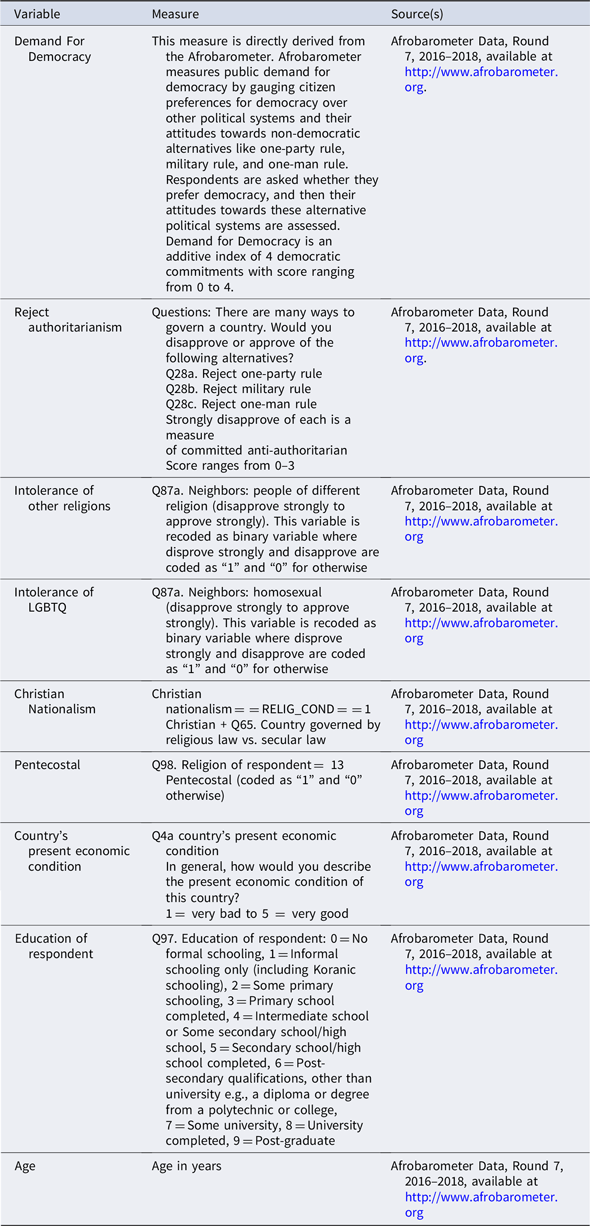
The list of variables used in this study and how they are measured via Afrobarometer data is provided below in Table 1.
Measures of variables

There are four dependent variables used in this study that measure institutional support for democracy (support for democracy, rejection of non-democratic alternatives) and expression of non-democratic attitudes (intolerance of other religions, and intolerance of LGBTQ individuals). To measure support for democracy, I use Afrobarometer’s “Demand for Democracy” that includes measures of support for democracy. Afrobarometer measures public demand for democracy by gauging citizen preferences for democracy over other political systems and their attitudes towards non-democratic alternatives like one-party rule, military rule, and one-man rule. Respondents are asked whether they prefer democracy, and then their attitudes towards these alternative political systems are assessed. Since 2000, Afrobarometer has asked respondents the same series of core questions to gauge their preferences regarding political regimes. To assess the level of popular support for democracy, Afrobarometer asked:
Which of these three statements is closest to your own opinion?
-
Statement 1: Democracy is preferable to any other kind of government.
-
Statement 2: In some circumstances, a non-democratic government can be preferable.
-
Statement 3: For someone like me, it doesn’t matter what kind of government we have.
The measure for support for democracy involves those who say democracy is preferable.
However, there are concerns about the validity of responses to questions that use the “d-word.” For instance, there may be widely differing views of what “democracy” means, or that respondents may simply register socially desirable responses to this question (because they do not want to appear anti-democratic). Thus, to probe the depth of popular commitment to democracy, respondents were asked to evaluate alternative types of non-democratic regimes. Afrobarometer asked:
There are many ways to govern a country. Would you disapprove or approve of the following alternatives?
-
A. Only one political party is allowed to stand for election and hold office.
-
B. The army comes in to govern the country.
-
C. Elections and Parliament are abolished so that the president can decide everything.
The “demand for democracy” measure results by combining the support for democracy and rejection of alternatives scores in a composite additive index score.
However, as an additional check, I also included rejection of authoritarianism separately as an additional dependent variable. This is because individuals may think of democracy and autocracy being very separate from each other. This variable is an additive measure that combines the rejection of three non-democratic alternatives listed above.
The third and fourth dependent variables I use are “intolerance of other religions” as neighbors and “intolerance of homosexuals as neighbors.” This question has been widely used as a measure of tolerance towards various groups (Gani Reference Gani2015; Berggren and Elinder Reference Berggren and Elinder2012; Florida Reference Florida2002). American scholars studying Christian Nationalism have identified intolerance of other religions and intolerance towards “out groups” as hallmarks of anti-democratic attitudes (Al-Kire Reference Ai-Kire2023). One of the most targeted out groups is homosexuals (Perry and Whitehead, Reference Perry and Whitehead2015a; Perry and Whitehead, Reference Perry and Whitehead2015b; Du Mez Reference Mez and Kobes2020; Whitehead and Perry Reference Whitehead and Perry2020; Gorski and Perry Reference Perry, Whitehead and Grubbs2022). Although there are certainly other anti-democratic attitudes, according to Ai-Kire (Reference Ai-Kire2023), such as favoring voter suppression and holding a belief in conspiracy theories, these are not included in the Afrobarometer. Thus, I employ the two dependent variables related to religious tolerance and tolerance of homosexuals.
For these two variables, I recode the responses from the Afrobarometer, where “strongly disapprove” and “disapprove” are coded as “1” and “0” for otherwise. Although the original measure was ordinal (with 1=Strongly dislike, 2=Somewhat dislike, 3=Would not care, 4=Somewhat like, and 5=Strongly like) I chose to recode these variables into binary measures. This is because I am interested in whether the respondent dislikes being a neighbor of other religions or homosexuals, as opposed to not disliking. It is also unclear as to whether there are major differences between strongly dislike and somewhat dislike, but there is a clear difference between dislike and the other responses. Further, this makes the direction and magnitude of the coefficients easier to interpret. Thus, these are used as proxy measures of intolerance, which is a critical component that is inimical to democracy according to the existing literature.
Turning to the independent variables, the primary explanatory variable is “Christian nationalism.” The above literature that conceptualizes Christian Nationalism points to two key dimensions that characterize Christian nationalist attitudes. First, the nation is defined as a community of Christians. Second, Christian nationalism, as a political ideology, sees control of the state as a key political goal to enact the creation of God’s kingdom on Earth.
Thus, as a measure of the extent to which an individual identifies as a Christian nationalist, I combine two questions to identify those who are likely to express a Christian nationalist view.Footnote 3 First, the individual must identify as a Christian (as opposed to other non-Christian religions, i.e., variable RELIG_COND==1). Second, I add the response from Q65 which asks whether the country should be governed by religious law or secular law. Since Christian nationalists believe in God’s kingdom on Earth, they should favor government based on religious law.Footnote 4
In addition, since the existing literature suggests that Pentecostal individuals are particularly prone towards Christian nationalist sentiments, I also include a dummy variable for individuals who identify themselves as Pentecostal.
Beyond these two primary explanatory variables, there are three control variables that are included, which can also affect attitudes about democracy. These control variables are derived from much of the literature that identifies factors that affect attitudes about democracy, particularly in Africa. I include these three variables (economic performance of the country, education level of the individual, and age of the respondent) as controls since they have been identified by Afrobarometer as being three of the most important individual level actors affecting attitudes towards democracy in Africa (Afrobarometer 2024; Evans and Rose Reference Evans and Rose2007).
First, there is an economic question, which asks individuals about their view of the state of the economy. Individuals who are satisfied with the state of the economy often translate into satisfaction with democracy, independent of cultural or political orientation (Gunther, Montero, and Torcal, Reference Gunther, Montero, Torcal, Gunther, Montero and Puhle2006; Przeworski et al., Reference Przeworski1995). Second there is the level of education of the respondent. As has long been held by modernization theory, broadening access to education promotes positive attitudes about democracy (Bendix Reference Bendix1964; Apter Reference Apter1965). Thus, respondents who have higher level of education should generally be more supportive of democracy than those with less education. Finally, I control for the age of the respondent. Some recent literature suggests that younger people are generally less supportive of democracy than older individuals, and suggests this is a global phenomenon (Claassen and Magalhaes Reference Claassen and Magalhaes2023).
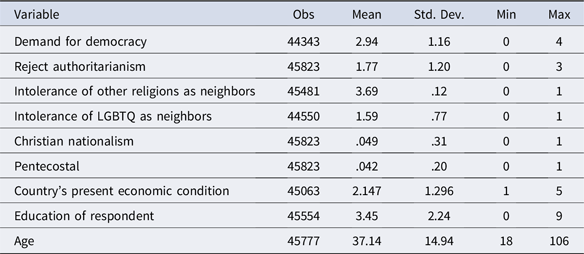
A summary of the variables used in the analysis is below with the reported descriptive statistics in Table 2.
Descriptive statistics

Analysis
Turning to the empirical analysis, I first examine the question of the geographic distribution of Christian Nationalism. In Figure 1 above, the overall percentage of respondents fitting the Christian nationalist profile is quite small, with only about 15.5% of the population reporting attitudes consistent with Christian nationalism. Further, not surprisingly, one of the highest concentrations of Christian nationalists is in Zambia, where it has been active the longest and where the constitution has enshrined the idea that the country is a Christian country.Footnote 5 However, other countries that have been mentioned in the literature, such as Nigeria and Cote D’Ivoire are below the African total, despite their being mentioned as cases where the sense of Christian nationalism is strong. Although one must be careful to draw conclusions based upon the above measure of Christian nationalism, because different measures may lead to different results (although I am limited by the Afrobarometer data I use), these results do not support some of the claims made in the literature.
Is Christian nationalism concentrated in the political elite of these countries? To determine elite status, in Table 3 above, I considered whether individuals reported having attained a post-secondary degree (or the most educated part of the population) and those from occupations that are managerial/professional. To address the question of whether Christian Nationalists are concentrated in the elite, in Table 3 above, I considered the proportion of the population that had attained a post-secondary degree and the proportion of those reporting managerial/professional occupation who are Christian nationalists. Based upon the distributions reported in Table 3, Christian nationalism does not appear to be concentrated in elite groups as has been suggested by some of the existent literature. Indeed, the proportions appear to be less among elites than in the general population.
Are Christian nationalists concentrated in the elite?

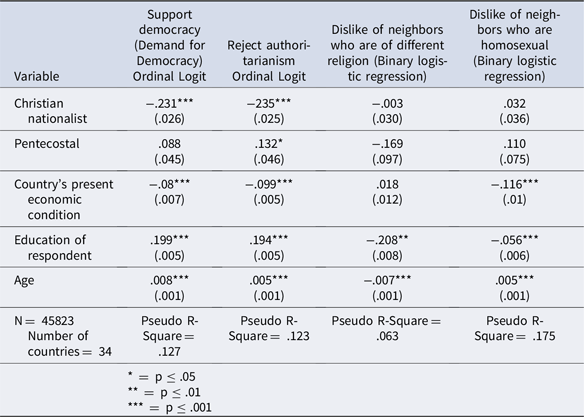
Turning to Table 4, which reports whether Christian nationalists are more or less likely to support democracy and reject authoritarian alternatives, and exhibit higher levels of intolerance of out groups, the results suggest some support for the argument that Christian nationalists tend to be less supportive of democracy and more tolerant of authoritarian alternatives to democracy. Table 4 reports the results of using an ordinal logistic regression procedure with country-fixed effects (approximated by using country dummy variables) for the four dependent variables.Footnote 6 As is indicated, as predicted by hypothesis 1, Christian nationalists are significantly less likely to support democracy. Further, as predicted by hypothesis 2, Christian nationalists are significantly less likely to reject authoritarianism. These findings are consistent with the literature that warns the rise of Christian Nationalism on the continent does not bode well for democracy in Africa.
Interestingly, in terms of tolerance, Christian nationalists are neither more nor less tolerant of neighbors who are of different religions than themselves and are not any more intolerant of LGBTQ individuals than the rest of the population. This might suggest that Christian nationalists are more tolerant than the literature suggests. However, these results should be interpreted carefully. The results for tolerance of other religions merely mean that Christian nationalists may be tolerant of other Christians, since the question does not specify living next to non-Christians (e.g., Muslims). Thus, this measure does not really capture entirely the extent to which Christian nationalists tolerate non-Christians.Footnote 7 Second, regarding LGBTQ individuals, the results simply indicate that Christian nationalists are not any more likely to report not wanting to have LGBTQ neighbor. However, given that the vast majority of respondents in Africa report not wanting a LGBTQ neighbor (around 80% of respondents), all these results indicate is that Christian nationalists are not any different from other Africans.
What about Pentecostals? The results in Table 4 indicate that, contrary to the claims made in the existing literature on Christian nationalism in Africa, Pentecostals are more likely to support democracy than other non-Pentecostals. There does not appear to be anything particular about Pentecostals that makes them support democracy less than others. On the other hand, Pentecostals are also significantly more likely to reject authoritarianism than others. Thus, contrary to the literature, Pentecostals may not favor an authoritarian “kingdom on earth” instead of “corrupt” democracies. These results question the argument in the literature that Pentecostalism is behind the anti-democratic attitudes that are associated with dominionism. Further, Pentecostals are significantly more likely to embrace members of other religions as neighbors but are neither more nor less likely to tolerate members of the LGBTQ as neighbors than the general population. Neither of these findings support the notion that Pentacostals are significantly more intolerant of out groups than the general population.
Discussion and Conclusions
The above paper was a general attempt to empirically test some of the arguments made about the anti-democratic nature of Christian nationalism in Africa. Indeed, Christian nationalism is associated with lower support for democracy and a lower likelihood for rejecting authoritarian political alternatives to democracy. This supports much of the literature that focused on Christian nationalist sentiments among African leaders and how those sentiments represented a threat to democracy. It appears that such sentiments are shared in the population, but as indicated above, the proportion of Africans who are Christian nationalists, does not appear large. Further, they are not concentrated in the ranks of the elites of African countries. Thus, the number of Christian nationalists in the population is not likely to represent a mass threat to democracy. It also means that there may not be as much support in the population for this kind of Christian nationalism that appears to have captivated the attention of African leaders.
Logistic regression with country-fixed Effects, Christian nationalism, democracy, autocracy, and tolerance of out groups

Second, it appears that Christian nationalists are not more or less tolerant of other religions and LGBTQ individuals than the rest of the population in Africa. Although it might be tempting to conclude that Christian nationalists are more tolerant than the literature suggests. However, as I note above, these results should be interpreted carefully. The religion question does not distinguish between Muslims and “other religions” (and, thus, does not capture the purported anti-Muslim bias of Christian nationalists). Further, the fact that Christian nationalists are not more intolerant of LGBTQ individuals when compared to other Africans may reflect that most Africans are intolerant regarding homosexuality.
Third, the emphasis on the role of Pentecostalism on Christian Nationalism may be a bit overblown. Indeed, some Christian nationalist leaders are located in countries where the focus is on other Christian religions such as Catholicism in Cote Ivoire and Orthodoxy in Ethiopia. Further, Pentecostals are not inevitably Christian nationalists, at least in terms of the general population.
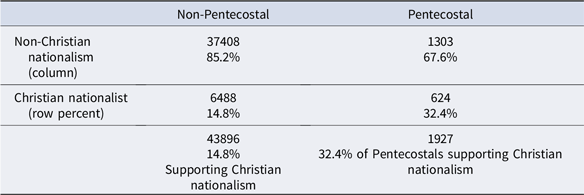
Table 5 reports the results of examining the relationship between Christian Nationalism and Pentecostals using the Afrobarometer data. A larger proportion of Pentecostals are Christian nationalists (32.4%) when compared to non-Pentecostals (14.8%). To be sure, this is higher than the 14.8% of non-Pentecostals supporting Christian nationalism, but Christian nationalist Pentecostals only make up 9.6% of the Christian nationalist population. This does not suggest support for the argument that Pentecostals are the leading edge of Christian nationalism on the continent, as has been suggested by the literature.
Christian nationalism and Pentecostals

In future projects, there are a number of additional research questions that should be explored. For instance, who is a Christian nationalist in Africa? Are particular minority groups attracted to Christian nationalism? Are those who are traditionally most marginalized in African societies more likely to be attracted to Christian nationalism (i.e., it rises from victimhood)? Is the spread of the ideology catalyzed by civil war and conflict? These and other questions represent a promising research agenda exploring the effects of Christian nationalism in Africa.
Nonetheless, the rise of Christian nationalism represents a potential challenge for democracy on the continent. The extent to which it takes root among the African masses remains to be seen, but since many African leaders are now pursuing this option as the basis for the state’s ideology (as is the case in Cote D’Ivoire, Zambia, and Ethiopia), this represents a continuing challenge to democracy and stability on the continent. Whether Africans follow their leaders in pursuing a Christian nationalist ideal for politics and the organization of the state remains to be seen—if they do, this will create many challenges to democracy and stability on the continent. Given this challenge, in sum, the study of the development and impact of Christian nationalism in Africa will remain an important area of inquiry for the foreseeable future.



 Open access

