


The prevalence of overweight has been increasing dramatically throughout the world during past decades. This trend has received a lot of attention in both the scientific and non-scientific literature. The majority of the literature showing the public health impact of overweight is on diabetes and CHD. Fewer studies show the impact of overweight on unhealthy life-years or its relationship with musculoskeletal disorders and disabilities such as impaired functioning in daily activities(Reference Han, Tijhuis, Lean and Seidell1) and work disability(Reference Rissanen2).
Osteoarthritis (OA) is known to be one of the most prevalent joint disorders and is the leading cause of physical disability in the elderly(Reference Lievense, Bierma-Zeinstra, Verhagen, van Baar, Verhaar and Koes3, Reference Peat, McCarney and Croft4). Previous research has shown that overweight is the most important modifiable risk factor in the development of OA(Reference Coggon, Reading, Croft, McLaren, Barrett and Cooper5–Reference Hochberg, Lethbridge-Cejku, Scott, Reichle, Plato and Tobin7). Owing to the ageing population in The Netherlands and the increasing rate of overweight(Reference Gast, Frenken, Van Leest, Wendel-Vos and Bemelmans8, Reference Schokker, Visscher, Van Baak and Seidell9), it is expected that the prevalence of OA will increase greatly over the next few years(Reference Visscher and Seidell10). One consequence of this trend is that OA-related health problems such as disability in mobility will also increase, as will the need for health-care facilities such as total knee replacement surgery and rehabilitation. With the ageing of the population physical dysfunctions are a major public health concern of the near future(Reference Picavet and Hoeymans11), so we were interested not only in the role of overweight in OA but also in the role of overweight in OA-related disability.
The objectives of the present study were to examine the associations between overweight and health problems of the lower extremities, i.e. OA, pain and disability.
Materials and methods
Study population
Baseline data from the Dutch population-based Musculoskeletal Conditions & Consequences Cohort (DMC3 study) were analysed. This study was executed in 1998 to examine physical disabilities and musculoskeletal conditions among the Dutch population. A random sample of 8000 men and women aged 25 years and over, stratified by 10-year age group and sex (equal numbers in each age–sex band), was taken from the population register of 1998. Data were obtained by a postal questionnaire. The net response rate of the DMC3 study was 46·9 % (n 3664). The response was slightly higher for women and for those aged 45–64 years(Reference Picavet and Schouten12, Reference Picavet13).
Questionnaire structure
The questionnaire contained general and health questions. Musculoskeletal disorders and pain in five different anatomical areas were recorded on pages with different colours(Reference Picavet and Schouten12). Data of the areas ‘hip and knee’ and ‘ankle and foot’ were used in the present analyses. Every coloured area started with a screening question: ‘Did you have pain in this joint during the last twelve months?’ Those who answered yes to this question were asked to answer all the questions of the relevant colour, focusing on the anatomical site, whether or not the pain still exists, the duration and severity of the pain, the course of the pain, self-reported causes, specific complaints and some consequences of the pain, e.g. health-care utilization or limitations in daily activities.
Definitions
Overweight
Participants were asked to report their height without shoes in centimetres and to report their weight without clothes in kilograms, from which BMI (kg/m2) was calculated. Overweight was defined as BMI ≥ 25·0 kg/m2, moderate overweight as 25·0 kg/m2 ≤ BMI < 30·0 kg/m2 and obesity was defined as BMI ≥ 30·0 kg/m2. We did not distinguish underweight, BMI < 18·5 kg/m2, because numbers were very low (n 51, 1·4 %). We excluded those with missing data for weight or height (n 119, 3·2 %).
Health problems of the lower extremities
In the present study, health problems of the lower extremities were classified according to the following definitions.
1. OA of the hip or knee: A positive answer to the question ‘Have you ever been told by a doctor that you have osteoarthritis?’ or ‘Are you in treatment for osteoarthritis by a general practitioner or medical specialist?’ Knee and hip OA were distinguished separately. Given the structure of the questionnaire we assumed that not ticking ‘yes/no’ to a specific disease implied not having that specific disease (n 549). Those with missing values either had missing ticks for all questions on musculoskeletal diseases (n 217) or only ticked ‘yes’ for those diseases the person had (n 332). So not ticking ‘yes/no’ implied ‘not applicable’, i.e. not having the disease.
2. Chronic pain in the lower extremities: Those who reported pain of the lower extremities, i.e. hip, knee, ankle or foot, with duration of longer than 3 months.
3. OA and chronic pain: Respondents with OA of the hip or knee who also reported chronic pain in at least one location of the lower extremities.
4. OA or chronic pain: Participants with either OA of the hip or knee or chronic pain reported in at least one location of the lower extremities.
Disabilities were reported according to the Euroqol questionnaire (EQ-5D)(14). The EQ-5D consists of five questions with the following dimensions: mobility, self-care, usual activities, pain and anxiety/depression. Each question contains three response categories(Reference Picavet and Hoeymans15): ‘no problems with’ (=1); ‘some problems with’ (=2); ‘many problems with or impossible to…’ (=3). Participants were coded disabled when they marked the answers ‘2’ or ‘3’. Missing values were assumed to indicate no problems (missing one of the five dimensions: n 200, 5·5 %).
Statistical analyses
The associations between OA of the hip or knee, chronic pain, disabilities and overweight were studied by the use of multiple logistic regression analysis, with adjustment for potential confounding by sex and age. The Statistical Package for the Social Science statistical software package version 12·0 (SPSS Inc., Chicago, IL, USA) was used for the computations. The characteristics of the study population are presented herein without standardization. This can result in differences with respect to former data published with standardization.
Results
Overweight affected 44·9 % of the respondents and 9·3 % were obese. Almost 30 % of the population reported chronic pain at one or more location(s) of the lower extremities or self-reported OA. A quarter of the sample reported disability in mobility (Table 1).
Characteristics of the study population: the Musculoskeletal Conditions & Consequences Cohort (DMC3 study), The Netherlands, 1998
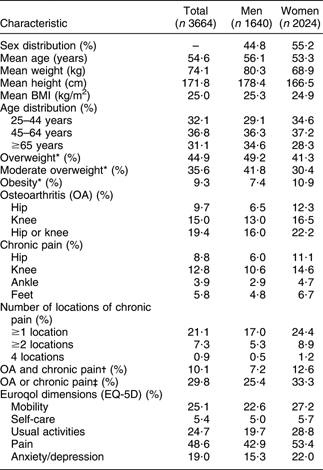
*Overweight defined as BMI ≥ 25·0 kg/m2, moderate overweight as 25·0 kg/m2 ≤ BMI < 30·0 kg/m2 and obesity as BMI ≥ 30·0 kg/m2; 119 participants had missing data for weight or height.
†Participants who reported OA of the hip or knee and at least one location of chronic pain.
‡Participants who reported OA of the hip or knee or at least one location of chronic pain.
Overweight was associated with a higher prevalence of health problems of the lower extremities, regardless of definition (Table 2). There also appeared to be a dose–response relationship between the degree of overweight and the presence of OA, pain and disabilities. For instance, for OA or chronic pain, the OR for moderate overweight was 1·6 (95 % CI 1·4, 1·9) and for obesity it was 2·6 (95 % CI 2·1, 3·4). The association seemed particularly strong between obesity and OA of the knee (OR = 3·1; 95 % CI 2·4, 4·2) and between obesity and chronic knee pain (OR = 3·1; 95 % CI 2·3, 4·1). In addition, we analysed the role of BMI as a continuous variable. For each unit increase in BMI respondents were 8 % more likely to report OA or chronic pain.
Associations of overweight/obesity with osteoarthritis (OA)-related health problems and disability in the total population: the Musculoskeletal Conditions & Consequences Cohort (DMC3 study), The Netherlands, 1998
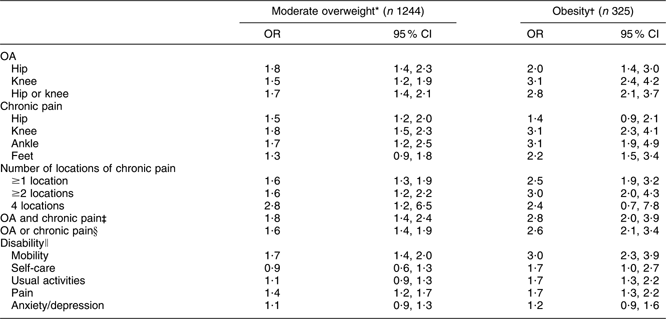
*Moderate overweight defined as 25·0 kg/m2 ≤ BMI < 30·0 kg/m2.
†Obesity defined as BMI ≥ 30·0 kg/m2.
‡Participants who reported OA of the hip or knee and at least one location of chronic pain.
§Participants who reported OA of the hip or knee or at least one location of chronic pain.
∥Disability according to Euroqol dimensions (EQ-5D).
Overweight and obesity were also associated with a higher prevalence of disability, particularly with disability in mobility (moderate overweight: OR = 1·7; 95 % CI 1·4, 2·0; obesity: OR = 3·0, 95 % CI 2·3, 3·9) and pain (moderate overweight: OR = 1·4; 95 % CI 1·2, 1·7; obesity: OR = 1·7, 95 % CI 1·3, 2·2) (Table 2). Also among those with self-reported OA or pain, overweight and obesity were associated with disability in mobility (OR = 1·3; 95 % CI 1·0, 1·8 for moderate overweight; OR = 2·4; 95 % CI 1·6, 3·6 for obesity) (Table 3). Among those with self-reported OA or pain there was no association of overweight with any of the other EQ-5D dimensions.
Effect of overweight/obesity on associations of osteoarthritis (OA)-related health problems with disability among participants with OA: the Musculoskeletal Conditions & Consequences Cohort (DMC3 study), The Netherlands, 1998
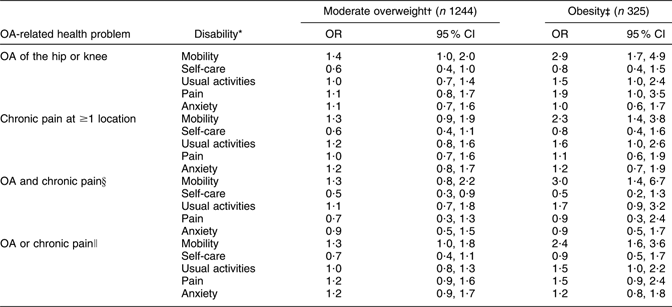
*Disability according to Euroqol dimensions (EQ-5D).
†Moderate overweight defined as 25·0 kg/m2 ≤ BMI < 30·0 kg/m2.
‡Obesity defined as BMI ≥ 30·0 kg/m2.
§Participants who reported OA of the hip or knee and at least one location of chronic pain.
∥Participants who reported OA of the hip or knee or at least one location of chronic pain.
The data were also analysed by age group and sex. No differences in patterns were found by age group but some differences were found between men and women (data not shown): overweight was more strongly associated with knee OA in women than in men and moderate overweight was more strongly associated with OA of the hip among men. Among those with OA, moderate overweight was more associated with disability in mobility in men than in women.
Discussion
The present study shows that overweight is associated with OA and that overweight increases the risk of disability in mobility, both in the general population and among those with OA. The study also reveals that overweight is associated with both hip and knee OA, the association being strongest for knee OA.
These associations are comparable to those found in previous cross-sectional, cohort and case–control studies. For OA of the knee, earlier published data are summarized in Table 4(Reference Coggon, Reading, Croft, McLaren, Barrett and Cooper5–Reference Hochberg, Lethbridge-Cejku, Scott, Reichle, Plato and Tobin7, Reference Anderson and Felson16–Reference Holmberg, Thelin and Thelin27), where it can be seen that the range in odds or relative risk is 1·9–6·8. In the present study we found OR of 1·5 (moderate overweight) and 3·1 (obesity) for OA of the knee and OR of 1·8 (moderate overweight) and 3·1 (obesity) for chronic pain of the knee. The descriptions in Table 4 show that the definitions of both knee OA and BMI categories differed substantially between the studies, as did the study populations and methods of analysis. However, it is clear is that both moderate overweight and obesity have an impact on knee OA, with higher associations with increasing BMI.
The association of osteoarthritis (OA) of the knee with overweight or obesity: results from some previous studies

NHANES I, First National Health and Nutrition Examination Survey; SWAN, Study of Women's health Across the Nation; TKR, total knee replacement; prev, prevalence; HRT, hormone replacement therapy; VAS, visual analogue scale; MRW, metropolitan relative weight.
*BMI units are kg/m2 throughout; values in parentheses after odds ratio or relative risk (RR) are 95 % CI.
The OR that we found for OA of the hip (1·8 for moderate overweight, 2·0 for obesity) and chronic pain of the hip (1·5 for moderate overweight, 1·4 for obesity) are also in line with published results: Lievense et al. presented odds in the range of 1·2–5·2 in a review on overweight and hip OA(Reference Lievense, Bierma-Zeinstra, Verhagen, van Baar, Verhaar and Koes3). They reported that the association between obesity and hip OA was stronger in studies in which the diagnosis was based not only on radiographic criteria but also on joint symptoms. Recent additional studies by Flugsrud et al.(Reference Flugsrud, Nordsletten, Espehaug, Havelin and Meyer28, Reference Flugsrud, Nordsletten, Espehaug, Havelin, Engeland and Meyer29) and Karlson et al.(Reference Karlson, Mandl, Aweh, Sangha, Liang and Grodstein30) also showed only a weak association between overweight and radiographic hip OA. Felson et al.(Reference Felson and Zhang31) reported that it is preferable to define OA by the presence of symptoms and radiographic change; however, they also stated that, especially for knee OA, some studies using symptom-based definitions of OA have yielded roughly similar results to studies using radiographic evidence. In the present study we used data based on hip pain and self-reported hip OA. Owing to our public health point of view we followed the advice from a working group of experts that ‘symptomatic arthritis rather than radiographic evidence of arthritis should be used to measure prevalence. Symptomatic includes both self-reported arthritis as well as reported pain in the joints’(Reference Tugwell, Chambers, Torrance, Reynolds, Wolfson, Bennett, Badley, Jamieson and Stock32). In addition there is also some evidence that a substantial proportion of those persons with hip or knee pain as identified with a questionnaire have radiographic OA(Reference O’Reilly, Muir and Doherty33, Reference Quintana, Arostegui, Escobar, Lafuente, Arenaza, Garcia and Aguirre34).
It is known that, compared with other chronic diseases, people with OA of the hip or knee report the worst quality of life among people with musculoskeletal diseases(14). Overweight and obesity play a role in this relationship: moderate overweight and in particular obesity were associated with disabilities in the present study, both among those with and without OA. This is also reported in previous studies(Reference Felson, Zhang, Hannan, Naimark, Weissman, Aliabadi and Levy22, Reference Okoro, Hootman, Strine, Balluz and Mokdad35–Reference Zamboni, Mazzali, Zoico, Harris, Meigs, Di Francesco, Fantin, Bissoli and Bosello38). Schouten et al. reported that disabilities could partly be due to cartilage loss, which is known to be strongly associated with knee OA and overweight(Reference Schouten, van den Ouweland and Valkenburg36). Peltonen et al.(Reference Peltonen, Lindroos and Torgerson37) concluded that obese subjects have more problems with work-restricting musculoskeletal pain than non-obese subjects. In a review Zamboni et al.(Reference Zamboni, Mazzali, Zoico, Harris, Meigs, Di Francesco, Fantin, Bissoli and Bosello38) found that body weight and BMI play a significant role in non-fatal physical disability in the elderly. In addition to these findings, it is meaningful to examine whether weight loss might prevent OA or delay its progression. Messier et al.(Reference Messier, Gutekunst, Davis and DeVita39) indicated that each pound (∼0·5 kg) of weight loss will result in a fourfold reduction in the load exerted on the knee per step during daily activities. Zamboni et al.(Reference Zamboni, Mazzali, Zoico, Harris, Meigs, Di Francesco, Fantin, Bissoli and Bosello38) also suggested that even small amounts of weight loss might be beneficial. Weight loss can be reached by a combination of physical activity and dietary weight loss. Both must be dosed moderately to provide better overall improvements in self-reported measures of function and pain and in performance measures of mobility(Reference Messier, Loeser, Miller, Morgan, Rejeski, Sevick, Ettinger, Pahor and Williamson40). In addition, weight loss has been reported to improve mobility-related self-efficacy(Reference Focht, Rejeski, Ambrosius, Katula and Messier41). These results also show that among those with OA, positive effects of weight loss can be found in terms of less disability, better quality of life and reduced health-care costs.
To explore the public health importance of the association of overweight and obesity with health problems of the lower extremities, we can also estimate the population-attributable risk (PAR): around 28 % of OA of the hip or knee is estimated to be attributed to overweight and almost 10 % to obesity in the present population. For the calculation of PAR, valid estimates for both the relative risks and the prevalences of overweight and obesity are needed(Reference Rothman and Greenland42). Using the OR as an estimation of the relative risk is limited by two factors: (i) calculating the PAR implies causality of the association studied, but the association is based on a cross-sectional survey; and (ii) the OR is generally not a good estimation of the relative risk in cases where the rare disease assumption is not met, although most outcome variables were lower than 20 %. With these limitations the estimated PAR should be interpreted with caution, but the OR we used in the PAR calculation was of the same order of magnitude as the relative risk estimates published in the literature and are even in the lower part of the range. This would suggest that our estimated PAR is an underestimation rather than an overestimation. The percentages of overweight and obese participants we used in the PAR estimation are similar to those presented in other Dutch studies(Reference Gast, Frenken, Van Leest, Wendel-Vos and Bemelmans8, Reference Schokker, Visscher, Van Baak and Seidell9). Although probably being underestimated, our PAR estimations are similar to those reported by others. Felson et al.(Reference Felson and Zhang31) reported a potential theoretical reduction in the incidence of hip OA of 26 % by eliminating obesity. Both Felson et al.(Reference Felson and Zhang31) and Hochberg et al.(Reference Hochberg, Lethbridge-Cejku, Scott, Reichle, Plato and Tobin7) estimated that 26–52 % of knee OA could be prevented by eliminating obesity. Coggon et al.(Reference Coggon, Reading, Croft, McLaren, Barrett and Cooper5) calculated a theoretical reduction of 57 % of total knee replacements if weight in the total population could be reduced to bring BMI in the normal range. Leveille et al.(Reference Leveille, Wee and Iezzoni43) estimated that 25·9 % of self-reported physician-based diagnoses of arthritis could be attributed to overweight and obesity in the most recent wave (1999–2002) of the US National Health and Nutrition Examination Survey.
The present study has some methodological limitations. First, the DMC3 study relies on self-reported data. These data could be influenced by reporting biases of various sorts. It is known that participants, especially the obese, tend to underestimate their weight. Moreover, participants tend to overestimate their height(Reference Okoro, Hootman, Strine, Balluz and Mokdad35). This could lead to an attenuated relationship between BMI and health outcomes.
Second, like other population-based studies in The Netherlands, the DMC3 study also has a relative high non-response(Reference Hupkens, van den Berg and van der Zee44). However, respondents and non-respondents did not differ in general characteristics, such as marital status, sex, age and region of living, from persons on the population register(Reference Picavet13). Only the group who is unmarried or divorced was slightly under-represented. We also compared the response to the DMC3 study with an interview survey carried out in The Netherlands at the same time; the differences were also small for characteristics such as work status, several chronic conditions, and health determinants like smoking, BMI and utilization of health-care services(Reference Picavet13). In addition, for the prevalence of musculoskeletal pain (and maybe also OA) it is suspected that the figures are slightly overestimated: late responders had slightly lower rates than early responders and a specific study among 729 non-responders showed slightly lower period prevalences but similar point prevalences of musculoskeletal pain(Reference Picavet and Schouten12).
Another limitation of the current study is that disability was assessed solely on the basis of a global measure, disability in mobility, as measured by the EQ-5D. Future studies should include more detailed data on disability because overweight seems to have an impact. Moreover, the case definition of self-reported OA might include some persons with injuries rather than arthritis. Finally, because of the cross-sectional design, we could not determine causality. It is possible that the risk factor of overweight develops or changes in prevalence after the onset of OA. It is also impossible to determine whether overweight participants with disability in mobility became overweight before or after the onset of disability.
The results of the present study confirm that, within the Dutch population aged >25 years, overweight is a risk factor for health problems of the lower extremities, i.e. OA and/or chronic pain. Overweight and especially obesity are also associated with an increased risk of disability in mobility, both among those with and without OA or chronic pain. With the prevalence of overweight arising at a younger age increasing and with the increasingly ageing population, this is reason for concern and argues for more attention to be paid to preventing overweight. In addition, there is some indication that the association of overweight/obesity with arthritis has become much stronger during the last three decades: Leveille et al.(Reference Leveille, Wee and Iezzoni43) estimated that the PAR for arthritis increased from 7·8 % (both overweight and obesity) in 1971–1974 to 25·9 % in 1999–2002. The data analysed in the present paper were collected in 1998, a decade ago, and the current prevalences of overweight and obesity might be even greater. The same could also be true for the PAR, as suggested by the trend of Leveille et al.(Reference Leveille, Wee and Iezzoni43), and this is an extra reason for concern about the health risks of overweight and obesity. This calls for attention to the development of new longitudinal studies on this topic, because the lifetime exposure of the current young and middle-aged population is very different from that of the same population a few decades ago, and this can imply different (and higher) risks.
In general, it important for professionals who are involved with problems resulting from overweight to realize that the burden of obesity is associated not only with diabetes and CVD but also with OA-related health problems. It cannot be accepted that OA, which is known as a disorder of old age, will in the future be increasingly diagnosed among adolescents, like type 2 diabetes is now(Reference Rosenbloom, Joe, Young and Winter45).
Conclusions
What this paper adds
1. It is well known that overweight and in particular obesity are risk factors for osteoarthritis of the lower extremities.
2. The study shows the association between overweight/obesity and health problems of the lower extremities, taking into account (self-reported) osteoarthritis, pain of the knee or hip, and disability in walking.
3. Among patients with osteoarthritis and chronic pain, both moderate overweight and obesity are associated with disability in walking.
4. Around 25 % of health problems of the lower extremities are estimated to be due to overweight and obesity.
5. With the ‘epidemic’ of obesity, its impact on osteoarthritis and disability is extra reason for concern.
Policy implications
1. There is an increasing public health policy awareness of the consequences of the increasing prevalences of overweight and obesity. This is focusing on diabetes and cardiovascular risks.
2. In addition, the risk on health problems of the lower extremities, including osteoarthritis, chronic pain and disability, should be taken into account, which has an effect on the planning of health facilities (e.g. total knee replacement and rehabilitation) and the need for development of preventive interventions.
Acknowledgements
Sources of funding: The Dutch population-based Musculoskeletal Complaints & Consequences Cohort (DMC3 study) was supported financially by the Ministry of Health, Welfare and Sport of The Netherlands and the National Institute of Public Health and the Environment.
Conflicts of interest: None declared.
Author contributions: A.T. carried out the data analyses, literature review and drafted the paper. T.L.S.V. and H.S.J.P supervised this work. H.S.J.P. designed the original study and the idea for the current analyses. All authors contributed to interpretation of the findings and finalizing the manuscript.
Acknowledgement: The DMC3 study was carried out in collaboration with Statistics Netherlands.



