





1. Introduction
When readers and listeners comprehend language in real-time, they quickly make meaning of sentences incrementally as new words appear (Tanenhaus et al., Reference Tanenhaus, Spivey-Knowlton, Eberhard and Sedivy1995). However, they can also make predictions about upcoming linguistic content, which is argued to facilitate processing (Kuperberg & Jaeger, Reference Kuperberg and Jaeger2016). Although the term “prediction” has been used with different meanings (Kuperberg & Jaeger, Reference Kuperberg and Jaeger2016), we understand it to refer to the use of incoming input to heighten readiness for upcoming input, which can involve anticipating certain linguistic features and structures (Ferreira & Chantavarin, Reference Ferreira and Chantavarin2018). Researchers have demonstrated that native speakers can use many different linguistic cues to make predictions about syntactic, semantic, pragmatic, and lexical information that will appear in sentences (Kuperberg & Jaeger, Reference Kuperberg and Jaeger2016). Considering these findings, L2 researchers began to ask the following: Can L2 learners also use prediction in real-time like native speakers, and how does their predictive ability develop with experience?
A growing body of work has since shown that L2 learners do use predictive mechanisms based on many types of cues, including verbal restrictions, grammatical gender, and prosody (Dussias et al., Reference Dussias, Valdés Kroff, Guzzardo Tamargo and Gerfen2013; Henry et al., Reference Henry, Jackson and Hopp2022; Koehne & Crocker, Reference Koehne and Crocker2015). However, how these mechanisms develop and the degree to which they match those of native speakers are questions that require more research (Kaan & Grüter, Reference Kaan, Grüter, Kaan and Grüter2021). In some cases, L2 learners with high proficiency have used prediction in a nativelike way (Dussias et al., Reference Dussias, Valdés Kroff, Guzzardo Tamargo and Gerfen2013; Lee et al., Reference Lee, Lu and Garnsey2013). In other cases, even advanced L2 learners have performed differently than L1 speakers on prediction-based tasks (Hopp, Reference Hopp2015; Kaan et al., Reference Kaan, Kirkham and Wijnen2016).
To further refine our understanding of the development of L2 prediction, we compare L2 Spanish learners’ and native Spanish speakers’ ability to use word order cues to make predictions about the semantic class of upcoming verbs. In Spanish, psych(ological) verbs that describe emotions tend to be used with the word order object-verb-subject (OVS), while active verbs that describe actions tend to be used with the word order subject-verb-object (SVO; Gattei et al., Reference Gattei, Dickey, Wainselboim and París2015a). See (1).


The presence or absence of the object marker a ‘to’ before the first noun phrase (NP) indicates the likely word order of the sentence, which is enough information for Spanish speakers to build an expectation for what type of verb will appear. A sentence-initial a ‘to’ signals an OVS word order, leading Spanish speakers to predict that a psych verb will appear (Gattei et al., Reference Gattei, Dickey, Wainselboim and París2015a, Reference Gattei, Tabullo, París and Wainselboimb, Reference Gattei, Sevilla, Tabullo, Wainselboim, París and Shalom2017). A bare NP at the beginning of a sentence (with no object marker a), on the other hand, signals an SVO word order, and Spanish speakers predict that an active verb will appear (Gattei et al., Reference Gattei, Dickey, Wainselboim and París2015a, Reference Gattei, Tabullo, París and Wainselboimb, Reference Gattei, Sevilla, Tabullo, Wainselboim, París and Shalom2017).
Based on these processing tendencies in Spanish, the current study addresses the following questions: when reading, do L2 Spanish learners also make verb type predictions based on whether the sentence-initial NP is interpreted as a subject or object? If they do make these predictions, at what proficiency level are they able to do so? To answer these questions, three groups of L2 learners at different proficiencies (beginner, intermediate, advanced) and a control group of native Spanish speakers completed a self-paced reading task with modified materials from Gattei et al. (Reference Gattei, Sevilla, Tabullo, Wainselboim, París and Shalom2017).
This study advances our understanding of L2 prediction/processing and acquisition in several ways. First, because L2 learners with three different proficiency levels took part in this study—including a group of L2 learners with an MA or PhD in Spanish—the results will be relevant to the long-standing question of whether L2 learners can acquire native-like knowledge or processing abilities (Bley-Vroman, Reference Bley-Vroman2009; Clahsen & Felser, Reference Clahsen and Felser2006, Reference Clahsen and Felser2017). Additionally, the focus on L2 learners’ ability to use morphosyntactic information for prediction is much needed due to conflicting findings on this topic (Schlenter & Felser, Reference Schlenter, Felser, Kaan and Grüter2021). Finally, the results will also contribute to the body of work on the L2 processing of the object marker a in Spanish (Hopp & León Arriaga, Reference Hopp and León Arriaga2016; Jegerski, Reference Jegerski2015, Reference Jegerski, Leeser, Keating and Wong2021), given that the identification of the first NP as a subject or object in Spanish hinges on the presence or absence of this marker.
2. Background
Before returning to the implications of SLA, the relationship between word order and verb type in Spanish will be outlined in further detail. As mentioned above, there are strong associations between word order and the semantic class of verbs in Spanish. In declarative sentences with verbs that denote actions, or active verbs (e.g., escribir ‘write’, cantar ‘sing’), the default word order is subject-verb-object (SVO) (Gattei et al., Reference Gattei, Dickey, Wainselboim and París2015a). However, in declarative sentences with a specific class of psychological (psych) verbs that convey cognitive, emotional, or sensory experiences (e.g., gustar ‘like’ and importar ‘matter’), the default word order is object-verb-subject (OVS) (e.g., Gattei et al., Reference Gattei, Dickey, Wainselboim and París2015a; Gutiérrez-Bravo, Reference Gutiérrez-Bravo2007). It is not ungrammatical to use active verbs with OVS word order or psych verbs with SVO word order, but these combinations are less common. Therefore, because grammaticality does not distinguish the different word order/verb type combinations, the concept of markedness will be used instead. Markedness has been used with different meanings (Haspelmath, Reference Haspelmath2006), but we use the term “unmarked” to refer to frequent, default patterns, and “marked” to refer to less frequent, non-default patterns. The markedness of word order/verb class pairings in Spanish is summarized in Table 1.
Unmarked and marked word order/verb type associations in Spanish
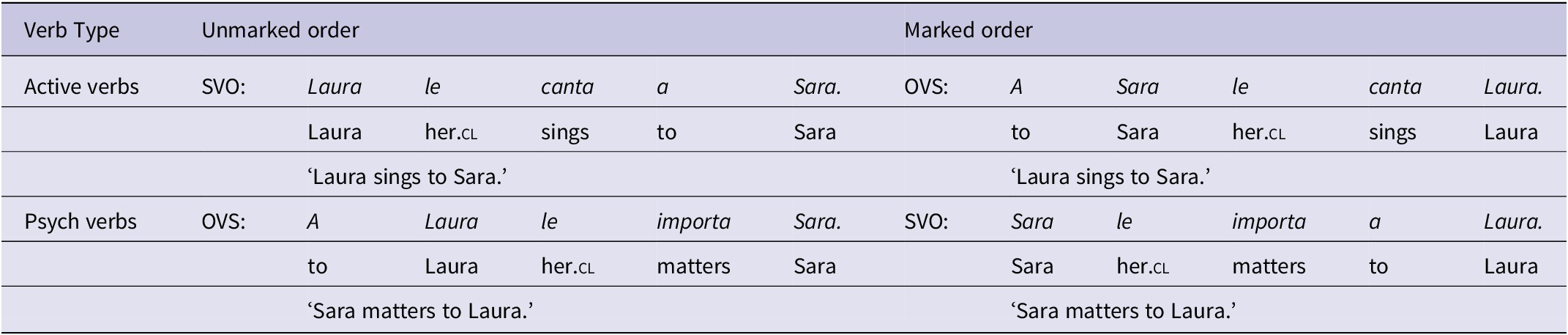
In a self-paced reading study, Gattei et al. (Reference Gattei, Dickey, Wainselboim and París2015a) found that unmarked word order/verb type associations guide Argentine Spanish speakers’ processing behavior. If the first NP in a sentence was interpreted to be an object, which could be deduced from the sentence-initial object marker a ‘to’, participants assumed they were reading an OVS sentence and expected a psych verb to appear. If an active verb appeared instead, a reading delay was observed immediately after the verbal region, which indicated processing difficulty. Conversely, if the first NP in a sentence was not preceded by the object marker a ‘to’, it was interpreted as a subject, which led participants to assume they were reading an SVO sentence and expect an active verb. If a psych verb appeared instead, processing difficulty ensued in the form of longer reading times after the verbal region. In sum, the unmarked patterns (SVO/Active and OVS/Psych) were comparatively easier to process than marked patterns (SVO/Psych and OVS/Active). Gattei et al. (Reference Gattei, Tabullo, París and Wainselboim2015b, Reference Gattei, Sevilla, Tabullo, Wainselboim, París and Shalom2017) also supported these general findings with ERP and eye-tracking studies.Footnote 1
The underlying relationship between syntax and semantics that motivates word order/verb type patterns will not be a central focus in this study because the relationship between L2 learning mechanisms, representational analysis, and real-time processing mechanisms is complex and beyond the scope of this study.Footnote 2 Instead, the focus will be the processing effects that L2 learners experience when encountering the word order/verb type patterns in Table 1, with the aim of discerning whether they are capable of making verb type predictions in real-time based on markedness. Although L2 processing has been shown to develop slowly and is often characterized by non-nativelike tendencies even at advanced proficiencies (Clahsen & Felser, Reference Clahsen and Felser2006), the word order/verb type patterns in the present study are common and typically available in linguistic input early on in L2 learners’ acquisition of Spanish. Whitley (Reference Whitley1995) explains that psychological verbs such as gustar ‘like’ and encantar ‘love’ tend to be some of the first verbs that L2 learners encounter, presumably most frequently in OVS sentences based on the Spanish norm. In contrast, L2 learners would most often encounter active verbs like cantar ‘sing’ and escribir ‘write’ in SVO sentences, which again, is assumed based on the predominance of this pattern in the language. Therefore, we assume that all participants in the present study, both advanced and non-advanced, have been exposed (to varying degrees) to the target structures.
2.1. Relevant L2 processing research
To our knowledge, there are no L2 studies that have examined whether Spanish learners can predict the semantic class of verbs based on word order cues. Nevertheless, there is a growing body of research on prediction in L2 processing that can help contextualize potential findings. L2 prediction can be similar or dissimilar to native speaker prediction, depending on many interrelated factors (Kaan & Grüter, Reference Kaan, Grüter, Kaan and Grüter2021). The effect of L2 proficiency seems to be particularly important, with several studies showing that L2 learners can use nativelike prediction if their proficiency is advanced enough. Other studies show that even L2 learners with advanced proficiency do not utilize prediction in a nativelike way. Both outcomes are described in the following subsection with a summary of two L2 processing studies that examined prediction based on morphosyntactic cues. Additionally, the processing of the object marker a—which is an important word order cue in the present study—has been examined in several L2 processing studies. The findings from these studies will be briefly discussed as well.
2.1.1. Prediction in L2 Research
Dussias et al. (Reference Dussias, Valdés Kroff, Guzzardo Tamargo and Gerfen2013) conducted a visual world eye-tracking experiment to determine whether L2 Spanish learners—like native Spanish speakers (Lew-Williams & Fernald, Reference Lew-Williams and Fernald2007)—were able to use the gender of definite articles to anticipate the upcoming noun in a sentence. Participants simultaneously listened to a recording of a sentence and saw a visual scene that contained both a feminine and masculine noun. In all sentences, the nouns were preceded by a gendered definite article (i.e., la fem. ‘the’ or el masc. ‘the’). The question was, would L2 learners use the gender of the definite article in a sentence to anticipatorily direct their gaze toward the image of the noun with that same gender, before hearing the noun itself? Dussias et al. found that neither L1 English nor L1 Italian participants with low proficiency in L2 Spanish were able to do so in a nativelike way. However, L1 English speakers with high Spanish proficiency performed similarly to native speakers. They were able to use both feminine and masculine articles to anticipate the noun that would appear in a sentence. This suggests that even learners who do not have an L1 with gendered definite articles (English) can use them to make nativelike predictions, as long as they have high enough proficiency. Another morphosyntactic processing study that shows non-nativelike prediction in low-proficiency L2 learners but nativelike prediction in high-proficiency L2 learners is Lee et al. (Reference Lee, Lu and Garnsey2013).
Hopp (Reference Hopp2015), on the other hand, found that even advanced L2 learners did not employ nativelike prediction. He used a visual-world paradigm to examine whether intermediate and advanced L2 German learners and native German speakers could integrate case cues on nouns with verbal semantics to predict upcoming nouns. In one trial, participants saw a scene with a wolf, a hunter, and a deer. They then listened to a sentence that began with the word ‘wolf’ with an accusative case marking (i.e., it was the direct object), followed by the verb ‘kills’. At this point, native speakers tended to anticipatorily look toward the hunter because it was the most plausible post-verbal agent. However, if the word ‘wolf’ was marked with a nominative case (i.e., it was the subject) and was followed by the verb ‘kills’, then native speakers would look toward the deer because it was the most plausible object/patient. In contrast, neither intermediate nor advanced L2 German learners seemed to engage in such prediction based on morphosyntactic cues. When they heard ‘wolf’ and ‘kills’, they looked toward the deer, regardless of the case marking on ‘wolf’. This indicated that, by default, L2 learners interpreted the preverbal ‘wolf’ as the subject and agent of the sentence, leading them to assume that the postverbal noun would be the wolf’s natural prey, a deer. This finding aligns with VanPatten’s (Reference VanPatten1996) First Noun Principle, which holds that L2 learners tend to interpret the first noun in a sentence as the subject/agentFootnote 3.
2.1.2. Processing of object marker a in Spanish
As mentioned previously, the presence or absence of a sentence-initial object marker a is the main cue that allows readers to predict the type of verb that will appear in a Spanish sentence. Because this marker is just a single letter, it is reasonable to question whether L2 learners will process it in real-time. However, Jegerski (Reference Jegerski2015, Reference Jegerski, Leeser, Keating and Wong2021) has shown that L2 learners are in fact sensitive to the use of a in real-time when it functions as a dative object marker, as in the present study. In Jegerski (Reference Jegerski2015), advanced L2 Spanish learners (L1 English) completed a self-paced reading experiment with target sentences that either contained or lacked an obligatory dative object marker a. In grammatical contexts, the a appeared as part of the contraction al ‘to the’, which is a conjunction of a and the definite article el ‘the’. The ungrammatical contexts contained the article el ‘the’, without the required a. See example (2).

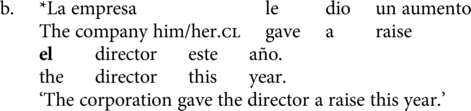
Both native Spanish speakers and advanced L2 learners’ reading times increased when they sensed that the object marker a was missing in ungrammatical sentences such as (2b), which indicated processing difficulty. Jegerski (Reference Jegerski, Leeser, Keating and Wong2021) did a follow-up study with intermediate learners and found that they were also sensitive to a missing object marker a in this context.
It’s worth noting that the object marker a has other functions, such as differential object marking (DOM; Bossong, Reference Bossong, Wanner and Kibbee1991). Differential object marking does not have an English equivalent, and Jegerski (Reference Jegerski2015, Reference Jegerski, Leeser, Keating and Wong2021) discovered that L2 learners are less sensitive to the presence or absence of a in this context. Hopp and León Arriaga (Reference Hopp and León Arriaga2016) similarly found that advanced L2 Spanish learners (with L1 German) are more sensitive to the presence of a when it functions as a dative object marker in ditransitive sentences than when it serves as an object marker in DOM contexts. The fact that L2 Spanish learners tend to be sensitive to a as a dative object marker is most relevant, given that the current study only involves this use of it. We move beyond issues related to grammaticality, however, and instead explore L2 learners’ ability to use the object marker a to make verbal predictions while reading sentences.
3. The current study
Based on the native speaker findings from Gattei et al. (Reference Gattei, Dickey, Wainselboim and París2015a, Reference Gattei, Tabullo, París and Wainselboim2015b, Reference Gattei, Sevilla, Tabullo, Wainselboim, París and Shalom2017), the goal of the current study is to examine whether L2 learners of Spanish are able to use morphosyntactic cues of word order to anticipate the type of verb that will appear in a sentence, as revealed by patterns of processing ease and difficulty in real-time measures. A second goal is to understand how this sensitivity might change with language proficiency, which will shed additional light on the development of L2 processing and the ability of learners to process sentences in a nativelike way. The research question that will guide this study is summarized as follows:
During sentence processing, do L2 Spanish learners at different proficiency levels (beginning, intermediate, advanced) predict the type of upcoming verb based on word order cues?Footnote 4
3.1. Predictions
We expect that prediction will be deployed differently between the groups due to the wide range of proficiencies, including an L2 group with decades of Spanish experience (on average). As Clahsen and Felser (Reference Clahsen and Felser2006b) explain, developing a nativelike processing ability in a linguistic context is only possible if nativelike grammatical knowledge related to that context has already been acquired. Because the advanced learners are the most likely L2 group to have nativelike knowledge of the relationship between word order and verb type, they are the most likely L2 group to be able to use prediction in a nativelike way in this context.
3.2. Methods
3.2.1. Participants
Three groups of native English speakers who learned Spanish as an L2 were recruited as participants. All were late L2 learners, which in this study means that they began learning Spanish after the age of 12. This was selected as a cutoff given that 12 years old was the age of onset after which Spanish learners tended to have non-nativelike knowledge of morphosyntax in Granena and Long (Reference Granena and Long2013). People who grew up bilingual or as heritage speakers were excluded from the study. Participant groups were initially formed based on their estimated experience with Spanish. The lowest level group consisted of 32 students enrolled in a fourth-semester Spanish language course at a large midwestern university. The second group of 32 students was recruited from advanced classes within the Spanish major and minor programs at the same university. These students were mostly juniors and seniors and were at least two semesters beyond the fourth-semester students in terms of Spanish experience. The final group of 32 L2 learners consisted of individuals with an MA or PhD in some field of Hispanic Studies. People who were familiar with psycholinguistics or experimental design in linguistic research were excluded, however.
Although participants were targeted based on their academic experience with Spanish, they also completed a shortened version of the Diploma de Español como Lengua Extranjera (DELE) as a measure of Spanish reading proficiency. The DELE has been used to measure proficiency in several other L2 self-paced reading studies, such as Jegerski (Reference Jegerski2014). The test consisted of three different multiple-choice cloze activities of increasing difficulty, with 34 points total.
As a control, 32 native Spanish speakers also participated in the study. They were all self-identified native Spanish speakers who grew up monolingually until at least 12 years old, and none of them lived in a predominantly English-speaking country before the age of 18. In terms of education, all had at least a BA degree. Thirty of the 32 native speakers were living full-time in the Midwest United States at the time of the experiment, and the remaining two resided in Spain. The group consisted of individuals from Spain, Mexico, Colombia, Argentina, and Ecuador. The mixing of different dialects was not considered to be an issue because unmarked and marked word order/verb type associations have not been reported to vary significantly by region.
As an additional screening measure, all participants completed a brief language background questionnaire to collect demographic information and verify their eligibility for the study. A summary of the participants’ demographics and their results from the DELE proficiency test are reported in Table 2.
Demographics and proficiency results of participants

The DELE test results revealed an uneven distribution between the groups in terms of proficiency. There was a significant gap in proficiency between the Spanish majors/minors (16.6/34) and the Spanish MA/PhDs (27.7/34), for example, which is a limitation in the study design. Nevertheless, a one-way analysis of variance (ANOVA) confirmed that there was a main effect of Spanish level (F 3,124 = 253.6, p < .001). Post-hoc pairwise comparisons revealed a significant difference between all four groups (p < .001 for all pairwise comparisons). To simplify discussion throughout this paper, the three different groups of L2 learners (4th-semester Spanish; Spanish majors/minors; Spanish MA/PhD) will be referred to as beginner, intermediate, and advanced. These categorizations will be used for convenience and do not necessarily correspond to any institutional proficiency scale (e.g., ACTFL proficiency scale).
3.2.2 Materials
The materials in this study were a modified version of those used in an L1 Spanish processing study, Gattei et al. (Reference Gattei, Sevilla, Tabullo, Wainselboim, París and Shalom2017). The two independent variables were word order and verb type, each having two levels. This resulted in a 2 × 2 design with four conditions: a) SVO/Active verb (unmarked); b) SVO/Psych verb (marked); c) OVS/Active verb (marked); d) OVS/Psych verb (unmarked). An example of each condition is respectively shown in (3).
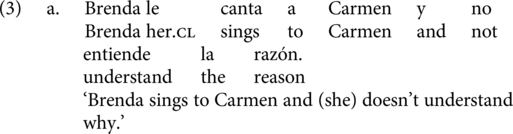
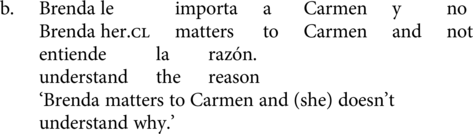
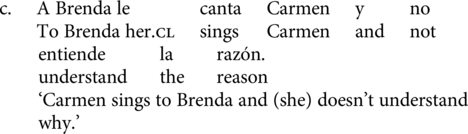
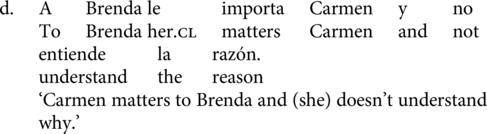
The sentences in (3) represent one item set out of a total of 24. The pairs of names were unique between items, with an even representation of traditional male and female names. It is important to note that each verb was repeated twice. This is because some of the psych and active verbs from Gattei et al. (Reference Gattei, Sevilla, Tabullo, Wainselboim, París and Shalom2017) were less common and would have been unfamiliar to many beginner and intermediate L2 Spanish learners. Therefore, instead of using 24 different psych and active verbs, a total of 12 of each type were used, with one repetition of each verb in two different item sets. The active verbs included cantar ‘sing’, robar ‘rob’, gritar ‘yell’, responder ‘respond’, enseñar ‘teach’, mentir ‘lie’, cocinar ‘cook’, hablar ‘talk’, llorar ‘cry’, sonreír ‘smile’, escribir ‘write’, contestar ‘answer’. The psych verbs included interesar ‘interest’, disgustar ‘disgust’, gustar ‘like’, encantar ‘love’, importar ‘matter’, fascinar ‘fascinate’, divertir ‘entertain’, deprimir ‘depress’, asustar ‘scare’, impresionar ‘impress’, aburrir ‘bore’, enojar ‘anger’.
Using a Spanish corpus on the NIM platform (Guasch et al., Reference Guasch, Boada, Ferré and Sánchez-Casas2013), the average log frequency of the active verbs and psych verbs was calculated based on their third-person forms, which were the only forms used in target sentences. The log frequency was found to be 1234 for active verbs and 894 for psych verbs. While this indicated that the active verbs were slightly more common than the psych verbs, a t-test determined that the two averages were not significantly different (p = .13). Therefore, if significant differences emerge between conditions in the present study, they are unlikely to be a result of verb frequency alone.
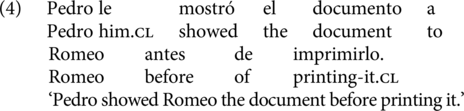
The 24 item sets consisting of four conditions were distributed across four lists using a Latin Square design. This ensured that participants read one condition of each item set and that they read the same number of trials of each condition. A total of 40 non-target sentences were also added to the experiment as a counterbalance. Twenty-four of them were superficially similar to target sentences, but they uniquely contained ditransitive verbs with both indirect objects and direct objects. These sentences were meant to distract participants from identifying target sentences, which did not contain direct objects. The distractor sentences were balanced based on word order: half SVO, and half OVS. An example is provided in (4).
An additional 16 filler sentences unrelated to target sentences were included. All target and non-target sentences were randomized for each participant. Both the Latin Square distribution and randomization were completed with the software Linger (Rohde, Reference Rohde2001). Finally, to encourage participants to remain focused on sentence comprehension throughout the study, a true/false comprehension prompt appeared after all target and non-target sentences. These prompts did not draw attention to either word order or verb type manipulations. For example, the prompt that followed any of the target items in (3) is shown in (5).

The correct answer to (5) would have been Falso ‘false’. Half of the comprehension prompts required a Cierto ‘true’ response, and the other half required a Falso ‘false’ response. The target and distractor sentences, along with their comprehension prompts, are provided in the supplementary materials (Appendix S1).
3.2.3. Methodology
To compare L2 learners’ reactions to the four different conditions above, we used phrase-by-phrase self-paced reading (Just et al., Reference Just, Carpenter and Woolley1982), a methodology provided by the software Linger (Rohde, Reference Rohde2001). Participants read the sentences in segments that varied between one to three words. The reading time per segment was recorded as participants read at their own pace.Footnote 5 Table 3 illustrates how the target sentences in (3) were divided into regions.
Sample set of stimuli with region labels
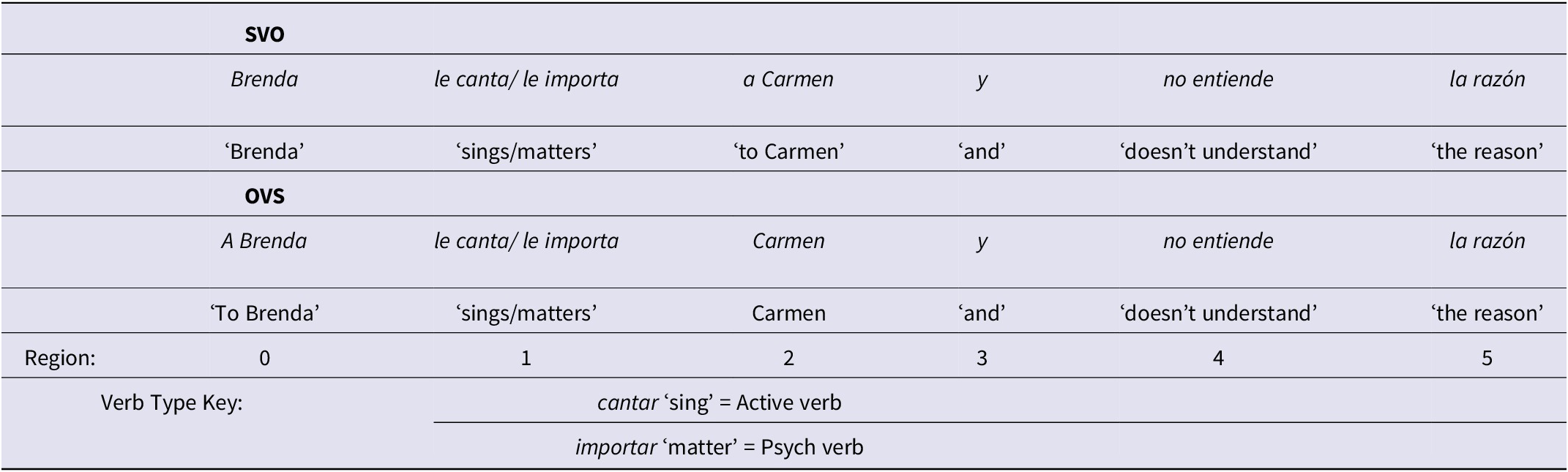
Region 0 contained a bare NP argument in SVO conditions and an object-marked NP in OVS conditions. Region 1 either contained a psych verb or an active verb, preceded by the indirect object pronoun le ‘to him/her’. The indirect object pronoun was required for grammaticality, but it was not a cue for word order or verb type in this study, so it was not expected to affect processing between conditions. If participants were to use word order cues at Region 0 to predict verb type based on unmarked patterns, region 1 (the critical region) would reveal whether their predictions were correct. Reading times would be expected to be faster at Region 1 when verb type predictions are correct relative to when they are incorrect (Gattei et al., Reference Gattei, Dickey, Wainselboim and París2015a). However, participants often do not react immediately at the critical region in self-paced reading. The effect from the critical region is commonly observed in the following region or the following two regions, which is known as the “spillover effect” (Keating & Jegerski, Reference Keating and Jegerski2015). Therefore, the spillover regions 2 and 3 will also be of interest. Regions 4 and 5 were added to make complete sentences and avoid “wrap-up effects” (Just & Carpenter, Reference Just and Carpenter1980), and were identical in all conditions within each item.
3.2.4. Procedure
Participants first completed a language background questionnaire and read an overview of the self-paced reading procedure. They then completed the reading task, consisting of 10 practice sentences and 64 experimental sentences (24 targets, 40 non-targets). The first five practice sentences were in English so that the L2 learners could familiarize themselves with the self-paced reading methodology in their native language before switching to their L2. The task was presented on a 15.4” Macbook Pro laptop computer using Linger (Rohde, Reference Rohde2001). All sentences were masked and presented in size 24 font with a moving window display. This means that each sentence was presented as a series of dashes (e.g., -----------------------------), and the participants used the space bar to reveal each segment in the sentence in isolation, from left to right. Participants were instructed to read sentences at a normal pace. After reading the last segment in a sentence, a true/false comprehension prompt appeared on the screen. Participants pressed the ‘D’ or ‘K’ keys on the keyboard to answer the prompt: D para cierto ‘D for true’ and K para falso ‘K for false’. Feedback regarding the correctness of the response was not given. After the reading task, participants completed the DELE reading proficiency test. In total, the experimental session lasted 40–60 minutes, and participants received monetary compensation.
3.2.5. Analysis
Reading time data, measured in milliseconds, was analyzed only from the trials in which the comprehension prompt was answered correctly because a measure of processing assumes comprehension. The comprehension rates for target trials were 85.1% for beginners, 90.1% for intermediates, 94.5% for advanced, and 91.9% for natives. These numbers represent the percentage of target trials in each group that were included in the analysis. To mitigate the effect of outlier data, reading times that deviated more than 3 standard deviations from the mean were not included in the analysis. This standard practice (Keating & Jegerski, Reference Keating and Jegerski2015) resulted in the removal of 1.87% of the data.
For transparency, raw reading times are provided in the supplementary materials (Table S1). However, because raw reading times often do not have a normal distribution of their residuals, reading times were log-transformed (Hofmeister & Vasishth, Reference Hofmeister and Vasishth2014). After computing the log reading times, we then fit a linear mixed-effects model on the reading times with segment length (i.e., number of characters)Footnote 6, the position of the segment in the sentence, and position of an item in the list as factors, with random effects for subject, following the procedure recommended by Jaeger (Reference Jaeger2008). In addition, following Jaeger (Reference Jaeger2008), a factor corresponding to previous segments was added as a fixed effect to account for the influence of specific words or names in previous segments in target sentences. These normalizations helped neutralize the effect that extraneous factors could have in the analysis. All further analyses were conducted on the residuals of this model. Using the lme4 package in R (Bates et al., Reference Bates, Mächler, Bolker and Walker2015; R Core Team, 2020), a mixed effects model was constructed for each population with log residual reading times as the dependent variable and verb type and word order as fixed effects. Since it was possible that baseline reading times could vary between target sentences and participants, random effects were respectively added for items and subjects. The results of the model will be presented as coefficient estimates (β), standard errors, t-values, and p-values. A Bonferroni correction for 4 separate comparisons (one for each population) sets the α to .0125. We comment on which results are significant at the corrected α-level (.0125), and which are significant only at the uncorrected α-level (.05).
4. Results
Significant reactions were not observed at the critical region (region 1), which is not uncommon in self-paced reading experiments. As a result, there is little to comment on in this region, but the statistical analysis is still provided in the supplementary materials (Table S2). The spillover regions, regions 2 and 3, were more revealing and will be the focus of the remainder of this section.
4.1. Results at Region 2
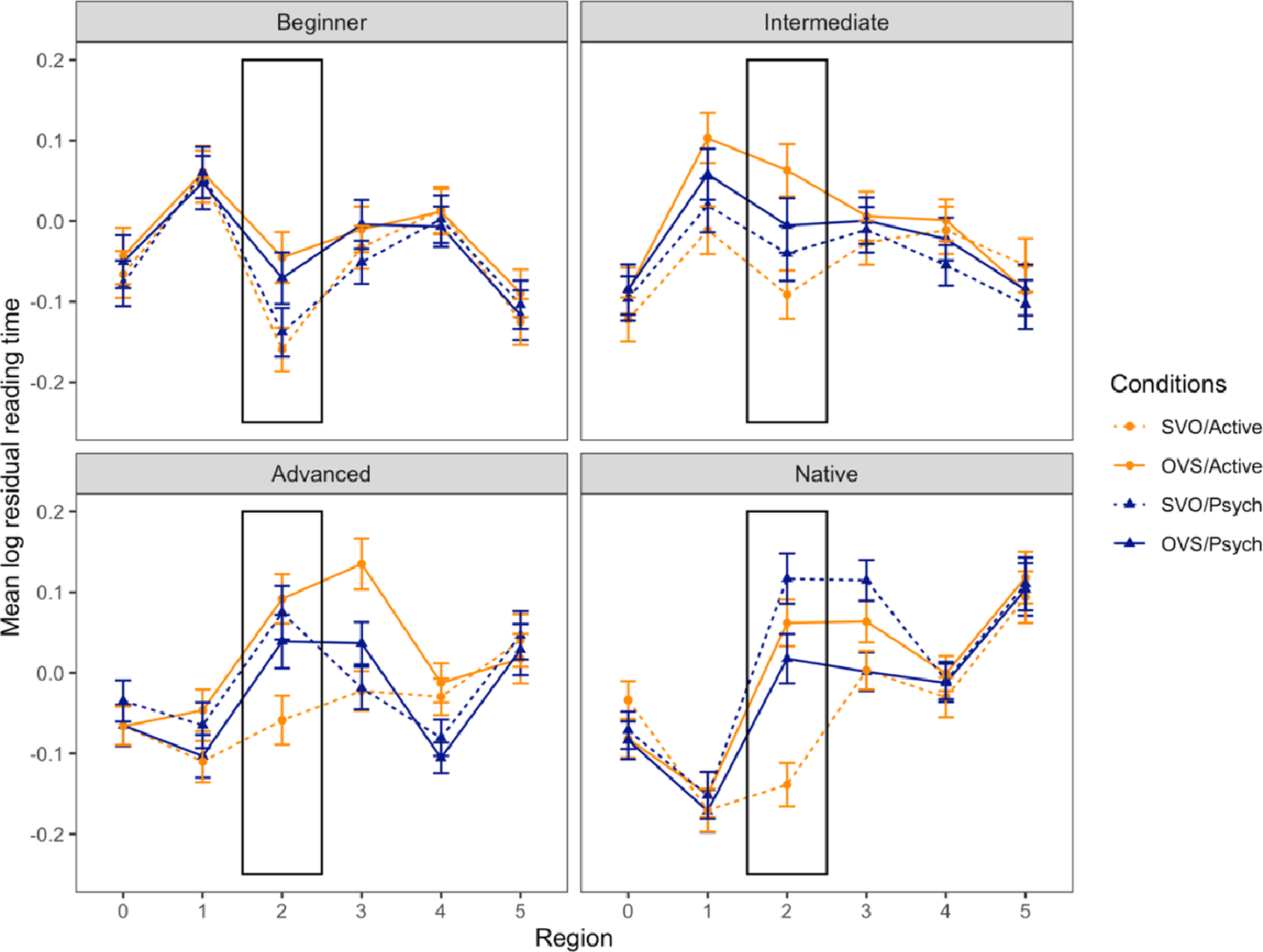
The mean log residual reading times for the four different conditions are represented by the group in Figure 1, with the first spillover region (region 2) highlighted. Results of the four linear mixed-effects models that fit each population for Region 2 are provided in Table 4.
Mean log residual reading times for the four different Word Order/Verb Type combinations for each population, with a focus on Region 2. Error bars represent two standard errors from the mean.
Results of the mixed effects model fit each population for Region 2, the first spillover region. Spillover variables for previous segments (S1 and S2) are not included. Bolded p-values are significant at the uncorrected α-level of .05; starred p-values are significant at the corrected α-level of .0125
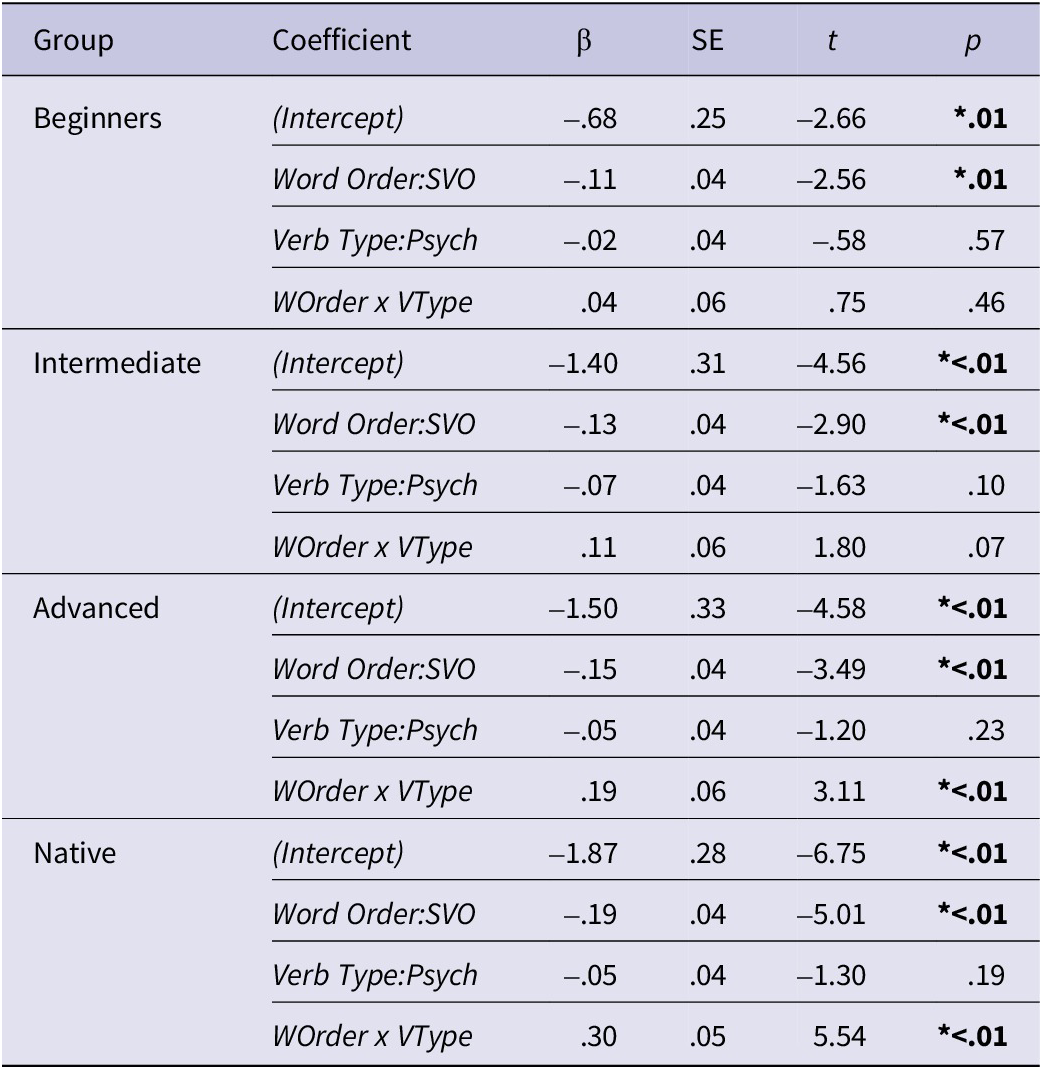
In the beginner group, only word order effects were found in Region 2. Participants read SVO conditions faster than OVS conditions (significant at corrected α level). A post-hoc pairwise comparison with Tukey honestly significant difference (HSD) correction revealed that SVO/Active and OVS/Active were the only isolated pair of conditions that had a marginally significant difference in reading times (β = .11, SE = .04, t = 2.56, p = .05).
The intermediate learners similarly read SVO sentences faster than OVS ones at region 2 (significant at corrected α), but there was also a marginal interaction between word order and verb type (β = .11, SE = .06, t = 1.80, p = .07). Nevertheless, a pairwise Tukey comparison indicated that there was only one pair of conditions that differed significantly at the uncorrected α, and this difference was driven by a word order variation: SVO/Active vs. OVS/Active (β = .13, SE = .04, t = 2.9, p = .02).
Like beginner and intermediate learners, advanced learners and native speakers also read SVO sentences faster than OVS ones (significant at corrected α). However, the advanced and native groups were additionally sensitive to the interaction between word order and verb type (significant at the corrected α level). A pairwise comparison with Tukey HSD correction revealed that advanced/natives read SVO sentences faster when they contained an active verb as opposed to a psych verb (Advanced: β = -.14, SE = .04, t = -3.18, p = .009; Native: β = -.25, SE = .04, t = 3.11, p < .001; both significant at corrected α). Although the advanced and native participants’ sentence processing was similar, native speakers showed an additional sensitivity to the distinction between SVO/Psych and OVS/Psych (β = -.11, SE = .04, t = 2.82, p = .002; significant at corrected α)—the latter being read faster. In what was a somewhat surprising finding based on the results of Gattei et al. (Reference Gattei, Dickey, Wainselboim and París2015a), neither the advanced L2 learners nor native speakers significantly distinguished the marked OVS/Active from the unmarked OVS/Psych in this region.
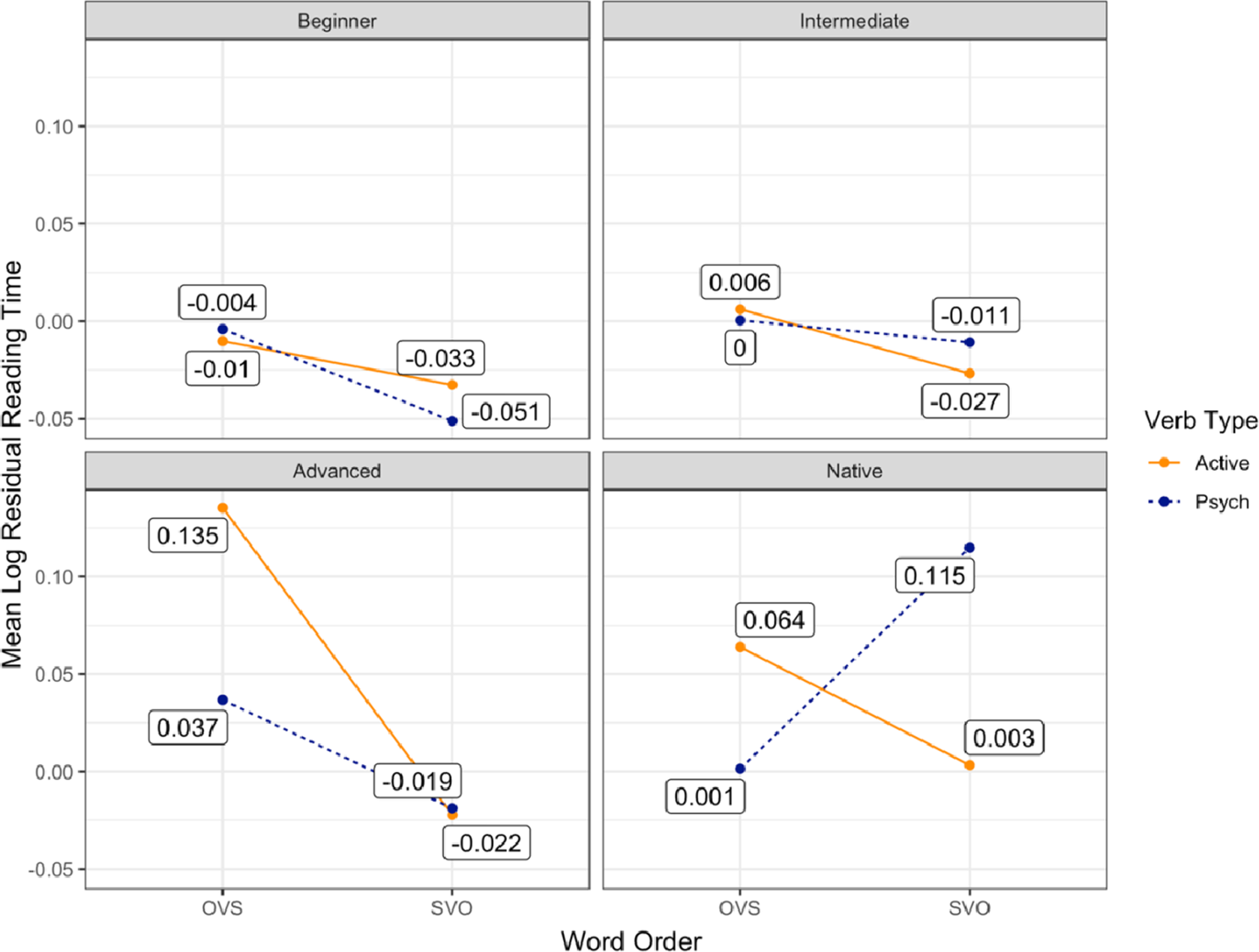
While there are nuanced differences between the four groups, what separates the two groups with the highest proficiency (advanced L2 and native) from the others is the ability to distinguish conditions based on markedness patterns, which is reflected in the interaction between word order and verb type. This interaction is more clearly appreciated in Figure 2.
Interaction between word order and verb type at region 2 based on mean log residual reading times. Inset numbers give values of each condition.
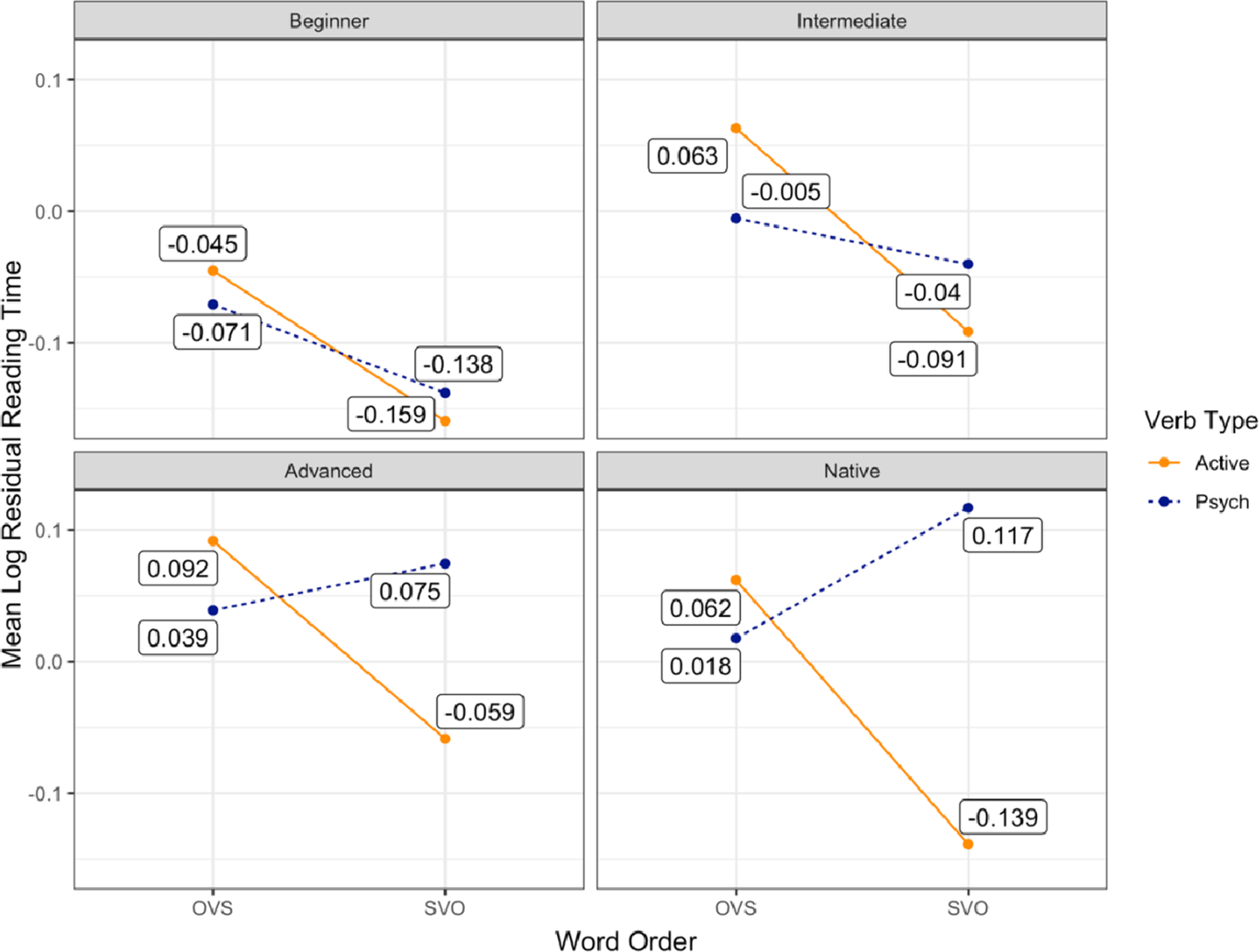
The differing sensitivity to the interaction between word order and verb type is most obvious in SVO conditions. While beginner and intermediate learners do not distinguish between SVO/Active and SVO/Psych, advanced learners and native speakers experience much more processing difficulty with SVO/Psych relative to SVO/active.
4.2. Results at Region 3
As the second spillover region, region 3 appears to reveal lingering processing effects. The mean log residual reading times are repeated in Figure 3 with Region 3 highlighted. The interaction between variables in Region 3 is also shown in isolation in Figure 4. Finally, the results of the four linear mixed-effects models fit to each population for Region 3 are provided in Table 5.
Mean log residual reading times for the four different Word Order/Verb Type combinations for each population, with a focus on Region 3.
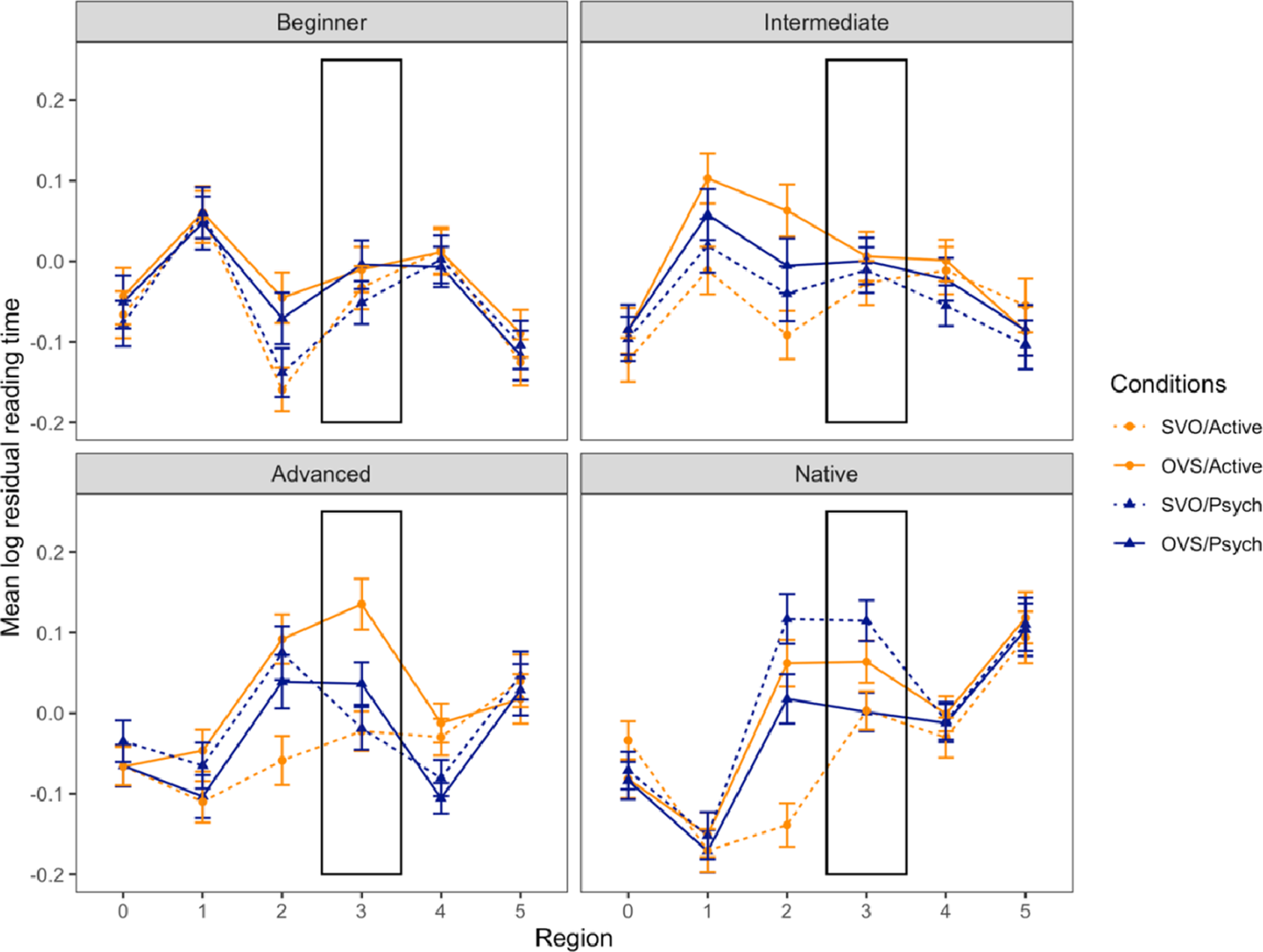
Interaction between word order and verb type at region 3 based on mean log residual reading times.
Results of the mixed effects model fit each population for Region 3, the second spillover region. Spillover variables for previous segments (S1 and S2) are not included. Bolded p-values are significant at the uncorrected α-level of .05; starred p-values are significant at the uncorrected α-level of .0125
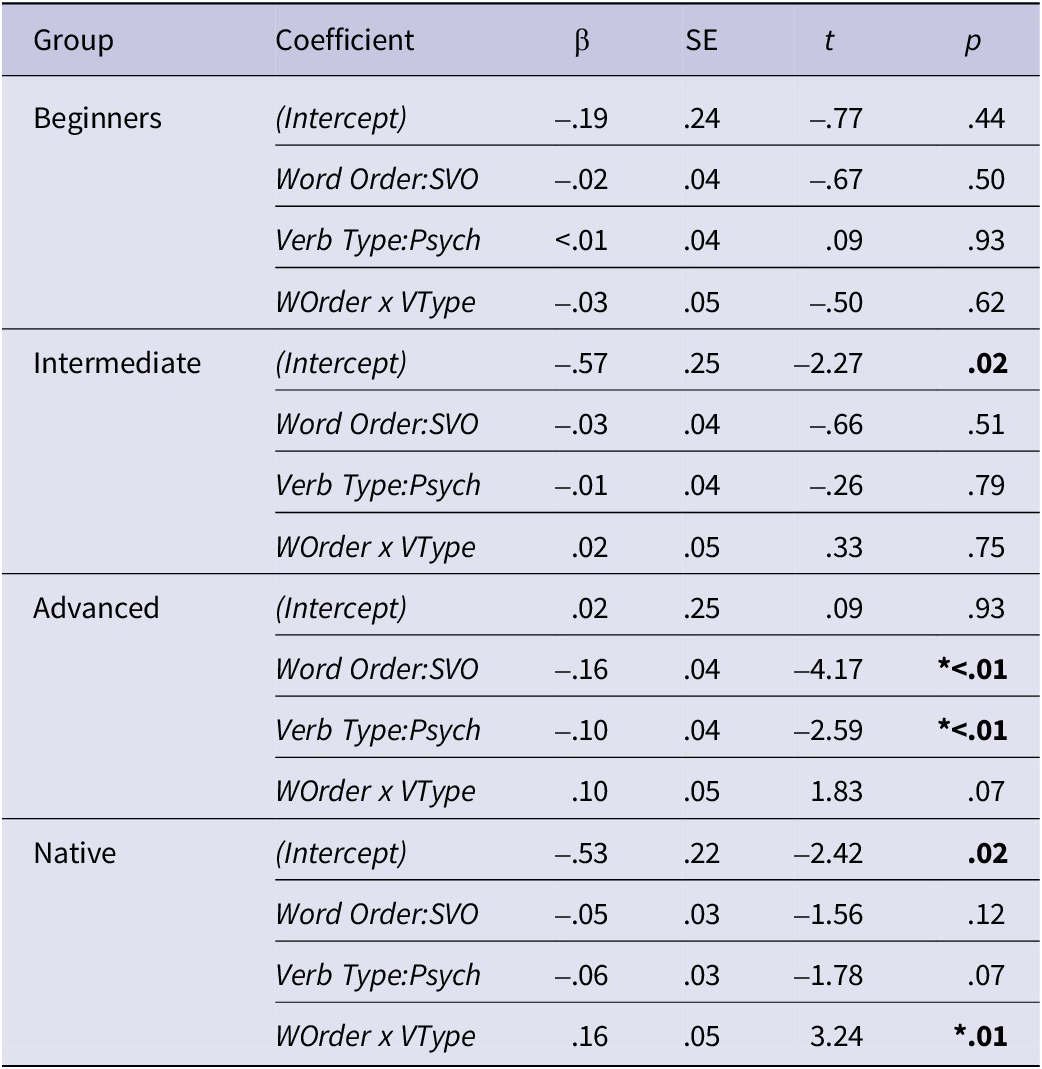
The beginner and intermediate groups did not show sensitivity to word order, verb type, or the interaction between these factors at region 3 (ps > .05). This indicates that their reactions to the different conditions coalesced fairly quickly after being affected mostly by word order in region 2. The advanced and native groups, on the other hand, showed lingering effects in region 3, which is indicative of increased sensitivity to the factors of word order and verb type. Nevertheless, these two groups’ reactions were qualitatively different in this region.
The most influential factors for the advanced group at Region 3 were word order and verb type; SVO conditions were read faster than OVS ones and psych verbs were read faster than active verbs, on average (significant at corrected α). There was also a marginal interaction between word order and verb type (β = .10, SE = .05, t = 1.83, p = .07), which seems to be mostly driven by a reading delay in the marked OVS/Active condition. This resulted in a difference between the marked OVS/Active and unmarked OVS/Psych (β = .10, SE = .04, t = 2.59, p = .049), although this was not significant at the corrected α. The significant contrast between OVS/Active and SVO/Active that was seen in region 2 was sustained in region 3 (β = .15, SE = .04, t = 4.17, p < .001; significant at corrected α). A notable shift from region 2 to 3 in the advanced group is the loss in sensitivity between the two SVO conditions (β = −.001, SE = .04, t = −.03, p = 1); there was no longer a relative processing hindrance caused by the marked SVO/Psych.
Native speakers were no longer sensitive to word order as an isolated variable at region 3 (p > .05). However, there was still an interaction effect between word order and verb type (p = .001; significant at corrected α). The condition that caused the greatest processing difficulty in Region 2, SVO/Psych, continued to do so at region 3. Pairwise comparisons revealed that this marked condition caused a processing delay in comparison to the two unmarked patterns: 1) SVO/Active (β = -.10, SE = .03, t = -2.82, p = .03; significant at uncorrected α) and 2) OVS/Psych (β = -.11, SE = .03, t = -3.05, p = .01; significant at corrected α). Native speakers’ processing does not appear to have been affected positively or negatively (p > .05) by the remaining marked pattern, OVS/Active, which contrasts with advanced L2 participants’ negative reaction to it. Despite these discrepancies, a commonality between advanced L2 learners and native speakers is that a marked pattern (OVS/Active for advanced L2; SVO/psych for natives) caused the greatest processing difficulty in region 3. No such effect based on word order/verb type markedness was observed in beginner and intermediate groups.
5. Discussion and conclusion
The results from this study support previous work that has shown that L2 learners’ processing behavior can become more nativelike as proficiency increases (Dussias et al., Reference Dussias, Valdés Kroff, Guzzardo Tamargo and Gerfen2013; Lee et al., Reference Lee, Lu and Garnsey2013). At the beginner and intermediate stages, L2 Spanish learners seem to be affected mostly by changes in word order. Their significant reading delay in OVS sentences indicates that they noticed (either consciously or subconsciously) the sentence-initial dative object marker a, which may have caused processing difficulty if they were primarily relying on a subject-first processing strategy (VanPatten, Reference VanPatten1996, Reference VanPatten, VanPatten, Keating and Wulff2020). This finding is in line with previous studies that have shown that lower-level L2 Spanish learners are attentive to a as a dative object marker, even if they might overlook it in non-dative contexts (Hopp & León Arriaga, Reference Hopp and León Arriaga2016; Jegerski, Reference Jegerski2015, Reference Jegerski, Leeser, Keating and Wong2021). Nevertheless, the beginner and intermediate learners were not able to use the marker a (or lack thereof) to predict what verb type might appear, as evidenced by the lack of an interaction between word order and verb type. It is possible that these L2 learners had not acquired enough grammatical knowledge related to the relationship between word order and verb type in Spanish, and as a result their processing simply reflected this lack of knowledge (Clahsen & Felser, Reference Clahsen and Felser2006b). It is also possible that making predictions was not practical based on their communicative goals or processing ability (Kaan & Grüter, Reference Kaan, Grüter, Kaan and Grüter2021; Kuperberg & Jaeger, Reference Kuperberg and Jaeger2016). If the non-advanced L2 learners’ main focus was comprehending the broad message of sentences rather than deeply comprehending them at different representational levels, making predictions may have been unnecessary or too costly in terms of their cognitive resources (Kaan & Grüter, Reference Kaan, Grüter, Kaan and Grüter2021; Kuperberg & Jaeger, Reference Kuperberg and Jaeger2016).
The advanced L2 and native Spanish speakers showed signs of more complex language processing. They were able to use their heightened sensitivity to word order/verb type relationships to predict the verb type based on the word order that they detected at the beginning of a sentence. This aligns with the findings from native speakers in Gattei et al. (Reference Gattei, Dickey, Wainselboim and París2015a, Reference Gattei, Sevilla, Tabullo, Wainselboim, París and Shalom2017), and supports the idea that markedness patterns play a significant role in Spanish sentence processing (Gattei et al., Reference Gattei, Dickey, Wainselboim and París2015a). This effect was especially noticeable in SVO contexts. There was a sizeable reading delay caused by SVO/psych conditions relative to SVO/active. The effect of word order/verb type markedness was not as prominent in OVS conditions, however, which may indicate that predictions related to verbal semantics are not as strong in this syntactic frame. Perhaps because SVO is much more common than OVS in Spanish overall (Dryer, Reference Dryer, Dryer and Haspelmath2013), predictions related to SVO word order are more developed, even among speakers with high proficiency.
Broadly speaking, the most theoretically significant finding of the current study is that advanced L2 Spanish speakers had the same general processing behavior as native speakers. Both groups showed sensitivity to word order and the interaction between word order and verb type, like native Spanish speakers in previous studies (e.g., Gattei et al., Reference Gattei, Dickey, Wainselboim and París2015a). Our findings therefore align with those of studies that have documented nativelike prediction in highly proficient or advanced L2 learners (Dussias et al., Reference Dussias, Valdés Kroff, Guzzardo Tamargo and Gerfen2013; Lee et al., Reference Lee, Lu and Garnsey2013), and contrast with the findings of studies that have observed non-nativelike prediction in advanced L2 learners (Hopp, Reference Hopp2015; Kaan et al., Reference Kaan, Kirkham and Wijnen2016). Nevertheless, the significance of any L2 prediction study depends greatly on its specific context. As Schlenter and Felser (Reference Schlenter, Felser, Kaan and Grüter2021), p. 48) point out, “the results from previous studies examining prediction in an L2 are not easily comparable because of differences between participants, experimental designs, and the language combinations tested.” Although the results of this study were compared with those of Dussias et al. (Reference Dussias, Valdés Kroff, Guzzardo Tamargo and Gerfen2013) and Hopp (Reference Hopp2015), said researchers used different experimental designs (visual world eye-tracking) to investigate L2 prediction. Another element that complicates comparisons between studies is proficiency level labels for participants. For example, in the present study, the ‘advanced’ L2 participants had an average of 26.9 years of exposure to their L2, but many researchers use the label ‘advanced’ to describe participants with much less language experience. Variations like this can make it challenging to develop conclusions regarding the similarities and differences between L1 and L2 processing at the highest proficiency levels (Keating, Reference Keating2017), but progress is being made to better define issues such as “advancedness” (Malovrh & Menke, Reference Malovrh and Menke2021). A limitation of the present study is the fact that there was a significant gap in years of Spanish experience between the ‘intermediate’ and ‘advanced’ groups. A future study might incorporate a group of learners with a proficiency between these two, in hopes of determining more precisely what proficiency level is necessary to become sensitive to word order/verb type markedness.
Clahsen and Felser (Reference Clahsen and Felser2006) explain that morphosyntactic information tends to be particularly challenging for L2 learners to process, but they (Clahsen & Felser, Reference Clahsen and Felser2017) also emphasize that not all morphosyntactic information should be assumed to be equally difficult to process. Therefore, we might be able to partially attribute the advanced L2 learners’ nativelike performance in the present study to the relatively simple nature of the relationship between word order and verb type. L2 learners are exposed early to both active and psych verbs (Whitley, Reference Whitley1995), presumably in their most common word orders. Additionally, being able to predict a specific verb type was predicated on the presence or absence of just one cue—the object marker a—so the processing load might have been less intense than in some previous studies that involved complex sentences with ambiguity or long-distance dependencies between words (e.g., Clahsen & Felser, Reference Clahsen and Felser2006). Nevertheless, the results from the present study support the idea that L2 learners can make predictions using morphosyntactic cues (Schlenter & Felser, Reference Schlenter, Felser, Kaan and Grüter2021). With sufficient proficiency, they can do so in a nativelike way in certain contexts.
Supplementary material
To view supplementary material for this article, please visit http://doi.org/10.1017/S1366728924000956.
Data availability statement
The data that support the findings of this study are openly available through OSF at https://osf.io/ubn8f/


 Open access

