





1. Introduction
Natural convective flows driven by temperature differences are ubiquitous in nature and engineering applications. To understand buoyancy-driven wall-bounded flows, it is common to study natural convection in a fluid confined between two vertical walls at different temperatures (Batchelor Reference Batchelor1954; MacGregor & Emery Reference MacGregor and Emery1969; Versteegh & Nieuwstadt Reference Versteegh and Nieuwstadt1999; Betts & Bokhari Reference Betts and Bokhari2000; Balaji, Hölling & Herwig Reference Balaji, Hölling and Herwig2007; Trias et al. Reference Trias, Soria, Oliva and P’erez-Segarra2007; Kiš & Herwig Reference Kiš and Herwig2012; Ng, Chung & Ooi Reference Ng, Chung and Ooi2013; Shishkina Reference Shishkina2016; Howland et al. Reference Howland, Ng, Verzicco and Lohse2022) or adjacent to a single heated vertical plate (Ostrach Reference Ostrach1953; Cheesewright Reference Cheesewright1968; Kuiken Reference Kuiken1968; George & Capp Reference George and Capp1979; Ruckenstein & Felske Reference Ruckenstein and Felske1980; Tsuji & Nagano Reference Tsuji and Nagano1988; Ke et al. Reference Ke, Williamson, Armfield, Komiya and Norris2021). The state of these convective flows is determined by two control parameters, the Rayleigh number ( ${\textit{Ra}}$
) and Prandtl number (
${\textit{Ra}}$
) and Prandtl number ( ${\textit{Pr}}$
). Laminar vertical convection has been understood by analysis of steady-state boundary-layer equations (Ostrach Reference Ostrach1953; Kuiken Reference Kuiken1968; Shishkina Reference Shishkina2016) but a full understanding of turbulent vertical convection is still lacking. Knowledge of turbulent vertical convection is important for engineering applications such as ventilation in buildings and can shed light on ice–ocean interaction at near-vertical ice surfaces in a polar ocean (Wells & Worster Reference Wells and Worster2008; Howland, Verzicco & Lohse Reference Howland, Verzicco and Lohse2023). Physical quantities of interest include heat flux, wall shear stress, maximum mean vertical velocity and mean temperature and velocity profiles.
${\textit{Pr}}$
). Laminar vertical convection has been understood by analysis of steady-state boundary-layer equations (Ostrach Reference Ostrach1953; Kuiken Reference Kuiken1968; Shishkina Reference Shishkina2016) but a full understanding of turbulent vertical convection is still lacking. Knowledge of turbulent vertical convection is important for engineering applications such as ventilation in buildings and can shed light on ice–ocean interaction at near-vertical ice surfaces in a polar ocean (Wells & Worster Reference Wells and Worster2008; Howland, Verzicco & Lohse Reference Howland, Verzicco and Lohse2023). Physical quantities of interest include heat flux, wall shear stress, maximum mean vertical velocity and mean temperature and velocity profiles.
A recent theoretical analysis by one of us (Ching Reference Ching2023) showed that, for fluid confined between two infinite vertical walls at different temperatures, the Nusselt number ( ${\textit{Nu}}$
) and shear Reynolds number (
${\textit{Nu}}$
) and shear Reynolds number ( ${\textit{Re}}_\tau$
), which describe heat flux and wall shear stress, scale as
${\textit{Re}}_\tau$
), which describe heat flux and wall shear stress, scale as ${\textit{Ra}}^{1/3}$
in the high-
${\textit{Ra}}^{1/3}$
in the high- ${\textit{Ra}}$
limit. These theoretical results can well describe direct numerical simulation (DNS) data (Howland et al. Reference Howland, Ng, Verzicco and Lohse2022). The scaling
${\textit{Ra}}$
limit. These theoretical results can well describe direct numerical simulation (DNS) data (Howland et al. Reference Howland, Ng, Verzicco and Lohse2022). The scaling ${\textit{Nu}} \sim \textit{Ra}^{1/3}$
is also consistent with experimental results for fluids with different
${\textit{Nu}} \sim \textit{Ra}^{1/3}$
is also consistent with experimental results for fluids with different ${\textit{Pr}}$
(Jakob Reference Jakob1949; MacGregor & Emery Reference MacGregor and Emery1969; Tsuji & Nagano Reference Tsuji and Nagano1988) and the asymptotic law of heat transfer derived by George & Capp (Reference George and Capp1979) for turbulent natural convection next to a semi-infinite heated vertical plate. The analysis by George & Capp (Reference George and Capp1979) also yields the mean temperature and velocity profiles. By proposing scaling functions of temperature and velocity of certain characteristic scales of length, velocity and temperature in an inner layer next to the heated plate and a turbulent outer layer far away from the plate and matching them in an overlap layer, which is assumed to exist in the high-
${\textit{Pr}}$
(Jakob Reference Jakob1949; MacGregor & Emery Reference MacGregor and Emery1969; Tsuji & Nagano Reference Tsuji and Nagano1988) and the asymptotic law of heat transfer derived by George & Capp (Reference George and Capp1979) for turbulent natural convection next to a semi-infinite heated vertical plate. The analysis by George & Capp (Reference George and Capp1979) also yields the mean temperature and velocity profiles. By proposing scaling functions of temperature and velocity of certain characteristic scales of length, velocity and temperature in an inner layer next to the heated plate and a turbulent outer layer far away from the plate and matching them in an overlap layer, which is assumed to exist in the high- ${\textit{Ra}}$
limit, they obtained an inverse cubic-root dependence on distance for the mean temperature and a cubic-root dependence for the mean velocity in the overlap layer. The result for the mean velocity deviates from both experimental and DNS data (Versteegh & Nieuwstadt Reference Versteegh and Nieuwstadt1999; Hölling & Herwig Reference Hölling and Herwig2005; Shiri & George Reference Shiri and George2008). Using a different temperature scale in the inner layer, a logarithmic mean temperature profile was obtained by Hölling & Herwig (Reference Hölling and Herwig2005). The inverse cubic-root and the logarithmic mean temperature profiles have been shown to fit experimental (Cheesewright Reference Cheesewright1968; Tsuji & Nagano Reference Tsuji and Nagano1988) and DNS data (Versteegh & Nieuwstadt Reference Versteegh and Nieuwstadt1999; Ng et al. Reference Ng, Chung and Ooi2013) for air (
${\textit{Ra}}$
limit, they obtained an inverse cubic-root dependence on distance for the mean temperature and a cubic-root dependence for the mean velocity in the overlap layer. The result for the mean velocity deviates from both experimental and DNS data (Versteegh & Nieuwstadt Reference Versteegh and Nieuwstadt1999; Hölling & Herwig Reference Hölling and Herwig2005; Shiri & George Reference Shiri and George2008). Using a different temperature scale in the inner layer, a logarithmic mean temperature profile was obtained by Hölling & Herwig (Reference Hölling and Herwig2005). The inverse cubic-root and the logarithmic mean temperature profiles have been shown to fit experimental (Cheesewright Reference Cheesewright1968; Tsuji & Nagano Reference Tsuji and Nagano1988) and DNS data (Versteegh & Nieuwstadt Reference Versteegh and Nieuwstadt1999; Ng et al. Reference Ng, Chung and Ooi2013) for air ( ${\textit{Pr}}=0.709$
) over different spatial regions but their validity for general values of
${\textit{Pr}}=0.709$
) over different spatial regions but their validity for general values of ${\textit{Pr}}$
has not been tested. Li et al. (Reference Li, Jia, Liu, Jiao and Zhang2023) studied the mean velocity and temperature profiles using models for turbulent heat flux and Reynolds stress but their models violate required boundary conditions at the vertical walls.
${\textit{Pr}}$
has not been tested. Li et al. (Reference Li, Jia, Liu, Jiao and Zhang2023) studied the mean velocity and temperature profiles using models for turbulent heat flux and Reynolds stress but their models violate required boundary conditions at the vertical walls.
In this paper, we propose a space-dependent eddy thermal diffusivity model for turbulent vertical convection in a fluid between two infinite vertical walls at different temperatures and use it to derive analytical results for the mean temperature profile. These analytical results reveal that mean temperature profiles for different Rayleigh and Prandtl numbers are described by two universal scaling functions in the inner region near the walls and the outer region near the centreline between the two walls. We validate our results using DNS data for $1 \le Pr \le 100$
and
$1 \le Pr \le 100$
and $10^6 \le \textit{Ra} \le 10^9$
(Howland et al. Reference Howland, Ng, Verzicco and Lohse2022) and show that the two scaling functions can better describe the data than results reported in previous studies.
$10^6 \le \textit{Ra} \le 10^9$
(Howland et al. Reference Howland, Ng, Verzicco and Lohse2022) and show that the two scaling functions can better describe the data than results reported in previous studies.
2. The problem
We consider a fluid confined between two infinite vertical walls separated by a distance $H$
. The wall at the wall-normal coordinate
$H$
. The wall at the wall-normal coordinate $x=0$
is kept at a temperature
$x=0$
is kept at a temperature $T_h$
and the wall at
$T_h$
and the wall at $x=H$
at a lower temperature
$x=H$
at a lower temperature $T_c =T_h-\varDelta T$
. With the Oberbeck–Boussinesq approximation, the equations governing the fluid motion are
$T_c =T_h-\varDelta T$
. With the Oberbeck–Boussinesq approximation, the equations governing the fluid motion are $\boldsymbol{\nabla }\boldsymbol{\cdot }{\boldsymbol{u}}=0$
and
$\boldsymbol{\nabla }\boldsymbol{\cdot }{\boldsymbol{u}}=0$
and
 \begin{align} \frac {\partial \boldsymbol{u} }{\partial t}+{\boldsymbol{u}}\boldsymbol{\cdot }\boldsymbol{\nabla }{\boldsymbol{u}}&=- \frac {1}{\rho } \boldsymbol{\boldsymbol{\nabla }} p + \nu {\nabla} ^2 {\boldsymbol{u}}+\alpha g(T-T_m)\hat {z} , \end{align}
 \begin{align} \frac {\partial T}{\partial t}+{\boldsymbol{u}}\boldsymbol{\cdot }\boldsymbol{\nabla }T&=\kappa {\nabla} ^2T , \end{align}
where $\boldsymbol{u}(x,y,z,t)=(u,v,w)$
is the velocity,
$\boldsymbol{u}(x,y,z,t)=(u,v,w)$
is the velocity, $p(x,y,z,t)$
is the pressure,
$p(x,y,z,t)$
is the pressure, $T(x,y,z,t)$
is the temperature,
$T(x,y,z,t)$
is the temperature, $\rho$
is the density of the fluid at the temperature at the centreline between the walls,
$\rho$
is the density of the fluid at the temperature at the centreline between the walls, $T_m=(T_h+T_c)/2$
,
$T_m=(T_h+T_c)/2$
, $\alpha$
,
$\alpha$
, $\nu$
and
$\nu$
and $\kappa$
are the volume expansion coefficient, kinematic viscosity and thermal diffusivity of the fluid, respectively,
$\kappa$
are the volume expansion coefficient, kinematic viscosity and thermal diffusivity of the fluid, respectively, $g$
is the acceleration due to gravity and
$g$
is the acceleration due to gravity and $\hat {z}$
is a unit vector along the vertical direction. The velocity field satisfies the no-slip boundary condition at the two walls. The Rayleigh number and the Prandtl number are defined by
$\hat {z}$
is a unit vector along the vertical direction. The velocity field satisfies the no-slip boundary condition at the two walls. The Rayleigh number and the Prandtl number are defined by
 \begin{eqnarray} \textit{Ra} \equiv \frac {\alpha g \varDelta T H^3}{\nu \kappa }, \qquad Pr \equiv \frac {\nu }{\kappa } .\end{eqnarray}
The flow quantities are Reynolds decomposed into sums of time averages and fluctuations such as $T(x,y,z,t)= \overline {T}(x,y,z)+T(x,y,z,t)$
, where an overbar denotes an average over time and primed symbols denote fluctuating quantities. As the vertical walls are infinite, all the mean flow quantities depend on
$T(x,y,z,t)= \overline {T}(x,y,z)+T(x,y,z,t)$
, where an overbar denotes an average over time and primed symbols denote fluctuating quantities. As the vertical walls are infinite, all the mean flow quantities depend on $x$
only. This is also valid when periodic boundary conditions are imposed on the velocity and temperature in the spanwise (
$x$
only. This is also valid when periodic boundary conditions are imposed on the velocity and temperature in the spanwise ( $y$
) and streamwise (
$y$
) and streamwise ( $z$
) directions as in DNS (Versteegh & Nieuwstadt Reference Versteegh and Nieuwstadt1999; Ng et al. Reference Ng, Chung and Ooi2013; Howland et al. Reference Howland, Ng, Verzicco and Lohse2022). Taking the time average of (2.1) and (2.2) leads to the mean flow equations (Versteegh & Nieuwstadt Reference Versteegh and Nieuwstadt1999)
$z$
) directions as in DNS (Versteegh & Nieuwstadt Reference Versteegh and Nieuwstadt1999; Ng et al. Reference Ng, Chung and Ooi2013; Howland et al. Reference Howland, Ng, Verzicco and Lohse2022). Taking the time average of (2.1) and (2.2) leads to the mean flow equations (Versteegh & Nieuwstadt Reference Versteegh and Nieuwstadt1999)
 \begin{align} \frac {d}{{\rm d}x} \overline {u' w'} &=\nu \frac {d^2}{{\rm d}x^2} \overline {w} +\alpha g (\overline {T} - T_m) , \end{align}
 \begin{align} \frac {d}{{\rm d}x} \overline { u'T'}&=\kappa \frac {d^2}{{\rm d}x^2} \overline {T} . \end{align}
The boundary conditions are
 \begin{align} \overline {w}(0)&=0, \qquad \overline {w}(H/2)=0, \end{align}
 \begin{align} \overline {T}(0)&= T_h, \qquad \overline {T}(H/2)=T_m , \end{align}
and by symmetry, the mean profiles $\overline {w}(x)$
and
$\overline {w}(x)$
and $\overline {T}(x)$
are antisymmetric about
$\overline {T}(x)$
are antisymmetric about $x=H/2$
. A well-known challenge for solving
$x=H/2$
. A well-known challenge for solving $\overline {w}(x)$
and
$\overline {w}(x)$
and $\overline {T}(x)$
is that (2.4) and (2.5) are not closed. In this paper, we focus on finding
$\overline {T}(x)$
is that (2.4) and (2.5) are not closed. In this paper, we focus on finding $\overline {T}$
by solving (2.5) with (2.7) using a closure model for the eddy thermal diffusivity.
$\overline {T}$
by solving (2.5) with (2.7) using a closure model for the eddy thermal diffusivity.
3. Eddy thermal diffusivity and mean temperature profiles
3.1. Eddy thermal diffusivity model
Integrating (2.5) with respect to $x$
, one obtains
$x$
, one obtains
 \begin{equation} \overline {u'T'} - \kappa \frac {{\rm d}\overline {T}}{{\rm d}x} = - \kappa \frac {{\rm d} \overline {T}}{{\rm d}x} \bigg |_{x=0} = \kappa {\textit{Nu}} \frac {\varDelta T}{H} ,\end{equation}
where ${\textit{Nu}}$
, being the ratio of the actual heat flux normal to the walls to the heat flux when there is only thermal conduction, is defined by
${\textit{Nu}}$
, being the ratio of the actual heat flux normal to the walls to the heat flux when there is only thermal conduction, is defined by
 \begin{equation} {\textit{Nu}} \equiv \frac {\overline { u' T'} - \kappa {\rm d}\overline {T} /{\rm d}x}{\kappa \varDelta T/H} \equiv \frac {q}{\kappa \varDelta T/H} .\end{equation}
The heat flux is given by the product of $q$
and
$q$
and $\rho c$
, where
$\rho c$
, where $c$
is the specific heat capacity of the fluid. We introduce a space-dependent function
$c$
is the specific heat capacity of the fluid. We introduce a space-dependent function $K(x)$
for the eddy thermal diffusivity
$K(x)$
for the eddy thermal diffusivity
 \begin{equation} \overline {u'T'} \equiv - K(x) \frac {{\rm d}\overline {T}}{{\rm d}x} .\end{equation}
Then (3.1) with (3.3) can be integrated to give (Ruckenstein & Felske Reference Ruckenstein and Felske1980)
 \begin{equation} \frac {1}{\varDelta T} [\overline {T}(x)-T_m]= \frac {1}{2} - {\textit{Nu}} \int _0^{x/H} \frac {{\rm d}y}{1+K(yH)/\kappa } , \end{equation}
and ${\textit{Nu}}$
is obtained by using the boundary condition at
${\textit{Nu}}$
is obtained by using the boundary condition at $x=H/2$
in (2.7)
$x=H/2$
in (2.7)
 \begin{equation} {\textit{Nu}} = \frac {1}{2} \left [ \int _0^{1/2} \frac {{\rm d}y}{1+K(yH)/\kappa } \right ]^{-1} .\end{equation}
Thus, both $\overline {T}$
and
$\overline {T}$
and ${\textit{Nu}}$
can be determined if
${\textit{Nu}}$
can be determined if $K(x)$
is known.
$K(x)$
is known.
The characteristic temperature scales in the inner region near the wall and the outer region near the centreline between the two walls should have different dependencies on $\nu$
and
$\nu$
and $\kappa$
as molecular diffusivities are expected to play a significant role in the inner region but not the outer region. As seen from (3.4), this suggests that the eddy diffusivity
$\kappa$
as molecular diffusivities are expected to play a significant role in the inner region but not the outer region. As seen from (3.4), this suggests that the eddy diffusivity $K(x)$
is governed by two independent parameters in the inner and outer regions. Thus, we model
$K(x)$
is governed by two independent parameters in the inner and outer regions. Thus, we model $K(x)$
separately in the inner and outer regions and in the intermediate region between them. Due to the no-slip and isothermal boundary conditions at the two vertical sidewalls,
$K(x)$
separately in the inner and outer regions and in the intermediate region between them. Due to the no-slip and isothermal boundary conditions at the two vertical sidewalls, $u'$
,
$u'$
, $T'$
and
$T'$
and $\partial u'/\partial x=-(\partial v'/\partial y+ \partial w'/\partial z)$
vanish at
$\partial u'/\partial x=-(\partial v'/\partial y+ \partial w'/\partial z)$
vanish at $x=0$
, and this leads to the vanishing of
$x=0$
, and this leads to the vanishing of $\overline {u'T'}$
and its first- and second-order derivatives with respect to
$\overline {u'T'}$
and its first- and second-order derivatives with respect to $x$
at
$x$
at $x=0$
(Ruckenstein & Felske Reference Ruckenstein and Felske1980; Ching Reference Ching2023). Since the temperature gradient at
$x=0$
(Ruckenstein & Felske Reference Ruckenstein and Felske1980; Ching Reference Ching2023). Since the temperature gradient at $x=0$
, being proportional to
$x=0$
, being proportional to ${\textit{Nu}}$
, is non-zero,
${\textit{Nu}}$
, is non-zero, $K(x)$
and its first- and second-order derivatives should also vanish at
$K(x)$
and its first- and second-order derivatives should also vanish at $x=0$
. Thus, we model
$x=0$
. Thus, we model $K(x)/\nu$
by a cubic function in the inner region. In the outer region, we make use of the symmetry of the problem. Since
$K(x)/\nu$
by a cubic function in the inner region. In the outer region, we make use of the symmetry of the problem. Since $\overline {u'T'}$
is symmetric and
$\overline {u'T'}$
is symmetric and $\overline {T}$
is antisymmetric about the centreline
$\overline {T}$
is antisymmetric about the centreline $x=H/2$
,
$x=H/2$
, $K(x)$
is symmetric about
$K(x)$
is symmetric about $x=H/2$
and attains a maximum value at
$x=H/2$
and attains a maximum value at $x=H/2$
. This motivates us to model
$x=H/2$
. This motivates us to model $K(x)/\nu$
by the simplest symmetric quadratic function with a peak at
$K(x)/\nu$
by the simplest symmetric quadratic function with a peak at $x=H/2$
in the outer region. For the intermediate region, we choose a linear function that connects continuously to the other two regions as it is simple and the resulting
$x=H/2$
in the outer region. For the intermediate region, we choose a linear function that connects continuously to the other two regions as it is simple and the resulting $K(x)$
gives rise to a
$K(x)$
gives rise to a ${\textit{Nu}}$
that scales as
${\textit{Nu}}$
that scales as ${\textit{Ra}}^{1/3}$
in the high-Ra limit in accord with the theoretical result (Ching Reference Ching2023) (cf. § 4). Putting all these results together, we propose a three-layer model for
${\textit{Ra}}^{1/3}$
in the high-Ra limit in accord with the theoretical result (Ching Reference Ching2023) (cf. § 4). Putting all these results together, we propose a three-layer model for $K(x)/\nu$
 \begin{eqnarray} \frac {K(x)}{\nu } = \begin{cases} A y^3, & 0 \le y \le y_1 ,\\ c_1 + c_2 y, & y_1 \lt y \lt y_2, \\ C_m[1- b(1/2-y)^2], & y_2 \le y \le 1/2, \end{cases} \end{eqnarray}
where $y=x/H$
. Near the walls, the turbulent heat flux is expected to be small compared with the conductive heat flux, or equivalently,
$y=x/H$
. Near the walls, the turbulent heat flux is expected to be small compared with the conductive heat flux, or equivalently, $K(x)$
is expected to be small compared with
$K(x)$
is expected to be small compared with $\kappa$
. Thus, a natural characteristic length scale for the inner region is given by
$\kappa$
. Thus, a natural characteristic length scale for the inner region is given by
 \begin{equation} l_i = \frac {H}{(\textit{Pr} A)^{1/3}} , \end{equation}
which is the position at which our proposed model of eddy thermal diffusivity is equal to $\kappa$
, and we set the width of the inner region to be
$\kappa$
, and we set the width of the inner region to be $2 l_i$
, i.e.
$2 l_i$
, i.e. $y_1 H= 2 l_i$
. We note that the equality of the eddy and molecular thermal diffusivities was used to define the thickness of the thermal boundary layer in vertical convection by Howland et al. (Reference Howland, Ng, Verzicco and Lohse2022). We fix the width of the outer region to be
$y_1 H= 2 l_i$
. We note that the equality of the eddy and molecular thermal diffusivities was used to define the thickness of the thermal boundary layer in vertical convection by Howland et al. (Reference Howland, Ng, Verzicco and Lohse2022). We fix the width of the outer region to be $0.2 H$
with
$0.2 H$
with $y_2=0.3$
and take
$y_2=0.3$
and take $b=4$
. These values are guided by the DNS data (Howland et al. Reference Howland, Ng, Verzicco and Lohse2022). The constants
$b=4$
. These values are guided by the DNS data (Howland et al. Reference Howland, Ng, Verzicco and Lohse2022). The constants $c_1$
and
$c_1$
and $c_2$
are fixed by the continuity of
$c_2$
are fixed by the continuity of $K(x)/\nu$
at
$K(x)/\nu$
at $x=y_1H$
and
$x=y_1H$
and $x=y_2H$
 \begin{align} c_1 = \frac {Ay_1^3 y_2-C_m\left [1-b(1/2-y_2)^2\right ]y_1}{y_2-y_1}, \quad c_2 = \frac {C_m\left [1-b(1/2-y_2)^2\right ]- Ay_1^3}{y_2-y_1} .\end{align}
Hence, the model has two independent parameters: $A$
and
$A$
and $C_m$
. We will show below that they determine the characteristic velocities for heat transfer in the inner and outer regions, respectively.
$C_m$
. We will show below that they determine the characteristic velocities for heat transfer in the inner and outer regions, respectively.
3.2. Mean temperature profiles
Substituting (3.6) into (3.4) and evaluating the integral, we obtain $\overline {T}(x)$
 \begin{align} \frac {1}{\varDelta T} [T_h - \overline {T}(yH)] &=\begin{cases} {\textit{Nu}} \ I_1(y), \qquad 0 \le y \le y_1 , \\ {\textit{Nu}} \ [I_1(y_1)+I_2(y)], & y_1 \lt y \lt y_2,\end{cases} \\[-12pt] \nonumber \end{align}
 \begin{align} \frac {1}{\varDelta T} [\overline {T}(yH)-T_{m}] &= {\textit{Nu}} \ I_3(y), \qquad y_2 \le y \le 1/2 , \\[9pt] \nonumber \end{align}
where
 \begin{equation} {\textit{Nu}} = \frac {1}{2[I_1(y_1)+ I_2(y_2) + I_3(y_2)]} , \end{equation}
and
 \begin{align} \nonumber I_1(y) &\equiv \frac {1}{\textit{Pr}^{\frac {1}{3}} {A^{\frac {1}{3}}}} \int _0^{\textit{Pr}^{1/3} A^{1/3}y} \frac {{\rm d}y' }{1+ y'^3} = \frac {1}{3\textit{Pr}^{\frac {1}{3}} A^{\frac {1}{3}}} \left \{ \frac {1}{2} \log \left [\frac {\left(1+\textit{Pr}^{\frac {1}{3}} A^{\frac {1}{3}} y\right)^3}{1+\textit{Pr} A y^3}\right ] \right . \nonumber \\& \quad +\left . \sqrt {3}\arctan \left (\frac {2 {\textit{Pr}^{\frac {1}{3}}} A^{\frac {1}{3}} y -1}{\sqrt {3}} \right ) + \frac {\sqrt {3} \pi }{6} \right \}\! , \end{align}
 \begin{align} I_2(y) &\equiv \int _{y_1}^{y} \frac {{\rm d}y' }{1+ \textit{Pr}(c_1 + c_2 y')} = \frac {1}{\textit{Pr} c_2} \log \left [ \frac {1+\textit{Pr}(c_1+ c_2y)}{1+\textit{Pr}(c_1 + c_2 y_1)} \right ]\! , \end{align}
 \begin{align} I_3 (y) &\equiv \int _{y}^{1/2} \frac {{\rm d}y' }{1+ {\textit{Pr}} C_m[1- b(1/2-y')^2]} \nonumber \\&= \frac {1}{2B(1+C_m {\textit{Pr}})} \log \left | \frac {1 + B (1/2-y)}{1 - B (1/2-y)} \right | , \ B= \sqrt {b C_m {\textit{Pr}}/(1+C_m {\textit{Pr}})}. \end{align}
We focus on the mean temperature profile in the inner and outer regions. The analytical results (3.9) and (3.10) reveal that $\overline {T}(x)$
is given by two universal scaling functions of their respective characteristic temperature and length scales in these two regions, namely
$\overline {T}(x)$
is given by two universal scaling functions of their respective characteristic temperature and length scales in these two regions, namely
 \begin{align} T_h - \overline {T}(x) &= T_i F_i (x/l_i) \qquad \mbox{inner wall region} ,\end{align}
 \begin{align} \overline {T}(x) - T_m &= T_o F_o(x/H) \qquad \mbox{outer centreline region} , \end{align}
where the inner and outer scaling functions are
 \begin{align} F_i(z) &= \frac {1}{6}\log \left [\frac {(1+z)^3}{1+z^3}\right ] + \frac {\sqrt {3}}{3} \arctan \left ( \frac {2z -1}{\sqrt {3}}\right ) + \frac {\sqrt {3}\pi }{18} , \end{align}
 \begin{align} F_o(z) &= \frac {1}{2\sqrt {b}} \log \left | \frac {1+\sqrt {b}(1/2-z)}{1-\sqrt {b}(1/2-z)} \right | = \frac {1}{4} \log \left (\frac {1 -z}{z}\right )\!, \end{align}
the inner and outer temperature scales are
 \begin{align} T_i &= \frac {\varDelta T Nu}{(\textit{Pr} A)^{1/3}} , \end{align}
 \begin{align} T_o &= \frac {\varDelta T \textit{Nu}}{\textit{Pr} C_m} , \end{align}
and the characteristic length scales in the inner and outer regions are $l_i$
and
$l_i$
and $H$
, respectively. To obtain (3.16) with (3.18), we have used the approximation
$H$
, respectively. To obtain (3.16) with (3.18), we have used the approximation ${\textit{Pr}} C_m \gg 1$
, which follows from the dominance of the turbulent heat flux over the conductive heat flux,
${\textit{Pr}} C_m \gg 1$
, which follows from the dominance of the turbulent heat flux over the conductive heat flux, $|\overline {u'T'}| \gg \kappa |{\rm d} \overline {T}/{\rm d}x|$
, at
$|\overline {u'T'}| \gg \kappa |{\rm d} \overline {T}/{\rm d}x|$
, at $x=H/2$
in the outer region for turbulent convective flows. Using (3.2) and (3.7), we can rewrite (3.19) and (3.20) as
$x=H/2$
in the outer region for turbulent convective flows. Using (3.2) and (3.7), we can rewrite (3.19) and (3.20) as
 \begin{equation} V_i T_i = V_o T_o = q ,\end{equation}
where
 \begin{align} V_i &\equiv \frac {\kappa }{l_i} = \frac {\kappa }{H} (\textit{Pr} A)^{1/3} , \end{align}
 \begin{align} V_o &\equiv \frac {K(H/2)}{H} = \frac {\nu C_m}{H} . \end{align}
Thus, the two parameters $A$
and
$A$
and $C_m$
determine
$C_m$
determine $V_i$
and
$V_i$
and $V_o$
, the characteristic velocities for heat transfer in the inner and outer regions, respectively.
$V_o$
, the characteristic velocities for heat transfer in the inner and outer regions, respectively.
4. Validation and discussions
4.1. Validation
Using DNS data for ${\textit{Pr}}=1, 2, 5, 10$
and
${\textit{Pr}}=1, 2, 5, 10$
and $100$
and
$100$
and ${\textit{Ra}}$
ranging from
${\textit{Ra}}$
ranging from $10^{6}$
to
$10^{6}$
to $10^{9}$
(Howland et al. Reference Howland, Ng, Verzicco and Lohse2022), we evaluate
$10^{9}$
(Howland et al. Reference Howland, Ng, Verzicco and Lohse2022), we evaluate $K(x)/\nu$
, we fit it by
$K(x)/\nu$
, we fit it by $A (x/H)^3$
in the region
$A (x/H)^3$
in the region $0 \le x/H \le 2 l_i/H=2/(\textit{Pr} A)^{1/3}$
using the least-square method to obtain
$0 \le x/H \le 2 l_i/H=2/(\textit{Pr} A)^{1/3}$
using the least-square method to obtain $A$
and extract
$A$
and extract $C_m$
directly as
$C_m$
directly as $C_m=K(H/2)/\nu$
. The values of
$C_m=K(H/2)/\nu$
. The values of $A$
and
$A$
and $C_m$
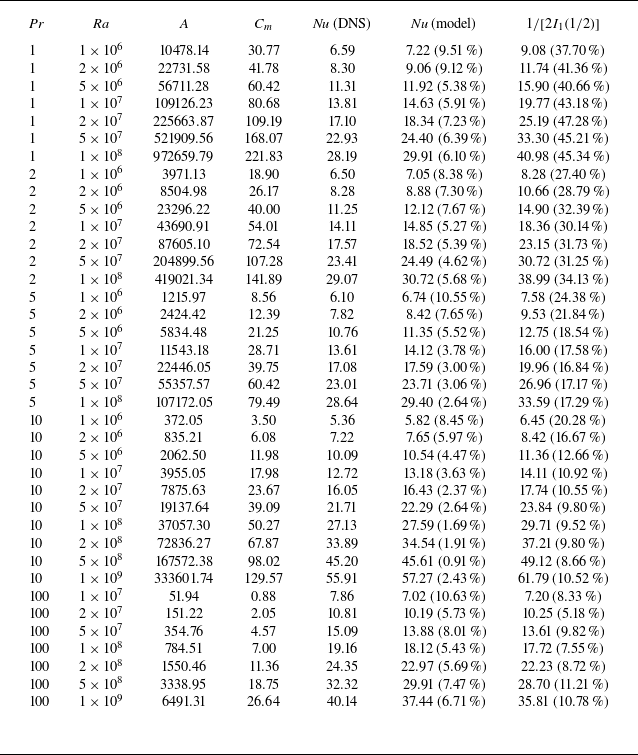
are shown in table 1. In determining
$C_m$
are shown in table 1. In determining $\overline {T}(x)$
and
$\overline {T}(x)$
and ${\textit{Nu}}$
, the relevant quantity is
${\textit{Nu}}$
, the relevant quantity is $F(x) = 1/[1+ Pr K(x)/\nu ]$
(see (3.4) and (3.5)). We compare
$F(x) = 1/[1+ Pr K(x)/\nu ]$
(see (3.4) and (3.5)). We compare $F(x)$
evaluated using the eddy diffusivity model (3.6) and the DNS data in figure 1. Good agreement can be seen, which is further supported by the relatively small errors of the values of
$F(x)$
evaluated using the eddy diffusivity model (3.6) and the DNS data in figure 1. Good agreement can be seen, which is further supported by the relatively small errors of the values of ${\textit{Nu}}$
estimated using the model with respect to the DNS data (see table 1). Good agreement between the analytical result for
${\textit{Nu}}$
estimated using the model with respect to the DNS data (see table 1). Good agreement between the analytical result for $\overline {T}$
and the DNS data is also shown in figure 1. If
$\overline {T}$
and the DNS data is also shown in figure 1. If $K(x)/\nu$
is modelled by
$K(x)/\nu$
is modelled by $A(x/H)^3$
throughout the whole region (Ruckenstein & Felske Reference Ruckenstein and Felske1980), the estimated
$A(x/H)^3$
throughout the whole region (Ruckenstein & Felske Reference Ruckenstein and Felske1980), the estimated ${\textit{Nu}}$
would be given by
${\textit{Nu}}$
would be given by $1/[2 I_1(1/2)]$
. As shown in table 1, the relative errors of these estimates of
$1/[2 I_1(1/2)]$
. As shown in table 1, the relative errors of these estimates of ${\textit{Nu}}$
are substantially larger for
${\textit{Nu}}$
are substantially larger for ${\textit{Pr}} \le 5$
.
${\textit{Pr}} \le 5$
.
Values of the parameters $A$
and
$A$
and $C_m$
of the eddy thermal diffusivity model. Here,
$C_m$
of the eddy thermal diffusivity model. Here, ${\textit{Nu}}$
(model) are the
${\textit{Nu}}$
(model) are the ${\textit{Nu}}$
values estimated using the eddy diffusivity model with these values of
${\textit{Nu}}$
values estimated using the eddy diffusivity model with these values of $A$
and
$A$
and $C_m$
and
$C_m$
and $1/[I_1(1/2)]$
are the values of
$1/[I_1(1/2)]$
are the values of ${\textit{Nu}}$
obtained when
${\textit{Nu}}$
obtained when $K(x)/\nu$
is modelled instead by
$K(x)/\nu$
is modelled instead by $A(x/H)^3$
. The numbers in parentheses are the relative errors of the estimated values of
$A(x/H)^3$
. The numbers in parentheses are the relative errors of the estimated values of ${\textit{Nu}}$
with respect to the DNS data by Howland et al. (Reference Howland, Ng, Verzicco and Lohse2022).
${\textit{Nu}}$
with respect to the DNS data by Howland et al. (Reference Howland, Ng, Verzicco and Lohse2022).

Value of $F(x) = 1/[1+Pr K(x)/\nu ]$
vs
$F(x) = 1/[1+Pr K(x)/\nu ]$
vs $x$
at
$x$
at ${\textit{Ra}}=10^8$
for
${\textit{Ra}}=10^8$
for ${\textit{Pr}}=1$
(black),
${\textit{Pr}}=1$
(black), ${\textit{Pr}}=10$
(blue) and
${\textit{Pr}}=10$
(blue) and ${\textit{Pr}}=100$
(green). The symbols are DNS data (Howland et al. Reference Howland, Ng, Verzicco and Lohse2022) and the solid lines are evaluated using the eddy diffusivity model (3.6) with the values of
${\textit{Pr}}=100$
(green). The symbols are DNS data (Howland et al. Reference Howland, Ng, Verzicco and Lohse2022) and the solid lines are evaluated using the eddy diffusivity model (3.6) with the values of $A$
and
$A$
and $C_m$
from table 1. In the inset, we compare the analytical result of the mean temperature profiles
$C_m$
from table 1. In the inset, we compare the analytical result of the mean temperature profiles $\overline {T}(x)$
from the model (solid lines) with the DNS data. The dashed lines denote the positions of
$\overline {T}(x)$
from the model (solid lines) with the DNS data. The dashed lines denote the positions of $y_1$
and
$y_1$
and $y_2=0.3$
.
$y_2=0.3$
.

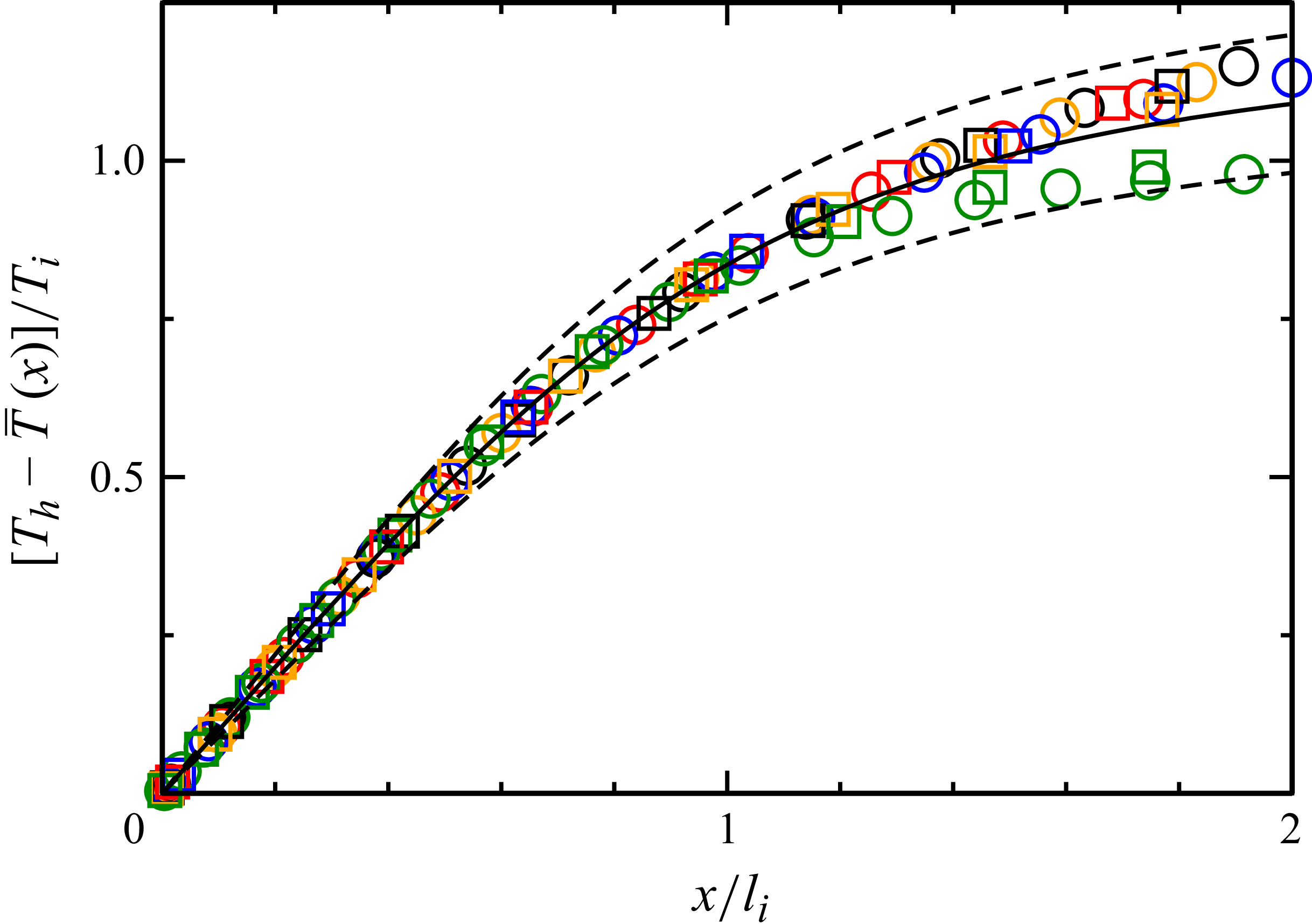
In figure 2, we plot $(T_h-\overline {T} )/T_i$
as a function of
$(T_h-\overline {T} )/T_i$
as a function of $x/l_i$
. The DNS data for different
$x/l_i$
. The DNS data for different ${\textit{Pr}}$
and
${\textit{Pr}}$
and ${\textit{Ra}}$
collapse onto a single curve that is well described by the theoretical inner scaling function
${\textit{Ra}}$
collapse onto a single curve that is well described by the theoretical inner scaling function $F_i$
in (3.17) for
$F_i$
in (3.17) for $0 \le x/l_i \lt 2$
, validating (3.15). In this region,
$0 \le x/l_i \lt 2$
, validating (3.15). In this region, $F_i$
clearly deviates from a linear function, showing that the turbulent heat flux
$F_i$
clearly deviates from a linear function, showing that the turbulent heat flux $\overline {u'T'}$
cannot be neglected even within the inner region. Following George & Capp (Reference George and Capp1979), we express the temperature and length scales in the inner region in terms of heat flux, or equivalently,
$\overline {u'T'}$
cannot be neglected even within the inner region. Following George & Capp (Reference George and Capp1979), we express the temperature and length scales in the inner region in terms of heat flux, or equivalently, $q$
, the buoyancy parameter
$q$
, the buoyancy parameter $\alpha g$
and the molecular diffusivities
$\alpha g$
and the molecular diffusivities $\nu$
and
$\nu$
and $\kappa$
. Dimensional analysis then yields
$\kappa$
. Dimensional analysis then yields
 \begin{eqnarray} T_i = \left ( \frac {q^3}{\alpha g \kappa } \right )^{\!\frac {1}{4}} g_i(\textit{Pr}) = T_{i,\textit{GC}} g_i(\textit{Pr}) = \varDelta T \textit{Nu}^{3/4} (\textit{Ra} \textit{Pr})^{-\frac {1}{4}} g_i(\textit{Pr}) ,\end{eqnarray}
up to some ${\textit{Pr}}$
-dependent function
${\textit{Pr}}$
-dependent function $g_i(\textit{Pr})$
. Using (3.21) and (3.22), we have
$g_i(\textit{Pr})$
. Using (3.21) and (3.22), we have
 \begin{equation} l_i = \left ( \frac {\kappa ^3}{\alpha g q}\right )^{\!\frac {1}{4}} g_i(\textit{Pr}) = l_{i,\textit{GC}} g_i(\textit{Pr}) .\end{equation}
Value of $(T_h-\overline {T})/T_i$
vs
$(T_h-\overline {T})/T_i$
vs $x/l_i$
at
$x/l_i$
at ${\textit{Ra}}_{\textit{min}}$
(circles) and
${\textit{Ra}}_{\textit{min}}$
(circles) and ${\textit{Ra}}_{\textit{max}}$
(squares) for
${\textit{Ra}}_{\textit{max}}$
(squares) for ${\textit{Pr}}=1$
(black),
${\textit{Pr}}=1$
(black), ${\textit{Pr}}=2$
(red),
${\textit{Pr}}=2$
(red), ${\textit{Pr}}=5$
(orange),
${\textit{Pr}}=5$
(orange), ${\textit{Pr}}=10$
(blue) and
${\textit{Pr}}=10$
(blue) and ${\textit{Pr}}=100$
(green). Here,
${\textit{Pr}}=100$
(green). Here, ${\textit{Ra}}_{\textit{min}}$
and
${\textit{Ra}}_{\textit{min}}$
and ${\textit{Ra}}_{\textit{max}}$
are the minimum and maximum values of
${\textit{Ra}}_{\textit{max}}$
are the minimum and maximum values of ${\textit{Ra}}$
for the corresponding
${\textit{Ra}}$
for the corresponding ${\textit{Pr}}$
(see table 1). The solid line is the inner scaling function
${\textit{Pr}}$
(see table 1). The solid line is the inner scaling function $F_i$
given by (3.17) and the two dashed lines indicate
$F_i$
given by (3.17) and the two dashed lines indicate $0.9F_i$
and
$0.9F_i$
and $1.1F_i$
.
$1.1F_i$
.

Our inner temperature and length scales $T_i$
and
$T_i$
and $l_i$
thus differ from the scales
$l_i$
thus differ from the scales $T_{i,\textit{GC}} = (q^3/\alpha g \kappa )^{1/4}$
and
$T_{i,\textit{GC}} = (q^3/\alpha g \kappa )^{1/4}$
and $l_{i,\textit{GC}}=(\kappa ^3/\alpha g q)^{1/4}$
adopted by George & Capp (Reference George and Capp1979). The inclusion of
$l_{i,\textit{GC}}=(\kappa ^3/\alpha g q)^{1/4}$
adopted by George & Capp (Reference George and Capp1979). The inclusion of $\nu$
in our analysis leads to an additional function
$\nu$
in our analysis leads to an additional function $g_i(\textit{Pr})$
, and this enables us to obtain a universal scaling function
$g_i(\textit{Pr})$
, and this enables us to obtain a universal scaling function $F_i$
in the inner region for all
$F_i$
in the inner region for all ${\textit{Pr}}$
. By comparing (3.19) with (4.1), we obtain
${\textit{Pr}}$
. By comparing (3.19) with (4.1), we obtain
 \begin{eqnarray} (\textit{Pr} A)^{-1/3} = (\textit{Ra} \textit{Pr} \textit{Nu})^{-1/4} g_i(\textit{Pr}) ,\end{eqnarray}
which is used to evaluate $g_i(\textit{Pr})$
. We find that
$g_i(\textit{Pr})$
. We find that $g_i(\textit{Pr})$
can be fitted by a power law
$g_i(\textit{Pr})$
can be fitted by a power law $k_i \textit{Pr}^{\beta }$
with
$k_i \textit{Pr}^{\beta }$
with $\beta = 0.425 \approx 3/7$
and
$\beta = 0.425 \approx 3/7$
and $k_i = 2.18$
. A commonly used velocity scale in the inner region is the friction velocity
$k_i = 2.18$
. A commonly used velocity scale in the inner region is the friction velocity $u_\tau = \sqrt {\nu{\rm d}\overline {w}/{\rm d}x |_{x=0}}$
. It is interesting to compare the inner velocity scale
$u_\tau = \sqrt {\nu{\rm d}\overline {w}/{\rm d}x |_{x=0}}$
. It is interesting to compare the inner velocity scale $V_i$
and
$V_i$
and $u_\tau$
. Using (3.22) and (4.3), we obtain
$u_\tau$
. Using (3.22) and (4.3), we obtain
 \begin{equation} \frac {V_i}{u_\tau } =\frac {(\textit{Ra} \textit{Nu})^{1/4} }{g_i(\textit{Pr}) \textit{Pr}^{3/4} Re_\tau } ,\end{equation}
where ${\textit{Re}}_\tau =u_\tau H/\nu$
is the shear Reynolds number. The theoretical results of Ching (Reference Ching2023) that
${\textit{Re}}_\tau =u_\tau H/\nu$
is the shear Reynolds number. The theoretical results of Ching (Reference Ching2023) that ${\textit{Nu}}$
and
${\textit{Nu}}$
and ${\textit{Re}}_\tau$
scale as
${\textit{Re}}_\tau$
scale as ${\textit{Ra}}^{1/3}$
in the high-
${\textit{Ra}}^{1/3}$
in the high- ${\textit{Ra}}$
limit then imply that
${\textit{Ra}}$
limit then imply that $V_i$
is related to
$V_i$
is related to $u_\tau$
by a
$u_\tau$
by a ${\textit{Pr}}$
-dependent function
${\textit{Pr}}$
-dependent function $h(\textit{Pr})$
when
$h(\textit{Pr})$
when ${\textit{Ra}}$
is sufficiently large
${\textit{Ra}}$
is sufficiently large
 \begin{equation} V_i \approx h(\textit{Pr}) u_\tau .\end{equation}
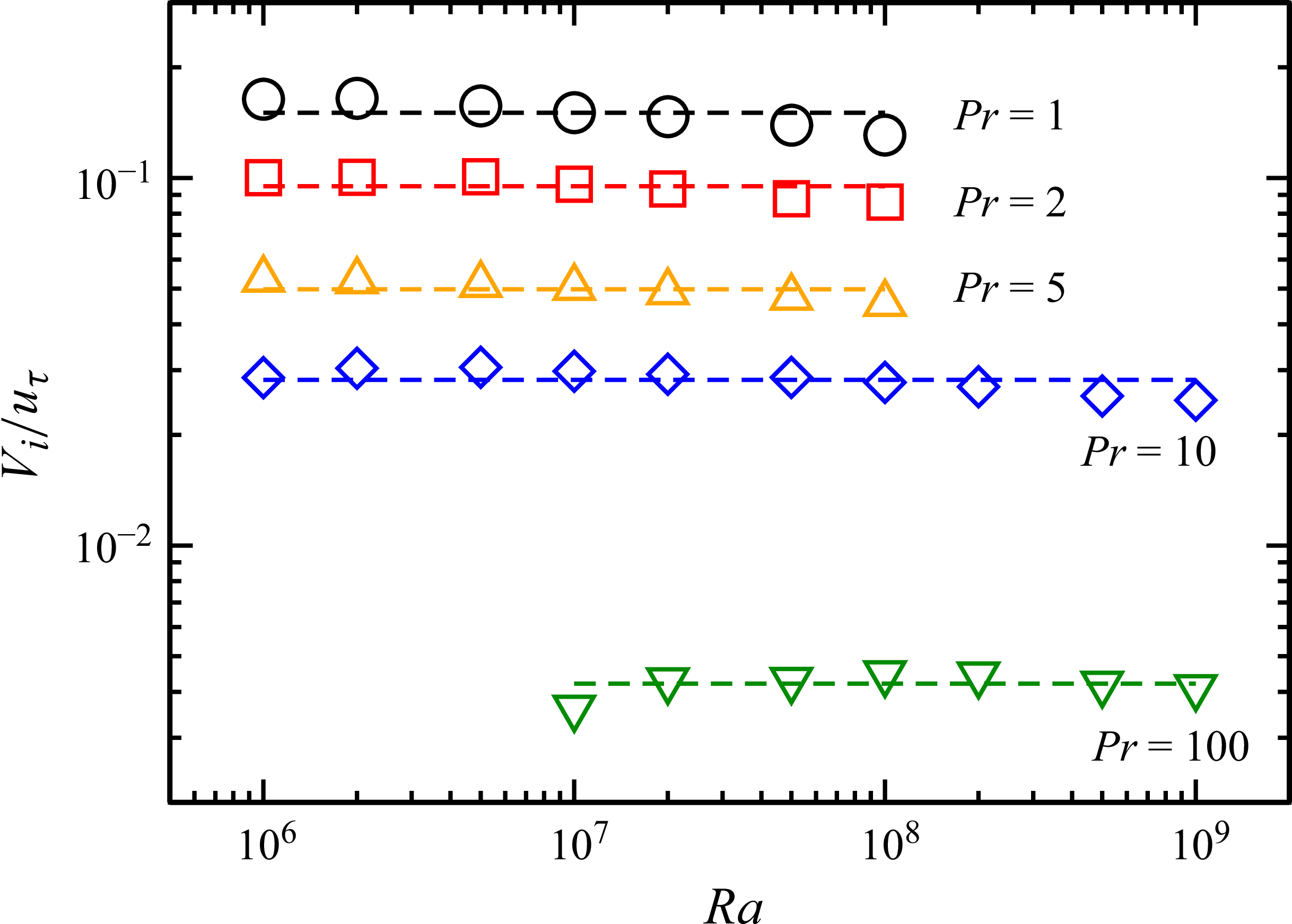
It can be seen in figure 3 that (4.5) is confirmed and $h(\textit{Pr})$
is a decreasing function of
$h(\textit{Pr})$
is a decreasing function of ${\textit{Pr}}$
. As a result, if the mean temperature profiles are rescaled by
${\textit{Pr}}$
. As a result, if the mean temperature profiles are rescaled by $l_\tau \equiv \kappa /u_\tau$
and
$l_\tau \equiv \kappa /u_\tau$
and $T_\tau \equiv q/u_\tau$
instead of
$T_\tau \equiv q/u_\tau$
instead of $l_i$
and
$l_i$
and $T_i$
, the profiles for different
$T_i$
, the profiles for different ${\textit{Pr}}$
do not collapse beyond the linear region near the wall (as shown in figure 5b of Howland et al. Reference Howland, Ng, Verzicco and Lohse2022).
${\textit{Pr}}$
do not collapse beyond the linear region near the wall (as shown in figure 5b of Howland et al. Reference Howland, Ng, Verzicco and Lohse2022).
Value of $V_i/u_\tau$
as a function of
$V_i/u_\tau$
as a function of ${\textit{Ra}}$
. The dashed lines give the average values of
${\textit{Ra}}$
. The dashed lines give the average values of $V_i/u_\tau$
over
$V_i/u_\tau$
over ${\textit{Ra}}$
for each
${\textit{Ra}}$
for each ${\textit{Pr}}$
.
${\textit{Pr}}$
.

Next we check (3.16). As shown in figure 4, the rescaling of $\overline {T}-T_m$
by
$\overline {T}-T_m$
by $T_o$
results in an approximate collapse of the data in the region
$T_o$
results in an approximate collapse of the data in the region $0.3 \le x/H \le 0.5$
. The collapsed data are consistent with the outer scaling function
$0.3 \le x/H \le 0.5$
. The collapsed data are consistent with the outer scaling function $F_o$
with
$F_o$
with $b=4$
in (3.18). These observations support our choice of
$b=4$
in (3.18). These observations support our choice of $y_2=0.3$
and
$y_2=0.3$
and $b=4$
and validate our proposed functional form of
$b=4$
and validate our proposed functional form of $K(x)$
in the outer region. If the outer temperature scale
$K(x)$
in the outer region. If the outer temperature scale $T_{o,\textit{GC}}$
proposed by George & Capp (Reference George and Capp1979) is used instead of
$T_{o,\textit{GC}}$
proposed by George & Capp (Reference George and Capp1979) is used instead of $T_o$
, the data collapse is worse (see the inset of figure 4). The scale
$T_o$
, the data collapse is worse (see the inset of figure 4). The scale $T_{o,\textit{GC}}$
, given by
$T_{o,\textit{GC}}$
, given by
 \begin{equation} T_{o,\textit{GC}}=\left (\frac {q^2}{\alpha g H} \right )^{1/3} , \end{equation}
was obtained by assuming that the temperature scale in the outer region depends on $q$
,
$q$
, $\alpha g$
and
$\alpha g$
and $H$
only and not on the molecular diffusivities
$H$
only and not on the molecular diffusivities $\nu$
and
$\nu$
and $\kappa$
. We find that
$\kappa$
. We find that
 \begin{equation} C_m \to k_o (\textit{Ra} \textit{Nu})^{1/3} \textit{Pr}^{-2/3} ,\end{equation}
with $k_o = 0.162$
for sufficiently large
$k_o = 0.162$
for sufficiently large ${\textit{Ra}}$
. This implies that
${\textit{Ra}}$
. This implies that $T_o \to k_o^{-1} T_{o,\textit{GC}}$
when
$T_o \to k_o^{-1} T_{o,\textit{GC}}$
when ${\textit{Ra}}$
is greater than certain threshold value
${\textit{Ra}}$
is greater than certain threshold value ${\textit{Ra}}_c(\textit{Pr})$
and
${\textit{Ra}}_c(\textit{Pr})$
and ${\textit{Ra}}_c(\textit{Pr})$
increases with
${\textit{Ra}}_c(\textit{Pr})$
increases with ${\textit{Pr}}$
.
${\textit{Pr}}$
.
Plot of $(\overline {T} - T_m)/T_o$
vs
$(\overline {T} - T_m)/T_o$
vs $x/H$
at
$x/H$
at ${\textit{Ra}}_{\textit{min}}$
and
${\textit{Ra}}_{\textit{min}}$
and ${\textit{Ra}}_{\textit{max}}$
for
${\textit{Ra}}_{\textit{max}}$
for ${\textit{Pr}}=1, 2, 5, 10, 100$
. Same symbols as in figure 2. The solid line is the function
${\textit{Pr}}=1, 2, 5, 10, 100$
. Same symbols as in figure 2. The solid line is the function $F_o$
given by (3.18). A similar plot is shown in the inset with the temperature rescaled by
$F_o$
given by (3.18). A similar plot is shown in the inset with the temperature rescaled by $T_{o,\textit{GC}}$
instead of
$T_{o,\textit{GC}}$
instead of $T_o$
.
$T_o$
.

Finally, we show that our model gives ${\textit{Nu}} \sim \textit{Ra}^{1/3}$
in the high-
${\textit{Nu}} \sim \textit{Ra}^{1/3}$
in the high- ${\textit{Ra}}$
limit. Using (4.3) and (4.7), it can be shown that, for sufficiently large
${\textit{Ra}}$
limit. Using (4.3) and (4.7), it can be shown that, for sufficiently large ${\textit{Ra}}$
,
${\textit{Ra}}$
, $I_1(y_1) \sim (Ra Nu)^{-1/4}$
,
$I_1(y_1) \sim (Ra Nu)^{-1/4}$
, $I_2(y_2) \sim (Ra Nu)^{-1/3} \ln (Ra Nu)$
and
$I_2(y_2) \sim (Ra Nu)^{-1/3} \ln (Ra Nu)$
and $I_3(y_2) \sim (Ra Nu)^{-1/3}$
and hence
$I_3(y_2) \sim (Ra Nu)^{-1/3}$
and hence
 \begin{eqnarray} {\textit{Nu}} \approx \frac {1}{2I_1(y_1)} \Rightarrow {\textit{Nu}} \sim \textit{Ra}^{1/3} . \end{eqnarray}
Substituting the theoretical result of ${\textit{Nu}} \approx [C^2f(\textit{Pr})]^{1/3}\textit{Pr}^{-1/9} \textit{Ra}^{1/3} = \gamma (\textit{Pr}) \textit{Ra}^{1/3}$
for
${\textit{Nu}} \approx [C^2f(\textit{Pr})]^{1/3}\textit{Pr}^{-1/9} \textit{Ra}^{1/3} = \gamma (\textit{Pr}) \textit{Ra}^{1/3}$
for ${\textit{Pr}} \ge 1$
in the high-
${\textit{Pr}} \ge 1$
in the high- ${\textit{Ra}}$
limit (Ching Reference Ching2023) into (4.3) and (4.7), we obtain
${\textit{Ra}}$
limit (Ching Reference Ching2023) into (4.3) and (4.7), we obtain
 \begin{align} A &\approx [\gamma (\textit{Pr})]^{3/4} [g_i(\textit{Pr})]^{-3} \textit{Pr}^{-1/4} \textit{Ra} = C_1(\textit{Pr}) \textit{Ra} ,\end{align}
 \begin{align} C_m &\approx k_o [\gamma (\textit{Pr})]^{1/3} \textit{Pr}^{-2/3} \textit{Ra}^{4/9} = C_2(\textit{Pr}) \textit{Ra}^{4/9} , \end{align}
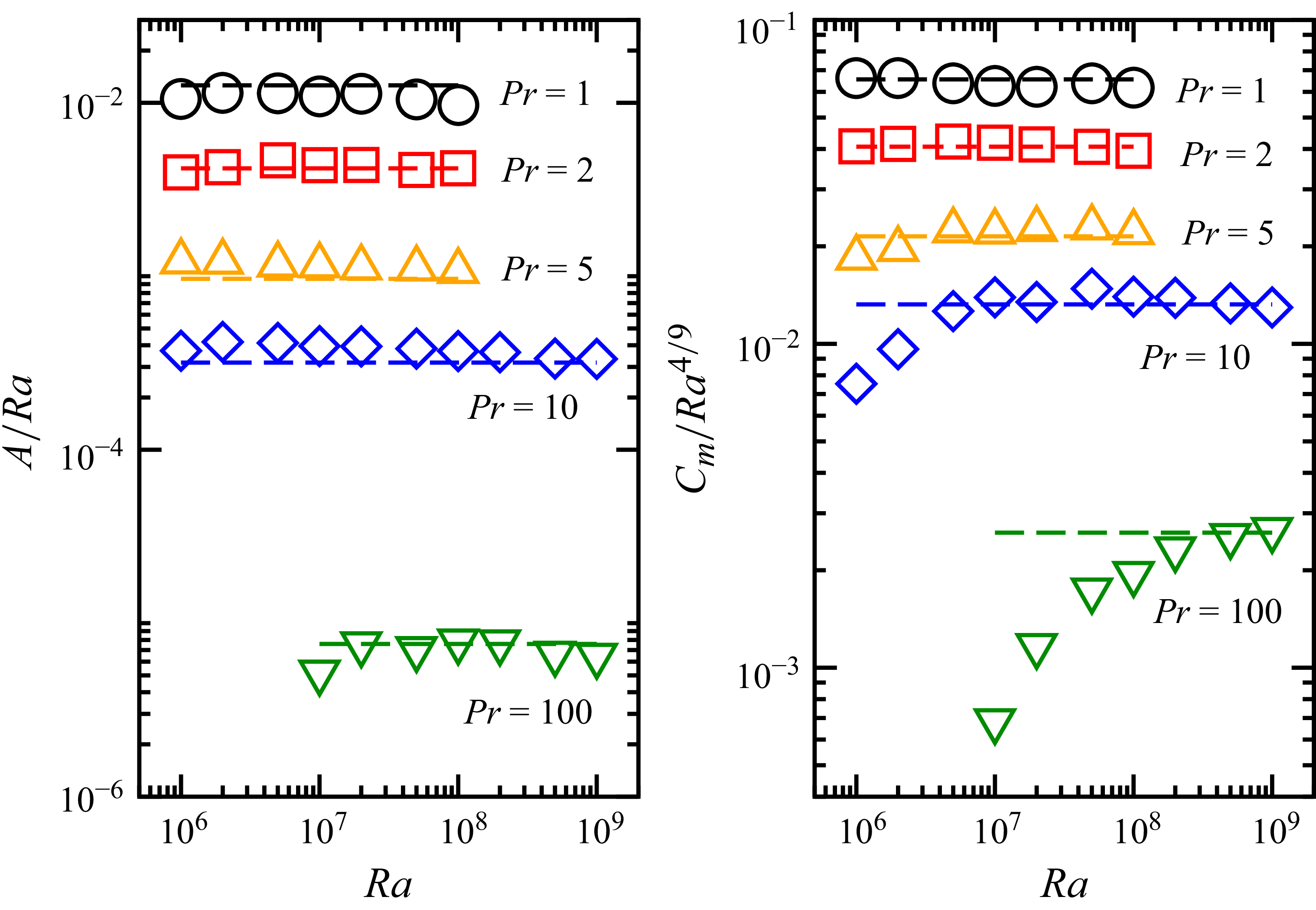
when ${\textit{Ra}}$
is sufficiently large. Such
${\textit{Ra}}$
is sufficiently large. Such ${\textit{Ra}}$
-dependencies of
${\textit{Ra}}$
-dependencies of $A$
and
$A$
and $C_m$
are confirmed in figure 5.
$C_m$
are confirmed in figure 5.
Plot of $A/Ra$
and
$A/Ra$
and $C_m/\textit{Ra}^{4/9}$
vs
$C_m/\textit{Ra}^{4/9}$
vs ${\textit{Ra}}$
.The dashed lines for different
${\textit{Ra}}$
.The dashed lines for different ${\textit{Pr}}$
are the values of
${\textit{Pr}}$
are the values of $C_1(\textit{Pr})$
and
$C_1(\textit{Pr})$
and $C_2(\textit{Pr})$
obtained by using
$C_2(\textit{Pr})$
obtained by using $C=0.043$
,
$C=0.043$
, $f(\textit{Pr})\approx 0.19$
(Ching Reference Ching2023) and the fitted values of
$f(\textit{Pr})\approx 0.19$
(Ching Reference Ching2023) and the fitted values of $k_i$
,
$k_i$
, $\beta$
and
$\beta$
and $k_o$
(see (4.9) and (4.10)).
$k_o$
(see (4.9) and (4.10)).

4.2. Comparison with mean temperature profiles reported in previous studies
One often-cited result for the mean temperature profile was obtained by George & Capp (Reference George and Capp1979). They proposed scaling functions in terms of $T_{i,\textit{GC}}$
and
$T_{i,\textit{GC}}$
and $l_{i,\textit{GC}}$
in the inner region and
$l_{i,\textit{GC}}$
in the inner region and $T_{o,\textit{GC}}$
and
$T_{o,\textit{GC}}$
and $H$
in the outer region. In an overlap layer in which both scaling functions hold, they obtained
$H$
in the outer region. In an overlap layer in which both scaling functions hold, they obtained
 \begin{align} \frac {T_h - \overline {T}(x)}{T_{i,\textit{GC}}} &= - K_1 \left (\frac {x}{l_{i,\textit{GC}}}\right )^{-1/3} + \phi _1(\textit{Pr}) , \end{align}
 \begin{align} \frac {\overline {T}(x)-T_m}{T_{o,\textit{GC}}} &= K_1 \left (\frac {x}{H}\right )^{-1/3} + \theta _1 , \end{align}
with undetermined constants $K_1$
,
$K_1$
, $\phi _1(\textit{Pr})$
and
$\phi _1(\textit{Pr})$
and $\theta _1$
; the independence of
$\theta _1$
; the independence of $K_1$
and
$K_1$
and $\theta _1$
from
$\theta _1$
from ${\textit{Pr}}$
follows from the independence of the outer scaling function from
${\textit{Pr}}$
follows from the independence of the outer scaling function from $\nu$
or
$\nu$
or $\kappa$
. Fitting their DNS data for
$\kappa$
. Fitting their DNS data for ${\textit{Pr}}=0.709$
(air), Versteegh & Nieuwstadt (Reference Versteegh and Nieuwstadt1999) and Ng et al. (Reference Ng, Chung and Ooi2013) found
${\textit{Pr}}=0.709$
(air), Versteegh & Nieuwstadt (Reference Versteegh and Nieuwstadt1999) and Ng et al. (Reference Ng, Chung and Ooi2013) found $K_1=4.2$
. Using the DNS data of Howland et al. (Reference Howland, Ng, Verzicco and Lohse2022), we find that the region that (4.11) with
$K_1=4.2$
. Using the DNS data of Howland et al. (Reference Howland, Ng, Verzicco and Lohse2022), we find that the region that (4.11) with $K_1=4.2$
can fit decreases drastically for larger
$K_1=4.2$
can fit decreases drastically for larger ${\textit{Pr}}$
while our result for the inner region (3.15) with (3.17), rewritten as
${\textit{Pr}}$
while our result for the inner region (3.15) with (3.17), rewritten as
 \begin{eqnarray} \frac {T_h - \overline {T}(x)}{T_{i,\textit{GC}}} = g_i(\textit{Pr}) F_i \left (\frac {1}{g_i(\textit{Pr})}\frac {x}{l_{i,\textit{GC}}}\right ) , \end{eqnarray}
can give good fits for all the 5 values of ${\textit{Pr}}$
studied. The comparison for
${\textit{Pr}}$
studied. The comparison for ${\textit{Pr}}=1$
and
${\textit{Pr}}=1$
and ${\textit{Pr}}=100$
is shown in figure 6.
${\textit{Pr}}=100$
is shown in figure 6.
Plots of $[T_h - \overline {T}(x)]/T_{i,\textit{GC}}$
vs
$[T_h - \overline {T}(x)]/T_{i,\textit{GC}}$
vs $x/l_{i,\textit{GC}}$
for
$x/l_{i,\textit{GC}}$
for ${\textit{Pr}}=1$
(left panel) and
${\textit{Pr}}=1$
(left panel) and ${\textit{Pr}}=100$
(right panel) at
${\textit{Pr}}=100$
(right panel) at ${\textit{Ra}} = 10^6$
(plusses),
${\textit{Ra}} = 10^6$
(plusses), $2\times 10^6$
(crosses),
$2\times 10^6$
(crosses), $5\times 10^6$
(stars),
$5\times 10^6$
(stars), $10^7$
(circles),
$10^7$
(circles), $2\times 10^7$
(squares),
$2\times 10^7$
(squares), $5\times 10^7$
(diamonds),
$5\times 10^7$
(diamonds), $10^8$
(triangles),
$10^8$
(triangles), $2\times 10^8$
(left triangles),
$2\times 10^8$
(left triangles), $5\times 10^8$
(inverted triangles) and
$5\times 10^8$
(inverted triangles) and $10^9$
(right triangles). The red solid lines are (4.13) and the blue dashed lines are (4.11) with
$10^9$
(right triangles). The red solid lines are (4.13) and the blue dashed lines are (4.11) with $K_1=4.2$
,
$K_1=4.2$
, $\phi _1(1)=5.10$
and
$\phi _1(1)=5.10$
and $\phi _1(100)=5.15$
.
$\phi _1(100)=5.15$
.

Using the same approach but with the temperature scale $T_{i,\textit{GC}}$
for both the inner and outer regions, Hölling & Herwig (Reference Hölling and Herwig2005) obtained a logarithmic profile in the overlap layer
$T_{i,\textit{GC}}$
for both the inner and outer regions, Hölling & Herwig (Reference Hölling and Herwig2005) obtained a logarithmic profile in the overlap layer
 \begin{align} \frac {T_h - \overline {T}(x)}{T_{i,\textit{GC}}} &= K_2 \log \left (\frac {x}{l_{i,\textit{GC}}}\right ) + \phi _2(\textit{Pr}) , \end{align}
 \begin{align} \frac {\overline {T}(x)-T_m}{T_{i,\textit{GC}}} &= - K_2 \log \left (\frac {x}{H}\right ) + \theta _2 , \end{align}
with undetermined constants $K_2$
,
$K_2$
, $\phi _2(\textit{Pr})$
and
$\phi _2(\textit{Pr})$
and $\theta _2$
. Different values of
$\theta _2$
. Different values of $K_2$
and
$K_2$
and $\phi _2$
, obtained by fitting DNS data for air, were reported (Versteegh & Nieuwstadt Reference Versteegh and Nieuwstadt1999; Hölling & Herwig Reference Hölling and Herwig2005; Kiš & Herwig Reference Kiš and Herwig2012; Ng et al. Reference Ng, Chung and Ooi2013). We thus test instead the relation between
$\phi _2$
, obtained by fitting DNS data for air, were reported (Versteegh & Nieuwstadt Reference Versteegh and Nieuwstadt1999; Hölling & Herwig Reference Hölling and Herwig2005; Kiš & Herwig Reference Kiš and Herwig2012; Ng et al. Reference Ng, Chung and Ooi2013). We thus test instead the relation between ${\textit{Nu}}$
,
${\textit{Nu}}$
, ${\textit{Ra}}$
and
${\textit{Ra}}$
and ${\textit{Pr}}$
, obtained by adding (4.14) and (4.15) and using (4.1) and (4.2)
${\textit{Pr}}$
, obtained by adding (4.14) and (4.15) and using (4.1) and (4.2)
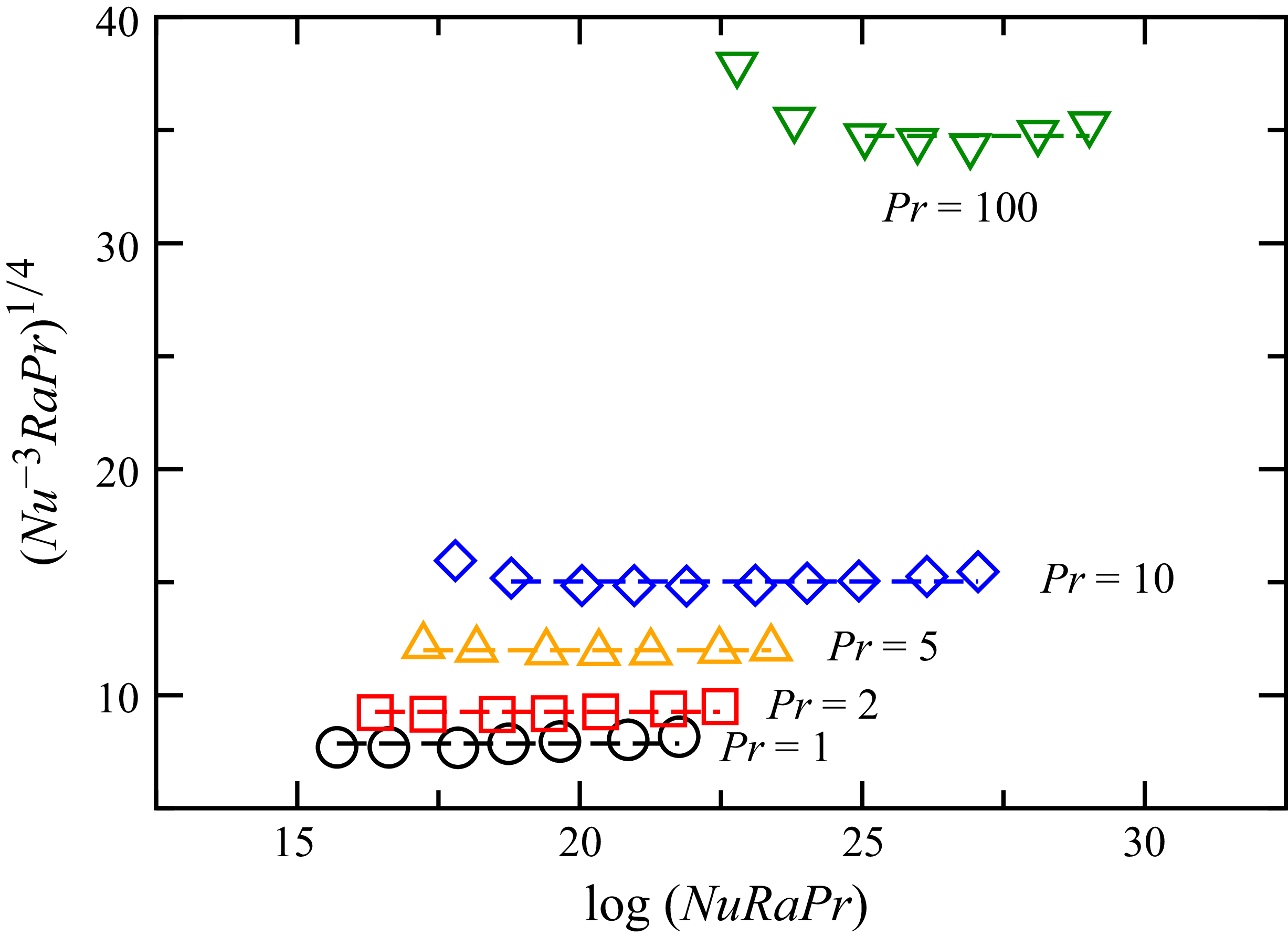
 \begin{align} (\textit{Nu}^{-3} \textit{Ra} \textit{Pr})^{1/4} = \frac {K_2}{2} \log (\textit{Nu} \textit{Ra} \textit{Pr}) + 2[\phi _2(\textit{Pr})+\theta _2] .\end{align}
Balaji, Hölling & Herwig (Reference Balaji, Hölling and Herwig2007) assumed (4.14) to hold up to $x=H/2$
and obtained a different relation than (4.16). As shown in figure 7, the DNS data (Howland et al. Reference Howland, Ng, Verzicco and Lohse2022) are consistent with (4.16) with
$x=H/2$
and obtained a different relation than (4.16). As shown in figure 7, the DNS data (Howland et al. Reference Howland, Ng, Verzicco and Lohse2022) are consistent with (4.16) with $K_2=0$
, indicating their incompatibility with (4.14) and (4.15). When
$K_2=0$
, indicating their incompatibility with (4.14) and (4.15). When $K_2=0$
, (4.16) reduces to
$K_2=0$
, (4.16) reduces to ${\textit{Nu}} \sim \textit{Ra}^{1/3}$
.
${\textit{Nu}} \sim \textit{Ra}^{1/3}$
.
Plot of $(\textit{Nu}^{-3} \textit{Ra} Pr)^{1/4}$
vs
$(\textit{Nu}^{-3} \textit{Ra} Pr)^{1/4}$
vs $\log (Nu \textit{Ra} Pr)$
using DNS data of Howland et al. (Reference Howland, Ng, Verzicco and Lohse2022). The dashed lines for different
$\log (Nu \textit{Ra} Pr)$
using DNS data of Howland et al. (Reference Howland, Ng, Verzicco and Lohse2022). The dashed lines for different ${\textit{Pr}}$
are the best fits of (4.16) with
${\textit{Pr}}$
are the best fits of (4.16) with $K_2=0$
.
$K_2=0$
.

A recent work (Li et al. Reference Li, Jia, Liu, Jiao and Zhang2023) studied the mean velocity and temperature profiles by modelling the Reynolds stress and turbulent heat flux
 \begin{align} \overline {u'w'} &= -k_1 x^2 \left ( \frac {\partial \overline {w}}{\partial x} \right )^2 \!,\end{align}
 \begin{align} \overline {u'T'} &= -k_2 x^2 \frac {\partial \overline {w}}{\partial x} \frac {\partial \overline {T}}{\partial x} ,\end{align}
where $k_1$
and
$k_1$
and $k_2$
are dimensionless coefficients. As discussed in § 3.1,
$k_2$
are dimensionless coefficients. As discussed in § 3.1, $\overline {u'T'}$
and its first- and second-order derivatives with respect to
$\overline {u'T'}$
and its first- and second-order derivatives with respect to $x$
vanish at
$x$
vanish at $x=0$
due to the boundary conditions. Similar arguments require
$x=0$
due to the boundary conditions. Similar arguments require $\overline {u'w'}$
and its first- and second-order derivatives with respect to
$\overline {u'w'}$
and its first- and second-order derivatives with respect to $x$
to vanish at
$x$
to vanish at $x=0$
. These properties should be satisfied by any closure model but they are violated by (4.17) and (4.18). Since both the mean velocity and temperature gradients,
$x=0$
. These properties should be satisfied by any closure model but they are violated by (4.17) and (4.18). Since both the mean velocity and temperature gradients, $\partial \overline {w}/\partial x$
and
$\partial \overline {w}/\partial x$
and $\partial \overline {T}/\partial x$
, are non-zero at
$\partial \overline {T}/\partial x$
, are non-zero at $x=0$
, the model expressions on the right-hand side of (4.17) and (4.18) have non-vanishing second-order derivatives at
$x=0$
, the model expressions on the right-hand side of (4.17) and (4.18) have non-vanishing second-order derivatives at $x=0$
. Applying (4.17) and (4.18) to the near-centreline outer region, Li et al., obtained an inverse cubic-root dependence for the mean temperature profile ((2.14b) of Li et al. Reference Li, Jia, Liu, Jiao and Zhang2023), which we rewrite as
$x=0$
. Applying (4.17) and (4.18) to the near-centreline outer region, Li et al., obtained an inverse cubic-root dependence for the mean temperature profile ((2.14b) of Li et al. Reference Li, Jia, Liu, Jiao and Zhang2023), which we rewrite as
 \begin{equation} \frac {\overline {T}(x)-T_m}{T_\tau } = c K\left [ \left (\frac {x}{H} \right )^{-1/3} - 2^{1/3} \right ] =c K x^* ,\end{equation}
where $K = (\alpha g H T_\tau /u_\tau ^2)^{1/3}$
,
$K = (\alpha g H T_\tau /u_\tau ^2)^{1/3}$
, $c \approx 3.8$
and
$c \approx 3.8$
and
 \begin{equation} x^*\equiv \left (\frac {x}{H} \right )^{-1/3} - 2^{1/3} .\end{equation}
We note that (4.19) implies that the mean temperature profiles in the outer region would collapse onto a straight line in $x^*$
when temperature is rescaled by
$x^*$
when temperature is rescaled by $T_\tau /K=T_{o,\textit{GC}}$
. Using (4.20), we rewrite our result for the outer region, (3.16) with (3.18), in terms of
$T_\tau /K=T_{o,\textit{GC}}$
. Using (4.20), we rewrite our result for the outer region, (3.16) with (3.18), in terms of $x^*$
$x^*$
 \begin{equation} \frac {\overline {T}(x)-T_m}{T_o} = \frac {1}{4} \log \left[\left(x^*+2^{1/3}\right)^3 - 1\right]\! .\end{equation}
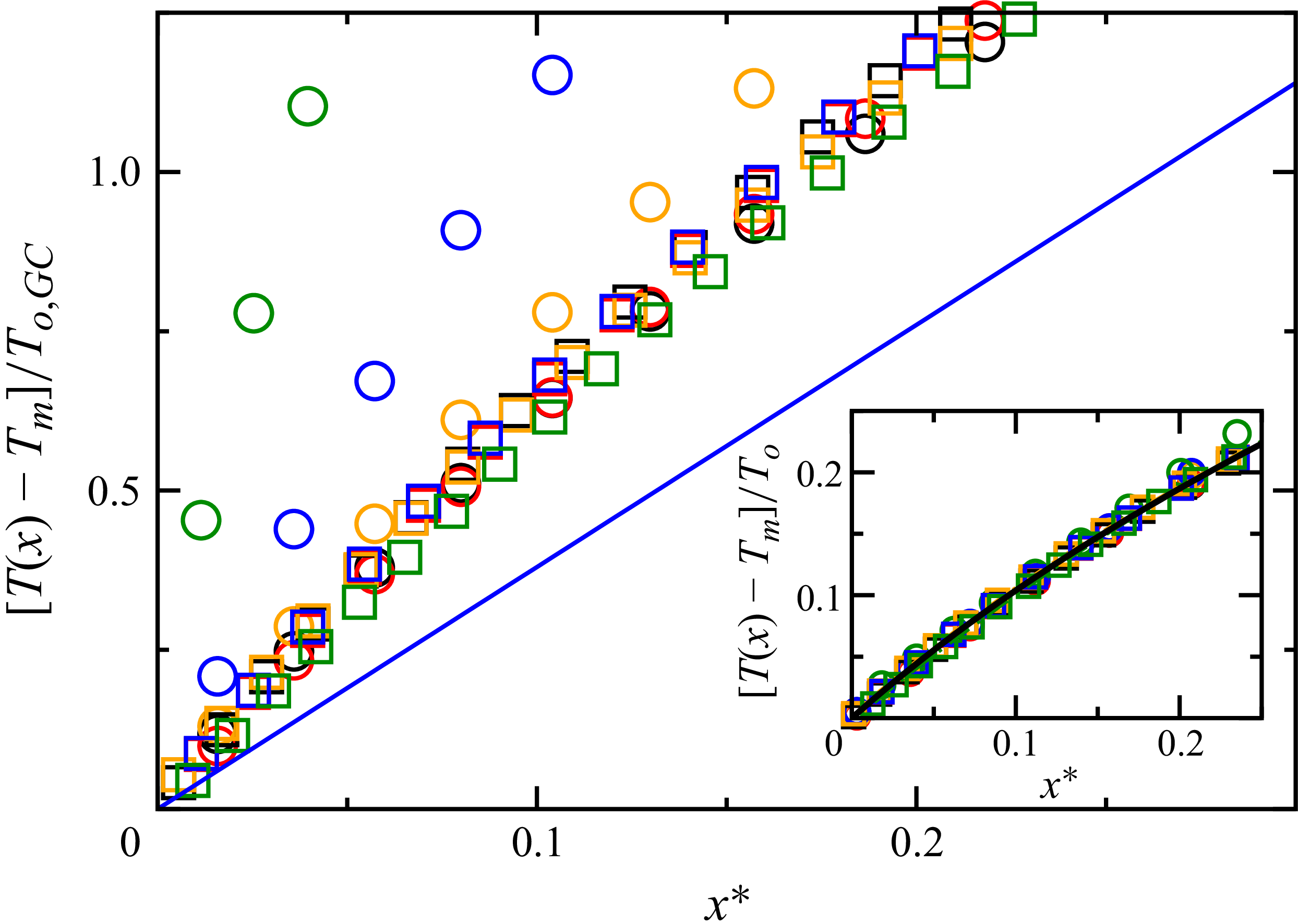
In figure 8, it can be clearly seen that the mean temperature profiles in the outer region do not collapse onto the straight line $c x^*$
when rescaled by
$c x^*$
when rescaled by $T_{o,\textit{GC}}$
, contrary to the prediction by (4.19), but they are well represented by (4.21).
$T_{o,\textit{GC}}$
, contrary to the prediction by (4.19), but they are well represented by (4.21).
Plot of $(\overline {T} - T_m)/(T_{o,\textit{GC}})$
vs
$(\overline {T} - T_m)/(T_{o,\textit{GC}})$
vs $x^*$
at
$x^*$
at ${\textit{Ra}}_{\textit{min}}$
and
${\textit{Ra}}_{\textit{min}}$
and ${\textit{Ra}}_{\textit{max}}$
for
${\textit{Ra}}_{\textit{max}}$
for ${\textit{Pr}}=1, 2, 5, 10, 100$
. Same symbols as in figure 2 and the solid straight line is
${\textit{Pr}}=1, 2, 5, 10, 100$
. Same symbols as in figure 2 and the solid straight line is $c x^*$
. In the inset, a similar plot is shown with the temperature rescaled by
$c x^*$
. In the inset, a similar plot is shown with the temperature rescaled by $T_{o}$
instead of
$T_{o}$
instead of $T_{o,\textit{GC}}$
and the solid line is (4.21).
$T_{o,\textit{GC}}$
and the solid line is (4.21).

5. Conclusions
In this study, we focus on determining the mean temperature profiles in turbulent natural convection between two infinite vertical walls at different temperatures. A three-layer model for the eddy thermal diffusivity with two parameters has been proposed. Using this model, we have derived analytical results for the mean temperature profiles in terms of the two parameters of the model. These analytical results reveal that the mean temperature profiles for different ${\textit{Ra}}$
and
${\textit{Ra}}$
and ${\textit{Pr}}$
are described by two universal scaling functions in the inner region next to the walls and the outer region near the centreline between the walls. The characteristic temperature scales in these two regions are expressed in terms of the two parameters, which determine the characteristic velocities for heat transfer in the two regions. The dependencies of the two parameters on
${\textit{Pr}}$
are described by two universal scaling functions in the inner region next to the walls and the outer region near the centreline between the walls. The characteristic temperature scales in these two regions are expressed in terms of the two parameters, which determine the characteristic velocities for heat transfer in the two regions. The dependencies of the two parameters on ${\textit{Ra}}$
and
${\textit{Ra}}$
and ${\textit{Pr}}$
are obtained. Analytical expressions of the two scaling functions are fully determined and there is no overlap region in which both functions hold. Our theoretical results for the mean temperature profiles in the inner and outer regions are in good agreement with DNS data for
${\textit{Pr}}$
are obtained. Analytical expressions of the two scaling functions are fully determined and there is no overlap region in which both functions hold. Our theoretical results for the mean temperature profiles in the inner and outer regions are in good agreement with DNS data for $1 \le Pr \le 100$
and
$1 \le Pr \le 100$
and $10^6 \le \textit{Ra} \le 10^9$
(Howland et al. Reference Howland, Ng, Verzicco and Lohse2022) and can give a better description of the data than results reported in the literature (George & Capp Reference George and Capp1979; Hölling & Herwig Reference Hölling and Herwig2005; Li et al. Reference Li, Jia, Liu, Jiao and Zhang2023).
$10^6 \le \textit{Ra} \le 10^9$
(Howland et al. Reference Howland, Ng, Verzicco and Lohse2022) and can give a better description of the data than results reported in the literature (George & Capp Reference George and Capp1979; Hölling & Herwig Reference Hölling and Herwig2005; Li et al. Reference Li, Jia, Liu, Jiao and Zhang2023).
Funding
This work was funded by the Hong Kong Research Grants Council (Grant No. CUHK 14303623).
Declaration of interests
The authors report no conflicts of interest.












 Open access

