




Introduction
A nuclear patron’s security guarantee is widely considered crucial in restraining a client state’s nuclear ambitions. A body of research argues that nuclear allies significantly reduce the likelihood of nuclear proliferation by providing a security guarantee that serves as a substitute for indigenous nuclear weapons (Singh and Way Reference Singh and Way2004; Jo and Gartzke Reference Jo and Gartzke2007; Bleek Reference Bleek, Potter and Mukhatzhanova2010; Bleek and Lorber Reference Bleek and Lorber2014; Fuhrmann and Sechser Reference Fuhrmann and Sechser2014; Miller Reference Miller2014). By relying on the patron’s nuclear umbrella to deter potential adversaries, a client state may be dissuaded from developing its own nuclear arsenal. The underlying logic is substitutability: external security guarantees can replace the need for domestic nuclear capability. In offering such a guarantee, the nuclear patron seeks to discourage the client from pursuing nuclear weapons by emphasizing the costs and risks associated with nuclear armament. Yet the South Korean case presents a puzzling question: why does strong public support for nuclear acquisition persist despite continued confidence in the credibility of US extended deterrence?
The effectiveness of a patron’s security guarantee in preventing proliferation hinges on its credibility and the resulting fear of abandonment perceived by the client. Fear of abandonment, as defined by Snyder (Reference Snyder1997), refers to the concern that the patron may fail to provide protection in times of crisis, leaving the client to bear the full burden of national defense. When a patron’s commitment is perceived as strong and reliable, the client is reassured and less likely to seek nuclear weapons. Conversely, if the patron’s commitment appears uncertain or unreliable, abandonment concerns grow, increasing the client’s incentive to pursue an independent nuclear deterrent. In theory, as the credibility of extended deterrence declines, the likelihood of nuclear proliferation should increase.
This theoretical logic does not align with South Korean public opinion data, where survey respondents’ support for nuclear armament remains high even among those who express trust in the US security guarantee. If doubts about the credibility of US extended deterrence were the driving factor behind public support for nuclear armament, we would expect support for nuclearization to be highest when confidence in the US commitment is low. However, public opinion data challenges this assumption. Surveys show that a majority of South Koreans believe the United States would respond militarily to a North Korean nuclear attack, and a substantial share express confidence in US extended deterrence. According to the 2023 EAI Public Opinion Poll on East Asia (East Asia Institute (EAI) 2023a), South Koreans overwhelmingly believe that Washington would respond to a North Korean nuclear attack with either nuclear retaliation (34.4%) or non-nuclear military measures (55.8%). Only about 10 percent believe the United States would not respond (EAI 2023b). Similarly, another survey finds that 61 percent of South Koreans express confidence in US extended deterrence in the event of a conflict (Dalton et al. Reference Dalton, Friedhoff and Kim2022, 6–7). More strikingly, support for nuclear armament appears to increase among those with greater trust in the US commitment (Dalton et al. Reference Dalton, Friedhoff and Kim2022; Sohn, Kim, and Park Reference Park2023).
These survey findings demonstrate that the public perception runs counter to the logic of substitutability, which holds that credible external security guarantees reduce the demand for nuclear weapons. Yet a substantial portion of South Koreans express confidence in the US commitment while simultaneously supporting nuclear armament. This apparent contradiction in public attitudes presents a key puzzle: why does strong public support for nuclear acquisition coexist with citizens’ trust in the credibility of US extended deterrence?
Based on our survey data, South Korean public assessments of US extended deterrence and North Korea’s military threat do not align with what conventional alliance and deterrence theories would expect. While these theories primarily focus on state-level decision-making, their underlying logic suggests that if applied to public opinion, high public trust in extended deterrence should correlate with low support for independent nuclear capabilities. However, our analysis reveals that South Korean respondents who express confidence in US security guarantees still demonstrate significant support for nuclear armament—a pattern that suggests a gap between theoretical expectations and public attitudes.
This article addresses the puzzle of South Korean public support for nuclear armament by applying the theoretical framework of preventive motivations for war (Copeland Reference Copeland2000; Levy Reference Levy1987, Reference Levy2008; Van Evera Reference Van Evera1999). We argue that South Koreans support nuclear armament not because they distrust the current US alliance or face heightened immediate threats, but because of preventive motivations shaped by pessimism about the future security environment. These motivations stem from two perceived power shifts. At the systemic level, concerns about the relative decline of the United States raise fears of strategic realignment and eventual disengagement from alliance commitments. At the inter-Korean level, North Korea’s advancing nuclear capabilities are perceived as threatening to surpass South Korea’s overall military strength, international standing, and bargaining power. This logic reveals a commitment problem embedded in both extended deterrence and inter-Korean relations, offering a forward-looking explanation for the persistent pro-nuclear sentiment in one of the United States’ closest allies. Taken together, these concerns foster a sense of a narrowing window of opportunity and a growing window of vulnerability, prompting increased public support for nuclear acquisition as an anticipatory response to expected decline.
While broader historical and policy developments provide context, this study focuses specifically on public opinion in 2023. In the next section, we develop our theoretical argument on preventive motivations for nuclear armament by applying the logic of preventive war to South Korea’s perceived security environment. We then present the research design, including data sources, model specifications, and descriptive statistics. In the results section, we discuss the major findings that empirically support our argument and highlight areas where our results challenge conventional expectations. We conclude by outlining the policy implications of this study and emphasizing the importance of understanding public opinion in shaping alliance policy and sustaining the global nonproliferation regime.
Preventive motivations for nuclear armament
From preventive war to preventive nuclearization: The strategic logic
The literature on “preventive war” offers a compelling framework for understanding the South Korean public’s puzzling support for nuclear armament. Preventive motivations for war arise from shifts in relative power capabilities driven by differing national growth rates, which create anxiety in a dominant but declining power about its future position. As a rising adversary grows stronger, the dominant power perceives its own military strength and bargaining power diminishing, leading to concerns about the long-term consequences of this shift (Levy Reference Levy1987, 87).
This dynamic generates a commitment problem between declining and rising powers. The dominant power fears that once it is surpassed, the rising power will seek to revise existing agreements or act aggressively, moves that cannot be reliably deterred or prevented through diplomacy (Powell Reference Powell2006). In response to this anticipated future threat, the declining power becomes increasingly sensitive to the timing of action. As its strategic advantage narrows, it perceives both a shrinking window of opportunity and a widening window of vulnerability. The former refers to a fading offensive advantage, while the latter reflects a growing defensive weakness (Van Evera Reference Van Evera1999, 75).
To avoid future disadvantage, the dominant power prefers to act before its position deteriorates further, initiating war while it can still shape power dynamics from a position of relative strength. Delaying action would allow the rising power to exploit its growing advantage, increasing the risk that any future conflict will be more costly or unwinnable (Van Evera Reference Van Evera1999, 74–76). While classical preventive war theories focus on major, rapid power shifts as a key trigger for preventive behavior, more recent works argue that it is not material shifts per se, but expectations of future decline that generate preventive motivations (Copeland Reference Copeland2000; Levy Reference Levy2008). In this context, the logic of “better-now-than-later” compels the declining power to initiate war before losing its strategic edge (Levy Reference Levy1987, Reference Levy2008).
We argue that this core logic—fearing future decline and preferring to act now rather than later—is not limited to interactions between states. It can also operate at the level of public opinion. Prospect theory demonstrates that individuals become more willing to take risks when facing potential losses (Kahneman and Tversky Reference Kahneman and Tversky1979). Similarly, South Korean citizens who anticipate a worsening security landscape, whether due to North Korea’s nuclear advances or concerns about long-term US reliability, may support high-risk options like indigenous nuclear armament.
This extension is further supported by research on “folk realism,” which demonstrates that ordinary citizens can engage in strategic thinking similar to state actors when facing security dilemmas. Citizens tend to adopt realist assumptions about international politics, emphasizing self-reliance, supporting anticipatory action against potential threats, and showing preference for policies that prioritize national interests over international cooperation (Kertzer and McGraw Reference Kertzer and McGraw2012; Drezner Reference Drezner2008; Rathbun Reference Rathbun2009). While this application of preventive logic moves beyond its original focus on great power decision-making, it is consistent with broader psychological tendencies that shape how both individuals and states respond to the prospect of strategic decline.
This preventive logic helps explain South Koreans’ support for nuclear armament despite high confidence in current US extended deterrence. South Koreans are not reacting only to present security conditions; they are extrapolating from system-level shifts, including doubts about the future US commitment and concerns about North Korea’s growing capabilities, and they are anticipating a less favorable security environment. The following sections examine how this preventive logic is reflected in public opinion, focusing on three interrelated concerns: fear of shifting power dynamics both at the systemic level and within the Korean Peninsula; commitment problems involving an uncertain ally and a rising adversary; and perceptions of a closing strategic window. This analysis focuses on developments and public perceptions up to August 2023, the period covered by our survey data.
Fear of shifting power dynamics
A core driver of preventive motivations is the fear that shifts in the balance of power will undermine one’s future security. This concern is rooted in two key developments in South Korean public opinion: perceptions of the United States’ relative decline and North Korea’s advancing military capabilities. Together, these developments shape public perceptions of South Korea’s growing strategic vulnerability within a shifting regional order. At the systemic level, the anticipated decline of US power is visible in South Korean public perceptions. Recent survey data from 2023 reveal that 61.4 percent of South Koreans believe China is likely to overtake the United States as the world’s leading power—about 23 percentage points higher than those who said it was unlikely. Notably, 20.1 percent predicted this would occur within the next 10 years, 28 percent within 30 years, and 13.4 percent within 50 years (Lee et al. Reference Lee2023, 74).Footnote 1 Although 30 to 50 years may seem distant, the fact that a clear majority expects such a shift reflects widespread public awareness of potential systemic change. This perception aligns with Copeland’s (Reference Copeland2000, 20) refinement of classical preventive war theories, which emphasizes that preventive motivations stem not merely from observable power transitions, but from leaders’ expectations of future relative decline. Crucially, even gradual shifts can trigger preventive behavior if a state perceives an inevitable loss of its strategic position, especially as that decline is expected to threaten vital national interests.
In parallel, South Koreans are increasingly alarmed by a shifting balance of power on the Korean Peninsula itself, driven by North Korea’s growing nuclear capabilities. While South Korea retains superiority in conventional forces, this advantage is widely seen as eroding due to Pyongyang’s expanding nuclear capabilities. According to the 2023 KINU survey, 57.2 percent of respondents viewed South Korea as militarily superior when explicitly considering only conventional capabilities, compared to just 17.7 percent who viewed North Korea as stronger. However, when nuclear weapons were implicitly included, these perceptions shifted significantly: 40.6 percent believed North Korea held overall military superiority, while only 33.1 percent still viewed South Korea as stronger (Lee et al. Reference Lee2023, 56–58). These assessments suggest that nuclear asymmetry is directly shaping public perceptions of South Korea’s vulnerability.
North Korea’s military trajectory further amplifies these concerns. Since declaring its nuclear program complete in 2017, Pyongyang has steadily advanced its arsenal, developing tactical nuclear weapons and submarine-launched ballistic missiles (Ministry of National Defense 2022). In 2022 alone, North Korea conducted more than 50 provocations (CSIS Beyond Parallel 2025) and formalized its readiness to use nuclear weapons through the adoption of a new Nuclear Forces Policy Law, which incorporated preemptive nuclear use into its national security doctrine (Ha and Kim Reference Ha and Kim2024). These actions signal Pyongyang’s intent to normalize and retain its nuclear capabilities, reinforcing South Korean fears about the shifting military balance. Taken together, perceptions of US relative decline and North Korea’s rise have contributed to a broader sense that the strategic balance is shifting against South Korea.
Commitment problems on two fronts: A declining ally and a rising adversary
Concerns about the shifting distribution of power, particularly the relative decline of US dominance and the changing balance between South and North Korea, create commitment problems for South Korea in two distinct ways. While the original commitment problem in preventive war theory involves rival powers, similar dynamics can emerge within alliances when a partner’s future reliability is in doubt (Cha Reference Cha1999; Lanoszka Reference Lanoszka2018; Snyder Reference Snyder1997). In the context of the US–South Korea alliance, public fears about the enduring credibility of US security guarantees reflect a preventive logic rooted in concerns over shifting power dynamics and narrowing strategic options. Although South Koreans continue to express confidence in US security commitments today, many anticipate that ongoing systemic shifts could weaken Washington’s willingness or capacity to fulfill those commitments over time. This concern stems not from immediate doubts about US credibility, but from forward-looking anxiety that evolving global power dynamics will heighten the risk of abandonment over time.
Over the past decade, the United States has shown signs of reorienting its foreign policy by prioritizing practical national interests over shared interests with its allies, responding to budgetary constraints, and focusing on strategic competition with China. These developments have periodically prompted uncertainty among allies regarding the future trajectory of US global engagement, concerns that have been reflected in South Korean public opinion. This anxiety was particularly evident from 2018 to 2020, when then-President Trump publicly questioned the value of the US–South Korea alliance and reportedly considered using the withdrawal of US troops from South Korea as leverage in trade and defense negotiations (Baker and Rich Reference Baker and Rich2018; Brunnstrom and Stewart Reference Brunnstrom and Stewart2020; Reuters 2019; Washington Post Editorial Board 2020).
The following year, disputes over defense cost-sharing further strained the alliance, as the Trump administration demanded a fivefold increase in South Korea’s financial contributions, raising concerns about the durability of US security commitments (Shin Reference Shin2021). Although these tensions were eventually resolved with the signing of a new Special Measures Agreement (SMA) in March 2021 (Lee and Lamothe 2021), public memories of these episodes have continued to fuel skepticism about the reliability of US commitments. In this context, public support for nuclear armament in South Korea may reflect a preventive motivation. Rather than indicating an imminent collapse of the alliance, this sentiment reflects a broader fear that US credibility will gradually erode over time.
South Korean public opinion data illustrates this pattern. First, a large body of evidence shows that the current US extended deterrence commitment is widely regarded as credible. According to the 2023 EAI survey, a vast majority (90.2%) believe that the United States would respond to a North Korean nuclear attack, either by employing its own nuclear weapons (34.4%) or through non-nuclear military measures (55.8%) (EAI 2023b). Additionally, 57.7 percent of respondents view the Washington Declaration as an adequate response to the North Korean nuclear threat and South Korea’s security concerns (EAI 2023b). The 2023 KINU Unification Survey reports comparable findings, despite some variation in question wording and figures. According to the KINU data, 72.1 percent of respondents trust the US nuclear umbrella policy, and 68.5 percent believe that it is effective in deterring a North Korean nuclear attack (Lee et al. Reference Lee2023, 40). Taken together, these results indicate that South Koreans perceive US extended deterrence as credible at present.
However, this prevailing confidence is accompanied by growing concerns about the sustained reliability of the US–South Korea alliance. Although a majority still affirms the alliance’s importance, recent surveys reveal subtle but meaningful signs of declining confidence. In 2023, support for the necessity of the ROK–US alliance declined compared to previous years, with the EAI survey reporting 88.9 percent. While this figure remains high, it marks a notable drop from earlier levels, which consistently ranged between 96 and 98 percent (EAI 2023b). Moreover, 33.3 percent of respondents agreed that the alliance is losing significance due to the relative decline of the United States compared to China (EAI 2023b). These patterns suggest latent concerns about the durability of US commitments. Even under more reassuring administrations, the lingering effects of past volatility continue to shape public perceptions.
This has left a lingering sense of vulnerability among South Koreans, even after the leadership change in 2020 that signaled a return to more predictable alliance engagement through 2023.Footnote 2 These patterns suggest the presence of a latent concern regarding the enduring credibility of US commitments. While a majority of South Koreans continue to express confidence in the alliance today, there is a gradual erosion of certainty. This is evident in declining confidence levels and growing perceptions of the United States’ relative decline, both of which reflect dynamics typically associated with the commitment problem.
The gradual erosion of public confidence reflects a deeper commitment problem rooted primarily in structural dynamics. While both structural and domestic factors can undermine alliance credibility, our argument highlights the systemic level—particularly how the South Korean public perceives US relative decline vis-à-vis China and growing doubts about the long-term viability of the ROK–US alliance. These concerns reflect a preventive logic: a desire to act early to avoid strategic disadvantage, grounded in broader assessments of shifting global power.
Domestic-level developments in the US—such as the Trump administration’s “America First” rhetoric or its transactional approach to alliances—can sharpen these fears. They translate abstract concerns about long-term decline into more immediate and emotionally resonant terms. However, they are not the root cause of public support for nuclear armament. Instead, they serve as catalysts that make an existing sense of strategic vulnerability more vivid. In this way, structural and domestic factors interact. But the core preventive impulse stems primarily from perceptions of long-term decline rather than short-term political turbulence in Washington.
In addition to concerns regarding US commitments, a second commitment problem stems from the shifting balance of power between North and South Korea. North Korea’s advancing nuclear capabilities, coupled with broader regional dynamics, raise concerns that Pyongyang may eventually gain political acceptance as a nuclear-armed state. The international community continues to reject any formal recognition of its nuclear status. This stance was reaffirmed by the Preparatory Committee for the 2026 NPT Review Conference (2023), which declared that “the DPRK cannot and will never have the status of a nuclear-weapon state in accordance with the NPT.” However, historical precedents, including India and Pakistan, illustrate how political realities can override formal prohibitions, leading to the normalization of their nuclear status. Should a similar outcome emerge in the case of North Korea, its bargaining position would be significantly strengthened, diminishing Seoul’s leverage both in international diplomacy and inter-Korean affairs. This would reinforce the perception that South Korea’s influence over inter-Korean relations is steadily eroding, leaving it more exposed to North Korean threats.
South Korean public opinion echoes this strategic concern: as North Korea’s power grows, so too does skepticism about its intentions and the future of inter-Korean relations. According to data from the Institute for Peace and Unification Studies at Seoul National University (IPUS), skepticism about North Korea’s willingness to denuclearize has grown since 2018. The proportion of respondents who believe that North Korea would not give up its nuclear weapons dropped from 87.4 percent in 2017 to 79.1 percent in 2018—likely due to optimism surrounding the inter-Korean summit—but began to rise again after the collapse of denuclearization talks in 2019. By 2022, the figure had reached a record high of 92.5 percent, the highest since IPUS began the survey in 2007. Although slightly lower in 2023, it remained elevated at 88.3 percent, nearly returning to pre-summit levels (Kim et al. Reference Kim, Kim, Kim, Kim, Lee, Cho, Cho and Kim2023, 68).
Windows of opportunity and vulnerability
South Korea’s preventive motivations for nuclearization stem from both a narrowing window of opportunity and a widening window of vulnerability, reflecting the same logic that drives preventive motivations for war. The shifting balance of power at the system level, along with anticipated adjustments in US foreign policy priorities, has raised concerns about the erosion of South Korea’s strategic advantages over North Korea. At the same time, North Korea’s continued advancement in nuclear capabilities, combined with a deteriorating inter-Korean relationship, has fueled fears of increasing vulnerability.
South Koreans have grown more doubtful about prospects for improved inter-Korean relations. As shown in Figure 1, the share of respondents expecting relations to worsen over the next five years rose sharply—from 6.2 percent in 2018 to 34.4 percent in 2023, according to a KINU survey (Lee et al. Reference Lee, Min, Yoon and Koo2021, 64; 2023, 331; Park et al. Reference Park2023, 347). This trend reflects declining optimism since 2018, when hopes for peaceful denuclearization were high. After the failure of the US–North Korea summit in 2019 and North Korea’s renewed provocations, expectations for improved relations deteriorated rapidly. Moreover, South Koreans’ evaluation of the likelihood of a nuclear war outbreak has continued to rise, from 3.38 in 2021 to 4.05 in 2023, although it still remains below 5 on a 0-to-10 scale (Lee et al. Reference Lee2023, 68). This evolving strategic environment creates a sense of urgency: a perceived imperative for South Korea to act before it is too late.
South Korean Expectations of Inter-Korean Relations (2018–2023).
Source: Authors’ elaboration based on Lee et al. (Reference Lee, Min, Yoon and Koo2021, 64; 2023, 331) and Park et al. (Reference Park2023, 347).

This imperative becomes even more pressing when considering the time required to develop nuclear weapons—a factor that intensifies the preventive motivation for nuclearization. Given the timeline for nuclear armament, it may no longer be premature to pursue such capabilities before South Korea is left unprotected. On average, developing a nuclear weapons program takes around ten years, though this varies depending on a state’s technological capacity (Miller Reference Miller2014). Technologically advanced states such as Japan, with extensive plutonium stockpiles and technical expertise, could potentially acquire nuclear weapons within a few months to two years (Windrem 2014). In contrast, South Korea would likely face a longer timeline. Even to achieve a premature or minimal level of nuclear armament, it would require two to three years (Kim Reference Kim2024; Lee Reference Lee2024).
The time required for nuclear development has been a key factor in the success of US nonproliferation policy toward its client states. It allows the United States to use the threat of abandonment as a tool to punish nuclear ambitions. Even if a US client aspires to develop nuclear weapons, it cannot afford the window of vulnerability that would emerge if it lost US protection before achieving its own nuclear capability (Gerzhoy Reference Gerzhoy2015; Lanoszka, Reference Lanoszka2018; Miller Reference Miller2014). The critical element here is that abandonment is conditional on the client’s behavior: punishment for pursuing nuclear weapons, continued protection for restraint. The US has thus been able to deter proliferation by threatening conditional abandonment.
However, when a client begins to expect unconditional abandonment—regardless of its compliance with nonproliferation norms—it may come to believe that the widening of its window of vulnerability is inevitable. In this situation, it may be too late to find an alternative to US security guarantees once they have already eroded. This perception can activate a preventive motivation for nuclearization, even when the client state still assesses US security commitments as credible in the present.
In sum, South Koreans’ seemingly puzzling support for nuclearization, despite their high levels of trust in US extended deterrence, can be understood as a reflection of preventive motivations. Rather than reacting to immediate threats or doubting current US security guarantees, we argue that a significant portion of South Koreans are motivated by pessimism about the future, particularly concerns over the sustained reliability of US commitments amid shifting global dynamics and South Korea’s weakening strategic position vis-à-vis North Korea. As the United States adjusts its global security posture and North Korea continues to advance its nuclear capabilities while maintaining an aggressive stance, this forward-looking pessimism drives public support for nuclear armament as a hedge against anticipated strategic decline.
To examine how these preventive motivations manifest in public attitudes, we focus on two key perceptions that shape support for nuclear acquisition. Our analysis focuses on how South Koreans interpret systemic power shifts through the lens of the US–ROK alliance. Specifically, we examine whether individuals who believe the alliance is becoming less important—given the United States’ relative decline—are more likely to support South Korea’s development of nuclear weapons.
Hypothesis 1: Individuals who perceive the US–ROK alliance as becoming less important, in the context of US relative decline, are more likely to support South Korea’s acquisition of nuclear weapons.
In addition to concerns about systemic power shifts, public perceptions of inter-Korean dynamics play a critical role in shaping preventive motivations. As South Koreans consider the future trajectory of relations with North Korea, many anticipate a deterioration in ties. These expectations, particularly in light of Pyongyang’s advancing nuclear capabilities and continued hostility, may increase support for domestic nuclear development as a safeguard against perceived strategic vulnerability.
Hypothesis 2 : Individuals who expect inter-Korean relations to deteriorate in the future are more likely to support South Korea’s acquisition of nuclear weapons.
Research design
To test our hypotheses, we use observational data and conduct statistical analyses, drawing on the 2023 EAI Public Opinion Poll on East Asia (EAI 2023a). The unit of analysis is the individual respondent. We employ logistic regression analysis to estimate the effects of key variables on support for South Korea’s possession of nuclear weapons. Our main independent variables capture South Koreans’ concerns about the future of the US–ROK alliance and inter-Korean relations. To compare the impact of these forward-looking concerns with perceptions of the current situation, we also include survey items that reflect assessments of the present state of the alliance and North Korean threats. We include a range of variables—such as fear of entrapment, perceived threat from China, priority on economic diplomacy, and national prestige—to evaluate factors highlighted in prior studies. Respondents’ demographic characteristics are also controlled for.
Dependent variable
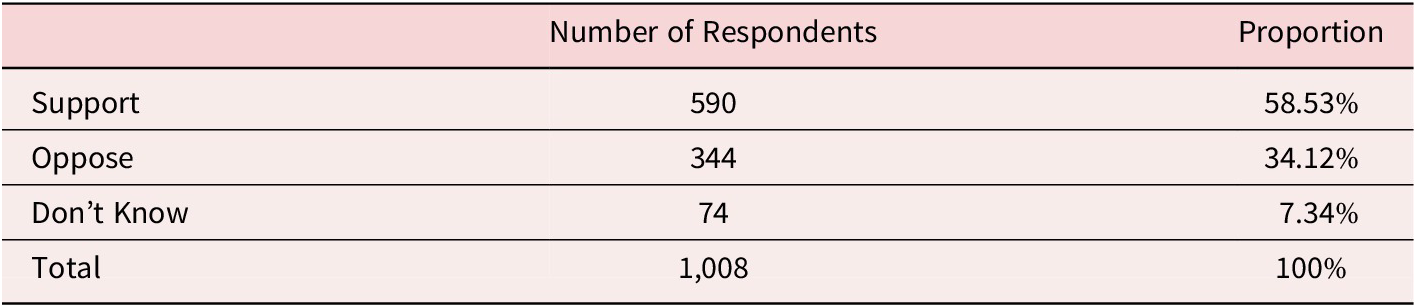
We construct the dependent variable, Support for Nuclear Armament, based on respondents’ agreement with the statement that South Korea should possess nuclear weapons if the threat from North Korea’s nuclear arsenal persists. Among the 1,008 respondents, 590 (58.53%) expressed support, while 344 (34.12%) opposed the idea. The variable is coded as 1 for agreement and 0 for opposition. Respondents who selected “Don’t know” (n = 74, 7.34%) are treated as missing values. Table 1 presents the distribution of the dependent variable.
Distribution of the dependent variable: Support for nuclear armament

Note: In our data, “Support” is coded as 1, “Oppose” is coded as 0, and “Don’t know” is represented by missing values.
Independent variables
This study investigates how expectations about the evolving security environment influence South Koreans’ support for nuclear armament. Drawing on the theory of preventive motivations for war, we hypothesize that concerns about shifting power dynamics, particularly their perceived effects on the US–South Korea alliance and inter-Korean relations, influence support for nuclear weapons. To capture these future-oriented expectations, we include the following explanatory variables.
Alliance relevance decline in the context of US relative power shift
To assess public concern about the future commitment of the United States, we introduce Alliance Relevance Decline due to US Relative Power Shift. This variable is based on respondents’ agreement with the statement: “Given the relative decline of the United States compared to China, the significance of the ROK–US alliance is diminishing.” We select this item as our independent variable because it captures public anticipation of systemic power shifts and their perceived implications for the relevance of the US–ROK alliance. Although the question does not specify a particular timeframe, we interpret responses as reflecting views about enduring structural trends rather than immediate developments. As discussed above, perceptions of US decline and potential strategic retrenchment raise doubts among South Koreans about the credibility of US defense commitments. The variable is coded as 1 if a respondent agrees with the statement and 0 otherwise. 33.3 percent of respondents align with this view.
Pessimism about future inter-Korean relations
We construct Pessimism about Future Inter-Korean Relations, based on a survey question asking respondents to forecast the political situation on the Korean Peninsula ten years from now: “What do you think the situation on the Korean Peninsula will be like in ten years?” The variable is coded as 1 if the respondent expects instability to continue or anticipates heightened tensions, and 0 if they expect improved relations or signs of reunification. This item captures forward-looking concerns about inter-Korean deterioration, aligning with our preventive motivations framework. 49.31 percent of respondents express a pessimistic outlook.
Control variables
Current assessments of US extended deterrence
While this study focuses on forward-looking concerns about the US security guarantee and North Korean threats, we control for present-day evaluations of the security environment to assess whether preventive motivations exert a stronger influence. Existing literature suggests that credible extended deterrence can serve as an effective alternative to indigenous nuclear weapons for client states (Singh and Way Reference Singh and Way2004; Jo and Gartzke Reference Jo and Gartzke2007; Bleek Reference Bleek, Potter and Mukhatzhanova2010). Some prior studies on public opinion about nuclear armament suggest that greater confidence in extended deterrence is negatively associated with support for nuclear acquisition (Ko Reference Ko2019; Lee Reference Lee2023; Son and Yim Reference Son and Yim2021). To test this relationship, we include two variables that capture public assessments of US extended deterrence in 2023.
Confidence in the US Nuclear Umbrella, measures whether respondents believe the United States would retaliate with nuclear weapons if North Korea launched a nuclear attack on South Korea. This binary variable is coded as 1 if the respondent expects a US nuclear response, and 0 otherwise. Overall, 34.4 percent of respondents express such confidence. Second, the perceived adequacy of the Washington Declaration captures an additional dimension of public perceptions related to US extended deterrence. On April 26, 2023, the United States and South Korea jointly announced the Washington Declaration, a bilateral agreement designed to strengthen extended deterrence and institutionalize nuclear consultation through the establishment of a Nuclear Consultative Group (NCG), in response to growing threats from North Korea (White House 2023a, 2023b). This variable is coded as 1 if respondents agree that the declaration adequately addresses North Korea’s nuclear threat and South Korea’s security concerns, and 0 otherwise. A total of 57.6 percent of respondents view the declaration as an appropriate response.
North Korea as a current military threat
We also include a measure of public evaluations of current military threats. The primary strategic benefit of acquiring nuclear weapons lies in the ability to independently deter nuclear threats (Sagan 1996–1997; Debs and Monteiro Reference Debs and Monteiro2017). Existing literature identifies threats from North Korea as a key predictor of public support for nuclear acquisition (Lee Reference Lee2023; Son and Yim Reference Son and Yim2021). This logic is not limited to elite strategic reasoning; members of the public who perceive North Korea as a serious threat may likewise view nuclear armament as a necessary means of national defense. According to our data, 62.1 percent of respondents identified North Korea as currently posing a military threat to South Korea. The variable North Korea as a Current Military Threat is coded as 1 if a respondent selects North Korea, and 0 otherwise. This variable distinguishes the effects of present threat perceptions from future-oriented concerns, which lie at the core of our theoretical argument.
Fear of entrapment
To address the same puzzle explored in this study, namely high public support for nuclear armament despite strong confidence in US extended deterrence, Sukin (Reference Sukin2020) attributes this support to fear of entrapment. While our argument highlights fears of abandonment as a key US-related driver of preventive motivations, the unwanted use theory posits that a highly credible US commitment can increase support for nuclear armament by raising concerns that South Korea might be pulled into an unwanted nuclear conflict initiated by the United States. While this is a compelling theoretical proposition, Sukin’s empirical analysis is limited by the characteristics of her dataset, which was quota-sampled based on gender, income, and individuals aged 18 to 48 (Sukin Reference Sukin2020, 1040). Although older respondents were included, their numbers were relatively small. Sukin reports no significant interaction between age and treatment effects, but the limited sample size of older cohorts warrants further examination.
Given that individuals aged 60 and above accounted for 26.5 percent of South Korea’s population in 2023 (Korean Statistical Information Service 2023), we find it necessary to re-examine her argument using an age-representative dataset. To test this explanation with our representative survey data, we include a binary variable capturing Fear of Entrapment. The variable is coded as 1 if a respondent agrees with the statement, “Due to the ROK–US alliance, South Korea may become entangled in regional disputes irrelevant to its national interests,” and 0 otherwise. 66.47 percent of respondents acknowledge this concern.
Threats from China
To account for the potential influence of China-related threat perceptions, we include perceived threats from China in two forms as control variables in the multivariate analysis. South Koreans’ view of China as a security threat has intensified in recent years, particularly after Beijing’s economic retaliation over the 2016 THAAD deployment (Kim et al. Reference Kim, Kim, Kim, Kim, Lee, Cho, Cho and Kim2023; Jeong Reference Jeong2024). Dalton et al. (Reference Dalton, Friedhoff and Kim2022) find that concerns about China are a key driver of public support for nuclear armament. In their survey, 39 percent of respondents who supported nuclear armament cited “defending South Korea from threats other than North Korea” as the primary reason. Additionally, 56 percent of all respondents identified China as “the biggest threat to South Korea in ten years” (Dalton et al. Reference Dalton, Friedhoff and Kim2022, 12–13). We operationalize China-related concerns in two ways. First, we code a binary variable, China as a Future World Leader, as 1 if the respondent agrees that “China will surpass the US and emerge as a global leader in the near future” (31.65% agree). Second, we include a dummy variable for whether a respondent identifies China as a Current Military Threat (40.08% agree).
National prestige
We include National Prestige as a control variable to assess whether it is associated with support for nuclear armament. “The norms model” of proliferation literature shows that national prestige drives decision-makers to pursue nuclear weapons (Frey Reference Frey2007; Hymans Reference Hymans2006; Sagan 1996–1997). The Chicago Council on Global Affairs (CCGA) also identifies national prestige as a central motivation behind South Korean public support for nuclear acquisition. Among pro-nuclear respondents, 26 percent selected “increasing the prestige of South Korea in the international community” as their primary reason (Dalton et al. Reference Dalton, Friedhoff and Kim2022, 14–15). A recent experimental study further demonstrates a causal relationship between perceived national prestige benefits and favorable attitudes toward nuclear armament (Jeong Reference Jeong2025). To capture this effect, we include a variable reflecting respondents’ views on South Korea’s role in global problem-solving as a proxy for national prestige. 89.6 percent of respondents support an expanded role for South Korea in addressing global challenges. The variable is coded as 1 if a respondent endorses such a role, and 0 otherwise.
Prioritizing economic diplomacy
Following findings from existing studies on South Koreans’ sensitivity to the economic costs of nuclear armament (Son and Park Reference Park2023; Lee Reference Lee2024), we expect that respondents who prioritize Economic Diplomacy are less likely to support nuclear armament. This variable is coded as 1 if a respondent selects economic diplomacy as the top priority in South Korea’s foreign policy. 15.3 percent of respondents identify economic diplomacy as the foremost objective.
Sociodemographic features
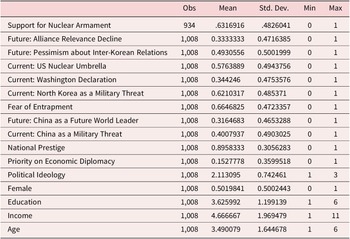
We include Political Ideology, Gender, Education, Income, and Age as control variables. Political Ideology is coded as a trichotomous variable: 1 for progressive, 2 for moderate, and 3 for conservative, with conservative serving as the baseline. We test whether conservatives show higher nuclear support than moderates or progressives (Lee et al. Reference Lee2023; Kim et al. Reference Kim, Kim, Kim, Kim, Lee, Cho, Cho and Kim2023; Dalton et al. Reference Dalton, Friedhoff and Kim2022). Gender is coded as 1 for female and 0 for male. Income ranges from 1 to 11, representing the lowest to highest income levels. Age is grouped into six categories, from twenties to seventy and above. Descriptive statistics appear in Table 2, full question wording in Appendix Table A2.
Descriptive statistics

Results and discussion
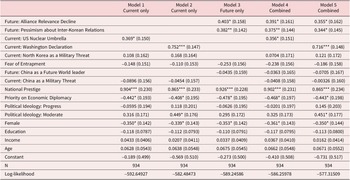
Table 3 presents the results of logistic regression analyses from five models, which differ based on their selection of main explanatory variables. Models 1 and 2 include only variables related to current assessments of the security environment, in line with existing studies that focus primarily on the present situation involving the US and North Korea. Regarding the North Korea issue, both models include North Korea as a (Current) Military Threat. The key distinction between Models 1 and 2 lies in how they measure the US security guarantee: Model 1 includes US Nuclear Umbrella, while Model 2 includes adequacy of the Washington Declaration.
Logistic regression analysis: South Koreans’ support for nuclear armament

Note: Standard errors in parentheses. * p<0.05, ** p<0.01, *** p<0.001
Models 3 through 5 test our argument regarding preventive motivations for nuclear armament by incorporating forward-looking assessments: perceptions of Alliance Relevance Decline due to US power shift, as well as Pessimism about Inter-Korean Relations. Model 3 includes only future-oriented assessments, while Models 4 and 5 incorporate all four variables—both current and future assessments regarding the ROK–US alliance and threats from North Korea. The difference between Models 4 and 5, again, stems from the choice of variable representing the current US commitment. In addition, China-related factors, included as control variables, are also divided into current (Models 1 and 2) and future assessments (Models 3 through 5), mirroring the structure applied to the North Korea variables.
Security tomorrow, nuclear today: Evidence of preventive motivations
We find empirical support for Hypotheses 1 and 2, which reflect preventive motivations rooted in concerns over power shifts at both the systemic and inter-Korean levels, as shown in Table 3. South Koreans’ forward-looking concerns about the declining relevance of the alliance, driven by perceptions of US decline, along with pessimism about future inter-Korean relations, are significantly associated with increased support for nuclear acquisition. However, current perceptions of extended deterrence and the North Korean threat diverge from conventional expectations: belief in the credibility of the US Nuclear Umbrella does not reduce support for nuclear armament, nor does viewing North Korea as a Current Military Threat increase it.
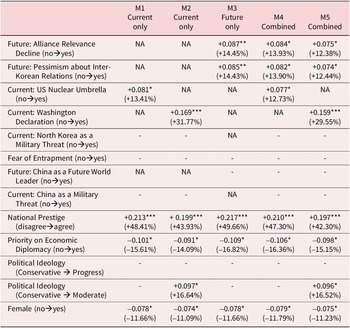
Table 4 presents the marginal effects of each variable, with percent changes shown in parentheses. First, future insecurity regarding the provider of extended deterrence is positively associated with support for nuclear acquisition. Agreement with the statement Alliance Relevance Decline due to US power shift increases the predicted probability of supporting nuclear armament by approximately 0.087 in Model 3. The effect of future concerns remains consistent, increasing the predicted probability by 0.084 in Model 4 and 0.075 in Model 5. These changes correspond to a 12.38–14.45 percent increase.
Change in predicted probability of supporting nuclear armament

Note: Percentage changes are presented in parentheses. “NA” denotes that the variable is not included in a model, while “-” indicates that the marginal effect of the variable is not statistically significant at the .05 level. Education, income, and age are excluded from the table due to limited space, as they lack statistical significance across all five models.
*p<0.05, **p<0.01, *** p<0.001.
In contrast to future expectations, current assessments of the US security guarantee reveal a different pattern. US Nuclear Umbrella confidence positively increases nuclear weapons support, contrary to proliferation literature expectations. The predicted probability increases by 0.077–0.081 (12.73–13.41%). Similarly, confidence in the Washington Declaration raises probability by 0.159–0.169 (approximately 30%).
Future-oriented concerns about North Korea corroborate our hypothesis, whereas current assessments do not show significant effects. Inter-Korean Pessimism is positively associated with support for nuclear acquisition. The predicted probability increases by 0.074 to 0.085 (12.44% to 14.43%). This result remains robust across all three models (Models 3–5). By contrast, perceiving North Korea as a Current Military Threat shows no positive association with support for nuclear armament (Models 1, 2, 4, and 5).
This finding is counterintuitive, given that North Korean threats occupy a central position in public discourse on South Korea’s security environment and nuclear policy. More than 62 percent identify North Korea as the primary military threat, but this perception alone does not appear to drive support for nuclear acquisition. Instead, consistent with our argument about preventive motivations, it is not the immediacy of the threat but the expectation of worsening conditions that compels support for nuclear armament. The public’s concern reflects an anticipatory logic—today’s preparations are necessary to address a more dangerous security environment in the future.
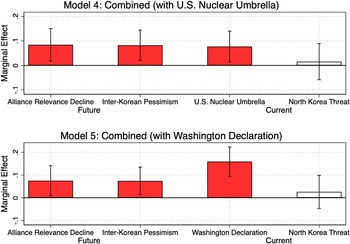
Figure 2 visualizes the marginal effects from Models 4 and 5. The figure highlights the consistent and significant effects of future-oriented concerns, in line with preventive motivation. In contrast, current assessments—including US nuclear umbrella, Washington Declaration, and North Korea Threat—do not follow conventional deterrence logic. This reinforces our core finding that public support for nuclear armament is shaped more by anticipatory concerns than by present-day threat perceptions.
Marginal Effects of Key Variables on Support for Nuclear Armament (Models 4–5).
Note: Variables with statistically significant results (p < 0.05) are colored; others remain white.

Absence of evidence for “fear of entrapment” and “threats from china”
Fear of Entrapment does not receive empirical support in any of the five models. This finding stands in contrast to Sukin’s unwanted use theory. As discussed earlier, differences in sampling—particularly with respect to age representation—may help explain the discrepancy. Timing may also play a role, as the 2023 survey was conducted in a potentially different political and strategic context. In our data, South Koreans did not appear concerned about excessive US commitment. Rather, the predominant concern is insufficient future US commitment, suggesting that apprehension stems not from current alliance behavior but from uncertainty about its sustained reliability. This finding reinforces our broader argument about preventive motivations: support for nuclear armament is shaped less by immediate threats or alliance overreach and more by pessimism about future security dynamics.
Threats from China do not demonstrate a significant effect on public support for nuclear acquisition. Neither forecasts of China as a Future World Leader nor perceptions of China as a Current Military Threat are significantly associated with support for nuclear armament. Our multivariate logistic regression, which extends beyond preset response options similar to those used in the CCGA survey (Dalton et al. Reference Dalton, Friedhoff and Kim2022), shows that perceived threats from China are not significantly associated with support for nuclear acquisition.
Sensitivity to national prestige and economic repercussion
Our measure of National Prestige is positively associated with the likelihood that South Koreans support the acquisition of nuclear weapons. Respondents who endorse a greater role for South Korea in addressing global challenges are more likely to support nuclear armament. According to Table 4, the predicted probability increases by approximately 0.197 to 0.217, representing a change of 42.30 percent to 49.66 percent. This association should be interpreted with caution, as the survey item includes “nonproliferation” among the examples of global challenges.
Priority on Economic Diplomacy acts as a constraining factor in public endorsement of nuclear weapons. Individuals who prioritize economic diplomacy are less inclined to support South Korea’s possession of nuclear weapons. The predicted probability of supporting nuclear acquisition decreases by approximately 0.091 to 0.109 (a 14.09 to 16.82% decline). It is likely that when respondents are presented with more explicit information about potential costs, such as economic sanctions or harm to the domestic economy, support for nuclear acquisition would decline even further.
Sociodemographic features: Ideology and gender
Individuals with a Moderate political orientation are more likely to support nuclear possession than Conservatives (Models 2 and 5). While conservative South Koreans are typically viewed as more aligned with military strength and national security, our data present a different picture in the context of nuclear weapons in 2023. Notably, we find no significant difference between Conservative and Progressive respondents. Overall, there is little evidence of ideological polarization in nuclear attitudes, though this warrants further validation. Female respondents are less likely to support the possession of nuclear weapons compared to their male counterparts. The predicted probability of supporting nuclear acquisition decreases by 0.074 to 0.079 (a reduction of 11.09% to 11.79%). This result is robust across all five models at the 0.05 significance level.
Conclusion
This paper addresses a puzzling feature of South Korean public opinion on nuclear acquisition: despite the widely perceived credibility of US extended deterrence, there remains strong public support for indigenous nuclear armament. To explain this disconnect, we adopt the theoretical framework of preventive motivations for war and argue that concerns about power shifts—both at the systemic level and within the inter-Korean context—fuel a deteriorating public outlook on the security environment. These concerns, in turn, drive support for acquiring nuclear weapons in advance of perceived strategic decline, reflecting a forward-looking, preventive logic rather than a reactive response to immediate threats.
At the systemic level, South Koreans perceive the United States’ relative decline amid the rise of competing great powers as undermining the sustained reliability of their most important ally. Simultaneously, although South Koreans generally perceive their conventional military strength as superior to North Korea’s, this confidence erodes when nuclear capabilities are taken into account. The prospect of Pyongyang gaining de facto recognition as a nuclear-armed state may further heighten anxiety about South Korea’s declining leverage, reinforcing the perceived need to pursue its own nuclear weapons. These perceptions generate a dual sense of urgency: a widening window of vulnerability due to North Korea’s trajectory and a narrowing window of opportunity given growing uncertainty about US commitments and the time required to develop a nuclear arsenal. Together, these dynamics shape a forward-looking, preventive motivation to support nuclear armament before the strategic environment deteriorates further.
The logistic regression analysis supports our argument with three core findings. First, future-oriented pessimism, reflected in doubts about the enduring reliability of the US alliance and expectations of worsening inter-Korean relations, is positively associated with support for nuclear armament. Second, current threat assessments do not exhibit the expected relationships suggested by existing literature. Confidence in US extended deterrence increases the likelihood of supporting indigenous nuclear weapons, rather than decreasing it, while threat perception from North Korea shows no significant effect. Third, our results also challenge prominent alternative explanations: neither fear of entrapment nor perceived threat from China has a meaningful influence on public support for nuclear acquisition.
These findings carry significant implications for policy and public engagement. First, credible assurance measures must address not only the present credibility of US extended deterrence but also its perceived future reliability. Public concerns are shaped by anxieties about shifting power dynamics at both the systemic level and in inter-Korean relations over time. Effective reassurance, therefore, requires forward-looking commitments, clear communication of strategic intentions, and institutionalization of nuclear policy cooperation to sustain confidence in the alliance.
This need is not limited to the public, as survey data from the Center for Strategic and International Studies (CSIS) reveal similar concerns among strategic elites. While most strategic elites remain more cautious—with only 34 percent supporting indigenous nuclear acquisition—evidence shows their views shift significantly when abandonment scenarios are made salient. Notably, 51 percent of elites who initially opposed nuclearization said they would reconsider if faced with concrete signs of US retrenchment—for example, the withdrawal of US troops (Cha Reference Cha2024, 10). Although elites are currently more restrained than the public, findings from the CSIS survey and our own analysis suggest a convergence in concerns about the future credibility of US commitments. As elite and public views become more closely aligned, this convergence could expand the political space for nuclear pursuit. This makes forward-looking reassurance essential not only to address public anxiety, but also to preserve elite restraint under evolving strategic conditions.
In this context, the rhetoric and stances of the Trump administration that distanced the United States from its allies illustrate how leadership signals can amplify abandonment fears. Rather than alleviating strategic uncertainty, such signals risk reinforcing the very concerns that drive public and elite support for nuclear acquisition in South Korea. More broadly, this dynamic may accelerate the spread of preventive motivations among other US allies, as publics increasingly perceive a narrowing window of opportunity to respond to evolving strategic risks.
Second, more active public engagement is needed to communicate the tradeoffs of nuclear armament, the constraints imposed by the global nonproliferation regime, and viable alternative strategies for addressing the North Korean nuclear threat. Political elites may selectively engage the public in nuclear policy debates when public preferences align with their own, using popular support to bolster their position (Saunders Reference Saunders2019). In this context, it becomes essential for researchers and policymakers to monitor public opinion—not because it directly determines foreign policy, but because it can be strategically leveraged when elite and public views converge. The growing salience of abandonment fears, reflected in both elite and public attitudes, underscores the need to track how perceptions evolve under conditions of strategic uncertainty.
Supplementary material
The supplementary material for this article can be found at http://doi.org/10.1017/jea.2025.10012.
Acknowledgments
The authors gratefully acknowledge valuable feedback from Chaesung Chun and Dong-Joon Jo, as well as constructive comments from the editor and anonymous reviewers, all of which significantly strengthened this manuscript. We also thank Yul Sohn and the East Asia Institute for granting permission to use their survey data for this research.
Competing interests
The authors declare none.



 Open access

