





Ad veritatem autem copulativae requiritur quod utraque pars sit vera, et ideo si quaecumque pars copulativae sit falsa, ipsa copulativa est falsa.
William of Ockham, Summa Logicae II.32Ad veritatem autem [propositionis] disiunctivae requiritur quod aliqua pars sit vera[.]
William of Ockham, Summa Logicae II.331 Classicality and compositional semantics
Philosophy abounds with general claims expressed with a truth predicate: Philosophers debate whether there are contingent or synthetic a priori truths, and whether there are unprovable or unverifiable truths; they mostly agree that what is known is true, but that some justified true beliefs are not known; they teach their students that the conclusion of a valid argument is true if its premisses are true and try to convince their students that the rules of natural deduction are truth-preserving. Specific instances of these claims can often be stated without a predicate for truth; but the quantified claims make essential use of the truth predicate.
In the arguments for this kind of claim, assumptions about the truth predicate are often used implicitly without further ado. In the present paper we strive to make these assumptions explicit by listing principles about the truth predicate that are jointly consistent with further plausible assumptions about the objects to which truth is ascribed. We presuppose that these objects share the structure of (types of) sentences without entering the debate about whether truth applies to propositions, beliefs, sentence tokens, or still other things.Footnote 1
It is widely believed that truth serves its role as a device of generalization in virtue of its disquotational feature; and a large part of the literature on truth is devoted to the development of strong disquotational truth theories. However, in their zeal to devise theories of disquotational truth, some philosophers seem to have lost sight of how we reason with generalizations. When truth is used as a device of generalization, disquotation is not the only principle that is used in reasoning with generalizations. Compositional principles are just as important and used routinely without qualms. We give three examples.
Our first example comes from logic. When motivating axioms or rules for a logical calculus, compositional laws of truth are used. In the case of the elimination rule for conjunction or for the universal quantifier in natural deduction, students usually quickly accept the claim that the rule preserves truth. At this point in the course, students may not have seen the model-theoretic notions of satisfaction and truth or the object/metalanguage distinction at all; nevertheless they have no problems in seeing that a conjunct must be true if the conjunction is true and that a substitution instance is true if the universally quantified sentence is true. The point can also be made about the history of logic: Logicians chose sound logical calculi long before the arrival of the modern model-theoretic notion of truth in Tarski and Vaught [Reference Tarski and Vaught43] in 1956 (as far as we know; see Hodges [Reference Hodges26]). Truth preservation of logical rules is often assumed to hold without any restriction. Any restriction to a specific sublanguage is at odds with the universality of logic.
The use of the compositional principles is by no means confined to the realm of logical theorizing. Our second example is from epistemology. Most epistemologists would be happy to endorse the following argument, which could form part of a Gettier example:
Smith believes a disjunction. He is justified in believing one disjunct, which happens to be false, while he does not believe the other disjunct, which happens to be true. Therefore Smith has a justified true belief.
In this argument we reason about the truth (and justification) of beliefs by analyzing and manipulating their logical structures without explicitly specifying exactly what these beliefs are. The validity of the argument depends on the assumption that a disjunction is true if one of its disjuncts is true, as stated by Ockham in the second quote above. Fujimoto [Reference Fujimoto16, Reference Fujimoto17] called this kind of reasoning blind deduction, because we reason about the truth of beliefs or sentences without being able to specify these beliefs or sentences by means of a quotational name or a structural description. Disquotation axioms or T-sentences used as axioms permit only reasoning about the truth of sentences that are explicitly given by such a naming device.
The use of the compositional principles is so ubiquitous that their use often goes unnoticed as in our third example:
Alfred made a claim that was denied by Kurt (i.e., Kurt asserted the negation of the claim); and everything Kurt claimed is true. Therefore not everything Alfred claimed is true.
For the validity of this argument we require the principle that a claim is not true if its negation is true.
In the examples we quantify over all sentences, beliefs, or propositions. Blind deductions are not restricted to sentences that are safe, grounded, determinate, healthy, non-circular, or in some other way ‘unproblematic’. Moreover, the full compositional principles are consistent without any restrictions on the underlying logic or syntax theory.
The axioms for truth can and should be added to a base theory that yields at least a comprehensive theory of syntax (in a direct or coded form); the base theory may also go far beyond a theory of syntax. In [Reference Halbach22, Reference Halbach23] the second author formulated the truth theory over set theory as the base. Here, however, we start from Peano arithmetic, which is traditionally used as base theory for axiomatic theories of truth; but we consider it only as a simple model case. Expressions are identified with their codes. As usual, we confine ourselves to a truth rather than a satisfaction predicate in the case of arithmetic, as names for all objects are available and satisfaction and variable assignments are not needed. All extensions of Peano arithmetic we consider are formulated in classical logic.
In what follows, $\mathcal {L}_0$
is the language of arithmetic. The axioms are formulated in an expansion of
$\mathcal {L}_0$
is the language of arithmetic. The axioms are formulated in an expansion of $\mathcal {L}_0$
with further predicate symbols
$\mathcal {L}_0$
with further predicate symbols $\mathrm {T}$
and
$\mathrm {T}$
and $\mathrm {D}$
. Negation and conjunction are the only connectives, and the universal is the only quantifier in the language; other connectives and the existential quantifier are assumed to be defined. In the axioms below
$\mathrm {D}$
. Negation and conjunction are the only connectives, and the universal is the only quantifier in the language; other connectives and the existential quantifier are assumed to be defined. In the axioms below
 expresses that x is a sentence of $\mathcal {L}$
. The symbol
$\mathcal {L}$
. The symbol
 expresses the function that, if it is applied to a sentence, returns its negation. If a suitable function symbol is not in $\mathcal {L}_0$
, this function needs to be expressed by a suitable formula;
$\mathcal {L}_0$
, this function needs to be expressed by a suitable formula;
 and
and
 are defined analogously. The quantifier $\forall t$
ranges over (codes of) closed terms and is defined using a suitable formula describing the set of closed terms; and
$\forall t$
ranges over (codes of) closed terms and is defined using a suitable formula describing the set of closed terms; and $x(t/v)$
designates the result of formally substituting t for the variable v in x. The following axioms then express that a negated sentences is true iff the sentence is not, that a conjunct is true iff both conjuncts are, and that a universally quantified sentence is true iff all its substitution instances are:
$x(t/v)$
designates the result of formally substituting t for the variable v in x. The following axioms then express that a negated sentences is true iff the sentence is not, that a conjunct is true iff both conjuncts are, and that a universally quantified sentence is true iff all its substitution instances are:
-
T4

-
T5
-
T6


The axioms T4–T6 capture a thoroughly classical concept or truth: The truth theory is not only formulated in classical logic, but the notion of truth axiomatized by T4–T6 is itself classical. According to the axioms, truth commutes with quantifiers and connectives for all sentences, including those with the truth predicate. Theories such as the Kripke–Feferman theory [Reference Feferman8, Reference Reinhardt37] or Cantini’s [Reference Cantini6] VF are formulated in classical logic as well, but capture a non-classical notion of truth.
Axiom T4 disproves the existence of truth value gaps and gluts. We define falsity as the truth of the negation, that is, we stipulate:
 . If the truth predicate is classical and T4 is assumed, then falsity is equivalent to non-truth. Thus, every sentence is true or false; and no sentence is both true and false.
Disquotation axioms have been been thought to be more fundamental than the compositional axioms. Consequently, there have been various attempts to obtain compositional from disquotational principles. Tarski [Reference Tarski42, p. 259] tried to derive restricted compositional principles from the T-sentences using what he called the rule of infinite induction, which is a generalization of the
 -rule. More recently, some authors, including Halbach [Reference Halbach19] and Horsten and Leigh [Reference Horsten and Leigh27], have used reflection principles instead, which are of course finitized versions of infinitary rules. We are sceptical about the prospects of justifying compositional from disquotational axioms. There are general objections against the use of infinitary and reflection rules to this end. Another crucial objection is especially relevant when unrestricted compositional principles are employed. Usually, attempts to obtain compositional axioms for all sentences of a certain kind from disquotational principles rely on the disquotation principle for all sentences of this kind. For instance, we may try to derive the compositional axioms for all $\mathrm {T}$
-free (or
$\mathrm {T}$
-free (or $\mathrm {T}$
-positive) sentences from all equivalences
$\mathrm {T}$
-positive) sentences from all equivalences $\mathrm {T}\ulcorner \phi \urcorner \leftrightarrow \phi $
, where
$\mathrm {T}\ulcorner \phi \urcorner \leftrightarrow \phi $
, where $\phi $
is
$\phi $
is $\mathrm {T}$
-free (or
$\mathrm {T}$
-free (or $\mathrm {T}$
-positive). However, in the case of the completely unrestricted compositional axioms T4–T6, this strategy is not very promising. Of course, the unrestricted compositional axioms T4–T6 can be derived from all instances
$\mathrm {T}$
-positive). However, in the case of the completely unrestricted compositional axioms T4–T6, this strategy is not very promising. Of course, the unrestricted compositional axioms T4–T6 can be derived from all instances $\mathrm {T}\ulcorner \phi \urcorner \leftrightarrow \phi $
; but this is because the unrestricted T-schema is inconsistent over arithmetic. Hence, we will not be able to derive all type-free compositional from disquotational principles, even if some kind of infinitary rule is assumed.Footnote
2
Therefore we adopt the unproblematic, fully general compositional principles as axioms and do not attempt to derive them from a disquotation schema, which has to be restricted in some way.
$\mathrm {T}\ulcorner \phi \urcorner \leftrightarrow \phi $
; but this is because the unrestricted T-schema is inconsistent over arithmetic. Hence, we will not be able to derive all type-free compositional from disquotational principles, even if some kind of infinitary rule is assumed.Footnote
2
Therefore we adopt the unproblematic, fully general compositional principles as axioms and do not attempt to derive them from a disquotation schema, which has to be restricted in some way.
2 Determinateness and disquotation
Our policy for restricting disquotation is inspired by disquotationalist and deflationist theories of truth. We expand the base language $\mathcal {L}_0$
by adding sentences that are needed for semantic ascent and generalization. The sentences of the base language together with those needed for semantic ascent and generalization form the set
$\mathcal {L}_0$
by adding sentences that are needed for semantic ascent and generalization. The sentences of the base language together with those needed for semantic ascent and generalization form the set $\mathfrak {D}$
. Roughly, if we have a sentence
$\mathfrak {D}$
. Roughly, if we have a sentence $\phi $
in
$\phi $
in $\mathfrak {D}$
, we also add an equivalent new sentence
$\mathfrak {D}$
, we also add an equivalent new sentence $\mathrm {T}\ulcorner \phi \urcorner $
as a ‘copy’ of
$\mathrm {T}\ulcorner \phi \urcorner $
as a ‘copy’ of $\phi $
. These copies are required for semantic ascent. We close then under connectives and quantifiers in a way to be explained. This permits generalizations, because we can now express, for instance, that all provable sentences of
$\phi $
. These copies are required for semantic ascent. We close then under connectives and quantifiers in a way to be explained. This permits generalizations, because we can now express, for instance, that all provable sentences of $\mathcal {L}_0$
are true. This process is then iterated: We add copies
$\mathcal {L}_0$
are true. This process is then iterated: We add copies $\mathrm {T}\ulcorner \phi \urcorner $
for semantic ascent and then close under connectives and quantifiers in order to be able to generalize. We add only sentences to
$\mathrm {T}\ulcorner \phi \urcorner $
for semantic ascent and then close under connectives and quantifiers in order to be able to generalize. We add only sentences to $\mathfrak {D}$
that are required for semantic ascent and generalization, not all sentences of the full language
$\mathfrak {D}$
that are required for semantic ascent and generalization, not all sentences of the full language $\mathcal {L}$
. In particular, not all sentences of the form
$\mathcal {L}$
. In particular, not all sentences of the form $\mathrm {T}\ulcorner \phi \urcorner $
are in
$\mathrm {T}\ulcorner \phi \urcorner $
are in $\mathfrak {D}$
. The set
$\mathfrak {D}$
. The set $\mathfrak {D}$
fails to be decidable. In a general setting with ‘contingent’ vocabulary, whether a sentence belongs to
$\mathfrak {D}$
fails to be decidable. In a general setting with ‘contingent’ vocabulary, whether a sentence belongs to $\mathfrak {D}$
may depend on empirical facts.
$\mathfrak {D}$
may depend on empirical facts.
Our truth theory $\mathsf {CD}$
itself is formulated in the full language
$\mathsf {CD}$
itself is formulated in the full language $\mathcal {L}$
; but the disquotation schema is restricted to sentences of
$\mathcal {L}$
; but the disquotation schema is restricted to sentences of $\mathfrak {D}$
, that is, to the sentences of the base language and those needed for semantic ascent and generalization. Being a sentence of
$\mathfrak {D}$
, that is, to the sentences of the base language and those needed for semantic ascent and generalization. Being a sentence of $\mathfrak {D}$
is expressed in
$\mathfrak {D}$
is expressed in $\mathsf {CD}$
by the primitive predicate symbol
$\mathsf {CD}$
by the primitive predicate symbol $\mathrm {D}$
, which is suitably axiomatized. As disquotation schema we can then use
$\mathrm {D}$
, which is suitably axiomatized. As disquotation schema we can then use $\mathrm {D}\ulcorner \phi \urcorner \rightarrow (\mathrm {T}\ulcorner \phi \urcorner \leftrightarrow \phi )$
for all sentences of
$\mathrm {D}\ulcorner \phi \urcorner \rightarrow (\mathrm {T}\ulcorner \phi \urcorner \leftrightarrow \phi )$
for all sentences of $\mathcal {L}$
, or rather a generalization thereof with parameters. We call the sentences in
$\mathcal {L}$
, or rather a generalization thereof with parameters. We call the sentences in $\mathfrak {D}$
determinate. If it were not for the additional predicate
$\mathfrak {D}$
determinate. If it were not for the additional predicate $\mathrm {D}$
, they would be the sentences that are grounded in Kripke’s [Reference Kripke28] sense (with some qualifications).
$\mathrm {D}$
, they would be the sentences that are grounded in Kripke’s [Reference Kripke28] sense (with some qualifications).
This approach ensures that truth can be used as a device of generalization over sentences in $\mathcal {L}_0$
and over generalizations of such generalizations, and so on. Hence this use of truth is fully available in
$\mathcal {L}_0$
and over generalizations of such generalizations, and so on. Hence this use of truth is fully available in $\mathsf {CD}$
. However, disquotation is not available for sentences that cannot be reached by semantic ascent and generalization.
$\mathsf {CD}$
. However, disquotation is not available for sentences that cannot be reached by semantic ascent and generalization.
2.1 Determinateness
We describe and axiomatize $\mathfrak {D}$
, the set of determinate sentences in more detail. First, we declare all atomic sentences of the base language
$\mathfrak {D}$
, the set of determinate sentences in more detail. First, we declare all atomic sentences of the base language $\mathcal {L}_0$
determinate:
$\mathcal {L}_0$
determinate:
-
D1

That is, all closed identity statements are determinate. If there were further predicate symbols in the base language, analogous axioms would be added. The axioms below will enable us to prove that all sentences of the base language $\mathcal {L}_0$
are determinate.
$\mathcal {L}_0$
are determinate.
If and only if $\phi $
is determinate, that is, in
$\phi $
is determinate, that is, in $\mathfrak {D}$
, we add a copy
$\mathfrak {D}$
, we add a copy $\mathrm {T}\ulcorner \phi \urcorner $
of
$\mathrm {T}\ulcorner \phi \urcorner $
of $\phi $
to
$\phi $
to $\mathfrak {D}$
. This is stated for arbitrary closed terms t, not only numerals
$\mathfrak {D}$
. This is stated for arbitrary closed terms t, not only numerals $\ulcorner \phi \urcorner $
:
$\ulcorner \phi \urcorner $
:
-
D2

The expression ${t}^{\circ }$
stands for the value of the term t. We cannot have a function symbol
${t}^{\circ }$
stands for the value of the term t. We cannot have a function symbol ${}^{\circ }$
in our language, and thus this function needs to be expressed by a suitable formula.
${}^{\circ }$
in our language, and thus this function needs to be expressed by a suitable formula.
A negated sentence is determinate iff the sentence is:
-
D4

Whether a conjunction is determinate depends on the determinateness of its conjuncts. Clearly, if both conjuncts are determinate, then so is their conjunction; and if both are indeterminate, so is their conjunction. But is a conjunction determinate if only one conjunct is?
Our choice here is motivated by the function of truth as a generalizing device. Typically, a universal generalization would have the form $\forall x\, (\phi (x)\rightarrow \mathrm {T} x)$
. The formula
$\forall x\, (\phi (x)\rightarrow \mathrm {T} x)$
. The formula $\phi (x)$
could express that x is a provable sentence of Peano arithmetic or that x is sentence of the form
$\phi (x)$
could express that x is a provable sentence of Peano arithmetic or that x is sentence of the form $\mathrm {T}\ulcorner \mathrm {T}\cdots \ulcorner 0\! =\!0\urcorner \urcorner \cdots \urcorner $
. We consider the simple example
$\mathrm {T}\ulcorner \mathrm {T}\cdots \ulcorner 0\! =\!0\urcorner \urcorner \cdots \urcorner $
. We consider the simple example $\forall x\, (x\! =\!\ulcorner 0\! =\! 0\urcorner \rightarrow \mathrm {T} x)$
whose antecedent is satisfied by a single sentence only; we ‘generalize’ via semantic ascent over all sentences of the form
$\forall x\, (x\! =\!\ulcorner 0\! =\! 0\urcorner \rightarrow \mathrm {T} x)$
whose antecedent is satisfied by a single sentence only; we ‘generalize’ via semantic ascent over all sentences of the form $0\! =\! 0$
. Of course, generalization via semantic ascent is not needed for a single sentence; but ‘generalizing’ over a single sentence demonstrates the principle. If
$0\! =\! 0$
. Of course, generalization via semantic ascent is not needed for a single sentence; but ‘generalizing’ over a single sentence demonstrates the principle. If $\mathfrak {D}$
contains the sentences required for generalizing via semantic ascent, then
$\mathfrak {D}$
contains the sentences required for generalizing via semantic ascent, then $\forall x\, (x=\ulcorner 0\! =\! 0\urcorner \rightarrow \mathrm {T} x)$
should be determinate. The determinateness of universal quantified sentences depends on their instances. Let
$\forall x\, (x=\ulcorner 0\! =\! 0\urcorner \rightarrow \mathrm {T} x)$
should be determinate. The determinateness of universal quantified sentences depends on their instances. Let $\lambda $
be an indeterminate sentence. Then the instance
$\lambda $
be an indeterminate sentence. Then the instance
 $$ \begin{align} \ulcorner \lambda\urcorner\! =\!\ulcorner 0\! =\! 0\urcorner\,\rightarrow\, \mathrm{T} \ulcorner \lambda\urcorner \end{align} $$
has a determinate antecedent and an indeterminate consequent, by axioms D1 and D2. If the instance (1) were indeterminate, so would be the universal generalization $\forall x\, (x\! =\!\ulcorner 0\! =\! 0\urcorner \rightarrow \mathrm {T} x)$
by any reasonably determinateness rules for quantification. Hence, our axioms for
$\forall x\, (x\! =\!\ulcorner 0\! =\! 0\urcorner \rightarrow \mathrm {T} x)$
by any reasonably determinateness rules for quantification. Hence, our axioms for $\mathrm {D}$
should declare (1) determinate.
$\mathrm {D}$
should declare (1) determinate.
The determinateness of (1) should follow from the determinateness of the antecedent $\ulcorner \lambda \urcorner \! =\!\ulcorner 0\! =\! 0\urcorner $
. The falsity of the determinate antecedent renders the consequent irrelevant; and the truth value of (1) does not depend on the consequent. Thus, we stipulate that a sentence
$\ulcorner \lambda \urcorner \! =\!\ulcorner 0\! =\! 0\urcorner $
. The falsity of the determinate antecedent renders the consequent irrelevant; and the truth value of (1) does not depend on the consequent. Thus, we stipulate that a sentence $\phi \rightarrow \psi $
can inherit its determinateness from a determinate and false antecedent. Equally, we also postulate that it is determinate if it has a true and determinate consequent.
$\phi \rightarrow \psi $
can inherit its determinateness from a determinate and false antecedent. Equally, we also postulate that it is determinate if it has a true and determinate consequent.
This method of generalization applies equally if we do not only ‘generalize’ over a single sentence such as $0 = 0 $
, but, for instance, over all sentences provable in
$0 = 0 $
, but, for instance, over all sentences provable in $\mathsf {PA}$
. Moreover, iterated semantic ascent permits generalization over all sentences
$\mathsf {PA}$
. Moreover, iterated semantic ascent permits generalization over all sentences $0\! =\! 0$
,
$0\! =\! 0$
, $\mathrm {T}\ulcorner 0\! =\! 0\urcorner $
,
$\mathrm {T}\ulcorner 0\! =\! 0\urcorner $
, $\mathrm {T}\ulcorner \mathrm {T}\ulcorner 0\! =\! 0\urcorner \urcorner $
, and so on.
$\mathrm {T}\ulcorner \mathrm {T}\ulcorner 0\! =\! 0\urcorner \urcorner $
, and so on.
In our official language negation and conjunction are our only connectives. $\phi \rightarrow \psi $
is conceived as an abbreviation of
$\phi \rightarrow \psi $
is conceived as an abbreviation of $\neg (\phi \wedge \neg \psi )$
. In the presence of D4 we can then state our determinateness axiom for binary connectives in the following way:
$\neg (\phi \wedge \neg \psi )$
. In the presence of D4 we can then state our determinateness axiom for binary connectives in the following way:
-
$\phi \wedge \psi $
is determinate iff:
-
$\phi $
and
$\psi $
are both determinate, or
-
one of the conjuncts is false and determinate.


This is expressed in the following axiom:
-
D5

By our conventions above, $\mathrm {F} x$
abbreviates
$\mathrm {F} x$
abbreviates
 , namely, falsehood of x; also note that $\mathrm {D} x$
and
$\mathrm {D} x$
and
 are equivalent by the axiom D4. By axiom T4, $\mathrm {F}$
can be replaced with
$\mathrm {F}$
can be replaced with $\neg \mathrm {T}$
.
$\neg \mathrm {T}$
.
Another way to argue for our treatment of binary connectives would be to argue that sentences such as $\forall x\, (x=\ulcorner 0\! =\! 0\urcorner \rightarrow \mathrm {T} x)$
and its instance (1) are only about the determinate sentence
$\forall x\, (x=\ulcorner 0\! =\! 0\urcorner \rightarrow \mathrm {T} x)$
and its instance (1) are only about the determinate sentence $0\! =\! 0$
and should be treated just like
$0\! =\! 0$
and should be treated just like $\mathrm {T}\ulcorner 0\! =\! 0\urcorner $
. The latter is determinate by axiom D1. Thus, it may be argued, semantic ascent applies to (1) and the universally quantified sentence in the same way it applies to
$\mathrm {T}\ulcorner 0\! =\! 0\urcorner $
. The latter is determinate by axiom D1. Thus, it may be argued, semantic ascent applies to (1) and the universally quantified sentence in the same way it applies to $\mathrm {T}\ulcorner 0\! =\! 0\urcorner $
. However, making precise the underlying notion of aboutness is notoriously challenging (see Picollo [Reference Picollo33, Reference Picollo34]); we do not attempt to pursue this line here.
$\mathrm {T}\ulcorner 0\! =\! 0\urcorner $
. However, making precise the underlying notion of aboutness is notoriously challenging (see Picollo [Reference Picollo33, Reference Picollo34]); we do not attempt to pursue this line here.
Universally quantified sentences are treated as conjunctions of their instances:
-
D6

Injecting the notion of determinateness into the object language makes it possible to apply the truth and determinateness predicates to sentences containing $\mathrm {D}$
. We treat both, truth and determinateness, as completely type-free:
$\mathrm {D}$
. We treat both, truth and determinateness, as completely type-free: $\mathrm {D}$
and
$\mathrm {D}$
and $\mathrm {T}$
can be applied meaningfully to any sentence of the language. This is in contrast to traditional conceptions of groundedness, which apply to sentences with truth, while truth cannot be applied to sentences containing groundedness claims. Therefore, in our setting, the question arises whether atomic sentences of the form
$\mathrm {T}$
can be applied meaningfully to any sentence of the language. This is in contrast to traditional conceptions of groundedness, which apply to sentences with truth, while truth cannot be applied to sentences containing groundedness claims. Therefore, in our setting, the question arises whether atomic sentences of the form $\mathrm {D} t$
are determinate.
$\mathrm {D} t$
are determinate.
Treating $\mathrm {D}$
like an elementary predicate of
$\mathrm {D}$
like an elementary predicate of $\mathcal {L}_0$
, that is, a predicate from
$\mathcal {L}_0$
, that is, a predicate from $\mathcal {L}_0$
would suggest the axiom
$\mathcal {L}_0$
would suggest the axiom
 . This would mean that we have $\mathrm {T}\ulcorner \mathrm {D} t\urcorner \leftrightarrow \mathrm {D} t$
for all terms t. However, when it comes to complex sentences, we axiomatize
$\mathrm {T}\ulcorner \mathrm {D} t\urcorner \leftrightarrow \mathrm {D} t$
for all terms t. However, when it comes to complex sentences, we axiomatize $\mathrm {D}$
in terms of
$\mathrm {D}$
in terms of $\mathrm {T}$
in D5 and D6. Hence, it looks unsafe to declare all sentence
$\mathrm {T}$
in D5 and D6. Hence, it looks unsafe to declare all sentence $\mathrm {D} t$
determinate;
$\mathrm {D} t$
determinate; $\mathrm {D}$
should be treated with the same caution as
$\mathrm {D}$
should be treated with the same caution as $\mathrm {T}$
: If, and only if
$\mathrm {T}$
: If, and only if $\phi $
is determinate, we stipulate that
$\phi $
is determinate, we stipulate that $\mathrm {D}\ulcorner \phi \urcorner $
is determinate. Generalizing this to terms other than numerals gives the following axiom analogous to D2:
$\mathrm {D}\ulcorner \phi \urcorner $
is determinate. Generalizing this to terms other than numerals gives the following axiom analogous to D2:
-
D3

This concludes the list of determinateness axioms.
2.2 Disquotation
We still need to add axioms stipulating that a sentence $\mathrm {T}\ulcorner \phi \urcorner $
in
$\mathrm {T}\ulcorner \phi \urcorner $
in $\mathfrak {D}$
is always obtained by semantic ascent and thus a ‘copy’ of
$\mathfrak {D}$
is always obtained by semantic ascent and thus a ‘copy’ of $\phi $
. Formally, we require that
$\phi $
. Formally, we require that $\mathrm {D}\ulcorner \phi \urcorner \rightarrow (\mathrm {T}\ulcorner \phi \urcorner \leftrightarrow \phi )$
is a theorem of our theory
$\mathrm {D}\ulcorner \phi \urcorner \rightarrow (\mathrm {T}\ulcorner \phi \urcorner \leftrightarrow \phi )$
is a theorem of our theory $\mathsf {CD}$
for every sentence of
$\mathsf {CD}$
for every sentence of $\mathcal {L}$
. We also require that our theory proves a more general, ‘uniform’ version of the disquotation schema; that is, we generalize it by quantifying over the closed terms and postulate for every formula
$\mathcal {L}$
. We also require that our theory proves a more general, ‘uniform’ version of the disquotation schema; that is, we generalize it by quantifying over the closed terms and postulate for every formula $\phi (x_1,\ldots , x_n)$
with at most
$\phi (x_1,\ldots , x_n)$
with at most $x_1,\ldots ,x_n$
the following:
$x_1,\ldots ,x_n$
the following:
-
DDS

In this uniform determinate disquotation schema the expression
 stands for a complex term expressing that $t_1,\ldots ,t_n$
are formally substituted for the free variables in
$t_1,\ldots ,t_n$
are formally substituted for the free variables in $\phi (x_1,\ldots ,x_n)$
. This permits us to bind the variables
$\phi (x_1,\ldots ,x_n)$
. This permits us to bind the variables $t_1,\ldots ,t_n$
in
$t_1,\ldots ,t_n$
in
 . This concludes the list of axioms for our theory $\mathsf {CD}$
.
$\mathsf {CD}$
.
2.3 Alternative axiomatizations
In the presence of the compositional axioms T4 –T6, we need to stipulate DDS only for atomic $\phi $
. Whatever our policy on disquotation is, we can always focus on the atomic instances; T4 –T6 will ensure that also all instances of
$\phi $
. Whatever our policy on disquotation is, we can always focus on the atomic instances; T4 –T6 will ensure that also all instances of $T\ulcorner \phi \urcorner \leftrightarrow \phi $
will be provable for all sentences
$T\ulcorner \phi \urcorner \leftrightarrow \phi $
will be provable for all sentences $\phi $
built from those atomic formulae. Because we aim at an axiomatization that is as lean as possible for technical reasons, our official axiomatization does not feature schema DDS, but only disquotational axioms concerning atomic sentences. In particular, schema DDS can be replaced with the following three axioms:
$\phi $
built from those atomic formulae. Because we aim at an axiomatization that is as lean as possible for technical reasons, our official axiomatization does not feature schema DDS, but only disquotational axioms concerning atomic sentences. In particular, schema DDS can be replaced with the following three axioms:
-
T1
-
T2
-
T3


T2 can be derived from the following instance of DDS and axiom D3:

Thus the three axioms imply DDS in the presence of the other axioms as is established in Lemma 3.1.
The principles T3, (2), and T2 show that the truth and determinateness predicates interact in a serious manner. In particular, $\mathrm {D}$
is not only a formalization of a metatheoretic notion that has been injected into the object language; predicates of the object language—and especially the truth predicate—can be meaningfully applied to sentences with
$\mathrm {D}$
is not only a formalization of a metatheoretic notion that has been injected into the object language; predicates of the object language—and especially the truth predicate—can be meaningfully applied to sentences with $\mathrm {D}$
.
$\mathrm {D}$
.
From (2) we can prove one direction of the T-sentences $\phi \rightarrow \mathrm {T}\ulcorner \phi \urcorner $
for all sentences without
$\phi \rightarrow \mathrm {T}\ulcorner \phi \urcorner $
for all sentences without $\mathrm {T}$
, including those with
$\mathrm {T}$
, including those with $\mathrm {D}$
. Some sentences without
$\mathrm {D}$
. Some sentences without $\mathrm {T}$
but with
$\mathrm {T}$
but with $\mathrm {D}$
—such as
$\mathrm {D}$
—such as $\mathrm {D}\ulcorner \lambda \urcorner $
for some indeterminate
$\mathrm {D}\ulcorner \lambda \urcorner $
for some indeterminate $\lambda $
—are not determinate, and thus DDS will not give us the T-schema for some sentences with
$\lambda $
—are not determinate, and thus DDS will not give us the T-schema for some sentences with $\mathrm {D}$
. Therefore, we consider the addition of the right-to-left direction to T2:
$\mathrm {D}$
. Therefore, we consider the addition of the right-to-left direction to T2:
-
T2 +
.

This sentence is not provable from the disquotation schema DDS, and is not covered by our policy about $\mathfrak {D}$
. With
$\mathfrak {D}$
. With $\textsf {T2}^{+}$
we can derive all T-sentences
$\textsf {T2}^{+}$
we can derive all T-sentences $\mathrm {T}\ulcorner \phi \urcorner \leftrightarrow \phi $
as long as
$\mathrm {T}\ulcorner \phi \urcorner \leftrightarrow \phi $
as long as $\phi $
is
$\phi $
is $\mathrm {T}$
-free.
$\mathrm {T}$
-free.
Determinateness is one of many predicates such as analyticity, knowledge, necessity, and logical validity that are deeply intertwined with truth. Having the T-sentences $\mathrm {T}\ulcorner \phi \urcorner \leftrightarrow \phi $
also for
$\mathrm {T}\ulcorner \phi \urcorner \leftrightarrow \phi $
also for $\phi $
containing such predicates may be desirable; but we know already that this is not be possible for all such
$\phi $
containing such predicates may be desirable; but we know already that this is not be possible for all such $\phi $
(see Halbach [Reference Halbach20]), as axioms like
$\phi $
(see Halbach [Reference Halbach20]), as axioms like $\textsf {T2}^{+}$
may engender inconsistency, depending on the axioms for the other predicates. We cannot think of a better strategy than to consider these axioms on a case-by-case basis and to endorse axioms like
$\textsf {T2}^{+}$
may engender inconsistency, depending on the axioms for the other predicates. We cannot think of a better strategy than to consider these axioms on a case-by-case basis and to endorse axioms like $\textsf {T2}^{+}$
, as long as they do not yield undesirable consequences. With
$\textsf {T2}^{+}$
, as long as they do not yield undesirable consequences. With $\textsf {T2}^{+}$
we leave the safety of disquotation for determinate sentences only. In the case of determinateness we show that axiom
$\textsf {T2}^{+}$
we leave the safety of disquotation for determinate sentences only. In the case of determinateness we show that axiom $\textsf {T2}^{+}$
does not affect the
$\textsf {T2}^{+}$
does not affect the
 -soundness of our theory and thus $\textsf {T2}^{+}$
can be added as a further optional axiom.
$\textsf {T2}^{+}$
can be added as a further optional axiom.
The quantifier $\forall t$
in D2, D3, T2, T3, and
$\forall t$
in D2, D3, T2, T3, and $\textsf {T2}^{+}$
ranges over all closed terms, including those that do not denote a sentence. It may be desirable to restrict the quantifier in these axioms to terms denoting sentences. This would allow us to make any stipulations about sentences
$\textsf {T2}^{+}$
ranges over all closed terms, including those that do not denote a sentence. It may be desirable to restrict the quantifier in these axioms to terms denoting sentences. This would allow us to make any stipulations about sentences $\mathrm {T} t$
and
$\mathrm {T} t$
and $\mathrm {D} t$
where t fails to denote a sentence. We have chosen the version above for their simplicity.
$\mathrm {D} t$
where t fails to denote a sentence. We have chosen the version above for their simplicity.
2.4 Extensionality
In this section we discuss two additional axioms that are irrelevant to most of the metamathematical properties of our system. However, at least the first of these axioms is conceptually important. The issue goes beyond our specific system, and even beyond axiomatic theories, because semantic theories of truth are affected as well.
We expect truth to be an extensional notion unlike necessity, apriority, or being known. The compositional axioms prove the extensionality of truth for sentences in the following sense: Substituting a subformula in a sentence $\phi $
with another subformula with the same truth value does not affect truth or falsity of
$\phi $
with another subformula with the same truth value does not affect truth or falsity of $\phi $
.
$\phi $
.
One would expect extensionality at the level of terms as well. That is, if the terms s and t have the same value, a sentence $\phi (t)$
ought to be true if, and only if
$\phi (t)$
ought to be true if, and only if $\phi (s)$
is true. However, this principle fails to be provable from the axioms we have listed so far. Only restricted versions can be proved, for instance, if the values of s and t are determinate or
$\phi (s)$
is true. However, this principle fails to be provable from the axioms we have listed so far. Only restricted versions can be proved, for instance, if the values of s and t are determinate or $\chi $
is purely arithmetical. Without axiom R1, we can refute
$\chi $
is purely arithmetical. Without axiom R1, we can refute $\mathrm {T}\ulcorner \mathrm {T} s\urcorner \wedge \neg \mathrm {T}\ulcorner \mathrm {T} t\urcorner $
under the assumption
$\mathrm {T}\ulcorner \mathrm {T} s\urcorner \wedge \neg \mathrm {T}\ulcorner \mathrm {T} t\urcorner $
under the assumption $s=t$
only for determinate s and t, but not for all terms. Here, we call a term determinate iff its value is. Thus, we state extensionality with respect to terms as an axiom:
$s=t$
only for determinate s and t, but not for all terms. Here, we call a term determinate iff its value is. Thus, we state extensionality with respect to terms as an axiom:
-
R1

Axiom R1 is closely related to the question whether identity is a logical constant. Using R1, we can prove the truth of $\forall x\,\forall y\, (x\! =\! y\rightarrow (\phi (x)\rightarrow \phi (y)))$
for all formulae
$\forall x\,\forall y\, (x\! =\! y\rightarrow (\phi (x)\rightarrow \phi (y)))$
for all formulae $\phi $
, which is a logical truth if identity is a logical constant. If identity is a logical constant and our theory is to prove all logically valid sentences, then we have to add R1 (or some other axiom).Footnote
3
$\phi $
, which is a logical truth if identity is a logical constant. If identity is a logical constant and our theory is to prove all logically valid sentences, then we have to add R1 (or some other axiom).Footnote
3
So far we have focused on truth. For determinateness we also stipulate extensionality:
-
R2

Whether determinateness should also be extensional may be less clear. For our purposes the extensionality of determinateness is not decisive. Omitting R2 would not affect the results below.
3 Axioms for classical determinate truth
We now collect the stipulations in the previous sections. We start from the language $\mathcal {L}_0$
of arithmetic. It contains at least a constant for
$\mathcal {L}_0$
of arithmetic. It contains at least a constant for $0$
and a function symbol S for the successor function, a symbol
$0$
and a function symbol S for the successor function, a symbol $+$
for addition, and a symbol
$+$
for addition, and a symbol $\cdot $
for multiplication. For each number n we use the numeral
$\cdot $
for multiplication. For each number n we use the numeral
 , defined as the result of applying S to $0$
for n-many times, as the canonical name for n.
$0$
for n-many times, as the canonical name for n. $\mathcal {L}_0$
may feature further function and constant symbols, even those for all primitive recursive functions. The identity symbol
$\mathcal {L}_0$
may feature further function and constant symbols, even those for all primitive recursive functions. The identity symbol $=$
is the only predicate symbol of
$=$
is the only predicate symbol of $\mathcal {L}_0$
; but further predicate symbols could easily be added.Footnote
4
$\mathcal {L}_0$
; but further predicate symbols could easily be added.Footnote
4
The language $\mathcal {L}_{\mathrm {T}}$
is
$\mathcal {L}_{\mathrm {T}}$
is $\mathcal {L}_0$
augmented with
$\mathcal {L}_0$
augmented with $\mathrm {T}$
;
$\mathrm {T}$
; $\mathcal {L}_{\mathrm {D}}$
is
$\mathcal {L}_{\mathrm {D}}$
is $\mathcal {L}_0$
augmented with
$\mathcal {L}_0$
augmented with $\mathrm {D}$
. Adding both
$\mathrm {D}$
. Adding both $\mathrm {T}$
and
$\mathrm {T}$
and $\mathrm {D}$
to
$\mathrm {D}$
to $\mathcal {L}_0$
yields the language
$\mathcal {L}_0$
yields the language $\mathcal {L}$
. Therefore, the following inclusions hold, if the languages are identified with the set of their formulae:
$\mathcal {L}$
. Therefore, the following inclusions hold, if the languages are identified with the set of their formulae:
 $$\begin{align*}\mathcal{L}_0 \subset \mathcal{L}_{\mathrm{T}}\ \mathrm{and}\ \mathcal{L}_{\mathrm{D}} \subset \mathcal{L.} \end{align*}$$
Our system is labelled $\mathsf {CD}$
for ‘Classical Determinate Truth’. It is formulated in the language
$\mathsf {CD}$
for ‘Classical Determinate Truth’. It is formulated in the language $\mathcal {L}$
with
$\mathcal {L}$
with $\mathrm {D}$
and
$\mathrm {D}$
and $\mathrm {T}$
. The syntax of
$\mathrm {T}$
. The syntax of $\mathcal {L}$
is appropriately arithmetized within
$\mathcal {L}$
is appropriately arithmetized within $\mathsf {PA}$
. We adopt the notation of Halbach [Reference Halbach21] concerning arithmetization of syntax. However, for dealing with new predicate
$\mathsf {PA}$
. We adopt the notation of Halbach [Reference Halbach21] concerning arithmetization of syntax. However, for dealing with new predicate $\mathrm {D}$
and other technical reasons, we slightly supplement (and change) his notation as follows:
$\mathrm {D}$
and other technical reasons, we slightly supplement (and change) his notation as follows:
-
•
,
${{\mathrm {Sent}}_{\mathrm {T}}} ( x )$
,
${{\mathrm {Sent}}_{\mathrm {D}}} ( x )$
, and
${{\mathrm {Sent}}_{0}} ( x )$
represent the set of codes of
$\mathcal {L}$
-,
$\mathcal {L}_{\mathrm {T}}$
-,
$\mathcal {L}_{\mathrm {D}}$
-, and
$\mathcal {L}_0$
-sentences, respectively. -
•
,
${\mathrm {Fml}_{\mathrm {T}}} ( x )$
,
${\mathrm {Fml}_{\mathrm {D}}} ( x )$
, and
${\mathrm {Fml}_{0}} ( x ),$
respectively, represent the set of codes of formula of these languages. -
• Similarly, we use
,
${\mathrm {AtFml}_{\mathrm {T}}} ( x )$
,
${\mathrm {AtFml}_{\mathrm {D}}} ( x )$
, and
${\mathrm {AtFml}_{0}} ( x )$
for the codes of atomic formulae of these languages, and
,
${\mathrm {AtSent}_{\mathrm {T}}} ( x )$
,
${\mathrm {AtSent}_{\mathrm {D}}} ( x )$
, and
${\mathrm {AtSent}_{0}} ( x )$
for the codes of atomic sentences of these languages, respectively. -
•
and
represent the sets of codes of variables and codes of
$\mathcal {L}$
-terms (= the set of codes of
$\mathcal {L}_0$
-terms), respectively; recall that
is for the set of codes of closed
$\mathcal {L}_0$
-terms, and note that every closed
$\mathcal {L}$
-term is a closed
$\mathcal {L}_0$
-term. -
• For each primitive predicate symbol R with arity k,
is a k-ary function that represents the syntactic operation of applying R to k-many terms. For instance,
is an arithmetical representation of the syntactic operation of applying
$\mathrm {D}$
to a term. -
•
$x ( y / z )$
represents the syntactic substitution of a term y for a variable z in an expression x.


Hence, it can be proved in $\mathsf {PA}$
that
$\mathsf {PA}$
that
 implies that v is the code of a variable (i.e.,
 ) and that x codes some formula $\phi $
with at most one free variable. We use
$\phi $
with at most one free variable. We use
 to express that x is a formula with at most the variable v free. Often we need to quantify over closed terms and abbreviate
 as
as $\forall t\, \psi (t)$
and also use s as a further variable ranging over closed terms.
$\forall t\, \psi (t)$
and also use s as a further variable ranging over closed terms.
The system $\mathsf {CD}$
is given by all axioms of
$\mathsf {CD}$
is given by all axioms of $\mathsf {PA}$
with induction in the language
$\mathsf {PA}$
with induction in the language $\mathcal {L}$
with
$\mathcal {L}$
with $\mathrm {T}$
and
$\mathrm {T}$
and $\mathrm {D}$
and the following axioms:
$\mathrm {D}$
and the following axioms:
Truth axioms
-
T1
-
T2
-
T3
-
T4
-
T5
-
T6


Determinateness axioms
-
D1
-
D2
-
D3
-
D4
-
D5
-
D6


As explained above, $\mathrm {F} x$
abbreviates
$\mathrm {F} x$
abbreviates
 , which expresses the falsity of x.
Extensionality axioms
-
R1
-
R2


We now turn to some subsystems and supersystems of $\mathsf {CD}$
in order to assess the significance of axioms T2 and D3. It will be shown that removing one of these two axioms or both does not affect the proof-theoretic strength of
$\mathsf {CD}$
in order to assess the significance of axioms T2 and D3. It will be shown that removing one of these two axioms or both does not affect the proof-theoretic strength of $\mathsf {CD}$
. That is, the three systems
$\mathsf {CD}$
. That is, the three systems
 $$ \begin{align*} \mathsf{CD}_{\mathsf{0}}& := \mathsf{CD} - \mathsf{T2} - \mathsf{D3}\\ \mathsf{CD}_{\mathsf{1}} &:= \mathsf{CD} - \mathsf{T2} \\ \mathsf{CD}_{\mathsf{2}} &:= \mathsf{CD} - \mathsf{D3} \end{align*} $$
are proof-theoretically equivalent, although they are different theories.
The addition of axiom $\textsf {T2}^{+}$
boosts the proof-theoretic strength of
$\textsf {T2}^{+}$
boosts the proof-theoretic strength of $\mathsf {CD}$
, that is,
$\mathsf {CD}$
, that is,
 $$ \begin{align*} & \mathsf{CD}^{+} := \mathsf{CD} + \mathsf{T2}^{+} \\ & \mathsf{CD}_{\mathsf{2}}^{+} := \mathsf{CD}_{\mathsf{2}} + \mathsf{T2}^{+} \end{align*} $$
is properly stronger than $\mathsf {CD}$
. Further variants of
$\mathsf {CD}$
. Further variants of $\mathsf {CD}$
will be studied in Part II of the paper.
$\mathsf {CD}$
will be studied in Part II of the paper.
We define disjunction $\vee $
, conditional
$\vee $
, conditional $\rightarrow $
, and the existential quantifier
$\rightarrow $
, and the existential quantifier $\exists $
in the standard manner in terms of negation
$\exists $
in the standard manner in terms of negation $\neg $
, conjunction
$\neg $
, conjunction $\wedge $
, and universal quantifier
$\wedge $
, and universal quantifier $\forall $
: accordingly, their corresponding operations
$\forall $
: accordingly, their corresponding operations

,

, and

are defined as

It readily follows from T4 to T6 that $\mathrm {T}$
commutes with
$\mathrm {T}$
commutes with $\vee $
,
$\vee $
, $\rightarrow $
, and
$\rightarrow $
, and $\exists $
. In addition, the following compositional rules of determinateness for these connectives are provable in
$\exists $
. In addition, the following compositional rules of determinateness for these connectives are provable in $\mathsf {CD}_{\mathsf {0}}$
:
$\mathsf {CD}_{\mathsf {0}}$
:


Concluding this section, we mention some simple observations. First, we show that the uniform determinate disquotation schema is provable in $\mathsf {CD}$
, as mentioned above.
$\mathsf {CD}$
, as mentioned above.
Lemma 3.1. For all $\mathcal {L}$
-formulae
$\mathcal {L}$
-formulae $\phi ( x_{1}, \ldots , x_{k} )$
with at most
$\phi ( x_{1}, \ldots , x_{k} )$
with at most $x_{1}, \ldots , x_{k} $
free the theory
$x_{1}, \ldots , x_{k} $
free the theory $\mathsf {CD}$
proves the following:
$\mathsf {CD}$
proves the following:
-
DDS

In particular, $\mathrm {D} \ulcorner \phi \urcorner \rightarrow ( \mathrm {T}\hspace{1pt} \ulcorner \phi \urcorner \leftrightarrow \phi ) $
is provable for all sentences
$\mathrm {D} \ulcorner \phi \urcorner \rightarrow ( \mathrm {T}\hspace{1pt} \ulcorner \phi \urcorner \leftrightarrow \phi ) $
is provable for all sentences $\phi $
.
$\phi $
.
The lemma can be proved by a metatheoretic induction on the complexity of $\phi $
, where the complexity of a formula
$\phi $
, where the complexity of a formula $\phi $
,
$\phi $
, $\mathit {cp}(\phi )$
for short, is standardly defined: every atomic formula has the complexity
$\mathit {cp}(\phi )$
for short, is standardly defined: every atomic formula has the complexity $0$
;
$0$
; $\mathit {cp}(\neg \phi ) = \mathit {cp}(\forall x \phi ) = \mathit {cp}(\phi ) + 1$
;
$\mathit {cp}(\neg \phi ) = \mathit {cp}(\forall x \phi ) = \mathit {cp}(\phi ) + 1$
; $\mathit {cp}(\phi \wedge \psi ) = \max \{ \mathit {cp}(\phi ), \mathit {cp}(\psi ) \} + 1$
.
$\mathit {cp}(\phi \wedge \psi ) = \max \{ \mathit {cp}(\phi ), \mathit {cp}(\psi ) \} + 1$
.
By an induction within $\mathsf {CD}$
all sentences of the base language can be shown to be determinate.
$\mathsf {CD}$
all sentences of the base language can be shown to be determinate.
 expresses that x is a sentence of $\mathcal {L}_0$
.
$\mathcal {L}_0$
.
Lemma 3.2.
 .
.
Using these two lemmata, we can establish the T-sentences for all sentences of the base language.
Lemma 3.3. For all $\mathcal {L}_0$
-formulae
$\mathcal {L}_0$
-formulae $\phi ( x_{1}, \ldots , x_{k} )$
with only
$\phi ( x_{1}, \ldots , x_{k} )$
with only $x_{1}, \ldots , x_{k}$
free, we have
$x_{1}, \ldots , x_{k}$
free, we have

Obviously, we cannot have the unrestricted T-schema in any axiomatic theory of truth. Some truth theories feature one direction of the T-schema without any restrictions. However, both directions are incompatible with $\mathsf {CD}$
.
$\mathsf {CD}$
.
Proposition 3.4. The axiom schemata ( $\mathrm {T}$
-Out) and (
$\mathrm {T}$
-Out) and ( $\mathrm {T}$
-In) are defined as follows:
$\mathrm {T}$
-In) are defined as follows:
-
(T-Out)
$\mathrm {T}\hspace{1pt} \ulcorner \phi \urcorner \rightarrow \phi $
for all
$\phi \in \mathcal {L}$
. -
(T-In)
$\phi \rightarrow \mathrm {T}\hspace{1pt} \ulcorner \phi \urcorner $
for all
$\phi \in \mathcal {L}$
.


Then, each of $(\mathrm {T} \text{-}\mathrm {Out})$
and
$(\mathrm {T} \text{-}\mathrm {Out})$
and $(\mathrm {T} \text{-}\mathrm {In})$
is inconsistent with T4 over arithmetic, and thus with
$(\mathrm {T} \text{-}\mathrm {In})$
is inconsistent with T4 over arithmetic, and thus with $\mathsf {CD}$
.
$\mathsf {CD}$
.
Proof We first derive a contradiction from $\mathsf {CD} + (\mathrm {T}\text{-} \mathrm {Out})$
. Let
$\mathsf {CD} + (\mathrm {T}\text{-} \mathrm {Out})$
. Let $\lambda $
be the liar sentence with
$\lambda $
be the liar sentence with $\lambda \leftrightarrow \neg \mathrm {T}\hspace{1pt} \ulcorner \lambda \urcorner $
as above. The liar sentence
$\lambda \leftrightarrow \neg \mathrm {T}\hspace{1pt} \ulcorner \lambda \urcorner $
as above. The liar sentence $\lambda $
implies
$\lambda $
implies $\mathrm {T}\hspace{1pt} \ulcorner \neg \lambda \urcorner $
by T4, from which
$\mathrm {T}\hspace{1pt} \ulcorner \neg \lambda \urcorner $
by T4, from which $\neg \lambda $
follows by (
$\neg \lambda $
follows by ( $\mathrm {T}$
-Out). Hence we have
$\mathrm {T}$
-Out). Hence we have $\neg \lambda $
. However,
$\neg \lambda $
. However, $\neg \lambda $
is equivalent to
$\neg \lambda $
is equivalent to $\mathrm {T}\hspace{1pt} \ulcorner \lambda \urcorner $
and thus implies
$\mathrm {T}\hspace{1pt} \ulcorner \lambda \urcorner $
and thus implies $\lambda $
by (
$\lambda $
by ( $\mathrm {T}$
-Out).
$\mathrm {T}$
-Out).
The inconsistency of ( $\mathrm {T}$
-In) is shown in a similar way by using the other direction of T4.
$\mathrm {T}$
-In) is shown in a similar way by using the other direction of T4.
A consequence of the compositional axioms is the thorough classicality of $\mathsf {CD}$
.
$\mathsf {CD}$
. $\mathsf {CD}$
proves that (classical) logic is truth-preserving for the entire language
$\mathsf {CD}$
proves that (classical) logic is truth-preserving for the entire language $\mathcal {L}$
.
$\mathcal {L}$
.
Lemma 3.5. The following holds for all formulae $\phi (x)$
and canonical provability predicates constructed from
$\phi (x)$
and canonical provability predicates constructed from $\phi (x)$
as defining the axioms:
$\phi (x)$
as defining the axioms:

Here, $\mathrm {Bew}_{\phi (x)}(y)$
expresses that y is provable from all sentences
$\mathrm {Bew}_{\phi (x)}(y)$
expresses that y is provable from all sentences $\psi $
with
$\psi $
with $\phi (\ulcorner \psi \urcorner )$
.
$\phi (\ulcorner \psi \urcorner )$
.
Proof The claim is shown by induction on the length of a proof. Since $\mathrm {T}$
commutes with all logical connectives, quantifiers, and identity in
$\mathrm {T}$
commutes with all logical connectives, quantifiers, and identity in $\mathsf {CD}$
,
$\mathsf {CD}$
, $\mathsf {CD}$
proves that every logical axiom is true; note that the extensionality axioms R1 and R2 are needed to show the logical axioms for identity. Every non-logical axiom is true by the assumption. The base step is thereby obtained. The induction step is straightforward, since commutativity ensures that every logical inference rule preserves truth.
$\mathsf {CD}$
proves that every logical axiom is true; note that the extensionality axioms R1 and R2 are needed to show the logical axioms for identity. Every non-logical axiom is true by the assumption. The base step is thereby obtained. The induction step is straightforward, since commutativity ensures that every logical inference rule preserves truth.
Fischer et al. [Reference Fischer, Horsten and Nicolai12] criticized truth theories such as FS and variants of KF formulated in classical logic, because they are incompatible with reflection principles for logic. In $\mathsf {CD}$
the soundness of a calculus for predicate logic is provable. This is a trivial consequence of the lemma above if
$\mathsf {CD}$
the soundness of a calculus for predicate logic is provable. This is a trivial consequence of the lemma above if $\mathrm {Bew} (x)$
expresses provability in pure logic.
$\mathrm {Bew} (x)$
expresses provability in pure logic.
Corollary 3.6. $\mathsf {CD}$
proves that every logically valid sentence (in classical logic) is true: namely,
$\mathsf {CD}$
proves that every logically valid sentence (in classical logic) is true: namely,
 .
.
4 Semantics
McGee [Reference McGee31] showed that certain theories of truth that are thoroughly classical are
 -inconsistent. In particular, the system FS that also features axioms T1 and T4 –T6 is
 -inconsistent. In order to defend $\mathsf {CD}$
and its variants we therefore do not only show that they are consistent, but also that they possess
$\mathsf {CD}$
and its variants we therefore do not only show that they are consistent, but also that they possess
 -models.
In this section, we will give an
 -model of $\mathsf {CD}^{+}$
, namely, a model of
$\mathsf {CD}^{+}$
, namely, a model of $\mathsf {CD}^{+}$
whose
$\mathsf {CD}^{+}$
whose $\mathcal {L}_0$
-reduct is the standard model of arithmetic. The existence of an
$\mathcal {L}_0$
-reduct is the standard model of arithmetic. The existence of an
 -model entails that $\mathsf {CD}^{+}$
and thus
$\mathsf {CD}^{+}$
and thus $\mathsf {CD}$
are
$\mathsf {CD}$
are
 -consistent.Footnote
5
-consistent.Footnote
5
4.1 The model
Let us define $\mathcal {L}$
-formulae
$\mathcal {L}$
-formulae $\mathcal {D}_{i} ( x )$
(
$\mathcal {D}_{i} ( x )$
( $1 \leq i \leq 6$
) as follows:
$1 \leq i \leq 6$
) as follows:

We thereby define $\mathcal {D} ( x ) :\Leftrightarrow \bigvee _{1 \leq i \leq 6} \mathcal {D}_{i} ( x )$
.
$\mathcal {D} ( x ) :\Leftrightarrow \bigvee _{1 \leq i \leq 6} \mathcal {D}_{i} ( x )$
. $\mathcal {D}$
describes the closure condition of a determinateness predicate
$\mathcal {D}$
describes the closure condition of a determinateness predicate $\mathrm {D}$
(relative to a fixed interpretation of the truth predicate
$\mathrm {D}$
(relative to a fixed interpretation of the truth predicate $\mathrm {T}$
).
$\mathrm {T}$
).
By $( \mathbb {N}, X, Y )$
let us denote the
$( \mathbb {N}, X, Y )$
let us denote the $\mathcal {L}$
-structure with domain
$\mathcal {L}$
-structure with domain

, the set of natural numbers, in which $\mathrm {D}$
is interpreted by X,
$\mathrm {D}$
is interpreted by X, $\mathrm {T}$
is interpreted by Y, and all the other symbols receive the standard interpretations. Both
$\mathrm {T}$
is interpreted by Y, and all the other symbols receive the standard interpretations. Both $\mathrm {D}$
and
$\mathrm {D}$
and $\mathrm {T}$
occur only positively in
$\mathrm {T}$
occur only positively in $\mathcal {D}$
. Hence, for each
$\mathcal {D}$
. Hence, for each

, $\mathcal {D}$
induces the following monotone operator
$\mathcal {D}$
induces the following monotone operator

so that

In general, given a monotone operator

, we say that

is $\Gamma $
-closed if
$\Gamma $
-closed if $\Gamma ( X ) \subset X$
, and that
$\Gamma ( X ) \subset X$
, and that

is a $\Gamma $
-fixed point if
$\Gamma $
-fixed point if $\Gamma ( X ) = X$
.
$\Gamma ( X ) = X$
.
Given an $\mathcal {L}_0$
-formula or
$\mathcal {L}_0$
-formula or $\mathcal {L}_0$
-term e, let us denote its standard interpretation by
$\mathcal {L}_0$
-term e, let us denote its standard interpretation by $e^{\mathbb {N}}$
and its Gödel number by
$e^{\mathbb {N}}$
and its Gödel number by $\# e$
. For instance,
$\# e$
. For instance,
 denote the set of the Gödel numbers of all $\mathcal {L}$
-sentences.
$\mathcal {L}$
-sentences.
Lemma 4.1. For every
 , the following are equivalent.Footnote
6
, the following are equivalent.Footnote
6
-
1. X is a
$\Gamma _{\mathcal {D} [ Y ]}$
-fixed point. -
2.
$( \mathbb {N}, X, Y )$
is a model of all the determinateness axioms D1–D6.


For each ordinal $\alpha $
, we define sets
$\alpha $
, we define sets $D_{\alpha }$
and
$D_{\alpha }$
and $T_{\alpha }$
as follows:
$T_{\alpha }$
as follows:

It is obvious from the definition that $T_{\lambda } = D_{\lambda } \cap T_{\lambda }$
for all limit ordinals
$T_{\lambda } = D_{\lambda } \cap T_{\lambda }$
for all limit ordinals $\lambda $
. We can also show by induction on ordinals that
$\lambda $
. We can also show by induction on ordinals that

for all ordinals $\xi $
.
$\xi $
.
The next two propositions are obvious by definition.
Lemma 4.2. Let $\xi $
be any ordinal, a be a closed
$\xi $
be any ordinal, a be a closed $\mathcal {L}_0$
-term,
$\mathcal {L}_0$
-term, $\phi $
and
$\phi $
and $\psi $
be
$\psi $
be $\mathcal {L}$
-sentences, and
$\mathcal {L}$
-sentences, and $\theta ( x )$
be an
$\theta ( x )$
be an $\mathcal {L}$
-formula with only a single variable x free.
$\mathcal {L}$
-formula with only a single variable x free.
-
1. If
$\xi> 0$
and
$\phi $
is
$\mathcal {L}_0$
-atomic, then
$\# \phi \in D_{\xi }$
. -
2.
$a^{\mathbb {N}} \in D_{\xi }$
iff
$\# \mathrm {T} a \in D_{\xi + 1}$
. -
3.
$a^{\mathbb {N}} \in D_{\xi }$
iff
$\# \mathrm {D} a \in D_{\xi + 1}$
. -
4.
$\# \phi \in D_{\xi }$
iff
$\# \neg \phi \in D_{\xi + 1}$
. -
5.
$\# ( \phi \wedge \psi ) \in D_{\xi + 1}$
, iff either
$\# \phi , \# \psi \in D_{\xi }$
or
$\# \neg \phi \in D_{\xi } \cap T_{\xi }$
or
$\# \neg \psi \in D_{\xi } \cap T_{\xi }$
. -
6.
$\# \forall x \theta ( x ) \in D_{\xi + 1}$
, iff either of the following holds:-
•
$\# \theta ( b ) \in D_{\xi }$
for all
$\mathcal {L}_0$
-closed terms b; -
•
$\# \neg \theta ( b ) \in D_{\xi } \cap T_{\xi }$
for some
$\mathcal {L}_0$
-closed term b.
-


Proof For example, we have
 and
and $( ( \# a )^{\circ } )^{\mathbb {N}} = a^{\mathbb {N}}$
, from which claim 2 follows, since we have
$( ( \# a )^{\circ } )^{\mathbb {N}} = a^{\mathbb {N}}$
, from which claim 2 follows, since we have
 $$ \begin{align*} a^{\mathbb{N}} \in D_{\xi} \quad \Leftrightarrow \quad ( \mathbb{N}, D_{\xi}, T_{\xi} ) \models \mathcal{D}_{2} ( \# \mathrm{T} a ) \quad \Leftrightarrow \quad \# \mathrm{T} a \in D_{\xi + 1}.\\[-33pt] \end{align*} $$
Lemma 4.3. Let $\xi $
be any ordinal, a and b be closed
$\xi $
be any ordinal, a and b be closed $\mathcal {L}_0$
-terms,
$\mathcal {L}_0$
-terms, $\phi $
and
$\phi $
and $\psi $
be
$\psi $
be $\mathcal {L}$
-sentences, and
$\mathcal {L}$
-sentences, and $\theta ( x )$
be an
$\theta ( x )$
be an $\mathcal {L}$
-formula only with some single variable x free.
$\mathcal {L}$
-formula only with some single variable x free.
-
1.
$\# ( a = b ) \in T_{\xi + 1}$
iff
$a^{\mathbb {N}} = b^{\mathbb {N}}$
. -
2.
$a^{\mathbb {N}} \in T_{\xi }$
iff
$\# \mathrm {T} a \in T_{\xi + 1}$
. -
3.
$a^{\mathbb {N}} \in D_{\xi }$
iff
$\# \mathrm {D} a \in T_{\xi + 1}$
. -
4.
$\# \neg \phi \in T_{\xi + 1}$
iff
$\phi \not \in T_{\xi + 1}$
. -
5.
$\# ( \phi \wedge \psi ) \in T_{\xi + 1}$
iff
$\# \phi \in T_{\xi + 1}$
and
$\# \psi \in T_{\xi + 1}$
. -
6.
$\# \forall x \theta ( x ) \in T_{\xi + 1}$
iff
$\# \theta ( c ) \in T_{\xi + 1}$
for all closed
$\mathcal {L}_0$
-terms c.


Let us define a formula $x \approx y$
as follows:
$x \approx y$
as follows:

Namely, for natural numbers $n, m \in \mathbb {N}$
,
$n, m \in \mathbb {N}$
, $n \approx ^{\mathbb {N}} \! m$
means that either
$n \approx ^{\mathbb {N}} \! m$
means that either $n = m$
or n and m code numerically equivalent
$n = m$
or n and m code numerically equivalent $\mathcal {L}$
-sentences in the sense that they are substitution instances of the same
$\mathcal {L}$
-sentences in the sense that they are substitution instances of the same $\mathcal {L}$
-formula with closed terms with the same values. Since all the existential quantifiers in the definition can actually be bounded by the values of some primitive recursive functions on x and y, the relation
$\mathcal {L}$
-formula with closed terms with the same values. Since all the existential quantifiers in the definition can actually be bounded by the values of some primitive recursive functions on x and y, the relation $\approx ^{\mathbb {N}}$
is primitive recursive in the value function (or the index function
$\approx ^{\mathbb {N}}$
is primitive recursive in the value function (or the index function $[ \, \cdot \, ]$
of the primitive recursive functions) and thus provably recursive in
$[ \, \cdot \, ]$
of the primitive recursive functions) and thus provably recursive in $\mathsf {PA}$
. The extensionality axioms R1 and R2 say that truth and determinateness are invariant across numerically equivalent
$\mathsf {PA}$
. The extensionality axioms R1 and R2 say that truth and determinateness are invariant across numerically equivalent $\mathcal {L}$
-sentences, namely, sentences
$\mathcal {L}$
-sentences, namely, sentences $\phi $
and
$\phi $
and $\psi $
with
$\psi $
with $\# \phi \approx ^{\mathbb {N}} \# \psi $
.Footnote
7
The following proposition is shown by a straightforward induction on ordinals.
$\# \phi \approx ^{\mathbb {N}} \# \psi $
.Footnote
7
The following proposition is shown by a straightforward induction on ordinals.
Proposition 4.4. Let $\xi $
be any ordinal and
$\xi $
be any ordinal and $n \approx ^{\mathbb {N}}\! m$
.
$n \approx ^{\mathbb {N}}\! m$
.
-
1.
$n \in D_{\xi }$
iff
$m \in D_{\xi }$
. -
2.
$n \in T_{\xi }$
iff
$m \in T_{\xi }$
; note that if
$\# \phi \approx ^{\mathbb {N}} \# \psi $
then
$( \mathbb {N}, X, Y ) \models \phi \leftrightarrow \psi $
.


The next is the main lemma of this subsection.
Lemma 4.5. For all ordinals $\xi $
and
$\xi $
and $\eta $
with
$\eta $
with $\xi \leq \eta $
, the following hold:
$\xi \leq \eta $
, the following hold:
-
1.
$D_{\xi } \cap T_{\xi } = D_{\xi } \cap T_{\eta }$
and -
2.
$D_{\xi } \subset D_{\eta }$
.


Proof By simultaneous induction on $\xi $
. The base step is trivial. Let
$\xi $
. The base step is trivial. Let $\xi $
be a limit ordinal and
$\xi $
be a limit ordinal and $\eta \geq \xi $
. For each
$\eta \geq \xi $
. For each $n \in D_{\xi }$
, there is some
$n \in D_{\xi }$
, there is some $\zeta < \xi $
such that
$\zeta < \xi $
such that $n \in D_{\zeta }$
, for which we have
$n \in D_{\zeta }$
, for which we have $D_{\zeta } \cap T_{\xi } = D_{\zeta } \cap T_{\zeta } = D_{\zeta } \cap T_{\eta }$
and
$D_{\zeta } \cap T_{\xi } = D_{\zeta } \cap T_{\zeta } = D_{\zeta } \cap T_{\eta }$
and $D_{\zeta } \subset D_{\eta }$
by the induction hypothesis.
$D_{\zeta } \subset D_{\eta }$
by the induction hypothesis.
Let $\xi $
be a successor ordinal. Claim 1 is shown by sub-induction on
$\xi $
be a successor ordinal. Claim 1 is shown by sub-induction on $\eta $
; we can assume
$\eta $
; we can assume $\eta> \xi $
. First, suppose
$\eta> \xi $
. First, suppose $\eta $
is a limit. If
$\eta $
is a limit. If $n \in D_{\xi } \cap T_{\xi }$
, then
$n \in D_{\xi } \cap T_{\xi }$
, then $n \in T_{\eta }$
by definition. Let
$n \in T_{\eta }$
by definition. Let $n \in D_{\xi } \cap T_{\eta }$
for the converse. By definition, there is some
$n \in D_{\xi } \cap T_{\eta }$
for the converse. By definition, there is some $\zeta < \eta $
such that
$\zeta < \eta $
such that $n \in D_{\zeta } \cap T_{\zeta }$
. If
$n \in D_{\zeta } \cap T_{\zeta }$
. If $\zeta < \xi $
, then
$\zeta < \xi $
, then $D_{\zeta } \cap T_{\zeta } \subset T_{\xi }$
by the induction hypothesis for 1; otherwise,
$D_{\zeta } \cap T_{\zeta } \subset T_{\xi }$
by the induction hypothesis for 1; otherwise, $\xi \leq \zeta < \eta $
and thus
$\xi \leq \zeta < \eta $
and thus $D_{\xi } \cap T_{\zeta } = D_{\xi } \cap T_{\xi }$
by the sub-induction hypothesis. Next, suppose
$D_{\xi } \cap T_{\zeta } = D_{\xi } \cap T_{\xi }$
by the sub-induction hypothesis. Next, suppose $\eta $
is a successor, and take any
$\eta $
is a successor, and take any $n = \# \phi \in D_{\xi }$
(
$n = \# \phi \in D_{\xi }$
(
 ) for an $\mathcal {L}$
-sentence
$\mathcal {L}$
-sentence $\phi $
. If
$\phi $
. If $\phi $
is an
$\phi $
is an $\mathcal {L}_0$
-atomic, then the claim follows from Lemmata 4.2.1 and 4.3.1. If
$\mathcal {L}_0$
-atomic, then the claim follows from Lemmata 4.2.1 and 4.3.1. If $\phi = \mathrm {T} a$
for some closed
$\phi = \mathrm {T} a$
for some closed $\mathcal {L}_0$
-term a, then we have
$\mathcal {L}_0$
-term a, then we have $a^{\mathbb {N}} \in D_{\xi - 1}$
by Lemma 4.2.2, and thus we obtain
$a^{\mathbb {N}} \in D_{\xi - 1}$
by Lemma 4.2.2, and thus we obtain
 $$\begin{align*}n \in T_{\xi} \stackrel{ 4.3.2 }{ \quad \Leftrightarrow \quad } a^{\mathbb{N}} \in T_{\xi - 1} \stackrel{ \mathrm{IH} }{ \quad \Leftrightarrow \quad } a^{\mathbb{N}} \in T_{\eta - 1} \stackrel{ 4.3.2 }{ \quad \Leftrightarrow \quad } n \in T_{\eta}, \end{align*}$$
where ‘IH’ denotes the induction hypothesis. If $\phi = \mathrm {D} a$
, then we have
$\phi = \mathrm {D} a$
, then we have $a^{\mathbb {N}} \in D_{\xi - 1}$
by Lemma 4.2.3, and thus
$a^{\mathbb {N}} \in D_{\xi - 1}$
by Lemma 4.2.3, and thus $n \in T_{\xi }$
and
$n \in T_{\xi }$
and $a^{\mathbb {N}} \in D_{\eta - 1}$
by Lemma 4.3.3 and the induction hypothesis for 2, respectively, the latter of which implies
$a^{\mathbb {N}} \in D_{\eta - 1}$
by Lemma 4.3.3 and the induction hypothesis for 2, respectively, the latter of which implies $n \in T_{\eta }$
again by Lemma 4.3.3; hence, both
$n \in T_{\eta }$
again by Lemma 4.3.3; hence, both $n \in T_{\xi }$
and
$n \in T_{\xi }$
and $n \in T_{\eta }$
hold. We move on to the cases for complex
$n \in T_{\eta }$
hold. We move on to the cases for complex $\phi $
s. Let
$\phi $
s. Let $\phi = \psi \wedge \theta $
. By Lemma 4.2.5,
$\phi = \psi \wedge \theta $
. By Lemma 4.2.5, $n \in D_{\xi }$
implies
$n \in D_{\xi }$
implies
 $$ \begin{align*} & \bigl( \# \psi, \# \theta \in D_{\xi - 1} \bigr) \vee \bigl( \# \neg \psi \in D_{\xi - 1} \cap T_{\xi - 1} \bigr) \vee \bigl( \# \neg \theta \in D_{\xi - 1} \cap T_{\xi - 1} \bigr). & \end{align*} $$
If the first disjunct holds, then we have
 $$ \begin{align*} n \in T_{\xi} \stackrel{ 4.3.5 }{ \ \ \Leftrightarrow \ \ } \# \psi, \# \theta \in T_{\xi} \stackrel{\mathrm{IH}}{ \ \ \Leftrightarrow \ \ } \# \psi, \# \theta \in T_{\xi - 1} \stackrel{\mathrm{IH}}{ \ \ \Leftrightarrow \ \ } \# \psi, \# \theta \in T_{\eta} \stackrel{ 4.3.5 }{ \ \ \Leftrightarrow \ \ } n \in T_{\eta}. \end{align*} $$
If the second disjunct holds, then we have $\# \neg \psi \in T_{\xi } \cap T_{\eta }$
by the induction hypothesis for 1, from which we can infer
$\# \neg \psi \in T_{\xi } \cap T_{\eta }$
by the induction hypothesis for 1, from which we can infer
 $$ \begin{align*} \# \neg \psi \in T_{\xi} \cap T_{\eta} \stackrel{4.3.4}{ \quad \Leftrightarrow \quad } \# \psi \not\in T_{\xi}\ \mathrm{and}\ \# \psi \not\in T_{\eta} \stackrel{4.3.5}{ \quad \Rightarrow \quad } \# \phi \not\in T_{\xi}\ \mathrm{and}\ \# \phi \not\in T_{\eta}. \end{align*} $$
The case where the third disjunct holds can be similarly treated. The claim for the remaining cases where $\phi $
is of the form
$\phi $
is of the form $\neg \psi $
or
$\neg \psi $
or $\forall x \psi ( x )$
can be shown similarly.
$\forall x \psi ( x )$
can be shown similarly.
Claim 2 for a successor $\xi $
is also shown by sub-induction on
$\xi $
is also shown by sub-induction on $\eta $
. As before, we can assume
$\eta $
. As before, we can assume $\eta> \xi $
, and the limit case is obvious. Let
$\eta> \xi $
, and the limit case is obvious. Let $\eta $
be a successor ordinal and take any
$\eta $
be a successor ordinal and take any $n = \# \phi \in D_{\xi }$
for an
$n = \# \phi \in D_{\xi }$
for an $\mathcal {L}$
-sentence
$\mathcal {L}$
-sentence $\phi $
. If
$\phi $
. If $\phi $
is
$\phi $
is $\mathcal {L}_0$
-atomic, then the claim trivially obtains by Lemma 4.2.1. If either
$\mathcal {L}_0$
-atomic, then the claim trivially obtains by Lemma 4.2.1. If either $\varphi = \mathrm {T} a$
or
$\varphi = \mathrm {T} a$
or $\varphi = \mathrm {D} a$
, then we have
$\varphi = \mathrm {D} a$
, then we have
 $$ \begin{align*} n \in D_{\xi} \stackrel{\mathrm{4.2.2\ or\ 3}}{ \ \ \quad \Leftrightarrow \quad \ \ } a^{\mathbb{N}} \in D_{\xi - 1} \stackrel{\mathrm{IH}}{ \ \ \quad \Rightarrow \quad \ \ } a^{\mathbb{N}} \in D_{\eta - 1} \stackrel{\mathrm{4.2.2\ or\ 3}}{ \ \ \quad \Leftrightarrow \quad \ \ } n \in D_{\eta}. \end{align*} $$
The claim for the other cases for complex $\phi $
s can be straightforwardly shown. For instance, if
$\phi $
s can be straightforwardly shown. For instance, if $\phi = \psi \wedge \theta $
, then we have
$\phi = \psi \wedge \theta $
, then we have
 $$ \begin{align*} & n \in D_{\xi} & & \stackrel{\mathrm{4.2.5}}{ \ \Leftrightarrow \ } & & \bigl( \# \psi, \# \theta \in D_{\xi - 1} \bigr) \vee \bigl( \# \neg \psi \in D_{\xi - 1} \cap T_{\xi - 1} \bigr) \vee \bigl( \# \neg \theta \in D_{\xi - 1} \cap T_{\xi - 1} \bigr) &\\ & & & \stackrel{\mathrm{IH}}{ \ \Rightarrow \ } & & \bigl( \# \psi, \# \theta \in D_{\eta - 1} \bigr) \vee \bigl( \# \neg \psi \in D_{\eta - 1} \cap T_{\eta - 1} \bigr) \vee \bigl( \# \neg \theta \in D_{\eta - 1} \cap T_{\eta - 1} \bigr) &\\ & && \stackrel{\mathrm{4.2.5}}{ \ \Leftrightarrow \ } & & n \in D_{\eta}. & \end{align*} $$
The other cases can be treated in a similar way.
Lemma 4.6. Let $\phi $
be an
$\phi $
be an $\mathcal {L}$
-sentence and
$\mathcal {L}$
-sentence and $\xi $
an ordinal.
$\xi $
an ordinal.
-
1. If
$\# \phi \in D_{\xi }$
, then
$\# \phi \in T_{\xi }$
iff
$( \mathbb {N}, D_{\xi }, T_{\xi } ) \models \phi $
. -
2. If
$a^{\mathbb {N}} = \# \phi \in D_{\xi }$
, then
$( \mathbb {N}, D_{\xi }, T_{\xi } ) \models \phi $
iff
$( \mathbb {N}, D_{\xi }, T_{\xi } ) \models \mathrm {T} a$
.


Proof
-
1. Let
$\# \phi \in D_{\xi }$
. Then, we have
$$ \begin{align*} \# \phi \in T_{\xi} \stackrel{4.5.1}{ \quad \Leftrightarrow \quad } \# \phi \in T_{\xi + 1} \stackrel{\mathrm{def}}{ \quad \Leftrightarrow \quad } \# ( \mathbb{N}, D_{\xi}, T_{\xi} ) \models \phi. \end{align*} $$
-
2. Let
$a^{\mathbb {N}} = \# \phi \in D_{\xi }$
. Then, we have
$$ \begin{align*} ( \mathbb{N}, D_{\xi}, T_{\xi} ) \models \phi \stackrel{\mathrm{by\ 1}}{ \quad \Leftrightarrow \quad } \# \phi \in T_{\xi} \stackrel{\mathrm{def}}{ \quad \Leftrightarrow \quad } ( \mathbb{N}, D_{\xi}, T_{\xi} ) \models \mathrm{T} a.\\[-51pt] \end{align*} $$


Lemma 4.7.
-
1. For each
$\xi $
and
$\mathcal {L}$
-sentence
$\phi $
, either
$\# \phi \not \in T_{\xi }$
or
$\# \neg \phi \not \in T_{\xi }$
. -
2. For each
$\xi $
and
$\mathcal {L}$
-sentence
$\phi $
, if
$\# \phi \in D_{\xi }$
, then either
$\# \phi \in T_{\xi }$
or
$\# \neg \phi \in T_{\xi }$
.


Proof 1. By induction on $\xi $
. The claim for a non-limit
$\xi $
. The claim for a non-limit $\xi $
immediately follows by definition. Let
$\xi $
immediately follows by definition. Let $\xi $
be a limit, and suppose for contradiction that
$\xi $
be a limit, and suppose for contradiction that $\# \phi \in T_{\xi }$
and
$\# \phi \in T_{\xi }$
and $\# \neg \phi \in T_{\xi }$
. Then, there are some
$\# \neg \phi \in T_{\xi }$
. Then, there are some $\zeta , \eta < \xi $
such that
$\zeta , \eta < \xi $
such that $\# \phi \in T_{\zeta } \cap D_{\zeta }$
and
$\# \phi \in T_{\zeta } \cap D_{\zeta }$
and $\# \neg \phi \in T_{\eta } \cap D_{\eta }$
, which is impossible by Lemma 4.5 and the induction hypothesis.
$\# \neg \phi \in T_{\eta } \cap D_{\eta }$
, which is impossible by Lemma 4.5 and the induction hypothesis.
2. By induction on $\xi $
. If
$\xi $
. If $\xi = 0$
, then
$\xi = 0$
, then
 and the claim trivially holds. If $\xi $
is a successor, then the claim immediately follows by Lemma 4.3.4. Finally, if
$\xi $
is a successor, then the claim immediately follows by Lemma 4.3.4. Finally, if $\xi $
is a limit and
$\xi $
is a limit and $\# \phi \in D_{\xi }$
, then
$\# \phi \in D_{\xi }$
, then $\# \phi \in D_{\zeta }$
for some
$\# \phi \in D_{\zeta }$
for some $\zeta < \xi $
, and thus either
$\zeta < \xi $
, and thus either $\# \phi \in T_{\zeta }$
or
$\# \phi \in T_{\zeta }$
or $\neg \phi \in T_{\zeta }$
by the induction hypothesis, from which the claim follows by Lemma 4.5.1.
$\neg \phi \in T_{\zeta }$
by the induction hypothesis, from which the claim follows by Lemma 4.5.1.
Let
 denote the least uncountable ordinal. By Lemma 4.5, we have $D_{\xi } \subset D_{\eta }$
and
$D_{\xi } \subset D_{\eta }$
and $D_{\xi } \cap T_{\xi } \subset D_{\eta } \cap T_{\eta }$
for all
$D_{\xi } \cap T_{\xi } \subset D_{\eta } \cap T_{\eta }$
for all $\xi \leq \eta $
. Hence, by the standard cardinality consideration, we have the following nice properties of
$\xi \leq \eta $
. Hence, by the standard cardinality consideration, we have the following nice properties of
 and
and
 :
:

in particular,
 is a
is a
 -fixed point. Let us denote
 and
and
 by
by $\mathit {D}_{\infty }$
and
$\mathit {D}_{\infty }$
and $\mathit {T}_{\infty }$
, respectively. We finally give an
$\mathit {T}_{\infty }$
, respectively. We finally give an
 -model of $\mathsf {CD}$
.
$\mathsf {CD}$
.
Theorem 4.8. Let $\mathbb {T}_{\infty } := \{ \# \phi \mid ( \mathbb {N}, \mathit {D}_{\infty }, \mathit {T}_{\infty } ) \models \phi \}$
. Then,
$\mathbb {T}_{\infty } := \{ \# \phi \mid ( \mathbb {N}, \mathit {D}_{\infty }, \mathit {T}_{\infty } ) \models \phi \}$
. Then, $( \mathbb {N}, \mathit {D}_{\infty }, \mathbb {T}_{\infty } ) \models \mathsf {CD}^{+}$
. Hence, in particular,
$( \mathbb {N}, \mathit {D}_{\infty }, \mathbb {T}_{\infty } ) \models \mathsf {CD}^{+}$
. Hence, in particular, $\mathsf {CD}^{+}$
and
$\mathsf {CD}^{+}$
and $\mathsf {CD}$
have an
$\mathsf {CD}$
have an
 -model and thus are
 -consistent.
Proof By definition, it immediately follows that $( \mathbb {N}, \mathit {D}_{\infty }, \mathbb {T}_{\infty } )$
is a model of T1,
$( \mathbb {N}, \mathit {D}_{\infty }, \mathbb {T}_{\infty } )$
is a model of T1, $\textsf {T2}^{+}$
, and T4–T6. To see
$\textsf {T2}^{+}$
, and T4–T6. To see $( \mathbb {N}, \mathit {D}_{\infty }, \mathbb {T}_{\infty } ) \models \textsf {T3}$
, take any
$( \mathbb {N}, \mathit {D}_{\infty }, \mathbb {T}_{\infty } ) \models \textsf {T3}$
, take any

and suppose $( {n}^{\circ } )^{\mathbb {N}} \in \mathit {D}_{\infty }$
. Then, there exist some closed
$( {n}^{\circ } )^{\mathbb {N}} \in \mathit {D}_{\infty }$
. Then, there exist some closed $\mathcal {L}_0$
-term a and
$\mathcal {L}_0$
-term a and $\mathcal {L}$
-sentence
$\mathcal {L}$
-sentence $\phi $
such that
$\phi $
such that $n = \# a$
and
$n = \# a$
and $( {n}^{\circ } )^{\mathbb {N}} = a^{\mathbb {N}} = \# \phi \in \mathit {D}_{\infty }$
(
$( {n}^{\circ } )^{\mathbb {N}} = a^{\mathbb {N}} = \# \phi \in \mathit {D}_{\infty }$
(

). Hence, we have

Since $\mathit {D}_{\infty }$
is a
$\mathit {D}_{\infty }$
is a $\Gamma _{\mathcal {D} [ \mathit {T}_{\infty } ]}$
-fixed point,
$\Gamma _{\mathcal {D} [ \mathit {T}_{\infty } ]}$
-fixed point, $( \mathbb {N}, \mathit {D}_{\infty }, \mathbb {T}_{\infty } )$
satisfies D1–D4 (which does not depend on the interpretation of
$( \mathbb {N}, \mathit {D}_{\infty }, \mathbb {T}_{\infty } )$
satisfies D1–D4 (which does not depend on the interpretation of $\mathrm {T}$
). To show
$\mathrm {T}$
). To show $( \mathbb {N}, \mathit {D}_{\infty }, \mathbb {T}_{\infty } ) \models \textsf {D5}$
, take any
$( \mathbb {N}, \mathit {D}_{\infty }, \mathbb {T}_{\infty } ) \models \textsf {D5}$
, take any $\mathcal {L}$
-sentences
$\mathcal {L}$
-sentences $\phi $
and
$\phi $
and $\psi $
. By Lemma 4.6.1, we have
$\psi $
. By Lemma 4.6.1, we have $\mathit {D}_{\infty } \cap \mathbb {T}_{\infty } = \mathit {D}_{\infty } \cap \mathit {T}_{\infty }$
and thus obtain
$\mathit {D}_{\infty } \cap \mathbb {T}_{\infty } = \mathit {D}_{\infty } \cap \mathit {T}_{\infty }$
and thus obtain
 $$ \begin{align*} \# \phi \wedge \psi \in \mathit{D}_{\infty} & \stackrel{\mathrm{4.2.5}}{ \quad \Leftrightarrow \quad } ( \# \phi, \# \psi \in \mathit{D}_{\infty} ) \vee ( \# \neg \phi \in \mathit{D}_{\infty} \cap \mathit{T}_{\infty} ) \vee ( \# \neg \psi \in \mathit{D}_{\infty} \cap \mathit{T}_{\infty} )\\ & \stackrel{ \ }{ \quad \Leftrightarrow \quad } ( \# \phi, \# \psi \in \mathit{D}_{\infty} ) \vee ( \# \neg \phi \in \mathit{D}_{\infty} \cap \mathbb{T}_{\infty} ) \vee ( \# \neg \psi \in \mathit{D}_{\infty} \cap \mathbb{T}_{\infty} ). \end{align*} $$
We can similarly show $( \mathbb {N}, \mathit {D}_{\infty }, \mathbb {T}_{\infty } ) \models \textsf {D6}$
using
$( \mathbb {N}, \mathit {D}_{\infty }, \mathbb {T}_{\infty } ) \models \textsf {D6}$
using $\mathit {D}_{\infty } \cap \mathit {T}_{\infty } = \mathit {D}_{\infty } \cap \mathbb {T}_{\infty }$
.
$\mathit {D}_{\infty } \cap \mathit {T}_{\infty } = \mathit {D}_{\infty } \cap \mathbb {T}_{\infty }$
.
4.2 The minimality of D
In this section, we will show that $\mathit {D}_{\infty }$
(
$\mathit {D}_{\infty }$
(
 ) has a certain ‘minimality’ property.
Let us define $\mathcal {L}$
-formulae
$\mathcal {L}$
-formulae $\mathcal {T}_{j} ( x )$
(
$\mathcal {T}_{j} ( x )$
( $1 \leq j \leq 6$
) as follows:
$1 \leq j \leq 6$
) as follows:

We define $\mathcal {T} ( x ) :\Leftrightarrow \bigvee _{1 \leq j \leq 6} \mathcal {T}_{j} ( x )$
. Note that
$\mathcal {T} ( x ) :\Leftrightarrow \bigvee _{1 \leq j \leq 6} \mathcal {T}_{j} ( x )$
. Note that $\mathcal {T}$
says nothing about the Gödel numbers of
$\mathcal {T}$
says nothing about the Gödel numbers of $\mathcal {L}$
-sentences of the form
$\mathcal {L}$
-sentences of the form $\neg \mathrm {D} a$
. Both
$\neg \mathrm {D} a$
. Both $\mathrm {D}$
and
$\mathrm {D}$
and $\mathrm {T}$
occur only positively in
$\mathrm {T}$
occur only positively in $\mathcal {T}$
. Hence, for each given
$\mathcal {T}$
. Hence, for each given

, it induces a monotone operator

such that

note that

for all

.
Lemma 4.9. Let
 . If
. If $( \mathbb {N}, X, Y ) \models \mathsf {CD}$
, then Y is
$( \mathbb {N}, X, Y ) \models \mathsf {CD}$
, then Y is $\Gamma _{\mathcal {T} [ X ]}$
-closed.
$\Gamma _{\mathcal {T} [ X ]}$
-closed.
Proof The proof is routine. Take any
 and let $n = \# \phi $
where
$n = \# \phi $
where $\phi $
is an
$\phi $
is an $\mathcal {L}$
-sentence. If
$\mathcal {L}$
-sentence. If $\phi = \mathrm {D} a$
for a closed
$\phi = \mathrm {D} a$
for a closed $\mathcal {L}_0$
-term a, then we have
$\mathcal {L}_0$
-term a, then we have $a^{\mathbb {N}} \in X$
and thus
$a^{\mathbb {N}} \in X$
and thus $( \mathbb {N}, X, Y ) \models \mathrm {D} {a}^{\circ }$
, which implies
$( \mathbb {N}, X, Y ) \models \mathrm {D} {a}^{\circ }$
, which implies
 , namely, $\# \phi \in Y$
, because
$\# \phi \in Y$
, because $( \mathbb {N}, X, Y ) \models \textsf {T2}$
; note that it is never the case that
$( \mathbb {N}, X, Y ) \models \textsf {T2}$
; note that it is never the case that $\# \phi = \neg \mathrm {D} a$
for any closed
$\# \phi = \neg \mathrm {D} a$
for any closed $\mathcal {L}_0$
-term a. If
$\mathcal {L}_0$
-term a. If $\phi = \neg \mathrm {T} a$
for a closed
$\phi = \neg \mathrm {T} a$
for a closed $\mathcal {L}_0$
-term a, then
$\mathcal {L}_0$
-term a, then
 and thus $a^{\mathbb {N}} \in X \setminus Y$
by
$a^{\mathbb {N}} \in X \setminus Y$
by $( \mathbb {N}, X, Y ) \models \textsf {D4} \wedge \textsf {T4}$
, which implies
$( \mathbb {N}, X, Y ) \models \textsf {D4} \wedge \textsf {T4}$
, which implies $\# \phi \in Y$
because
$\# \phi \in Y$
because $( \mathbb {N}, X, Y ) \models \textsf {T3} \wedge \textsf {T4}$
. Next, let
$( \mathbb {N}, X, Y ) \models \textsf {T3} \wedge \textsf {T4}$
. Next, let $\phi = \neg ( \psi \wedge \theta )$
. Then, either
$\phi = \neg ( \psi \wedge \theta )$
. Then, either $\# \neg \psi \in Y$
or
$\# \neg \psi \in Y$
or $\# \neg \theta \in Y$
. If the former is the case, then
$\# \neg \theta \in Y$
. If the former is the case, then $\# \psi \not \in Y$
by
$\# \psi \not \in Y$
by $( \mathbb {N}, X, Y ) \models \textsf {T4}$
and thus
$( \mathbb {N}, X, Y ) \models \textsf {T4}$
and thus $\# \phi \not \in Y$
by
$\# \phi \not \in Y$
by $( \mathbb {N}, X, Y ) \models \textsf {T5}$
, from which we get
$( \mathbb {N}, X, Y ) \models \textsf {T5}$
, from which we get $\# \neg \phi \in Y$
by
$\# \neg \phi \in Y$
by $( \mathbb {N}, X, Y ) \models \textsf {T4}$
. We leave the remaining cases to the reader.
$( \mathbb {N}, X, Y ) \models \textsf {T4}$
. We leave the remaining cases to the reader.
Lemma 4.10. Let
 . Suppose the following:
-
(a) X is
$\Gamma _{\mathcal {D} [ Y ]}$
-closed; -
(b) Y is
$\Gamma _{\mathcal {T} [ X ]}$
-closed.


Then we have $\mathit {D}_{\infty } \subset X$
and
$\mathit {D}_{\infty } \subset X$
and $\mathit {T}_{\infty } \subset Y$
and thus, by (6) above,
$\mathit {T}_{\infty } \subset Y$
and thus, by (6) above, $\mathit {T}_{\infty } \subset \mathit {D}_{\infty } \cap Y$
.
$\mathit {T}_{\infty } \subset \mathit {D}_{\infty } \cap Y$
.
Proof It suffices to show the following under the supposition of (a) and (b): for all $\mathcal {L}$
-sentences
$\mathcal {L}$
-sentences $\phi $
and ordinals
$\phi $
and ordinals $\alpha $
,
$\alpha $
,
 $$ \begin{align} \# \phi &\in D_{\alpha} \rightarrow \# \phi \in X, \end{align} $$
 $$ \begin{align} \# \phi &\in D_{\alpha} \cap T_{\alpha} \rightarrow \# \phi \in Y, \end{align} $$
 $$ \begin{align} \# \phi &\in D_{\alpha} \setminus T_{\alpha} \rightarrow \# \neg \phi \in Y. \end{align} $$
They are shown by simultaneous induction on $\alpha $
. The base step is trivial. If
$\alpha $
. The base step is trivial. If $\alpha $
is a limit, the claim follows from the induction hypothesis using Lemma 4.5. Let
$\alpha $
is a limit, the claim follows from the induction hypothesis using Lemma 4.5. Let $\alpha $
be a successor. The claim for the case where
$\alpha $
be a successor. The claim for the case where $\phi $
is an
$\phi $
is an $\mathcal {L}_0$
-atomic is obvious. We will go through the remaining cases.
$\mathcal {L}_0$
-atomic is obvious. We will go through the remaining cases.
Let $\phi = \mathrm {T} a$
and suppose
$\phi = \mathrm {T} a$
and suppose $\# \phi \in D_{\alpha }$
. We have
$\# \phi \in D_{\alpha }$
. We have $a^{\mathbb {N}} \in D_{\alpha - 1}$
(
$a^{\mathbb {N}} \in D_{\alpha - 1}$
(

) by Lemma 4.2.2. Then, we have $a^{\mathbb {N}} \in X$
by the induction hypothesis and thus
$a^{\mathbb {N}} \in X$
by the induction hypothesis and thus $\# \phi \in X$
by (a); hence (7) holds for
$\# \phi \in X$
by (a); hence (7) holds for $\phi $
. The other claims (8) and (9) are obtained as follows:
$\phi $
. The other claims (8) and (9) are obtained as follows:

Let $\phi = \mathrm {D} a$
and suppose
$\phi = \mathrm {D} a$
and suppose $\# \phi \in D_{\alpha }$
. We have
$\# \phi \in D_{\alpha }$
. We have $a^{\mathbb {N}} \in D_{\alpha - 1}$
by Lemma 4.2.3. Then, we get
$a^{\mathbb {N}} \in D_{\alpha - 1}$
by Lemma 4.2.3. Then, we get $a^{\mathbb {N}} \in X$
by the induction hypothesis, which implies
$a^{\mathbb {N}} \in X$
by the induction hypothesis, which implies $\# \phi \in Y$
by (b); hence, (7) and (8) hold for
$\# \phi \in Y$
by (b); hence, (7) and (8) hold for $\phi $
. The other claim (9) trivially holds, since
$\phi $
. The other claim (9) trivially holds, since $\# \phi \not \in T_{\alpha }$
would imply
$\# \phi \not \in T_{\alpha }$
would imply $a^{\mathbb {N}} \not \in D_{\alpha - 1}$
by Lemma 4.3.3, which is absurd.
$a^{\mathbb {N}} \not \in D_{\alpha - 1}$
by Lemma 4.3.3, which is absurd.
Let $\phi = \neg \psi $
and suppose
$\phi = \neg \psi $
and suppose $\# \phi \in D_{\alpha }$
. We have
$\# \phi \in D_{\alpha }$
. We have $\# \psi \in D_{\alpha - 1}$
by Lemma 4.2.4. Then, it follows that
$\# \psi \in D_{\alpha - 1}$
by Lemma 4.2.4. Then, it follows that $\# \psi \in X$
by the induction hypothesis and thus
$\# \psi \in X$
by the induction hypothesis and thus $\# \phi \in X$
by (a). The other claims (8) and (9) are obtained as follows:
$\# \phi \in X$
by (a). The other claims (8) and (9) are obtained as follows:
 $$ \begin{align*} & \# \phi \in T_{\alpha} & & \stackrel{4.3.4}{ \Leftrightarrow } && \# \psi \not\in T_{\alpha} && \stackrel{4.5.1}{ \Leftrightarrow } && \# \psi \not\in T_{\alpha - 1} & & \stackrel{\mathrm{IH}}{ \Rightarrow } && \# \phi \in Y; & \\ & \# \phi \not\in T_{\alpha} && \stackrel{4.3.4}{ \Leftrightarrow } && \# \psi \in T_{\alpha} && \stackrel{4.5.1}{ \Leftrightarrow } & & \# \psi \in T_{\alpha - 1} && \stackrel{\mathrm{IH}}{ \Rightarrow } & & \# \psi \in Y && \stackrel{\mathrm{(b)}}{ \Rightarrow } & & \# \neg \phi \in Y. & \end{align*} $$
Let $\phi = \psi \wedge \theta $
and suppose
$\phi = \psi \wedge \theta $
and suppose $\# \phi \in D_{\alpha }$
. By Lemma 4.2.5, there are three cases to be separately considered. First assume
$\# \phi \in D_{\alpha }$
. By Lemma 4.2.5, there are three cases to be separately considered. First assume $\# \psi , \# \theta \in D_{\alpha - 1}$
. Then, we get
$\# \psi , \# \theta \in D_{\alpha - 1}$
. Then, we get $\# \psi \in X$
and
$\# \psi \in X$
and $\# \theta \in X$
by the induction hypothesis, and thus
$\# \theta \in X$
by the induction hypothesis, and thus $\# \phi \in X$
by (a); hence, (7) holds for
$\# \phi \in X$
by (a); hence, (7) holds for $\phi $
. We next obtain (8) as follows:
$\phi $
. We next obtain (8) as follows:
 $$ \begin{align*} \# \phi \in T_{\alpha} \stackrel{4.3.5}{ \ \ \Leftrightarrow \ \ } \# \psi, \# \theta \in T_{\alpha} \stackrel{4.5.1}{ \ \ \Leftrightarrow \ \ } \# \psi, \# \theta \in T_{\alpha - 1} \stackrel{\mathrm{IH}}{ \ \ \Rightarrow \ \ } \# \psi, \# \theta \in Y \stackrel{\mathrm{(b)}}{ \ \ \Rightarrow \ \ } \# \phi \in Y. \end{align*} $$
For the remaining claim (9), we infer
 $$ \begin{align*} \# \phi \not\in T_{\alpha} \stackrel{4.3.5}{ \ \ \ \Leftrightarrow \ \ \ } \# \psi \not\in T_{\alpha} \ \mathrm{or} \ \# \theta \not\in T_{\alpha} & \stackrel{4.5.1}{ \ \ \ \Leftrightarrow \ \ \ } \# \psi \not\in T_{\alpha - 1} \ \mathrm{or} \ \# \theta \not\in T_{\alpha - 1}\\ & \stackrel{\mathrm{IH}}{ \ \ \ \Rightarrow \ \ \ } \# \neg \psi \in Y \ \mathrm{or} \ \# \neg \theta \in Y \stackrel{\mathrm{(b)}}{ \ \ \ \Rightarrow \ \ \ } \# \neg \phi \in Y. \end{align*} $$
Second assume $\# \neg \psi \in D_{\alpha - 1} \cap T_{\alpha - 1}$
. We have
$\# \neg \psi \in D_{\alpha - 1} \cap T_{\alpha - 1}$
. We have $\# \neg \psi \in X \cap Y$
by the induction hypothesis, which implies
$\# \neg \psi \in X \cap Y$
by the induction hypothesis, which implies $\# \phi \in X$
and
$\# \phi \in X$
and $\# \neg \phi \in Y$
by (a) and (b); hence, (7) and (9) hold for
$\# \neg \phi \in Y$
by (a) and (b); hence, (7) and (9) hold for $\phi $
. Note that
$\phi $
. Note that $\# \phi \in T_{\alpha }$
can never be the case under the current assumption, since it would imply
$\# \phi \in T_{\alpha }$
can never be the case under the current assumption, since it would imply $\# \neg \psi \not \in T_{\alpha }$
by Lemmata 4.3.4 and 4.3.5 and thus
$\# \neg \psi \not \in T_{\alpha }$
by Lemmata 4.3.4 and 4.3.5 and thus $\# \neg \psi \not \in T_{\alpha - 1}$
by Lemma 4.5.1; hence, (8) trivially holds for
$\# \neg \psi \not \in T_{\alpha - 1}$
by Lemma 4.5.1; hence, (8) trivially holds for $\phi $
. The case where
$\phi $
. The case where $\# \neg \theta \in D_{\alpha - 1} \cap T_{\alpha - 1}$
can be similarly treated.
$\# \neg \theta \in D_{\alpha - 1} \cap T_{\alpha - 1}$
can be similarly treated.
The remaining case where $\phi = \forall x \psi ( x )$
can be similarly treated to the last case, and we omit the details.
$\phi = \forall x \psi ( x )$
can be similarly treated to the last case, and we omit the details.
Remark 4.11. As we have remarked, $\mathit {D}_{\infty }$
is
$\mathit {D}_{\infty }$
is $\Gamma _{\mathcal {D} [ \mathit {T}_{\infty } ]}$
-closed. We can also show that
$\Gamma _{\mathcal {D} [ \mathit {T}_{\infty } ]}$
-closed. We can also show that $\mathit {T}_{\infty }$
is
$\mathit {T}_{\infty }$
is $\Gamma _{\mathcal {T} [ \mathit {D}_{\infty } ]}$
-closed; the proof is routine. Hence, it follows from Lemma 4.10 that
$\Gamma _{\mathcal {T} [ \mathit {D}_{\infty } ]}$
-closed; the proof is routine. Hence, it follows from Lemma 4.10 that $\mathit {D}_{\infty }$
and
$\mathit {D}_{\infty }$
and $\mathit {T}_{\infty }$
are simultaneously inductively defined by the following monotone operators from
$\mathit {T}_{\infty }$
are simultaneously inductively defined by the following monotone operators from $\mathcal {P} ( \mathbb {N} ) \times \mathcal {P} ( \mathbb {N} )$
to
$\mathcal {P} ( \mathbb {N} ) \times \mathcal {P} ( \mathbb {N} )$
to $\mathcal {P} ( \mathbb {N} )$
:
$\mathcal {P} ( \mathbb {N} )$
:
 $$ \begin{align*} & \Gamma_{\mathcal{D}} ( X, Y ) = \Gamma_{\mathcal{D} [ Y ]} ( X ) & & \mathrm{and} & & \Gamma_{\mathcal{T}} ( X, Y ) = \Gamma_{\mathcal{T} [ X ]} ( Y ). & \end{align*} $$
Lemma 4.12. Let
 . Suppose the same conditions (a) and (b) as in Lemma 4.10, as well as the following additional condition:
 $$\begin{align*} \kern-28pt(\mathrm{c}) \qquad\qquad & \mathrm{for\ all }\ \mathcal{L}\text{-}\mathrm{sentences }\ \phi, \mathrm{ if }\ \# \phi \in X, \mathrm{ then\ either }\ \# \phi \not\in Y \mathrm{ or }\ \# \neg \phi \not\in Y. \end{align*}$$
Then the following holds.
-
1.
$\mathit {D}_{\infty } \cap Y = \mathit {T}_{\infty }$
. -
2.
$\mathit {D}_{\infty }$
is the least
$\Gamma _{\mathcal {D} [ Y ]}$
-closed set.


Proof We have $\mathit {T}_{\infty } \subset \mathit {D}_{\infty }$
by (6) and
$\mathit {T}_{\infty } \subset \mathit {D}_{\infty }$
by (6) and $\mathit {T}_{\infty } \subset Y$
by Lemma 4.10; hence,
$\mathit {T}_{\infty } \subset Y$
by Lemma 4.10; hence, $\mathit {T}_{\infty } \subset \mathit {D}_{\infty } \cap Y$
. For the converse, take any
$\mathit {T}_{\infty } \subset \mathit {D}_{\infty } \cap Y$
. For the converse, take any $\# \phi \not \in \mathit {T}_{\infty }$
. If
$\# \phi \not \in \mathit {T}_{\infty }$
. If $\# \phi \in \mathit {D}_{\infty }$
, then we have
$\# \phi \in \mathit {D}_{\infty }$
, then we have $\# \neg \phi \in \mathit {T}_{\infty } \subset Y$
by Lemma 4.7.2 and thus
$\# \neg \phi \in \mathit {T}_{\infty } \subset Y$
by Lemma 4.7.2 and thus $\# \phi \not \in Y$
by (c).
$\# \phi \not \in Y$
by (c).
For claim 2, we first show that $\mathit {D}_{\infty }$
is
$\mathit {D}_{\infty }$
is $\Gamma _{\mathcal {D} [ Y ]}$
-closed. We observe that
$\Gamma _{\mathcal {D} [ Y ]}$
-closed. We observe that $\mathrm {T}$
only appears in the clauses
$\mathrm {T}$
only appears in the clauses $\mathcal {D}_{5}$
and
$\mathcal {D}_{5}$
and $\mathcal {D}_{6}$
of
$\mathcal {D}_{6}$
of $\mathcal {D}$
in the form
$\mathcal {D}$
in the form
 . Hence, since $\mathit {D}_{\infty } \cap Y = \mathit {D}_{\infty } \cap \mathit {T}_{\infty }$
by claim 1, we have
$\mathit {D}_{\infty } \cap Y = \mathit {D}_{\infty } \cap \mathit {T}_{\infty }$
by claim 1, we have $\Gamma _{\mathcal {D} [ Y ]} ( \mathit {D}_{\infty } ) = \Gamma _{\mathcal {D} [ \mathit {T}_{\infty } ]} ( \mathit {D}_{\infty } ) \subset \mathit {D}_{\infty }$
. Now, take any
$\Gamma _{\mathcal {D} [ Y ]} ( \mathit {D}_{\infty } ) = \Gamma _{\mathcal {D} [ \mathit {T}_{\infty } ]} ( \mathit {D}_{\infty } ) \subset \mathit {D}_{\infty }$
. Now, take any $\Gamma _{\mathcal {D} [ Y ]}$
-closed set Z. Since the intersection of
$\Gamma _{\mathcal {D} [ Y ]}$
-closed set Z. Since the intersection of $\Gamma _{\mathcal {D} [ Y ]}$
-closed sets is also
$\Gamma _{\mathcal {D} [ Y ]}$
-closed sets is also $\Gamma _{\mathcal {D} [ Y ]}$
-closed (by the monotonicity of
$\Gamma _{\mathcal {D} [ Y ]}$
-closed (by the monotonicity of $\Gamma _{\mathcal {D} [ Y ]}$
),
$\Gamma _{\mathcal {D} [ Y ]}$
), $\mathit {D}_{\infty } \cap Z$
is
$\mathit {D}_{\infty } \cap Z$
is $\Gamma _{\mathcal {D} [ Y ]}$
-closed. Also, since
$\Gamma _{\mathcal {D} [ Y ]}$
-closed. Also, since $\mathrm {D}$
occurs in
$\mathrm {D}$
occurs in $\mathcal {T}$
only positively, it also follows that Y is
$\mathcal {T}$
only positively, it also follows that Y is $\Gamma _{\mathcal {T} [ \mathit {D}_{\infty } \cap Z ]}$
-closed; for,
$\Gamma _{\mathcal {T} [ \mathit {D}_{\infty } \cap Z ]}$
-closed; for, $\mathit {D}_{\infty } \subset X$
by Lemma 4.10 and thus
$\mathit {D}_{\infty } \subset X$
by Lemma 4.10 and thus $\Gamma _{\mathcal {T} [ \mathit {D}_{\infty } \cap Z ]} ( Y ) \subset \Gamma _{\mathcal {T} [ \mathit {D}_{\infty } ]} ( Y ) \subset \Gamma _{\mathcal {T} [ X ]} ( Y ) \subset Y$
. Hence,
$\Gamma _{\mathcal {T} [ \mathit {D}_{\infty } \cap Z ]} ( Y ) \subset \Gamma _{\mathcal {T} [ \mathit {D}_{\infty } ]} ( Y ) \subset \Gamma _{\mathcal {T} [ X ]} ( Y ) \subset Y$
. Hence, $\mathit {D}_{\infty } \cap Z$
and Y satisfy the conditions (a) and (b) of Lemma 4.10, and thus we obtain
$\mathit {D}_{\infty } \cap Z$
and Y satisfy the conditions (a) and (b) of Lemma 4.10, and thus we obtain $\mathit {D}_{\infty } \subset Z$
.
$\mathit {D}_{\infty } \subset Z$
.
The next theorem immediately follows from Lemmata 4.1, 4.9, and 4.12.
Theorem 4.13. Let $X, Y \subset \mathbb {N}$
. If
$X, Y \subset \mathbb {N}$
. If $( \mathbb {N}, X, Y ) \models \mathsf {CD}$
, then the following hold:
$( \mathbb {N}, X, Y ) \models \mathsf {CD}$
, then the following hold:
-
1.
$\mathit {D}_{\infty } \subset X$
. -
2.
$\mathit {D}_{\infty } \cap Y = \mathit {T}_{\infty }$
. -
3.
$\mathit {D}_{\infty }$
is the least
$\Gamma _{\mathcal {D} [ Y ]}$
-fixed point.


This theorem says that every sentence in $\mathit {D}_{\infty }$
is determinate in any
$\mathit {D}_{\infty }$
is determinate in any
 -model of $\mathsf {CD}$
, the truth and the falsity are invariable on
$\mathsf {CD}$
, the truth and the falsity are invariable on $\mathit {D}_{\infty }$
across all
$\mathit {D}_{\infty }$
across all
 -models of $\mathsf {CD}$
, and
$\mathsf {CD}$
, and $\mathit {D}_{\infty }$
is the least fixed point of
$\mathit {D}_{\infty }$
is the least fixed point of $\Gamma _{\mathcal {D} [ Y ]}$
(and thus is the least set Z with
$\Gamma _{\mathcal {D} [ Y ]}$
(and thus is the least set Z with $( \mathbb {N}, Z, Y ) \models \textsf {D1}-\textsf {D6}$
) whenever
$( \mathbb {N}, Z, Y ) \models \textsf {D1}-\textsf {D6}$
) whenever $( \mathbb {N}, X, Y ) \models \mathsf {CD}$
for some X. This mathematical fact, as well as the philosophical story that motivated
$( \mathbb {N}, X, Y ) \models \mathsf {CD}$
for some X. This mathematical fact, as well as the philosophical story that motivated $\mathsf {CD}$
, suggests an axiom expressing such a minimality property of
$\mathsf {CD}$
, suggests an axiom expressing such a minimality property of $\mathrm {D}$
, which yields a new theory
$\mathrm {D}$
, which yields a new theory $\mathsf {CD}_{\mu }$
. This axiom and the resulting system will be briefly explained in Section 9, but their full analysis is left for the Part II.
$\mathsf {CD}_{\mu }$
. This axiom and the resulting system will be briefly explained in Section 9, but their full analysis is left for the Part II.
5 A lower bound of the strength of
$\mathsf {CD}$

In this section, we will show that the system $\mathsf {RA}_{< \varepsilon _{0}}$
of ramified analysis up to
$\mathsf {RA}_{< \varepsilon _{0}}$
of ramified analysis up to $\varepsilon _{0}$
and the system
$\varepsilon _{0}$
and the system $\mathsf {RT}_{< \varepsilon _{0}}$
of
$\mathsf {RT}_{< \varepsilon _{0}}$
of $\varepsilon _{0}$
-iterated truth (see [Reference Halbach21] for its definition) are arithmetically conservative over
$\varepsilon _{0}$
-iterated truth (see [Reference Halbach21] for its definition) are arithmetically conservative over $\mathsf {CD}$
, that is, every arithmetical theorem of the former system is provable in the latter system, and also that
$\mathsf {CD}$
, that is, every arithmetical theorem of the former system is provable in the latter system, and also that $\mathsf {RA}_{< \varepsilon _{\varepsilon _{0}}}$
and
$\mathsf {RA}_{< \varepsilon _{\varepsilon _{0}}}$
and $\mathsf {RT}_{< \varepsilon _{\varepsilon _{0}}}$
are arithmetically conservative over
$\mathsf {RT}_{< \varepsilon _{\varepsilon _{0}}}$
are arithmetically conservative over $\mathsf {CD}^{+}$
. The reductions will be achieved by constructing a relative interpretation of intermediate systems
$\mathsf {CD}^{+}$
. The reductions will be achieved by constructing a relative interpretation of intermediate systems $\mathsf {KF}$
and
$\mathsf {KF}$
and $\mathsf {CT} [ \! [ \mathsf {KF} ] \! ]$
in
$\mathsf {CT} [ \! [ \mathsf {KF} ] \! ]$
in $\mathsf {CD}$
and
$\mathsf {CD}$
and $\mathsf {CD}^{+}$
, respectively.
$\mathsf {CD}^{+}$
, respectively.
5.1 The systems
$\mathsf {KF}$
and
$\mathsf {CT}$


For the sake of the reader’s convenience, we repeat the definition of the system $\mathsf {KF}$
of Feferman [Reference Feferman8] (in our notation).
$\mathsf {KF}$
of Feferman [Reference Feferman8] (in our notation).
Definition 5.1. The $\mathcal {L}_{\mathrm {T}}$
-system
$\mathcal {L}_{\mathrm {T}}$
-system $\mathsf {KF}$
is defined as
$\mathsf {KF}$
is defined as $\mathsf {PA}$
with full induction in
$\mathsf {PA}$
with full induction in $\mathcal {L}_{\mathrm {T}}$
augmented with the following axioms:
$\mathcal {L}_{\mathrm {T}}$
augmented with the following axioms:
-
K1
-
K2
-
K3
-
K4
-
K5
-
K6
-
K7
-
R3


Note that, while $\mathrm {F} x$
and
$\mathrm {F} x$
and $\neg \mathrm {T} x$
are equivalent in
$\neg \mathrm {T} x$
are equivalent in $\mathsf {CD}$
, they are not equivalent in
$\mathsf {CD}$
, they are not equivalent in $\mathsf {KF}$
, and we have to distinguish them when working in
$\mathsf {KF}$
, and we have to distinguish them when working in $\mathsf {KF}$
. It is easily shown that
$\mathsf {KF}$
. It is easily shown that $\mathsf {R}3$
is redundant and provable from the other axioms (see [Reference Cantini5, Lemma 3.1]). We will occasionally consider two extra axioms
$\mathsf {R}3$
is redundant and provable from the other axioms (see [Reference Cantini5, Lemma 3.1]). We will occasionally consider two extra axioms $\mathrm {Cons}$
and
$\mathrm {Cons}$
and $\mathrm {Comp}$
, which are defined as follows:
$\mathrm {Comp}$
, which are defined as follows:
 $$ \begin{align*} \kern-90pt\mathrm{Cons}{:} \qquad\qquad\qquad\qquad\qquad\ & \forall x\, \bigl( {{\mathrm{Sent}}_{\mathrm{T}}}(x)\rightarrow\neg(\mathrm{T} x \wedge \mathrm{F} x ) \bigr), \end{align*} $$
 $$ \begin{align*} \kern-96.5pt\mathrm{Comp}{:} \qquad\qquad\qquad\qquad\qquad & \!\forall x\, \bigl( {{\mathrm{Sent}}_{\mathrm{T}}} ( x ) \rightarrow ( \mathrm{T} x \vee \mathrm{F} x ) \bigr). \end{align*} $$
For each $\varphi \in \mathcal {L}_{\mathrm {T}}$
, let
$\varphi \in \mathcal {L}_{\mathrm {T}}$
, let $\varphi ^{c}$
denote Cantini’s ‘dual’ translation of
$\varphi ^{c}$
denote Cantini’s ‘dual’ translation of $\varphi $
: namely,
$\varphi $
: namely, $\mathrm {T}^{c} a := \neg \mathrm {F} a$
for each
$\mathrm {T}^{c} a := \neg \mathrm {F} a$
for each $\mathcal {L}_0$
-term a, and c preserves the
$\mathcal {L}_0$
-term a, and c preserves the $\mathcal {L}_0$
-vocabulary (as well as the logical connectives and quantifiers); see [Reference Cantini5, Section 4]. c is a relative interpretation of
$\mathcal {L}_0$
-vocabulary (as well as the logical connectives and quantifiers); see [Reference Cantini5, Section 4]. c is a relative interpretation of $\mathsf {KF} + \mathrm {Cons}$
in
$\mathsf {KF} + \mathrm {Cons}$
in $\mathsf {KF} + \mathrm {Comp}$
and vice versa. Cantini [Reference Cantini5] showed that
$\mathsf {KF} + \mathrm {Comp}$
and vice versa. Cantini [Reference Cantini5] showed that $\mathsf {KF} + \mathrm {Cons}$
and
$\mathsf {KF} + \mathrm {Cons}$
and $\mathsf {KF} + \mathrm {Comp}$
are both proof-theoretically equivalent to
$\mathsf {KF} + \mathrm {Comp}$
are both proof-theoretically equivalent to $\mathsf {KF}$
.
$\mathsf {KF}$
.
Lemma 5.2. $\mathsf {KF}$
proves the following.
$\mathsf {KF}$
proves the following.
-
1.
. -
2.
. -
3.
.


Definition 5.3. Let $\mathcal {L}_{1}$
be a first-order language that extends
$\mathcal {L}_{1}$
be a first-order language that extends $\mathcal {L}_0$
only with new predicate symbols. We set a new language
$\mathcal {L}_0$
only with new predicate symbols. We set a new language $\mathcal {L}_{1}^{+}$
to be
$\mathcal {L}_{1}^{+}$
to be $\mathcal {L}_{1} \cup \{ \mathbb {T} \}$
where
$\mathcal {L}_{1} \cup \{ \mathbb {T} \}$
where $\mathbb {T}$
is a fresh unary predicate symbol: the new predicate
$\mathbb {T}$
is a fresh unary predicate symbol: the new predicate $\mathbb {T}$
will be interpreted as the Tarskian typed compositional truth for the language
$\mathbb {T}$
will be interpreted as the Tarskian typed compositional truth for the language $\mathcal {L}_{1}$
. Let
$\mathcal {L}_{1}$
. Let
 be a representation of the set of (codes of) $\mathcal {L}_{1}$
-sentences. Given any
$\mathcal {L}_{1}$
-sentences. Given any $\mathcal {L}_{1}$
-system
$\mathcal {L}_{1}$
-system $\mathsf {S}$
, the
$\mathsf {S}$
, the $\mathcal {L}_{1}^{+}$
-system
$\mathcal {L}_{1}^{+}$
-system $\mathsf {CT} [ \! [ \mathsf {S} ] \! ]$
is defined as
$\mathsf {CT} [ \! [ \mathsf {S} ] \! ]$
is defined as $\mathsf {S}$
with all axiom schemata of
$\mathsf {S}$
with all axiom schemata of $\mathsf {S}$
(possibly including other schemata than induction) extended for
$\mathsf {S}$
(possibly including other schemata than induction) extended for $\mathcal {L}_{1}^{+}$
together with the following axioms expressing Tarski’s ‘inductive clauses’ of truth.
$\mathcal {L}_{1}^{+}$
together with the following axioms expressing Tarski’s ‘inductive clauses’ of truth.
-
𝕋1
, for all
$\mathcal {L}_{1}$
-atomic formulae
$\mathrm {R} \vec {x.}$
-
𝕋2
-
𝕋3
-
𝕋4
-
R4


Here we abbreviate a sequence of variables (or terms), $x_{0}, \ldots , x_{k}$
(or
$x_{0}, \ldots , x_{k}$
(or $a_{1}, \ldots , a_{k}$
), by
$a_{1}, \ldots , a_{k}$
), by $\vec {x}$
(or
$\vec {x}$
(or $\vec {a}$
) for saving space. If
$\vec {a}$
) for saving space. If $\mathcal {L}_{1} \supset \mathcal {L}_{\mathrm {T}}$
, then
$\mathcal {L}_{1} \supset \mathcal {L}_{\mathrm {T}}$
, then $\mathbb {T}1$
contains
$\mathbb {T}1$
contains
 . It can be shown in a parallel manner to the case of $\mathsf {R}3$
in
$\mathsf {R}3$
in $\mathsf {KF}$
that
$\mathsf {KF}$
that $\mathsf {R}4$
is derivable from the other axioms.
$\mathsf {R}4$
is derivable from the other axioms.
Lemma 5.4. Let $\mathsf {S}$
be as above.
$\mathsf {S}$
be as above. $\mathsf {CT} [ \! [ \mathsf {S} ] \! ]$
proves the following theorems:
$\mathsf {CT} [ \! [ \mathsf {S} ] \! ]$
proves the following theorems:
-
1.
-
2.
-
3.


5.2 Reduction of
$\mathsf {KF}$
to
$\mathsf {CD}_{\mathsf {0}}$


The translation $\natural $
of
$\natural $
of $\mathcal {L}_{\mathrm {T}}$
into
$\mathcal {L}_{\mathrm {T}}$
into $\mathcal {L}$
replaces every atomic formula
$\mathcal {L}$
replaces every atomic formula $\mathrm {T}^{\natural } a $
(for a term a) with
$\mathrm {T}^{\natural } a $
(for a term a) with $\mathrm {T} a \wedge \mathrm {D} a $
;
$\mathrm {T} a \wedge \mathrm {D} a $
; $\natural $
does not change anything else.
$\natural $
does not change anything else.
In what follows, we will occasionally write
 instead of
 ,
,
 instead of
 , and similarly for other formulae.
Lemma 5.5. $\natural $
is a relative interpretation of
$\natural $
is a relative interpretation of $\mathsf {KF}$
in
$\mathsf {KF}$
in $\mathsf {CD}_{\mathsf {0}}$
.
$\mathsf {CD}_{\mathsf {0}}$
.
Proof We will only exhibit the proofs that $\natural $
preserves the axioms K2, K5, and K7. For K2, take any
$\natural $
preserves the axioms K2, K5, and K7. For K2, take any

. Then we have

The other conjunct can be shown similarly. For K5, take any $x, y \in {{\mathrm {Sent}}_{\mathrm {T}}}$
; then we have
$x, y \in {{\mathrm {Sent}}_{\mathrm {T}}}$
; then we have

For K7, take any v and x such that

; then we have

The remaining cases are similarly and even more easily shown.
Because $\natural $
does not affect arithmetical sentences, the next corollary follows.
$\natural $
does not affect arithmetical sentences, the next corollary follows.
Corollary 5.6. $\mathsf {KF}$
is arithmetically conservative over
$\mathsf {KF}$
is arithmetically conservative over $\mathsf {CD}_{\mathsf {0}}$
and thus
$\mathsf {CD}_{\mathsf {0}}$
and thus $\mathsf {CD}$
.
$\mathsf {CD}$
.
Finally, since $\mathsf {KF}$
and
$\mathsf {KF}$
and $\mathsf {RA}_{< \varepsilon _{0}}$
are known to have the same arithmetical theorems by results due to Cantini [Reference Cantini5] and Feferman [Reference Feferman8],
$\mathsf {RA}_{< \varepsilon _{0}}$
are known to have the same arithmetical theorems by results due to Cantini [Reference Cantini5] and Feferman [Reference Feferman8], $\mathsf {RA}_{< \varepsilon _{0}}$
is arithmetically conservative over
$\mathsf {RA}_{< \varepsilon _{0}}$
is arithmetically conservative over $\mathsf {CD}$
.
$\mathsf {CD}$
.
5.3 Reduction of
$\mathsf {CT} [ \! [ \mathsf {KF} ] \! ]$
to
$\mathsf {CD}_{\mathsf {2}}^{+}$


Let k be an $\mathcal {L}_0$
-definable function that represents the arithmetization of the translation
$\mathcal {L}_0$
-definable function that represents the arithmetization of the translation $\natural $
of
$\natural $
of $\mathcal {L}_{\mathrm {T}}$
in
$\mathcal {L}_{\mathrm {T}}$
in $\mathcal {L}$
: that is, for all
$\mathcal {L}$
: that is, for all
 ,
,

With the standard coding, k is primitive recursive and thus definable in $\mathsf {PA}$
, and
$\mathsf {PA}$
, and $\mathsf {PA}$
proves
$\mathsf {PA}$
proves
 . Furthermore, with the notation of [Reference Cantini5], $\mathsf {PA}$
also proves
$\mathsf {PA}$
also proves $\forall z \bigl ( \mathrm {Free} ( z, x ) \leftrightarrow \mathrm {Free} ( z, k x ) \bigr )$
, where
$\forall z \bigl ( \mathrm {Free} ( z, x ) \leftrightarrow \mathrm {Free} ( z, k x ) \bigr )$
, where $\mathrm {Free} ( a, b )$
says that a is a code of a variable that is free in the formula coded by b; in particular, we have
$\mathrm {Free} ( a, b )$
says that a is a code of a variable that is free in the formula coded by b; in particular, we have
 .
.
We thereby extend $\natural $
to a translation of
$\natural $
to a translation of $\mathcal {L}_{\mathrm {T}}^{+}$
to
$\mathcal {L}_{\mathrm {T}}^{+}$
to $\mathcal {L}$
by stipulating the following:
$\mathcal {L}$
by stipulating the following:
 $$\begin{align*}\mathbb{T}^{\natural} x \ := \ \mathrm{T} k x. \end{align*}$$
We will use the same symbol $\natural $
for the two translations for simplicity.
$\natural $
for the two translations for simplicity.
Lemma 5.7.

Proof By a routine induction on the complexity of x.
Lemma 5.8. The following claims are provable in $\mathsf {CD}_{\mathsf {2}}$
.
$\mathsf {CD}_{\mathsf {2}}$
.


Theorem 5.9. $\natural $
is a relative interpretation of
$\natural $
is a relative interpretation of $\mathsf {CT} [ \! [ \mathsf {KF} ] \! ]$
in
$\mathsf {CT} [ \! [ \mathsf {KF} ] \! ]$
in $\mathsf {CD}_{\mathsf {2}}^{+}$
.
$\mathsf {CD}_{\mathsf {2}}^{+}$
.
Proof It immediately follows from the definition of $\natural $
and the last lemma that the
$\natural $
and the last lemma that the $\natural $
-translations of the axioms
$\natural $
-translations of the axioms $\mathbb {T}1$
for all
$\mathbb {T}1$
for all $\mathcal {L}_0$
-atomics and
$\mathcal {L}_0$
-atomics and $\mathbb {T}2$
–
$\mathbb {T}2$
– $\mathbb {T}4$
are provable in
$\mathbb {T}4$
are provable in $\mathsf {CD}_{\mathsf {2}}$
.
$\mathsf {CD}_{\mathsf {2}}$
. $\mathsf {R}4^{\natural }$
readily follows from R1 and Lemma 5.7 (though this step is actually redundant because
$\mathsf {R}4^{\natural }$
readily follows from R1 and Lemma 5.7 (though this step is actually redundant because $\mathsf {R}4$
is derivable from the other axioms of
$\mathsf {R}4$
is derivable from the other axioms of $\mathsf {CT} [ \! [ \mathsf {KF} ] \! ]$
). For the remaining case, i.e., the axiom
$\mathsf {CT} [ \! [ \mathsf {KF} ] \! ]$
). For the remaining case, i.e., the axiom $\mathbb {T}1$
for an atomic of the form
$\mathbb {T}1$
for an atomic of the form $\mathrm {T} x$
, take any
$\mathrm {T} x$
, take any

. Then we have

note that the use of $\textsf {T2}^{+}$
in the third equivalence is crucial here.
$\textsf {T2}^{+}$
in the third equivalence is crucial here.
Corollary 5.10. $\mathsf {CT} [ \! [ \mathsf {KF} ] \! ]$
is arithmetically conservative over
$\mathsf {CT} [ \! [ \mathsf {KF} ] \! ]$
is arithmetically conservative over $\mathsf {CD}_{\mathsf {2}}^{+}$
and thus
$\mathsf {CD}_{\mathsf {2}}^{+}$
and thus $\mathsf {CD}^{+}\!\!\!$
.
$\mathsf {CD}^{+}\!\!\!$
.
Now, the following fact is essentially due to Cantini [Reference Cantini5].
Fact 5.11. $\mathsf {CT} [ \! [ \mathsf {KF} + \mathrm {Cons} ] \! ]$
(
$\mathsf {CT} [ \! [ \mathsf {KF} + \mathrm {Cons} ] \! ]$
( $= \mathsf {CT} [ \! [ \mathsf {KF} ] \! ] + \mathrm {Cons}$
) is arithmetically equivalent to
$= \mathsf {CT} [ \! [ \mathsf {KF} ] \! ] + \mathrm {Cons}$
) is arithmetically equivalent to $\mathsf {RA}_{< \varepsilon _{\varepsilon _{0}}}$
, that is, the two systems have the same arithmetical theorems.
$\mathsf {RA}_{< \varepsilon _{\varepsilon _{0}}}$
, that is, the two systems have the same arithmetical theorems.
Hence, $\mathsf {RT}_{< \varepsilon _{\varepsilon _{0}}}$
is arithmetically conservative over
$\mathsf {RT}_{< \varepsilon _{\varepsilon _{0}}}$
is arithmetically conservative over $\mathsf {CD}^{+}$
.
$\mathsf {CD}^{+}$
.
6 An upper bound of the strength of
$\mathsf {CD}$

In this section, we will show that $\mathsf {CD}$
is proof-theoretically reducible to
$\mathsf {CD}$
is proof-theoretically reducible to $\mathsf {KF}$
. This will be achieved via partial cut-elimination for a semi-formal system for
$\mathsf {KF}$
. This will be achieved via partial cut-elimination for a semi-formal system for $\mathsf {CD}$
.
$\mathsf {CD}$
.
6.1 Semi-formal system
$\mathsf {CD}^{\infty }$

In this subsection, we will introduce a Tait-style semi-formal system $\mathsf {CD}^{\infty }$
.
$\mathsf {CD}^{\infty }$
.
Throughout this Section 6, capital Greek letters $\Gamma $
and
$\Gamma $
and
 will be used as variables ranging over finite sets of $\mathcal {L}$
-sentences, and we will only consider
$\mathcal {L}$
-sentences, and we will only consider $\mathcal {L}$
-sentences in negation-normal form (or in what is sometimes called ‘Tait form’), which are constructed from closed
$\mathcal {L}$
-sentences in negation-normal form (or in what is sometimes called ‘Tait form’), which are constructed from closed $\mathcal {L}_0$
-literals by conjunction, disjunction, and universal and existential quantifiers; we will abuse the notation and denote the negation operation on negation-normal forms, which is often written as ‘
$\mathcal {L}_0$
-literals by conjunction, disjunction, and universal and existential quantifiers; we will abuse the notation and denote the negation operation on negation-normal forms, which is often written as ‘ $\sim $
’ in the literature, also by
$\sim $
’ in the literature, also by $\neg $
, e.g.,
$\neg $
, e.g., $\neg ( \mathrm {T} a \wedge \mathrm {D} a ) = \neg \mathrm {T} a \vee \neg \mathrm {D} a$
. Following the convention, for a finite set
$\neg ( \mathrm {T} a \wedge \mathrm {D} a ) = \neg \mathrm {T} a \vee \neg \mathrm {D} a$
. Following the convention, for a finite set $\Gamma $
of
$\Gamma $
of $\mathcal {L}$
-sentences and an
$\mathcal {L}$
-sentences and an $\mathcal {L}$
-sentence A, we will write
$\mathcal {L}$
-sentence A, we will write $\Gamma , A$
for
$\Gamma , A$
for $\Gamma \cup \{ A \}$
.
$\Gamma \cup \{ A \}$
.
The derivation relation
 in the semi-formal system $\mathsf {CD}^{\infty }$
for ordinals
$\mathsf {CD}^{\infty }$
for ordinals
 and
and
 and a set $\Gamma $
of
$\Gamma $
of $\mathcal {L}$
-sentences, which intuitively means that at least one
$\mathcal {L}$
-sentences, which intuitively means that at least one $\phi \in \Gamma $
is verified by a derivation of length
$\phi \in \Gamma $
is verified by a derivation of length
 with cut-rank p, is defined as follows.
Axioms. Let a, b, and c be any closed $\mathcal {L}_0$
-terms,
$\mathcal {L}_0$
-terms, $\Gamma $
any set of
$\Gamma $
any set of $\mathcal {L}$
-sentences,
$\mathcal {L}$
-sentences,
 any ordinal, and
 any finite ordinal.
-
(Ax1) If A is a true closed
$\mathcal {L}_0$
-literal, then
. -
(Ax2) If
$a^{\mathbb {N}} \approx ^{\mathbb {N}} b^{\mathbb {N}}$
(see p.13 for the definition of
$\approx $
), then
. -
(Ax3) If
$a^{\mathbb {N}} \approx ^{\mathbb {N}} b^{\mathbb {N}}$
, then
. -
(D1) If
and
, then
.


Logical Rules. Let A and B be $\mathcal {L}$
-sentences,
$\mathcal {L}$
-sentences, $C ( x )$
an
$C ( x )$
an $\mathcal {L}$
-formula with at most one free variable,
$\mathcal {L}$
-formula with at most one free variable,
 an ordinal, and
 .
.
-
(∨1) If
for some ordinal
, then
. -
(∨2) If
for some ordinal
, then
. -
(∧) If
and
for some ordinals
, then
. -
(∃) If
for some closed
$\mathcal {L}_0$
-term a and ordinal
, then
. -
(∀) If there exists some ordinal
for each closed
$\mathcal {L}_0$
-term a such that
, then
. -
(cut) If
and
for some ordinals
and
$\mathcal {L}$
-sentence A with complexity
$< p$
, then
.


Rules for positive occurrences of $\mathrm {D}$
. For ordinals
$\mathrm {D}$
. For ordinals
 and
and
 and a closed term a,
 holds, if one of the following holds for some ordinal
 Footnote
8
:
Footnote
8
:
-
$( \textsf {D}{2}_{\infty }^{\mathit {pos}} )$
There is a closed term b such that
and
.
-
$( \textsf {D}{3}_{\infty }^{\mathit {pos}} )$
There is a closed term b such that
and
.
-
$( \textsf {D}{4}_{\infty }^{\mathit {pos}} )$
There is a closed term b such that
and
.
-
$( \textsf {D}{5}_{\infty }^{\mathit {pos}} )$
There are some closed terms b and c such that
and
.
-
$( \textsf {D}{6}_{\infty }^{\mathit {pos}} )$
There are some closed terms b and c such that
and
.


Rules for negative occurrences of $\mathrm {D}$
. For ordinals
$\mathrm {D}$
. For ordinals
 and
and
 and a closed term a,
 holds, if one of the following holds for some ordinal
 :
:
-
$( \textsf {D}{2}_{\infty }^{\mathit {neg}}) $
There is a closed term b such that
and
.
-
$( \textsf {D}{3}_{\infty }^{\mathit {neg}}) $
There is a closed term b such that
and
.
-
$( \textsf {D}{4}_{\infty }^{\mathit {neg}}) $
There is a closed term b such that
and
.
-
$( \textsf {D}{5}_{\infty }^{\mathit {neg}}) $
There are some closed terms b and c such that
and
.
-
$( \textsf {D}{6}_{\infty }^{\mathit {neg}}) $
There are some closed terms b and c such that
and
.


Rules for positive occurrences of $\mathrm {T}$
. For ordinals
$\mathrm {T}$
. For ordinals
 and
and
 and a closed term a,
 holds, if one of the following holds for some ordinal
 :
:
-
$(\textsf {T}{1}_{\infty }^{\mathit {pos}} )$
There are some closed terms b and c such that
and
.
-
$(\textsf {T}{2}_{\infty }^{\mathit {pos}} )$
There is a closed term b such that
and
.
-
$(\textsf {T}{3}_{\infty }^{\mathit {pos}} )$
There is a closed term b such that
and
.
-
$(\textsf {T}{4}_{\infty }^{\mathit {pos}} )$
There is a closed term b such that
and
.
-
$(\textsf {T}{5}_{\infty }^{\mathit {pos}} )$
There are some closed terms b and c such that
and
.
-
$(\textsf {T}{6}_{\infty }^{\mathit {pos}} )$
There are some closed terms b and c such that
and
.


Rules for a negative occurrence of $\mathrm {T}$
. For ordinals
$\mathrm {T}$
. For ordinals
 and
and
 and a closed term a,
 holds, if one of the following holds for some ordinal
 :
:
-
$( \textsf {T}{1}_{\infty }^{\mathit {neg}} )$
There are some closed terms b and c such that
and
.
-
$( \textsf {T}{3}_{\infty }^{\mathit {neg}} )$
There is a closed term b such that
and
.
-
$( \textsf {T}{4}_{\infty }^{\mathit {neg}} )$
There is a closed term b such that
and
.
-
$( \textsf {T}{5}_{\infty }^{\mathit {neg}} )$
There are some closed terms b and c such that
and
.
-
$( \textsf {T}{6}_{\infty }^{\mathit {neg}} )$
There are some closed terms b and c such that
and
.


Note that there is no rule for a negative occurrence of $\mathrm {T}$
corresponding to
$\mathrm {T}$
corresponding to $(\textsf {T}{2}_{\infty }^{\mathit {pos}} )$
.
$(\textsf {T}{2}_{\infty }^{\mathit {pos}} )$
.
Lemma 6.1. The following basic properties of $\mathsf {CD}^{\infty }$
can be shown in the standard manner, and we omit their proofs.
$\mathsf {CD}^{\infty }$
can be shown in the standard manner, and we omit their proofs.
-
1. (Structural Lemma)
For all
,
$q \leq p$
, and
, if
, then
. -
2. (Numerical Equivalence Lemma)
For all closed terms a and b, if
$a^{\mathbb {N}} = b^{\mathbb {N}}$
and
, then
. -
3. (Tautology Lemma)
${\mathsf {CD}^{\infty } \, | \mspace {-5mu} \tfrac { \ {2 \cdot \mathit {cp}(A)} }{ \ {0} \ } \,} A, \neg A$
; recall that
$\mathit {cp}(A)$
denotes the complexity of A (see page 12). -
4. (
$\wedge $
-Inversion)If
, then
, and
. -
5. (
$\vee $
-Exportation)If
, then
. -
6. (
$\forall $
-Inversion)If
, then
for all closed terms a.


The next lemma is nearly obvious from the design of $\mathsf {CD}^{\infty }$
, and the proof is routine.
$\mathsf {CD}^{\infty }$
, and the proof is routine.
Lemma 6.2. For every $\mathcal {L}$
-sentence
$\mathcal {L}$
-sentence $\psi $
, if
$\psi $
, if $\mathsf {CD} \vdash \psi $
, then
$\mathsf {CD} \vdash \psi $
, then
 for some
 ; actually, we can primitive recursively calculate k and n from a given derivation of $\psi $
.
$\psi $
.
The following three lemmata can also be shown standardly.
Lemma 6.3 (Reduction Lemma).
If $\mathsf {CD}^{\infty } {\, | \mspace {-5mu} \tfrac { \ {\alpha } }{ \ {1 + n + 1} \ } \,} \Gamma $
, then
$\mathsf {CD}^{\infty } {\, | \mspace {-5mu} \tfrac { \ {\alpha } }{ \ {1 + n + 1} \ } \,} \Gamma $
, then $\mathsf {CD}^{\infty } {\, | \mspace {-5mu} \tfrac { \ {2^{\alpha }} }{ \ {1 + n} \ } \,} \Gamma $
.
$\mathsf {CD}^{\infty } {\, | \mspace {-5mu} \tfrac { \ {2^{\alpha }} }{ \ {1 + n} \ } \,} \Gamma $
.
Lemma 6.4 (Partial Cut-elimination Lemma).
If $\mathsf {CD}^{\infty } {\, | \mspace {-5mu} \tfrac { \ {\alpha } }{ \ {1 + n} \ } \,} \Gamma $
, then
$\mathsf {CD}^{\infty } {\, | \mspace {-5mu} \tfrac { \ {\alpha } }{ \ {1 + n} \ } \,} \Gamma $
, then
 , where
 is recursively defined as follows:
 and
and
 .
.
Lemma 6.5. For every $\mathcal {L}$
-sentence
$\mathcal {L}$
-sentence $\psi $
, if
$\psi $
, if $\mathsf {CD} \vdash \psi $
, then
$\mathsf {CD} \vdash \psi $
, then
 for some
 .
.
Note that
 means that there is a derivation of $\psi $
in
$\psi $
in $\mathsf {CD}^{\infty }$
in which
$\mathsf {CD}^{\infty }$
in which $( \mathrm {cut} )$
is only applied to closed
$( \mathrm {cut} )$
is only applied to closed $\mathcal {L}$
-literals; such a derivation corresponds to what Cantini [Reference Cantini5] calls a quasi-normal derivation in his semi-formal system
$\mathcal {L}$
-literals; such a derivation corresponds to what Cantini [Reference Cantini5] calls a quasi-normal derivation in his semi-formal system $\mathrm {TKF}^{\infty }$
.
$\mathrm {TKF}^{\infty }$
.
6.2 Reduction of
$\mathsf {CD}$
to
$\mathsf {KF}$


Let $\sigma $
,
$\sigma $
, $\tau $
, and
$\tau $
, and $\xi $
be ordinals. Recall that we only consider
$\xi $
be ordinals. Recall that we only consider $\mathcal {L}$
-sentences in negation-normal form throughout the Section 6. Given an
$\mathcal {L}$
-sentences in negation-normal form throughout the Section 6. Given an $\mathcal {L}$
-sentence
$\mathcal {L}$
-sentence $\phi $
, we write
$\phi $
, we write $\models \phi [ \sigma , \tau , \xi ]$
when
$\models \phi [ \sigma , \tau , \xi ]$
when $\phi $
is true under the following interpretation:
$\phi $
is true under the following interpretation:
-
• the quantifiers range over
; -
• the
$\mathcal {L}_0$
-vocabulary receives the standard interpretations; -
• each negative occurrence of
$\mathrm {D}$
in
$\phi $
is interpreted by
$D_{\sigma + 1}$
; -
• each positive occurrence of
$\mathrm {D}$
in
$\phi $
is interpreted by
$D_{\tau + 1}$
; -
• each (either negative or positive) occurrence of
$\mathrm {T}$
in
$\phi $
is interpreted by
$T_{\xi + 1}$
.


We extend this notation to finite sets $\Gamma $
of
$\Gamma $
of $\mathcal {L}$
-sentences and write
$\mathcal {L}$
-sentences and write $\models \Gamma [ \sigma , \tau , \xi ]$
when
$\models \Gamma [ \sigma , \tau , \xi ]$
when $\models \phi [ \sigma , \tau , \xi ]$
for some
$\models \phi [ \sigma , \tau , \xi ]$
for some $\phi \in \Gamma $
. By Lemma 4.5.2, the sequence
$\phi \in \Gamma $
. By Lemma 4.5.2, the sequence $\langle D_{\xi } \mid \xi \in On \rangle $
is a monotonically increasing, where
$\langle D_{\xi } \mid \xi \in On \rangle $
is a monotonically increasing, where $On$
denotes the class of ordinals, and thus the next lemma can be shown in the standard manner.
$On$
denotes the class of ordinals, and thus the next lemma can be shown in the standard manner.
Lemma 6.6 (Persistence Lemma).
Let $\phi $
be an
$\phi $
be an $\mathcal {L}$
-sentences and
$\mathcal {L}$
-sentences and $\Gamma $
a finite set of
$\Gamma $
a finite set of $\mathcal {L}$
-sentences. For every ordinals
$\mathcal {L}$
-sentences. For every ordinals $\sigma _{1} \leq \sigma _{0}$
,
$\sigma _{1} \leq \sigma _{0}$
, $\tau _{0} \leq \tau _{1}$
, and
$\tau _{0} \leq \tau _{1}$
, and $\xi $
, the following hold.
$\xi $
, the following hold.
-
1. If
$\models \varphi [ \sigma _{0}, \tau _{0}, \xi ]$
, then
$\models \varphi [ \sigma _{1}, \tau _{1}, \xi ]$
. -
2. If
$\models \Gamma [ \sigma _{0}, \tau _{0}, \xi ]$
, then
$\models \Gamma [ \sigma _{1}, \tau _{1}, \xi ]$
.


The next is the main lemma of the present section.
Lemma 6.7. For all ordinals
 , if
, if
 , then for all ordinals $\sigma $
and
$\sigma $
and $\xi $
, if
$\xi $
, if
 , then
 .
.
Proof The claim is shown by induction on derivation. Throughout this proof, a, b, c, and d always denote closed $\mathcal {L}_0$
-terms.
$\mathcal {L}_0$
-terms.
Suppose that the last inference is made by either of the following axioms:

where $\mathit {A}$
is a true closed
$\mathit {A}$
is a true closed $\mathcal {L}_0$
-literal,
$\mathcal {L}_0$
-literal, $a^{\mathbb {N}}\! \approx ^{\mathbb {N}} b^{\mathbb {N}}$
, and
$a^{\mathbb {N}}\! \approx ^{\mathbb {N}} b^{\mathbb {N}}$
, and $c^{\mathbb {N}}$
is the Gödel number of a closed
$c^{\mathbb {N}}$
is the Gödel number of a closed $\mathcal {L}_0$
-atomic. The claim for the first case is obvious; the claim for the second case follows from Proposition 4.4.2, and the claim for the third case follows from Proposition 4.2.1. Next, suppose the last inference is made by the axiom (Ax2):
$\mathcal {L}_0$
-atomic. The claim for the first case is obvious; the claim for the second case follows from Proposition 4.4.2, and the claim for the third case follows from Proposition 4.2.1. Next, suppose the last inference is made by the axiom (Ax2):

where $a^{\mathbb {N}}\! \approx ^{\mathbb {N}} b^{\mathbb {N}}$
. Take any ordinal
$a^{\mathbb {N}}\! \approx ^{\mathbb {N}} b^{\mathbb {N}}$
. Take any ordinal $\sigma $
and
$\sigma $
and $\xi $
. Since
$\xi $
. Since

by Lemma 4.5.1,

implies $a^{\mathbb {N}} \not \in D_{\sigma + 1}$
and thus
$a^{\mathbb {N}} \not \in D_{\sigma + 1}$
and thus $b^{\mathbb {N}} \not \in D_{\sigma + 1}$
by Proposition 4.4.1. Hence, either
$b^{\mathbb {N}} \not \in D_{\sigma + 1}$
by Proposition 4.4.1. Hence, either
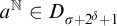
or $b^{\mathbb {N}} \not \in D_{\sigma + 1}$
holds, and thus
$b^{\mathbb {N}} \not \in D_{\sigma + 1}$
holds, and thus

.
We move on to the induction step. The case where we use a logical rule in the last inference, except for cut, can be treated in the usual manner. For instance, suppose the last inference is made by $( \forall )$
, namely, (our variant of) the
$( \forall )$
, namely, (our variant of) the

-rule:

where

for each a. Take any $\sigma $
and
$\sigma $
and $\xi $
with
$\xi $
with

. It follows from the induction hypothesis that for each closed term a, we have the following:

If

for any a, then we have

by Lemma 6.6. Otherwise, for all closed terms a, we have

and thus

by Lemma 6.6, which implies

.
Next, the claim for the cases where the last inference is made by one of the rules for determinateness can be straightforwardly shown using Lemmata 4.2 and 4.5. For example, suppose the last inference is of the following form:

where

and

. Take any $\sigma $
and
$\sigma $
and $\xi $
with
$\xi $
with

. If we have $\models \Gamma \cup \{ \neg \mathrm {D} a \} [ \sigma , \sigma + 2^{\gamma }, \xi ]$
, then we get
$\models \Gamma \cup \{ \neg \mathrm {D} a \} [ \sigma , \sigma + 2^{\gamma }, \xi ]$
, then we get

by Lemma 6.6. Otherwise, we have the following by the induction hypothesis:

Since $D_{\sigma + 1} \supset D_{\sigma }$
and
$D_{\sigma + 1} \supset D_{\sigma }$
and $D_{\sigma } \cap T_{\xi + 1} = D_{\sigma } \cap T_{\sigma }$
by Lemma 4.5, this implies
$D_{\sigma } \cap T_{\xi + 1} = D_{\sigma } \cap T_{\sigma }$
by Lemma 4.5, this implies

Hence, by Lemma 4.2.5, we obtain $a^{\mathbb {N}} \not \in D_{\sigma + 1}$
and thus
$a^{\mathbb {N}} \not \in D_{\sigma + 1}$
and thus

. Let us see one more example. Suppose the last inference is of the following form:

where

and

. Take any $\sigma $
and
$\sigma $
and $\xi $
with
$\xi $
with

. As before, if $\models \Gamma \cup \{ \mathrm {D} a \} [ \sigma , \sigma + 2^{\gamma }, \xi ]$
, then the claim follows by Lemma 6.6. Otherwise, by the induction hypothesis, we have
$\models \Gamma \cup \{ \mathrm {D} a \} [ \sigma , \sigma + 2^{\gamma }, \xi ]$
, then the claim follows by Lemma 6.6. Otherwise, by the induction hypothesis, we have

Since

, it follows from Lemma 4.5 that

which implies

by Lemma 4.2.6 and thus

. We leave the other cases to the reader.
Now, let us assume that the last inference is made by a truth rule. Suppose the last inference is made by either $(\textsf {T}{4}_{\infty }^{\mathit {pos}} )$
or
$(\textsf {T}{4}_{\infty }^{\mathit {pos}} )$
or $( \textsf {T}{3}_{\infty }^{\mathit {neg}} )$
:
$( \textsf {T}{3}_{\infty }^{\mathit {neg}} )$
:

where

and

. Take any $\sigma $
and
$\sigma $
and $\xi $
with
$\xi $
with

. We will prove the claim only for the former case; the latter case can be similarly shown. If ${\models \neg \mathrm {T} b [ \sigma , \sigma + 2^{\gamma }, \xi ]}$
, then
${\models \neg \mathrm {T} b [ \sigma , \sigma + 2^{\gamma }, \xi ]}$
, then $b^{\mathbb {N}} \not \in T_{\xi + 1}$
and thus
$b^{\mathbb {N}} \not \in T_{\xi + 1}$
and thus $a^{\mathbb {N}} \in T_{\xi + 1}$
by Lemma 4.3.4, which implies
$a^{\mathbb {N}} \in T_{\xi + 1}$
by Lemma 4.3.4, which implies

. Otherwise, we have $\models \Gamma \cup \{ \mathrm {T} a \} [ \sigma , \sigma + 2^{\gamma }, \xi ]$
by the induction hypothesis, and the claim follows by Lemma 6.6 as before. Next, suppose that we make either of the following inferences at the last step:
$\models \Gamma \cup \{ \mathrm {T} a \} [ \sigma , \sigma + 2^{\gamma }, \xi ]$
by the induction hypothesis, and the claim follows by Lemma 6.6 as before. Next, suppose that we make either of the following inferences at the last step:

where

and

. Take any $\sigma $
and
$\sigma $
and $\xi $
with
$\xi $
with

. For the former case, if $\models \mathrm {T} {b}^{\circ } \wedge \mathrm {D} {b}^{\circ } [ \sigma , \sigma + 2^{\gamma }, \xi ]$
, then, by Lemma 4.5, we have
$\models \mathrm {T} {b}^{\circ } \wedge \mathrm {D} {b}^{\circ } [ \sigma , \sigma + 2^{\gamma }, \xi ]$
, then, by Lemma 4.5, we have

and thus, by Lemmata 4.2.2, 4.3.2, and 4.5, we obtain

which implies

; otherwise, we have $\models \Gamma \cup \{ \mathrm {T} a \} [ \sigma , \sigma + 2^{\gamma }, \xi ]$
by the induction hypothesis, and the claim follows by Lemma 6.6 as before. Similarly, for the latter case, if
$\models \Gamma \cup \{ \mathrm {T} a \} [ \sigma , \sigma + 2^{\gamma }, \xi ]$
by the induction hypothesis, and the claim follows by Lemma 6.6 as before. Similarly, for the latter case, if $\models \neg \mathrm {T} {b}^{\circ } \wedge \mathrm {D} {b}^{\circ } [ \sigma , \sigma + 2^{\gamma }, \xi ]$
, then, by Lemma 4.5, we have
$\models \neg \mathrm {T} {b}^{\circ } \wedge \mathrm {D} {b}^{\circ } [ \sigma , \sigma + 2^{\gamma }, \xi ]$
, then, by Lemma 4.5, we have

and thus, again by Lemmata 4.2.2, 4.3.2, and 4.5, we obtain

which implies

; otherwise, we have $\models \Gamma \cup \{ \neg \mathrm {T} a \} [ \sigma , \sigma + 2^{\gamma }, \xi ]$
by the induction hypothesis, and the claim follows by Lemma 6.6 as before. Thirdly, suppose that the last inference is made by the rule
$\models \Gamma \cup \{ \neg \mathrm {T} a \} [ \sigma , \sigma + 2^{\gamma }, \xi ]$
by the induction hypothesis, and the claim follows by Lemma 6.6 as before. Thirdly, suppose that the last inference is made by the rule $(\textsf {T}{2}_{\infty }^{\mathit {pos}} )$
:
$(\textsf {T}{2}_{\infty }^{\mathit {pos}} )$
:

where

and

. Take any $\sigma $
and
$\sigma $
and $\xi $
with
$\xi $
with

. Suppose $\models \mathrm {D} {b}^{\circ } [ \sigma , \sigma + 2^{\gamma }, \xi ]$
. We have
$\models \mathrm {D} {b}^{\circ } [ \sigma , \sigma + 2^{\gamma }, \xi ]$
. We have $( {b}^{\circ } )^{\mathbb {N}} \in D_{\sigma + 2^{\gamma } + 1}$
and thus
$( {b}^{\circ } )^{\mathbb {N}} \in D_{\sigma + 2^{\gamma } + 1}$
and thus $( {b}^{\circ } )^{\mathbb {N}} \in D_{\xi }$
by Lemma 4.5.2. Hence, we get
$( {b}^{\circ } )^{\mathbb {N}} \in D_{\xi }$
by Lemma 4.5.2. Hence, we get $a^{\mathbb {N}} \in T_{\xi + 1}$
by Lemma 4.3.3 and thus
$a^{\mathbb {N}} \in T_{\xi + 1}$
by Lemma 4.3.3 and thus

. Otherwise, the claim follows by Lemma 6.6 as before. The remaining cases for the other truth rules can be dealt with similarly.
Finally, let us assume that the last inference is made by $( \mathrm {cut} )$
. We only consider the crucial case where the cut formulae are of the forms
$( \mathrm {cut} )$
. We only consider the crucial case where the cut formulae are of the forms $\mathrm {D} a$
and
$\mathrm {D} a$
and $\neg \mathrm {D} a$
:
$\neg \mathrm {D} a$
:

where

. Let $\gamma = \max \{ \gamma _{0}, \gamma _{1} \}$
and take any
$\gamma = \max \{ \gamma _{0}, \gamma _{1} \}$
and take any $\sigma $
and
$\sigma $
and $\xi $
with
$\xi $
with

. Suppose

for contradiction. Since

, it would follow that
 $$ \begin{align*} & \not\models \Gamma [ \sigma, \sigma + 2^{\gamma}, \xi ] & & \mathrm{and} & & \not\models \Gamma [ \sigma + 2^{\gamma}, \sigma + 2^{\gamma} + 2^{\gamma}, \xi ] & \end{align*} $$
by Lemma 6.6. Hence, by the induction hypothesis, we would have
 $$ \begin{align*} & \models \mathrm{D} a [ \sigma, \sigma + 2^{\gamma}, \xi ] & & \mathrm{and} & & \models \neg \mathrm{D} a [ \sigma + 2^{\gamma}, \sigma + 2^{\gamma} + 2^{\gamma}, \xi ], & \end{align*} $$
which means $a^{\mathbb {N}} \!\in D_{\sigma + 2^{\gamma } + 1}$
and
$a^{\mathbb {N}} \!\in D_{\sigma + 2^{\gamma } + 1}$
and $a^{\mathbb {N}}\! \not \in D_{\sigma + 2^{\gamma } + 1}$
; a contradiction. The remaining case in which the cut formulae are closed
$a^{\mathbb {N}}\! \not \in D_{\sigma + 2^{\gamma } + 1}$
; a contradiction. The remaining case in which the cut formulae are closed $\mathcal {L}_{\mathrm {T}}$
-literals can be straightforwardly treated.
$\mathcal {L}_{\mathrm {T}}$
-literals can be straightforwardly treated.
Combining this with Lemma 6.5, we obtain the next corollary.
Corollary 6.8. For each $\mathcal {L}$
-sentence
$\mathcal {L}$
-sentence $\phi $
, if
$\phi $
, if $\mathsf {CD} \vdash \phi $
, then there is some
$\mathsf {CD} \vdash \phi $
, then there is some
 such that
 .
.
Now, the argument of this section can be adequately formalized within $\mathsf {KF}$
(or
$\mathsf {KF}$
(or $\mathsf {RA}_{< \varepsilon _{0}}$
), in which we can formalize the construction of
$\mathsf {RA}_{< \varepsilon _{0}}$
), in which we can formalize the construction of $D_{\xi }$
s and
$D_{\xi }$
s and $T_{\xi }$
s for sufficiently large ordinals (
$T_{\xi }$
s for sufficiently large ordinals ( $< \varepsilon _{0}$
) and prove (the arithmetization of) Corollary 6.8 in terms of them. Hence, in particular, we obtain the following.
$< \varepsilon _{0}$
) and prove (the arithmetization of) Corollary 6.8 in terms of them. Hence, in particular, we obtain the following.
Corollary 6.9. $\mathsf {CD}$
is arithmetically conservative over
$\mathsf {CD}$
is arithmetically conservative over $\mathsf {KF}$
.
$\mathsf {KF}$
.
Combining this corollary with Corollary 5.6, we obtain our main theorem.
Theorem 6.10. $\mathsf {CD}_{\mathsf {0}}$
,
$\mathsf {CD}_{\mathsf {0}}$
, $\mathsf {CD}_{\mathsf {1}}$
,
$\mathsf {CD}_{\mathsf {1}}$
, $\mathsf {CD}_{\mathsf {2}}$
, and
$\mathsf {CD}_{\mathsf {2}}$
, and $\mathsf {CD}$
are arithmetically equivalent to
$\mathsf {CD}$
are arithmetically equivalent to $\mathsf {KF}$
,
$\mathsf {KF}$
, $\mathsf {RA}_{< \varepsilon _{0}}$
, and
$\mathsf {RA}_{< \varepsilon _{0}}$
, and $\mathsf {RT}_{< \varepsilon _{0}}$
, that is, they have exactly the same arithmetical theorems.
$\mathsf {RT}_{< \varepsilon _{0}}$
, that is, they have exactly the same arithmetical theorems.
In fact, our proofs establish stronger results: All the systems are proof-theoretically reducible to each other in the sense of Feferman [Reference Feferman7, Reference Feferman9].
7 Upper bound of the strength of
$\mathsf {CD}^{+}$

We will show that $\mathsf {CD}^{+}$
is arithmetically conservative over
$\mathsf {CD}^{+}$
is arithmetically conservative over $\mathsf {RT}_{< \varepsilon _{\varepsilon _{0}}}$
. This will be shown by constructing a relative interpretation of
$\mathsf {RT}_{< \varepsilon _{\varepsilon _{0}}}$
. This will be shown by constructing a relative interpretation of $\mathsf {CD}^{+}$
in
$\mathsf {CD}^{+}$
in $\mathsf {CT} [ \! [ \mathsf {KF} + \mathrm {Cons} ] \! ]$
(
$\mathsf {CT} [ \! [ \mathsf {KF} + \mathrm {Cons} ] \! ]$
( $= \mathsf {CT} [ \! [ \mathsf {KF} ] \! ] + \mathrm {Cons}$
) that preserves the arithmetical part.
$= \mathsf {CT} [ \! [ \mathsf {KF} ] \! ] + \mathrm {Cons}$
) that preserves the arithmetical part.
7.1 Total and consistent predicates
We begin with the following definition:
 $$\begin{align*}D^{+} ( x ) \ :\Leftrightarrow \ ( \mathrm{F} x \leftrightarrow \neg \mathrm{T} x ). \end{align*}$$
Thus, $D^{+} ( x )$
is equivalent to
$D^{+} ( x )$
is equivalent to $( \mathrm {T} x \vee \mathrm {F} x ) \wedge ( \neg \mathrm {T} x \vee \neg \mathrm {F} x )$
. We obviously have
$( \mathrm {T} x \vee \mathrm {F} x ) \wedge ( \neg \mathrm {T} x \vee \neg \mathrm {F} x )$
. We obviously have
 $$ \begin{align} \begin{aligned} & \mathsf{KF} + \mathrm{Cons} \vdash ( \forall x \in {{\mathrm{Sent}}_{\mathrm{T}}} ) \bigl( D^{+} ( x ) \leftrightarrow ( \mathrm{T} x \vee \mathrm{F} x ) \bigr),\\ & \mathsf{KF} + \mathrm{Comp} \vdash ( \forall x \in {{\mathrm{Sent}}_{\mathrm{T}}} ) \bigl( D^{+} ( x ) \leftrightarrow ( \neg \mathrm{T} x \vee \neg \mathrm{F} x ) \bigr). \end{aligned} \end{align} $$
Lemma 7.1. The following are provable in $\mathsf {KF}$
.
$\mathsf {KF}$
.
-
1.
; use K2. -
2.
; use K3.


Lemma 7.2. The following are provable in $\mathsf {KF} + \mathrm {Cons}$
.
$\mathsf {KF} + \mathrm {Cons}$
.
-
1.
-
2.
-
3.
-
4.


Proof We work within $\mathsf {KF} + \mathrm {Cons}$
; recall that we have
$\mathsf {KF} + \mathrm {Cons}$
; recall that we have $D^{+} ( x ) \leftrightarrow ( \mathrm {T} x \vee \mathrm {F} x )$
for all
$D^{+} ( x ) \leftrightarrow ( \mathrm {T} x \vee \mathrm {F} x )$
for all $x \in {{\mathrm {Sent}}_{\mathrm {T}}}$
in
$x \in {{\mathrm {Sent}}_{\mathrm {T}}}$
in $\mathsf {KF} + \mathrm {Cons}$
. For claim 1, take any
$\mathsf {KF} + \mathrm {Cons}$
. For claim 1, take any $x, y \in {{\mathrm {Sent}}_{\mathrm {T}}}$
; then we have
$x, y \in {{\mathrm {Sent}}_{\mathrm {T}}}$
; then we have

Claim 2 can be shown similarly to 1 using Lemma 7.1.2 and K3. For claim 3, take any v and x with

; then we have

Claim 4 can be shown similarly to 3 using Lemma 7.1.2 and K3.
Lemma 7.3.
 .
.
Proof Take any

. The following four equivalences are provable in $\mathsf {KF}$
:
$\mathsf {KF}$
:

The claim follows from these by logic.
7.2 Reduction of
$\mathsf {CD}^{+}$
to
$\mathsf {CT} [ \! [ \mathsf {KF} + \mathrm {Cons} ] \! ]$


In the present subsection, we give an interpretation of $\mathsf {CD}^{+}$
in
$\mathsf {CD}^{+}$
in $\mathsf {CT} [ \! [ \mathsf {KF} + \mathrm {Cons} ] \! ]$
that preserves
$\mathsf {CT} [ \! [ \mathsf {KF} + \mathrm {Cons} ] \! ]$
that preserves $\mathcal {L}_0$
. For this purpose, we need a few preliminary definitions.
$\mathcal {L}_0$
. For this purpose, we need a few preliminary definitions.
By the recursion theorem we obtain a recursive function f that satisfies the following condition:

Here
 is an arithmetical representation of the syntactic operation of applying the function f to terms so that
 is provable in $\mathsf {PA}$
for each
$\mathsf {PA}$
for each
 .Footnote
9
We can show that f is provably total in
.Footnote
9
We can show that f is provably total in $\mathsf {PA}$
and thus f is a
$\mathsf {PA}$
and thus f is a $\mathsf {PA}$
-definable function. Obviously we have
$\mathsf {PA}$
-definable function. Obviously we have $f x \in {\mathrm {Fml}_{\mathrm {T}}}$
for every
$f x \in {\mathrm {Fml}_{\mathrm {T}}}$
for every
 (provably in $\mathsf {PA}$
), and, as in the case for the function k, we have
$\mathsf {PA}$
), and, as in the case for the function k, we have $\forall z \bigl ( \mathrm {Free} ( z, x ) \leftrightarrow \mathrm {Free} ( z, f x ) \bigr )$
; hence, we have
$\forall z \bigl ( \mathrm {Free} ( z, x ) \leftrightarrow \mathrm {Free} ( z, f x ) \bigr )$
; hence, we have $f x \in {{\mathrm {Sent}}_{\mathrm {T}}}$
for every
$f x \in {{\mathrm {Sent}}_{\mathrm {T}}}$
for every
 (provably in $\mathsf {PA}$
).
$\mathsf {PA}$
).
The next is shown by routine induction on the complexity of x (cf. Lemma 5.7).
Lemma 7.4.
 .
.
Now, we define a translation $\sharp $
of
$\sharp $
of $\mathcal {L}$
into
$\mathcal {L}$
into $\mathcal {L}_{\mathrm {T}}^{+}$
as follows: for each term a,
$\mathcal {L}_{\mathrm {T}}^{+}$
as follows: for each term a,
 $$ \begin{align*} & \mathrm{D}^{\sharp} a \ := \ \mathrm{T} f a \vee \mathrm{F} f a & & \mathrm{and} & & \mathrm{T}^{\sharp} a \ := \ \mathbb{T} f a; & \end{align*} $$ $\sharp $
preserves all the
$\sharp $
preserves all the $\mathcal {L}_0$
-vocabulary. By (11), we have
$\mathcal {L}_0$
-vocabulary. By (11), we have

We will show that $\sharp $
is a relative interpretation of
$\sharp $
is a relative interpretation of $\mathsf {CD}$
in
$\mathsf {CD}$
in $\mathsf {CT} [ \! [ \mathsf {KF} + \mathrm {Cons} ] \! ]$
.
$\mathsf {CT} [ \! [ \mathsf {KF} + \mathrm {Cons} ] \! ]$
.
Lemma 7.5. The following are provable in $\mathsf {KF} + \mathrm {Cons}$
.
$\mathsf {KF} + \mathrm {Cons}$
.


Hence, the $\sharp $
-translations of D1, D2, and D4 are provable in
$\sharp $
-translations of D1, D2, and D4 are provable in $\mathsf {KF} + \mathrm {Cons}$
.
$\mathsf {KF} + \mathrm {Cons}$
.
Lemma 7.6.
 . Hence, the $\sharp $
-translations of D3 is provable in
$\sharp $
-translations of D3 is provable in $\mathsf {KF} + \mathrm {Cons}$
.
$\mathsf {KF} + \mathrm {Cons}$
.
Proof The claim is readily observed from the following equivalences:

Lemma 7.7. The following are provable in $\mathsf {CT} [ \! [ \mathsf {KF} + \mathrm {Cons} ] \! ]$
.
$\mathsf {CT} [ \! [ \mathsf {KF} + \mathrm {Cons} ] \! ]$
.
-
1.
-
2.
-
3.
-
4.
-
5.
.


Hence, the $\sharp $
-translation of T1 and T2 and T4–T6 are provable in
$\sharp $
-translation of T1 and T2 and T4–T6 are provable in $\mathsf {CT} [ \! [ \mathsf {KF} + \mathrm {Cons} ] \! ]$
.
$\mathsf {CT} [ \! [ \mathsf {KF} + \mathrm {Cons} ] \! ]$
.
Proof We work within $\mathsf {CT} [ \! [ \mathsf {KF} + \mathrm {Cons} ] \! ]$
. Claim 1 is obvious by
$\mathsf {CT} [ \! [ \mathsf {KF} + \mathrm {Cons} ] \! ]$
. Claim 1 is obvious by $\mathbb {T}1$
. For claim 2, take any
$\mathbb {T}1$
. For claim 2, take any

, and then we infer

Claims 3 and 4 readily follow from $\mathbb {T}2$
and
$\mathbb {T}2$
and $\mathbb {T}3$
, respectively, together with the definition (12) of f. For claim 5, let v and x be such that
$\mathbb {T}3$
, respectively, together with the definition (12) of f. For claim 5, let v and x be such that

. Then, we have

Lemma 7.8. $\mathsf {CT} [ \! [ \mathsf {KF} + \mathrm {Cons} ] \! ] \vdash \forall x \bigl ( \mathrm {D}^{\sharp } ( x ) \rightarrow ( \mathbb {T} f ( x ) \leftrightarrow \mathrm {T} f ( x ) ) \bigr )$
.
$\mathsf {CT} [ \! [ \mathsf {KF} + \mathrm {Cons} ] \! ] \vdash \forall x \bigl ( \mathrm {D}^{\sharp } ( x ) \rightarrow ( \mathbb {T} f ( x ) \leftrightarrow \mathrm {T} f ( x ) ) \bigr )$
.
Proof If

then $f ( x ) = \ulcorner 0 \!\neq \! 0\urcorner $
and thus
$f ( x ) = \ulcorner 0 \!\neq \! 0\urcorner $
and thus $\mathbb {T} f ( x ) \wedge \mathrm {T} f ( x )$
. Let
$\mathbb {T} f ( x ) \wedge \mathrm {T} f ( x )$
. Let

. The claim is shown by induction on the complexity of x. For the base step, assume

. The case where $x \in {\mathrm {AtSent}_{0}}$
is obvious. Next, if
$x \in {\mathrm {AtSent}_{0}}$
is obvious. Next, if

for some

, then we have

Lastly, let

for some

. Then, we have

For the induction step, we first let

and assume $\mathrm {D}^{\sharp } x$
. We have
$\mathrm {D}^{\sharp } x$
. We have $\mathrm {D}^{\sharp } y$
by Lemma 7.5.3 and thus
$\mathrm {D}^{\sharp } y$
by Lemma 7.5.3 and thus $D^{+} f ( y )$
by (13). Hence, we have
$D^{+} f ( y )$
by (13). Hence, we have

note that the assumption $\mathrm {D}^{\sharp } x$
is crucial here. The other cases can be shown similarly, but without the need to use the assumption
$\mathrm {D}^{\sharp } x$
is crucial here. The other cases can be shown similarly, but without the need to use the assumption $\mathrm {D}^{\sharp } x$
.
$\mathrm {D}^{\sharp } x$
.
Lemma 7.9.
 . Hence, the $\sharp $
-translation of T3 is provable in
$\sharp $
-translation of T3 is provable in $\mathsf {CT} [ \! [ \mathsf {KF} + \mathrm {Cons} ] \! ]$
.
$\mathsf {CT} [ \! [ \mathsf {KF} + \mathrm {Cons} ] \! ]$
.
Proof Take any

and suppose $\mathrm {D}^{\sharp } ( {s}^{\circ } )$
. Then, we have
$\mathrm {D}^{\sharp } ( {s}^{\circ } )$
. Then, we have

Lemma 7.10. $\mathsf {CT} [ \! [ \mathsf {KF} + \mathrm {Cons} ] \! ]$
proves the following.
$\mathsf {CT} [ \! [ \mathsf {KF} + \mathrm {Cons} ] \! ]$
proves the following.
-
1.
. -
2.
.


Hence, the $\sharp $
-translations of D5 and D6 are provable in
$\sharp $
-translations of D5 and D6 are provable in $\mathsf {KF} + \mathrm {Cons}$
.
$\mathsf {KF} + \mathrm {Cons}$
.
Proof 1. Let

. Then, we have

2. Let

. Then, we similarly obtain

By Lemmata 7.5–7.7, 7.9, and 7.10, we obtain the next theorem.
Theorem 7.11. The translation $\sharp $
is a relative interpretation of
$\sharp $
is a relative interpretation of $\mathsf {CD}^{+}$
in
$\mathsf {CD}^{+}$
in $\mathsf {CT} [ \! [ \mathsf {KF} + \mathrm {Cons} ] \! ]$
. Hence, in particular,
$\mathsf {CT} [ \! [ \mathsf {KF} + \mathrm {Cons} ] \! ]$
. Hence, in particular, $\mathsf {CD}^{+}$
is arithmetically conservative over
$\mathsf {CD}^{+}$
is arithmetically conservative over $\mathsf {CT} [ \! [ \mathsf {KF} + \mathrm {Cons} ] \! ]$
.
$\mathsf {CT} [ \! [ \mathsf {KF} + \mathrm {Cons} ] \! ]$
.
Combining this theorem with Corollary 5.10 and Fact 5.11, we obtain the next.
Theorem 7.12. $\mathsf {CD}_{\mathsf {2}}^{+}$
and
$\mathsf {CD}_{\mathsf {2}}^{+}$
and $\mathsf {CD}^{+}$
are arithmetically equivalent to
$\mathsf {CD}^{+}$
are arithmetically equivalent to $\mathsf {RA}_{< \varepsilon _{\varepsilon _{0}}}$
and
$\mathsf {RA}_{< \varepsilon _{\varepsilon _{0}}}$
and $\mathsf {RT}_{< \varepsilon _{\varepsilon _{0}}}$
.
$\mathsf {RT}_{< \varepsilon _{\varepsilon _{0}}}$
.
As before, our proofs actually establish that all these systems are proof-theoretically reducible to each other in the sense of Feferman [Reference Feferman7, Reference Feferman9].
8 Some supplementary results
8.1 An interpretation of
$\mathsf {CD}^{+}$
in
$\mathsf {CT} [ \! [ \mathsf {KF} + \mathrm {Comp} ] \! ]$


Preliminarily, we give an interpretation of $\mathsf {CD}^{+}$
in
$\mathsf {CD}^{+}$
in $\mathsf {CT} [ \! [ \mathsf {KF} + \mathrm {Comp} ] \! ]$
.Footnote
10
$\mathsf {CT} [ \! [ \mathsf {KF} + \mathrm {Comp} ] \! ]$
.Footnote
10
Similarly to the function f, introduced in (12) above, we define a recursive function h by the recursion theorem so that the following condition obtains:

Using h, the translation $\flat $
of
$\flat $
of $\mathcal {L}$
into
$\mathcal {L}$
into $\mathcal {L}_{\mathrm {T}}$
is defined as follows: for each term a,
$\mathcal {L}_{\mathrm {T}}$
is defined as follows: for each term a,
 $$ \begin{align*} & \mathrm{D}^{\flat} a \ = \ \neg \mathrm{T} h a \vee \neg \mathrm{F} h a & & \mathrm{and} & & \mathrm{T}^{\flat} a \ = \ \mathbb{T} h ( a ); & \end{align*} $$
all the $\mathcal {L}_0$
-vocabulary, logical connectives, and quantifiers are preserved by
$\mathcal {L}_0$
-vocabulary, logical connectives, and quantifiers are preserved by $\flat $
. By (11), we have
$\flat $
. By (11), we have $\mathsf {KF} + \mathrm {Comp} \vdash \forall x \bigl ( \mathrm {D}^{\flat } x \leftrightarrow D^{+} ( h x ) \bigr )$
.
$\mathsf {KF} + \mathrm {Comp} \vdash \forall x \bigl ( \mathrm {D}^{\flat } x \leftrightarrow D^{+} ( h x ) \bigr )$
.
The proof of the next theorem is completely dual to that of Theorem 7.11, and we omit the details.
Theorem 8.1. $\flat $
is a relative interpretation of
$\flat $
is a relative interpretation of $\mathsf {CD}$
in
$\mathsf {CD}$
in $\mathsf {CT} [ \! [ \mathsf {KF} + \mathrm {Comp} ] \! ]$
.
$\mathsf {CT} [ \! [ \mathsf {KF} + \mathrm {Comp} ] \! ]$
.
8.2 Liars and truth tellers
In previous section we compared $\mathsf {CD}$
and its variants with other truth theories with respect to their strength. Truth theories are often compared by the way liar and truth teller sentences behave. In the present section we establish a few results about their behaviour in
$\mathsf {CD}$
and its variants with other truth theories with respect to their strength. Truth theories are often compared by the way liar and truth teller sentences behave. In the present section we establish a few results about their behaviour in $\mathsf {CD}$
and its variants.
$\mathsf {CD}$
and its variants.
Let $\mathfrak {l}$
and
$\mathfrak {l}$
and $\mathfrak {t}$
be closed
$\mathfrak {t}$
be closed $\mathcal {L}_0$
-terms with the following properties:
$\mathcal {L}_0$
-terms with the following properties:
 $$ \begin{align} \mathsf{PA} \vdash \mathfrak{l} = \ulcorner \!\neg \mathrm{T} \mathfrak{l}\urcorner \quad \mathrm{and} \quad \mathsf{PA} \vdash \mathfrak{t} = \ulcorner \mathrm{T} \mathfrak{t}\urcorner. \end{align} $$
Hence, we have
 $$ \begin{align} \mathsf{CD} \vdash \mathrm{T} \mathfrak{l} \leftrightarrow \neg \mathrm{T}\hspace{1pt} \ulcorner \mathrm{T} \mathfrak{l}\urcorner \quad \mathrm{and} \quad \mathsf{CD} \vdash \mathrm{T} \mathfrak{t} \leftrightarrow \mathrm{T}\hspace{1pt} \ulcorner \mathrm{T} \mathfrak{t} \urcorner\!\!. \end{align} $$
Therefore, $\neg \mathrm {T} \mathfrak {l}$
and
$\neg \mathrm {T} \mathfrak {l}$
and $\mathrm {T} \mathfrak {t}$
are a liar and a truth-teller sentence, respectively.Footnote
11
$\mathrm {T} \mathfrak {t}$
are a liar and a truth-teller sentence, respectively.Footnote
11
Proposition 8.2.
-
1.
$\mathsf {CD} \vdash \neg \mathrm {D} \mathfrak {l}$
. -
2.
$\mathsf {CD}^{+} \not \vdash \mathrm {D} \mathfrak {t}$
. -
3.
$\mathsf {CD}^{+} \not \vdash \mathrm {T} \mathfrak {t}$
and
$\mathsf {CD}^{+} \not \vdash \neg \mathrm {T} \mathfrak {t}$
. -
4.
$\mathsf {CD}^{+} \not \vdash \neg \mathrm {T} \mathfrak {l}$
and
$\mathsf {CD}^{+} \not \vdash \mathrm {T} \mathfrak {l}$
.


Proof 1. Provably in $\mathsf {CD}$
, if
$\mathsf {CD}$
, if $\mathrm {D} \mathfrak {l}$
were the case, then we would have
$\mathrm {D} \mathfrak {l}$
were the case, then we would have $\mathrm {T} \mathfrak {l} \leftrightarrow \mathrm {T}\hspace{1pt} \ulcorner \mathrm {T} \mathfrak {l} \urcorner $
by T3, which contradicts (16).
$\mathrm {T} \mathfrak {l} \leftrightarrow \mathrm {T}\hspace{1pt} \ulcorner \mathrm {T} \mathfrak {l} \urcorner $
by T3, which contradicts (16).
2. Using (15), we can show that $\mathfrak {t} \not \in D_{\xi }$
for all
$\mathfrak {t} \not \in D_{\xi }$
for all $\xi $
by straightforward induction on
$\xi $
by straightforward induction on $\xi $
.
$\xi $
.
3. For the function f defined in Section 7.2, we observe that $\mathsf {PA}$
proves the following:
$\mathsf {PA}$
proves the following:
 $$ \begin{align} f ( \mathfrak{t} ) = f ( \ulcorner \mathrm{T} \mathfrak{t}\urcorner ) = \ulcorner \mathrm{T} f ( \mathfrak{t} )\urcorner \quad \mathrm{and} \quad h ( \mathfrak{t} ) = h ( \ulcorner \mathrm{T} \mathfrak{t}\urcorner ) = \ulcorner \mathrm{T} h ( \mathfrak{t} )\urcorner; \end{align} $$
hence, both $f ( \mathfrak {t} )$
and
$f ( \mathfrak {t} )$
and $h ( \mathfrak {t} )$
are also truth-tellers. Let I be the least Kripkean fixed point, namely, the least set
$h ( \mathfrak {t} )$
are also truth-tellers. Let I be the least Kripkean fixed point, namely, the least set
 such that $( \mathbb {N}, I ) \models \mathsf {KF}$
, where I interprets the truth predicate
$( \mathbb {N}, I ) \models \mathsf {KF}$
, where I interprets the truth predicate $\mathrm {T}$
. It is known that
$\mathrm {T}$
. It is known that $( \mathbb {N}, I ) \models \mathrm {Cons}$
. By the standard argument, we can show that
$( \mathbb {N}, I ) \models \mathrm {Cons}$
. By the standard argument, we can show that $f ( \mathfrak {t} ) \not \in I$
and
$f ( \mathfrak {t} ) \not \in I$
and
 . Let
. Let $J := \{ \# \neg \phi \mid \# \phi \not \in I \}$
; hence,
$J := \{ \# \neg \phi \mid \# \phi \not \in I \}$
; hence, $( \mathbb {N}, J )$
is the
$( \mathbb {N}, J )$
is the $\mathcal {L}_{\mathrm {T}}$
-structure induced from
$\mathcal {L}_{\mathrm {T}}$
-structure induced from $( \mathbb {N}, I )$
by Cantini’s dual interpretation, and thus
$( \mathbb {N}, I )$
by Cantini’s dual interpretation, and thus $( \mathbb {N}, J ) \models \mathsf {KF} + \mathrm {Comp}$
. Then, we have
$( \mathbb {N}, J ) \models \mathsf {KF} + \mathrm {Comp}$
. Then, we have
 $$ \begin{align} ( \mathbb{N}, I ) \not\models \mathrm{T} f ( \mathfrak{t} ) \quad \mathrm{and} \quad ( \mathbb{N}, J ) \models \mathrm{T} h ( \mathfrak{t} ). \end{align} $$
Now, by (17), we have the following:
 $$ \begin{align} \mathsf{CT} [ \! [ \mathsf{KF} ] \! ] \vdash \mathbb{T} f ( \mathfrak{t} ) \leftrightarrow \mathrm{T} f ( \mathfrak{t} ) \quad \mathrm{and} \quad \mathsf{CT} [ \! [ \mathsf{KF} ] \! ] \vdash \mathbb{T} h ( \mathfrak{t} ) \leftrightarrow \mathrm{T} h ( \mathfrak{t} ). \end{align} $$
Let $I^{+} := \{ \# \phi \mid ( \mathbb {N}, I ) \models \phi \}$
and
$I^{+} := \{ \# \phi \mid ( \mathbb {N}, I ) \models \phi \}$
and $J^{+} := \{ \# \phi \mid ( \mathbb {N}, J ) \models \phi \}$
; then, the
$J^{+} := \{ \# \phi \mid ( \mathbb {N}, J ) \models \phi \}$
; then, the $\mathcal {L}_{\mathrm {T}}^{+}$
-structures
$\mathcal {L}_{\mathrm {T}}^{+}$
-structures $( \mathbb {N}, I, I^{+} )$
and
$( \mathbb {N}, I, I^{+} )$
and $( \mathbb {N}, J, J^{+} )$
, in which
$( \mathbb {N}, J, J^{+} )$
, in which $\mathbb {T}$
is interpreted by
$\mathbb {T}$
is interpreted by $I^{+}$
and
$I^{+}$
and $J^{+}$
respectively, are models of
$J^{+}$
respectively, are models of $\mathsf {CT} [ \! [ \mathsf {KF} + \mathrm {Cons} ] \! ]$
and
$\mathsf {CT} [ \! [ \mathsf {KF} + \mathrm {Cons} ] \! ]$
and $\mathsf {CT} [ \! [ \mathsf {KF} + \mathrm {Comp} ] \! ]$
, respectively. It follows from (18) and (19) that
$\mathsf {CT} [ \! [ \mathsf {KF} + \mathrm {Comp} ] \! ]$
, respectively. It follows from (18) and (19) that
 $$\begin{align*}( \mathbb{N}, I, I^{+} ) \not\models \mathbb{T} f ( \mathfrak{t} ) \quad \mathrm{and} \quad ( \mathbb{N}, J, J^{+} ) \not\models \neg \mathbb{T} h ( \mathfrak{t} ). \end{align*}$$
Hence, $\mathsf {CD}^{+} \not \vdash \mathrm {T} \mathfrak {t}$
and
$\mathsf {CD}^{+} \not \vdash \mathrm {T} \mathfrak {t}$
and $\mathsf {CD}^{+} \not \vdash \neg \mathrm {T} \mathfrak {t}$
by Theorems 7.11 and 8.1.
$\mathsf {CD}^{+} \not \vdash \neg \mathrm {T} \mathfrak {t}$
by Theorems 7.11 and 8.1.
4. Observe that $\mathsf {PA}$
proves the following:
$\mathsf {PA}$
proves the following:
 $$ \begin{align} f ( \mathfrak{l} ) = f ( \ulcorner \neg \mathrm{T} \mathfrak{l}\urcorner ) = \ulcorner \neg \mathrm{T} f ( \mathfrak{l} )\urcorner \quad \mathrm{and} \quad h ( \mathfrak{l} ) = h ( \ulcorner \neg \mathrm{T} \mathfrak{l}\urcorner ) = \ulcorner \neg \mathrm{T} h ( \mathfrak{l} )\urcorner; \end{align} $$
namely, $f ( \mathfrak {l} )$
and
$f ( \mathfrak {l} )$
and $h ( \mathfrak {l} )$
are also liar sentences. Hence, we obtain
$h ( \mathfrak {l} )$
are also liar sentences. Hence, we obtain
 $$ \begin{align} \mathsf{KF} \vdash \mathrm{T} f ( \mathfrak{l} ) \leftrightarrow \mathrm{F} f ( \mathfrak{l} )\qquad\qquad \mathrm{and}\qquad\qquad \mathsf{KF} \vdash \mathrm{T} h ( \mathfrak{l} ) \leftrightarrow \mathrm{F} h ( \mathfrak{l} ), \end{align} $$
which implies $\mathsf {KF} + \mathrm {Cons} \vdash \neg \mathrm {T} f ( \mathfrak {l} )$
and
$\mathsf {KF} + \mathrm {Cons} \vdash \neg \mathrm {T} f ( \mathfrak {l} )$
and $\mathsf {KF} + \mathrm {Comp} \vdash \mathrm {T} h ( \mathfrak {l} )$
. Finally, it follows from (20) that
$\mathsf {KF} + \mathrm {Comp} \vdash \mathrm {T} h ( \mathfrak {l} )$
. Finally, it follows from (20) that $\mathsf {CT} [ \! [ \mathsf {KF} ] \! ]$
proves
$\mathsf {CT} [ \! [ \mathsf {KF} ] \! ]$
proves
 $$ \begin{align*} \mathbb{T} f ( \mathfrak{l} ) \leftrightarrow \mathbb{T}\hspace{1pt} \ulcorner \neg \mathrm{T} f ( \mathfrak{l} )\urcorner \leftrightarrow \neg \mathrm{T} f ( \mathfrak{l} ) \quad \mathrm{and} \quad \mathbb{T} h ( \mathfrak{l} ) \leftrightarrow \mathbb{T} ( \ulcorner \neg \mathrm{T} h \mathfrak{l}\urcorner ) \ \Leftrightarrow \ \neg \mathrm{T} h ( \mathfrak{l} ). \end{align*} $$
Hence, we have $\mathsf {CT} [ \! [ \mathsf {KF} + \mathrm {Cons} ] \! ] \vdash \mathbb {T} f ( \mathfrak {l} )$
and
$\mathsf {CT} [ \! [ \mathsf {KF} + \mathrm {Cons} ] \! ] \vdash \mathbb {T} f ( \mathfrak {l} )$
and $\mathsf {CT} [ \! [ \mathsf {KF} + \mathrm {Comp} ] \! ] \vdash \neg \mathbb {T} h ( \mathfrak {l} )$
, which implies
$\mathsf {CT} [ \! [ \mathsf {KF} + \mathrm {Comp} ] \! ] \vdash \neg \mathbb {T} h ( \mathfrak {l} )$
, which implies $\mathsf {CD}^{+} \not \vdash \neg \mathrm {T} \mathfrak {l}$
and
$\mathsf {CD}^{+} \not \vdash \neg \mathrm {T} \mathfrak {l}$
and $\mathsf {CD}^{+} \not \vdash \mathrm {T} \mathfrak {l}$
by Theorems 7.11 and 8.1.
$\mathsf {CD}^{+} \not \vdash \mathrm {T} \mathfrak {l}$
by Theorems 7.11 and 8.1.
Proposition 8.3. Let us write $\lambda $
for
$\lambda $
for $\neg \mathrm {T} \mathfrak {l}$
. We have the following:
$\neg \mathrm {T} \mathfrak {l}$
. We have the following:
-
1.
$\mathsf {CD}^{+} \not \vdash \mathrm {T}\ulcorner \mathrm {T}\ulcorner \lambda \vee \neg \lambda \urcorner \urcorner $
and
$\mathsf {CD}^{+} \not \vdash \neg \mathrm {T}\ulcorner \mathrm {T}\ulcorner \lambda \vee \neg \lambda \urcorner \urcorner $
; hence, the truth of some logical truth is neither provable nor refutable in
$\mathsf {CD}$
. -
2.
$\mathsf {CD}^{+} \nvdash \mathrm {T}\,\ulcorner \,(\,\mathrm {T}\,\ulcorner \neg \lambda \urcorner \leftrightarrow \neg \mathrm {T}\,\ulcorner \lambda \urcorner )\,\urcorner $
; hence, not all
$\mathsf {CD}$
-axioms are provably true in
$\mathsf {CD}$
. -
3.
$\mathsf {CD}^{+} \vdash \neg \mathrm {D}\,\ulcorner \,(\,\mathrm {T}\,\ulcorner \neg \lambda \urcorner \leftrightarrow \neg \mathrm {T}\,\ulcorner \lambda \urcorner )\,\urcorner $
; hence, not all
$\mathsf {CD}$
-axioms are provably determinate in
$\mathsf {CD}$
.


Proof 1. $\mathsf {CT} [ \! [ \mathsf {KF} ] \! ]$
proves the following equivalences:
$\mathsf {CT} [ \! [ \mathsf {KF} ] \! ]$
proves the following equivalences:
 $$ \begin{align*} & \mathrm{T}^{\sharp} \ulcorner \mathrm{T}\ulcorner \lambda \vee \neg \lambda\urcorner\urcorner \ \Leftrightarrow \ \mathbb{T}\hspace{1pt} \ulcorner \mathrm{T} f ( \ulcorner \lambda\vee \neg \lambda\urcorner )\urcorner \ \Leftrightarrow \ \mathrm{T} f ( \ulcorner \lambda\vee \neg \lambda\urcorner ) \ \Leftrightarrow \ \mathrm{T} f ( \lambda ) \vee \mathrm{F} f ( \lambda ), \\ & \mathrm{T}^{\flat} \ulcorner \mathrm{T}\ulcorner \lambda \vee \neg \lambda\urcorner\urcorner \ \Leftrightarrow \ \mathbb{T}\hspace{1pt} \ulcorner \mathrm{T} h ( \ulcorner \lambda\vee \neg \lambda\urcorner )\urcorner \ \Leftrightarrow \ \mathrm{T} h ( \ulcorner \lambda\vee \neg \lambda\urcorner ) \ \Leftrightarrow \ \mathrm{T} h ( \lambda ) \vee \mathrm{F} h ( \lambda ). \end{align*} $$
By (15) and (21), $\mathsf {KF} + \mathrm {Cons} \vdash \neg ( \mathrm {T} f ( \lambda ) \vee \mathrm {F} f ( \lambda ) )$
and
$\mathsf {KF} + \mathrm {Cons} \vdash \neg ( \mathrm {T} f ( \lambda ) \vee \mathrm {F} f ( \lambda ) )$
and $\mathsf {KF} + \mathrm {Comp} \vdash \mathrm {T} h ( \lambda ) \vee \mathrm {F} h ( \lambda )$
. Hence,
$\mathsf {KF} + \mathrm {Comp} \vdash \mathrm {T} h ( \lambda ) \vee \mathrm {F} h ( \lambda )$
. Hence, $\mathsf {CT} [ \! [ \mathsf {KF} + \mathrm {Cons} ] \! ] \vdash \neg \mathrm {T}^{\sharp } \ulcorner \mathrm {T}\ulcorner \lambda \vee \neg \lambda \urcorner \urcorner $
and
$\mathsf {CT} [ \! [ \mathsf {KF} + \mathrm {Cons} ] \! ] \vdash \neg \mathrm {T}^{\sharp } \ulcorner \mathrm {T}\ulcorner \lambda \vee \neg \lambda \urcorner \urcorner $
and $\mathsf {CT} [ \! [ \mathsf {KF} + \mathrm {Comp} ] \! ] \vdash \mathrm {T}^{\flat } \ulcorner \mathrm {T}\ulcorner \lambda \vee \neg \lambda \urcorner \urcorner $
; thus,
$\mathsf {CT} [ \! [ \mathsf {KF} + \mathrm {Comp} ] \! ] \vdash \mathrm {T}^{\flat } \ulcorner \mathrm {T}\ulcorner \lambda \vee \neg \lambda \urcorner \urcorner $
; thus, $\mathsf {CD}^{+} \not \vdash \mathrm {T}\hspace{1pt} \ulcorner \mathrm {T}\ulcorner \lambda \vee \neg \lambda \urcorner \urcorner $
and
$\mathsf {CD}^{+} \not \vdash \mathrm {T}\hspace{1pt} \ulcorner \mathrm {T}\ulcorner \lambda \vee \neg \lambda \urcorner \urcorner $
and $\mathsf {CD}^{+} \not \vdash \neg \mathrm {T}\hspace{1pt} \ulcorner \mathrm {T}\ulcorner \lambda \vee \neg \lambda \urcorner \urcorner $
by Theorems 7.11 and 8.1.
$\mathsf {CD}^{+} \not \vdash \neg \mathrm {T}\hspace{1pt} \ulcorner \mathrm {T}\ulcorner \lambda \vee \neg \lambda \urcorner \urcorner $
by Theorems 7.11 and 8.1.
2. $\mathsf {CT} [ \! [ \mathsf {KF} ] \! ]$
derives the following:
$\mathsf {CT} [ \! [ \mathsf {KF} ] \! ]$
derives the following:
 $$ \begin{align*} \mathrm{T}^{\sharp} \ulcorner \,(\,\mathrm{T}\,\ulcorner \neg \lambda \urcorner\leftrightarrow \neg \mathrm{T}\,\ulcorner \lambda \urcorner)\urcorner & \ \quad \Leftrightarrow \quad \ \mathbb{T} f ( \ulcorner \,\mathrm{T}\,\ulcorner \neg \lambda\urcorner\urcorner ) \leftrightarrow \neg \mathbb{T} f ( \ulcorner \mathrm{T}\,\ulcorner \lambda \urcorner\urcorner ) \\ & \ \quad \Leftrightarrow \quad \ \mathrm{F} f ( \lambda ) \leftrightarrow \neg \mathrm{T} f ( \lambda ) \\ & \stackrel{(15) \, \& \, (21)}{ \ \quad \Leftrightarrow \quad \ } \mathrm{T} f ( \lambda ) \leftrightarrow \neg \mathrm{T} f ( \lambda ). \end{align*} $$
Hence, we have $\mathsf {CT} [ \! [ \mathsf {KF} + \mathrm {Cons} ] \! ] \vdash \neg \mathrm {T}^{\sharp } \ulcorner \,(\,\mathrm {T}\,\ulcorner \neg \lambda \urcorner \leftrightarrow \neg \mathrm {T}\,\ulcorner \lambda \urcorner )\urcorner $
, from which the claim follows by Theorems 7.11.
$\mathsf {CT} [ \! [ \mathsf {KF} + \mathrm {Cons} ] \! ] \vdash \neg \mathrm {T}^{\sharp } \ulcorner \,(\,\mathrm {T}\,\ulcorner \neg \lambda \urcorner \leftrightarrow \neg \mathrm {T}\,\ulcorner \lambda \urcorner )\urcorner $
, from which the claim follows by Theorems 7.11.
3. Provably in $\mathsf {CD}$
, if
$\mathsf {CD}$
, if $\mathrm {D}\,\ulcorner \,(\,\mathrm {T}\,\ulcorner \neg \lambda \urcorner \leftrightarrow \neg \mathrm {T}\,\ulcorner \lambda \urcorner )\,\urcorner $
, then
$\mathrm {D}\,\ulcorner \,(\,\mathrm {T}\,\ulcorner \neg \lambda \urcorner \leftrightarrow \neg \mathrm {T}\,\ulcorner \lambda \urcorner )\,\urcorner $
, then $\mathrm {D} \ulcorner \neg \mathrm {T}\hspace{1pt} \ulcorner \lambda \urcorner \urcorner $
and thus
$\mathrm {D} \ulcorner \neg \mathrm {T}\hspace{1pt} \ulcorner \lambda \urcorner \urcorner $
and thus $\mathrm {D} \mathfrak {l}$
by (15), which contradicts Proposition 8.2.1.
$\mathrm {D} \mathfrak {l}$
by (15), which contradicts Proposition 8.2.1.
8.3 Additional axioms
In this subsection, we will consider a few conservative extensions of $\mathsf {CD}^{+}$
with additional axioms about iterations of truth.
$\mathsf {CD}^{+}$
with additional axioms about iterations of truth.
Lemma 8.4.
-
1.
. -
2.
.


Proof We work within $\mathsf {CT} [ \! [ \mathsf {KF} + \mathrm {Cons} ] \! ]$
. Take any
$\mathsf {CT} [ \! [ \mathsf {KF} + \mathrm {Cons} ] \! ]$
. Take any

. We have

recall that $\mathrm {T}^{\sharp } a := \mathbb {T} f a$
and
$\mathrm {T}^{\sharp } a := \mathbb {T} f a$
and $\mathrm {D}^{\sharp } a := D^{+} f a$
. Similarly, for each
$\mathrm {D}^{\sharp } a := D^{+} f a$
. Similarly, for each

, we have

This completes the proof.
By the dual argument, we can also show the following.
Lemma 8.5.
-
1.
. -
2.
.


Let $\mathsf {num} ( n )$
represent the function
$\mathsf {num} ( n )$
represent the function
 and thus it is the code of the numeral for n. Following the notation of [Reference Halbach21], given a formula $\phi ( x )$
with a distinguished free variable x,
$\phi ( x )$
with a distinguished free variable x,
 denotes $\ulcorner \phi ( x )\urcorner ( \mathsf {num} ( z ) / \ulcorner x\urcorner )$
and also
$\ulcorner \phi ( x )\urcorner ( \mathsf {num} ( z ) / \ulcorner x\urcorner )$
and also
 denotes $\ulcorner \phi ( x )\urcorner ( s / \ulcorner x\urcorner )$
for
$\ulcorner \phi ( x )\urcorner ( s / \ulcorner x\urcorner )$
for
 . We will occasionally write
 or
or
 without specifying the distinguished free variable of $\phi $
, but in doing so we always assume that
$\phi $
, but in doing so we always assume that $\phi $
contains some free variable to be substituted for.
$\phi $
contains some free variable to be substituted for.
Lemma 8.6.
 .
.
Proof Take any

. The first conjunct is shown as follows:

The second conjunct can be shown similarly by just replacing f above with h.
We conclude with the next theorem, which immediately follows from the last three lemmata and Theorems 7.11 and 8.1.
Theorem 8.7. The following two systems are both conservative over $\mathsf {CD}^{+}$
:
$\mathsf {CD}^{+}$
:
-
1.
-
2.


Hence, either set of the new axioms can be consistently added to $\mathsf {CD}$
.
$\mathsf {CD}$
.
9 The minimality axiom
The axioms for determinateness postulate that certain sentences are determinate; but $\mathsf {CD}$
lacks axioms that tell us that no other sentences are determinate. For instance, our axioms for determinateness do not rule out that truth teller sentences or similar sentences are determinate. Only in the case of sentences, such as liar sentences, where the assumption of determinateness leads to inconsistency, can we prove in
$\mathsf {CD}$
lacks axioms that tell us that no other sentences are determinate. For instance, our axioms for determinateness do not rule out that truth teller sentences or similar sentences are determinate. Only in the case of sentences, such as liar sentences, where the assumption of determinateness leads to inconsistency, can we prove in $\mathsf {CD}$
that they are not determinate.
$\mathsf {CD}$
that they are not determinate.
Theorem 4.13 says that no matter what model $( \mathbb {N}, X, Y )$
of
$( \mathbb {N}, X, Y )$
of $\mathsf {CD}$
we choose,
$\mathsf {CD}$
we choose, $\mathit {D}_{\infty }$
is the least fixed point of
$\mathit {D}_{\infty }$
is the least fixed point of $\Gamma _{\mathcal {D} [ Y ]}$
and can be inductively defined ‘from the bottom up’ in Y. Hence,
$\Gamma _{\mathcal {D} [ Y ]}$
and can be inductively defined ‘from the bottom up’ in Y. Hence, $\mathit {D}_{\infty }$
seems to be a natural candidate for the ‘intended’ interpretation of the determinateness predicate
$\mathit {D}_{\infty }$
seems to be a natural candidate for the ‘intended’ interpretation of the determinateness predicate $\mathrm {D}$
. In this section, we present an axiomatization of this conception of determinateness, which allows us to refute the determinateness of truth tellers, and state the proof-theoretic strength of the resulting system; however, the full analysis of the system goes beyond limited space of the present paper and is left for the Part II.
$\mathrm {D}$
. In this section, we present an axiomatization of this conception of determinateness, which allows us to refute the determinateness of truth tellers, and state the proof-theoretic strength of the resulting system; however, the full analysis of the system goes beyond limited space of the present paper and is left for the Part II.
The system $\mathsf {ID}_{1}$
of (positive arithmetical) inductive definitions contains an axiom schema expressing that each fixed point expressed by a predicate of
$\mathsf {ID}_{1}$
of (positive arithmetical) inductive definitions contains an axiom schema expressing that each fixed point expressed by a predicate of $\mathsf {ID}_{1}$
is the least, inductively defined, one. We use the same strategy for expressing the leastness of
$\mathsf {ID}_{1}$
is the least, inductively defined, one. We use the same strategy for expressing the leastness of $\mathrm {D}$
. We remind the reader of the definition of
$\mathrm {D}$
. We remind the reader of the definition of $\mathsf {ID}_{1}$
. The language
$\mathsf {ID}_{1}$
. The language $\mathcal {L}_{\mathrm {fix}}$
of
$\mathcal {L}_{\mathrm {fix}}$
of $\mathsf {ID}_{1}$
has a predicate symbol
$\mathsf {ID}_{1}$
has a predicate symbol $J_{\mathcal {A}}$
for each second-order arithmetical formula
$J_{\mathcal {A}}$
for each second-order arithmetical formula $\mathcal {A} ( x, X )$
with only the displayed variables free in which X occurs only positively.
$\mathcal {A} ( x, X )$
with only the displayed variables free in which X occurs only positively. $\mathsf {ID}_{1}$
comprises the following axioms for each predicate
$\mathsf {ID}_{1}$
comprises the following axioms for each predicate $J_{\mathcal {A}}$
together with the axioms of
$J_{\mathcal {A}}$
together with the axioms of $\mathsf {PA}$
and full induction for
$\mathsf {PA}$
and full induction for $\mathcal {L}_{\mathrm {fix}}$
:
$\mathcal {L}_{\mathrm {fix}}$
:
-
ID1
$\forall x \bigl ( \mathcal {A} ( x, \mathit {J}_{\mathcal {A}} ) \rightarrow \mathit {J}_{\mathcal {A}} x \bigr ),$
-
ID2
$\forall x \bigl ( \mathcal {A} ( x, \Phi ) \rightarrow \Phi ( x ) \bigr ) \rightarrow \forall x \bigl ( \mathit {J}_{\mathcal {A}} x \rightarrow \Phi ( x ) \bigr )$
, for all
$\Phi \in \mathcal {L}_{\mathrm {fix}},$


where $\mathcal {A} ( x, \Phi )$
for an
$\mathcal {A} ( x, \Phi )$
for an $\mathcal {L}_{\mathrm {fix}}$
-formula
$\mathcal {L}_{\mathrm {fix}}$
-formula $\Phi ( u )$
with a designated variable u is the result of substituting
$\Phi ( u )$
with a designated variable u is the result of substituting $\Phi ( a )$
for each occurrence of
$\Phi ( a )$
for each occurrence of $a \in X$
in
$a \in X$
in $\mathcal {A} ( x, X )$
for each term a (with renaming of bound variables as necessary to avoid collision). Inspired by ID2, Burgess [Reference Burgess4] proposes the following axiom schema as an axiomatic characterization of the groundedness of the truth predicate
$\mathcal {A} ( x, X )$
for each term a (with renaming of bound variables as necessary to avoid collision). Inspired by ID2, Burgess [Reference Burgess4] proposes the following axiom schema as an axiomatic characterization of the groundedness of the truth predicate $\mathrm {T}$
in Kripke’s [Reference Kripke28] sense:
$\mathrm {T}$
in Kripke’s [Reference Kripke28] sense:
 $$ \begin{align*} \forall x \bigl( \mathcal{B} ( x, \Phi ) \rightarrow \Phi ( x ) \bigr) \rightarrow \forall x \bigl( \mathrm{T} x \rightarrow \Phi ( x ) \bigr), \ \mathrm{for\ all }\ \Phi \in \mathcal{L}_{\mathrm{T}}, \end{align*} $$
where $\mathcal {B} ( x, X )$
is taken so that
$\mathcal {B} ( x, X )$
is taken so that $\forall x \bigl ( \mathcal {B} ( x, X ) \rightarrow X \bigr )$
expresses that X is closed under the strong Kleene evaluation schema of truth values. Burgess’s schema expresses that the extension of
$\forall x \bigl ( \mathcal {B} ( x, X ) \rightarrow X \bigr )$
expresses that X is closed under the strong Kleene evaluation schema of truth values. Burgess’s schema expresses that the extension of $\mathrm {T}$
is the least Kripkean fixed point under the strong Kleene evaluation schema; the system obtained by augmenting
$\mathrm {T}$
is the least Kripkean fixed point under the strong Kleene evaluation schema; the system obtained by augmenting $\mathsf {KF}$
with this schema is called
$\mathsf {KF}$
with this schema is called $\mathsf {KFB}$
. We follow the lead of Burgess’s idea toward an axiomatic characterization of
$\mathsf {KFB}$
. We follow the lead of Burgess’s idea toward an axiomatic characterization of $\mathrm {D}$
as the least set that satisfies the closure conditions of determinateness relative to the truth predicate
$\mathrm {D}$
as the least set that satisfies the closure conditions of determinateness relative to the truth predicate $\mathrm {T}$
(but recall that the least such set is invariant across the choice of
$\mathrm {T}$
(but recall that the least such set is invariant across the choice of $\mathrm {T}$
).
$\mathrm {T}$
).
For each $\mathcal {L}$
-formula
$\mathcal {L}$
-formula $\Phi ( u )$
with a designated variable u, we write
$\Phi ( u )$
with a designated variable u, we write $\mathcal {D} ( x, \Phi )$
for the result of substituting
$\mathcal {D} ( x, \Phi )$
for the result of substituting $\Phi ( a )$
for each occurrence of
$\Phi ( a )$
for each occurrence of $\mathrm {D} a$
in
$\mathrm {D} a$
in $\mathcal {D} ( x )$
for each term a (with renaming of bound variables as necessary to avoid collision). For the uniformity of notation, we will write
$\mathcal {D} ( x )$
for each term a (with renaming of bound variables as necessary to avoid collision). For the uniformity of notation, we will write $\mathcal {D} ( x, \mathrm {D} )$
for
$\mathcal {D} ( x, \mathrm {D} )$
for $\mathcal {D} ( x )$
in (and only in) the present section. Thereby we introduce two new axioms.
$\mathcal {D} ( x )$
in (and only in) the present section. Thereby we introduce two new axioms.
 $$\begin{align*} \kern-131pt D_{\mu}1 \kern40pt & \forall x ( \mathcal{D} ( x, \mathrm{D} ) \rightarrow \mathrm{D} x ). \end{align*}$$
 $$\begin{align*} \kern-50pt D_{\mu}2 \kern40pt & \forall x \bigl( \mathcal{D} ( x, \Phi ) \rightarrow \Phi ( x ) \bigr) \rightarrow \forall x ( \mathrm{D} x \rightarrow \Phi ( x ) ), \ \mathrm{for\ all}\ \Phi \in \mathcal{L}. \end{align*}$$
Note that Dμ2 is not a single axiom but an axioms schema.
Definition 9.1. We define the system $\mathsf {CD}_{\mu }$
as
$\mathsf {CD}_{\mu }$
as $\mathsf {CD} + \mathrm {D}_{\mu }1 + \mathrm {D}_{\mu }2$
. We can easily show that Dμ1 is derivable from
$\mathsf {CD} + \mathrm {D}_{\mu }1 + \mathrm {D}_{\mu }2$
. We can easily show that Dμ1 is derivable from $\mathsf {CD}$
and thus
$\mathsf {CD}$
and thus $\mathsf {CD}_{\mu }$
is identical with
$\mathsf {CD}_{\mu }$
is identical with $\mathsf {CD} + \mathrm {D}_{\mu }2$
. The system
$\mathsf {CD} + \mathrm {D}_{\mu }2$
. The system $\mathsf {CD}^{+}_{\mu }$
is defined as
$\mathsf {CD}^{+}_{\mu }$
is defined as $\mathsf {CD}^{+} + \mathrm {D}_{\mu }2$
.
$\mathsf {CD}^{+} + \mathrm {D}_{\mu }2$
.
The next follows from Theorems 4.8 and 4.13.
Corollary 9.2. $( \mathbb {N}, D_{\infty }, \mathbb {T} ) \models \mathsf {CD}^{+}_{\mu }$
.
$( \mathbb {N}, D_{\infty }, \mathbb {T} ) \models \mathsf {CD}^{+}_{\mu }$
.
The system $\mathsf {CD}_{\mu }$
has some desirable properties. For example, we have the following.
$\mathsf {CD}_{\mu }$
has some desirable properties. For example, we have the following.
Proposition 9.3. $\mathsf {CD}_{\mu } \vdash \neg \mathrm {D} \mathfrak {t}$
; see Section 8.2 for the definition of
$\mathsf {CD}_{\mu } \vdash \neg \mathrm {D} \mathfrak {t}$
; see Section 8.2 for the definition of $\mathfrak {t}$
.
$\mathfrak {t}$
.
Proof Suppose $\mathrm {D} \mathfrak {t}$
for contradiction. Let
$\mathrm {D} \mathfrak {t}$
for contradiction. Let $\Phi ( x ) := \mathrm {D} x \wedge x \neq \mathfrak {t}$
. Since
$\Phi ( x ) := \mathrm {D} x \wedge x \neq \mathfrak {t}$
. Since $\mathcal {D} ( \mathfrak {t}, \Phi )$
implies
$\mathcal {D} ( \mathfrak {t}, \Phi )$
implies $\Phi ( \mathfrak {t} )$
by (15), we have
$\Phi ( \mathfrak {t} )$
by (15), we have $\neg \mathcal {D} ( \mathfrak {t}, \Phi )$
and thus
$\neg \mathcal {D} ( \mathfrak {t}, \Phi )$
and thus $\forall x ( \mathcal {D} ( x, \Phi ) \rightarrow \Phi ( x ) )$
by Dμ1, which would imply
$\forall x ( \mathcal {D} ( x, \Phi ) \rightarrow \Phi ( x ) )$
by Dμ1, which would imply $\forall x ( \mathrm {D} x \rightarrow \Phi ( x ) )$
; a contradiction.
$\forall x ( \mathrm {D} x \rightarrow \Phi ( x ) )$
; a contradiction.
In fact, all the underivability results proved in Section 8.2 still hold in $\mathsf {CD}_{\mu }$
and
$\mathsf {CD}_{\mu }$
and $\mathsf {CD}^{+}_{\mu }$
, and the additional axioms considered in Section 8.3 are also consistent with
$\mathsf {CD}^{+}_{\mu }$
, and the additional axioms considered in Section 8.3 are also consistent with $\mathsf {CD}_{\mu }$
and
$\mathsf {CD}_{\mu }$
and $\mathsf {CD}^{+}_{\mu }$
.
$\mathsf {CD}^{+}_{\mu }$
.
The full proof-theoretic analyses of these new systems are left for the Part II. We state the main results below without giving their proofs.
Theorem 9.4.
-
1.
$\mathsf {CD}_{\mu }$
is proof-theoretically equivalent to
$\mathsf {ID}_1$
. -
2.
$\mathsf {CD}^{+}_{\mu }$
is proof-theoretically equivalent to
$\mathsf {BID}_{1}^{2}$
(see [Reference Pohlers and Buss36] for its definition and Fujimoto [Reference Fujimoto15] for its proof-theoretic analysis), and thus its proof-theoretic ordinal (if appropriately defined) is
.


10 Comparison with other axiomatizations of truth
We think that $\mathsf {CD}$
is more promising than many other systems found in the literature. This section contains brief comparisons with such systems. We leave a more thorough discussion of the philosophical aspects for another paper.
$\mathsf {CD}$
is more promising than many other systems found in the literature. This section contains brief comparisons with such systems. We leave a more thorough discussion of the philosophical aspects for another paper.
10.1 Comparison with the Friedman–Sheard system
The Friedman–Sheard system $\mathsf {FS}$
features all the truth axioms of
$\mathsf {FS}$
features all the truth axioms of $\mathsf {CD}$
, except for the truth iteration axiom T3 and all axioms involving
$\mathsf {CD}$
, except for the truth iteration axiom T3 and all axioms involving $\mathrm {D}$
, which is not in the language of
$\mathrm {D}$
, which is not in the language of ${\mathsf {FS}}$
. Axiom T3 is replaced with two rules called Necessitation NEC and Conecessitation CONEC:
${\mathsf {FS}}$
. Axiom T3 is replaced with two rules called Necessitation NEC and Conecessitation CONEC:

Adding these two rules for all sentences to T1 and T4 – T6 yields the Friedman–Sheard system ${\mathsf {FS}}$
, which was analyzed by Friedman and Sheard [Reference Friedman and Sheard13] with a different axiomatization. McGee [Reference McGee31] showed that a subsystem of
${\mathsf {FS}}$
, which was analyzed by Friedman and Sheard [Reference Friedman and Sheard13] with a different axiomatization. McGee [Reference McGee31] showed that a subsystem of ${\mathsf {FS}}$
is
${\mathsf {FS}}$
is

-inconsistent and thus does not have a standard model, that is, the standard model of arithmetic cannot be expanded to a model of ${\mathsf {FS}}$
by specifying a suitable extension for the truth predicate. Halbach [Reference Halbach18] determined the proof-theoretic strength of
${\mathsf {FS}}$
by specifying a suitable extension for the truth predicate. Halbach [Reference Halbach18] determined the proof-theoretic strength of ${\mathsf {FS}}$
as ramified analysis
${\mathsf {FS}}$
as ramified analysis

up to

or

-times iterated typed truth (see Halbach [Reference Halbach21, Section 14.2]).
A neat feature of ${\mathsf {FS}}$
is its symmetry: What is provable in
${\mathsf {FS}}$
is its symmetry: What is provable in ${\mathsf {FS}}$
and what is provably true in
${\mathsf {FS}}$
and what is provably true in ${\mathsf {FS}}$
coincide. Moreover, if
${\mathsf {FS}}$
coincide. Moreover, if $\phi $
is a classical tautology such as
$\phi $
is a classical tautology such as $\lambda \vee \neg \lambda $
(for a liar sentence
$\lambda \vee \neg \lambda $
(for a liar sentence $\lambda $
), the sentence
$\lambda $
), the sentence
 $$\begin{align*}\underbrace{\mathrm{T}\ulcorner\mathrm{T}\ulcorner\ldots \mathrm{T}}_{n\ \mathrm{ iterations\ of\ }\mathrm{T}}\ulcorner{\phi }\urcorner\ldots\urcorner\urcorner \end{align*}$$
is provable in ${\mathsf {FS}}$
. In
${\mathsf {FS}}$
. In $\mathsf {CD}$ $\mathrm {T}\ulcorner \phi \urcorner $
is provable for every classical tautology, but
$\mathrm {T}\ulcorner \phi \urcorner $
is provable for every classical tautology, but $\mathrm {T}\ulcorner \mathrm {T}\ulcorner \lambda \vee \neg \lambda \urcorner \urcorner $
and further iterations are not, as was shown in Proposition 8.3. In
$\mathrm {T}\ulcorner \mathrm {T}\ulcorner \lambda \vee \neg \lambda \urcorner \urcorner $
and further iterations are not, as was shown in Proposition 8.3. In ${\mathsf {FS}}$
no transfinite iterations of truth can be proved. Hence neither is
${\mathsf {FS}}$
no transfinite iterations of truth can be proved. Hence neither is ${\mathsf {FS}}$
a subsystem of
${\mathsf {FS}}$
a subsystem of $\mathsf {CD}$
nor is
$\mathsf {CD}$
nor is $\mathsf {CD}$
a subsystem of
$\mathsf {CD}$
a subsystem of ${\mathsf {FS}}$
. Moreover, neither can the truth predicate of
${\mathsf {FS}}$
. Moreover, neither can the truth predicate of ${\mathsf {FS}}$
be defined in
${\mathsf {FS}}$
be defined in $\mathsf {CD}$
nor can the truth predicate of
$\mathsf {CD}$
nor can the truth predicate of $\mathsf {CD}$
be defined in
$\mathsf {CD}$
be defined in ${\mathsf {FS}}$
. This follows from general arguments by Fujimoto [Reference Fujimoto14] (see also Halbach [Reference Halbach21]). We will show in Part II that
${\mathsf {FS}}$
. This follows from general arguments by Fujimoto [Reference Fujimoto14] (see also Halbach [Reference Halbach21]). We will show in Part II that $\mathsf {CD}$
can be consistently closed under NEC and CONEC. The result is a system that properly contains
$\mathsf {CD}$
can be consistently closed under NEC and CONEC. The result is a system that properly contains ${\mathsf {FS}}$
and is consequently
${\mathsf {FS}}$
and is consequently
 -inconsistent.
The system ${\mathsf {FS}}$
has rightly been criticized by various authors. Barrio and Picollo [Reference Barrio and Picollo2] list some of the problematic features of
${\mathsf {FS}}$
has rightly been criticized by various authors. Barrio and Picollo [Reference Barrio and Picollo2] list some of the problematic features of ${\mathsf {FS}}$
caused by the
${\mathsf {FS}}$
caused by the
 -inconsistency. In particular, the rule NEC can naturally be replaced with an
 -times iterated reflection axiom. If the reflection axiom is iterated into the transfinite, an inconsistency ensues (Halbach and Horsten [Reference Beall and Armour-Garb3] and Halbach [Reference Halbach21, Corollary 14.39]). These shortcomings of ${\mathsf {FS}}$
prompted our search for an alternative to
${\mathsf {FS}}$
prompted our search for an alternative to ${\mathsf {FS}}$
without giving up the thorough classicality of
${\mathsf {FS}}$
without giving up the thorough classicality of ${\mathsf {FS}}$
and endorsing the internal non-classicality of systems such as
${\mathsf {FS}}$
and endorsing the internal non-classicality of systems such as ${\mathsf {KF}}$
.
${\mathsf {KF}}$
.
Some alternative systems have been developed that prove the truth of classical tautologies, but are
 -consistent such as Cantini’s [Reference Cantini6] $\mathsf {VF}$
and Stern’s [Reference Stern41]
$\mathsf {VF}$
and Stern’s [Reference Stern41] $\mathsf {IT}$
and their variants. For these systems
$\mathsf {IT}$
and their variants. For these systems
 -models can be obtained via constructions involving supervaluations.
10.2 Comparison with Kripke–Feferman
Feferman [Reference Feferman8] defined a determinateness predicate D in terms of a truth and a falsity predicate within the Kripke–Feferman system ${\mathsf {KF}}$
.Footnote
12
Understanding the falsity of a sentence as the truth of its negation, Feferman defined D as the formula we called
${\mathsf {KF}}$
.Footnote
12
Understanding the falsity of a sentence as the truth of its negation, Feferman defined D as the formula we called $D^{+}$
above:
$D^{+}$
above:

The schema $D\ulcorner \phi \urcorner \rightarrow (\mathrm {T}\ulcorner \phi \urcorner \leftrightarrow \phi )$
becomes provable in
$D\ulcorner \phi \urcorner \rightarrow (\mathrm {T}\ulcorner \phi \urcorner \leftrightarrow \phi )$
becomes provable in ${\mathsf {KF}}$
with this definition. The schema had been mentioned by Kripke [Reference Kripke28] already.
${\mathsf {KF}}$
with this definition. The schema had been mentioned by Kripke [Reference Kripke28] already.
Reinhardt [Reference Reinhardt37, Reference Reinhardt and de Alcantara38] takes the determinateness predicate to express meaningful applicability or significance; and truth is only meaningfully applicable to determinate sentences.Footnote
13
In particular, the liar sentence is not in the range of significance of the truth predicate. Reinhardt concludes that the system ${\mathsf {KF}}$
, which is formulated in classical logic, is not sound in the sense that it proves only true theorems, where truth is understood in the sense of the truth predicate
${\mathsf {KF}}$
, which is formulated in classical logic, is not sound in the sense that it proves only true theorems, where truth is understood in the sense of the truth predicate $\mathrm {T}$
of
$\mathrm {T}$
of ${\mathsf {KF}}$
. According to Reinhardt, one might hope that the sentences
${\mathsf {KF}}$
. According to Reinhardt, one might hope that the sentences $\phi $
with
$\phi $
with $\mathsf {KF}\vdash \mathrm {T}\ulcorner \phi \urcorner $
are true and significant. The set of these sentences is not closed under classical logic. The theorems of
$\mathsf {KF}\vdash \mathrm {T}\ulcorner \phi \urcorner $
are true and significant. The set of these sentences is not closed under classical logic. The theorems of ${\mathsf {KF}}$
itself need not be significant or trustworthy; only those whose truth can be proved are. Generally, it is very hard to avoid the provability of sentences that are not ‘significant’ or not ‘healthy’, as Reinhardt [Reference Reinhardt37] and Bacon [Reference Bacon1] have argued.
${\mathsf {KF}}$
itself need not be significant or trustworthy; only those whose truth can be proved are. Generally, it is very hard to avoid the provability of sentences that are not ‘significant’ or not ‘healthy’, as Reinhardt [Reference Reinhardt37] and Bacon [Reference Bacon1] have argued.
In contrast to Reinhardt, we do not think that the range of significance of the truth predicate is restricted in any way; the determinateness predicate cannot be seen as indicating the range of significance of $\mathrm {T}$
. For instance, truth should commute with connectives for all sentences, not just with those in some range of significance. However, some sentences, including liar sentences, are sensitive to the addition of another layer of truth. Stacking an additional layer of truth onto the liar sentence will change its semantic status; but that does not mean that the truth predicate cannot meaningfully applied to it. We would only run into the Reinhardt–Bacon problem by postulating that only insensitive sentences ought to be provable. We reject this kind of soundness condition. We endorse sensitive sentences such as the compositional axioms or classical tautologies as theorems. However, we may not be able to ascend semantically from such sentences and add a further level of truth. It is not possible to ascend semantically from the compositional axiom; they are already at the highest level of generality and further semantic ascend and generalization is not possible.
$\mathrm {T}$
. For instance, truth should commute with connectives for all sentences, not just with those in some range of significance. However, some sentences, including liar sentences, are sensitive to the addition of another layer of truth. Stacking an additional layer of truth onto the liar sentence will change its semantic status; but that does not mean that the truth predicate cannot meaningfully applied to it. We would only run into the Reinhardt–Bacon problem by postulating that only insensitive sentences ought to be provable. We reject this kind of soundness condition. We endorse sensitive sentences such as the compositional axioms or classical tautologies as theorems. However, we may not be able to ascend semantically from such sentences and add a further level of truth. It is not possible to ascend semantically from the compositional axiom; they are already at the highest level of generality and further semantic ascend and generalization is not possible.
10.3 Comparison with Feferman’s DT
Feferman [Reference Feferman10, p. 205] originally introduced $\mathsf {KF}$
as an instrument to explain ‘what notions and principles one ought to accept if one accepts the basic notions and principles of the theory’, the foundational question which had long been one of the central themes of Feferman’s work.Footnote
14
$\mathsf {KF}$
as an instrument to explain ‘what notions and principles one ought to accept if one accepts the basic notions and principles of the theory’, the foundational question which had long been one of the central themes of Feferman’s work.Footnote
14
As a theory of truth per se, Feferman later proposed another system $\mathsf {DT}$
. Again, each predicate is assumed to have a domain of significance and to be meaningfully applicable only to objects in that domain. In the case of the truth predicate
$\mathsf {DT}$
. Again, each predicate is assumed to have a domain of significance and to be meaningfully applicable only to objects in that domain. In the case of the truth predicate $\mathrm {T}$
, its domain
$\mathrm {T}$
, its domain $\mathfrak {D}$
of significance is taken to consist of the sentences that are meaningful and determinate, and all the principles of truth are only applicable to the sentences in the domain
$\mathfrak {D}$
of significance is taken to consist of the sentences that are meaningful and determinate, and all the principles of truth are only applicable to the sentences in the domain $\mathfrak {D}$
. Accordingly, the system
$\mathfrak {D}$
. Accordingly, the system $\mathsf {DT}$
comprises two groups of axioms: the axioms characterizing the domain
$\mathsf {DT}$
comprises two groups of axioms: the axioms characterizing the domain $\mathfrak {D}$
and the axioms expressing the
$\mathfrak {D}$
and the axioms expressing the $\mathrm {T}$
-schema and the compositional axioms for all sentences in
$\mathrm {T}$
-schema and the compositional axioms for all sentences in $\mathfrak {D}$
.
$\mathfrak {D}$
.
Feferman’s axioms for determinateness differ from ours in particular with respect to the determinateness of sentences formed with binary connectives. In his system a disjunction is determinate if, and only if both disjuncts are; and a conjunction is determinate if, and only if both conjuncts are. We discussed our choice of axiom D5 on page 6 and justified its endorsement with the generalizing function of truth. Many harmless generalizations would become indeterminate (and consequently the system proof-theoretically weak) if generalization were expressed with conjunction and disjunction and Feferman’s concept of determinateness. To overcome the problem, he introduced a special conditional $\rightarrow $
as a primitive logical connective so that the truth and determinateness of a conditional sentence
$\rightarrow $
as a primitive logical connective so that the truth and determinateness of a conditional sentence $\phi \rightarrow \psi $
is characterized independently and differently from its usual definition
$\phi \rightarrow \psi $
is characterized independently and differently from its usual definition $\neg ( \phi \wedge \neg \psi )$
in terms of negation and conjunction (or
$\neg ( \phi \wedge \neg \psi )$
in terms of negation and conjunction (or $\neg \phi \vee \psi $
in terms of negation and disjunction) by the following axioms:
$\neg \phi \vee \psi $
in terms of negation and disjunction) by the following axioms:

Feferman’s approach diverges from ours in two crucial respects: First, he took $\mathfrak {D}$
as the range of all the principles of truth comprehensively and restricted every principle of truth to the class of determinate sentences
$\mathfrak {D}$
as the range of all the principles of truth comprehensively and restricted every principle of truth to the class of determinate sentences $\mathfrak {D}$
, whereas we take the class of determinate sentences only as the range of the disquotation schema and postulate the compositional axioms unrestrictedly for every sentence. Secondly, he took
$\mathfrak {D}$
, whereas we take the class of determinate sentences only as the range of the disquotation schema and postulate the compositional axioms unrestrictedly for every sentence. Secondly, he took $\mathfrak {D}$
as definable in terms of truth by stipulating
$\mathfrak {D}$
as definable in terms of truth by stipulating $D x\leftrightarrow \mathrm {T} x \vee \mathrm {F} x$
; but this definition does not yield the desired properties of
$D x\leftrightarrow \mathrm {T} x \vee \mathrm {F} x$
; but this definition does not yield the desired properties of $\mathrm {D}$
in our theory and we consequently introduce determinateness as a primitive notion.
$\mathrm {D}$
in our theory and we consequently introduce determinateness as a primitive notion.
Fujimoto [Reference Fujimoto14] observed that $\mathsf {DT}$
is identical with the system
$\mathsf {DT}$
is identical with the system $\mathsf {FKF} + \mathrm {Cons}$
of non-classical partial truth whose evaluation rule is given by the Aczel–Feferman evaluation schema. The Aczel–Feferman evaluation schema is the same as the weak Kleene evaluation schema, with the exception of the evaluation rule of the conditional.
$\mathsf {FKF} + \mathrm {Cons}$
of non-classical partial truth whose evaluation rule is given by the Aczel–Feferman evaluation schema. The Aczel–Feferman evaluation schema is the same as the weak Kleene evaluation schema, with the exception of the evaluation rule of the conditional. $\mathsf {FKF}$
is a variant of
$\mathsf {FKF}$
is a variant of $\mathsf {KF}$
with the Aczel–Feferman evaluation schema:
$\mathsf {KF}$
with the Aczel–Feferman evaluation schema: $\mathsf {FKF}$
is to the Aczel–Feferman evaluation schema is what
$\mathsf {FKF}$
is to the Aczel–Feferman evaluation schema is what $\mathsf {KF}$
is to the strong Kleene evaluation schema.
$\mathsf {KF}$
is to the strong Kleene evaluation schema.
10.4 Comparison with the Leitgeb–Schindler system
Schindler [Reference Schindler40] defined a group of systems that resemble ours. They differ from $\mathsf {CD}$
in restricting the compositional principles T4 –T6 to grounded sentences. The predicate symbol G for groundedness plays a role comparable to that of
$\mathsf {CD}$
in restricting the compositional principles T4 –T6 to grounded sentences. The predicate symbol G for groundedness plays a role comparable to that of $\mathrm {D}$
in
$\mathrm {D}$
in $\mathsf {CD}$
. The full system is called
$\mathsf {CD}$
. The full system is called $\mathsf {CG}$
. All the unrestricted compositional axioms T4–T6 are provable except for the right-to-left direction of the negation axiom T4. That is,
$\mathsf {CG}$
. All the unrestricted compositional axioms T4–T6 are provable except for the right-to-left direction of the negation axiom T4. That is,
 is not provable in $\mathsf {CG}$
. In this sense Schindler’s system fails to be thoroughly classical.
$\mathsf {CG}$
. In this sense Schindler’s system fails to be thoroughly classical.
One of the axioms of $\mathsf {CG}$
is a ‘definitional’ axiom of groundedness [Reference Schindler40, p. 77]:
$\mathsf {CG}$
is a ‘definitional’ axiom of groundedness [Reference Schindler40, p. 77]:

This axiom of $\mathsf {CG}$
is not a theorem (with
$\mathsf {CG}$
is not a theorem (with $\mathrm {D}$
for G) of our theory
$\mathrm {D}$
for G) of our theory $\mathsf {CD}$
, because the full negation axiom T4 and thus
$\mathsf {CD}$
, because the full negation axiom T4 and thus

are theorems of $\mathsf {CD}$
and therefore Schindler’s definitional axiom would imply
$\mathsf {CD}$
and therefore Schindler’s definitional axiom would imply

. Consequently, Schindler’s system does not really require a primitive predicate for groundedness, while the definition of determinateness as truth or falsity fails in our system.
On Schindler’s approach, $\mathrm {T}$
applies provably only to sentences without G, because it lacks an axiom analogous to our T2. This is in line with the intended interpretation of G as Leitgeb’s [Reference Leitgeb30] notion of groundedness. Also G cannot be iterated, and axiom D3 is absent from Schindler’s list of axioms. However, contrary to Schindler’s official formulation of the system, we could view
$\mathrm {T}$
applies provably only to sentences without G, because it lacks an axiom analogous to our T2. This is in line with the intended interpretation of G as Leitgeb’s [Reference Leitgeb30] notion of groundedness. Also G cannot be iterated, and axiom D3 is absent from Schindler’s list of axioms. However, contrary to Schindler’s official formulation of the system, we could view $G x$
as a metalinguistic abbreviation for
$G x$
as a metalinguistic abbreviation for
 . Then $\mathrm {T}$
provably applies to sentences containing G.
$\mathrm {T}$
provably applies to sentences containing G.
10.5 Comparison with Halbach’s system PUTB
The truth-theoretic axioms of the system $\mathsf {PUTB}$
are given by all instances
$\mathsf {PUTB}$
are given by all instances $\mathrm {T}\ulcorner \phi \urcorner \leftrightarrow \phi $
of the T-schema where the truth predicate occurs only positively in
$\mathrm {T}\ulcorner \phi \urcorner \leftrightarrow \phi $
of the T-schema where the truth predicate occurs only positively in $\phi $
and parameters are allowed in
$\phi $
and parameters are allowed in $\phi $
.
$\phi $
.
Positiveness has the advantage over determinateness that it is a very simple syntactic decidable property that is definable in the language of arithmetic. If in the schema
-
DDS

the symbol $\mathrm {D}$
expresses that
$\mathrm {D}$
expresses that $\mathrm {T}$
occurs only positively, no primitive predicate
$\mathrm {T}$
occurs only positively, no primitive predicate $\mathrm {D}$
is needed, as positiveness can be expressed by an arithmetical formula. Consequently, because
$\mathrm {D}$
is needed, as positiveness can be expressed by an arithmetical formula. Consequently, because $\mathrm {D}$
is arithmetical, our axiom
$\mathrm {D}$
is arithmetical, our axiom $\textsf {T2}^{+}$
, that is,
$\textsf {T2}^{+}$
, that is,
 becomes provable.
The theory $\mathsf {PUTB}$
does not prove the compositional axiom T4 –T6. To obtain a system closer to
$\mathsf {PUTB}$
does not prove the compositional axiom T4 –T6. To obtain a system closer to $\mathsf {CD}$
, one could add the compositional axioms to
$\mathsf {CD}$
, one could add the compositional axioms to $\mathsf {PUTB}$
or derive them from reflection principles, as Horsten and Leigh [Reference Horsten and Leigh27] suggest.
$\mathsf {PUTB}$
or derive them from reflection principles, as Horsten and Leigh [Reference Horsten and Leigh27] suggest.
However, T-positiveness and determinateness differ significantly: In particular, truth-teller sentences are provably T-positive, while they are not provably determinate in our sense; in fact we can refute their determinateness in $\mathsf {CD}_{\mu }$
as was shown in proposition 9.3. The proof-theoretic strength of
$\mathsf {CD}_{\mu }$
as was shown in proposition 9.3. The proof-theoretic strength of $\mathsf {PUTB}$
relies crucially on indeterminate instances that allow one to mimick positive inductive definitions. Overall the restriction to determinate instead of positive sentences is better motivated.
$\mathsf {PUTB}$
relies crucially on indeterminate instances that allow one to mimick positive inductive definitions. Overall the restriction to determinate instead of positive sentences is better motivated.
10.6 Comparison with Picollo’s system WFUTB
Picollo [Reference Picollo34, Reference Picollo, Arazim and Dancak35] defines a notion of referential well-foundedness, which is related to determinateness in our sense. Here we do not go into the details of its definition and only highlight some differences to our approach. First, the notion of well-foundedness is defined in such a way that it becomes arithmetically definable. Thus only a truth predicate needs to be added and no separate predicate for referential well-foundedness as our primitive predicate $\mathrm {D}$
. Roughly, the main axiom schema of her system
$\mathrm {D}$
. Roughly, the main axiom schema of her system $\mathsf {WFUTB}$
then states the T-sentences for sentences that are referentially well-founded in her sense (or
$\mathsf {WFUTB}$
then states the T-sentences for sentences that are referentially well-founded in her sense (or $\mathsf {PA}$
- provably equivalent to such a sentence).Footnote
15
$\mathsf {PA}$
- provably equivalent to such a sentence).Footnote
15 $\mathsf {WFUTB}$
does not feature any compositional axioms, and it can be shown that they are not provable in it, although the system was shown by Picollo to be proof-theoretically at least as strong as ramified analysis
$\mathsf {WFUTB}$
does not feature any compositional axioms, and it can be shown that they are not provable in it, although the system was shown by Picollo to be proof-theoretically at least as strong as ramified analysis $\mathsf {RA}_{<\Gamma _0}$
up to
$\mathsf {RA}_{<\Gamma _0}$
up to $\Gamma _0$
and thus much stronger than PUTB and compositional theories such as
$\Gamma _0$
and thus much stronger than PUTB and compositional theories such as $\mathsf {KF}$
.
$\mathsf {KF}$
.
10.7 Comparison with Field’s systems Int
The most fundamental decision for the truth theorist is whether to sacrifice classical logic for transparency or transparency for classical logic. By transparency we mean here some equivalence of $\phi $
with
$\phi $
with $\mathrm {T}\ulcorner \phi \urcorner $
for all
$\mathrm {T}\ulcorner \phi \urcorner $
for all $\phi $
. Field [Reference Field11] sacrifices classical logic; we sacrifice transparency. Field saves truth from paradox; we save logic from paradox. We regain transparency for determinate sentences; Field regains classical logic for what he calls strongly classical sentences.
$\phi $
. Field [Reference Field11] sacrifices classical logic; we sacrifice transparency. Field saves truth from paradox; we save logic from paradox. We regain transparency for determinate sentences; Field regains classical logic for what he calls strongly classical sentences.
Field employs a new primitive predicate $Scl$
for strongly classical truth. Although Field’s and our approach are pulling in exactly opposite directions, Field’s axioms for
$Scl$
for strongly classical truth. Although Field’s and our approach are pulling in exactly opposite directions, Field’s axioms for $Scl$
and ours for
$Scl$
and ours for $\mathrm {D}$
have a striking resemblance. As Field in footnote 6 mentions, he and we arrived at our axiomatizations independently. Of course, a serious comparison of Int and
$\mathrm {D}$
have a striking resemblance. As Field in footnote 6 mentions, he and we arrived at our axiomatizations independently. Of course, a serious comparison of Int and $\mathsf {CD}$
leads back to the most fundamental decision that truth theorists face, and we do not enter the discussion here.
$\mathsf {CD}$
leads back to the most fundamental decision that truth theorists face, and we do not enter the discussion here.
11 Further perspectives
In the part II of this paper, we will give proof-theoretic analysis of variants of $\mathsf {CD}$
. In particular, among many others, we will give a proof of Theorem 9.4. We conclude the paper by listing two open problems.
$\mathsf {CD}$
. In particular, among many others, we will give a proof of Theorem 9.4. We conclude the paper by listing two open problems.
-
(I) We may consider
$\mathsf {CD}$
and its variants with the schema of induction restricted to the arithmetical sentences. In many cases, the restriction of induction to the arithmetical sentences results in a proof-theoretically conservative theory (over
$\mathsf {PA}$
). We conjecture that the same holds for
$\mathsf {CD}$
. Conservativeness proofs in the analogous case of
$\mathsf {KF}$
can be given in a model-theoretic way by showing how to extend a given model of
$\mathsf {PA}$
to a model of
${\mathsf {KF}}$
with arithmetical induction only. This is not possible in the case of
$\mathsf {CD}$
because Lachlan’s theorem [Reference Lachlan29] applies and nonstandard models that can be expanded to
$\mathsf {CD}$
with restricted induction have to be recursively saturated. -
(II) It may be of interest to replace the axiom D3 of
$\mathsf {CD}$
with an alternative axiom
. Together with DDS this would yield our additional axiom
$\textsf {T2}^{+}$
. Thus, adding
may be more natural than adding
$\textsf {T2}^{+}$
. We do not know how strong
$\mathsf {CD}$
becomes if
is added.


Acknowledgments
We are grateful to Dora Achourioti, Anton Broberg, Hannes Leitgeb, Beau Mount, Carlo Nicolai, Lavinia Picollo, Lorenzo Rossi, Thomas Schindler, Johannes Stern, Philip Welch, and the referee for comments and suggestions.
Funding
V.H. would like to thank the Leverhulme Trust for supporting his work with a Research Fellowship.


 Open access

