

Introduction
Cereals are important contributors to ruminant feeding worldwide. They are most often used as grain, either in concentrate or as rough diet. However, cereals are often managed as forages, the whole plant being grazed, ensiled or green chopped. Whole-plant triticale seems to be a good forage alternative to traditional winter species such as barley and wheat. Its hardiness and high-yield potential under limiting conditions has been noticed in different areas of the world (Lozano et al., Reference Lozano, Zamora, Solis, Mergoum and Pfeiffer1998; McLeod et al., Reference McLeod, Gan, Salmon and Baron1998; Delogu et al. Reference Delogu, Faccini, Faccioli, Reggiani, Lendini and Berardo2002). Its dual purpose, as a grain harvest occurring after the forage harvest, has also been pointed out (Andrews et al., Reference Andrews, Wright, Simpson, Jessop, Reeves and Wheeler1991; Royo and Pares, Reference Royo and Pares1996; Jobim and Emile, Reference Jobim and Emile1999).
This crop nowadays covers more than 330 000 ha in France and up to 1 200 000 ha in the European Union (2005 data), but only a small part (from 5 to 10% depending to the areas) is used as forage. This culture could be of great interest compared with summer crops such as maize or sorghum silage in order to spare water resources or to valorize low-input management (Bernard et al., Reference Bernard, Jestin, Bernard, Gay and Bonhomme1992; Le Gall et al., Reference Le Gall, Delattre and Cabon1998).
Feeding experiments with triticale silages are, however, infrequent and have given contrasting results (Zobell et al., Reference Zobell, Goonewardene and Engstrom1992; McCartney and Vaage, Reference McCartney and Vaage1994; Scerra et al., Reference Scerra, Galvano, Angelis, Galvano and Rapisarda1994), which may have prevented the development of this species as forage. On the other hand, a large variability is potentially available within this breeding species. Therefore, the objectives of this study were to evaluate the in vivo digestibility of selected whole-crop cereals in order to (i) evaluate and compare the quality of barley, wheat, rye and triticale and (ii) determine whether there are any differences among the triticale cultivars.
Material and methods
Plants and forage
Ten genotypes of winter cereals were sown in late October of 1997 at INRA Lusignan (France). Those genotypes included six cultivars of triticale (X Triticosecale Wittm.) ‘Aubrac’, ‘Calao’, ‘Carnac’, ‘Inradi34-2’, ‘Lasko’ and ‘Trimaran’; two cultivars of wheat (Triticum aestivum L.) ‘Renan’ and ‘Trémie’; one cultivar of barley (Hordeum vulgare L.) ‘Angela’; and one cultivar of rye (Secale cereale L.) ‘Clou’. Plots were 1500 m2 for each genotype. The cereals were harvested as silage in the middle of June 1998 at the late milk-early dough grain stage in order to obtain a dry matter (DM) content of the silages approaching 30 to 35%. Two experimental silos of approximately 450 kg DM were made for each genotype (Traineau, Reference Traineau1991) and stored outdoors 48 to 70 days prior to in vivo evaluation.
Grain content of the ensiled forage was estimated at the time of harvest from four samples of 0.25 m2(0.5 × 0.5 m2) for each genotype. Throughout the in vivo evaluation, silage samples were taken twice a week, dried at 60°C, bulked and ground through a 2-mm hammer mill for in situ evaluation. Other samples of offered silage were pressed. The resulting juice was frozen and then analysed in order to determine pH, lactic acid, butyric acid, acetic acid, ammonia-nitrogen and soluble nitrogen (N) according to standard methods.
In vivo digestibility evaluation
Twenty-four castrated Texel sheep housed individually in digestibility cages were allocated in four balanced groups of six sheep according to their weight (average weight of 83.0 ± 1.5 kg) and age. Each of the 20 silages (10 treatments × 2 replications) was fed twice a day to one of those groups for 2 weeks. The measurement period lasted 5 days, after a 7-day-long period of adaptation. Feeding was adjusted to the maintenance requirement of each animal according to its metabolic weight (40 g/kg0.75). Offered forage and faeces DM content were recorded daily. The ash, crude protein (CP), crude fibre (CF), fibre content (NDF, ADF, ADL) and enzymatic digestibility (IVDMD) were assessed from a weekly bulk sample. The fibre content procedure was adapted from Goering and Van Soest (Reference Goering and Van Soest1970). Voluntary intake (VI), organic matter digestibility (OMd) and cell wall digestibility (NDFd), computed from offered forage, refusal and faeces content, were derived from the average value for 5 days and six sheep (Demarquilly et al., Reference Demarquilly, Chenost and Giger1995). The net energy value for lactation in dairy cattle was computed according to Andrieu and Demarquilly (Reference Andrieu and Demarquilly1987) and expressed as UFL (1 UFL = 7.106 MJ/kg DM). The non-digestible cell wall (NDFnd) was calculated according to Demarquilly et al. (Reference Demarquilly, Chenost and Giger1995) as 100 × NDFnd = NDF × (100−NDFd). Main and nested effects were tested by analysis of variance following the model: genotype + genotype(animal) and using the GLM procedure (Statistical Analysis Systems Institute (SAS), 1989). Genotype least-square means were compared by a Duncan test. The Pearson correlation coefficients between feeding value traits were performed using the CORR procedure (SAS, 1989).
Results
Silage composition
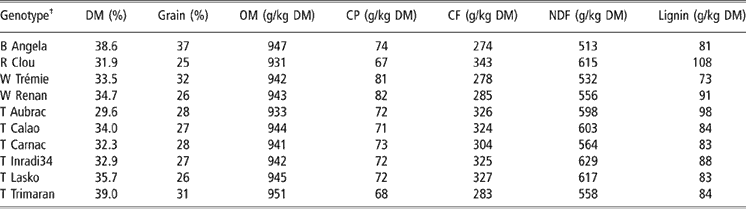
The chemical composition of the silages is given in Table 1. Silages DM content varied from 29.6 to 39.0% (34.2% on average). Grain content at harvest time rose from 25 to 37% of the total DM. The average values for organic matter (OM), CP, CF, NDF and lignin were respectively of 942, 73, 307, 578 and 87 g/kg DM. IVDMD fluctuated between 41.1 (rye) and 55.5% (barley), the triticale being intermediate from 45.0 to 51.8% according to the genotype.
Chemical composition (dry matter (DM), organic matter (OM), crude protein (CP), crude fibre (CF), neutral-detergent fibre (NDF)) of the silages
† Abbreviation for silage species: B = barley; R = rye; W = wheat; T = triticale.
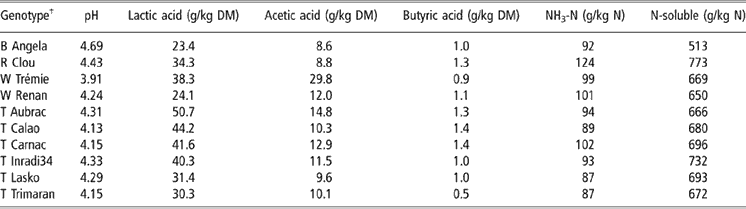
The mean values for the silages conservation parameters, pH (4.26), ammonia-N (97 g/kg total N) and lactic acid (72% of the total acids) showed good silage fermentation (Table 2). Nevertheless, the amount of acetic acid (26%) and butyric acid (2%), and the amount of soluble N (674 g/kg total N %) were higher than expected. The triticale Tremie had a high proportion of acetic acid (43%).
Fermentative characterization of the silages
† Abbreviation for silage species: B = barley; R = rye; W = wheat; T = triticale.
In vivo digestibility evaluation
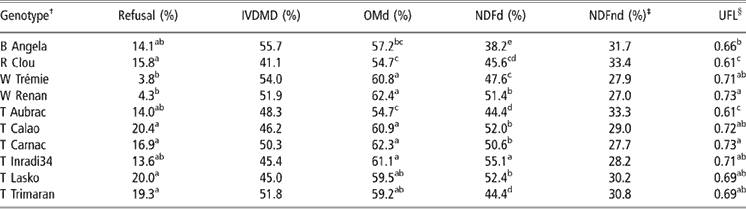
Despite the sheep being fed a limited amount, a high proportion of forage refusal was observed, from 3.8 to 20.4% of the total offered DM (Table 3). In order to prevent interactions between intake level and digestibility data, the option was made to discard individual digestibility data when the intake was lower than 30 g/kg0.75. Observed OMd ranged from less than 55% to more than 62%. Wheat cultivars (61.6%, mean value) appeared more digestible than the barley (57.2%) and the rye (54.7%) but no different from the triticales (mean value, 60.6%). Within triticale genotypes, OMd ranged from 54.7 to 62.3%, differences are significant.
Refusal forage, enzymatic digestibility (IVDMD), organic matter digestibility (OMd), neutral-detergent fibre digestibility (NDFd), non-digestible NDF (NDFnd) and net energy content (UFL)
a,b,c,d,e Values within columns with different superscripts are different (P < 0.01).
† Abbreviation for silage species: B = barley; R = rye; W = wheat; T = triticale.
‡ 100 × NDFnd = NDF × (100 − CWD).
§ UFL: milk net energy content computed with OMd, intake, crude protein and crude fibre (Weende) (1 UFL = 7.106 MJ).
The NDFd varied between 38.2 (barley) and 55.1% (triticale inra di34-2) taking into account all genotypes, and between 44.4 and 55.1% within triticales. Concerning the wheat cultivars, Renan was more digestible than Trémie. NDFnd varied from 27.0 to 33.4%.
The mean feeding value of triticale was 0.69 UFL (=4.90 MJ), varying from 0.61 to 0.73 UFL depending on the cultivars, when wheat, barley and rye values were 0.72, 0.66 and 0.61 UFL, respectively.
Discussion
The pH of silages was lower than 4.5, reflecting an active fermentation. There were no marked differences in ammonia-N and soluble N between genotypes and cultivars. The amount of acetic acid, butyric acid and the high level of soluble N can be attributed to the slower acidification of the forages in experimental silos than in larger ones. However, conservation characteristics were similar to those recorded in similar studies (Bergen et al., Reference Bergen, Byrem and Grant1991; Scerra et al., Reference Scerra, Galvano, Angelis, Galvano and Rapisarda1994, Jobim et al., Reference Jobim, Reis and Rosa1996) and appeared to be intermediate between those currently given for maize silage and for grass silage.
Despite the fact that forages were given in limited amounts, a low level of consumption was noticed. The refusals represent less than 5% for wheat cultivars but 14 to 20% for the triticales. As previously stated, the effect of the forage conservation on intake should probably be discarded. One could accuse the depressive effect of a high DM content, as often observed by farmers, but the DM contents were lower than the 40% critical value (29.6 to 39.0%). Moreover, the presence of rough barbs on the spikes of the awned plants, which could physically decrease the palatability of the forages, must be considered. The wheat cultivars are barbless (Renan) or their barbs are smooth and short (Trémie). In a study involving sheep and growing heifers, McCartney and Vaage (Reference McCartney and Vaage1994) noticed palatability problems with the triticale diet and concluded it was related to its coarse texture. In their study, Scerra et al. (Reference Scerra, Galvano, Angelis, Galvano and Rapisarda1994) attributed the poor palatability of triticale to the presence of barbs.
As noticed by Adesogan et al. (Reference Adesogan, Owen and Givens1998b) in an evaluation involving 36 winter wheat forages, the chemical composition data of the forages were inaccurate predictors of OMd. Variations in OM digestibilities were nevertheless linked to the NDF digestibility and strongly to the non-digestible NDF content (Table 4). Enzymatic digestibility (IVDMD) appeared closely dependent on the NDF content but not on the OM or the NDF digestibilities. As the enzymatic technique simulates the ruminal digestion, it does not sufficiently account for post-ruminal digestion of the cell wall and starch components of the plants.
Correlations between feeding value traits: organic matter digestibility (OMd), neutral-detergent fibre (NDF), NDF digestibility (NDFd), non-digestible NDF (NDFnd) and enzymatic digestibility (IVDMD)
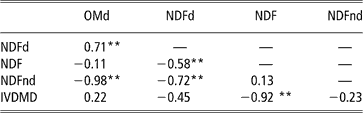
** P < 0.01.
The OMd values of the wheat and barley genotypes were consistent with the data given by Andrieu et al. (Reference Andrieu, Demarquilly and Sauvant1988), Garnsworthy and Stokes (Reference Garnsworthy and Stokes1993) and Adesogan et al. (Reference Adesogan, Owen and Givens1998a), but five points lower than data given by McCartney and Vaage (Reference McCartney and Vaage1994). Rye OMd was the lowest in this study and no comparative data seem to be available on this species. Those data need to be made relative because the potential genetic variations within those species were not been explored in this study. Triticale OMd values were similar to those of barley and wheat in this experiment and lower than in evaluations conducted by Scerra et al. (Reference Scerra, Galvano, Angelis, Galvano and Rapisarda1994) and McCartney and Vaage (Reference McCartney and Vaage1994). The range of variation within this species (more than six points) was as wide as reported by Delogu et al. (Reference Delogu, Faccini, Faccioli, Reggiani, Lendini and Berardo2002) in an evaluation involving nine genotypes. This genetic variability for digestibility is well known in numerous forage species and is related to the amount of starch in the plant and also to the characteristics of the cell wall components of the genotypes.
Conclusion
Whole-crops winter cereals harvested as silage at 30 to 35% DM content provide forage of good quality for feeding ruminants. Among the species, wheat has a higher nutritional value than barley and rye. Within the six triticale genotypes, a variability for digestibility seems to exist. The best of them are better than the wheat cultivars while the worst are no different from that of rye. This fact is not surprising due to the genetic background of this species, but it is of importance for further development of the species. Such a variability in a species known for its ability to be cropped under limiting conditions (soil, manure, pest control) must be explored in greater depth. This could lead to providing farmers with genotypes of good quality with an acceptable yield under extensive conditions and at a lower cost.



