


Historical and archaeological context
Medieval castles are among the most well-studied subjects in European historiography (Figure 1), not least for their role as material evidence for the consolidation of seigneurial power between the Early and Late Middle Ages (tenth–thirteenth centuries). Within the Castles project, we chose to focus on sites from three Italian regions, Tuscany, Liguria and Piedmont, as the development of castles in this part of the peninsula appears to have followed shared characteristics and patterns (Figure 2). These include the presence of pre-existing early medieval (seventh–ninth centuries) timber settlements, an initial burst of castle construction in the ninth–tenth centuries, and a prolonged phase of gradual transformation into fortified settlements, some of which persist into the modern era (Francovich & Hodges Reference Francovich and Hodges2003).
Aerial view of Rocca San Silvestro in Tuscany, one of the case studies in the project (photograph by authors).

Geographic distribution of castle sites included in the project (figure by authors).

Archaeological and historical research has identified four phases of castle formation, spanning from the tenth to the fourteenth centuries in Italy (Carocci Reference Carocci2021). The second phase, roughly dated to the eleventh and twelfth centuries, remains both one of the most obscure yet one of the most consequential for understanding the historical processes associated with castle building. During this period, Italian castles underwent substantial structural transformations, closely linked to a reorganisation of seigneurial power in the surrounding countryside. Recent historiographical work (Fiore Reference Fiore2020; Haack et al. Reference Haack2025) points to the transition between the eleventh and twelfth centuries as particularly significant, marking a major shift in seigneurial power that led to broader sociopolitical changes. However, our understanding of the precise chronologies of these shifts is limited by a lack of detailed textual sources and by a similar dearth of precise archaeological ‘index fossils’ for this period. The primary objective of the Castles project was to refine the chronologies of castle construction during this critical phase to verify the accuracy of the historiographical consensus. A secondary goal was to develop a precise and integrated protocol for the analysis of historical mortars. This protocol would lead to the creation of a model addressing the project’s historical and archaeological questions while also establishing a benchmark system to assess the reliability of the mortar analyses themselves.
Research methods and strategies
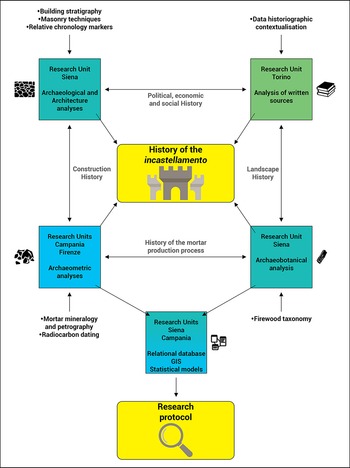
The Castles project involved four research units, each with its own distinct disciplinary focus (Figure 3). The initial research strategy focused on identifying castles with structures that could plausibly date to the eleventh–twelfth centuries, based on pre-existing textual and archaeological evidence. After a comprehensive review of available sources, we conducted field surveys at each identified site, together with preliminary geological analyses of the locations and surrounding areas.
Research units and disciplinary focus in the project (figure by authors).

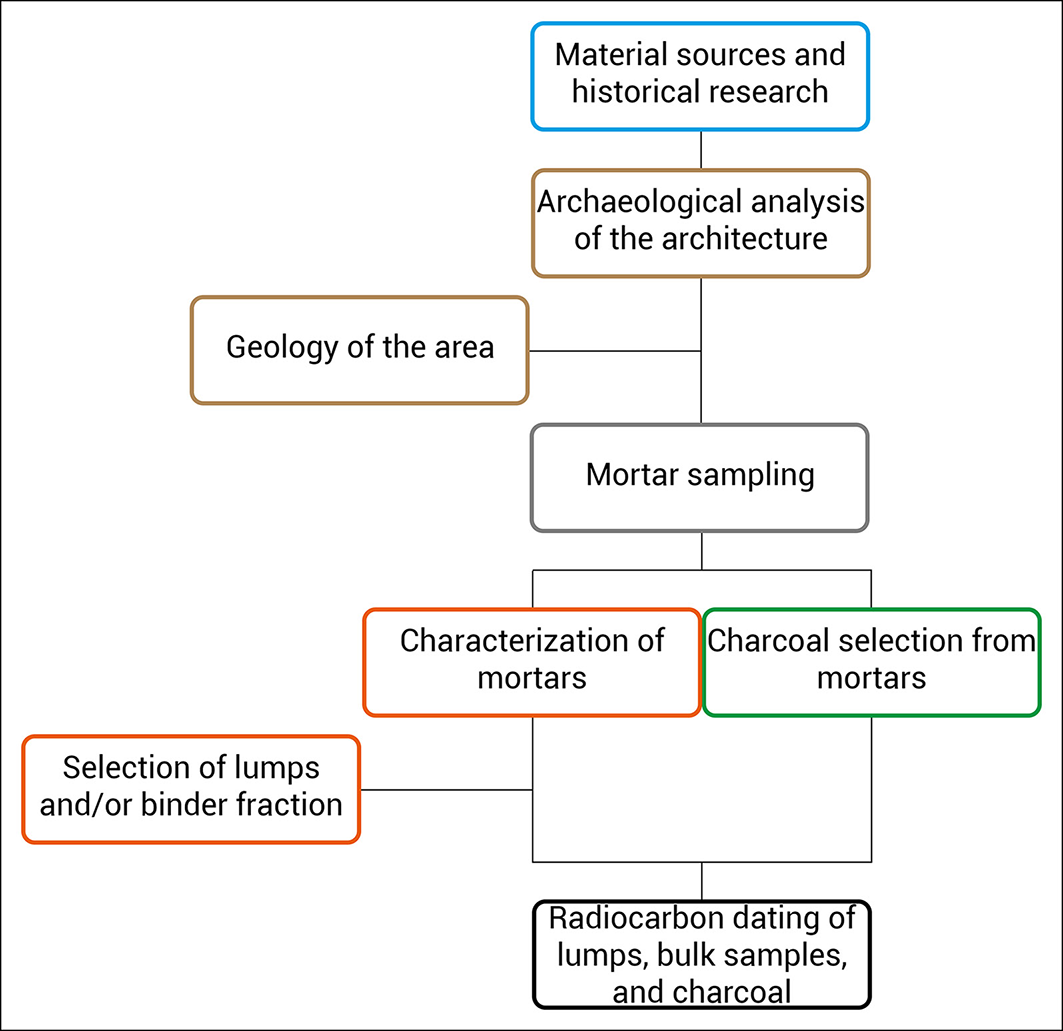
Subsequently, we undertook detailed architectural stratigraphic analyses on each selected structure to identify its distinct building phases. Sampling then followed, with mortars subject to comprehensive analyses, including phenolphthalein and penetrometer tests in the field, followed by laboratory-based characterisation through mineralogical, petrographic and microchemical analyses. During this phase, we also carried out a process of selection and further characterisation of the collected mortar lumps, as well as of mortar bulk (isolating the binder from the aggregates), and prepared mortar samples for radiocarbon dating using the Cryo2sonic protocol, which the team had previous experience with, though on a smaller scale (Ricci et al. Reference Ricci2019).
Alongside these analyses, we also identified and extracted charcoal fragments from the mortar (representing the remnants of the fuel used to fire the lime) and processed them for radiocarbon dating (Figure 4).
Integrated method workflow (figure by authors).

Over the course of three years, we analysed 24 castles, collecting a total of 213 mortar samples. From these, we extracted 162 charcoal fragments for radiocarbon dating and characterised 93 mortars, selecting 63 powder samples for inorganic dating. In total, 225 samples underwent dating, yielding 90 successful results.
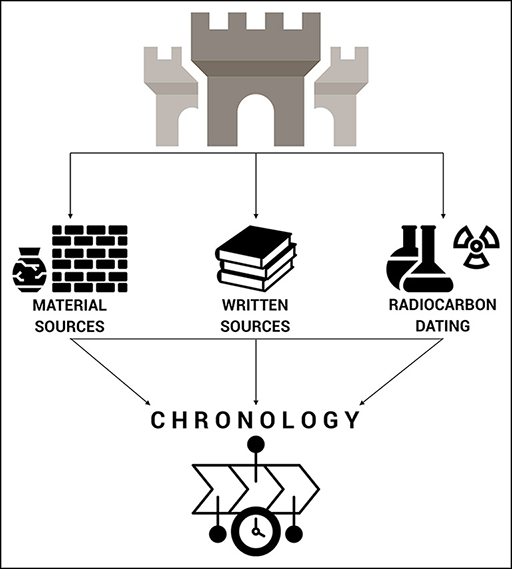
To account for the shape of the twelfth-century section of the radiocarbon calibration curve and to refine the precision of our dating intervals, we used Bayesian modelling, integrating data derived from each site’s documentary and archaeological sources, as well as from our geological and material analyses (Figure 5).
Multidisciplinary calibration outline (figure by authors).

Results
The project successfully identified new key chronological trends, revealing a novel picture of the development of castles and of the phenomenon of incastellamento as a whole, both before and during the twelfth century.
In the three regions examined, we identified a strong phase of castle building between the tenth and the first half of the eleventh century. Castles from this phase were generally sizable and associated with specific economic activities, reflecting the interests of elites operating in the orbit of central royal authority. This finding diverges from the prevailing view that castles from this period were of limited economic and material significance.
Between the eleventh and twelfth centuries, a time marked by a crisis of central authority and by the consolidation of seigneurial powers, castles underwent processes of transformation. In most cases, these involved the reuse of pre-existing structures or the construction of new elite residences, buildings with strong symbolic significance. This offers tangible evidence of the broader seigneurial reorganisation. However, this phase left material traces that are less visible and less imposing than expected and which do not seem to feature the construction of fortified villages within the castle walls, contrary to earlier historiographical claims (Carocci Reference Carocci2021). It is only at the very end of the twelfth century that castles become veritable fortified settlements. The project has therefore highlighted a new and important chronological shift that leads us to reconsider the very nature of seigneurial change in Italy around 1100.
Indeed, the project results show that the construction of new castle walls, of houses and of structures serving the castle community all date to late periods. These findings represent a novelty within current historiography and prompt a reconsideration of established hypotheses regarding not only the fabric of power in the Italian countryside, but also settlement dynamics, castle building chronologies and, more broadly, the history of rural landscapes.
Conclusions
The project’s originality rests on four key aspects: its multidisciplinary approach; its scale, both in terms of its extensive territorial scope (among the largest in the Mediterranean) and the large number of mortar samples analysed; the integration of analyses with key historical questions; and the creation of a new protocol for analysis. The discovery of large stone castle structures dating back to before the year 1000 and the absence of fortified villages before the late twelfth century are important findings that pave the way for broader historical investigations, which will require further modelling and comparison across larger territorial contexts.
Funding statement
The project was funded by the Italian Ministry for Universities and Research, Project PRIN 2020, Prot. 20203YX58R.
Author contributions: CRediT categories
Giovanna Bianchi: Conceptualization-Lead, Funding acquisition-Lead, Investigation-Equal, Project administration-Lead, Supervision-Lead, Writing – original draft-Lead, Writing – review & editing-Lead. Andrea Arrighetti: Investigation-Equal, Methodology-Equal, Data curation-Equal, Writing – review & editing-Equal. Mauro Paolo Buonincontri: Investigation-Equal, Methodology-Equal, Formal analysis-Equal, Writing – review & editing-Equal. Maria Ausiliatrice Ginatempo: Investigation-Supporting, Resources-Supporting, Writing – review & editing-Supporting. Giulia Bellato: Investigation-Equal, Formal analysis-Supporting, Writing – review & editing-Equal. Alessio Fiore: Conceptualization-Equal, Investigation-Equal, Project administration-Lead, Supervision-Equal, Writing – review & editing-Lead. Luigi Provero: Conceptualization-Supporting, Investigation-Equal, Supervision-Supporting, Writing – review & editing-Equal. Carlo Alberto Garzonio: Conceptualization-Equal, Methodology-Lead, Project administration-Lead, Supervision-Equal, Writing – review & editing-Supporting. Sara Calandra: Investigation-Equal, Methodology-Equal, Formal analysis-Equal, Writing – review & editing-Equal. Elena Pecchioni: Investigation-Equal, Methodology-Equal, Formal analysis-Equal, Writing – review & editing-Equal. Noemi Mantile: Investigation-Equal, Formal analysis-Equal, Methodology-Supporting, Writing – review & editing-Equal. Maria Rosa Di Cicco: Investigation-Equal, Formal analysis-Equal, Writing – review & editing-Equal. Carmine Lubritto: Conceptualization-Equal, Methodology-Lead, Project administration-Lead, Supervision-Equal, Writing – review & editing-Equal.



 Open access

