





1. Introduction
In a Crump–Mode–Jagers (CMJ) branching process (named after [Reference Crump and Mode4, Reference Crump and Mode5, Reference Jagers12]), an ancestral root individual produces offspring according to a collection of points on the non-negative real line. Each individual ‘born’ produces offspring according to an identically distributed collection of points, translated by its birth time. One is generally interested in properties of the population as a function of time. Classical work from the 1970s and 1980s related to this model generally deals with the Malthusian case, which, informally, refers to the fact that the population grows exponentially in time; see, e.g., [Reference Athreya and Ney3, Reference Jagers13] and the references therein for an overview of classical CMJ theory.
Far fewer results exist for CMJ branching processes when a Malthusian parameter does not exist. One family of CMJ branching processes for which this is the case is the family of explosive CMJ branching processes. Here, the total progeny of the branching process grows infinitely large in finite time with positive probability. Early work on such CMJ branching processes by Sevast’yanov [Reference Sevast’yanov19, Reference Sevast’yanov20], Grey [Reference Grey6], Grishechkin [Reference Grishechkin7], and Vatutin [Reference Vatutin21] concerns necessary and sufficient conditions for (non-)explosion of Bellman–Harris processes (a special type of CMJ branching process). More recent work on this topic distinguishes between processes where individuals produce finitely many offspring in finite time almost surely and processes where individuals can produce infinite offspring themselves in finite time. In the former case, Komjáthy [Reference Komjáthy14] provides general criteria for the explosion of CMJ branching processes in terms of solutions of a functional fixed point equation, and also extends the necessary and sufficient criteria for explosion in branching random walks in [Reference Amini, Devroye, Griffiths and Olver1]. In the latter case, Oliveira and Spencer [Reference Oliveira and Spencer16], and, more recently, Iyer [Reference Iyer10] study a particular family of explosive CMJ branching processes with exponential inter-birth times, and Sagitov and Lindo [Reference Sagitov17, Reference Sagitov and Lindo18] consider Bellman–Harris processes where individuals, on death, may produce infinite offspring.
In a recent work, Iyer and the author [Reference Iyer and Lodewijks11] investigate a family of explosive CMJ branching processes in a random environment. Here, each individual born in the branching process is assigned an independent identically distributed (i.i.d.) random weight, and the distribution of the point process that governs the offspring of the individual depends on its weight. Sufficient conditions for the emergence of infinite stars (individuals that produce infinite offspring) and infinite paths (an infinite lineage of descendants) in the branching process, stopped at the (finite) time of explosion, are formulated in a general set-up. Other sufficient criteria for explosion for CMJ processes in a random environment are also studied in [Reference Iyer9].
1.1. Overview of our contribution
In this paper, we study the emergence of infinite stars in explosive CMJ processes in a random environment. In particular, we weaken certain assumptions provided in previous work of Iyer and the author [Reference Iyer and Lodewijks11], under which we prove that an infinite star appears almost surely.
We use these results in an application to super-linear preferential attachment trees with fitness. This model consists of a sequence of discrete-time trees in which vertices are assigned vertex-weights and arrive one by one. A new vertex connects to a random vertex in the tree, selected with a preference for vertices with high degree or vertex-weight, or both. We largely extend the class of models for which such results can be proved. This significantly improves on the results in [Reference Iyer and Lodewijks11], and also adds to the recent work of Iyer [Reference Iyer10] on persistence in (super-linear) preferential attachment trees (without fitness).
1.2. Model definition
We consider individuals in the process as being labelled by elements of the infinite Ulam–Harris tree $\mathcal{U}_\infty \;:\!=\; \bigcup_{n \geq 0} \mathbb{N}^{n}$
; where
$\mathcal{U}_\infty \;:\!=\; \bigcup_{n \geq 0} \mathbb{N}^{n}$
; where $\mathbb{N}^{0} \;:\!=\; \{\varnothing\}$
contains a single element, which we call the root. We denote elements
$\mathbb{N}^{0} \;:\!=\; \{\varnothing\}$
contains a single element, which we call the root. We denote elements $u \in \mathcal{U}_{\infty}$
as tuples, so that if
$u \in \mathcal{U}_{\infty}$
as tuples, so that if $u = (u_{1}, \ldots, u_{k}) \in \mathbb{N}^{k}, k \geq 1$
, we write
$u = (u_{1}, \ldots, u_{k}) \in \mathbb{N}^{k}, k \geq 1$
, we write $u = u_{1} \cdots u_{k}$
. An individual
$u = u_{1} \cdots u_{k}$
. An individual $u = u_1u_2\cdots u_k$
is to be interpreted recursively as the
$u = u_1u_2\cdots u_k$
is to be interpreted recursively as the $u_k$
th child of the individual
$u_k$
th child of the individual $u_1 \cdots u_{k-1}$
; for example,
$u_1 \cdots u_{k-1}$
; for example, $1, 2, \ldots$
represent the offspring of
$1, 2, \ldots$
represent the offspring of $\varnothing$
. Further, for individuals
$\varnothing$
. Further, for individuals $u=(u_1,\ldots, u_k)$
and
$u=(u_1,\ldots, u_k)$
and $v=(v_1,\ldots, v_\ell)$
, we let
$v=(v_1,\ldots, v_\ell)$
, we let $uv=(u_1,\ldots, u_k,v_1,\ldots, v_\ell)$
denote their concatenation. Suppose that
$uv=(u_1,\ldots, u_k,v_1,\ldots, v_\ell)$
denote their concatenation. Suppose that $(\Omega, \Sigma, \mathrm{P})$
is a complete probability space and
$(\Omega, \Sigma, \mathrm{P})$
is a complete probability space and $(S, \mathcal{S})$
is a measure space. We also equip
$(S, \mathcal{S})$
is a measure space. We also equip $\mathcal{U}_{\infty}$
with the sigma algebra generated by singleton sets. Then we fix random mappings
$\mathcal{U}_{\infty}$
with the sigma algebra generated by singleton sets. Then we fix random mappings $X\;:\; \Omega \times \mathcal{U}_{\infty} \rightarrow [0, \infty]$
,
$X\;:\; \Omega \times \mathcal{U}_{\infty} \rightarrow [0, \infty]$
, $W\;:\; \Omega \times \mathcal{U}_{\infty} \rightarrow S$
, and define
$W\;:\; \Omega \times \mathcal{U}_{\infty} \rightarrow S$
, and define $(X, W)\;:\; \Omega \times \mathcal{U}_{\infty} \rightarrow [0, \infty] \times S$
, so that
$(X, W)\;:\; \Omega \times \mathcal{U}_{\infty} \rightarrow [0, \infty] \times S$
, so that $(\omega,u) \mapsto ((X(u))(\omega), W_{u}(\omega))$
. In general, for
$(\omega,u) \mapsto ((X(u))(\omega), W_{u}(\omega))$
. In general, for $u \in \mathcal{U}_{\infty}$
and
$u \in \mathcal{U}_{\infty}$
and $j\in \mathbb{N}$
, we interpret
$j\in \mathbb{N}$
, we interpret $W_{u}$
as a ‘weight’ associated with u, and X(uj) the waiting time or inter-birth times between the birth of the
$W_{u}$
as a ‘weight’ associated with u, and X(uj) the waiting time or inter-birth times between the birth of the $(j-1)$
th and jth child of u.
$(j-1)$
th and jth child of u.
We use the values of X to associate birth times $\mathcal{B}(u)$
to individuals
$\mathcal{B}(u)$
to individuals $u \in \mathcal{U}_{\infty}$
. In particular, we define
$u \in \mathcal{U}_{\infty}$
. In particular, we define $\mathcal{B}\;:\; \Omega \times \mathcal{U}_{\infty} \rightarrow [0, \infty]$
recursively, as
$\mathcal{B}\;:\; \Omega \times \mathcal{U}_{\infty} \rightarrow [0, \infty]$
recursively, as

We note that a value of $X(ui) = \infty$
indicates that the individual u has stopped producing offspring, and produces at most
$X(ui) = \infty$
indicates that the individual u has stopped producing offspring, and produces at most $i-1$
children.
$i-1$
children.
We introduce some notation related to elements $u \in \mathcal{U}_{\infty}$
. We use
$u \in \mathcal{U}_{\infty}$
. We use $|\cdot|$
to measure the length of a tuple u, so that
$|\cdot|$
to measure the length of a tuple u, so that $|u|=0$
when
$|u|=0$
when $u=\varnothing$
and
$u=\varnothing$
and $|u|=k$
when
$|u|=k$
when $u = u_{1} \cdots u_{k}$
. If, for some
$u = u_{1} \cdots u_{k}$
. If, for some $x \in \mathcal{U}_{\infty}$
, we have
$x \in \mathcal{U}_{\infty}$
, we have $x = u v$
, we say u is an ancestor of x. Further, given
$x = u v$
, we say u is an ancestor of x. Further, given $\ell \leq |u|$
, we write
$\ell \leq |u|$
, we write $u_{|_\ell} \;:\!=\; u_{1} \cdots u_{\ell}$
for the different ancestors of u. We equip
$u_{|_\ell} \;:\!=\; u_{1} \cdots u_{\ell}$
for the different ancestors of u. We equip $\mathcal{U}_{\infty}$
with the lexicographic total order
$\mathcal{U}_{\infty}$
with the lexicographic total order $\leq_{L}$
. Given elements u, v, we say
$\leq_{L}$
. Given elements u, v, we say $u \leq_{L} v$
if either u is an ancestor of v, or
$u \leq_{L} v$
if either u is an ancestor of v, or $u_{\ell} < v_{\ell}$
where
$u_{\ell} < v_{\ell}$
where $\ell = \min \left\{i \in \mathbb{N}\;:\; u_{i} \neq v_{i} \right\}$
. For
$\ell = \min \left\{i \in \mathbb{N}\;:\; u_{i} \neq v_{i} \right\}$
. For $u \in \mathcal{U}_{\infty}$
, we let
$u \in \mathcal{U}_{\infty}$
, we let $\mathcal{P}_{i}(u)$
denote the time, after the birth of u, required for u to produce i offspring. That is,
$\mathcal{P}_{i}(u)$
denote the time, after the birth of u, required for u to produce i offspring. That is,
 \begin{equation}\mathcal{P}_{i}(u) \;:\!=\; \sum_{j=1}^{i} X(uj) \quad \text{and} \quad \mathcal{P}(u) \;:\!=\; \mathcal{P}_{\infty}(u) = \sum_{j=1}^{\infty} X(uj).\end{equation}
We use the notation $\mathcal{P}_{i}$
and
$\mathcal{P}_{i}$
and $\mathcal{P}$
to denote i.i.d. copies of
$\mathcal{P}$
to denote i.i.d. copies of $\mathcal{P}_{i}(u)$
and
$\mathcal{P}_{i}(u)$
and $\mathcal{P}(u)$
, respectively.
$\mathcal{P}(u)$
, respectively.
For $t\geq 0$
, we set
$t\geq 0$
, we set $\mathscr{T}_{t} \;:\!=\; \{x \in \mathcal{U}_\infty\;:\; \mathcal{B}(x) \leq t\}$
and identify
$\mathscr{T}_{t} \;:\!=\; \{x \in \mathcal{U}_\infty\;:\; \mathcal{B}(x) \leq t\}$
and identify $\mathscr{T}_{t}$
as the genealogical tree of individuals with birth time at most t. For a given choice of X, W, we say
$\mathscr{T}_{t}$
as the genealogical tree of individuals with birth time at most t. For a given choice of X, W, we say $(\mathscr{T}_{t})_{t \geq 0}$
is the genealogical tree process associated with an (X, W)-CMJ branching process; often, we refer to
$(\mathscr{T}_{t})_{t \geq 0}$
is the genealogical tree process associated with an (X, W)-CMJ branching process; often, we refer to $(\mathscr{T}_{t})_{t \geq 0}$
directly as an (X, W)-CMJ branching process, viewed as a stochastic process in t.
$(\mathscr{T}_{t})_{t \geq 0}$
directly as an (X, W)-CMJ branching process, viewed as a stochastic process in t.
With regards to the process $(\mathscr{T}_{t})_{t \geq 0}$
, we define the stopping times
$(\mathscr{T}_{t})_{t \geq 0}$
, we define the stopping times $(\tau_{k})_{k \in \mathbb{N}_{0}}$
such that
$(\tau_{k})_{k \in \mathbb{N}_{0}}$
such that
 \begin{equation*}\tau_{k} \;:\!=\; \inf\{t \geq 0\;:\; |\mathscr{T}_{t}| \geq k\},\end{equation*}
where we adopt the convention that the infimum of the empty set is $\infty$
. One readily verifies that
$\infty$
. One readily verifies that $(|\mathscr{T}_{t}|)_{t \geq 0}$
is right-continuous, and thus
$(|\mathscr{T}_{t}|)_{t \geq 0}$
is right-continuous, and thus $|\mathscr{T}_{\tau_{k}}| \geq k$
(when
$|\mathscr{T}_{\tau_{k}}| \geq k$
(when $\tau_k<\infty$
). For each
$\tau_k<\infty$
). For each $k \in \mathbb{N}$
, we define the tree
$k \in \mathbb{N}$
, we define the tree $\mathcal{T}_{k}$
as the tree consisting of the first k individuals in
$\mathcal{T}_{k}$
as the tree consisting of the first k individuals in $\mathscr{T}_{\tau_{k}}$
ordered by birth time, breaking ties lexicographically. We call
$\mathscr{T}_{\tau_{k}}$
ordered by birth time, breaking ties lexicographically. We call
 \begin{equation*}\tau_{\infty} \;:\!=\; \lim_{k \to \infty} \tau_{k}\end{equation*}
the explosion time of the process, at which the branching process has grown infinitely large (given the process survives). We also define the tree $\mathcal{T}_{\infty} \;:\!=\; \bigcup_{k=1}^{\infty} \mathcal{T}_{k}$
.
$\mathcal{T}_{\infty} \;:\!=\; \bigcup_{k=1}^{\infty} \mathcal{T}_{k}$
.
Remark 1. With the more commonly used notation for CMJ branching processes, we assign a point process (denoted $\xi^{(u)}$
) to each
$\xi^{(u)}$
) to each $u \in \mathcal{U}_{\infty}$
, and refer to the points
$u \in \mathcal{U}_{\infty}$
, and refer to the points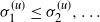 $\sigma^{(u)}_{1} \leq \sigma^{(u)}_{2}, \ldots$
associated with this point process (in the notation used here,
$\sigma^{(u)}_{1} \leq \sigma^{(u)}_{2}, \ldots$
associated with this point process (in the notation used here, $\mathcal{B}(u1), \mathcal{B}(u2), \ldots$
). We do not use this framework here, because this requires us to be able to write the measure
$\mathcal{B}(u1), \mathcal{B}(u2), \ldots$
). We do not use this framework here, because this requires us to be able to write the measure $\xi^{(u)} = \sum_{i=1}^{\infty} \delta_{\sigma_{i}}$
, which requires us to impose
$\xi^{(u)} = \sum_{i=1}^{\infty} \delta_{\sigma_{i}}$
, which requires us to impose $\sigma$
-finiteness assumptions on the point process (see, for example, [Reference Last and Penrose15, Corollary 6.5]). This
$\sigma$
-finiteness assumptions on the point process (see, for example, [Reference Last and Penrose15, Corollary 6.5]). This $\sigma$
-finiteness is implied by the classical Malthusian condition but, in this general setting, we believe that it is easier to have a framework where we can directly refer to the points
$\sigma$
-finiteness is implied by the classical Malthusian condition but, in this general setting, we believe that it is easier to have a framework where we can directly refer to the points $\mathcal{B}(u1), \mathcal{B}(u2), \ldots$
1.3. Notation
Throughout the paper we use the following notation. We let $\mathbb{N}\;:\!=\;\{1,2,\ldots\}$
and set
$\mathbb{N}\;:\!=\;\{1,2,\ldots\}$
and set $\mathbb{N}_0\;:\!=\;\{0,1,\ldots\}$
and
$\mathbb{N}_0\;:\!=\;\{0,1,\ldots\}$
and $\mathbb R_+\;:\!=\;[0,\infty)$
. For
$\mathbb R_+\;:\!=\;[0,\infty)$
. For $n\in\mathbb{N}$
, we set
$n\in\mathbb{N}$
, we set $[n]\;:\!=\;\{1,\ldots, n\}$
. For
$[n]\;:\!=\;\{1,\ldots, n\}$
. For $x\in\mathbb R$
, we let
$x\in\mathbb R$
, we let $\lceil x\rceil\;:\!=\;\inf\{n\in\mathbb Z\;:\; n\geq x\}$
and
$\lceil x\rceil\;:\!=\;\inf\{n\in\mathbb Z\;:\; n\geq x\}$
and $\lfloor x\rfloor\;:\!=\;\sup\{n\in\mathbb Z\;:\; n\leq x\}$
. For sequences
$\lfloor x\rfloor\;:\!=\;\sup\{n\in\mathbb Z\;:\; n\leq x\}$
. For sequences $(a_n)_{n\in\mathbb{N}}$
and
$(a_n)_{n\in\mathbb{N}}$
and $(b_n)_{n\in\mathbb{N}}$
, such that
$(b_n)_{n\in\mathbb{N}}$
, such that $b_n$
is positive for all n, we say that
$b_n$
is positive for all n, we say that $a_n=o(b_n)$
,
$a_n=o(b_n)$
, $a_n=\mathcal{O}(b_n)$
, and
$a_n=\mathcal{O}(b_n)$
, and $a_n=\Theta(b_n)$
if
$a_n=\Theta(b_n)$
if $\lim_{n\to\infty} a_n/b_n=0$
, if there exists a constant
$\lim_{n\to\infty} a_n/b_n=0$
, if there exists a constant $C>0$
such that
$C>0$
such that $|a_n|\leq Cb_n$
for all
$|a_n|\leq Cb_n$
for all $n\in\mathbb{N}$
, and if
$n\in\mathbb{N}$
, and if $a_n=\mathcal{O}(b_n)$
and
$a_n=\mathcal{O}(b_n)$
and $b_n=\mathcal{O}(a_n)$
, respectively. For random variables
$b_n=\mathcal{O}(a_n)$
, respectively. For random variables $X,(X_n)_{n\in\mathbb{N}}$
, we let
$X,(X_n)_{n\in\mathbb{N}}$
, we let $X_n\overset{\mathrm d}{\longrightarrow} X, X_n\overset{\mathrm{P}}{\longrightarrow} X$
, and
$X_n\overset{\mathrm d}{\longrightarrow} X, X_n\overset{\mathrm{P}}{\longrightarrow} X$
, and $X_n\overset{\mathrm{a.s.}}{\longrightarrow} X$
denote convergence in distribution, probability, and almost sure convergence of
$X_n\overset{\mathrm{a.s.}}{\longrightarrow} X$
denote convergence in distribution, probability, and almost sure convergence of $X_n$
to X, respectively. For a non-negative real-valued random variable X and
$X_n$
to X, respectively. For a non-negative real-valued random variable X and $\lambda > 0$
, we let
$\lambda > 0$
, we let
 \[\mathcal{M}_{\lambda}(X) \;:\!=\; \mathrm{E}[\!\exp(\lambda X)] \quad \text{and} \quad \mathcal{L}_{\lambda}(X) \;:\!=\; \mathrm{E}[\!\exp(\!-\lambda X)].\]
Finally, for real-valued random variables X, Y, we say that $X \preceq Y$
if Y stochastically dominates X.
$X \preceq Y$
if Y stochastically dominates X.
2. Results
Throughout this paper, we make the following general assumptions, which are common when studying (explosive) (X, W)-CMJ processes. We assume that the pairs $((X(uj))_{j \in \mathbb{N}}, W_{u})$
with
$((X(uj))_{j \in \mathbb{N}}, W_{u})$
with $u\in\mathcal{U}_\infty$
are i.i.d. For a given
$u\in\mathcal{U}_\infty$
are i.i.d. For a given $w \in S$
, we let
$w \in S$
, we let $(X_{w}(uj))_{j \in \mathbb{N}}$
denote a sequence
$(X_{w}(uj))_{j \in \mathbb{N}}$
denote a sequence $(X(uj))_{j \in \mathbb{N}}$
, conditionally on the weight
$(X(uj))_{j \in \mathbb{N}}$
, conditionally on the weight $W_{u} = w$
. We also assume throughout that, for any
$W_{u} = w$
. We also assume throughout that, for any $w \in S$
and any
$w \in S$
and any $u\in\mathcal{U}_\infty$
, the random variables
$u\in\mathcal{U}_\infty$
, the random variables $(X_w(ui))_{i\in\mathbb{N}}$
are mutually independent.
$(X_w(ui))_{i\in\mathbb{N}}$
are mutually independent.
2.1. Sufficient criteria for infinite star in CMJ branching processes in random environment
Our main interest and aim is to understand how an explosive CMJ branching process explodes. We determine sufficient conditions under which the branching process explodes due to an individual giving birth to an infinite number of children in finite time (an infinite star). The assumptions are as follows.
Assumption 1. $\;$
$\;$
-
(i) There exist positive random variables $(Y_{n})_{n \in \mathbb{N}_{0}}$
with finite mean such that, for any
$w \in S$
and all
$n\in\mathbb{N}_0$
, (2.1)
\begin{equation}\sum_{i=n+1}^{\infty} X_{w}(i) \preceq Y_{n}.\end{equation}
$(Y_{n})_{n \in \mathbb{N}_{0}}$
with finite mean such that, for any
$w \in S$
and all
$n\in\mathbb{N}_0$
, (2.1)
\begin{equation}\sum_{i=n+1}^{\infty} X_{w}(i) \preceq Y_{n}.\end{equation}
-
(ii) There exists an increasing sequence
$(\lambda_n)_{n\in\mathbb{N}}\subset(0,\infty)$
such that
$\lim_{n\to\infty}\lambda_n=\infty$
and
\begin{equation*}\sum_{n=1}^\infty \mathcal{M}_{\lambda_n}(Y_n) \mathcal{L}_{\lambda_n}(\mathcal{P}_n(\varnothing))<\infty.\end{equation*}
-
(iii) We have
$ \mathrm{E}[\sup\{k\;:\; X(1)=\cdots=X(k) = 0\}] < 1$
. In addition, for each
$n \in \mathbb{N}$
, almost surely,
\begin{equation*}\sum_{i=n+1}^{\infty} X(i) > 0.\end{equation*}


Remark 2. Note that under Condition (i) of Assumption 1, we have $\mathrm{P}\left( \tau_\infty<\infty\right) =1$
, since, for example, the root
$\mathrm{P}\left( \tau_\infty<\infty\right) =1$
, since, for example, the root $\varnothing$
produces an infinite number of children in finite time, almost surely.
$\varnothing$
produces an infinite number of children in finite time, almost surely.
Remark 3. In Assumption 1, we can consider Condition (i) as a uniform explosivity condition: regardless of its weight, the distribution of the time until an individual produces infinite offspring, after having already produced n children, is dominated by $Y_n$
. This assumption is essential to work around dependencies that arise because of the random environment (i.e. the weights of individuals).
$Y_n$
. This assumption is essential to work around dependencies that arise because of the random environment (i.e. the weights of individuals).
Condition (ii) is used in the proof of Proposition 1, and provides an upper bound for the expected number of children that produce infinite offspring before their parent does.
Condition (iii) is a technical assumption, necessary to rule out certain trivial cases. Indeed, if, for example, $\mathrm{E}\left[\sup\{k\;:\;X(k)=0\}\right] > 1$
, the tree consisting of all the individuals born instantaneously at time 0 is a supercritical Bienaymé–Galton–Watson branching process. Hence, with positive probability, this tree is infinitely large, whilst it may not contain an individual with infinite offspring.
$\mathrm{E}\left[\sup\{k\;:\;X(k)=0\}\right] > 1$
, the tree consisting of all the individuals born instantaneously at time 0 is a supercritical Bienaymé–Galton–Watson branching process. Hence, with positive probability, this tree is infinitely large, whilst it may not contain an individual with infinite offspring.
Remark 4. Condition (ii) weakens and combines two conditions in Assumption $2.2$
in [Reference Iyer and Lodewijks11]. There, it was assumed, with
$2.2$
in [Reference Iyer and Lodewijks11]. There, it was assumed, with $\lambda_n\;:\!=\;c\mathrm{E}\left[Y_n\right]^{-1}$
and
$\lambda_n\;:\!=\;c\mathrm{E}\left[Y_n\right]^{-1}$
and $c<1$
, that
$c<1$
, that $\lambda_n$
increases and diverges, and that
$\lambda_n$
increases and diverges, and that
 \begin{equation*}\limsup_{n\to\infty}\mathcal{M}_{\lambda_n}(Y_n)<\infty \quad\text{and}\quad \sum_{n=1}^\infty \mathcal{L}_{\lambda_n}\left (\mathcal{P}_n(\varnothing) \right )<\infty.\end{equation*}
It is clear that these assumptions imply Condition (ii).
We then have our main result.
Theorem 1 (Infinite star). Under Assumption 1, the infinite tree $\mathcal{T}_{\infty}$
almost surely contains a node of infinite degree (an infinite star).
$\mathcal{T}_{\infty}$
almost surely contains a node of infinite degree (an infinite star).
2.2. Application
We apply the result of Theorem 1 when the inter-birth times are exponentially distributed. In particular, this allows us to relate the results for (X, W)-CMJ branching processes to a family of recursively grown discrete trees, known as super-linear preferential attachment trees with fitness, introduced in [Reference Iyer and Lodewijks11]. This is a sequence of trees where vertices are introduced one by one and are assigned vertex-weights (fitness values). When a new vertex is introduced, it connects to one of the vertices already in the tree, where vertices with high degree or high fitness are more likely to make connections with new vertices.
We generally consider trees as being rooted, with edges directed away from the root; hence, the number of ‘children’ of a node corresponds to its out-degree. More precisely, given a vertex labelled v in a directed tree T, we let $\mathrm{deg}^+{v, T}$
denote its out-degree in T. We now define the preferential attachment with fitness model.
$\mathrm{deg}^+{v, T}$
denote its out-degree in T. We now define the preferential attachment with fitness model.
Definition 1. Suppose that $(W_{i})_{i \in \mathbb{N}}$
are i.i.d. copies of a random variable W that takes values in S, and let
$(W_{i})_{i \in \mathbb{N}}$
are i.i.d. copies of a random variable W that takes values in S, and let $f\colon\mathbb{N}_{0}\times S \rightarrow (0, \infty)$
denote the fitness function. A preferential attachment tree with fitness is the sequence of random trees
$f\colon\mathbb{N}_{0}\times S \rightarrow (0, \infty)$
denote the fitness function. A preferential attachment tree with fitness is the sequence of random trees $(T_{i})_{i \in \mathbb{N}}$
such that
$(T_{i})_{i \in \mathbb{N}}$
such that $T_{1}$
consists of a single node 1 with weight
$T_{1}$
consists of a single node 1 with weight $W_{1}$
; for
$W_{1}$
; for $n \geq 2$
,
$n \geq 2$
, $T_{n}$
is constructed, conditionally on
$T_{n}$
is constructed, conditionally on $T_{n-1}$
, as follows.
$T_{n-1}$
, as follows.
-
(i) Sample a vertex
$j \in T_{n-1}$
with probability
\begin{equation*}\frac{f(\mathrm{deg}^+{j, T_{n-1}}, W_j)}{\sum_{i=1}^{n-1} f(\mathrm{deg}^+{i,T_{n-1}}, W_i)}.\end{equation*}
-
(ii) Connect j with an edge directed outwards to a new vertex n with weight
$W_{n}$
.


The correspondence between preferential attachment trees with fitness and the (X, W)-CMJ process with exponential inter-birth times is as follows. For each $u\in\mathcal{U}_\infty$
, set
$u\in\mathcal{U}_\infty$
, set $X(ui)\sim \mathrm{Exp}\left( f(i-1,W_u) \right)$
for
$X(ui)\sim \mathrm{Exp}\left( f(i-1,W_u) \right)$
for $i\in\mathbb{N}$
. The trees
$i\in\mathbb{N}$
. The trees $(\mathcal{T}_{i})_{i \in \mathbb{N}}$
associated with the (X, W)-CMJ process then satisfy
$(\mathcal{T}_{i})_{i \in \mathbb{N}}$
associated with the (X, W)-CMJ process then satisfy
 \begin{equation*}\{T_i\;:\;i\in\mathbb{N}\}\overset d=\{\mathcal{T}_i\;:\; i\in\mathbb{N}\}.\end{equation*}
In addition, with $T_\infty\;:\!=\;\cup_{n=1}^\infty T_n$
, we also have
$T_\infty\;:\!=\;\cup_{n=1}^\infty T_n$
, we also have $T_\infty \overset d=\mathcal{T}_\infty$
. As a result, the structural properties of
$T_\infty \overset d=\mathcal{T}_\infty$
. As a result, the structural properties of $\mathcal{T}_\infty$
can be translated to
$\mathcal{T}_\infty$
can be translated to $T_\infty$
. The equality in distribution is a consequence of the memory-less property and the fact that the minimum of exponential random variables is also exponentially distributed, with a rate given by the sum of the rates of the corresponding variables; see, for example, [Reference Iyer8, Section 2.1]. The use of continuous-time embeddings of combinatorial processes was pioneered by Athreya and Karlin [Reference Athreya and Karlin2].
$T_\infty$
. The equality in distribution is a consequence of the memory-less property and the fact that the minimum of exponential random variables is also exponentially distributed, with a rate given by the sum of the rates of the corresponding variables; see, for example, [Reference Iyer8, Section 2.1]. The use of continuous-time embeddings of combinatorial processes was pioneered by Athreya and Karlin [Reference Athreya and Karlin2].
We require the following assumptions on the fitness function f:
 \begin{equation}\exists w^*\in S\;:\; \forall w\in S, j\in \mathbb{N}\;:\; f(j,w)\geq f(j,w^*) \quad \text{and} \quad \sum_{j=0}^{\infty} \frac{1}{f(j, w^{*})} < \infty.\end{equation}
That is, there exists a minimizer $w^*\in S$
that, uniformly in
$w^*\in S$
that, uniformly in $j\in \mathbb{N}$
, minimizes
$j\in \mathbb{N}$
, minimizes $f(j,\cdot)$
, and the reciprocals of
$f(j,\cdot)$
, and the reciprocals of $f(j,w^*)$
are summable. Whilst the latter condition is necessary to have an (X, W)-CMJ branching process where individuals can produce an infinite number of children in finite time (i.e. where an infinite star can appear), the former assumption is to avoid certain technicalities only. We also define the quantities
$f(j,w^*)$
are summable. Whilst the latter condition is necessary to have an (X, W)-CMJ branching process where individuals can produce an infinite number of children in finite time (i.e. where an infinite star can appear), the former assumption is to avoid certain technicalities only. We also define the quantities
 \begin{equation} \mu_n^w\;:\!=\; \sum_{i=n}^\infty \frac{1}{f(i,w)}, \quad w\in \mathbb R_+,\ n\in \mathbb{N}, \quad \text{and set } \mu_n\;:\!=\;\mu_n^{w^*}.\end{equation}
Define $\mu_x$
for
$\mu_x$
for $x\in\mathbb R_+\setminus\mathbb{N}_0$
by linear interpolation. We then have the following corollary.
$x\in\mathbb R_+\setminus\mathbb{N}_0$
by linear interpolation. We then have the following corollary.
Corollary 1 (Infinite star in super-linear preferential attachment trees). Let $(T_{i})_{i \in \mathbb{N}}$
be a preferential attachment tree with fitness function f that satisfies Assumption (w*
). Let
$(T_{i})_{i \in \mathbb{N}}$
be a preferential attachment tree with fitness function f that satisfies Assumption (w*
). Let $(\lambda_n)_{n\in\mathbb{N}}\subset [0,\infty)$
be increasing and tend to infinity with n, such that there exists
$(\lambda_n)_{n\in\mathbb{N}}\subset [0,\infty)$
be increasing and tend to infinity with n, such that there exists $N\in\mathbb{N}$
with
$N\in\mathbb{N}$
with $\lambda_n< f(i,w^*)$
for all
$\lambda_n< f(i,w^*)$
for all $i\geq n\geq N$
. If
$i\geq n\geq N$
. If
 \begin{equation} \sum_{n=N}^{\infty} \bigg(\prod_{i=n}^\infty \frac{f(i,w^*)}{f(i,w^*)-\lambda_n}\bigg)\mathrm{E}\bigg[\prod_{i=0}^{n-1}\frac{f(i,W)}{f(i,W) + \lambda_n}\bigg] < \infty,\end{equation}
then the tree $T_{\infty}$
contains a unique node of infinite degree and no infinite path, almost surely.
$T_{\infty}$
contains a unique node of infinite degree and no infinite path, almost surely.
Remark 5. Though we present a corollary for the specific choice of exponentially distributed inter-birth times, similar results can be proved to hold when considering other distributions for the inter-birth times (e.g. beta, gamma, Rayleigh distributions).
The corollary follows by showing that the conditions in Assumption 1 are met. It is readily verified that Condition (iii) is satisfied, as the exponential distribution does not have an atom at zero. Setting
 \begin{equation} Y_n\;:\!=\;\sum_{i=n+1}^\infty \widetilde X_{w^*}(i),\end{equation}
where $\widetilde X_{w^*}(i)$
is an independent copy of
$\widetilde X_{w^*}(i)$
is an independent copy of $X_{w^*}(i)$
, and applying Assumption (w*
), Condition (i) follows. Finally, Condition (ii) is equivalent to (2.3) when the inter-birth times are exponentially distributed and
$X_{w^*}(i)$
, and applying Assumption (w*
), Condition (i) follows. Finally, Condition (ii) is equivalent to (2.3) when the inter-birth times are exponentially distributed and $Y_n$
is as in (2.4). The uniqueness of the node of infinite degree and absence of an infinite path follows from [Reference Iyer and Lodewijks11, Theorem
$Y_n$
is as in (2.4). The uniqueness of the node of infinite degree and absence of an infinite path follows from [Reference Iyer and Lodewijks11, Theorem $2.12$
] and is true, in general, for inter-birth time distributions that have no atoms.
$2.12$
] and is true, in general, for inter-birth time distributions that have no atoms.
We juxtapose Corollary 1 with the following result from [Reference Iyer and Lodewijks11].
Theorem 2 ([Reference Iyer and Lodewijks11, Theorem 3.4].) Recall $\mu^{w}_{n}$
from (2.2). Recall
$\mu^{w}_{n}$
from (2.2). Recall $\mu_n^w$
from (2.2). If, for some
$\mu_n^w$
from (2.2). If, for some $c>1$
and all
$c>1$
and all $w\geq 0$
, we have
$w\geq 0$
, we have
 \begin{equation*}\sum_{n=1}^\infty \mathrm{E}\bigg[\prod_{i=0}^\infty \frac{f(i,W)}{f(i,W)+c(\mu_n^w)^{-1}\log n}\bigg]=\infty,\end{equation*}
then $T_\infty$
contains a unique infinite path and no node of infinite degree, almost surely.
$T_\infty$
contains a unique infinite path and no node of infinite degree, almost surely.
In the following subsection, we provide a range of examples for which the conditions in Corollary 1 can be satisfied, for which we use $\lambda_n=\delta \mu_n^{-1} \log n$
, where
$\lambda_n=\delta \mu_n^{-1} \log n$
, where $\delta>0$
is a sufficiently small constant and
$\delta>0$
is a sufficiently small constant and $\mu_n$
is as in (2.2). For this choice of
$\mu_n$
is as in (2.2). For this choice of $\lambda_n$
, we see that Corollary 1 and Theorem 2 are close to being converse results. Indeed, we confirm this in a range of examples in the following subsection.
$\lambda_n$
, we see that Corollary 1 and Theorem 2 are close to being converse results. Indeed, we confirm this in a range of examples in the following subsection.
2.2.1. Super-linear preferential attachment with fitness.
We proceed by studying a family of preferential attachment trees (with fitness) for which we can verify the conditions provided in Corollary 1. In doing so, we extend the number of models for which it is known that $T_\infty$
contains a unique node of infinite degree from a handful of examples to larger, but more particular, class. This class consists of a family of multiplicative fitness functions. That is, vertex-weights take values in
$T_\infty$
contains a unique node of infinite degree from a handful of examples to larger, but more particular, class. This class consists of a family of multiplicative fitness functions. That is, vertex-weights take values in $S=\mathbb R_+$
, and
$S=\mathbb R_+$
, and $f(i,w)=g(w)s(i)$
for some functions
$f(i,w)=g(w)s(i)$
for some functions $g\colon \mathbb R_+\to (0,\infty)$
and
$g\colon \mathbb R_+\to (0,\infty)$
and $s\colon \mathbb{N}_0\to (0,\infty)$
. To satisfy Assumption (w*
), we assume that
$s\colon \mathbb{N}_0\to (0,\infty)$
. To satisfy Assumption (w*
), we assume that
 \begin{equation} \exists w^*\in \mathbb R_+\ \forall w\in \mathbb R_+\;:\; g(w)\geq g(w^*)>0\quad \text{and}\quad \ \sum_{i=0}^\infty \frac{1}{s(i)}<\infty.\end{equation}
Our main interest is in functions s that grow barely faster than linear, for which the summability condition in (2.5) is only just satisfied. For example, $s(n)=n\log(n+2)\log\log(n+3)^\sigma$
, with
$s(n)=n\log(n+2)\log\log(n+3)^\sigma$
, with $\sigma>1$
. Earlier work by Iyer and the author in [Reference Iyer and Lodewijks11] is only able to deal with cases for which s(n) grows fast enough, that is, faster than
$\sigma>1$
. Earlier work by Iyer and the author in [Reference Iyer and Lodewijks11] is only able to deal with cases for which s(n) grows fast enough, that is, faster than $n(\!\log n)^\alpha$
with
$n(\!\log n)^\alpha$
with $\alpha>2$
. Here, we extend this to a much wider range of functions that grow more slowly.
$\alpha>2$
. Here, we extend this to a much wider range of functions that grow more slowly.
We introduce the following assumption on the function s.
Assumption 2. Suppose s satisfies (2.5). Moreover, suppose there exist $\beta\in(0,1)$
and
$\beta\in(0,1)$
and $p\in(1,1+\beta)$
such that
$p\in(1,1+\beta)$
such that
 \begin{equation*}\lim_{n\to\infty}\frac{s(n)}{n^\beta}=\infty\quad \text{and}\quad \lim_{n\to\infty}\frac{s(n)}{n^p}=0,\end{equation*}
and there exist $C>0$
and
$C>0$
and $N\in\mathbb{N}$
such that, for all
$N\in\mathbb{N}$
such that, for all $n\geq N$
,
$n\geq N$
,
 \begin{equation*}s(n)\leq C\frac{n^{1+\beta-p}}{\log n}\inf_{i\geq n}s(i).\end{equation*}
Remark 6. Though the first limit in Assumption 2 may seem unnecessary when s satisfies (2.5), one can construct examples of s with a sufficiently sparse summable subsequence that grows slowly. For example, with $\epsilon>0$
small,
$\epsilon>0$
small,
 \begin{equation*}s(n)=\begin{cases}n^{(1+\epsilon)/2} &\text{if } \sqrt n\in\mathbb{N}, \\(n+2)(\!\log (n+2))^2 &\text{otherwise.}\end{cases}\end{equation*}
Though this choice of s satisfies (2.5), the subsequence $s(n_k)$
with
$s(n_k)$
with $n_k=k^2$
grows relatively slowly compared with the values s(n) when n is not a perfect square, so that the first limit in Assumption 2 is satisfied only for
$n_k=k^2$
grows relatively slowly compared with the values s(n) when n is not a perfect square, so that the first limit in Assumption 2 is satisfied only for $\beta<\frac{1+\epsilon}{2}$
. The inequality in Assumption 2 quantifies how much slower such sparse slowly growing subsequences are allowed to grow. Overall, Assumption 2 thus allows us to deal with some choices of s with sparse slowly growing subsequences.
$\beta<\frac{1+\epsilon}{2}$
. The inequality in Assumption 2 quantifies how much slower such sparse slowly growing subsequences are allowed to grow. Overall, Assumption 2 thus allows us to deal with some choices of s with sparse slowly growing subsequences.
We then have the following result.
Theorem 3 (Barely super-linear preferential attachment with fitness). Suppose that $f(i,w)=g(w)s(i)$
, where s satisfies Assumption 2 and g and s satisfy (2.5). Suppose there exists a sequence
$f(i,w)=g(w)s(i)$
, where s satisfies Assumption 2 and g and s satisfy (2.5). Suppose there exists a sequence $(k_n)_{n\in\mathbb{N}}$
and constants
$(k_n)_{n\in\mathbb{N}}$
and constants $\epsilon>0, \delta\in(0,\epsilon)$
, and
$\epsilon>0, \delta\in(0,\epsilon)$
, and $n_0\in\mathbb{N}$
, such that both
$n_0\in\mathbb{N}$
, such that both
 \begin{equation*}\mathrm{P}\left(g(W)>k_n\right)\leq n^{-(1+\epsilon)}, \quad\textit{for all }n\geq n_0,\end{equation*}
and
 \begin{equation} \lim_{n\to\infty} \frac{\mu_{(\delta\log(n)/(\mu_n k_n))^{1/\beta}}}{\mu_nk_n}=\infty\end{equation}
are satisfied, where $\beta$
is as in Assumption 2. Then, the limiting infinite tree
$\beta$
is as in Assumption 2. Then, the limiting infinite tree $T_\infty$
contains a unique infinite star and no infinite path, almost surely.
$T_\infty$
contains a unique infinite star and no infinite path, almost surely.


2.3. Examples
To conclude the section, we present a (non-exhaustive) list of examples of functions g and s and vertex-weight distributions, such that we can verify the conditions of Theorem 3. Without loss of generality, we can take $g(w)=w+1$
, as one can change vertex-weight distribution accordingly for other choices of g. For each example, we have the following assumptions for the function s and the tail distribution of the vertex-weights. With
$g(w)=w+1$
, as one can change vertex-weight distribution accordingly for other choices of g. For each example, we have the following assumptions for the function s and the tail distribution of the vertex-weights. With $\sigma>1$
,
$\sigma>1$
, $\kappa>0$
,
$\kappa>0$
, $\nu\in(0,1)$
,
$\nu\in(0,1)$
, $\gamma>1$
, and
$\gamma>1$
, and $\alpha\in(1/2,1]$
,
$\alpha\in(1/2,1]$
,
 \begin{equation*}\begin{aligned}({}&i) &&s(i)=(i+1) (\!\log(i+2) )^\sigma, \quad &&\mathrm{P}(W\geq x)=\Theta\big( \mathrm{e}^{-x^\kappa}\big),\\({}&ii) && s(i)=(i+1)\log(i+2)\exp\!( (\!\log\log(i+3) )^\nu ), \quad && \mathrm{P}(W\geq x)=\Theta \big(\!\exp\!\big(-\mathrm{e}^{(\!\log x)^\gamma}\big)\big),\\({}&iii) && s(i)=(i+1)\log(i+2) (\!\log\log(i+3) )^\sigma, \quad &&\mathrm{P}(W\geq x)=\Theta\big(\!\exp\!\big(-\mathrm{e}^{x^\kappa}\big)\big),\\({}&iv) && s(i)=\begin{cases}i^\alpha &\text{if } \sqrt{i}\in\mathbb{N},\\(i+1) \left (\log (i+2) \right )^\sigma &\text{otherwise,}\end{cases} \quad && \mathrm{P}(W\geq x)=\Theta \big(\mathrm{e}^{-x^\kappa}\big).\end{aligned}\end{equation*}
We then have the following result.
Theorem 4. Consider the four examples (i)–(iv). The infinite tree $T_\infty$
almost surely contains a unique infinite star and no infinite path when
$T_\infty$
almost surely contains a unique infinite star and no infinite path when
 \begin{equation*}(i)\ \ (\sigma-1)\kappa>1;\quad (ii)\ \ \nu\gamma>1;\quad (iii)\ \ (\sigma-1)\kappa>1; \quad (iv)\ \ (\sigma-1)\kappa>1.\end{equation*}
When these inequalities are reversed (i.e. when changing the $>$
to a
$>$
to a $<)$
, almost surely,
$<)$
, almost surely, $T_\infty$
contains a unique infinite path and no infinite star.
$T_\infty$
contains a unique infinite path and no infinite star.
Remark 8. For case (i), the condition for the existence of an infinite path was already known [Reference Iyer and Lodewijks11]. A sufficient condition for the existence of an infinite path was $(\sigma-1)\kappa>1+\tfrac1\kappa$
, which we sharpen to
$(\sigma-1)\kappa>1+\tfrac1\kappa$
, which we sharpen to $(\sigma-1)\kappa>1$
here to close the gap in the phase transition. For the other cases, the conditions for the existence of both an infinite star and an infinite path are novel. For the existence of an infinite path, we verify conditions from [Reference Iyer and Lodewijks11].
$(\sigma-1)\kappa>1$
here to close the gap in the phase transition. For the other cases, the conditions for the existence of both an infinite star and an infinite path are novel. For the existence of an infinite path, we verify conditions from [Reference Iyer and Lodewijks11].
2.3.1. Super-linear preferential attachment without fitness.
To conclude, we consider the case $g\equiv 1$
, so that
$g\equiv 1$
, so that $f(i,w)=s(i)$
. That is, we consider a model where the evolution of the tree does not depend on the vertex-weights. Here, recent work of Iyer [Reference Iyer10] shows that the limiting tree
$f(i,w)=s(i)$
. That is, we consider a model where the evolution of the tree does not depend on the vertex-weights. Here, recent work of Iyer [Reference Iyer10] shows that the limiting tree $T_\infty$
almost surely contains a unique infinite star when
$T_\infty$
almost surely contains a unique infinite star when
 \begin{equation} \sum_{i=0}^\infty \frac{1}{s(i)}<\infty\quad\text{and}\quad \exists \kappa >0\ \forall n\in\mathbb{N}_0\;:\; \max_{i\leq n}\frac{s(i)}{i+1}\leq \kappa \frac{s(n)}{n+1}.\end{equation}
In the following result, we allow for functions s that do not meet the second condition, thus extending the family of models for which we know that a unique infinite star arises.
Corollary 2 (Barely super-linear preferential attachment). Let s satisfy (2.5) and Assumption 2, and suppose that
 \begin{equation} \lim_{n\to\infty}\frac{\mu_{ (\!\log(n)\mu_n^{-1})^{1/\beta}}}{\mu_n}=\infty,\end{equation}
where $\beta$
is as in Assumption 2. Then the limiting infinite tree
$\beta$
is as in Assumption 2. Then the limiting infinite tree $T_\infty$
contains a unique vertex with infinite degree and no infinite path, almost surely.
$T_\infty$
contains a unique vertex with infinite degree and no infinite path, almost surely.

Though not entirely general, the conditions in Corollary 2 encompass a large class of functions s. The four cases in Theorem 4 (ignoring the condition on the vertex-weights) satisfy the conditions, for example. In fact, we believe that the condition in (2.8) is satisfied by any function s that satisfies Assumption 2. As we were unable to prove this, we included it as a condition in the Corollary (as well as in Theorem 3).
Corollary 2 provides, to some extent, more general conditions under which $T_\infty$
contains a unique infinite star, compared with (2.7). Indeed, we can construct examples such that the second condition in (2.7) is not satisfied but for which the weaker conditions in Corollary 2 are satisfied (see Case (iv) in Section 4). At the same time, the conditions in (2.7) can deal with a range of functions s that are not within the range of Corollary 2.
$T_\infty$
contains a unique infinite star, compared with (2.7). Indeed, we can construct examples such that the second condition in (2.7) is not satisfied but for which the weaker conditions in Corollary 2 are satisfied (see Case (iv) in Section 4). At the same time, the conditions in (2.7) can deal with a range of functions s that are not within the range of Corollary 2.
3. Proofs of Main Results
This section is dedicated to proving the results presented in Section 2. In Section 3.1, we focus on the main result; Theorem 1. Section 3.2 is dedicated to proving Theorem 3.
3.1. Proof of Theorem 1
We introduce the following terminology, used in the remainder of the section. Recall $\mathcal{P}_k$
and
$\mathcal{P}_k$
and $\mathcal{P}$
from (1.1). For
$\mathcal{P}$
from (1.1). For $a, b \in \mathcal{U}_{\infty}$
, we say,
$a, b \in \mathcal{U}_{\infty}$
, we say,

We also say,

Finally, for $a \in \mathcal{U}_{\infty}$
with
$a \in \mathcal{U}_{\infty}$
with $|a| \geq 1$
, we say that
$|a| \geq 1$
, we say that $a= a_{1} \cdots a_{m}$
is
$a= a_{1} \cdots a_{m}$
is $a_{1}$
-conservative if, for each
$a_{1}$
-conservative if, for each $j \in \left\{2, \ldots, m\right\}$
, we have
$j \in \left\{2, \ldots, m\right\}$
, we have $a_{j} \leq a_{1}$
. We then have the following result.
$a_{j} \leq a_{1}$
. We then have the following result.
Lemma 1. Under Assumption 1, there exist $\zeta < 1$
and
$\zeta < 1$
and $K = K(\zeta) > 0$
such that, for all
$K = K(\zeta) > 0$
such that, for all $a_1 > K(\zeta)$
and all integers
$a_1 > K(\zeta)$
and all integers $m\in \mathbb{N}$
,
$m\in \mathbb{N}$
,
 \begin{equation*}\sum_{\substack{a:|a| = m\\ a\text{ is $a_1$-conservative}}}\!\!\!\!\!\!\!\!\!\!\!\!\! \mathrm{P}\left(a \text{ has at least $a_1$ children before } \varnothing \text{ explodes}\right) \leq \zeta^{m-1} \mathcal{M}_{\lambda_{a_1}}(Y_{a_1})\mathcal{L}_{\lambda_{a_1}}(\mathcal{P}_{a_{1}}).\end{equation*}
Proof. Suppose that $a = a_1 \cdots a_m \in \mathcal{U}_\infty$
. For a to have at least
$a = a_1 \cdots a_m \in \mathcal{U}_\infty$
. For a to have at least $a_1$
children before the explosion of
$a_1$
children before the explosion of $\varnothing$
, all the ancestors of a (including a) need to be born, and then a needs to produce
$\varnothing$
, all the ancestors of a (including a) need to be born, and then a needs to produce $a_1$
children. All this needs to happen before
$a_1$
children. All this needs to happen before $\varnothing$
produces infinitely many children, starting to count from its
$\varnothing$
produces infinitely many children, starting to count from its $(a_1+1){\mathrm{st}}$
child. That is,
$(a_1+1){\mathrm{st}}$
child. That is,
 \begin{equation} \mathrm{P}\left(a \text{ has at least $a_1$ children before } \varnothing \text{ explodes}\right)= \mathrm{P} \Bigg(\!\mathcal{P}_{a_1}(a)+\!\sum_{j=2}^m\mathcal{P}_{a_j} \left (a_{|_{j-1}} \right ) \leq\!\!\!\!\sum_{k= a_{1} + 1}^{\infty}\!\!\!\! X(k)\!\Bigg).\end{equation}
Using Assumption 1(i) and a Chernoff bound, with $\lambda_{a_1}>0$
, we arrive at the upper bound:
$\lambda_{a_1}>0$
, we arrive at the upper bound:
 \begin{equation*}\mathrm{P} \Bigg(\!\mathcal{P}_{a_1}(a)+\!\sum_{j=2}^m\mathcal{P}_{a_j} \left (a_{|_{j-1}} \right ) \leq Y_{a_1}\!\Bigg)\leq \mathcal{M} \left (\lambda_{a_1} \left (Y_{a_1} \right ) \right )\mathcal{L}_{\lambda_{a_1}} \left (\mathcal{P}_{a_1} \right )\prod_{j=2}^m \mathcal{L}_{\lambda_{a_1}} \left (\mathcal{P}_{a_j} \right ),\end{equation*}
where the last line follows from the fact that the sequence $(\mathcal{P}_{j}(u))_{j\in \mathbb{N}}$
is independent and distributed like
$(\mathcal{P}_{j}(u))_{j\in \mathbb{N}}$
is independent and distributed like $(\mathcal{P}_{j}(\varnothing))_{j\in \mathbb{N}}$
for any
$(\mathcal{P}_{j}(\varnothing))_{j\in \mathbb{N}}$
for any $u\in\mathcal{U}_\infty$
. When we sum over the possible conservative sequences a that are
$u\in\mathcal{U}_\infty$
. When we sum over the possible conservative sequences a that are $a_1$
-conservative, each
$a_1$
-conservative, each $a_{j}$
takes values between 1 and
$a_{j}$
takes values between 1 and $a_1$
, for
$a_1$
, for $j=2,\ldots, m$
. Thus,
$j=2,\ldots, m$
. Thus,
 \begin{equation}\begin{aligned} \sum_{\substack{a:|a| = m\\ a\text{ $a_1$-conservative}}}\!\!\!\!\!\!\!\!\!\!\!{}\; \mathrm{P} & \,\!(a \text{ has at least $a_1$ children before } \varnothing \text{ explodes} )\\& \quad \quad \quad \leq{} \sum_{a_{2} = 1}^{a_{1}} \sum_{a_{3} = 1}^{a_{1}} \cdots \sum_{a_{m}=1}^{a_1} \mathcal{M} (\lambda_{a_1} (Y_{a_1} ) )\mathcal{L}_{\lambda_{a_1}} (\mathcal{P}_{a_1} )\prod_{j=2}^m \mathcal{L}_{\lambda_{a_1}} (\mathcal{P}_{a_j} )\\&\quad \quad \quad = {} \mathcal{M}(\lambda_{a_1}(Y_{a_1}))\mathcal{L}_{\lambda_{a_1}} (\mathcal{P}_{a_1}) \left(\sum_{n = 1}^{a_{1}} \mathcal{L}_{\lambda_{a_1}} \left (\mathcal{P}_{n} \right ) \right)^{m-1}.\end{aligned}\end{equation}
It thus remains to show that, for $a_1$
sufficiently large,
$a_1$
sufficiently large,
 \[\sum_{n=1}^{a_1}\mathcal{L}_{\lambda_{a_1}}(\mathcal{P}_n) < \zeta.\]
As $\lambda_n>0$
for all
$\lambda_n>0$
for all $n\in\mathbb{N}$
, we have
$n\in\mathbb{N}$
, we have $\mathcal{M}_{\lambda_n}(Y_n)\geq 1$
for all
$\mathcal{M}_{\lambda_n}(Y_n)\geq 1$
for all $n\in\mathbb{N}$
. Hence, by Assumption 1(ii),
$n\in\mathbb{N}$
. Hence, by Assumption 1(ii),
 \begin{equation*}\sum_{n=1}^\infty \mathcal{L}_{\lambda_n}(\mathcal{P}_n)<\infty\end{equation*}
also holds. As a result, for any $\eta>0$
there exists
$\eta>0$
there exists $N = N(\eta)\in\mathbb{N} $
such that, for all
$N = N(\eta)\in\mathbb{N} $
such that, for all $a_1 > N$
,
$a_1 > N$
,
 \begin{equation} \sum_{n=N}^{a_1} \mathcal{L}_{\lambda_{a_1}}(\mathcal{P}_n) < \sum_{n=N}^{\infty} \mathcal{L}_{\lambda_n}(\mathcal{P}_n) < \frac{\eta}{2},\end{equation}
where the inequality uses the fact that $\lambda_n$
is increasing in n. Conversely, since
$\lambda_n$
is increasing in n. Conversely, since $\lambda_n$
diverges with n, bounded convergence (bounding the integrand by 1) yields
$\lambda_n$
diverges with n, bounded convergence (bounding the integrand by 1) yields
 \begin{equation}\lim_{a_1 \to \infty} \sum_{n = 1}^{N-1}\mathcal{L}_{\lambda_{a_1}}(\mathcal{P}_n) =\sum_{n=1}^{N-1} \mathrm{P}\left(\mathcal{P}_n=0\right)=\sum_{n=1}^{N-1}\mathrm{P}(X(1)=\cdots =X(n)=0).\end{equation}
We note that, by Assumption 1(iii), there exists $\xi>0$
, such that
$\xi>0$
, such that
 \begin{equation*}\mathrm{E}[\sup\{k\;:\;X(1)=\cdots= X(k)=0\}]=\sum_{n=1}^\infty \mathrm{P}(X(1)=\cdots =X(n)=0) <1-\xi.\end{equation*}
Hence, the right-hand side of (3.4) is at most $1-\xi$
for any
$1-\xi$
for any $N\in\mathbb{N}$
. Thus, we first take
$N\in\mathbb{N}$
. Thus, we first take $\eta<\xi$
and N large enough that we have the upper bound in (3.3). Then we take
$\eta<\xi$
and N large enough that we have the upper bound in (3.3). Then we take $K\geq N$
sufficiently large, so that, for all
$K\geq N$
sufficiently large, so that, for all $a_1\geq K$
,
$a_1\geq K$
,
 \begin{equation*} \sum_{n = 1}^{N-1} \mathcal{L}_{\lambda_{a_1}}(\mathcal{P}_{\ell}) < 1-\xi/2.\end{equation*}
Combined, we thus arrive at
 \begin{equation*}\sum_{n=1}^{a_1}\mathcal{L}_{\lambda_{a_1}}(\mathcal{P}_{\ell})<1-\xi/2\;=\!:\;\zeta.\end{equation*}
Using this in (3.2), we conclude the proof.
This lemma provides an upper bound for the probability of the event that a vertex a explodes before the root of $\mathcal{U}_\infty$
, in the case that a is
$\mathcal{U}_\infty$
, in the case that a is $a_1$
-conservative. When a does not satisfy this condition, we can view a as a concatenation of a number of conservative sequences. That is, we write
$a_1$
-conservative. When a does not satisfy this condition, we can view a as a concatenation of a number of conservative sequences. That is, we write $a=\overline b_1\cdots \overline b_\ell$
, where
$a=\overline b_1\cdots \overline b_\ell$
, where $\overline b_i=b_{i,1}\ldots b_{i,m_i}$
for each
$\overline b_i=b_{i,1}\ldots b_{i,m_i}$
for each $i\in[\ell]$
and for some
$i\in[\ell]$
and for some $\ell\in\mathbb{N}, (m_i)_{i\in[\ell]}\in \mathbb{N}^\ell$
, and
$\ell\in\mathbb{N}, (m_i)_{i\in[\ell]}\in \mathbb{N}^\ell$
, and $(b_{i,j})_{i\in[\ell],j\in[m_i]}$
, such that
$(b_{i,j})_{i\in[\ell],j\in[m_i]}$
, such that $\overline b_i$
is
$\overline b_i$
is $b_{i,1}$
-conservative for each
$b_{i,1}$
-conservative for each $i\in[\ell]$
. By the independence of birth processes of distinct individuals (or, in fact, the independence of disjoint subtrees), we are able to apply Lemma 1 to each conservative sequence in the concatenation to arrive at a bound for the expected number of individuals that explode before all their ancestors.
$i\in[\ell]$
. By the independence of birth processes of distinct individuals (or, in fact, the independence of disjoint subtrees), we are able to apply Lemma 1 to each conservative sequence in the concatenation to arrive at a bound for the expected number of individuals that explode before all their ancestors.
Proposition 1. Under Assumption 1, there exists $K'>0$
sufficiently large, such that
$K'>0$
sufficiently large, such that
 \begin{equation*}\mathrm{E}[| \{a\in \mathcal{U}_\infty\;:\; a_1>K',\ a\text{ explodes before all its ancestors} \} |]<\infty.\end{equation*}
Proof. As explained before the proposition statement, we think of sequences $a\in\mathcal{U}_\infty$
as a concatenation of conservative sequences. Let
$a\in\mathcal{U}_\infty$
as a concatenation of conservative sequences. Let $a=a_1\ldots a_m$
be a sequence of length
$a=a_1\ldots a_m$
be a sequence of length $m\in\mathbb{N}$
, and assume that there exist
$m\in\mathbb{N}$
, and assume that there exist $k\in[m]$
and indices
$k\in[m]$
and indices $1\;:\!=\;I_1<I_2<\ldots<I_k$
such that
$1\;:\!=\;I_1<I_2<\ldots<I_k$
such that $a_1\;=\!:\;a_{I_1}<a_{I_2}<\ldots <a_{I_k}$
and
$a_1\;=\!:\;a_{I_1}<a_{I_2}<\ldots <a_{I_k}$
and $a_i\leq a_{I_j}$
for all
$a_i\leq a_{I_j}$
for all $i\in \{I_j+1,\ldots, I_{j+1}-1\}$
and
$i\in \{I_j+1,\ldots, I_{j+1}-1\}$
and $j\in [k]$
(with
$j\in [k]$
(with $I_{k+1}\;:\!=\;m+1$
). That is, the
$I_{k+1}\;:\!=\;m+1$
). That is, the $I_j$
are the indices of the running maxima of a. We also set
$I_j$
are the indices of the running maxima of a. We also set $I_{k+1} \;:\!=\; m + 1$
and
$I_{k+1} \;:\!=\; m + 1$
and $a_{0} = \varnothing$
. We think of a as a concatenation of the conservative sequences
$a_{0} = \varnothing$
. We think of a as a concatenation of the conservative sequences $a_{I_j}\cdots a_{I_{j+1}-1}$
, with
$a_{I_j}\cdots a_{I_{j+1}-1}$
, with $j\in[k]$
. These subsequences can be seen as corresponding to an
$j\in[k]$
. These subsequences can be seen as corresponding to an $a_{I_j}$
-conservative individual, rooted at
$a_{I_j}$
-conservative individual, rooted at $a_{I_j-1}$
, for each
$a_{I_j-1}$
, for each $j\in[k]$
. We can thus apply Lemma 1 to these subsequences.
$j\in[k]$
. We can thus apply Lemma 1 to these subsequences.
Since, by definition, we have $a_{I_{\ell +1}} > a_{I_{\ell}}$
, applying a similar logic to (3.1), we have the inclusion
$a_{I_{\ell +1}} > a_{I_{\ell}}$
, applying a similar logic to (3.1), we have the inclusion
 \begin{equation*}\begin{aligned}E_a\;:\!=\;{}&\{a\text{ explodes}\text{ before any of its ancestors explodes}\}\\\subseteq{}&\bigcap_{\ell=1}^{k}\{a_1\cdots a_{I_{\ell+1}-1} \text{ gives birth to at least } a_{I_{\ell}}\text{ children before }a_1\cdots a_{I_{\ell}-1}\text{ explodes}\}\\ ={}& \bigcap_{\ell=1}^{k}\left \{ \mathcal{P}_{a_{I_{\ell}}} \left (a_{|_{I_{\ell+1}-1}} \right )+\sum_{j=I_{\ell}}^{I_{\ell+1}-2}\mathcal{P}_{a_{j+1}} \left (a_{|_j} \right ) \leq \sum_{i= a_{I_{\ell}} + 1}^{\infty} X \left (a_1 \cdots a_{I_{\ell}-1} i \right )\right \}\;=\!:\;\bigcap_{\ell=1}^k E_{a,\ell}.\end{aligned}\end{equation*}
Now, note that the events $(E_{a, \ell}, \ell \in [k])$
are not independent, since, for a given
$(E_{a, \ell}, \ell \in [k])$
are not independent, since, for a given $\ell$
, the term
$\ell$
, the term $\mathcal{P}_{a_{I_{\ell}}}(a_{|_{I_{\ell+1}-1}})$
in
$\mathcal{P}_{a_{I_{\ell}}}(a_{|_{I_{\ell+1}-1}})$
in $E_{a, \ell}$
may be correlated with the summands
$E_{a, \ell}$
may be correlated with the summands $ X(a_1 \cdots a_{I_{\ell+1}-1} i)$
appearing in
$ X(a_1 \cdots a_{I_{\ell+1}-1} i)$
appearing in $E_{a, \ell+1}$
(via the weight
$E_{a, \ell+1}$
(via the weight $W_{a_{I_{\ell+1}-1}}$
). However, as we assume that, for any
$W_{a_{I_{\ell+1}-1}}$
). However, as we assume that, for any $u\in \mathcal{U}_\infty$
, the random variables
$u\in \mathcal{U}_\infty$
, the random variables $(X(uj))_{j\in\mathbb{N}}$
, conditionally on
$(X(uj))_{j\in\mathbb{N}}$
, conditionally on $W_u$
, are independent, it follows that these events are conditionally independent, given the weights of a and all its ancestors,
$W_u$
, are independent, it follows that these events are conditionally independent, given the weights of a and all its ancestors, $W_\varnothing, W_{a_1},W_{a_1a_2},\ldots, W_a$
. Thus,
$W_\varnothing, W_{a_1},W_{a_1a_2},\ldots, W_a$
. Thus,
 \begin{equation*}\begin{aligned}\mathrm{P}{}&(E_a \, | \, W_\varnothing, W_{a_1},W_{a_1a_2},\ldots, W_a)\\ & \leq \prod_{\ell=1}^{k} \mathrm{P} \Bigg (\!\mathcal{P}_{a_{I_{\ell}}} \big(a_{|_{I_{\ell+1}-1}}\big)+\sum_{j=I_{\ell}}^{I_{\ell+1}-2}\mathcal{P}_{a_{j+1}} \big(a_{|_j}\big) \leq \!\!\!\!\sum_{i= a_{I_{\ell}} + 1}^{\infty}\!\!\!\! X \big(a_1 \cdots a_{I_{\ell}-1} i \big) \bigg | W_\varnothing, W_{a_1},W_{a_1a_2},\ldots, W_a\!\Bigg )\\ & \stackrel{(2.1)}{\leq} \prod_{\ell=1}^{k} \mathrm{P}\Bigg(\!\mathcal{P}_{a_{I_{\ell}}} \big(a_{|_{I_{\ell+1}-1}}\big)+\sum_{j=I_{\ell}}^{I_{\ell+1}-2}\mathcal{P}_{a_{j+1}} \big(a_{|_j}\big) \leq Y^{ (a_1 \cdots a_{I_{\ell}-1} )}_{a_{I_{\ell}}} \, \bigg | \, W_\varnothing, W_{a_1},W_{a_1a_2},\ldots, W_a \!\Bigg )\\ & = \prod_{\ell=1}^{k} \mathrm{P}(\widetilde E_{a, \ell} | W_\varnothing, W_{a_1},W_{a_1a_2},\ldots, W_a),\end{aligned}\end{equation*}
where each $Y^{(a_1 \cdots a_{I_{\ell}-1})}_{a_{I_{\ell}}}$
is independent and distributed like
$Y^{(a_1 \cdots a_{I_{\ell}-1})}_{a_{I_{\ell}}}$
is independent and distributed like $Y_{a_{I_{\ell}}}$
and does depend on the vertex-weights. Now, each of the events
$Y_{a_{I_{\ell}}}$
and does depend on the vertex-weights. Now, each of the events $ \widetilde E_{a, \ell}$
is independent, as they each depend on different weights. Hence, so is each of the terms appearing in the product, so that taking expectations on both sides yields
$ \widetilde E_{a, \ell}$
is independent, as they each depend on different weights. Hence, so is each of the terms appearing in the product, so that taking expectations on both sides yields
 \begin{equation} \mathrm{P}\left(E_a\right)\leq \prod_{\ell=1}^k \mathrm{P}\left(\widetilde E_{a,\ell}\right).\end{equation}
We now let $d_j\;:\!=\;I_{j+1}-I_j-1$
for
$d_j\;:\!=\;I_{j+1}-I_j-1$
for $j\in[k-1]$
and
$j\in[k-1]$
and $d_k\;:\!=\;m-I_k$
denote the number of entries between the running maxima of a. We can then define, for
$d_k\;:\!=\;m-I_k$
denote the number of entries between the running maxima of a. We can then define, for $(d_j)_{j\in[k]}\in\mathbb{N}_0^k$
(with
$(d_j)_{j\in[k]}\in\mathbb{N}_0^k$
(with $[0]\;:\!=\;\emptyset$
),
$[0]\;:\!=\;\emptyset$
),
 \begin{multline*}\mathscr P_k({} a_{I_1},a_{I_2},\ldots, a_{I_k}, d_1, \ldots, d_k)\\\;:\!=\;\{a\in \mathcal{U}_\infty\;:\; \text{ For all }j\in\{1,\ldots, k\}\text{ and all }i\in[d_j],\ a_{I_j+i}\in[a_{I_j}]\}\end{multline*}
as the set of all sequences a with running maxima $a_1=a_{I_1},\ldots, a_{I_k}$
, and
$a_1=a_{I_1},\ldots, a_{I_k}$
, and $d_j$
many entries between the
$d_j$
many entries between the $j{\text{th}}$
and
$j{\text{th}}$
and $(j+1){\text{th}}$
maximum. For brevity, we omit the arguments of
$(j+1){\text{th}}$
maximum. For brevity, we omit the arguments of $\mathscr P_k$
. We then write the expected value in the proposition statement as
$\mathscr P_k$
. We then write the expected value in the proposition statement as
 \begin{equation}\begin{aligned} \sum_{\substack{ a\in \mathcal{U}_\infty \\ a_1>K'}}\mathrm{P}(E_a)=\sum_{m=1}^\infty \sum_{\substack{a\;:\; |a|=m\\ a_1>K'}}\mathrm{P}\left(E_a\right)\leq \sum_{m=1}^\infty \sum_{k=1}^m \sum_{a_{I_k}>\ldots >a_{I_1}>K'}\sum_{\substack{(d_\ell)_{\ell\in[k]}\in \mathbb{N}_0^k\\ \sum_{\ell=1}^k d_\ell=m-k}}\sum_{a\in \mathscr P_k}\prod_{\ell=1}^k\mathrm{P}(\widetilde E_{a,\ell}).\end{aligned}\end{equation}
In the first step, we introduce a sum over all sequence lengths m. In the second step, we furthermore sum over the number of running maxima k, the values of the running maxima $a_{I_1}, \ldots a_{I_k}$
, the number of entries
$a_{I_1}, \ldots a_{I_k}$
, the number of entries $d_\ell$
between each maxima
$d_\ell$
between each maxima $I_\ell$
and
$I_\ell$
and $I_{\ell+1}$
(or between
$I_{\ell+1}$
(or between $I_k$
and m if
$I_k$
and m if $\ell=m$
), and all sequences
$\ell=m$
), and all sequences $a\in\mathscr P_k$
that admit such running maxima and inter-maxima lengths. Moreover, we use (3.5) to bound
$a\in\mathscr P_k$
that admit such running maxima and inter-maxima lengths. Moreover, we use (3.5) to bound $\mathrm{P}\left(E_a\right)$
from above, now that we know the number of running maxima in a.
$\mathrm{P}\left(E_a\right)$
from above, now that we know the number of running maxima in a.
We can now take the sum over $a\in\mathscr P_k$
into the product, because we can decompose each sequence
$a\in\mathscr P_k$
into the product, because we can decompose each sequence $a\in\mathscr P_k(a_{I_1},\ldots, a_{I_k},d_1,\ldots d_k)$
into a concatenation of sequences
$a\in\mathscr P_k(a_{I_1},\ldots, a_{I_k},d_1,\ldots d_k)$
into a concatenation of sequences $a^{(1)}\ldots a^{(k)}$
, with
$a^{(1)}\ldots a^{(k)}$
, with $a^{(\ell)}\;:\!=\;a_{I_\ell}\cdots a_{I_{\ell+1}-1}\in\mathscr P_1(a_{I_\ell},d_\ell)$
for each
$a^{(\ell)}\;:\!=\;a_{I_\ell}\cdots a_{I_{\ell+1}-1}\in\mathscr P_1(a_{I_\ell},d_\ell)$
for each $\ell\in[k]$
. This yields
$\ell\in[k]$
. This yields
 \begin{equation*}\sum_{a\in\mathscr P_k}\prod_{\ell=1}^k \mathrm{P}(\widetilde E_{a,\ell})=\prod_{\ell=1}^k\!\!\!\! \sum_{\substack{a^{(\ell)}:|a^{(\ell)}|=d_\ell+1\\ \text{$a^{(\ell)}$ $a_{I_\ell}$-conservative}}}\!\!\!\!\!\!\!\!\!\!\!\mathrm{P}(\widetilde E_{a,\ell}).\end{equation*}
We can then directly apply Lemma 1 to each of the sums in the product. Indeed, as $a_{I_\ell}>a_{I_1}=a_1>K'$
, we can take K
′ large enough to obtain, for some
$a_{I_\ell}>a_{I_1}=a_1>K'$
, we can take K
′ large enough to obtain, for some $\zeta<1$
, the upper bound
$\zeta<1$
, the upper bound
 \begin{equation*}\prod_{\ell=1}^k \!\!\!\!\sum_{\substack{a^{(\ell)}:|a^{(\ell)}|=d_\ell+1\\ \text{$a^{(\ell)}$ $a_{I_\ell}$-conservative}}}\!\!\!\!\!\!\!\!\!\!\!\mathrm{P}(\widetilde E_{a,\ell})\leq \prod_{\ell=1}^k \zeta^{d_\ell}\mathcal{M}_{\lambda_{a_{I_\ell}}} \big(Y_{a_{I_\ell}} \big) \mathcal{L}_{\lambda_{a_{I_\ell}}} \big(\mathcal{P}_{a_{I_\ell}} \big).\end{equation*}
We can take out the factors $\zeta^{d_\ell}$
and use the fact that the
$\zeta^{d_\ell}$
and use the fact that the $d_\ell$
sum to
$d_\ell$
sum to $m-k$
. Using this in (3.6) yields
$m-k$
. Using this in (3.6) yields
 \begin{equation*}\begin{aligned}\sum_{m=1}^\infty{} \sum_{k=1}^m & \sum_{a_{I_k}>\ldots >a_{I_1}>K'}\zeta^{m-k} \sum_{\substack{(d_j)_{j\in[k]}\in \mathbb{N}_0^k\\ \sum_{\ell=1}^k d_\ell=m-k}}\prod_{\ell=1}^k \mathcal{M}_{\lambda_{a_{I_\ell}}} \big(Y_{a_{I_\ell}}\big) \mathcal{L}_{\lambda_{a_{I_\ell}}} \big(\mathcal{P}_{a_{I_\ell}}\big)\\&\leq \sum_{m=1}^\infty \sum_{k=1}^m \binom{m-1}{k-1}\zeta^{m-k}\sum_{a_{I_1}>K'}\cdots \sum_{a_{I_k}>K'}\prod_{\ell=1}^k \mathcal{M}_{\lambda_{a_{I_\ell}}} \big(Y_{a_{I_\ell}}\big) \mathcal{L}_{\lambda_{a_{I_\ell}}} \big(\mathcal{P}_{a_{I_\ell}}\big)\\&=\sum_{m=1}^\infty \sum_{k=1}^m \binom{m-1}{k-1}\zeta^{m-k}\bigg(\sum_{n> K'} \mathcal{M}_{\lambda_n}(Y_n)\mathcal{L}_{\lambda_n}(\mathcal{P}_n)\bigg)^k.\end{aligned}\end{equation*}
By Assumption 1(ii), we can bound the innermost sum from above by $\zeta/M$
for some
$\zeta/M$
for some $M>0$
when K
′ is sufficiently large, so that we obtain the upper bound
$M>0$
when K
′ is sufficiently large, so that we obtain the upper bound
 \begin{equation*}\sum_{m=1}^\infty \sum_{k=1}^m \binom{m-1}{k-1}\zeta^mM^{-k}=\frac{\zeta}{M}\sum_{m=1}^\infty \Big(\zeta\big(1+\tfrac1M\big)\Big)^{m-1}<\infty,\end{equation*}
where the last step follows when M is large enough that $\zeta(1+1/M)<1$
, which holds by choosing K
′ sufficiently large, as follows from (3.3).
$\zeta(1+1/M)<1$
, which holds by choosing K
′ sufficiently large, as follows from (3.3).
We then state three results, proved by Iyer and the author in [Reference Iyer and Lodewijks11]. First, we introduce, for $L\in \mathbb{N}$
,
$L\in \mathbb{N}$
,
 \[\mathcal{U}_{L} \;:\!=\; \left\{u \in \mathcal{U}_{\infty}\;:\; u_{i} \leq L \text{ for all } i \in [|u|] \right\} \cup \{\varnothing\}.\]
Following [Reference Oliveira and Spencer16], we say that elements of $\mathcal{U}_{L}$
are L-moderate. We then have the following result, which tells us that the subtree consisting of L-moderate individuals does not explode, almost surely.
$\mathcal{U}_{L}$
are L-moderate. We then have the following result, which tells us that the subtree consisting of L-moderate individuals does not explode, almost surely.
Proposition 2 ([Reference Iyer and Lodewijks11].) Let $(\mathscr{T}_{t})_{t \geq 0}$
be a (X,W)-CMJ branching process satisfying Condition (iii) of Assumption 1. Then, almost surely, for all
$(\mathscr{T}_{t})_{t \geq 0}$
be a (X,W)-CMJ branching process satisfying Condition (iii) of Assumption 1. Then, almost surely, for all $t \in (0,\infty)$
, we have
$t \in (0,\infty)$
, we have $|\mathscr{T}_{t}\cap \mathcal{U}_L| < \infty$
.
$|\mathscr{T}_{t}\cap \mathcal{U}_L| < \infty$
.
Recall that, for an (X, W)-CMJ branching process $(\mathscr{T}_{t})_{t \geq 0}$
, we have
$(\mathscr{T}_{t})_{t \geq 0}$
, we have
 \[\tau_{\infty} = \lim_{k \to \infty} \tau_{k} = \inf\left\{t > 0\;:\; |\mathscr{T}_t| = \infty\right\}.\]
Recall also that we have $\mathcal{T}_{\infty} = \bigcup_{k=1}^{\infty} \mathcal{T}_{k} = \bigcup_{k=1}^{\infty} \mathscr{T}_{\tau_{k}}$
. We then have the following result.
$\mathcal{T}_{\infty} = \bigcup_{k=1}^{\infty} \mathcal{T}_{k} = \bigcup_{k=1}^{\infty} \mathscr{T}_{\tau_{k}}$
. We then have the following result.
Lemma 2 ([Reference Iyer and Lodewijks11].) Let $(\mathscr{T}_{t})_{t \geq 0}$
be a (X,W)-CMJ branching process satisfying Condition (iii) of Assumption 1. Then, almost surely,
$(\mathscr{T}_{t})_{t \geq 0}$
be a (X,W)-CMJ branching process satisfying Condition (iii) of Assumption 1. Then, almost surely, $\mathcal{T}_{\infty} = \left\{u \in \mathcal{U}_{\infty}\;:\; \mathcal{B}(u) < \tau_{\infty}\right\} \subseteq \mathscr{T}_{\tau_{\infty}}$
.
$\mathcal{T}_{\infty} = \left\{u \in \mathcal{U}_{\infty}\;:\; \mathcal{B}(u) < \tau_{\infty}\right\} \subseteq \mathscr{T}_{\tau_{\infty}}$
.
Finally, we relate $\tau_\infty$
to the explosion times of all individuals in
$\tau_\infty$
to the explosion times of all individuals in $\mathcal{U}_\infty$
.
$\mathcal{U}_\infty$
.
Lemma 3 ([Reference Iyer and Lodewijks11].) Let $(\mathscr{T}_{t})_{t \geq 0}$
be a (X,W)-CMJ branching process that satisfies Assumption 1. Almost surely,
$(\mathscr{T}_{t})_{t \geq 0}$
be a (X,W)-CMJ branching process that satisfies Assumption 1. Almost surely, $\tau_{\infty} = \inf_{u \in \mathcal{U}_{\infty}}\{\mathcal{B}(u) + \mathcal{P}(u)\}$
.
$\tau_{\infty} = \inf_{u \in \mathcal{U}_{\infty}}\{\mathcal{B}(u) + \mathcal{P}(u)\}$
.
Combining these three lemmas with Proposition 1, we are ready to prove Theorem 1. Although the proof is identical to the proof of Theorem $2.5$
in [Reference Iyer and Lodewijks11], as it uses these three results and a weaker version of Proposition 1, we include it for the article to be self-contained.
$2.5$
in [Reference Iyer and Lodewijks11], as it uses these three results and a weaker version of Proposition 1, we include it for the article to be self-contained.
Proof of Theorem
1. Fix K
′ as in Proposition 1. We may view any $w \in \mathcal{U}_{\infty}$
as a concatenation
$w \in \mathcal{U}_{\infty}$
as a concatenation $w = uv$
, where
$w = uv$
, where $u \in \mathcal{U}_{K'}$
is K
′-moderate, and
$u \in \mathcal{U}_{K'}$
is K
′-moderate, and $v = v_1 \cdots v_{k}$
, where
$v = v_1 \cdots v_{k}$
, where $v_{1} > K'$
(here we also allow v to be empty, so that K
′-moderate nodes w may also be interpreted as a concatenation). Now, note that (on
$v_{1} > K'$
(here we also allow v to be empty, so that K
′-moderate nodes w may also be interpreted as a concatenation). Now, note that (on $\mathcal{B}(u) < \infty$
) the birth times
$\mathcal{B}(u) < \infty$
) the birth times $\mathcal{B}(uv) - \mathcal{B}(u) \sim \mathcal{B}(v)$
, and thus, by arguments analogous to those appearing in Proposition 1, for any
$\mathcal{B}(uv) - \mathcal{B}(u) \sim \mathcal{B}(v)$
, and thus, by arguments analogous to those appearing in Proposition 1, for any $u \in \mathcal{U}_{\infty}$
(in particular for
$u \in \mathcal{U}_{\infty}$
(in particular for $u \in \mathcal{U}_{K'}$
),
$u \in \mathcal{U}_{K'}$
),
 \begin{equation} \mathrm{E}\left[\left| \left\{a = a_1 \cdots a_{m} \in \mathcal{U}_\infty\;:\; a_1>K', u a\text{ explodes before } ua_{|_{m-1}}, ua_{|_{m-2}}, \ldots, u\right\}\right| \right]<\infty.\end{equation}
Now, since $\tau_{\infty} < \infty$
almost surely, we infer from Proposition 2 with
$\tau_{\infty} < \infty$
almost surely, we infer from Proposition 2 with $L = K'$
, that
$L = K'$
, that $|\{u \in \mathcal{U}_{K'}\;:\; \mathcal{B}(u) \leq \tau_{\infty}\}| < \infty$
almost surely. Therefore, by (3.7), the set
$|\{u \in \mathcal{U}_{K'}\;:\; \mathcal{B}(u) \leq \tau_{\infty}\}| < \infty$
almost surely. Therefore, by (3.7), the set
 \begin{equation*} E_{\mathrm{expl}}\;:\!=\;\left\{u \in \mathcal{U}_\infty\;:\; \mathcal{B}(u) \leq \tau_{\infty}, u \text{ explodes before all of its ancestors} \right\}\end{equation*}
is finite almost surely. By the definition of $E_{\mathrm{expl}}$
and the fact that the infimum of a finite set is attained by (at least) one of its elements, Lemma 3 implies that, almost surely,
$E_{\mathrm{expl}}$
and the fact that the infimum of a finite set is attained by (at least) one of its elements, Lemma 3 implies that, almost surely,
 \[\exists u^{*}\in E_{\mathrm{expl}}\;:\; \mathcal{B}(u^{*}) + \mathcal{P}(u^{*}) = \inf_{v \in E_{\mathrm{expl}}} \{\mathcal{B}(v) + \mathcal{P}(v)\} = \inf_{u \in \mathcal{U}_\infty} \{\mathcal{B}(u) + \mathcal{P}(u)\} = \tau_{\infty}.\]
This implies that $u^{*}$
has infinite degree in
$u^{*}$
has infinite degree in $\mathscr{T}_{\tau_{\infty}}$
. By Condition (iii) of Assumption 1, we have
$\mathscr{T}_{\tau_{\infty}}$
. By Condition (iii) of Assumption 1, we have $\sum_{i=n+1}^{\infty} X(u^{*}i) > 0$
almost surely, so that
$\sum_{i=n+1}^{\infty} X(u^{*}i) > 0$
almost surely, so that $\mathcal{B}(u^{*}i) < \tau_{\infty}$
for each
$\mathcal{B}(u^{*}i) < \tau_{\infty}$
for each $i\in\mathbb{N}$
, almost surely. Therefore, by Lemma 2,
$i\in\mathbb{N}$
, almost surely. Therefore, by Lemma 2, $u^{*}$
has infinite degree in
$u^{*}$
has infinite degree in $\mathcal{T}_{\infty}$
as well, which yields the desired result.
$\mathcal{T}_{\infty}$
as well, which yields the desired result.
3.2. Proof of Theorem 3
Proof of Theorem
3. The desired result follows by verifying the conditions on $ \lambda_n$
and the vertex-weights in Corollary 1. We start by constructing a sequence
$ \lambda_n$
and the vertex-weights in Corollary 1. We start by constructing a sequence $(\lambda_n)_{n\in\mathbb{N}}$
such that there exists
$(\lambda_n)_{n\in\mathbb{N}}$
such that there exists $N\in\mathbb{N}$
for which we have
$N\in\mathbb{N}$
for which we have $\lambda_n<f(i,w)$
, for all
$\lambda_n<f(i,w)$
, for all $i\geq n\geq N$
. We recall that there exist
$i\geq n\geq N$
. We recall that there exist $\epsilon>0$
,
$\epsilon>0$
, $n_0\in\mathbb{N}$
, and a sequence
$n_0\in\mathbb{N}$
, and a sequence $(k_n)_{n\in\mathbb{N}}$
such that
$(k_n)_{n\in\mathbb{N}}$
such that $\mathrm{P}\left(g(W)>k_n\right)\leq n^{-(1+\epsilon)}$
, for all
$\mathrm{P}\left(g(W)>k_n\right)\leq n^{-(1+\epsilon)}$
, for all $n\geq n_0$
. Then, let
$n\geq n_0$
. Then, let $\delta\in(0,\epsilon)$
, as in the statement of Theorem 3, recall
$\delta\in(0,\epsilon)$
, as in the statement of Theorem 3, recall $\mu_n$
from (2.2), and set
$\mu_n$
from (2.2), and set
 \begin{equation}\lambda_n\;:\!=\;\delta\log(n)\mu_n^{-1}.\end{equation}
It is clear that $\mu_n$
is decreasing in n and tends to zero by (2.5), so that
$\mu_n$
is decreasing in n and tends to zero by (2.5), so that $\lambda_n$
is increasing and diverges. Then, by Assumption 2, we fix
$\lambda_n$
is increasing and diverges. Then, by Assumption 2, we fix $\eta>0$
small and take N large so that, for all
$\eta>0$
small and take N large so that, for all $n\geq N$
,
$n\geq N$
,
 \begin{equation} \mu_n^{-1}=\Bigg(\sum_{j=n+1}^\infty \frac{1}{g(w^*)s(j)}\Bigg)^{-1}\leq g(w^*)\Bigg(\sum_{j=n+1}^\infty \frac{1}{\eta j^p}\Bigg)^{-1}=(\eta g(w^*)(p-1)+o(1)) n^{p-1}.\end{equation}
At the same time, again for N large and all $n\geq N$
, we have
$n\geq N$
, we have $s(n)\geq \eta^{-1} n^\beta$
, so that
$s(n)\geq \eta^{-1} n^\beta$
, so that
 \begin{align}\lambda_n=\delta \log(n)\mu_n^{-1} & \leq (\eta \delta g(w^*)(p-1)+o(1) )\log(n) n^{p-1} \\& \leq (\eta^2 \delta g(w^*)(p-1)+o(1) )\frac{\log(n)}{n^{(1+\beta)-p}} s(n).\end{align}
The final condition of Assumption 2 then implies that
 \begin{equation*}\lambda_n\leq (\eta^2 \delta C g(w^*)(p-1)+o(1) ) \inf_{i\geq n}s(i),\end{equation*}
for all $n\geq N$
and some large
$n\geq N$
and some large $N\in\mathbb{N}$
. As we can choose
$N\in\mathbb{N}$
. As we can choose $\eta$
arbitrarily small, we can make the constant on the right-hand side arbitrarily small, so that
$\eta$
arbitrarily small, we can make the constant on the right-hand side arbitrarily small, so that
 \begin{equation*}\lambda_n=o(\inf_{i\geq n}s(i)),\end{equation*}
as desired.
We then prove (2.3). By the choice of f and assuming (without loss of generality) that $g(w^*)=1$
, we have that (2.3) is equivalent to
$g(w^*)=1$
, we have that (2.3) is equivalent to
 \begin{equation} \sum_{n=N}^\infty \prod_{i=n}^\infty \bigg(\frac{s(i)}{s(i)-\lambda_n}\bigg)\mathrm{E}\Bigg[\prod_{i=0}^{n-1}\frac{g(W)s(i)}{g(W)s(i)+\lambda_n}\Bigg]<\infty.\end{equation}
By using that $1-x\leq \mathrm{e}^{-x}$
for all
$1-x\leq \mathrm{e}^{-x}$
for all $x\in \mathbb R$
, we can bound each term in the sum from above by
$x\in \mathbb R$
, we can bound each term in the sum from above by
 \begin{multline} \exp{}\Bigg(\lambda_n \sum_{i=n}^\infty \frac{1}{s(i)-\lambda_n}-\lambda_n \sum_{i=0}^{n-1} \frac{1}{k_ns(i)+\lambda_n}\Bigg)+\exp\Bigg(\lambda_n \sum_{i=n}^\infty \frac{1}{s(i)-\lambda_n}\Bigg)\mathrm{P}\left(g(W)>k_n\right)\\\leq{} \exp\Bigg(\lambda_n\sum_{i=n}^\infty \frac{1}{s(i)-\lambda_n}- \frac{\lambda_n}{k_n}\sum_{i=0}^{n-1}\frac{1}{s(i)+\lambda_n /k_n}\Bigg)+\exp\Bigg(\lambda_n\sum_{i=n}^\infty\frac{1}{s(i)-\lambda_n}\Bigg)\frac{1}{n^{1+\epsilon}},\end{multline}
where we take $N\geq n_0$
and use the fact that
$N\geq n_0$
and use the fact that $\mathrm{P}\left(g(W)>k_n\right)\leq n^{-(1+\epsilon)}$
for all
$\mathrm{P}\left(g(W)>k_n\right)\leq n^{-(1+\epsilon)}$
for all $n\geq N$
to arrive at the upper bound. Using
$n\geq N$
to arrive at the upper bound. Using $\lambda_n=o(\inf_{i\geq n}s(i))$
and
$\lambda_n=o(\inf_{i\geq n}s(i))$
and $g(w^*)=1$
,
$g(w^*)=1$
,
 \begin{equation*}\sum_{i=n}^\infty \frac{1}{s(i)-\lambda_n}=(1+o(1))\mu_n.\end{equation*}
Then, by the choice of $\lambda_n$
in (3.8), we can write (3.11) as
$\lambda_n$
in (3.8), we can write (3.11) as
 \begin{equation} \exp\Bigg((\delta+o(1))\log(n)- \frac{\lambda_n}{k_n}\sum_{i=0}^{n-1}\frac{1}{s(i)+\lambda_n /k_n}\Bigg)+n^{-(1+\epsilon-\delta+o(1))}.\end{equation}
Since $\delta<\epsilon$
, the second term is summable in n. It thus remains to bound the first term.
$\delta<\epsilon$
, the second term is summable in n. It thus remains to bound the first term.
We recall that $p\in(1,1+\beta)$
and that
$p\in(1,1+\beta)$
and that $k_n\geq g(w^*)=1$
for all n. As a result, for some constant
$k_n\geq g(w^*)=1$
for all n. As a result, for some constant $C_\beta>0$
and using (3.9),
$C_\beta>0$
and using (3.9),
 \begin{equation*}\left(\frac{\lambda_n}{k_n}\right)^{1/\beta}\leq \lambda_n^{1/\beta}\leq C_\beta (\!\log n)^{1/\beta} n^{(p-1)/\beta}=o(n).\end{equation*}
We then observe that $\lambda_n/k_n$
tends to infinity with n. Indeed, as
$\lambda_n/k_n$
tends to infinity with n. Indeed, as $\sup_{x\geq 0}\mu_x$
is finite (where we define
$\sup_{x\geq 0}\mu_x$
is finite (where we define $\mu_x$
for non-integer x by linear interpolation), for all n large,
$\mu_x$
for non-integer x by linear interpolation), for all n large,
 \begin{equation*}\frac{\lambda_n}{k_n}=\delta \frac{\log n}{\mu_n k_n}\geq \frac{\mu_{(\delta \log (n)/(\mu_nk_n))^{1/\beta}}}{\mu_nk_n},\end{equation*}
and the right-hand side tends to infinity with n by the condition in (2.8). Further, Assumption 2 yields that $s(i)\geq M i^\beta$
for any M large and all
$s(i)\geq M i^\beta$
for any M large and all $i\geq I=I(M)\in\mathbb{N}$
. Combined, we obtain, for all n large, that
$i\geq I=I(M)\in\mathbb{N}$
. Combined, we obtain, for all n large, that
 \begin{equation*}s(i)\geq Mi^\beta \geq M\frac{\lambda_n}{k_n}, \quad \text{for all } i\geq \left(\frac{\lambda_n}{k_n}\right)^{1/\beta}.\end{equation*}
As a result,
 \begin{equation*}\sum_{i=0}^{n-1}\frac{1}{s(i)+\lambda_n /k_n}\geq \sum_{i=(\lambda_n/k_n)^{1/\beta}}^{n-1}\frac{1}{s(i)+\lambda_n/k_n}=\frac{\mu_{(\lambda_n/k_n)^{1/\beta}}-\mu_n}{1+1/M}.\end{equation*}
Since $\lambda_n=\delta \log(n)\mu_n^{-1}$
, we use this in the first term in (3.12) to obtain
$\lambda_n=\delta \log(n)\mu_n^{-1}$
, we use this in the first term in (3.12) to obtain
 \begin{equation*}\exp\left(\left(\delta\frac{2M+1}{M+1}+o(1)\right)\log(n)- \delta\frac{M}{M+1}\log(n)\frac{\mu_{(\lambda_n/k_n)^{1/\beta}}}{\mu_nk_n}\right).\end{equation*}
By the assumption in (2.6), it follows that we can bound the entire term from above by $n^{-C}$
for any
$n^{-C}$
for any $C>0$
, since the ratio
$C>0$
, since the ratio $\mu_{(\lambda_n/k_n)^{1/\beta}}/(\mu_nk_n)$
can be bounded from below by a sufficiently large constant for all n large by (2.8). This yields (3.10) and concludes the proof.
$\mu_{(\lambda_n/k_n)^{1/\beta}}/(\mu_nk_n)$
can be bounded from below by a sufficiently large constant for all n large by (2.8). This yields (3.10) and concludes the proof.
4. Examples
In this section, we discuss the examples that Theorem 4 deals with. The proof comes down to verifying the conditions in Theorem 3. We recall that we set $g(w)=w+1$
. In each case, we asymptotically determine
$g(w)=w+1$
. In each case, we asymptotically determine $\mu_n$
, provide
$\mu_n$
, provide $k_n$
, and show that the required assumptions are satisfied.
$k_n$
, and show that the required assumptions are satisfied.
Proof of Theorem
4. $\;$
$\;$
Infinite star. To prove there exists a unique infinite star almost surely, we verify the conditions in Theorem 3.
Case (i). It is clear that Assumption 2 is satisfied with $\beta=1$
and any
$\beta=1$
and any $p\in(1,2)$
. By switching from summation to integration:
$p\in(1,2)$
. By switching from summation to integration:
 \begin{equation} \mu_n=\sum_{i=n}^\infty \frac{1}{s(i)}=\int_n^\infty\frac{1+o(1)}{x(\!\log x)^\sigma}\,\mathrm d x=\int_{\log n}^\infty \frac{1+o(1)}{y^\sigma}\, \mathrm d y=\big((\sigma-1)^{-1}+o(1)\big)(\!\log n)^{-(\sigma-1)}.\end{equation}
We set $k_n\;:\!=\;((1+\epsilon)\log n)^{1/\kappa}$
with
$k_n\;:\!=\;((1+\epsilon)\log n)^{1/\kappa}$
with $\epsilon>0$
, and take
$\epsilon>0$
, and take $\delta\in(0,\epsilon)$
. There exists
$\delta\in(0,\epsilon)$
. There exists $C_1>0$
such that
$C_1>0$
such that
 \begin{equation} \mathrm{P}\left(g(W)>k_n\right)\leq C_1\mathrm{e}^{-k_n^\kappa}=C_1n^{-(1+\epsilon)},\end{equation}
which is summable. Then there exists $C_2>0$
such that
$C_2>0$
such that
 \begin{equation*}\frac{\mu_{\delta \log(n)/(\mu_nk_n)}}{\mu_nk_n}= \left (C_2+o(1) \right )\frac{(\!\log n)^{\sigma-1}(\!\log\log n)^{-(\sigma-1)}}{(\!\log n)^{1/\kappa}}=(\!\log n)^{(\sigma-1)-1/\kappa-o(1)}.\end{equation*}
When $(\sigma-1)\kappa>1$
, this quantity diverges with n, so that the condition in Theorem 3 holds.
$(\sigma-1)\kappa>1$
, this quantity diverges with n, so that the condition in Theorem 3 holds.
Case (ii). It is clear that Assumption 2 is satisfied with $\beta=1$
and any
$\beta=1$
and any $p\in(1,2)$
. By switching from summation to integration and substituting
$p\in(1,2)$
. By switching from summation to integration and substituting $y=(\!\log\log x)^\nu$
:
$y=(\!\log\log x)^\nu$
:
 \begin{equation} \mu_n=\sum_{i=n}^\infty \frac{1}{s(i)}=\int_n^\infty \!\!\!\frac{1+o(1)}{x\log x\exp((\!\log\log x)^\nu)}\,\mathrm d x= \left (1+o(1) \right )\int_{(\!\log\log n)^\nu}^\infty \!\!\!\!\!\!\!\!\!y^{1-1/\nu}\mathrm{e}^{-y}\mathrm d y.\end{equation}
By using the incomplete gamma function, we arrive at $\mu_n=\exp(-(1+o(1))(\!\log\log n)^\nu)$
. We set
$\mu_n=\exp(-(1+o(1))(\!\log\log n)^\nu)$
. We set $k_n\;:\!=\;\exp((\!\log((1+\epsilon)\log n))^{1/\gamma})$
with
$k_n\;:\!=\;\exp((\!\log((1+\epsilon)\log n))^{1/\gamma})$
with $\epsilon>0$
, and take
$\epsilon>0$
, and take $\delta\in(0,\epsilon)$
. There exists
$\delta\in(0,\epsilon)$
. There exists $C_1>0$
such that
$C_1>0$
such that
 \begin{equation} \mathrm{P}\left(g(W)>k_n\right)\leq C_1\exp\!\big(-\mathrm{e}^{(\!\log k_n)^\gamma}\big)=C_1n^{-(1+\epsilon)},\end{equation}
which is summable. Then
 \begin{equation*}\frac{\mu_{\delta \log(n)/(\mu_nk_n)}}{\mu_nk_n}=\exp\Big(\big[(\!\log\log n)^\nu-(\!\log\log n)^{1/\gamma}-\big(1-\tfrac1\gamma\big)^\nu (\!\log\log\log n)^\nu\big](1+o(1))\Big).\end{equation*}
When $\nu\gamma>1$
, this quantity diverges with n, so that the condition in Theorem 3 holds.
$\nu\gamma>1$
, this quantity diverges with n, so that the condition in Theorem 3 holds.
Case (iii). It is clear that Assumption 2 is satisfied with $\beta=1$
and any
$\beta=1$
and any $p\in(1,2)$
. By switching from summation to integration and with similar steps as in (4.1):
$p\in(1,2)$
. By switching from summation to integration and with similar steps as in (4.1):
 \begin{equation} \mu_n=\sum_{i=n}^\infty \frac{1}{s(i)}=\int_n^\infty \frac{1+o(1)}{x\log(x)(\!\log\log x)^\sigma}\,\mathrm d x=\big((\sigma-1)^{-1}+o(1)\big)(\!\log\log n)^{-(\sigma-1)}.\end{equation}
We set $k_n\;:\!=\;(\!\log((1+\epsilon)\log n))^{1/\kappa}$
with
$k_n\;:\!=\;(\!\log((1+\epsilon)\log n))^{1/\kappa}$
with $\epsilon>0$
, and take
$\epsilon>0$
, and take $\delta\in(0,\epsilon)$
. There exists
$\delta\in(0,\epsilon)$
. There exists $C_1>0$
such that
$C_1>0$
such that
 \begin{equation} \mathrm{P}\left(g(W)>k_n\right)\leq C_1\exp(-\mathrm{e}^{k_n^\kappa})=C_1n^{-(1+\epsilon)},\end{equation}
which is summable. Then there exists $C_2>0$
such that
$C_2>0$
such that
 \begin{equation*}\frac{\mu_{\delta \log(n)/(\mu_nk_n)}}{\mu_nk_n}= \left (C_2+o(1) \right )\frac{(\!\log \log n)^{\sigma-1}(\!\log\log\log n)^{-(\sigma-1)}}{(\!\log\log n)^{1/\kappa}}=(\!\log \log n)^{(\sigma-1)-1/\kappa-o(1)}.\end{equation*}
When $(\sigma-1)\kappa>1$
, this quantity diverges with n, so that the condition in Theorem 3 holds.
$(\sigma-1)\kappa>1$
, this quantity diverges with n, so that the condition in Theorem 3 holds.
Case (iv). It is clear that the first part of Assumption 2 is satisfied for any $\beta<\alpha$
and any
$\beta<\alpha$
and any $p\in(1,1+\beta)$
. Since, for large n, the smallest value s(i) among all
$p\in(1,1+\beta)$
. Since, for large n, the smallest value s(i) among all $i\geq n$
is attained at
$i\geq n$
is attained at $i=\lceil \sqrt n\rceil^2$
, with value
$i=\lceil \sqrt n\rceil^2$
, with value $s(i)=\lceil \sqrt n\rceil^{2\alpha}=(1+o(1))n^\alpha$
, it follows that the second part of Assumption 2 is also satisfied, since
$s(i)=\lceil \sqrt n\rceil^{2\alpha}=(1+o(1))n^\alpha$
, it follows that the second part of Assumption 2 is also satisfied, since $\alpha\in(\tfrac12,1]$
and we can thus choose p close enough to 1 and
$\alpha\in(\tfrac12,1]$
and we can thus choose p close enough to 1 and $\beta$
close enough to
$\beta$
close enough to $\alpha$
so that
$\alpha$
so that $1+\beta-p>\tfrac12>1-\alpha$
. Hence, for all n large,
$1+\beta-p>\tfrac12>1-\alpha$
. Hence, for all n large,
 \begin{equation*}s(n)\leq (n+1)(\!\log(n+2))^\sigma \leq \frac{n^{1+\beta-p}}{\log n} n^\alpha=(1+o(1))\frac{n^{1+\beta-p}}{\log n} \inf_{i\geq n}s(i).\end{equation*}
The last part of Assumption (2) is thus satisfied with $C>1$
and N sufficiently large. Then
$C>1$
and N sufficiently large. Then
 \begin{equation} \mu_n =\sum_{i=n}^\infty \frac{1}{s(i)}=\sum_{\substack{i=n\\ \sqrt i\in\mathbb{N}}}^\infty \frac{1}{i^\alpha}+\sum_{\substack{i=n\\ \sqrt i\not\in\mathbb{N}}}^\infty \frac{1}{(i+1)(\!\log(i+2))^\sigma}.\end{equation}
As $i^\alpha\leq (i+1)(\!\log(i+2))^\sigma$
for all
$i^\alpha\leq (i+1)(\!\log(i+2))^\sigma$
for all $i\geq n$
when n is large, since
$i\geq n$
when n is large, since $\alpha\leq 1$
, we can use (4.1) to obtain the lower bound:
$\alpha\leq 1$
, we can use (4.1) to obtain the lower bound:
 \begin{equation*}\mu_n\geq \big((\sigma-1)^{-1}+o(1)\big)(\!\log n)^{-(\sigma-1)}.\end{equation*}
For an upper bound, we include all $i\geq n$
in the second sum in (4.7) and again use (4.1). The first sum on the right-hand side of (4.7) is then bounded from above by
$i\geq n$
in the second sum in (4.7) and again use (4.1). The first sum on the right-hand side of (4.7) is then bounded from above by
 \begin{equation*}\sum_{\substack{i=n\\ \sqrt i\in\mathbb{N}}}\frac{1}{i^\alpha}=\sum_{i=\lceil \sqrt n\rceil}^\infty i^{-2\alpha}= \frac{1+o(1)}{2\alpha -1}n^{1/2-\alpha}.\end{equation*}
As a result, the upper bound matches the lower bound, regardless of the value of $\alpha\in(\tfrac12,1]$
, to obtain
$\alpha\in(\tfrac12,1]$
, to obtain
 \begin{equation} \mu_n=((\sigma-1)^{-1}+o(1))(\!\log n)^{-(\sigma-1)}.\end{equation}
The remainder of the computations then follow the same approach as Case (i).
Infinite path. To prove that there exists a unique infinite path, we use [Reference Iyer and Lodewijks11, Lemma $6.4$
] to verify the conditions in Theorem 2. That is, if, for any
$6.4$
] to verify the conditions in Theorem 2. That is, if, for any $w\geq 0$
,
$w\geq 0$
,
 \begin{equation*}\limsup_{n\to\infty}\frac{1}{\mu_n^w}\sum_{i=0}^\infty \frac{1}{f(i,k_n)}<1,\end{equation*}
where $k_n$
is a sequence such that
$k_n$
is a sequence such that $\mathrm{P}\left(g(W)>k_n\right)$
is not summable, then
$\mathrm{P}\left(g(W)>k_n\right)$
is not summable, then $T_\infty$
contains a unique infinite path and no node of infinite degree, almost surely. As
$T_\infty$
contains a unique infinite path and no node of infinite degree, almost surely. As $f(i,x)=g(x)s(i)=(x+1)s(i)$
, it follows from (2.5) that it suffices to show that
$f(i,x)=g(x)s(i)=(x+1)s(i)$
, it follows from (2.5) that it suffices to show that $\mu_n k_n$
diverges.
$\mu_n k_n$
diverges.
Case (i). With $\mu_n$
as in (4.1) and
$\mu_n$
as in (4.1) and $k_n\;:\!=\;((1-\epsilon)\log n)^{1/\kappa}$
, it follows that
$k_n\;:\!=\;((1-\epsilon)\log n)^{1/\kappa}$
, it follows that $\mathrm{P}\left(g(W)>k_n\right)$
is not summable when the inequality in (4.2) is reversed (and using a constant
$\mathrm{P}\left(g(W)>k_n\right)$
is not summable when the inequality in (4.2) is reversed (and using a constant $C_1'<C_1$
). We then conclude that
$C_1'<C_1$
). We then conclude that $\mu_nk_n$
diverges when
$\mu_nk_n$
diverges when $(\sigma-1)\kappa<1$
.
$(\sigma-1)\kappa<1$
.
Case (ii). With $\mu_n$
as in (4.3) and
$\mu_n$
as in (4.3) and $k_n\;:\!=\;\exp((\!\log(1-\epsilon)\log n))^{1/\gamma})$
, it follows that
$k_n\;:\!=\;\exp((\!\log(1-\epsilon)\log n))^{1/\gamma})$
, it follows that $\mathrm{P}\left(g(W)>k_n\right)$
is not summable when the inequality in (4.4) is reversed (and using a constant
$\mathrm{P}\left(g(W)>k_n\right)$
is not summable when the inequality in (4.4) is reversed (and using a constant $C_1'<C_1$
). We then conclude that
$C_1'<C_1$
). We then conclude that $\mu_nk_n$
diverges when
$\mu_nk_n$
diverges when $\nu \gamma <1$
.
$\nu \gamma <1$
.
Case (iii). With $\mu_n$
as in (4.5) and
$\mu_n$
as in (4.5) and $k_n\;:\!=\;(\!\log((1-\epsilon)\log n))^{1/\kappa}$
, it follows that
$k_n\;:\!=\;(\!\log((1-\epsilon)\log n))^{1/\kappa}$
, it follows that $\mathrm{P}\left(g(W)>k_n\right)$
is not summable when the inequality in (4.6) is reversed (and using a constant
$\mathrm{P}\left(g(W)>k_n\right)$
is not summable when the inequality in (4.6) is reversed (and using a constant $C_1'<C_1$
). We then conclude that
$C_1'<C_1$
). We then conclude that $\mu_nk_n$
diverges when
$\mu_nk_n$
diverges when $(\sigma-1)\kappa<1$
.
$(\sigma-1)\kappa<1$
.
Case (iv). With $\mu_n$
as in (4.8), we can follow the same steps as in Case (i) to arrive at the desired result.
$\mu_n$
as in (4.8), we can follow the same steps as in Case (i) to arrive at the desired result.
Acknowledgements
The author thanks Thomas Gottfried for some useful discussions, as well as Tejas Iyer for the stimulating collaboration on work that preceded this paper and useful discussions.
Funding information
The author has received funding from the European Union’s Horizon 2022 research and innovation programme under the Marie Skłodowska-Curie grant agreement no. 101108569.
Competing interests
There were no competing interests, arising during the preparation or publication process of this article, to declare.

 Open access

