





Introduction
On 4 March 2025, the District Court of Limassol delivered judgment in Director of the Customs Department through the Attorney General v. Odyssey Retriever Inc. Footnote 1 The case arose from the seizure, in December 2015, of underwater cultural objects discovered aboard the Odyssey Explorer at the port of Limassol. Cypriot authorities seized the objects after the vessel entered port having declared that it carried no cargo, despite the presence on board of hundreds of archaeological artefacts recovered from a shipwreck site located in the Lebanese Exclusive Economic Zone (henceforth: EEZ).Footnote 2 The decision is significant because it illustrates the interaction between domestic customs enforcement and the fragmented international legal framework governing underwater cultural heritage. Although the court ultimately confined itself to the legality of the customs seizure, the dispute raises broader questions concerning the recovery, transportation, and protection of underwater cultural heritage in the Eastern Mediterranean Sea and beyond.
This case note proceeds in two parts. First, it provides an exposition of the facts, procedural history, applicable legal framework, and the court’s reasoning (Section 2). Then it offers a critical assessment of the judgment and its broader implications for the governance of underwater cultural heritage (Section 3). The concluding section provides final reflections on the case and its significance (Section 4). Two observations should be kept in mind. First, given that an appeal is currently pending, and bearing in mind that the original proceedings commenced more than a decade ago,Footnote 3 the present analysis should be understood as necessarily provisional, particularly in light of the protracted pace of judicial proceedings in Cyprus.Footnote 4 Second, the authors have not been involved in this case in any professional and/or personal capacity.
Factual background, the parties’ claims, and the court’s decision
Factual background
The case concerned the Odyssey Explorer, a Panamanian-flaggedFootnote 5 vessel associated with the Enigma Shipwreck Project, a private deep-sea exploration initiative operating in the Eastern Mediterranean.Footnote 6 According to public statements issued by Enigma Recoveries, the vessel was conducting survey and excavation operations in the Levantine Basin, including areas situated between the Cypriot and Lebanese EEZs,Footnote 7 where it identified several shipwreck sites dating from the Hellenistic, Roman, Umayyad, and Ottoman periods. Particular attention was directed toward an Ottoman-period wreck tentatively dated to c. 1630, located within the Lebanese EEZ,Footnote 8 which formed the principal focus of the recovery operations underlying the present proceedings. The wreck is believed to have formed part of an early modern maritime trade route linking Alexandria and Constantinople (modern-day Istanbul) during the reign of Sultan Murad IV (r. 1623–1640). The site comprised a substantial debris field extending across approximately 158 × 90.5 meters, including a partially exposed hull measuring around 43 meters in length and 10.7 meters in width, with an estimated cargo capacity of between 700 and 1,000 tonnes.Footnote 9
Archaeological assessments undertaken by the recovery team identified approximately 988 artefacts on the seabed during excavation campaigns conducted between October and December 2015, of which 595 were recovered.Footnote 10 The recovered assemblage reflected the cosmopolitan character of early modern Mediterranean commerce and included commercial cargo, personal belongings, navigational components, and an intact wooden rudder. The cargo assemblage was notably non-homogenous and represented extensive commercial connections across at least 14 cultural and geographic regions, including Chinese porcelain, Italian painted and Montelupo ceramics, Indian peppercorns, Egyptian flax, Persian Gulf glazed jars, Yemeni qullal jars and coffee cups, an Ottoman tobacco pipe, and various crew-related artefacts originating from regions including Belgium, Portugal, Spain, North Africa, and the wider Ottoman world.Footnote 11 The precise location of the wreck and the nature of the activities undertaken by the vessel are central to the legal analysis of the case, as each maritime zone entails distinct rights and obligations for both coastal and flag states. The architecture established under the 1982 United Nations Convention on the Law of the Sea (henceforth: 1982 UNCLOS), namely the division of the sea into discrete maritime zones subject to differing jurisdictional regimes, is likewise reflected in the 2001 United Nations Cultural, Scientific and Educational Organisation (UNESCO) Convention on the Protection of the Underwater Cultural Heritage (henceforth: 2001 UNESCO Convention). This is most clearly evidenced by Article 3 of the latter, which expressly affirms its compatibility with the 1982 UNCLOS. It should be noted at the outset that both CyprusFootnote 12 and LebanonFootnote 13 are parties to the 1982 UNCLOS, whereas only Lebanon is a party to the 2001 UNESCO Convention.Footnote 14 Nevertheless, Cyprus has incorporated the Annex to the Convention into its domestic legal framework.Footnote 15
On 17 December 2015, the Odyssey Explorer entered the port of Limassol. Prior to its arrival, the vessel’s shipping agents submitted electronic customs documentation declaring that the vessel carried “nil cargo.”Footnote 16 Similar declarations were subsequently made by the ship’s captain through standard International Maritime Organization (IMO) documentation, including the IMO Cargo Declaration, which likewise indicated that no cargo was on board.Footnote 17 These declarations were subsequently shown to be inaccurate.
At approximately the same time, the Cypriot Department of Antiquities had received information concerning the activities of a vessel allegedly engaged in underwater archaeological operations in maritime zones adjacent to Cyprus. The Department informed the Ministry of Foreign Affairs, which on 23 December 2015 requested that the chief of police investigate whether the vessel had conducted archaeological searches and/or excavations in potential violation of Part IIIA of the Antiquities Law (Cap. 31).Footnote 18
A search of the vessel was conducted later that day in the presence of police officers, officials from the Department of Antiquities, customs authorities, and the ship’s captain. During the inspection, investigators found a locked room secured by an iron door, fitted with metal bars on both the door and window and monitored by an external surveillance camera. Inside, authorities discovered 57 numbered plastic containers, together with a refrigerator and other equipment. The contents of the containers consisted of antiquities, a fact accepted by both parties to the proceedings. Investigators also recovered printed catalogues containing photographs and identification numbers corresponding to the objects stored in each container as well as photographic equipment and a designated area used for documenting the objects.Footnote 19
The antiquities were subsequently seized pursuant to the Customs Code Law No. 94(I)/2004 on the basis that the vessel had falsely declared that it carried no cargo.Footnote 20 Following this, the antiquities were examined and catalogued by the Department of Antiquities in the presence of customs officials.Footnote 21 The vessel itself was temporarily detained. The company later paid €40,000 for the release of the vesselFootnote 22 while simultaneously challenging the legality of the seizure before the Cypriot courts.
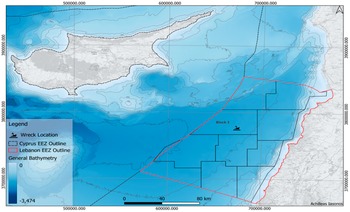
Prior to the present proceedings, related litigation had already arisen before the Supreme Court of Cyprus in 2016Footnote 23 and 2017Footnote 24 concerning certiorari Footnote 25 applications challenging the search warrant issued in respect of the vessel. Those applications were unsuccessful. The location of the shipwreck from which the objects were recovered, as established through archival research, is provided in Figure 1.
Site coordinates extracted from Enigma Recoveries statement 2020 (unpublished—on file with the authors), © Achilleas Iasonos

Figure 1. Long description
A geographical map with a coordinate grid showing the maritime region between Cyprus and Lebanon.
* Landmasses: The island of Cyprus is located in the northwest, outlined with a dashed black line. The coastline of Lebanon and Syria is visible on the eastern edge, outlined with a solid red line.
* Maritime Boundaries: A dashed black line defines the Cyprus EEZ (Exclusive Economic Zone). A solid red line defines the Lebanon EEZ. These boundaries intersect in the central-eastern portion of the map.
* Exploration Blocks: Several rectangular areas are outlined in black within the maritime zones. One specific area in the center-right is labeled Block 3.
* Wreck Location: A black ship icon indicates a wreck location within the eastern half of Block 3.
* Bathymetry: The sea depth is represented by shades of blue. A legend in the bottom-left indicates a gradient from 0 (light blue) to -3,474 (dark blue). Deepest areas are concentrated in the south and west, while shallower shelf areas surround the landmasses.
* Scale and Coordinates: A scale bar at the bottom center indicates 0, 40, and 80 km. The X-axis shows coordinates from 500,000.000 to 700,000.000, and the Y-axis shows coordinates from 3,800,000.000 to 3,900,000.000.
The parties’ claims
The company argued that the seizure of the vessel was null and void or at the very least legally defective. It further sought compensation in the amount of €40,015.30 representing the sum it had paid for the release of the vessel following its detention.Footnote 26 The company raised several additional objections, namely: (1) The company had no intention of leaving the antiquities undeclared; (2) neither the company, its parent entity, nor other affiliated companies operating within the Lebanese EEZ intended to engage in the trade of antiquities; (3) the excavation and recovery of the antiquities had been conducted in accordance with scientific standards; (4) the excavation activities were lawful under both international law and the domestic legal framework of Lebanon; (5) the vessel had not been subject to any objection, enforcement action, or other adverse treatment by the Lebanese authorities during its time in Beirut in 2016; and (6) there were reasonable prospects of successfully pursuing a legal claim in Lebanon in relation to the matter.Footnote 27 In contrast, the Republic maintained that the central issue concerned the lawfulness of the seizure of the antiquities upon the vessel’s arrival at the port of Limassol.Footnote 28
The court’s reasoning and decision
The District Court held that the decisive issue before it was the legality of the customs seizure of the antiquities rather than the broader legality of the underwater recovery operations conducted in the Lebanese EEZ. The court expressly clarified that the proceedings did not concern ownership of the antiquities nor whether the company possessed valid excavation permits, but solely whether the seizure had been carried out in accordance with the Customs Code.Footnote 29 This finding effectively foreclosed the company’s arguments discussed in the preceding section (points 1–6), as those arguments were directed primarily at the legality of the recovery operations rather than the customs seizure.
The Court relied principally on Articles 15 (1), 103 (1), and 104 (h) of the Customs Code Law 2004 (No. 94(I)/2004), as applicable prior to its amendment by Law 18(I)/2022. Article 15 (1) imposed an obligation to declare all cargo on board a vessel, while Articles 103 and 104 (h) authorized seizure where goods had not been properly declared or where false or misleading statements had been made.Footnote 30 Drawing on relevant UK case law, the court interpreted these provisions as establishing the legal framework governing customs seizures.Footnote 31
The court accepted the evidence presented by customs officials and the Cyprus Department of Antiquities that the antiquities had been present on board the vessel but had not been declared. In particular, it relied on the vessel’s electronic customs declaration indicating “nil cargo,” the captain’s IMO declarations confirming the absence of cargo, and the subsequent discovery of 57 containers of antiquities stored in a secured area of the vessel. On that basis, the court concluded that the seizure had been lawful under Articles 103 and 104 (h) of the Customs Code.Footnote 32
A central aspect of the judgment was the court’s insistence that the proceedings were confined to the legality of the seizure itself. The company sought to broaden the scope of the dispute by arguing, as discussed in the preceding section (points 1–6), that the recovery operations complied with international law and Lebanese law, that the excavation had been conducted according to scientific and archaeological standards,Footnote 33 that the antiquities were not intended for commercial exploitation, and that no intent existed to deceive the Cypriot authorities. The company further raised a question of private international law nature, arguing that Lebanese law was applicable, since the events took place within the Lebanese EEZ and Continental Shelf (CS).Footnote 34 It argued that Lebanon’s absence from the proceedings constituted a procedural defect and alleged that the seizure had been politically motivated in order to facilitate the transfer of the antiquities to Lebanon.Footnote 35
The court rejected these arguments as irrelevant to the central legal issue before it, namely whether the antiquities had been lawfully seized because they had not been declared as cargo. It emphasized that the statutory framework governing customs seizures did not authorize the court to examine the legality of the excavation operations, the ownership of the antiquities, compliance with archaeological standards, or the motives of the authorities.Footnote 36 Likewise, the court considered questions relating to Lebanon’s rights or possible future restitution claims to fall outside the scope of the proceedings.Footnote 37
The company additionally argued that the proceedings constituted an abuse of process because it had already paid €40,000 in connection with the release of the vessel. The court rejected this contention, holding that the payment related solely to the release of the vessel and did not preclude separate proceedings concerning the antiquities.Footnote 38 It also dismissed the company’s reliance on ignorance of the law, reiterating that ignorance cannot constitute a valid defense.Footnote 39 The company further challenged the District Court’s jurisdiction on the basis of the valuation of the antiquities. The court rejected this objection, clarifying that under Article 22 (1) of the Courts Law (No. 14/1960), the District Court retained jurisdiction irrespective of the value of the disputed objects.Footnote 40 Similarly, the court dismissed arguments concerning lack of intent, emphasizing that the proceedings were administrative rather than criminal in nature and therefore did not require proof of criminal intent.Footnote 41
Finally, the court rejected arguments that delays by the Customs Department invalidated the proceedings.Footnote 42 While acknowledging that the authorities were expected to act within a reasonable timeframe, it held that delay alone could not extinguish the state’s right of action absent an express statutory limitation. The court considered that the archaeological nature and significance of the objects weighed against dismissal in the interests of justice.Footnote 43 The importance of this consideration for the present analysis is discussed in the following section. The proceedings concluded with a costs order of €14,500 against the company.Footnote 44 An appeal against the judgment is currently pending.Footnote 45 The authors’ attempts to verify this information, including inquiries with lawyers representing the company regarding other measures that the company may be considering, were unsuccessful.Footnote 46
Comment and assessment of the decision
Where the judgment sheds light
The most recent ruling of the District Court presents both lights and shadows. On the positive side, the judgment is significant in that it represents one of the rare instances in which incidents involving underwater cultural heritage, despite attracting considerable attention from international bodies such as UNESCOFootnote 47 as well as substantial domestic and international media coverage, have reached the courts. Second, the case highlights important matters relating to the illicit trafficking of underwater cultural heritage in the Eastern Mediterranean Sea and beyond. It illustrates how companies operating transnationally can move across jurisdictions and how administrative omissions, such as failures in cargo declaration, may lead to effective confiscation, without any substantive consideration of the underlying permitting basis, if any, or regulatory compliance of the activities involved as issued or potentially not issued by the responsible custodian agency. The proximity of states, combined with divergences in their legal frameworks governing underwater cultural heritage, can be exploited by such actors. In this instance, as the court clarified, Cypriot jurisdiction was established on the basis of an administrative failure to declare the cargo. The significance of customs declarations in combating the illicit trafficking extends beyond the underwater cultural heritage context. In both the United Kingdom and the United States, customs-related enforcement mechanisms have been successfully employed to facilitate the seizure and forfeiture of antiquities on the basis of false, misleading, and/or incomplete import declarations. Illustrative examples include, in the UK context, HM Revenue & Customs v. Al-Qassas (2015), concerning the forfeiture of a looted Libyan funerary statue that had been misdescribed in import documentation, including false representations regarding its provenance, ownership, and lawful right of saleFootnote 48 and Anwar Enajah v. Revenue and Customs (2020), which concerned the seizure of Roman and Carthaginian coins imported from Libya that had been concealed and left undeclared.Footnote 49 In the US context, United States v. An Antique Platter of Gold (1997)Footnote 50 and United States v. Approximately Four Hundred Fifty Ancient Cuneiform Tablets, et al. (2017)Footnote 51 similarly involved antiquities, namely, in the former case, an ancient Sicilian gold phiale, and, in the latter, approximately 450 cuneiform tablets and 3,000 clay bullae originating from Iraq, which were imported on the basis of materially false customs and/or shipping declarations. In each of these cases, inaccurate, misleading, and/or incomplete customs documentation constituted a central basis for seizure and forfeiture proceedings. These cases demonstrate that customs controls may constitute an effective tool for disrupting the illicit trade in cultural objects, irrespective of whether the objects originate from terrestrial or underwater contexts.
Third, the proceedings shed light on the organizational sophistication of the companies involved. The discovery of printed catalogues, designated photography areas, reinforced iron doors for storing objects, and even video recordings documenting the extraction of items from the seabed provides valuable insight into the structured nature of such operations. This contributes to a clearer understanding of how commercial salvors in this sector function and operate. Another important aspect of the ruling is the court’s observation that, even if the Customs Department delayed in handling the case, dismissing the claim would not have served the interests of justice. In effect, the court recognized the special status and vulnerability of underwater cultural heritage, thereby adopting a more culture-sensitive and flexible procedural approach that resonates with Alessandro Chechi’s conception of an emerging lex culturalis , a transnational body of cultural heritage norms capable of relaxing ordinary private law and procedural rules designed for conventional commercial disputes.Footnote 52 In the present case, the court’s willingness to implicitly prioritize the protection of underwater cultural heritage over strict procedural formalism can therefore be understood as a manifestation of this developing lex culturalis , where the uniqueness and public value of underwater cultural heritage justify departures from rigid legal doctrines in order to secure substantive justice.
Where the judgment leaves shadows
Notwithstanding these contributions, the judgment simultaneously leaves several important issues unresolved. Regrettably, the court’s engagement with the broader legal framework governing underwater cultural heritage remains, at best, superficial and, at worst, almost entirely absent. While this may be partially explained by the narrow procedural focus of the case, namely, the legality of the seizure rather than questions of ownership, the court nevertheless missed an important opportunity to situate its reasoning within the relevant international legal context. In particular, the court could have invoked the provisions of the 1982 UNCLOS and the 2001 UNESCO Convention, which paradoxically have been advanced by the company. Provisions of both instruments have been incorporated into Cypriot law through amendments to the Antiquities Law (Cap. 31), in particular Articles 18A–18D, adopted on the basis of the 1982 UNCLOS and amended in 2014, as well as through the incorporation of the Annex to the 2001 UNESCO Convention by means of a separate legislative instrument, namely the Regulations for the Protection of Maritime Antiquities (No. 218/2016). Their omission is striking, especially given that the case concerns the movement and handling of underwater cultural material across jurisdictions. Moreover, the court could have examined the matter from the perspective of Lebanese law. Lebanon is a state party to both the 1982 UNCLOS and the 2001 UNESCO Convention. Under Article 4 of the latter, salvage of underwater cultural heritage is permissible only under specific conditions, and the commercial exploitation of such heritage is explicitly prohibited. The 2001 UNESCO Convention was incorporated into the domestic legal order through a specific legislative instrument, namely Law No. 722/2006, which in essence adopts the Arabic authentic version of the convention.Footnote 53
These provisions are directly relevant to assessing the (il)legality of the activities undertaken within the Lebanese EEZ/CS, particularly in determining whether any permits of whatever nature were issued by the Lebanese authorities authorizing either the salvaging of the wreck in question or the geophysical surveys that ultimately led to the site’s discovery. This context may explain the company’s contention that the assessment should be guided by Lebanese legal standards. More broadly, however, this line of argument raises a wider legal question that requires a clearer understanding of the company’s position in order to assess the underlying legality of the situation. In particular, it cannot be excluded that licensing may have been granted by Lebanese authorities other than the competent archaeological and/or heritage authority, possibly by another governmental body, for activities such as geophysical surveying conducted for non-archaeological purposes (e.g., geological, environmental, or biological research). Such activities could have resulted in the discovery of the site and, subsequently, in the unlawful salvaging of the wreck. If this were indeed the case, the matter would warrant a more comprehensive legal analysis, especially in light of the likely restitution of the confiscated objects. Such restitution could give rise to further litigation before Lebanese courts and potentially provide additional grounds for contesting the ownership of the objects in question. Ultimately, however, the plausibility of this hypothesis depends on the nature and scope of any permits actually granted by the Lebanese authorities to the company, if any such permits existed. In this regard, contemporaneous press reports indicated that Lebanese Minister of Culture Mohammad Wissam El-Mortada stated that the company had been commissioned by the Lebanese Ministry of Public Works and Transport to locate and recover the remains of an aircraft that crashed in 1957. According to those accounts, rather than locating the aircraft, the company encountered maritime antiquities and subsequently transferred them to Cyprus.Footnote 54 Interestingly, the opposing view appeared very briefly in the judgment. According to witness 2, a lawyer and member of the Beirut Bar Association testifying on behalf of the company, Lebanon had no right to assert claims over the antiquities discovered within its EEZ, as it had failed to adopt implementing regulations for the convention, particularly Article 10, which concerns the protection of underwater cultural heritage in the EEZ and on the CS. Following this line of reasoning, since no licensing framework had been established and no license could therefore be obtained, no offence could be said to have occurred.Footnote 55 The court did not address this issue, which would otherwise have shed light on the provision.
From the perspective of international law, the discovery of the site appears to have arisen as a by-product of activities potentially falling within the scope of marine scientific research (MSR) under Part XIII of 1982 UNCLOS (Articles 238–265), which broadly encompasses scientific activities relating to the oceans and their resources. However, as Iasonos argues, activities specifically directed at underwater cultural heritage fall outside the permissible scope of MSR envisaged by 1982 UNCLOS, exposing significant limitations in the regime governing the identification and recovery of underwater cultural heritage beyond the Territorial Sea.Footnote 56 This raises the question whether the survey activities were genuinely incidental to authorized MSR or instead constituted targeted underwater cultural heritage exploration conducted under the guise of scientific research, particularly given the company’s association with commercially driven salvage operations.
Concluding remarks
The present case marks the latest chapter in an extended cycle of litigation concerning events that unfolded a decade ago. Its significance lies not only in the immediate procedural questions surrounding the seizure of underwater cultural objects but also in its broader implications for the protection of underwater cultural heritage in Cyprus and across the Eastern Mediterranean Sea. The ruling reveals a complex seascape. Οn the one hand, it demonstrates the capacity of domestic institutions to act decisively in preventing the illicit movement of underwater cultural material. Οn the other, it exposes structural weaknesses in the legal and judicial engagement with the international frameworks that govern this field.
As the analysis shows, the court illuminated several important dimensions of the case, including the organized and transnational nature of commercial entities engaged in underwater activities, the challenges posed by non-declaration of cargo, and the need for a robust response to the trafficking of cultural objects. The court also acknowledged the special character of underwater cultural heritage, noting that even administrative delays should not automatically undermine efforts to safeguard such objects. These elements reflect a welcome recognition of the urgency and complexity of protecting underwater cultural heritage, particularly in a region where archaeological remains are abundant and vulnerabilities are acute.
At the same time, however, the judgment revealed certain limitations. Opportunities to anchor the reasoning firmly in the applicable international legal framework, most notably 1982 UNCLOS and the 2001 UNESCO Convention, were not fully seized. Nor did the court meaningfully engage with the Lebanese legal perspective, despite the central role of the Lebanese EEZ/CS in the underlying facts. These omissions point to a persistent gap between the formal incorporation of international norms and their practical judicial application, a gap that continues to shape how underwater cultural heritage is treated in domestic contexts. In particular, the possibility that non-archaeological permits issued by Lebanese authorities facilitated the identification and subsequent recovery of the wreck raises unresolved questions concerning the legality of the salvage activities, the restitution of confiscated artefacts, and Lebanon’s ability to assert sovereign and proprietary claims over objects recovered from its EEZ and CS under both domestic and international law.
How the case will ultimately conclude remains to be seen, particularly with an appeal now pending. It is hoped that, in the meantime, the lessons emerging from this case will contribute to a more comprehensive and internationally informed approach to underwater cultural heritage protection not only in Cyprus but across the Eastern Mediterranean Sea and beyond. The ongoing challenges posed by illicit trafficking, vividly illustrated by the Odyssey case, underscore the urgency of developing a coherent and consistent legal response grounded in both domestic law and the broader international regime.
Acknowledgments
The authors wish to thank the Editor-in-Chief, Dr. Sophie Vigneron, University of Kent, and the anonymous reviewer for their constructive comments. All errors remain solely our own.

 Open access

