


Introduction
While some might consider it a “modern” construct, the phenomenon of buying-shopping disorder (BSD) has been described for over 100 years in literature and in psychiatric textbooks.Reference Zola1, Reference Kraepelin2 In 1899, the eminent German psychiatrist Emil Kraepelin mentioned the pathological propensity to buy (“krankhafte Kauflust”) alongside kleptomania and acquisitiveness (“Sammelwuth”) in the 6th edition of his Textbook of Psychiatry.Reference Kraepelin3 In contrast, the most recent 5th edition of the Diagnostic and Statistical Manual of Mental Disorders (DSM-5) and the recently released 11th revision of the International Classification of Diseases (ICD-11) have not included BSD as a formal mental health disorder.4, 5
Past proposals to categorize BSD as a distinct mental health condition within modern psychiatric taxonomies have been ignored based on arguments that there is insufficient research on this topic.Reference Grant and Chamberlain6 However, the authors of this article argue that, while ongoing research into BSD is crucial as with all psychiatric disorders, failing to recognize BSD as a mental health disorder ignores the now well-documented burden of suffering, the associated impairment, and reduced quality of life of patients with BSD, as well as the accelerating prevalence of BSD and its impact on public health within different cultural settings. In the following, we offer a perspective to consider BSD as a mental health condition and to classify this disorder as a behavioral addiction, based on both research data and on long-standing clinical experience.
Phenomenology
According to the early descriptions by Kraepelin, BSD is characterized by an inability to control one’s excessive buying behavior, a continuous delay in paying an accumulation of debts, and the absolute incapability of the individual to think differently, including to perceive the negative consequences of spending in excess.Reference Kraepelin2 Likewise, more recent definitions characterize BSD by the excessive preoccupations with buying/shopping, poorly controlled impulses to purchase that are experienced as irresistible, and recurrent maladaptive buying/shopping excesses that lead to marked distress and impairments.Reference McElroy, Keck, Jr, Smith and Strakowski7 Patients with BSD report that they buy consumer goods that are not needed or that are beyond their budget, or they purchase items in unnecessary quantities, and regularly spend much more time than they intended buying and shopping. It appears that the act of buying/shopping itself, which is mainly driven by an intense, compelling, but temporary, desire to instantly own a specific product, is the main issue in BSD. Most possessions purchased are rarely or never used, but instead they are hidden, stored, given away as gifts, forgotten, or discarded.Reference Weinstein, Maraz and Griffiths8 In the early stages of the disorder process, individuals with BSD experience pleasure and other positive feelings while shopping and buying.Reference Christenson, Faber and de Zwaan9, Reference Kellett and Bolton10 This pattern appears to change over time, with buying episodes being used more and more to get relief from negative mood states, to the point where they become the primary response to negative events and feelings.Reference Kyrios, McQueen and Moulding11, Reference Müller, Mitchell and Crosby12 Efforts to stop BSD episodes are unsuccessful, despite the awareness of repeated failures in self-regulation, experiences of post-purchase guilt and regret, and longer-term adverse consequences. The latter include the increase or de novo development of comorbid psychiatric disorders, increased familial discord, work impairment, financial problems (including bankruptcy), criminal proceedings due to spending-related deception and embezzlement, and decreased quality of life.Reference McElroy, Keck, Jr, Smith and Strakowski7, Reference Christenson, Faber and de Zwaan9, Reference Zhang, Brook, Leukefeld, De La Rosa and Brook13 Diagnostically, the specification of substantial impairments is important in order to differentiate BSD from occasional impulsive overbuying that is solely driven by materialistic goals focused on wealth, possessions, and status as per the way that social anxiety disorder is differentiated from normal anxiety or shyness, for example.Reference Kasser14 In individuals with BSD, “retail therapy” is the primary or only way of coping with stress, discomfort, and negative feelings. Most patients describe the course of BSD as chronic and episodic, with a typical age of onset in the late adolescence or early adulthood.Reference Black, Shaw and Allen15
Epidemiology
Population-based studies provide evidence that BSD is a cross-national problem with high prevalence rates within different cultural settings, including the United States, Europe, China, India, and Brazil.Reference Koran, Faber, Aboujaoude, Large and Serpe16–Reference Leite and Silva26 Exemplary prevalence estimates for BSD are listed in Table 1. A recent meta-analysis indicated an estimated point prevalence of BSD of 5%, which is similar to the levels of other high-prevalence mental health disorders that receive considerable attention and are acknowledged as distinct conditions.Reference Maraz, Griffiths and Demetrovics20 Furthermore, the prevalence of BSD seems to increase in developing consumer societies.Reference Neuner, Raab and Reisch17, Reference Hubert, Hubert, Gwozdz, Raab and Reisch19
Prevalence estimates of buying-shopping disorder
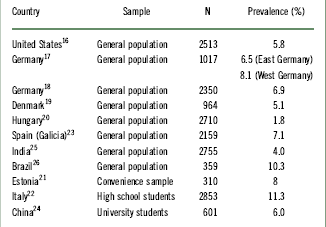
The majority of population-based surveys have found that there are higher prevalence rates among women.Reference Maraz, Griffiths and Demetrovics20 Treatment-seeking samples with BSD consistently comprise more female than male patients.Reference McElroy, Keck, Jr, Smith and Strakowski7, Reference Mestre-Bach, Steward, Jiménez-Murcia and Fernández-Aranda27–Reference Mueller, Mueller and Silbermann29 Studies investigating gender differences in the prevalence of BSD in adolescents and young adults have had mixed results, with some studies reporting a higher propensity toward BSD in female participantsReference Neuner, Raab and Reisch17, Reference Maraz, Griffiths and Demetrovics20, Reference Otero-Lopez and Villardefrancos23 and others not finding a gender bias.Reference Müller, Mitchell and Crosby18, Reference Villella, Martinotti and Di Nicola22, Reference Jiang and Shi24 While there is evidence for a higher prevalence of BSD in younger adults, pointing to the need of introducing and implementing prevention programs for BSD at an early age,Reference Neuner, Raab and Reisch17 less pronounced gender differences in younger samples may reflect less traditional gender role identities and a stronger emphasis on buying and shopping among youth.Reference Dittmar30 Most studies have failed to find significant differences between individuals with BSD and those without BSD with respect to other sociodemographic variables such as marital status, education, job situation, or income.Reference Hubert, Hubert, Gwozdz, Raab and Reisch19, Reference Otero-Lopez and Villardefrancos23, Reference Müller, de Zwaan, Mitchell and Zimmermann28
Comorbidity
Buying disorder rarely occurs as a problem in isolation. Comorbidity rates are high, with depressive disorder, social anxiety disorder, hoarding disorder, bulimia nervosa or binge eating disorder, gambling disorder, and substance use disorders being the most common comorbid conditions.Reference Mestre-Bach, Steward, Jiménez-Murcia and Fernández-Aranda27, Reference Black, Coryell, Crowe, Shaw, McCormick and Allen31–Reference Lawrence, Ciorciari and Kyrios34
The most prevalent personality disorders in individuals with BSD are avoidant (15–37%), obsessive-compulsive (22–27%), and borderline personality disorder (15–20%).Reference Claes and Müller35 Although research on temporal order, symptom covariations, and family transmission of possible shared neurobiological or genetic risk factors for BSD and comorbid disorders is limited, there are indicators for increased familial incidence, especially with respect to other mental disorders. An earlier controlled study showed that first-degree relatives of patients with BSD were more likely than comparison relatives to suffer from more psychiatric disorders, particularly depression and substance use disorder.Reference Black, Repertinger, Gaffney and Gabel36 Another study investigated the relationship between gambling disorder and several DSM-IV impulse control spectrum disorders (ie, intermittent explosive disorder, kleptomania, pyromania, trichotillomania, compulsive sexual behavior, Internet addiction, and BSD).Reference Black, Coryell, Crowe, Shaw, McCormick and Allen31 BSD was by far the most frequent condition in individuals with pathological gambling and in their first-degree relatives.Reference Black, Coryell, Crowe, Shaw, McCormick and Allen31 This finding suggests that there may be an underlying common etiological pathway between BSD and gambling disorder.
Classification of BSD
As noted previously, BSD was not included as a separate disorder in DSM-5.4 However, the high comorbidity between BSD and hoarding disorder and the fact that there is a subsection of those with hoarding disorder who do not engage in BSD but acquire through other means, including free items and inheritances, or even just a slow but insidious acquisition of items,Reference Frost, Steketee and Tolin33, Reference Lawrence, Ciorciari and Kyrios34 have been acknowledged by the DSM in introducing the hoarding disorder specifier “With excessive acquisition.”4 Elsewhere in the DSM-5, excessive spending is listed as an example of the impulsive behaviors of borderline personality disorder.4 More generally, over the last 3 decades, several nosological categorizations for BSD have been suggested, with BSD considered either as a subtype of obsessive-compulsive–related disorders, an impulse control disorder, or a behavioral addiction.Reference Hollander and Allen37
BSD as an obsessive-compulsive–related disorder
There are some commonalities between BSD and obsessive-compulsive disorders (OCDs), which explains why BSD had been considered as a potential obsessive-compulsive–related disorder in the 1990s.Reference Lawrence, Ciorciari and Kyrios34 For instance, preoccupations with buying and shopping are central to BSD. Past studies found a high comorbidity between OCDs and BSD.Reference Lejoyeux, Bailly, Moula, Loi and Ades38 Furthermore, selective serotonin reuptake inhibitors (SSRIs, ie, fluvoxamine, citalopram, escitalopram), which are approved for the treatment of OCDs, have shown promise in open label trials, case studies, and open-label lead-in studies for BSD.Reference Soares, Fernandes and Morgado39 However, controlled studies with fluvoxamine failed to confirm the optimism of earlier open-label trials.Reference Soares, Fernandes and Morgado39 Only one controlled trial of citalopram has shown benefit during double-blind discontinuation phases, but it failed to show efficacy with the more active compound escitalopram.Reference Soares, Fernandes and Morgado39
In further contrast to OCD but akin to hoarding disorder, BSD is typically not associated with unwanted (intrusive) thoughts about spending, but is characterized by ego-syntonic attitudes, in this instance toward identity-seeking and materialism.Reference Dittmar30, Reference Claes, Müller and Luyckx40, Reference Moulding, Duong, Nedeljkovic and Kyrios41 Patients describe their shopping and buying habits as being chaotic and unplanned rather than being ritualized.Reference Kellett and Bolton10 Buying and shopping are used to relieve tension as BSD progresses, but not at the onset of the disease, which is different from OCD. Noteworthy, more recent studies investigating clinical variables related to the BSD phenotype compared to OCDs or other behavioral addictions revealed close similarities between BSD and gambling disorder, but considerably less similarity between BSD and OCDs.Reference Mestre-Bach, Steward, Jiménez-Murcia and Fernández-Aranda27, Reference Lawrence, Ciorciari and Kyrios34 While treatments for BSD are emerging, their overall efficacy is not yet as robust as those for OCDs, nor are there standard approaches or clinical guidelines for treatment. Cognitive-behavioral treatments have been found to be effective, although larger scale quality studies need to be conducted.Reference Mueller, Mueller and Silbermann29, Reference Hague, Hall and Kellett42
The previously reported high comorbidity of BSD with OCDs is probably accounted for by the inclusion before DSM-5 of hoarding as a dimension of OCD.Reference Torres, Fontenelle and Shavitt43 The fact that excessive acquisition (according to the currently released ICD-11 version: “repetitive urges or behaviours related to amassing or buying items”5) is one of the core characteristics of hoarding could serve as an argument to understand BSD as being simply a symptom of hoarding disorder.Reference Fontenelle and Grant44 However, at least in treatment-seeking samples, only about half of patients with BSD suffer from hoarding, whereas the remaining patients have no difficulty discarding possessions and do not accumulate the items purchased, clearly differentiating BSD from hoarding disorder, which is centrally characterized by the psychological difficulty in discarding, resulting in clutter.Reference Frost, Steketee and Tolin33, Reference Möllenkamp, de Zwaan and Müller45 It is important to note that patients with BSD and hoarding symptoms are less likely to respond to BSD treatment than those without hoarding.Reference Mueller, Mueller and Silbermann29 In our opinion, hoarding should be considered as a specifier for BSD, especially in light of a subtyping treatment approach that might be helpful in the treatment of patients with BSD.
BSD as an impulse control disorder or a behavioral addiction
The classification of BSD as an impulse control disorder (ICD) has been favored over the past 20 years by many researchers. According to the ICD-11 working group on obsessive-compulsive and related disorders, ICDs “… should be defined by the repeated failure to resist an impulse, drive, or urge to perform an act that is rewarding to the person (at least in the short-term), despite longer term harm either to the individual or others.”Reference Grant, Atmaca and Fineberg46 The clinical picture seen in patients with BSD meets these criteria. It is often characterized by increasing tension prior to a BSD episode, which is relieved while shopping or spending. Furthermore, BSD is associated with high impulsivity, with failures in impulse control, and in many cases with the violation of the rights of others.Reference Christenson, Faber and de Zwaan9, Reference Zander, Claes, Voth, de Zwaan and Müller47 In the proposed ICD-11 coding tool, BSD (according to the ICD-11 coding tool: “compulsive buying-shopping disorder”) is now mentioned as an example for the residual category “Other specified impulse control disorders” (category 6C7Y).5
Recent considerations have moved away from the conceptualization of BSD as an ICD due to intriguing research findings indicating shared key characteristics of BSD with substance-use disorders and gambling disorder, suggesting that BSD might be viewed most appropriately as a behavioral addiction.Reference Mestre-Bach, Steward, Jiménez-Murcia and Fernández-Aranda27, Reference Jimenez-Murcia, Granero and Moragas48–Reference Guerrero-Vaca, Granero and Fernandez-Aranda50 Factors that appear to link BSD and substance-use disorders/gambling disorder are maladaptive decision-making processes, increased salience of disorder-specific stimuli, cue-induced craving, and reward seeking.Reference Trotzke, Brand and Starcke51–Reference Voth, Claes and Georgiadou56 Models referring to the sensitization of reward-related neural structures and the accompanying cognitive interferences, which are well known as being related to substance use disorders and gambling disorder, can also be applied to BSD.Reference Berridge and Robinson57, Reference Clark, Averbeck, Payer, Sescousse, Winstanley and Xue58 In the beginning, when buying/shopping is a pleasant experience, different cues become related to the positive reinforcing features of buying/shopping (“liking”), resulting in incentive salience. Sensitization of incentive salience is associated with strong craving reactions (“wanting”) and the maintenance of buying/shopping, even in the face of several negative consequences.Reference Trotzke, Brand and Starcke51 In accordance with recent models of addiction, a transition from initial positive reinforcement motivations (impulsivity) to later negative reinforcement (compulsivity) can be observed. Impulsivity occurs during the early stages of BSD when the person acts on powerful urges to experience the pleasure of recreational buying/shopping. As BSD progresses, buying/shopping becomes habitual (compulsive) and is used to relief from negative mood states.Reference Müller, Mitchell and Crosby12, Reference Nicolai, Daranco and Moshagen59
Hypotheses on the Brain Processes Involved in BSD
There is a considerable lack of human studies that investigate the extent to which neural circuits are involved in BSD. Of interest is a brain imaging study that was conducted in patients with BSD compared to healthy control participants.Reference Raab, Elger, Neuner and Weber60 Similar to several findings related to substance use disorders/gambling disorder,Reference Potenza61 the functional magnetic resonance imaging (fMRI) study indicated an activation of the ventral striatum (nucleus accumbens) during the anticipation phase of reward processing (i.e., the presentation of purchasable products).Reference Raab, Elger, Neuner and Weber60 In addition, lower activity of the insula was found during presentation of product and price, indicating lower price sensitivity in patients with BSD compared to controls.Reference Raab, Elger, Neuner and Weber60
With regard to clinical research, it has been suggested that the use of opioid receptor antagonists may be efficacious in BSD, as these have shown positive effects in the treatment of alcohol use disorder, opioid use disorder, kleptomania, and gambling disorder, following the assumption that dopaminergic reward pathways are also involved in BSD.Reference Soares, Fernandes and Morgado39 Two case studies reported improvement of BSD symptoms due to naltrexone administration, but systematic studies are lacking.Reference Soares, Fernandes and Morgado39
In analogy to disorders due to substance use or addictive behaviors, it has been argued that the imbalance of interacting neural circuits is likely to contribute to BSD.Reference Weinstein, Maraz and Griffiths8 Referring to the dual-process models framework, addictive behaviors may occur because the impulsive neural system (subcortical brain regions involved in reward: ventral striatum, amygdala, orbitofrontal cortex) is not down-regulated by the reflective neural system (prefrontal cortex, hippocampus) or overrides the reflective system due to neuroadaptations in response to repeated drug exposure.Reference Bechara62 Applying the dual-process model of addiction to BSD, it can be assumed that the interplay of personal and situational factors contributes to a predominantly impulsive processing mode, which is associated with diminished reflective processing.Reference Trotzke, Brand and Starcke51 Similarly, the brain disease model of addictionReference Volkow, Koob and McLellan63 could be applied to BSD.
Future research could profit from the integration of consumer neuroscience findings, including neuroeconomics research that focuses on neural correlates of economic decision-making.Reference Javor, Koller, Lee, Chamberlain and Ransmayr64 However, it is important to consider the ecological relevance of these paradigms to BSD. Although it is mandatory to understand brain processes involved in the disorder, BSD should be examined in its genetic, psychological, social, cultural, and environmental contexts.
Implications of the National Institutes of Health Research Domain Criteria (RDoC) Framework for BSD Research
Considering the complexity of BSD, the dimensional RDoC approachReference Cuthbert and Insel65 could be useful for addressing the neurobiological, physiological, genetic, and behavioral underpinnings of BSD. Recently, the RDoC units of analysis and research domains have been used to conceptualize impulsivity and compulsivity and their interaction with respect to addictions.Reference Brooks, Lochner, Shoptaw and Stein66 The findings of Brooks et al Reference Brooks, Lochner, Shoptaw and Stein66 call for the examination of transdiagnostic processes in relation to BSD. In our opinion, the RDoC system could be helpful for the conceptualization of BSD, as it highlights moving beyond shared symptoms and comorbidity. Using the research-oriented RDoC system would focus on evaluating whether the underpinnings of obsessive-compulsive–related disorders (including hoarding disorder), impulse control disorders, substance use disorders, or behavioral addictions (eg, gambling disorder) are contributing to BSD.
Conclusion
Considering recent research findings, the high prevalence rates of BSD, its dysfunctionality and interference with daily functioning, and the increasing number of individuals seeking treatment for BSD, we believe that there is no question that it really is time to recognize BSD as a separate mental health condition. Given that BSD has much in common with substance use disorders and gambling disorder, it should be considered as a candidate for the ICD-11 category “Other specified disorders due to addictive behaviours (6C5Y)” that belongs to the “Substance use and related disorders” chapter according to the release version of the ICD-11.5 The inclusion of BSD in the ICD-11 would enable researchers to accumulate further knowledge that will result in advanced diagnostic tools, etiological models, and treatment strategies for BSD, and it would support the promotion of public health efforts relating to policies and prevention.


 Open access

