





While the origin of mechanical strength, toughness, and creep resistance is well studied in most metals, much less is known about the properties of more complex crystal structures—despite their wide use as reinforcement phases and the undiscovered potential in their sheer number and variability. A major challenge in plasticity research of the next years will therefore be to close this gap in knowledge. Small-scale testing techniques have been demonstrated as a key enabling technique for such studies. Most prominent is microcompression, which helps overcome the fundamental challenge of studying plasticity in materials, which suffer from extreme brittleness in conventional testing.[ Reference Östlund, Rzepiejewska-Malyska, Leifer, Hale, Tang, Ballarini, Gerberich and Michler 1 , Reference Östlund, Howie, Ghisleni, Korte, Leifer, Clegg and Michler 2 ] Their plastic properties may, at first glance, appear to be of only academic interest: aiming to deduce fundamental relationships of crystal plasticity and structure to enable knowledge-guided search and data mining for new structural materials. However, they are in fact essential to performance at the microstructural scale of many advanced and highly alloyed materials and to understanding the effects of alloying strategies aimed at inducing deformability as baseline or reference information.
Investigating plasticity in hard crystals
A deep understanding of plasticity and dislocation motion exists in most metallic crystals and strategies to engineer different aspects, for example by adjustment of the stacking fault energy, have been very successful.[ Reference Zongrui, Martin, Stefanie, Roman, Bob, Dierk and Jörg 3 , Reference Pierce, Jiménez, Bentley, Raabe and Wittig 4 ] These are being applied—with great effect—to hexagonal metals[ Reference Zongrui, Martin, Stefanie, Roman, Bob, Dierk and Jörg 3 ] which in spite of their closely related atomic packing show strongly anisotropic deformation and are therefore much more difficult to deform at low temperatures. In BCC metals, fundamental aspects of dislocation core structure, stress tensor dependence, and resulting non-Schmid behavior, are also still under investigation.[ Reference Koester, Ma and Hartmaier 5 , Reference Marichal, Van Swygenhoven, Van Petegem and Borca 6 ] However, in all of these materials, the availability of large-grained or single crystals with sufficient purity has scarcely been a problem, nor has the ability to deform such samples under carefully controlled conditions. Suitable investigations by conventional, analytical and high-resolution microscopy techniques have also been carried out whenever new methods have allowed researchers to dive deeper into the physics of their plastic deformation.
In intermetallics, ceramics, and compounds we face challenges at a far more fundamental level. In addition to the overwhelming number and variability of these crystals, even where only binary and ternary systems are considered as a starting point, it is the simple step at the beginning of the research process, which has proved a major obstacle: achieving basic samples deformed under known and carefully controlled reference conditions for further analysis.
Specific challenges in studying such brittle and/or anisotropic crystals therefore lie in:
-
• Avoiding premature fracture during deformation at temperatures below the macroscopic brittle-to-ductile transition temperature.
-
• Achieving uniaxial stress states to target individual slip systems and extract critical resolved shear stresses.
-
• Assuring that the same mechanical test methods are applicable for a direct comparison within any set of investigated alloys or crystal structures, including both the ductile and brittle variants.
-
• Resolving the local (mobile) defect structure, even where the above aspects have been satisfied, for high-resolution characterization in crystals with large unit cells, containing both very light and heavy elements and without pre-conceived insights into the possible dislocation core structures, often including several partials, to guide the experiment.
-
• Modeling of the structure, or more complex yet the motion, of dislocations in crystals with large unit cells and containing several atomic species, including those in which magnetism might have to be considered in atomic scale modeling.
Research in hard materials traditionally uses indentation at all scales and compression under triaxial stresses, providing a confining element to make the opening of a crack resulting in fracture energetically less favorable.[ Reference Marsh 7 , Reference Paterson and Wong 8 ] Alternatively, tests are conducted at high temperatures to achieve plastic deformation by the motion of dislocations at stresses below those required to extend a crack. The most extreme cases of these types of experiments may be found in the geological sciences, where mantle materials are investigated at several times atmospheric pressure.[ Reference Cordier, Amodeo and Carrez 9 ]
In engineering materials, hard crystals are employed to carry loads in four predominant classes of materials: the very hard ceramic or intermetallic bulk parts used nearly exclusively in compression to avoid catastrophic failure from intrinsic flaws, hard coatings giving wear protection in application or tooling, and composites of hard phases with softer matrices aiming at a beneficial combination of the properties of both materials. Finally, hard phases, in particular intermetallics and carbides, are found as intentional or undesired precipitates within a metallic matrix (Fig. 1).
Examples of hard phases in engineering materials. (a) Tungsten carbide in the cemented carbide WC-Co exhibiting plastic deformation in nanoscratch testing, (b) topologically close-packed μ-phase precipitates in a nickel-based superalloy after creep-testing and (c) intermetallic skeleton included in cast Mg–Al–Ca alloy to increase creep resistance. [images: (a) courtesy of J. S. K.-L. Gibson; (b) Reprinted with permission from Elsevier Ref. Reference Simonetti and Caron86; (c) courtesy of C. Zehnder].

Where these are very small and densely spaced, they may act as obstacles to dislocations, one of the major hardening mechanism employed in metals.[ Reference Gottstein 10 ] In these cases, the intrinsic strength is not of primary importance as size and crystal relationship with the matrix determine the efficiency as obstacles to dislocations. In highly alloyed systems, such as superalloys used in turbines, the use of a large collection of elements results in the formation of a number of stable phases as precipitates, often as carbides or topologically close-packed phases containing several refractory elements[ Reference Reed 11 ] [Fig. 1(b)]. While their structures and crystal relationships with the surrounding matrix is well studied, qualitative data with respect to the operative slip systems and quantitative data on the respective stresses are largely missing.[ Reference le Graverend, Cormier, Caron, Kruch, Gallerneau and Mendez 12 ] Where defect structures have been studied in the related bulk phases, these are often growth defects due to the difficulties encountered in producing large single crystals and deforming them at relevant application temperatures, i.e., high temperatures near 1000 °C during power conversion and near room temperature during ramp up/down where the risk of fracture increases.[ Reference Carvalho and De Hosson 13 – Reference Hiraga, Yamamoto and Hirabayashi 15 ] Quantitative measurements of hardness circumvent the problem of specimen size by testing at the nanometer scale directly within precipitates; however, this technique is still largely limited to room temperature in most laboratories and anisotropy of a crystal is usually difficult to considered with explicit reference to individual slip planes in such studies.[ Reference ur Rehman, Durst, Neumeier, Parsa, Kostka, Eggeler and Göken 16 ]
Microcompression: a new way to study plasticity in hard crystals
The majority of challenges in studying plasticity in brittle materials have been overcome recently by means of small-scale testing, in particular microcompression, which has allowed the characterization of plasticity under previously inaccessible conditions. First demonstrated in 2004,[ Reference Uchic, Dimiduk, Florando and Nix 17 ] it was initially used predominately to investigate the effect of size on strength in metals previously confined to whiskers.[ Reference Uchic, Shade and Dimiduk 18 – Reference Brenner 20 ] However, this method soon proved exceedingly useful in the study of brittle materials by addressing the challenges outlined above, particularly the fundamental possibility to avoid brittle fracture by scaling down the size of the experiment.
Research of the last few years was focused on adapting the “microcompression” technique to characterize hard and brittle materials at small scales without fracture and while distinguishing anisotropic plastic properties.[ Reference Östlund, Howie, Ghisleni, Korte, Leifer, Clegg and Michler 2 , Reference Csanadi, Bl'anda, Duszova, Chinh, Szommer and Dusza 21 – Reference Kiani, Yang and Kodambaka 32 ] A selection of materials thus studied in terms of their plasticity is shown in Fig. 2, while Figs. 3–6, 8, and 10 also contain examples of materials, which are shown to deform plastically well below their macroscopic brittle-to-ductile transition temperature. For an example, Fig. 3 presents the first study of silicon at low, but variable temperatures without a hydrostatic pressure component allowing analysis of the active slip systems and supporting the theoretical hypothesis of a change in slip system with temperature.[ Reference Korte, Barnard, Stearn and Clegg 31 , Reference Rabier, Pizzagalli, Demenet, Hirth, Kubin, Hirth and Kubin 33 ] The conventional scheme for studies of directional plasticity in brittle crystals using microcompression on a polycrystalline sample in correlation with electron backscatter diffraction (EBSD) and where desired transmission electron microscopy (TEM) is shown in Fig. 4.[ Reference Korte and Clegg 34 ]
Selection of hard crystals tested by microcompression. ZrB2,[ Reference Csanadi, Szommer, Chinh, Grasso, Dusza and Reece 87 ] Mo2BC,[ Reference Korte-Kerzel, Klöffel and Meyer 85 ] WC,[ Reference Csanadi, Bl'anda, Duszova, Chinh, Szommer and Dusza 21 ] Fe3Al,[ Reference Janda, Ghassemi-Armaki, Bruder, Hockauf, Heilmaier and Kumar 88 ] Co3(Al,W),[ Reference Chen, Okamoto, Demura and Inui 89 ] CMSX-4,[ Reference Korte, Stearn, Wheeler and Clegg 36 ] Si,[ Reference Korte, Barnard, Stearn and Clegg 31 ] GaAs,[ Reference Östlund, Howie, Ghisleni, Korte, Leifer, Clegg and Michler 2 ] InSb,[ Reference Wheeler, Thilly, Morel, Taylor, Montagne, Ghisleni and Michler 90 ] Al2O3 (unpublished), MgO,[ Reference Korte, Ritter, Jiao, Midgley and Clegg 25 ] (Fe,Ni)2Nb,[ Reference Takata, Ghassemi Armaki, Terada, Takeyama and Kumar 30 ] (Mg, Al)2Ca (courtesy of C. Zehnder), Nb2Co,[ Reference Korte and Clegg 34 ] AlN,[ Reference Guo, Reddy, Hirata, Fujita, Gazonas, McCauley and Chen 91 ] GaN,[ Reference Wheeler, Niederberger, Tessarek, Christiansen and Michler 92 ] doped ZrO2, [ Reference Zeng, Lai, Gan and Schuh 93 ] LiF,[ Reference Soler, Molina-Aldareguia, Segurado, Llorca, Merino and Orera 94 ] Al7Cu2Fe,[ Reference Singh, Guo, Xie and Chawla 95 ] FeZn13,[ Reference Okamoto, Inomoto, Adachi, Takebayashi and Inui 96 ] Cu6Sn5,[ Reference Jiang and Chawla 24 ] m-Al13Co4 (unpublished), o-Al13Co4,[ Reference Walter, Wheeler, Barnard, Raghavan, Korte-Kerzel, Gille, Michler and Clegg 44 ] Nb2Co7.[ Reference Korte and Clegg 34 ] Reprinted with permissions by Elsevier, Cambridge University Press and Taylor & Francis Ltd. (www.tandfonline.com) from the references given for each material.

Use of microcompression testing to characterize flow in brittle materials in previously mostly inaccessible low-temperature regime (here silicon). The reduction in size allows suppression of fast fracture with cracks forming at slip band intersections [locked dislocations (LD) in TEM micrograph, top right] and propagating axially [scanning electron microscopy (SEM) micrograph at far left], while testing over a range of temperature allows the study of thermally activated flow and analysis of dislocation structures by electron microscopy. Reprinted with permission by Elsevier from Ref. Reference Korte, Barnard, Stearn and Clegg31.

Conventional scheme followed for studies of plasticity in hard intermetallics—example materials: soft Nb2Co7 and the hard Laves NbCo2 phase. Following sample preparation by arc-melting, micropillars are machined by focused ion beam milling in grains with known orientation and slip planes analyzed after compression, where the reduction in size leads to suppression of cracking. As a result, critical shear stresses can be measured and mechanically induced defects investigated. Parts of this figure are reprinted with permission by John Wiley & Sons from Ref. Reference Korte and Clegg34.

Only a few years after its first use, the microcompression technique was made even more powerful in unraveling deformation mechanisms by enabling experiments at elevated temperatures.[ Reference Korte and Clegg 35 , Reference Korte, Stearn, Wheeler and Clegg 36 ] In nanoindentation, the related nanomechanical method based on the same equipment, publications are currently rising every year with respect to the development of high-temperature capability and the limit is being pushed toward 1000 °C, reaching application temperatures of turbine materials.[ Reference Harris, Beake, Armstrong and Davies 37 , Reference Wheeler, Armstrong, Heinz and Schwaiger 38 ] In addition, variable rate experiments[ Reference Durst and Maier 39 ] now allow the characterization of rate dependence from the impact[ Reference Jennett and Nunn 40 ] to the creep regime[ Reference Phani and Oliver 41 , Reference Maier, Merle, Göken and Durst 42 ] at any given temperature. These experiments now allow the study of temperature-dependent effects in dislocation plasticity, such as the change in the resistance of the lattice to dislocation motion or transitions in dislocation structure. In conjunction with in- and ex-situ microscopy techniques,[ Reference Korte, Ritter, Jiao, Midgley and Clegg 25 , Reference Korte and Clegg 43 ] microcompression is therefore ideally suited to reveal the plasticity mechanisms and any anisotropy of brittle materials, which cannot be studied otherwise at low temperatures. This also includes their ductile counterparts, which might be available only in small volumes such as thin films or microscopic precipitates.
Among the systems, which have been studied to date by research groups around the globe are Cu–Sn phases (solders), carbides and nitrides, MAX phases, binary nickel and iron aluminides, metallic and silicate glasses, high entropy alloys and quasicrystals,[ Reference Östlund, Howie, Ghisleni, Korte, Leifer, Clegg and Michler 2 , Reference Csanadi, Bl'anda, Duszova, Chinh, Szommer and Dusza 21 – Reference Kiani, Yang and Kodambaka 32 , Reference Korte, Stearn, Wheeler and Clegg 36 , Reference Walter, Wheeler, Barnard, Raghavan, Korte-Kerzel, Gille, Michler and Clegg 44 – Reference Lacroix, Chomienne, Kermouche, Teisseire, Barthel and Queste 48 ] see also Fig. 2. This rapid integration of the technique to the repertoire of research in hard materials highlights its usefulness in analyzing plasticity in hard materials.
Specific aspects of microcompression
In the following, those aspects most important to studies of plasticity in hard, brittle, and anisotropic materials are highlighted and discussed both in terms of their often unique advantages and associated challenges still to be overcome. Reviews and analyses of experimental difficulties, potential artifacts, and also size effects in microcompression or related nanoindentation methods in general are numerous in the literature[ Reference Uchic, Shade and Dimiduk 18 , Reference Wheeler, Armstrong, Heinz and Schwaiger 38 , Reference Durst and Maier 39 , Reference Kiener, Grosinger and Dehm 49 – Reference Shade, Wheeler, Choi, Uchic, Dimiduk and Fraser 55 ] and therefore only those aspects directly relevant to hard, brittle, and/or anisotropic crystals are considered here.
Suppressing fracture in microcompression
The effect of size on fracture has long been known in particle technology as the grinding limit, where further breakdown of particles ceases,[ Reference Kendall 56 ] and has been at the heart of most established theories of fracture where critical flaw sizes of ratios between surface area created and volume elastically relaxed are considered.[ Reference Griffith 57 ] It is the scaling laws in these concepts and the small volume, excluding pre-existing cracks, which allow the plastic deformation of even the most brittle materials by microcompression.
It was shown that where no pre-existing cracks are present, it is their nucleation—as a result of dislocation motion, intersection and lock formation—which must be avoided to achieve significant plasticity.[ Reference Östlund, Howie, Ghisleni, Korte, Leifer, Clegg and Michler 2 ] This is illustrated in Fig. 5 and of course depends on both the crystal orientation allowing single or multiple slip, as well as the relative stresses at which dislocations move or cracks extend, once nucleated. Within Fig. 3 the approach shown in Fig. 5 is applied in terms of the temperature-dependent flow stress and size of silicon micropillars and shows very good correlation of the experimentally observed and predicted ductile and brittle regimes. Other mechanisms and geometries of cracking have also been discussed in the literature[ Reference Östlund, Rzepiejewska-Malyska, Leifer, Hale, Tang, Ballarini, Gerberich and Michler 1 , Reference Howie, Korte and Clegg 23 ] and a size effect on the deformation behavior is also observed in the amorphous bulk metallic glasses, although its physical origin and magnitude is still under debate.[ Reference Greer and De Hosson 58 ]
Axial splitting and suppression of fast fracture in semiconductors and oxide ceramics. Splitting model/geometry from Ref. Reference Östlund, Howie, Ghisleni, Korte, Leifer, Clegg and Michler2 Reprinted with permission by Taylor & Francis Ltd. (www.tandfonline.com) from Ref. Reference Östlund, Howie, Ghisleni, Korte, Leifer, Clegg and Michler2, John Wiley and Sons from Ref. Reference Östlund, Rzepiejewska-Malyska, Leifer, Hale, Tang, Ballarini, Gerberich and Michler1 and Springer from Ref. 97, (Al2O3: unpublished).

Characterization of individual slip systems in hard and anisotropic materials
In hexagonal, ionic, and/or ordered structures, but especially in anisotropic crystals of which a substantial fraction has larger unit cells, it is important to be able to distinguish the properties of individual slip systems. Indentation is largely representative of the resistance governing three-dimensional (3D) accommodation of the tip, i.e., often the hardest slip system that is required to operate to fulfill the von Mises criterion. In contrast, failure—or in fact machinability as more desirable quality in brittle materials—is commonly governed by the weakest link, that is the softest slip system. A prominent example of this is given by the MAX phases,[ Reference Barsoum and Radovic 59 ] atomically layered ternary carbides with a critical resolved shear stress on the basal planes that is much lower than the commonly factor of the order of six assumed to link critical or flow shear stresses and hardness.
In microcompression, a near uniaxial stress state can be achieved and specific orientations for the single-crystal constituting the sample may be chosen and characterized individually (see Fig. 6); either by producing a well aligned single crystal and preparing several identical pillars by employing focused ion beam (FIB) milling or lithography, or alternatively by using EBSD to map the local crystal orientation followed by the site-specific FIB preparation. If the slip systems which operate in a given crystal structure are not known a priori, then indentation may nevertheless be exceedingly useful in a purposeful preparation of the more involved microcompression experiments. Correlated EBSD-nanoindentation maps may be used to identify statistically those slip planes on which deformation occurs if slip traces are formed on the surface. TEM, either conventional or high resolution, is easily performed after compression by the site-specific FIB milling and where necessary further thinning of a transparent membrane from the micropillar (see Figs. 3, 4, 6, and 10, for examples).
Characterization of individual slip systems in highly anisotropic crystals, here MgO. By choice of crystal orientation, like in macroscopic single-crystal studies, slip on specific sets of systems can be activated, analyzed by TEM and quantitative measurements of the critical resolved shear stresses achieved. A comparison of the soft ${\rm \{ 110\}} {\textstyle\,{{\rm 1} \over {\rm 2}}\,}\langle \overline {\rm 1} {\rm 10}\rangle $
and hard
${\rm \{ 110\}} {\textstyle\,{{\rm 1} \over {\rm 2}}\,}\langle \overline {\rm 1} {\rm 10}\rangle $
and hard ${\rm \{ 001\}} {\textstyle\,{{\rm 1} \over {\rm 2}}\,}\langle \overline {\rm 1} {\rm 10}\rangle $
slip systems in MgO[
Reference Korte and Clegg
70
] highlights the reduced relative importance of plasticity size effects on yielding on slip systems with high intrinsic strength governed by the lattice resistance rather than discrete obstacles and source length.
${\rm \{ 001\}} {\textstyle\,{{\rm 1} \over {\rm 2}}\,}\langle \overline {\rm 1} {\rm 10}\rangle $
slip systems in MgO[
Reference Korte and Clegg
70
] highlights the reduced relative importance of plasticity size effects on yielding on slip systems with high intrinsic strength governed by the lattice resistance rather than discrete obstacles and source length.

Size effects in hard crystal: dislocation motion and nucleation
The stresses measured are affected by size effects on plasticity.[ Reference Kraft, Gruber, Mönig and Weygand 19 , Reference Uchic, Shade and Dimiduk 53 ] Here, an advantage lies in a high bulk intrinsic strength governed by the lattice resistance due to the intrinsically much smaller length scale of double kink formation. Similarly, materials already strengthened by exploiting a length scale significantly below the pillar size, e.g., in dispersion and precipitation strengthened alloys,[ Reference Uchic, Dimiduk, Florando and Nix 17 , Reference Baptiste, Andreas, Carl and Eduard 60 ] exhibit a smaller or negligible size effect within the range of sizes studied by microcompression. This is shown for a range of materials in Fig. 7, including a fit using one of the simplest expressions for size effects due to source size as given by Parthasarathy et al.[ Reference Parthasarathy, Rao, Dimiduk, Uchic and Trinkle 61 ] The higher intrinsic strength therefore reduces the factor by which small-scale characterization overestimates the bulk material strength, producing more directly applicable data. This is also shown in a direct comparison of the critical resolved shear stress of MgO on the soft and hard slip systems with macroscopic data in Fig. 6, where a much more pronounced deviation is found on the soft system for identical processing and testing conditions.
Comparison of the effect of size on critical resolved shear stress across material classes, including FCC Al (unpublished), BCC Mo,[
Reference Schneider, Frick, Arzt, Clegg and Korte
98
] the soft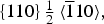 ${\rm \{ 110\}} {\textstyle\,{{\rm 1} \over {\rm 2}}\,}\langle \overline {\rm 1} {\rm 10}\rangle, $
and hard
${\rm \{ 110\}} {\textstyle\,{{\rm 1} \over {\rm 2}}\,}\langle \overline {\rm 1} {\rm 10}\rangle, $
and hard ${\rm \{ 001\}} {\textstyle\,{{\rm 1} \over {\rm 2}}\,}\langle \overline {\rm 1} {\rm 10}\rangle $
slip systems in MgO,[
Reference Korte and Clegg
70
] the oxide ceramics MgAl2O4 spinel, and Al2O3 alumina (unpublished) as well as the semiconductors InAs (unpublished) and Si.[
Reference Korte, Barnard, Stearn and Clegg
31
]
${\rm \{ 001\}} {\textstyle\,{{\rm 1} \over {\rm 2}}\,}\langle \overline {\rm 1} {\rm 10}\rangle $
slip systems in MgO,[
Reference Korte and Clegg
70
] the oxide ceramics MgAl2O4 spinel, and Al2O3 alumina (unpublished) as well as the semiconductors InAs (unpublished) and Si.[
Reference Korte, Barnard, Stearn and Clegg
31
]

The hard materials are also often less prone to FIB damage in the form of formation of dislocations as seen frequently in the soft metals.[ Reference Kiener, Motz, Rester, Jenko and Dehm 52 ] Only a blessing at first glance, this does mean that nucleation must be considered to play a substantial role in determining the stresses required for deformation. In metals, where the stress required to move a dislocation, even a short segment, is usually much lower than the nucleation stress, the regimes of dislocation motion and nucleation are often readily distinguished.[ Reference Johanns, Sedlmayr, Sudharshan Phani, Mönig, Kraft, George and Pharr 62 ] In very hard materials, the critical stresses for dislocation nucleation (i.e., a fraction of the shear modulus), and the stress to overcome the lattice resistance may be close enough to not allow a distinction based on stress level alone. This is due to the experimental scatter and uncertainties of the stress calculation, such as the choice of representative cross-sectional area in tapered micropillars. As a result of the similar activation volumes of double kink formation and dislocation nucleation,[ Reference Zhu, Li, Samanta, Leach and Gall 63 ] a distinction based on variable rate testing also appears difficult. It should be noted, however, that in many cases stable deformation can be achieved even in brittle crystals. Under such conditions, continuous formation of new dislocations is required and where surface steps have been formed as a result of slip crossing the pillar, the nucleation stresses will fall significantly[ Reference Li and Xu 64 ] to or below the stresses required for nucleation motion.
An example of the surface affecting scatter and strength of silicon micropillars is shown as part of Fig. 3, where testing of pristine 2 µm pillars at room temperature led to appreciable scatter, presumably due to the need to nucleate dislocations from a fairly pristine surface damaged mostly in terms of amorphization during FIB milling, but with no line defects visible by TEM in the undeformed volume.[ Reference Korte, Barnard, Stearn and Clegg 31 ] Consistently, testing at the same temperature after exposure to some high-temperature surface oxidation resulted in a much smaller scatter and average strength values toward the lower bound of those measured in the pristine pillars.[ Reference Korte, Barnard, Stearn and Clegg 31 ]
In general, the effect of size on strength is less pronounced in hard materials, but also more difficult to quantify. This is due to the missing overlap in sample size tested in brittle materials, where samples of the order of microns can be deformed plastically, but no bulk samples can be prevented from fracturing at low temperatures. A representative bulk yield stress then needs to be estimated from macroscopic data collected at high temperatures and extrapolated toward lower temperatures. This approach includes significant errors in the application of any type of equation describing thermal activation and the resulting Peierls barrier or lattice resistance at temperatures above 0 K, such as[ Reference Bhakhri, Wang, Ur-rehman, Ciurea, Giuliani and Vandeperre 65 , Reference Clegg, Vandeperre and Pitchford 66 ]
 $$\tau (T,\rho _{\rm m}, \dot \gamma ) = \tau _{\rm P} + \displaystyle{{kT} \over V}\ln \left( {\displaystyle{{\dot \gamma} \over {\rho _{\rm m} b^2 \nu _{\rm A}}}} \right),$$
where τ
P is the Peierls stress (i.e., the lattice resistance at 0 K), k the Boltzmann constant, T the absolute temperature, V the activation volume, $\dot \gamma $
the shear strain rate, ρ
m the mobile dislocation density, b the Burgers vector, and ν
A an attempt frequency of the order of 1011 s−1.[
Reference Bhakhri, Wang, Ur-rehman, Ciurea, Giuliani and Vandeperre
65
,
Reference Frost and Ashby
67
] There are several parameters, which are difficult to determine accurately in a small-scale experiment, even if the microsample has been machined from the same bulk material, as the dislocation density may have been changed by FIB milling[
Reference Shim, Bei, Miller, Pharr and George
68
] and be affected by dislocation exhaustion during deformation.[
Reference Kiener and Minor
69
] In addition, the shear strain rate may vary locally for a tapered pillar. A more detailed discussion of this difficulty may be found in Ref. Reference Korte and Clegg70. A direct comparison of different slip systems in the same material, while maintaining a constant level of FIB damage and similar effects of taper, confirms the general trend of an increased size effect at the reduced bulk strength (Fig. 6).
$\dot \gamma $
the shear strain rate, ρ
m the mobile dislocation density, b the Burgers vector, and ν
A an attempt frequency of the order of 1011 s−1.[
Reference Bhakhri, Wang, Ur-rehman, Ciurea, Giuliani and Vandeperre
65
,
Reference Frost and Ashby
67
] There are several parameters, which are difficult to determine accurately in a small-scale experiment, even if the microsample has been machined from the same bulk material, as the dislocation density may have been changed by FIB milling[
Reference Shim, Bei, Miller, Pharr and George
68
] and be affected by dislocation exhaustion during deformation.[
Reference Kiener and Minor
69
] In addition, the shear strain rate may vary locally for a tapered pillar. A more detailed discussion of this difficulty may be found in Ref. Reference Korte and Clegg70. A direct comparison of different slip systems in the same material, while maintaining a constant level of FIB damage and similar effects of taper, confirms the general trend of an increased size effect at the reduced bulk strength (Fig. 6).
A last difficulty in achieving a direct comparison between bulk and microscale deformation may occur where dislocations move as dissociated partials with an increasing dissociation distance as the stress on the slip plane is raised.[ Reference Wessel and Alexander 71 ] Where the sample size is reduced, the leading partial may cross the entire volume without nucleation of the trailing partial, as shown, for example, in GaAs.[ Reference Michler, Wasmer, Meier, Ostlund and Leifer 26 ] The implications for the stresses measured must then be assessed carefully in each case. Possible strategies to avoid this problem include careful choice of the crystal orientation such that the Schmid factor becomes larger for the trailing partial and selection of as large a pillar size as possible.
Thermal activation of plasticity
In case of hard materials, the study of thermal activation is of particular interest for three reasons: firstly, high-temperature mechanical properties are often of interest in those to be applied at high temperatures. Secondly, the underlying deformation mechanisms and their rate-limiting steps may be understood in greater detail by studying the associated activation volumes and therefore rate and temperature dependence [cf. Eq. (1)] and, thirdly, correlation with macroscopic experiments is usually confined to reference data at high temperatures, in which case the interpolated gap should be minimized.
An example of high-temperature microcompression testing is shown in Fig. 8. Having first been demonstrated in air[ Reference Korte and Clegg 35 ] based on the oxide ceramic MgAl2O4 and a few years later in vacuum[ Reference Korte, Stearn, Wheeler and Clegg 36 ] initially using a superalloy, it is now routinely available to several hundred degrees and being developed based on similar efforts in nanoindentation to 1000 °C in order to achieve temperatures relevant to operation in turbines.[ Reference Beake, Harris, Fox-Rabinovich, Rauh, Davies, Armstrong and Vishnyakov 72 ] Especially in the highly anisotropic superalloys, the advantage of uniaxial testing is again apparent in that macroscopic yield stresses are reproduced in uniaxial compression (cf. pillar and macroscopic yield stress in Fig. 8), while in nanoindentation the triaxial stress-state causes significant deviation from uniaxial test results even if the 8% flow stress is taken as a reference, consistent with the change in superalloy properties based on orientation.
High-temperature microcompression experiments. First demonstrated in air on spinel[ Reference Korte and Clegg 35 ] to 400 °C (left) and in vacuum to 630 °C on the superalloy CMSX-4 tested[ Reference Korte, Stearn, Wheeler and Clegg 36 ] (right). Extensive plasticity at 200 °C in spinel, about 1500 °C below significant plasticity is commonly achieved in conventional uniaxial testing without hydrostatic pressure, highlights again the effect of size on fracture, while the data obtained on the superalloy reveals the importance of uniaxial testing and choice of representative strain in comparison with macroscopic data and high-temperature nanoindentation affected by the 3D stress-state in the highly anisotropic crystal. Image of spinel micropillar (left) adapted from Ref. Reference Korte and Clegg35 and plotted data taken from [I],[ Reference Korte, Stearn, Wheeler and Clegg 36 ] [II],[ Reference Gibson, Schröders, Zehnder and Korte-Kerzel 99 ] [III],[ Reference Reed 11 ] [IV],[ Reference Wee and Suzuki 100 ] [V].[ Reference Conforto, Molénat and Caillard 101 ] Images reprinted with permission by Elsevier from Ref. Reference Korte and Clegg35 and Cambridge University Press from Ref. Reference Korte, Stearn, Wheeler and Clegg36.

Exemplified above in the case of silicon, high-temperature tests can give valuable information regarding transitions in deformation mechanism, thermal activation and properties in a certain temperature range. However, studies of rate sensitivity at a given temperature as well as creep/relaxation testing at the extremes of slow rates/long times are often of interest, either where not enough measurements can be taken in a specific temperature regime to extract a gradient or where creep mechanisms are of interest.[ Reference Maier, Merle, Göken and Durst 42 , Reference Wehrs, Deckarm, Wheeler, Maeder, Birringer, Mischler and Michler 73 – Reference Maier, Durst, Mueller, Backes, Höppel and Göken 76 ] Strain rate jump tests and creep/relaxation hold segments may therefore be employed in microcompression in a similar way to macroscopic testing (Fig. 9). Points to consider when performing such experiments usually include the change in cross-sectional area in ex situ experiments, compatibility of tip and sample material at elevated temperatures[ Reference Wheeler and Michler 77 ] and long contact times as well as the effect of temperature on gallium, both positive and negative, by encouraging diffusion from the sample surface into the bulk or formation of low-melting phases.
Studies of rate sensitivity in nickel, including rate jump testing, creep, and relaxation hold segments in microcompression inside the SEM.[ Reference Wheeler, Armstrong, Heinz and Schwaiger 38 ] Reprinted with permission by Elsevier from Ref. Reference Wheeler, Armstrong, Heinz and Schwaiger38.

Extracting general principles of plasticity
Where fundamental deformation mechanisms and the effect of local atomic arrangement and bonding character are of interest, experiments are often correlated with ab initio calculations in order to elucidate the underlying atomic environment.[ Reference Gouriet, Carrez, Cordier, Guitton, Joulain, Thilly and Tromas 78 , Reference Emmerlich, Music, Braun, Fayek, Munnik and Schneider 79 ] However, in crystals with large unit cells and especially where repeating sub-units are also large, the use of ab initio approaches is limited by the size of the required cell. Other modeling approaches, such as atomistic modeling requiring suitable interatomic potentials[ Reference Hammerschmidt, Drautz and Pettifor 80 ] and novel methods for extraction of dislocation core structure[ Reference Walker, Gale, Slater and Wright 81 ] and lattice resistance[ Reference Cordier, Amodeo and Carrez 9 ] are advancing continuously. Their application to complex crystals will be of particular interest where not only computation time for ab initio calculations is an issue, but also where there is a direct application of commonly accepted concepts. This applies for example to the use of the generalized stacking fault energy.[ Reference Vítek 82 ] Usually computed for a few selected planes, these may not be straightforward to interpret, as they do not give dislocation core structures directly and also do not immediately highlight complicated deformation mechanisms relying on coordinated movement on adjacent planes, e.g., synchroshear,[ Reference Chisholm, Kumar and Hazzledine 14 ] or mechanisms based on shuffling of atoms, as proposed for the giant metadislocation cores of quasicrystal approximants.[ Reference Heggen and Feuerbacher 83 ]
However, the addition of modeling to the basic approach of nanomechanical testing and simple microstructural characterization is nevertheless powerful, particularly where either the modeling or more in-depth TEM-based methods are individually too time-consuming in execution or subsequent analysis to perform for a vast matrix of crystal orientations, lattice planes, etc. While microcompression can enable the quantitative characterization of activated slip systems in a crystal of unknown slip geometries in combination with TEM, this approach does not directly give defect structures. These are analyzed by time-intensive characterization methods such as two-beam imaging or LACBED analysis of Burgers vectors[ Reference Morniroli 84 ] and HR-TEM of defects to obtain their atomic structure. Guided by initial experimental results—such as operative slip planes from microcompression with EBSD and/or conventional TEM plane trace analysis—ab initio calculations can be focused based on this experimental data. The calculations can, for example, identify slip planes for generalized stacking fault calculations, which in turn guides high-resolution work in identifying potential Burgers vectors and stacking faults, e.g., the choice of membrane orientation. In this way, the combination of both approaches also offers a strategy to find correlations between crystal structure and bonding conditions on the one hand and critical stresses, active slip systems, and defect structures on the other, even in complex crystals where current understanding is very limited. An example of such an approach is summarized in Fig. 10, where the study of plasticity in the hard coating material and superconductor Mo2BC has benefited from the closely linked analysis by both ab initio, nanomechanical and electron microscopy methods.[ Reference Korte-Kerzel, Klöffel and Meyer 85 ]
Combination of ab initio calculations and microcompression with SEM/EBSD and TEM. Gamma surface calculated by B. Meyer and T. Klöffel.[ Reference Korte-Kerzel, Klöffel and Meyer 85 ]

Conclusions and future challenges
Microcompression has the potential to dramatically expand our knowledge of plasticity mechanisms in hard, brittle and anisotropic crystals and extend our understanding of the interplay between crystal structure and defect mobility toward high crystalline complexity.
The major challenge overcome by scaling down the conventional uniaxial compression is the suppression of cracking, making experimental data on plasticity and subsequent analysis of plasticity mechanisms available at low temperatures and in the most brittle materials not previously accessible. In addition, quantitative measurements of stresses in the hardest materials are less affected by size effects.
Challenges in improving both execution and interpretation of studies on hard materials using microcompression will include the:
-
• Evaluation of the role of dislocation nucleation, its impact on stresses measured and strategies to assure dislocation motion rather than nucleation is the mechanisms governing plasticity in the experiment.
-
• Study of further size effects on deformation, such as the motion of individual partials. This needs to be considered in greater detail and its effect on critical stresses and residual defect structures resolved for the case of more complex unit cells.
-
• Implementation of reliable and stable high-temperature testing techniques, including compatible indenter tip materials, suitable sample preparation methods and availability of dedicated equipment, and transparent strategies for data analysis.
-
• Development of computational methods complementing future studies to elucidate the structure and motion of dislocations in complex crystals.
-
• Acceleration of test routines, preparation and analysis in order to allow systematic experimental matrices and optimization of analytical depth for each given sub-set of experiments.
-
• Adaptation and use of novel combinatorial techniques allowing testing at the single-crystal level where limitations exist with respect to established techniques, such as small grain sizes in thin films and diffusion times as well as phase width in diffusion multiples.
Whatever progress will be achieved over the next years, systematic studies of complex crystals varying structure and elemental composition without restrictions on the availability of large single crystals or brittleness have the potential to answer fundamental questions in our understanding of plasticity. They can open our horizon for materials development and search of new candidates for structural materials enabling the future technologies we already envision and the often extreme conditions associated with them.
Acknowledgments
The author would like to thank Dr. J. S. K.-L. Gibson and the reviewers for their encouragement and constructive criticism on the manuscript.


 Open access

