

This article is part of a larger investigation into the relationship between dance and politics in Argentina during the 1960s and 1970s. As Victoria Fortuna (Reference Fortuna2013, 68–69) points out, most of the historical studies of modern and contemporary dance in Argentina have focussed on describing the process of modernizing artistic practices.Footnote 1 Accordingly, certain studies have organized their historical discourse by taking as their starting point a description of the influence that given foreign artists exerted on the aesthetic development of stage dance. The following study aims to give an account of the specific character of the Argentine case by viewing its relationship with cultural metropolises as an important variable, but not as its main angle of study.
To be more specific, I believe that a feature that defines how dance practices evolved in Argentina in this period was the fact that “actors” in the field were constantly compelled to deal with the political. Dance practices had to adapt to a context of institutional instability that was linked to a fragile democratic order and successive coups d’état. They were also subject to control: the two works I intend to study suffered attempts by the dictatorial government to censor them. Nevertheless, dance played an active role in the political space. By studying the impact caused between 1968 and 1970 by two contemporary dance works presented by the San Martín Theater Ballet, Oscar Aráiz's The Rite of Spring and Ana Itelman's Phaedra, I shall attempt to analyze the position these practices occupied in a context of widespread social contestation. Ultimately, this article will seek to reflect on the politicality of these works (Vujanovic Reference Vujanović, Siegmund and Hölscher2013), that is to say, on their capacity to act politically in a specific historical context.
Dictatorship and Utopian Subversion
On June 28 1966, a coup led by General Juan Carlos Onganía overthrew the democratically elected president Arturo Illia. This was the fourth coup against a constitutional government since 1930. The new dictatorship called itself Revolución Argentina (Argentine Revolution) and aimed to install itself in power for a prolonged period in order to fundamentally modify economic, social, and cultural conditions. The coup arose under the influence of what is known as the “Doctrine of National Security” linked to various US foreign policy actions aimed at preventing the advance of communism in Latin America in the context of the Cold War and after the Cuban revolution. Accordingly, the new dictatorship was characterized by a strongly anticommunist ideology.Footnote 2
The control and repression practiced by the Onganía dictatorship were resisted from various spaces, by the workers' movement and political militants as well as by the universities and the cultural sector. Three years after the coup, in May 1969, there was a popular uprising in the city of Córdoba, known as the Cordobazo, which weakened Onganía's leadership within the military elite. In the course of the following years a progressive radicalization of political militants took place; in other words, some militants started to view armed struggle as the only option for achieving a return to democracy and profoundly changing society. A triumphalist atmosphere reigned among wide sectors of militants, who claimed that a revolution was imminent or genuinely close to happening, something that represented at the time the sensation of living through “an abrupt and imminent change in all fields of life” (Longoni Reference Longoni2014, 22). In 1970 the guerrilla organizations started to act openly, throwing the authoritarian government into crisis. In June of that year, Onganía was replaced by Roberto Marcelo Levingston, another military man. The early years of the 1970s constitute one of the most politically explosive phases in the whole of Argentine history. Sociologically speaking, this historical moment tends to be defined as one of widespread social contestation that produces a situation of social ungovernability. In response to this extreme situation, the authoritarian government decided to call a democratic election, and the decision was taken to lift the ban on Peronism.Footnote 3 As a result Juan Domingo Perón returned to the country in 1973. In this connection, Tortti (Reference Tortti and Pucciarelli1999) maintains that Perón's return to power with a reformist program did not represent a triumph for the revolution but rather the only way the ruling classes could find to keep a truly revolutionary process from developing.
It is against this backdrop of widespread contestation that the first civil rights movements started to emerge. For example, 1970 saw the birth of the Unión Feminista Argentina (Argentine Feminist Union). Then, in 1972 the Movimiento de Liberación Femenina (Women's Liberation Movement) was founded (Calvera Reference Calvera1990; Andújar et al. Reference Andújar, D'Antonio, Lozano, Grammático and Rosa2009). In parallel, the Frente de Liberación Homosexual (Homosexual Liberation Front) was created in 1971. As the poet and sociologist Nestor Perlongher, an active member of the Frente de Liberación Homosexual, explained, the organization embodied the desire of a minority of homosexuals “to take part in a supposedly revolutionary process, from a place in which their own sexual and living conditions could be addressed” (Perlongher Reference Perlongher2008, 78). Thus, it can be argued that the socially explosive moment that characterized the first few years of the 1970s went beyond the realm of party politics. The movements mentioned emerged from the fertile soil of a youth culture in search of greater personal freedom that took up sex as a tool to bring about a change in morals.
Political radicalization also found direct expression in the arts. Longoni and Mestman (Reference Longoni and Mestman2002) describe the journey made by a group of artists who in the course of 1968 broke with the artistic institutions they had previously been involved with—basically, with the Di Tella Institute—and adopted an attitude of direct opposition to the military government. The best-known expression of this movement was the collective work Tucumán Arde (“Tucumán is burning”), which took place at the end of that year (Longoni and Mestman Reference Longoni and Mestman2002, 21). According to Longoni, there was a first period in which certain visual artists sought to achieve a direct effect in the political sphere with their works. However, in the new period beginning in 1969, the acceptance of revolutionary violence as the only route to transformation led them to question the place of art (Longoni Reference Longoni2014, 54). As a result, many of these artists gave up practicing their art to join the armed struggle. The process of political contestation thus led to certain groups questioning the very meaning of art as a practice.
This is the context in which the works analyzed in this article are presented: a context of widespread contestation and redefinition of social, cultural, and political practices. Nevertheless, it is necessary to point out that Oscar Aráiz and Ana Itelman were not part of this radicalized youth. Unlike the artists studied by Longoni and Mestman, Aráiz and Itelman did not sever their ties with arts institutions for ideological reasons. Nor did they explicitly adopt a discourse of opposition to the dictatorship, and neither did they actively participate in political militancy. Nevertheless, as I shall attempt to demonstrate, their works were a political intervention of a very special kind. As Mark Franko maintains, “politics are not located directly ‘in’ dance, but in the way dance manages to occupy (cultural) space” (Reference Franko2006, 5). In that regard, my analysis will seek to study artistic representation as action, that is to say, the staging of a work understood as a social act whose meaning is not determined solely by the explicit will of its creator but instead emerges from the way it is received. The presentation of a work understood as a social act acquires meaning from the effects of its intervention in the network of power relations in which it acts.
In this sense, my work implies a redefinition of the role of the author. As we shall see, it is not choreographers alone who are responsible for giving their work a political content. Unlike the artists studied by Longoni and Mestman, who explicitly adopt a political position in a personal manner, in the case of The Rite and Phaedra the political content emerges as an effect of the action. The theater authorities with their links to the dictatorship that tries to censor them as well as the journalism that vindicates them are cultural actors who give political content to the work above and beyond the choreographers' explicit intentions. Thus, I take as my starting point a deregulation of the role of the author and consider the social network of the works' reception as a producer of meaning.
In the historical period under study, the gaze of the authoritarian power occupies a central role that, in some ways, determines the political character of the works created. Thus, it is essential to give an account of the categories the dictatorship used to interpret political acts against the regime. In their study of censorship, Invernizzi and Gociol (Reference Invernizzi and Gociol2003) summarize the conceptual distinction drawn by the dictatorship between Marxism and subversion. In order to define something as Marxist, the analysts of the intelligence services looked for direct references in published material to “class struggle,” “dialectical materialism,” or for the presence of key names, such as Marx, Engels, Che Guevara, Lenin, Trotsky, or even Marcuse or Antonio Gramsci. To define something as subversive, however, they made use of much broader and more heterogeneous categories, such as “questioning the established order,” “unionization,” “abortion,” “sexual freedom,” or “liberation theology” (Invernizzi and Gociol Reference Invernizzi and Gociol2003, 50). In this way, while the category Marxist pointed to the existence of a defined theoretical political program, the category subversion was applied to a fuzzy range of ideas and practices that were, nevertheless, viewed as questioning the social and cultural order. Given the way in which the concept of subversion is used by authoritarian power, it presupposes the existence of nonideological types of political intervention. In this way, a dance piece could clearly be considered subversive, that is to say, as an act tending to alter the established order.
In short, I believe that in The Rite and Phaedra there is an element that might provide the key to interpretation. Both works implicitly mobilize the figure of the utopian, of the a-topos (no-where), of a nonexistent space from which are projected images, bodies, and discourses capable of challenging fundamental mechanisms of power such as patriarchal domination or Catholic morality. Thus, I aim in this study to affirm the figure of a utopian subversion. Paul Ricoeur argues that it is through utopia that fundamental social questions such as the family, consumption, authority, and religion can be radically rethought (Reference Ricoeur1986, 16). In that regard, he says that imagining another society possesses an undeniable capacity for questioning reality (Ricoeur Reference Ricoeur1986, 16). Using the concepts developed by Jill Dolan (Reference Dolan2005) and José Esteban Muñoz (Reference Muñoz2009), my aim is to analyze the utopian content of the dance works mentioned, considering them in their turn as forms of political action.
Throughout my analysis, I will provide basic historical data about the development of dance in Argentina that can give an account of its specific qualities and the working conditions of its interpreters and choreographers. For that reason, before embarking on a study of the works using the hypothesis I put forward, I will present two topics that I consider play a central role in understanding artistic output in the period under review. The first relates to the place occupied by dance practice in the context of youth culture. As we will see, the dance creations studied developed under a double tension: with regard to the authoritarian regime on the one hand and to political militancy on the other. The second topic refers to how censorship operated under the Onganía government. Aside from its staunch anticommunism and its respect for Catholic morality, the Argentine dictatorship did not articulate a carefully thought-out ideology. In that sense, it can be differentiated clearly from what is considered a totalitarian regime. The lack of clear rules as regards the application of censorship led to a cultural scene with many instances of negotiation, one in which contradictory phenomena coexisted. In my view, the existence of this unregulated space was one of the conditions for the emergence of utopian subversion in dance.
The San Martín Ballet (El Ballet del San Martín)
The year 1968 was a foundational moment in the history of contemporary dance in Argentina. This was the year that saw the creation, under the direction of Oscar Aráiz, of the Ballet del Teatro San Martín (San Martín Theater Ballet), the country's first contemporary dance company to be supported institutionally and financially by the state. Until then, contemporary dance had developed through private initiatives and through the work of a nongovernmental organization, la Asociación Amigos de la Danza (the Friends of the Dance Association; Kaehler Reference Kaehler2012). According to Aráiz's account (Reference Aráiz and Rovner1993, 8), in a text that describes this first experience, the San Martín Theater Ballet inherited an identity linked to the works that had been launched by the Friends of the Dance Association, whose main feature was their aesthetic heterogeneity and the juxtaposition of classical and modern techniques.
In the mid-1960s, dance in Argentina was still at an embryonic stage. The dancers who made up the ballet in 1968 had received different kinds of training. One group, linked to the Ballet del Teatro Argentino de La Plata (Ballet of the Argentine Theater of La Plata), with ballerinas such as Irma Baz or Norma Binaghi, had been classically trained; another group including Susana Ibañez, Doris Petroni, and Ana María Stekelman, among others, had a solid background in contemporary dance. A third group, which included Mauricio Wainrot and José Carlos Campitelli, consisted of young people who did not have a great deal of experience. All these dancers are today major personalities on the Argentine contemporary dance scene, which shows how important this Ballet Company was in the development of artistic activity in Argentina (Tambutti Reference Tambutti2000, 120).
Nevertheless, the fate of the San Martín Theater Ballet during those years depended to a great extent on the discretion of the municipal authorities. In 1968, César Magrini was appointed director of the theater, with the support of Roberto Vernengo, Municipal Secretary of Culture, and Manuel Ircibar, governor of the city of Buenos Aires. Magrini was a writer and journalist and the musical correspondent for the daily newspaper El Cronista Comercial. In that paper he had frequently written highly complimentary reviews of the choreographer Oscar Aráiz's dance compositions. As Aráiz recounted in an interview, the plan to create the ballet was his own initiative. Magrini commissioned him to organize a series of dance performances and the choreographer suggested to him that a company should be set up that would work in the theater permanently and be associated with the language of contemporary choreography (Isse Moyano Reference Isse Moyano2006, 112). After some initial hesitation, Magrini agreed to the plan.
In the years leading up to that, the success of two works had propelled Aráiz to the position of director of the ballet company despite his youth (he was twenty-seven in 1968.) One was The Rite of Spring, premiered in 1966 with the support of the Friends of the Dance Association, and the other was Crash, presented in the Instituto Di Tella (Di Tella Institute) in 1967. The latter was an unprecedented success for contemporary dance in Argentina. In 1967 and 1968 it was performed over one hundred times to an average audience of one hundred fifty, according to the accounts of the Di Tella Institute. The work, defined as “a divertimento in one act and twenty-two scenes without a curtain,” was described by the critics as provocative, humorous, and a “creative experiment.”Footnote 4 Crash, which had a highly eclectic sound track ranging from the chant of a group of soccer fans to Beatles songs, was the expression of an emerging youth culture. In a magazine article, Aráiz said:
I do things, I'm always doing things, I never stand still because standing still is dying. I adore miniskirts and long hair. Money doesn't excite me at all: I have a flat in Belgrano, a bed, a dog—Ron—and three pictures. That's it. At the Di Tella I wanted to do an entertaining collage, to get away a bit from the ballet stereotype, to show something new.Footnote 5
Aráiz's words—possibly “touched up” by the reviewer—chimed perfectly with the basic ideas of hippie culture and pop as artistic movements, both of which were a novelty in Argentine society of the time.
Two years earlier, the magazine Primera Plana (Front page), at that time the most influential and most widely read weekly in Argentina, published a piece with the title “Pop, ¿Una nueva manera de vivir?” (Pop: A new way of life?) in which an attempt was made to define this artistic style using the Di Tella InstituteFootnote 6 and the artist Marta MinujínFootnote 7 as points of reference nationally.Footnote 8 The piece presented a phrase by the artist Susana Salgado as a summary of pop's imaginary: “We don't do theory, we simply live in a fairy tale.”Footnote 9 Pop as a cultural movement supposedly expressed a posture that was simultaneously nonconformist and naive regarding political and social reality. As an example of pop dance, the Primera Plana piece mentioned a work by the choreographers Marilú Marini and Ana KamienFootnote 10 called Dance Bouquet, which was presented at the Di Tella Institute in 1965 and can be seen as an aesthetic forerunner of Crash. Marini and Kamien's work included visual artists, musicians, and actors as well as ballerinas, and it was inspired by popular culture: comics, Hollywood movies, and music hall. In fact, in many cases the ballerinas' gestures were taken from fashion photographs (Herrera Reference Herrera2010, 42–43). One could say that, artistically speaking, at the time of the creation of the San Martín Ballet, Oscar Aráiz occupied an intermediate, and in some sense strained, position between the pop movement, hippie culture, and official high culture represented nationally by the Teatro Colón.
Nevertheless, from the point of view of the relationship between art and politics, Aráiz found himself in a different position. Within the space of youth culture at that time, Pujol identifies a tension between two currents: that of young people who were politically committed and that of counterculture young people who were associated with rock music, pop, and the hippie movement (Pujol Reference Pujol and James2003, 311). In his view, there was an ideological incompatibility at that time between the popular anti-imperialist nationalism of the Juventud Peronista (Peronist Youth) and the artistic practices of the counterculture, which were seen politically as an expression of cultural imperialism (Pujol Reference Pujol and James2003, 313). Artists linked to the counterculture thus faced a double rejection: first, on the part of the Onganía government, which associated their practices with subversion, and second, on the part of political militants from the Left, who considered them superficial and imperialist.
The piece in the magazine Siete Días Ilustrados that portrayed Aráiz as a hippie was in reality quite critical about Crash. It interpreted the work as a concession by the choreographer to commercialism after the fiasco that was the 1967 censoring of his Rite of Spring:
When this year the censors objected to the performance of Igor Stravinsky's The Rite of Spring at the Teatro Colón because they considered that the work and the choreography were an affront to public decency, Aráiz did not only lose part of his audience. Basically, he was left out of the framework of official prestige that surrounds the old building on Calle Libertad [the Teatro Colón]. He then decided to put on a performance in another, less prestigious and less official, cultural building, … the Di Tella Institute.Footnote 11
In the eyes of the writer of the article, Crash was a desperate attempt to “fit in” or “adjust” to the new medium after Aráiz's earlier rejection by “official culture.” The article, which in some ways blamed Aráiz for his work being censored, was disingenuous. In reality, the implicit aim was to legitimize the cultural control being exercised by Onganía's authoritarian government.
Censorship
As Buch states (Reference Buch2001, 109–110), from the time of the coup on June 28, 1966, on, the authoritarian government waged a campaign to raise the country's moral standards by censoring people's actions, such as wearing long hair, kissing in public squares, having extramarital affairs, or being homosexual. In addition to the banning of political parties, there was also constant intervention in Argentina's cultural life, such as the censoring of many forms of expression: graphic, artistic, cinematographic, theatrical, musical, and dance-related. The policy of censorship was a central part of government thinking, encouraged in part by the dictator's wife, María Green de Onganía. She was the one who walked out on the performance at the Teatro Colón because she was scandalized by the supposedly extreme erotic charge of Araíz's Rite of Spring. It was May 17, 1967, and the choreography was being presented as part of a musical evening in honor of Prince Akihito of Japan. The reaction of Onganía's wife meant that the piece was immediately removed from the theater's program of performances.
Two months later, on June 9, and with the “scandalous” precedent of Aráiz's work in mind, Onganía categorically demanded the banning of Alberto GinasteraFootnote 12 and Manuel Mujica Láinez's opera Bomarzo, for which Aráiz had provided the choreography. The Bomarzo case, studied by Buch (Reference Buch2003), highlighted the inconsistencies in the military government's cultural policy and caused a strong press reaction. The opera had its first performance at the Lisner Auditorium in Washington on May 19 that same year in front of an audience that included the vice president of the United States and the Argentine ambassador. In an official decree in April, the government had announced that the opera's premiere was an important event for Argentine culture. It was unbelievable, said a magazine article, that the same work should be censored due to its “obsessive references to sex, violence and hallucination.”Footnote 13
The censoring of the opera Bomarzo, like the censoring of Aráiz's Rite, exposed the internal tensions besetting the dictatorial government. As Sidicaro says (Reference Sidicaro and Pucciarelli2004, 81), the coup coalition that swept Onganía to power in 1966 was like no other in that it brought together actors who were so different and had such divergent interests and views of society. The government's policy of raising moral standards was a response to the influence of the Catholic Church; at the same time that policy was in opposition to a certain section of the culturally sophisticated bourgeoisie who were equally close to the government and saw works like Bomarzo or The Rite of Spring as expressions of cultural modernization. This lack of consistency in the evaluation of artistic practices went hand in hand with an unclear and, to some extent, perverse way of applying censorship.
Unlike in other paradigmatic cases, for example, in Francoist Spain, in Argentina there was never a centralized censorship office with established ways of working and a visible administrative organization (Avellaneda Reference Avellaneda1986, 13–14). Nor, with the exception of cinema and radio, did the discourse of censorship lay down a precise code of practice aside from some general moral guidelines opposing communist ideology. This lack of specification aimed at establishing self-censorship mechanisms both for artists and for the cultural institutions that were responsible for the works they presented. The piece in the magazine Primera Plana “La censura va por dentro” (Censorship comes from within) was a report on this situation. Footnote 14
The authorities in their turn used a double standard that undermined their acts of censorship. In a recent interview, Oscar Aráiz stated that, in effect, no decree was ever published prohibiting his Rite of Spring. Footnote 15 It was banned from the Teatro Colón, but there was no ban on its being performed in other theaters. A similar procedure occurred with Bomarzo, as Buch states (Reference Buch2003, 109). Nevertheless the fear of a new ban discouraged producers from showing the works in a private theater. In her study of Argentine theater under the last dictatorship, Graham-Jones (Reference Graham-Jones2000, 20–21) identifies the practice of countercensorship as a form of opposition to censorship and self-censorship. Countercensorship involves artists using strategies designed to get a potentially censorable message through to the public by the use of shared codes. As we shall see later on, thinking of The Rite and Phaedra in those terms is problematic since their authors denied, or were not aware of, the political character of their works. Nevertheless, we can consider their utopian component as an element that functioned as a countercensorship strategy.
The Rite of Spring
As Fortuna argues (Reference Fortuna2013, 64), reference to cultural metropolises in the case of dance functioned historically as a way of legitimizing local artistic production. Oscar Aráiz's Rite of Spring replicated this rationale. The fact that an Argentine choreographer was capable of producing a version of this work raised—or at least sought to raise—Argentina symbolically to the cultural level of Europe or the United States. The piece published in the magazine Panorama about the 1966 premiere of the work, entitled “The consecration of Stravinsky and his choreographers,”Footnote 16 confirms this interpretation. The article pointed out with pride that Aráiz was the sixth choreographer, after Vaslav Nijinsky, Leonide Massine, Boris Romanoff, Maurice Béjart, and Kenneth MacMillan, to create a ballet based on Stravinsky's music.Footnote 17 Bearing this interpretation in mind makes it possible to understand why the Argentine minister of foreign affairs decided to offer a performance of this work to the Japanese prince in order to demonstrate the country's high cultural standing. Nevertheless, the magazine critic simultaneously pointed to the great influence that Maurice Béjart had presumably had on Aráiz's version. This French choreographer had presented his Rite in the Teatro Colón in 1963 to great public acclaim. The article insinuated that Aráiz's version was lacking in originality. The incomplete nature of the process of modernizing Argentine dance (Fortuna Reference Fortuna2013; García Canclini Reference García Canclini2005) was revealed in Aráiz's Rite through its supposed lack of originality. This raises the question whether this criticism tells us more about Aráiz's need to have a foreign point of reference to legitimize his aesthetic ideas or about the critics' need to belittle Aráiz's project in order to meekly confirm the peripheral nature of local culture.
Oscar Aráiz was twenty-six at the time of the first performance of his Rite. In an interview (Falcoff Reference Falcoff and Durante2008, 270), he stated that his interest in Stravinsky's music went back to his early childhood and to the beginning of his dance studies with Elide Locardi, one of the pioneers of modern dance in Argentina (Osswald Reference Osswald2010, 45). The opening tableau of the work, entitled “Germination”, was the one that made the greatest impact on newspaper critics at the time; one of those critics, César Magrini, two years later was to make the creation of the San Martín Theater Ballet possible. In an interview, Aráiz describes that opening tableau as follows:
It is the spirit of the Earth awakening. There's a woman, or it could be a man, who covers the whole of the stage with their skirt, all the material is very taut, and this woman is squatting, she's like a shoot, something that is beginning to germinate, that is coming out of the Earth, a stalk. Underneath, the Earth begins to curl up and becomes a monstrous placenta, the dancers underneath make ripples in the material with their breath and everything begins to come to life. Bit by bit this whole society is being born, this tribe that will create the ritual.Footnote 18
Doris Petroni, The Rite of Spring, 1970. Choreography by Oscar Aráiz, photo by Alicia Sanguinetti.

The work represented the idea of regeneration, the birth of a new society, a longing that manifestly existed at the time, especially among the young. Over the years, Aráiz has made several statements about the piece, which, in his view, profoundly changed its meaning in accordance with the different versions in which it was performed. Brigitte Kehrer (Reference Kehrer and Buffat1988, 17) describes the version that the choreographer put on in Geneva during the Falklands War in 1982, a version he made aggressive and military, partly changing the staging as a way of expressing his anguish at the confrontation between Argentina and Great Britain. In hindsight, Aráiz defines the 1960s version of The Rite as a “Dionysian festival” that led to his being contracted to choreograph all the operatic bacchanals at the Teatro Colón in those years, such as Samson and Delilah, Bomarzo, Moses and Aaron, and Padmavati (Isse Moyano Reference Isse Moyano2006, 112). The erotic charge was not something unconnected with its creator's wishes, and, in a certain sense, it was part and parcel of his aesthetic project.
The year before the creation of the San Martín Theater Ballet, the suicide of German choreographer Dore Hoyer occurred. In 1960, Oscar Aráiz had been a member of a company led by Hoyer in the Teatro Argentino de La Plata (Argentine Theater of La Plata), in the province of Buenos Aires. This choreographer's influence imparted an expressionist stamp to Aráiz's training, something he transmitted to his pupils (Dorin Reference Dorin, Bohórquez and Ávila Pérez2015, 126). As a tribute, Aráiz recreated Cadena de fugas, which was performed in the first season of the Ballet in 1968. Equally, as a contrast with the introspective atmosphere of Hoyer's work, Aráiz put on Beat Suite at the same time, a divertimento that was a continuation of the pop aesthetic of Crash. On the whole, 1968 was a positive year for the San Martín Ballet, but it ended with a change of personnel in the municipality of Buenos Aires. Alberto Obligado was appointed culture secretary and the following year the general management of the theater was taken over by Fernando Lanús. The change was not necessarily a disadvantage for the group: the company's first European tour, which included Paris, London, and Madrid, was made possible by both officials. However, the third year was set to be rather difficult for the ballet. In Aráiz's words: “1970 would be the last of those three significant years for the San Martín Theater Ballet: even though the personnel did not change much, a cloud was cast over almost the entire season by threats, foreboding, fears, rumors, censorship and, still worse, self-censorship” (Aráiz Reference Aráiz and Rovner1993, 16).
That same year of 1970, the San Martín Theater Ballet put on The Rite of Spring again—the work that had been censored by Onganía three years earlier. That dictator had been replaced in the meantime by Roberto Marcelo Levingston, but the tension over the revival of the work continued. Aráiz claims to have had to stage a dress rehearsal in front of the theater authorities before the performance in order to obtain their approval for the opening night (Aráiz Reference Aráiz and Rovner1993, 16). In an article in Primera Plana entitled “Consagraciones y Brujerías,” and published two years later in 1972, the anonymous writer gave a sort of historical description of the vicissitudes of the work. He or she started with an account of the scandal caused during the special entertainment for the Japanese prince in 1967 and then stated that in 1970 it had been possible to revive the work thanks to Aráiz's promise to make major changes to the choreography and the costumes.Footnote 19 According to the writer of the article, despite these promises the work had been performed in the same way as on previous occasions. The only fundamental change was the replacement of the male principal dancer, who in 1970 was Freddy Romero. In this regard, The Rite of Spring can be interpreted, at least as far as the press was concerned, as a disruptive work, and its revival can be seen as a form of resistance to power in the cultural sphere.
Freddy Romero, The Rite of Spring, 1970. Choreography by Oscar Aráiz, photo by Alicia Sanguinetti.
The program notes for the 1970 version of The Rite included quotes from Georges Gusdorf's (Reference Gusdorf1960, 76–85) Mito y Metafísica (Myth and Metaphysics):
The festival appears as a global liturgy, as a total phenomenon … the whole of existence is transfigured. The festival is the great social game of transcendence, the beginning-again of the Great Beginning. The universe is in the process of being born and … it restores to humankind immense lost possibilities. … The festival reestablishes the extreme situation where order has been born out of disorder, where chaos and cosmos still touch. … Individualities lose their distance and tend to merge. … The festival is a performance without an audience. Everyone is performing for everyone else. The festival celebrates humankind's joy, the springtime of the world and the springtime of humankind.
Several ideas from this text find an echo in Aráiz's work, in which the festival represents a utopia of change and regeneration. As far as I have been able to establish through interviews with Aráiz himself, with several members of the audiences, and with dancers, the structure of the choreography stayed the same over time. In the absence of any recordings of the 1966, 1967, and 1970 performances, my reference points are the interviews already mentioned and the only film version available in the Centro de Documentación de Teatro y Danza del Complejo Teatral de Buenos Aires (Theater and Dance Documentation Center of the Buenos Aires Theater Complex), which dates from the 1990s. Aráiz's Rite respects the basic outline of Nijinsky's original: the existence of a tribal group, the separation of the dancers by gender, and the central role of the Chosen One toward the end of the work. As the work unfolds, several scenes with highly erotically charged male-female duets are presented. Bodies brush against each other, they writhe, they submit to one another, and they reproduce movements that refer to coupling. A certain fusion of the human body with nature is also expressed, united by a basic instinct linked to sexual reproduction. However, the two moments I consider to have the greatest impact are the beginning and the finale of the work.
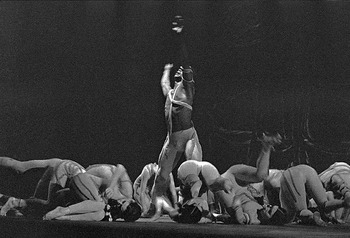
In the first scene, “Germination,” a character covers the whole stage with a skirt and that figure's body emerges like the stalk of a plant coming out of the Earth. This Earth is represented by a mass of human bodies that intertwine and merge, behaving like a single, universal body. The flesh-colored leotard costumes in their turn convey the impression of a nude, neuter body. In the final scene of the “Death of the Chosen One,” this structure of a shapeless mass of bodies is repeated. Instead of dancing herself to death, as in Nijinsky's version, the Chosen One clambers onto a mountain of bodies formed by the dancers and raises herself above the group. In the 1990s version, the Chosen One is left hanging in the air, with the support of a rope hanging from the flies, but in the 1970 version, according to José Carlos Campitelli, who was one of the performers, the character of the Chosen One, performed by Ana María Stekelman, climbs to the top and then falls backward toward the audience.
“The Death of the Chosen One,” The Rite of Spring, 1970. Choreography by Oscar Aráiz, photo by Alicia Sanguinetti.

The idea of festival suggested by Gusdorf and quoted by Aráiz is brought out in this shapeless mass of bodies that open the performance and are its culmination. This is the utopian manifestation of a total revolution. José Esteban Muñoz (Reference Muñoz2009) reflects on the utopian, based on Ernst Bloch's philosophy. From a Blochian perspective, art is capable of expressing an “anticipatory illumination” that, according to Muñoz (Reference Muñoz2009, 3), helps us to see “the not-yet-conscious” in the guise of a “utopian feeling.” In the same connection, Muñoz refers to the distinction made by Agamben (Reference Agamben1999) between possibility and potentiality: “unlike a possibility, a thing that simply might happen, a potentiality is a certain mode of nonbeing that is eminent, a thing that is present but not actually existing in the present tense” (Muñoz Reference Muñoz2009, 9). In the scenes previously mentioned, The Rite presents a fusion of seminaked bodies of indeterminate sex that project a utopian feeling of fraternity. The work announces the potentiality of a refoundation of society by returning to a state of deindividuation, of mechanical identification with one another.
The mass of people that appears in Aráiz's work can be linked to the accounts of group sex practices written by Samuel Delany and quoted by José Esteban Muñoz in which “the men … took care of one another not only by offering flesh but by performing a care for the self that encompassed a vast care for others—a delicate and loving ‘being for others’” (Muñoz Reference Muñoz2009, 51). It is this “being for others” that represents the primordial link of the utopian revolution suggested by The Rite. Aráiz's work points to a future collectivity, to the potentiality of an orgiastic society as a horizon. This is a utopian feeling that, so we intuit, haunts the imaginary of Argentine youth culture of the time. As Jill Dolan (Reference Dolan2005, 7) points out, art constitutes a space in which “another world” can be expressed, not in a descriptive or didactic way, but rather by communicating an alternative experience. The work presents the viewer with the experience of utopian fraternity, and that fact constitutes, in its own way, a subversive act in the face of authoritarian power.
Phaedra
Some months before the revival of The Rite, there was a performance of another piece that had led to attempts by the theater authorities to censor it. This was the choreographer Ana Itelman's Phaedra, based on texts by Euripides, Racine, and Unamuno. Despite the fact that her work has not received the official recognition that Aráiz's has, to this day Ana Itelman is an important reference point for several generations of Argentine dancers and choreographers. She was a teacher at the Taller de danza del Teatro San Martín (San Martín Theater Dance Workshop), which began to operate in 1977, and she was in permanent contact with the theater ballet until her tragic death in 1989. Itelman had belonged to the modern dance company set up by Miriam Winslow in Argentina in 1944. Her contact with American dance was strengthened in the years that followed when she took classes with Martha Graham, Louis Horst, Hanya Holm, and José Limón. In the 1950s, she came back to Argentina, and after suffering from an illness that prevented her from carrying on as a ballerina, she created a school of modern dance and worked as a choreographer. In 1957 she returned to the United States and for twelve years worked as associate professor and then head of the dance department at Bard College in New York. In those years, she presented pieces such as House of Doors, Jove and Io, Three Rivers, There is a Dead Horse in the Bathtub and other Perplexities, The Girl in the Black Raincoat and The Man with the Blue Guitar (Szuchmacher Reference Szuchmacher2002, 19–20). Apart from her intense activity in the United States, Itelman regularly returned to Argentina to put on works with the support of the Friends of the Dance Association and the San Martín Theater Ballet. She settled back in Buenos Aires in 1969 and founded a Café Estudio of Dance Theater that was later donated to the theater. The San Martín Theater Dance Workshop still operates on that site to this day. Her most celebrated works presented in Argentina include Casa de Puertas, Ciudad nuestra Buenos Aires, Odi et Amo, Dobletres, Las Casas de Colomba, Historia del Soldado (The Soldier's Tale), Suite de Percal, 20 x12+1 Fuga, Y ella lo visitaba and El Capote.Footnote 20 Itelman is a leading point of reference in the field of dance theater, a genre that has a major presence in Argentina (Tambutti Reference Tambutti2000, 120).
The year that marked the high point in the tension between the ballet company and the San Martín Theater authorities was 1970. The attempt to censor Phaedra undoubtedly intensified the confrontation. The reason for the censorship, according to what Ruben Szuchmacher (Reference Szuchmacher2002, 151) says,Footnote 21 was that after the preview for critics and the authorities, the wife of a high-ranking official had been outraged and had asked her husband to ban the work because of the obscenity of certain scenes. Yet again, the supposed immorality of dance was being exposed. Regarding the content of the work, for which there is no archive film, the program, written by Ana Itelman, said this: “Phaedra: Stage production to be filmed. Phaedra lives in an implacable society that forces her to live and die precariously. The tale is simple; it tells the story of a mature woman's love for her stepson Hippolytus.”
José Carlos Campitelli, Virginia Martinez, and Cristina Barnils, Phaedra, 1970. Choreography by Ana Itelman, photo by Norberto Lavecchia, courtesy of José Carlos Campitelli.

According to what José Carlos Campitelli, who performed the role of Hippolytus, has said in interviews, the process of creating the piece was very difficult.Footnote 22 Rehearsals lasted eight months and called on dancers to develop acting skills in which they had had no training. In the program for the work, Ana Itelman included the following text explaining the process of creation:
The members of the San Martín Ballet who made up the cast of Phaedra began rehearsals in November 1969. In principle, the approach required the author to have a framework and to direct. Later on, the piece was worked up by using themes that were suggested [by the performers], and directing turned into observing and capturing the material that came out of the improvisations. As the group grew in confidence and internalized the deep meaning of Phaedra, they were progressively able to do without a director. This final phase is, in my view, the most important result of this cumulative experience. The group is able to interpret the work to the extent that it lives it out on stage, because everyone in the group gets inside their character through their own individuality. The actor-dancers come onto a set where scenes from Phaedra are being filmed. The work has no beginning and no ending. They are unconnected scenes that can be put together as the viewer sees fit.
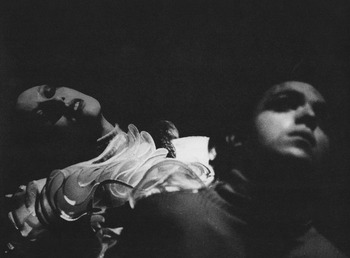
Phaedra was conceived as a “photonovel” (fotonovela); it did not include dance scenes or choreography and was based fundamentally on improvisations. On the basis of archive photographs and the invaluable eyewitness accounts of José Carlos Campitelli and Doris Petroni, which I obtained in interviews, it is clear that the piece had numerous scenes of physical contact between the performers. There was a scene, mentioned by Doris Petroni,Footnote 23 who played Phaedra, in which she sat on Hippolytus' lap, caressed him, and tried to kiss him, in front of her husband Enrique, played by Enrique Zabala, who pretended not to notice anything that was going on. José Carlos Campitelli also remembers a scene in which he was having a bath while seminaked, which caused him great embarrassment. It was a piece that, according to what Campitelli says, had a profound effect on the performers. The atmosphere during rehearsals was very intense, because Ana Itelman had become extremely obsessive about the staging. From his position as director of the ballet company, Aráiz said that the process of creating the work was “unsettling, dark, with novel suggestions and [that], as in any true adventure, anxiety kept [them] in suspense” (Aráiz Reference Aráiz and Rovner1993, 16). From an artistic point of view, the work was an avant-garde experiment for Argentine dance.
Doris Petroni and José Carlos Campitelli, Phaedra, 1970. Choreography by Ana Itelman, photo by Hector Boetto, courtesy of José Carlos Campitelli.

Regarding the supposed obscenity used to justify censoring the piece, one possible interpretation is that it consisted basically in the portrayal on stage of a mature woman's desire for a young man, which challenged patriarchal culture. The myth represented a story in which the role dynamics of courtship were reversed, and it counterposed feminine desire to the maternal role. Phaedra brought to the stage a novel type of femininity that in some ways expressed the advancement of women in an Argentine society still tied to a way of life that was conservative and imbued with Catholic morality, above and beyond political convictions. As Felitti (Reference Felitti2012, 12) points out, privileging procreation and a woman's maternal character over her individual freedom is an idea that at the time was upheld both by conservatives and by groups linked to left-wing political militancy.
Nevertheless, the changes to feminine subjectivity were part of the process of widespread social contestation that was brewing. In 1966, the Argentine sociologist Julio Mafud published a book of sociological research under the title La revolución sexual argentina (The Argentine sexual revolution), which described changes in female sexuality and the appearance of new sexual practices following the introduction of the contraceptive pill and the entry of women in the labor market. Mafud defined this phenomenon as a “sexual revolution” that pointed to “the most profound change that [has] happened in modern Argentinian society” (Mafud Reference Mafud1966, 11).
Phaedra subverts the figure of the dominant male, which, according to Taylor (Reference Taylor1997, 17), is a central pillar in the construction of the Argentine nation-state. It is undeniable that Itelman's work touches a raw nerve and destabilizes the figure of masculine virility clearly associated with the archetype of the military man as leader (38). In this sense, the work openly challenges the “feminization of the enemy” (62) and the construction of national identity on the basis of the “destruction of the feminine” (9) studied by Taylor.
Dolan uses the concept of “utopian performatives” and defines it as “small but profound moments in which performance calls the attention of the audience in a way that lifts everyone slightly above the present, into a hopeful feeling of what the world might be like if every moment of our lives were as emotionally voluminous, generous, aesthetically striking, and intersubjectively intense” (2005, 5). This concept, according to Dolan, is connected with Bertolt Brecht's notion of gestus, a notion defined as “actions in performance that crystallize social relations and offer them to spectators for critical contemplation” (7). Itelman, in her staging of female desire as a desire that overwhelms the institutions of marriage and the family, presents a crystallizing view of political and social reality. The scenes of Phaedra represent the utopia of female domination guided by desire and pleasure in the context of a society clearly dominated by the masculine.
José Carlos Campitelli and Cristina Barnils, Phaedra, 1970. Choreography by Ana Itelman, photo by Norberto Lavecchia, courtesy of José Carlos Campitelli.
In a 1983 text, the poet and sociologist Néstor Perlongher (Reference Perlongher2008, 25–27) reminds us of the municipal ordinances under the dictatorship to control the female body, for example, regarding the use of miniskirts or interaction with people of the opposite or the same sex in public spaces. Phaedra goes beyond suggesting the feminist demands of the era. It is not just a question of affirming a woman's power over her own body: Phaedra affirms the quasi-perverse desire of an oppressed woman. In this sense, its approach is connected with Perlongher's radical politico-sexual ideas expressed in his phrase: we homosexuals “do not want to be tolerated, nor do we want to be understood: what we want is for people to desire us” (Reference Perlongher2008, 34). In the same way as homosexuals, according to Perlongher, want to be desired, the women represented by Phaedra want to desire; they want to play an active role; they want to dominate. We are talking about a gesture of utopian subversion that destabilizes masculine domination.
The work was performed on June 27, 1970, in a preview for “officials, the authorities, and members of the artistic community” (Szuchmacher Reference Szuchmacher2002, 155). According to Aráiz, “audience and press greeted Phaedra with icy astonishment and the Theater authorities made it clear that it was undesirable to carry on with the performances” (Reference Aráiz and Rovner1993, 16). An attempt was then made to censor the piece, which caused a strongly worded response from the choreographer. According to the message they transmitted to Ana Itelman via Oscar Aráiz, the authorities had decided the piece could not be performed because of its “lack of decency,” “lack of good taste,” and “lack of artistic value” (Szuchmacher Reference Szuchmacher2002, 153). In reply, the choreographer penned a letter dated July 24, 1970, to the board and the advisory commission of the theater in defense of her creation.
In hindsight, Itelman's reply is striking in its audaciousness. After countering the accusations against her work, the choreographer turned the affront on its head, and herself accused those who were trying to censor her. She wrote:
The decision of the authorities involves a restriction on theatrical freedom. … By taking on the responsibility they have announced, the authorities have put the Theater in a very delicate position: that of turning it into a censored, stifled, limited Theater. The Municipal General San Martín Theater was carrying out a fundamental task when it offered to the Argentine public works by artists of different movements, ungrudgingly and without prior evaluation, without prejudices and without preconceived aesthetic judgments. It is regrettable that the authorities reserve the right to wrest this privilege away from Argentine citizens, who, in the first and in the final analysis, pay for the Theater that its current authorities manage. … The authorities have added a new element to the running of the theater: authoritarianism. (Szuchmacher Reference Szuchmacher2002, 154)
After these words, Itelman suggested holding another dress rehearsal in front of the authorities and specialist journalists to decide collectively what should happen to the piece; she requested a reply within five days of receiving the letter. Itelman's letter seems to implicitly deny the political context from which it emerged. Her reference to the figure of the “citizen” and her surprise when faced with “authoritarianism” presuppose a democratic context when, in reality, Argentina had been living under a dictatorship for four years. We have to bear in mind that the dictatorship of the 1960s did not reach the same levels of repression and violence as the Proceso de Reorganización Nacional (Process of National Reorganization) in 1976. In the 1960s, nothing suggested that in the following decade Argentina was going to experience one of the bloodiest dictatorships in the whole of Latin America and that it was going to be the victim of state terrorism that would lead to the forced disappearance of 30,000 citizens. Nevertheless, Itelman's intervention was a gesture of great courage.
In the same way, her letter is not innocent. Her response operates intentionally in that ill-defined territory in which censorship, as a repressive practice of the authoritarian state, attempts to extend itself to the individual level in the form of self-censorship in order to avoid accepting the political cost of its actions. Itelman's intervention strategy also includes the appeal to a sort of utopia. The ideological substratum of her intervention is the conception of art as a practice separated from the rest of society, the idea of l'art pour l'art. As far as Itelman is concerned, authoritarianism has only just come into the theater with the censoring of Phaedra. Her claim is obviously mistaken, since artists are, above all, subjects immersed in a social reality, and under a dictatorship freedom is curtailed. Artists were not really free, and Itelman was not unaware of that reality. Her intervention is fascinating not because of its pseudonaive affirmation of a neutral and apolitical art, but rather because of her aim in this discourse to reclaim a space of freedom from which to act politically. Her letter is simultaneously a utopian gesture and a concrete political act. The idea of conceiving of access to the theater as a right of citizens defines art as a space constitutive of democratic practice.
The Finale
At the end of 1970, the San Martín Ballet received an invitation from Norman Singer, director of the City Center in New York, to perform in the United States. The US embassy invited Oscar Aráiz to visit the New York City in January 1971, and it is during this trip that he got the news that the members of the San Martín Ballet would not have their contracts renewed. There had been a change of personnel: the municipal secretary of culture, Alberto Obligado, had resigned to take up a UNESCO post, and his replacement, Francisco Carcavallo, a former theatrical impresario, had appointed the veteran actress Iris Marga as the theater's artistic director. Those newly in control favored a more traditional and commercial type of theater, and they took the decision to cut short the experiment of the San Martín Ballet, using budgetary problems as their justification.Footnote 24 The company managed to obtain new contracts as late as June 1971 under the auspices of the Directorate-General of Culture in the Teatro Nacional Cervantes (Cervantes National Theater), thanks to the support it had received from Ricardo Freixá, an official. However, those contracts expired in January 1973 and were not renewed. It would only be in 1977, thanks to the creation of the Grupo de Danza Contemporánea (Contemporary Dance Group) at the instigation of Kive Staiff, director of the San Martín Theater at the time, that this genre of dance once again had institutional backing. There can be no doubt that political and administrative conditions determined the development of contemporary dance in Argentina by placing constraints on dance practice, but also by creating constant institutional instability that interrupted extremely valuable creative processes.
Whether it was because of the explicit or subtle censorship to which they were exposed or because of their championing by the print media that condemned their banning, The Rite of Spring and Phaedra became political beyond their creators' intentions. According to my analysis, the political emerges in these works from a struggle over sexuality and, in this sense, for “the constitution of individuality, of subjectivity,” that is to say, “of the manner in which we behave and in which we become conscious of ourselves” (Foucault Reference Foucault and Carrette1999, 140). For Foucault, the relationship between sexuality and politics expresses itself in the way that power produces bodies. Since the beginning of the modern era, the human body has been constructed as a labor force integrated into a system of production. This construction of the body began to be questioned during the 1960s. In this way, as Foucault maintains, “c'est cette lutte pour le corps qui fait que la sexualité est un problème politique [is this struggle for the body that makes sexuality a political problem]” (Reference Foucault and Foucault2001, 1405). Sexuality as a topic of investigation in both works is a mechanism for calling into question the production of subjectivity that was typical of that historical moment. The dictatorship aimed to construct a disciplined, moral body, a submissive worker. The struggle to liberate desire and pleasure undertaken by these works is part and parcel of a global strategy to subvert dictatorial power and to recover the body. In this way, above and beyond the fact that these artistic productions had a troubled relationship with left-wing anti-imperialist militants, utopian subversion operated in favor of the revolutionary process people were attempting to develop, given that, as Muñoz states, “utopian feelings” are “indispensable to the act of imaging transformation” (Reference Muñoz2009, 9).



