




1. Introduction and a “historically interesting” letter (1930) from Freud to Heinrich Löwy (and, by implication, to Richard von Mises) about his working method
The following article focuses on the transcript of an audiotaped interview (hereafter “the Interview”),Footnote 1 conducted on May 30, 1953 by the Austrian-American psychoanalyst Kurt Robert Eissler (1908-1999),Footnote 2 with two mathematicians, the married coupleFootnote 3 Richard von Mises (1883-1953, hereafter RvM)Footnote 4 and Hilda von Mises (1893-1973, née Geiringer, henceforth Geiringer),Footnote 5 in Cambridge near Boston (USA). Geiringer was born in Vienna, and RvM’s family had moved to the Austrian capital in 1890 from his birthplace Lemberg in Galicia (today Lvív in Ukraine). The purpose of the Interview was to collect information about the couple’s contacts to Sigmund Freud (1856-1939) and to psychoanalysis. Six weeks later, on July 14, 1953, RvM, a pioneer of modern applied mathematics and of probability theory, died of cancer.
In the “Finding Aid” to the papers in the Sigmund Freud Collection in the Library of Congress,Footnote 6 there is one entry for the name “Mises,” which is the above Interview, with the designation “Von Mises, Hilda, 1953” in box 133. The given name “Richard” or R. appears nowhere in the Finding Aid or in the text of the transcript. Nevertheless, RvM, who was ten years older than his wife, was the main contributor to the Interview. RvM was able to recall events early in the century, like the Hervay affair (1904) and conflicts between Freud and his former close friend Wilhelm Fließ (1906),Footnote 7 events which for reasons of age both his wife and Eissler, the two other participants in the Interview, could not possibly remember. Throughout the Interview, RvM was addressed by Eissler as “Herr Professor,” while Geiringer, an internationally acclaimed applied mathematician as well and at the time professor at Wheaton College near Boston, had to be content with the then usual form of address “Gnädige Frau.”
In the following three sections I will offer a detailed commentary on the Interview and its background. As an appendix, I publish in English translation a very slightly shortened (mainly to avoid text redundancies and repetitions) version of the spaciously written 51-page German transcript, indicating corrections based on the audio file. Footnotes in the appendix refer back to the article’s commentary or explain minor points. Note that all page numbers cited in the article when quoting the interview refer to the pagination of the original German transcript, and not to the translation.
The celebrated Viennese essayist and journalist Karl Kraus (1874-1936), a scathing critic of the linguistic and ethical failings of his culture, plays a special role among the persons mentioned in the Interview. His periodical, Die Fackel (“The Torch”), was virtually required reading for educated Viennese, including Freud and RvM. The latter kept a complete run of the Fackel as he mentions in the Interview.
Nearly all the actors who appear in this article, not only the three participants in the Interview, but also Freud himself, Karl Kraus, Siegfried Bernfeld, and most of the others mentioned, had a Jewish cultural or religious background. The Viennese among them clearly tended in their opinions more toward the liberal, even “red” Vienna, although only a few of them, like Bernfeld and Geiringer, were close to Marxism and Social Democracy in their youth. Their Jewish origin and the prevailing anti-Semitism in the (Catholic) Christian Social Party and in the (mostly Protestant) German National Parties that supported “Black Vienna” (Wasserman Reference Wasserman2014, 120) and were close to people like the conservative philosopher Othmar Spann (1878-1950) would not have left them much choice anyway.
Roazen mentioned, in 1971, that the numerous Eissler interviews from the early 1950s were generally embargoed “for fifty to one hundred years” (Roazen Reference Roazen1971, 549). As can be seen from the interview with the Mises Couple published here, RvM also asked for temporary secrecy, although he was aware of the eventual public accessibility of the information he had given.Footnote 8 In particular, he believed that the three postcards in RvM’s possession written by Freud to Karl Kraus in 1906, which were discussed in the course of the Interview, could cast a skewed and unfavorable light on Freud. The controversy over Freud allegedly having dishonestly passed on Wilhelm Fließ’ ideas about biological periods and “bisexuality”Footnote 9 (ideas which are connected) was conducted in public in 1906, among other things, by the Fackel. RvM says in the Interview about Freud: “He used Karl Kraus as a journalist” (20,26).Footnote 10
This main reason for the secrecy of the Interview, however, essentially disappeared by 1961 at the latest, when Ernst Freud (1892-1970) published selected letters from his father in English translation. Among them was a letter from Freud to Karl Kraus dated January 12, 1906 (see below in section 3), which seemed to indicate even more clearly than Freud’s postcards that Kraus had been instrumentalized by Freud. A detailed and nuanced investigation of the “priority dispute,” which was actually more about Freud’s patient Hermann Swoboda and the then much-discussed eccentric genius Otto Weininger (1880-1903), was done by Michael Schröter (Reference Schröter2002, Reference Schröter2003). I discuss this further below in section 3, in connection with what the Interview says about the contacts between Freud and Kraus. First, however, a few remarks on the prehistory and the historical context of the Interview.
Freud’s daughter AnnaFootnote 11 had written to RvM from London on March 30, 1950. She had heard from the Viennese psychoanalyst Eduard (now Edward) Hitschmann (1871-1957),Footnote 12 who was living in the USA, that RvM had a “very interesting” letter from her father. Anna Freud asked RvM for a copy of the letter.Footnote 13 Anna Freud’s confidante in America, Eissler, wrote to RvM two years later, on December 24, 1952.Footnote 14 He had heard that RvM possessed two letters from Freud to Kraus, and was also interested in copies of any additional documents that might be relevant to Freud research. This request seems to have led to the Interview in May 1953.
The historical context of the Interview is perhaps best understood at the point where interviewer Eissler talks about the motivation behind his interview project and the entire Freud Archives:Footnote 15
Eissler: Freud needs interest in Freud, whether that interest will be there, we do not know.
RvM: Well, my private, unimportant opinion is that much of psychoanalysis will disappear. But Freud will not, Freud remains a great man!
Eissler: Well, I believe it depends on what direction civilization is going to go.
RvM: Well, except for the Atomic Bomb /laughs/. You mean in case it continues at all!
Eissler: Yes!
RvM: If it goes on, I do believe that this [psychoanalysis] is one of the great advances of mankind.
Eissler: But around the year 700 only very few people knew about Plato and Aristotle, at least in Europe. And here is something very similar, actually.
RvM: Yes!? What do you mean by that?
Geiringer: That it can perhaps come up again later, even if it disappears now for a century?
Eissler: Yes, I was thinking about something like that.
RvM: I don’t believe it. Today’s world isn’t really like that.
Eissler: Don’t you think that [we are living in] new Middle Ages, new spiritual Middle Ages [ein neues geistiges Mittelalter]?
RvM: Not today, the position of science is quite different, I believe. But I don’t have much to say.
The Interview took place during the height of McCarthyism (1950-1954). The “spiritual Middle Ages” cannot mean anything else than Eissler’s allusion to this environment. RvM, the scientist and believer in progressive, positivist thinking,Footnote 16 remained optimistic with respect to a survival of science. However, RvM was not naïve about the effect of the Cold War, of Stalinist ideology and McCarthyism on intellectual discussion. In a posthumously published manuscript on Positivism in May 1953, (i.e. in the month of the Interview), he wrote:
Any type of metaphysics, whether with or without religious shading, leads by its very nature to intolerance and injustice, makes a peaceful life and the pursuit of happiness for the whole of mankind impossible. If the present trends towards metaphysics in both camps go on unabatedly, are allowed to continue, the only imaginable future for both is the final attempt at physical annihilation of the counter-side. (Mises 1953, 547)Footnote 17
Eissler thanked RvM for the Interview in a letterFootnote 18 of June 3, 1953, and he did not forget to mention the special efforts RvM had to make because of his poor health. As he had already done during the Interview, Eissler guaranteed in this letter that all material relating to the Interview would remain strictly confidential according to RvM’s wishes. Eissler wanted the material to be given to the Library of Congress (i.e. the Sigmund Freud Papers) and to be embargoed there for at least fifty years. The material which was handed over to Eissler apparently included the original of Freud’s letter to Heinrich Löwy (1884-?)Footnote 19 of May 30, 1930 and RvM’s accompanying commentary, which are both reproduced below. The accompanying letter is one of the last letters written by RvM. Freud’s letter was a “scientifically interesting” letter („wissenschaftlich interessant,“ according to RvM’s words in the Interview), which answers an inquiry by Löwy and RvM. Freud’s letter, which apparently has been kept as an original in the Freud Papers since the 1953 Interview,Footnote 20 bore no obvious risk to cause offense and it was published as early as in 1961 in the aforementioned collection of letters by Freud’s son Ernst.
Vienna IX, Berggasse 19
March 30, 1930
Dear Doctor [Löwy]
Your biography of Popper-Lynkeus which accompanied your letter has pleased me so much by its dignity and truthfulness that I would like to comply with your wish and make a contribution to your collection of solutions to scientific problems. But in trying to find some suitable examples I have encountered strange and almost insuperable obstacles, as though certain procedures that can be expected from other fields of investigation could not be applied to my subject matter.Footnote 21 Perhaps the reason for this is that within the methods of our work there is no place for the kind of experiment made by physicists and physiologists.
When I recollect isolated cases from the history of my work, I find that my working hypothesis invariably came about as a direct result of a great number of impressions based on experience. Later on, whenever I had the opportunity of recognizing an hypothesis of this kind to be erroneous, it was always replaced—and I hope improved—by another idea which occurred to me (based on the former as well as new experiences) and to which I then submitted the material.
I am afraid the above will not be of any great use to your collection.
With kind regards
Yours sincerely
FreudFootnote 22
After the Interview, RvM sent an undated comment to Eissler, which must be considered as one of the last letters from RvM. It reads (in English translation):
The letter is directed to Dr. Heinrich Löwy (physicist, now in Cairo, Egypt), with whom I planned the edition of a “Collection of Examples” for the solution of scientific problems. He had asked Freud for a contribution. The plan has not been realized.
The biography of Popper-Lynkeus mentioned in the beginning of the letter has appeared in “Jüdisches Lexikon” [Löwy Reference Löwy, Herlitz and Kirschner1930].
In the following introductory commentary, I will attempt to outline the historical significance of the Interview in two sections, focusing on three main points. These are briefly formulated as follows:
-
Remarks on the reception of psychoanalysis and the perception of Freud by the three participants of the Interview at different points in time in the first half of the century, especially how the Mises Couple encountered Freud and psychoanalysis on various personal, political, and philosophical levels.
-
Addition to and correction of genealogical remarks made in the Interview.
-
The relationship between Sigmund Freud and Karl Kraus, primarily using the example of the conflict between Freud and Fließ, and secondarily using the so-called “Hervay affair” as an example. The discussion takes place from the perspective of some postcards from Freud to Kraus, which were in the possession of RvM in 1953.
For each of the three points, I shall draw on published and unpublished sources, especially material relating to RvM, and on literature, especially archive materials and publications by RvM and Geiringer. Perhaps the most important topics and unknown documents—beyond the Interview—that enter into the discussion and are briefly discussed in the commentary below, are
-
The failed application of Siegfried Bernfeld, the Freud student mentioned several times in the Interview, for a teaching position at Berlin University (1931). RvM was significantly involved in the Berlin faculty decisions. My work complements earlier German accounts of Tenorth (Reference Tenorth, Hörster and Müller1992, Reference Tenorth1999) and Dudek (Reference Dudek2012). RvM’s rather distant relationship to Bernfeld’s and S. Feitelberg’s attempt to connect thermodynamics and psychoanalysis (libidometry) confirms RvM’s critical attitude vis-à-vis certain theories of physicalism supported by the Vienna Circle of Logical Empiricism. This modifies the common picture which represents RvM as a follower of the Circle.
-
An unknown letter (1931) from the Gestalt psychologist Wolfgang Köhler to RvM in connection with Bernfeld’s failed application.
-
Geiringer’s activity in the Austrian youth and adult education movement with regard to the role of psychoanalysis.
-
A hitherto largely unknown letter from Karl Kraus to Freud dated September 16, 1906, which sheds new light on the relationship between Freud and Kraus, and on Freud’s position vis-à-vis the Fackel.
Another aspect of the Fließ Affair will be dealt with in the short fourth and concluding section of the commentary: RvM was not only interested in Wilhelm Fließ’ theory of bisexuality. As an applied mathematician he was also interested in Fließ’ theory of biological periods. The positive review of Fließ’ paper on the latter theory (Fließ Reference Fließ1906a) by the famous chemist and philosopher of science Wilhelm Ostwald (Reference Ostwald1907) may have increased RvM’s interest in this theory. The one-sided public discrediting of the theory by Martin Gardner (Reference Gardner1966) and Frank J. Sulloway (Reference Sulloway1979) is contrasted below with a statement by RvM (1926).
For the biographies of RvM and Geiringer and their importance as mathematicians I refer to separate literature in the bibliography (cited above). From the outset, it should be taken into account that both mathematicians were and remained closely connected to Freud’s Vienna. They had successful lives as applied mathematicians behind them in 1953, but also lives that were marked by their flight to the USA from Hitler’s Germany via the intermediate station of Turkey. Typical traits of RvM in particular stand out in the Interview, such as his strong self-confidence and a certain condescension towards colleagues whom he regarded as intellectually below his level (here visible in some general slights against colleagues in Strasbourg and in the USA). Also in evidence is his intellectual leadership and somewhat paternalistic attitude towards Geiringer, which she—herself an important applied mathematician—tolerated. This is reflected in smaller remarks in the Interview, like those concerning graphology, masochism, etc.
The information contained in the Interview is illuminating on multiple fronts. It contains accounts of atmospheric changes in the reception of psychoanalysis and of Freud over nearly half a century. Contemporary historical details, such as the travel conditions between Austria and Germany after the end of World War I, also provide interest for the overall historical picture. Finally, though RvM and Geiringer, two pioneers of modern applied mathematics, were not psychoanalysts, the Interview may nevertheless contribute to the understanding of the historical impact of psychoanalysis beyond medical, psychological and philosophical circles. As far as the historical accuracy of the Interview is concerned, it should be noted that we have no information whatsoever about how thoroughly the participants prepared themselves for itFootnote 23 and to what extent their statements reflect the complete state of their knowledge.
2. Richard von Mises, Hilda Geiringer, and Freud
2.1. Personal and genealogical connections
In the first third of the Interview, RvM repeatedly discusses genealogical matters and personal encounters with members of the Freud family, but he remains rather vague. His dating of the few personal encounters with Sigmund Freud to the early 1920s seems doubtful, as he claims that “as a young mathematician” he did not dare to talk with Freud about substantive aspects of psychoanalysis at that time. From RvM’s biography, on the other hand, we know of his great personal self-confidence and of his philosophical reflections and publications from the beginning of the 1920s. RvM says in the Interview explicitly: “I am not a 100% fan of psychoanalysis, but of Freud I am. He is a great man after all. … My private, unimportant opinion is that much of psychoanalysis will disappear. But Freud will not, Freud remains a great man!” (36–37). Later in the interview, however, he says something in contradiction to this, declaring: “I do believe that this [psychoanalysis] is one of the great advances of mankind” (37). RvM also reports short personal meetings with Freud’s mother Amalia, née Nathansohn, and with Freud’s wife Martha, née Bernays. He describes both of them as not very erudite and not well informed about Freud’s intellectual achievements. Martha he rather distantly calls a “Zetzen” (Austrian slang for tiresome person). As an example, he mentions a trip with her via Prague to Berlin around 1920.
Geiringer attended Freud’s lectures in 1916/17, but she had no personal meetings with Freud. She describes Freud’s personality as impressive, but is somewhat contradictory in her statements about what this impression was based on, especially whether his lectures were clear and understandable. On the other hand, she knew Freud’s children Anna, Ernst and Martin personally, but says in the Interview: “I was not close [intim] with them” (46). However, Geiringer must have had repeated contact with Anna Freud within the adult education movement (Volkshochschulbewegung) and in Siegfried Bernfeld’s personal environment (see below).
In the Interview, RvM repeatedly emphasizes his blood relationship with Sigmund Freud through his mother Adele, née Landau, and the Nathansohn family from Brody, which led to occasional encounters with the Freud family. However, according to RvM the kinship was “weak” (4). RvM also claims that Freud’s mother was connected to the bank Nathansohn & Kallir and therefore must have had a large dowry. He uses this to explain that Sigmund Freud, contrary to some statements in the literature, could not possibly have grown up in difficult financial circumstances.
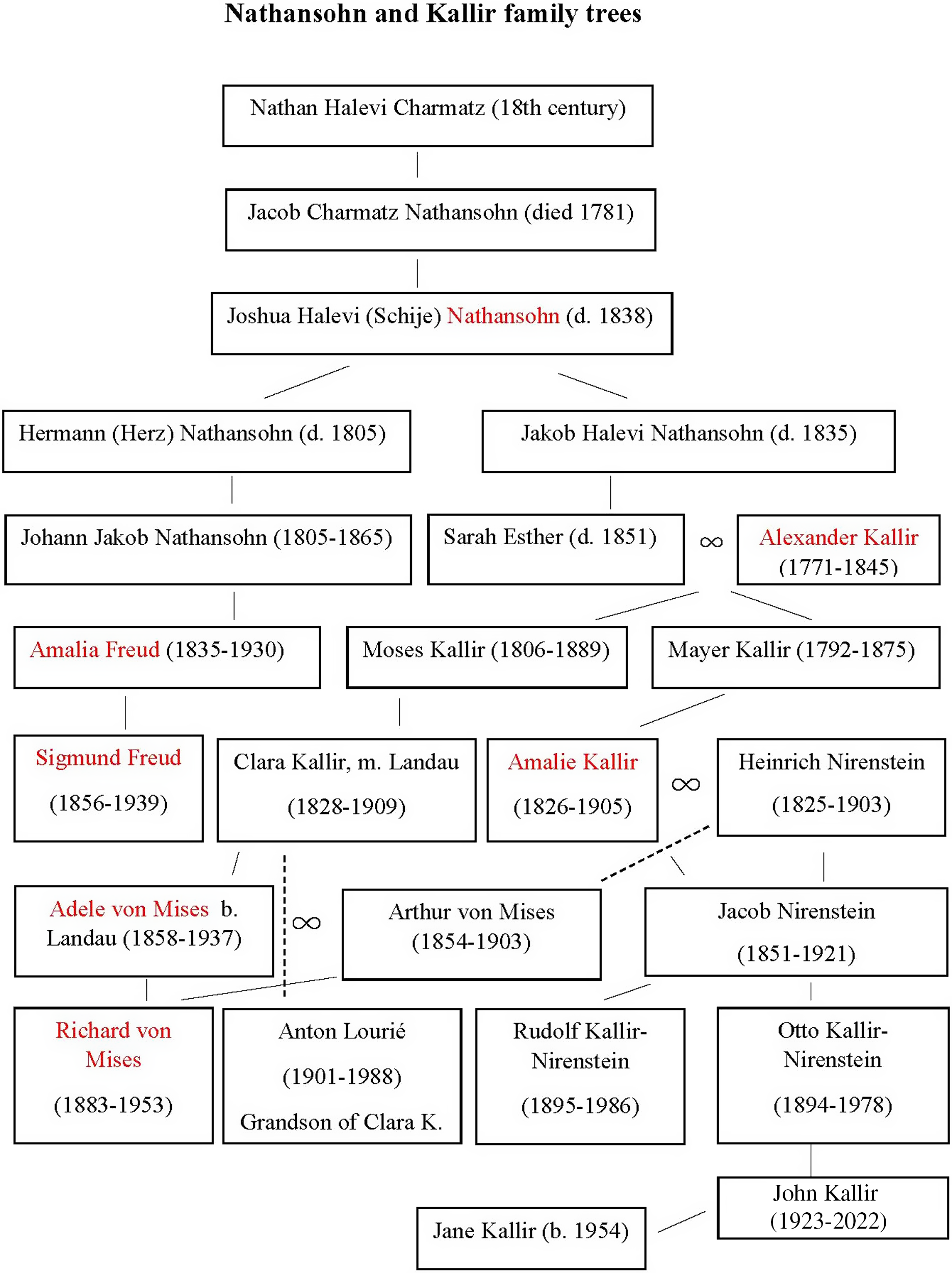
It turns out that RvM’s information is very imprecise and not based on detailed knowledge of the pedigrees. Again, the spontaneous atmosphere of the Interview must be taken into account here (as throughout), and it cannot be ruled out that RvM would have expressed himself differently if he had reflected more thoroughly. Selected branches from the Nathansohn and Kallir family trees are presented in an appendix to this paper, not only in the interest of the comprehensibility of the Interview, but also because of the general importance of these Jewish families (see appendix 1).
The family relations are most compactly described by RvM’s mother Adele (née Landau, 1858-1937) in her well-written German memoirs of her youth in Brody in Galicia, which contain a chapter “The Nathanson [sic] and Kallir families,” and are available online from the Leo Baeck Institute in New York City (Mises Reference Mises1929).Footnote 24 Adele wrote the memoirs in 1929 for her niece Elisabeth Eliasberg (né Lourié), and (apparently) for her nephew Anton Lourié, who is mentioned in the Interview.Footnote 25
According to the family tree (appendix 1) Adele Landau was very remotely related—through their common progenitor Joshua Halevi (Schije) Nathansohn—to Amalia Freud, who was two steps above her in the generational line and thus a distant great-aunt of Adele. Similarly, RvM (born 1883) and Sigmund Freud (born 1856) were also two generations apart, despite an age difference of only 27 years.
It seems that the applied mathematician RvM was somewhat too hasty in the Interview, with insufficient knowledge of the concrete “heritage arithmetic.” In particular, at one point in the Interview he seems to confuse Amalia Freud, née Nathansohn, with Amalie Nirenstein, née Kallir. The fact that RvM’s distant cousin Otto Nirenstein had adopted the name Kallir may have misled RvM to the assumption that Otto’s grandmother Amalie Kallir was a born Nathansohn. At one point during the Interview (3) RvM must have thought that Freud was an uncle of Otto Kallir. This confusion seems to be the main reason for RvM’s erroneous assumption that Amalia Freud was close to the Nathansohn & Kallir bank. His mother Adele was apparently much better informed about this (Mises Reference Mises1929).
2.2. Encounters of the Mises Couple with Freud’s follower Siegfried Bernfeld through the Viennese youth culture movement (Geiringer before 1921) and the Berlin Philosophical Faculty (RvM 1930–31)
Geiringer attended Freud’s lectures on psychoanalysis as a mathematics student in Vienna in 1916/17. She says in the Interview that this must be seen as part of her political activities, especially her involvement in the Viennese youth and adult education movements, and that she also attended a seminar with the famous sociologist Max Weber (1864-1920). She had already read some of Freud’s works before attending his lectures. It was fashionable in her circles at the time to use psychoanalytic jargon.
Geiringer’s publications from her youth—that is, before she worked as a mathematician with RvM in Berlin—leave no doubt about her feminist, socialist, and, in part, Marxist convictions. One of these publications (Geiringer Reference Geiringer1920) is used in the literature today as an essential source for the description of a short-lived “proletarian school community” (Kinderheim Baumgarten west of Vienna, 1919–20), in which Geiringer herself was involved as a teacher (Dudek Reference Dudek2012). This project was led by the Freud supporter, pedagogue, and socialist Zionist Siegfried Bernfeld (1892-1953).Footnote 26
Bernfeld’s name appears at various points in the Interview, first in connection with the biographical article on Freud (Bernfeld & Cassirer Reference Bernfeld and Cassirer-Bernfeld1944). This article was partially criticized by RvM, especially with regard to biographical and genealogical information contained therein. However, RvM and Geiringer had an even closer relationship with Bernfeld on various levels other than those the Interview suggests.
From the Siegfried Bernfeld Papers in the Library of Congress, especially from the letters from Geiringer to Bernfeld dating from around 1920, the close personal and political relationship between Geiringer and Bernfeld, who were only one year apart in age, is evident.Footnote 27 It seems no coincidence that Geiringer subsequently corrected her original formulation in the Interview “close friend of Bernfeld [intime Freundin]” to “very good friend” (2). Geiringer was of course aware of the ambiguity of the German word “intim”.Footnote 28 On January 16, 1921, Geiringer wrote to her friend Bernfeld, alluding to an earlier phase of apparently even closer ties: “You said that you didn’t feel like ‘psychoanalyzing’ me (I too was too inhibited) because that would make a personal relationship of mutual affection, which we both wanted at the time, impossible or jeopardized.”Footnote 29
From the early 1920s, Bernfeld became increasingly prominent in publications, and also as a practicing psychoanalyst, and his friend Geiringer tried to learn psychoanalysis from him. This was particularly in the context of her efforts to gain a deeper philosophical understanding of her own science, mathematics, in which she had received her doctorate in 1917 with a very theoretical (i.e. apparently distant from applications) topic on Fourier series under Wilhelm Wirtinger (1865-1945) in Vienna. Geiringer’s efforts culminated in her book The World of Thoughts in Mathematics (Die Gedankenwelt der Mathematik), which appeared in 1922 in a book series in Berlin and Frankfurt (Geiringer Reference Geiringer1922). The series was connected with the German and Austrian adult education movements.
Before the book was published, Geiringer wrote several letters to Bernfeld about its contents and about her efforts to use psychoanalytic interpretative elements in her work. On June 20, 1920, she wrote to Bernfeld: “I am now very, very much looking forward to mathematics, to all its wonderful strict abstract unreality. But I will learn psychoanalysis after all. I’m sure I understand a little bit of it now.”Footnote 30 On October 26, 1920, she wrote to Bernfeld after explaining her book project:
It goes without saying, it is almost a commonplace that science, like art, … etc., obeys an external and an internal drive. The latter is usually negated. When this became very clear to me, I thought I understood why you spoke of a one-sidedness and the need to supplement the material [istic] conception of history with psychological considerations…. Perhaps a psychoanalysis of science would help to find out (I asked Heinz [Hartmann] whether the existing psa [psychoanalysis] of art was useful, he said it accomplished little). In such a case, a psa of math, as you suggest, would certainly be a good start, because mathematics is such a specific knowledge and such a deeply rooted and characteristic one.Footnote 31
Interestingly, Geiringer connects psychoanalysis primarily to the more abstract part of mathematics, not to the field which would later dominate her interest: applied mathematics.
In the book itself, however, Geiringer was rather ambivalent about the explanatory potential of psychoanalysis for mathematics and its history, arguing that “it is still a question whether it will be reserved exactly for psychoanalytical investigations … to make the almost mystical magic comprehensible, which lies precisely in the problems of mathematics that are most alienated [entfremdet] from reality. In any case, here lies a key to a still deeply closed chamber” (Geiringer Reference Geiringer1922, 160).Footnote 32 Moreover, regarding the Baumgartner School Project, Geiringer writes of a “(still very imperfect) application of psychoanalysis” (Geiringer Reference Geiringer1920, 114).
In an otherwise very positive review of Geiringer’s book on The World of Thoughts in Mathematics, RvM wished his then assistant “here and there a somewhat clearer and more mature judgement” (Mises Reference Mises1922, 224). Geiringer, like many others who had to find their career paths, later hardly mentioned her political involvement in Vienna during the war and postwar period, probably warned by episodes such as the one around 1927, when political prejudices of colleagues in the background seem to have threatened her habilitation procedure in Berlin (Siegmund-Schultze Reference Siegmund-Schultze1993). In the 1953 Interview, Geiringer felt the need at one point to apologize for the socialist convictions of Bernfeld, who had died shortly before in America: “Bernfeld’s social convictions should do you no harm. I think he always meant [it well]” (49). The “apolitical” (i.e. in reality strongly anti-Communist) environment in the United States at this time, as described in the introduction, may have contributed to Geiringer’s trivialization of Bernfeld’s political positions.
RvM’s contacts with Bernfeld were on a completely different level, more professional than political, from those of Geiringer.Footnote 33 Geiringer, who had been privately as well as professionally close to RvM since the late 1920s, was most likely informed about that.Footnote 34 In two papers (Tenorth Reference Tenorth, Hörster and Müller1992, Reference Tenorth1999) Heinz-Elmar Tenorth has documented that the Faculty of Philosophy of Berlin University in 1930/31 rejected a ministry-supported psychoanalytic lectureship for Bernfeld, although there was a very positive report from Sigmund Freud himself.Footnote 35 Tenorth’s research was further extended in Dudek’s book (2012). The faculty’s negative opinion of June 25, 1931, states, among other things:
According to the impression that Bernfeld’s writings, including the essay “Is Psychoanalysis a World View,” give to the reader, psychoanalytic teaching is an inviolable dogma that does not need proof. And if he expressly emphasizes the destructive effect that this—his—science can have (while one usually tends to praise the constructive powers of science), the fear that the universal method, to which psychoanalysis is extended here, could be exploited for purposes of agitation that go beyond the planned teaching assignment, does not seem unfounded. How little this could be reconciled with the teaching tasks of the university needs no explanation. As far as the fundamental position on psychoanalysis is concerned, the faculty is not able to recognize it as a science in its present state. (Dudek Reference Dudek2012, 435-36, my translation)
Already in this part of the statement, the faculty’s bias against psychoanalysis as a science, and also unfairness towards Bernfeld, is evident, because in the quoted essay by Bernfeld one can read (at the very beginning) roughly the opposite of what the faculty writes:
It may be … advisable to acknowledge the fact that there is another “psychoanalysis” besides the Freudian science of psychoanalysis, which really wants to be a worldview [Weltanschauung]. From this recognition, perhaps the possibility of a more effective refutation or combat [against this Weltanschauung] arises. For, to be frank, the “Weltanschauung Psychoanalysis” is an unsympathetic and dangerous thing from which the circle of psychoanalytic educators may remain protected as far as possible! (Bernfeld Reference Bernfeld1928, 201)
Bernfeld’s attempt to emphasize the scientific nature of his approach and thus gain access to university science was bound to fail. It may not have helped his case that he—in the same essay of 1928—had slightly attacked Eduard Spranger (1882-1963), who would then prove to be his main opponent at the Faculty of Philosophy in Berlin. Tactically not very cleverly, Bernfeld imputed to Spranger and other psychologists a “non-scientific background” for their attacks on psychoanalysis (Bernfeld Reference Bernfeld1928, 203).
The faculty files contain a draft of the final faculty opinion from 25 June, 1931, about Bernfeld’s application, which had been discussed on a faculty meeting on 11 June. In the more general part, drafted by Spranger and the philosopher Max Dessoir (1867-1947)Footnote 36 and dealing with psychoanalysis as such, is the following passage, which was left out of the faculty’s letter to the ministry later:
The Faculty is not able to recognize that psychoanalysis in its psychological, cultural-philosophical and pedagogical parts is a science in the strict sense. According to Prof. Freud’s expression it should be “above all the art of interpretation.” In fact, it has become an industry of interpretation which, under the brand “scientific discovery,” produces masses of myths and offensive puns. It evades scrutiny in two ways. On the one hand, its procedure is such that it always remains in the right: if, for example, a dreamer admits a certain symbolic interpretation, everything is fine; if he resists it, he proves that the interpretation was correct precisely through this “resistance.” The other deviation from the law of science lies in the dogma that access to the truths of psychoanalysis can only be gained through one’s own analysis, because this is a kind of initiation, an act of admission into an esoteric circle, but not a teachable condition of knowledge and insight for objective research.Footnote 37
Parts of this are reminiscent of Karl Popper’s later verdict upon psychoanalysis as not being scientific because it is not falsifiable.
The other, more physics-related part of the original faculty opinion had been drafted by the eminent Berlin Gestalt psychologist Wolfgang Köhler (1887-1967). Here one reads:
In his writings, published jointly with Feitelberg and summarized under the title “Energy and Drive,” Bernfeld attempts to relate essential features of Freud’s drive theory to the concept of physical energetics. Insofar as these essays contain a rendition of general physical theorems in close connection with the formulations of experts, they are correct. As soon as Bernfeld begins to apply the laws of physics to biological and psychological problems, it becomes apparent that there is not even the slightest understanding of the basic physical concepts and clarity of thought that is absolutely necessary for the task undertaken. One misinterpretation of the physical theorems follows the other, the very vaguely understood concepts of theoretical physics flow into each other in the worst possible way, and similarities on the very surface immediately lead to the identification of physical, biological and psychological facts. Never could a procedure have been more rightly called dilettantism in the worst sense of the word than this frivolous and confused undertaking. The boldness of the undertaking and the vastness of the intended theory-building would be welcome in itself. But if the conscientiousness and rigor of thought is completely lost, such products will separate themselves from everything that deserves the name of science. Nothing worse could happen to students in their scientific and personal development than to be influenced by such an example of vagueness and frivolousness.”Footnote 38
Bernfeld, in a book written in collaboration with the engineer, physicist and physician Sergei Feitelberg (1905-1967), had tried to find bridges between physics and psychology based on Wilhelm Ostwald’s “energetics” (Bernfeld & Feitelberg Reference Bernfeld and Feitelberg1930). The two authors assumed the “Existence of psychic energies, which enable the work performance of the psychic apparatus” (ibid, 3). They tried to connect to “Köhler’s important use of the concept of system in psychology” (ibid, 5) but also realized Köhler’s reservations:
Köhler has discussed in detail the very interesting fact that in physics electric and magnetic fields possess Gestalt properties. Together with Wertheimer, he showed the importance of psychical gestalten [psychische Gestalten]. A connection between these two phenomena is not attempted or rejected. On the basis of the energetic view that we hold here, such a connection arises as a necessary consequence of the concept of personalized energy [personierte Energie].” (Bernfeld & Feitelberg Reference Bernfeld and Feitelberg1930, 37)
Köhler confirmed his reservations by the scathing verdict noted above. But why would the faculty not send this original draft to the ministry?
Although RvM was not a member of the faculty commission dealing with Bernfeld’s application, and although he is mentioned only marginally by Tenorth in his essay (Tenorth Reference Tenorth1999, 304, 306), he was a member of the faculty and participated in the final formulation of the statement against Bernfeld. However, he did this in a somewhat mitigating and conciliatory manner.Footnote 39 This is documented by the protocol of the faculty meeting on 11 June 1931, which says, among other things, the following about the draft: “V. Mises finds the general criticism of psychoanalysis too sharp. In the physical questions, the negative judgment of Bernfeld seems too harsh to him as well. The faculty decides that Mr. Köhler and v. Mises should reformulate the sentences relating to physics.”Footnote 40
The next step towards reformulating the faculty opinion is mentioned in a hitherto unknown letter written by Köhler to RvM on 13 June. According to this letter, Köhler now preferred to leave the task of finding the right formulation for the scientific part to RvM.
An English translation of Köhler’s letter in figure 5 reads:
Psychological Institute of the University Berlin C2, Schloss (Castle), 13 June 1931
Esteemed colleague,
May I make a suggestion? I am thoroughly tired of the extensive occupation with Mr. Bernfeld’s work. However, when we soon sit down together to turn the judgement I have proposed on his physical-biological writings into a wording that seems to you to be more just than the previous one, it will again take a lot of time. I am convinced that we will reach our goal much more quickly if you yourself write down and bring along a few sentences in advance which reflect your opinion and could be included in the larger document.
I am sure that you too will save time in this procedure. And since you agree with the rest of us on the main point, namely the negative assessment, it is hardly to be expected that your wording will be subject to a lot of requests for changes. I also admit that my criticism contained too many extreme expressions in dense accumulation. I myself had such a feeling when colleague Spranger read out the wording. Admittedly, this does not mean that my position on the matter has changed. You yourself will not have the impression that Bernfeld, where Mr. Feitelberg apparently let him operate alone, reveals even remotely sufficient insight into the content of the Second Law [of Thermodynamics; RS].
With sincere admiration and best regards
Your very devoted
Wolfgang Köhler
Eventually, based on RvM’s reformulation, the physics-related part of the negative faculty opinion of June 25, 1931 read:
In Professor Freud’s letter, special reference is made to Bernfeld’s more recent work, in which he attempts to tackle questions of psychoanalysis with the means of exact science. The Faculty has examined the works published by Bernfeld and Feitelberg (Energy and Drive 1930) and is unable to recognize in them a valuable scientific achievement. The physical foundations on which the authors build are inadequate in every sense; in the first of their treatises they start from a physical principle that was occasionally stated in the 1880s, but has since long been recognized as inapplicable by all physicists. The further explanations are based on the classical laws of thermodynamics which are reproduced in an undefined and vague form and try to draw conclusions from them for the evaluation of psychic processes. It is explicitly emphasized that measurement methods for the variables that come into question in mental processes cannot be given. But since those thermodynamic laws, like all theorems of physics, contain essentially quantitative statements, they become completely meaningless as soon as they are transferred to series of phenomena that are inaccessible to measurement. Therefore, all the conclusions drawn by the authors are unfounded, and if these conclusions take a form by which they seem to support certain claims of psychoanalysis, this can only be explained by the tendency of the authors, which is fixed from the outset, and which is not aimed at an objective test, but exclusively at a confirmation of the doctrine which is dogmatically accepted.”Footnote 41
Excerpt from the letter from Sigmund Freud to Heinrich Löwy (and by implication Richard von Mises) which is online at https://www.loc.gov/resource/mss39990.03643/?sp=2 Library of Congress, Manuscript Division, Sigmund Freud Papers, box 36, folder 43.

The letter by Richard von Mises for the Freud Papers is online at https://www.loc.gov/resource/mss39990.03643/?sp=7 Library of Congress, Manuscript Division, Sigmund Freud Papers, box 36, folder 43.

Richard von Mises’ family in Vienna, ca. 1894. From the left: his older brother Ludwig (later a famous economist), his father Arthur, RvM, Adele, and to the right his younger brother Karl, who died early in 1899. Courtesy Harvard University Archives, HUG 4574.92 p.

Hilda Geiringer (1893-1973) – private possession Magda Tisza (Boston).

Letter by Wolfgang Köhler to Richard von Mises. Courtesy Harvard University Archives, HUG 4574.5. Box 2, Folder 1931.

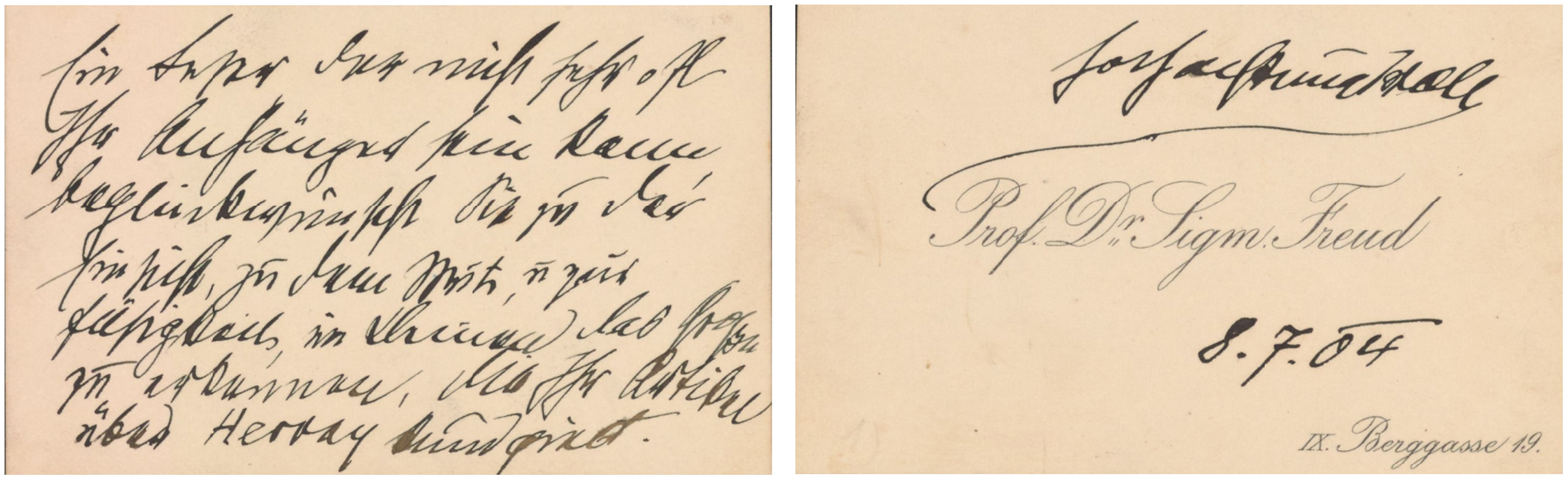
The postcard (front and reverse) from Sigmund Freud to Karl Kraus is accessible online at https://www.loc.gov/resource/mss39990.03540/?sp=2 and the following page. Library of Congress, Manuscript Division, Sigmund Freud Papers, box 35, folder 40.
John von Neumann (front left), Richard von Mises (second), and George Taylor (third from left) received honorary doctorates from the University of Istanbul on the occasion of the International Congress for Applied Mechanics in April 1952, one year before the Interview. Courtesy Harvard University Archives. HUG 4574.90P.

Nathansohn and Kallir family trees (only selected lines leading to Freud, to Richard von Mises, and to John and Jane Kallir). Produced by the author.
By the “physical principle that was occasionally stated in the 1880s,” RvM meant a principle set forth by the French chemist Henry Louis Le Chatelier (1850-1936).Footnote 42 The principle is based on chemical equilibrium and has been extended into economic theory. Le Chatelier’s principle can also be used in describing mechanical systems in that a system put under stress will respond in such a way as to reduce or minimize that stress. But RvM was at the time skeptical vis-à-vis the use of the principle in physics, let alone psychology. As to the principles of “energetics” assumed by Bernfeld and Feitelberg, the relation of the laws of thermodynamics to them is a topic that is still under debate today.
The discussion about Bernfeld’s teaching position took place in the immediate run-up to RvM’s election as Dean of the Faculty of Philosophy (which included mathematics, the sciences and psychology, but also history and philosophy) for the academic year 1931/32. Entrusting RvM with the final formulation of the faculty statement should be interpreted as a kind of “test” for RvM, shortly before his election on 16 July 1931.Footnote 43 As Köhler says, RvM agreed “with the rest of us on the main point, namely the negative assessment.” As a mathematician and physicist, RvM argued against the recognition of psychoanalysis as a science, despite a positive evaluation by Freud and despite personal ties to Vienna. Thus, the faculty could be reasonably assured that RvM, this incredibly energetic Austrian of Jewish origin, would not “betray” the German ideals of science and, on the other hand, would take over the unpleasant administrative tasks of a dean to general satisfaction.
One wonders whether the decision of the faculty would have been different if Kurt Lewin (1890-1947),Footnote 44 the other noted Gestalt theorist besides Köhler at the Berlin institute for psychology, had been involved (he was only associate professor and therefore without a vote). He was known to be more open to psychoanalysis than Köhler and appreciated parts of Bernfeld’s work (Ash Reference Ash1995, 267). Dudek describes how Bernfeld, in the early 1930s, tried to connect to Lewin, until the latter left for Stanford (US) in May 1932 (Dudek Reference Dudek2012, 506–507). In his paper “Die Gestalttheorie,” Bernfeld appealed to both Lewin and Köhler for cooperation, in particular for finding “a path from qualitative to quantitative research” (Bernfeld Reference Bernfeld1934, 76).
Beyond the Berlin Philosophical Faculty, the attempt by Bernfeld and Feitelberg to create a bridge between the Second Law of Thermodynamics and the death drive (or the opposing libido) via the notion of entropy was very critically discussed by both psychoanalysts and physicists.Footnote 45 However, as described by Dudek (Reference Dudek2012, 492), this effort for “libidometry,” which was partly based on animal experiments, found vivid interest among some members of the Vienna Circle of Logical Empiricism and the Unified Science Movement, which led to contact between Bernfeld and Otto Neurath, and later also Hans Reichenbach.Footnote 46
It is interesting to note that the name of Sergei Feitelberg also appears in the 1953 Interview (49–51). There is, however, not a word in the Interview about the Berlin affair of 1931. Although Feitelberg was recognized as a pioneer in the use or radioisotopes in clinical medicine, RvM and Geiringer vividly recall what they view as Bernfeld and Feitelberg’s incompetent use, around 1930, of physical and mathematical arguments to justify psychoanalysis: their acceptance of Freudian theory ended exactly at the point where their own expertise as scientists was at stake. Indirectly, the fact that RvM sided with the Berlin faculty in the decision against Bernfeld seems to confirm a certain outsider position in the Vienna Circle (Stadler Reference Stadler2015), in whose famous Manifesto of 1929 he is not even mentioned among scholars “close to the Circle” (Verein Ernst Mach 1929). RvM’s notion of “unified science” differed considerably from the one promoted in the Circle; RvM’s insistence on “connectibility” in his own epistemological work (Mises Reference Mises1951) went in a rather different, specific direction which still awaits detailed analysis.
2.3. Richard von Mises’ statistical epistemology of psychoanalysis
2.3.1. Richard von Mises’ interpretation of dreams
Two passages of the Interview in which RvM and Eissler reflect on the posthumous reputation of Freud and of psychoanalysis have been quoted above. I now quote the second one in a broader context, this time with the passage of the Interview that deals more precisely with the interpretation of dreams (36–37):
RvM: Well, I am not a 100% fan of psychoanalysis, but of Freud I am. /laughs/ He is a great man after all, right? Do you think Freud as a personality will lose interest?
Eissler: I do not think so, otherwise I wouldn’t be doing this job. Because I think that he might be very important for a very specific reason, because he was actually the first person who was able to analyze himself, which was to some extent against human nature. And I don’t think one has any idea why it was possible for him to do that. …
RvM: Yes, I find his dreams that way, not his small Traumdeutung [Interpretation of Dreams], but the thick volume, that contains his dreams.
Eissler: Yes
RvM: I find that so amazing!
Eissler: That was surely his greatest work. To be able to do this was a very great deed. And I don’t think that anyone today has any idea how such a thing was possible. It was actually a reversal of the whole energetic process in humans [Umkehrung des ganzen energetischen Ablaufes im Menschen].
Apart from the fact that RvM here apparently confuses the more popular and shorter book About Dreams (Über den Traum) from 1901 with the earlier and more detailed Interpretation of Dreams (Traumdeutung) from 1900,Footnote 47 which he describes as “the thick volume,” the passage clearly shows that RvM was quite intensively engaged in reading the Interpretation of Dreams.
In RvM’s estate at Harvard University Archives there is a folder entitled “Theory of Dream,” which contains nine pages of handwritten German notes about RvM’s own dreams and interpretations. As an “example of a dream with identification, 27 XI.1943,”Footnote 48 RvM tells of a “perceptive” (scharfsinnig) mathematical discussion with his motherFootnote 49 in her Vienna apartment which was “in some unspeakable way”Footnote 50 connected with an operation which his mother performed on the mathematician Eduard Helly (1884-1943), who was stretched out diagonally on the dining table and wrapped in a linen cloth: “It turns out to be completely natural that Dr. H. is dead at the last step.”Footnote 51
In the same folder follows a printed notice of Helly’s death on November 28, 1943, one day after the dream. Whether RvM interpreted his dream as a premonition of Helly’s death, or whether RvM had been informed long before about an illness of his Viennese friend, who had also been forced into American emigration, is unknown.
One of RvM’s handwritten notes in the same folder says the following: “The psychoanalytical interpretation of dreams can only be understood as a statistical law. Childhood experiences or other repressions determine an inclination to certain dreams. – Certain dreams are more common in people with certain waking experiences of the past” (emphasis in original).Footnote 52
2.3.2. Richard von Mises’ philosophical reflections on psychoanalysisFootnote 53
In 1959, Geiringer, who was by then RvM’s widow, wrote about him: “He interpreted everyday things instinctively in scientific terms. Statistics played a very great role in his scientific conception of the world. (Many discussions with Einstein who said: ‘Gott würfelt nicht.’) Mises saw in the statistical conceptions a great progress towards unification.”Footnote 54 This attitude apparently also determined RvM’s relationship to psychoanalysis, as indicated above. There are similar remarks in RvM’s Kleines Lehrbuch des Positivismus (1939), which came out in 1951 in English translation as Positivism (Mises Reference Mises1951) and provoked numerous, often rather contradicting reviews, mostly by philosophers.
In 1951 the psychologist (not strictly psychoanalyst) Abraham A. Roback (1890-1965), who is mentioned in the Interview (34), published a review of RvM’s philosophical book on Positivism (Mises Reference Mises1951) in the New York German-American weekly Aufbau (21 December 1951, 7–8). There he says: “He favors psychoanalysis to the extent that he supposes it is confirmed by statistical correlation. But that is just what academic psychologists would like to see” (8).Footnote 55 In the reviewed book itself, Mises begins by saying:
On the border line between psychology and psychopathology stands psychoanalysis, a creation of Sigmund Freud (1856-1939). It comprises a scientific theory of a specific area of psychological phenomena and a technique for the treatment of certain illnesses derived from the theory. … The effective content of the unconscious is primarily formed by “repressions” which originate in most cases in the conflict between sexual drives and external circumstances. By making the repressed experiences conscious again, they may be deprived in part of their harmful influence. (Mises Reference Mises1951, 238)
In his philosophical effort to demonstrate the “connectibility” of physical, biological and spiritual phenomena, RvM then says: “Nobody will deny that every experience leaves in the experiencing subject, … an ‘engram,’ which may remain latent for a long time and become effective again later on. That does not constitute a contrast between living and dead matter, to which modern physics also assigns a kind of a memory” (Mises Reference Mises1951, 238).
Finally, RvM discusses his statistical interpretation of psychoanalysis:
Possibly, from a logical point of view, the objection could be raised that, instead of the concept of strict causality, a statistical relation should be applied to the interdependencies indicated by psychoanalysis—perhaps in the sense that persons under the influence of certain engrams are more inclined toward certain Freudian slips, nervous symptoms, and dream pictures than others who are free of them, just as a die that has been tampered with shows more sixes on the average than an unbiased one. The entire field of phenomena like dream images, slips, etc., seems much more similar to the type of recurrent events (Chapter 14, 1 [referring to his own book]) with which the calculus of probability is concerned, than to that type of physical events which led to the concept of causality (Chapter 13). It is a reasonable conjecture that psychoanalytic theory would have received a more correct form, modified in this sense, if at the time of its creation the deterministic conception of all natural occurrences had not been so absolutely predominant in science and if, instead, the concept of the collective as discussed in Chapter 14, 3 had been generally better known.
Psychoanalysis comprises the scientific theory of a specific area of psychological occurrences: on the grounds of uncontestable observations it constructs a causal connection between certain symptoms and the latent remainders of earlier experiences. Almost all objections raised against it so far are of an extra-logical nature. But it seems justified to point out that the totality of the observations in this field seems to correspond more to the assumption of a statistical than of a strictly causal correlation. (Mises Reference Mises1951, 238)
Earlier in the century, RvM had tried to re-interpret fluid dynamics and the famous Navier-Stokes equations in terms of statistical concepts (Siegmund-Schultze Reference Siegmund-Schultze2018). With the “concept of the collective,” RvM refers in his book to his own theory and to his foundations of probability and statistics. The latter foundations were highly controversial, and not only among his American colleagues. RvM’s theory experienced a certain renaissance in the 1960s in the context of A.N. Kolmogorov’s algorithmic complexity theory (Siegmund-Schultze Reference Siegmund-Schultze2004).
A manuscript in English from May 1953, shortly before the Interview, entitled “The Role of Positivism in the XX Century,” which Hilda Geiringer published in 1964 in the second volume of her husband’s Selected Papers, states:
First, in the sixteenth century the overthrow of the geocentric conception of the world by Copernicus, then in the first half of the nineteenth century the appearance of those ideas which are associated with the name of Darwinism, and finally in our time the theory of psychoanalysis. These are three steps in the coming of age of mankind. As we shall see, positivism in general is another such step. …
If such things must be stated in connection with a scientific doctrine of well over one hundred years standing [Darwinism], no one will expect that a more satisfactory picture can be drawn in the case of modern psychoanalysis, my third example. One of the revolutionary ideas of psychoanalysis is to establish an interconnection between certain bodily characteristics of man and the loftiest products of the human mind, art, scientific invention, and religion. It is true that some aspects of psychoanalytic practice are fashionable to-day—I would say too much so—and enjoy a similar popularity and a trend towards exaggeration as did the theory of evolution two generations ago. But this refers to a limited circle of half-intellectuals who only appreciate conspicuous innovations without realizing their last consequences.
During the past year [i.e. 1952, RS], some official approbation, full of reservations, has been given by the Church authority. Now, the way is open to the typical development: the gradual absorption of the fundamentals of the theory into the body of established science, accompanied by the never ceasing latent opposition of Church and state authorities, of the general public, and of all those who in books, magazines and newspapers cater to the taste of the public. (Mises 1953, 537–539)
Compared to 1931, when he did not recognize psychoanalysis as a science, in compliance with the dominant mood in the Faculty of Philosophy in Berlin, RvM—having emigrated to a new, American environment—had apparently changed his mind. By describing psychoanalysis as one of four “steps in the coming of age of mankind,” along with Copernicanism, Darwinism, and Positivism, which he himself advocated, RvM was paying the maximum possible tribute to the theory of his fellow countryman Freud.
3. New insights into the relationship between Freud and Karl Kraus based on the 1953 Interview and on a recently rediscovered letter by Kraus from September 1906
The relationship between Freud and Karl Kraus (1874-1936), two prominent figures of Viennese intellectual life in the first decades of the twentieth century, is addressed several times in the Interview. Freud, like almost all intellectuals in Vienna, was a reader of the Fackel, which did not necessarily mean that he agreed with the views of Kraus, who often filled the entire journal with his own contributions. RvM says at one point of the Interview: “I have the entire Fackel” (25). And he had said before: “Freud had a somewhat strange relationship with Karl Kraus” (19). Based on postcards from Freud to Kraus in his possession, RvM says repeatedly that “He used Karl Kraus as a journalist” (20, 26). In another passage, RvM responds to a remark made by his wife (26):
Geiringer: Yes, but also Kraus [thought highly] of Freud.
RvM: No, I don’t know, Kraus is not such an easy thing [einfache Sache]. Kraus made tremendous jokes about him, about psychoanalysis.
RvM says finally: “Kraus later became a great mocker of psychoanalysis” (26). However, this later relationship between Freud and Kraus is not discussed in the Interview. The Interview is only about their relationship in the years 1904-1906, when Freud and Kraus got to know each other for the first time.
In the course of the Interview, RvM showed Eissler four postcards from Freud to Kraus that were in his possession at the time. One was from July 1904, and the other three from October 1906. Like Kraus, RvM was an autograph collector, and had acquired these four postcards from Kraus’ estate after his death in 1936, as the Interview reveals (29). They later came into the possession of a friend of the Mises Couple,Footnote 56 the psychoanalyst Grete L. Bibring (1899-1977),Footnote 57 who, in 1961, became the first female professor at Harvard Medical School. Bibring gave the cards to the Freud Papers in December 1976, where they are now located and have been available for researchers since 2000.
3.1. Freud, Kraus, and the Hervay Affair
While the three postcards of October 1906 are related to the so-called Fließ Affair (see below), Freud wrote the first one, from July 8, 1904, spontaneously and apparently without a concrete purpose: “A reader who cannot be your follower very often, congratulates you on the insight, the courage and the ability to recognize the great in the small that your article on Hervay reveals” (see figure 6). Kraus himself quoted this postcard with correct wording much later, on June 19, 1908, in a polemical article against Maximilian Harden in Die Fackel.Footnote 58 In this article, Kraus does not give a date for Freud’s postcard, but adds that Freud and he were not personally acquainted with each other at the time.
This July 1904 postcard from Freud to Kraus, which marks the first contact between the two, has been connected to the so-called Hervay affair by Edward Timms, though based on vague sources and with incorrect date.Footnote 59 I therefore publish it here in facsimile, which gives the exact date as July 8.
Freud reacts here to an article by Kraus published on the same day in Die Fackel. The background to Kraus’ article and to Freud’s reaction of the same day was the Hervay Affair, which at the time caused a great stir but is hardly known today. It was briefly discussed in Timms (Reference Timms1986, 64-67) and has been thoroughly described and analyzed in Alison Rose’s book Antisemitism, Gender Bias, and the ‘Hervay Affair’ of 1904: Bigotry in the Austrian Alps (Rose Reference Rose2016). Since the Interview provides some additional information about the affair below, I provide here just a few general remarks, based on Rose’s book.
In 1904, Leontine von Hervay (1860-after 1930), newlywed wife of the district governor (Bezirkshauptmann) of Mürzzuschlag, a small resort town in Styria halfway between Vienna and Graz, was arrested, tried, and convicted of bigamy and false registration. Her rather unusual family history as the immigrant, repeatedly divorced daughter of a magician with a non-Catholic (allegedly Jewish) background, the fact that she was twelve years older than her new husband Franz von Hervay, and envy of the latter’s rapid rise to the office of district governor at the age of only thirty-two, all led to a hounding of the unequal couple, which ultimately drove Hervay to suicide. After his death, his widow received a disproportionately severe punishment for the minor formal errors and inaccurate information she gave when she married, even compared to the legal norms of the time. In the end, the Hervay family enriched itself with the personal property of the accused widow. According to Rose, Franz’s brother Karl von Hervay, whom RvM knew “very well” from his time in the Austrian army during the World War (Interview, 23), played a particularly inglorious role in the affair.
For the Austrian satirical writer and journalist, Karl Kraus, the “Hervay Affair” highlighted sexual hypocrisy and antisemitism, while the anti-Semitic press claimed the affair illustrated Jewish criminal behavior and the corruption of the Jewish press (Kraus Reference Kraus1904).
As noted above, of the three participants in the Interview, only RvM was of an age to personally remember the Hervay Affair. RvM’s choice of the word “demi monde” (23) in the Interview may reflect his petty bourgeois resentment against Mrs. Hervay. His refusal to address the anti-Semitic aspect of the affair is not untypical of his behavior at other times in his life, when he did not mention this topic despite having experienced discrimination himself. In any case, in the Interview RvM also shows compassion for the district governor’s wife. Given the political situation at the time, RvM’s use of the word “witch Prozess” would not have been accidental, especially for a resident of Cambridge, near Boston, such as RvM. In January 1953, Arthur Miller’s play The Crucible, which was widely regarded as a parable for the “Red Scare” conjured up by Senator Joe McCarthy, premiered in Boston. In Salem, a suburb of Boston, the original witch trial had taken place in 1692, which inspired Miller’s play and led to the politically even more explicit French-East German film in 1957, based on a screenplay by Jean-Paul Sartre. In any case, RvM’s following remark in the Interview about Freud’s postcard of July 8, 1904, where he refers to Kraus’ article in the Fackel “Der Fall Hervay” (1904) of the same day, seems justified: “Kraus has taken care of her [Hervay’s wife]. And so this seems to be a spontaneous statement from Freud in favor of Hervay’s wife” (25)
3.2. Freud, Kraus, and the Fließ Affair
The three other postcards from Freud to Kraus that were in RvM’s possession at the time of the Interview are, as mentioned, related to the Fließ Affair, and have the following dates:
-
October 2, 1906: Freud’s suggestion to Kraus to meet at Café Landtmann.
-
October 7, 1906: Freud alerting Kraus to an article by Magnus Hirschfeld in Wiener Klinische Rundschau, no. 38 about the Fließ Affair.
-
October 31, 1906: Freud thanking Kraus for his “dismissive treatment” („wegwerfende Behandlung“) of Fließ’ protestations in Kraus’ article (1906) in Fackel of the same day.
These three postcards have already been mentioned by Szasz ([1976] Reference Szasz1990), Worbs (Reference Worbs1983), and Timms (Reference Timms1986), and have been partially cited by them from then still uncertain sources (auction catalogs), while Schröter (Reference Schröter2002, Reference Schröter2003) has interpreted the postcards in more detail, based on these citations.Footnote 60 The postcards were made available to researchers by the Freud Archive in 2000.Footnote 61
With respect to the “Fließ Affair,” which has been repeatedly discussed in the Freud literature and briefly alluded to in the introduction above, the specialists essentially agree that Fließ and his supporter Richard PfennigFootnote 62 exceeded every reasonable measure in their public statements against Freud. However, there is also agreement that Freud himself was somewhat careless in passing on Fließ’ ideas about bisexuality to Otto Weininger, who used them in 1903 for his much-discussed book Geschlecht und Charakter (Sex and Character) without mentioning Fließ.Footnote 63
In 1961, Freud’s son Ernst published a letter from Freud to Kraus dated January 12, 1906, in English translation (Freud Reference Freud1961, 259–60). After informing Kraus about the campaign by Fließ and Pfennig against him, Freud says in his letter: “I trust it is not necessary for me to defend myself in detail against such absurd slander.” Alluding to the involvement of Weininger in the affair Freud then adds: “I personally do not share the high esteem for Weininger as expressed in the Fackel. But in this case I feel obliged to side with Weininger’s friends.” In the same January 1906 letter, however, Freud utters a warning against one-sided support for the deceased Weininger: “The undoubtedly brilliant young man cannot be spared the reproach of having failed to divulge the source of this idea and, instead, of passing it off as his own inspiration.” Freud ends his letter to Kraus with the following words: “Please consider these lines as a private communication, and rest assured that I shall be at your disposal at any time with comments suitable for publication.”Footnote 64
Because Kraus would eventually, in his short article in the Fackel of 31 October (Kraus Reference Kraus1906), side with Freud in the Fließ Affair, Freud’s letter from January 1906 has been repeatedly interpreted as evidence for Freud’s instrumentalization of Kraus for his purposes. According to the 1953 Interview, RvM, too, had gained the same impression from the three 1906 postcards in his possession, although he apparently did not know of the January 1906 letter. However, in a more nuanced historical analysis, Schröter (Reference Schröter2002, Reference Schröter2003) has pointed to Kraus’ own interest in an exoneration of Weininger, whom, as Freud remarked in his letter, he had repeatedly supported in the Fackel before.
Further evidence for Kraus’ own vested interest in the Fließ Affair comes from a letter which Kraus wrote to Freud on September 16, 1906.Footnote 65 This letter has to my knowledge not been mentioned anywhere in the Freud or Kraus literature, let alone published. Kraus says first, in obvious allusion to the final remarks in Freud’s letter of 12 January: “You, esteemed Sir, addressed a letter to me in this matter at the time, but you did not consider the publication of it appropriate.” Kraus continues in his letter of September 16:
Mr. Swoboda asked me almost simultaneously not to take any notice of the affair until the publication of his justification paper. Now it seems to me—especially after the vehement “self-advertisement” [Selbstanzeige] of Mr. Fließ in Harden’s The Future [Die Zukunft]—that a statement of the Fackel is necessary. I myself, who have dealt far too little with the actual object of the dispute, unfortunately cannot take the floor…. That is why I would like to ask you, esteemed Professor, to finally clarify the matter as the most competent person. I am extremely grateful to you if you would like to send me a letter—also for your own protection against the arrogations [Arrogationen] of Herr Fließ—which could be as long or as short as you wish.
Kraus thus explains a previous absence of polemics against Fließ in the Fackel with a wish of Swoboda,Footnote 66 the patient of Freud, who, according to the unanimous opinion of all commentators today, was wrongly accused by Fließ of having plagiarized his theory of biological periods (see below section 4). Kraus does not claim that Freud had asked him not (!) to polemicize against Fließ on principle. Indeed, Freud’s offer to “be at your disposal at any time with comments suitable for publication” (see above) seems to point to the opposite.Footnote 67 It seems to me that Freud was primarily interested in having an effective publication against Fließ in the Fackel, one which should not be implausible from the outset—by concealing Weininger’s improper behavior in this matter.
What is striking about Kraus’ letter of September 1906 is that Kraus admits that a publication in the weekly magazine Die Zukunft (Fließ Reference Fließ1906b) had provoked him to attack Fließ. This can certainly not be understood independently of Kraus’s longstanding polemical dispute with Maximilian HardenFootnote 68 in Berlin. Thus, the entire affair was probably about a double front position of Kraus vs. Harden and Freud vs. Fließ, and in both cases the resentment of the Austrians, Freud and Kraus, against the self-righteous German “Piefkes” (slang for Prussians) Fließ and Pfennig probably played a role. Also remarkable about the September letter is that Kraus clearly admits his lack of competence in the scientific question of bisexuality.
The next archival evidence of a reaction is a letter from Freud to Kraus nine days later, on September 25, 1906.Footnote 69 Without directly referring to Kraus’ letter of September 16, Freud says there: “The miserable Fließ affair should bring the one thing I desire, that I am able to make your personal acquaintance.” He then asks Kraus to indicate a possible meeting place. The postcard from October 2, 1906 in RvM’s former possession,Footnote 70 in which Freud invites Kraus to Café Landtmann, is then apparently only the next step in the preparation of the meeting.Footnote 71
An evaluation of the contact between Freud and Kraus in the Fließ Affair cannot, of course, be made without a look at the result, namely Kraus’ publication in the Fackel on October 31, 1906, entitled “Bisexueller” (Kraus Reference Kraus1906).Footnote 72 Here Kraus considers it necessary, first of all, to trivialize the affair and to discredit the value of the object of dispute, Fließ’ theory of bisexuality, with the following remark: “In a meeting of the Scientific-Humanitarian Committee [Wissenschaftlich-humanitäres Komitee] in Berlin, it was pointed out, as the monthly report of February 1, 1906, says, that the idea of the double sex of humans had already been clearly expressed by Plato, for which the Berlin scholar Fliess now claims priority” (Kraus Reference Kraus1906).Footnote 73
In the second part of his short article, Kraus quotes from two letters that Freud had written to the prominent Berlin sexologist Magnus Hirschfeld (1868-1935), who had also been attacked by Fließ and Pfennig for his work on bisexuality. Freud had apparently explicitly permitted Hirschfeld to publish these letters directed against Fließ in his Monthly Reports (Monatsberichte). Thus Freud, by indirectly contributing to the polemics in a more scientific outlet such as the Monthly Reports, was by no means concerned with preventing publications against Fließ. One can probably also assume that it was Freud himself who drew Kraus’ attention to this article and thus to his letters to Hirschfeld. It is possible that Freud gave him a copy during the meeting at Café Landtmann. However, Kraus did not use Hirschfeld’s article in the Vienna Clinical Journal (Wiener Klinische Rundschau) about which Freud had informed him after the meeting in a postcard dated October 7, 1906.Footnote 74 This article would apparently have been too detailed and too scientific for Kraus’ purposes. Again, Kraus was above all interested in a statement from the master himself, from Freud. Freud, on the other hand, did not want to “defend himself in detail against such absurd slander” (as quoted above), and even less did he want to appear as a “journalist” himself in a magazine like the Fackel with a broad readership, especially in his hometown Vienna.Footnote 75
Kraus’ article “Bisexueller” of October 31 (Kraus Reference Kraus1906), which was partially quoted above, certainly underlines—among other things by the trivial reference to Plato—Kraus’ incompetence in the factual evaluation of the Fließ affair. He himself had admitted this incompetence in his letter to Freud in September 1906. Thus, Freud’s reply card of the same day, which is quoted in Eissler’s Interview with the Mises Couple (20), can be understood in two ways: as thanks to Kraus and as a slight criticism of his superficial, unscientific journalism: “Dear Sir! Thank you, this matter certainly does not deserve anything other than such dismissive [wegwerfend] treatment.”Footnote 76 Apparently the two great Viennese instrumentalized each other for their own purposes in the Fließ Affair.
4. Richard von Mises’ interest in Wilhelm Fließ’ theories of bisexuality and biological periods
RvM himself seems to have been interested in theories of bisexuality in a psychoanalytical context. In the 1950s, he corresponded on the subject with the Viennese psychoanalyst Hitschmann (mentioned above in section 1), who, like RvM, had also sought refuge in the United States. In an undated letter to RvM from 1951/52, Hitschmann gives examples from his psychoanalytic practice. Among other things, the letter first alludes to a (not documented) mention by RvM of the notion of the hermaphrodite (Zwitter) and then continues: “We are all hermaphrodites, but the organs of the opposite sex are in us—rudimentary; but mentally it makes so many difficulties! One of the causes of neuroses!”Footnote 77
RvM was even more interested in Fließ’ second theory, which also played a role in the “priority dispute” with Freud, especially with regard to Freud’s patient and student Swoboda, the so-called period theory. This theory asserts that there are time intervals which are biologically important for individual human life. Fließ claimed that they can be represented in a simple way, measured in days as multiples of the period numbers 23 and 28. This theory was related to Fließ’ theory of bisexuality. The number 28 was associated with the female menstrual cycle, and the number 23 with a specific, empirically obtained male cycle,Footnote 78 and it was claimed that both cycles were to determine the life of each individual of both sexes in a specific way. Period theory was mentioned in the Interview even before the theory of bisexuality came up, with RvM only saying that Freud had probably never given it much thought (20–25).
However, other historical sources now show that RvM himself had a certain interest in Fließ’ periodic theory from the perspective of an applied mathematician. This—and the fact that prominent scientists and philosophers such as Wilhelm Ostwald (1853-1932) showed interest in the theory as well (see below)—may have led RvM to suspect (although this is not documented) that Fließ was treated unfairly by Freud and in reviews of his book on periodicity (Fließ Reference Fließ1906a). In all of RvM’s statements, however, one must bear in mind that he often loved to swim against the tide and to play the devil’s advocate, as he sometimes felt himself pushed into the position of an outsider (Siegmund-Schultze Reference Siegmund-Schultze2004).
Frank J. Sulloway gives in his Freud—Biologist of the Mind (1979) the following damning verdict of the mathematics in Fließ’ theory of periodicity:
As for Fliess’s claim to have turned biology into a natural, mathematical science, Martin Gardner—otherwise known for his monthly Scientific American column “Mathematical Games,” as well as for his delightful book Fads and Fallacies in the Name of Science (1957)—has delivered the last and perhaps the most damaging blow to Fliess’s “Teutonic crackpottery.” Fliess, Gardner explains (1966), analyzed all his periodicity data in terms of the general formula x • 23 ± y • 28. Unfortunately Fliess’s mathematical abilities must have been limited to elementary arithmetic, Gardner asserts, for what Fliess did not seem to realize was that any two positive integers that possess, like 23 and 28, no common divisor, can be used with his general formula x • 23 ± y • 28 to derive any positive number whatsoever. Thus, there was no positive integer that Fliess’s formula could not produce, given the right juggling of the values of x and y. (Sulloway Reference Sulloway1979, 142)
Sulloway and Gardner, on whom he relies, cannot possibly have read Fließ’ original works very attentively. In fact Fließ himself wrote in his 1907 reaction to first reviews of his book (Fließ Reference Fließ1906a):
Now every pupil [Schüler] knows that you can represent any number … in this way. Only if you are able to prove, that the coefficients [x] and [y] are not arbitrary values, but are in a transparent relation to each other, that a law of coefficients exists, only then the formula has a scientific justification. The author has dedicated a separate section of 73 pages (page 342 to page 415) to this fundamental question…. One will certainly later be amazed at the degree of elementary education of these “critics” of the twentieth century. (Fließ Reference Fließ1907, 121–22)
It seems that the “pupils” at the end of the twentieth century knew even less about the basics of number theory than those at the beginning, and that later critics such as Sulloway and Gardner did not take any more trouble with Fließ’ book than the earliest critics had after its publication in 1906.
In the journal ZAMM (Journal for Applied Mathematics and Mechanics), of which he was editor, RvM himself had complained about the same hasty judgement against Fließ’ period theory, and claimed that it was typical of widespread reservations against applied mathematics:Footnote 79
But now, right at the beginning of his book Der Ablauf des Lebens (1906), Fließ says the following: “The mathematically educated reader wants to spare himself the cheap objection that every number can be represented as sum or difference of 23 and 28, until the course of the representation has informed him about the construction of the coefficients.” In fact, the whole of Fließ’ extensive book is devoted to the attempt to prove that when biological data are presented on the basis 23, 28, the coefficients have a systematic construction. Whether the experiment was successful and what the whole question means for biology must remain undecided here. In itself, Fließ’ assertion is quite reasonable, and the way the number theorist judges it is probably unsatisfactory…. [It is] a typical phenomenon that especially the most astute and critical mathematicians, as soon as they approach a field of application, reduce their critical attention too much. (Mises Reference Mises1926, 325)
It is remarkable that Fueter, in his book under review, refers directly to the 1907 article by Fließ quoted above, which he can by no means have read thoroughly. The editor of the Annalen der Naturphilosophie (Annals of Natural Philosophy), the prominent chemist and philosopher of science Ostwald, on the other hand, wrote in his journal, in a review of Fließ’ 1906 book:
But even if a considerable proportion of the proposed mathematical relationships [rechnerischen Beziehungen] should prove to be not as exact as the author sees them, there is still so much that is valuable and new that one can be sure that science can and will draw considerable stimulus and support from the ideas presented. This work will be like all those from whom new paths have been taken: it will initially experience multiple opposition. But to the reporter his scientific instinct tells him that the current of time will perhaps neglect [fortführen, used in a rarely used secondary meaning, “drive away”] some of it, but that most of it will remain as valuable ore and will be utilized in manifold new forms. (Ostwald Reference Ostwald1907, 96)
At the end of his review, Ostwald also reproduces Fließ’ statement “In eigener Sache” (On behalf of own matters) from the latter’s book on periodicity (Fließ Reference Fließ1906a, 583) and refers to Fließ’ forthcoming article in the Annals of Natural Philosophy (Fließ Reference Fließ1907), quoted above.
RvM, who in his philosophical statements was usually critical but constructive towards Ostwald’s “Monism” and “Energetics”,Footnote 80 may have read Ostwald’s positive review form 1907 and been influenced by it in favor of Fließ. In view of his own controversial work on the foundations of probability theory, RvM may have hoped, both in 1926 when he wrote the review, and shortly before his death at the time of the Interview in May 1953, that most of his own work “will remain as valuable ore and be utilized in manifold new forms” (Ostwald Reference Ostwald1907, 96).
Acknowledgments
I have to thank Daniela Aharon, Michael Schröter (both Berlin), and Jane Kallir (New York City) for reading the manuscript and for fruitful discussions. Under conditions of the Coronavirus my daughter Ulrike Romberg (Berlin) did research for me at the Humboldt University Archives. June Barrow-Green (London) kindly helped me with structure and language of the paper. The managing editor of Science in Context, Thom Rofé, examined it very carefully. The Harvard University Archives gave me access to the Richard von Mises Papers, HUG 4574, and permission for publication of documents. Magda Tisza (Boston), who passed away in 2020, I thank for some biographical details about her mother Hilda Geiringer and her stepfather Richard von Mises, as well as permission for the publication of pictures. Louis Rose and Margaret McAleer allowed the use of several documents from the Freud Papers at the Library of Congress in Washington, D.C. and provided kind information about them. Similarly, the curators of the Center for Jewish History in New York City informed me about the John-Kallir-Papers at the Leo-Baeck-Institute, and Katharina Prager from the Wienbibliothek about the Kraus Archives in Vienna. Emanuel E. Garcia, the literary executor of the K.R. Eissler Estate, gave permission for the publication of the Interview at the Freud Papers.
Appendix 1. The Nathansohn and Kallir family trees
Adele von Mises’ report (1929), deposited in the Leo Baeck Institute in New York City, is the most important source for the following family tree.
Other sources used for additional information and correction are the John-Kallir Papers,Footnote 81 also at the Leo Baeck Institute, genealogical websites such as Geni.com, and personal communications, especially from John Kallir’s daughter Jane Kallir. The unreliability of data, in particular related to the older generations, is considerable.Footnote 82
As far as Freud, RvM and the bank Nathansohn & Kallir (as discussed in the Interview, page 3) are concerned, three different lineages of “Nathansohn” from the town Brody in Galicia have to be considered, the third leading through Heinrich Nirenstein to John and Jane Kallir. They go back to two sons of the very wealthy Joshua Halevi (Schije) Nathansohn,Footnote 83 who is assumed to have died as late as 1838.The two sons were Jakob Halevi Nathansohn (1785-1835) and Hermann (Herz) Nathansohn (?-1805). Jakob’s daughter Sarah Esther (deceased 1851) married Alexander Kallir (1771-1845), while Herz’ son Johann Jakob Nathansohn (1805-1865) was the father of Freud’s mother Amalia (1835-1930).
Two sons of Alexander and Sarah Esther Kallir were Moses (1806-1889) and Mayer Kallir (1792-1875), who both became very active and influential in Brody—both politically and as philanthropists.Footnote 84 Nothing comparable is known about the father of Amalia Freud, Johann Jakob Nathansohn. Moses Kallir was father of Clara Kallir, married Landau, and grandfather of RvM’s mother Adele, who moved with her parents from Brody to Vienna in 1876.
Mayer Kallir founded the best known new line of the Kallirs, which, due to its fame, can be more easily researched than others. John Kallir (1923-2022), who belonged to the Mayer-Kallir lineage, gave custody of the John Kallir papers to the Leo Baeck Institute in New York City. He was the son of the well-known art dealer Otto Kallir (1894-1978), born Nirenstein, who is mentioned in the Interview (3).
Although Amalia Freud was two generations closer to their common ancestor Joshua Halevi (Schije) Nathansohn than Adele von Mises, which may have been conducive to preserving her share of the Nathansohns’ fortune, it can by no means be concluded that Amalia was also closer to the bank Nathansohn & Kallir than Adele. The bank mentioned in the Interview was founded by Sarah Esther Nathansohn and Alexander Kallir. The two of them distributed their fortune, which had apparently grown considerably through their marriage, among their numerous children, including their sons Moses and Mayer Kallir. Financial participation in the bank by Esther’s cousin Johann Jakob Nathansohn, the father of Amalia Freud, is not documented.
All children and children-in-law of the parents Nathansohn-Kallir initially became partners in the bank. However, after Mayer Kallir’s son-in-law Heinrich Nirenstein (1825-1903), who married Amalie Kallir (1826-1905), joined the bank and later became its managing director, the bank was run solely by Mayer Kallir and his heirs. His brother Moses Kallir and other siblings founded their own businesses and banks. The bank Nathansohn & Kallir moved from Brody to Vienna in 1887 and was dissolved in 1927. There is no documentary evidence that Amalia Freud had shares in the bank Nathansohn & Kallir, which of course does not exclude the possibility that she was wealthy.
In contrast to Amalia Freud, the von Mises family was somewhat more closely connected to the same bank. This not only indirectly through Moses Kallir, but also more directly through Heinrich Nirenstein, the brother of Arthur von Mises’ mother Marie Nirenstein.Footnote 85 In any case, the healthy financial situation of the von Mises family is clearly documented from other sources. In the Interview (16), RvM denies the scientific importance of Nathan Halevi Charmatz, the grandfather of Joshua Halevi (Schije) Nathansohn, as a Talmud scholar.Footnote 86 With this negation RvM seems to emphasize the intellectual tradition of the Kallir family against the money power of the Nathansohns. There was a well-respected Rabbi Eleazar Kallir near Prague in the eighteenth century who was related to the family. Some members of the Kallir family believe that they are even related to the famous Byzantine Jewish poet of the sixth century, Eleazar ben Kalir.Footnote 87 RvM may also have seen parallels between the separate careers and comparative significance of Mayer Kallir in Brody and Mayer Rachmiel MisesFootnote 88 in neighboring Lemberg at about the same time, whose spiritual traditions merged in his own von Mises family.
Otto Kallir, who was the grandson of the above-mentioned Heinrich Nirenstein, took the name of his grandmother Amalie Kallir in the early 1930s, apparently together with one or more of his brothers.
John Kallir’s uncle, Otto’s brother Rudolf Kallir-Nirenstein (1895-1986), was also very active in the field of genealogy. Rudolf Kallir corresponded with Sigmund Freud in 1936/37 about Freud’s connection to the Kallir family.Footnote 89 Although Freud closes his letter to Rudolf Kallir of January 10, 1937 “with kinship greetings” („mit verwandtschaftlichen Grüßen“), Freud’s two letters only underscore that the relationship with the Kallir family was very distant and historical.
The prominent New York art dealer Jane Kallir (born 1954), John Kallir’s daughter, tells me:
My entire family is interested in history—my grandfather, Otto Kallir, at least as much if not more so than his brother, Rudolf. I am quite sure that the documents in the Leo Baeck Institute were given to my father by Otto. … The name Nirenstein … was typical of the Germanized names that were later imposed on Jews. In other words, my grandfather never considered it a legitimate name. But because he was known professionally as Nirenstein, he kept the hyphenated name, Kallir-Nirenstein, until the family emigrated. In the US, the “Nirenstein” became superfluous. (email Jane Kallir to RS, 23 September 2020)
Of the three families Freud-Nathansohn, von Mises-Kallir and Mayer Kallir, as discussed here, all of whom are related to the Nathansohns, the first was historically the least known, and only attained its significance through Freud himself. Freud research (for example, the three-volume work by Jones) has made little systematic contribution to genealogical research, which may be related to the fact that it is objectively difficult to trace less important ancestors retrospectively.
The double, albeit distant, kinship between the von Mises and Kallir-Nirenstein families described above certainly favored frequent contacts between them after both families moved to Vienna from Lemberg (von Mises) and Brody (Kallir-Nirenstein). RvM is quite generous in his use of the term “cousin” in the Interview. He calls Otto Kallir his “cousin” and at the same time a “young man” (3), although Otto was only eleven years younger than RvM, who was seventy years old at the time. In fact, as seen above, RvM was the grandson of Marie Nirenstein, while Otto Kallir was the grandson of her brother Heinrich Nirenstein. Thus, although they were doubly related by blood (through the paternal and maternal lines), they were not even second cousins, strictly speaking. Hülsmann writes in his biography of the brother of RvM, the famous economist Ludwig von Mises (1881-1973):
Ludwig’s parents could rely on a closely-knit network of relatives that greatly helped their integration in Vienna. In particular, Arthur and Adele could build on blood ties with the local members of the Mises and Landau clans, as well as with the Nirensteins and Kallirs. Ludwig and Richard would have lifelong friendships with the young Nirensteins and Kallirs. (Hülsmann Reference Hülsmann2007, 27)Footnote 90
Appendix 2. The Interview
Interview of Kurt Robert Eissler with the applied mathematicians and married couple Richard von Mises (1883-1953) and Hilda Geiringer-von Mises (1893-1973) on May 31 1953 at their home in 10 Chauncy Street, Cambridge, MA
Kurt Robert Eissler (1908-1999) was an Austrian-American psychoanalyst, confidante of Freud’s daughter Anna. He was an important figure of the psychoanalytic movement, with valuable contributions to its history in German and English publications (Eissler Reference Eissler1965), who founded the Freud Archives (today in the Library of Congress, Washington, D.C. http://www.freudarchives.org/).
A German transcript of the tape of the interview is kept at the Sigmund-Freud-Papers, LC, Washington Box 133 (Online) https://www.loc.gov/item/mss3999001809
In the Finding Aid of the Sigmund Freud Papers this appears as: Interviews and Recollections, 1914-1998; Set B, 1939-1974; Interviews; Von Mises, Hilda, 1953, mss39990, box 133, German transcription 51pp. The original tape has been made accessible to this author as well. For unknown reasons it stops in the middle of a sentence, which correspondingly the transcript does too, at page 51. However, it is clear from the discussion that the interview was approaching the end at this point.
Richard von Mises (RvM) does not appear explicitly in the Finding Aid or in the title of the transcript of the interview. His first name is not mentioned in the interview although he is clearly a participant and even contributes the most to the interview.
The voices of both interviewees are clear and pleasant. Von Mises’ speech is very measured, Geiringer’s quite quick. Their Vienna accents—in particular the typical prolonged vowels—were not very strong, certainly less so than the interviewer’s Eissler’s accent.
The interview was conducted six weeks before Richard von Mises died of cancer. In the interview there are occasional allusions to his illness, for example, when he asks for a pillow and when he apologizes for his age when he cannot remember certain facts.
I have translated the transcript into English, proceeding quite literally and keeping the spontaneous style. I have shortened the text very slightly (from about 9000 to 8500 words), mainly through the suppression of repetitions of words and phrases. The original German text can be easily checked online, and any translation is no longer an original, which makes cuts legitimate. Even the slightly shortened version has some redundancies, as is to be expected from a transcript of an oral interview.
Insertions in brackets [ ] are mine and contain for the most part original German words or completions of phrases, RS stands for my name. When the bracket contains an “A:” this is meant to point to a difference of the audio file from the transcript, which I noticed when listening in 2022. Footnotes are added by myself, and are meant to complement the introduction of this paper for minor, specific points raised by the interview. Insertions in slashes // are original in the transcription of the tape (possibly inserted by Eissler).
Abbreviations
M = Richard von Mises (RvM), E = Kurt Robert Eissler, G = Hilda Geiringer
/x means transition from page (x-1) to page x. […] refers to minor cuts in the text which I have made, dots without brackets are originally in the transcription. Emphasis by underlining is in the original transcript.
M: What I can tell you first is, you know, Freud’s mother is a relative of ours, of mine. […]
Mrs. Nathansohn,Footnote 91 and I knew her. When did she die?
E: It must have been 1927/28, something like that. […]
M: So he [Sigmund] was already an old man then. Yes, but I knew her earlier. BernfeldFootnote 92 wrote about the youth of Freud, didn’t he? And he knew about it, and a cousin of mine who lives in Los Angeles,Footnote 93 he gave him information, and I corresponded with him, with Bernfeld, about it. The information was not quite correct. I corrected it a little bit for Bernfeld. […]
E: Your cousin knew the family too?
/2
M: He’s much younger, yes.
G: I knew the family very well, I saw all the Freudian phases […]
E: Then would you also tell me about it, Madam?
G: Well, there’s not much to tell about that. I heard the original lectures by Freud. […]
E: How interesting!
G: Yes, the ones that were printed, those lectures.
E: But no, you have certainly a lot to tell about them!
G: I was incredibly involved in this whole circle, I was a very close [intim] friend, a very good friend of Bernfeld and of Hartmann.
M: Tell me, what happened to Bernfeld?
G: Bernfeld died suddenly, didn’t he?
E: Yes
M: What was wrong with him? […]
G: Bernfeld was sick all his life. […]
/3
G: He had a severe TB … and then later asthma is said to have been added. […] We were terribly shocked, that means I was very shocked, when I heard he had died. […]
M: I knew Freud’s mother at a time when Freud was not yet famous.
E: You knew her in Vienna? And how did you get to know the family?
M: I told you. We are relatives, the Nathansohn family, Kallir’s mother is a born Nathansohn.Footnote 94 […]
G: It is still one generation higher. The mother of
M: No, [not] the mother of Otto, after all Otto is a young man.
G: Otto’s grandmother, but the mother of Freud.Footnote 95
M: Yes.
/4
E: And what is the relationship with you, Professor?
G: Weak!
M: So these families, that’s a weak [relationship]! They’re all old generation. Kallir is a cousin of mine. […] Otto is in New York. […] He has a lot of family knowledge. […] Here, on 57th Street.
/5
46 West 57th Street, Gallery St. Etienne,Footnote 96 this is an art dealer, collector, and I think he knows something, … but I’m not sure. He’s very young.
E: And the cousin in Los Angeles?
M: That’s Anton Lourié. There it is “Freud’s Early Childhood,” Siegfried Bernfeld. [Apparently pointing to the article (Bernfeld & Cassirer (1944)] At my instigation he interviewed Lourié who gave him information.Footnote 97 […]
E: In what year did you know her, Professor?
M: Before the war and after the war, before the First War and after the First War.
E: You made visits?
/6
M: No, she came to old aunts of mine.
E: And there you saw her by chance?
M: By chance, yes.
E: She spoke of this son a lot?
M: Yes, of course. The son was always a genius, that was the great genius that she was talking about, so already at a time when nobody really knew who Freud was. Before the year ’18 Freud was not very well known in Vienna.
G: No!
M: When did it start that
E: No, in Vienna it was actually always limited to a very small circle.
M: Yes, very small [A: added “Kreis” = circle]
E: In America he has [become known] actually only after the depression, I would say between ’30 and ’40, no, already around ’23, yes.
G: When did the Traumdeutung [Interpretation of Dreams] appear? And the
E: But it was not, the Traumdeutung was not a success.
G: And the Psychopathologie ?Footnote 98
E: That was no success either.
G: Not even?
E: Traumdeutung was published in 1900. […]
/7
E: But not too many copies were sold. […]
G: Well, but we [A: added “knew” = schon gekannt] all of them already then.
M: Who is Freud-Bernays, Anna? […]
M: That is the sister of Sigmund Freud.Footnote 99
G: Are these with our Bernays,Footnote 100 with the …/not understandable/ [A: Mathematiker]
M: No. Bernays is a very common name. There are many Bernays.
E: And you met Freud personally, Professor?
M: I knew Freud and his wife. I will tell you. I knew Freud’s wife later. Immediately after the war, in ’19 or ’18, she wanted to go to Berlin. I was living in Berlin then.Footnote 101 So I took her with me. At that time it was a major affair to go from Vienna to Berlin. You had to travel more than 24 hours when the war had ended. […]
M: You went via Prague and it took 24 hours. And so Freud did not want to let her go on her own. It was really a major affair and I went with her, and I have to say she has troubled me a lot [A: “sie hat mich sehr geplagt” instead “ich hab mich sehr geplagt” in the script].
E: /laughs/ And why?
/8
M: Did you know her?
E: I saw her once for ten minutes.
M: I mean, she was really a little bit difficult. […]
G: In what way was it a major affair?
M: Not at first, but later. When the war was just finished, it was a difficult thing. I remember, once we were stopped at the border for eight hours. On this occasion I got to know some Czech places [A: “Orte.” The transcription “Worte” = words is erroneous]. There was no regular traffic and no real passport yet and nothing worked. And she wanted to visit her children then. And the son, the architect, he picked her up at the train station in Berlin.
G: That was Ernst Freud? […]
M: Yes.
E: And what did she plague you with, Professor?
M: She is what you call a Zetzen [Austrian slang for “tiresome person”] if you know that expression.
E: Yes, yes. I think, she was always afraid that something would happen.
M: Yes. And every time she asked for something.
/9
When I brought it she wanted to have soup instead and this and that. … She didn’t understand that there was war [sic]. … So at that time, when Czechoslovakia had just broken away and not yet officially, there was still no Czech state, but the Czechs did set up a border, and there were no border facilities. You had to get out [of the train] and wait for hours until you got permission to continue. […]
M: It was a bit unpleasant. That’s when I got to know her a little better. But I knew her from before.
E: And how did Freud know that you were going to Berlin?
M: I was a professor in Berlin, people knew that.
[…]
E: Who were the common acquaintances, Professor?
/10
G: There is a very sweet story told by Bernfeld!
M: Bernfeld, I told him that a great-aunt of mine named Finkelstein would always give these …
G: Snacks [Jausen].
M: If you know what that is.
E: Yes, of course!
G: Are you Viennese, Doctor?
E: Yes.
M: And there was always Mother Freud. She was a constant guest there. You should have heard Bernfeld tell that story /laughs/, Bernfeld always said that “I’d rather have a Jause at Aunt Finkelstein’s than the cocktail party /incomprehensible/.”
G: No, it was much better [A: “viel schöner”. The transcription “anders = different” is erroneous]: “I would give all the cocktail parties
M: of Los AngelesFootnote 102 for a snack at Aunt Finkelstein’s!” /all laugh/
G: Well, that’s more characteristic for Bernfeld than for Freud.
E: No, I think Freud wouldn’t have liked the cocktail parties in Los Angeles either. […]
/11
[…]
M: By the way, I corrected something what was said there [Bernfeld & Cassirer’s 1944 paper mentioned above], what he got from Lourié. Namely about the family origin. I think he says here that he [Freud] came from poor and modest circumstances, that is, from Jewish modest ones.Footnote 103
E: Would you like to sit in the armchair?
M: No, but the pillow.
G: No but the pillow, where is the pillow. Do we have that inside [RvM’s room]?
M: […] And, that’s not the case. The Nathansohns, that means the mother, was the biggest bank in this area, in Galicia, or in, I believe also in Vienna. It was a large bank, Nathansohn & Kallir, owned by people who were very rich, at least by the standards of the time. So it is not true that Freud comes from very modest circumstances.
/12
[…]
M: The mother must have had a lot of money.
G: I can’t find the pillow!
M: For those times she must have had a lot of money.
E: But the father, I think, wasn’t a great genius.
M: The father was not successful.
E: And he may have lost the money.Footnote 104
M: Wasn’t successful, yes.
E: But you do not know how Fräulein Nathansohn came to Freiberg.Footnote 105
[…]
E: They could have met in Vienna. They got married in Vienna.
[…]
M: And they lived in Vienna, because they had money. And I actually assume that she had a big dowry,
/13
Ms. Nathansohn.
E: But why she had met the Freud, the father Freud, you wouldn’t know? That was an unusual marriage, actually! He was a widower and so much older, and no money. Why did he marry into this rich family?
M: I couldn’t say.
[…]
G: Doesn’t he write about that in his own biography about his parents?
E: Not why they got married.
M: Jacob Freud was a wool merchant. You know that of course from Freud.
E: Yes.
M: Has he written another biography or is there only the one?
E: He has two or three /not understandable/ [A: “kleine Arbeiten geschrieben” = written small papers] […] Professor, what, I think, could become important [A: “wichtig werden kann,” not “später wichtig wäre” = would be important in the future, as erroneously in the script] for the historian later on is, as is well known, gossip [Tratsch]. What we all do not like to do,
/14
and what we always despise – but which for the historian is a source of information.
M: Well, no yes.
E: What was the rumor about the professor or about his family without telling an interviewer?
M: As far as I can remember, only later, when he provoked offence.
E: About his teachings, and so on?
M: Yes, when he offended sexually [sexuell Anstoss erregt hat]. Of course everyone was horrified.
E: But how did the family explain that? Did they associate it with his character?
M: I knew Breuer.Footnote 106 He was kind of family doctor with my father [A: “war eine Art Hausarzt bei meinem Vater,” not “war als Hausarzt bei meinem Vater” = my father’s family doctor, as in the script]. Breuer often spoke of Freud. But that was later, that was in the twenties.
E: And what did he say then?
M: Well, that he had separated [er sich getrennt hat] and that, so to speak, he wanted nothing to do with it.
E: And that it was all wrong or something like that?
M: Wrong, I don’t know, but at least he was
/15
very, very distant. Breuer has distanced himself enormously. He did not want to go along with these consequences. But this is well known!
E: And, yes, but how did he explain that Freud went this wrong way?
M: I don’t know, I can’t say.
E: He also said nothing about the personality of Freud himself?
M: Not that I know of!
E: And the family had some theory about what happened there, didn’t they?
M: No! God, the family was always inclined to think of him as a genius.
E: The mother but not the rest of the family?
M: Yes! They [the others] too, […]
E: The family has withdrawn from him?
M: No, no, not at all!
/16
[…]
E: And, and did Freud’s mother know that he provoked so much offence? Was she aware of this?
M: I don’t know, I don’t believe so. She knew too little [A: to be added “davon” = about this]
E: And his wife?
M: I think the wife later did.
E: Did the wife know anything about psychoanalysis?
M: I didn’t have the impression!
G: You think she knew nothing?
M: Not much.
G: Even though everybody in Vienna knew [some psychoanalysis]?
M: The wife was actually very simple.
E: In any case, on the trip she did not bother you with psychoanalysis?
M: No, the wife was, I can only say simple. So here he [Bernfeld] says: “The proud and happy mother, herself a descendant of a one-time famous scholar, firmly believed this prediction that he will be a great man.”Footnote 107 And then he says: “Nathan Halivi Charmatz of Brody, Poland,”Footnote 108 and I have to say, I don’t think that’s correct information. Since this Nathan Halivi Charmatz of Brody is in my opinion not a
/17
great scholar, not a great man. How he [Bernfeld] came to this Charmatz, I do not know. I believe he quotes here Lourié. Well, my letter to Bernfeld will probably turn up and
G: What did you write in it?
M: I wrote him a little bit, that according to my recollection things are a little different. This Anton Lourié is a writer, actually he is also an amateur and he is an enthusiastic psychoanalyst, but he does not practice it. […] He writes books. Well, that’s one thing. But I can also show you this, I collect autographs, I have various things from Freud.
E: Really?
M: But this, I have to tell you, I would not like to see it published yet.
/18
E: No, nothing will be published at all. We are not writing a biography, unlike Bernfeld. We just want to collect. And that will remain closed for as many years as you decide, Professor.
M: Well.
E: I want to emphasize that very much. I personally am against any
M: That would not cast a very good light on Freud.
G: After all, so many are still alive.
M: Exactly.
E: No, I only agreed to do this on the condition that nothing would be published.
M: Well, then please let us go to the other room.
G: Your room?
M: Yes.
Long break (from 22:00 to 25:05 minutes on the audio file)
G: According to the laws of large and small /not understandable/ [numbers].Footnote 109 That is all written into each other.
M: According to the laws of … This is a letterFootnote 110 he [Freud] wrote to us, [to me and] Dr. Heinrich Löwy. You won’t know him by name. [A: to be added: “Er ist jetzt in Ägypten” = he is now in Egypt]. We had the intention to publish a book, a book with, where famous scientists write something about
/19
their way of working and about their methods. We had written to Freud, and this is his answer. It tells you something about his way to work. If you want to look at this!
G: And what does it mean in graphology, when the descenders [Unterlängen] merge?
M: Ruthlessness, outrageous [unerhörte], tremendous ruthlessness.
G: Not confusion?
M: No!
G: Did you have the letter photographed?
M: It has been photographed once before.Footnote 111
E: Yes, this is apparently a very interesting letter!
M: Right? This is a scientifically interesting letter [wissenschaftlich interessanter Brief].
E: Yes!
M: Yes, well, that is what I have. And then I have some correspondence. You know who Karl Kraus is? Of course!
E: Yes!
M: Well, Freud had a somewhat strange relationship with Karl Kraus.
E: Yes?
/20
M: I have a couple of letters and cards. It seems when Freud had the priority dispute with FließFootnote 112 about periodicity where Fließ, I think, has claimed priority on various things and Freud resisted very vigorously. And he used Karl Kraus as a journalist. I have three cardsFootnote 113 from Freud.
E: To Karl Kraus?
M: Yes. To Karl Kraus. So the first is from October 31, 1906. No. 210 of the Fackel of October 31, 1906 contains a note under the title “Bisexual [Bisexueller] – the priority claims of Dr. Fließ against Freud” and quotes statements by Freud in letters to Magnus Hirschfeld.Footnote 114 Freud writes to Kraus, apparently of his own accord: “Dear Sir! Thank you, this matter certainly does not deserve anything other than such dismissive [wegwerfend] treatment.”Footnote 115 So Kraus treated Fließ badly there.
E: Yes
M: And Freud wrote him this spontaneously. It is also possible that he had been in contact with him [on that point] earlier.Footnote 116 […]
/21
[…]
G: The letterFootnote 117 was actually addressed to [A: “Löwy”]
M: To both of us [von Mises and Löwy], we both signed it.Footnote 118
M: Now here is a previous number [eine vorige Nummer] of the Fackel,Footnote 119 so he is referring to the previous number of the Fackel, so October 7th. Yes, there is a card from October 7th. It was incorrect, the one which we discussed before was the later. So, the card is from October 7, 1906: “Dear Sir: Thank you very much for sending me the previous issue of the Fackel. You are right, Hauer’s article is once again brilliant, and some violent
/22
analogies aside, it seems to me he is right. Perhaps you might be interested in an essay by Hirschfeld, “Die gestohlene Bisexualität,” [The stolen bisexuality], in the Wiener Klinische Rundschau No. 38, in which the factual aspects of the Fließ affair are treated in a way that, in my opinion, is final and conclusive.Footnote 120 HauerFootnote 121 is an associate of the early Kraus. In the beginning the Fackel was not written by Kraus alone. Hauer was a co-worker who had quite sharp [scharfe] sexual theories. His theory of masochism was that the desire to create pain [in yourself; RS] is stronger than the unwillingness to suffer pain yourself.
G: That is sadism, the desire to create pain.Footnote 122
M: No.
E: [Pain in] Yourself!
M: In yourself!
G: I see! To yourself. […]
/23
[…]
M: And this [apparently pointing to another card by Freud to Kraus; RS] is perhaps the first communication. This is now 1904. Freud writes:Footnote 123 “A reader who cannot be your follower very often, congratulates you on the insight, the courage and the ability to recognize the great in the small that your article on Hervay reveals [kundgiebt].”Footnote 124 Hervay, you [Sie, RvM is addressing Eissler, born 1908] won’t remember, this was an affair of a woman who was, let us say, a kind of demi monde, who married an Austrian District Governor [Bezirkshauptmann] Mr. von Hervay, who then, when it came out, silently, took his own life. It was a big affair. He was a Bezirkshauptmann, you know what that was a fairly official position, Herr von Hervay,
/24
I knew his brother very well. He was an artillery captain in Vienna. And then she was accused of all sorts of things because she had concealed her origin [Herkunft].Footnote 125 So he was very much in love with her, she somehow got him to marry her and thus ruined his career.
G: More than his career. After all he killed himself!
M: And then she became … you [Du: RvM addressing Geiringer, born 1893] don’t remember the Hervay affair, no, that is old, that is 1904. I remember it very well. As I said, I also knew his brother and he [i.e. the Bezirkshauptmann] was such an authority that he had to be very careful about his social position. So the fact that he had married a demi mondaine—I think she was also accused of bigamy, she was not really divorced from someone and all that, and was convicted, so it was what one calls [A: “nennt,” not “nannte” = called, as in the script] a witch trial [witch Prozess]. She was [regarded] as a witch—it was in the province, not in Vienna—it was in Styria, and the whole population regarded her as a witch and she was monstrously, tremendously damaged, imprisoned, and all kinds of things.
/25
Kraus has taken care of her. And so this seems to be a spontaneous statement from Freud in favor of Hervay’s wife.
E: Yes
M: That was 1904, and the other thing refers to the Fließ affair:Footnote 126 “May I suggest that we meet tomorrow, Thursday, 3.X. at 9 h in the evening at the Café Landtmann (near the Burgtheater) for a conversation. If I do not get an answer from you, I assume it is alright for you.” So Freud obviously had an appointment with Kraus, and he explained to him his position on the Fließ matter, and Kraus then took a position on the Fließ matter in the sense of Freud. I have all the data, I also have the entire Fackel, the … Apparently this note in Fackel No. 210 is the result of this meeting [A: added “with Kraus”].
E: So it was about bisexuality.
M: Yes
E: But then the theory of periodsFootnote 127 came in and Freud himself did not have it.
M: Periods, I think Freud never [discussed].
E: But, well, but there was something with Swoboda, can you remember, that he allegedly told Swoboda
/26
something about Fließ’ theory and Swoboda then took it up and published it.Footnote 128
M: Yes, yes, there was something [A: added “noch so was” = more]. So you would have to, you would have to see. You also know that Kraus later became a great mocker of psychoanalysis.
E: Yes, yes!
M: That’s why it is so interesting.
M: That Freud /laughs/ originally turned to Kraus, probably quite spontaneously.
E: Yes.
M: That he, secondly, used him as a journalist in his [own] case.
E: Yes.
M: And that, thirdly, Freud obviously thought highly of Kraus at the time.
E: Yes.
G: Yes, but also Kraus [thought highly] of Freud.
M: No, I don’t know, Kraus is not such an easy thing [einfache Sache]. Kraus made tremendous jokes about him, about psychoanalysis.
E: Yes, Professor, you have also [“auch,” which is not in Audio file] met Freud personally?
/27
M: I met him too, yes. But nothing special, right! Once with his wife.Footnote 129
E: Socially?
M: Yes.
E: He visited you? Or you were …
M: Not with me. No, no, it was elsewhere with some other people.
E: And there was never a scientific discussion [between RvM and Freud]?
M: No, no, no! As a matter of fact, I was back then, I was a mathematician, a young mathematician.Footnote 130 I did not mix into other sciences [Ich hab mich da nicht hineingemengt in andere Wissenschaften].
E: But what was your impression [of him]?
M: Oh God, in what respect? That he was an important man, this one could see.
[ … ]
G: In which year was that?
M: In the early 20s.Footnote 131
G: I see!
E: How often did you see the professor in all?
M: Maybe two or three times.
E: And what would you say, what would give you the impression [that he was a great man]?
/28
M: Well, one sees that. I have met many professors, of course not American, but European [The two last sentences are not in the script, however on the audio file. The original is: “Das sieht man schon. Ich habe viele Professoren gekannt, und zwar nicht amerikanische, sondern europäische.“; R.S.] I have been a professor, a university professor from 1908,Footnote 132 for 45 years, and of course back then I didn’t, today I dare to talk about other things than my subject, but back then I certainly didn’t make any statements to experts from other disciplines.
E: But you say that Freud was different from the other university professors.
M: He belonged to those, to the people who make an impression.
E: Even at such a social gathering.
M: I was, as I said, a professor in Strasbourg in 1908, at the University of Strasbourg, and I still hold my opinion from that time, that half of the people [A: RvM laughing] there were very inferior [sehr minderwertig]. Not [as inferior as]Footnote 133 what you call a professor in America, but still [immerhin] they were no great men! But some of them were, I have known many people who were worth a great deal, and Freud was certainly one of them.
G: But he must have been old at the time, in 1920 or so?
/29
E: He was 64 [in 1920].
M: Well, I can’t remember.
G: Of course, he was already an old man.
M: I can’t remember before the war. I can’t say if I saw him before the war, before ’18. I came to Strasbourg in 1909, and then the whole wartime I was in the military. I saw no one there. So between 1909 and ’14, I can’t say whether I saw him. But of course I did see him after the war, from 1920 on, when I traveled with his wife, we saw each other occasionally, but without getting into any content matters [sachliche Dinge] at all. And I got these things here [apparently pointing to Freud’s cards to Kraus] only later. When Kraus died, his papers … [apparently meaning: have been auctioned; RS]. Kraus surely had a lot of correspondence, but he kept autographs of famous people. And the Freudian cards were all there. Everything that he had from Freud he had kept together with things from Liliencron,Footnote 134 and from those people he held in high esteem.
E: Did you know anybody who had been treated [in Behandlung] by Freud?
/30
M: In treatment? I don’t know, back then you did not have that … Well, I knew it from some of the people of my /incomprehensible/ [A: “von den Leuten um ihn herum habe ich schon welche gekannt” = of the people around him I certainly knew some]. I did not know Lou Salomé back then. I got to know her much later.Footnote 135 I did not know that she … I do not know, when did it actually start, that you had such a real patient with an analysis of one year …? Was it this early?
E: One season at least, that means from autumn to the vacations. [ … ] It was around 1910, probably a little earlier.
M: So!
E: Yes. The long analyses, the 3, 4, 5 years, that is probably only after the [war], no, the WolfsmannFootnote 136 was already before the war. But Wolfsmann was in analysis for four years.
M: When was HitschmannFootnote 137 with him?
E: Hitschmann was already early, 1904/5, I think.
G: Back then you heard about Hank and Reik.Footnote 138
/31
E: Yeah, yeah. But you don’t know of anybody that he was in treatment with Freud? And Dr Mayer [sic] in Egypt also knew Freud personally?
M: Who do you mean?
G: Dr. Löwy knew Freud, yes.
E: Do you have his address?
M: No, he has pretty much disappeared.
E: That is an archaeologist or…?
M: No, no, a physicist. He is at the university. We have come apart completely. That was a very good friend of mine, Dr. Heinrich Löwy, if you write that down. [ …] Dr Heinrich Löwy, physicist, University of Cairo. I don’t know if he was [a patient of Freud], I am completely out of contact with him.
E: Yes. And I can easily find Lourié in Los Angeles?
M: You will find Lourié, yes.
E: Do you know of any other people who were in contact with Freud?
M: No yes, now I know Hitschmann very well. But he is
/32
more accessible to you.Footnote 139
E: But so from Viennese circles, you say you had many common [gemeinsame]Footnote 140 acquaintances.
M: Yes, yes, it was like that in Vienna. [A: laughing]
E: Yes, but who were the common acquaintances?
M: For example, Breuer.Footnote 141 I met Breuer very often.
E: Emanuel [sic] Löwy,Footnote 142 I think, was very close to him, the archaeologist.
M: The archaeologist Löwy, yes, I [A: heard that too].
E: But you did not know him [Löwy] personally?
M: I did not know him, no, no! It’s been a long time.
E: Yes
M: It is not like that anymore. I am 70 now, I don’t remember /laughs/ everything that happened at 30!
E: And family members?Footnote 143 I mean, family members, with whom one could take contact.
/33
M: Now?
E: Yes
M: All dead. My father and my mother have been dead for decades.Footnote 144 And I do not remember anything more.
E: Yeah. But you do not know anything more about the history of the Nathansohn family?
M: So, about the family, about the history of the Nathansohn family, Anton Lourié is an expert. Moreover, he was very engaged with the entire family history and had a big archive, but that perished during the war. That was on the Athenia, on the ship he was on, he wanted to rescue that from Europe at the beginning of the Second World War, the second year of the war, and the ship was bombed.Footnote 145 [ … ] The entire box with the archive was destroyed. He saved his life. And how far [wie weit], what he has now, I don’t know.
/34
[…]
E: You never attended lectures by Freud?
M: I didn’t attend. Tell me, do you know Dr. Roback here?Footnote 146 He also has a letter from Freud.
G: There you have it!
M: Show me! The Psychology of Conscience. [A: “The Psychology of Common Sense”]Footnote 147 Roback is, how shall I say, not a very serious scientist. But he had a personal relationship with Freud. And he has, as far as I remember, in this book a facsimile of a letter which Freud wrote to him. Maybe you could write to him. I don’t know if you would be interested in visiting him.
E: But of course, yes!
/35
[…]
M: And there is a letter from Freud to Roback. You will find it. […] He belongs to the people who have no inhibitions and wrote to Freud. And Freud did answer him. Maybe it is in the other one, there are other books by Roback there. […]
E: I can easily find that out. I am very grateful to you for
M: And of course it belongs in a collection.
/36
M: Once you publish all the letters.
E: No, as I told you, we do not want to publish anything. We are just collecting.
M: But one day it will be, it will be published anyway /laughs/.
E: Freud needs interest in Freud, whether that interest will be there, we do not know.
M: Well, I am not a 100% fan [Anhänger] of psychoanalysis, but of Freud I am. /laughs/ He is a great man after all, right? Do you think Freud as a personality will lose interest?
E: I do not think so, otherwise I wouldn’t be doing this job. Because I think that he might be very important for a very specific reason, because he was actually the first person who was able to analyze himself, which was to some extent against human nature. And I don’t think one has any idea why it was possible for him to do that. And from that point of view, I think you will find his biography someday …
M: Yes, I find his dreams that way, not his [A: adding “kleine” = short] Traumdeutung, but the thick volume,
E: Yes.
/37
M: that contains his dreams.Footnote 148
E: Yes
M: I find that so amazing!
E: That was surely his greatest work. To be able to do this was a very great deed. And I don’t think that anyone today has any idea how such a thing was possible. It was actually a reversal of the whole energetic process in humans [Umkehrung des ganzen energetischen Ablaufes im Menschen].
M: Well, my private, unimportant [unmaßgeblich: German understatement] opinion is that much of psychoanalysis will disappear. But Freud will not, Freud remains a great man!
E: Well, I believe it depends on what direction civilization is going to go.
M: Well, except for the Atomic Bomb /laughs/. You mean in case it continues at all [A: “wenn es weitergeht” with emphasis on “wenn” = if]!
E: Yes!
M: If it goes on, I do believe that this [psychoanalysis] is one of the great advances of mankind.Footnote 149
/38
E: But around the year 700 only very few people knew about Plato and Aristotle, at least in Europe. And here is something very similar, actually.
M: Yes!? What do you mean by that?
G: That it can perhaps come up again later, even if it disappears now for a century?
E: Yes, I was thinking about something like that.
M: I don’t believe it. The [A: added “jetzige” = today’s] world isn’t really like that.
E: Don’t you think that Middle Ages, new spiritual Middle Ages [ein neues geistiges Mittelalter]?Footnote 150
M: Not today, the position of science is quite different, I believe.Footnote 151 But one does not know [A: “Man weiß ja nicht”, not “Ich weiß darüber nichts” = I do not know, as in the script] Yes, I believe that, that’s all … I don’t want to keep you. I don’t have much to say.
E: Many, many thanks, Professor. Don’t you [Eissler apparently turning now to Hilda Geiringer-von Mises; RS] have a special memory? You went to the lectures?Footnote 152
G: Yes, I went to all of Freud’s lectures. I did, it was for several years, yes. I was a student
/39
back then, a very young student.
E: What faculty did you go to?
G: Mathematics.
E: And why did you come to Freud?
G: Because I was interested in it! /laughs/ That was after all in Vienna, right? [A: to be added “Not as it is here!” = Nicht so wie hier, laughing]
E: Yes
G: Besides, I was in a whole circle [Kreis] where everyone was interested. For a while, around ’13, I was very friendly with Bernfeld and with … these are, after all, my friends.
E: Yes
G: I was also with Hartmann and with Ernst Kris,Footnote 153 whom I’ve known since he was a little boy. So I think it was in the air for me. But quite independently of that, if [wenn] you studied in Vienna, it was simply not like here, that you major [gemajored]Footnote 154 in something, and everything else you simply [ignore] … I was very interested and I went there.
E: And what memories do you have of
G: Well, I have a very clear memory of Freud himself, but as a very old man. Well, I was very young, but he was also
/40
objectively old … When were the lectures? Was it ’17 or ’18?
E: ’16, from 16–17.
G: Yes, ’16, ’17, wasn’t it? I was very young, and he was old after all, wasn’t he? He spoke quite clearly. We actually understood very well. I came along very well. I mean, I understood very well and knew the things very well. It was nothing new. You had read and studied the Psychopathologie des Alltagslebens [Psychopathology of Everyday Life] and the Traumdeutung [Interpretation of Dreams] and everything we had read and understood. When I say “we” I always mean the whole circle of young people, men, girls and boys I was with. Have you heard of the Viennese youth movement [Wiener Jugendbewegung]?
E: Yes of course!
G: Well, I was right in the middle of it!
E: Yes.
G: And this whole circle was tremendously interested in Freud.
E: Yes.
/41
G: And there was Bernfeld in the lead, and Philipp and Karl FrankFootnote 155 and me, we were in the middle. I was Hilda Geiringer, that’s the name people all knew me by.
E: Is that a relative, Dr. Geiringer, who also went to the lectures?
G: I don’t know who this Dr. Geiringer is.
E: Someone told me that.
G: I would rather think not. I have three brothers in New York.Footnote 156 But I don’t think that they went to the lectures with me. Geiringer is not an unusual name. […]
/42
E: Yes.
G: It may be someone else. I can’t say anything. Of course I was a young person, I tried to understand. Overall I was very impressed, tremendously, by his personality. But it was in Vienna at that time, remember, Max Weber came and gave seminars, and I went there, for example.
E: Yes.
G: He gave a sociology seminar. That was a very natural thing in Vienna to do.
E: And when you compare: the impression you had of Max Weber, for example, …
G: I would say that Max Weber also impressed me as a very great man. But just as my husband said, great differences were made. Freud or Max Weber impressed as very important men, and others were laughed at, even if they were great professors.
E: Who was actually more fascinating as a man?
G: I can’t quite compare them, because there was no lecture from Max Weber. It was a personal seminar in a very small circle.
E: Yes
/43
G: Where I talked a lot, maybe without understanding much /laughs/ and Freud at the lectern you followed with a lot of effort, Freud was not so clear,Footnote 157 you didn’t understand it that easily, but you had the impression of an overwhelming personality. I mean, think of all the young people like me who sat at his feet. And then came at some stage /laughs/, I can’t exactly remember the years, lectures about neuroses, the third part of the lectures. I stayed away, more or less, I was not so interested in that anymore. It became too technical-medical.
E: Yes
G: Because I was interested from the point of view of psychology and philosophy and in general … This was incredibly strong in our circle. We could not talk to each other at all anymore without always saying, “That’s why you said that, and that’s why I said tonight” … We couldn’t talk at all, it was a joke later, especially among the young people in the circle of intellectuals, young
/44
university listeners and the youth movement, that you would pay a fine (five groschen or so) if you did an analysis. We couldn’t stand it anymore.
E: Yes
G: You could not speak or hear a straight word. On the other hand, Bernfeld at that time, in parody of the word of Plato—I can’t speak enough Greek now, “No one enters who is not a mathematician,” he said, “No one enters who is not an analyst” [A: “psychoanalyst.”]. That shows how strong it was in our circle on the one hand, but on the other hand we were already becoming repugnant about ourselves. So much did we analyze each other’s words!
[ … ]
E: Can you somehow still capture what you thought was great about Freud?
G: The personality; more [A: “mehr”, not “mir” = me] the personality!
E: But I mean, what was it?
G: That, the clarity, the clarity in speaking.
E: Can you remember the voice?
G: Oh yes! Very well, ha, yes!
/45
E: Can you describe the voice? What kind of voice was it?
G: I can’t do that. But I see him very clearly in front of me. The certainty, this clarity, that you had the feeling, even then, that’s a huge thing to hear these lectures! A feeling, which I didn’t have /laughs/ at hundreds [A: “hunderten” instead of “anderen” = other, which is in the script] of lectures that one has heard elsewhere at the university: just the fact that we ran there as mathematicians is telling, isn’t it?
M: I would say the conviction with which he said things without exaggeration [A: to be added “wenigstens ohne äußere Übertreibung” = at least without superficial exaggeration].
E: Yes.
G: And the game [Und das Spiel !?]. I remember this thing that, I think I read and didn’t hear [in the lectures], this famous one, that when a person walks through the forest, he starts to sing. His fear is less because of it, but
/46
the forest does not become less dark /laughs/. So this, this mixture, this is greatness. I mean, due to his style and everything you had a feeling of, I told you very often [Geiringer obviously addressing her husband RvM], of greatness and distance. And therefore the things [which he presented; RS], as well as the content, seemed to us to be tremendously remarkable and great.
E: You say, you also knew the children?
G: Yes, of course! Anna Freud, and Martin Freud, and Ernst Freud. That was our, that was my youth. I mean, I was not close [intim] with them.
E: Yes.
G: I was close [intim] with Bernfeld and with Frank [probably Karl Frank who was her age; RS] and with ErmersFootnote 158 and with Kris and with Hartmann. Those were [A: “Das waren” instead of “We were” = “Wir waren” in the script] close [intime], good friends. With the Freudian children we were on the periphery, but I knew them. They didn’t impress me very much. Ernst was a good-looking man with whom you could dance well. I danced with him at many balls.
E: And Martin?Footnote 159
G: Martin, no, Martin didn’t impress me so much … I have a memory of Ernst Freud as an elegant, bright boy, with whom you danced, but who didn’t impress you more deeply.
/47
E: Did Ernst tell you anything about the professor? Can you remember?
G: No. I would not say so. [A: Ich würde nicht sagen,” instead “Würde nichts sagen” = “Would not say anything” in the script]. You knew the stories that Freud himself told, and you knew that Anna Freud was the only one who was spiritually in a stronger relationship with her father, with the children’s dreams that he told about Anna Freud.
M: And we once met Martin Freud in Berlin.
G: Yes, we once met Martin Freud.
M: At a party with the son-in-law of Einstein, what’s his name?
G: Kaiser,Footnote 160 yes! That was Martin Freud, … I don’t know how they developed. Is Ernst Freud the more important [bedeutendere]?
E: Yes, I think so!
G: I mean, I had this impression very strongly as a young girl, when you
/48
are quickly finished with your judgment, looking at young people. But, of course, one always had the impression that Ernst Freud was more intellectual [A: adding “oder so als der Martin Freud = or so than Martin Freud”].
E: Yes, I believe absolutely!
M: How does he make his living today?
G: I don’t know, he was an architect.
E: He is still an architect, in London, yes. What Martin does, I don’t know.
G: Psychoanalysis has [played a huge role; RS] in our [circles], I remember Bernfeld very clearly. Bernfeld has gone through so many changes. And he was first a pedagogue, wasn’t he? Incredibly strong, I don’t know if you [know] this story, but he told me about this orphanage [Kinderheim] Baumgarten.
E: Yes
G: I also taught there. My maiden name, Hilda Geiringer comes up very often in this context. I used to teach there, and it was already then
/49
incredibly psychoanalytically influenced.
E: Yes
G: First Bernfeld was a pedagogue, then he became a tremendously enthusiastic Zionist, and then he became a tremendously enthusiastic psychoanalyst.Footnote 161
E: Yes.
M: and Social Democrat.
G: Not too much, Bernfeld’s social convictions should do you no harm. I always thought.Footnote 162 But then, do you remember [addressing von Mises; RS] at the time when Bernfeld was with us in Berlin, he was with this Feitelberg,Footnote 163 and they had such terribly stupid, half physical [A: “halb physikalische”, instead of “rein physikalische” = purely physical, which is in the script], psychological-physical theories. Did something come of him?
E: Yes, he is a very well-known physicist at the Hospital in New York, Mt. Sinai Hospital.
M: What is he there?
E: I think he has the physics laboratory, yes.
G: Strange! But at least back then they had physical-psychological theories, Bernfeld and
/50
/not understandable/ [Feitelberg], where we [apparently RvM and Hilda Geiringer; RS] always said it was very sad to see what he [Bernfeld] has developed into /laughs/. Because I have always appreciated and revered Bernfeld, but physical-psychological theories… I have all the books at home, they seem very stupid to me, don’t they? That was nothing at all!
M: Yes, it was actually Feitelberg who was responsible [schuldig] here.
G: Yes.
M: Feitelberg had no real understanding of physics and was unable to [… ] No, what was much worse, they didn’t understand the physical theories.
G: But they used them all the time. I think Bernfeld would not take it very seriously now. His real [interests] were psychoanalytic and psychological.
M: When you say that the Feitelberg is now a physicist.
G: But he may have developed! [ … ]
E: He is very much appreciated in the Hospital […]
/51
G: I remember another figure that was later greatly appreciated, Fenichel, who died.Footnote 164 He was, in our circle they made fun of him very much!
E: Yes?
G: In the original circle, he was unbearable with his sexuality! I mean he was unbearable in a way that we all had the feeling of stickiness and intolerability. As a young boy. With those who later became well known, like Hartmann and Kris and Bernfeld, you didn’t have that feeling at all. I only want to say that one can still develop and change!
E: Yes!
G: And his name was Otto Fenichel. He was an unbearable phenomenon [Erscheinung] to me. That I [A: “Ich” instead of “one” = man, which is in the script] would hardly shake hands with him.
E: I knew him later, then he was already
[Audio file and its transcription stop here after 66 minutes (page 51) for unknown reasons]
Reinhard Siegmund-Schultze, born 1953, is a German historian of mathematics working and living in Kristiansand (Norway). He has published broadly about the social and disciplinary history of mathematics in the nineteenth and twentieth centuries. Currently he is working on a scientific biography of Richard von Mises.


 Open access

