


25.1 Introduction: Transitions Thinking – A Systemic Approach to Sustainability
Transitions research has gained traction in sustainability studies for its holistic, systemic, policy-operational approach to environmental challenges. A central tenet is that the persistence of these challenges can be attributed to ‘system failures’ (Rotmans, Reference Rotmans2005; Turnheim Reference Turnheim and Sovacool2020; Turnheim & Sovacool, 2020). Accordingly, system innovation is held to be needed, that is, a multitude of innovations that co-evolve into system-wide transformations (Chapter 2). So, transitions are transitions of systems. They are processes of change from one defined system state to another (Chapter 2). Recurring questions therefore arise concerning: Transition of which system? To where? For instance, is transitioning the ‘mobility system’ a matter of electrification or of unlearning car dependency? In transitioning the ‘energy system’, is importation of rare minerals a central part or an externality?
This chapter provides an overview of discussions around the ‘which system, to where’ issues. We approach it as a methodological challenge: When studying transitions, one needs to define and conceptualise the system under study (ontology), to think through how it can become known to us (epistemology; cf. Chapter 24), to determine what matters most in any given context (normativity), to specify system demarcations (analytical focus) and to choose methods for the empirical analysis of the systems under study (data gathering).
Taking a reflexive methodology approach (Alvesson & Sköldberg, Reference Alvesson and Sköldberg2017), this chapter addresses ‘systems’ as representations. Common notions of ‘energy systems’, ‘mobility systems’ or ‘innovation systems’ – and related more institutional ideas around socio-technical ‘regimes’ and ‘incumbent actors’ – are all representations of relevant aspects of transitions issues. So it is not self-evident what might count as the most ‘systematic system representation’ (Holtz et al., Reference Holtz, Alkemade, de Haan, Köhler and Trutnevyte2015). It is through a variety of corresponding ‘mental models’ of systems that individuals address transitions challenges (van Den Broek et al., Reference Van den Broek, Negro and Hekkert2024), and it is by developing sophisticated but understandable system models (MLP, transition management, TIS and many others) that transitions thinking has become attractive for policymakers and other practitioners (Voß, Reference Voß2014).
Our reflexive, constructivist approach serves two purposes. First, it provides a canvas for our methodological overview of systems analysis. Second, it brings out how transitions research has developed a fine sense of Critical Systems Thinking (CST) (Ulrich, Reference Ulrich2003; Midgley & Rajagopalan, Reference Midgley and Rajagopalan2020). CST underlines that system change revolves around the negotiation of different system understandings – and especially around the implicit assumptions underlying these system understandings. CST opens up dialogue on these assumptions through so-called boundary questions. Transforming ‘systems’: Which? How? Whose? Why? Whither? Whence?
Accordingly, the chapter will bring out how transitions research has engaged with such critical systems thinking through a range of methodological advances. On the other hand, we will also show the need for further methodological reflection. Many contrasting views of ‘systems’ and ‘systemic frameworks’ are seemingly always clamouring for attention, whilst it is not always clear what they’re referring to. Importantly, this ambiguity is sometimes strategic: Casual references to ‘systems’ often conveniently sidestep uncertainty and disagreement – don’t we all aim for sustainable mobility, energy and food ‘systems’? The chapter therefore highlights how system analysis has brought transitions research not only a common language for interdisciplinary collaboration but also a space within which to convene contending interests and perspectives. As such, systems thinking raises some particularly controversial methodological issues: Identification of particular ‘systems’ and ‘systemic problems’ informs proposals for particular systemic interventions.
The chapter continues with an overview of systems thinking in transitions research, sketching historical development and identifying the main research themes (Section 25.2). After providing some empirical illustrations (Section 25.3), we delve deeper into ongoing debates (Section 25.4) and reflect on recently emerging and future research (Section 25.5).
25.2 Historical and Thematic Development: ‘Systems’ in Transitions Research
Transitions thinking has made its mark in sustainability science/governance through its holistic, systemic policy-operational approach (Chapters 1 and 2). As it emerged around the turn of the millennium, its key argument was that persistent sustainability problems were of a deep-rooted, systemic nature – and that systemic ‘solution’ strategies should accordingly be devised. Rotmans (Reference Rotmans2005) underlined that sustainability governance should move beyond the ideological discussions of market and government failures and address systemic failures instead. Smith et al. (Reference Smith, Voß and Grin2010) have clarified how the associated proposals for system innovation marked a shift in sustainable innovation research. Compared to the still prevalent focus on sustainable technologies and innovation in products and processes, transitions thinking presented an attractive allure of comprehensiveness.
A key concept in this systems thinking is the socio-technical ‘regime’. Throughout transitions research, these are taken as more institutionally informed views of the ‘systems’ to be pushed towards sustainable development paths. Especially in early transitions research, much effort was expended in seeking to specify system components: ANT, SCOT and the history of technology have been invoked to clarify what socio-technical systems are made of. Regarding the system boundaries, transitions thinking is informed by insights on organisational fields, large technical systems and innovation systems. These concepts help to understand how socio-technical networks can solidify into more or less coherent systems. Regarding the system dynamics, transitions thinking draws on the history of technology and innovation studies to understand how social and technological system components cluster, form webs of relations and interdependencies, and solidify eventually in path-dependent and possibly locked-in (Unruh, Reference Unruh2000) systems. Combined with insights from sociology and especially institutional theory (Fuenfschilling & Truffer, Reference Fuenfschilling and Truffer2014), this makes for quite elaborate insights into system reproduction.
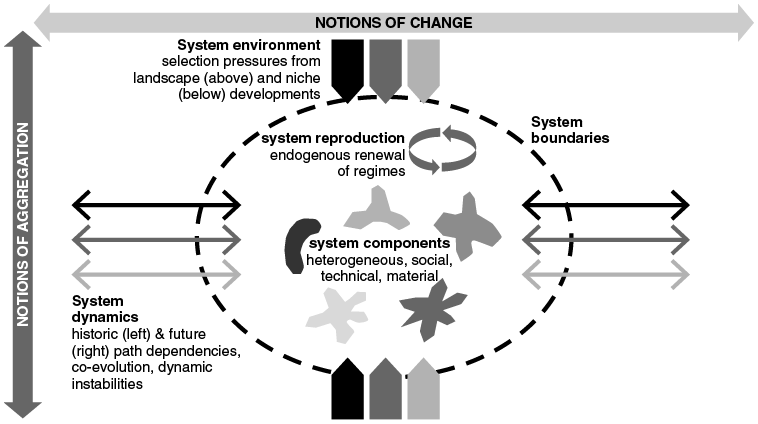
Beyond these ideas about system reproduction and systemic inertia, transitions research stands out for its exploration of dynamics of system change. Here, a key concept is the transitions S-curve, indicating shifting rates of change and innovation diffusion. Elaborating these system understandings further through insights from Complex Adaptive Systems, evolutionary economics, sociology, institutional theory and governance studies, transitions research has theorised the dynamic instability of the socio-technical ‘regimes’, the co-evolution between external pressures from system environments (e.g. ‘landscape’ pressures and emerging ‘niches’), internal dynamics (like ‘endogenous renewal’ of regimes) and system transformation ‘pathways’ that can be discerned across empirical contexts. Taken together, these insights have yielded a basic grammar of system transitions. Broadly shared by an interdisciplinary transitions research community and a wide range of practitioners as well, this systems vocabulary might be visualised as follows:
Figure 25.1 schematises some key features in this shared systems language. It shows how this system transformation vocabulary allows diverse actors to work together despite contrasting notions of system change (in multiple dimensions and modalities collapsed onto the horizontal axis) and of system aggregation (multiple dimensions and levels of aggregation collapsed onto the vertical axis). Frameworks such as the MLP, TIS and SNM have proposed more specific ideas about such features of systems ontologies. In particular, transition management (Rotmans, Reference Rotmans2005; Loorbach, Reference Loorbach2007) has been important in conceptualising transitions in terms of complex adaptive system dynamics (Grin et al., Reference Grin, Rotmans and Schot2010). Functioning implicitly as ‘boundary objects’ (Voß, Reference Voß2014), the elements represented in Figure 25.1 offer only a rough consensus. Throughout the past twenty-five years of transitions research, questions have arisen on all these elements:
What are the key system dynamics and how to underpin accounts of these? This is a longstanding question in transitions research, and notably in transition modelling. Through its disciplinary roots in integrated sustainability assessment and Complex Adaptive Systems research (Peter & Swilling, Reference Peter and Swilling2014), transitions research has always relied strongly on systems modelling approaches (Holtz et al., Reference Holtz, Alkemade, de Haan, Köhler and Trutnevyte2015). Intensively researched issues of system dynamics are the co-evolution patterns underlying transition pathways (Chapter 2), the dynamics of niche formation (Chapter 5) or the barriers and drivers in innovation systems (Chapter 4). After this ‘first wave’ (Chapter 24) of research on the transition dynamics themselves, the underpinning of the theorised system dynamics has been debated more in recent years (Sorrell, Reference Sorrell2018). A prominent example is Geels (Reference Geels2022), discussing different kinds of complex causal mechanisms.
How to transform the system? This line of questioning tends to accompany the aforementioned system dynamics questions (Grin et al., Reference Grin, Rotmans and Schot2010). This coupling of analysis and intervention is usual in systems thinking, operations research and management. The ‘how to transform’ issues have of course been considered extensively in transitions governance research (Chapter 3). Particularly noteworthy however are the specifically systems-analytical ideas on ‘tipping points’ and ‘intervention points’, in the tradition of Meadows’ (Reference Meadows1997) ‘leverage points’ in complex systems.
What is the system environment? In transitions theory, the system in focus is by default a ‘regime’, in interaction with various external ‘niche’ and ‘landscape’ processes. By contrast, analyses in terms of TIS or social practices zoom in on configurationally smaller systems (with socio-technical ‘regimes’ as the system’s environment). For its part, ‘deep transitions’ research (Chapter 7) rather zooms out. More generally, there is an intensifying reflection on the socio-material, political-economic, cultural, ideological and social-ecological system environments through which transition processes are shaped.
What are the system’s boundaries? Queries about system environments logically imply questions on the boundaries that separate systems from their environment. System demarcation is in fact a prominent line of questioning in its own right: Is it to be regarded as a ‘system innovation’, or is it just system optimization that innovates at the level of a subsystem? Such issues have been addressed in terms of ‘subsystems’ (Pel & Boons, Reference Pel and Boons2010), ‘whole system reconfiguration’ (McMeekin et al., Reference McMeekin, Geels and Hodson2019) and ‘multi-system interactions’ (Andersen & Geels, Reference Andersen and Geels2023).
What are the systems composed of? Figure 25.1 only sketches the general assumptions of heterogeneous, socio-technical ‘regimes’. Basic questions on system components tend to be taken for granted, however. When they are addressed, this typically occurs through a dialogue between sector-specific and more general transitions-theoretical insights. For example, Gaitán-Cremaschi et al. (Reference Gaitán-Cremaschi, Klerkx, Duncan, Trienekens, Huenchuleo, Dogliotti and Rossing2019) distinguish ‘agricultural production system’, ‘value chain’ and ‘support structures’ to specify the components of food systems. Holtz et al. (Reference Holtz, Brugnach and Pahl-Wostl2008) presented a more fundamental consideration of ‘regime’ components, and Svensson & Nikoleris (Reference Svensson and Nikoleris2018) initiated further discussion: How to develop causal explanations if we conceive of transitions as changes in rules and institutions? The relevance of material system components has been argued in the account of social-metabolic transitions by Fischer-Kowalski (Reference Fischer-Kowalski2011), a view on system components that is particularly relevant in the context of ‘circular economy’ transitions.
What is system reproduction? Questions on system components may appear rather formal, analytical matters. However, as Svensson & Nikoleris (Reference Svensson and Nikoleris2018) stressed, questions about system constitution are crucial if we want to distinguish system reproduction from system transition. Even if seldom undertaken through explicit systems thinking, questions on system reproduction form the core of research on transitions governance, politics and institutionalisation dynamics (Fuenfschilling & Truffer, Reference Fuenfschilling and Truffer2014). Highlighting the paradoxes, grey zones and ‘niche–regime dynamics’ (Chapter 9) of transition processes, these analyses contain urgent questions about what changes and what stays the same.
This overview summarises intensive explorations of the systems to be transformed. Yet beyond the above ‘what’ and ‘how’ questions, a further line of queries emerges. As underlined in second-order cybernetics, representations in the spirit of Figure 25.1 provide ‘first-order’ systems pictures: Meant to show a categorically objectified system ‘out there’, they downplay how such representations are shaped and coloured by the context of their respective system observers. (Krippendorff, Reference Krippendorff1996: 311) considered this difference essential: ‘To me, the shift from a first-order to a second-order cybernetics signaled a shift in scientific attitude toward reality, from privileging the perspectives of detached observers, spectators or engineers of a world outside of themselves to acknowledging our own participation in the world we observe and construct as its constituents’.
Transforming systems, a common systems vocabulary in transitions research
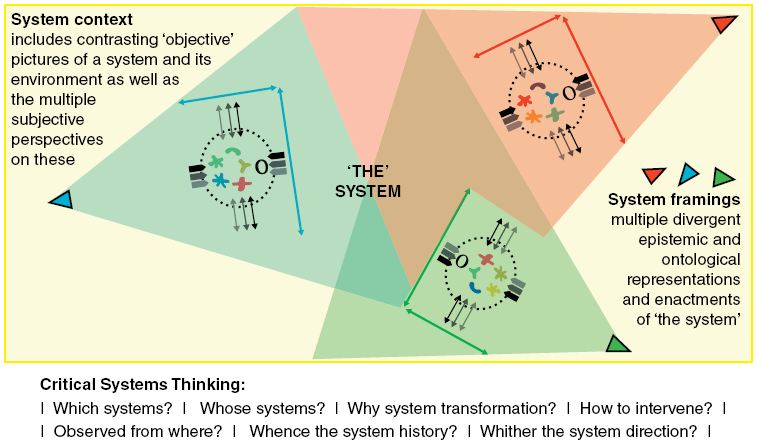
The systems that transitions thinking is dealing with are composed of people, Krippendorf reminds us. Yet many forms of system understanding are rather distant, objectifying people and speaking in the abstract of ‘them’. The conditions bearing on the kinds of representations people choose typically remain under-attended to. To remedy this, system analyses might more systematically disclose how different observers (and their different contexts of observation) tend to yield contrasting representations and framings of the same systems (Krippendorff, Reference Krippendorff1996: 314). System representations might thereby become more ‘plural and conditional’ (Stirling, Reference Stirling2008) – paying more balanced attention not just to a plurality of quite disparate system representations, but also to the particular political, cultural or institutional conditions that each embodies. This central importance of recognising how systems are ‘framed’ forms a key part of the ‘pathways approach’ to sustainability transformations (cf: figure 3.1 in Leach et al., Reference Leach, Stirling and Scoones2010).
As emphasised in participatory approaches to transition modelling (Köhler et al., Reference Köhler, Turnheim and Hodson2020), system analysis can take the form of a dialogue between transitions researchers and practitioners about the (mobility, energy, food or other) systems in which they are implicated. But the point here is not simply to aggregate into some supposedly transcendent ‘consensus view’ but to systematically elicit how contrasting equally valid political perspectives yield different system ontologies, epistemologies and normativities. Transitions analysis – no matter how authoritative it may seem – should never be treated as if it could stand definitively on its own (Saltelli et al., Reference Saltelli and Di Fiore2023), or as if it were exempt from thorough democratic deliberation (Stirling, Reference Stirling2024).
In keeping with this broader and deeper ‘second order’ systems view, Figure 25.2 displays three different framings of Figure 25.1. Different actors associated with diverse subjectivities across the ‘system context’ can make different assumptions about system components, system reproduction, transformation dynamics and system boundaries. This may lead them to widely different framings of transitioning systems – hence the visualisation in different colours. Likewise, as indicated through the arrows that define axes for each system view, they may analyse the systems along different epistemic, ontological and normative dimensions. As displayed at the bottom, this multiplicity of system framings raises a range of ‘boundary questions’ – the queries used in Critical Systems Thinking to disclose the different assumptions underlying system understandings (Ulrich, Reference Ulrich2003):
Which systems? The shift from first-order (Figure 25.1) to second-order (Figure 25.2) systems thinking implies a move away from questions about ‘what the system components, boundaries, dynamics are’. Rather than categorically assuming objective systems ‘out there’, it raises relational ‘which systems’ questions that acknowledge the existence of multiple valid representations. This way of speaking about systems is not uncommon in transitions research. It is one way to avoid the ‘reification trap’ (Ison, Reference Ison2016) of mistaking system representations for reality itself. An MLP analysis, for instance, can identify the main features of mobility systems, but its results do not show us ‘the mobility system’. ‘Which systems’ questions help to avoid ‘voyeuristic’, managerial (Walker & Shove, Reference Walker and Shove2007:219) systems thinking that are overconfident regarding system interventions.
Whose system representations count? Whose interests are reflected in system representations? The notion of ‘system failures’ is suggestive of objective states of affairs and agreed-upon problem. The same applies to common references to ‘the energy regime’ and ‘the incumbent actors’. This objectivism has been challenged particularly extensively in Smith & Stirling (Reference Smith and Stirling2010). Applying critical systems thinking to an empirical study on traffic management, Pel & Boons (Reference Pel and Boons2010) showed how transitions governance revolves around the re-definition of systems. This is in fact a key element of transition management (Loorbach, Reference Loorbach2007): Transition arenas and visioning activities are meant to instigate ‘second-loop learning’ and dialogue on systemic problems.
Why is system transformation needed? These ‘why’ questions tend especially to open up normative dimensions of transitioning systems. These normative dimensions often remain implicit, or hidden under global consensus on ‘sustainability’, ‘system lock-in’ and ‘institutional inertia’. ‘Why’ questions have been asked in various early critical interventions (Walker & Shove, Reference Walker and Shove2007; Bening et al., Reference Bening, Blum and Schmidt2015; Schlaile et al., Reference Schlaile, Urmetzer, Blok, Andersen, Timmermans, Mueller and Pyka2017), but these normative aspects of systems thinking are becoming particularly central issues in analyses of ‘just’ transitions. Especially relevant readings are ‘justice, equity, inclusion, and fair transitions’ (Chapter 16) and studies of the ‘dark sides’ of transitions (Pel et al., 2023).
How to intervene? Observed from where? As mentioned, Figure 25.2 highlights the position of the system observer. Jørgensen (Reference Jørgensen2012) pointed out similarly how societal actors can have widely divergent interpretations of the MLP. So: From which vantage point do we know and engage with the system? To help address this, Smith & Stirling (Reference Smith and Stirling2007) elaborated a distinction between ‘inside’ and ‘outside’ perspectives. Quite literal approaches to the ‘observing from where’ question were offered by Stirling (Reference Stirling2019) and Sovacool et al. (Reference Sovacool, Hess, Amir, Geels, Hirsh, Medina and Yearley2020), who argued for ‘worm eye’ modes of systems analysis. Similar arguments against transcendent, ‘ideal-observer’, ‘cockpit’ and ‘bird’s eye’ perspectives have been made in calls for ‘humility’, ‘situated analysis’, reflexive research (Chapter 27) and in (often participatory) transitions research that accounts for positionality.
Whence the system history? There is agreement that transitions are processes of change that take place over time. Figure 25.1 expresses this temporal aspect through the notions of system reproduction and system dynamics. Guided by ideas about transition processes between present and future system states, the transitions-theoretical systems thinking revolves around evolutionary mechanisms, such as niche development, selection pressures, emergence and co-evolution. Many studies work with a rather pragmatically chosen t = 0, but there are questions to ask about the start of system evolution: The ‘deep transitions’ framework (Chapter 7) proposes to start from ‘industrial modernity’, for example, but there are also more fundamental moves towards a plural understanding of system histories: Key examples are the analyses of temporality (Garud & Gehman, Reference Garud and Gehman2012) and engagements with coloniality (Ghosh et al., Reference Ghosh, Ramos-Mejía, Machado, Yuana and Schiller2021). Importantly, different histories lead to different system understandings (Balanzó-Guzmán & Ramos-Mejía, Reference Balanzó-Guzmán and Ramos-Mejía2023).
Whither the system direction? There are many ways of knowing systems: as a basis for future predictions or as a diagnosis of past transformations. Where the former tends to disclose possibilities and initiatives towards sustainability transitions, the latter tends to elicit lock-in, debt and injustice. Informed by historical case studies, transitions thinking has developed a distinctly prospective mode of systems thinking. A key element of transition management is indeed to evoke reflection on ‘whither the system direction’, through activities of problem structuring and visioning in transition arenas (Loorbach, Reference Loorbach2007). Scholarship on transitions directionality has underlined that this reflection on possible and desirable futures is indeed crucial for the transitions-theoretical systems thinking. It has long been observed that actors in system transitions can influence the direction for change by successfully articulating expectations (Brown & Michael, Reference Brown and Michael2002). Importantly, transition scholars’ own representations also raise expectations (Stirling, Reference Stirling2019). The ‘whither’ question is thus fundamental. It should not be reduced to a matter of ‘directing the transition towards the right direction’ (Stirling, Reference Stirling2024): Transitions research deals with systems that are not only complex as objects but also as performative representations (they create expectations).
Critical systems thinking: boundary questions in systems thinking
This overview already reveals how systems thinking forms a quite diverse methodological family. It gives rise to debates and controversies. Before going into these in Section 25.4, we briefly discuss empirical applications.
25.3 Empirical Application: System Transitions across Contexts
Transitions research has developed a systems language that helps to understand transformative change across contexts. It helps to compare ‘niche–regime’ dynamics (Chapter 9) or ‘strategic niche management’ (Chapter 5) across empirical domains. Featuring volumes on transitions in mobility, agriculture, energy and health systems, the KSI book series starting from Grin et al. (Reference Grin, Rotmans and Schot2010) illustrates this very well. Inversely, context-transcending models such as the MLP, TIS, SNM and transition management have been developed and validated through the comparison and formalisation of various historical case studies. Empirical application of the systems thinking has proven to be easy: This speaks to the proliferating multiplicity of adapted MLP or TIS diagrams, or schemes of transition management phases, that have been crafted to express case specifics.
Transitioning-systems language has been applied to a very wide range of empirical contexts: Beyond the many studies on functional systems of energy, mobility, agriculture and health, other remarkable examples are practices of burying and cremation, rock ‘n’ roll, animal welfare or earth-space engineering. Kanger (Reference Kanger2020) stresses how the study of such ‘neglected systems’ – even if less interesting in terms of environmental impacts – is likely to support theoretical advances. Also, the ‘geographical turn’ in transitions research (Chapters 21–23) has questioned how widely our systems language can be applied: Does it make sense to conceive of transformations in national systems, as if they were isolated processes? Is the idea of coherent, identifiable ‘regimes’ applicable beyond the (northwestern-) European context?
Throughout empirical domains and across the different strands of transitions research, we see many applications of critical systems thinking. Researchers and practitioners illuminate in many ways how the conceptualisation and demarcation of ‘systems’ tends to be neither obvious nor innocent: The ‘mobility system’, with its unsustainable fossil fuel dependency, is often represented as a sub-system of the energy system. Meanwhile, the mobility system has also been characterised by the regime of car dependence. Importantly, the latter system understanding refers to other mechanisms of system reproduction and other key system components than the former. In turn, these different ‘mobility system’ understandings lead to quite different evaluations of system innovation and system reproduction: Electric vehicles can be considered as radical ‘niches’ challenging the dominant design of the internal combustion motor, but they can also be considered as ‘techno fixes’ that essentially reproduce the car-dependency system. Meanwhile, it is not even obvious to characterise energy transition as a matter only of decarbonisation. Again, this underscores how greater reflection on the diversity of possible attributed system purposes – whether in terms of ‘energy democracy’ (Stirling, Reference Stirling2014) or wider ‘innovation democracy’ – supports accountable practices concerning system representations.
Studying transitions processes through systems analysis directs attention to very basic aspects of empirical situations. A most instructive application is the comparative analysis by Papachristos et al. (Reference Papachristos, Sofianos and Adamides2013). Starting from the common assumption that transitions are often triggered by particular ‘outsiders’, they revisited several of the well-known empirical cases that underpinned typologies of transition pathways. Considering concrete examples of ‘outsiders’ (e.g. medical doctors or the taxi sector), they explored a series of fundamental theoretical issues: The outsiders, in which sense are they external to the system under study? Should they perhaps be rather considered as parts of niches, spawned by the internal tensions of the ‘regime’, and as such as parts of the system under study? And if they are indeed to be considered as external to the system under study, are they then to be considered as niches challenging other, surrounding ‘regimes’?
Considering further that radical niches can come from within and from without, and that ‘regime’ shifts are partly resulting from the dynamics of other, surrounding systems – is it then not logical that we see empirical examples of newly emerging systems, such as the functional foods ‘niche’, or the computer regime (ibidem.: 62)? And these newly emerging systems, how can we distinguish them from their ‘parent systems’? Rigorously examining empirical cases for their systemic properties, this study laid important foundations for later explorations of ‘multi-system interactions’ (Andersen & Geels, Reference Andersen and Geels2023). Importantly, it also provided a good demonstration of CST: The analysis of ‘multi-system interactions’ presupposes a series of assumptions about insiders and outsiders, about system boundaries, about exogenous and endogenous ‘drivers’ of change, and about the supposed ‘functions’ of systems and technologies. An instructive example from Papachristos et al. (Reference Papachristos, Sofianos and Adamides2013) was the ‘functional foods’: Should they be analysed as derivative of foods or of pharmaceutical products, as a hybrid between these two, or as something entirely different altogether?
25.4 Ongoing Debates: Adequacy, Politics and Plural Perspectives
Regarding ongoing debates, a first observation is perhaps that many accounts of ‘system transitions’ lack specific reference to any concrete, bounded, empirical system. A certain common understanding has developed around socio-technical ‘regimes’, their components and the co-evolution dynamics of system transitions, but the systems vocabulary is seldom operationalised in detail. This is reflected in a tendency towards relatively casual references to ‘outsiders’ or ‘endogenous change’ (Section 25.3).
This relative absence of systematic debate is noteworthy, but we have also seen a quite thorough exploration of systems and system understandings (Section 25.2). The engagements with the boundary questions have opened up scientific debates and indeed controversies. As expressed through the Figures 25.1 and 25.2, one can raise different kinds of questions about ‘systems’ in transitions. The questions we raise reflect fundamental ontological and epistemological assumptions, as well as contrasting patterns of normative interest in systems: Systems can be taken as analytical constructs for modelling, as coding devices for case comparison, as representations of governance issues, or as resources for policy advocacy. As Krippendorff (Reference Krippendorff1996) stressed, first-order and second-order systems thinking really raise different questions and perspectives. It makes a difference whether one takes an ‘eagle eye’ or a ‘worm eye’ perspective.
Overall, we can see three main debates about the systems-in-transitions thinking. These debates are connected in terms of theoretical and practical implications, yet scholars tend to engage in them out of different knowledge interests. The debates unfold to a certain extent in parallel.
(1) Ontological adequacy. In first-order systems thinking, ‘what’ and ‘how’ questions predominate. This involves intensive debates about the social-technical-ecological constitution of the systems to transform (‘how about economic sectors, socio-economic classes, geographic regions, or geo-morphological layers?’), and about the underpinnings of theorized transition dynamics (‘how useful is the focus on rules/institutions for transition analysis, what about material impacts?’). These debates have yielded a rich systems-theoretical body of knowledge on units and levels of transitions analysis, systems-of-systems, whole-systems analysis, subsystem innovation and multi-system interactions. These debates are driven mostly by scholars engaged in theory development, and by the transitions modelling community. While the discussions on transitions ontologies involve an increasingly diversified transitions research field, the modelling community plays a key role in the formalisation of the ‘systems’ under study.
(2) Normative-political implications. The ‘which’, ‘why’ and ‘whose’ systems questions have gained attention, especially in research on transitions governance and politics. A recurring issue is whether prevailing system representations are giving appropriate, balanced and fair accounts of systemic problems and solutions. Are the representations of systems challenging or reproducing dominant actor constellations, interests and discourses? Whose system definitions count? In the politics-focused approaches and in ‘just’ transitions scholarship, a central issue is who gets to define the system. This marks to a certain extent the shift from Figure 25.1 (representing the singular system ‘out there’) to Figure 25.2 (representing plurality of system understandings). On the other hand, some of these debates stay within first-order systems thinking. This is the case for example when dominant system representations are dismissed as ‘false’ system representations.
(3) Plural perspectives. Finally, there is the dispersed but ongoing engagement with the ‘whence’, ‘whither’ and ‘observed from where’ lines of questioning. These are the typical second-order systems thinking questions of Figure 25.2, starting from the diversity of system understandings. A key issue is the position of the actor defining the system, and related to this, the many subtle ways in which system definitions introduce assumptions of expertise, overview and control. The system’s language itself carries a certain technocratic temptation, a mindset of overview and control (Stirling, Reference Stirling2019). An increasingly prominent question is therefore (see also Chapter 23 on the Global South and North): How are system representations articulating or suppressing epistemic diversity? The debates on epistemic diversity involve engagements with entirely different approaches to sustainable development, such as political ecology. This deepens transitions research through questions such as the following: Is the ‘systems’ notion at all compatible with the handling of complex transformation processes, and with the heterogeneity of social-ecological networks? Should we perhaps understand transitions in terms of networks, arenas, processes, flows, webs or fields? It is worth noting how this line of questioning links back into the debates on ontological adequacy.
25.5 Emerging Research and Further Needs
Systems thinking is fundamental for transitions research – the cross-references to other chapters have underlined this. The vocabulary of transitioning systems has helped to develop our highly interdisciplinary transitions research community. The notion of ‘the system’ is easily taken for granted, however. This chapter has shown how casual references to ‘outsiders’, ‘endogenous change’ and ‘system transformations’ call for greater clarity about systems and system representations. Invoking Critical Systems Thinking, we have also shown how some transitions research has developed quite rich debates around various ‘boundary questions’ about the ‘systems’ in transition (Section 25.2). This systems thinking tradition provides useful methodological resources for the investigation and comparison of diverse transition cases (Section 25.3).
Regarding the emergence of promising lines of research and further needs, it is important to recognise the notable advances that are already being made. There is some shared critical awareness of the ‘reification trap’, that is, of assuming system understandings to be obvious and beyond discussion. First-order systems thinking still prevails as a norm for its capacity to make complexity tractable, but it is generally accompanied with at least some second-order systems thinking awareness. System models and theories tend to be presented cautiously as ‘frameworks’ or ‘perspectives’, for example, and there have been many efforts to articulate the variety of system understandings. We have indicated various newly emerging themes, but the debates over ontological adequacy, normative-political implications and epistemic diversity also indicate an already longstanding tradition of systems thinking (Section 25.4).
In more operational terms, it is noteworthy to see how researchers in transition modelling and scenario development are developing iterative, participatory approaches (Köhler et al., Reference Köhler, Turnheim and Hodson2020). This shows in a nutshell how reflection on first-order and second-order systems thinking can be applied and valorised. Also encouraging is the emergence of methodologies for addressing epistemic diversity, such as multi-criteria analysis, ‘quantitative storytelling’ (Kovacic et al., Reference Kovacic, Strand and Völker2019) or critical innovation studies (Godin & Vinck, Reference Godin and Vinck2017). Finally, there is also transitions research that is clearly in the second-order systems spirit of Krippendorff (Reference Krippendorff1996), highlighting how appraisal itself forms part of the transitioning systems being studied. This includes studies on the performativity of the ‘transition management’ governance model (Voß, Reference Voß2014) and its susceptibility to inadvertent influence by incumbent interests (Stirling, Reference Stirling2019). Such second-order systems thinking approaches remind us of the fundamental democratisation issues that transitions research itself is raising – through the circulation of system representations (Stirling, Reference Stirling2024).
Regarding ‘further needs’, it must be stressed in critical systems thinking mode that no ‘advance’ can be considered definitive, self-evident or unambiguous. Figures 25.1 and 25.2 indicate an important epistemological move towards second-order systems thinking. The awareness of this inescapable subjectivity is a fundamental advance in systems thinking. Still, these first and second orders should not be mistaken for hierarchical orders: as shown, they indicate different modes of asking questions about systems. The three debates distinguished in Section 25.4 should similarly not be taken as progressive ‘stages of reflection’. This would neglect how the various ‘what’, ‘which’ and ‘whose’ questions evoke each other. As already elaborated under the banners of ‘double-loop learning’ (Argyris, Reference Argyris1977), Soft Systems Methodology (Checkland & Scholes, Reference Checkland and Scholes1999) and indeed Critical Systems Thinking (Ulrich, Reference Ulrich2003), any of these questions can be the start of a dialogue about the ‘systems’ to be transitioned. This chapter has provided concepts, themes and search terms that support this.

 Open access