





Introduction
The trace fossil Polykampton Ooster, Reference Ooster, Ooster and Fischer-Ooster1869, typified by P. alpinum Ooster, Reference Ooster, Ooster and Fischer-Ooster1869 from the Paleogene flysch deposits of Switzerland, was almost forgotten for more than a century and treated as a monospecific ichnogenus (Häntzschel, Reference Häntzschel and Teichert1975; Seilacher, Reference Seilacher2007). Discoveries of four new ichnospecies of Polykampton from Cretaceous–Oligocene flysch deposits (Wetzel and Uchman, Reference Wetzel and Uchman1997; Uchman and Rattazzi, Reference Uchman and Rattazzi2018; Uchman et al., Reference Uchman, Wetzel and Rattazzi2019, Reference Uchman, Lebanidze, Beridze, Kobakhidze, Lobzhanidze, Khutsishvili, Chagelishvili, Makadze, Koiava and Khundadze2020) showed that this ichnogenus is more diverse and widespread than previously thought. In this paper, a sixth named ichnospecies of Polykampton is described and interpreted. The new ichnospecies derives from the Maastrichtian–Paleogene deep-sea deposits of the Northern Apennines in Italy. The objectives of this study are to add to the knowledge on: (1) the general increase in diversity of deep-sea trace fossils since the Late Cretaceous, (2) the diversification of their nutritional strategies since the Late Cretaceous (Uchman, Reference Uchman and McIlroy2004), and (3) the competitive behavior of burrowing invertebrates in generally oligotrophic environments.
Geological setting
The study area is characterized by the Monte Antola Unit of the Northern Apennines, specifically, in the Val Borbera region and its surroundings, north of Genova in northwestern Italy (Fig. 1). The Monte Antola unit is probably an allochthonous tectonic slab of Ligurid units (e.g., Marroni et al., Reference Marroni, Mollia, Ottria and Pandolfi2001 and references therein). The described trace fossil occurs in the stratigraphically higher part of the slab, which is composed of the Bruggi-Selvapiana Formation overlain by the Pagliaro Formation.
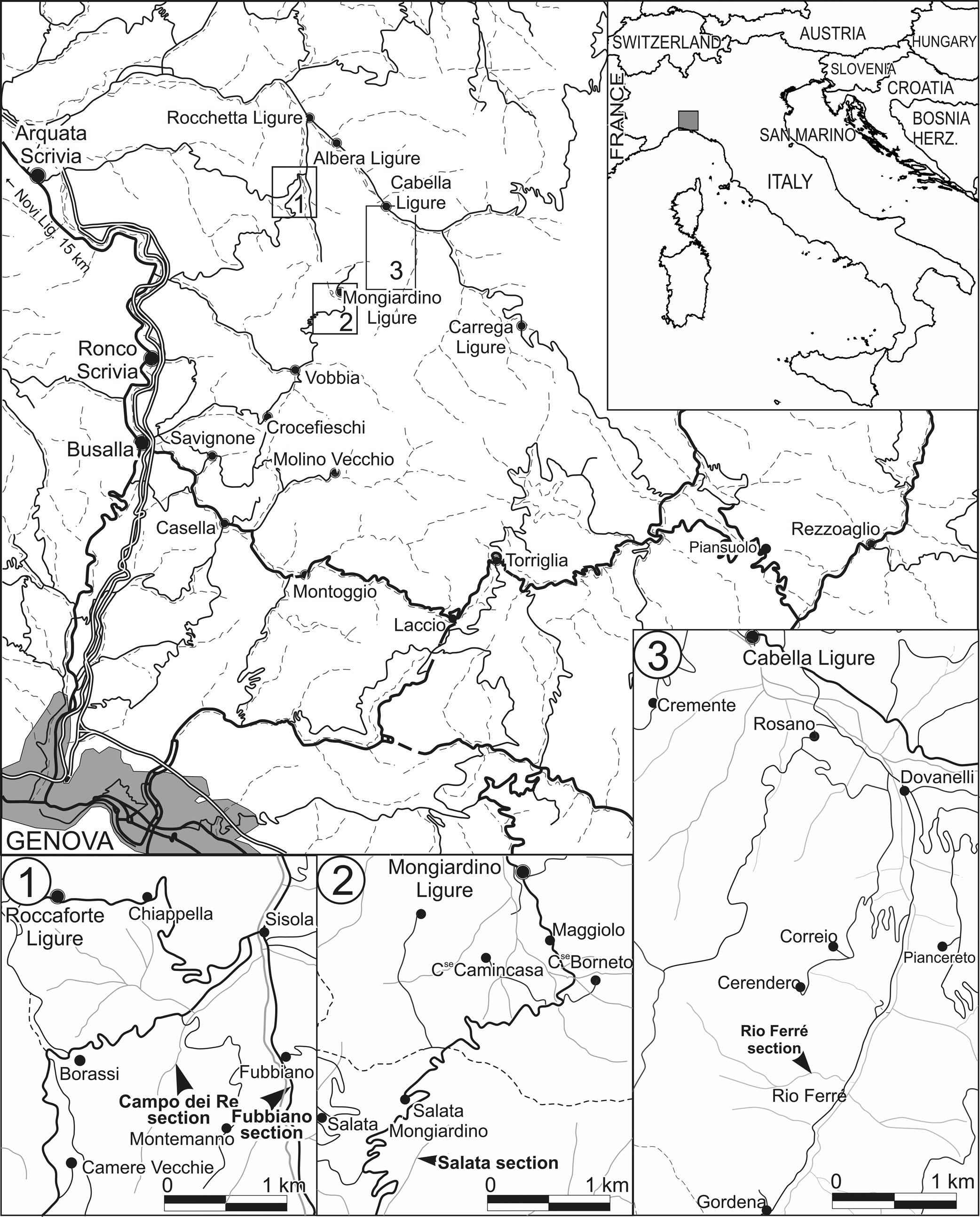
Figure 1. A general location map with inserts containing indications of the sections in detail. (1) Campo dei Re section and Fubbiano section. (2) Salata section. (3) Rio Ferré section. Location of the study region is indicated by the gray quadrangle in the upper right insert.
The Bruggi-Selvapiana Formation (late Campanian–late Maastrichtian) is a c. 500 m thick succession of thick- and very thick-bedded hybrid turbidites. Their lower part is composed of siliciclastic material, and their upper part consists mainly of marlstones (marlstone understood as hard rock of the composition as in marl) in the upper part, which alternate with subordinate thin-bedded sandstones and shales (Abbate and Sagri, Reference Abbate and Sagri1967). In the Borbera Valley, this unit is thinner than elsewhere because it pinches out here (Levi et al., Reference Levi, Ellero, Ottria and Pandolfi2006).
The Pagliaro Formation (Bellinzona et al., Reference Bellinzona, Boni, Braga and Marchetti1971; Marroni et al., Reference Marroni, Mollia, Ottria and Pandolfi2001, Reference Marroni, Feroni, di Biase, Ottria, Pandolfi and Taini2002; Levi et al., Reference Levi, Ellero, Ottria and Pandolfi2006) is about 300–400 m thick (Abbate and Sagri, Reference Abbate and Sagri1967) and is dated to nannoplankton NP1–NP5 zones of the early Paleocene to early late Paleocene (Marroni et al., Reference Marroni, Mollia, Ottria and Pandolfi2001) or to the CC25b–NP5 zones of the late Maastrichtian–early late Paleocene (Levi et al., Reference Levi, Ellero, Ottria and Pandolfi2006; Catanzariti et al., Reference Catanzariti, Ellero, Levi, Ottria and Pandolfi2007). In the lower to middle part, the Pagliaro Formation consists mainly of thin- to thick-bedded turbidites, whose beds are composed of sandstones and/or siltstones becoming gradually replaced by turbiditic marlstone and/or shale. At the top of the beds, the shales represent partly the pelagic and hemipelagic background sedimentation. They are commonly dark gray and noncalcareous. The silty or muddy turbiditic marlstones are massive and light gray, dark gray, or pale rose in color. Some of these beds are up to a few meters thick. The sandstones are rich in plant detritus. Commonly, thinner beds display the Ta–d Bouma intervals. Locally, the beds thicken in upward trends in packages about 10 m thick. In the upper part of the formation, the marlstone beds are less common. The formation is gently tectonically deformed, with folds, faults, and internal detachments, especially in the middle and upper parts (Marroni et al., Reference Marroni, Feroni, di Biase, Ottria, Pandolfi and Taini2002; Levi et al., Reference Levi, Ellero, Ottria and Pandolfi2006). Trace fossils of the Pagliaro Formation are very diverse and locally abundant; they are typical of the deep-sea Nereites ichnofacies (Uchman, Reference Uchman2007; Uchman and Rattazzi, Reference Uchman and Rattazzi2018; Uchman et al., Reference Uchman, Wetzel and Rattazzi2019).
The Pagliaro Formation is overlain unconformably by lower Oligocene fan-delta conglomerates of the Savignone Formation and locally by other Oligocene sediments, mainly the Ranzano Formation (e.g., Gelati and Gnaccolini, Reference Gelati and Gnaccolini1978; Ghibaudo et al., Reference Ghibaudo, Clari and Perello1985; Gnaccolini, Reference Gnaccolini1988). The conglomerates pass upward into the kilometer-thick series of turbidites of the Monastero Formation (Bellinzona et al., Reference Bellinzona, Boni, Braga and Marchetti1971; Mutti et al., Reference Mutti, Papani, di Biase, Davoli, Mora, Segadelli and Tinterri1995; Marroni et al., Reference Marroni, Ottria, Pandolfi, Catanzariti, Bormioli, Cucchi and Molettain press). In the lower part, the turbidites are locally conglomeratic, while pelitic facies prevail in the upper part. Locally, pebbly mudstones and slump deposits are present. The calcareous nannoplankton matches the NP23 or NP24 zones of late Rupelian to early Chattian (Marroni et al., in press). These lithostratigraphic units belong to the filling of the episutural Tertiary Piemonte Basin.
The described Polykampton occurs in five sections, four in the middle part of the Pagliaro Formation (Fig. 1), the Campo dei Re section (44°39.440′N, 009°02.438′E), the Salata (44°37.063′N, 009°03.042′E) and Fubbiano (44°40.086′N, 009°03.035′E) sections, and one section in the Bruggi-Selvapiana Formation in the Rio Ferré (44°38.283′N, 009°06.217′E). At the first locality, it was found in a marlstone bed outcropping in a few-meters-high escarpment on the right side of a ravine (Fig. 2). Most specimens derive from this bed. In the Salata section, turbiditic deposits a few tens of meters thick are exposed in a steep ravine. The trace fossil was found in a marlstone bed on the left bank of the stream close to the bottom of the ravine (Fig. 2). In the Fubbiano section (an escarpment in the river valley) and Rio Ferré sections (a stream bed in a ravine), specimens of the described Polykampton had been found occasionally in previous years. Those specimens derive from beds that have recently been covered, so detailed sections cannot be presented.
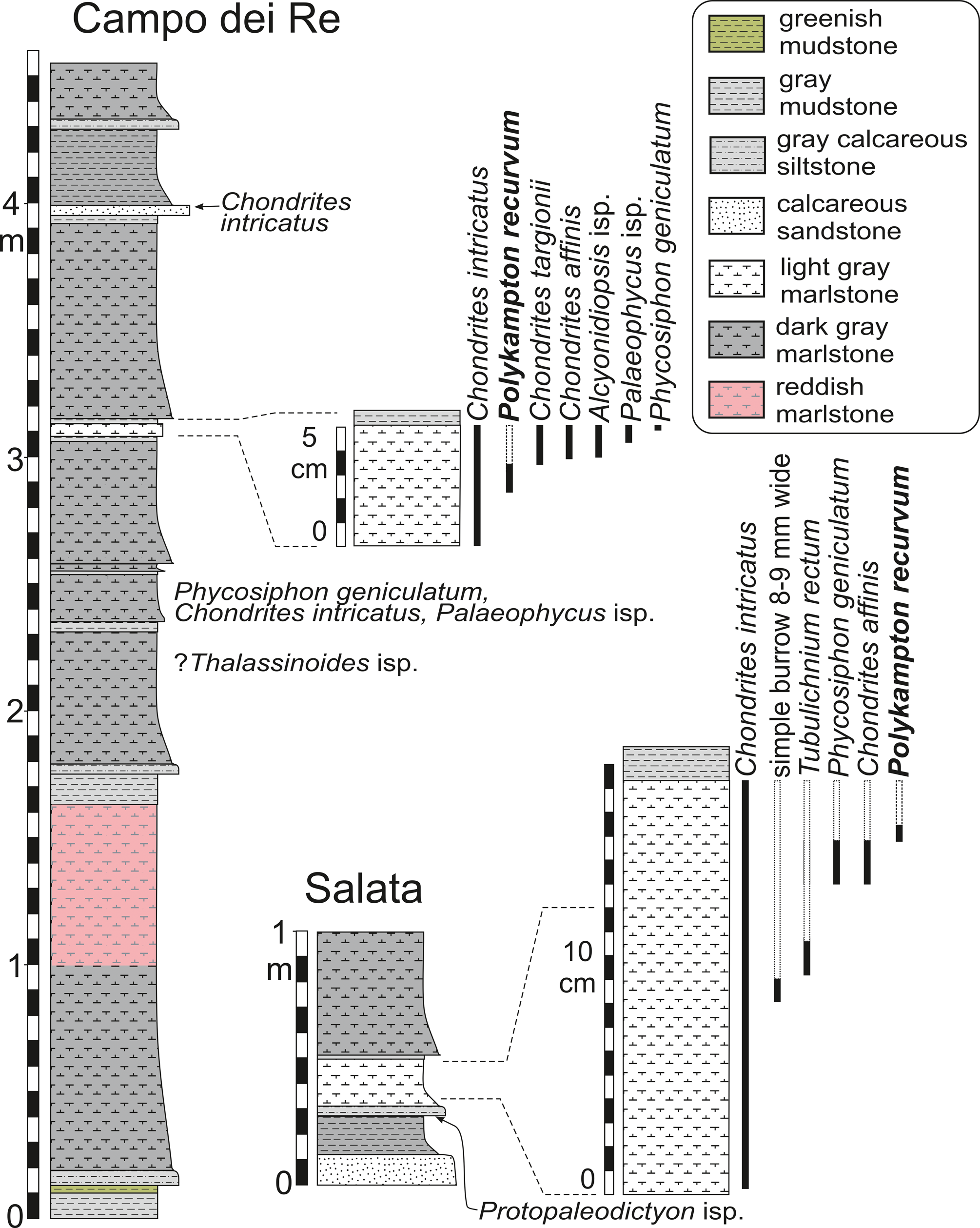
Figure 2. Fragments of sections of the Pagilaro Formation at Campo dei Re and Salata with indication of trace fossils and distribution in the bed bearing Polykampton.
Materials and methods
Sections at Campo dei Re and Salata were measured bed by bed, and collected specimens were hand prepared. For better contrast between host rock and trace fossils, some split surfaces were oxidized with a weak acid. The same effect is obtained after at least a few months of weathering in natural conditions. The size measurements are made by means of mechanical calipers.
Repositories and institutional abbreviations
Type material and other specimens examined in this study are deposited in the following institutions: The Crocefieschi Museum near Genova in Italy and the Nature Education Centre of the Jagiellonian University (CEP) – Museum of Geology (Kraków, Poland). Specimens of the new Polykampton ichnospecies labeled with four-digit numbers are housed in the Crocefieschi Museum. Specimens in the Nature Education Centre of the Jagiellonian University (CEP) – Museum of Geology are under the acronym INGUJ249P. Several specimens are composed of two pieces of a split bed (labeled as “a” and “b” after the number [in CEP] or as “bis” for one of them, which is the counterpart [in the Crocefieschi Museum]).
Systematic ichnology
Ichnogenus Polykampton Ooster, Reference Ooster, Ooster and Fischer-Ooster1869
Type ichnospecies
Polykampton alpinum Ooster, Reference Ooster, Ooster and Fischer-Ooster1869 from the Paleogene flysch deposits of Switzerland, by original designation.
Diagnosis
Horizontal, ribbon-like structure composed of a median cylindrical tunnel and complex leaf-like lobes (Uchman et al., Reference Uchman, Lebanidze, Beridze, Kobakhidze, Lobzhanidze, Khutsishvili, Chagelishvili, Makadze, Koiava and Khundadze2020, modified from Uchman and Rattazzi, Reference Uchman and Rattazzi2018 and Uchman et al., Reference Uchman, Wetzel and Rattazzi2019).
Remarks
The ichnogenus Polykampton, aside from its type ichnospecies Polykampton alpinum, includes P. eseri (Unger, Reference Unger1850) (Wetzel and Uchman, Reference Wetzel and Uchman1997), P. cabellae Uchman and Rattazzi, Reference Uchman and Rattazzi2018, P. guberanum Uchman, Wetzel, and Rattazzi, Reference Uchman, Wetzel and Rattazzi2019, P. multiflabellatum Uchman, Wetzel and Rattazzi, Reference Uchman, Wetzel and Rattazzi2019, and P. georgianum Uchman et al., Reference Uchman, Lebanidze, Beridze, Kobakhidze, Lobzhanidze, Khutsishvili, Chagelishvili, Makadze, Koiava and Khundadze2020. They are known from Upper Cretaceous to Oligocene flysch deposits, so far only in Europe and the Caucasus region.
Polykampton recurvum new ichnospecies
Figures 3–6

Figure 3. Types of Polykampton recurvum n. isp. from the Pagliaro Formation in the Campo dei Re section. (1) The holotype, specimen 7335. (2) Paratype 1, INGUJ149P230b. Chi = Chondrites intricatus. (3, 4) Details of (2). (5) Paratype 2, specimen 7333 bis. (6) Paratype 3, INGUJ149P231b.

Figure 4. Selected specimens of Polykampton recurvum n. isp. from the Pagliaro Formation in the Fubbiano (1, 2) and Campo dei Re (3–6) sections. Cha = Chondrites affinis; Chi = Chondrites intricatus; Pa = Palaeophycus isp.; Phg = Phycosiphon geniculatum. (1) Specimen 6755. (2) 6756bis. (3) 7137. (4) 7213 and 7213 bis. (5) 7145 and 7145bis. Red arrows point to intersection of lobes with the median tunnel. (6) 7136bis.

Figure 5. Selected specimens of Polykampton recurvum n. isp. from the Pagliaro Formation in the Campo dei Re section (1, 2, 4–8) and from the Bruggi-Selvapiana Formation in the Rio Ferré section (3). Al = Alcyonidiopsis isp.; Cha = Chondrites affinis; Chi = Chondrites intricatus; Pa = Palaeophycus isp.; Phg = Phycosiphon geniculatum; Phi = Phycosiphon incertum; Plbd = Planolites with filling bioturbated with Chondrites (“Bandchondriten”). (1) Specimen 7148bis. (2) 7146. (3) 6718. (4) 7139. (5) Detail of (2), 7146; red arrow points to intersection of lobes with the median tunnel. (6) INGUJ149P244. (7) 7151. (8) INGUJ149P235.
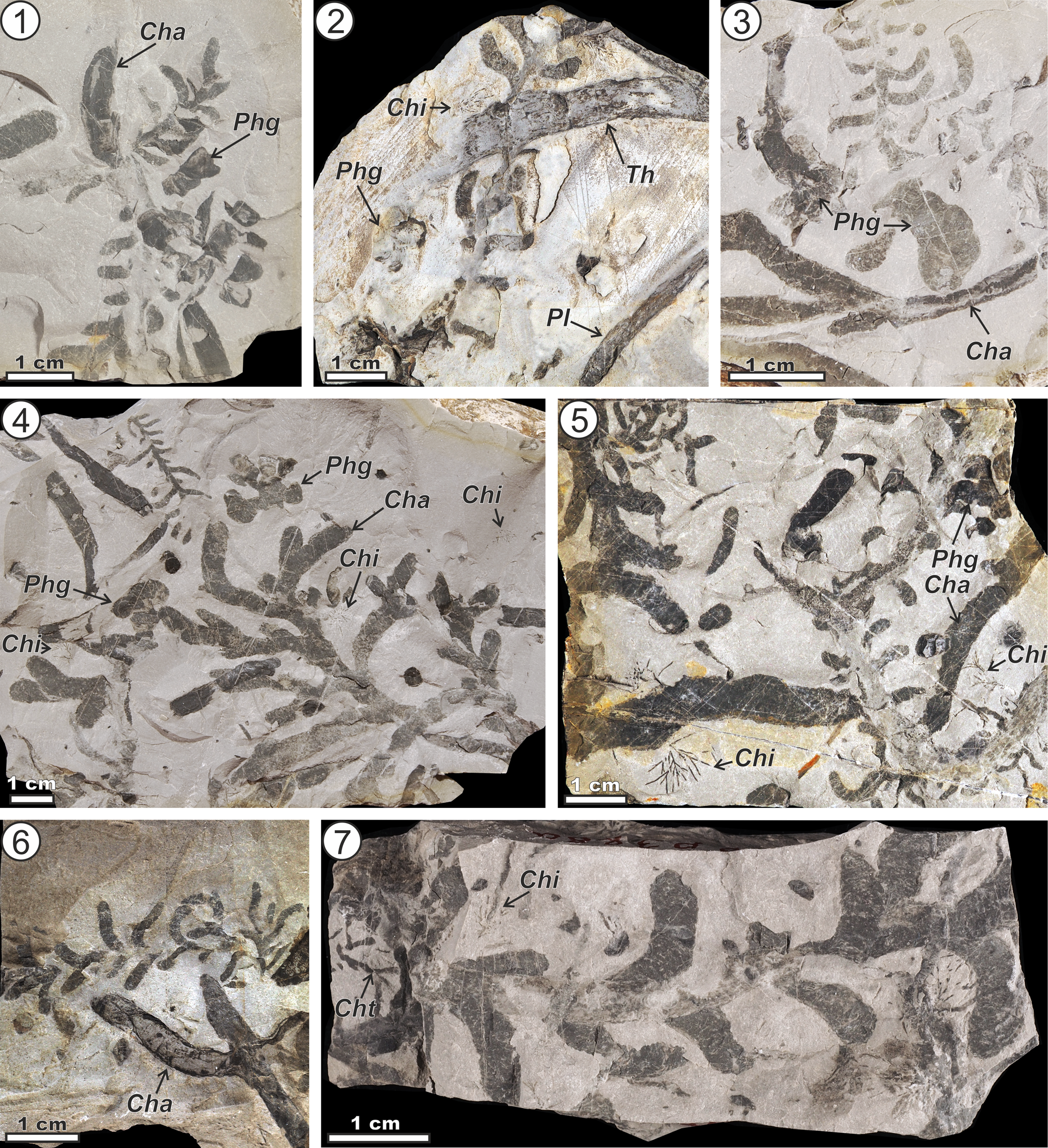
Figure 6. Selected specimens of Polykampton recurvum n. isp. from the Pagliaro Formation in the Campo dei Re (1–6) and the Salata (7) sections. Cha = Chondrites affinis; Chi = Chondrites intricatus; Cht = Chondrites targionii; Phg = Phycosiphon geniculatum; Pl = Planolites isp.; Th = Thalassinoides isp. (1) INGUJ149P237a. (2) INGUJ149P233. (3) INGUJ149P238. (4) INGUJ149P239a. (5) INGUJ149P231b. (6) INGUJ149P390. (7) INGUJ149P388b.
Holotype
Specimen 7335 (Fig. 3.1) from the Pagliaro Formation in the Campo dei Re section.
Paratypes
Paratype 1, INGUJ149P230b (Fig. 3.2–3.4). Paratype 2, specimen 7333bis (Fig. 3.5). Paratype 3, INGUJ149P234b (Fig. 3.6), all from the Pagliaro Formation in the Campo dei Re section.
Diagnosis
Horizontal structure composed of a median cylindrical tunnel and narrow, usually back-curved, sparse, lateral lobes arranged alternately.
Description
The median tunnel is straight, gently curved, or slightly winding, 0.7–5 mm wide (mean 2.3 mm, n = 45; see Fig. 7 for morphometric parameters). In some specimens, width of the median tunnel changes gradually toward one end by ~20–40%. The length of the median tunnel was observed for ~12–85 mm (mean 39.7 mm, n = 45). Its natural termination is unknown because the tunnel plunges into or emerges from the rock or is broken at the edge of a specimen. The width of the median tunnel is usually the same or larger than the width of the lobes. Rarely, the contrary situation is seen (Fig. 4.3), but in such cases this could be an effect of intersection if the tunnel runs at a slightly different level from the lobes. The variable morphometric parameters are shown in Figure 7.1 and the data in Table 1. Selected statistic relationships between some morphometric parameters are presented in Figure 7.3–7.8.

Figure 7. (1) Morphometric parameters of Polykampton recurvum n. isp. (2) Width of subsequent lobes on both sides in specimen 7213. (3–8) Selected statistical relationships between some morphometric parameters.
Table 1. Morphometric parameters of Polykampton recurvum n. isp., n = 45. For the parameter definitions, see Figure 7.1.

The lateral lobes are located alternately positioned on both sides of the tunnel. They show a constant width and a semicircular termination. The width of individual lobes may differ within the same specimen. In all specimens (n = 45), the width of the widest lobes ranges from 1 to 4.5 mm (mean 2.2 mm), and the width of the narrowest lobes ranges from 0.7 mm to 4 mm (mean 1.8 mm). The narrower lobes are usually more frequent in one part of the specimen than in the other (Figs. 4.2, 4.4, 5.1, 5.8, 6.2, 7.2). The length of the lobes may differ within a specimen. The longest lobes reach 3.5–18 mm (mean 5.3 mm) and the shortest lobes are 1–6.5 mm long (mean 4.2 mm). The spacing between the near lobes ranges from 1 to 19 mm (mean 4.1 mm) and may vary significantly within a specimen. The maximum width of the trace fossil (measured perpendicularly to the median tunnel) ranges from 8 to 38 mm (mean 17.8 mm, n = 45). The number of lobes in better-developed specimens ranges from 8 to 24 (mean 13.3, n = 24). This gives 12–40 lobes/20 cm (mean 23.8 lobes/10 cm).
The lobes emanate tangentially from the mid or basal flanks of the median tunnel and run in the same direction at an angle of ~45° to the tunnel axis, but shortly after (within <2 mm) they turn to a more perpendicular orientation and form an arc. The arc may be prolonged backward (i.e., recurved). In most specimens, the lobes form regular arcs having a similar curvature, but some are slightly winding (Figs. 3.5, 4.6, 5.1, 5.4, 6.6). Rarely, the course of some lobes continues in the direction of emanation from the median tunnel (Figs. 3.2, 4.5, 6.2); that is, they are not recurved. Even more rarely, the lobes can be curved toward the median tunnel shortly after emanation and miss the tunnel at a slightly different level (Figs. 4.5, 5.5).
Rarely, some lobes are branched, with one or two branches, which are straight or curved back (Figs. 4.6, 6.6). Exceptionally, about half of the lobes in specimen 7146 are branched (Fig. 5.5). The lobes and the median tunnel can be on slightly different levels; that is, the lobe can run deeper than the tunnel. Therefore, on some parting surfaces, incomplete lobes may be visible whose length can be underestimated.
The trace fossil is filled with noncalcareous gray mudstone, which contrasts with the beige color of the surrounding marlstone. Filling of the median tunnel is lighter than filling of the lobes. Not rarely, sediment in the filling of the lobes is pelleted and slightly meniscate (Figs. 3.2–3.4, 4.2, 6.7). The pellets are indistinct, elliptical in outline, less than 0.5 mm in diameter. The menisci are manifested as shallow, densely packed convex-outward arcs on the surface. Exceptionally, in one specimen (ING149P235), pelleted and meniscate sediment also fills the median tunnel (Fig. 5.8).
Etymology
Recurvus (Latin) means bent back. This corresponds to the shape of the lobes.
Material
Thirty-four specimens (6476, 7079, 7136, 7137, 7138, 7139, 7145, 7146, 7147, 7148, 7151, 7182, 7183, 7213, 7321, 7334, 7336, 7372, 7390, 7455, 7456, INGUJ149P231, 233, 235, 237, 238, 239, 243, 244, 246, 247, 387, 390, 391) from the Campo dei Re section (Pagliaro Formation), five specimens (6445, 6933, INGUJ149P387, 388, 408) from the Salata section (Pagliaro Formation), two specimens (6755, 6756) from the Fubbiano section (Pagliaro Formation), and one specimen (6718) from the Rio Ferré section (Bruggi Selvapiana Member).
Remarks
Polykampton recurvum n. isp. shows all features of Polykampton as presented in the diagnosis of the ichnogenus, first being the median tunnel and lateral lobes as the principle ichnotaxobase. The shape and arrangement of the lobes is the ichnotaxobase for the ichnospecies of Polykampton. Compared with the other ichnospecies, it is most similar to P. eseri from the Late Cretaceous and Eocene of the Alps (Uchman, Reference Uchman1999; Wetzel and Uchman, Reference Wetzel and Uchman1997). However, P. eseri, known only from a few specimens, is different as its lateral lobes are closely spaced and not curved backward (Figs. 8, 9). The other ichnospecies of Polykampton show different geometries of the lobes, which are much wider and show a leaf- or petal-like outline (Uchman et al., Reference Uchman, Wetzel and Rattazzi2019, Reference Uchman, Lebanidze, Beridze, Kobakhidze, Lobzhanidze, Khutsishvili, Chagelishvili, Makadze, Koiava and Khundadze2020). They can easily be distinguished from P. recurvum n. isp.

Figure 8. Contours of Polykampton recurvum n. isp., P. eseri, and Dendrotichnium for a comparison of their general shapes.

Figure 9. Geometric differences in schematic contours of Polykampton recurvum n. isp. and P. eseri.
Chondrites recurvus (Brongniart, Reference Brongniart1823) shows back-curved branches as in P. recurvum, but the branches emanate asymmetrically from a back-curved tunnel or emanate successively one from another. Moreover, their filling does not show any pellets or menisci (Fu, Reference Fu1991). Generally, this ichnospecies has any median tunnel.
Some similarities are displayed by Dendrotichnium Häntzschel, Reference Häntzschel and Teichert1975, which is typified by D. llarenai (Farrés, Reference Farrés1967) from the Upper Cretaceous of Spain. It has a median tunnel and sparse, lateral, alternating branches, but the branches are never back-curved. All parts of the trace fossil show different proportions than in Polykampton recurvum (Fig. 8). Moreover, Dendrotichnium is preserved as a convex hypichnion on a turbiditic bed. D. seilacheri Kozur, Krainer and Mostler, Reference Kozur, Krainer and Mostler1996 from the Permian of Sicily is geometrically somewhat similar. In D. haentzscheli (Farrés, Reference Farrés1967), the lateral branches emanate symmetrically from the median tunnel. These representatives of Dendrotichnium show no evidence of active filling. Therefore, the branches cannot be treated as lobes, and their relation to Polykampton seems to be apparent.
The narrow, almost tubular lobes of Polykampton recurvum are somewhat similar to the tubes of Cladichnus D'Alessandro and Bromley, Reference D'Alessandro and Bromley1987. However, Cladichnus has no central tunnel, the tubes are branched, and the branching pattern characterized by side offshoots is distinctly different (see Fu, Reference Fu1991; Wetzel and Uchman, Reference Wetzel and Uchman2013).
Distribution and associated trace fossils
Polykampton recurvum n. isp. occurs in single beds of beige marlstone. In the Campo dei Re section, the bed is 5 cm thick and covered by a 0.7 cm thick layer of gray noncalcareous mudstone (Fig. 2). In the Salata section, P. recurvum is present in a 22 cm thick marlstone bed having a 3 cm thick layer of marly siltstone at the base and a 2 cm thick layer of gray marlstone at the top (Fig. 2). After splitting of the beds approximately along a horizontal plane, P. recurvum is usually seen on both the lower and upper slit surface. The color contrast between the burrow filling and the host rock is greater after oxidized.
In the Campo dei Re section, Polykampton recurvum occurs in the same bed as Chondrites intricatus (Brongniart, Reference Brongniart1823) (Figs. 3.1, 4.5, 5.1, 6.2, 6.4, 6.5, 6.7), Chondrites affinis (Sternberg, Reference Sternberg1833) (Figs. 5.2, 5.5, 6.1, 6.3–6.6), Palaeophycus isp. (Figs. 4.5, 5.1, 5.7, 5.8), Planolites isp. (Fig. 6.2), Alcyonidiopsis isp. (Fig. 5.8), Phycosiphon geniculatum (Sternberg, Reference Sternberg1833) (Figs. 4.6, 5.7, 6.1–6.5), and possibly Thalassinoides isp. (Fig. 6.2). Considering the penetration depth of these trace fossils from the top of the beds, Polykampton recurvum occupies a middle tier; only Chondrites intricatus more deeply and distinctly crosscuts P. recurvum.
In the same bed in the Salata section, Polykampton recurvum co-occurs with Chondrites intricatus (Fig. 6.7), Chondrites targionii (Brongniart, Reference Brongniart1828) (Fig. 6.7), Chondrites affinis, Tubulichnium rectum (Fischer-Ooster, Reference Fischer-Ooster1858), Phycosiphon geniculatum, and a simple, tubular burrow that is 8–9 mm wide (?Planolites isp.). The base of the bed contains Protopaleodictyon isp. Here, all the associated burrows descend below P. recurvum. In both sections, P. recurvum occurs 2–2.5 cm below the top of the marlstone.
The slabs bearing Polykampton recurvum from the Fubbiano section contain Palaeophycus isp. (Fig. 5.2). The slab with P. recurvum from the Rio Ferré section contain Chondrites intricatus (Figs. 4.4, 5.3), Chondrites affinis (Fig. 4.4), Phycosiphon geniculatum (Fig. 5.3), and Planolites isp., which was preferentially reworked by the Chondrites producer forming “Bandchondriten” sensu Ehrenberg (Reference Ehrenberg1942) (Fig. 5.3).
Discussion
The dark mudstone of the lobes and their meniscate structure prove that Polykampton recurvum n. isp. is actively filled with mud of similar lithology deposited above the top of the marlstone beds. This implies that the burrow has had an open connection to the seafloor and was formed when the mud had already accumulated as background sediment after deposition of the marly turbidite (Fig. 10). The connection to the seafloor was not detected in the rock although some effort was made for that purpose. The lighter color of the median tunnel suggests that it was an open burrow, which was passively filled in most specimens. However, meniscate filling in one of the specimens (Fig. 5.8) suggests that the tunnel could also be actively filled, probably only in the part that served occasionally as a lobe. It is not clear whether the small pellets in the fill of some specimens were produced by the tracemaker or derived from pelleted sediment on the seafloor. Outward concavity of the menisci in the filling of the lobes shows that the tracemaker entered the sediment laterally from the median tunnel, stuffed the lobes with mud, probably in several repetitive acts, withdrew to the median tunnel, moved forward, and produced a similar lobe on the other side (Fig. 10). The consistent direction of emanation of the lobes from the median tunnel points to repetitive action initiated from one side of the median tunnel leading to unidirectional propagation of the structure from proximal to distal parts. This suggests a single opening to the seafloor through which the mud was transported into the tunnel and probes below.

Figure 10. Model of the burrow system and formation of Polykampton recurvum n. isp. The letters (a–e) indicate order of production of the lobes.
Gentle curvature of the lobes and lobe–tunnel connections suggests a longer, flexible body of a worm-like organism, probably a polychaete, agreeing with prior interpretation of the tracemakers of the other Polykampton ichnospecies. Some polychaetes are known to drag freshly deposited organic matter into deeper subsurface sediment on the deep-sea floor (Jumars et al., Reference Jumars, Mayer, Deming, Baross and Wheatcroft1990; Levin et al., Reference Levin, Blair, DeMaster, Plaia, Fornes, Martin and Thomas1997).
The differences in the width of the lobes within a specimen can be referred to the ontogenetic growth of the tracemaker during formation of the burrow. The differences in width of the median tunnel and the lobes, and values of other morphometric parameters between specimens (Fig. 7.1, Table 1), point to different sizes of the tracemaker body, which can also be related to the ontogenetic development. This is exemplified by: (1) the distinct increase in width of lobes from proximal to distal side of the burrow (Fig. 7.2), (2) the strong (r = 0.62) or very strong (r = 0.71) positive correlation of minimum/maximum values of lobe width (parameters c2, c1) to those of the median tunnel (a2/a1; Fig. 7.3, 7.4), (3) the strong positive correlation (r = 0.68) between the maximal width of the median tunnel (a1) and the widest spacing between the lobes (e1) (Fig. 7.5), (4) the strong positive correlation (n = 0.67) between largest width (c2) and the largest length (d) of the lobes (Fig. 7.6), and (5) the very strong positive correlation (r = 0.78) between the maximal (c1) and minimal (c2) width of the lobes (Fig. 7.7). The moderate positive correlation (r = 0.32) between the smallest and widest spacing between the lobes (e1/e2; Fig. 7.8) corresponds to the visually poor or moderate regularity of the spacing between the lobes (Figs. 3–6). The width of the narrowest lobe in the proximal part of the burrow may correspond to the width of the body in the initial phase of burrow formation. The maximum width of the tunnel, which usually corresponds to the width of the most distal lobes, reflects the width of the body during the final stage of burrow occupation. This leads to formation of the burrow with a relatively wide median tunnel and lobes whose width increases from proximal to distal parts (Fig. 11). The differences usually do not exceed 50% of the final stage. The ontogenetic development reflected by the differences in size parameters between individual burrows suggests that the tracemaker could form several complete burrows during its life.

Figure 11. Ontogenetic growth expressed by increasing width of the successive lobes (a, b, c) and width of the median tunnel, which is equal to width of the last lobe.
According to this interpretation, Polykampton recurvum was formed for purposed nutrition. The organic-rich, dark-gray mud was a source of food, especially during periods when little organic matter arrived on the seafloor (= nonbloom times). Therefore, it can be inferred that the lobes served as pantries for food storage. However, there are no traces of reworking of the lobes. This is a repetitive problem in all ichnospecies of Polykampton, which can be explained by the possibility that the food can be obtained by ingestion without reworking by means of exoenzymes produced by bacteria, as proposed for the other ichnospecies of Polykampton (Uchman and Rattazzi, Reference Uchman and Rattazzi2018; Uchman et al., Reference Uchman, Wetzel and Rattazzi2019, Reference Uchman, Lebanidze, Beridze, Kobakhidze, Lobzhanidze, Khutsishvili, Chagelishvili, Makadze, Koiava and Khundadze2020). Labile organic matter can be released from particulate organic matter by exoenzymes (e.g., Aller and Cochran, Reference Aller and Cochran2019) and leached into the main tunnel. As noticed by Boetius (Reference Boetius1995) and Chung and King (Reference Chung and King2001), exoenzymes are concentrated in some polychaete burrows.
Because of the storage of organic-rich mud in Polykampton recurvum, it can be treated as another example of the ethological category sequestrichnia, which embraces traces partly or completely filled with sediment utilized as a source of food (Wetzel and Uchman, Reference Wetzel, Uchman, Neto de Carvalho and Rodrigues2016). Such manner of feeding is typical of the generally oligotrophic deep-sea environments, with a seasonally fluctuating supply of organic matter that is prone to quick oxidization, microbial decomposition, and/or consumption by competitive organisms on the surface (see Druffel et al., Reference Druffel, Williams, Bauer and Ertel1992). Such predictable supply of organic matter to the deep-sea floor can be seasonal (see Tyler, Reference Tyler1988; Rowe, Reference Rowe2013). It is not excluded that in response to that, the lateral lobes were formed in the same rhythm, as already postulated for P. cabellae (Uchman and Rattazzi, Reference Uchman and Rattazzi2018). If so, P. recurvum was formed at least within 8–24 (mean 13) seasons.
The storage of the organic-matter-rich sediment in a burrow prolongs its nutritional utility. Such behavior is in line with the accelerated diversification of deep-sea trace fossils since the Late Cretaceous and continued through the beginning of the Paleogene because of competition for food (Uchman, Reference Uchman and McIlroy2004). It corresponds to the late phase of the Mesozoic Marine Revolution in the deep sea, establishing the benthic–pelagic coupling pattern, which is already typical of the Modern evolutionary fauna (Buatois et al., Reference Buatois, Carmona, Curran, Netto, Mángano, Wetzel, Mángano and Buatois2016).
Location of the beds bearing Polykampton recurvum with a depositional system is difficult because of small outcrops and the absence of sedimentary features that would be diagnostic of a common sedimentary model, especially the deep-sea fan with channels, depositional lobes, and associated elements. The abundance of plant detritus in sandy portions of some beds of the sections suggests an extrabasinal origin of the sand, which was supplied from a land by rivers (cf. Zavala et al., Reference Zavala, Arcuri and Blanco Valiente2012). Thick marlstone/mudstone portions in several beds let us suppose that suspension was trapped in some depression. Their material derived probably from a collapsing deeper shelf and slopes. Similar deposition in a deep-sea trench was proposed for the underlying Monte Antola Formation (Fontana et al., Reference Fontana, Spadafora, Stefani, Stocchi, Tateo, Villa and Zuffa1994). The commonly noncalcareous background mudstones suggest deposition below the calcium compensation depth.
Conclusions
Polykampton recurvum n. isp. is a horizontal, ribbon-like structure composed of a median cylindrical tunnel and sparse, narrow, usually back-curved, lateral lobes, arranged alternately. It occurs 2–3 cm below the top of the Maastrichtian–Paleocene deep-sea turbiditic marlstone beds and is filled with gray mudstone from above. P. recurvum was produced by a “worm,” probably a polychaete. The trace fossil belongs to the category sequestrichnia and reflects a generally oligotrophic environment (deep-sea trench below the calcium compensation depth) with periodic supply of organic matter that is quickly oxidized or consumed. Accumulation of organics in the lateral lobes was evidently a source of food for the tracemaker.
Acknowledgments
The fieldwork of A.U. was supported by the Fondazione Luigi, Cesare e Liliana Bertora. Additional support was provided by the Jagiellonian University. A.K. Rindsberg (Livingstone, Alabama, USA) and A. Wetzel (Basel, Switzerland) provided reviews that helped to improve the paper. M.G. Mángano provided further editorial remarks.


 Open access

