Contents
Research Article
A Generalization of the Inequality of the Arithmetic-Geometric Means
-
- Published online by Cambridge University Press:
- 18 May 2009, pp. 149-158
-
- Article
-
- You have access
- Export citation
A General Theory of One-dimensional Local Rings
-
- Published online by Cambridge University Press:
- 18 May 2009, pp. 159-169
-
- Article
-
- You have access
- Export citation
A Few Infinite Integrals involving E-Functions
-
- Published online by Cambridge University Press:
- 18 May 2009, pp. 170-172
-
- Article
-
- You have access
- Export citation
-
The object of this paper is to evaluate a few infinite integrals involving E-functions by applying the Parseval-Goldstein [1] theorem of Operational Calculus; that, if

and

then

when the integrals are convergent.


A Theorem in Operational Calculus and some Integrals involving Legendre, Bessel and E-Functions
-
- Published online by Cambridge University Press:
- 18 May 2009, pp. 173-179
-
- Article
-
- You have access
- Export citation
-
In this paper we prove a theorem in Operational Calculus and use it to evaluate a few infinite integrals involving Legendre, Bessel and E-functions. We write

when

and

when

(2) is a generalisation of (1) as given by Meijer [2] and it reduces to (1) when v = ±½ by virtue of the relation


Integrals involving Products of Bessel Functions
-
- Published online by Cambridge University Press:
- 18 May 2009, pp. 180-182
-
- Article
-
- You have access
- Export citation
-
The first formula to be proved is
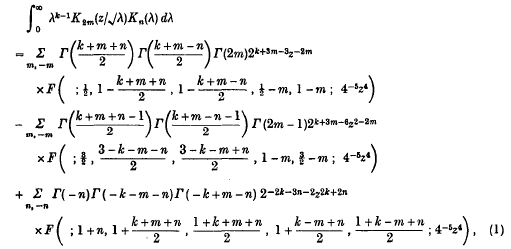
where R(z)>0.
Some Bessel Function Integrals
-
- Published online by Cambridge University Press:
- 18 May 2009, pp. 183-184
-
- Article
-
- You have access
- Export citation
-
The basic formula to be proved is

where p≧q + 1, z ≠0; | amp z | < π, R(n)>0, r = 1, 2,…,p. For other values of pand qthe result holds if the integral converges. From this formula some results, involving Bessel functions and Confluent Hypergeometric functions, will be deduced.
Matrices Associated with Fractional Hankel and Fourier Transformations
-
- Published online by Cambridge University Press:
- 18 May 2009, pp. 185-192
-
- Article
-
- You have access
- Export citation
Prime Ideals in Matrix Rings
-
- Published online by Cambridge University Press:
- 18 May 2009, pp. 193-195
-
- Article
-
- You have access
- Export citation
Front matter
GMJ volume 2 issue 4 Cover and Front matter
-
- Published online by Cambridge University Press:
- 18 May 2009, pp. f1-f2
-
- Article
-
- You have access
- Export citation
Back matter
GMJ volume 2 issue 4 Cover and Back matter
-
- Published online by Cambridge University Press:
- 18 May 2009, pp. b1-b2
-
- Article
-
- You have access
- Export citation