
In his seminal article ‘How to read a Roman portrait’, Sheldon Nodelman confronted the intrinsic semiotics of the genre.Footnote 1 Where scholars have often championed the ‘true-to-life’ (even so-called ‘veristic’) qualities of late republican and imperial portraits,Footnote 2 Nodelman instead emphasized their status as signa.Footnote 3 Despite their careful attention to physiognomy and form, Roman portraits can never be taken at face value, Nodelman argued. For what is so distinctive about Roman portraiture — indeed, what is wholly new ‘in the history of art’ — is its acute awareness of the spectator (Nodelman, Reference Nodelman and D'Ambra1993: 10):
Like all works of art, the portrait is a system of signs; it is often an ideogram of ‘public’ meanings condensed into the image of a human face. Roman portrait sculpture from the Republic through the late Empire — the second century bc to the sixth ad — constitutes what is surely the most remarkable body of portrait art ever created. Its shifting montage of abstractions from human appearance and character forms a language in which the history of a whole society can be read.
Since each element of a Roman portrait makes sense only in relation to every other, Nodelman likens the visual medium to a written or spoken ‘language’ of verbal communication. To understand the ‘formalized conventional references’, it follows, one has to approach the ‘abstract meaning-structure’ as ‘referential system’ (Nodelman, Reference Nodelman and D'Ambra1993: 15, 18, 17): learning to view Roman portraiture means learning to ‘read’ it — to interpret/translate/decipher its historically contingent ‘system of signs’.Footnote 4
In this article, I explore an artwork that literalizes Nodelmann's metaphor of ‘reading a Roman portrait’. My subject lies in a little-known Roman author of the early fourth century ad: Publilius Optatianus Porfyrius, or ‘Optatian’ for short. More specifically, I set out to revisit just one of Optatian's poems (poem 3) — a work that, delighting in both the lisible and visible nature of its signa, confronts viewer-readers with a purported portrait of the emperor Constantine (Figs 5–8).Footnote 5
What interests me about this picture-poem is its capacity to open up larger questions about portraiture, signs and the nature of visual (as indeed verbal) representation in the early fourth century ad. For at the heart of Optatian's artefact is the conceit that — through the very fabric of the poem's crafted letters — the poet might visualize the facial ‘countenance’ (uultus) of the emperor. Exploiting the latent iconic potential of poetry, Optatian creates something that exists between the realms of language and imagery — a ‘facial’ figure that calls for reading and viewing alike. But how should that gesture be understood? How does Optatian play with Roman ideas about portraits? And what might our case study suggest about shifting attitudes towards representation in the early fourth century?
FACE TO FACE WITH CONSTANTINE: THE MULTIFACETED WORLD OF OPTATIAN
Before introducing my particular case study, let me begin with a few words about its Latin poet. ‘Optatian’ is a little-known name among classical philologists, historians and archaeologists. Indeed, the few scholars who have examined his work have generally condemned it as ‘trivial’, ‘ridiculous’ and ‘decadent’.Footnote 6 As I have argued at greater length elsewhere, the works of Optatian are ripe for reappraisal, and from a variety of different viewpoints: in terms of later Latin literary traditions, certainly; but also from the perspectives of fourth-century political, philosophical and theological history, not to mention contemporary visual culture.Footnote 7
So who was Optatian, and what sorts of works did he compose? External evidence is frustratingly slight.Footnote 8 Two extant inscriptions have been used to reconstruct Optatian's civic career, the first (of contested date) showing that he was governor of Achaea, the second that he served as member of a priestly college in Rome (before ad 315, and most likely under Maxentius).Footnote 9 We also find two fourth-century literary references: Saint Jerome records that, in ad 329, Optatian ‘was released from exile after sending a remarkable volume (insigne uolumen) to Constantine’;Footnote 10 likewise, a table of praefecti urbis Romae between 254 and 354 informs us that ‘Publilius Optatianus’ held that office twice in the years 329 and 333.Footnote 11 Jerome's talk of exile is confirmed by additional references within the corpus of 31 poems ascribed to the poet: if Optatian sometimes alludes to his ‘unjust lot’ (sors iniqua, 20a.22) and ‘sad destiny’ (fata | tristia, 2.11–12), he also associates it with a ‘false accusation’ (falso … crimine, 2.31; cf. 2.5–6).Footnote 12 Despite their best efforts, however, scholars cannot be sure of the exact chronology of Optatian's works, nor the precise form of any anthology dispatched to Constantine:Footnote 13 as ever, we have only later manuscripts to work from, dating from between the eighth and seventeenth centuries. Although the extant corpus offers tantalizing glimpses into the relationship between poet and emperor — not least in the two letters purportedly exchanged between Optatian and ConstantineFootnote 14 — the precise history must remain a matter of speculation.
The works of Optatian nonetheless offer an important — and underplayed — source for approaching the political, cultural and above all religious transformations of Constantine's principate. The poems themselves can leave little doubt about the ingenuity of their author. Most intriguing are the ‘iconotextual’ qualities:Footnote 15 Optatian plays knowingly with ideas of reading and seeing; throughout the corpus, his self-declared signa oscillate between written and depicted ‘signs’.Footnote 16 In three examples, we find the poet imitating the picture-poems (technopaegnia) of Hellenistic Alexandria: by setting each letter within an evenly spaced grid, and by varying the number of letters in each line, Optatian exploits the outer shape of his verses to evoke the mimetic outlines of a water-organ (Fig. 1), an altar and a set of panpipes.Footnote 17 The same working principle seems to have led Optatian to his favourite design, this time laid out within a ‘gridded’ arrangement (and sometimes referred to as carmina cancellata).Footnote 18 Developing a penchant for acrostichs, mesostichs and telostichs, with verses that vertically trickle down the page,Footnote 19 Optatian once again breaks down his words into their constituent alphabetic units. In the carmina cancellata, however, the writerly space of the poem emerges as a sort of artistic canvas: by highlighting textured patterns within the grid, and depicting them in multiple colours, Optatian could tease out additional ‘signs’ from the fabric of his ground-text. If these ‘gridded poems’ consequently vacillate between words and pictures, the written/drawn signa sometimes also fluctuate between Latin and Greek languages: in three examples, the individual Latin letters add up to phrases that make semantic sense in Greek — whether yielding a single hexameter (poem 23), three hexameters (poem 16), or an elegiac couplet (poem 19).Footnote 20
Optatian [Publilius Optatianus Porfyrius], poem 20 (text after Polara, Reference Polara1973). (Typeset by Aaron Pelttari, and reproduced by kind permission.)
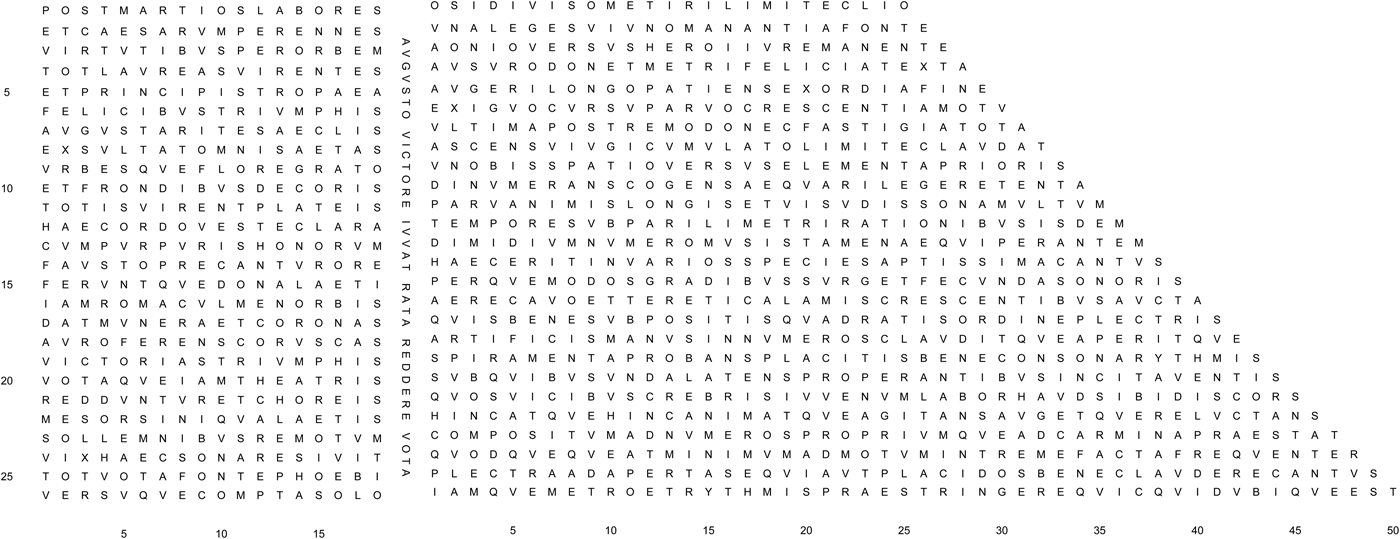
Optatian exploited the form of his carmina cancellata to experiment with different designs and rationales. The most common format, recurring ten times, revolves around a square grid comprised of 35 letters along both the horizontal and vertical axes (poems 2, 3, 5, 6, 7, 8, 10, 14, 18, 24).Footnote 21 In each case, Optatian looked to the internal space of the grid to figure various graphic forms, ranging from alphabetic and numerical letters, through abstract and ornamental patterns, to schematized mimetic forms.Footnote 22 The individual letters of the poem consequently function like the tessellated pieces of a mosaic; indeed, the very forms figured within the poems parallel the different verbal, decorative and iconic designs found in contemporary mosaics of the early fourth century.Footnote 23 Some of the figures amount to geometric shapes or apparent floral adornments (for example, poems 2, 7, 12, 18, 21, 22 and 23). Others give rise to schematic pictures — a possible shield in poem 7, a palm frond in poem 9 (Fig. 2), and a quincunx army formation in poem 6. Still other examples sketch letters and numbers within the grid: so it is, for example, that the abbreviation AVG. XX CAES. X is embroidered within poem 5 (‘Augustus twenty [years], the Caesars ten’ — celebrating the twentieth imperial anniversary of Constantine and the decennalia of his two sons in the year 326); likewise, in poem 8, the name IESVS is spelled out around an emblazoned chi-rho christogram (Fig. 3).Footnote 24 Poem 19 is arguably the most complex of all, bringing together different rationales (Fig. 4). In visual terms, the grid yields a ship (complete with tiller, rudder, oars and ramming spike), topped with a mast and sail in the shape of a chi-rho. While the image of this poem is drawn from highlighted Latin letters, additional alphabetical forms are emblazoned within its pictorial space, spelling out VOT above (an abbreviated reference to the uota or ‘vows’ mentioned at 19.4, 12, 13, 26, 31, 35), and XX below (figured within the ship's hull, and alluding numerically to the twentieth anniversary of the emperor, as well as the ten-year jubilees of his two sons). Most remarkably of all, the Latin letters that make up the ship's mast, sail, tiller and rudder conceal a Greek elegiac couplet: hidden within the ground-text, the constituent letters of the image furnish a ‘paratextual’ commentary on the picture seen.Footnote 25
Optatian, poem 9 (text after Polara, Reference Polara1973). (Typeset by Aaron Pelttari, and reproduced by kind permission.)

Optatian, poem 8 (text after Polara, Reference Polara1973). (Typeset by Aaron Pelttari, and reproduced by kind permission.)

Optatian, poem 19 (text after Polara, Reference Polara1973). (Typeset by Aaron Pelttari, and reproduced by kind permission.)

It is within this framework of carmina cancellata that my specific case study — the third poem within the corpus — should likewise be understood. I illustrate the poem via a new typeset rendition (Fig. 5), as well as through three extant manuscript presentations (Figs 6–8): first, a page of an early sixteenth-century codex in the Herzog August Bibliothek in Wolfenbüttel (where the internal patterns are marked in red and through yellow block-highlighting); second, a ninth-century folio in Bern that this time writes its letters in lower-case script (using orange to distinguish the internal letters and to bind them together); and third, a late sixteenth-century manuscript in Munich where gold lines set out the internal pattern (with all the letters written in majuscule quadrata script, and in black).Footnote 26 Since — so far as I know — the poem has never before been translated into English, let me begin with a first attempt, following the ‘knotty’ (nodosos, v. 30) forms of Optatian's Latin syntax:Footnote 27
I would be burning to fashion your face in verse with the power of the Muses, kindly father of the world, in fulfilment of my duties and prayers, should my scheme (ratio) not depart from the rule of Phoebus. They sing of deeds, whom the kindly Aonian power permits to enjoy the lot of a bard; thereafter, elevating them with gifts for poetry and encouraging mouths to resound with verse, you inspire the mind of the bard; you constantly call joys, holy one, to yourself; you, encouraging him in every way to produce learned words of the Muse, joyfully hear favouring vows, so that they may be ratified; your age the gentle ruler of Olympus preserves serene with special piety.
(12) Your golden age, victorious Constantine, is now mighty in all the world. He who would tell all this in metres freed from the law of the weave moves the Muses in a great herd; but my songs, as Calliope weaves them with difficulty in Phoebus’ painted measures, she rejoices if the Delian would favour my vows, so that the Muse may help my woven endeavours along an equal path, sealing the golden age in verse.
(19) But the Aonian Muses, trusting in the vow, transport into joy the mind devoted to you and bid him speak boldly through untrodden paths; and, as strict the laws that bind them to take care of their words, they sing of you, glorious princeps, and your wars so great, with all heart and faith through the voice of your bard, and they work new songs with Pegasean draught, and want now duly to sound the glorious empire in their weave, for they delight to perform so great a task and to speak forth in verse along rocky heights.
(28) A wondrous work of the mind, to weave a song into the verses in various directions: trapped in narrow confine, it [the mind] might scarcely carry the knotted visions of its art, clever though it be, beyond that confine; and, daring nevertheless to speak with such mighty mouth, my mind is in turmoil, and thinks not to offer up a poem worthy of its vows, singing by such a law, vows which my duty of love will fulfil, a page — only one, though it come from Helicon — painted according to the Muses’ lore with varied weave of elements.
Readers will quickly see the connection with my opening comments about ‘how to read a Roman portrait’. The object that faces us may look rather different from the sorts of painterly portraits with which classical archaeologists usually deal — whether sculpted busts, mosaics or painted images like the imperial ‘mummy-portraits’ remarkably preserved in Fayoum (for example, Fig. 9).Footnote 28 And yet, in this explicit address to Constantine, Optatian suggests that the very form of his poem might emulate a painted portrait of the emperor: the opening theme is the uultus of Constantine (v. 1), and the poem makes much of its promise of materializing that form in verse (uersu, vv. 2, 6, 18, 27).
Optatian, poem 3 (text after Polara, Reference Polara1973). (Typeset by Aaron Pelttari, and reproduced by kind permission.)

Optatian, poem 3, as presented in the sixteenth-century Codex Guelferbytanus 9 Augustaneus 4o (folio 5r). (Reproduced by kind permission of the Herzog August Bibliothek, Wolfenbüttel.)

Optatian, poem 3 (with scholion above), as presented in the ninth-century Codex Bernensis 212 (folio 111v). (Reproduced by kind permission of the Burgerbibliothek, Bern.)

Optatian, poem 3 (with scholion below), as presented in the sixteenth-century Codex Latinus Monacensis 706a (folio 3r). (Reproduced by kind permission of the Bayerische Staatsbibliothek, Munich.)

Funerary portrait from Er-Rubayat, late second century ad. Malibu, Getty Villa: inv. 74.AP.11; © HIP / Art Resource, NY.

We will return a little later to the schematic graphic pattern of the grid. For now, I restrict myself to two preliminary observations. First, we should note that the poem does not supply any precise information about date. The only clue comes in vv. 12–13: Optatian here describes Constantine as ‘victor’, one whose ‘golden age’ is now prevailing ‘in all the world’ (aurea iam toto, uictor, tua saecula pollent, | Constantine, polo). Although beyond proof, the reference most likely suggests a date soon after Constantine's victory over Licinius in ad 324; if so, the whole encomium might be understood as an allusion to Constantine's Vicennalia in ad 325–6 (an anniversary which Optatian celebrates in several other poems).Footnote 29
Second, and no less importantly, the poem draws attention to its material appearance on the page. Not only are individual letters marked out within the grid, but those letters can be read in their own written right. Once we transform the tessellated units back into words, we find six additional hexameters. Two of these are derived from the poem's horizontal and vertical crux, the one forming a mesostich at the symmetrical centre (from top to bottom in the eighteenth column), the other occupying the symmetrical horizontal axis (in line with the eighteenth verse).Footnote 30 To read the other four hexameters, audiences must zigzag across the grid: in each case, we have to start near the outer corner and then proceed in a variety of horizontal, vertical and diagonal directions.Footnote 31 Because the lines are arranged spatially, there is no fixed order for reading them; likewise the two verses that form the central crux of the poem can be read either before or after the other four.Footnote 32 The Latin syntax nonetheless suggests the following arrangement:
Were the Muse able to fashion the face of Augustus in such song, with the law of metre and verse unbroken, the page, painted according to the lore of the Muses with varied weave of elements, will dare outdo Apellean waxes. (v) Great things will be sought, should the joyful Muse favour her bard's endeavours, sealing the golden age in verse.
If two of these hexameters repeat lines from the main text (3.vi = 3.18; 3.iii = 3.35), the others subtly recycle the constituent letters, words and syntactical phrases of the ground-text. Although they do not this time address Constantine directly, the verses deliver an encoded message to the reader; what is more, they once again comment upon the feat of crafting the ‘countenance of Augustus’ (uultus Augusti). There can be no doubting the self-referential thinking: in a mise-en-abyme of metapoetic reflections, this poem within the poem offers an additional commentary on the text that contains it; we are dealing, in short, with a carmen that responds to the ‘sort of song’ (tali carmine) from which it derives (cf. carminis, v. 5; carmina, v. 15; carmina, v. 24; carmen, v. 28; carmen, v. 32). Perhaps most revealingly of all, Optatian relates the feat to one of classical antiquity's most celebrated artists. This fourth-century ad Latin poem asks to be viewed against the precedent of Greek painting in the fourth century bc: the painted page (picta … pagina), we are told, will dare outdo the wax-pictures of the great Apelles himself (Apelleas … ceras).Footnote 33
MEDIAL REFLECTIONS: ‘THE LAW OF THE WEAVE’
The Apellean reference is in fact just one of many allusions to the ‘pictorial’ status of the poem. Of course, the whole work amounts to a panegyric hymn in honour of the emperor — ‘victorious Constantine’, the ‘kindly father of the world’, ‘glorious princeps’, ruler of the ‘glorious empire’ (uictor … Constantine, vv. 12–13; alme parens orbis, v. 2; princeps inclite, v. 23; egregium imperium, v. 26). Throughout, though, the glorious ‘feats’ (gesta, v. 4) of the emperor are interwoven with musings about the intermedial workings of our painter-poet — the uates who makes those deeds known throughout the world.Footnote 34
For all its nods to the emperor, this is an artefact that reflects knowingly on its feat of literary and artistic composition.Footnote 35 Before tackling the issue of ‘reading’ the poem's ‘portrait’, I therefore begin by exploring the verbal imagery with which Optatian draws out his project. I restrict myself here to just six themes: each concerns a specific characteristic of the metapoetic — as indeed metapictorial — commentary of our text; cumulatively, however, these ‘medial reflections’ will form the backdrop for my subsequent remarks about the pattern figured within.
My first observation concerns the explicit presentation of this work as poem and picture alike. Of course, the bulk of the text is dedicated to the challenges of poetic composition.Footnote 36 One thinks of vv. 17–18, for example, which talk of arranging the ‘woven endeavours’ (intexta … orsa) ‘along an equal path’ (parili sub tramite) — that is, of ensuring each vertical and horizontal line is made up of on ‘equal’ number of 35 letters. When Optatian elaborates on the metrical laws that bind the poet to take care of his words (quantis sua uerba tueri | legibus adstrictae, vv. 21–2), the thinking proves to be no less metaliterary: after all, the poet must keep an eye not only on the number of lettered constituents in each line, but also on the metrical lengths of his uerba. Yet the commentary of the poem does not concern poetry alone. For alongside his reflections on literary composition, Optatian also draws attention to the ‘painterly’ dimensions at work. In vv. 15–16, the poet expressly refers to ‘painted measures’ (pictis … modulis), just as v. 35 constructs the page as something ‘painted’ (picta — reused in v. vi).Footnote 37 Still more explicit is the reference to the ‘knotted visions of art’ (nodosos uisus artis, v. 30). Optatian here relies on the multiple connotations of the term ars — a word that (like technē in Greek) can refer to feats of literary and artistic craftsmanship alike. At the same time, he emphasizes the visual dimension of his written text: we are dealing with something not just to be read, but also to be seen.
In this connection, second, it is worth noting the poetic-pictorial conceit underlying the ‘golden age’ of Constantine. Optatian emphasizes this idea at two places within the poem (aurea … saecula, v. 12; aurea saecla, v. 18), capitalizing on a long-standing tradition of imperial panegyric;Footnote 38 in its repetition of v. 18, the highlighted horizontal verse at the centre repeats the sentiment, telling how the poet ‘seals the golden age in his verse’ (uersu consignans aurea saecla, v. v). But what should we make of this ‘goldenness’? Needless to say, we do not know how this poem was originally presented: our only evidence comes in the form of much later medieval manuscripts (Figs 6–8).Footnote 39 It nonetheless seems important that, at least in other contexts, Optatian talks of the multicoloured hues of his poems: nowhere is this more vivid than in the first poem, where Optatian describes his former œuvre as ‘written with letters that glitter in silver and gold’ (argento auroque coruscis | scripta notis, 1.3–4).Footnote 40 Were we to think — as seems likely — that some of the letters within our poem might likewise have been inscribed in gold (cf. Fig. 8), the very sentiment of the ‘golden age’ would have been manifested through the written form of the text.Footnote 41 The play on the word consignans (‘sealing’ — and thereby ‘establishing’, ‘indicating’ and ‘authenticating’), emblazoned along the crux of v. 18 (uersu consignans aurea saecla), nicely champions the point: as combined poetic and pictorial signa, the marks on the page offer a visual literalization — which is to say also a literal visualization! — of an imperial ‘golden age’.Footnote 42
A third, and again related, theme lies in the rhetoric of elementa. In the final line of the poem (v. 35), Optatian refers to its ‘elemental’ units (picta elementorum uario per musica textu), playfully ‘varying’ the spatial layout of the same hexameter at the bottom of the page (v. iii): the artefact, we are told, is ‘painted according to the lore of the Muses with varied weave of elements’.Footnote 43 But what should we make of these elementa? By the time Optatian was writing, there was a long tradition of discussing the cosmological ‘elements’ of the universe in relation to the constituent units of language. In the first century bc Lucretius had turned to the example of alphabetic letters to expound his Epicurean theory of elementa (DRN 2.682–92; cf. 1.196–7): as the elemental building-blocks of linguistic expression, letters were analogous to the raw elements of nature.Footnote 44 This ‘atomistic’ view of language was played out in multiple other Roman contexts — from Quintilian's prescription that young children should play with ‘ivory forms of letters’ in order to learn their syllables (1.1.26)Footnote 45 to the linguistic games of the so-called tabulae lusoriae (in which players joined up segregated verbal units to form a variety of Latin words).Footnote 46 Late antique grammarians also took up the thinking. As Sergius puts it (most likely writing in the fifth century ad), individual letters are the essential elements of verbal communication: for ‘the letter alone cannot be split into any further division’ (littera sola non habet quo soluatur), we are told, and ‘it is for this reason that it is called “indivisible” by philosophers’ (ideo a philosophis atomos dicitur).Footnote 47 The overriding game of Optatian's poem is premised upon a related view of language, whereby individual words can be broken down into their constituent components. But the poet also delights in the fact that his elementa can be put together to form new compound entities: the elements are building-blocks for manufactured creations that function visually and verbally at once; the picture that the poem yields, in short, exploits the elementa to generate further words, phrases and poetic hexameters in turn.
My fourth observation pertains to the poetic imagery in which the poet interlaces this act of manufacture: namely, as an art of weaving. At numerous points within the poem (texit, v. 15; intexta, v. 17; intexere, v. 28; textu, v. 35), we find Optatian crafting an analogy between the process of poetic and pictorial composition and that of manufacturing a textured fabric. As a self-proclaimed nexus (vv. 13, 25), the very form of this artefact is imagined in terms of something sewn or interlaced.Footnote 48 Of course, the figurative analogy between composing poetry and spinning a yarn had a long literary history among Greek and Latin authors alike.Footnote 49 Among Optatian's contemporaries, it was also replayed in the genre of the cento — that is, of poems ‘stitched’ together from the fabric of the poetic past (above all, lines from Virgil).Footnote 50 For Optatian, this materialist metaphor seems to take on an additional significance, brilliantly figuring a unique sort of poetic–pictorial cross-stich. It is in this context that we should understand the term that Optatian coins for the verses interlaced within the gridded poems: in the ninth poem, one such apparition is described as an intextus … uersus — an ‘interwoven verse’ embroidered into the tapestry of the text (9.v; cf. 21.16: texti … uersus). When, in our poem, Optatian tells how Calliope ‘weaves the songs with difficulty in Phoebus’ painted measures’ (mea uix pictis dum texit carmina Phoebi | Calliope modulis, vv.15–16) — or how the page is ‘painted according to the Muses’ lore with varied weave of elements’ (picta elementorum uario per musica textu, v. 35 — repeated in v. vi) — the poet interlaces the literary metaphor over a materialist rhetoric of artistic manufacture: part of the ‘variety’ of this production lies in its textile combinations of painted figure and textured word.
But — and this is my fifth point — our textus is not simply something ‘written’, ‘painted’ or indeed ‘woven’. As a script that must be animated by the voice of the reading respondent, this poem is presented as something to be performed.Footnote 51 If the poet declares himself to be a uates (vv. 5, 7, 23, v), he likewise heralds his creation as carmen — not just a ‘poem’ on the page, but also a ‘song’ for oral recital (carminis, v. 5; carmina, vv. 15, 24; carmen, vv. 28, 32; carmine, v. i). Almost as soon as the first verse introduces the topos of the uultus, Optatian underscores the point, telling how the Muses are now singing of Constantine's deeds (gesta canunt, v. 4; cf. canunt, v. 24; canens, v. 33). So great are those feats, it seems, that they call for a vocal response in turn (uoce, v. 23; cf. ore, v. 6; ore, v. 31), responding to the call of Constantine himself (uocas, v. 8). Just as Constantine will ‘hear’ the resulting artefact (audis, v. 10), so too will this creation itself sound (uersu instigans ora sonare, v. 7; sonare, v. 25): not only does the creation promise to ‘speak’ and ‘be proclaimed’ (loqui, v. 20; fari, v. 27; loqui, v. 31), it responds to things already spoken (dicta, v. 9), and likewise points to the potential of future speech (dicturus, v. 14).
From this perspective, Optatian might be said to enact a lesson not just in ‘reading’ a Roman portrait, but also, as it were, in ‘singing’ one: words, images and sounds are all interwoven within the multimedial tapestry. This performative aspect is echoed in the final line of the poem — a verse, as we have said, which is also laid out in ‘varied’ spatial form towards the bottom of the grid: picta elementorum uario per musica textu (vv. 35, iv). Like so many others, the verse proves difficult to render into English. In the translation above, I opted for ‘painted according to the Muses’ lore with varied weave of elements’. But the substantive adjective musica is rather more multifaceted. On one level, musica of course refers to things that pertain to the Muses. And yet, on another, the adjective can simultaneously refer to things that are ‘musical’, ‘tuneful’ and ‘melodious’. It is not just ‘pictorial’ elements that make up Optatian's ‘varied weave’, in other words. Intrinsic to Optatian's feat is also an idea of musical performance — inscribed within something ‘painted according to music with varied weave of elements’.Footnote 52
This takes me to a sixth preliminary observation — and to a paradox. For despite all the talk of sound, this interweaving of poem and picture is predicated upon an audience viewing the artefact on the page (pagina, v. 33) rather than hearing it spoken or sung. To put the point negatively, we might say that the very promise of performance — so emphatically championed throughout the text — threatens to disentangle the pictorial–poetic cross-stitch. The observation goes hand in hand with the repeated talk of ‘limitations’.Footnote 53 When in vv. 28–9 Optatian declares it a ‘wondrous work of the mind to weave a song into verses in various directions’ (mentis opus mirum metris intexere carmen | ad uarios cursus), his image of cognitive freedom is set against the idea of boundaries, constraints and restrictions — of being ‘trapped in narrow confine’ (arto in limite clausa, v. 29).Footnote 54 No less important are vv. 13–14, addressing the potential of a poem to ‘move’ (mouet) the Muses — albeit in the context of a poem, distinct from the poet's present verses (at mea … carmina), which are poignantly not ‘in their metres freed from the law of the weave’ (nexus lege solutis | … metris). Despite its loaded potentiality — for picture, as indeed for song — this is an artefact that emblazons the question of ‘limits’ first and foremost.
MASQUERADE: READING BETWEEN THE LINES?
It is at this point that I want to proceed from the text of our poem to the image of its woven apparition (Figs 5–8). For just what kind of uultus is shown here? How should we make sense of its form? And how might any interpretation of the picture align with a reading of the poetic text that figures it?
One way of reconstructing what earlier audiences might have seen in the picture is to examine the extant scholia.Footnote 55 After drawing out each of the uersus intexti, the scholiast tradition characterized the figurative scheme as a polygonal pattern: ‘on this page there are four hexagons with an equal number of letters, and eight orthogonal triangles, again with equal numbers of letters, which increase or decrease in turn by way of single letters’ (in hac pagina quattuor hexagona sunt pari numero litterarum, et octo orthogona adaeque pari numero litterarum per singulas litteras crescentia uel decrescentia). According to this geometric interpretation, the figure amounts to a series of linear forms: first, the scholiast divides the pattern into four eight-sided shapes (each occupying a symmetrical quarter of the page); second, he proceeds around the edges of the grid, noting a series of triangular patterns that vary from nine to ten letters along their two equilateral lengths.Footnote 56
But how might such a shape be understood — by any stretch of the imagination — to figure the uultus of Constantine? The problem has vexed modern readers, and none more so than Giovanni Polara.Footnote 57 Over and above any other living scholar, Polara has strived to rehabilitate Optatian's scholarly standing. But Polara was stumped by the pictorial form of this particular example. According to his 1973 commentary, the pattern is said to have functioned as an elaborate praeteritio: it offers a poetic explanation as to why such a uultus Augusti would be impossible (hence the metapoetic reflections not only in the main text, but also in the uersus intexti, with their reference to the ‘unbroken law of the metre and verse’, metri et uersus lege manente, v. ii). Later, Polara ventured an alternative suggestion, supposing that the poem might have served as a preface to a different work. According to this subsequent argument, Optatian wrote a poem that did succeed in visualizing the uultus of the emperor — but one very different from the text at hand, and long since lost.Footnote 58
In my view, neither of these explanations is satisfactory. For whatever else we make of the poem, Optatian seems to paint a rather more complex picture. As we read the text and its uersus intexti, we find the poet reflecting knowingly on the (im)possibility of representing a portrait of the emperor. The very question of whether the image is a portrait, no less than what viewers/readers should make of it, is — deliberately — left open.
Nowhere is this clearer than in the poem's opening lines (vv. 1–3):
I would be burning to fashion your face in verse with the power of the Muses, kindly father of the world, in fulfilment of my duties and prayers, should my scheme not depart from the rule of Phoebus.
Optatian opens the poem with an elaborate conditional sentence. But, as Petra Schierl and Cédric Scheidegger Lämmle remind us, these verses combine different registers of conditional possibility.Footnote 59 The phrase expressing the condition (‘protasis’) is delayed, so as to appear in the third verse. But it differs in tense — and hence meaning — from the opening main clause (‘apodosis’): while the sentence begins with an apodosis in the unreal present (fingere … flagrarem — marking an impossibility through its imperfect subjunctive), the protasis of v. 3 is couched in a present subjunctive (abnuat), holding out a remote — but not excluded — possibility.Footnote 60
A similar tension recurs in the uersus intexti that zigzag across the four sides of the grid (cf. above, p. 195). In these verses we find a conditional sentence that subtly reconfigures the opening lines of the poem, beginning in the verse that runs along the top of the page. Instead of the unreal present of the opening apodosis within the main poem (fingere Musarum flagrarem numine uultus), this first hexameter furnishes the phrase fingere Musa queat tali si carmine uultus … (‘Were the Muse able to fashion the face in such song …’, v. i). At least three transformations have taken place. First, there is a change in subject: we move from the speaking poet (addressing his audience in the first person: fingere … flagrarem) to a statement about the Muse (fingere Musa queat). Second comes a shift in both tense and meaning: not only does the verb queat thrust questions of ability to the fore, it does so in the potential (rather than unreal) realm of a present subjunctive. Third, the apodosis of the main text — dependent on the delayed subordinate clause of v. 3 (si ratio non abnuat ordine Phoebi) — has been turned inside out: the main clause of the ground-text has been reconfigured as a subordinate protasis. It is only when we look to the verse running along the right-hand side of the grid that we find the corresponding main clause of the conditional sentence: uincere Apelleas audebit pagina ceras (v. iv). Where the main poem had tendered an unreal suggestion in the imperfect subjunctive (flagrarem, v. 1), the mood of this apodosis has shifted (audebit, v. iv): the declaration that ‘the page will dare outdo Apellean waxes’ is now made to signal a very real prospect in the future indicative.Footnote 61
That Optatian leaves these different registers of possibility unresolved is confirmed by the two verses that criss-cross the centre of the grid (vv. v–vi):
Great things will be sought, should the joyful Muse favour her bard's endeavours, sealing the golden age in verse.
With these hexameters, the poet inscribes a conditional sentence right at the literal and metaphorical crux of the poem; indeed the protasis and apodosis are themselves split across the criss-crossing verses, so that both occupy the horizontal and vertical axes alike. But these lines hardly settle the conditional ambiguities. On the one hand, the subordinate protasis is staked upon a less real future in the present subjunctive (iuuet). On the other, the apodosis is once again couched in a realizable passive future indicative (quaerentur). These central lines ‘seal’ the poem with a possibility that rests uneasily between different moods and tenses. And as with the other conditional phrases, the syntax turns out to be highly tactical, leaving readers to puzzle over the possible or impossible hypotheticals introduced: with each protasis and apodosis, we shift back and forth between a wholly unreal present prospect (imperfect subjunctive: flagrarem), a possibility in the less real future (present subjunctive: abnuat, queat, iuuet) and a more realizable future potential (future indicative: audebit, quaerentur).
Such syntactical ambiguities go hand in hand, I think, with the phrase that describes the project of ‘fashioning’ a portrait of Constantine: fingere … uultus (vv. 1, i). The choice of both noun and verb strikes me as significant. In Latin, the word uultus does not quite equate to ‘face’. It refers instead to a ‘look’ or ‘countenance’ (which Optatian here renders in an accusative plural) — that is, to a mode of facial animation and expression.Footnote 62 Numerous Latin authors help pinpoint the semantic range, above all by associating the uultus with a person's mores (‘character’). According to Cicero, who discusses the uultus as something moulded by the mind (uultus, cum mentis, a qua is fingitur …, Tusc. 3.31), the ‘countenance’ could be called both the imago animi (‘mirror of the emotions’: De or. 3.221; cf. Orat. 60) and sermo tacitus mentis (‘silent speech of the mind’, Pis. 1.1).Footnote 63 Noting that the Greeks have no corresponding word, Cicero likewise observes that ‘what we call the uultus, which can be found in no living creature save man, is a mark of mores’ (is, qui appellatur uultus, qui nullo in animante esse praeter hominem potest, indicat mores, Leg. 1.27).Footnote 64 If the uultus gives outward form to something so ‘internal’ and ‘invisible’ as the rational soul (animus), abstract things could also have a uultus attributed to them — among them ‘law’ (e.g. Cic. Tusc. 3.31), rhetorical ‘eloquence’ (e.g. Tac. Dial. 18.3) and ‘oratory’ (e.g. Quint. 9.1.21).Footnote 65
The multiple connotations of the word uultus — referring to something that can be both concrete and abstract — should be understood in connection with the infinitive verb fingere.Footnote 66 The primary meaning of this verb is of course to ‘mould’ or ‘shape’ — especially in the context of plastic media (thereby adding a third ‘sculptural’ dimension to Optatian's talk of ‘painting’).Footnote 67 Yet this image of physical ‘fashioning’ could also be applied to works of literary ‘fiction’: fingere could refer metaphorically to the act not just of ‘coining’ words, but also of ‘composing’ poems. No less importantly, the word can suggest a mental picture — that is, the idea of conjuring up an image in the mind's eye of the subject (translating the Greek word πλάττειν).Footnote 68 With the phrase fingere uultus, then, Optatian loads his poem with a range of ideas, suggesting at once a physical, literary and conceptual mode of forging Constantine's uultus. Depending upon how seriously we take the variations in the conditional clauses, we might detect an additional semantic resonance too: taken together, the Latin phrase fingere uultus could refer to acts of ‘modifying’ or ‘transforming’ facial expression — that is, of ‘disguising’, ‘hiding’ or indeed ‘masquerading’ one's true character.Footnote 69
Our artefact might be thought the ultimate in ‘masquerade’: as we have observed, it raises the prospect of visualizing a uultus, while remaining non-committal about whether that prospect has been/is being/will be (or for that matter could be) fulfilled. Optatian leaves such questions poignantly unanswered. Yet in playing with the very possibility of rendering a uultus in verse, he also situates his conceit against a particular literary critical backdrop. For whatever we make of the actual pattern of his verses, Optatian draws upon a long-standing literary topos about the respective ability of words and pictures to fashion a ‘true’ portrait of their subject.
One important intertext — as first noted by Marie-Odile Bruhat — comes in an epigram by Martial, addressed to Caecilius Secundus. Within a poem expressly devoted to the comparative resources of painting and language, above all their capacity to fashion a uultus, Martial had staged a comparison between a purported ‘painted tablet’ (picta tabella) and poetry (7.84):Footnote 70
While my portrait is being made for Caecilius Secundus, and while the picture, painted by a skillful hand, seems to breathe, go, my book, to the Getic Peuce and the submissive Danube; this is his post, among the conquered people. You will give a little gift to my dear friend, but a sweet one: my countenance will be surer in my verse. This [uultus of verse] will live, indestructible by accidents or lapse of years, while the work of Apelles shall die.
This self-declared carmen provides a striking precedent for our poem. Just as Martial adduces an Apelleum opus as a counterpart to poetry, Optatian develops the same analogy, relating his carmine uultus (v. i) to ‘Apellean waxes’ (Apelleas ceras, v. iv); indeed, Optatian even uses the same adjectival form found in the earlier epigram.Footnote 71 If Optatian alludes to Martial's poem, he nonetheless goes beyond its critical framework. While Martial ultimately stages a distinction between poem and picture, Optatian tenders the promise of uniting the two: the uultus is rendered within the carmen, and the carmen is constructed out of the uultus. Such knowing recourse to literary precedent also has significance in its own right: both the themes and language of Optatian's poem are comprised from the spolia of the literary past — paralleling, among other things, the sorts of spoliation found in Constantinian art (and nowhere more programmatically than on Constantine's eponymous triumphal arch at Rome).Footnote 72
But Martial forms just part of the literary critical picture. For both Optatian and Martial alike play upon a still longer topos of poetically responding to portraiture. In this connection, it is worth recalling what we have said about the poem's multiple references to its sonorous qualities, not least through its repeated references to ‘speaking’, ‘declaring’ and ‘singing’ (cf. above, pp. 200–1). Within the generic frameworks of Greek and Latin epigram, especially epigrams on painted or sculpted portraits, this element of ‘speech’ was a mainstay for contemplating the respective workings of poetic and pictorial composition. It was Simonides who, in the early fifth century bc, famously declared painting to be ‘silent poetry’ and poetry poem to be ‘speaking painting’.Footnote 73 By the Hellenistic period, we find Greek epigrammatists contemplating portraits in closely related terms.Footnote 74 Among the most celebrated examples is an epigram on a painting of Agatharcis preserved in the Greek Anthology, and attributed to Erinna (Anth. Pal. 6.352 = Erinna 3 G–P):Footnote 75
This painting/writing [grammata] is the work of delicate hands. Most excellent Prometheus, there are humans as clever as you! At least if the person who so accurately depicted/wrote [egrapsen] this girl had only also added a voice, you would be Agatharchis complete.
While punning on the dual meanings of the Greek words graphein and gramma, and thereby drawing out an analogy between written words and painted imagery, Erinna's poem supplies the voice that painting, qua painting, lacks. There can be no doubt that Optatian was aware of this critical tradition. What is so special about his creation, however, is once again its fusion of words and images: where Cicero had labelled the uultus the ‘silent speech of the mind’, the text of Optatian's uultus promises to talk, sound and sing. Indeed, one of the ways in which the resulting page might be said to ‘dare outdo the waxes of Apelles’ (uincere Apelleas audebit pagina ceras, v. vi) lies precisely in its promise of bestowing voice on the picture.
We will return a little later to literary responses to portraits. Before proceeding, however, it is worth pausing to say a little more about the reference to Apelles specifically. In my view, the very allusion to Apelles here supplies an additional prompt to see the poem's uultus as more than mere literary fiction. By the time Optatian was writing, ‘Apellean’ was of course a byword for painterly virtuosity: the work of this fourth-century bc painter was synonymous with the very best in Classical Greek painting.Footnote 76 But it is perhaps significant that Apelles was also legendary for his portraits of a particular patron: according to long ancient tradition, Alexander the Great entrusted Apelles with painting his portraits, just as he gave Lysippus and Pyrgoteles a monopoly in representing him in statuary and glyptic gems.Footnote 77 Within a poem expressly dedicated to the theme of depicting Constantine, the reference to the preferred portraitist of Alexander seems particularly pointed. As Marie-Odile Bruhat has noted, Apellean images of Alexander were a live topic among earlier Roman imperial writers, who exploited them to debate the nature of the emperor's imperial image (no less than modes of literary patronage).Footnote 78 Still more important is the fact that, in fashioning his own self-image, Constantine seems to have knowingly nodded to Alexandrian iconographic models.Footnote 79 Quite apart from the emperor's studied recourse (from ad 313 onwards) to a young imperial image — apparently alluding to Julio-Claudian models (above all Augustus), as well as to that of TrajanFootnote 80 — there are various iconographic references on Constantinian coins. From ad 324 onwards, we find not only the motif of an upward gaze (emulating and adapting a type developed by Alexander),Footnote 81 but also the addition of a kingly diadem, often studded with jewels and diamonds (Fig. 10): once again, the motif imitates a stylistic feature common on the coinage of Alexander and his immediate successors (for example, Fig. 11).Footnote 82 When approached from the perspective of Constantine's own self-image in the 320s, the promise of outdoing ‘Apellean waxes’ takes on a political hue: it relates the imperial uultus of the poem to iconographic models that were being intensely revisited during the period.
Gold solidus of Constantine (minted in Siscia, c. ad 326–7). London, British Museum: inv. CM R.244; © The Trustees of the British Museum / Art Resource, NY.

Silver tetradrachm with a posthumous portrait of Alexander the Great (adorned with the ram's horns of Zeus-Ammon and wearing the royal diadem), 297–281 bc. Berlin, Staatliche Museen (Münzkabinett); © bpk / Münzkabinett, SMB (photograph by Reinhard Saczewski) / Art Resource, NY.

There seems to be at least one other possible resonance to this reference to Apelles. If the allusion brings to mind the Alexandrian debts of Constantine's imperial self-image, it might also spark more metapoetic reflections. Particularly relevant is the well-known anecdote recorded by Pliny the Elder about a makeshift competition between Apelles and Protogenes. Here is the story in full (HN 35.81–3):Footnote 83
scitum inter Protogenen et eum quod accidit. ille Rhodi uiuebat, quo cum Apelles adnauigasset, auidus cognoscendi opera eius fama tantum sibi cogniti, continuo officinam petiit. aberat ipse, sed tabulam amplae magnitudinis in machina aptatam una custodiebat anus. haec foris esse Protogenen respondit interrogauitque, a quo quaesitum diceret. ab hoc, inquit Apelles arreptoque penicillo lineam ex colore duxit summae tenuitatis per tabulam. et reuerso Protogeni quae gesta erant anus indicauit. ferunt artificem protinus contemplatum subtilitatem dixisse Apellen uenisse, non cadere in alium tam absolutum opus; ipsumque alio colore tenuiorem lineam in ipsa illa duxisse abeuntemque praecepisse, si redisset ille, ostenderet adiceretque hunc esse quem quaereret. atque ita euenit. reuertit enim Apelles et uinci erubescens tertio colore lineas secuit nullum relinquens amplius subtilitati locum. at Protogenes uictum se confessus in portum deuolauit hospitem quaerens, placuitque sic eam tabulam posteris tradi omnium quidem, sed artificum praecipuo miraculo. consumptam eam priore incendio Caesaris domus in Palatio audio, spectatam nobis ante, spatiose nihil aliud continentem quam lineas uisum effugientes, inter egregia multorum opera inani similem et eo ipso allicientem omnique opere nobiliorem.
A clever incident took place between Protogenes and him [i.e. Apelles]. Protogenes lived at Rhodes, and Apelles sailed there from a desire to make himself acquainted with Protogenes’ works, whom he knew only by reputation. He went at once to his studio. The artist was not in, but there was a panel of considerable size ready on the easel for painting, which was in the charge of a single old woman. When he asked, she told him that Protogenes was not at home, and asked who it was she should say wanted him. ‘Say it was this person,’ said Apelles, and taking up a brush he painted in colour across the panel an extremely fine line. When Protogenes returned the old woman showed him what had taken place. The story goes that the artist, after looking closely at the subtlety, immediately said that it was Apelles who had come: so perfect a piece of work tallied with nobody else; and he himself, using another colour, drew a still finer line exactly on the top of the first one, and leaving the room told her to show it to him if he returned, and to add that this was the man he was looking for. And so it turned out: for Apelles came back and, ashamed to be defeated, cut the lines with another in a third colour, leaving no room for any further display of minute work. Hereupon Protogenes admitted he was defeated, and flew down to the harbour to look for the visitor; and it was decided that the panel should be handed down to posterity as it was, to be admired as a marvel by everybody, but particularly by artists. I am informed that it was burnt in the first fire which occurred in Caesar's palace on the Palatine; it had previously been admired by us, containing nothing on its vast surface other than the almost invisible lines, so that among the outstanding work of many artists it looked like an empty space, and by that very fact attracted attention — and was more esteemed than any masterpiece.
According to Pliny, this encounter confirms the special place of the artist within the history of Greek painting: Apelles is said to have surpassed all painters before and after him (omnes prius genitos futurosque postea superauit Apelles, HN 35.79). Yet what interests me about the anecdote is the suggestive terminology in which the ‘lines’ of Apelles and Protogenes are described. With these virtuoso strokes, the Hellenistic poetics of leptotês or ‘finesse’, translated into the associated Latin terminology of tenuitas and subtilitas, finds a pictorial counterpart. In a series of diminishing strokes on a ‘panel of considerable size’ (tabulam amplae magnitudinis), Apelles’ initial line of great finesse (lineam summae tenuitatis) spurs an even thinner (tenuiorem) pictorial response from Protogenes; that second mark is in turn outdone by the third and final line of Apelles — who leaves ‘no room for any further display of minute work’ (nullum relinquens amplius subtilitati locum).Footnote 84 What we find here, in short, is Pliny discussing the aesthetics of painting in the language of Hellenistic literary criticism.
Pliny's anecdote perhaps provides an additional lens for approaching Optatian's painterly creation. For those so minded, the artefact might be seen as transforming the painterly miraculum of Apelles and Protogenes — as described in the language of poetic subtilitas — back into literal poetic–pictorial ‘wonder’ (mirum, v. 28). What we find is a line-painting that constructs its subtle strokes from the very fabric of poetic verse: on the one hand, the multicoloured lines of the page echo the polychrome creation of the Plinian Apelles and Protogenes (ex colore … alio colore … tertio colore); on the other, this feat is predicated on the idea of a series of divisible lines — something that the virtuoso artist can ‘cut’ (secuit). Where Apelles and Protogenes only managed three lines between them, ‘leaving no space for further subtlety’, Optatian outdoes both artistic predecessors at once: thanks to his poetic–pictorial ingenuity, he is able to divide the lines of his verses multiple times — and in a plurality of different directions. In that sense, at least, this is a poetic artwork that outstrips the most celebrated of classical painters — a display of artistry that dares to trump the virtuosity even of the great Apelles himself.
A CHRISTIAN INTERFACE? THE ‘SAVING SIGN’ OF THE VVLTUS
The story of the line-painting by Apelles and Protogenes takes us back to the challenge of making sense of Optatian's picture as a uultus Augusti. Just as the legendary tabula of Apelles is described as looking like something empty (inani similem) — that is, as something devoid of significance, and even of artistic facture — so too the promise of depicting Constantine's portrait might seem metaphorically vacant. Despite its carefully delineated verses, the ‘invisibility’ of this artefact might be thought to outdo the scarcely perceptible traces of Apelles, so as to recall that panel ‘containing nothing on its vast surface other than the almost invisible lines’ (spatiose nihil aliud continentem quam lineas uisum effugientes).
But anecdotes about Apelles provide only part of the poem's literary framework. If Optatian's intermedial feat resonates with ancient traditions of artistic criticism, the talk of fashioning a verbal uultus also develops a literary figure. As we have already noted, there were numerous precedents for the idea of forging a poetic portrait — parallels which lead us to Hellenistic Greek epigram, as well as to the purported imago of Martial (cf. above, pp. 206–8). But by the time Optatian was writing, the trope of ‘painting’ a portrait in words had seeped into all manner of non-poetic literary genres. Particularly important here is the comparison between the portraitist and the biographer. Consider the following passage from Plutarch's Life of Alexander, penned in the late first century ad (Alex. 1.3):
ὥσπερ οὖν οἱ ζῳγράφοι τὰς ὁμοιότητας ἀπὸ τοῦ προσώπου καὶ τῶν περὶ τὴν ὄψιν εἰδῶν, οἷς ἐμφαίνεται τὸ ἦθος, ἀναλαμβάνουσιν, ἐλάχιστα τῶν λοιπῶν μερῶν φροντίζοντες, οὕτως ἡμῖν δοτέον εἰς τὰ τῆς ψυχῆς σημεῖα μᾶλλον ἐνδύεσθαι καὶ διὰ τούτων εἰδοποιεῖν τὸν ἑκάστου βίον, ἐάσαντας ἑτέροις τὰ μεγέθη καὶ τοὺς ἀγῶνας.
Just as painters acquire the likenesses in their portraits from the face and the expression of the eyes, in which the person's character shows itself, yet make very little account of the other parts of the body, so I must be permitted to devote myself rather to the signs of the soul in men, and by means of these to portray the life of each, leaving to others the description of their great contests.
Here, at the outset of his biography of Alexander, Plutarch draws an analogy between the verbal art of fashioning a biographical narrative and the painterly art of forging a subject's ‘likenesses’ (ὁμοιότητας): just as a portraitist must take his lead from the face and expression of eyes (ἀπὸ τοῦ προσώπου καὶ τῶν περὶ τὴν ὄψιν εἰδῶν), so the biographer must focus on the ‘signs of the soul’ (τὰ τῆς ψυχῆς σημεῖα). Subsequent writers would develop the analogy, not least in the context of imperial biographical ‘portraits’. Given the Constantinian subject, one particularly informative parallel comes in the opening of the Life of Constantine written by Eusebius (probably in the late 330s). At the beginning of his biography, Eusebius explains that, for all the difficulties of treating so great a subject, it is ‘nonetheless necessary to model oneself on the human painter, and dedicate an image of words in memory of the God-beloved’ (ὅμως ἀναγκαῖον μιμήσει τῆς θνητῆς σκιαγραφίας τὴν διὰ λόγων εἰκόνα τῇ τοῦ θεοφιλοῦς ἀναθεῖναι μνήμῃ, Vit. Const. 1.10.1).Footnote 85 In interrogating the possibility of fashioning a facial countenance through language, our poem certainly develops a long-standing metaphor of verbal description as visual representation. Crucially, though, Optatian literalizes Eusebius’ notion of fashioning a Constantinian image through words (τὴν διὰ λόγων εἰκόνα): he exploits the iconic potential of writing to bring a material eikōn before the eyes.
Much more might be said about this literary critical backdrop. On the one hand, the underlying idea of ‘seeing’ a verbally evoked subject might lead us to contemporary rhetorical ideas about ecphrasis (in turn literalized through Optatian's poem): the imperial Greek Progymnasmata of Theon, Hermogenes, Nikolaus and Apollonius all introduce ecphrasis in terms of ‘a descriptive passage which brings the subject that is shown before one's eyes with visual vividness’ (ἔκφρασίς ἐστι λόγος περιηγηματικὸς ἐναργῶς ὑπ’ ὄψιν ἄγων τὸ δηλούμενον);Footnote 86 still more importantly, all four authors introduce the evocation of prosôpa — that is, the description of both literal ‘faces’ and more figurative ‘persons’ — as a particularly germane subject for ecphrastic description.Footnote 87 On the other hand, this poem takes its place against a series of closely related Second Sophistic ‘graphic’ attempts to summon up portrait-pictures through words.Footnote 88 Among numerous other examples, one might think of the Imagines of Lucian, a dramatic skit staged between Lycinus and Polystratus, revolving around an attempt to evoke an image of a described female subject.Footnote 89 Just as Plutarch's Life of Alexander distinguished between the material resources of painting and the immaterial ‘signs of the soul’ (τὰ τῆς ψυχῆς σημεῖα, 1.3), the protagonists of this dialogue discuss the possibility of sketching an ‘image’ through language (τὸ εἶδος … τῷ λόγῳ, Imag. 3). While Lycinus complains that not even the likes of Apelles, Zeuxis or Parrhasius could paint so magnificent a model (nor indeed Pheidias or Alcmenes sculpt her), the various artistic comparanda that follow end up championing the power of literary ecphrasis over material portraiture. As Polystratus concludes, promising to render the dialogue into book-form (εἰς βιβλίον καταθέμενοι), the spoken exchange results in something ‘more enduring than the works of Apelles and Parrhasius and Polygnotus’ (μονιμωτέρα … τῶν Ἀπελλοῦ καὶ Παρρασίου καὶ Πολυγνώτου): for ‘it would not be made of wood and wax and colours,’ Poystratus explains, ‘but is portrayed with inspirations from the Muses, and this will be found the most accurate kind of image, since it simultaneously discloses beauty of body and nobility of soul’ (ὅσῳ μὴ ξύλου καὶ κηροῦ καὶ χρωμάτων πεποίηται, ἀλλὰ ταῖς παρὰ Μουσῶν ἐπιπνοίαις εἴκασται, ἥπερ ἀκριβεστάτη εἰκὼν γένοιτ' ἂν σώματος κάλλος καὶ ψυχῆς ἀρετὴν ἅμα ἐμφανίζουσα, Imag. 23).
Comparanda like these certainly help in sketching the rhetorical setting for our poem. They are less enlightening, though, when it comes to the graphic form of the uersus intexti. For just what sort of uultus Augusti is revealed in Optatian's geometric figure, and how is so abstract a pattern to be visually understood?
It is worth stating unequivocally that Optatian does not provide any single answer to such questions. As we have noted, the poem wavers uneasily between different hypothetical registers: the conditional clauses slip and slide between a real and unreal possibility of depicting Constantine's face; likewise, the very notion in Latin of ‘fashioning a countenance’ (fingere … uultus) can encompass a series of figurative meanings — whether physical and real or figurative and abstract. Although some scholars have tried to solve the enigma by viewing the pattern in terms of some mimetic referent — a butterfly, four-leaf clover, eagle or military standard, for exampleFootnote 90 — I do not think that Optatian need be taken at his word. Indeed, the very talk of signa, as heralded in the poet's metaphor of ‘sealing in verse’ (uersu consignans, vv. 18, vi), suggests that we are dealing with a more sophisticated sort of lettered ‘portrait’: Optatian, I think, constructs an interpretive framework that can encompass metaphorical, symbolic and allegorical registers of significance alongside the literal.
With those caveats in view, I want to propose that there might be more to this pattern than first meets the eye. Although Optatian eschews any single mode of interpreting the picture — indeed, allows his readers to view its design in relation to an elaborate poetic praeteritio — one way of making sense of this shape is as two interlaced cross-formations: the first cross is constructed from the axial intersection at the centre of the poem (two single lines meeting at the letter ‘S’ in the eighteenth row and column); the second is derived from a more elaborate sixteen-sided shape, rotated at a 45-degree angle from the first. The arrangement strikes me as potentially important.Footnote 91 For those minded to approach it in this way, the poem furnishes the potential to read the artefact not just as an imperial panegyric, but also as a veiled religious reference: it turns the uultus Augusti into something pregnant with potential Christian symbolism. In her 1999 doctoral dissertation, Marie-Odile Bruhat briefly touched upon such an interpretation, arguing that the ‘double image of the cross could well be the key to the figure’ (albeit sagely adding that such interpretation ‘is difficult to confirm’).Footnote 92 In what follows, I set out to develop some of Bruhat's arguments: just as the poem flits between verbal and visual modes, as indeed between different registers of potential, so too might its picture oscillate between different semantic frameworks.
Before explaining what I mean here, it is perhaps worth countering the objection that Optatian was an exclusively ‘pagan’ author, or that such ‘Christian’ registers have no place in his poems. When it comes to the cultural milieu in which Optatian was writing in the 320s, such neat modern scholarly polarities prove hopelessly reductive.Footnote 93 It is certainly true that overtly ‘Christian’ references are relatively few and far between within the corpus.Footnote 94 Yet Optatian's signa fluctuate between different frames of reference, always dependent on the perspective of their viewer-reader. Nowhere is this multivalence more evident than in the cross-shapes that recur in Optatian's uersus intexti. In the four carmina cancellata emblazoned with chi-rho christograms (poems 8 [Fig. 3], 14, 19 [Fig. 4] and — if genuine — 24), Optatian plays upon the multiple semantics of the motif, above all its combined role as both imperial emblem and Christian sign. Chiastic formations recur elsewhere too, sometimes even radiating out from the centre of the grid, as in the tenth poem (Fig. 12).Footnote 95 Whatever else we make of such designs, it is clear that they were paralleled in other contemporary media, not least Constantinian coins: on a series of bronze examples minted in Thessalonica, we even find an obverse portrait of Constantine paired with the figure of Sol (with globe in his left hand) on top of a structure of overlaid X-formations (Fig. 13);Footnote 96 although interpretations of the coin have been contested, it seems to reflect one puzzled attempt to make sense of the chi-rho — this time rendering the figure of Sol himself as an alphabetical rho within the christogram.Footnote 97
Optatian, poem 10 (with scholion below), as presented in the fifteenth-century Codex Parisinus 8916 (folio 75r). (Reproduced by kind permission of the Bibliothèque Nationale de France, Paris.)

Bronze nummus of Constantine (minted in Thessalonica, c. ad 319). London, British Museum: inv. CM B.3915. © The Trustees of the British Museum.

Once we approach the poems of Optatian with an eye to Christian symbolism, we find further patterns of possible religious significance within the corpus. The nineteenth poem, with its ship and chi-rho mast/sail (Fig. 4), for example, taps into a favoured Christian motif as well as into the the imagery of the ‘ship of state’;Footnote 98 likewise the palm-frond of poem 9 has at least the potential to bring to mind motifs loaded with religious symbolism (Fig. 2).Footnote 99 Throughout the corpus, Optatian seems aware of such semantic fluctuation — the capacity of his signa to slip and slide not only between writing and drawing, but also between different semantic frames. Nowhere is this more evident than in the sixteenth poem, which has plausibly been dated to the first half of the 320s (Fig. 14).Footnote 100 Reading the poem's 38 hexameters, we find Constantine invoked as ‘lord’, ‘Roman father’, ‘splendour of the world’, ‘glorious light’ and ‘saviour’ (dominum, 16.10; parentem | Romanum, 16.10–11; decus orbis, 16.15; lux inclyta, 16.21; saluator, 16.33). As audiences switch from the horizontal axis to the vertical acrostich and mesostichs, however, they find a different semantic configuration. While the left-hand acrostich dedicates the poem, in Latin, ‘to our lord Constantine, the perpetually August’ (domino nostro Constantino perpetuo Augusto), the three subsequent mesostichs disguise Greek hexameters, presenting Constantine's ‘kingship’ as an explicit gift from ‘Christ’.Footnote 101 In this case, the semantic switch — literalized in the twin movement from horizontal to vertical on one hand, and from Latin to Greek on the other — is echoed in the poet's talk of a ‘double voice’ (duplicem … uocem, 16.6): ‘the mind dares to compose dissonant things out of words that are entwined together’ (dissona conexis audet componere uerbis | … mens, 16.1–2), as Optatian puts it.
Optatian, poem 16 (text after Polara, Reference Polara1973). (Typeset by Aaron Pelttari, and reproduced by kind permission.)

It is with this semantic ‘dissonance’ in view that I approach the uultus Augusti of the third poem. As so often with his works, Optatian furnishes no explicit prompt to read the design in Christian terms: with the numerous references to the Muses (vv. 1, 8, 13–18, 21, 35), and not least the nods to Phoebus Apollo and Zeus (‘gentle ruler of Olympus’, mitis rector Olympi, v. 10),Footnote 102 the very fabric of the poem fits squarely within a classical literary tradition. But despite the verbal constituents of the text, the cruciform visual pattern has the potential to lead audiences along a different interpretative path: it tenders the possibility of wholly more figurative modes of interpretation.
So what might it mean to associate the uultus of Constantine with a twin sign of the cross? At the time when the poem was produced — following Constantine's legendary vision of the Christian signum before the Battle of the Milvian Bridge in ad 312 — the significance of the cross was of course a live topic.Footnote 103 Whatever the precise form of the apparition that Constantine allegedly witnessed, we know that the emperor quickly appropriated the chi-rho as personal emblem. Already by the mid-310s, it was associated with the imperial image on Constantinian coins; indeed, one of the earliest appearances shows it integrated — revealingly, perhaps — within his portrait, as crowing emblem within the helmet (Fig. 15).Footnote 104 So enamoured was Constantine with this ‘symbol’ (σύμβολον), according to Eusebius, that he even emblazoned it within his palace (Vit. Const. 3.49):Footnote 105
τοσοῦτος δὲ θεῖος ἔρως τὴν βασιλέως κατειλήφει ψυχήν, ὡς ἐν αὐτοῖς τοῖς ἀνακτόροις τῶν βασιλείων, κατὰ τὸν πάντων ἐξοχώτατον οἶκον τῆς πρὸς τῷ ὀρόφῳ κεχρυσωμένης φατνώσεως κατὰ τὸ μεσαίτατον, μεγίστου πίνακος ἀνηπλωμένου μέσον ἐμπεπῆχθαι τὸ τοῦ σωτηρίου πάθους σύμβολον ἐκ ποικίλων συγκείμενον καὶ πολυτελῶν λίθων ἐν χρυσῷ πολλῷ κατειργασμένων. φυλακτήριον δὲ ἐδόκει τοῦτο αὐτῆς βασιλείας τῷ θεοφιλεῖ πεποιῆσθαι.
So great a divine passion had seized the emperor's soul that in the royal quarters of his imperial palace themselves, on the most eminent building of all — at the very middle of the gilded coffer adjoining the roof, in the centre of a very large panel — had been fixed the emblem of the saving Passion, made up of a variety of precious stones and set in much gold. It seemed to have been made for the God-beloved as a protection for his empire.
The emblem that Eusebius describes here, ‘made up of a variety of precious stones and set in much gold’ (ἐκ ποικίλων συγκείμενον καὶ πολυτελῶν λίθων ἐν χρυσῷ πολλῷ κατειργασμένων), might remind us of the polychrome page of Optatian, ‘all shining in purple, written with letters that glitter in silver and gold (ostro tota nitens, argento auroque coruscis | scripta notis, 1.3–4). But no less important is Eusebius’ talk of the cross as ‘the emblem of the saving Passion’ (τὸ τοῦ σωτηρίου πάθους σύμβολον). Just as Eusebius frequently refers to the Christian emblem as a ‘saving sign’ (σωτηρίον σημεῖον), describing how Constantine exploited it in all manner of contexts,Footnote 106 so too does Optatian make recourse to a closely related set of terms: in the eighth poem, for example, he alludes to the poem's emblazoned christogram (Fig. 3) as a salutari … signo (8.i); likewise, amid the figured patterns of the nineteenth poem (with its chi-rho of a mast and sail [Fig. 4]), Optatian describes his patterns as ‘heavenly signs’ (caelestia signa, 19.1), alluding to the language used by Lactantius to describe the vision of Constantine in ad 312.Footnote 107
Obverse of a silver medallion (struck in Ticinum — modern-day Pavia —c. ad 315): Constantine is portrayed carrying a sceptre or standard over the left shoulder; he wears a helmet complete with chi-rho monogram on the crest (top left). Munich, Staatliche Münzsammlung; © The Art Archive at Art Resource, NY.

If at least some contemporaries were aware of the Christian significance of such cruciform signa, they also seem to have been sensitive to the idea of ‘reading’ the face as a Christian cross. By the time Optatian was writing, there was in fact long-standing Judaeo-Christian precedent for the thinking.Footnote 108 Already in the second century, Justin Martyr introduced the physiognomy of the face as a demonstration of the universal symbolism of the crucifix. The representation of the cross, writes Justin, is the greatest symbol of God's power and rule (τὸ μέγιστον σύμβολον τῆς ἰσχύος καὶ ἀρχῆς), and something imitated in all manner of shapes and forms — whether in the mast of the ship, the plough that tills the land or the military banner. But the most significant manifestation of this Christian revelation could be seen in the human face itself (Apol. 1.55.4–5):Footnote 109
τὸ δὲ ἀνθρώπειον σχῆμα οὐδένι ἄλλῳ τῶν ἀλόγων ζώων διαφέρει ἢ τῷ ὀρθόν τε εἶναι καὶ ἔκτασιν χειρῶν ἔχειν καὶ ἐν τῷ προσώπῳ ἀπὸ τοῦ μετωπίου τεταμένον τὸν λεγόμενον μυξωτῆρα φέρειν, δι’ οὗ ἥ τε ἀναπνοή ἐστι τῷ ζώῳ, καὶ οὐδὲν ἄλλο δείκνυσιν ἢ τὸ σχῆμα τοῦ σταυροῦ. καὶ διὰ τοῦ προφήτου δὲ ἐλέχθη οὕτως· Πνεῦμα πρὸ προσώπου ἡμῶν Χριστὸς κύριος.
And the human form differs from that of the irrational animals in nothing else than in its being erect and having the hands extended, and having on the face extending from the forehead what is called the nose, through which there is respiration for the living creature; and this shows no other form than that of the cross. And so it was said by the prophet: ‘The breath before our face is the Lord Christ.’
According to Justin, the crux of the nose reflects ‘no other form than that of the cross’ (οὐδὲν ἄλλο δείκνυσιν ἢ τὸ σχῆμα τοῦ σταυροῦ); indeed, it is through this cruciform shape, Justin adds, that we draw our life-breath — the spiritual pneuma through which Christ is made manifest. This text is not alone in comparing the face with the sign of the cross. Just as Justin sees the human prosôpon as a cruciform apparition, so too could other authors approach the face as a site for ‘inscribing’ saving insignia. In the Revelation of Saint John, for example, it is the signs written on the face that segregate the saved from the damned (Rev. 7:3, 9:4, 14:1). According to the apocalyptic narrative that ensues, itself harking back to Old Testament precedent (above all Ezekiel 9:4–6),Footnote 110 a sphragis on the forehead could suffice to seal the fate of those spared from damnation, marking them with the ‘name of the Father of Christ written/drawn on their foreheads’ (τὸ ὄνομα τοῦ πατρὸς αὐτοῦ γεγραμμένον ἐπὶ τῶν μετώπων αὐτῶν, Rev. 14:1).
There is precedent, then, for treating the face as Christian sign, as well as a site for ‘sealing’ subjects with the mark of Christian salvation. But is there any evidence for associating the cross with the face of Constantine specifically? The parallels discussed above might not perhaps add up to much were it not for some additional testimony, preserved again in The Life of Constantine. So enamoured was Constantine with Christ's ‘saving sign’ (σωτηρίῳ … σημείῳ), Eusebius relays, that the emperor openly ‘impressed’ his face with it (Vit. Const. 3.2.2):Footnote 111
καὶ τί νεώτερον ἦν <ἢ> τὸ θαῦμα τῆς βασιλέως ἀρετῆς ἐκ θεοῦ σοφίας τῷ θνητῷ γένει δεδωρημένον; τοιγάρτοι τὸν Χριστὸν τοῦ θεοῦ σὺν παρρησίᾳ τῇ πάσῃ πρεσβεύων εἰς πάντας διετέλει, μηδ<ὲν> ἐγκαλυπτόμενος τὴν σωτήριον ἐπηγορίαν, σεμνολογούμενος δ' ἐπὶ τῷ πράγματι, φανερὸν δὲ αὐτὸ καθίστη, νῦν μὲν τὸ πρόσωπον τῷ σωτηρίῳ κατασφραγιζόμενος σημείῳ, νῦν δ’ ἐναβρυνόμενος τῷ νικητικῷ τροπαίῳ.
And what could have been more novel than the marvel of the emperor's virtue, bestowed by God's wisdom on mankind? For he continually announced the Christ of God with complete openness to all, in no way concealing the title of the Saviour, but instead taking pride in the practice. He made it quite plain, at one time sealing his face with a saving sign, at another proudly delighting in the victorious trophy.
Quite what to make of this account is unclear: Eusebius may be referring to some material insignia that Constantine wore or inscribed on his face, or else (perhaps more likely) to the performed act of making the sign of the cross.Footnote 112 In any event, the image of Constantine ‘sealing’ his face with the saving sign of the cross (τὸ πρόσωπον τῷ σωτηρίῳ κατασφραγιζόμενος σημείῳ) takes us back to the imagery in the Revelation of Saint John. As Franz Josef Dölger long ago demonstrated in his foundational study of the sphragis as ‘altchristliche Taufbezeichnung’, the image of ‘sealing’ with the sign of the cross was, by the fourth century, synonymous with the act of baptism: to christen a subject was to ‘seal’ the physical body with the saving sign, impressing it with the character of Christian salvation.Footnote 113 The metaphor was widespread in the fourth century, and it would later be played out in the act of chiselling the sign of the cross onto the head of ‘pagan’ statues (for example, Fig. 16).Footnote 114 But it is perhaps no coincidence that the same image seals Optatian's poem in turn: at the literal and figurative crux the poem is stamped with the idea of poetically ‘sealing’ the golden age of the emperor (uersu consignans aurea saecla, v. vi).Footnote 115
Portrait of Augustus from Ephesus, with cross later chiseled onto the forehead (most likely in the fifth century ad). Ephesus, Archaeological Museum. (Photograph by the author.)

Immediately after the passage cited above, Eusebius continues his Life of Constantine with a further association between the emperor's ‘face’ (τὸ πρόσωπον) and the ‘saving sign’ (σωτήριον σημεῖον) of the Christian cross. According to Eusebius, the same emblem — set within a high panel before the entrance to the palace, and ‘for the eyes of all to see’ (τοῖς πάντων ὀφθαλμοῖς ὁρᾶσθαι) — was painted above the heads of the emperor and his two sons, this time within an allegorical picture that showed Constantine vanquishing the devilish forces of a dragon: the painting depicted the ‘saving sign’ directly over Constantine's head (τὸ μὲν σωτήριον σημεῖον ὑπερκείμενΟν τῆς αὑτοῦ κεφαλῆς, 3.3.1), we are told, thereby demonstrating how the emperor vanquished his enemy ‘through the power of the saving trophy set above his head’ (δυνάμει τοῦ ὑπὲρ κεφαλῆς ἀνακειμένου σωτηρίου τροπαίου, 3.3.2). Whatever this painting might have looked like, the important point lies once again in the assimilation — at least for a Christian apologist like Eusebius — between the projected face of the emperor and the symbolic shape of the cross.Footnote 116
All this has a particular relevance for approaching the purported uultus of our poem. Unlike the ‘saving sign’ discussed by Eusebius, ‘in no way concealed’ by Constantine (μηδ<ὲν> ἐγκαλυπτόμενος), the potential Christian significance of these two intersecting crosses calls for active deciphering: Optatian does not ‘openly’ (φανερόν) display the significance, but instead relies upon a reader-viewer's capacity to transform abstract geometric pattern into pregnant symbol. What is needed, in short, is an active leap of the imagination: in the terms of Richard Wollheim, such an interpretation requires viewers not to ‘see as’ but rather to ‘see in’; the schematic outline accordingly serves as a stepping-stone for an intellectual sort of insight, one that trumps physical vision by ‘uploading’ into the form a significance beyond face values.Footnote 117 Although they could not of course fall back on Wollheim's terminology, Optatian and his contemporaries did have a related critical language, not least a distinction — as most famously articulated in the Life of Apollonius of Tyana by the Elder Philostratus — between phantasia and mimēsis.Footnote 118 Like the ‘cloud-paintings’ discussed by Philostratus (VA 2.22), the figurative outline of our poem invites respondents to make creative sense of the abstract design: it goads us into thinking about the significance of the shape by thinking beyond what can physically be seen.
Such interplay between image and imagination also leads back to the fluctuation between words for reading and images for seeing. As we follow the verses that make up the fabric of the poetic apparition, we find numerous allusions to acts of mental agility and imagination. This is a poem that reiteratively emphasizes ‘reason’ (ratio, v. 3) and ‘mind’ (mentem inspiras, v. 7; mentem, v. 19; tota mente fideque, v. 22; mens, v. 31): in vv. 28–30, Optatian explicitly introduces the idea that it is ‘a wondrous work of the mind, to weave a song into verses in various directions’ (mentis opus mirum metris intexere carmen | ad uarios cursus); the subsequent talk of the mind being ‘trapped in narrow confine’ (arto in limite clausa, v. 29) is further related back to the ‘knotted visions’ of the art in which this figure itself appears (nodosos uisus artis, v. 30). Just as Optatian introduces his own composition as a creative wonder, so too might our modes of poetic and pictorial response amount to a mentis opus — an intellectual work that weaves the nodosos uisus into meaningful insight: as the central cruciform lines of the uersus intexti remind us, the ‘great things’ promised by the poem must actively be ‘sought’ (grandia quaerentur).Footnote 119
In that connection, it is worth returning one last time to the opening word of our poem: fingere. As we have said, the verb applies to the act of physical crafting — of fashioning something into a three-dimensional shape — as well as to associated creations of literary composition. But like the Greek verb πλάττειν, the word fingere can also refer to an act of imaginary visualization — that is, of conjuring up a mental picture in the mind's eye.Footnote 120 Right from the very outset, and in a deeply programmatic way, Optatian inscribes his poem with an ambiguity about its art of fabrication. Moreover, he invites his reader-viewers to continue — in their own mind's eye — his own creative process: while forging an image, Optatian nonetheless leaves it to his audience to endow his emblem with insightful meaning.
CONCLUSION: VIEWING AND READING THE PORTRAITURE OF CONSTANTINE
I do not mean to suggest that a Christian interpretation provides the only way of making sense of our poem, still less of reading its ‘portrait’. As I have emphasized, Optatian's works play upon multiple and layered levels of meaning; they give combined verbal and visual form to an inherent interpretative instability. But if, as I have suggested, the third poem confronts its audience with a visual puzzle, my argument has been that a Christian perspective might offer one possible response — a response, moreover, that develops various aspects of the text's own verbal fabric.Footnote 121 Whether or not one agrees with my ‘reading’, I hope to have shown that Optatian offers a fascinating lens through which to inspect fourth-century Roman portraiture: on the one hand, this poem demonstrates the self-reflexive sophistication with which Roman portraits could be thought about in late antiquity; on the other, both poem and poet open up new vistas into the political, religious and intellectual history of Constantine's principate.
Allow me to end on a different note. Throughout this article, I have touched upon the interconnections between the poems of Optatian and contemporary visual culture. But how, one might ask, does this purported ‘portrait’ relate to extant images of Constantine, above all those found on Constantinian coins and statues? Needless to say, extant images of Constantine hardly resemble the schematic form of Optatian's diagram. But in its invitation to look beyond material form, and to probe different modes of symbolic and allegorical meaning, our poem may perhaps speak to one important aspect of Constantinian portraiture.
As we have already said, one of the most striking features of Constantine's portraiture — at least from the 310s onwards — is the emphasis on the subject's upward gaze (cf. Fig. 10). Sculptors made a point of incising the irises and pupils of the emperor's eyes, and contemporary coin-impressions developed the effect through an upward turn of the neck. The famous marble portrait of Constantine in the Metropolitan Museum — the recutting of which was probably more or less contemporary with Optatian's poem — nicely demonstrates the point (Fig. 17): with his gaze focused above, Constantine is made to avert his look from the earthly realm (and indeed his viewer), fixing it instead on a higher plane.Footnote 122
Marble portrait of Constantine, most likely from between ad 324 and 337 (but recut from a Trajanic prototype). New York, Metropolitan Museum of Art (Bequest of Mary Clark Thompson, 1923: inv. 26.229); © The Metropolitan Museum of Art / Art Resource, NY.

Now, Constantine was of course not the first emperor to exploit this iconographic motif: inscribed pupils and irises, made to look upwards, can already be found in the third quarter of the third century, not least in the imperial portraiture of Gallienus.Footnote 123 But Constantine's contemporaries were the first to make a programmatic point about this visual feature, associating it with a particular cosmology (sometimes connected with the Christian outlook of the emperor).Footnote 124 According to Eusebius' laudatory oration of ad 336, Constantine directs his gaze upwards: ‘arrayed in the image of heavenly kingship, he governs by looking up to the archetype of heaven and rules those below’ (τῆς οὐρανίου βασιλείας εἰκόνι κεκοσμημένος, ἄνω βλέπων κατὰ τὴν ἀρχέτυπον ἰδέαν τοὺς κάτω διακυβερνῶν ἰθύνει, Tric. or. 3.5). In his Life of Constantine, Eusebius went even further — commenting not only on the emperor's upward gaze, but also his ban on worshipping the emperor's image (Vit. Const. 4.15–16):Footnote 125
ὅση δ’ αὐτοῦ τῇ ψυχῇ πίστεως ἐνθέου ὑπεστήρικτο δύναμις, μάθοι ἄν τις καὶ ἐκ τοῦδε λογιζόμενος, ὡς ἐν τοῖς χρυσοῖς νομίσμασι τὴν αὐτὸς αὐτοῦ εἰκόνα ὧδε γράφεσθαι διετύπου, ὡς ἄνω βλέπειν δοκεῖν ἀνατεταμένου πρὸς θεὸν τρόπον εὐχομένου. τούτου μὲν οὖν τὰ ἐκτυπώματα καθ’ ὅλης τῆς Ῥωμαίων διέτρεχεν οἰκουμένης. ἐν αὐτοῖς δὲ βασιλείοις κατά τινας πόλεις ἐν ταῖς εἰς τὸ μετέωρον τῶν προπύλων ἀνακειμέναις εἰκόσιν ἑστὼς ὄρθιος ἐγράφετο, ἄνω μὲν εἰς οὐρανὸν ἐμβλέπων, τὼ χεῖρε δ’ ἐκτεταμένος εὐχομένου σχήματι. ὧδε μὲν οὖν αὐτὸς ἑαυτὸν κἀν ταῖς γραφαῖς εὐχόμενον ἀνίστη. νόμῳ δ’ ἀπεῖργεν εἰκόνας αὐτοῦ εἰδώλων ἐν ναοῖς ἀνατίθεσθαι, ὡς μηδὲ μέχρι σκιαγραφίας τῇ πλάνῃ τῶν ἀπειρημένων μολύνοιτο <ἡ γραφή>.
The great strength of the divinely inspired faith fixed in his soul might also be deduced by considering the fact that he had his own portrait so depicted on the gold coinage that he appeared to look upwards in the manner of one reaching out to God in prayer. Impressions of this type were circulated throughout the entire Roman world. In the imperial quarters of various cities, in the images erected above the entrances, he was portrayed standing up, looking up to heaven, his hands extended in a posture of prayer. Such was the way he would have himself depicted praying in works of graphic art. But by law he forbade images of himself to be set up in idol-shrines, so that he might not be contaminated by the error of replicating forbidden things.
A related sentiment can be found in Constantine's Oration to the Saints — a purported Greek translation of a speech delivered by the emperor in Latin, and preserved as an appendage to Eusebius’ Life of Constantine: the emperor is said to have declared that ‘the only power in man which can be elevated to a comparison with that of God’ (μόνη … ἀντίρροπος θεοῦ δυνάμεως ἀνθρωπίνη δύναμις) comes from raising our affections above the things of earth, and directing our thoughts, as far as we may, to high and heavenly objects (τὸ μὴ εἰς γῆν νενευκέναι ἀλλ', ὅση δύναμις, τὴν διάνοιαν ἐπὶ τὰ ὄρθιά τε καὶ ὑφηλὰ ἀναβιβάζειν, Orat. 14). If Constantine here tenders an intellectual rationale for approaching the iconography of his portraits, other contemporary writers went still further. Take the following passage from the Divine Institutes of Lactantius (1.25):Footnote 126
quanto satius est, spretis inanibus, as Deum te conuertere, tueri statum, quem a Deo acceperis, tueri nomen! idcirco enim ἄνθρωπος, quia sursum spectat, nominatur: sursum autem spectat, qui Deum uerum et uiuum, qui est in coelo, suspicit, qui artificem, qui parentem animae suae non modo sensu ac mente, uerum etiam uultu et oculis sublimibus quaerit. qui autem se terrenis humilibusque substernit, utique illud, quod est inferius, sibi praefert. nam, cum ipse opus Dei sit, simulacrum autem opus hominis, non potest humanum opus diuino anteponi. et sicut Deus hominis parens est, ita simulacri homo. stultus igitur et amens, qui adorat quod ipse fabricauit; cuius artificii detestabilis et inepti auctor fuit Prometheus, patruo Iouis Iapeto natus.
How much better, spurning things that are empty, to turn to the living God, to preserve that station assigned you by Him, and so uphold your name as ‘man’! A man is called anthrōpos because his gaze is upward. He gazes upward who looks to the true and living God, who is in heaven; who seeks the maker and parent of his soul not merely by feeling and intellect but with uplifted countenance and eyes. He who submits himself to the base things of this world obviously chooses what is beneath him; for, since he is God's handiwork, whereas an image is man's handiwork, the human handiwork cannot be preferred to the divine. And as God is the creator of man, so is man the creator of the image. He is foolish and insane who adores what he himself has made — a hateful and inept artifice invented by Prometheus, son of Jupiter's uncle Iapetus …
Although Lactantius is not discussing the emperor explicitly in this passage, his image of the person who ‘gazes upwards’ and ‘looks to the true and living God … with uplifted countenance and eyes’ (sursum autem spectat, qui Deum uerum et uiuum … uultu et oculis sublimibus) speaks directly to Constantinian portraiture: it offers one Christian interpretation of the imperial gaze configured in the portraits of the emperor. Still more significantly, perhaps, this discussion of ‘looking upwards’ comes in the context of an express repudiation of all manmade imagery. Couching his polemic in deeply Platonic terms, Lactantius advises us to look upward rather than to mortal artworks, since human handiwork can only lead us to things that are ‘earthly and base’ (terrenis humilibusque).Footnote 127
Such anti-materialist rhetoric provides a final lens for ‘reading’ the uultus of Optatian's poem. For perhaps the ultimate way in which the page ‘will dare outdo Apellean waxes’ lies in its apparent ascendance above material mimēsis. Where classical traditions of painting ground us in the material world (at least according to the polemic of Lactantius), Optatian invites us to direct our gaze upwards — and onto a higher intellectual plane. From an archaeologist's perspective, Optatian certainly figures a very different portrait of Constantine. In its games of sight and insight, however, our artefact might be seen to draw upon a sentiment at the crux of Constantinian portraiture itself.Footnote 128



