




1. The problem: colexification of celestial bodies
A word in one language may refer to several entities or processes, each of which has its own name in other languages. This is known as ‘colexification’, a process whereby different meanings are expressed by the same word (see François Reference François and Vanhove2008, Reference François2022). The ways in which terms are assigned to commonly accessible entities vary across the world’s languages. The two celestial bodies – ‘sun’ and ‘moon’ – are observable as distinct entities in the sky, and numerous languages have separate terms for each. In a large selection of languages across the Pacific and some regions of the Americas, we find one term covering both (see overviews by Urban Reference Urban2009 and Lévy-Strauss Reference Lévy-Strauss1967). Even if the terms for ‘sun’ and ‘moon’ are segmentally different, they may be grouped together in other ways – assigned to one gender, or subsumed under one classifier. Conceptual unity of ‘sun’ and ‘moon’ can be reflected in myths and legends, and in the symbols and totems of traditional clans.
A conceptual association between the objects is a necessary condition for colexification (see the discussion and references in Xu et al. Reference Xu, Duong, Malt, Jiang and Srinivasan2020, and a telling example in Ding & Dong Reference Ding and Dong2024). Such conceptual associations find their reflection in the myths, legends, and ancestral stories, forming the basis for the communicative need and efficient communication as functional motivations (see also Karjus et al. Reference Karjus, Blythe, Kirby, Wang and Smith2021, Regier et al. Reference Regier, Carstensen and Kemp2016).
Convergence in language and culture contact, and the spread of shared concepts and ways of saying things, work towards easing the cognitive load in communicative patterns (along the lines of Du Bois Reference Du Bois, MacWhinney, Malchukov and Moravcsik2014: 272). Language and culture contact, and shared patterns of interaction, offer further grounds for colexification and its loss, or de-colexification.Footnote 1
Having one word for ‘sun’ and ‘moon’ may be a relatively recent phenomenon, evolved as a result of contact between languages and cultures. Colexification may then be incomplete: the two original meanings will still be distinguishable in derivations and idiomatic expressions. The opposite process of contact-induced de-colexification may also correlate with cultural changes, reflecting the newly emergent requirements for successful communication. An investigation of the impact of contact and colexification, grounded in documented histories of languages in multilingual settings, remains a gap in current studies. This paper aims to address these processes and the motivations behind them.
How to recognise recent colexification? Why may colexification be lost? And will colexification involve either sun or moon used for both celestial bodies? These questions, based on an inductive investigation and hardly ever addressed before, are a further focus of this study.
In Section 2, we offer a brief overview of the expressions for ‘sun’ and ‘moon’, their representation and myth, and the documented historical trajectories for their colexification and its loss. To unveil the mechanisms behind the colexification of the two heavenly bodies and their loss, we turn to a firsthand study of two extant dialects of Tariana, the only North Arawak language spoken in the Traditional Vaupés River Basin Linguistic Area in Brazil (Section 3). We then turn to the term for moon as a target of colexification (Section 4). The final section (Section 5) offers a summary and conclusions.
2. The ‘sun’ and ‘moon’ in their unity and diversity
We start with a brief overview of the lexical options for ‘sun’ and ‘moon’ across the world (Section 2.1). Linguistic categorisation of ‘sun’ and ‘moon’ is the topic of Section 2.2. We then turn to the roles of ‘sun’ and ‘moon’ in myth and legends, and their correlations with the linguistic expression for the two celestial bodies, in Section 2.3. The potential pathways for colexification of ‘sun’ and ‘moon’ and their demise in language history are addressed in Section 2.4.
2.1. One word or two? ‘Sun’ and ‘moon’ worldwide
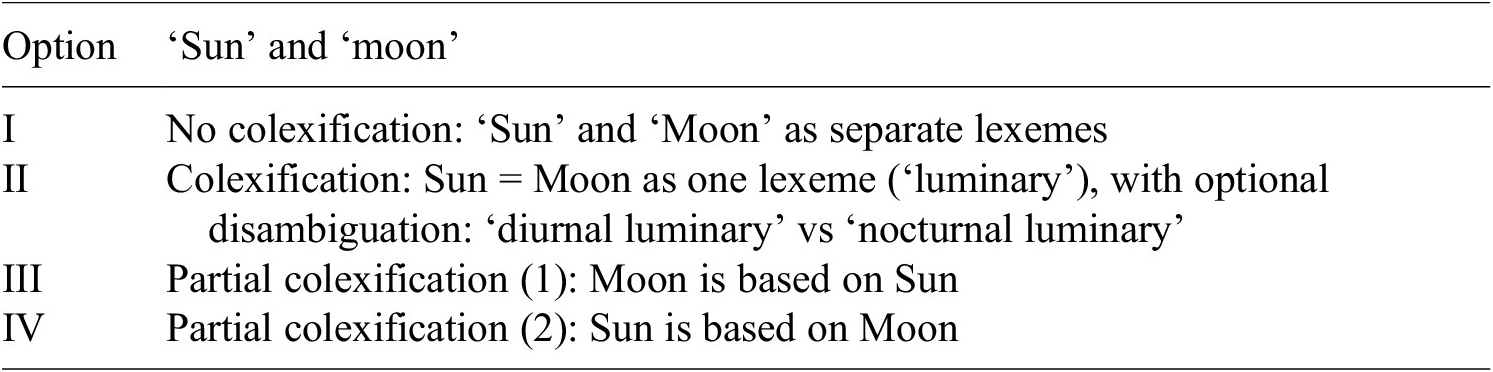
Table 1 summarises the options for colexification of ‘sun’ and ‘moon’ in the languages of the world (see also a preliminary classification by Urban Reference Urban2009).Footnote 2 A colexified ‘sun’ and ‘moon’ is termed ‘luminary’.
‘Sun’ and ‘Moon’: The Lexical Options

The term ‘partial colexification’ is introduced here to reflect an incomplete overlap in the reference to the two celestial bodies. We now turn to some examples of each option.
2.1.1. Option I: ‘sun’ and ‘moon’ as separate lexemes
Option I is the most common. This is what we find in numerous Indo-European and Semitic languages, across Africa and Australia, and in a few instances in North America and South America and the Pacific (including most Austronesian languages). For instance, in Murui, a Witotoan language spoken in the Caquetá-Putumayo region in Colombia (bordering the Vaupés River Basin Linguistic Area), jito-ma (jito ‘son + masculine classifier’) means ‘moon’, and the word for ‘sun’ is fï-vui (?-classifier:month) (Kasia Wojtylak, p.c.).
A language may have several terms for both ‘sun’ and ‘moon’. Nyawaygi, an Australian language, has two words for ‘sun’ at various times of the day: jula ‘hot sun (at midday), summertime’ and bujira ‘less hot sun (as in the early morning)’ and two for moon, ngilgan ‘full moon’ and balanu ‘new moon’ (Dixon Reference Dixon2015: 152)
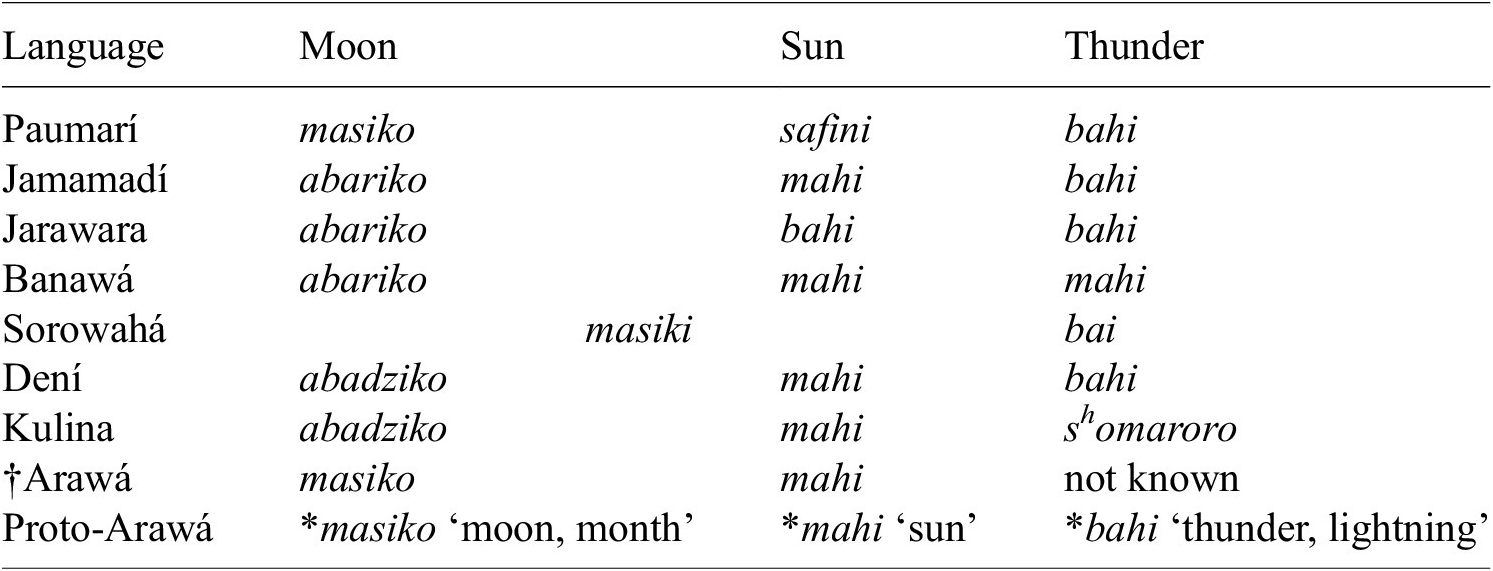
Terms for ‘sun’ and ‘moon’ may cover different semantic grounds. In numerous languages, the term for ‘moon’ also means ‘month’ or ‘lunar month’ (see also Osmond Reference Osmond, Ross, Pawley and Osmond2007: 164–165, on Oceanic languages). The majority of Arawá languages of Southern Amazonia have different forms for ‘sun’ and ‘moon’, reconstructed as Proto-Arawá *masiko ‘moon, month’ and *mahi ‘sun’ (Dixon Reference Dixon, Dixon and Aikhenvald1999: 297, Reference Dixon2004: 62–63). The term bahi, a reflex of Proto-Arawá *bahi ‘thunder, lightning’, is used in the meaning of ‘sun, thunder’ in Jarawara. The original reflex of *mahi is lost, and a new colexification pattern has evolved. In the closely related Banawá, mahi means ‘sun, thunder’, and the reflex of the original *bahi is lost. Sorowahá, the least studied language of the family, has one form masiko for ‘sun’ and ‘moon’ (a reflex of ‘moon’ in the proto-language). The reflex of *bahi survives in Sorawahá bai ‘thunder’. This is summarised in Table 2.
Sun, Moon, and Thunder in Arawá Languages

Several terms for ‘sun’ and ‘moon’ can be reconstructed for a proto-language. One can be more restricted in its meaning than the others. All Arawak languages have a reflex of the Proto-Arawak *kahithi ‘moon’. Two forms for ‘sun’ with somewhat different semantic scope are reconstructible to the proto-language: Proto-Arawak *kamu(i) ‘sun, heat, summer’ and Proto-Arawak *ketʃi ‘sun, day’ (see Aikhenvald Reference Aikhenvald2010, Reference Aikhenvald2021b).Footnote 3 For instance, in Piapoco, a North Arawak language from the Uapuí subgroup spoken in Colombia, queeri ‘moon’ is a reflex of Proto-Arawak *kahithi ‘moon’. Piapoco èeri ‘day, world, sun’ goes back to Proto-Arawak *ketʃi ‘sun, day’ (Klumpp Reference Klumpp1995: 29, 89). In Baniwa of Içana (e.g. dialects Hohôdene Baniwa and Siuci), from the same subgroup, ke:ǯi ‘moon’ goes back to Proto-Arawak *kahithi ‘moon’ (see Section 3.4 for further discussion). The term for ‘sun’ is kamoi/kamui, a reflex of Proto-Arawak *kamu(i) ‘sun, heat, summer’. The verb -kamu, cognate to ‘sun’, means ‘heat up (something)’. The noun denoting a celestial body has a different meaning when used as a verb (an instance of zero-derivation, or conversion). A full study of the semantic span of each term in Option I goes beyond our scope.
2.1.2. Option II: colexification of ‘sun’ and ‘moon’
Option II, whereby ‘sun’ and ‘moon’ are expressed with one lexeme, as a ‘luminary’, is a feature of quite a few languages in North and South America and across the Pacific (see also Urban Reference Urban2009).Footnote 4 Among them are Arapesh languages (including Bukyip, Mufian and Weri: Lise Dobrin, p.c.), Iteri (Left May family in the Sepik region) (ona ‘sun, moon’: Joseph Brooks, p.c.), and possibly all the languages from the Lakes Plain language family of West Papua (Brendan Yoder, p.c., Clouse Reference Clouse1997: 156, 183).
A single term for a ‘luminary’ (with colexification of the two celestial bodies) can go back to the proto-language. The colexified term *hasi ‘sun/moon, luminary’, is reconstructed for Proto-Muskogean (Pamela Munro p.c., George Aaron Broadwell, p.c. and Broadwell Reference Broadwell2025 and p.c., Jack Martin, p.c.).Footnote 5 The colexified form for sun/moon is reconstructed for Proto-Algonquian (https://protoalgonquian.atlas-ling.ca; Amy Dahlstrom, p.c.) as *ki·šeʔϴwa, e.g. Meskwaki or Fox ki:šeswa ‘sun, moon, month’, Ojibwe ki:sissw ‘sun/moon/month’ (see also Mithun Reference Mithun1999: 338). Proto-Iroquoian *-ɹahkʷ also covers ‘moon, planet, sun’ (Julian Reference Julian2010: 534, Marianne Mithun, p.c.).
Colexification of ‘sun’ and ‘moon’ is a pervasive feature of East Tukanoan languages spoken across the multilingual Vaupés River Basin Linguistic Area in Lowland Amazonia, spanning Brazil and Colombia. These include Tukano muhĩpũ ‘sun, moon’ (Ramirez Reference Ramirez1997: 107), Desano abe ‘sun, moon’ (Alemán et al. Reference Alemán, Tulio and Miller2000: 9), Barasano (or Barasano-Eduria) muiju, mujiju (Jones and Jones Reference Jones and Jones2009: 466) or muhihũ (Hugh-Jones Reference Hugh-Jones2019: 95), and Cubeo aviá ‘sun, moon’ (Morse et al. Reference Morse, Salser and de Salser1999: 34).Footnote 6 Colexification of ‘sun’ and ‘moon’ is a feature of Tariana, the only North Arawak language within the area (on its Brazilian side), which has ke:ri ‘sun, moon’, and of the Hup-Yuhup group spoken outside the exogamous marriage network on the outskirts of the Vaupés River Basin Linguistic Area, e.g. Yuhup wero ‘sun, moon’ (see Silva & Silva Reference Silva and Silva2012: 306–307, Epps Reference Epps, Aikhenvald and Dixon2006: 285).
The colexified root ‘luminary’ may have further meanings. It can cover any celestial body, including ‘stars’, in addition to ‘sun’ and ‘moon’, as is the case in Yuhup wero ‘sun, moon, star (celestial body in general)’. The polyfunctional root gyemk in Sm’algyax, a Tsimshianic language, can be used as a noun in the meaning of ‘heat, moon, sun’ and as a verb with the meaning ‘be hot, bright, warm’ (Stebbins Reference Stebbins2004: 16). The two can be considered instances of zero-derivation. The form gyemk is also used in disambiguating compounds gyemgm dziiws (heat/sun/moon day) ‘sun’ and gyemgm aatk (heat/sun/moon night) ‘moon’. As Stebbins (Reference Stebbins2004: 16) puts it, ‘these compounds suggest that the form gyemk refers equally to “heat”, “moon”, and “sun”’, and ‘we can treat gyemk as a general term for a large celestial body and the light or the heat it produces’.
A shared expression for ‘sun’ and ‘moon’ can be of a different nature. The term hári in Sanskrit has a wide range of meanings, covering ‘(to be) yellow or green, fawn-coloured, yellow, fallow, bay (especially applied to horses); horse, steed, lion; the sun; monkey; a ray of light; the moon’ (Monier-Williams Reference Monier-Williams1899). The connection between ‘sun’ and ‘moon’ and the use of the same term for both has to do with its use to refer to bay-coloured horses. These horses used to draw the chariots of various gods, primarily Indra, and also the Sun and Soma, who are also periodically referred to as hári-. In Sanskrit texts and in modern Hinduism, Soma is associated with the Moon. Monier-Williams (Reference Monier-Williams1899) notes that Moon/Soma can be referred to as hari-. This usage is attested only in the work of lexicographers and not found in texts (marked as L in Monier-Williams Reference Monier-Williams1899; Alexandr Lubotsky, p.c., Leonid Kulikov, p.c.). The use of hári- in the meaning of ‘sun’ is not widespread and occurs in just some texts (e.g. Bṛhat Saṃhitā: Leonid Kulikov, p.c.).
All the languages with Option II we had access to allow for a possibility of disambiguation of the same word for both luminaries. This is the case in many East Tukanoan languages. The colexified form muhĩpũ ‘sun, moon’ in Tukano can be disambiguated with modifiers, as in yamî muhĩpũ (night sun/moon) ‘moon’ and imîkoho muhĩpũ (day sun/moon) ‘sun’ (Ramirez Reference Ramirez1997: 107). In Cubeo, the reference of the colexified term aviá ‘sun, moon’ can be optionally distinguished by modifiers: aviá ñamicacu (sun/moon nightly) ‘moon’ and aviá jãravucacu (sun/moon daily) (diurnal sun/moon) ‘sun’ (Morse et al. Reference Morse, Salser and de Salser1999: 34, 152, 228, 378, 406). Along similar lines, the term wero in Yuhup (Silva & Silva Reference Silva and Silva2012: 307) can be disambiguated in wero sääm nih yap (luminary become.night possessive individualiser) ‘moon, night luminary’ and wero wag nih yap (luminary be.day possessive individualiser) ‘sun, day luminary’. In Tariana, the colexified term ke:ri ‘sun/moon’ can be disambiguated as ehkwapite ke:ri (day+ncl:animate sun/moon) ‘sun’, literally, ‘diurnal sun/moon’, and de:pite ke:ri (night+ncl:animate sun/moon) ‘moon’, literally, ‘nocturnal sun/moon’. These uses occur in stories about the rivalry between ‘sun’ and ‘moon’, pedagogical materials, and the dictionary (Brito & Aikhenvald Reference family and Aikhenvald2002).
Speakers of Chickasaw consistently use hashi’ in the meaning of both ‘sun’ and ‘moon’ (and also ‘month’) (with a tendency to interpret hashi’ as ‘sun’ when taken out of context. ‘If they want to specify ‘moon’, they say hashi’ ninak aa or just hash’ ninak – ‘the sun/moon that goes at night’, or just ‘night sun/moon’. But many expressions referring to the moon just use hashi” (Pamela Munro, p.c. 23 August 2025). Similar to other Algonquian languages, Innu, East Cree and Atikamekw have the same word for ‘moon’ and ‘sun’, pisimw. To specify each of them, one can add ‘day’ or ‘night’, as in Atikamekw: kicikaw pisimw (the luminary of day, i.e. the sun), tipiskaw pisimw (luminary of night, i.e. the moon) (Marie-Odile Junker, p.c.). The latter appears to be rare (there is a different word for ‘star’: atcakoc). Functional motivation for disambiguation lies in the necessity for clarity of expression, especially in dictionaries for Western audiences (see, e.g., Regier et al. Reference Regier, Carstensen and Kemp2016).
As a variation on such lexical disambiguation, one term will be used for ‘sun’ and ‘moon’, but only the meaning ‘moon’ can be optionally specified. In Wappo (Yuki-Wappo), hín means both ‘sun’ and ‘moon’ (see Sawyer Reference Sawyer, Shepherd and Elmendorf1991: 70, 107). The meaning ‘moon’ can be optionally specified using a complex expression ʔŭču.aʔ-meʔ hín (night-belonging.to sun/moon) ‘nightly sun/moon’. There is no similar expression for ‘sun’ (see Sawyer Reference Sawyer1965). Only the form hín occurs in the meaning of ‘sun’ and ‘moon’ in Thompson et al. (Reference Thompson, Park and Li2006: 38, 144). Along similar lines, Meskwaki (or Fox), an Algonquian language, uses ki:šeswa in the meaning of ‘sun’ and ‘moon’. A compound tepehki-ki:šeswa (tepehki ‘night’) can be used to refer specifically to the moon. There is no parallel compound for specifically designating the sun (Goddard and Thomason Reference Goddard and Thomason2014: 299, 358, Amy Dahlstrom, p.c.) (see also Urban Reference Urban2009: 329, for similar examples).
2.1.3. Option III: Partial colexification (1): Moon is based on Sun
Option III involves the term for moon based on ‘sun’. An example comes from Kwanga, an isolate from the Sepik region of Papua New Guinea. The nouns nika means ‘sun/month’, and nika-hako means ‘moon’ (Manabe Reference Manabe1995). The meaning of the formative -hako is not clear; it is reminiscent of hako ‘harvest’. The term for ‘moon’ can cover stars, as in Kwanga nika-hako (sun/month-?) ‘moon, star’ (Manabe & Manabe Reference Manabe and Manabe1979: 36). In Lake Miwok (Utian), híi means ‘sun’, and a complex form káwul híi ‘night sun’ refers to moon (Callaghan Reference Callaghan1965). Similarly, in Esselen, an extinct isolate from California, the term for ‘moon’, tomanis-aci (night-sun) was based on aci (or asi) ‘sun’ (see Shaul Reference Shaul1995: 227, Kroeber Reference Kroeber1904, Mithun Reference Mithun1999: 413). No complex term for ‘sun’ has been recorded.
Alternatively, the terms for ‘sun’ and ‘moon’ may contain a similar root, accompanied by further morphological material. In Ayoreo, a Zamucoan language from Bolivia and Paraguay, the term for ‘sun’ is guede, and the term for ‘moon’ is guedoside (Ciucci Reference Ciucci, Aikhenvald, Dixon and Jarkey2021: 278–279). The term for ‘moon’ appears to be morphologically more complex than ‘sun’ in Trumai, an isolate from the Xingu Indigenous Park in Brazil (Guirardello-Damian Reference Franchetto2011: 130–131), with atetla ‘sun’ and atetlpak ‘moon’. A special term for ‘moon’, yaï, is a borrowing from the neighbouring and unrelated Kamaiurá (jay, p. 119). It appears only in mythological narratives.
2.1.4. Option IV: Partial colexification (2): Sun is based on Moon
There appear to be just a few instances of Option IV in the world’s languages. An example comes from Jiangle and Shunchang dialects of Shaojiang Min 月頭 (‘moon’ + ‘head’) ‘sun’ and Guilin and Lingshuan dialects of Northern Pinghua: 月頭 (‘moon’ + ‘head’) ‘sun’, where the first character (which equals a syllable) refers to the ‘moon’, and the second character, ‘head’, specifies the celestial body as ‘sun’ https://en.wiktionary.org/wiki/%E5%A4%AA%E9%99%BD#Chinese (Christoph Holz, p.c.; accessed 12 March 2026).
In most instances where ‘moon’ is colexified with ‘sun’, ‘sun’ appears to be the functionally unmarked term. ‘Moon’ (and not ‘sun’) tends to be optionally specified. In the instances of partial colexification ‘moon’ appears to be based on ‘sun’ rather than the reverse. The functional and cognitive motivation for this tendency requires further investigation for each individual language and the culture it reflects.
2.2. Linguistic categorisation of ‘sun’ and ‘moon’
Terms for ‘sun’ and ‘moon’, even if segmentally different (as, for example, in Options I and III), can belong to the same gender. Ayoreo and Old Zamuco, two Zamucoan languages, have two different (albeit related) lexemes for the two entities (Option III). Both belong to masculine gender and represent male mythological characters (see Ciucci Reference Ciucci2016: 782, Reference Ciucci, Aikhenvald, Dixon and Jarkey2021: 249–250, 278–279). Palikur, a North Arawak language, has kayg ‘moon’ (a reflex of Proto-Arawak *kahithi ‘moon’). The term for ‘sun’ is kamuw ‘sun’ (a reflex of Proto-Arawak *kamu(i) ‘sun, heat, summer’) (Option I). These and all other heavenly bodies (stars, planets), thunder and lightning belong to masculine gender. According to traditional legends, they were once men (Aikhenvald and Green Reference Aikhenvald, Green, Aikhenvald and Dixon2011, Diana Green, p.c.). Manambu, Yalaku and all the other languages of the Ndu family (the Sepik region of Papua New Guinea) have different lexical items for ‘moon’ and ‘sun’. Both are assigned to the feminine gender, as are all objects of round shape (Aikhenvald Reference Aikhenvald2025: 30). In Asheninca and Ashaninca Campa (Arawak languages from Peru), all inanimates belong to the feminine gender. All animates are masculine. Both moon (cashiri) and sun (oorya) are masculine, and represent different mythological characters (see Payne Reference Payne1989: 130, Romani Miranda Reference Romani Miranda2004). In Baniwa of Içana, a North Arawak language, both ‘sun’ and ‘moon’ belong to the non-feminine gender (marked in demonstratives and verbal cross-referencing), and take the non-feminine animate agreement marker on adjectives.
Alternatively, the two entities can share one specific classifier. An example comes from Siona, a West Tukanoan language spoken on the Putumayo River in Colombia (outside the Vaupés River Basin Linguistic Area). Similar to other Tukanoan languages, Siona employs a large set of classifiers in multiple contexts, and classifiers on nouns as derivational markers is one of them (see more on classifiers in multiple contexts in Aikhenvald Reference Aikhenvald2025: 202–225, and references there). There are two different lexical roots for sun and for moon. The two terms share one specific classifier -guë ‘celestial bodies’ in its derivational function, in ñaña-guë ‘moon’ (from ñaña ‘collapse’, lit. the one that collapses) and ënsë-guë ‘sun’ (from ‘shine’, lit. ‘the one that shines’) (Wheeler Reference Wheeler1987, volume 1: 107). In the traditional language, both ‘sun’ and ‘moon’ were treated as grammatically animate; younger speakers consider them inanimates (Wheeler Reference Wheeler1987, volume 1: 105, 107).
In languages with Option II, colexified ‘sun’ and ‘moon’ always belong to the same grammatical class. In East Tukanoan languages (spoken within the Vaupés River Basin Linguistic Area) sun/moon is usually animate and masculine (i.e. non-feminine). In its meaning ‘month’, the term may belong to a different grammatical class. In Desano (Option II), the noun abe belongs to the masculine gender and is treated as animate in its reference to the two celestial bodies. In its reference to ‘month’, it is treated as inanimate (e.g. in agreement with demonstratives: Alemán et al. Reference Alemán, Tulio and Miller2000: 119). We will see in Section 3.2 that ke:ri ‘sun, moon’ in Tariana belongs to the animate class in its reference to the celestial bodies (reflected in agreement on modifiers, including number words). When used in the meaning ‘month’, it occurs with the classifier for elongated objects in all the classifier contexts.
‘Sun’ and ‘moon’ may belong to different genders. In many Australian languages with Option I, the moon is assigned to masculine gender and conceived of as a man. The sun is feminine and described as a woman (see Alpher Reference Alpher1987: 180). Different genders for ‘sun’ and ‘moon’ are a feature of many Indo-European languages (see also Matasović Reference Matasović2004: 98–102, Gamkrelidze & Ivanov Reference Gamkrelidze and Ivanov1995: 590–591).
2.3. ‘Sun’ and ‘moon’ in myth
Colexification of terms for ‘sun’ and ‘moon’ (Option II in Table 1) or lack thereof (Options I, III and IV in Table 2) may or may not correlate with their roles or representation in myth.
A recently described instance of co-conceptualisation of ‘sun’ and ‘moon’ as one entity (albeit with two distinct realisations and roles) comes from the mythological traditions of the Yagwoia, an Angan-speaking nation of the Morobe province of Papua New Guinea. The language represents an instance of Option I, with separate terms for ‘sun’ (mapya) and ‘moon’ (lamnyi : Loving Reference Loving1975: 59, 66). The two celestial bodies are the Ancestral Being’s (Imacoqwa’s) ‘two eyes’, ‘identified as the differentiated (sexuated) and individuated human ancestral couple, from whom all humans descend’ (Mimica Reference Mimica2025: 25). ‘The core myth of the sun^moon … simultaneously maintains the unity and difference of their differentiated and individualized identities’, reflecting their ‘biunity’ (reflected in the title of Mimica Reference Mimica2025).
In other instances, colexification of celestial bodies – or lack thereof – correlates with their distinct roles in myth. As mentioned in Section 2.1.1, Hohôdene Baniwa, a North Arawak language, has two words for ‘sun’ (kamoi) and ‘moon’ (ke:ǯi); their different roles in myth are reflected in the stories about the origin of night and of the moon (Brandão de Amorim Reference Antonio1987: 449–453), and the sun as the creator (especially as told by ‘Jaguar’ shamans: see Wright Reference Wright2013: 52–57). Along similar lines, Sahaptin has two different terms for the two celestial bodies (aan ‘sun’ and alxayx ‘moon’: Jansen Reference Jansen2010: 42; 279), with the corresponding characters having different roles in myth (see the tale of the Sun and the Moon in Boas Reference Boas, Teit, Farrand, Gould and Spinden1917: 197).
All Indo-European languages distinguish ‘sun’ and ‘moon’ (Option I). In the early Indo-European traditions, the two had different roles, with varied kinds of close relationships – ‘seen as a pair of siblings, united by marriage (the moon is the husband, the sun the wife) or kinship (twins)’ (Gamkrelidze and Ivanov Reference Gamkrelidze and Ivanov1995: 591; see also Dexter Reference Dexter1984 and Matasović Reference Matasović2018).
In further instances, the conceptual unity of ‘sun’ and ‘moon’ directly correlates with their colexification. This is how Brüzzi (Reference Brüzzi1977: 231) describes this unity of ‘sun’ and ‘moon’ for Tukano (Option II):
‘There is only one name to refer to the sun and the moon, it is Muhĩ-pũ. Originally, they conceived of them as one and the same entity which illuminated the world, and it was always day. Until such time as the night appears, in the way of dark dust spread in space.’Footnote 7
In a number of further, well-documented, East Tukanoan traditions (each with Option II), ‘sun’ and ‘moon’ are conceptualised as closely linked, and yet are distinguished by their role in myth. We mentioned in Section 2.1.1 that Desano has one form abe ‘sun, moon’ (Alemán et al. Reference Alemán, Tulio and Miller2000: 9). The Creation Myth of the Desano states ‘In the beginning there were the Sun and the Moon. They were twin brothers’, or ‘one single androgynous being’ (Reichel-Dolmatoff Reference Reichel-Dolmatoff1971: 24; for more on the special role of the moon in the Desano universe, and the moon’s role in reproduction and female menstruation, see Reichel-Dolmatoff Reference Reichel-Dolmatoff1997: 38–39, 64).
The Sun is considered the older brother of the Moon by the Cubeo (Goldman Reference Goldman2004: 168), another East Tukanoan language with Option II, with Sun given ‘relatively minor importance’ compared to the Moon. Barasano (or Barasano-Eduria) also has one term for ‘sun’ and ‘moon’ (muiju or mujiju: Jones and Jones Reference Jones and Jones2009: 435, 466). As pointed out by Hugh-Jones (Reference Hugh-Jones2019: 95), ‘sun’ and ‘moon’ are both muhihũ and could be said to be parts of the same entity. The Moon has close associations with the Underworld, is responsible for female menstruation and is the source of fierce magic (C. Hugh-Jones Reference Hugh-Jones1979: 156–157, S. O. Hugh-Jones Reference Hugh-Jones1979: 274ff).
While ‘sun’ and ‘moon’ may belong to one gender, their roles in myth may be different. In Siona, the Sun is said to be ‘the most powerful shaman’ (Wheeler Reference Wheeler1987, volume II: 21), while the Moon is simply referred to as a ‘character’ (presumably, in myth: Wheeler Reference Wheeler1987, volume II: 59). The terms share the same classifier for celestial bodies (see Section 2.2).
To recapitulate: representing ‘sun’ and ‘moon’ as two siblings – or even twins – is a feature of numerous languages with different terms for both (Option I) (e.g. Gamkrelidze & Ivanov Reference Gamkrelidze and Ivanov1995: 591) and of those with just one (Option II), as we saw for East Tukanoan languages. There does not appear to exist any direct dependency between colexification of ‘sun’ and ‘moon’ and their unity in myth. These facts support the conclusions by Lévy-Strauss (Reference Lévy-Strauss1967: 1168), based on numerous examples from the Americas, that ‘there is no automatic correspondence between linguistic oppositions and those (oppositions) which are expressed in other ways: in religious beliefs, rituals, myths, and legends’.Footnote 8 However, the dynamics of diachronic development and contact-induced change in multilingual settings qualifies this statement. In a situation of intensive language and culture contact, colexification of ‘sun’ and ‘moon’ and their joint categorisation change and go together with borrowing of legends and stories which reflect their unity – see Section 3.
We now turn to the role of language contact in the dynamics of colexification, a topic hardly addressed in previous studies.
2.4. Historical trajectories of colexification and of its demise
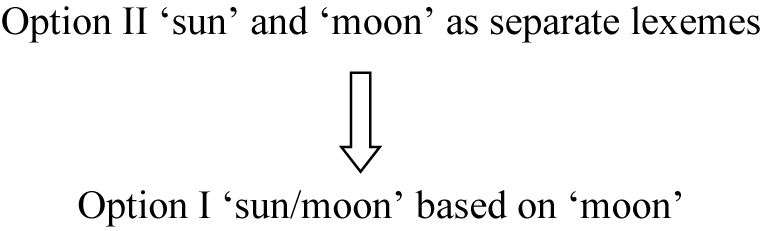
Colexification of ‘sun’ and ‘moon’ can come about as a result of language contact. One term will be used instead of the original two. Eastern Pomo, a Pomo language, is a case in point. All Pomo languages distinguish ‘sun’ (reflexes of Proto-Pomo *haʔdá ‘sun’) and ‘moon’ (Proto-Pomo *q’alá.(xa) or *ʔal.á.(xa) ‘moon’) (McLendon Reference McLendon1973: 81, 92). Eastern Pomo is the only language in the family to have one form for both, lá . ‘sun, moon’, a reflex of Proto-Pomo *ʔal.á.(xa) ‘moon’ (McLendon Reference McLendon1973: 81). The archaic noun dá ‘sun’ (a reflex of Proto-Pomo reflexes of Proto-Pomo *haʔdá ‘sun’) was collected by Kroeber in 1904. Speakers with whom Sally McLendon worked confirmed this former usage and claimed ‘to no longer use it because of the homophony with /dá/ “woman”’. In this instance, language contact with a neighbouring nation may also have played a role. Wappo (with one term for both: Option II) used to be spoken to the east of Eastern Pomo, and there is evidence for linguistic interactions between these groups in the past (Marianne Mithun, p.c.).Footnote 9 The colexified form for ‘sun/moon’ is based on ‘moon’. A similar process in Tariana – one term for ‘sun’ and ‘moon’ – is discussed in Section 3.1. In both cases, the development from Option I to Option II involves semantic change, from ‘moon’ to ‘sun/moon’. This is summarised in Figure 1.
Colexification of ‘Sun’ and ‘Moon’.

Why could ‘moon’ be the target of colexification? We turn to this in Section 4.
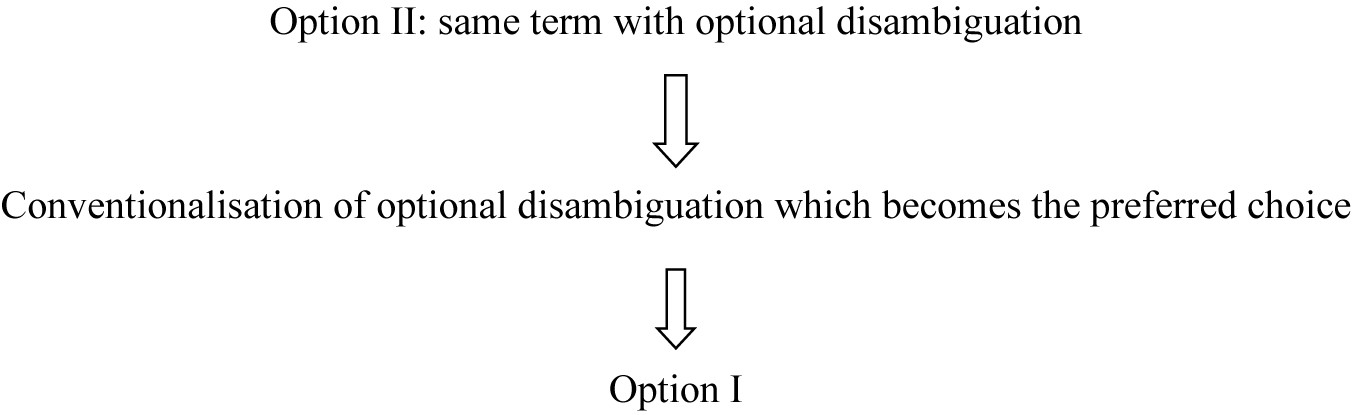
The process of de-colexification, that is, developing two words for ‘sun’ and for ‘moon’ instead of the original one, may be also due to language contact. In languages with Option II, what used to be optional means for disambiguation may become conventionalised. The outcome will then be de-colexification of the single term for a ‘luminary’, or ‘celestial body’. This is summarised in Figure 2.
De-colexification of ‘Sun’ and ‘Moon’.

In other words, having an option for disambiguating the colexified term ‘sun/moon’ (within Option II) creates a pathway for its potential de-colexification. A telling instance comes from Muskogee, a Muskogean language. In older sources on Muskogee, one noun, hvse (https://www.webonary.org/muscogee/gbf47a2ea-310a-4a6b-9805-311d3ac2ab7c/) [hasí], was used in the meaning of ‘sun/moon, month’ (see the discussion of the Proto-Muskogean form in Section 2.1.2). ‘Sun’ and ‘moon’ could be optionally differentiated with modifiers, as netta-hvse (day-luminary) used specifically for ‘sun’ and nerē-hvse (night-luminary) for ‘moon’ (Jack Martin, p.c., 24 August 2025). In the dictionary which reflects current usage, hvse [hasí] means ‘sun, month’. The noun hvrēssē (from nerē-hvse) is used in the meaning of ‘moon’ (see https://www.webonary.org/muscogee, Martin & McKane Mauldin Reference Martin and Mauldin2004: 273, 326).
Lexical differentiation of related forms for ‘sun’ and for ‘moon’ in Muskogee is a new phenomenon, and must have been developed under the influence of English (as suggested by Jack Martin, p.c., 24 August 2025). English is a major language of communication for the people, and this innovation allows Muskogee speakers to render the same distinctions in their languages as the ones in the national majority language. This can be considered an instance of contact-induced de-colexification, based on the language’s own resources.
An alternative pathway may involve borrowing one of the terms. We saw in Section 2.1.2 that most Muskogean languages have one single word for ‘sun/moon’ which goes back to the proto-language. The forms in individual languages include Creek hasi, Mikasuki ha:si, Alabama and Koasati hasi, Choctaw and Chickasaw hashi. In modern languages ‘the two can be disambiguated with a phrase that means ‘night’ or ‘goes by night’, e.g. Koasati nilahasi ‘night sun, moon’, Choctaw hashi ninak aya ‘sun that goes at night, moon’ (Broadwell Reference Broadwell2025: 14) (Option II: Section 2.1.2). The only Muskogean language with consistently different forms for ‘sun’ and ‘moon’ is the extinct Apalachee, with limited attestation. The two terms are nico ‘sun, fire’ and hitok <hitoc> ‘moon’ (used in a traditional folktale: Broadwell Reference Broadwell2025, p.c.). Neither form can be derived from Proto-Muskogean. The form nico is likely to be a borrowing from the word nico ‘burning’ in the unrelated Timucua, a language isolate formerly spoken in northern and central Florida and southern Georgia. In contrast to Muskogean languages, Timucua had two words: ela ‘sun’ and acu ‘moon’, as Option I (see https://www.native-languages.org/timucua_words.htm, de la Grasserie Reference Grasserie1888: 410, 413, 418).Footnote 10 Historical accounts point towards an extensive interaction between the Apalachee and the Timucua during the early Spanish colonial period in Florida. These included trade and intermarriage, creating the right social conditions for interlingual borrowing (Broadwell Reference Broadwell2025, p.c.). The development of two words for the two celestial bodies in Apalachee may have partly had its roots in language contact with Timucua.Footnote 11
In each of these instances, language contact provides an additional motivation for the communicative necessity of having two terms for the celestial bodies, opting for extra complexity and clarity rather than simplicity and cognitive ease (we return to the issue of competing motivations and functional explanations for colexification in Section 5). In Section 3.3, we turn to a further documented instance of contact-induced de-colexification of ‘sun’ and ‘moon’ in Kumandene Tariana. This involves two processes: contact-induced reinterpretation of the term ‘moon’ and borrowing of the term ‘sun’ from the closely related dominant language, the Hohôdene dialect of Baniwa of Içana.
The examples discussed in this section are, so far, the only instances of attested and historically traceable colexification and of its demise. Each involves language contact and language adjustment to one another. A comprehensive fieldwork-based firsthand investigation of historically documented colexification of ‘sun’ and ‘moon’ in two extant dialects of Tariana – the topic of Section 3 – offers further systematic insights into the pathways, and the motivations, for having one or two terms for the celestial bodies, within the context of language and culture contact.
The geographical distribution of having one word for ‘sun’ and ‘moon’ across the world (Option II) is intriguing. Languages with Option II are spread, in pockets, across the Pacific and across North and South America. Whether or not this phenomenon could be indicative of ancient contact (as suggested by Urban Reference Urban2009) remains an open question.
3. Sun, moon, and language contact in action: colexification and its demise in Tariana
In Section 3.1, we start with a snapshot of Tariana and its dialects. Evidence for incomplete colexification of sun/moon in one extant dialect which uses one term ke:ri for both ‘sun’ and ‘moon’ is addressed in Section 3.2. In Section 3.3, we turn to an emergent pattern of de-colexification of sun/moon in the other dialect of the language, where a form borrowed from a closely related language, the Hohôdene dialect of Baniwa of Içana, is used in the meaning of ‘sun’ and the colexified form ‘sun/moon’ tends to be used in its Proto-Arawak meaning, ‘moon’. Data from other, extinct, dialects and interim conclusions are in Section 3.4.
3.1. Tariana as an aberrant Arawak language
Tariana is the only North Arawak language spoken in the Vaupés River Basin Linguistic Area in northwest Amazonia (spanning adjacent areas of Brazil and Colombia).Footnote 12 The traditional area was characterised by obligatory multilingualism based on the principle of linguistic exogamy: ‘those who speak the same language as us are our brothers, and we do not marry our sisters’ (see Aikhenvald Reference Aikhenvald2010, Reference Aikhenvald2015: 75–83, Reference Aikhenvald, Mufwene and Escobar2022, and references there).
Languages spoken in this area traditionally included the East Tukanoan languages Tukano, Wanano (or Kotiria), Desano, Piratapuya (or Waikhana), Tuyuca (and a few others) and one North Arawak language, Tariana.Footnote 13
A long-term interaction based on institutionalised societal multilingualism between East Tukanoan languages and Tariana has resulted in rampant diffusion of grammatical and semantic patterns (though not so much of forms) and calquing of categories. The Vaupés River Basin Linguistic Area is characterised by a strong cultural inhibition against language mixing, viewed in terms of borrowing forms, or inserting bits of other languages, in one’s Tariana, so as to keep languages different. This inhibition operates predominantly in terms of recognisable loan forms (see C. Hugh-Jones Reference Hugh-Jones1979, S. O. Hugh-Jones Reference Hugh-Jones1979, Aikhenvald Reference Aikhenvald2010, Reference Aikhenvald2015, Reference Aikhenvald, Mufwene and Escobar2022, and references thereon language attitudes in the area).
Using Grace’s (Reference Grace and Baldi1990) term, Tariana is an ‘aberrant’ language within the Arawak family, due to numerous East Tukanoan-like features which define its grammatical profile. In contrast, other languages of the same Uapuí subgroup – dialects of Baniwa of Içana/Kurripako, Piapoco and Guarequena – are ‘exemplary’ in that they are more archaic and more in line with the common Arawak profile (see also Aikhenvald Reference Aikhenvald2021a,Reference Aikhenvaldb). Comparison of Tariana with closely related Arawak languages of the Uapuí subgroup and other languages of the family helps identify which features have diffused into Tariana from Tukanoan languages and which are inherited from the proto-language.
A trait shared by Tariana with other, unrelated, languages of the Vaupés River Basin and its surrounds is colexification of ‘sun’ and ‘moon’, with their optional differentiation. This is what we saw in Sections 2.1.2–2.1.3 for Tariana ke:ri ‘sun, moon’ (Option II), a reflex of Proto-Arawak *kahithi ‘moon’. Colexification of ‘sun’ and ‘moon’ is also a feature of East Tukanoan languages and also of languages spoken outside the exogamous marriage network on the outskirts of the Vaupés River Basin Linguistic Area – the Hup-Yuhup languages (see Epps Reference Epps, Aikhenvald and Dixon2006: 285, Silva & Silva Reference Silva and Silva2012: 306–307, and Sections 2.1–2.3). West Tukanoan languages spoken outside the Vaupés River Basin Linguistic Area have different words for ‘sun’ and ‘moon’ – an indication that this colexification is likely to be Vaupés-specific.
The Tariana are divided into a number of hierarchically organised clans, depending on the order in which their ancestors were created. The clans higher up in the hierarchy are said to have emerged first from a hole in the Uapuí Rapids on the Aiari River (a tributary of the Içana river). Most of the groups who were high in the tribal hierarchy gradually lost their language around the early twentieth century (Koch-Grünberg Reference Koch-Grünberg1911, Aikhenvald Reference Aikhenvald2003). At present, the number of ethnic Tariana is over 3,000, with only about a hundred competent in the language.
Each clan used to speak their own dialect, with varying degree of mutual intelligibility. Based on the comparison of existing sources, and the results of Aikhenvald’s own fieldwork spanning more than three decades, we estimate that the differences between the clan-based dialects used to be comparable to those between Spanish and Portuguese.
Only two dialects are currently spoken: that of the Wamiarikune Tariana (henceforth referred to as W-Tariana) and that of the Kumandene Tariana (K-Tariana). Both are highly endangered and are barely mutually intelligible. This is due to a number of factors, including the recent influence of Baniwa of Içana on K-Tariana, and the special developments in W-Tariana not shared with K-Tariana.Footnote 14
The W-Tariana are the descendants of a low-ranking group referred to, pejoratively, as iñemi (or iyäyne) ‘devils, forest spirits’ (alternatively Yurupary: Brüzzi Reference Brüzzi1977: 101–102, Koch-Grünberg Reference Koch-Grünberg1911: 50–51, see also Aikhenvald Reference Aikhenvald2014: 330 on this term used by the K-Tariana). The dialect is currently spoken in two locations on the Vaupés river (Santa Rosa and Periquitos), with a few speakers living in the mission centre Iauaretê and São Gabriel da Cachoeira (the capital of the Federal territory of the Upper Rio Negro, Amazonas, Brazil). Originally, the W-Tariana lived in small settlements off the Vaupés River, from where they were forced to move to their current locations by Salesian missionaries, two generations ago.
In contrast, the K-Tariana are a higher-ranking group than the W-Tariana (something acknowledged by both groups). K-Tariana is currently spoken in the village of Santa Terezinha on the Iauarí River (off the Vaupés). They are direct descendants of a group who spoke a dialect originally located in Iauaretê (see the arguments in Aikhenvald Reference Aikhenvald2014, Reference Aikhenvald2021b). Its earliest documentation goes back to Koch-Grünberg (Reference Koch-Grünberg1911). The K-Tariana left their ancestral location in Iauaretê, fleeing from the missionaries, at the very start of the twentieth century, and made their way to where they currently reside via the Içana River, coming in contact with speakers of the Hohôdene dialect of Baniwa of Içana along the way. Other varieties of Tariana formerly spoken in various locations on the Vaupés River are now extinct.
The Tariana are believed to be relatively recent arrivals into the Vaupés River Basin, dating back a couple of hundred years (see Aikhenvald Reference Aikhenvald2010: 17–28). Their migrations are reflected in ethnic histories and extant documentation. Based on those, we can confidently state that subgroups represented by the documented dialects moved to their current locations in separate waves following different routes. The Wamiarikune Tariana came from the Japurá River basin to the south-west from the Vaupés River Basin (as recorded in ancestral stories: see Aikhenvald Reference Aikhenvald, Mufwene and Escobar2022). The presence of a Tariana group on the Japurá (or Caquetá) river in Colombia was signalled by von Martius (Reference Martius1867, volume 1: 537), based on his travels in north-west Amazonia in the second decade of the nineteenth century.Footnote 15 In contrast, the Tariana of Ipanoré still remembered their origins in the basin of the Ayari River (off the Içana River), in the north-east direction from their then location on the Vaupés river where a speaker was interviewed by Johann Natterer (Reference Natterer1831). We will see, in Section 3.4, that this dialect of Tariana, no longer spoken, had different terms for ‘sun’ and ‘moon’ (Option I).
3.2. Evidence for incomplete colexification of ‘sun’ and ‘moon’ in W-Tariana
‘Sun’ and ‘moon’ are colexified in W-Tariana, following the pathway in Figure 1 (Section 2.4). However, the original meaning ‘moon’ for the noun ke:ri ‘sun/moon’ is still discernible. This is an indication of a relatively recent origin of the colexification.
The meaning of a root or a stem as a bound form may differ from its meaning as a free form. This may be related to the semantic development of a root. For instance, English meat means ‘(edible) flesh’ when used on its own. In compounds, such as sweet-meats or collocations like mince-meat tart, it retains the archaic meaning of ‘non-flesh food’ in general (see also https://www.oed.com/dictionary/sweetmeat_n?tab=meaning_and_use#19582930 accessed 12 March 2026, further examples and discussion are in Aikhenvald Reference Aikhenvald and Shopen2007: 39). This is what we find for the W-Tariana form ke:ri ‘sun, moon’, in a variety of contexts.
First, ke:ri in combination with classifiers refers exclusively to ‘moon’. The form ke:ri ‘sun, moon’ occurs with a number of semantically appropriate classifiers as derivational markers.Footnote 16 The meaning of the resulting forms is that of ‘moon, moon cycle’, e.g. ke:ri-pu (underlying form: keri-(i)pu) (sun/moon-cl:long.hollow) ‘moon-lit path’, ke:ri-pi (sun/moon-cl:long.thin) ‘moon-cycle; month’.
Secondly, the form keri or ke:ri has the meaning ‘moon’ in a number of fixed collocations. The most frequently used one is wali-pi ke:ri (new-cl:long.thin sun/moon) ‘a new moon’. Current speakers pronounce this as one phonological word [walipikeri], with phonetic reduction of the long vowel in ke:ri. The morpheme -pi-keri (-cl:long.thin sun/moon) is also used as a classifier for ‘month, monthly cycle’, e.g. pa:-pi-keri (one- cl:long.thin-sun/moon) ‘one (month)’.Footnote 17
To inflict evil and transform into a jaguar, a most potent shaman kahwikiri obtains his supreme powers by ‘sniffing the penis of the moon’, ke:ri i-hi-ni-na (moon indef-copulate-top.adv.der-cl:extended.long), literally ‘moon’s long extended (one) copulator’ (see examples in Aikhenvald Reference Aikhenvald2003: 619, Brito & Aikhenvald Reference family and Aikhenvald2002: 87–88). The noun phrase ke:ri i-hi-ni-na ‘moon’s penis’ contains the indefinite (or unspecified possessor) prefix obligatory in possessive constructions with NP Possessor preposed to the Possessee, especially so in the traditional language. Younger and innovative speakers tend to replace the indefinite prefix with a personal prefix in all possessive constructions, e.g. Traditional Tariana diha-nai i-kuda (it-cl:lake.like.waterway indef-bed) ‘the bed of a lake’ versus Innovative Tariana diha-nai di-kuda (it-cl:lake.like.waterway 3sgnf-bed) ‘the bed of a lake’. Such variation is not acceptable in fixed collocations, including the noun phrase ‘moon’s penis’. Replacing the indefinite prefix with a personal prefix will be ungrammatical. In other words, ke:ri i-hi-ni-na (moon indef-copulate-top.adv.der-cl:extended.long), literally ‘moon’s long extended (one) copulator’ cannot be recast as *ke:ri di-hi-ni-na (moon 3sgnf-copulate-top.adv.der-cl:extended.long) (see Aikhenvald Reference Aikhenvald2021a: 476).
Another fixed collocation with ke:ri meaning ‘moon’ is ke:ri i-pe (moon indef-flesh) ‘the flesh of the moon’ (used in a description of the magic practices of the Desano, classificatory younger brothers of the Tariana, known for their magical powers) (see also Brito & Aikhenvald Reference family and Aikhenvald2002: 241).
A further example comes from a traditional blessing. The Moon – not the Sun – is believed to have powers over travellers. It used to be customary to say (1) before a trip or a hunting expedition (see also Brito & Aikhenvald Reference family and Aikhenvald2002: 290-291).

This saying can be nominalised as ke:ri-ne pa-ñapa-nipe (moon-instr impers-bless-nom) ‘blessing by/with the Moon’. The power to perform the blessing is attributed to a kawhikiri shaman who ‘sniffs the moon’s penis’ (mentioned above).
In stories about the Sun and the Moon, the two are consistently distinguished with adjectival derivations. Similar to East Tukanoan languages, both ‘sun’ and ‘moon’ are considered animate and thus assigned animate agreement forms when used with demonstratives (see examples (2) and (3)). The two meanings of ke:ri ‘sun, moon’ can also be differentiated by context in a broad sense. The expression ke:ri disa-ka di-nu (sun/moon 3sgnf+go.up-rec.p.vis 3sgnf-come) ‘the sun comes up, rises’ typically refers to the rising sun (and not to the moon). The phrase ke:ri di-eku (sun/moon 3sgnf-run) describes a sunset, and saying ke:ri di-yana-ka (sun/moon 3sgnf-boil-rec.p.vis), lit. ‘sun is cooking’, describes the heat of the sun, and cannot be applicable to the moon. The noun ke:ri-depita (moon-cl:night) describes a moon-lit night; here the meaning ‘moon’ is preconditioned by its occurrence with ‘night’. The moon eclipse is referred to as ke:ri di-ñami-ka (moon 3sgnf-die-rec.p.vis) ‘the moon dies’. The Tariana say that no-one has ever witnessed the sun eclipse, and so ke:ri cannot be interpreted as ‘sun’ in this instance.
According to Tariana lore (shared with East Tukanoans), a new moon makes women menstruate (which makes them ritually unclean and thus dangerous). This typical activity is described in (2), followed by (3), with an explanation that a woman’s menstruation is a natural result of a sexual intercourse she has with the moon (see also Aikhenvald Reference Aikhenvald2003: 270). The description refers to a supranatural activity not available to the human eye, and so is cast in non-visual evidential.


Stories told by younger speakers about the competition and a quarrel between ‘the Sun’, called Ehwapite ke:ri (day/world+ncl:anim sun/moon) literally, ‘daily sun/moon’, and ‘the Moon’, Depite ke:ri (night+ncl:anim sun/moon) literally, ‘nightly sun/moon’, mirror the stories told by Tukanoans (including Myth 3 relating a quarrel between ‘sun’ and ‘moon’ in S. O. Hugh-Jones Reference Hugh-Jones1979). No ancestral stories about either the Sun or the Moon appear to ever have been known to the traditional Tariana elders. Speakers who told the stories about ‘sun’ and ‘moon’ as siblings-rivals commented that the stories were borrowed from Tukano (in Tariana, wa-sawaya wa-kalite (1pl-borrow 1pl-speak) ‘we borrow (and) tell (a story)’).
We conclude that the colexification of ‘sun’ and ‘moon’ under the umbrella ke:ri in Tariana is incomplete. The original meaning of this word, ‘moon’, still transpires in derivations and in fixed expressions. This meaning survives in the ways of speaking about magical experience, as an archaic feature. The incomplete colexification reflects (a) a footprint of historical development at the current stage of the language, and (b) a trace of competing motivations in colexification. This involves the tendency to express as many meanings as functionally necessary (along the lines of Regier et al. Reference Regier, Carstensen and Kemp2016) which is counteracted by the tendency to reduce the cognitive load by calquing the semantic patterns of neighbouring languages in daily use in a multilingual environment within the area (cf. Du Bois Reference Du Bois, MacWhinney, Malchukov and Moravcsik2014: 272, on Clarity versus Ease in competing motivations).
3.3. De-colexification: from ‘sun/moon’ to ‘sun’ and ‘moon’ in K-Tariana
Kumandene Tariana (K-Tariana) is spoken in Santa Terezinha, alongside Hohôdene Baniwa, the major language of the community (see Aikhenvald Reference Aikhenvald2014, Reference Aikhenvald2021b for further details). The growing impact of Hohôdene Baniwa is felt in just about every aspect of the language. One of the notable features is the introduction of the voiced postalveolar fricative ǯ as a variant of the original flap before front vowels, e.g. older K-Tariana ke:ri ‘sun, moon’ (Koch-Grünberg Reference Koch-Grünberg1911: 89), modern K-Tariana ke:ǯi ‘sun, moon’ (see also Aikhenvald Reference Aikhenvald2014: 335–336, and a summary in Aikhenvald Reference Aikhenvald2021b: 85–86). The speakers of K-Tariana tend to confuse the identity of borrowings from Hohôdene Baniwa, treating them as ‘Tariana proper’, typical for obsolescent languages and language ‘blends’ (see Aikhenvald Reference Aikhenvald2014: 354–356).
Similarly to the W-Tariana described in Section 3.2, the K-Tariana originally used one term for both ‘sun’ and ‘moon’ (under the influence of East Tukanoan languages). During his stay in Iauaretê in August 1904, Koch-Grünberg worked with the Kumandene (or Kumatene) Tariana and collected a word list (see Reference Koch-Grünberg1910: 17, 23–24; 1911) which comprised one segmental form for ‘sun’ and ‘moon’, ké:ri (Koch-Grünberg Reference Koch-Grünberg1911: 86; 89). A further piece of earlier documentation of K-Tariana comes from Brüzzi (Reference Brüzzi1961: 34, 146–148).
According to his account, in 1956 he tape-recorded a word list (loosely based on a Swadesh’s list) with a female speaker named Fabrícia (45 years old), who was said to have come from the Iauarí River. Fabrícia spoke no Portuguese, and Brüzzi spoke no Tariana. The forms for ‘sun’ and ‘moon’ in Brüzzi (Reference Brüzzi1961: 147, items 66 and 67) are ke:ri ‘sun, moon’ (his original transcription kê: ri) and ke:ri and kamõy for ‘moon’ (his original transcription kê:ri, kamõi). The Tukano equivalent for both is given as muhĩ-pũ ‘sun, moon’.Footnote 18 There was no phonological interference from Hohôdene Baniwa in Fabrícia’s pronunciation of ke:ri ‘sun, moon’ (pronounced with a flap) (Aikhenvald Reference Aikhenvald2014, Reference Aikhenvald2021b).
During Aikhenvald’s fieldwork in 1999 with RL (then in his 50s) and KB (in her 30s), both ‘sun’ and ‘moon’ were referred to as ke:ǯi (reflecting phonological influence of Hohôdene Baniwa). RL made a point of specifying the two meanings of the same form as depite ke:ǯi (night+ncl:anim sun/moon) ‘nightly sun/moon’ and ehkwapite ke:ǯi (day/world+ncl:anim sun/moon) ‘daily sun/moon’. These forms are reminiscent of those used by W-Tariana speakers (see Sections 2.1.3 and 3.2).
During Aikhenvald’s fieldwork in 2012 which involved the majority of the K-Tariana speakers in Santa Terezinha, a different picture emerged (see a summary in Aikhenvald Reference Aikhenvald2021b: 98). Older speakers (over 50) consistently used the term ke:ǯi in the meaning of ‘sun, moon’. Speakers in their 40s and younger used the Hohôdene Baniwa form kamui ‘sun’ for ‘sun’, and the original term Tariana ke:ǯi for ‘moon’. This is summarised in Table 3. The Hohôdene Baniwa forms in the first column are compared to the K-Tariana forms assembled across a century, including the data documented in Koch-Grünberg (Reference Koch-Grünberg1911), by Brüzzi (Reference Brüzzi1961), and then during original fieldwork in 1999 and in 2012 (and in later correspondence with younger speakers).
‘Sun’ and ‘Moon’ in K-Tariana: The Dynamics of Colexification

The root ke:ǯi in K-Tariana also occurs in combination with the classifier -yali ‘cycle’, e.g. pa:-pi ke:ǯi-yali (one-cl:long moon-cl:cycle) ‘during one month’, in the meaning of ‘month’ (used by a younger speaker, in her 20s).
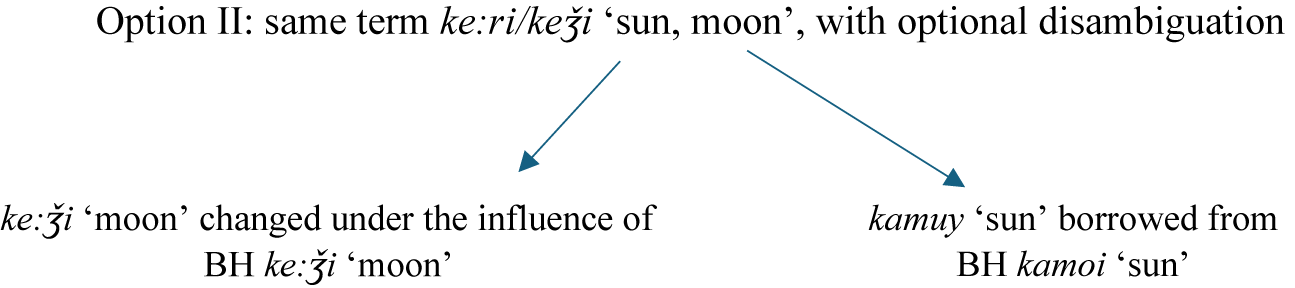
The development of the terms for ‘sun’ and ‘moon’ reflects the history of the K-Tariana and their contacts with the neighbouring groups (see also Diagram 1 in Aikhenvald Reference Aikhenvald2021b: 82). In the early twentieth century, the K-Tariana escaped the Iauaretê area (within the Vaupés River Basin Linguistic Area) fleeing from the missionaries (who had been trying to convert them). This interrupted their interactions with East Tukanoan speakers (whose influence was responsible for the colexification of ‘sun’ and ‘moon’). The K-Tariana moved north, away from the Vaupés River Basin, along the Aiarí River, intermarrying with the Hohôdene Baniwa who resided there. In the 1950s the joint settlement of Santa Terezinha on the Iauarí river was established by the K-Tariana and the Hohôdene Baniwa, further strengthening the Tariana-Baniwa bilingualism. The influence of Baniwa on the reference to the celestial bodies in K-Tariana is reflected in the wordlist recorded in 1956. Colexification is still there in the records, from older and traditional speakers, obtained in 1999 and later. This is now gradually giving way to a Baniwa-like pattern, with two terms for ‘sun’ and ‘moon’ (the latter influenced by Baniwa). The Hohôdene Baniwa form kamui (or kamuy) is currently expanding, resulting in de-colexification of the names of the two celestial bodies. The older pattern of using one term for ‘sun’ and ‘moon’ in K-Tariana – in itself an outcome of East Tukanoan influence – is being replaced by an innovative pattern, replicating the ways of saying ‘sun’ and ‘moon’ in the major language of the village, Hohôdene Baniwa. The reasons for this contact-induced change lie in the relatively recent multilingual patterns.
The form ke:ǯi in K-Tariana was adjusted to H-Baniwa (as speakers of K-Tariana tend to pronounce the intervocalic [r] as [ǯ]), and cannot be considered a borrowing from Baniwa: it is an example of phonological accommodation (see Aikhenvald Reference Aikhenvald2010, on this term). In contrast, the use of kamuy in the meaning of ‘sun’ (the reflex of Proto-Arawak kamu(i) ‘sun, heat, summer’) is a borrowing from Hohôdene Baniwa. There is no evidence that kamu(y) ever referred to the ‘sun’ as a celestial body in K-Tariana, or in any other Tariana dialect.
The root kamu, with a variant kamuy, is used in the modern K-Tariana in the meaning of ‘hot season, summer heat’. In combination with the classifier -yali, kamu-yali (heat/hot.season-cl:cycle) means ‘during the period of hot season’. The cognate root -kamu ‘heat (something) up’ is a transitive verb, a feature shared with all the varieties of Baniwa of Içana (including Hohôdene: Ramirez Reference Ramirez2001a: 159, own data) and Kurripako -kamo ‘heat (something) up’. The cognate noun in Kurripako is kamoi ‘hot season, summer’ (Bezerra Reference Bezerra2015: 31).
The noun kamu, kamuy in W-Tariana also has the meaning of ‘hot season, dry season, summer heat’ (the traditional Tariana calendar is in Brito & Aikhenvald Reference family and Aikhenvald2002: 62–66). The form -kamu ‘the period of, the season of’ is used in W-Tariana in the names of traditional divisions of the year (which may last longer than a moon cycle, or ‘month’, e.g. pipiri-kamu (peach.palm.fruit-season.of) ‘the dry season of peach palm’ (around January). The dry season periods are referred to as kamuy-pe (hot.season-pl) ‘periods of dry season or heat, summers’. In translations and spontaneous conversations, the noun kamu is used in the meaning of ‘year’ (similar to Tukano ki’má dry season, summer, year, time of’ (Ramirez Reference Ramirez1997: 83, Brüzzi Reference Brüzzi1977: 233). In K-Tariana, only the verbal root -kamu occurs just in one stative verb sa-kamu (smoke-heat) ‘be lukewarm’ and its causative derivation sa-kamu-ita (smoke-heat-caus) ‘to warm up’.
The on-going process of de-colexification of ‘sun’ and ‘moon’ in K-Tariana is summarised in Figure 3. BH stands for Baniwa Hohôdene.
De-colexification of ‘Sun’ and ‘Moon’ in K-Tariana.

The K-Tariana speak Hohôdene Baniwa on a day-to-day basis. The stories they tell are shared with the Hohôdene Baniwa, and include accounts of different historical trajectories of ‘sun’ and ‘moon’. One of the major stories is that of the origin of night where the Moon emerged after the Sun had already been there (see, for instance, Brandão de Amorim Reference Antonio1987). The two are not considered siblings, or parts of the same entity. The necessity of distinguishing ‘sun’ and ‘moon’ in shared stories appears to be a further factor in the evolving lexical differentiation between the two celestial bodies in K-Tariana.
3.4 ‘Sun’ and ‘moon’ across the Tariana dialects and interim conclusions
The terms for ‘sun’ and ‘moon’ were colexified in a number of dialects of Tariana, under the impact of language contact with East Tukanoan languages. The pathway, from Option I (typical for all other Arawak languages) to Option II, was summarised in Figure 1.
Colexification of ‘sun’ and ‘moon’ in Tariana under the impact of East Tukanoan languages was first noted by Koch-Grünberg (Reference Koch-Grünberg1911: 54–55):
‘It is well due to the influence of the Betóya languages [Tukanoan languages – AA] that Tariana has lost the old Aruak expression for “sun”: “kamu, kamui” and refers to the moon and sun without distinction with “keri,” the old Aruak word for “moon,” since most Betóya languages have only one word for “sun” and “moon.”’Footnote 19
This observation – based on Koch-Grünberg’s extensive work with numerous North Arawak languages – can now be qualified. There is no evidence that Tariana ever had the reflexes of the Proto-Arawak (Aruak) *kamu(i) in the meaning ‘sun’. The root (-)kamu in W-Tariana, K-Tariana and across other Tariana dialects is attested only in its meaning ‘heat, hot season’.
As a result of close interaction with Baniwa of Içana, the Kumandene Tariana dialect followed the opposite direction – de-colexifying ‘sun’ and ‘moon’. The original term ke:ri for ‘moon’ is retained. It is now pronounced in the same way as Baniwa ke:ǯi, as an instance of phonological accommodation (see Table 3). The term for ‘sun’, kamuy, was borrowed from Baniwa Hohôdene. Reverting to a lexical distinction between ‘sun’ and ‘moon’ makes Tariana retrieve the common Arawak pattern and become more like an ‘exemplary’ Arawak language. Both colexification and its demise in the two extant dialects of Tariana are outcomes of contact-induced change and language adjustment in multilingual settings.
Colexification of ‘sun’ and ‘moon’ was a feature of the majority of the extinct Tariana dialects, formerly spoken by clans high up in the hierarchy. These dialects lost ground to Tukano, the main language of the region, at different times throughout the twentieth century (e.g. kéthi ‘sun, moon’ in Wallace Reference Wallace1853: 520, 522, numbers 56–57 in his list; keéri ‘moon’ and ‘sun’ in Giacone Reference Giacone1962: 90, 105; a summary in Huber & Reed Reference Huber and Reed1992: 64–65; see a brief analysis of older sources on Tariana and references in Aikhenvald Reference Aikhenvald2003: 627–629). The two terms are distinguished in the oldest source on Tariana collected by Johann Natterer (20 July 1831) in São Gerônimo (now Ipanoré), on the Vaupés river (see Adelaar & Brijnen Reference Adelaar and Brijnen2014 on Natterer’s word lists) – see Table 4.
‘Sun’ and ‘Moon’ in Tariana of Ipanoré (Natterer Reference Natterer1831, Folio 28-2)

The W-Tariana form is given in the last column for comparison. Different words for ‘sun’ and ‘moon’ were also recorded for an unnamed dialect documented by Hermann Schmidt on the Vaupés river (1906-1908): kerí ‘moon’ and hedi ‘sun’ (cited in Koch-Grünberg Reference Koch-Grünberg1911: 53, 270, 281). The noun heéri ‘sun’ is a reflex of Proto-Arawak *ketʃi ‘sun, day’. Its cognates, within the Uapuí subgroup of North Arawak, include Piapoco èeri, Kurripako (Ñame and Kuri groups) eedi, and Cabiyari ˀeri (Klumpp Reference Klumpp1995, Bezerra Reference Bezerra2015, and Reinoso Galindo Reference Reinoso Galindo2012, Reinoso Galindo et al. Reference Reinoso Galindo, Curvelo and Gonzalez1994, Aikhenvald Reference Aikhenvald2010, Reference Aikhenvald2014, Reference Aikhenvald2021a on the phonological changes characteristic of the Uapuí subgroup).
The noun keèri is a reflex of Proto-Arawak *kahi(thi) ‘moon’, cognate to W-Tariana ke:ri ‘sun/moon’ and the K-Tariana ke:ǯi ‘sun/moon; moon’. Further cognates among closely related languages are Baniwa Içana (Karo group: Hohôdene and Siuci) ke:ǯi, Guarequena keri, Piapoko quéeri, Cabiyari kê:ɽi (Bezerra Reference Bezerra2015, Ramirez Reference Ramirez2001b, González Ñánez Reference Gonzalez Ñáñez2005, Klumpp Reference Klumpp1995, Reinoso Galindo Reference Reinoso Galindo2012, Koch-Grünberg Reference Koch-Grünberg1911, Aikhenvald Reference Aikhenvald2010, Reference Aikhenvald2014 for the relevant phonological changes). Segmental similarity between the original terms for ‘sun’ and ‘moon’, retained in the Tariana of Ipanoré, may have been an enhancing factor in their colexification across other Tariana dialects.
Natterer (Reference Natterer1831) commented that the speakers of the Ipanoré dialect of Tariana (Table 4) had only recently migrated from the Içana river, where they must have spoken a language close to Baniwa of Içana, with two terms for ‘sun’ and ‘moon’. A relatively recent origin of colexification of ‘sun’ and ‘moon’ across Tariana, and the shallow time-depth of Tariana-East Tukanoan contact, is corroborated by the retention of the meaning of ‘moon’ in a number of archaic expressions with the colexified term ke:ri (see Section 3.2).
4. The mighty moon: the direction of colexification
What could be the reason for colexification of the two celestial bodies in favour of the ‘moon’ (as shown in Figure 1)?
In many societies, the Moon is believed to have special powers. The Kuurn Kopan Noot nation of Australia (speakers of Dhauwurd Wurrung, of the Western District of Victoria) used to believe in the existence of a malevolent spirit located in the Moon (‘devil in the moon’: Dawson Reference Dawson1881: 50). No such stories are recorded for the Sun. The Ndu languages of the Middle Sepik (Papua New Guinea) have different terms for ‘sun’ and ‘moon’ – Manambu ñə, Yalaku nukwa, Iatmul nya ‘sun’, and Manambu ba:p, Yalaku popo and Iatmul bap(a) ‘moon’ (Option I). Sun, moon, and stars are totems of the same clan group (Wulwi-ñawi for the Manambu and Nukwa-popo for the Yalaku, translated into English as ‘Sun-moon’ clan group). This reflects co-conceptualisation of ‘sun’ and ‘moon’ (see also Aikhenvald Reference Aikhenvald2008, Harrison Reference Harrison1990). At the same time, Moon (assigned to the feminine gender) has a special status. She is responsible for female menstruation and is accorded more frequent mentions in stories and in day-to-day discourse among the Manambu and the Yalaku. The noun ‘moon’ (ba:p ‘moon’, bapa-ta:kw ‘lady moon’) is used in terms of address to the members of the Sun-Moon clan group in Manambu. The term for ‘sun’ is not used this way. A new moon used to be the occasion for young Manambu children to leave their ‘wards’ (or dwelling areas), run around the village and shout producing high-pitched ‘ululating’ sounds, as their first experience in socialisation outside their wards (Harrison Reference Harrison1981). A similar practice was documented for Konomala children in the New Ireland Province of Papua New Guinea (Christoph Holz, p.c.). No such traditions have been documented with regard to the sun. Such asymmetries, worldwide, demonstrate the singular position of the moon.
We find comparable instances across the Vaupés River Basin. As Goldman (Reference Goldman2004: 168-9) put it, the ‘Cubeo give the sun relatively minor importance’, in an apparent contrast to the Moon, with its ‘demonic aspect that associates him [the Moon: Authors] with knowledge, sorcery, and illness’ (p. 168). Across the Vaupés River Basin Area, the Moon is responsible for female menstruation and is said to ‘copulate’ with women. In the Wamiarikune Tariana lore, there are numerous tales about the dangerous Moon, and none about the Sun. This special role of the moon underlying the frequency of its mentions is likely to be the reason why the moon is ‘taking over’ as the term for both celestial entities. This confirms a generally accepted correlation between frequency and semantic change (see Phillips Reference Phillips, Janda, Joseph and Vance2021, Aitchison Reference Aitchinson1991: 78–81, Diessel Reference Diessel2007, Winter & Srinivasan Reference Winter and Srinivasan2022, and Percillier & Schauwecker Reference Percillier and Schauwecker2024).
5. To conclude: the two celestial entities across time and space
From a functional perspective, a major driver for colexification is the need for efficient communication, communicative needs of the speakers, and also the environment (see, for instance, Regier et al. Reference Regier, Carstensen and Kemp2016 and Xu et al. Reference Xu, Duong, Malt, Jiang and Srinivasan2020). Intensive language contact fostered by obligatory societal multilingualism goes together with shared communication patterns and shared concepts. The resulting cognitive improvement, or ease of cognitive load, balances the need to manage several languages – which is believed to be a potential source for the increase of cognitive load (see, for instance, Percillier & Schauwecker Reference Percillier and Schauwecker2024). Colexification of culturally salient and conceptually entities linked goes together with shared stories and imagery (along the lines of Ding and Dong Reference Ding and Dong2024). In a situation of intensive language contact, colexification of reference to two closely linked celestial entities – ‘sun’ and ‘moon’ – enhances intertranslatability and ease of communication between several neighbouring languages.
Economy, simplicity, and efficiency are behind the cognitive drivers and the motivations for sharing one term for the two entities, which can be differentiated if required for clarity of communication. The emergence of one colexified term for ‘sun’ and ‘moon’ in one extant dialect of Tariana, the only North Arawak language in the multilingual Vaupés River Basin Linguistic Area, is a case in point. Under the influence of neighbouring majority East Tukanoan languages, the terms for ‘sun’ and ‘moon’ underwent recent colexification in the Wamiarikune Tariana dialect (see Section 3). Language contact and the necessity of expressing similar concepts in matching ways account for the change from the original Option I where the terms for ‘sun’ and ‘moon’ are distinct and there is no colexification to Option II where there is one colexified term which can be optionally disambiguated (see Section 2 for an overview of expressions for ‘sun’ and ‘moon’ across the world’s languages). This historical trajectory is summarised in Figure 1
The recent nature of contact-induced colexification in Wamiarikune Tariana is evidenced in the ways the colexified term ke:ri ‘sun, moon’ – which goes back to the Proto-Arawak ‘moon’ – preserves the original meaning ‘moon’ as a bound form and in various archaic expressions (especially those involving shamanic blessings and magic: see Sections 3.1–2). The presence of two separate terms for ‘sun’ and ‘moon’ in an archaic dialect of Tariana of Ipanoré (documented in the early nineteenth century and no longer spoken) points in the same direction: speakers of the Ipanoré dialect had moved to the area relatively recently and their contact with East Tukanoans and had not had enough time for colexification of ‘sun’ and ‘moon’ (Section 3.4).
The reason why ‘moon’ and not ‘sun’ is the target of colexification in Wamiarikune Tariana lies in the frequency of mentions of the moon, involving its special powers and links with the world of magic (see Section 4). This supports an established thesis of frequency as a driving force in language change (see also Du Bois Reference Du Bois, MacWhinney, Malchukov and Moravcsik2014, and Winter & Srinivasan Reference Winter and Srinivasan2022).
The opposite process – loss of colexification, or de-colexification – can also be triggered by intensive contact between languages, and the communicative necessity to express matching concepts, as summarised in Figure 2 (from Option II to Option I). This is the case for the other extant dialect of Tariana, Kumandene Tariana. As a consequence of intensive language and culture contact with Baniwa of Içana, a closely related North Arawak language which does not colexify ‘sun’ and ‘moon’, Kumandene Tariana is gradually undergoing the process of de-colexification of its erstwhile term for ‘sun/moon’, ke:ri, with the term for ‘sun’ borrowed from the Hohôdene dialect of Baniwa of Içana. This development is partly reminiscent of Muskogee (where a similar process has occurred under the influence of English, the national language: Martin & McKane Mauldin Reference Martin and Mauldin2004: 273, 326; see Section 3.3). The cognitive motivation for having one term for ‘sun’ and one for ‘moon’ lies in clarity, transparency, and informativeness of expression (see Brochhagen & Boleda Reference Brochhagen and Boleda2022).
Colexification and lack thereof reflect competing motivations – economy versus clarity, informativity versus simplicity and ease (along the lines of Haiman Reference Haiman and Song2011 and Du Bois Reference Du Bois, MacWhinney, Malchukov and Moravcsik2014: 272). That the lexical reference to both celestial bodies can always be disambiguated if need be helps maintain clarity in word referencing (especially in translations into national languages and dictionary making).
On the one hand, the necessity for a clarity of expression drives lexical differentiation. On the other hand, the necessity for reducing cognitive load supports colexification (along the lines of Haiman Reference Haiman and Song2011). As in other parts of language, we are faced with competing motivations and opposite tendencies. In each instance, the need for efficient and easy communication between multilingual groups in contact – who share stories, myths, and ways of saying things – shifts the pendulum in choosing the ‘winning’ motive.
Both colexification of sun/moon and their de-colexification go together with replicating the stories from majority languages – East Tukanoan for Wamiarikune Tariana and Hohôdene Baniwa for Kumandene Tariana. The changes in the lexicon accompany those in myths and stories as a reflection of communicative necessity, determined by culture contact between the groups – the need to match one’s neighbour. These correlations qualify the statement by Levy-Strauss (Reference Lévy-Strauss1967: 1168) concerning the absence of direct correspondence between linguistic categories and mythological imagery.
The organisation of the lexicon of a language reflects the histories of the speakers, and correlates with the dynamics of what they have to express and how. As Sapir (Reference Sapir1912: 230) put it,
‘an instructive example of how largely interest determines the character of a vocabulary is afforded by the terms in several languages for ‘sun’ and ‘moon’. While we find it necessary to distinguish ‘sun’ and ‘moon’, not a few tribes content themselves with a single word for both, the exact reference being left to the context… The presence or absence of general terms is to a large extent dependent on the negative or positive character of the interest in the elements of environment involved’.
This ‘interest’ and the meanings of terms may shift over the course of language history, even within a few generations, as a result of language and culture contact and the necessities of communicative efficiency between multilingual groups. The dynamics of a relatively recent colexification, its incomplete nature, and its on-going demise across the dialects of Tariana, an aberrant Arawak language, underscore the role of cultural context in the fate of lexicon within evolving multilingual settings, with regard to colexification of salient terms.
Abbreviations
- 1, 2, 3
-
first, second, third person
- after ds
-
after different subject
- caus
-
causative
- cl
-
classifier
- dem.anim
-
animate demonstrative
- indef
-
indefinite person prefix
- ncl
-
noun class
- obj
-
object case
- pl, pl
-
plural
- pres.non.vis
-
present non-visual
- rec.p.vis
-
recent past visual
- sg
-
singular
- sgnf
-
singular non-feminine
- sub
-
subordinator
- top.adv.der
-
topic advancing derivation
- top.non.a/s
-
topical non-subject
Acknowledgements
We are grateful to George Aaron Broadwell, Joseph Brooks, Thago Chacón, Luca Ciucci, Amy Dahlstrom, Lise Dobrin, Matthew Dryer, Zygmunt Frajzyngier, Christoph Holz, Marie-Odile Junker, Leonid Kulikov, Alexandr Lubotsky, Jack Martin, Jadran Mimica, Marianne Mithun, Pam Munro, Kasia Wojtylak, and Brendan Yoder for answering our questions and providing insightful comments and observations, and to the three anonymous referees for their queries and the references provided. Many thanks to Brigitta Flick and Bruce Allen for careful proofreading and insightful comments. Our gratitude goes to the speakers of Tariana (especially the Brito family and Roni Lopez and other members of the Santa Terezinha community) and to Afonso Fontes, Ilda Cardoso da Silva, and the late Marcília Fontes (Hohôdene Baniwa) for sharing the treasures of their languages with the first co-author.



 Open access

