





Diet is a crucial modifiable risk factor for morbidity and mortality( 1 – Reference Mente, de Koning and Shannon 3 ). A healthy diet is especially important in an elderly population who are at an increased risk of chronic disease, especially CVD, and it is therefore important to understand the determinants of dietary intake in the elderly( 1 , 4 ). Historically, dietary research has focused on single food items and nutrients; however, in recent times, this focus has shifted to total diet quality and dietary patterns, to reflect the fact that foods are not eaten in isolation and there may be interactions between foods or nutrients consumed( Reference Hu 5 , Reference Schulze and Hoffmann 6 ). Many predefined dietary scores have been developed based on adherence to dietary recommendations or specific dietary patterns( Reference Kant 7 , Reference Waijers, Feskens and Ocke 8 ), with the Mediterranean Diet Score being one of the most commonly used markers of overall diet quality( Reference Sofi, Abbate and Gensini 9 , Reference Trichopoulou, Kouris-Blazos and Wahlqvist 10 ).
Strong socio-economic gradients in diet quality are well established, and studies have shown consistently that higher socio-economic groups are more likely to consume a Mediterranean-style diet, characterised by a high consumption of fresh fruit and vegetables, whole grains, lean meats, fish and low-fat dairy products( Reference Bonaccio, Bonanni and Di Castelnuovo 11 – Reference Martikainen, Brunner and Marmot 14 ). A meta-analysis of 18- to 85-year-olds from seven European countries has also shown strong associations between higher socio-economic position (SEP), defined using occupation or education, and a greater daily fruit and vegetable consumption( Reference Irala-Estevez, Groth and Johansson 15 ). It has been suggested that not only adult socio-economic factors, but also childhood socio-economic factors, may have an impact on adult dietary patterns( Reference Hare-Bruun, Togo and Andersen 16 , Reference Mishra, Prynne and Paul 17 ). Apart from socio-economic factors, social relationships such as frequency of contact, living arrangements and marital status, which are known to be associated with increased mortality and CVD risk( Reference Eng, Rimm and Fitzmaurice 18 ), are also increasingly being recognised as important dietary determinants particularly in the older population( Reference Conklin, Forouhi and Surtees 19 , Reference Sahyoun and Zhang 20 ). Although socio-economic gradients in diet quality have been shown to persist in the older population( Reference Brennan and Singh 21 – Reference Wolfe, Frongillo and Valois 25 ), the influence of different types of material socio-economic conditions particularly in childhood, and the use of multiple disaggregated socio-economic measures on diet quality have been little studied in the elderly.
The present study aimed to examine the associations between a range of childhood and adult socio-economic measures (including occupation/father's occupation, education and household amenities) and social relationships (social contact, living arrangements and marital status) with diet quality in older British men. Daily fruit and vegetable consumption and the Elderly Dietary Index (EDI) were used as markers of a Mediterranean-style diet and hence of overall diet quality( Reference Kourlaba, Polychronopoulos and Zampelas 26 ).
Methods
Study population
The British Regional Heart Study (BRHS) is a prospective study of CVD, in a socio-economically and geographically representative sample of 7735 men, drawn from general practices in twenty-four towns across Great Britain( Reference Shaper, Pocock and Walker 27 ). The cohort was initially examined in 1978–80 and is predominantly of white European ethnic origin (>99 %). In 1998–2000, 4252 men aged 60–79 years (77 % of survivors) attended a 20th-year re-examination. All men attended a physical examination, provided a fasting blood sample, and completed a lifestyle questionnaire and a FFQ( Reference Walker, Whincup and Shaper 28 ). The present study is a cross-sectional analysis using data from the 20th-year re-examination and additional data on childhood and adult social circumstances from questionnaires. All participants provided written informed consent, in accordance with the Declaration of Helsinki. Ethical approval was obtained from relevant local research ethics committees.
Dietary assessment
In 1998–2000, participants completed a self-administered postal FFQ that was used to assess usual weekly consumption of eighty-six food and drink items. The FFQ was developed for use in the WHO's Monitoring Trends and Determinants in Cardiovascular Disease Survey( 29 ), and has been validated in the British population against weighed food intake( Reference Bolton-Smith and Milne 30 , Reference Yarnell, Fehily and Milbank 31 ). Participant's total energy intakes were all within a range compatible with a normal lifestyle (2092–33 472 kJ/d (500–8000 kcal/d) in men( Reference Goldberg, Black and Jebb 32 )), so no exclusions were made on this basis.
We examined diet quality using a predefined dietary score, the EDI, as a marker of a Mediterranean-style diet. The EDI score was used instead of the Mediterranean Diet Score as it was developed specifically to address adherence to nutritional recommendations for older adults( Reference Kourlaba, Polychronopoulos and Zampelas 26 , Reference Lichtenstein, Rasmussen and Yu 33 ), and it has also previously shown the strongest association with CVD mortality and all-cause mortality, compared with other dietary scores, in this population( Reference Atkins, Whincup and Morris 34 ). The EDI differs from the Mediterranean Diet Score as it uses a four-point scoring system for each food component as opposed to a dichotomous scoring system, and the EDI score used here does not include alcohol intake. The EDI consisted of nine food components (meat, fish and seafood, vegetables, cereals, fruit, legumes, olive oil, dairy products, and bread), each scoring 1–4 based on the frequency of consumption, with a total score ranging from 9 to 36. Additional details pertaining to the scoring of the EDI are included in online supplementary Table S1. Higher scores of the EDI indicated greater adherence to dietary recommendations and a healthier diet quality. Participants were categorised into four ordered groups of the EDI score, which were as close to quartiles as possible.
In addition to the EDI, daily fruit and vegetable consumption was used as an additional marker of diet quality. Fruit and vegetable consumption, which has consistently been shown to be strongly associated with reduced CVD mortality( Reference He, Nowson and Lucas 35 ), is simpler to measure than the EDI and hence less prone to measurement error. Participants were asked how frequently they consumed fresh fruit and vegetables (1, 2, 3, 4, 5, 6 or 7 d/week, monthly, or rarely/never). Daily consumption was classified as both fruit and vegetable consumption on 7 d/week.
Measures of socio-economic position
Adult occupational social class was based on the longest-held occupation recorded at study entry (aged 40–59 years) using the Registrar General's occupational classification: I (professionals), II (managerial), III non-manual (semi-skilled non-manual), III manual (semi-skilled manual), IV (partly skilled) and V (unskilled). Participants were classified as manual or non-manual, excluding men who were in the Armed Forces (n 112). Additional socio-economic measures available from questionnaires were education (age at leaving full-time education), pension (state only or state plus private pension), car and house ownership, and whether participants had central heating at home. A composite score combining adverse socio-economic measures was created to investigate the cumulative impact of low SEP, and to take into account a range of socio-economic measures that may have a greater impact than occupation alone. One point was assigned for adult manual social class, education ≤ 14 years, no car, not a house owner, state pension only and no central heating, to generate a total score ranging from 0 to 6( Reference Ramsay, Whincup and Papacosta 36 ).
Childhood socio-economic measures were collected through a postal questionnaire in 1992. Childhood occupational social class was based on father's longest-held occupation. Participants were classified as manual or non-manual using the Office of Population Censuses and Surveys Classification of Occupations (1980) social class coding manual( Reference Wannamethee, Whincup and Shaper 37 ). Men whose father's longest-held occupation was the Armed Forces were excluded (n 81). Information was also collected on childhood household amenities. Participants were asked whether, up to 10 years old, their home had a bathroom, hot water supply or family car ownership. An adverse childhood socio-economic score was created, as a marker of overall early-life SEP, including childhood manual social class, no bathroom, no hot water supply and no family car ownership, to generate a total score ranging from 0 to 4( Reference Ramsay, Whincup and Papacosta 36 ).
To assess the combined effect of childhood and adult social class on diet quality, participants were categorised into four combined childhood and adult social class groups: childhood and adult non-manual social class; childhood non-manual and adult manual social class; childhood manual and adult non-manual social class; childhood and adult manual social class. In addition, a combined adverse childhood and adulthood socio-economic measure score was created by summing the adverse adult and childhood scores, to generate a total score ranging from 0 to 10.
Measures of social relationships
In the 1998–2000 questionnaire, men were asked how often they saw or spoke to their children, siblings, friends and neighbours (every week, every month, every few months, every year, rarely/never and does not apply), whether they were living alone (living alone, living with a partner/spouse, living with other family members and living with other people), and about their marital status (single, married, widowed, divorced/separated and other). Participants whose marital status was classified as ‘other’ were excluded from the analysis (n 8).
Covariates
Information on cigarette smoking, alcohol intake and physical activity were collected via a questionnaire in 1998–2000. Men were classified into four smoking groups (never smoked, long-term ex-smokers (>15 years), recent ex-smokers ( ≤ 15 years) and current smokers)( Reference Wannamethee, Lowe and Shaper 38 ). Alcohol intake was classified into five groups based on the number and frequency of alcoholic beverages consumed (none, occasional, light, moderate and heavy)( Reference Wannamethee, Lowe and Shaper 39 ). Current physical activity was classified into six groups based on exercise frequency and intensity (inactive, occasional, light, moderate, moderately vigorous and vigorous)( Reference Wannamethee, Lowe and Whincup 40 ). Height and weight were measured at the 20th-year re-examination. BMI was calculated, and participants were classified into four WHO-defined groups (underweight < 18·5 kg/m2, normal weight 18·5–24·99 kg/m2, overweight 25–29·99 kg/m2 and obese ≥ 30 kg/m2)(41).
Statistical analysis
Of the 4252 men attending the 20th-year re-examination, data on fruit and vegetable intake were available for 4067 participants; of these, 3924 men had adequate data to generate the EDI score. Descriptive characteristics of the participants were presented by EDI quartiles and by daily fruit and vegetable intake. P values for trend across EDI quartiles were obtained using regression analyses, and P values for difference between groups for daily fruit and vegetable intake were obtained using χ2 tests. The relationship between childhood and adult socio-economic measures was assessed using correlation coefficients. Multivariable logistic regression assessed the associations between childhood and adult socio-economic measures, and social relationships, with daily fruit and vegetable intake and being in the top quartile of the EDI. OR for the EDI were presented for being in the highest quartile compared with the lower three quartiles. Logistic regression models were adjusted for age, energy intake (kJ/d), smoking status, alcohol intake, physical activity and BMI. In addition, childhood socio-economic measures and social relationships were adjusted for adult occupational social class, and adult socio-economic measures were adjusted for childhood occupational social class. For the adjustments, age and energy intake were fitted as continuous variables, and smoking status, alcohol intake, physical activity, BMI, adult and childhood social class were fitted as categorical variables. A test for interaction between childhood and adult social class was also carried out. All analyses were performed in Stata 12.1 (Stata Corporation).
Results
Only 17·9 % of participants consumed fresh fruit and vegetables daily. The EDI score was normally distributed with a mean of 24·2, an sd of 3·3, ranging from 12 to 35. Table 1 presents the cohort characteristics by EDI quartiles and by daily fruit and vegetable intake. In the highest EDI quartile, there was a significantly lower proportion of men who were current smokers, heavy drinkers, physically inactive, of manual adult social class and of manual childhood social class, and had a slightly lower mean age and total energy intake. In those who consumed fruit and vegetables daily, there was a significantly lower energy intake and a significantly lower proportion of current smokers, physically inactive, manual adult social class and manual childhood social class. The correlations between socio-economic measures in childhood and adulthood are summarised in Table 2. Overall, correlations were modest but significant, with the strongest correlations found between childhood measures and adult occupational social class and education.
Characteristics of the British Regional Heart Study participants aged 60–79 years by diet quality (Elderly Dietary Index (EDI) quartiles and daily fruit and vegetable intake) (Mean values and standard deviations; number of participants and percentages)

* Data for the EDI available for 3924 participants. P for trend across the EDI quartiles.
† Data for fruit and vegetable intake available for 4067 participants. P for difference between groups.
Correlations between childhood and adult socio-economic measures
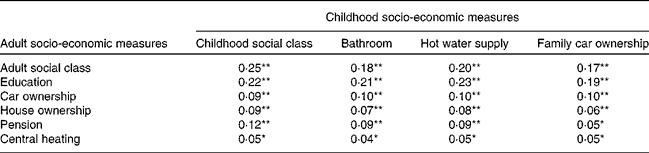
* P< 0·05.
** P< 0·001.
Table 3 presents the OR of being in the top quartile of the EDI and of consuming fruit and vegetables daily according to childhood socio-economic measures. Childhood social class was the strongest childhood socio-economic measure associated with diet quality, with men of manual childhood social class being significantly less likely to be in the top EDI quartile (OR 0·73, 95 % CI 0·61, 0·88) and to consume fresh fruit and vegetables daily (OR 0·80, 95 % CI 0·66, 0·97), independent of behavioural factors and adult social class. In sensitivity analysis, further adjusting for all the other adult socio-economic measures, the associations were attenuated slightly between childhood social class and the EDI (OR 0·81, 95 % CI 0·67, 0·98) and daily fruit and vegetable consumption (OR 0·82, 95 % CI 0·66, 1·02). Men with no family car ownership in childhood were less likely to be in the highest EDI quartile, with borderline significance after adjustment for behavioural factors and adult social class, but family car ownership was not significantly associated with fruit and vegetable intake. Whether the childhood home had a bathroom or a hot water supply showed no significant associations with either the EDI or daily fruit and vegetable consumption. There was a significant trend between the adverse childhood socio-economic score and the EDI, but no significant trend with daily consumption of fruit and vegetables after adjustment for behavioural factors and adult social class.
Top quartile of the Elderly Dietary Index (EDI) and daily fruit and vegetable intake according to childhood socio-economic (SE) measures (Odds ratios and 95 % confidence intervals)

* Data for the EDI available for 3924 participants. OR for quartile 4 v. quartiles 1–3.
† Data for fruit and vegetable intake available for 4067 participants.
‡ Adjusted for age, energy intake, smoking status, physical activity, alcohol intake, BMI and adult social class.
§ Score includes childhood manual social class, no bathroom, no hot water supply and no family car ownership.
The OR of being in the top quartile of the EDI and consuming fruit and vegetable daily according to adult socio-economic measures are given in Table 4. Adult social class was strongly associated with diet quality, with men of manual social class being significantly less likely to be in the top EDI quartile (OR 0·66, 95 % CI 0·55, 0·79) and to consume fresh fruit and vegetables daily (OR 0·65, 95 % CI 0·54, 0·79), independent of behavioural factors and childhood social class. Additional sensitivity analysis, further adjusting for all the other adult socio-economic measures, showed that the associations were attenuated between adult social class and the EDI (OR 0·86, 95 % CI 0·70, 1·06) and daily fruit and vegetable consumption (OR 0·74, 95 % CI 0·59, 0·93). Examining occupational social class as a continuous variable showed that for every unit decrease in social class, the odds of being in the top quartile of the EDI (OR 0·82, 95 % CI 0·77, 0·88) and of consuming fruit and vegetables daily (OR 0·81, 95 % CI 0·75, 0·88) decreased. Men with a state pension only or ≤ 14 years of education were significantly less likely to be in the highest EDI quartile and to consume fruit and vegetables daily. Examining education as a continuous variable showed that for every additional year of education, the odds of being in the top quartile of the EDI (OR 1·03, 95 % CI 1·01, 1·05) and of consuming fruit and vegetables daily (OR 1·02, 95 % CI 1·01, 1·04) increased. In addition, men who were not car owners, not house owners or did not have central heating were significantly less likely to be in the highest EDI quartile, but these variables were not associated with daily fruit and vegetable consumption. There was a significant inverse trend between the adverse socio-economic score and both the EDI and daily consumption of fruit and vegetables.
Top quartile of the Elderly Dietary Index (EDI) and daily fruit and vegetable intake according to adult socio-economic (SE) measures (Odds ratios and 95 % confidence intervals)

* Data for the EDI available for 3924 participants. OR for quartile 4 v. quartiles 1–3.
† Data for fruit and vegetable intake available for 4067 participants.
‡ Adjusted for age, energy intake, smoking status, physical activity, alcohol intake, BMI and childhood social class.
§ Score includes manual social class, education ≤ 14 years, no car, not a house owner, state pension only and no central heating.
Examining the combined effects of occupational social class in early and later life showed that diet quality was best in men with both childhood and adult non-manual social class and the poorest in those with both childhood and adult manual social class (Table 5). Exposure to manual social class, whether in childhood or adulthood, was also associated with a poorer diet quality. A test for interaction between childhood and adult social class showed evidence that the effect of childhood social class (manual/non-manual) differed between those of adult manual and non-manual groups (P= 0·02 for EDI quartiles). However, no interaction was observed for daily fruit and vegetable intake (P= 0·44). There was also a significant inverse trend between the combined adverse childhood and adulthood socio-economic score with both the EDI and daily consumption of fruit and vegetables. Additional sensitivity analyses, examining fruit and vegetable intake separately, showed significant inverse trends with the combined adverse childhood and adulthood socio-economic score, but this association was stronger for vegetables than for fruit consumption.
Top quartile of the Elderly Dietary Index (EDI) and daily fruit and vegetable intake according to combined childhood and adult socio-economic (SE) measures (Odds ratios and 95 % confidence intervals)

* Data for the EDI available for 3924 participants. OR for quartile 4 v. quartiles 1–3.
† Data for fruit and vegetable intake available for 4067 participants.
‡ Adjusted for age, energy intake, smoking status, physical activity, alcohol intake and BMI.
§ Score includes childhood SE measures (childhood manual social class, no bathroom, no hot water supply and no family car ownership) and adult SE measures (manual social class, education ≤ 14 years, no car, not a house owner, state pension only and no central heating).
Table 6 presents the OR of being in the top quartile of the EDI and of consuming fruit and vegetables daily according to the measures of social relationships. Compared with married men, men who were widowed or divorced/separated were significantly less likely to eat fruit and vegetables daily. Men living alone were significantly less likely to be in the highest EDI quartile (OR 0·71, 95 % CI 0·53, 0·95) and to eat fruit and vegetables daily (OR 0·61, 95 % CI 0·44, 0·85) compared with those living with others. However, social contact with children, siblings, friends or neighbours showed no associations with the EDI or daily fruit and vegetable consumption.
Top quartile of the Elderly Dietary Index (EDI) and daily fruit and vegetable intake according to social relationships (Odds ratios and 95 % confidence intervals)

* Data for the EDI available for 3924 participants. OR for quartile 4 v. quartiles 1–3.
† Data for fruit and vegetable intake available for 4067 participants.
‡ Adjusted for age, energy intake, smoking status, physical activity, alcohol intake, BMI and adult social class.
Discussion
The present study examined the associations between a range of childhood and adult socio-economic factors and measures of social relationships with diet quality, assessed by daily fruit and vegetable consumption and the EDI, in older British men aged 60–79 years. The present results show that both childhood and adult socio-economic factors were independently associated with diet quality, with adult factors appearing to be more influential than childhood factors. Diet quality was also influenced by marital status and living arrangements, but showed no association with social contact. The present study adds to the limited literature on the influence of different types of material socio-economic conditions particularly in childhood, and the use of multiple disaggregated socio-economic measures on diet quality in the elderly. The results show that, at least for men, father's social class persists as a strong influence on diet quality in older ages.
We found strong associations between several adult socio-economic measures and diet quality in older men, which were independent of behavioural factors and childhood social class. The magnitude of associations with the EDI was strongest jointly for home ownership and pension (two strong markers of material wealth), followed by education, then car ownership, then social class and then central heating. By contrast, associations with daily fruit and vegetable intake specifically were strongest for social class, then pension and then education. These socio-economic gradients in diet quality are consistent with previous literature showing a healthier diet (characterised by a high intake of fruit, vegetables and other Mediterranean-style food groups) in higher socio-economic groups, measured by occupation, education, income, house ownership or car access in both middle-aged( Reference Bonaccio, Bonanni and Di Castelnuovo 11 , Reference Darmon and Drewnowski 12 , Reference Martikainen, Brunner and Marmot 14 , Reference Irala-Estevez, Groth and Johansson 15 , Reference Ferranti, Dunbar and Higgins 42 ) and older adult populations( Reference Bamia, Orfanos and Ferrari 43 – Reference Shatenstein, Gauvin and Keller 47 ). The EDI score specifically previously showed that those in the highest EDI tertile had better financial status and a higher educational level( Reference Kourlaba, Polychronopoulos and Zampelas 26 ). The present study extends previous findings by including socio-economic measures particularly relevant to older adults (pension status and central heating) and uses a combination of different adverse adult socio-economic factors, which showed a strong inverse trend with both the EDI score and daily fruit and vegetable intake.
We also found that childhood occupational social class was strongly associated with diet quality, with men of manual father's social class less likely to be in the top EDI quartile and to consume fruit and vegetables daily, independent of behavioural factors and adult social class. With regard to childhood household amenities, there was a borderline significant association between family car ownership and the EDI, which may be due to car ownership being a strong marker of SEP or material wealth, particularly for the generation of this cohort. However, hot water supply and the presence of a bathroom in the house were not associated with diet quality. These findings are consistent with previous studies showing that father's social class influences dietary intake in middle-aged populations( Reference Hare-Bruun, Togo and Andersen 16 , Reference Mishra, Prynne and Paul 17 , Reference Osler, Godtfredsen and Prescott 48 ). However, one previous study in early old age (61–80 years) showed that childhood social circumstances (social class and per capita household food expenditure) were not strongly related to adult diet quality, as measured by the Healthy Diet Score( Reference Maynard, Gunnell and Ness 45 ). To our knowledge, our findings are the first to confirm that the influences of childhood social class on diet quality in middle-aged populations persist in older ages.
In addition, combining childhood and adult socio-economic factors showed that there were cumulative effects of adverse childhood and adult socio-economic factors on diet quality in older age. This supports previous research in a British adult population suggesting that although adult dietary patterns are determined by childhood influences, diet can be modified as a result of social transition in adulthood( Reference Mishra, Prynne and Paul 17 ). Previous studies have found that adult socio-economic measures are more influential than childhood socio-economic measures (based on father's occupation or mother's education) on adult diet quality( Reference Hare-Bruun, Togo and Andersen 16 , Reference Maynard, Gunnell and Ness 45 , Reference Giskes, Lenthe Fv and Brug 49 ). The present study supports this notion, but in an older adult population, as the magnitude of the effect on diet quality observed for adult occupational social class was greater than that for childhood occupational social class.
Examining the combined effects of occupational social class in early and later life showed that diet quality was best in men with both childhood and adult non-manual social class and the poorest in those with both childhood and adult manual social class (Table 5). Exposure to manual social class, whether in childhood or adulthood, was also associated with a poorer diet quality.
The present results showed that better diet quality in older men is associated with not living alone and being married. This is consistent with previous studies showing that these measures of social relationships are important determinants of diet in the elderly( Reference Conklin, Forouhi and Surtees 19 , Reference Sahyoun and Zhang 20 , Reference Robinson, Syddall and Jameson 46 , Reference Charlton 50 , Reference Donkin, Johnson and Morgan 51 ), and research has suggested that barriers to healthy eating in older men living alone include poor cooking skills and low motivation to change eating habits( Reference Hughes, Bennett and Hetherington 52 ). The literature has also shown that diet quality in older adults is affected by frequency of social contact( Reference Conklin, Forouhi and Surtees 19 , Reference Sahyoun and Zhang 20 ). However, we found no such association in the present study. This may be because most men in this cohort were not socially isolated; the majority of participants had contact with their children, siblings, friends or neighbours at least once per week. More refined categories of social contact may have been needed to identify associations with diet quality.
The major strength of the present study is that it is a large population-based cohort, assessing a range of socio-economic measures, and the analysis has included adjustment for several potentially important confounding factors. However, misclassification of childhood socio-economic status is possible with participants, from lower SEP in particular, overestimating the social class of their father( Reference Batty, Lawlor and Macintyre 53 ). This recall bias could have resulted in a weakened association between childhood socio-economic status and diet quality. Dietary intakes were assessed using an eighty-six-item FFQ that has been validated previously against weighed food intakes in the British population( Reference Bolton-Smith and Milne 30 , Reference Yarnell, Fehily and Milbank 31 ). The FFQ method is more prone to measurement error than other measures such as weighted food records or 24 h dietary recalls. The collection of dietary data may also have been subject to social desirability bias, and it is possible that low socio-economic groups could have been more affected by this, leading to an underestimation of associations. In elderly populations, in particular, non-response to questions could have increased the chance of under-reporting( Reference Willett 54 , Reference Maynard and Blane 55 ); however, this misclassification is likely to have been non-differential and hence may have biased the results towards the null. Observed associations between socio-economic indicators and diet quality were generally stronger based on the EDI score compared with daily fruit and vegetable intake. This may indicate that a high EDI score is a better marker of an overall healthy diet than using the simpler measure of daily fruit and vegetable consumption in this older population. We examined older men, of predominantly white European ethnic origin. The results are, therefore, limited to this population and should not be applied to women, due to sex differences in dietary intake( Reference Conklin, Maguire and Monsivais 56 , Reference O'Doherty Jensen and Holm 57 ). Further research is needed to replicate findings in other populations. Some residual confounding is possible due to the self-reported nature of variables such as smoking status, alcohol intake and physical activity. Lastly, it is possible that diet quality could also be influenced by additional confounders such as health status, dentition and whether men lived in rural or urban environments. However, adjustment for poor self-reported health made very minor differences to the results. It is possible that both residual and unmeasured confounding may have underestimated or exaggerated the measures of the association observed.
Diet quality in older men is independently influenced by socio-economic factors both in childhood and adulthood, with adult SEP being more influential than early-life SEP in determining dietary patterns. In addition, diet quality is influenced by marital status and adult living arrangements. Public health interventions aimed at improving diet quality of older people need to consider both early- and later-life social circumstances.
Supplementary material
To view supplementary material for this article, please visit http://dx.doi.org/10.1017/S0007114515000604
Acknowledgements
The BRHS is a British Heart Foundation Research Group and also received funding from the Department of Health, England. J. L. A. was funded by a PhD studentship from the National Institute for Health Research School for Primary Care Research. S. E. R. was funded by a UK Medical Research Council Fellowship.
The authors' contributions are as follows: J. L. A., S. E. R. and S. G. W. conceived the study concept and design; J. L. A. performed the statistical analysis and drafted the manuscript; P. H. W. and L. T. L. planned the data collection; S. E. R., P. H. W., R. W. M. and S. G. W. contributed to the interpretation of the data and writing of the manuscript; S. E. R., P. H. W., R. W. M., L. T. L. and S. G. W. critically reviewed and approved the final draft of the manuscript.
The authors declare that there is no conflict of interest.


 Open access

