




1 Introduction
1.1 Aims and methodology
Although for the Old English period the focus has normally been on West Saxon, Anglian dialects (Mercian and Northumbrian) play a very important role in the history of English, as recognized by, among others, Hogg (Reference Hogg1997: 98). Their importance can be seen in the fact that they already show some linguistic changes that have generally been ascribed to Middle English, such as accusative/dative syncretism, the extension of -s to the present indicative, or the weakening of unstressed vowels. The present article studies the extension of genitive singular -es and nominative/accusative plural -as from the a-stems to other noun classes in two of the most important extant witnesses of late Northumbrian (tenth century): the gloss to the Lindisfarne Gospels (London, British Library, Nero D.iv) and the gloss to the Durham Collectar (Durham, Cathedral Library, A.iv.19), composed about two decades later by Aldred the Provost, whom scholarly consensus identifies with the glossator of Lindisfarne (cf. Jolly Reference Jolly and Cuesta2016 and Roberts Reference Roberts, Cuesta and Pons-Sanz2016, among others).
Ross (Reference Ross1937: 99) remarked that -es was extended to practically all classes in Lindisfarne (lufes, saules, sibbes, brydes, oxes, widues), and that this must be considered as the normal form of the genitive singular in this gloss, although older forms are often preserved as well. Analogical extension of -es is also widespread in Durham, as shown by Rodríguez Ledesma (Reference Rodríguez Ledesma2018). With regard to the plural, Ross (Reference Ross1937: 100) observed that -as was extended to other classes in Lindisfarne (suordas, ebolsungas, witgas), although this inflection is not found in the u-stems and in the neuter n-stems. There is, however, a clear distinction between these two analogical processes: ‘whereas the gen. sg. in -es is normal in practically all classes, the nom. acc. pl. in -as only occurs sporadically outside its own class’ (Reference Ross1937: 100).Footnote 2 It is the endings -o, -a that are normally found for the nominative/accusative plural in almost every class, their origin being partly the weak declension and partly the neuter a-stems (Reference Ross1937: 101).
The aim of this article is to establish the actual scale on which these two analogical changes are found in Lindisfarne and Durham. To this end a quantitative analysis has been carried out of all nouns attested in the glosses whose etymological inflection for both the genitive singular and nominative/accusative plural is other than an s-form (117). They consist of feminine nouns (nouns ending in -UNG, nouns ending in -ness, remaining ō-stems, i-stems, root-stems), kinship r-stems and n-stems. For the study of nominative/accusative plural, all neuter a-stems attested in the glosses in these cases have additionally been considered (94).
Although some general observations about these analogical processes are found in previous literature, no systematic investigation has been carried out. The present study intends to shed more light on the morphological restructuring process affecting the declensional system of late Northumbrian, and has three main aims: (a) to determine the pattern of dissemination of the innovative inflectional endings; (b) to establish which variables are significant in these analogical processes: declension, type and token frequency, grammatical context, Latin lemma, demarcation; and (c) to account for the different developmental tendencies of these two linguistic changes (the extension of genitive singular -es and nominative/accusative plural -as from the a-stems to other noun classes). The results of this study also contribute to topics of scholarly interest, such as the question of authorship (is Aldred the glossator of all four gospels?), or the supposed conservatism of Durham compared with Lindisfarne.
The data have been retrieved using the Dictionary of Old English Corpus (DOEC), which is based on Skeat's edition of Lindisfarne (Reference Skeat1871–7) and on Lindelöf's edition of Durham (Reference Lindelöf1927).Footnote 3 Given the inaccuracies detected in the DOEC with regard to Lindisfarne, all tokens have been checked against the facsimile edition (Kendrick et al. Reference Kendrick, Brown, Bruce-Mitford, Roosen-Runge, Ross, Stanley and Werner1956) and the digitalized manuscript in order to detect possible errors.
For this study, the declension and gender of nouns has been assessed on the basis of Old English grammars (Wright & Wright Reference Wright and Wright1914; Campbell Reference Campbell1959; Hogg & Fulk Reference Hogg and Fulk2011), glossaries (Cook Reference Cook1894; Lindelöf Reference Lindelöf1901), and dictionaries, such as the Dictionary of Old English (DOE) when available (A‒I) and Bosworth & Toller. In some cases, however, there is no agreement among the sources, and different genders are assigned to a noun.Footnote 4 Because of these difficulties and disagreements, the classification presented in this article merely indicates that the nouns studied were mostly or usually a member of some particular class, in line with Lass (Reference Lass, Nevalainen and Kahlas-Tarkka1997: 108).
The presentation and analysis of the data are organized as follows: feminine nouns are studied first (section 2), and they are subdivided into five categories: nouns ending in -UNG (section 2.1), nouns ending in -ness (section 2.2), remaining ō-stems (section 2.3), feminine i-stems (section 2.4) and feminine root-stems (section 2.5). Kinship r-stems are analysed in section 3, weak nouns or n-stems in section 4 and the plural of neuter a-stems in section 5. Examples of masculine a-stems with vocalic-plural forms are given in section 6 and conclusions are provided in section 7. In each section the results of the study of the spread of -s in Lindisfarne have been compared with those found in Durham in order to offer a more comprehensive account of the process of morphological restructuring affecting the declensional system of late Northumbrian.
1.2 Productivity of the a-stems
Previous studies have criticized the classification of Old English nouns found in traditional grammars, such as Campbell (Reference Campbell1959) and Brunner (Reference Brunner1965), on the grounds that they are ‘presented in terms of their historical origins and etymologically predicted forms, rather than as synchronic structures’ and are based on a set of Early West Saxon texts that ‘provide a standard against which the deviations of other texts can be measured’ (Hogg Reference Hogg1997: 96). By making a distinction between declensions which are synchronically active (major declensions) and those which are fossilized (minor declensions), Hogg claims that there are only three major declensions: the masculine/neuter as-declension (stan), the feminine a-declension (lufu) and the n- (or weak) declension (nama) (Reference Hogg1997: 97).
Krygier (Reference Krygier2002) similarly uses the criterion of paradigm unity to reclassify Old English nouns into three declensional types: declension I (the es-type), declension II (the e-type), declension III (the an-type). According to Krygier, one of the advantages of this new model is that it is ‘truly synchronic’ (Reference Krygier2002: 316). However, it can be criticized on the grounds that it views Old English as a homogeneous entity, whereas in fact it comprises texts written in different dialects and at different times, for many of which (those written in late Northumbrian, for example) this model does not apply. Another advantage, according to Krygier, is that ‘the model has clear retrodictive power’, i.e. the ‘ability to correctly predict and explain the subsequent developments as they really happened’ (Reference Krygier2002: 317), but this argument can be criticized as being post hoc, since the model was established once it was already known the direction in which English had changed.Footnote 5
Lass (Reference Lass, Nevalainen and Kahlas-Tarkka1997: 108) sums up these difficulties:
Given the general behaviour of Germanic gender-assignment and noun-declension, it's never entirely safe to say that some particular noun N ‘was an X-stem of gender G’. The best we can say, given the rather exiguous remains of Old Germanic in general, is that, in the vast and murky continuum of Germanic dialects, any given noun was mostly or usually a member of some particular class.
Although I agree with Hogg (Reference Hogg1997) and Krygier (Reference Krygier2002) that etymology is not an adequate criterion for a synchronic analysis of Old English, I have followed the traditional classification (with Lass's caveat) since it is useful when it comes to identifying and describing the different analogical processes taking place in late Northumbrian.Footnote 6
These analogical changes can be described as interparadigmatic, since they involve the spread of inflections of a morphological pattern, that of the a-stems, to nouns belonging to other declensions that followed a different pattern, the result being the reduction of allomorphy across inflectional classes. Two important facts about analogy stressed by Hogg are that it ‘can take place in improbable directions’ (Reference Hogg1979: 66) and that ‘failure of analogical change is often quite unpredictable’ (Reference Hogg1979: 62).
The a-stems included the highest percentage of nouns in Old English. Quirk & Wrenn (Reference Quirk and Wrenn1957: 20) state that 45 per cent of the nouns in the Old English lexicon are masculine, of which nearly four-fifths have genitive singular in -es and nominative/accusative plural in -as, and 25 per cent of the nouns are neuter, almost all of which have genitive singular in -es and nominative/accusative plural in -u or without ending. Hogg & Fulk stress the frequency factor and remark that, out of the 100 most frequent nouns in Old English, 54 belong to this class (including subclasses): 47 a-stems (22 masc., 25 neut.); 6 ja-stems (3 masc., 3 neut.); 1 wa-stem (masc.) (Reference Hogg and Fulk2011: 14).Footnote 7 According to these figures, the quantitative preponderance of the a-stems can be seen not only in terms of ‘type frequency’ (it contained the highest percentage of nouns in Old English), but also of ‘token frequency’ (nouns belonging to it occurred very frequently in texts).
Bertacca (Reference Bertacca2001: 5–6) gives several reasons for the productivity of the a-stems in Old English: (i) it included over 50 per cent of the nouns in the Old English lexicon; (ii) except for some nouns (ende), this declension had word-based inflection, ‘which is morphosemantically and morphotactically more transparent than stem-inflection’ (Reference Bertacca2001: 5); (iii) many borrowings were integrated into this declension; (iv) except for a comparatively small number of neuter nouns (see table 7), the a-stems were the only ones in which the nominative/accusative plural had a distinctive inflection, which was not used for any other case; and (v) the a-stems attracted nouns from other inflectional classes. However, some of his arguments lack explanatory power (iii and v, for example) and, therefore, cannot be considered ‘reasons’ for the productivity of this class; they merely prove the fact that this was a productive declension, since it attracted other nouns. Others are circular or ad hoc: with regard to reason (ii), for instance, there were declensions, such as the n-stems, which had stem-based inflection rather than word-inflection but were, nevertheless, productive in both Old and Middle English, since they attracted nouns from other inflectional classes and borrowings from other languages.
Adamczyk (Reference Adamczyk2008: 108) agrees with some of the reasons given by Bertacca for the productivity of the a-stems, namely the quantitative preponderance of this declension (i), and the fact that the inflection for the nominative/accusative plural was not used for any other case (iv). The ‘distinctiveness’ of its case markers is another factor:
Both the GEN.SG. ending -es and the NOM/ACC.PL. marker -as were more distinct than their feminine o-stem counterparts (-e, -a) and were, consequently, more expansive markers, whose productivity was steadily growing throughout the Old English period. (Adamczyk Reference Adamczyk2018: 193)
2 Feminine nouns
2.1 Nouns ending in -UNGFootnote 8
Table 1 gives the list of nouns belonging to this class which are attested in the genitive singular in Lindisfarne and the number of occurrences of the different inflections.Footnote 9
Genitive singular of nouns ending in -UNG in Lindisfarne

a In these nouns there is variation between -a and -e (Hogg & Fulk Reference Hogg and Fulk2011: 110). In Lindisfarne, -o is also found (costungo), probably illustrating the weakening of vowels in final position.
b Cf. the form of'suiðung' in example (8).
As can be seen in the table, -es is the dominant ending in the genitive singular of these nouns. There are some tokens of zero inflection, a feature of Northern dialects normally associated with Middle English but already attested in Old Northumbrian (see Rodríguez Ledesma Reference Rodríguez Ledesma2015, Reference Rodríguez Ledesma, Cuesta and Pons-Sanz2016). By contrast, there is only one occurrence of the etymological inflection. In this class, therefore, the innovative -es inflection is well established in the paradigm, showing very little synchronic variation.
Nouns such as ðrowung or clænsung gloss Latin (L.) genitives ending in -is, so there is the possibility of influence of the original, the <s> in Latin triggering an <s> in Old English:

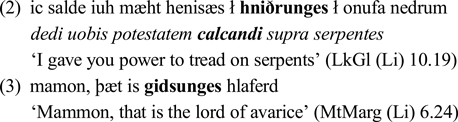
However, -es is also found when rendering Latin forms ending in a vowel, as in (2), and in occurrences attested independently of the original, as in (3):
Some of these nouns are attested in the nominative/accusative plural in the gloss. Most of them take the etymological inflection ending in a vowel: fæstnunga (1x); groetencgo, groetengo, groetingo (3x); leasunga (1x); mercunga, merconga (2x); ðrowungo (1x). However, there are also occurrences of forms in -as, such as ebolsungas, ebolsongas, efalsongas, efolsungas (6x) for the noun efolsung, or gitsungas (1x) for gitsung. The spread of -as as marker of nominative/accusative plural in these nouns is, therefore, not as advanced as that of -es in the genitive singular.
With regard to Durham, the extension of -es is widespread in this gloss, no example of the etymological inflection being attested in the genitive of these nouns. Twenty-eight out of a total of 31 occurrences (90.32%) take the innovative ending -es, as against two instances of abbreviated forms (6.45%)Footnote 10 and one example of uninflected genitive (Rodríguez Ledesma Reference Rodríguez Ledesma2018: 618). Only one of these nouns is attested in the nominative/accusative plural in Durham, bloedsvng, and takes -as: bloedsvngas (1x) (DurRitGl 2 (Thomp-Lind) 126.1).
2.2 Nouns ending in -ness Footnote 11
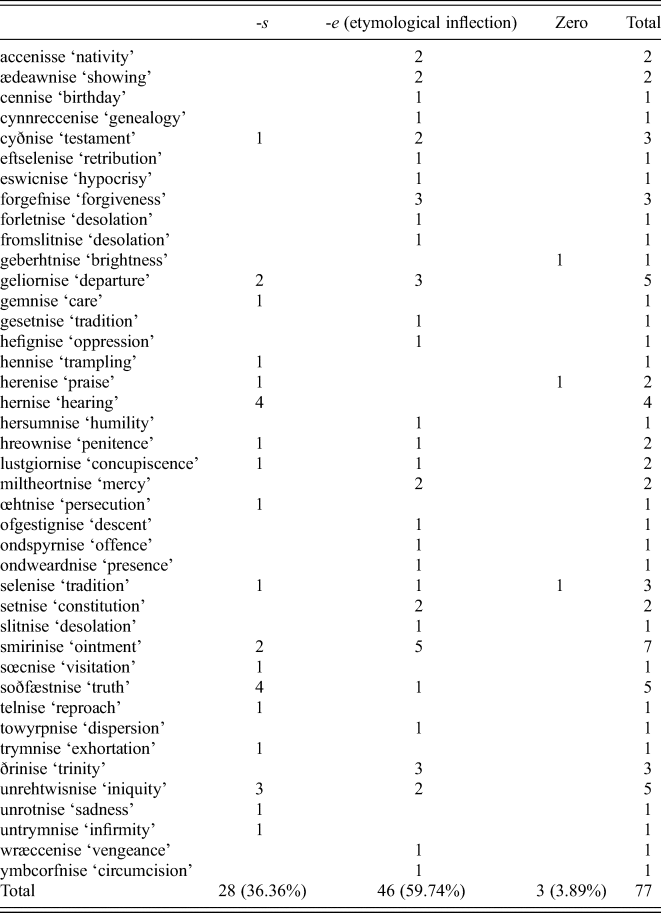
In his study on Lindisfarne, Ross gives 26 tokens of innovative -es for the genitive singular of these nouns vs 43 of -e and 3 of endingless forms (Reference Ross1937: 71). He comments on this variation and offers a possible explanation for the limited extension of -es: ‘there was a tendency to avoid forms in -es in these words with s in the stem’ (Reference Ross1937: 73).
Table 2 gives the list of nouns belonging to this class which are attested in the genitive singular in Lindisfarne and the number of occurrences of the different inflections. My figures are very similar to those given by Ross (Reference Ross1937). As can be seen in the table, forms with the etymological inflection are dominant: most nouns take -e in the genitive singular, and those which present variation tend to favour -e (cyðnise, geliornise, smirinise), the exceptions being soðfæstnise and unrehtwisnise, which favour -es. The noun hernise stands out, since only forms in -es are attested in the genitive in the gloss.
Genitive singular of nouns ending in -ness in Lindisfarne
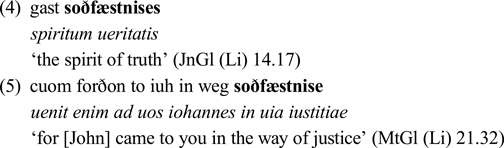
Some of the innovative forms gloss Latin genitives ending in -is, so there is the possibility of influence of the original. Thus, the noun soðfæstnisse is attested five times in the genitive: the four instances ending in -es gloss L. ueritatis, whereas the example in -e renders L. iustitiae:
The noun unrehtwisnise, which also favours -es, renders another Latin noun whose genitive ends in -is (iniquitatis), as in LkGl (Li) 13.27: alle ða wyrcendo unrehtwisnises, L. omnes operari iniquitatis ‘all the workers of iniquity’. However, the noun which stands out in this group, hernise, since it has only variants in -es in the genitive, renders a Latin form ending in a vowel:

In some cases there is no internal gender agreement within the noun phrase: the noun takes the etymological inflection but is modified by the historically masculine/neuter form of the demonstrative:Footnote 12
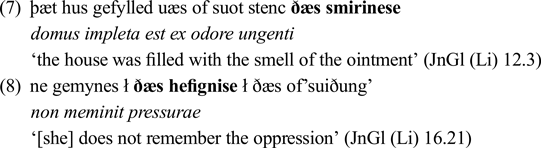
The spread of -es is not so advanced as in the previous group, probably for phonetic reasons, as pointed out by Ross (Reference Ross1937). That may also explain why no example of -as is attested in the nominative/accusative plural of these nouns in the gloss, the few forms found taking the etymological inflection ending in a vowel: smiriniso (1x), telnisse (1x), unrehtwisnise (1x).
Comparison of these findings with those obtained from Durham (Rodríguez Ledesma Reference Rodríguez Ledesma2018: 622) confirms that the spread of -es to these nouns has advanced further in Durham, where examples of innovative -es outnumber those of the etymological ending: 25 out of a total of 64 (39.06%), as against 9 of -e (14.06%).Footnote 13 This was already pointed out by Ross, who remarked that in Durham the genitive singular in -es coexists with that in -e, and that ‘here, in contradistinction to his practice in L[indisfarne], Aldred has no feeling against -es’ (Reference Ross1971: 56). Only two of these nouns are attested in the nominative/accusative plural, and both take the etymological inflection ending in a vowel: eftseleniso (1x), hernisso (1x).
2.3 Remaining ō-stem nouns
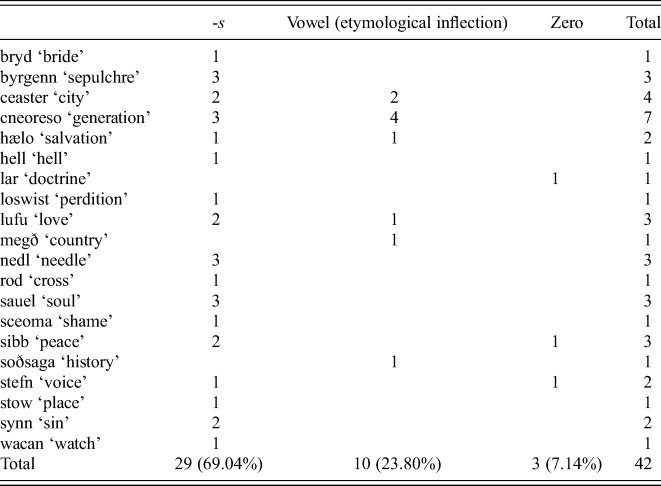
As can be seen in table 3, forms in -es are dominant in the genitive of these nouns in Lindisfarne, followed by forms with the etymological inflection and finally by uninflected forms. Most nouns (12 out of a total of 20) take -es in the genitive singular, and those which present variation (6) tend to favour the innovative inflection (lufu, sibb), the exception being cneoreso, which favours a vowel.Footnote 14 The spread of -es has advanced further than in nouns ending in -ness, but not so much as in those in -UNG.
Genitive singular of remaining ō-stem nouns in Lindisfarne
As in the previous group, some of these forms, both those ending in a vowel (9) and those ending in -es (10), are modified by the historically masculine/neuter form of the demonstrative:
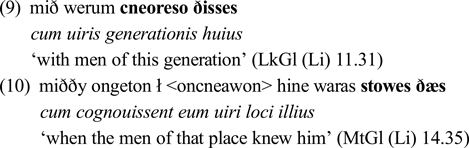
The masculine gender of Latin locus may have influenced the choice of the demonstrative in (10), but that cannot be the case in (9), since generatio is a feminine noun. As argued in Rodríguez Ledesma (Reference Rodríguez Ledesma2018: 619), these examples seem to indicate that -es has become a marker of genitive singular in the gloss not only for nouns, but also for demonstratives and adjectives, and can be added to any element in a noun phrase to unambiguously mark genitive case.
Some of these nouns are attested in the nominative/accusative plural in the gloss, but none of them takes innovative -as, all of them retaining the etymological inflection ending in a vowel: byrgenna (7x), byrgenno (1x); ceastra (3x), ceastre (1x), ceastræ (1x), ceastro (2x); cneoreso (1x), cneuresa (1x), cneuresua (3x); hælo (1x); laro (1x), lara (1x), laruo (1x); sauela (1x), sauelo (1x); sibbo (1x); stefno (1x); stowa (7x), stoua (2x); synna (16x), synno (5x), synne (1x); wacana (1x).
With regard to Durham, forms in -es are dominant (63x, 59.43%), followed by abbreviated forms (19x, 17.92%), forms with the etymological inflection (17x, 16.03%) and finally uninflected forms (6x, 5.66%) (Rodríguez Ledesma Reference Rodríguez Ledesma2018: 629). Comparison of the two glosses shows a higher percentage of both innovative -es and etymological -e in the genitive of these nouns in Lindisfarne. In the nominative/accusative plural no example of -as is attested in Durham, only forms ending in a vowel: laro (1x); savlo (5x), savelo (1x); sibba (1x); synna (3x), synno (8x), synne (1x) (Rodríguez Ledesma Reference Rodríguez Ledesma2018: 631).
2.4 Feminine i-stems
Table 4 gives the list of nouns belonging to this class which are attested in the genitive singular in Lindisfarne and the number of occurrences of the different inflections.
Genitive singular of feminine i-stem nouns in Lindisfarne
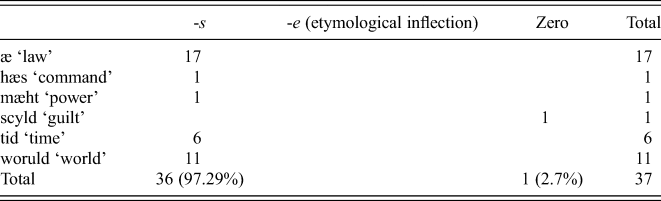
Although few nouns belonging to this class are attested in the genitive in Lindisfarne, this gloss exhibits generalization of innovative -es to all of them. However, they retain the etymological inflection ending in a vowel in the nominative/accusative plural: tido (1x), tide (1x); uorulda (1x).
Four of these nouns are attested in the genitive in Durham: æ (2x), maeht (4x), tid (1x) and worvld (4x), and they take -es (8x), except for one instance of uninflected vorld and two of abbreviated forms (Rodríguez Ledesma Reference Rodríguez Ledesma2018: 632). In Durham the number of tokens is much lower than in Lindisfarne, but in both glosses there is generalization of -es in these nouns, no example being attested of the etymological inflection.Footnote 15 In this class, therefore, the innovative -es inflection is already well established in the paradigm, showing no synchronic variation. With regard to the nominative/accusative plural, these nouns retain the etymological inflection ending in a vowel in Durham, as is also the case in Lindisfarne: dedo (4x), mæhto (1x), tido (3x); worvlda, worvldo, worvlde (see Lindelöf Reference Lindelöf1901).
2.5 Feminine root-stems
Only two nouns belonging to this class are attested in the genitive singular in Lindisfarne: næht ‘night’ and burug ‘city’. The former takes innovative -es: næhtes (3x), but the latter shows variation: burge (1x) and uninflected burug (1x). By contrast, the five instances of nominative/accusative plural take -as (burgas). This seems to be the only noun in the gloss which has adopted the s-plural but not the s-genitive.Footnote 16 In Durham there are five tokens of genitive singular næhtes, whereas burug is not attested in any of these cases.
3 Kinship r-stems
As shown in table 5, there is widespread generalization of -es to nouns belonging to this declension, with the exception of swœster, which takes zero inflection in the only example attested in the gloss. The Lindisfarne data seem to reveal a different picture from that described by Adamczyk for this declension, according to which ‘the spread of innovative inflection appears to have been affected by the gender, with the feminine nouns resenting [sic] the adoption of the masculine genitive sg. -es inflection’ (Reference Adamczyk2014: 67–8).
Genitive singular of kinship r-stems in Lindisfarne (adapted from Rodríguez Ledesma Reference Rodríguez Ledesma, Cuesta and Pons-Sanz2016)
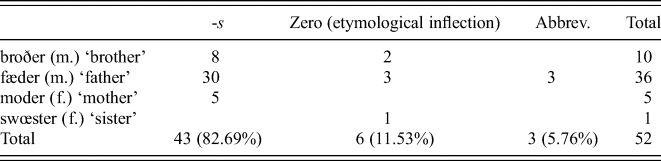
Although -es has been generalized in the genitive singular of these nouns, nominative/accusative plural usually end in a vowel or have zero inflection: broðro (22x), broðero (5x), broðra (5x), broðera (1x), broðre (1x), broðer (3x); dohtero (1x); fadero (1x), fador (1x); modero (1x); suoestro (4x), soestra (1x), suoester (1x). The only exception is fæder, which also has forms ending in -s: fadoras (1x), fadores (1x).
In Durham only two of these nouns are attested in the genitive: fæder (17x) and moder (1x). With regard to fæder, abbreviated forms are dominant (10x), followed by forms in -es (6x) and finally by zero inflection (1x). The only instance of the genitive of moder is abbreviated moder' (cf. Rodríguez Ledesma Reference Rodríguez Ledesma2018: 633). In the nominative/accusative plural, forms ending in a vowel or abbreviated forms are attested: broðro (4x), broð' (57x), bro' (15x), br' (1x); dohtoro (1x).
4 Weak nouns or n-stems
Table 6 gives the list of weak nouns which are attested in the genitive singular in Lindisfarne and the number of occurrences of the different inflections. They have been separated according to their gender: feminine nouns are listed first, and then masculine nouns.
Genitive singular of weak nouns in Lindisfarne
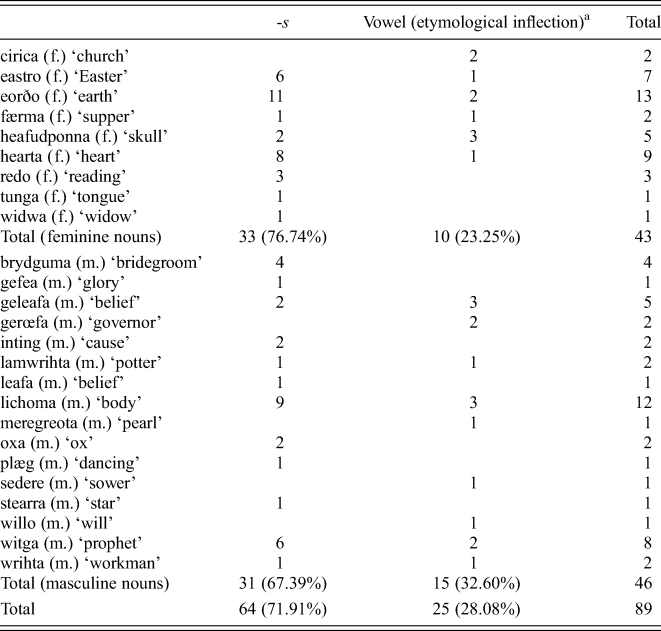
a The etymological inflection was -an, but in late Northumbrian final /n/ was lost, so that forms ending in a vowel are found throughout the singular and in the nominative/accusative plural of these nouns.
As can be seen in the table, -es is the dominant ending in the genitive singular of n-stems in Lindisfarne, although not all nouns behave in the same way. Grammatical gender does not seem to condition the choice of inflection: forms in -es are dominant with both feminine and masculine nouns, despite the fact that some nouns take only the etymological inflection.
Although -es has been generalized in the genitive singular of weak nouns, nominative/accusative plural normally end in a vowel: færmo (2x), færma (1x); gefea (1x); hearto (1x), hearta (4x); lichoma (1x), lichomo (1x); meregrotta (2x); stearra (1x); widua (1x); uillo (1x); witgo (20x), uitga (2x), witga (1x), witgæ (1x), iwtgo (1x).Footnote 17 However, there are occasional occurrences of forms in -as, such as steorras (MkGl (Li) 13.25), and witgas, which is attested once in a double gloss (as against 25 instances of forms ending in a vowel):Footnote 18

Four of the nouns included in table 6 are attested in the genitive in Durham: cirica (7x), earðe (10x), gileafa (2x), lichoma (20x). Forms in -es are found for all of them, and are dominant in the case of gileafa (2x) and lichoma (16x) (see Rodríguez Ledesma Reference Rodríguez Ledesma2018: 634–5). In the nominative/accusative plural, however, no example of -as is attested, only forms ending in a vowel: gidvolo (1x); lichomo (2x), lichoma (4x). My findings, therefore, do not support Adamczyk's hypothesis:
crucial for the spread of the as-plural inflection in the northern dialects was probably also the early loss of inflectional -n, whereby the weak nouns lost their plural marker. (Reference Adamczyk2008: 108)
5 Neuter a-stems
The etymological inflections of these nouns in the nominative/accusative plural are -u for short stems and zero for long stems. Campbell (Reference Campbell1959: 144) explains that -u in final unstressed syllables is lost after a long stressed syllable (word) or a short stressed syllable and another syllable (weorod), but is preserved after a short stressed syllable (fatu) or a long stressed syllable followed by a short syllable (heafodu). Nonetheless, many analogical forms are found, such as heafod on the pattern of weorod (Reference Campbell1959: 146). Nouns ending in a liquid or a nasal often develop a parasitic vowel in the uninflected forms: tungol, wæter, tacon. The nominative/accusative plural of these neuter nouns should have zero inflection, since the final -u should be lost after the long syllable before the parasitic vowel was added (*tunglu > *tungl > tungol), but forms in -u are also found (tunglu, wæteru, tacnu), normally with loss of the parasitic vowel (Reference Campbell1959: 226).Footnote 20
Although u-apocope after a heavy syllable is the rule in early texts, the situation is different in late West Saxon and, especially, in late Northumbrian. Hogg & Fulk (Reference Hogg and Fulk2011: 108) state that all disyllabic neuter nouns are inflected in the nominative/accusative plural in North Northumbrian, which seems to indicate that the synchronic rule of apocope had been lost from the inflectional morphology of a-stems. The loss of this rule is confirmed by the emergence of heavy-stemmed monosyllabic nouns ending in a vowel in the plural, such as wordu, and may have been motivated by a desire to distinguish singular and plural forms (Reference Hogg and Fulk2011: 92). Two other factors in the loss of this rule may have been the replacement of -u by -a as the regular inflection for the plural, and the existence of phonologically regular -u after a long syllable in old ja-stems (witu) and feminine nouns (yrmþu) (Reference Hogg and Fulk2011: 108–9).
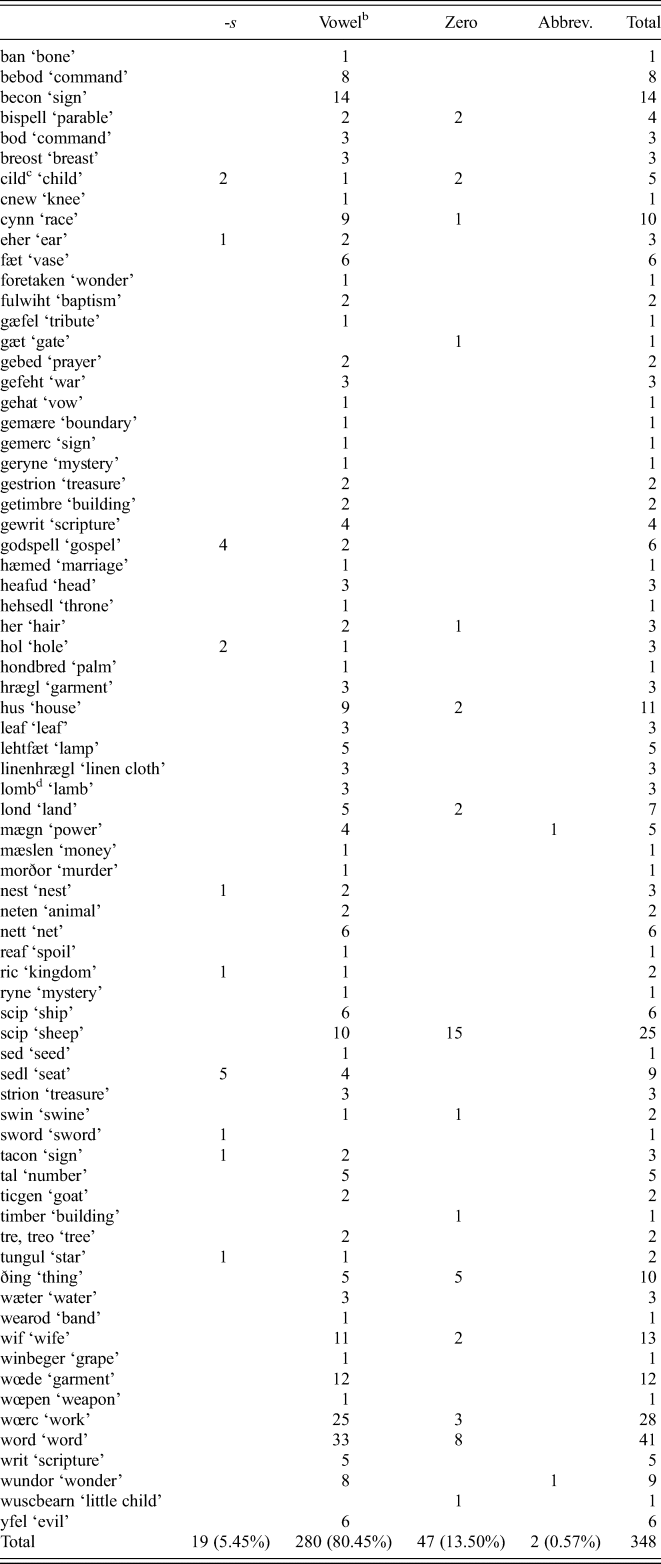
Table 7 gives the list of neuter a-stems which are attested in the nominative/accusative plural in Lindisfarne and the number of occurrences of the different inflections. Some of them are classified by Hogg & Fulk (Reference Hogg and Fulk2011: 14–15) amongst the 100 most frequent lexemes: bearn, bebod, gebed, folc, godspell, heafod, hus, land, þing, weorc, wif, wæter, word, wundor, yfel.
Nominative/accusative plural of neuter a-stems in Lindisfarnea
a They include ja- and wa-stems such as cynn and cnew respectively.
b No example of etymological -u is attested in Lindisfarne, the usual vowels being -o and -a.
c Originally this was an os-stem that was assimilated to the a-stems (DOE s.v. cild).
d Like cild, lomb was originally an os-stem that was assimilated to the a-stems.
The results of my study show two changes in progress in the nominative/accusative plural of neuter a-stems in Lindisfarne: the spread of the masculine s-form plural marker, which is, however, restricted to ten items, and the extension of a vowel to nouns with a long stem whose etymological inflection was zero, a change that is much more widespread in the gloss.
My findings confirm and refine Hogg & Fulk's description given above: although most disyllabic neuter nouns are inflected in the nominative/accusative plural in Lindisfarne, some of them take zero inflection: bispell (2x), timber (1x). Nonetheless, the rule of apocope seems to have been lost from the inflectional morphology of a-stems, since monosyllabic nouns with a long stem tend to add a vowel in the plural. Not only are forms such as husa/huso, wifo/wifa, woerca/woerco or wordo/worda attested in the nominative/accusative plural, but they are much more frequent than uninflected hus, wif, woerc or word (see table 7). Only in the case of scip ‘sheep’ does the etymological form outnumber those ending in a vowel.Footnote 21
My results are consistent with those obtained by Newman (Reference Newman2011) in his study of disyllabic neuter a-stems. His corpus comprises six late Old English texts (three West Saxon, one Northumbrian, one Mercian and one Kentish), and he concludes that there is ‘extensive irregular vocalic-plural marking in these neuters in LOE [late Old English]’ (Reference Newman2011: 12). Newman also finds evidence of the spread of the masculine s-form plural marker:
the s-plural forms tacnas and tunglas, both attested in LG [Lindisfarne Gospels], indicate an increase in the productivity, and likely the incidence of the masculine s-form plural marker in Late Northumbrian, just as the n-plural form tunglan, attested in CH [Ælfric's Catholic Homilies] (I), points to similar circumstances regarding the weak n-form plural marker in Late West Saxon. (Reference Newman2011: 12)Footnote 22
As mentioned above, only 10 nouns out of a total of 73 have variants in -s in Lindisfarne: cild, eher, godspell, hol, nest, ric, sedl, sword, tacon, tungul. In only three of these, s-forms outnumber those ending in a vowel: godspell, hol, sedl. Influence of the Latin lemma or of neighbouring words may account for some of these forms. Thus, in DOE ehras is considered an anomalous masculine form in (12), and the inflection -as due perhaps to the influence of the alternative gloss croppas or the feminine accusative plural ending of the Latin lemma spicas (DOE s.v. ēar 1):

Although not mentioned in DOE, a similar explanation may account for the -as forms of the noun hol in these parallel passages:
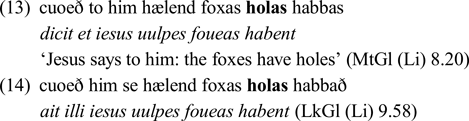
As in the previous case, influence of Latin foueas or of neighbouring foxas may account for the inflection -as in holas. In the same context, however, a vocalic-plural form is also found: foxas holo habbað, L. uulpes foueas habere (LkHeadGl (Li) 40).
Similarly, in the case of sedl, the five tokens ending in -as (seatlas (4x), ceatlas (1x)) render Latin cathedras: MtGl (Li) 23.6, MkGl (Li) 11.15, LkGl (Li) 11.43, 20.46; MtGl (Li) 21.12.Footnote 24 In the case of cild, the form cildas is attested in a double gloss, the alternative being a masculine a-stem ending in -as (cnæhtas), whereas plural cildes renders a Latin noun ending in -es (infantes), as illustrated by (15) and (16) respectively:
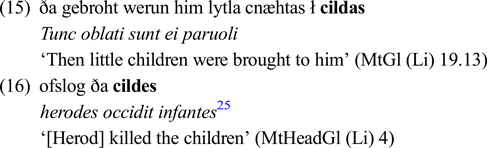
However, vocalic-plural forms are attested in the same contexts, and therefore the ending -s of the Latin lemma or of an alternative gloss does not necessarily trigger -as in Lindisfarne. There are also examples of innovative s-forms which cannot be accounted for by claiming influence of another word, as with the nouns godspell, ric, sword and tungol, which gloss Latin forms ending in a vowel: euangelia, regna, gladii and signa respectively.Footnote 26 As shown above, there is variation: innovative forms occur in the same contexts and, in some cases, side by side with etymological forms,Footnote 27 which is characteristic of a change in progress.
Table 8 gives the list of neuter a-stems which are attested in the nominative/accusative plural in Durham and the number of occurrences of the different inflections.Footnote 28
Nominative/accusative plural of neuter a-stems in Durham
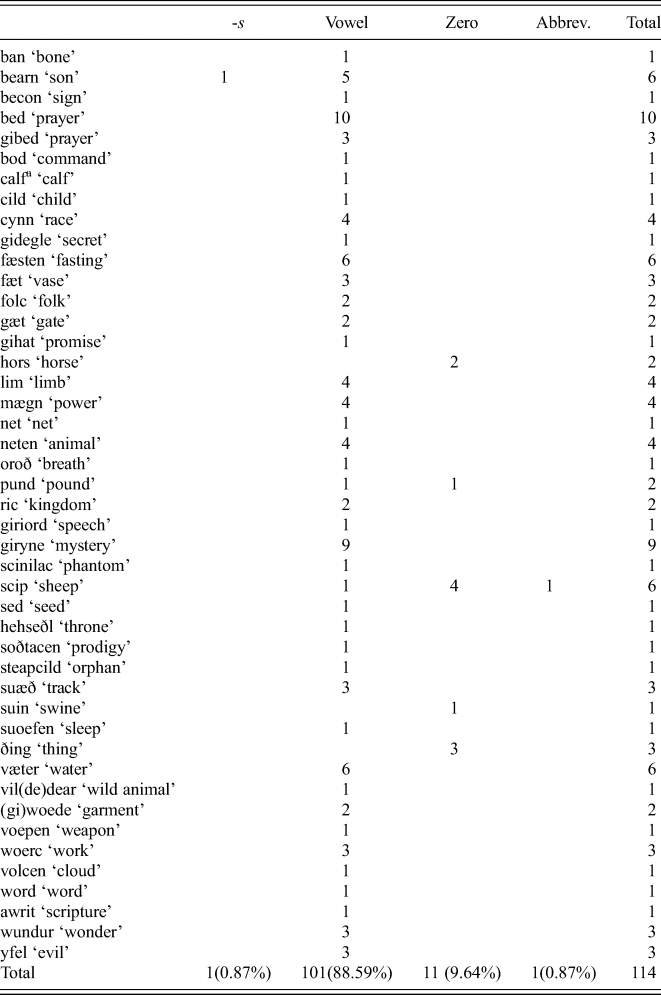
a Originally this was an os-stem that was assimilated to the a-stems (DOE s.v. cealf).
As in Lindisfarne, there is limited evidence of the spread of -s to the plural of neuter a-stems in Durham (only one token), and widespread extension of a vowel to disyllabic nouns and heavy-stemmed monosyllabic nouns whose etymological inflection was zero. These findings are in line with those obtained for feminine nouns, kinship r-stems and n-stems (see sections 2, 3 and 4), and show that the spread of -s in the plural is an incipient change in progress in late Northumbrian, not so advanced as the extension of -s in the genitive singular.
6 Masculine a-stems with vocalic-plural forms
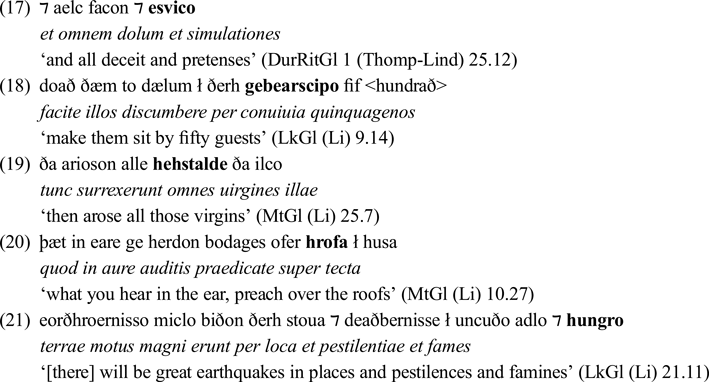
In both Lindisfarne and Durham there are some masculine a-stems which take a vowel in the plural instead of, or besides, etymological -as. This is the case with the nouns eswice, gebearscip, hehstald, hlaf, hrof and hunger, as illustrated by the following examples:
Masculine a-stem hlaf behaves slightly differently from the previous nouns, since it presents variation. In Durham only one token is attested, lafo (DurRitGl 1 (Thomp-Lind) 99.4); in Lindisfarne there are 27 instances of nominative/accusative plural, 15 of which end in -as and 12 in a vowel:
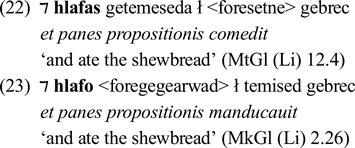
Influence of the Latin lemma cannot be argued to account for these forms, since in many cases they render nouns ending in -s, such as L. simulationes (17), uirgines (19), fames (21) or panes (23). These forms seem to illustrate a further step in the generalization of a vowel as plural marker in the glosses, after its spread to heavy-stemmed neuter a-stems which etymologically had zero inflection in the plural (section 5).
7 Conclusions
This article has shown the extension of -es from the a-stems to all noun classes in Lindisfarne regardless of gender and declension, a clear example of interparadigmatic analogical change. In this light, Lass's observation that in Old English ‘anything in -es is a genitive singular (and not feminine)’ (Reference Lass and Blake1992: 104) has to be modified: that may be the case in early texts or in West Saxon, but in late Northumbrian this inflection is used as a genitive singular marker of feminine nouns as well.
Although forms in -es are found in the genitive singular of all noun classes, the spread of this inflection advances at different speed in the different declensions. At one end there are three classes with a widespread extension of -es: feminine i-stems, nouns ending in -UNG and kinship r-stems. In these classes the innovative genitive -es inflection is already well established in the paradigm, showing little synchronic variation. At the other end of the scale are positioned nouns ending in -ness, the only group which favours the etymological inflection, probably for reasons of euphony, as pointed out by Ross (Reference Ross1937: 73). Comparison with Durham shows similar results: as in Lindisfarne, nouns ending in -UNG and feminine i-stems present widespread generalization of -es and little or no synchronic variation. The main difference between the two glosses concerns nouns ending in -ness: the extension of -es to this class has advanced further in Durham, where they outnumber forms with the etymological ending (see table 9).
Genitive singular in Lindisfarne and Durham (percentages)
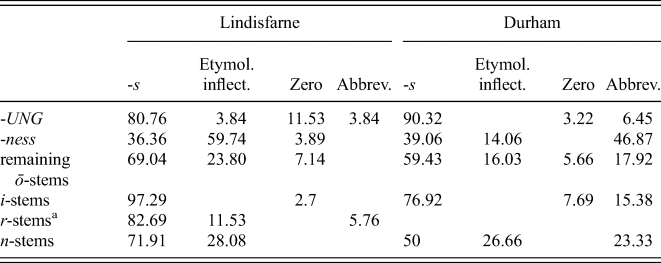
a In Durham the data are too scarce for comparison.
The widespread extension of -es to feminine i-stems and kinship r-stems may be due to the fact that both are minor declensions and therefore contain few nouns, although they tend to have a very high token frequency. This factor, however, does not seem to inhibit the operation of analogical processes in Lindisfarne and Durham. It may seem strange that feminine i-stems were not attracted to the productive feminine declension, the ō-stems, but the reason may be that these nouns were already undergoing a change in progress at the time, gradually adopting the genitive inflection of the a-stems, as shown in table 9.
Declension, therefore, has been shown to play a significant role in the extension of genitive singular -es in both Lindisfarne and Durham. The Latin lemma may have had some influence, since many of these forms gloss Latin nouns belonging to the third declension whose genitive singular ends in -is. However, as shown above, the -es inflection is also used in rendering Latin forms ending in a vowel. Therefore, influence from the Latin original may have reinforced an existing trend in the language, rather than being fully responsible for it.
As is the case in Durham (cf. Rodríguez Ledesma Reference Rodríguez Ledesma2018: 638), the frequency variable does not seem to play a crucial role in Lindisfarne. The -es ending is found and even favoured not only by low-frequency nouns, but also by those with a high token frequency, such as the i-stems æ, woruld, or the n-stems eorðo, hearta and lichoma.Footnote 29 This seems to run counter to the hypothesis that ‘high-frequency forms are resistant to change on the basis of the structure of other forms and patterns’ (Bybee Reference Bybee2015: 102)Footnote 30 and may indicate that the spread of -es is quite advanced in the glosses, at the stage of nearing completion.
Demarcation is not significant either, since innovative forms are not confined to certain sections of Lindisfarne that have been identified in previous literature (Brunner Reference Brunner1947/48; van Bergen Reference Bergen2008).Footnote 31 The noun lichoma, for example, is attested 10 times in the genitive singular: 9 tokens end in -s and one in the etymological vowel (MtArgGl (Li) 1). The innovative forms are found in all gospels: Matthew (2x), Mark (2x), Luke (1x), John (4x). Similarly, fader is attested 36 times in the genitive singular, the 30 innovative forms being distributed throughout the gloss: Matthew (11x), Mark (2x), Luke (6x), John (11x). These results are not in line with those obtained from the study of accusative/dative syncretism in Lindisfarne, which show that this process is not even throughout the gloss, with the section corresponding to John having the lowest degree of syncretism in a statistically significant wayFootnote 32 (cf. Fernández Cuesta & Rodríguez Ledesma Reference Fernández Cuesta and Ledesma2020).
The spread of -es to feminine nouns in Lindisfarne is interpreted by Lass as evidence of gender loss, a process which began in the north: ‘there are fluctuations as early as the tenth-century Lindisfarne Gospels, where, for instance, endung “ending” appears as masculine (abstract nouns in -Vng are historically feminine)’ (Reference Lass and Blake1992: 107). However, I disagree with this interpretation, since in that case those feminine nouns with -es in the genitive singular would be expected to take -as in the nominative/accusative plural, something not supported by the data, as shown above. Rather, I favour Jones’ contention that the earlier gender/case indicative function of the -es inflection has been ‘waived in favour of one purely of case’ (Jones Reference Jones1967: 104). Sandred (Reference Sandred1991: 5) also remarks that -es genitives such as byriges or burges ‘are no proof that OE burg was masc. in the language of the writer’ and Adamczyk (Reference Adamczyk2018: 135) explains that the spread of -s in the paradigm of feminine nouns ‘did not necessarily entail a change in gender affiliation’.Footnote 33
Sometimes there is no internal gender agreement within the noun phrase: the noun takes the etymological inflection, but is modified by the historically masculine/neuter form of the demonstrative or adjective: lytles geleafa (MtGl (Li) 14.31, 16.8), godcundes stefn (MkArgGl (Li) 2). These examples are not so frequent in Lindisfarne as in Durham, but seem to indicate that -es no longer signals gender, but just grammatical function, and can therefore be added to any element in a noun phrase to unambiguously mark genitive case (see Rodríguez Ledesma Reference Rodríguez Ledesma2018).
With regard to the other change in progress, the evidence for the spread of -s as plural marker is very limited in both Lindisfarne and Durham, showing that this is an incipient change. Most of the nouns which take -es in the genitive singular in Lindisfarne and are attested in the nominative/accusative plural in the gloss take the etymological inflection ending in a vowel: nouns ending in -UNG (fæstnunga, groetengo, mercunga), remaining ō-stems (byrgenna, ceastra, cneoreso, laro, stowa, synna) and weak nouns (færmo, hearta, witgo). There are only occasional occurrences of forms in -as with nouns ending in -UNG (ebolsungas, gitsungas), the kinship r-stem fader (fadoras), and the weak nouns witga and stearra (witgas, steorras). The spread of -s as plural marker is also very limited in Durham, where -as forms are attested only with nouns ending in -UNG (bloedsvngas).
The results of the study of neuter a-stems are in line with these findings and show that the spread of -s to the plural of these nouns is an incipient change in late Northumbrian, restricted to very few items (see tables 7 and 8). There is, however, another change in progress in the nominative/accusative plural of these nouns: the extension of a vowel to heavy-stemmed neuters whose etymological inflection was zero, an analogical process that is much more widespread in the glosses and results in the elimination of allomorphic variation within this paradigm and the loss of the rule of apocope.
My findings support Ross's observation that in late Northumbrian there is a clear distinction between these two analogical processes: whereas genitive singular -es is extended to practically all classes, nominative/accusative plural -as is ‘somewhat abnormal where it was not etymologically justifiable’ (Ross Reference Ross1937: 101 footnote 236). The differences in the pattern of dissemination of these two inflections may have to do with their type frequency: genitive -es is the etymological inflection of both masculine and neuter a-stems and, therefore, its type frequency is much higher than plural -as, found only with masculine a-stems. In the plural, moreover, there are two patterns in competition in late Northumbrian: forms ending in a vowel and forms ending in -as. A vowel (regardless of its quality) is the etymological inflection of a large number of nouns: ō-stems, i-stems, u-stems and light-stemmed neuter a-stems and, because of the loss of /n/ in final unstressed position in late Northumbrian, is also found in weak nouns. In the glosses, it is also extended to heavy-stemmed neuter a-stems. Numerically, then, vocalic-plural forms outnumber those ending in -as in late Northumbrian. As the type frequency of this pattern became higher in these varieties, it had the power to attract more members to it, reinforcing its productivity and extension throughout the plural, as shown by the fact that forms ending in a vowel are also attested for the nominative/accusative plural of masculine a-stems, such as hlaf, hrof or hunger. My findings, therefore, support Fertig's claim that ‘analogical change favors whatever patterns and pattern types happen to be most common in a language, in terms of type frequency’ (Reference Fertig2013: 121).Footnote 34
Lindisfarne and Durham show similar results with regard to the development of these analogical processes: in both the extension of -es as a genitive singular marker is much more widespread than -as as a plural marker, and the pattern of dissemination across declensions is the same. Both glosses provide evidence that these linguistic changes that have generally been ascribed to Middle English were already in progress in late Northumbrian, hence their importance for the history of English.


 Open access

